Differences in mathematical achievement between Mandarin Chinese- and English-speaking children have been widely and consistently documented (e.g. Mullis, Martin, Gonzalez & Chrostowski, Reference Mullis, Martin, Gonzalez and Chrostowski2004). Mandarin-speaking children have scored reliably higher than American children on tests of mathematical performance in the eighth, fourth (Mullis et al., Reference Mullis, Martin, Gonzalez and Chrostowski2004) and first grades (Stevenson, Lee & Stigler, Reference Stevenson, Lee and Stigler1986). Even prior to elementary school, Chinese children outperform American children on mental addition and written tests of addition (Geary, Bow-Thomas, Fan & Siegler, Reference Geary, Bow-Thomas, Fan and Siegler1993), as well as number-line estimation tasks (Siegler & Mu, Reference Siegler and Mu2008). Explanations for a Chinese math advantage include the transparency of the base-ten number system (e.g. Miller, Major, Shu & Zhang, Reference Miller, Major, Shu and Zhang2000), cultural differences in educational attitudes (e.g. Geary, Reference Geary1994) and disparities in classroom teaching practices (e.g. Stevenson & Stigler, Reference Stevenson and Stigler1992). Factors such as the base-ten system may relate to differences in children's counting as early as three years of age (Miller, Smith, Zhu & Zhang, Reference Miller, Smith, Zhu and Zhang1995), but others such as teaching techniques may exert a greater influence only once children have entered formal schooling. We expect that all of these factors contribute to mathematical achievement to some degree, even at the earliest ages tested. In this study, we investigate an additional factor that may lead to differences in mathematical achievement between Mandarin Chinese- and English-speaking children: the numeric language input children hear before they enter school.
The most fundamental concept in elementary school mathematics is whole number. Difficulty in solving simple arithmetic and word problems has been attributed to entering school with underdeveloped numerical proficiency (Jordan, Levine & Huttenlocher, Reference Jordan, Levine and Huttenlocher1995). Case & Griffin (Reference Case and Griffin1990) found that number sense is linked to the amount of formal or informal instruction on numerical concepts provided at home. Moreover, recent research has found that an intervention in which number is correctly modeled and talked about appears to help children learn the abstract language of mathematics (Milgram, Reference Milgram and Schoenfeld2004). Thus, the amount of numerical input and practice children receive prior to entering school may aid in understanding issues related to children's mathematical proficiency once children begin school.
A robust relationship between parental language input and children's vocabulary acquisition has been repeatedly documented (e.g. Huttenlocher, Haight, Bryk, Seltzer & Lyons, Reference Huttenlocher, Haight, Bryk, Seltzer and Lyons1991). Specifically, words most frequent in a parent's speech to a child are acquired earliest. Additionally, depth of vocabulary, or understanding of words and their meanings, is highly related to frequency of input (Vermeer, Reference Vermeer2001). Resultantly, children whose parents frequently talk about number should acquire numerical terms more readily and deeply than children who hear numbers less often. Indeed, Suriyakham, Levine & Huttenlocher (Reference Suriyakham, Levine and Huttenlocher2006) found that children who hear more number words at age 2 ; 6 say more number terms at ages 2 ; 6 and 3 ; 2. These findings suggest that differences in numeric language input may influence numerical competence and may factor into early differences in mathematical performance.
One major difference in expression of quantities between Mandarin and English is the singular/plural distinction (Sarnecka, Kamenskaya, Yumana, Ogura & Yudovina, Reference Sarnecka, Kamenskaya, Yamana, Ogura and Yudovina2007). In English, quantities are expressed each time a noun is spoken – singular nouns indicate quantities of one; plural nouns indicate quantities greater than one. In contrast, Chinese nouns do not have regular plural forms. In English, a suffix can be added to indicate plurality (e.g. dog to dog s), while nouns in Mandarin may need specific cardinal numbers to denote plurality and set size (e.g. ‘five dog_’). Accordingly, this aspect of the language may result in Mandarin-speaking children hearing cardinal numbers more frequently, which may lead to earlier and deeper cognizance of specific quantities.
Another well-described difference between English and Mandarin is the obligatory use of classifiers with number in Mandarin (Cheng & Sybesma, Reference Cheng and Sybesma1998). Classifiers are measure words such as piece or cup in English, or kuai4,Footnote 1 ‘piece’ in Mandarin. In English, only mass nouns, which cannot be pluralized and describe unbounded entities (e.g. sugar or clay), receive a classifier (i.e. one cupof sugar). English count nouns, which have regular singular and plural forms, describe discrete bounded entities (e.g. carrot or chair), and do not typically take classifiers when quantified. In Mandarin, classifiers, with rare exceptions, are required with all nouns, whether singular or plural (Chien, Lust & Chiang, Reference Chien, Lust and Chiang2003). For example, si4 zhi1 lao3 hu3 means ‘four [unit] tigers’. Classifiers could increase the learning demands associated with acquiring number terms because Mandarin-speaking children would not only need to learn number words and their meanings, but also the classifier for the object that is being enumerated.
Finally, there may be cross-linguistic differences in the grammatical use of numerical terms. Number terms can occur as modifiers where the number describes the noun (onedog), as pronouns where the number replaces the noun (the purple ones), and within numerical sequences (1, 2, 3). An understanding of the cardinal meaning of number terms involves comprehending quantity as a property of a set. Thus, the modifier form would provide the clearest cues to the meaning of the number (i.e. as a property of objects), while the pronoun form would provide the least clear cues to cardinality, or set size. Further, in cases such as the plural use of ones to indicate multiple objects, the pronoun form may even provide misleading cues to numerical meaning. Therefore, the ways in which parents talk about number might be as important as the amount that parents talk about number in helping children to decode the meaning of number terms.
In this paper, we examine the frequency and types of numeric input Mandarin- and English-speaking children hear. We ask whether children hear similar proportions of numeric speech, and whether the types of numeric speech differ between the languages in ways that may matter for quantitative understanding. We also consider how language-specific differences, such as the obligatory use of classifiers in Mandarin, but not English, may affect children's numeric acquisition. We address these questions by examining transcripts of parental speech to children from the CHILDES database.
METHOD
Participants
Mandarin
Ninety-seven Mandarin Chinese transcripts were selected from the Tardif Beijing (Reference Tardif1993, Reference Tardif1996) and Zhou corpora of CHILDES (MacWhinney & Snow, Reference MacWhinney and Snow1990). These transcripts involved interactions between 59 children (37 male, 22 female) and their caregivers, as the corpora included multiple transcripts of the same dyads. The mean age of the children was 1 ; 11·12 (range 0 ; 14 to 0 ; 32, SD=0 ; 4·23). In the Beijing corpus, half of the parents were college educated, and half were educated at high school level or below. The Zhou families represented a range of SES found in middle-class China (mothers were white-collar workers; most graduated from university). All children and parents were native Mandarin monolingual speakers. All events transcribed took place in Beijing (Tardif) and Nanjing (Zhou), China. These transcripts depicted naturalistic interactions between parents and children either at home or in a laboratory setting. Contexts included free-play activities with toys or picture books, mealtimes and social exchanges.
English
The Mandarin transcripts were matched with native monolingual English transcripts of naturalistic parent–child interactions from CHILDES (MacWhinney & Snow, Reference MacWhinney and Snow1990; see Appendix for specific citations) by utterance length, child age and, when possible, child gender on a transcript-by-transcript basis. Contexts of recordings were similar to the Mandarin transcripts (i.e. free-play activities in laboratory settings, or social exchanges and mealtimes at home). English transcripts were generally shorter in length than Mandarin, so more English transcripts were needed to match the number of Mandarin utterances. In some circumstances, several English transcripts matching in age, gender and context were combined to create a comparable length, age, gender and context match to a Mandarin transcript. This was accomplished by summing the total utterances (lines of speech) within each transcript. In total, 180 English transcripts were used, involving interactions between 68 children (37 male, 31 female, mean age 1 ; 11·13, range 1 ; 3 to 2 ; 8, SD=0 ; 4·14) and their adult caregiver, generally their mother. The vast majority of families were middle to upper-middle class, with college-educated parents, similar to the Chinese sample. Four families sampled were considered working class. In order to create feasible length, age, context and gender matches to the Mandarin transcripts to the best of our ability, one English-UK corpus was included (29 transcripts, 20 children, 15 male, 5 female). Total amounts of speech and/or number-specific speech did not vary between American and British transcripts. After matching and combining, English transcripts averaged 1008·18 utterances (SD=835·05, range 22 to 2650). Mean Mandarin length was 1014·95 utterances (SD=845·29, range 55 to 2615). There were 97,793 utterances across all English transcripts used, and 98,450 total utterances across all Mandarin transcripts used. Although matched pairs were created between the English and Mandarin transcripts, we were conservative in statistical analyses and treated the two groups as independent samples.
Coding and data analysis
Coding was completed by native Mandarin speakers for Mandarin transcripts and native English speakers for English. All number instances within the transcripts were first identified. For the purposes of this study, number instances were operationally defined as number terms (e.g. one, twenty-seven, shi2 ba1 ‘eighteen’), or questions and requests for quantities (e.g. You3 ji3 ge4 qian1 bi2? ‘How many pencils are there?’).
Grammatical form
Each number utterance was evaluated for grammatical status. A number term was coded as a pronoun when speakers used numbers in a case where a noun could grammatically replace the number term. Examples of this include this one, where one could be replaced by cat, and na4 yi1 ge4, ‘that one [individual]’, where yi1 ge4 could be replaced by xiao3 mao1 ‘kitten’. A number term was coded as a modifier when speakers used numbers with a direct referent. In these instances a noun could not grammatically replace the numeric term and retain meaning. For example, in the phrase one bicycle, one cannot be replaced by cat, and in the phrase yi1 ge4 xiang1 jiao1 ‘one banana’, yi1 ge4, ‘one [unit]’ cannot be replaced by xiao3 mao1 ‘kitten’. A number term was coded as a sequence when number terms were spoken in sequential order, i.e. when speakers counted, for example, one, two, three. Finally, a number term was coded as isolated when it appeared alone, e.g. Three!, without any grammatical framing.
Categories of number
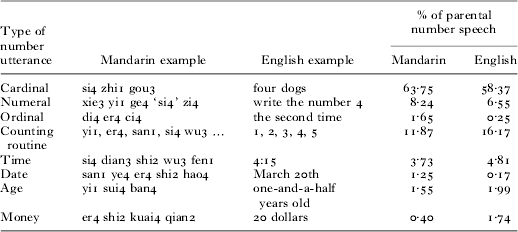
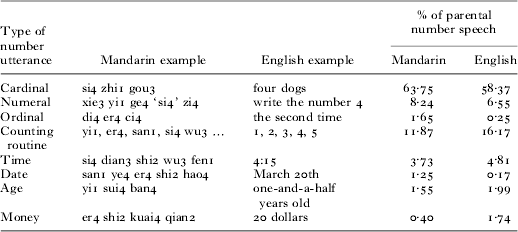
Table 1 describes the categories of number speech analyzed in this study and their mean percentage of occurrences in overall parental number speech. Cardinal numbers were defined as a representation of the number of items in a set, based on the quantity, for example, threebunnies (e.g. Gelman & Gallistel, Reference Gelman and Gallistel1978). Numeral utterances were defined as speech that referred to written numbers (e.g. the number ‘two’). Ordinal numbers were defined as number terms depicting sequential order (e.g. di4 si4 ming2 ‘fourth place’). Counting routines were statements in which a part of the count sequence was recited (e.g. yi1, er4, san1 ‘one, two, three’). Although counting routines included multiple number terms, each sequence was counted as a single number utterance. Time (seven thirty, yi1 dian3 zhong1 ‘one o'clock’), age (twenty-sixmonths, liang3 sui4 duo1 ‘two or more years old’) and money (fiftycents, liu4 kuai4 qian2 ‘six dollars’) were also coded. On occasion, number terms were used in ways that did not fit into any of the categories. This occurred very seldom (a total of 18 times in English and 3 times in Mandarin).
Categories and frequency of parental number speech analyzed
Classifiers
Classifiers were defined as units of measure distinguishing discrete countable units within a set, such as sheet in two sheetsof paper, or zhi1 in liang3 zhi1 gou3 ‘two [unit] dogs’, (Cheng & Sybesma, Reference Cheng and Sybesma1998). When classifiers were paired with a number term, we noted the specific classifier used (e.g. slice, ge4 ‘unit’).
To ensure inter-rater reliability, 10% of the transcripts from a random sample of transcripts from each language were coded by more than one coder and compared. Agreement between coders was 90% or greater in both languages, after comparing all individual number utterances coded.
RESULTS
Overall, Mandarin-speaking caregivers' speech to children contained a higher proportion of number terms than English-speaking caregivers' speech. Mandarin-speaking parents, on average, referenced number in 7% (SD=4·97, range 0 to 24%) of utterances, whereas English-speaking parents referenced number in an average of 4·90% (SD=4·60, range 0 to 25%) of utterances. An independent samples t-test confirmed that Mandarin-speaking parents made significantly more number utterances than their English-speaking counterparts (t(192)=3·11, p<0·01).
Grammatical form
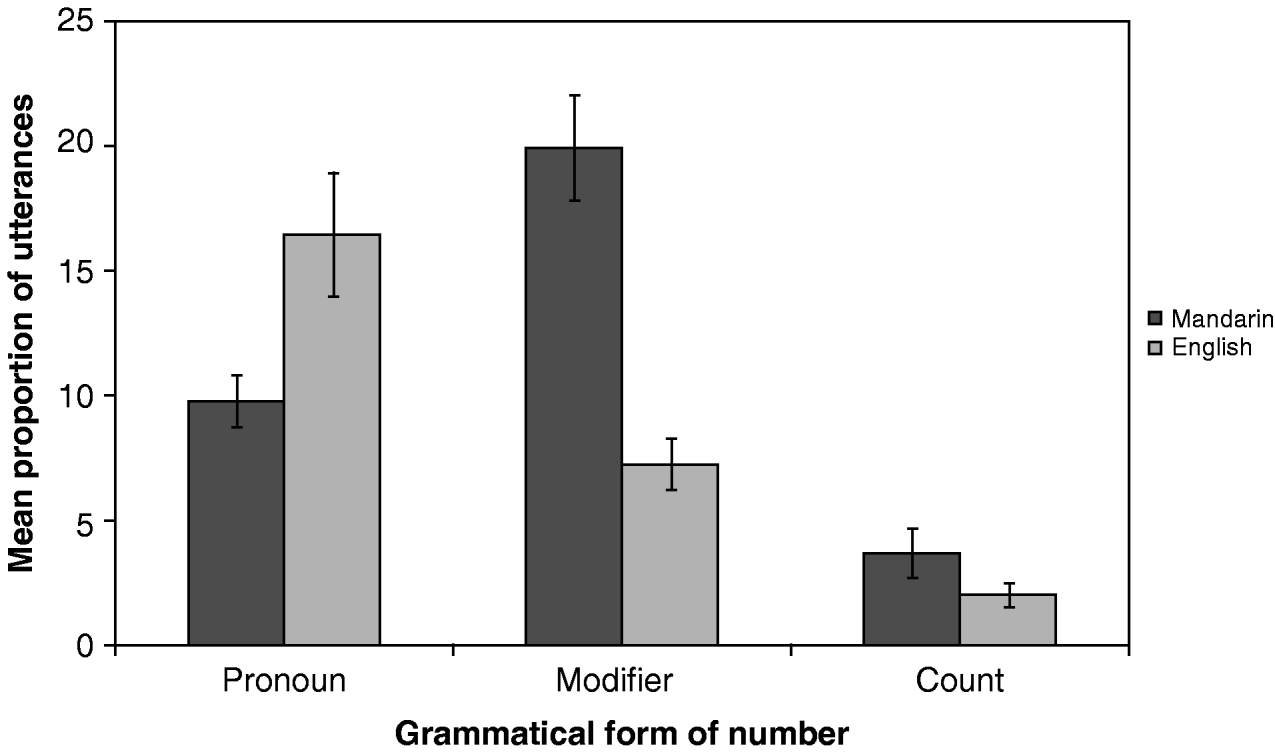
In both languages, number terms primarily occurred in two grammatical forms: as a pronoun, e.g. gei3 wo3 na4 yi1 ge4 ‘give me that one’, or as a modifier, e.g. liang3 zhi1 gou3 ‘two [unit] dogs’. Figure 1 illustrates the relative proportion of times that parental number utterances occurred in each of these grammatical forms in Mandarin and English. Number terms occurred in pronoun form much more often in English than in Mandarin. English-speaking parents used pronominal numbers an average of 16·44 times per transcript (SD=24·11), which accounted for 57·03% of English number terms. Overwhelmingly, these were instances in which parents used the word one within an utterance (e.g. I like this one). In contrast, Mandarin-speaking parents used pronominal numbers an average of 9·75 times per transcript (SD=10·34), and this accounted for 23·78% of Mandarin-speaking parents' total number utterances. An independent-samples t-test revealed that English-speaking parents used number in pronoun form significantly more than Mandarin-speaking parents (t(192)=–2·51, p<0·05).
Relative proportion of grammatical forms of number by language.
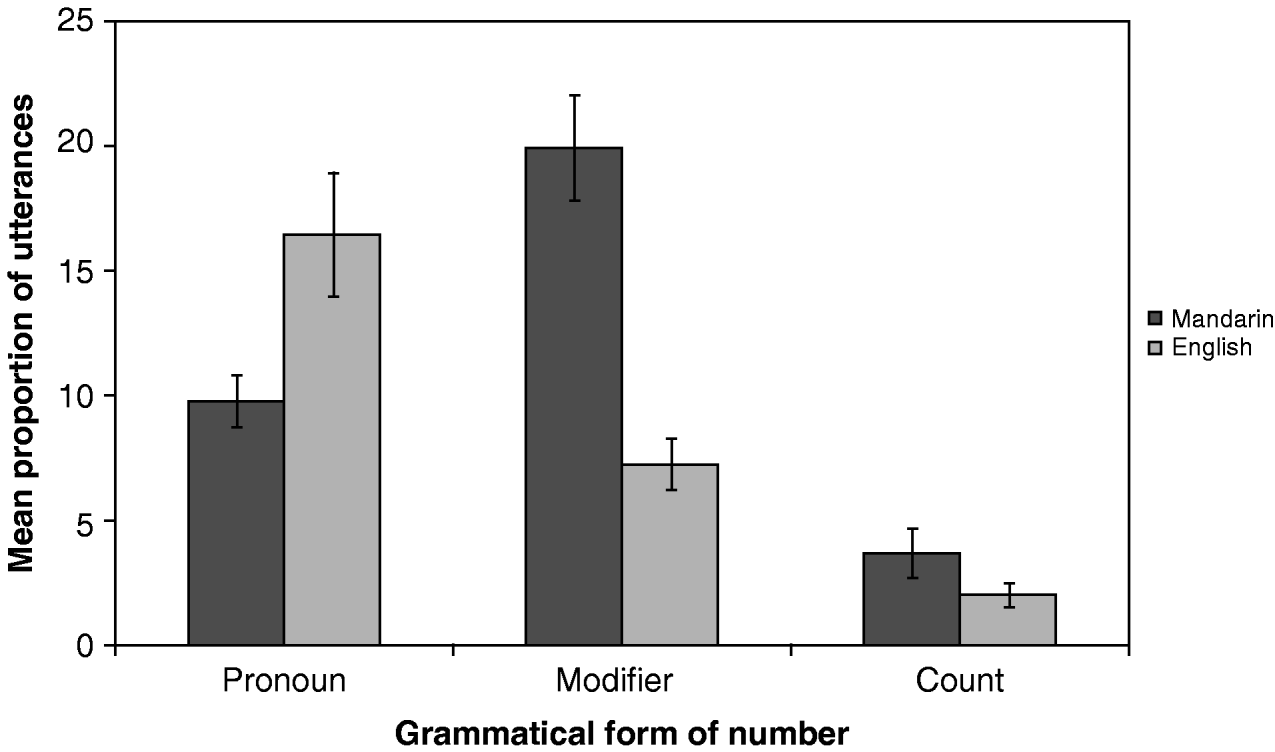
In addition, Mandarin-speaking parents were more likely to use number terms in modifier form than English-speaking parents. In Mandarin, parents used number as a modifier, on average, 19·93 times per transcript (SD=20·57), comprising 48·60% of Mandarin parents' total number speech, compared to an average of 7·26 times per transcript (SD=10·09), or 25·17% of English-speaking parents' total number speech. An independent-samples t-test confirmed that Mandarin-speaking parents talked about number in the modifier form more than English-speaking parents (t(192)=7·40, p<0·01). Thus, Mandarin-speaking children hear number terms in conjunction with object labels more often than English-speaking children.
In sum, number terms used in speech to Mandarin-speaking children most commonly point to quantity as a property of a set (i.e. cardinality). In contrast, the majority of number terms used in English parental speech are pronouns that do not emphasize numeric content (e.g. Gallistel, Reference Gallistel2007). At best, pronouns express a less obvious relation to quantity than other usages. At worst, pronouns (typically the word one) actively point children to a non-numeric meaning of number words. In subsequent analyses, pronouns are not included. When pronoun instances are removed from the frequency counts, it becomes apparent that Mandarin-speaking parents talk about discrete quantity much more often than English-speaking parents. In Mandarin, 4·43% of total speech to children contains numeric references whereas in English, 2·05% of total speech to children contains numeric references. An independent samples t-test confirmed that Mandarin-speaking parents talked about number significantly more than English-speaking parents (t(192)=6·88, p<0·01). Notably, parents talked about number twice as often in Mandarin as in English.
Types of number productions
Cardinal numbers
Cardinal numbers, numbers that represent a quantity, were frequent in speech to child speakers of both languages. However, Mandarin-speaking parents produced more cardinal number utterances than English-speaking parents. As Table 1 shows, 63·75% of Mandarin, and 58·37% of English number utterances were cardinal, and Mandarin-speaking parents produced an average of 19·93 cardinal number utterances per transcript compared to a mean of 7·75 number utterances per transcript by the English-speaking parents. An independent-samples t-test revealed significant differences between the two languages (t(192)=7·40, p<0·01). The comparative abundance of cardinal number utterances in Mandarin suggests that child speakers experience considerably more instances of direct quantification of sets in their parents' speech compared to their English-speaking peers. This result is in line with the prediction that the lack of Chinese singular/plural markers may lead to more frequent production of cardinal numbers in Mandarin.
Other numeric utterances
Mandarin-speaking parents also referred to written numerals and ordinal numbers significantly more often than English-speaking parents. There were also infrequent uses of number in each language to refer to calendar dates (e.g. August 3rd, xing1 qi1 liu4 ‘Saturday’), to discuss age (liang3 sui4 ‘two years old’), money (shi2 kuai4 qian2 ‘ten dollars’) and time (si4 dian3 shi2 wu3 fen1 ‘4:15’) in both languages, but no significant differences were found.
Classifiers
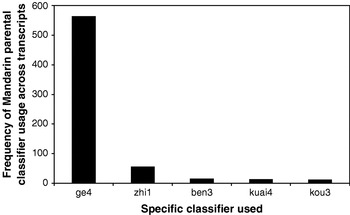
Classifiers, or modifiers that indicate a unit of measure were used frequently in Mandarin number speech, and rarely in English. Mandarin-speaking parents used classifiers when quantifying a set of items an average of 7·72 times per transcript (SD=8·29), compared to 0·14 times per transcript (SD=0·59) for the English-speaking parents. An independent samples t-test revealed a significant difference in classifier productions between the two languages (t(192)=8·98, p<0·01). This result has been previously reported in studies of Mandarin adult speech (e.g. Cheng & Sybesma, Reference Cheng and Sybesma1998) and indicates differences in language structure between the two languages. Classifiers indicate how many countable units exist within a set, and are mandatory in essentially all instances of quantification in Mandarin. Consistent with these findings, 94·93% of Mandarin (711 of 749 utterances) classifiers were paired with a cardinal number utterance. Moreover, 36·78% of Mandarin cardinal number utterances involved classifier usage paired with numbers and objects to signify units of measure. The remaining cardinal utterances used specific classifiers (e.g. he2 ‘box’ or tiao2 ‘long, thin object’) that were not paired with an additional noun to create a complete cardinal number utterance. The types of classifiers parents used in cardinal number speech to children were also not distributed equally. Figure 2 illustrates the frequencies of occurrence for the five most common classifiers used in Mandarin parental number speech to children. An overwhelming majority, comprising 75·30% of the classifiers spoken by parents in Mandarin, was ge4, a generic classifier that can be used with many nouns. Because ge4 was used so frequently to classify quantity, Mandarin-speaking children heard most numerical terms paired with this word. The second most frequently used classifier by Mandarin parents was zhi1 ‘[animal unit]’, which accounted for 7·48% of all classifiers, followed by ben3 ‘[book unit]’ (2·14%), kuai4 ‘piece’ (1·87%) and kou3 ‘mouthful’ (1·60%).
Frequencies of occurrence for the five most commonly used Mandarin classifiers in parental number speech.

DISCUSSION
Given the robust relationship between frequency of parental language input and vocabulary acquisition (Huttenlocher et al., Reference Huttenlocher, Haight, Bryk, Seltzer and Lyons1991), differences in overall frequency of number talk might lead Mandarin-speaking children to acquire number terms earlier and more readily than English-speaking children. The disparate ways in which parents talked about number might also influence number acquisition. For example, pronoun usages of one, most common in English, can provide information about quantity, but weak cues to the numerical meaning of the word. When a parent asks a child, Do you like this one?, the meaning of one does not necessarily emphasize the quantity of the set. The question Can you give me those ones? refers to multiple objects rather than a single object, which may be misleading. In contrast, children who hear number terms more frequently in modifier form, e.g. onerabbit, should have an easier time interpreting the meaning of the terms.
In a study examining children's acquisition of adjectives, Mintz & Gleitman (Reference Mintz and Gleitman2002) found that children were more likely to extend meanings of novel adjectives as object properties when modifying nouns with coherent category information (e.g. cat), suggesting that children might benefit from hearing number terms immediately preceding a noun. Because English-speaking children hear the number term one as a pronoun most often, they may not acquire knowledge of its numerical meaning as readily as children who hear the word one as a direct quantifier, despite frequency.
The function of Chinese classifiers as an indicator of quantity when paired with a number term may also have a direct relationship with Mandarin-speaking children's cognizance of cardinality prior to formal schooling. Because classifiers – specifically ge4 ‘[generic unit]’ – appear with the majority of cardinal numbers in Mandarin, their presence may indicate that a word refers to number, even if children are unsure of exact quantity. For example, words like a million may be interpreted as synonymous with a lot in English, whereas Mandarin-speaking children can more readily infer that it refers to a specific quantity of ‘a lot’ because classifiers directly indicate cardinal status, or set size. Further, classifiers may point to cardinality even when the words are used in pronoun form. For example, si4 ge4, which roughly translates to ‘four units’ in Mandarin, was coded as pronominal, as it does not specify what is being quantified. The ge4 in the Mandarin utterance specifies countable units. Therefore, even in Mandarin pronominal number forms, the implications of cardinality are much more salient than in English.
Results from early intervention studies (e.g. Milgram, Reference Milgram and Schoenfeld2004) indicate that math-related language is better learned when children hear and correctly model number speech with great frequency. This supports the idea that hearing number terms in pronoun form in lieu of appropriate quantification may not guide comprehension of the cardinal number principle. Moreover, it has been found that underachievement in early elementary school math is closely related to a lack of ‘intuitive knowledge’ regarding basic numeric concepts that should be acquired in early childhood (e.g. Pagani, Jalbert & Girard, Reference Pagani, Jalbert and Girard2006). Thus, while the relationship between frequency of language input and vocabulary acquisition has been consistently documented, evidence suggests that context and type of numeric input should be considered in tandem when examining how children glean meaningful information from their parents' speech.
Why parents talk differently about number between languages is probably due to both language and cultural differences, which are difficult to uncouple. Some differences clearly arise from language, such as consistent use of classifiers with set size and lack of regular plurals, as well as the base-ten counting system in Mandarin (e.g. Miller et al., Reference Miller, Smith, Zhu and Zhang1995). Because neither Chinese classifiers nor noun phrases distinguish between singular and multiple objects (e.g. zhang1 means ‘sheet’, but does not differentiate a single sheet from multiple sheets), Mandarin speakers are more likely to use number terms as descriptors in noun phrases than English speakers, who can express the idea of ‘more than one’ easily without directly stating a quantity. However, while classifier usage may correlate with specific quantification in Mandarin, singular and plural markings in language have also been shown to aid children in learning number terms (Sarnecka et al., Reference Sarnecka, Kamenskaya, Yamana, Ogura and Yudovina2007). Other disparities between English and Mandarin number speech may likely arise from culture: written numbers may be more prevalent in the Chinese culture due to the historical importance and complex meanings behind written characters. In many numeral utterance instances, for example, Mandarin-speaking parents were instructing children to write or recognize Chinese characters.
Still, reasons for other language input differences are less clear. Although the preschool years have been described as the ‘age of innocence’ in Chinese culture, when children should not be concerned with academic progress (Stevenson & Stigler, Reference Stevenson and Stigler1992), attitudes on academic achievement may indirectly affect parents even before children enter school. Although we cannot isolate causes for cross-linguistic differences in input or later math performance based on the current study, the results do suggest that even prior to entering kindergarten, Mandarin- and English-speaking children already differ in exposure to number through parental numeric language input. One limitation of our data involves the usage of the CHILDES database. While our utterance counts are based on its guidelines of one utterance per line, we realize that this may not always be followed. Thus, our estimates of number utterances per transcript may be based on more utterances than indicated by lines of text. In the event that this differs between corpora and languages, the differences observed in our data may be affected by artifactual differences in the transcription and coding of the transcripts.
Because the foundations of mathematics rest on the understanding of whole number and cardinality, it is notable that Mandarin-speaking children are more experienced with cardinal (i.e. whole) number terms via parental language input compared to their English-speaking peers. While we cannot draw causal conclusions from the present study, these differences may aid Mandarin-speaking children's understanding of numerosity by school age, which may then contribute to the well-documented advantages in math performance throughout their education (e.g. Mullis et al., Reference Mullis, Martin, Gonzalez and Chrostowski2004). In this way, parent–child interactions during the preschool years may also contribute to the Chinese advantage in mental addition and number-line estimation tasks even prior to entering kindergarten (Geary et al., Reference Geary, Bow-Thomas, Fan and Siegler1993; Siegler & Mu, Reference Siegler and Mu2008). Appropriately, an earlier and better understanding of the concept of cardinality, or set size, derived from parental numeric language input may then be an important additional part of the intricate framework – including cultural, linguistic and educational factors – that underlies the arithmetic advantages documented in Mandarin-speaking children as early as the start of kindergarten, and throughout grade school.
APPENDIX: CHILDES CORPORA CITATIONS