Nativelike sentence processing, whether in speaking or in understanding, requires the ability to generate the same range of candidate structures as a native speaker1
The notion of generation used here refers to the ability to construct a mental representation of a sentence structure and is intended to be neutral between comprehension and production mechanisms. See Boland and Cutler (1996) for a useful discussion of the terms generation and selection in psycholinguistics.
RELATIONS BETWEEN L1 AND L2 STRUCTURES
The focus of much previous research on L2 sentence processing has been on effects of transfer from the speaker's L1 to their L2 in ambiguity resolution. Specifically, these studies investigated whether the range of structures allowed by the L1 grammar affects the range of alternatives that L2 speakers consider during processing and whether L1 ambiguity resolution preferences carry over into the L2.
A number of studies tested cases in which an ambiguous L2 sentence has a close cognate in the L1 and investigated whether L2 processing is affected by the status of the L1 cognate. For example, several studies have investigated the parsing of ambiguous sentences with complex noun phrases (NP) of the type N1-of-N2 followed by a relative clause, as in Jan read the review of the book that was written by her politics professor. These investigations have predominantly targeted cases in which the same relative clause attachment ambiguity exists in both the L1 and the L2 (Dussias, 2003; Fernández, 1999; Frenck-Mestre, 1997; Papadopoulou & Clahsen, 2003). Some of these studies reported evidence of transfer of L1 parsing preferences (Fernández; Frenck-Mestre), whereas the results of others suggest that knowing a L2 at an advanced level affects parsing in both the L1 and L2 (Dussias; Felser et al., 2003; Papadopoulou & Clahsen). Juffs (1998) investigated the parsing of ambiguous reduced relative clauses, such as The leader defeated in the election resigned one day later, in the English of NSs of Chinese, Japanese, Korean and a number of Romance languages; an effect of transfer from L1 was found on sentence processing in the L2. In all of these cases, the preferred resolution of the ambiguity in the L2 corresponds to a structure that is acceptable in the L1 and in some cases matches the preferred resolution of a similar ambiguity in the L1.
A study by Hoover and Dwivedi (1998) examined how fluent L2 French speakers processed ambiguities involving clitics and causative constructions that had no close cognate in English, the speakers' L1. They found that the L2 speakers resolved these ambiguities in a similar fashion to NSs of French. In this case, the lack of a clear L1 cognate made it unsurprising that no transfer effects were observed.
These previous studies are all consistent with the generalization that when speakers encounter ambiguous L2 sentences, processing is affected by the existence of close L1 cognates, sometimes even leading to apparent transfer of ambiguity resolution biases. When the L1 provides no close cognates, L2 processing is less affected by the L1. These studies show that L2 sentence processing is affected by the L1, but leave open questions about precisely how it is that knowledge of the L1 affects processing in the L2. On the one hand, L1 knowledge might affect L2 processing at a superficial level by favoring structures in the L2 that closely resemble structures that are highly favored in the L1. Under this view, L2 processing makes direct reference to specific structures in the L1. On the other hand, L2 processing might resemble L1 processing at a more abstract level, through the application of the same generation and selection processes used in processing in the L1, regardless of whether they are applied to superficially similar structures in the L2. Under this view, L2 processing resembles L1 processing by virtue of employing parallel mechanisms rather than by virtue of manipulating closely related structures. To begin to address this distinction, we consider a case of ambiguity in Japanese wh-questions for which the NS preference has been argued to reflect the same general selection mechanism that applies in English, but where the closest surface cognate in English corresponds to the dispreferred resolution of the ambiguity for Japanese NSs. Before describing our experiment, we first lay out key features of the structure and processing of wh-questions in Japanese and English.
Wh-QUESTIONS IN JAPANESE
Japanese is a strongly verb-final language. All arguments, including clausal complements, precede the verb in Japanese. Therefore, the embedded clause verb appears before the main clause verb in multiclausal sentences, as illustrated in (1).

Japanese marks the scope of wh-questions via affixation of a question marking particle (QM) to the verb, such as -ka (for embedded or main verbs) or -no (for main verbs only). These question particles contrast with the declarative complementizer -to. Direct questions are created by affixing a QM to the main verb (2a), whereas indirect questions are created by affixing a QM to the embedded verb (2b). This method of scope marking contrasts with English, where the scope of a wh-question is indicated by the surface placement of the wh-word within the sentence: The wh-word appears at the front of the main clause in direct questions (3a) and at the front of the embedded clause in indirect questions (3b).

Japanese wh-questions typically adopt a wh-in-situ structure in which the wh-phrase occupies its canonical, thematic position (4a). Wh-phrases can also undergo fronting, also known as wh-scrambling (4b). However, in contrast to English, the placement of the wh-phrase has no effect on the scope of the question. In both examples in (4), the sentence is interpreted as an indirect question because the QM is affixed to the embedded verb.

A general requirement on wh-questions in Japanese is that the QM must be at least as high in the sentence structure as the thematic position of the wh-phrase (Miyamoto & Takahashi, 2002; Nishigauchi, 1990). For example, the sentence in (5a) is unacceptable because the nominative wh-phrase in the main clause receives its thematic interpretation in a higher clause than the QM affixed to the embedded clause verb. On the other hand, (5b) is acceptable: The wh-phrase can be associated with the main clause QM while the embedded clause QM indicates an indirect yes-no question.

The ability to leave wh-phrases in situ contrasts with the wh-fronting found in the overwhelming majority of wh-questions in English. However, there are two cases in English in which wh-in-situ does occur. The first is in echo questions, in which a previous statement (as in [6a]) is repeated with one constituent replaced in an attempt for clarification (6b). It is important for the current study that echo questions are always direct questions. It is impossible for an echo question like (6b) to be interpreted as an indirect question.2
Forms similar to echo questions also occur in quiz show contexts in English—for example, The Maple Leafs are the hockey team for which Canadian city? As with echo questions, these forms are always direct questions.

The second case of wh-in-situ in English occurs in multiple wh-questions, in which fronting of one wh-phrase may force an additional wh-phrase with the same scope to remain in its canonical thematic position. Thus, the in situ wh-phrases in (7a) and (7b) are unambiguously interpreted as direct and indirect interrogatives, respectively, matching the scope of the fronted wh-phrase in each case. It is only in the case of a question with three wh-phrases (7c) that an in situ wh-phrase in English might exhibit a scope ambiguity (Baker, 1970).

Therefore, whereas in situ wh-phrases in Japanese are scopally free (provided that they are associated with an appropriate higher QM), in situ wh-phrases in English are almost always scopally fixed. Furthermore, in sentences with a single in situ wh-phrase (i.e., echo questions), they always take main clause scope.
PROCESSING Wh-QUESTIONS IN ENGLISH AND JAPANESE
Recent research on NS processing of Japanese has shown that Japanese speakers show a locality bias in processing wh-questions, which parallels a long-established finding about language comprehension in English. Interestingly, however, the locality bias manifests itself in somewhat different ways in the two languages.
In English, the surface position of a fronted wh-phrase marks the scope of the question, and the processing of a wh-phrase initiates a search for the canonical position in which the wh-phrase receives its thematic role. In the sentence processing literature, the fronted phrase is generally known as a filler and its canonical position is known as a gap, and the dependencies established between these positions are known as filler-gap dependencies (Fodor, 1978). Although the parser could, in principle, wait for direct evidence of an empty argument position before positing a gap, much evidence now indicates that the parser pursues a more active approach. It posits a gap site as soon as a potential gap site is identified and does not wait for confirmation that the gap site is not already filled. A classic piece of evidence for this active gap creation mechanism comes from the filled gap effect elicited by examples like (8). An active search for a gap following the wh-phrase who in (8a) would identify a potential direct object gap site as soon as the transitive verb bring is encountered, although this would need to be rescinded at the next word, when it becomes apparent that the potential gap site is filled by the overt pronoun us. Slower reading times at the pronoun us in (8a) relative to the control sentence in (8b) supports this account (Crain & Fodor, 1985; Stowe, 1986).

Further evidence for completion of filler-gap dependencies at the first potential verb position in English comes from a variety of different sources, including implausibility detection studies using eye movements (Traxler & Pickering, 1996), event-related potentials (ERP measures; Garnsey, Tanenhaus, & Chapman, 1989; Kaan, Harris, Gibson, & Holcomb, 2000; Phillips, Kazanina, & Abada, 2005), complexity-based arguments (Pickering & Barry, 1991), antecedent reactivation effects (Nicol, Fodor, & Swinney, 1994; Nicol & Swinney, 1989; but cf. McKoon, Ratcliff, & Ward, 1994), and patterns of anticipatory eye movements (Sussman & Sedivy, 2003). Some additional evidence suggests that the parser might also include potential subject positions in its search for the first potential gap position (Lee, 2004). In sum, there is a good deal of evidence for a locality bias in processing English wh-questions. Related evidence for rapid construction of filler-gap dependencies has also been found in many other languages, including Dutch (Frazier, 1987; Frazier & Flores d'Arcais, 1989; Kaan, 1997), Russian (Sekerina, 2003), Hungarian (Radó, 1999), Italian (de Vincenzi, 1991), and German (Schlesewsky, Fanselow, Kliegl, & Krems, 2000). Note that although the standard terminology in the sentence processing literature explicitly refers to gap positions, most evidence is equally compatible with theories in which fronted phrases are directly associated with the verb (Pickering & Barry, 1991; Sag & Fodor, 1994). Nothing in this article depends on the choice between these two representational alternatives.
The finding of locality biases in the processing of filler-gap dependencies in many languages suggests the effects of a basic property of parsing, independent of particular languages. However, findings from English-type languages have generally left open the question of how broadly locality biases apply in terms of the range of structural dependencies that are affected. A highly relevant finding in this regard is due to Miyamoto and Takahashi (2002), who reported a different kind of locality bias in processing wh-questions in Japanese. In wh-in-situ constructions in Japanese, the surface position of the wh-phrase indicates its thematic role but does not indicate the scope of the wh-question. Miyamoto and Takahashi presented evidence for an active search mechanism in Japanese that leads comprehenders to expect a QM to appear as soon as possible after an in situ wh-phrase. This is shown by slower reading times for verbs marked with the declarative complementizer -to (9a) than for verbs marked with the QM -ka (9b) in sentences that contain a wh-phrase, reversing the pattern of relative difficulty observed in non-wh sentences. This slowdown is termed the typing mismatch effect (TME).

Miyamoto and Takahashi (2002) argued that the TME reflects the same active search processes that generate the filled-gap effect in English, except that the Japanese parser searches for a scope marker, whereas the English parser searches for a thematic position. The preference for a local scope marker in Japanese has been confirmed by Aoshima et al. (2004), using both a replication of Miyamoto and Takahashi's TME and a sentence completion study in which speakers provided completions for sentence fragments containing wh-phrases. Fragments like (10) that consisted of a sequence of noun phrases (NPs) from the beginning of a two-clause sentence as well as a wh-phrase required completions that included at least two verbs and one QM. Other studies had shown that a nominative NP in the second position is an effective cue for a biclausal structure (Miyamoto, 2002). Although an embedded clause wh-phrase could, in principle, be followed by either an embedded clause QM (indirect question) or a main clause QM (direct question), speakers showed an overwhelming bias to generate completions in which the QM is in the embedded clause; that is, completions tended to be indirect questions. This showed the same locality bias observed in Miyamoto and Takahashi's study. Thus, both studies showed that Japanese readers prefer to generate a QM in an embedded clause and establish a syntactic dependency between a wh-word and a QM as soon as possible.

This finding about sentence generation provides perhaps the most robust evidence for the locality bias in processing Japanese wh-questions and forms the basis for the study of L2 learners reported here.
Taken together, the findings about the structure and processing of wh-questions in English and Japanese create an interesting scenario for investigating L2 processing. NSs of English and Japanese both show a reliable locality bias in processing wh-questions. This bias might be attributed to the same underlying mechanism in English and Japanese, despite differences in how it is realized in the two languages. Therefore, if English-speaking learners of Japanese process scopally ambiguous wh-questions in Japanese using the same underlying mechanism as in English, we might expect them to perform similarly to NSs of Japanese in a sentence fragment completion task like the one used by Aoshima et al. (2004, see experiment 3). For a biclausal sentence fragment with an in situ wh-phrase such as (10), this would lead to an expectation for an embedded clause question particle. However, if L2 learners of Japanese are guided more by surface similarities between the L1 and the L2, then we predict a different outcome. English sentences with a single in situ wh-phrase can only be interpreted as direct questions, as seen in (6). This might lead L2 learners to resolve fragments like (10) as direct questions, in contrast to the NS pattern.
Note that although the sentence fragment completion task is unable to provide detailed information about the time course of dependency construction in SLA, its use here serves as a worthwhile first step and might even have certain advantages over more online methods. In studies with NSs of Japanese, a locality bias was observed when both online (self-paced reading) and offline methods were used, but the results were clearest with the offline fragment completion task, which makes this a more reliable benchmark measure (Aoshima et al., 2004; Miyamoto & Takahashi, 2002). Furthermore, time-sensitive measures of sentence processing, whether behavioral (e.g., self-paced reading, eye-tracking) or electrophysiological (ERP; MEG: magnetoencephalography), are useful to the extent that the cognitive processes under investigation are time-locked to the eliciting event and show consistent timing across participants. It is more difficult to satisfy these prerequisites in a group of L2 learners, particularly when dealing with a low-density population such as advanced learners of Japanese and when using a task that requires proficient reading of an unfamiliar orthographic script. For these reasons, an offline measure of processing preferences might be a more informative first step.
THE PRESENT STUDY
The aim of this experiment was to investigate whether advanced English-speaking learners of Japanese resolve scopally ambiguous question fragments in a manner similar to NSs, as predicted on the basis of shared underlying processing mechanisms, or in a manner different from NSs, as predicted on the basis of dependence on surface cognates in English.
Participants
There were 42 participants (age: 19–33 years; mean: 23.7 years), which consisted of a group of 18 NSs of English who described themselves as advanced L2 speakers of Japanese (L2 Japanese group), and a comparison group of 24 NSs of Japanese (native Japanese group). All participants in the L2 Japanese group had studied Japanese for at least 2.5 years prior to completing the task (range: 2.5–15 years; mean: 5.7 years) and had spent some time in Japan (minimum: 2 weeks; mean duration: 1.5 years). Participants were recruited from universities in the Washington, DC, area and through Japanese-speaking Internet communities. All subjects gave informed consent and were paid $15 for their participation, which lasted approximately 90 min. The participants in the native Japanese group were all undergraduate students at Shizuoka University or Shizuoka Sangyo University, Japan. They were paid $5 for their participation, which lasted only around 30 min because they did not need to complete the diagnostic test and were able to complete the sentence generation task more quickly than the L2 Japanese group.
All of the L2 participants self-identified as English NSs who were also advanced L2 speakers of Japanese. Due to the scarcity of available individuals who meet both criteria, we did not require any specific formal qualifications in Japanese as prerequisites for participation in the study, such as the Japanese language proficiency test (JLPT) given by the Japan Foundation or the Oral Proficiency Interview administered by the American Council for the Teaching of Foreign Languages. A number of participants reported that they had passed either Level 1 (highest) or Level 2 of the JLPT; however, there were other participants who had never taken these tests and who performed very well in our studies. Therefore, in order to determine whether participants were fluent enough to complete the main sentence generation task, participants in the L2 Japanese group completed a diagnostic test prior to the sentence generation task. The diagnostic test was designed specifically for this study; it focused on aspects of Japanese vocabulary and grammar that were considered necessary to satisfy the premises of the sentence generation task. This was considered preferable to the use of scores from standardized tests of advanced proficiency in Japanese that would have required more testing time and provided less detailed information relevant to the structures tested in this study.
Diagnostic Test
The diagnostic test was composed of three parts. The first was a 20-item multiple-choice grammar test that probed proficiency in four areas: basic formation of wh-questions using question particles such as -ka; basic formation of wh-phrases such as dare-ni “wh-dat” and dare-ga “who-nom”; comprehension of biclausal sentences—in particular, direct and indirect questions; and knowledge of argument structure and appropriate case particle marking for ditransitive structures. The second part was a vocabulary translation task in which participants were asked to match Japanese words to their English translations. All words presented in this task later appeared in target or filler items of the main sentence generation task and thus also served to refresh participants' familiarity with these lexical items. The third part was a five-item sentence fragment completion task similar to the task used for the main study. Participants read the first four elements of a sentence and were instructed to write a completion for the sentence in a grammatical manner with whatever words they deemed appropriate. This task included no fragments that were similar to those used in the main study but was administered to ensure that participants were able to complete a task of this nature within a reasonable amount of time.
Results from the diagnostic test confirmed that the participants were able to comprehend the type of materials used in the main sentence generation task. Combined scores for the grammar test and the vocabulary test averaged 84.4%, and all participants were able to complete the practice sentence generation task in less than 10 min.
Materials
The main sentence generation task included three experimental conditions. Test items were sentence fragments consisting of a sequence of four phrases. Materials were similar to those used by Aoshima et al. (2004, see experiment 3), except that they were simplified in order to be more suitable for L2 speakers. In all three conditions, the test items included two subject NPs (which indicated that the sentence was biclausal), one dative-marked NP, and one adverbial phrase. In all three conditions, one of the NPs was an in situ wh-phrase. In two of the conditions, the wh-phrase was a dative-marked NP. The conditions with dative wh-phrases were identical except that the main clause subject bore a nominative marker in one condition and a topic marker in the other. This contrast was included because both possibilities are available for marking main clause subjects in Japanese. Topic-marked subjects are often perceived as more natural, but nominative-marked subjects are more unambiguous. However, both forms turned out to be equally effective indicators of the main clause subject position in our study. In the third condition, the wh-phrase was the main clause subject. This condition was included in order to distinguish a nativelike pattern of QM placement from a grammar-independent version of the locality bias.
In all conditions, the presence of a wh-phrase in the sentence fragment indicated that the sentence contained an interrogative clause, but it was left to the participants to decide whether to generate a direct question completion with a main clause QM or an indirect completion with an embedded clause QM. If the L2 participants resolve the scope ambiguity in a nativelike fashion, then they should generate embedded clause QMs in the conditions with embedded clause dative wh-phrases, but should generate main clause QMs in the conditions with main clause subject wh-phrases, because Japanese grammar requires that main clause wh-phrases be associated with main clause QMs (Miyara, 1982; Nemoto, 1999; Saito, 1985; Takezawa, 1989). On the other hand, a grammar-independent linear version of the locality bias would lead the L2 participants to generate embedded clause QMs in all conditions because the embedded verb is the first verb in the sentence. Alternatively, if the learners of Japanese treat the in situ wh-phrases analogously to in situ wh-phrases in English, then they would generate main clause QMs in all conditions, given that in situ wh-phrases in English are reliably associated with direct questions.
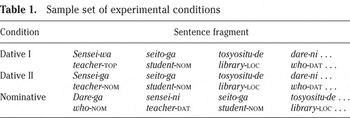
Target items consisted of 15 sets of sentences, each set including one item from each of the three conditions. The members of each set were distributed among three lists in a Latin Square design, such that each list contained only one item from each set. The three lists were each combined with 30 filler items in pseudorandom order in order to create three versions of the sentence generation test. Filler items matched the targets in length and complexity and included a mix of fragments requiring monoclausal and biclausal completions. Filler items were also configured such that there should be no statistical bias in the study for sentences requiring declarative or interrogative completions. The questionnaires were presented in a 12-point MS Gothic Japanese font, with furigana syllabic readings placed over each kanji compound in order to ensure that kanji reading presented no difficulties for the L2 Japanese participants. A sample set of target sentences can be found in Table 1. Example (11) is a set of examples of possible grammatical sentence completions. A list of all target items is included in the Appendix.
Sample set of experimental conditions


Procedure
The experiment was completed using pen and paper. Participants were instructed to first read the fragments and then to complete the sentence with the first grammatically acceptable completion that came to mind. They were further instructed that they were free to write kanji or in hiragana and katakana for their answers. The sentence generation task took 45 min to 1 hr.
RESULTS
Clause Number
Because only biclausal completions are grammatical and relevant for testing the experimental hypotheses, responses were first analyzed for the number of clauses in the completions. Completions were counted as multiclausal if two or more verbs were supplied, and other types of completion were excluded from all subsequent analyses. Japanese NSs generated no monoclausal sentences. L2 Japanese participants incorrectly provided monoclausal sentences in 40 of the 258 codable sentence completions (15.5%). However, 38 out of 40 of these were provided by three participants. Given that these three participants also performed poorly on the diagnostic test, scoring on average 72.2% correct and providing three of the four worst scores, their data were not included in further analyses. The remaining 15 participants produced only 2 out of the 213 monoclausal sentences (0.9%), which indicates that they recognized that only biclausal completions were grammatical. Fisher Exact tests showed no statistical difference between any of the three conditions on this score, and no difference between the native Japanese group and the L2 Japanese group on this measure.
Question Markers
In the next step of the analysis, we checked that the completions contained at least one QM that could be associated with the wh-phrase in the fragment. Japanese NSs provided a QM on at least one of the verbs in 96.6% (347/359) of relevant trials. Across conditions, this consisted of 97.5% of completions with QMs in the two dative conditions and 95% of completions with QMs in the nominative condition. L2 Japanese speakers omitted the QM more frequently, providing a QM in 73.2% (156/213) of trials. Across conditions, this consisted of 64% in the dative I condition, 70.4% in the dative II condition, and 82.3% in the nominative condition.3
In a very small number of trials, participants placed the quantificational morpheme -mo after the wh-phrase dare-ni to create the quantificational expression dare-ni-mo, a quantifier that does not need to be associated with a QM. This occurred in 0.6% (2/359) of trials for the native Japanese group and in 1.9% (4/213) of trials for the L2 Japanese group.
The question of why we see a higher rate of QM omission by the L2 speakers can also be examined in light of the discussion of the omission of functional categories in L2 acquisition. There has been some debate about the implication of such omissions. Some have argued that L2 speakers have no deficiency in their grammatical structures but, rather, have problems with morphological mapping of proper inflection, which, in turn, causes the observed omissions (e.g., Haznedar & Schwartz, 1997; Lardiere, 1998; Prévost & White, 2000). Another position is that the lack of functional categories in production is due to a grammatical impairment in L2 speakers caused by a lack of features, feature strength, or the functional categories themselves (e.g., Beck, 1998; Clahsen, 1988; Eubank, 1993/1994). A third view holds that although functional categories are extant in the L2 grammar, they are limited to features that exist in the L1 grammar; thus, when a L2 requires an element that the L1 lacks, the L2 speaker is unable to properly produce said element, which leads to the omission of functional category inflection (e.g., Franceschina, 2001; Hawkins & Chan, 1997). Given that we did not attempt to specifically control functional category production in our experiment, we make no claims regarding the broader implications of the QM omissions that we observe.
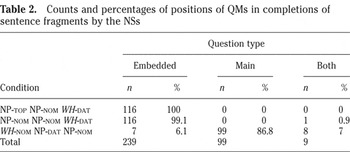
The sentence fragments that were completed with QMs were then analyzed as a function of the position of the QM. Participants in the native Japanese group showed a clear contrast between the dative conditions and the nominative conditions, which replicated the finding of Aoshima et al. (2004). In the dative conditions, an embedded QM was provided in 100% (233/233) of trials, including one trial in which a QM was provided in both clauses. In the nominative conditions, a main clause QM was provided in 93.8% (107/114) of trials, including eight trials in which a QM was provided in both clauses. The 6.1% of trials with a QM in only the embedded clause were not grammatical completions. It is not a surprise that a Fisher Exact test showed that the results for each of the dative conditions were reliably different from the nominative condition, p < .0001. Results for the native Japanese group are summarized in Table 2.
Counts and percentages of positions of QMs in completions of sentence fragments by the NSs

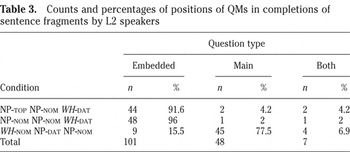
Results for the L2 Japanese group were strikingly similar to those for the native Japanese group. For the two dative conditions, an embedded QM was provided in 96.9% (92/98) of trials, including three trials with QMs in both clauses. A Fisher Exact test showed no difference between the two dative conditions, p = .61, two-tailed. However, in the nominative condition, which required a QM in the main clause, main clause QMs were provided in 84.4% (49/58) of trials, including four trials with QMs in both clauses. Fisher Exact tests confirmed that the results for each of the dative conditions were reliably different from the nominative condition, p < .0001, two-tailed. Results for the L2 Japanese group are summarized in Table 3.
Counts and percentages of positions of QMs in completions of sentence fragments by L2 speakers

Both the L2 and the NS groups produced a portion of their sentence completions as quotations of questions, in which the QM is followed by the quotative particle, as in (12).

Native speakers produced quotative questions in 25.9% (30/116) of the grammatical completions for the dative I condition and in 30.2% (35/116) of the grammatical completions for the dative II condition. Additionally, four of the seven ungrammatical embedded question completions for the nominative condition were phrased as quotations. For the L2 speakers, quotative questions made up approximately one third of the grammatical completions in the two dative conditions: 34% (15/44) for the dative I condition and 33% (16/48) for the dative II condition. Two of the nine ungrammatical embedded question completions for the nominative condition in the L2 data were phrased as quotes. Fisher Exact tests show no significant difference between the two groups' production of quotations (p = .46 for dative I and p = .86 for dative II).
Because quotations of questions in Japanese are still located in the embedded clause, we argue that it is appropriate to treat them as indirect questions. However, even if one were to exclude the data in which quotations were produced, the strong preference for creating indirect questions in the two dative conditions as opposed to direct questions in the nominative condition would still remain significant for both subject groups, as measured by Fisher Exact tests, p < .0001, two-tailed.
Finally, we compared the distribution of QMs across conditions in the two groups using Fisher Exact tests for each condition. Although these tests indicated that the difference between the two participant groups was not significant in any condition, there was a marginally significant effect in two of the three conditions (dative I: p < .08; dative II, p < .3; nominative, p < .06), which reflects the fact that there were more exceptions to the general tendency for QM placement in the L2 Japanese group. However, the overall pattern of QM placement was highly similar in the native Japanese and L2 Japanese groups.
DISCUSSION
The sentence generation study yielded rather clear results. L2 Japanese speakers with English as a L1 resolved scope ambiguities in wh-questions in a very similar manner to Japanese NSs, by consistently generating a QM in the first complementizer position above the in situ wh-phrase. In the case of embedded clause dative wh-phrases, this led to a clear majority of embedded clause QMs (i.e., indirect questions). In the case of main clause nominative wh-phrases, this led to a clear majority of main clause QMs (i.e., direct questions). The findings for Japanese NSs confirm earlier reports of locality biases in resolving wh-question scope ambiguities in Japanese (Aoshima et al., 2004; Miyamoto & Takahashi, 2002). On the other hand, the nativelike performance of the L2 Japanese speakers is a new finding. In what follows, we consider possible sources for this highly nativelike performance, including the question of whether the similar performance between the two groups reflects similar underlying processing mechanisms.
The contrast between the nominative and dative conditions is important for the interpretation of the results from the L2 speakers. A simple grammar-blind local licensing strategy would incorrectly predict that QMs would be consistently generated on the embedded verb in all conditions because it is the first verb of the sentence. On the other hand, a strategy that assimilated the Japanese sentences to English sentences with a single in situ wh-phrase would incorrectly predict that QMs would be consistently generated on the main verb in all conditions. This is because English echo questions are always direct questions. Thus, the L2 Japanese speakers cannot have been simply relying upon the closest English surface cognate to the Japanese sentences in order to resolve the scope ambiguities. As a result, these findings go beyond previous studies of ambiguity resolution in L2 research in which the preferred resolution of the ambiguity in the L2 involved a surface structure that has a close counterpart in the L1 (e.g., Dussias, 2003; Fernández, 1999; Frenck-Mestre, 1997; Juffs, 1998; Papadopoulou & Clahsen, 2003).
The contrast between the nominative and dative conditions also casts doubt on the possibility that the results might reflect the results of formal teaching in Japanese. A survey of widely used college textbooks for Japanese (Banno, Ohno, Sakane, Shinagawa, & Tokashiki, 1999; International Christian University, 1996; Jorden, 1987, 1988; Jorden & Noda, 1990; Makino, Hasata, & Hasata, 1998; Tohsaku, 1995) and grammar books for Japanese (Makino & Tsutsui, 1986, 1995) showed that indirect questions with embedded clause wh-phrases are typically introduced in intermediate-level texts and that biclausal direct questions are not explicitly taught. Therefore, we consider it unlikely that our results from L2 Japanese speakers could have been straightforwardly caused by biases in classroom materials. Even if the classroom materials were somehow responsible for a bias to treat biclausal interrogatives as indirect questions, this would fail to capture the contrast between our conditions, as the dative conditions showed a strong bias for indirect questions and the nominative condition showed a strong bias for direct questions. Moreover, we should emphasize that because most of our L2 group had extensive experience using Japanese outside of classroom settings, it is unlikely that they were greatly influenced by any potential sampling biases that might arise from exposure to only classroom materials.
We next considered whether the L2 speaker results might reflect the surface frequencies of the relevant question types in their naturalistic Japanese input. For example, the bias for embedded clause QMs in the dative conditions might conceivably reflect a frequency bias for embedded in situ dative wh-phrases to appear in indirect questions rather than direct questions.
To examine this possibility, we compared our experimental data with a small corpus of naturalistic Japanese sentences derived from an Internet search using Google Japan. We searched for listings in which a wh-argument phrase such as nani-ga/wo/ni “what-nom/acc/dat” and dare-ga/wo/ni “who-nom/acc/dat” co-occurred with one of two main clause report verbs: iu “say” and osieru “tell.” We focused on report verbs in our search because these are high-frequency verbs that allow either declarative or interrogative clausal complements and, thus, are compatible with both direct and indirect questions, as shown in the contrast between (2a) and (2b). Moreover, both of these verbs appeared in the completions generated by the native Japanese and L2 Japanese participants in our experiment. We excluded from our corpus any examples in which the embedded clause was a direct quotation, because that would lead to a confounding of direct and indirect questions.
In our experimental data from Japanese NSs, 71 completions contained an in situ dative wh-phrase and a main clause report verb, and 99% (70/71) of these examples consisted of an indirect question with an embedded clause QM. Among our L2 Japanese participants, the corresponding figure was 100% (11/11). Thus, both groups of experimental participants showed an overwhelming bias for embedded QMs in items with in situ dative wh-phrases and a main clause report verb. On the other hand, the first 200 listings on Google Japan that contained both a wh-phrase and a main clause report verb—either itta “said” or osieta “told”—yielded 162 occurrences of monoclausal wh-questions, 25 biclausal direct wh-questions, and 13 biclausal indirect wh-questions. Thus, among the biclausal wh-questions, there was a bias for direct questions, p < .05, sign test, which was the reverse of the bias found in our sentence generation study. In sum, the preliminary corpus investigation found no evidence of the overwhelming bias for indirect wh-questions observed in our experimental data and, thus, it is unlikely that the nativelike performance of our L2 Japanese speakers reflected superficial distributional properties of their Japanese input.
An account of the results that accurately captures the observed patterns is one in which the L2 Japanese speakers draw upon the same general dependency-formation mechanisms in processing their L2 that they rely upon in processing their L1. Processing of the left-hand member of a syntactic dependency initiates an active search for the right-hand member of the dependency. In English, this gives rise to processes that actively search for a thematic position (gap) in the first grammatically appropriate position following a fronted wh-phrase (Frazier & Clifton, 1989; Stowe, 1986). In Japanese, this gives rise to processes that actively search for a scope-marking question particle in the first grammatically appropriate position following an in situ wh-phrase (Aoshima et al., 2004; Miyamoto & Takahashi, 2002). For embedded clause dative wh-phrases, this correctly predicts a QM on the embedded clause verb. For main clause nominative wh-phases, this correctly predicts a QM on the main clause verb because the grammar requires that the QM be at least as high in the structure as the wh-phrase. If it is the case that the L2 Japanese speakers' performance reflects an underlying mechanism that is already operative in their L1, then this removes the need to explain how the L2 learners might have derived the observed biases from the Japanese input that they had received.
If the observed locality bias in our L2 participants does not reflect teaching or surface frequency biases in naturalistic input, then we should expect no correlation between individuals' performance in the fragment completion task and their length of experience studying Japanese or living in Japan. To test this prediction, we conducted two correlation analyses that tested for a relation between the percentage of indirect questions generated in the completion task (dative conditions only) and time spent learning Japanese or living in Japan. Neither the correlation with time spent learning Japanese, r = .352, p = .19, two-tailed, nor the correlation with time spent living in Japan, r = .377, p = .16, two-tailed, was significant. This suggests that the participants who had been exposed to the Japanese language for a shorter amount of time behaved similarly to those who had substantially greater exposure.
The overwhelming strength of the locality bias in our study—particularly in the case of NSs of Japanese—might raise doubts about the acceptability of embedded clause wh-phrases in direct questions in Japanese. However, we should emphasize that direct questions with embedded clause wh-phrases are uncontroversially acceptable and can also be found in naturally occurring texts, as in the example in (13), taken from our Google Japan search. The fact that locality biases in long-distance dependency formation are more robust than certain other types of ambiguity resolution bias might reflect the fact that they involve anticipatory commitments rather than decisions about how to attach ambiguous material to previously parsed structures.

The main implication of our findings is that the grammars of L2 learners need to encode information in a form that is sufficiently abstract to capture the parallel between the two types of dependencies involving wh-phrases, such that it is possible to give a common account of local dependency-formation effects found in wh-gap dependencies in English and in wh-question-particle dependencies in Japanese. This contrasts with the alternative that similarities between L1 and L2 processing are primarily driven by similarities at the level of specific surface structures. We view this issue of surface versus more abstract parallels as orthogonal to a number of other theoretical controversies in SLA. For example, a number of studies in the framework of the competition model (MacWhinney, 1987, 2005) have explored SLA as a process of adjusting cue weights from the L1 to the L2 environment, as a result of gradually accrued experience in the L2 (e.g., Liu, Bates, & Li, 1992; McDonald & Heilenman, 1991). A version of this model that treats wh-phrases as strong cues for direct questions in Japanese—a reasonable generalization from the statistics of Japanese and English alike—will run into the same difficulties as the general statistical approach discussed previously, because our learners of Japanese clearly do not treat embedded wh-phrases as cues for direct questions. On the other hand, it might be possible to propose a sufficiently abstract encoding of wh-dependencies that would make it feasible to capture our findings using competition model dynamics.
A possible objection to our findings is that it is unsurprising to find nativelike performance in a group of learners who are highly advanced. This objection would be appropriate in tests of L2 phenomena that have been explicitly taught or that are well represented in naturalistic input to learners. However, for properties of the L2 that are not well represented in the learners' input, it is less obvious that advanced learners should have mastered these properties. The scope interpretation bias that our L2 learners exhibit does not reflect a frequency bias in the input, nor does it seem to reflect a property that even NSs of Japanese are consciously aware of. The interpretation bias reflects a temporary ambiguity that is almost always resolved by the end of a sentence in Japanese. Thus, we do not consider it obvious that advanced learners should have mastered this property of Japanese, simply by virtue of their length of exposure to Japanese.
Another possible concern is that it is inappropriate to draw conclusions about locality biases in language processing from a sentence fragment completion task, which might be primarily a language production measure. However, the fragment completion task has a number of features that make it very similar to other measures of sentence comprehension. As in standard comprehension tasks, the fragment completion task requires the participant to generate an interpretation based on a prespecified form. This contrasts with production tasks that require the participant to generate a form based on a prespecified message. The fragment completion task in Japanese probes the syntactic and semantic expectations that are generated as a consequence of reading preverbal material, paralleling studies that use reading time measures to probe similar expectations (e.g., Miyamoto & Takahashi, 2002). The fact that the completion task can be carried out at all suggests a relatively tight coupling between comprehension and production systems. Finally, fragment completion tasks are widely used in language comprehension studies as ways of norming experimental materials, and it is standard to find correlations between reading times and the results of completion tasks. For these reasons, we consider it entirely appropriate to compare the current results with results generated using other experimental measures.
It is important to note two issues that our current results do not resolve. First, if the performance of the L2 speakers reflects an underlying locality bias in syntactic dependency formation, we cannot distinguish between an account in which this is explicitly transferred from English and an account in which this is a basic design feature of the language processor that is present for all languages. Resolution of this issue would require studies of mechanisms that are not candidates for universal properties of language processing. Second, we cannot draw any firm conclusions about the time course of operations in the sentence generation task used here; the task only provided information about the final answers, with no information about the process of generating a completion. Resolution of this issue will require further studies using more time-sensitive measures.
CONCLUSION
This article showed that English-speaking L2 learners of Japanese exhibit a strongly nativelike processing bias in the resolution of scope ambiguities with in situ wh-questions, despite the fact that the closest superficial cognate in English is unacceptable. We interpret these results as showing that the relevant point of comparison with English wh-questions is not the superficial similarity of echo wh-questions, but the more abstract bias to resolve syntactic dependencies as soon as possible. Just as psycholinguistic studies of NSs of English and Japanese have revealed that the same underlying locality bias yields contrasting effects in the two languages, the current study shows that L2 Japanese speakers might draw upon the same mechanisms they use to process English, albeit with superficially different outcomes.
Appendix: Stimuli
Each of the items in this list represents one full set of stimuli from the experiment. In conditions (a) and (b) (dative I and II), the alternation of the case markers is indicated by square brackets, separated by a slash (/).