1 Introduction
Argentina, Burundi, China, Ecuador, Gambia, Italy, Kenya, Peru, Russia, South Africa, Trinidad and Tobago, the UK, the US and Venezuela – the debate on an alleged backlash against international institutions, in particular international courts (ICs), is not short of empirical examples, creating the impression of a globe-spanning resistance against the norms, procedures and institutions of global governance. Framed as a counter-movement to the advocates of multilateralism and the idea of global democracy (Held, Reference Held1995), this new pushback is intended to attack the fundamental structures of international decision-making. In this contribution, we examine instances and threats of withdrawal from the Inter-American Court of Human Rights (IACtHR) in order to assess whether those cases can be qualified as backlash against the inter-American system of human rights protection.
‘International courts seem to be living in hard times’ (Krisch, Reference Krisch2016) – this statement is certainly true, as becomes clear by the many examples mentioned by Madsen, Cebulak and Wiebusch in the their framework paper included in this special issue (Madsen et al., Reference Madsen, Cebulak and Wiebusch2018). However, whether a generalised backlash against international adjudication is currently underway is still under debate (Madsen et al., Reference Madsen, Cebulak and Wiebusch2018). International institutions face important challenges to their authority: withdrawals or threats of withdrawal, non-compliance, attempts to systematically water-down international obligations, vitriol, etc. ICs that decide on particularly sensitive social matters are especially vulnerable to challenges to their authority. Unsurprisingly, classical forms of international dispute settlement are not faced with the same degree of backlash as ‘new-style’ ICs such as the ECtHR, the IACtHR, the WTO DSB, the ICC and investment arbitration fora, which often entail compulsory jurisdiction and give standing to non-state actors (Alter, Reference Alter2014; Bogdandy and Venzke, Reference Bogdandy and Venzke2012; Shany, Reference Shany2009). Moreover, in most cases, amending the mandate of an IC requires the consensus of all state parties; hence, a dissatisfied state party might be more inclined to threaten withdrawal than to push for a costly and protracted reform process (Alter et al., 2016a, p. 315). Those reasons all call for examining whether the challenges to the authority of ICs amount to state backlash against international decision-making.
The IACtHR has a robust view of its own authority. Its champions tend to call it bold (Burgorgue-Larsen and Úbeda de Torres, Reference Burgorgue-Larsen and Úbeda de Torres2011) whereas its critics call it activist (Malarino, Reference Malarino2012; Neumann, Reference Neumann2008). Although the framers of the American Convention on Human Rights (ACHR) opened legal pathways for the Court to assert considerable authority, their statements in 1969 and the general experience of the time did not presage this direction. To the tune of ten to fifteen cases a year, the IACtHR (the Court) has radically altered the legal landscape of the region. It has struck down laws, given direct effect to some of its decisions and ordered all domestic authorities to ex officio measure the legality of their actions in accordance with the American Convention and its jurisprudence. For the twenty states over which it exercises jurisdiction, it has become an undeniably powerful legal actor, an additional check on state power and a forum in which the demands of vulnerable sectors of the population can be ventilated (Soley, Reference Soley, von Bogdandy, Ferrer Mac-Gregor, Morales-Antoniazzi and Piovesan2017).
Recent events call the success story of regional human rights regimes into question. Many scholars argue that refusal to implement judgments and openly critical attitudes of state authorities threaten the effectiveness of regional human rights regimes. They argue that those incidents are part of an alleged ‘human rights backlash’, which targets not only the regional human rights regimes, but also the ideas of global justice embodied by the ICC. For instance, with regard to the IACtHR, several inter-American experts characterised the decision of the Argentine National Supreme Court of Justice in the case of Fontevecchia and D'Amico,Footnote 1 where it was held that the IACtHR acted ultra vires when it ordered the revocation of a national judgment as backlash (Abramovich, Reference Abramovich2017; Contesse, Reference Contesse2017; Gargarella, Reference Gargarella2017).
State backlash constitutes the greatest challenge to the authority of an IC. Political authority, derived from the idea of ‘öffentliche Gewalt’ in a nation state, is built upon the Weberian premise that every exercise of public authority must be both effective and legitimate (Habermas, Reference Habermas1998; Weber, Reference Weber1958). Authority is not a binary concept. Studies on ICs have revealed that it is necessary not only to contrast de facto and de lege authority, but also to make a more fine-tuned differentiation of authority itself (Alter et al., Reference Alter, Helfer and Madsen2016b; see also Caserta and Cebulak, Reference Caserta and Cebulak2018). It is obvious that an IC does not automatically ‘lose’ its authority by the challenge of one state party – however, its authority in the sense of the ‘legal capacity to determine others and to reduce their freedom’ (Bogdandy et al., Reference Bogdandy, Dann, Goldmann, von Bogdandy, Wolfrum, von Bernstorff, Dann and Goldmann2010) might undergo significant changes (Madsen, Reference Madsen2016). Hence, in cases of open and explicit instances of state criticism, both dimensions of a court's authority are challenged: on the one hand, non-compliance of state parties seriously impacts the effectiveness of the IC in question; on the other hand, instances of open and explicit dissent indicate that the legitimacy of an IC is contested by the state parties. Nevertheless, criticism of ICs is nothing new. The exercise of authority is bound to occasionally trigger negative reactions from states. Prominent but isolated instances of state criticism are not necessarily proof of an attack on the existence of an IC. For these reasons, we have to distinguish backlash from other forms of criticism (Madsen et al., Reference Madsen, Cebulak and Wiebusch2018).
This contribution consists of three parts. The first part of this paper is theoretical and analyses the concept of backlash. Backlash – similarly to ‘crisis’ – is an alluring but indeterminate concept in scholarship. The particular fuzziness of the term makes it appealing for widespread use and thus might account for its popularity. In legal and political science scholarship, backlash often serves as an umbrella term for any form of disagreement (Caron and Shirlow, Reference Caron and Shirlow2016; Sunstein, Reference Sunstein2007). Hence, we need to differentiate ‘backlash’ from closely connected concepts such as ‘contestation’ and ‘resistance’.Footnote 2 We define backlash as a process of systematic and consistent criticism of the institutional set-up of an IC as well as severe instances of non-compliance. Serious instances of backlash are actually quite rare – ‘most supposed examples of backlash turn out to be little more than piqued criticisms, impassioned speeches or policy suggestions that are never seriously pursued’ (Alter et al., Reference Alter, Gathii and Helfer2016a, p. 294).
The second part of this paper is empirical and examines four cases in which a state party withdrew or threatened to withdraw from the IACtHR with the aim of understanding how these processes of resistance developed and whether they can all be characterised as instances of backlash. Because withdrawal, or the threat thereof, is such a highly visible and obvious challenge to the authority of an institution, from the outset, our case selection is oriented towards extraordinary practices of critique. There are many other subtle and less subtle forms of criticism against the IACtHR (Huneeus, Reference Huneeus2011; Cetra and Nascimiento, Reference Cetra and Nascimiento2016). Nevertheless, as the case-study will show, not even all instances in which such a drastic option is considered or carried out necessarily amount to backlash. This contribution focuses on four cases, namely Trinidad and Tobago, Peru, the Dominican Republic and Venezuela. The case sample features a variety of political systems, subject matters and domestic actors involved. Out of the four cases, two state parties (Trinidad and Tobago, Venezuela) ended up withdrawing, Peru's attempt was unsuccessful and the case of the Dominican Republic remains ambiguous. Moreover, two cases were spearheaded by the executive (Trinidad and Tobago, Peru) and two cases involved the judiciary (Venezuela, Dominican Republic).
The third part posits that the specific framework of the IACtHR allows innovative starting points for managing state discontent, in particular the two-tiered structure, the alliance with civil society and the presence of compliance partners within states.
2 Narrowing down the concept of backlash against ICs
In the following section, we first define the phenomenon of backlash, especially in relation to closely connected concepts such as contestation and resistance (Section 2.1). In a second step, we examine three existing hypotheses on the emergence of state backlash both from a political science and international law perspective (Section 2.2).
2.1 Backlash as a practice of criticism
The Merriam Webster Dictionary defines backlash as ‘a sudden violent backward movement or reaction’ and ‘a strong adverse reaction (as to a recent political or social development)’. This is in line with the initial emergence of the concept of backlash in social movement studies, which was used to analyse the radicalisation of particular social groups in modern democracies. For instance, case-studies from US domestic politics in the 1970s show that progressive causes such as gender or race equality resulted in the loss of status and power of particular segments of society (Lipset and Raab, Reference Lipset and Raab1973; Mansbridge and Shames, Reference Mansbridge and Shames2008). Scholars observed that this shift in entrenched power structures inevitably generated a violent or non-violent backlash from the losing groups that mobilised to form a reactionary counter-movement. For instance, Jane Mansbridge and Shauna Shames define backlash as ‘the use of coercive power to regain lost power as capacity’ (Mansbridge and Shames, Reference Mansbridge and Shames2008, p. 626). Due to shifting conditions and changes over time, backlash is a ‘process of dynamic resistance’ (Mansbridge and Shames, Reference Mansbridge and Shames2008, p. 626).
In social science literature, backlash is considered to involve both state and non-state actors: while state parties might choose to review particular judgments, terminate or withdraw from existing treaties, as well as refuse to ratify additional protocols or sign new treaties, civil society might resort to transnational activism, campaigning, naming and shaming, protests and reporting. Legal studies, however, have mainly focused on backlash spearheaded by states. Russia is perhaps the most widely debated example with regard to backlash against the ECtHR, as it systematically refused to comply with general measures requested in Chechnya, blocked the adoption of Protocol 14 and its Constitutional Court claims the power to review the compatibility of ECtHR judgments with the Russian Constitution (Leach and Donald, Reference Leach and Donald2015; Mälksoo, Reference Mälksoo2016).
Moreover, many scholars interlink the debate on backlash with the question of non-compliance. Looking at the practices of ICs, this is problematic (similarly Madsen et al., Reference Madsen, Cebulak and Wiebusch2018, pp. 20ff.). On the one hand, de facto state compliance with a decision of an IC can be coupled with extraordinary critique of the decision or mobilisation against the court rendering it. On the other hand, most cases of non- or partial compliance with a decision are not accompanied by open and explicit critique of the court. Nevertheless, both debates are somewhat interrelated. Since the question of compliance has already triggered substantial scholarship (Chayes and Chayes, Reference Chayes and Chayes1993; Franck, Reference Franck1990), this contribution primarily aims at providing clarification for the second issue: the process of systematic and consistent criticism.
In recent years, several scholars, especially from political science, have been analysing phenomena of criticism, discontent and dissidence. For instance, politicisation research has looked at the increasing utilisation of international institutions and their expanding activities, as well as the growing protest against those same institutions (Zürn et al., Reference Zürn, Binder and Ecker-Ehrhardt2012; De Wilde, Reference De Wilde2011). Thus, in order to define the concept of state backlash against ICs, we must differentiate it from other practices of criticism.
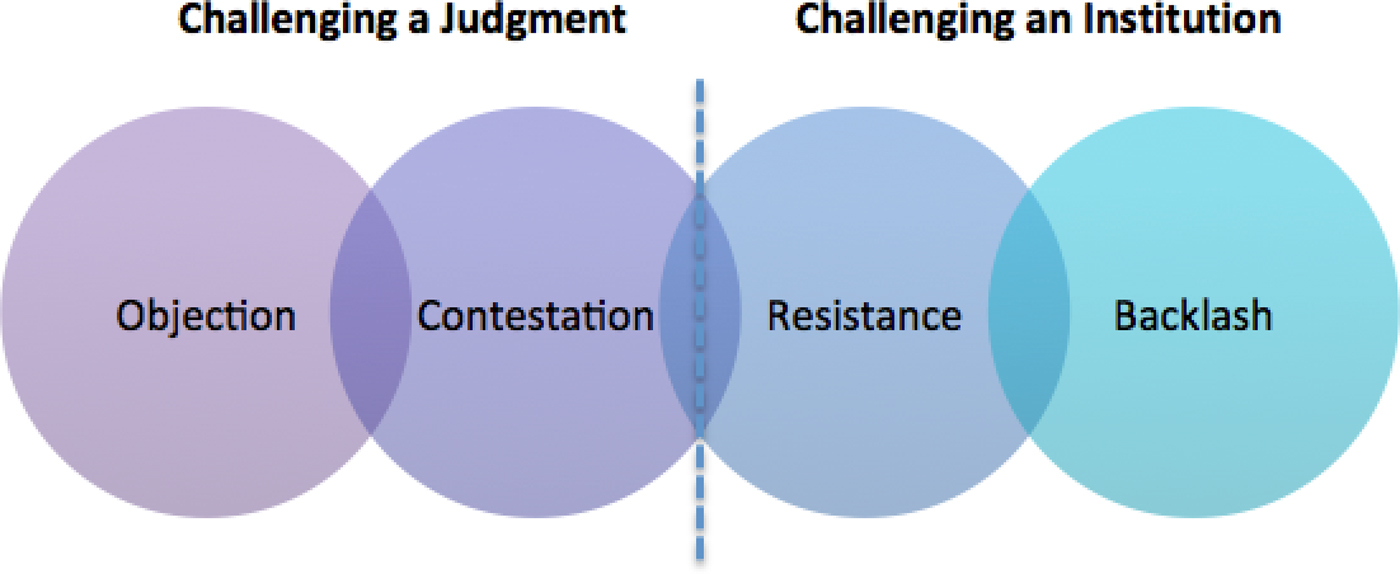
In defining these concepts, we primarily focus on the practice itself and do not distinguish between the sources of critique, meaning that the particular practice of criticism can emerge from all branches of government. Moreover, we share the dominant ideas proposed by the editors of this special issue, in particular the rejection of a linear spiral of escalation, the idea of criticism as a process and the differentiation between ordinary and extraordinary reactions (Madsen et al., Reference Madsen, Cebulak and Wiebusch2018, pp. 9ff.). However in contrast to Madsen et al., we recommend a more fine-tuned conceptualisation, which not only distinguishes between ordinary pushback and extraordinary backlash, but differentiates between four practices of criticism, which differ in their severity and in their object of criticism. The line dividing objection and contestation from resistance and backlash roughly corresponds to the distinction introduced in the framing paper between the categories of pushback and backlash. Whereas objection and contestation are ordinary practices of critique, resistance and backlash are not. The same holds true for the object of criticism; while objection and contestation centre on a particular judgment or the norms applied, resistance and backlash challenge the institution as such. Consequently, in contrast to the framing paper, the term ‘resistance’ does not describe the general practice of criticism, but refers to a particular type of critique that is levelled against an institution.
In Figure 1, on the far left side lies objection as a general category featuring all types of negative reactions towards a particular judgment. The decisive criteria in this group are that the criticism remains rhetorical, does not have imminent consequences on the structure and functioning of the IC and relates to a particular decision. In general, it is limited to the state parties involved in the judicial proceedings. Objections are part and parcel of the adjudicative process.
Practices of criticism.

Second, next to objection stands contestation. Contestation can be defined as an interactive social practice, which involves ‘discursive and critical engagement with norms of governance’ (Wiener, Reference Wiener2014, p. 2), meaning that the criticism is not focused on the judgment anymore, but primarily targets the norm(s) that are embodied in the decision. As this theory stems from social science, it is important to point out that the concept of ‘norm’ goes beyond the scope of a legal norm, since it includes organising principles and standardised procedures. Moreover, according to Nicole Deitelhoff and Lisbeth Zimmermann, one can differentiate between two types of contestatory discourses: on the one hand, norm applicatory discourses deal with the right interpretation and application of a norm; on the other hand, norm justificatory discourses challenge whether the norm as such is valid (Deitelhoff and Zimmermann, Reference Deitelhoff2013, p. 5). Hence, during contestation, the state organs or institutions engaging in it either criticise an order on the grounds of how judges have applied particular norms to the factual situation or they question the validity of the norms applied. The latter type of discourse clearly exceeds the scope of a particular judgment.
Third on the continuum is resistance. This form of criticism does not target a particular norm anymore, but is aimed at the institution as such. However, in contrast to backlash, the state party is still invested in the institution and seeks to reform it from within. For instance, Sandholtz et al. argue that ‘non-cooperation and non-compliance are perennial forms of resistance to international courts’ (Reference Sandholtz, Bei and Caldwell2017, p. 4). Backlash, on the other hand, consists of ‘actions that go beyond resistance and aim to reduce the authority, competence, or jurisdiction of the court’ (Sandholtz et al., Reference Sandholtz, Bei and Caldwell2017, p. 4).
Ultimately, backlash describes only the most severe form of criticism. It can ‘manifest as “intense”, “sustained” and “aggressive” calls for the abandonment of a system or for the adoption of an alternative structure’ (Caron and Shirlow, Reference Caron and Shirlow2016). Hence, we define backlash against ICs as systematic and consistent criticism as well as severe instances of non-compliance. The ‘goal of backlash is not to undo a particular ruling (though it may be triggered by a specific judgment)’ (Caron and Shirlow, Reference Caron and Shirlow2016, p. 1) or to change a particular norm, but rather to undermine the institution, such as by hollowing out its competences or by setting up a parallel institution (Morse and Keohane, Reference Morse and Keohane2014). This means that backlash has to come from the in-group of the institution: the refusal to ratify the jurisdiction of an international tribunal or to join an international treaty in the first place cannot be considered backlash.
2.2 Factors in the emergence of backlash
Different angles exist to analyse, understand and predict the rise of backlash against ICs. Legal scholars, in particular, like to frame backlash as a reaction to the proliferation of a new style of ICs (Oellers-Frahm, Reference Oellers-Frahm, Schabas and Murphy2017), which affect competences long considered to be exclusive to state authorities (Alter, Reference Alter2014). Nowadays, ICs serve more functions than mere dispute settlement; they often stabilise normative expectations, engage in law-making, and control and legitimise public authority (Bogdandy and Venzke, Reference Bogdandy and Venzke2014). In the case of human rights courts, these functions are fulfilled with respect to matters that are fiercely disputed within society (i.e. the provision of amnesties in transitional situations, the application of the death penalty, etc.). This makes them more likely to trigger state criticism. From the available literature in political science and international law, we identified three core arguments, which attempt to explain the emergence of state backlash against human rights courts: the cost of membership, the political system of the state party and the domestic impact of the judgment.
The first core argument to explain the emergence of backlash focuses on the cost of membership. This line of thought posits that the costs associated with membership in international organisations are decisive for the emergence of backlash. Costs are not only defined as financial sanctions or losses, but include non-financial expenses. For instance, Sandholtz et al. differentiate between three types of costs arising from membership in human rights courts:
‘sovereignty costs, regime costs, and adaptation costs. Sovereignty costs refer to perceptions that an international court's decisions intrude upon or excessively compromise a state's control over domestic law, policy, and institutions. Regime costs arise when an international court's judgments undermine the legitimacy of, or otherwise weaken, a specific national government. Adaptation costs occur when a state must take politically costly domestic actions – legislative, judicial, executive, or administrative – in response to international court decisions. Politically costly domestic measures include those that require policy or legal changes that are unpopular with the public.’ (Sandholtz et al., Reference Sandholtz, Bei and Caldwell2017, pp. 4ff.)
The rational choice-logic assumes that a state will remain in a human rights regime as long as the costs associated with membership are in acceptable proportion to the desired benefits. For example, ratifying a human rights treaty, even though it entails sovereignty costs, might be a good option for repressive governments to deflect criticism. Later on, costs may rise, for instance when the domestic human rights situation comes under the spotlight of the international community and opposition activists form alliances with international civil society to press for political change. ‘Backlash is more likely to occur when governments perceive a significant increase in the perceived costs of IHRC [international human rights courts] membership’ (Sandholtz et al., Reference Sandholtz, Bei and Caldwell2017, p. 5).
The second explanation centres on the political system of the state party. Proponents of this line of reasoning argue that a particular orientation of the domestic system facilitates the emergence of backlash against ICs. Many argue that autocracies are more likely than democracies to reject international institutions when they generate negative consequences for the state parties involved, the premise being that autocracies are less likely to suffer from non-financial non-compliance costs such as loss of reputation (Erdmann et al., Reference Erdmann2013; Hathaway, Reference Hathaway2002; Mattes and Rodriguez, Reference Mattes and Rodríguez2014). Recent practice seems to confirm this hypothesis. Russia, Turkey and Venezuela – states with increasing autocratic practices – have openly and loudly challenged the authority of IHRC.
However, this phenomenon is not only restricted to autocratic states. States that have undergone democratic transitions are also at risk of engaging in backlash against international institutions once democratic rule is consolidated. Andrew Moravcsik argues that the governments of newly established democracies voluntarily relinquish parts of their sovereignty to ICs in order to decrease domestic political uncertainty and ‘lock in’ their commitments to international regimes (Moravcsik, Reference Moravcsik2000). The underlying logic of this argument is that states create independent international tribunals to increase the credibility of their commitments in specific multilateral settings (Helfer and Slaughter, Reference Helfer and Slaughter2005). Accordingly, states that just underwent a democratic transition are very committed to their new obligations and less likely to engage in backlash against ICs (Hafner-Burton et al., Reference Hafner-Burton, Mansfield and Pevehouse2008). Nevertheless, this behaviour can change drastically as the democratic system stabilises. Sandholtz et al. claim that, ‘[i]ronically, once states have passed through a transition and achieved some degree of democratic consolidation and respect for basic rights, they may be more sensitive to challenges from international courts’ (Sandholtz et al., Reference Sandholtz, Bei and Caldwell2017, p. 2). In the setting of a consolidated democracy, political leaders no longer fear a return to autocratic politics. In other words, there is no need to stabilise the status quo by means of international obligations anymore. As a result, a ruling of an IC, which harms the domestic interests of political leaders, is more likely to trigger backlash against ICs in consolidated democracies than in new ones.
The third theory argues from the domestic impact of the judgment. In other words, it is argued that state backlash results from the domestic impact of a judgment. For instance, in a comparative study of three regional courts, Alter and Helfer found that it is not expansive judicial law-making per se that increases challenges to the legitimacy of a court, but rather the domestic impact of a particular judgment, which is crucial in triggering criticism (Helfer and Alter, Reference Helfer and Alter2013). In particular, rulings concerning very sensitive domestic policy matters are more likely to trigger state backlash, for instance same-sex marriage or abortion. This is why, in some instances, ICs attempt to refrain from adjudicating on such matters. For example, the dissenting judges in the ECtHR's Hirst judgment argued in favour of a wide margin of appreciation when reviewing the UK's blanket ban on prisoners’ voting in order to take ‘into account the sensitive political character of this issue, the diversity of the legal systems within the Contracting States and the lack of a sufficiently clear basis for such a right in Article 3 of Protocol No. 1’.Footnote 3
We argue that the three factors – cost of membership, the political system of the state party and the domestic impact of the judgment – increase the likelihood of state backlash. However, whether they trigger state backlash also depends on the specific institutional setting. In the following section, we will analyse whether withdrawals or the threat thereof amount to backlash and which of the three factors were prevalent in the context of the IACtHR.
3 Parting ways or lashing back? The case of the IACtHR
The IACtHR is embedded in the regional context of the Americas and the institutional framework of the Organization of American States (OAS). Located in San José, Costa Rica, it started functioning in 1979 to enforce and interpret the provisions of the American Convention on Human Rights (1969), in both contentious cases and advisory opinions. The IACtHR, together with the Inter-American Commission on Human Rights (1959, IACHR) based in Washington, DC, makes up the human rights protection system of the OAS. At the moment of writing, all thirty-five independent states of the Americas are members of the OAS, even though Venezuela gave its notice of withdrawal on 28 April 2017 (effective in 2019). However, only twenty-three OAS state parties have currently ratified the American Convention, and only twenty have accepted the contentious jurisdiction of the Court. The US, Canada and most Anglo-Caribbean states have not ratified the Convention.
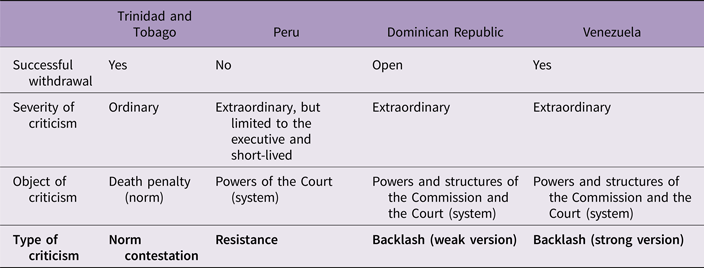
In this section, we examine four cases in which a state party withdrew or threatened to withdraw from the IACtHR. We argue that exiting or threatening to exit the system constitutes a strong challenge to the authority of an institution. There are other challenges to authority, which also hurt an institution, such as reducing funds, refusing to comply with judgments, etc. and they constitute the rich terrain of a future research agenda. As a starting point and from a methodological perspective, withdrawals or threats of withdrawal are easily identified instances of criticism, which can be compared in a most similar cases design (Table 1). Regarding Trinidad and Tobago, state authorities contested the abolitionist stance of the inter-American system's organs towards the death penalty. Peru staged a short-lived incidence of resistance under the Fujimori regime, which was soon overturned by the transitional government. The Dominican Republic lashed back against the Court following a ruling on the obligation to prevent statelessness. Venezuela is the most extreme case of backlash against the IACtHR. The conflict between Venezuela and the inter-American system went on for over a decade and culminated in the complete withdrawal of Venezuela not only from the IACtHR, but also from the OAS.
Overview of threats to withdraw/withdrawal against the IACtHR

3.1 Contesting limitations on the death penalty: Trinidad and Tobago
The IACtHR's first experience with withdrawals or threats of withdrawal came from Trinidad and Tobago in 1998. The overarching contentious point was the application of the death penalty. On the one hand, Trinidadian authorities claimed that the death penalty was part of its long-standing legal tradition and that it enjoyed popular support as a measure to address high criminal rates (Helfer, Reference Helfer2002, p. 1868). On the other, a coordinated strategy of litigation before domestic and ICs was undertaken to ‘challenge aspects of the penalty’ and thus substantially limit its application (Tittemore, Reference Tittemore2004, p. 465). The American Convention on Human Rights does not ban the death penalty; however, it restricts its application and the overall tendency of the system is towards abolition.Footnote 4
An important judgment concerning the application of the death penalty was rendered in 1993 by the Judicial Committee of the Privy Council (Privy Council). This court, which acts as a high court of appeal in the Caribbean Commonwealth countries, considered in Pratt and Morgan Footnote 5 that remaining longer than five years on death row constituted cruel, inhuman and degrading treatment. Accordingly, when this timeframe was exceeded, a death sentence had to be automatically commuted to life in prison. Five years was too short a time for appellate and international review procedures to run their course and meant that, in practice, the death penalty could never be applied. Pratt and Morgan was a determining factor in the chain of events that led to the withdrawal of Trinidad and Tobago from the IACtHR.
The number of applications to the Commission regarding the death penalty increased substantially after the Privy Council decision (Tittemore, Reference Tittemore2004, pp. 471–473). In the following years, Trinidad and Tobago sought the co-operation of the Commission in expediting procedures and asked for assurances that it would deal with these cases within eighteen months – the timeframe that the Pratt and Morgan judgment had considered reasonable for international review. At the time, the Commission argued that it was unable to accommodate this request – despite later modifying its procedure precisely to process the surge in petitions concerning the death penalty (Tittemore, Reference Tittemore2004, p. 502). In its notice of denunciation of 26 May 1998, Trinidad and Tobago claimed that this had been the reason for withdrawal.Footnote 6
On 27 May 1999, one day after the denunciation came into effect, the Court ordered the stay of execution of the petitioners in the case of James et al. until the petition had been handled by the Commission.Footnote 7 Despite this order, ten people were hanged in Port of Spain in the summer of 1999, among them a beneficiary of said provisional measures. Petitions that had been filed before the denunciation became effective were still pending before the Court. However, Trinidad and Tobago stopped cooperating with the IACtHR. Trinidadian authorities refused to submit information regarding the more than thirty persons on death row, who were beneficiaries of provisional measures. Moreover, after challenging the jurisdiction of the Court in the preliminary objections phase, the state declined to participate in hearings, submit written arguments or provide witnesses, and also refused to comply with the judgments against it.
The official reasons given for such a lack of co-operation and participation can be traced back to the preliminary objections raised in 2001 in the case of Hilaire. Footnote 8 Trinidad and Tobago argued that the Court lacked jurisdiction because of a reservation it had formulated in the sense that
‘the Republic of Trinidad and Tobago, recognizes the compulsory jurisdiction of the Inter-American Court of Human Rights … only to such extent that recognition is consistent with the relevant sections of the Constitution of the Republic of Trinidad and Tobago; and provided that Judgment of the Court does not infringe, create or abolish any existing rights or duties of any private citizens.’ (Trinidad and Tobago, ‘Reservations made at the time of adhesion’ (4 March 1991), https://www.oas.org/dil/treaties_B-32_American_Convention_on_Human_rights_sign.htm)
The Court rejected this argument but Trinidadian authorities continued to justify the lack of appearance in the merits stage based on the reservation.Footnote 9
The conflict between Trinidad and Tobago and the inter-American organs began as a case of norm contestation. The dispute did not centre on the existence of the Court nor on its general jurisprudence, but only on the specific matter of the death penalty. This thesis is supported by the fact that Trinidad and Tobago also denounced the additional protocol to the International Covenant on Civil and Political Rights on the Abolition of the Death Penalty and also considered revoking the Privy Council's power to hear appeals on criminal matters. One may argue that norm contestation became resistance when criticism was no longer limited to legal opinion on the death penalty and was then directed at the IACHR. Trinidad and Tobago's ambassador to the OAS is quoted in official documents stating that his country's withdrawal stemmed from the ‘total dissatisfaction and frustration … with the performance of the Inter-American Commission on Human Rights’, which he accused of becoming ‘the tool of those who seek the abolition of the death penalty in Trinidad and Tobago’.Footnote 10 However, the criticism of the inter-American organs was so closely linked to their interpretation and application of this one particular norm that the case of Trinidad and Tobago is still best classified as one of contestation.
3.2 Resistance to the IACtHR in Fujimori's Peru
Only a few months after Trinidad and Tobago announced its denunciation of the ACHR and withdrawal from the jurisdiction of the IACtHR, Peru followed suit. In contrast to Trinidad and Tobago, the dispute between Peru and the IACtHR did not concern a specific issue, but was motivated by domestic political change. In the 1990s, Peru was shaken by an economic crisis and the violent actions of terrorist groups that sought to install a communist Maoist regime. In this tense political climate, Alberto Fujimori was elected as president. His strategy to combat terrorism included forced disappearances of persons, torture and summary executions. Moreover, he slowly started to dismantle checks on his power. For instance, when Congress refused to grant him broad legislative power on economic matters and to fight against subversives, he dissolved it on 5 April 1992 and called for new elections and a new Constitution.
In this part of his tenure, he intervened in the judiciary – dismissing judges and eliminating guarantees of their independence – passed increasingly repressive laws, set up special tribunals to try crimes against alleged terrorists and co-opted the media. The Commission denounced the erosion of democracy in Peru both in its reports and when dealing with individual petitions of persons tried under anti-subversive legislation. Things came to a head on 30 May 1999 when, in Castillo Petruzzi, a case concerning Chilean nationals found guilty of treason, the IACtHR held that the due process rights of the defendants had not been guaranteed and ordered their retrial.Footnote 11 At the same time, two important cases were pending before the Court. One case concerned the removal of three Constitutional Court judges who had ruled that Fujimori could not stand for a third term in office.Footnote 12 The second case, Ivcher Bronstein, dealt with the stripping of Peruvian nationality of the owner of a media outlet that was critical to the president.Footnote 13 Under these circumstances, Peru withdrew the recognition of jurisdiction to the Court on 9 July 1999.
Peru did not intend to denounce the ACHR, but merely wanted to withdraw from the jurisdiction of the IACtHR. The Commission and the Court, however, rejected the possibility of partial withdrawal (Feria Tinta, Reference Feria Tinta2000).Footnote 14 The Court went ahead and ruled on the cases against Peru in its docket. The president of the Court attempted to rally the support of the political organs of the OAS to deal with the Peruvian situation but his efforts were in vain (Cançado Trindade, Reference Cançado Trindade2001a, p. 108; Reference Cançado Trindade2001b, p. 85).
Peru gave various reasons for its decision to withdraw: the infringement of Peru's sovereignty; the Court's distance from a terrorist atmosphere; and its lack of authority to order the modification of laws (Cassel, Reference Cassel1999). Despite being approved by Congress, the decision to withdraw did not enjoy the support of several important domestic political actors. For instance, the Peruvian ombudsman at the time urged Congress and the executive to reconsider their decision. His office drew up a report making the legal case for remaining a party to the Court and compiled all reports and statements against withdrawal prepared by bar associations, universities, the EU and civil society organisations.Footnote 15
Shortly after the decision to withdraw, Fujimori was accused of manipulating election results. Economic conditions in the country worsened and a series of corruption scandals touched his inner circle. Subsequently, Fujimori fled the country and a transitional government took over. Less than two months after Fujimori left power, Congress struck down the legislation on withdrawal from the IACtHR and normalised its relationship with the Court.
At the very end of the Fujimori regime, Peru's reputation was in trouble.Footnote 16 The transitional government considered the ‘return’ to the IACtHR an important measure to regain lost international reputation and to signal a break from the previous regime. The testimony of Javier Pérez de Cuellar, foreign minister during the transitional government, and of Valentín Paniagua, head of the transitional government, in the case of Lori Berenson Mejía, supports this claim.Footnote 17 The relationship between Peru and the IACtHR not only survived this conflict, but it was also significantly strengthened in the course of the democratic transition. As a matter of fact, Barrios Altos, a judgment declaring the ‘lack of effects’ of that country's amnesty law and one of the most far-reaching decisions of the IACtHR, was rendered in 2001.Footnote 18 In Barrios Altos, the Peruvian state recognised all international responsibility and did not offer any type of legal defence for the actions of the previous regime.
The Peruvian decision to withdraw can be considered an instance of resistance against the IACtHR. However, changes in the domestic political situation made resistance short-lived and limited its effects. Although an element of Peruvian criticism of the IACtHR was the Court's stance on due process rights for persons accused of terrorism and the competences that the Court assumed when it exercised judicial review of legislation, the main point of contention was Fujimori's refusal to accept checks on his power. In this situation of creeping authoritarianism, the Court was considered an undesirable influence. The Commission and the Court continued to insist on the international obligation to comply with human rights and rule of law standards – a position that was resisted by those in power but welcomed by many who opposed the regime and its tactics.
3.3 Lashing back over the Haitian question: the Dominican Republic
Similarly to the situation of Trinidad and Tobago, the disagreements of the Dominican Republic with the IACtHR also centred on a specific issue: the granting of Dominican nationality to persons of Haitian background in fulfilment of the obligation to prevent statelessness. The 2014 judgment in Expelled Dominicans and Haitians Footnote 19 generated discontent in that country and triggered a ruling by the Dominican Constitutional Court that has cast a shadow of uncertainty on the legal position of that state vis-à-vis the IACtHR and in unsuccessful attempts to reform it.
Contention centred on the situation of Haitian migrants and Dominican persons of Haitian origin in the Dominican Republic. For generations, the Dominican agricultural sector that relies on migrant labour, coupled with the deplorable economic situation of Haiti, has led hundreds of thousands of Haitians to seek a new home at the other end of the island of Hispaniola. Haitian migrants and their Dominican-born children suffer discriminatory practices regarding access to education, the issuance of identity documents and when registering as Dominican nationals. This raised increased scrutiny by the Commission and the Court. Through country visits, reports, hearings, precautionary measures, petitions and cases, the inter-American organs have consistently called Dominican authorities to account.
Expelled Dominicans and Haitians was the third in a total of four cases against the Dominican Republic that dealt with the situation of Haitians. The previous judgments of the Court had been met with low rates of compliance but had not generated strong reactions from Dominican authorities. A series of factors caused a stronger Dominican response to the judgment. First, the 2010 earthquake and tsunami that hit Haiti led to an even larger influx of Haitian migrants and anti-immigrant sentiment was rife.Footnote 20 Previous cases had also not analysed a 2013 decision of the Constitutional Court that stripped thousands of persons of their Dominican nationality, rendering them stateless (Shelton and Hunneus, Reference Shelton and Huneeus2015, p. 868). The executive attempted to attenuate the effects of this decision by offering a procedure to register as a Dominican national. Applicants were required to submit proof of nationality in a period of eighteen months. However, many thousands of persons of Haitian origin who were born and raised in the Dominican Republic lack identity documents and the procedures to obtain them have proved to be insurmountable for a large number of them.
The judgment condemned these practices of the Dominican Republic in strong terms. The Court held that deportation measures followed logics of racial profiling and were often carried out without any type of due process guarantees. More importantly, it determined that the interpretation of the Constitutional Court on acquisition of Dominican nationality and the regularisation plans of the executive were in contravention of Article 20(1) ACHR, which enshrines the obligation to prevent statelessness. The arguments of the Dominican Republic in the sense that many of these persons could apply for Haitian nationality were dismissed since, in the Court's opinion, the Dominican Republic could not prove that this was indeed a viable option. Moreover, the Haitian legal framework was not unequivocal on whether the foreign-born children of Haitians could obtain nationality.
Tensions between the IACtHR and the Dominican Republic grew when the Constitutional Court issued a ruling on 4 November 2014, declaring that the instrument of recognition of the contentious jurisdiction of the Court did not enjoy congressional approval and was therefore in contravention of constitutional provisions.Footnote 21 Already in 2005, the Attorney General's office had initiated the constitutional review procedure of the instrument of recognition. The judgment of the Constitutional Court revealed that this issue was hotly contested among the Dominican legal community. First, in 2014, the position of the Attorney General's office had changed: it no longer sought the declaration of unconstitutionality, but rather supported the legal position held by the inter-American organs. One of the main arguments was that the instrument of recognition is not an international treaty, but merely an act that is derived from the optional clause of the treaty and hence does not need congressional approval. Second, all amicus curiae interventions (with the exception of one) supported the inter-American position. Third, three judges dissented and appended opinions to the judgment. Judge Jiménez Martínez made clear that the judgment did not reflect sound legal reasoning, but was rather a reaction to Expelled Dominicans and Haitians.
In the aftermath of the Constitutional Court's judgment, high-ranking officials criticised the IACtHR and its recent judgment against the Dominican Republic. The minister of foreign affairs declared that ‘every country has the right to define the mechanism to grant citizenship, … and that a sovereign decision cannot be interpreted under any circumstances as a denial of the respect of human rights’ (El Nuevo Diario, ‘Canciller afirma gobierno demuestra profundo respeto derechos humanos’, 14 November 2014). He added that the Dominican Republic ‘cannot accept the terms of the ruling’. Similarly, former Dominican President Leonel Fernández, who actually signed the instrument of recognition of the contentious jurisdiction of the Court, stated before the OAS in November 2014, that the IACtHR judgment against the Dominican Republic ‘constitutes a clear infringement of the sovereignty of the Dominican Republic’ and ‘that the Dominican State is impeded from complying with the decision’.Footnote 22 He also published a piece in El País, a Spanish newspaper that is widely received among Latin American leaders and intellectuals, denying any discriminatory application of nationality laws or measures leading to statelessness.Footnote 23
The Constitutional Court did not spell out the consequences of its judgment; however, the ruling resonated with the executive. Before the judgment of the Constitutional Court, the minister of foreign affairs had denied any intention of denouncing the Convention.Footnote 24 After the judgment by the Constitutional Court, he expressly considered it an option. This was justified in terms of complying with the domestic constitutional judgment and ultimately safeguarding ‘institutions, the legal order and the separation of powers principle’.Footnote 25 A couple of weeks later, he also questioned the broad powers that the Commission and Court had claimed for themselves and vowed to push for reform of the system.Footnote 26 Those arguments were in line with the recently concluded reform process of the inter-American system (the so-called ‘Strengthening Process’). The general idea put forward by Dominican authorities was that, since the Commission and the Court were created when the region was in the grips of authoritarian regimes and states were now democratic, their ‘design and structure’ needed to be re-evaluated.Footnote 27 Nevertheless, no clear action by the Dominican authorities has been taken to denounce the ACHR. The IACtHR has continued to assert its jurisdiction and has ruled on provisional measures against that country. For its part, the Dominican Republic has stopped appearing before the IACtHR or providing information on compliance with judgments.
The developments following Expelled Dominicans and Haitians fall into the definition of backlash. Although they were brought on by a particular judgment, the discussion does not centre on statelessness and treatment of migrants, but rather on the powers and structure of the Commission and Court. Until now, a lack of domestic support and the unorthodox solution offered by the Constitutional Court's judgment has prevented the Dominican Republic from denouncing the Convention and fully withdrawing from the jurisdiction of the IACtHR. At the regional level, this country's attempt to reopen a recently concluded reform process (the so-called ‘Strengthening Process’) has also failed due to a lack of like-minded allies at the OAS. Nevertheless, the process of backlash is far from over and may yet yield unexpected results.
3.4 Full-blown backlash by the Bolivarian Republic of Venezuela
Venezuela has been the most outspoken critic of the inter-American human rights system so far. Since 2008, the Chávez regime had threatened to withdraw Venezuela from the scrutiny of the inter-American human rights organs. In September of 2012, the Venezuelan Foreign Affairs Minister, Nicolás Maduro, gave formal notice to the Secretary-General of the OAS of his state's denunciation of the ACHR. In the preceding years, the Court had rendered a number of judgments that were heavily criticised by the Venezuelan government: they concerned the lack of independence of the judiciary (arbitrary dismissal of judgesFootnote 28), the curtailment of freedom of expression (closing-down of regime-critical media outletsFootnote 29) and the persecution of political opponents.Footnote 30 Similarly to Peru, Venezuela's contention took place in a context of creeping authoritarianism.
In 2008, almost four years before actually denouncing the Convention, the Constitutional Chamber of the Supreme Court of Venezuela rendered a decision declaring an IACtHR judgment non-executable.Footnote 31 It held that the individual interests of the dismissed judges could not prevail over national sovereignty, understood as the expression of the collective will. The Constitutional Chamber recommended the denunciation of the ACHR. Moreover, the reparations ordered by the Court of San José and the nature of the judgment were challenged. The Chamber also overturned its jurisprudence on the supra-constitutional rank of the ACHR, reversing an important regional trend (Góngora Mera, Reference Góngora Mera2011). Additionally, it introduced a distinction between supranational and international regimes to justify why inter-American decisions are not directly applicable and subject to constitutional control.
Venezuela's criticism of the inter-American human rights system was not directed solely at the IACtHR, but also at the Commission. In 2009, the IACHR published a 300-page report on democracy and human rights in Venezuela that documented the crackdown on political opponents, curbs to freedom of expression, government meddling in the judiciary and other patterns of human rights violations.Footnote 32 This was not the first time the Commission had antagonised the Venezuelan government. For almost a decade, the Commission had included that country in section IV of its annual report, which is dedicated to ‘problem countries’. This became an important point of contention in the broader ‘Strengthening Process’ of the inter-American human rights organs (Cassel, Reference Cassel2014, p. 21).
The activities of both the Commission and the Court were framed by Venezuelan authorities in early 2010 as part of an international conspiracy against that country. The ambassador to the OAS expressed as much when announcing his country's intention to withdraw from the Convention:
‘The constant and incorrigible complicity of the IACHR, not of all its judges, but of most of them, with the destabilizing forces of Venezuelan democracy; the lies, evidenced in the constant defamatory reports on the human rights situation in Venezuela; the politicization and the service to the interests of the inter-American far-right; and of course the empire and American University, a factory of human rights bureaucrats, that are behind all this conspiracy and machinations against our country.’Footnote 33
In the view of Venezuelan leaders, the OAS represented a liberal world order that stood in the way of the so-called Bolivarian revolution – a radical program of political and social transformation spearheaded by socialist president, Hugo Chávez, and supported, to different extents, by other South American leaders, such as Evo Morales of Bolivia and Rafael Correa of Ecuador (Huneeus, Reference Huneeus2012). The actions and statements of Venezuelan public officials evidence the depth of the problem. At a certain point, it was no longer clear whether Venezuela was lashing back against the IACHR or IACtHR per se, or rather against a US-backed and for many years also a US-controlled OAS. For instance, in response to the Commission's country report in 2010, Chávez expressed: ‘it's a mafia, a real mafia, it's just like the OAS, that is why it's a part of the OAS. That is why one day the OAS must disappear’.Footnote 34 More importantly, Venezuela had been setting up parallel institutions, to serve as alternatives to the OAS, for years (Cassel, Reference Cassel2013, pp. 3–4). For example, it set up the Community of Latin American and Caribbean States (CELAC), made up of all OAS states minus Canada and the US and dealing with different aspects of regional economic integration and development; the Union of South American Nations (UNASUR), entrusted with issues of security and democracy; and the Alliance of Bolivarian States (ALBA), an alternative to the Free Trade Agreement of the Americas (Cassel, Reference Cassel2013, pp. 3–4).
In 2011, following the IACtHR's decision on the right to political participation of Leopoldo López, Chávez engaged in another verbal attack of the Court:
‘What kind of importance does that Court even have? It is insignificant…. There might be honest people among its members but I believe that with this decision they are helping the struggle, the dialectics. … The corrupt, dictators, fugitive bankers, they are all protected by the US and by that international system that obeys both imperial power and the bourgeoisie that is part of that power.’Footnote 35
Venezuela finally notified the denunciation of the Convention on 10 September 2012. In its notice of denunciation, it listed and reiterated many of its complaints against the regional human rights organs.Footnote 36 The reasons given for denunciation were manifold: the increased attention that the actions of the Venezuelan state had gained in the preceding decade; their permanent inclusion in Chapter IV of the Commission's annual report; the Commission's supposed recognition of the 2002 coup; a lack of clarity on the grounds justifying precautionary measures; a lack of clarity regarding time-limits before the Commission; the lack of observance of the exhaustion of local remedies rule; and the fact that inter-American judges were recorded agreeing on the general outline of the Usón Ramírez judgment before the state had submitted its written conclusions. Additionally, it was held that the complementary or subsidiary nature of the international human rights protection system had been subverted since domestic constitutional provisions were disregarded, the state was ordered to amend its legislation and the Court had set itself up as a ‘fourth instance’. A common thread running through all of those allegations was the perception of a bias of the inter-American human rights organs against Venezuela's Bolivarian regime.
Both the Court and Commission have mostly remained firm in their stance towards Venezuela. The Commission submitted as many cases as it could before the denunciation of the Convention entered into force. Although the Court adopted a more restrictive take on the exhaustion of local remedies and rejected cases on these grounds in the preliminary objections phase, for example the case of Brewer Carías, it did not revisit any fundamental issues, such as its powers to order legislative measures or the meaning of complementarity. Following withdrawal, Venezuela continued to appear before the IACtHR regarding cases still pending against it but the general situation has markedly deteriorated. The government gained widespread opprobrium in the General Assembly of the OAS for its blatant descent into authoritarianism. Ultimately, pressure from the OAS Secretary-General led to Venezuela's withdrawal from the OAS in April 2017 – the first time a state party has ever willingly exited the OAS.
The case of Venezuela is a textbook example of backlash against the inter-American system. Venezuela's participation in the reform process of the inter-American human rights organs did not demonstrate continued investment in them, but was rather another avenue to undermine them. Moreover, it also engaged in systematic and consistent criticism of the Court and the Commission, refused to comply with several judgments of the Court and set up parallel institutions to replace the OAS. The human rights organs of the OAS were the main targets of Venezuelans’ backlash, as they consistently condemned the authoritarian transformation of the Venezuelan state. In contrast to Peru, where resistance was short-lived and soon reversed by the domestic opposition, Venezuela was successful in creating alliances with like-minded state parties. Moreover, it was able to capitalise on growing discontent with the inter-American human rights system from other state parties, such as Argentina, Brazil and Peru (Huneeus, Reference Huneeus2012).
3.5 Comparative results
The four case-studies revealed that criticism against the IACtHR is fuelled by a variety of factors (Table 2). All three arguments from Section 2, namely costs of membership, domestic political system and domestic impact of the judgments, are reflected in our sample. In all cases, criticism was triggered by a combination of those three factors. Rising costs of membership in the inter-American system was decisive for the Peruvian and Venezuelan backlash. In contrast, the Dominican Republic's ambiguous stance can be explained by the value that important stakeholders in that country still associate with membership in the regional human rights system. Moreover, the influence of the domestic political system may be observed again in the cases of Peru and Venezuela. Where checks and balances are dismantled and the press muzzled, practices of criticism are more likely to be extraordinary and even hostile. While Peru's resistance was very limited in time due to the abrupt departure of that country's strongman followed by a democratic transitional government, which was eager to embrace the inter-American human rights system, Venezuela's descent into authoritarianism escalated the conflict with the IACtHR. For Trinidad and Tobago, and the Dominican Republic, the judgments of the Court concerned sensitive domestic matters: the death penalty and the granting of nationality to the children of migrants. These issues were highly contested in the domestic sphere and the international judgments on the topic were not successful in overcoming deep disagreement.
Categorising practices of criticism against the IACtHR

Ultimately, the empirical analysis revealed that, even though withdrawal or the threat thereof is a fairly strong condemnation of a norm or institution, it is not always synonymous with backlash. The case of Trinidad and Tobago most clearly evinces that a decision to leave an institution is not necessarily an attempt to undermine it. Disagreement over the application of the death penalty was so intractable that exit seemed to be the only alternative. Peru's resistance against the IACtHR is similar, in the sense that its president merely wanted free rein at home and to rid his country of a watchdog he could not control. We see backlash, in a strong and weak variant, in the examples of Venezuela and the Dominican Republican. The critique raised against the inter-American organs goes beyond mere disagreement with norm application or the scope of competencies. To different degrees, both countries have used hostile rhetoric to de-legitimise the inter-American organs and engaged in attempts to substantially weaken their legal powers as well as to modify their mandate and mission. In the following section, we will highlight which institutional factors contributed to the resilience of the IACtHR.
4 Factors of the IACtHR's resilience
For human rights courts in general, and particularly for the IACtHR, criticism is unavoidable. Human rights tribunals are called upon to rule on sensitive domestic matters and to serve as checks on state power. It should not come as a surprise when the exercise of this task generates criticism, resistance, contestation and even backlash. The robust exercise of authority by the IACtHR, in terms of far-reaching interpretations, the legal effects it attributes to its case-law and the remedies it orders (Huneeus, Reference Huneeus2011), makes it particularly vulnerable to criticism on behalf of states. For example, its remedial practice multiplies the risk of adverse reactions: by formulating an array of measures that have to be implemented by different state authorities, the number of parties that can consider themselves to be negatively affected by its rulings multiplies. To make matters more complicated, the Court has not developed doctrines to return issues to the political sphere, such as the margin of appreciation, deference and political question (Núñez Poblete and Acosta Alvarado, Reference Núñez Poblete and Acosta Alvarado2012; see also Odermatt on the avoidance of politically sensitive matters by ICs, this issue).
However, the specific framework of the IACtHR allows innovative starting points to manage state discontent, in particular the two-tiered structure, the alliance with civil society and the presence of compliance partners, namely domestic actors vested with the power to decide whether to comply with a particular judgment (Alter, Reference Alter2014), within states.
First, the existence of the Commission protects the Court from a great deal of criticism. In other words, the Commission acts as a lightning rod that prevents certain instances of criticism from reaching the Court. In contrast to the Court, which normally deals with situations that lie many years in the past, the Commission handles human rights violations in real time. Some cases take up to twenty years to be processed by the Commission (Dulitzky, Reference Dulitzky2013). Moreover, the Commission is much more than the first step in a two-tier human rights protection system. It also holds hearings that are widely accessible to civil society organisations, orders hundreds of precautionary measures a year and publishes thematic or country reports.Footnote 37 In many instances, the Commission is the most uncomfortable actor for states. This was reflected in the 2011–2012 ‘Strengthening Process’ – a reform process of the human rights organs, which took place in the wake of the Venezuelan backlash and after a series of decisions that raised discontent among a very heterogeneous group of states (Cassel, Reference Cassel2013, p. 4). The Working Group came up with fifty-three recommendations. Only three of these were addressed at the Court, the remaining fifty at the Commission.Footnote 38
Second, the influence of civil society in the inter-American system has also played an important role in managing backlash and defusing criticism. Although they are best known for strategic litigation – a large majority of the cases brought to the IACtHR are the product of such strategies – these groupings also fulfil another function. Organised civil society is the most vocal ally of the Commission and the Court when these organs are challenged. Civil society organisations immediately coalesce release statements to the public regarding the threats to the human rights protection system, lobby ambassadors at the OAS, set-up conferences and other discussion fora, and formulate proposals.Footnote 39 The inter-American organs depend on civil society organisations for human rights violations to come to their attention, be it through individual petitions or through thematic or country hearings before the Commission. In turn, civil society organisations depend on the Commission and the Court, either to give credence to their claims or to protect them from the violence and threats that they suffer. Until now, civil society groups have acted as defenders of the Court in times of crisis. In contrast to the situation in Africa, where community secretariats and subregional parliaments played an important role in mitigating backlash (Alter et al., Reference Alter, Gathii and Helfer2016a), the role of the political organs of the OAS and the Secretary-General has been negligible.
Finally, the presence of compliance partners within state structures is a boon in times of backlash. The practice of the IACtHR reveals that it addresses progressive forces within the state (Parra Vera, Reference Parra Vera, von Bogdandy, Ferrer Mac-Gregor, Morales-Antoniazzi and Piovesan2017). Through different means, the Court empowers public actors that share its stance (Soley, Reference Soley, von Bogdandy, Ferrer Mac-Gregor, Morales-Antoniazzi and Piovesan2017, pp. 343ff.) A particular important instrument in this regard is the conventionality control doctrine, which requires all state authorities to ex officio apply the American Convention as interpreted by the Court (Contesse, Reference Contesse2017; Ferrer Mac-Gregor, Reference Ferrer Mac-Gregor, von Bogdandy, Ferrer Mac-Gregor, Morales-Antoniazzi and Piovesan2017). Just as the IACtHR comes to the aid of state authorities when they are under attack by other domestic authorities, these also come to the aid of the Court when its decisions raise negative reactions. Moreover, compliance partners can help to diffuse tension by returning some issues to the domestic sphere and they can reactivate good relationships with the system's organs once the political situation shifts. This was the case in Peru and seems to be the case in Venezuela and the Dominican Republic. The visit that the former Attorney General of Venezuela paid to the IACtHR on 29 August 2017 could be read in this light.
Criticism is not necessarily destructive for an institution. We argue that practices of criticism are a mechanism to express disagreement and thus shed light on possible problems that an institution may have. Ultimately, they can also serve as an impetus for reform and improvement. Our case sample revealed that it is important for the institution to address criticism before it escalates into backlash, but it also showed that some instances of backlash cannot be avoided if the institution in question takes its mandate seriously. For example, placating Peru and Venezuela would have required the Court to ignore systematic meddling in the judiciary, the co-opting of the press and the persecution of political opponents.
Although the occurrence of backlash is rare, once it does occur, spaces to contest the legitimacy of the system are opened up. A good example of this in the inter-American context is the Venezuelan case, which triggered a cascade of state challenges to the authority of the IACtHR, even from states that never threatened to withdraw such as Ecuador or Brazil. Putting the genie back into the bottle is a formidable task and ICs often lack the mechanisms to channel such disagreement. This is where institutional embedding becomes important. Political bodies attached to ICs can serve as channels for voicing discontent and may transform criticism into reform. For example, following the 2011–2012 ‘Strengthening Process’, the procedures for selecting the Secretary of the Commission were revised to make the process more competitive and merit-based; the criteria to grant precautionary measures were clarified; the Commission agreed to more balance in the work of thematic rapporteurships; and to dedicate resources to promotional activities (Cassel, Reference Cassel2014). At the same time, backlash may also give relevant political actors the chance to reaffirm their commitment to an institution. The latest reform process seems to have fulfilled both.
Acknowledgements
We would like to express our gratitude to the organisers of this special issue for the invitation to contribute as well as their very valuable feedback throughout the writing process. Moreover, we are thankful for helpful comments by Jorge Contesse, Andreas Follesdal, Laurence Helfer, the Dienstagsrunde of Armin von Bogdandy and the anonymous reviewer.