Implications
The nutritive and environmental values of plants from natural diversified grasslands are largely unknown. The in vitro rumen fermentation characteristics of some of these plants are different from commonly used forages: they can lead to low methane production and/or low protein degradation through different mechanisms, while sometimes remaining readily digestible. This study provides more knowledge about the use of lesser-known plants as whole plant forage by ruminants, and identifies candidate plants for potential use as additives in the form of plant extracts.
Introduction
A recent analysis suggests that climate change, biodiversity loss and interference with the nitrogen (N) cycle cannot continue without significantly eroding the resilience of major components of Earth system functioning (Rockström et al., Reference Rockström, Steffen, Noone, Persson, Chapin, Lambin, Lenton, Scheffer, Folke and Schellnhuber2009), and the role of livestock production in perturbations of carbon and N cycles is regularly pointed out (Steinfeld and Wassenaar, Reference Steinfeld and Wassenaar2007). One way to enhance the sustainability of animal farming systems is via agroecology-based approaches mobilizing biotic regulations to combine good economic performance and a reduced environmental footprint (Dumont et al., Reference Dumont, Fortun-Lamothe, Jouven, Thomas and Tichit2013). In ruminant nutrition, forage plants should combine high nutritive value and lower pollutant emissions, implying high digestibility and the reduction of energy and N losses in the form of methane (CH4) and urinary urea, respectively.
Permanent grasslands in the French Massif Central exhibit a broad plant biodiversity that provides a number of ecological functions and ecosystem services, such as carbon sequestration, pollinator activity and preservation of patrimonial species (Clergue et al., Reference Clergue, Amiaud, Pervanchon, Lasserre-Joulin and Plantureux2005). The nutritive and environmental values of most of the plants in these grasslands are unknown, and this kind of ecosystem is a reservoir of secondary metabolites potentially helpful for improving animal health and reducing the environmental footprint of ruminant production systems (Makkar et al., Reference Makkar, Francis and Becker2007). For instance, beneficial biological activities of these compounds can be found in the ability of condensed tannins to bind feed proteins, reducing rumen proteolysis and thus improving N use efficiency (Theodoridou et al., Reference Theodoridou, Aufrère, Andueza, Pourrat, Le Morvan, Stringano, Mueller-Harvey and Baumont2010), or in the antiprotozoal property of saponins, allowing the reduction of CH4 production in the fermentation gases (Patra, Reference Patra2010). In addition, some unknown bioactive compounds present in permanent grassland plants may also be active on ruminant digestion.
Investigating the use efficiency of lesser-known plants by ruminants is an important step in achieving a better overview of the nutritive and environmental values of the permanent grasslands according to the species and botanical families present in them. In addition, screening a large number of selected plants that have not been examined before may identify bioactive candidate plants for potential incorporation in forage mixtures or use as plant extracts to manipulate rumen fermentation (Bodas et al., Reference Bodas, López, Fernández, García-González, Rodríguez, Wallace and González2008; Durmic et al., Reference Durmic, Hutton, Revell, Emms, Hughes and Vercoe2010).
The aim of this study was to conduct in vitro rumen fermentation assays on a large number of grassland plants to discriminate them using multiple criteria based on their nutritive value and their potential to reduce CH4 production and protein degradation in the rumen. An analysis by botanical family was also carried out to highlight their relative potentials.
Material and methods
Selection, harvesting and preparation of plant samples
A set of 156 plants was selected in a large wild plant collection gathered in the French Massif Central area, a high plant biodiversity region, from May to September 2008. The plants were chosen because of their habitat in natural grasslands and hedges, and to bring information on plants for which the value for ruminants (nutritive value, digestibility) and the potential pollutant emissions from their digestion are largely unknown. Perennial ryegrass (PRG) was used as a reference, given its common use as forage. Collection and identification of plants were carried out by a botanist with a thorough knowledge of local plants and animal–plant relationships. For each plant species, the aerial parts of several specimens were collected on a same site. Samples were frozen in liquid N within <3 h, stored in a cold box to keep the samples frozen and freeze-dried. One representative sample of each species was ground to pass through a 1-mm sieve, and kept in a dry place out of direct light.
In vitro rumen fermentation assay
The screening assay was carried out by incubating pure plant substrates in cultures of mixed rumen microorganisms. Samples of rumen digesta were collected before the morning feeding from three rumen-cannulated sheep (72±5.6 kg mean BW) fed at maintenance with 1.2 kg of a diet composed of (per kg) 960 g of ryegrass hay, 103 g of barley, 96 g of pulp beet, 24 g of soybean meal, 12 g of molasses, and 5 g of minerals and vitamins, in two equal daily meals at 0800 and 1600 h. The chemical composition of the diet was (per kg dry matter (DM)) 935 g organic matter (OM), 642 g NDF, 361 g ADF and 160 g CP. The animals were adapted to the diet 2 weeks before the beginning of in vitro experiments and had free access to water and salt block supplement (Sel’pur, Salins, Paris, France). In vitro incubations were performed as described by Niderkorn et al. (Reference Niderkorn, Baumont, Le Morvan and Macheboeuf2011). In brief, 600±0.5 mg DM of pure substrate was weighed into 120 ml serum bottles (Wheaton, Millville, NJ, USA) previously warmed to 39°C and flushed with N2, and 40 ml of a mixture of phosphate–carbonate buffer solution and strained rumen fluid (2/1, v/v) was added. N in the buffer media was only provided by cysteine (0.598 mg N/batch in all the batches). The bottles were sealed and placed in a shaking water bath at 39°C for 24 h. The medium was agitated intermittently using a magnetic bar (300 r.p.m. for 30 s and then a resting period of 2.5 min). All 156 plants were tested in three fermentation runs (52 plants per run) and all the incubations were performed in triplicate on separate days (total of nine runs). For each run, three bottles containing PRG and three blanks containing the buffered rumen fluid without substrate were included.
Sampling and analytical procedures
Plant substrates were analyzed for DM by oven-drying at 103°C for 48 h, and for OM by ashing at 550°C for 6 h in a muffle furnace. Plant NDF and ADF were analyzed according to the method described by Van Soest et al. (Reference Van Soest, Robertson and Lewis1991) using a Fibertec analyzer (Foss Analytical, Hillerød, Denmark). Total CP in plants was determined by the Dumas combustion method (Association of Official Analytical Chemists, 1995) using a Leco-FP428 nitrogen analyzer (Leco Corp., St. Joseph, MI, USA). At 24 h of incubation, gas production was recorded using the pressure transducer technique, as described by Theodorou et al. (Reference Theodorou, Williams, Dhanoa, McAllan and France1994), and a headspace sample was collected in a syringe for gas composition analysis (CH4, CO2 and H2) by GLC, as described by Macheboeuf et al. (Reference Macheboeuf, Morgavi, Papon, Mousset and Arturo-Schaan2008). The content of each serum bottle was transferred into a pre-weighed 50 ml Falcon tube, and the pH was immediately measured. Tubes were centrifuged at 2000×g for 10 min at 4°C. Aliquots of supernatant were sampled for volatile fatty acids (VFA) analysis using GLC as described by Broudiscou and Lassalas (Reference Broudiscou and Lassalas2000), and for ammonia (N–NH3) analysis using the Berthelot reaction (Chaney and Marbach, Reference Chaney and Marbach1962). The residue containing non-degraded particles was autoclaved in neutral detergent solution at 110°C for 40 min to remove solid-associated bacteria, washed and oven-dried. OM was determined as described above for forages. This procedure allowed the further calculation of the in vitro true OM digestibility (IVTOMD).
Calculations and statistical analysis
The means of blanks per run were subtracted from values obtained for plants to calculate the net production of VFA and N–NH3, and the organic matter truly digested (OMTD) for the determination of IVTOMD. Hydrogen (H2) recovery was calculated as the proportion of H produced by fermentation of substrate carbohydrates and amino acids that is utilized in the formation of end products (Demeyer, Reference Demeyer1991): 2H recovery=2H utilized/2H produced, with 2H utilized=2P+2B+4CH4+4V+H+2O and 2H produced=2A+P+4B+3V, where A, B, H, P, V are the net molar amounts of acetate, butyrate, hydrogen, propionate and valerate produced, respectively. O is concentration of oxygen in the headspace of fermentor that was quickly consumed at the beginning of fermentation and always below 2% because of the N2 flush of batch before the run. The data shown in the tables and figures for individual plants are means of values obtained in the three fermentation runs. Statistical differences (P<0.05) between individual plants and PRG used as reference were examined by one-way ANOVA followed by Dunett’s test using the Statistical Analysis System software package (version 9, SAS Institute Inc., Cary, NC, USA). The general model used was Y i =µ+ε i , where Y i is the dependent variable, µ the overall mean and ε i the residual error.
Results
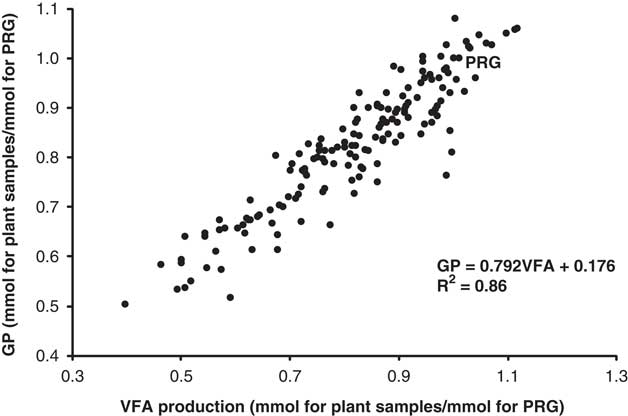
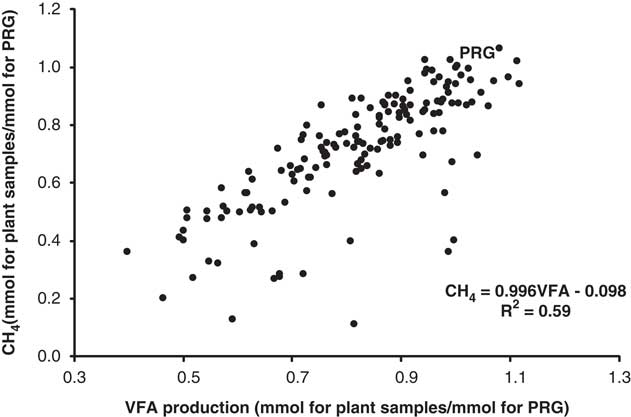
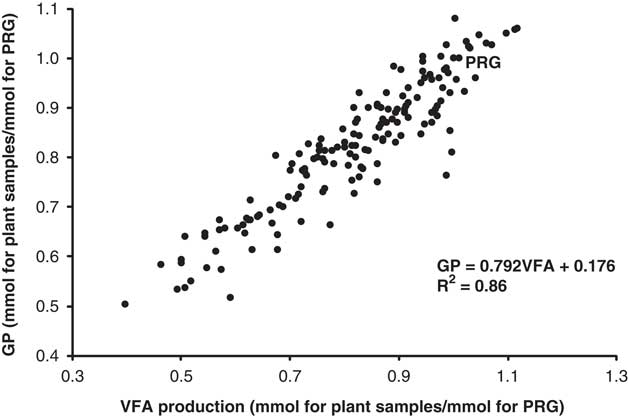
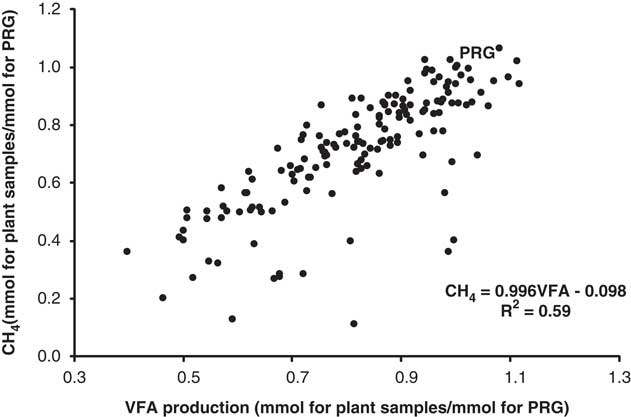
The chemical composition, growth stages and botanical families of plants screened (n=156) are reported in Table 1. Taking all the plants tested, there was a weak correlation between IVTOMD and NDF (r 2=0.56) and ADF contents (r 2=0.53), and between N–NH3 concentration in the medium and CP content (r 2=0.49). There was no correlation between CH4 production and NDF (r 2=0.02) or ADF contents (r 2=0.01). As expected by the stoichiometry of fermentation, there was a close positive correlation between VFA and total gas production at 24 h incubation (r 2=0.86; Figure 1), whereas the positive correlation between VFA and CH4 production was weaker (r 2=0.59; Figure 2). This difference was due to 12 plants in which the CH4 production per unit of VFA was appreciably lower than the others.
Relationship between total gas production (GP) and volatile fatty acids (VFA) production (mmol for plant samples/mmol for perennial ryegrass (PRG) used as reference) after 24 h incubation.
Relationship between methane (CH4) production and volatile fatty acids (VFA) production (mmol for plant samples/mmol for perennial ryegrass (PRG) used as reference) after 24 h incubation.
Scientific names, chemical composition, growth stages and botanical families of the plant samples tested (n=1)

DM=dry matter; OM=organic matter; nd=not determined.
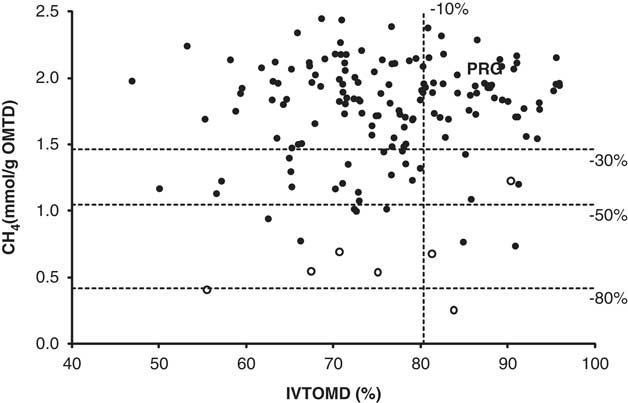
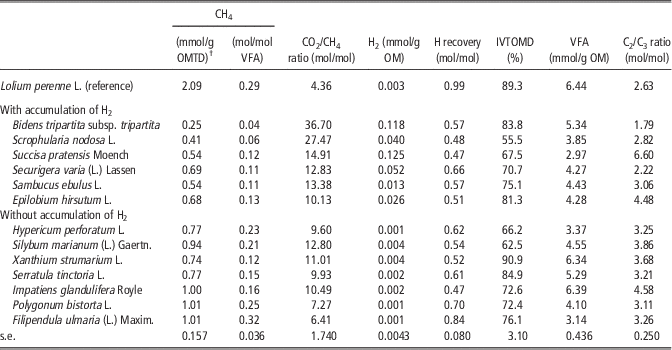
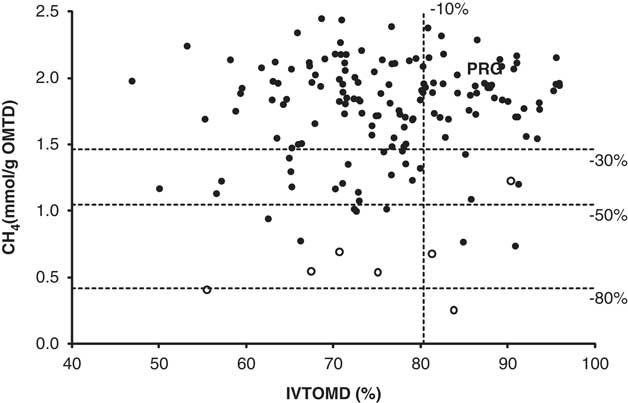
When CH4 production was expressed per unit of OMTD, 34 plants produced 30% less, 13 plants 50% less and 2 plants (Bidens tripartita subsp. tripartita and Scrophularia nodosa L.) 80% less than PRG (Figure 3). The plants producing 15% less CH4 than PRG were significantly different from PRG (P<0.05). Among the 13 plants producing 50% less CH4 than PRG, 6 showed an accumulation of H2 in the fermentation gases after 24 h incubation, and one (B. tripartita subsp. tripartita) showed an acetate/propionate ratio significantly lower than PRG (P<0.001; Table 2). There was no correlation between IVTOMD and CH4 production (r 2=0.01). Interestingly, four species (B. tripartita subsp. tripartite, Epilobium hirsutum L., Xanthium strumarium L. and Serratula tinctoria L.) showed simultaneously low levels of CH4 production and IVTOMD higher than 80%. Among these species, only E. hirsutum L. was significantly lower than PRG for IVTOMD (P<0.05).
Distribution of plants tested according to methane (CH4) production (expressed in mmol/g organic matter truly digested (OMTD)) and in vitro true organic matter digestibility (IVTOMD). (●) represents plants with an H2 accumulation lower than 7.5 µmol/g organic matter (OM), and (○) represents plants with an H2 accumulation higher than 7.5 µmol/g OM. Plants producing 15% less CH4 or having IVTOMD 10% lower than perennial ryegrass (PRG) were significantly different from PRG (P<0.05).
Explicative fermentation parameters for plants producing 50% less methane (CH4) than perennial ryegrass (Lolium perenne L.) (n=3)
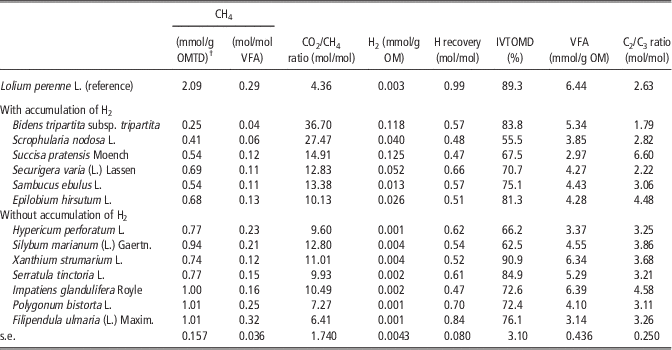
IVTOMD=in vitro true organic matter digestibility; OMTD=organic matter truly digested; VFA=volatile fatty acids; C2/C3=acetate/propionate.
† All the plants were significantly different (P<0.05) of Lolium perenne L. for CH4 production.
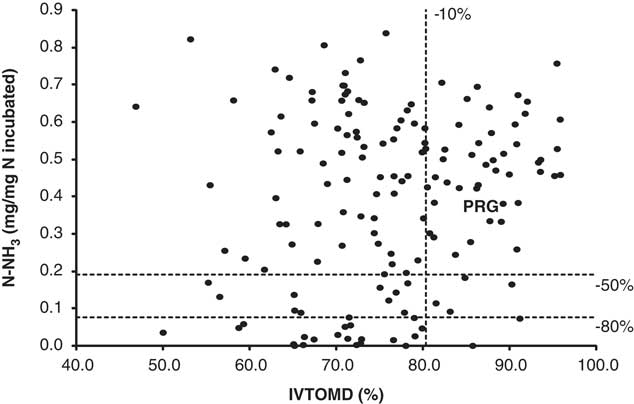
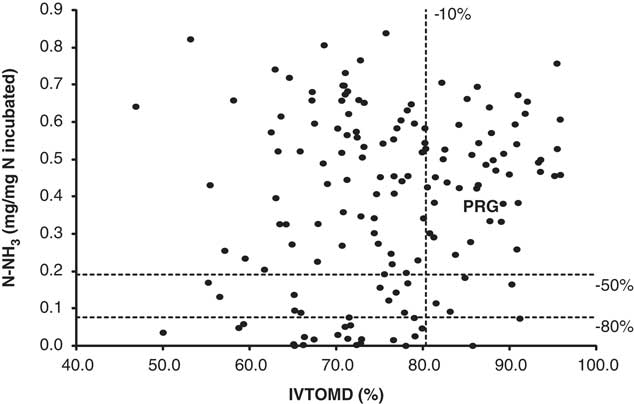
Among the 156 plants tested, the concentration of N-NH3 per unit of N incubated at 24 h incubation was 50% less than PRG for 37 plants, and 80% less than PRG for 23 plants (Figure 4). The plants producing 25% less N–NH3 than PRG were significantly different from PRG (P<0.05). For six plants (Oenothera biennis L., Polygonum hydropiper L., Hypericum perforatum L., Polygonum bistorta L., Actaea spicata L. and Sanguisorba officinalis L.), N–NH3 concentration in the medium was nil or <0.005 mg/mg N.
Distribution of plants tested according to in vitro true organic matter digestibility (IVTOMD) and ammonia (NH3–N) concentration (mg/mg N incubated) in the incubation medium. Plants producing 25% less NH3–N or having IVTOMD 10% lower than perennial ryegrass (PRG) were significantly different from PRG (P<0.05).
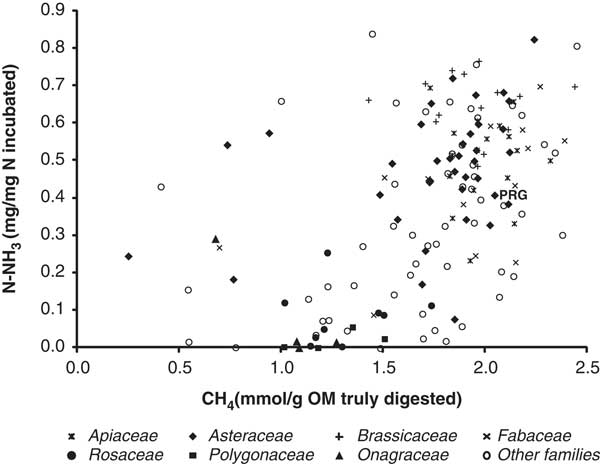
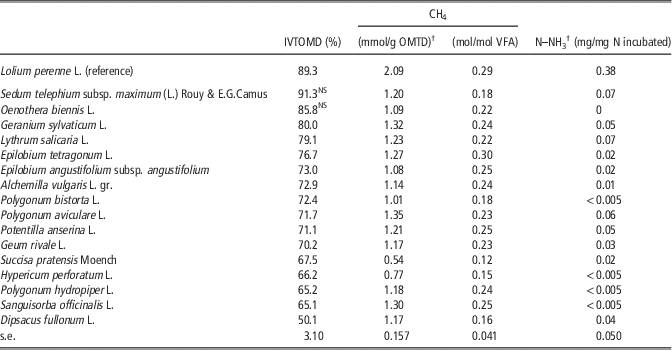
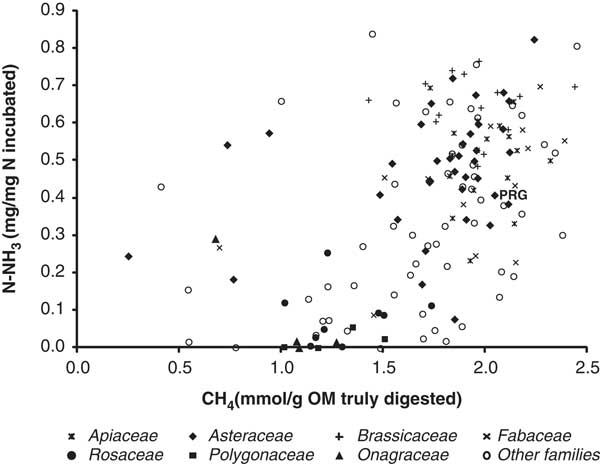
Among the plants tested, 16 produced simultaneously 30% less methane (CH4) and 80% less N–NH3 than PRG (Table 3). Interestingly, the three species of Polygonum and two of the three species of Epilobium were in this list of plants. The analysis of the results according to botanical family (for families with n>3), showed that the Rosaceae (n=9), Polygonaceae (n=4), Dipsacaceae (n=4) and Onagraceae (n=4) produced simultaneously low levels of CH4 (on average, 1.31±0.21, 1.26±0.18, 1.28±0.48 and 1.03±0.22 mmol/g OMTD, respectively) and N–NH3 (on average, 0.09±0.07, 0.02±0.02, 0.08±0.08 and 0.08±0.12 mg/mg N incubated, respectively) (Figure 5). Among these families, IVTOMD for the Onagraceae (on average, 79.2±4.8%) was higher than for the other three families (on average, from 61.1±7.3% to 69.5±6.7%).
Distribution of botanical families tested according to in vitro methane (CH4) production and ammonia (NH3–N) concentration (mg/mg N incubated) in the incubation medium. Plants producing 15% less CH4 or 25% less NH3–N than perennial ryegrass (PRG) were significantly different from PRG (P<0.05).
Selection of plants producing simultaneously 30% less methane (CH4) and 80% less ammonia (N–NH3) than perennial ryegrass (Lolium perenne L.) (n=3)
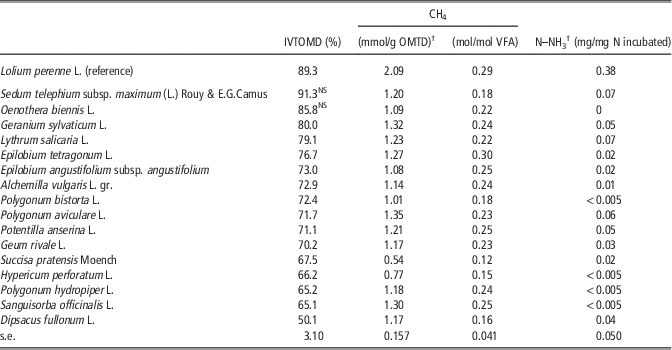
IVTOMD=in vitro true organic matter digestibility; OMTD=organic matter truly digested.
NSFor IVTOMD, these plants were not significantly different (P<0.05) of Lolium perenne L.
† All the plants were significantly different (P<0.05) of Lolium perenne L. for CH4 and N–NH3 production.
Discussion
Enhancing biological diversity in agricultural production systems is an important principle in agroecology, including when applied to animal production. Besides a number of ecosystem services, grassland plant diversity helps to strengthen the resilience of ruminant production by securing the feeding system against seasonal and long-term climatic variability, so maintaining animal performance (Dumont et al., Reference Dumont, Garel, Ginane, Decuq, Farruggia, Pradel, Rigolot and Petit2007). Plants from diversified grasslands can potentially contain bioactive compounds such as secondary metabolites that may interfere, especially with methane production (Patra and Saxena, Reference Patra and Saxena2010) and proteolysis in the rumen (Selje et al., Reference Selje, Hoffmann, Muetzel, Ningrat, Wallace and Becker2007). The plants tested for this study were selected because their nutritive value and their ability to impact the digestive processes, especially energy and N metabolisms, were largely unknown. Some of these plants are abundant in natural pastures and are potentially consumed in large amounts by grazing ruminants. They are also candidates for plant extracts useful as rumen fermentation manipulators.
In this study, the fermentation of a large majority of the tested plants produced less, and sometimes much less CH4 per unit of OMTD than PRG. The strong correlation between total gas and VFA productions, the weaker correlation between CH4 and VFA productions, and the absence of any correlation between fiber content and CH4 production showed that the fermentation of some plants resulted in a deviation from the stoichiometry relationship. It is well established that the formation of VFAs during rumen fermentation largely determines the production of H2, a part of which is subsequently converted to CH4 by the methanogenic Archaea. This demonstrates that the CH4 production for these plants is not only related to their fermentable OM content, but is also modulated by plant bioactive compounds. In the next part of this paper, CH4 production will be expressed per unit of OMTD to give a better overview of specific antimethanogenic properties and trade-off between nutritive value and CH4 production.
Different mechanisms seem to occur among the plants giving the lowest CH4 production. Demeyer (Reference Demeyer1991) reported that the H2 recovery for forages varies between 0.78 and 0.96 mol/mol. Among the 13 plants producing 50% less CH4 than PRG, 12 had H2 recovery lower than 0.78. This result obviously indicates that the usual pathways of H2 utilization were inhibited during the fermentation of these plants. Interestingly, the six plants giving at least 65% less CH4 than PRG accumulated H2 in the fermentation gases. This clearly demonstrates that methanogenesis was at least partially ineffective, although the substrates (CO2 and H2) were present. The fermentation of B. tripartita subsp. tripartita resulted simultaneously in the lowest CH4 production and the lowest acetate : propionate ratio among the 156 plants tested, and a large accumulation of H2. This plant, which is also highly digestible, clearly inhibited methanogenesis and redirected rumen fermentation toward the propionate pathway using a part, but not all, of accumulated H2. B. tripartita is known to contain significant amounts of tannins, flavonoids, xanthophylls, volatile oil, acetylene, sterols, aurones, chalcones and caffeine. It has medicinal properties including antiseptic effects, and is relatively safe toxicologically in mice (Sandu et al., Reference Sandu, Tarţău, Miron, Zagnat, Ghiciuc and Lupuşoru2012). Two other plants showed similar fermentation characteristics in terms of low CH4 production, H2 accumulation and low acetate : propionate ratio, Securigera varia (L.) Lassen and S. nodosa L., the latter containing iridoid glycosides with antimicrobial effects (Sesterhenn et al., Reference Sesterhenn, Distl and Wink2007). Two plants, Succisa pratensis Moench and E. hirsutum L. accumulating H2 had a different fermentation profile, as the acetate : propionate ratio was high. For these plants, a part of accumulated H2 due to the antimethanogenic effect may have been integrated in the microbial biomass.
When H2 accumulates in the rumen, sinks are needed to maintain an effective functioning of the rumen fermentation. Several alternative strategies to sink H2 have been reported. Stimulating hydrogenotrophic acetogenic bacteria naturally present in the rumen allows the conversion of CO2 and H2 to acetate, which is not an energy loss like CH4 (Morvan et al., Reference Morvan, Dore, Rieu-Lesme, Foucat, Fonty and Gouet1994), for instance, by adding probiotic strains (Chaucheyras et al., Reference Chaucheyras, Fonty, Bertin and Gouet1995). Organic acids such as fumarate and malate are propionate precursors via the succinate pathway, which utilizes H2. When methanogens are fully operational, these two strategies are usually not very efficient due to the ability of methanogens to outcompete with acetogens (McAllister and Newbold, Reference McAllister and Newbold2008) or because the reduction of fumarate is thermodynamically less favorable than methanogenesis, respectively. However, in the situation when methanogens are previously inhibited by bioactive plants and subsequent accumulation of H2 in the rumen, these complementary strategies could be more relevant. Another way to remove accumulated H2 is to add nitrate or sulfate, which act as H2 sinks during their reduction in the rumen (Van Zijderveld et al., Reference Van Zijderveld, Gerrits, Apajalahti, Newbold, Dijkstra, Leng and Perdok2010). However, nitrates would have to be utilized with caution due to the possible toxic effects of nitrite, an intermediate formed during the reduction of nitrate to NH3.
From a more practical point of view, intake of these plants in grasslands, as an ingredient in a total ration or in the form of plant extract may curb methanogenesis and redirect H2 toward more favorable fermentation pathways. For the plants producing low levels of CH4 and not accumulating H2 (H. perforatum L., Silybum marianum (L.) Gaertn., X. strumarium L., S. tinctoria L., Impatiens glandulifera Royle, P. bistorta L. and Filipendula ulmaria (L.) Maxim), microbial biomass may have acted as an H2 sink or the H2 production may have been partially inhibited, for instance, through an antiprotozoal effect (Morgavi et al., Reference Morgavi, Forano, Martin and Newbold2010).
To our knowledge, very little screening of plants has been carried out to identify species inhibiting rumen proteolysis. Selje et al. (Reference Selje, Hoffmann, Muetzel, Ningrat, Wallace and Becker2007) tested 500 plants using an in vitro test based on the digestion of 14C-labeled casein in the presence of rumen digesta, and found five plants that were particularly promising. In four of these, inhibition of proteolysis was due to the formation of insoluble tannin–protein complexes, whose role in the inhibition of protein digestion is well known, and by another unknown mechanism for Knautia arvensis. However, the inclusion of 12% K. arvensis in the concentrate of growing–fattening lambs had no significant effects on feed utilization or performance (Bodas et al., Reference Bodas, Giráldez, Rodríguez, Wallace, González and López2011).
In our screening, the fermentation of a number of plants produced <50% N–NH3 per unit of N incubated compared with PRG, suggesting that their intake by ruminants could result in less urinary N loss. For these plants, a greater proportion of dietary protein reaching the small intestine could be expected or a greater proportion of N–NH3 could be captured for use in microbial protein synthesis in the rumen, a key strategy to increase N use efficiency (Calsamiglia et al., Reference Calsamiglia, Ferret, Reynolds, Kristensen and Van Vuuren2010). Some of these plants are known to contain tannins, and it is likely that low N–NH3 concentrations were due to these bioactive compounds. For instance, the tannin–protein precipitation capacity of Epilobium angustifolium subsp. angustifolium, was clearly demonstrated using microplate gel filtration in the previous study (McArt et al., Reference McArt, Spalinger, Kennish and Collins2006). However, the antiproteolytic mode of action for most of the plants for which N degradation was inhibited in our study remains unclear.
Plants giving simultaneously low levels of CH4 and N–NH3 as fermentation end-products are particularly promising. If in addition, plants have high values of IVTOMD and are common and competitive in grasslands, and so potentially consumed in significant amounts by ruminants, such as Geranium sylvaticum L. (Pacha and Petit, Reference Pacha and Petit2008), they are of interest for use as whole plant forage from both production and environmental points of view. Conversely, plants whose main habitat is not in grasslands or whose IVTOMD is low, could be more useful as plant extracts. The three species of Polygonum tested and two species of Epilobium were among the plants yielding simultaneously low levels of CH4 and N–NH3, respectively. Polygonum species that were efficient in our study have previously been shown to have various biological activities including antioxidant or antiparasitic effects due to their high phenolic and flavonoid contents (Kim et al., Reference Kim, Woo and Park1994; Peng et al., Reference Peng, Strack, Baumert, Subramaniam, Goh, Chia, Ngin Tan and Chia2003; Hsu, Reference Hsu2006). Epilobium species have been shown to have high antimicrobial activity (Battinelli et al., Reference Battinelli, Tita, Evandri and Mazzanti2001) and high macrocyclic tannin contents, mainly of oenothein. A literature search reveals that Polygonum and Epilobium are commonly used as traditional medicinal plants (Wojdyło et al., Reference Wojdyło, Oszmiański and Czemerys2007).
Considering botanical families, the Onagraceae, mainly represented by the Epilobium species, showed simultaneously all the beneficial effects conducive to combining production and environmental advantages: high IVTOMD, and low CH4 and N–NH3. The Polygonaceae, mainly represented by Polygonum species, the Rosaceae and the Dipsacaceae showed similar favorable profiles to the Onagraceae, except for IVTOMD, which was lower. However, the number of species tested per botanical family was too low to generalize these observations. The presence of bioactive compounds in Epilobium and Polygonum species, as described above, could to a large extent explain the results obtained in the analysis by botanical family. However, the practical use of candidate bioactive plants will depend on their agronomic characteristics, palatability, possible toxicity for animals and long-term effects in vivo.
Conclusion
Our findings highlight the potential of some species and botanical families to reduce CH4 emissions and rumen ammonia production, and some of them additionally had high digestibility. It is likely that different antimethanogenic effects occurred, because the gas composition and VFA profiles were different among efficient plants. For most of the plants showing the lowest CH4 productions, values of H2 recovery indicated that the usual pathways of H2 utilization were inhibited. However, the exact nature of the underlying mechanisms and dose–response effects leading to beneficial outcomes remains to be determined.