1 Introduction
The classification of holomorphic univariate parabolic germs up to local change of analytic coordinate was first described by Birkhoff [Reference BirkhoffBir39] in 1939, but the manuscript was somehow forgotten almost immediately to be rediscovered only by the end of the century. In the meantime, Écalle [Reference ÉcalleÉca75] and Voronin [Reference VoroninVor81] carried out this task again nearly forty years ago. In addition to building a modulus (characterizing the conjugacy class of a parabolic germ), they were able to solve the inverse problem by recognizing which similar objects came as the moduli of parabolic germs, a property G. Birkhoff was only able to conjecture. The latter problem is what interests us in the present paper.
1.1 Modulus of classification and inverse problem
Heuristically, if
 $\Delta $
is a germ that is tangent to the identity and fixes
 $0\in \mathbb {C}$
,

then the conformal structure of its orbit space
 $\Omega $
completely encodes its analytic class up to local changes of analytic coordinate near the fixed point. For the sake of simplicity, assume that
 $\Delta $
is generic, that is, that it belongs to the space

(here and in everything that follows,
 $*$
stands for a non-zero complex number).
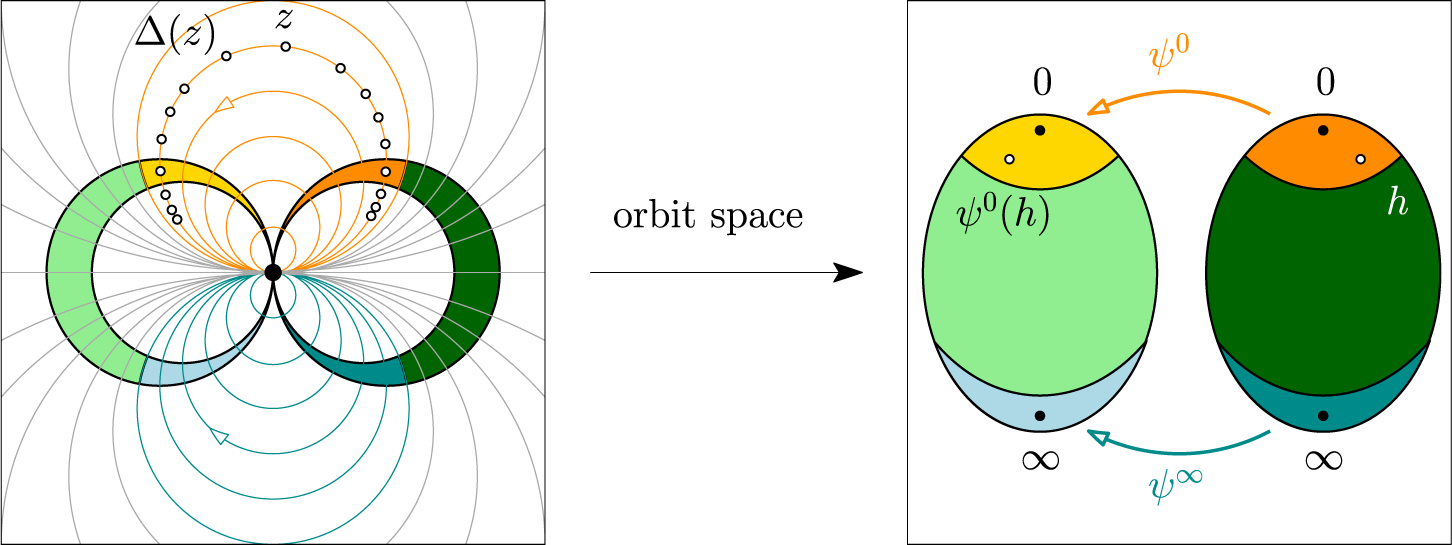
Fundamental region of the dynamics of a generic parabolic germ (left) and the corresponding orbit space and horn maps (right) (colour online).

It is well known that a fundamental region for the iterative action of
 $\Delta $
is given by a pair of crescent-shaped regions that are identified by the dynamics near their horns, attached at the fixed point
 $0$
. More precisely, as dipicted in Figure 1, the orbit space

is obtained as the gluing of two spheres
 $\overline {\mathbb {C}}$
near
 $0$
and
 $\infty $
by germs of a diffeomorphism
 and
 , sometimes called horn maps:

When we endow the space  with the quotient topology, the two points
 $0$
and
 $\infty $
(corresponding to the fixed point of
 $\Delta $
) are not separated.
One can choose conformal coordinates on the spheres so that  itself becomes tangent to the identity. The only degree of freedom that remains is the linear change of coordinates
 $h\mapsto ch$
for
 $c\in \mathbb {C}^{\times }$
applied simultaneously to both spheres. The Birkhoff–Écalle–Voronin (BÉV) theorem (see aforementioned bibliography) states that the map

is well defined and one-to-one. The Écalle–Voronin theorem states that it is also onto, answering the inverse problem.
Problem. Being given a pair  , recover (synthesize) a parabolic germ
 $\Delta $
such that its modulus is
 .
In the present article, we revisit the question and provide an essentially unique representative
 $\Delta $
for a given pair
 , what can be called a normal form. The germ
 $\Delta $
will be ‘global’ on the sphere
 $\overline {\mathbb {C}}$
in some sense, which is why we borrow Écalle’s terminology and speak about spherical normal forms.
1.2 Statement of the main results
We answer the inverse problem in the following fashion.
Synthesis Theorem. For fixed
 $\mu \in \mathbb {C}$
and positive
 $\unicode{x3bb}>0$
, define the rational vector field (holomorphic near
 $0$
and
 $\infty $
), called here the formal model,
 $$ \begin{align*} X_{0}(z) :=\frac{1-z^{2}}{1+z^{2}}\times\frac{\unicode{x3bb} z^{2}}{1+\mu\unicode{x3bb} z-z^{2}}\frac{\partial}{\partial z}, \end{align*} $$
and denote by
 $f\mapsto X_{0}\cdot f$
the associated Lie (directional) derivative on a power series. Let
 be given and pick
 $\mu $
so that
 .
One can then find an explicit
 $\unicode{x3bb} (\psi )>0$
such that for each
 $0<\unicode{x3bb} \leq \unicode{x3bb} (\psi )$
, there exists a unique formal power series
 $F\in z\mathbb {C}[[z]] $
, depending on
 $\unicode{x3bb} $
and satisfying all of the following properties.
-
(1) The time-
 $1$
map
$\Delta $
of the formal vector field, said to be in spherical normal form, is a convergent power series at
$$ \begin{align*} X_{F}:= \frac{1}{1+X_{0}\cdot F}X_{0}, \end{align*} $$
$0$
(that is, with positive radius of convergence).
-
(2)
$\Delta $
belongs to with -
(3) The power series F is
$1$
-summable (see below) and its 1-sum can be realized as a pair
$(f^{+},f^{-})$
of functions holomorphic and bounded by
$1$
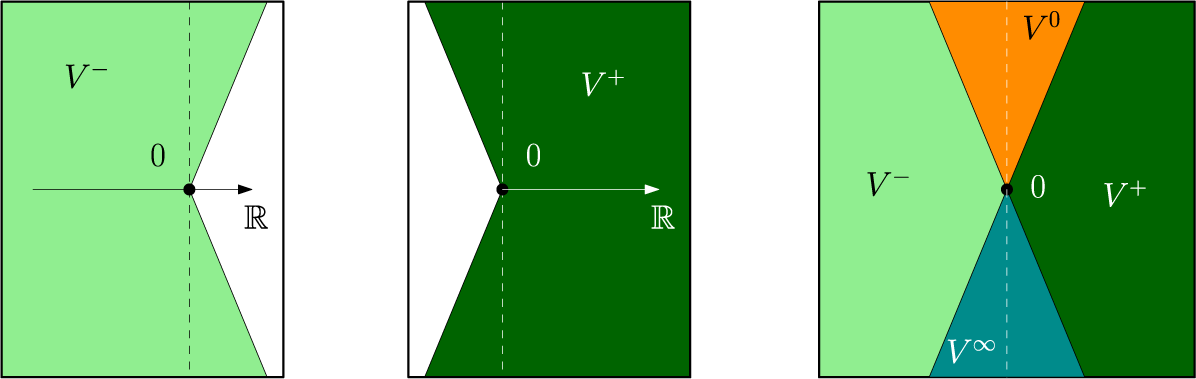
on the respective infinite sectors as in Figure 2.
$$ \begin{align*} V^{\pm} :=\bigg\{ z\neq0:\lvert\ \arg(\pm z)\rvert<\frac{5\pi}{8}\bigg\} \end{align*} $$
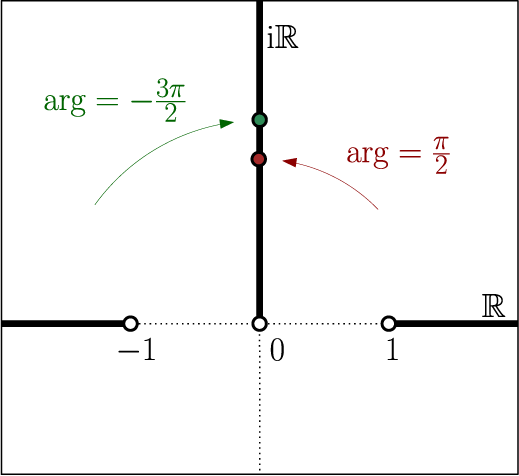
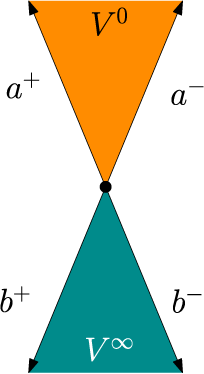
Figure 2The infinite sectors
$V^{\pm }$
and the components , of their intersection
$V^{\cap }$
(colour online).


 with


 ,
 of their intersection


A pair
 $f=(f^{+},f^{-})$
of functions holomorphic on the corresponding sector
 $V^{+}$
or
 $V^{-}$
has order-1 flat discrepancy at
 $0$
whenever
 $$ \begin{align*} \limsup_{\begin{array}{l} z\to0\\ z\in V^{\cap} \end{array}}|z|\ln|f^{-}(z)-f^{+}(z)|\in\ ]{-}\infty,0[, \quad V^{\cap}:=V^{+}\cap V^{-}. \end{align*} $$
It follows from a theorem of Ramis and Sibuya [Reference Loday-RichaudLR16, Theorem 5.2.1] that there exists some
 $F=\sum _{n\geq 0}F_{n}z^{n}\in \mathbb {C}[[z]] $
, which is their common Gevrey-1 asymptotic expansion at
 $0$
(in the sense of Poincaré):
 $$ \begin{align*} (\text{there exists } C>0)&(\text{for all } N\in\mathbb{N}) (\text{for all } z\in V^{\pm})\\&\bigg|f^{\pm}(z)-\sum_{n>0}^{N}F_{n}z^{n}\bigg|\leq C(N+1)!|z|^{N+1}. \end{align*} $$
We then say that F is
 $1$
-summable with
 $1$
-sum f. The mapping
 $f\mapsto F$
is injective (because
 $V^{\pm }$
is wider than a half-plane). This notion is compatible with the usual arithmetic and differential operations (by taking a narrower subsector if necessary).
Remark 1.1. The notion of
 $*$
-summability has a standard, more general definition (see e.g. [Reference Loday-RichaudLR16]) allowing for more flexibility. We will not need the whole refinement of the theory as we only rely on this specific implementation of the theorem of Ramis and Sibuya.
We can exhibit a value of the upper bound
 $\unicode{x3bb} (\psi )$
as follows. There exist
 $\mathfrak {m}_{\mu },\mathfrak {t}_{\mu }>0$
depending only on
 $\mu $
(given for instance in equation (4.2)) for which, if we denote by
 and
 the respective radii of convergence of the Taylor series at
 $0$
of
 and
 , we may define

and take

where

Remark 1.2.
-
(1) Any holomorphic vector field X with a double zero at
$0$
is the infinitesimal generator of a generic parabolic germ with modulus
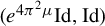
$({e}^{4\pi ^{2}\mu }\mathrm {Id},\mathrm {Id})$
for some
$\mu \in \mathbb {C}$
, see [Reference ÉcalleÉca75]. In this case, we say that the modulus is trivial. This is, in particular, the case for
$X_{0}$
. As a consequence of the uniqueness assertion above, the only normal form with convergent
$F\in z\mathbb {C}[[z]] $
is the formal model itself (
$F=0$
). -
(2) Let
$X\in z^{2}(\mathbb {C}^{\times }+z\mathbb {C}[[z]] ){\partial }/{\partial z}$
be a formal vector field with a double zero at
$0$
. It may happen that the formal power series is convergent at
$$ \begin{align*} \Delta :=(\exp X)\cdot\mathrm{Id} \end{align*} $$
$0$
, in which case, it belongs to and we say that
$\Delta $
is the time-1 map of the infinitesimal generator X. Beware that this does not imply the convergence of
$(\exp tX)\cdot \mathrm {Id}$
for
$t\notin \mathbb {Z}$
even for small
$|t|$
: this is, for instance, the case with the entire map
$\Delta :z\mapsto \exp (z)-z$
(see [Reference BakerBak62]). If the lattice of those
$t\in \mathbb {C}$
for which the power series converges is not discrete, then the modulus of
$\Delta $
is trivial [Reference ÉcalleÉca75] (that is,
$\Delta $
is analytically conjugate to the time-1 flow of a vector field holomorphic near 0).
-
(3) There might exist other representatives of
of the form
$({1}/({1+X_{0}\cdot F}))X_{0}$
for some
$1$
-summable F with
$1$
-sum f on
$V^{\pm }$
. Then, f must have large norm. This is likely related to what F. Loray discusses after [Reference LorayLor04, Theorem 1].








 and we say that





 of the form


The functions
 $z\in V^{\pm }\mapsto f^{\pm }(z)-(({1-z^{2}})/{\unicode{x3bb} z})+\mu \log ({\unicode{x3bb} z}/({1-z^{2}}))$
are Fatou coordinates for
 $\Delta $
(that is, local conformal coordinates
 on which
 $\Delta $
acts as a translation by
 $1$
, see §3.2). Hence, we parametrize the analytic classes of parabolic germs by their formal Fatou coordinates. By picking them in a class of ‘global’ formal objects, we benefit from a rigidity which makes the parametrization injective.
The power series F is global in the sense that its
 $1$
-sum
 $f=(f^{+},f^{-})$
exists on a pair of sectors whose union covers
 $\mathbb {C}^{\times }$
. Moreover,
 $\Delta |_{V^{\pm }}$
is the time-1 map of the
 $1$
-sum of its formal infinitesimal generator
 $$ \begin{align*} X_{}^{\pm} :=\frac{1}{1+X_{0}\cdot f^{\pm}}X_{0}, \end{align*} $$
which is a meromorphic vector field on
 $V^{\pm }$
. A quick computation tells us that the formal model
 $X_{0}$
is invariant by the involution
 $$ \begin{align*} \sigma:\overline{\mathbb{C}} & \longrightarrow\overline{\mathbb{C}}\\ z & \mapsto\frac{-1}{z} \end{align*} $$
fixing
 $\pm {i}$
, while the sectors
 $V^{+}$
and
 $V^{-}$
are swapped, that is,
 $$ \begin{align*} \sigma(V^{\pm}) =V^{\mp}. \end{align*} $$
A nice feature of the synthesis is that f not only defines a parabolic germ near
 $0$
, but it also creates one at
 $\infty $
, corresponding to the companion dynamics induced there by
 $X^{\pm }$
, since (§4.3)
 $$ \begin{align} f^{\pm}\circ\sigma =-f^{\mp}. \end{align} $$
This is why we call these dynamical systems spherical normal forms, a term borrowed from Écalle [Reference EcalleEca05] as discussed in §1.2.2. We can describe completely the dynamics of
 $\Delta $
and its monodromy as a multivalued map over the whole Riemann sphere
 $\overline {\mathbb {C}}$
.
Globalization Theorem. Assume
 $\mu \neq 0$
.
-
(1) If
$\unicode{x3bb} <\min \{ {1}/{2|\mu |}, {1}/{12\,800}\} $
, then
$X_{}^{\pm }$
has exactly three (simple) poles
$\{ p_{-{i}},p_{{i}},p_{\pm }\} $
, which are
$\mathrm {O}(\sqrt {\unicode{x3bb} })$
-close to
$-{i}$
,
${i}$
and
$\pm 1$
, respectively. In particular, this means that the pole
$p_{\pm {i}}$
is shared by
$X^{-}$
and
$X^{+}$
. -
(2) (See Figure 3.) To each one of the four poles
$p\in \{ p_{-{i}},p_{{i}},p_{-},p_{+}\} $
is attached a unique pair of
$\mathrm {O}(\sqrt {\unicode{x3bb} })$
-close points
$\{ z_{p},w_{p}\} $
lying at the intersection of the stable manifolds through p of
$X_{f}^{+}$
and
$X_{f}^{-}$
, mapped onto p by the time-1 map of
$X_{f}^{\pm }$
. In other words, the analytic continuation of
$\Delta $
to
$\overline {\mathbb {C}}$
provides a multivalued map with ramification points at each
$z_{p}$
and
$w_{p}$
, to which it extends continuously by
$\Delta (z_{p})=\Delta (w_{p})=p$
. A domain of holomorphy for
$\Delta $
is given, for instance, by the slit sphere where
$$ \begin{align*} \mathcal{D}:= \overline{\mathbb{C}}\backslash\bigcup_{p\text{ pole}}\gamma_{p}, \end{align*} $$
$\gamma _{p}$
is the arc of stable manifold passing through p of
$X_{f}^{+}$
or
$X_{f}^{-}$
(choose one) linking
$z_{p}$
and
$w_{p}$
. In particular, the radius of convergence about
$0$
of
$\Delta $
is
$1+\mathrm {O}(\sqrt {\unicode{x3bb} })$
.Figure 3Foliation induced by the real-time flow of a typical sectorial vector field
$X^{+}$
with the highlighted six ramification points
$z_{p}$
,
$w_{p}$
(orange spots) of its time-1 map
$\Delta $
. The poles
$p_{- {i}},p_{ {i}},~p_{+}$
of
$X^{+}$
are represented by red squares (colour online). -
(3) The multivalued continuation of
$\Delta $
to
$\overline {\mathbb {C}}$
has eight branch points. The monodromy around any one of the eight points
$\{ z_{p},~w_{p}:p\in \{ p_{-{i}},p_{{i}},p_{-},p_{+}\} \} $
is involutive. -
(4)
$\Delta |_{\mathcal {D}}$
is holomorphic and injective. It possesses four fixed-points
$0$
,
$\infty $
and
$\pm 1$
. The first two are parabolic, while
$\Delta $
admits a linearizable dynamics at
$\pm 1$
of multiplier
$\exp (\mp {1}/{\mu })$
. The dynamics at infinity
$\sigma ^{*}\Delta =\sigma \circ \Delta \circ \sigma $
belongs to and
$$ \begin{align*} \mathrm{B}\acute{\mathrm{E}}\mathrm{V}(\sigma^{*}\Delta) =\mathrm{B}\acute{\mathrm{E}}\mathrm{V}(\Delta)^{\circ-1}. \end{align*} $$


 and

In the case where
 $\mu =0$
, the result still holds except that the pole
 $z_{\pm }$
near
 $\pm 1$
cancels out the stationary point at
 $\pm 1$
. There only remain the parabolic fixed-points of
 $\Delta $
and its ramification locus coming from
 $\{ -{i},{i}\} $
.
It is remarkable that a twin fixed-point is automatically produced at
 $\infty $
, especially because the modulus there is given by the reciprocal modulus. This has a simple explanation, however: the involution
 $\sigma $
permutes the sectors
 $V^{+}$
and
 $V^{-}$
, while it does not change the infinitesimal generators much; therefore, the identification at the horns is the same while taking place in the reverse direction.
Another remarkable feature is that
 $\Delta $
has very simple dynamics: it is an injective, holomorphic map on a slit sphere
 $\mathcal {D}$
that can be forward iterated on the open set
 $\overline {\mathbb {C}}\backslash \gamma $
, where
 $\gamma $
is the union of the closure of the stable manifolds of
 $X^{\pm }$
passing through the poles. On each connected component of
 $\overline {\mathbb {C}}\backslash \gamma $
, the dynamics of
 $\Delta $
converges uniformly to a fixed-point (a parabolic point or the attracting point sitting at
 $\pm 1$
when
 $\mu \notin {i}\mathbb {R}$
). The reason behind this stable behaviour is the parameter
 $\unicode{x3bb} $
, which is chosen so that no chaotic remains of a global dynamics, usually arising from a frontier in the analytic continuation of the modulus [Reference EpsteinEps93], can be seen from the normal form.
The obvious downside of the previous feature is precisely that the dynamics of
 $\Delta $
is too simple to readily offer an insight regarding the dynamical richness that is displayed by holomorphic iteration on compact curves. What we prove is that any such dynamics, say of a rational mapping with a parabolic basin
 $\mathcal {B}$
, is locally conjugate by some
 $\Psi $
to a spherical normal form near the parabolic fixed-point
 $0$
, but the domain of the conjugacy cannot contain the whole component
 $\partial \mathcal {B}$
of the Julia set. Indeed,
 can be pushed forward by the flow of
 $X^{+}$
to give a compact invariant set J which is locally conformally equivalent to the fractal set
 $\partial \mathcal {B}$
. However, the one set J has no relevance to the dynamics of
 $\Delta $
whatsoever, for the latter has only Fatou components with real-analytic boundary, and that regularity increases as
 $\unicode{x3bb} \to 0$
. In that respect, an interesting question arises: can one recover part of the original dynamics by letting
 $\unicode{x3bb} $
grow (which may cause
 $X^{\pm }$
to sport more and more poles, for instance)?
1.2.1 Regarding the formal model
The family of vector fields
 $X_{0}$
depending on
 $\unicode{x3bb}>0$
is obtained from the ‘usual’ formal model
 $({x^{2}}/({1+\mu x}))({\partial }/{\partial x})$
(see Figure 4) by performing the degree-2 pullback
 $$ \begin{align*} \Pi:z \mapsto x=x(z):=\frac{\unicode{x3bb} z}{1-z^{2}} \end{align*} $$
(which is invertible near
 $0$
). Observe that
 $\Pi $
is invariant under the involution
 $\sigma $
, so that
 $\sigma $
is a symmetry of
 $X_{0}$
, a fact that has been already remarked. The obvious consequence is that
 $X_{0}$
has a stationary point at
 $\infty $
that mirrors the one it admits at
 $0$
.
Remark 1.3. The only normal form
 $X_{f}$
that can be factored through
 $\Pi $
(that is, realized as a global sectorial perturbation of the usual formal model) is the formal model itself (
 $f=0$
) since we must both have
 $f^{\pm }\circ \sigma =f^{\mp }$
(factorization through
 $\Pi $
) and
 $f^{\pm }\circ \sigma =-f^{\mp }$
as in equation (1.1).
Foliation induced by the real-time flow of
 $({x^{2}}/({1+\mu x})) {\partial }/{\partial x}$
((a)
 $\mu :=0$
; (b),
 $\mu :=2$
). There is one double stationary point at
 $0$
(green circle), yielding a parabolic germ for the time-1 map, and one saddle point (red square) corresponding to the pole
 $-{1}/{\mu }$
(colour online).

The time-1 map of
 $X_{0}$
is a generic parabolic germ (Lemma 2.4)
 $$ \begin{align*} \Delta_{0}(z):=\Phi_{X_{0}}^{1}(z) =z+\unicode{x3bb} z^{2}+\unicode{x3bb}^{2}(1-\mu)z^{3}+\mathrm{o}(z^{3}) \end{align*} $$
with trivial BÉV modulus. Any germ  with the same
 $\mu $
is formally conjugate to
 $\Delta _{0}$
(whatever
 $\unicode{x3bb} $
), which explains the terminology formal model.
The sectors and the model
 $X_{0}$
are tailored in such a way that the orbital region of
 $\Delta _{0}$
, as seen from the intersection
 $V^{\cap }$
, is a neighbourhood of
 $0$
or
 $\infty $
of size
 as
 $\unicode{x3bb} \to 0$
(cf. §4.1). Gaining such a control is essential: eventually the neighbourhood fits within the discs of convergence of the data
 and keeps lying there even after small perturbations.
Picking
 $X_{0}$
among all vector fields realizing the trivial pair
 $({e}^{4\pi ^{2}\mu }\mathrm {Id},\mathrm {Id})$
is arguably canonical since the pullback
 $z\mapsto {\unicode{x3bb} z}/({1-z^{2}})$
is very simple and the pair of sectors
 $(V^{+},V^{-})$
is fairly standard.
Remark 1.4. For technical reasons, we also need that
 $\infty $
and
 $0$
be mapped to
 $0$
by the pullback. Thereby, the ‘obvious’ choice of a degree-1 pullback, like
 $z\mapsto {\unicode{x3bb} z}/({1-z})$
, cannot be used to perform the construction presented here. Apart from this restriction, one can use pretty much any other pullback, provided the ‘sectors’ are tailored conveniently.
Example 1.5. We refer to Figure 5. Assume here that
 $\mu :=0$
so that
 $$ \begin{align*} X_{0}(z) =\frac{\unicode{x3bb} z^{2}}{1+z^{2}}\frac{\partial}{\partial z} \end{align*} $$
has only stationary (double) points at
 $0$
and
 $\infty $
, as well as two simple poles at
 $\pm {i}$
with residue
 $\pm {\unicode{x3bb} {i}}/{2}$
. These poles spawn the ramification locus of
 $\Delta _{0}$
, as can be seen from a direct integration of
 $\dot {z}=X_{0}(z)$
at time
 $1$
with initial value
 $z_{*}$
:
 $$ \begin{align*} 1 =\int_{z_{*}}^{\Delta_{0}(z_{*})}\frac{1+z^{2}}{\unicode{x3bb} z^{2}}\,\mathit{d}z, \end{align*} $$
which yields
 $$ \begin{align*} z_{*}\Delta_{0}(z_{*})^{2}-(z_{*}^{2}+\unicode{x3bb} z_{*}-1)\Delta_{0}(z_{*})-z_{*} =0. \end{align*} $$
Hence,
 $\Delta _{0}$
is algebraic and its ramification points are the four points z for which
 $$ \begin{align*} (z^{2}+\unicode{x3bb} z-1)^{2}+4z^{2} =0. \end{align*} $$
Notice that
 $\Delta _{0}$
admits a limit at each one of these points z, and
 $\Delta _{0}(z)$
lies within the polar locus
 $\{ \pm {i}\} $
of
 $X_{0}$
. Therefore,
 $\Delta _{0}$
extends as a multivalued function over the domain
 $\overline {\mathbb {C}}\backslash \{ z^{2}+\unicode{x3bb} z=1\} $
(which contains
 $0$
) with involutive monodromy around any one of the ramification points given by the action of
 $\sigma $
, which is moreover sent to a pole of
 $X_{0}$
by the time-1 map. More details can be found in Lemma 2.7.
Foliation induced by the real-time flow of
 $X_{0}$
for
 $\mu :=0$
, revealing the double stationary point (green circle) and two simple poles (red squares) (colour online).

Remark 1.6. When
 $\mu \neq 0$
, the mapping
 $\Delta _{0}$
cannot be algebraic (see [Reference ÉcalleÉca75]). It seems safe to conjecture that the only algebraic normal form
 $\Delta $
is
 $\Delta _{0}$
when
 $\mu =0$
.
1.2.2 Link with Écalle canonical synthesis
In [Reference EcalleEca05], J. Écalle revisits the inverse problem by performing the canonical-spherical synthesis using the framework of resurgent functions and alien/mould calculus (for details, see [Reference ÉcalleÉca85]) that he developed in the wake of his original paper [Reference ÉcalleÉca75]. In that setting, the modulus is not built from dynamical considerations, as was first done by G. Birkhoff, himself and S. Voronin (the viewpoint taken here), but as coefficients
 $(A_{n})_{n\in \mathbb {Z}}$
coming from the associated resurgence equation and carried by the discrete set of singularities of the analytic continuation of the Borel transform of the formal normalization
 $\Delta \widehat {\sim }\Delta _{0}$
. The link between the pair
 and the collection
 $(A_{n})_{n}$
is described in [Reference EcalleEca05, §5.1].
To perform the canonical-spherical synthesis, J. Écalle introduced a (usually large) parameter he called the twist
 $c>0$
, corresponding here to
 ${1}/{\unicode{x3bb} }$
, and a family of resurgent monomials that served as building blocks for his synthesis. It turns out that the normal forms produced here are very likely the objects obtained by J. Écalle, as witnessed, for instance, by the definition of the Cauchy-like kernel [Reference EcalleEca05, §§5.1 and 10.3], which is pretty much the one involved in the present construction (compare Definition 4.13).
Canonical-Spherical Synthesis Conjecture. Given data  and
 $0<\unicode{x3bb} \leq \unicode{x3bb} (\psi )$
, define the twist
 . The normal form
 $\Delta $
given by the Synthesis Theorem is then the parabolic germ coming from Écalle’s canonical-spherical synthesis.
If it were true, this would allow us to invoke the effective methods provided by [Reference EcalleEca05] in the present dynamical context. Conversely, let us discuss in which sense the approach given here completes and sheds a dynamical light on Écalle’s synthesis for parabolic germs. To quote J. Écalle (the reader should be aware that he works in the variable
 ${1}/{z}$
):
‘As already pointed out, our twisted monomials have much the same behavior at both poles of the Riemann sphere. The exact correspondence has just been described
 ${[}\cdots {]}$
using the so-called antipodal involution: in terms of the objects being produced, this means that canonical object synthesis automatically generates two objects: the ‘true’ object, local at
 $\infty $
and with exactly the prescribed invariants, and a ‘mirror reflection’, local at 0 and with closely related invariants. Depending on the nature of the
 ${[}\cdots {]}$
invariants (verification or non-verification of an ‘overlapping condition’), these two objects may or may not link up under analytic continuation on the Riemann sphere.’
It could happen that both synthesis processes produce different objects, but what is sure is that the objects built in this paper match very precisely the above expectations and comments. In our setting, the mirror reflection comes from the degree-2 pullback
 $\Pi :z\mapsto {\unicode{x3bb} z}/({1-z^{2}})$
invariant by the symmetry
 $\sigma $
. The Synthesis Theorem gives quantitative bounds and a uniqueness statement that are not readily available from [Reference EcalleEca05], while the Globalization Theorem simply tells that the normal form is defined and injective on almost all of
 $\mathbb {C}$
. Although it is true that the Taylor series of
 $\Delta $
at
 $0$
and that of its companion near
 $\infty $
have a radius of convergence of order
 $1+\mathrm {O}(\sqrt {\unicode{x3bb} })$
, both germs are unconditionally obtained by analytic continuation one from the other, provided of course that
 $0<\unicode{x3bb} \leq \unicode{x3bb} (\psi )$
. In our synthesis, the ‘closely related’ moduli are, in fact, mutually reciprocal.
1.2.3 General parabolic and rationally indifferent germs
Even though in this article, we address in detail only the case of germs in  , our construction can be adapted in a straightforward manner to the space
 consisting in those germs in the form
 $\Delta (z)=z+*z^{k+1}+\mathrm {o}(z^{k+1})$
for some
 $k\in \mathbb {Z}_{>0}$
. The inverse problem then regards the realization of collections
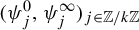 and, in that case, every ingredient must be considered pulled-back by the branched-covering
 $z\mapsto z^{k}$
. Namely:
-
• the formal model
$X_{0,k}$
is given by the pullback of
$({x^{k+1}}/({1+\mu x^{k}})){\partial }/{\partial x}$
by the mapping
$\Pi _{k}:z\mapsto {\unicode{x3bb} z}/{(1-z^{2k})^{{1}/{k}}}$
, which is invariant by the
$2k$
-periodic homography
$\sigma _{k}:={{e}^{{i}{\pi }/{k}}}{\mathrm {Id}}$
; -
• the normal form is
$({1}/({1+X_{0,k}\cdot F}))X_{0,k}$
with a k-summable
$F\in z\mathbb {C}[[z]] $
; -
• F admits bounded k-sums on infinite sectors
$V_{j}^{\pm }:=\{ z\neq 0:\lvert \arg (\pm z^{k})\rvert <{5\pi }/{8}\} $
, , which are circularly permuted by
$\sigma _{k}$
.




 , which are circularly permuted by

The general case of a rationally indifferent germ  with coprime integers p and q, not conjugate to a rational rotation, can also be recovered from the study we perform here.
1.3 Parabolic renormalization
Iteration near a parabolic fixed-point is an important topic in dynamical systems, since complicated phenomena arise once a perturbation is made. Some significant consequences include [Reference Avila and LyubichAL22, Reference Buff and ChéritatBC10, Reference ShishikuraShi98], in which the (near-)parabolic renormalization and its fixed-points play an important role.
The parabolic renormalization map

associates the
 $\infty $
-component of the invariant of a generic parabolic germ
 $\Delta $
. It may happen that
 $\mathcal {R}(\Delta )$
is itself generic, in which case,
 $\mathcal {R}$
can be iterated. As far as I know, a statement of the kind (while not referring specifically to spherical normal forms) was first communicated privately by R. Schäfke.
Parabolic Renormalization Corollary. Take an arbitrary  . There exists a bound
 such that, for all
 , there exists a unique spherical normal form
 $\Delta $
satisfying

Again, the bound
 $\widehat {\unicode{x3bb} }$
can be made explicit, we refer to Corollary 6.3.
1.4 Real case
If  is real (that is, commutes with the complex conjugation
 $\overline {\bullet }$
), then
 $\mu \in \mathbb {R}$
and its modulus
 satisfies the identity:

Real Synthesis Corollary. Take
 $\mu \in \mathbb {R}$
, a pair
 and
 $\unicode{x3bb}>0$
as in the Synthesis Theorem. If, moreover, the identity
 $(\square )$
holds, then the synthesized normal form
 $\Delta $
is real.
1.5 Structure of the article and summary of the proofs
One of the main concerns of this paper is to provide as explicit bounds as possible, which explains why so much effort went into technical lemmas. The main tools are basic calculus / complex analysis, and the work is necessary in any case to obtain uniform bounds with respect to
 $\unicode{x3bb} $
.
All the constructions will take place within the space of pairs
 $f=(f^{+},f^{-})$
with 1-flat difference in
 $V^{\cap }$
and bounded 1-type, both at
 $0$
and
 $\infty $
, as discussed at the beginning of the introduction:
 $$ \begin{align*} \mathcal{S} :=\big\{ f\in\mathcal{S}(V^{+})\times\mathcal{S}(V^{-}):\limsup_{z^{\pm1}\to0}|z|^{\pm1}\ln|f^{-}(z)-f^{+}(z)|\leq-5\text{ for }z\in V^{\cap}\big\} , \end{align*} $$
where

is equipped with the canonical product Banach norm. We denote by
 $\mathcal {B}$
its unit ball.
Remark 1.7. Actually, the uniform bound
 $-5$
on the
 $1$
-type of
 $f^{-}-f^{+}$
can be sharpened as
 $-{5}/{\unicode{x3bb} }$
(see equation (3.5)), that is, the difference becomes increasingly flatter as
 $\unicode{x3bb} $
tends to
 $0$
, although we do not need that fact.
-
(1) In §2, we give some basic material about vector fields and their time-1 maps, focusing more particularly on the local dynamics near their poles and zeroes, and how they stitch together to organize the global dynamics of the model
$X_{0}$
. This will allow us to conjugate to the model
$$ \begin{align*} X_{f}^{\pm} :=\frac{1}{1+X_{0}\cdot f^{\pm}}X_{0} \end{align*} $$
$X_{0}$
over the better part of
$V^{\pm }$
(effective bounds are described in §5.2). This sectorial mapping takes the form
$\Phi _{X_{0}}^{f^{\pm }}$
given by the flow of
$X_{0}$
at time
$f^{\pm }$
. The dynamics of the formal model
$\Delta _{0}$
, studied in §2.3, is then pulled-back by
$\Psi ^{\pm }$
to give sectorial counterparts for the time-1 map of
$X_{f}^{\pm }$
.
-
(2) Coupled to the Ramis–Sibuya theorem, the above preliminary part allows one to reduce the problem of finding a parabolic germ
$\Delta $
with prescribed modulus to that of finding
$(f^{+},f^{-})\in \mathcal {S}$
satisfying some (nonlinear) Cousin problem
$(\star )$
below; see Proposition 3.3 in §3. -
(3) We can then tackle the main result (§4). We begin with fixing a formal class
$\mu \in \mathbb {C}$
in . Then, must be tangent to the linear map
${e}^{4\pi ^{2}\mu }\mathrm {Id}$
. Being given with holomorphic near
$\sharp \in \{ 0,\infty \} $
, we must find
$f^{\pm }$
on
$V^{\pm }$
such that (⋆)where are the two components of
$V^{\cap }$
, and
$H_{f}^{+}$
is a primitive first-integral of the sectorial time-1 map
$\Delta ^{+}$
of
$X_{f}^{+}$
(in other words,
$H_{f}^{+}$
provides preferred orbital coordinates over the sector
$V^{+}$
). Condition
$(\star )$
implies that
$\Delta ^{+}$
coincides with
$\Delta ^{-}$
in
$V^{\cap }$
and thus is the restriction to
$V^{+}$
of a single .
The nonlinear Cousin problem
$(\star )$
is solved using a fixed-point method involving a classical Cauchy–Heine integral transform. This technique was already employed in [Reference Schäfke and TeyssierST15] (and [Reference Rousseau and TeyssierRT21]) to build normal forms for convergent saddle-node foliations in the complex plane (and their unfoldings). More precisely, we build a map (Proposition 4.11): such that
$\Lambda (f)^{-}-\Lambda (f)^{+}=\varphi \circ H_{f}^{+}$
. Therefore, if and only if condition
$(\star )$
holds. We prove (Proposition 4.14) that eventually stabilizes the unit ball
$\mathcal {B}\subset \mathcal {S}$
. The smaller
$\unicode{x3bb} $
, the more contracting , so that eventually a unique fixed-point of exists in that ball (Corollary 4.15).
-
(4) In §5.1, as is discussed above, we establish the Globalization Theorem making use of the involution
$\sigma $
and the property that for the fixed-point f of , we have Prior to that, we describe the dynamical properties of
$$ \begin{align*} f^{\pm}\circ\sigma =-f^{\mp}. \end{align*} $$
$\Delta $
in §5.3 using a priori bounds on the flow of
$X^{\pm }$
.
-
(5) The fixed-points of the parabolic renormalization are also obtained as a holomorphic fixed-point in §6.1. Let
$\text {Synth}_{\unicode{x3bb} }:\psi \mapsto \Delta $
be the synthesis map built previously and consider for given , the iterations
$\Delta _{0}:=\mathrm {Id}$
and . It so happens that
$\text {Synth}_{\unicode{x3bb} }$
cannot shrink too much the radius of convergence of
$\Delta _{n}$
, which always remains above
${3}/{16}$
. By taking
$\unicode{x3bb} $
smaller, we prove next that
$\text {Synth}_{\unicode{x3bb} }$
is a contracting self-map of some closed ball of the Banach space . -
(6) The real setting is explored in §6.2 (Real Synthesis Corollary). It merely consists in checking that every step leading to the fixed-point of
preserves realness, which is straightforward.


 . Then,
 must be tangent to the linear map

 with
 holomorphic near


 are the two components of


 .


 if and only if condition

 eventually stabilizes the unit ball


 , so that eventually a unique fixed-point of
 exists in that ball (Corollary

 , we have


 , the iterations

 . It so happens that


 .
 preserves realness, which is straightforward.
1.6 Notation
-
•
$\dot {z}={\mathit {d}z}/{\mathit {d}t}$
stands for differentiation with respect to the variable
$t\in \mathbb {C}$
. -
• For a topological space
$\mathcal {M}$
and a point
$p\in \mathcal {M}$
, we use
$(\mathcal {M},p)$
to stand for a (sufficiently small) neighbourhood of p in
$\mathcal {M}$
. -
• The set
$\overline {U}$
is the topological closure of
$U\subset \mathcal {M}$
. -
• We use the notation
$\mathbb {D}$
for the standard open unit disk in
$\mathbb {C}$
. -
•
$\overline {\mathbb {C}}$
stands for the compactification of the complex line
$\mathbb {C}$
as the Riemann sphere. -
• The nth iterate of a diffeomorphism
$\Delta $
is written
$\Delta ^{\circ n}$
for
$n\in \mathbb {Z}$
. -
•
$\Phi _{X}^{t}$
designates the flow at time t of the vector field X. -
• If
$\Psi :U\to V$
is locally biholomorphic, we recall its action by conjugacy (change of coordinate) on diffeomorphisms: on vector fields:
$$ \begin{align*} \Psi^{*}\Delta :=\Psi^{\circ-1}\circ\Delta\circ\Psi, \end{align*} $$
If
$$ \begin{align*} \Psi^{*}X :=\mathrm{D}\Psi^{\circ-1}(X\circ\Psi). \end{align*} $$
$\Delta $
is the time-1 map of X, then
$\Psi ^{*}\Delta $
is the time-1 map of
$\Psi ^{*}X$
.


2 Sectorial normalization
We recall that the functional space
 $\mathcal {S}$
is defined in §1.5 above. The main purpose of this section is to investigate, in some detail, the dynamics of

which we deduce from two ingredients:
-
• the dynamics of the rational vector field
(2.1)studied in §2.3;
$$ \begin{align} X_{0}(z):= \frac{1-z^{2}}{1+z^{2}}\times\frac{\unicode{x3bb} z^{2}}{1+\unicode{x3bb}\mu z-z^{2}}\frac{\partial}{\partial z} \end{align} $$
-
• the sectorial normalization between
$X^{\pm }$
and
$X_{0}$
obtained in §2.4, that is, the existence of biholomorphisms on
$V^{\pm }\backslash \{ \text {small neighbourhhood of the poles}\} $
conjugating the dynamics of both vector fields.



The dynamics of a meromorphic vector field X on some domain U is organized by its singular locus, which splits between the stationary points and the poles
 $$ \begin{align*} \text{Zero}(X) & :=\{ z\in U:X(z)=0\}, \\ \mathrm{Pole}(X) & :=\{ z\in U:X(z)=\infty\}. \end{align*} $$
Since
 $f^{\pm }$
is holomorphic on
 $V^{\pm }$
, we can never have
 ${1}/({1+X_{0}\cdot f^{\pm }})=0$
except at the poles of
 $X_{0}$
, and hence,
 $$ \begin{align*} \text{Zero}(X^{+})\cup\,\text{Zero}(X^{-}) =\text{Zero}(X_{0}). \end{align*} $$
It is also true that
 $z\in \mathrm {Pole}(X^{\pm })$
if and only if:
-
•
$z\in \mathrm {Pole}(X_{0})$
and
$(f^{\pm })'(z)=0$
; -
• or
$z\notin \mathrm {Pole}(X_{0})$
and
$1+(X_{0}\cdot f^{\pm })(z)=0$
.



We begin with fixing some notation and recall the important Lie formula regarding holomorphic vector fields X, then proceed to a short description of the local behaviour of the trajectories near singularities and finally explain how the global dynamics of rational X is woven from these local parts.
2.1 Basic vector fields material
2.1.1 Flow and time-1 map
Let
 $U\subset \overline {\mathbb {C}}$
be a domain and
 $X=R({\partial }/{\partial z})$
be a holomorphic vector field on U (that is, R is a holomorphic function on U). For any
 $z_{*}\in U$
, the differential system
 $\dot {z}=X(z)$
has a unique local solution
 $t\in (\mathbb {C},0)\mapsto z(t)$
with
 $z(0)=z_{*}$
, giving rise to a germ of a holomorphic mapping

(to be more correct, the neighbourhood  depends on
 $z_{*}$
, but its size is locally uniform). The flow of X is the maximal multivalued analytic continuation of
 $\Phi _{X}^{}$
. It is probably best understood as the reciprocal of the time function
 $$ \begin{align} (z_{*},\phi)\in U^{2} \longmapsto\bigg(z_{*},\int_{z_{*}}^{\phi}\frac{\mathit{d}z}{R(z)}\bigg)\in U\times\overline{\mathbb{C}}, \end{align} $$
obtained by rewriting
 $\dot {z}=X(z)$
as
 $\mathit {d}t=\mathit {d}z/{R(z)}$
and integrating the time form
 $$ \begin{align} \tau_{X} :=\frac{\mathit{d}z}{R}. \end{align} $$
The analytic continuation of the time function is explicit, at least when R is rational.
Definition 2.1. We call
 $\Delta :z\mapsto \Phi _{X}^{1}(z)$
the time-1 map of X. As a multivalued mapping over U, for any path
 $\gamma :[0,1]\to U$
satisfying
 $$ \begin{align*} 1 =\int_{\gamma}\tau_{X}, \end{align*} $$
a determination of
 $\Delta $
satisfies the identity
 $$ \begin{align*} \Delta(\gamma(0)) =\gamma(1), \end{align*} $$
with the special case
 $\Delta (z)=z$
if
 $X(z)=0$
.
Remark 2.2. For
 $t\in \mathbb {C}^{\times }$
, the time-t map
 $\Phi _{X}^{t}$
is obtained as the time-1 map of
 $({1}/{t})X$
.
2.1.2 Lie’s formula
One also encounters the notation
 $\exp (tX)$
to stand for
 $\Phi _{X}^{t}$
. This can be understood in the light of Lie’s formula relating the action of the operator
 $\exp (tX)$
and of the flow mapping. Pick a function
 and some
 $z\in U$
. For any
 , one has
 $$ \begin{align} g\circ\Phi_{X}^{t}(z) & =\sum_{n=0}^{+\infty}\frac{t^{n}}{n!}(X\cdot^{n}g)(z)\\ & =:(\exp(tX)\cdot g)(z),\nonumber \end{align} $$
where the iterated Lie’s derivative is defined by
 $$ \begin{align*} X\cdot^{n}g :=\underset{n\text{ times}}{\underbrace{X\cdot X\cdot(\cdots)\cdot X\cdot}}g. \end{align*} $$
2.1.3 Long-time behaviour
In this paper, we only use the real-time flow, that is, for
 $t\in (\mathbb {R},0)$
, and designate by
 $t_{\max }(z_{*})\in ]0,+\infty ]$
the maximal time of existence of the forward trajectory
 $t\in [0,t_{\max }(z_{*})[\mapsto \Phi _{X}^{t}(z_{*})$
. Without going into too much detail, a consequence of the Bendixson–Poincaré theorem and of Cauchy’s formula applied to equation (2.2) is the following classification of asymptotic behaviour for the real flow of a meromorphic vector field X on some domain U. Starting from
 $z_{*}\notin \mathrm {Pole}(X)$
, the forward trajectory
 $t\geq 0\mapsto z(t)$
matches one of the mutually exclusive outcomes:
-
(1) either
$t_{\max }(z_{*})=\infty $
, exactly in the following situations:centre case: z is periodic (non-constant), in which case, neighbouring trajectories also are (with same period) and at least one stationary point of X of centre type is enclosed by the trajectory;
equilibrium case:
$\lim _{t\to +\infty }z(t)\in \text {Zero}(X)$
; -
(2) or
$t_{\max }(z_{*})<\infty $
, exactly in the following situations:escape case:
$\lim _{t\to t_{\max }(z_{*})}z(t)\in \partial U$
;separation case:
$\lim _{t\to t_{\max }(z_{*})}z(t)\in \mathrm {Pole}(X)$
.


2.2 Local behaviour near singularities
2.2.1 Dynamics near a simple zero
Let
 $p\in \overline {\mathbb {C}}$
be a simple stationary point of a meromorphic vector field
 $X=R({\partial }/{\partial z})$
, and denote by
 $\alpha \neq 0$
the derivative of R at this point. One can find a conformal coordinate
 $z=\Psi (w)$
near p such that X takes the form

A direct integration describes the local behaviour of the dynamics of the linear vector field around a simple zero:
 $$ \begin{align*} \Phi_{W}^{t}(w) =w{e}^{\alpha t}. \end{align*} $$
In particular, the time-1 map of X is linearizable near its fixed-point p, which can be of three types:
-
• attractive (
$\mathrm {Re}(\alpha )<0$
) or repulsive (
$\mathrm {Re}(\alpha )>0$
) in the equilibrium case; then there exists a domain
$U:=(\overline {\mathbb {C}},p)$
such that any trajectory crossing
$\partial U$
converges asymptotically to p in forward or backward time (a basin of attraction/repulsion); -
• but it can also be a centre case (
$\mathrm {Re}(\alpha )=0$
).


Example 2.3. When
 $\mu \neq 0$
, the formal model
 $X_{0}$
admits a simple stationary point at
 $\pm 1$
with linear part
 $\alpha =-{1}/{\mu }$
.
2.2.2 Dynamics near a double zero
Take now a double zero of X which, for the sake of convenience, we locate at
 $0$
, and define the constants
 $a\neq 0$
and b by
 $$ \begin{align*} X(z) =(az^{2}+bz^{3}+\mathrm{O}(z^{4}))\frac{\partial}{\partial z}. \end{align*} $$
Lemma 2.4. For all
 $a\in \mathbb {C}^{\times }$
and
 $b\in \mathbb {C}$
, we have
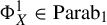 . More precisely, the
 $3$
-jet of the mapping at
 $0$
is given by
 $$ \begin{align*} \Phi_{X}^{1}(z) =z+az^{2}+(a^{2}+b)z^{3}+\mathrm{O}(z^{4}). \end{align*} $$
This germ is linearly conjugate to
 $w\mapsto w+w^{2}+(1+{b}/{a^{2}})w^{3}+\mathrm {o}(w^{3})$
through the transform
 $w:=az$
, and hence the formal invariant of
 $\Phi _{X}^{1}$
is
 $-{b}/{a^{2}}$
.
Proof. Using the Lie formula, we obtain
 $$ \begin{align*} \Phi_{X}^{1}(z) =z+(az^{2}+bz^{3})+a^{2}z^{3}+\mathrm{O}(z^{4}). \end{align*} $$
The rest is straightforward algebra, but for the fact that the formal invariant of
 $w\mapsto w+w^{2}+cw^{3}+\mathrm {O}(w^{4})$
is
 $1-c$
.
Example 2.5. In the case of
 $X_{0}$
, we have

with formal invariant
 $\mu $
independently on
 $\unicode{x3bb} $
.
Remark 2.6. There exists a domain
 $U:=(\overline {\mathbb {C}},p)$
such that any trajectory crossing
 $\partial U$
converges asymptotically to p in forward- or backward-time (a parabolic basin).
2.2.3 Dynamics near a simple pole (separation case)
Consider here the case where
 $X(p)=\infty $
is a simple pole. One can find a conformal coordinate
 $z=\Psi (w)$
near p such that X takes the form

A direct integration describes the local behaviour of the dynamics of the linear vector field around a simple pole.
Lemma 2.7. Let
 $W:=({1}/{w}){\partial }/{\partial w}$
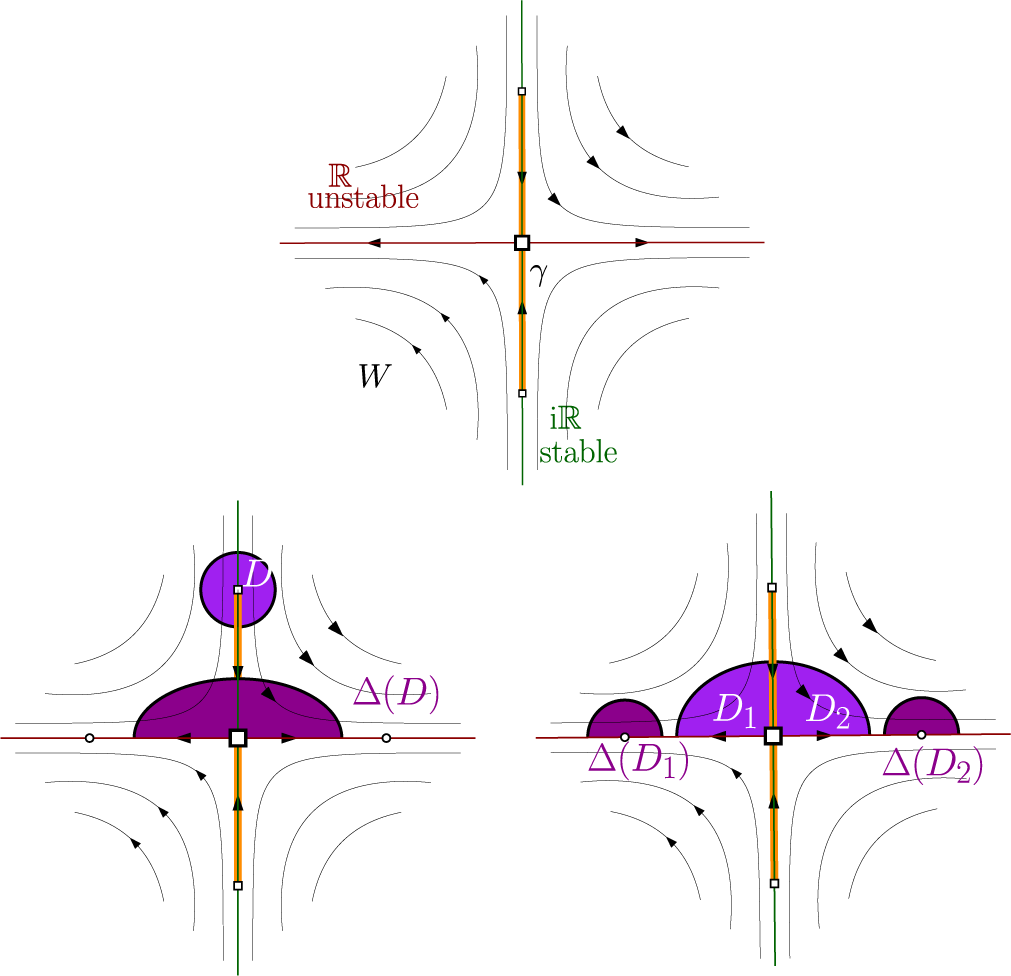
. We refer to Figure 6 for an illustration of the statements to come.
-
(1) The foliation induced by W has a saddle-point at
$0$
with stable manifold
${i}\mathbb {R}$
and unstable manifold
$\mathbb {R}$
.Figure 6Saddle dynamics near a simple pole of a vector field W and induced slicing dynamics of its time-1 map
$\Delta $
. The latter is holomorphic on the complement of the arc
$\gamma $
, included in the stable manifold and whose endpoints are sent to the pole in time
$1$
(colour online). -
(2) The time-1 map of W is defined and holomorphic on
$\mathbb {C}\backslash \gamma $
with
$\gamma :={i}\sqrt {2}[-1,1]$
, where it evaluates to
$$ \begin{align*} \Phi_{W}^{1}(w) =\pm\sqrt{2+w^{2}}. \end{align*} $$
-
(3) The analytic continuation of the above map as a multivalued function can be realized over
$\mathbb {C}\backslash \{ \pm {i}\sqrt {2}\} $
with monodromy .


 .
Example 2.8. The vector field
 $X_{0}$
admits two symmetric simple poles
 $\pm {i}$
, fixed by
 $\sigma $
, as well as two additional simple poles
 $$ \begin{align*} z_{\pm} :=\frac{\unicode{x3bb}\mu\pm\sqrt{\unicode{x3bb}^{2}\mu^{2}+4}}{2}, \end{align*} $$
swapped by
 $\sigma $
, provided
 $\mu \neq \pm ({2{i}}/{\unicode{x3bb} })$
(otherwise, it is a double pole
 $z_{+}=z_{-}=\mu \in {i}\mathbb {R}$
) and
 $\mu \neq 0$
(else the pole
 $\pm 1$
cancels out the zero of
 $X_{0}$
located at
 $\pm 1$
).
Near
 $\pm {i}$
, the vector field
 $X_{0}$
is conjugate to
 $\Phi _{W}^{1}$
and this conjugacy sends
 $\sigma $
to the involution
 $w\mapsto -w$
, so that the monodromy of
 $\Delta _{0}$
around the ramification points attached to
 $\pm {i}$
is
 $\sigma $
(the ramification is induced by the change of variable
 $\Pi $
). The corresponding local involution near
 $z_{\pm }$
has a different nature and comes from the involution
 $\nu \neq \mathrm {Id}$
of the usual formal model
 $({x^{2}}/({1+\mu x})){\partial }/{\partial x}$
near the pole
 $-{1}/{\mu }$
, which solves
 $$ \begin{align*} \mu\log x-\frac{1}{x} =\mu\log\nu-\frac{1}{\nu} \end{align*} $$
(observe indeed that
 $t\mapsto \mu \log t-{1}/{t}$
has a critical point at
 $-{1}/{\mu }$
).
Remark 2.9. The case of a kth-order pole
 $({1}/{w^{k}}){\partial }/{\partial w}$
is similar, with time-1 map
 $\Phi _{W}^{1}(w)=(k+1+w^{k+1})^{{1}/({k+1})}$
, giving rise to
 $k+1$
ramification points and
 $k+1$
determinations of the time-1 map. The integer k is a topological invariant.
2.3 Global dynamics of the formal model
We explain why/how we choose the formal model
 $X_{0}$
and the sector
 $V^{\pm }$
in §4.1. For now, let us present the global features of the dynamics of
 $X_{0}$
on
 $\overline {\mathbb {C}}$
for fixed
 $\unicode{x3bb}>0$
and
 $\mu \in \mathbb {C}$
. We explain how the local dynamics near the singular set of X we described above stitch together by studying the real-analytic foliation of the sphere
 $\overline {\mathbb {C}}$
induced by the real-time flow (Figure 7).
(a) Foliation induced by the real-time flow of
 $X_{0}$
for
 $\unicode{x3bb} :=\tfrac 12$
and
 $\mu :=\tfrac 12$
, revealing the three stationary points (green circles) and four poles (red squares). (b) The spinal graph (blue, connecting zeroes) and separatrix graph (red, connecting poles to zeroes) (colour online).

Remark 2.10.
-
(1) Whether
$\mu =0$
or not leads to different dynamics, since the simpler
$X_{0}(z)=({\unicode{x3bb} z^{2}}/({1+z^{2}})){\partial }/{\partial z}$
has less poles and zeroes. The dynamics of this particular vector field has been studied in Example 1.5, so we allow ourselves to assume that
$\mu \neq 0$
whenever it leads to a more straightforward exposition. -
(2) To avoid other zero/pole cancellations, we must, in addition, suppose that
$\mu \neq \pm ({2{i}}/{\unicode{x3bb} })$
(the latter is ensured whenever
$\unicode{x3bb} <{1}/{2|\mu |}$
). Under these assumptions, the rational vector field has three stationary points located at
$0$
(double) and
$\pm 1$
(simple), as well as four simple poles located at
$z_{\pm }:=({\unicode{x3bb} \mu \pm \sqrt {\unicode{x3bb} ^{2}\mu ^{2}+4}})/{2}$
and
$\pm {i}$
.


2.3.1 Spinal graph
After the pioneering work of S. Smale et al starting at the beginning of the 1980s to study general numerical Newton-like schemes for solving polynomial equations [Reference SmaleSma81, Reference Shub, Tischler and WilliamsSTW88], the foliations induced by holomorphic polynomial vector fields X have been thoroughly studied in the generic case by Douady, Estrada and Sentenac in an unpublished manuscript [Reference Douady, Estrada and SentenacDES05]. Then, Branner and Dias [Reference Branner and DiasBD10] completed the task for every polynomial vector field and, in his thesis, J. Tomasini studied some rational vector fields. All these considerations result in the following statement: the topological class of X (up to orientation-preserving homeomorphism) is completely classified by its combinatorial dynamics. Roughly speaking, it is encoded as the spinal graph of X, the way poles and stationary points of the vector field are connected by the closure of maximal trajectories.
Lemma 2.11. Let X be a rational vector field. The separatrix graph
 $\mathrm {Sep}(X)$
of X is the closure of the union of all stable and unstable manifolds passing through the poles of X. Then,
 $\overline {\mathbb {C}}\backslash \mathrm {Sep}(X_{})$
consists in finitely many X-invariant connected components. Any two trajectories in the same component are:
-
• either both periodic with same period;
-
• or they link the same pair of stationary points
$q\to p$
of X.

Proof. Assume that
 $t\mapsto z(t)$
is a periodic trajectory. Cauchy’s formula indicates that nearby trajectories are also periodic with the same period. A straightforward connectedness argument allows us to conclude that every other trajectory in the component is periodic with the same period.
Assume now that
 $t\mapsto z(t)$
is neither a centre nor a separatrix. Then, z goes towards some
 $p\in \text {Zero}(X)$
in forward time, say, and then there exists a domain
 $U_{p}\ni p$
(the basin of attraction of an attractive fixed-point or a parabolic basin for a multiple zero) such that any trajectory landing at p eventually hits
 $\partial U_{p}$
and vice versa. Hence, z links
 $\partial U_{q}$
to
 $\partial U_{p}$
in finite time, and the flow-box theorem asserts this remains the case for neighbouring trajectories. Again, a direct connectedness argument brings the conclusion.
Definition 2.12. We define the spinal graph
 $\mathrm {Spine}(X)$
as the oriented graph with vertices
 $\text {Zero}(X)$
and ordered edges corresponding to a trajectory of X linking those vertices
 $q\to p$
, one per component of
 $\overline {\mathbb {C}}\backslash \mathrm {Sep}(X_{})$
. Isolated vertices correspond to centre stationary points.
Remark 2.13. Both graphs
 $\mathrm {Spine}(X)$
and
 $\mathrm {Sep}(X)$
come with a canonical, non-ambiguous geometric realization with edges as integral curves of X. For that reason, we identify the combinatorial data and its canonical geometric realization as a subset of
 $\overline {\mathbb {C}}$
.
We can equip both graphs with an oriented length, by integrating the time form equation (2.3) along injective subpaths
 $\gamma $
:
 $$ \begin{align} \ell_{X}(\gamma) :=\int_{\gamma}\tau_{X}=\int_{\gamma}\frac{\mathit{d}z}{X\cdot\mathrm{Id}}\in\overline{\mathbb{R}}. \end{align} $$
We omit the proof of the next lemma.
Lemma 2.14. If
 $\mu \neq 0$
and
 $\mu \neq \pm {2{i}}/{\unicode{x3bb} }$
, the graph
 $\mathrm {Spine}(X_{0})$
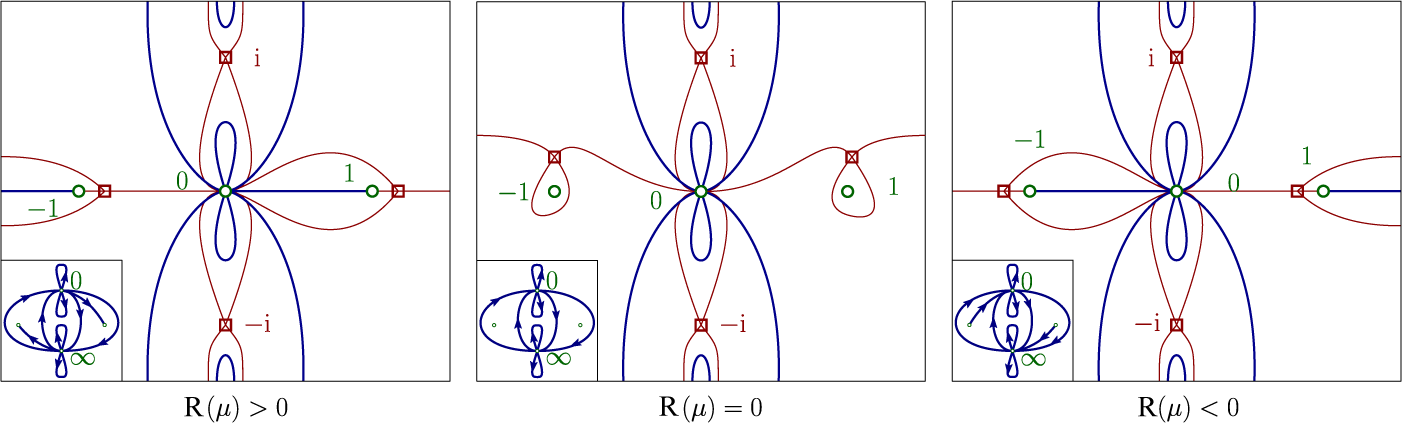
belongs to the following list, according to the sign of
 $\mathrm {Re}(\mu )$
. A centre bifurcation occurs when
 $\mathrm {Re}(\mu )=0$
. In Figure 8, the separatrix graph is represented in red while the spinal graph is coloured blue.
The three distinct spinal and separatrix graphs that can arise for X (the bottom-left boxes represent the combinatorial class of the corresponding spinal graph) (colour online).

2.3.2 Dynamics of the time-1 map
$\Delta _{0}$

From the description of the qualitative dynamics of time-1 maps of rational vector fields, we work out more quantitative specifics for the model
 $X_{0}$
.
Lemma 2.15. Let X be a rational vector field and
 $\Delta $
be its time-1 map. Then,
 $\Delta $
is a multivalued map over
 $\overline {\mathbb {C}}$
with branch points
 $z_{*}\in \mathrm {Sep}(X)$
at time-
 $1$
from an element of
 $\mathrm {Pole}(X)$
, by which we mean that there exists a subpath
 $\gamma \subset \mathrm {Sep}(X)$
with
 $\gamma (0)=z_{*}$
,
 $\gamma (1)\in \mathrm {Pole}(X)$
and
 $\ell _{X}(\gamma )=1$
as in equation (2.5). A pole of order k gives rise to
 $k+1$
local determinations.
Proof. For
 $\Delta $
to be locally holomorphic at
 $z\in U$
, there must exist a path
 $\tau :[0,1]\longrightarrow \mathbb {C}$
with
 $\tau (0)=0$
and
 $\tau (1)=1$
, on a neighbourhood of whose image the germ
 admits an analytic continuation. This is clearly the case as long as
 $\Phi _{X}^{\tau }(z)$
does not cross
 $\mathrm {Pole}(X)$
. If
 $t\in ]0,1[$
and
 $\tau (t)\in \mathrm {Pole}(X)$
, then one can slightly deform
 $\tau $
, while keeping the endpoints fixed, to avoid the pole (the different non-equivalent choices of the deformation provide differing determinations of
 $\Delta $
). Hence,
 $\Delta $
can be analytically continued around z as long as
 $ {{\Phi _{X}^{\tau (1)}(z)}}=\Delta (z)\notin \mathrm {Pole}(X)$
. If the trajectory issued from
 $z_{*}\in \mathbb {C}$
reaches some pole p in finite time
 $t_{\max }(z_{*})\in \mathbb {R}>0$
, then
 $z_{*}$
belongs to a stable manifold passing through the pole p. It follows from Lemma 2.7 that there is only k such smooth manifolds in the neighbourhood of p, and thus
 $\gamma $
as described is a well-defined closed set of the sphere. Hence, whenever
 $z_{*}\notin \gamma $
, we can define a locally analytic
 $\Delta $
near
 $z_{*}$
, and that mapping can be extended to
 $\partial \gamma $
continuously by setting
 $\Delta (\partial \gamma ):=\{ p\} $
.
Remark 2.16. As we did not use explicitly the rationality of X, this lemma actually holds for vector fields whose real-time trajectories do not escape from their domain of meromorphy.
Proposition 2.17. Assume
 $\mu \neq 0$
and
 $0<\unicode{x3bb} <{1}/{2|\mu |}$
small enough.
-
(1) The time-1 map
$\Delta _{0}$
of
$X_{0}$
is holomorphic and injective on the dense domain , where
$\Gamma =\bigcup _{p\in \mathrm {Pole}(X_{0})}\gamma (p)$
is the union of four real-analytic, forward
$X_{0}$
-invariant and smooth curves passing through the poles of
$X_{0}$
. Each one of these curves is the arc of the stable manifold of
$X_{0}$
through p joining the two points mapped to p in time 1 along
$X_{0}$
. -
(2) The holed-out sphere
is included in
$$ \begin{align*} \mathcal{D}_{\unicode{x3bb}}:=\overline{\mathbb{C}}\backslash(D_{-{i}}\cup D_{{i}}\cup D_{z_{-}}\cup D_{z_{+}}) \end{align*} $$
$\overline {\mathbb {C}}\backslash \Gamma $
, where
$D_{p}$
is an open disc centred at the pole p whose diameter decreases to
$0$
as
$\unicode{x3bb} $
does. In fact,
$\Phi _{X_{0}}^{\tau }$
is holomorphic on
$\mathcal {D}_{\unicode{x3bb} }$
for any
$\tau \in \overline {\mathbb {D}}$
.
-
(3)
$\Delta _{0}$
extends as a multivalued function over
$\mathbb {C}\backslash \bigcup _{p\in \mathrm {Pole}(X_{0})}\partial \gamma (p)$
with involutive monodromy around each one of the poles p. The endpoints
$\partial \gamma (p)$
of the arc
$\gamma (p)$
are mapped to p by
$\Delta _{0}$
.


 , where


In the case where
 $\mu =0$
, the result still holds save for the fact that the pole at
 $z_{\pm }=\pm 1$
cancels out the stationary point at
 $\pm 1$
. There only remain the parabolic fixed-points of
 $\Delta _{0}$
and their ramification locus coming from the two poles
 $\{ \pm {i}\} $
of
 $X_{0}$
.
Remark 2.18.
-
(1) We give quantitative bounds on the smallness of
$\unicode{x3bb} $
and
$D_{p}$
in §5.2. -
(2) Whatever the value of
$\unicode{x3bb}>0$
and
$|\tau |\leq 1$
, the flow
$\Phi _{X_{0}}^{\tau }$
is holomorphic on since
$0$
can be reached only in infinite time. -
(3) The complement in
$\overline {\mathbb {C}}$
of the closure of all stable manifolds of
$X_{0}$
through its poles is an open and dense forward
$X_{0}$
-invariant set, that is, on which
$\Delta _{0}$
can be (forward-)iterated ad lib. It is not a neighbourhood of
$0$
nor of
$\infty $
.


 since


Proof. (1) The holomorphy of
 $\Delta _{0}$
outside
 $\Gamma $
is simply the content of Lemma 2.15. Observe next that only at a pole p can two trajectories meet in finite time. As a matter of consequence, if
 $\Delta _{0}(z_{0})=\Delta _{0}(z_{1})=:p$
, then the real trajectories of
 $X_{0}$
issued from
 $z_{0}$
and
 $z_{1}$
must cross each other at time 1, and hence p is a pole of
 $X_{0}$
and
 $z_{0},\,z_{1}$
belong to
 $\partial \Gamma $
. In other words,
 $\Delta _{0}$
is injective outside
 $\Gamma $
.
(2) We wish to bound the magnitude of
 $\Phi _{X_{0}}^{\tau }(z_{*})$
for any
 $z_{*}$
close to a pole p of
 $X_{0}$
and
 $\tau \in \mathbb {S}^{1}$
. It is clear that the connected component of
 $\ell _{X_{0}}^{-1}(\mathbb {D})$
containing p shrinks to
 $\{ p\} $
as
 $\unicode{x3bb} $
goes to
 $0$
, one can then take
 $D_{p}$
containing that component. More details are given in §5.2.
(3)
 $X_{0}$
is conjugate to
 $({1}/{w}){\partial }/{\partial w}$
as in Lemma 2.7 on a full neighbourhood of each
 $\gamma (p)$
. For a detailed proof, we refer to the proof of Proposition 5.8.
2.4 Sectorial normalization of
$X^{\pm }$

Let us reformulate the previous study for variable-time flow
 $\Phi _{X}^{f}$
.
Proposition 2.19. Let f be a function holomorphic on a domain
 $U\subset \mathbb {C}$
and X be a meromorphic vector field on U. Define the meromorphic vector field on U by
 $$ \begin{align*} X_{f} :=\frac{1}{1+X\cdot f}X. \end{align*} $$
-
(1) X and
$X_{f}$
share the same stationary points, while
$$ \begin{align*} \mathrm{Pole}(X_{f}) =\mathrm{Pole}(X)\cap(f')^{-1}(0)\cup(1+X\cdot f)^{-1}(0)\backslash\mathrm{Pole}(X). \end{align*} $$
-
(2) If the flow
$\Psi :z\mapsto \Phi _{X}^{f(z)}(z)$
at time f along X is locally holomorphic around some
$z\in U$
, then:-
(a)
(this particularly means that if
$$ \begin{align*} \frac{X\cdot\Psi}{1+X\cdot f} =X\circ\Psi \end{align*} $$
$\Psi $
is locally biholomorphic at
$z\in U$
, then
$\Psi ^{*}X=X_{f}$
around z);
-
(b)
where
$$ \begin{align*} \Psi\circ\Delta_{f} =\Delta\circ\Psi, \end{align*} $$
$\Delta _{f}$
is the time-1 map of
$X_{f}$
and
$\Delta $
is that of X (this particularly means that if
$\Psi $
is locally biholomorphic at
$z\in U$
, then
$\Psi ^{*}\Delta =\Delta _{f}$
around z).
-
-
(3)
$\Psi $
is locally holomorphic at all
$z\in U$
except maybe for
$z\in \mathrm {Pole}(X_{f})$
. In particular,
$\Psi $
is holomorphic on a neighbourhood of
$\text {Zero}(X)$
and
$\Psi |_{\text {Zero}(X)}=\mathrm {Id}$
.


Proof. (1) If
 $p\in \mathrm {Pole}(X)$
, then
 $X_{f}(p)=({1}/{f'(p)}){\partial }/{\partial z}$
, else a pole in
 $X_{f}$
can only come from a zero of
 $1+X\cdot f$
.
(2) (a) Using Lie’s formula
 $\Psi =\sum _{n=0}^{\infty }({f^{n}}/{n!})X\cdot ^{n}\mathrm {Id}$
, we derive formally
 $$ \begin{align*} X_{f}\cdot\Psi & =\frac{1}{1+X\cdot f}X\cdot\sum_{n=0}^{\infty}\frac{f^{n}}{n!}X\cdot^{n}\mathrm{Id}\\& =\frac{1}{1+X\cdot f}\bigg(\sum_{n=0}^{\infty}\frac{f^{n}}{n!}X\cdot^{n+1}\mathrm{Id}+(X\cdot f)\frac{f^{n-1}}{(n-1)!}X\cdot^{n}\mathrm{Id}\bigg)\\& =\sum_{n=0}^{\infty}\frac{f^{n}}{n!}X\cdot^{n+1}\mathrm{Id}\\& =X\circ\Psi. \end{align*} $$
(b) The Lie formula again implies that
 $$ \begin{align*} \Psi\circ\Delta_{f}=\Psi\circ\Phi_{X_{f}}^{1} =\sum_{n=0}^{\infty}\frac{1}{n!}X_{f}\cdot^{n}\Psi, \end{align*} $$
but a direct recursion yields
 $X_{f}\cdot ^{n}\Psi =(X\cdot ^{n}\mathrm {Id})\circ \Psi $
.
(3) See Proposition 2.17 and subsequent remark.
Remark 2.20. Item (2) remains true for formal
 $f\in z\mathbb {C}[[z]] $
and formal
 $X\in z\mathbb {C}[[z]] {\partial }/{\partial z}$
(in that case,
 $\Psi $
is invertible as a formal transform at
 $0$
).
Following the previous discussion, we define for
 $f\in \mathcal {S}$
, with
 ,
 $$ \begin{align*} \Psi^{\pm} :z\longmapsto\Phi_{X_{0}}^{f^{\pm}(z)}(z). \end{align*} $$
Whenever
 $\Psi ^{\pm }$
is locally invertible, we have
 $$ \begin{align*} (\Psi^{\pm})^{*}X_{0} =X^{\pm} \end{align*} $$
by Proposition 2.19(1) with
 $X:=X_{0}$
.
Lemma 2.21. Invoking the notation of Lemma 2.17, the mapping
 $\Psi ^{\pm }$
is locally biholomorphic on the holed-out domain
 $V^{\pm }\cap \mathcal {D}_{\unicode{x3bb} }$
and therefore conjugate
 $X_{0}$
with
 $X^{\pm }=X_{f^{\pm }}$
.
Proof. Because
 $|f^{\pm }(z)|\leq 1$
for all
 $z\in V^{\pm }$
, the construction of
 $\mathcal {D}_{\unicode{x3bb} }$
guarantees that
 $\Phi _{X_{0}}^{f^{\pm }}$
is well defined and holomorphic on
 $V^{\pm }\cap \mathcal {D}_{\unicode{x3bb} }$
. However, the poles of
 $X_{0}$
lie outside
 $\mathcal {D}_{\unicode{x3bb} }$
; therefore, the conclusion follows from Proposition 2.19(3).
From this lemma, we deduce that the dynamics of
 $X^{\pm }$
(governed by its sectorial spinal graph) is very close to that of
 $X_{0}|_{V^{\pm }}$
. A more quantitative analysis is conducted in §§5 and 6.1.
3 Reduction
The proof of the next proposition, which reduces the problem of finding
 $\Delta $
to that of finding the pair
 $(f^{+},f^{-})$
in orbit space, is performed in §3.3. The definition of the functional space
 $\mathcal {S}$
is given in Definition 4.6 and the orbit space of the model vector field
 $X_{0}$
is studied in detail in §3.1 below.
Definition 3.1.
-
(1) We say that a holomorphic
$L:U\to \mathbb {C}$
is a first-integral of
$\Delta $
when
$$ \begin{align*} L\circ\Delta =L. \end{align*} $$
-
(2) A function
$H\neq 0$
holomorphic on V is a primitive function of X whenever
$$ \begin{align*} X\cdot H =2{i}\pi H. \end{align*} $$


Primitive functions H (actually unique up to a multiplicative constant) play a central role in the present study, because the Cousin problem
 $(\star )$
below comes from the structure of the ring of first-integrals of the map
 $\Delta $
. When U is a component of
 $V^{\cap }$
, the primitive function H turns out to be a functional generator of the ring (Corollary 3.8): every first-integral L of
 $\Delta $
factors holomorphically as
 $\phi \circ H$
. The latter property can be reworded equivalently as H gives a preferred coordinate on the space of orbits of
 $\Delta $
.
Remark 3.2. A primitive function H of X is indeed a first-integral of
 $\Delta $
(Lie formula):
 $$ \begin{align*} H\circ\Delta =\sum_{n=0}^{+\infty}\frac{1}{n!}X\cdot^{n}H=\bigg(\sum_{n=0}^{+\infty}\frac{(2{i}\pi)^{n}}{n!}\bigg)H=H, \end{align*} $$
and hence any function of the form
 $\phi \circ H$
is a first-integral of
 $\Delta $
.
Proposition 3.3. Take
 $f\in \mathcal {S}$
and fix
 $\unicode{x3bb}>0$
. Let
 $$ \begin{align*} X_{}^{\pm} :=\frac{1}{1+X_{0}\cdot f^{\pm}}X_{0} \end{align*} $$
and
 $\Delta ^{\pm }$
be the time-1 map of
 $X_{}^{\pm }$
. We write
 $\Delta _{0}$
for the time-1 map of
 $X_{0}$
.
-
(1)
-
(a)
$\Delta ^{\pm }$
is holomorphic and bounded on and
$\Delta ^{\pm }(z)=\Delta _{0}(z)+\mathrm {o}(z^{3})$
near
$0\in \overline {V^{\pm }}$
. -
(b) Its space of orbits over
is canonically given by the range of the primitive function
$H_{}^{\pm }:=H_{0}\exp (2{i}\pi f^{\pm })$
, where is a primitive function of
$$ \begin{align*} H_{0}(z) :=\bigg(\frac{\unicode{x3bb} z}{1-z^{2}}\bigg)^{2{i}\pi\mu}\exp\bigg(-2{i}\pi\frac{1-z^{2}}{\unicode{x3bb} z}\bigg) \end{align*} $$
$X_{0}$
. Moreover, -
(c) For
$\sharp \in \{ 0,\infty \} $
, one has so that.
-
-
(2) The following properties are equivalent:
-
(a)
$\Delta ^{\pm }$
is the restriction to of a parabolic germ in ; -
(b)
$\Delta ^{+}=\Delta ^{-}$
on ; -
(c) the difference
$f^{-}-f^{+}$
is a first-integral of
$\Delta ^{+}$
; -
(d) there exists
,
$\sharp \in \{ 0,\infty \} $
, such that (⋆)
-
-
(3) Assume here that condition
$(\star )$
holds, so that .-
(a) The modulus of
$\Delta $
is . -
(b)
$(f^{+},f^{-})$
is the 1-sum of a formal power series
$F\in z\mathbb {C}[[z]] $
and
$\Delta $
is the time-1 map of
$({1}/({1+X_{0}\cdot F}))X_{0}$
.
-

 and


 is canonically given by the range of the primitive function


 .

 of a parabolic germ in
 ;

 ;


 ,


 .

 .


3.1 Primitive function and space of orbits near
$0$

Define, by analytic continuation, the multivalued function over
 $\mathbb {C}\backslash \{ 0,\pm 1\} $
 $$ \begin{align*} H_{0}(z): =\exp(2{i}\pi t(z))=\bigg(\frac{\unicode{x3bb} z}{1-z^{2}}\bigg)^{2{i}\pi\mu}\exp\bigg(-2{i}\pi\frac{1-z^{2}}{\unicode{x3bb} z}\bigg), \end{align*} $$
with branch-cuts and determination indicated in Figure 9. By construction, it is a primitive function of
 $X_{0}$
:
 $$ \begin{align*} X_{0}\cdot H_{0} =2{i}\pi H_{0} \end{align*} $$
and the real-flow of
 $X_{0}$
corresponds to level curves of
 $|H_{0}|$
.
Definition 3.4. The cut sector
 $\widehat {V}$
is the complement
 $$ \begin{align*} \widehat{V}^{\pm} :=V^{\pm}\backslash(\pm\mathbb{R}_{\geq1}) \end{align*} $$
on which
 $H_{0}$
is given the holomorphic determination induced by Figure 9 and written
 $H_{0}|_{\widehat {V}}$
. Notice that

Branch-cut scheme of
 $H_{0}$
(cuts along fat lines) (colour online).

For every
 $z\in \widehat {V}$
such that
 $\Delta _{0}(z)\in \widehat {V}$
, one has
 $$ \begin{align*} H_{0}(\Delta_{0}(z)) =H_{0}(z). \end{align*} $$
Moreover, the orbits of
 $\Delta _{0}|_{\widehat {V}}$
are in 2-to-
 $1$
correspondence with level sets of
 $H_{0}|_{\widehat {V}}$
, but the correspondence becomes 1-to-1 on
 . As
 $z\to 0$
in
 $V^{\pm }$
, we have

and hence,

This particularly shows that
 $H_{0}(\widehat {V}^{\pm })=\mathbb {C}^{\times }$
: the sectorial space of orbits near
 $0$
of
 $\Delta _{0}$
is a doubly punctured sphere,

the whole sphere
 $\overline {\mathbb {C}}$
being obtained by taking the closure
 for
 $\sharp \in \{ 0,\infty \} $
.
Remark 3.5. Similarly, as
 $z\to \infty $
in
 $V^{\pm }$
, we have

so that

The (direct) monodromy of
 $H_{0}$
around
 $0$
is generated by the linear map
 $$ \begin{align*} h \mapsto{e}^{-4\pi^{2}\mu}h. \end{align*} $$
Therefore, for the choice of the determination and branch-cuts we made, we have

which gives us a representation of the space of orbits of  as

where
 $\overline {\mathbb {C}}\sqcup \overline {\mathbb {C}}$
stands for the abstract, disjoint union of two copies of
 $\overline {\mathbb {C}}$
.
3.2 Sectorial orbit space and first-integrals
Here, we are particularly interested in the structure of the space of orbits of the sectorial time-1 maps
 $\Delta ^{\pm }$
of
 $X_{}^{\pm }$
. We wish to prove that these perturbations of
 $X_{0}$
still possess the properties underlined in §3.1 for the model, which is obtained via the sectorial normalization (§2.4).
Example 3.6. A Fatou coordinate of X is a locally biholomorphic mapping
 $\Psi $
such that
 $$ \begin{align*} \Psi^{*}\frac{\partial}{\partial z} =X. \end{align*} $$
This condition is equivalent to
 $X\cdot \Psi =1$
. Obviously, the Abel equation
 $\Psi ^{*}\Delta =\mathrm {Id}+1$
holds whenever the time-1 map is defined, and we also speak of a Fatou coordinate for
 $\Delta $
.
Let
 $H_{}^{\pm }:=H_{0}\exp (2{i}\pi f^{\pm })$
for
 $f\in \mathcal {S}$
. By construction,
 $H_{}^{\pm }$
is a primitive function of
 $X_{}^{\pm }$
:
 $$ \begin{align*} X_{}^{\pm}\cdot H_{}^{\pm} & =\frac{1}{1+X_{0}\cdot f^{\pm}}X_{0}\cdot H_{}^{\pm}=\frac{1}{1+X_{0}\cdot f^{\pm}}(X_{0}\cdot H_{0}+2{i}\pi H_{0}X_{0}\cdot f^{\pm})\exp(2{i}\pi f^{\pm})\\ & =2{i}\pi H_{}^{\pm}. \end{align*} $$
Hence,
 $({1}/{2{i}\pi })\log H_{}^{\pm }$
is a (sectorial) Fatou coordinate of
 $X_{}^{\pm }$
on
 $\widehat {V}^{\pm }$
.
3.2.1 Sectorial orbit space
According to §2.4, we have near 
 $$ \begin{align*} X_{}^{\pm} =(\Phi_{X_{0}}^{f^{\pm}})^{*}X_{0} \end{align*} $$
and the sectorial dynamics of
 $X_{}^{\pm }$
(respectively of
 $\Delta ^{\pm }$
) are conjugate to that of
 $X_{0}|_{V^{\pm }}$
(respectively of
 $\Delta _{0}|_{V^{\pm }}$
). Because
 $X_{0}(0)=0$
, the mapping
 $\Phi _{X_{0}}^{f^{\pm }}$
is tangent to the identity near
 $0$
. We deduce at once the following result from the study performed above §2.3 by pullback. In particular, observe that the primitive function
 $H_{}^{\pm }$
of
 $X_{}^{\pm }$
(which provides the preferred coordinate on the orbit space of
 $\Delta $
) is the pullback of
 $H_{0}|_{V^{\pm }}$
by
 $\Phi _{X_{0}}^{f^{\pm }}$
according to Lie’s formula (2.4):
 $$ \begin{align*} H_{0}\circ\Phi_{X_{0}}^{f^{\pm}} =\sum_{n=0}^{\infty}\frac{(f^{\pm})^{n}}{n!}X_{0}\cdot^{n}H_{0}=H_{0}\sum_{n=0}^{\infty}\frac{(2{i}\pi f^{\pm})^{n}}{n!}=H_{}^{\pm}. \end{align*} $$
In that sense,
 $\Delta ^{\pm }$
and
 $\Delta _{0}|_{V^{\pm }}$
share the same canonical orbital coordinate, a fact we summarize below.
Lemma 3.7. Let
 $f^{\pm }$
be holomorphic on
 $V^{\pm }$
with continuous extension to
 $\overline {\mathbb {C}}$
. Define
 $X_{}^{\pm }:=({1}({1+X_{0}\cdot f^{\pm }}))X_{0}$
and
 $H_{}^{\pm }:=H_{0}\times \exp (2{i}\pi f^{\pm })$
. There exists
 such that the following assertions hold.
-
(1) The time-1 map
$\Delta ^{\pm }$
of
$X_{}^{\pm }$
is holomorphic and injective on
$V^{\pm }\cap \mathcal {V}$
. Moreover,
$\Delta ^{\pm }(z)=\Delta _{0}(z)+\mathrm {o}(z^{3})$
near
$0$
in
$V^{\pm }$
. -
(2)
$H^{\pm }(V^{\pm }\cap \mathcal {V})=\mathbb {C}^{\times }$
and for
$\sharp \in \{ 0,\infty \} $
. -
(3) There exists a bijection between orbits of
$\Delta ^{\pm }$
on
$V^{\pm }\cap \mathcal {V}$
and level sets of
$H^{\pm }|_{V^{\pm }\cap \mathcal {V}}$
.


 for


3.2.2 Sectorial primitive first-integrals
Corollary 3.8. Let U be an open subsector of
 $V^{\pm }$
attached to
 $0$
. The primitive function
 $H_{}^{\pm }$
of X is a primitive first-integral of
 $\Delta ^{\pm }$
, in the sense that any first-integral L of
 $\Delta ^{\pm }$
on U factors as
 $$ \begin{align*} L =g\circ H_{}^{\pm} \end{align*} $$
for some g holomorphic on
 $H_{}^{\pm }(U)$
. (The converse is trivial.)
Proof. Let L be such that
 $L\circ \Delta =L$
. Then, it induces a holomorphic function
 $g:h\mapsto g(h)$
on the orbit space
 . According to the previous lemma, this space embeds as
 $H_{}^{\pm }(U)\subset \mathbb {C}^{\times }$
. Therefore, we can assume that the coordinate h is given by
 $H_{}^{\pm }$
, i.e.
 $L=g\circ H_{}^{\pm }$
.
3.3 Reduction: proof of Proposition 3.3
3.3.1 Item 1: sectorial dynamics and orbit space
This is the content of Lemma 3.7, and hence the item is proved.
3.3.2 Item 2: gluing condition
-
(a)⇒(b) This is trivial.
-
(b)⇒(a) The condition
$\Delta ^{-}=\Delta ^{+}$
guarantees that both sectorial functions glue to form a holomorphic germ, still called
$\Delta $
, on a punctured neighbourhood of
$0$
. As
$\Delta $
is bounded, Riemann’s theorem on removable singularity applies:
$\Delta $
extends holomorphically to . Finally, since
$\Delta _{0}(z)=z+\unicode{x3bb} z^{2}+\mathrm {o}(z^{2})$
(Lemma 2.4) and
$\Psi $
fixes
$0$
, we conclude . -
(c)⇒(b) The time-1 map of
$X_{}^{\pm }$
is
$\Delta ^{-}$
with primitive first-integral
$H_{f}^{-}= H_{0}\exp (2{i}\pi f^{-})=H_{f}^{+}\times \exp (2{i}\pi (f^{-}-f^{+}))$
. Hence,
$H_{f}^{-}$
is a first-integral of
$\Delta ^{+}$
as well as of
$\Delta ^{-}$
. Take
$z\in V^{\cap }$
a point where both
$\Delta ^{-}$
and
$\Delta ^{+}$
are defined (this property holds on some bounded subsector ). Then, which means that
$$ \begin{align*} H_{f}^{-}(\Delta^{+}(z)) & =H_{f}^{-}(z)\\ & =H_{f}^{-}(\Delta^{-}(z)), \end{align*} $$
$\Delta ^{+}=(\Delta ^{-})^{\circ \ell }$
for some
$\ell \in \mathbb {Z}$
, since orbits of
$\Delta ^{-}$
are in
$1$
-to-
$1$
correspondence with level sets of
$H_{f}^{-}$
. The integer
$\ell $
may depend on z, but Baire’s category theorem together with the principle of analytic continuation assert that
$\ell $
does actually not.
On the one hand,
$\Delta ^{+}$
and
$\Delta ^{-}$
coincide with
$\Delta _{0}$
up to
$\mathrm {o}(z^{3})$
, while on the other hand,
$\Delta _{0}^{\circ \ell }(z)=z+\ell \unicode{x3bb} z^{2}+\mathrm {o}(z^{2})$
for all . Thus,
$\ell =1$
and
$\Delta ^{+}=\Delta ^{-}$
on
$V^{\cap }$
. -
(b)⇒(c) The previous argument can actually be read backwards too.
-
(c)⇒(d) This is the content of Corollary 3.8.


 . Finally, since


 .


 ). Then,


 . Thus,


3.3.3 Item 3: realization
-
(a) By construction, the Écalle–Voronin modulus of
$\Delta $
satisfies Replacing
$H_{}^{\pm }$
by
$H_{0}\exp (2{i}\pi f^{\pm })$
, then by and by brings the previous system into condition
$(\star )$
.
-
(b) Near
$0$
in , the function
$H_{}^{\pm }$
is 1-flat according to equation (3.1): for some choice of
$$ \begin{align*} |H_{}^{\pm}(z)| & \leq|H_{0}(z)|\exp(2\pi|f^{\pm}(z)|)\\ & \leq\exp\bigg(2\pi-\frac{\varepsilon}{|z|}\bigg) \end{align*} $$
(3.5)since
$$ \begin{align} 0<\varepsilon \leq\frac{5}{\unicode{x3bb}}<\frac{2\pi\cos({\pi}/{8})}{\unicode{x3bb}} \end{align} $$
$\unicode{x3bb} \leq 1$
. Because , the composition is also 1-flat at
$0$
, with the same 1-type. Therefore,
$f^{-}-f^{+}$
is 1-flat at
$0$
in , with the same 1-type. The same argument also applies in (beware that is embodied as a convergent power series in
${1}/{H_{f}^{+}}$
). Then, the Ramis–Sibuya theorem [Reference Loday-RichaudLR16, Theorem 5.2.1] asserts exactly that
$(f^{+},f^{-})$
is the 1-sum of some
$F\in z\mathbb {C}[[z]] $
. Being a
$1$
-sum is stable by differentiation so that
$(X_{0}\cdot f^{+},X_{0}\cdot f^{-})$
is a
$1$
-sum of
$X_{0}\cdot F$
, with the same 1-type. Hence,
$(\Phi _{X_{0}}^{f^{+}},\Phi _{X_{0}}^{f^{-}})$
is locally a
$1$
-sum of
$\Psi :=\Phi _{X_{0}}^{F}$
(according to Lemma 2.19), from which follows that
$(\Delta ^{+},\Delta ^{-})$
is a
$1$
-sum of (Here, the notion of
$$ \begin{align*} \Phi_{X}^{1} =\Psi^{*}\Delta_{0}. \end{align*} $$
$1$
-sum differs from that stated in the introduction in that we only have the holomorphy of
$\Psi ^{\pm }$
on a small sectorial region near
$0$
. This is sufficient, though.) Since
$\Delta ^{+}=\Delta ^{-}$
is a convergent power series at
$0$
, it can only mean that
$\Delta =\Phi _{X}^{1}$
.


 by
 and
 by
 brings the previous system into condition


 , the function


 , the composition
 is also 1-flat at


 , with the same 1-type. The same argument also applies in
 (beware that
 is embodied as a convergent power series in





4 Synthesis
We begin with fixing a formal class
 $\mu \in \mathbb {C}$
in
 (then
 must be tangent to the linear map
 ${e}^{4\pi ^{2}\mu }\mathrm {Id}$
) and pick an analytic data

We wish to incarnate the abstract variable h as a concrete coordinate on a sectorial orbit space of a germ  . To perform this task, we seek a pair of functions
 $(H^{+},H^{-})$
 $$ \begin{align*} H^{\pm}:V^{\pm} \longrightarrow\mathbb{C}\subset\overline{\mathbb{C}} \end{align*} $$
whose range is biholomorphic to
 ${{ V^{\pm }}}/{{ \Delta }}$
and such that
 gives the transition between
 $H^{+}$
and
 $H^{-}$
:

We recall that the two connected components of the intersection
 $V^{\cap }$
are sectors defined as in Figure 2 by
 $V^0 :=\left\{ z:\textrm{Im} (z)>0\right\} \cap V^{\cap}, V^\infty :=\left\{ z:\textrm{Im} (z)<0\right\} \cap V^{\cap}.$
Starting from a pair

the idea is to obtain
 $H^{\pm }$
as a perturbation
 $$ \begin{align*} H_{}^{\pm} :=H_{0}\times\exp(2{i}\pi f^{\pm}),\quad f^{\pm}\in\mathcal{S} \end{align*} $$
of a primitive first-integral of the time-1 map
 $\Delta _{0}$
of the formal model
 $X_{0}$
(see §2.3). According to Proposition 3.3, we need to solve the nonlinear Cousin problem

We introduce the Cauchy–Heine operator  in §4.3, then prove it admits a unique fixed point in the unit ball of
 $\mathcal {S}$
(§4.4). The latter is the sought solution of problem
 $(\star )$
.
Remark 4.1. The proofs of all the technical lemmas involved below are to be found in §4.5.
4.1 Choice of the formal model and of the sectors
Before even considering solving the Cousin problem
 $(\star )$
, it should be well posed. In particular, the compositions
 and
 must make sense in the respective intersections
 and
 . This condition is not technical: for a genuine parabolic germ
 $\Delta $
, a horn map is defined at least on the maximal domain of orbits that are sent by the local dynamics from one end of the sector
 $V^{+}$
to the corresponding end of
 $V^{-}$
.
Roughly speaking, this orbital domain is the range of the corresponding sectorial first-integral
 $H_{f}^{+}$
of the respective intersection’s component
 or
 . To be able to gain control on its size, we impose the technical restriction

where  and
 are the radius of convergence of
 and
 , the former as a power series in
 and the latter in
 .
The natural idea that comes up is to use the 1-flatness of sectorial first-integrals at
 $0$
: on a small pair of sectors near
 $0$
, the above condition can be easily enforced. One then synthesizes
 $\Delta $
on
 in the preferred fashion (invoking Ahlfors–Bers theorem or directly by a holomorphic fixed-point). Treading on that path involves technical complications and other shortcomings, least of all the complete lack of a control on the form of the resulting germ
 $\Delta $
. This, in turn, prevents any foreseeable statement about the uniqueness of
 $\Delta $
.
To address the uniqueness question, one is therefore led to synthesize a global object
 $\Delta $
. However, one has to pay a price for it: any given model first-integral has a given range
 over
 , which cannot fit within the domain of every germ
 . Admittedly, one could contract the coordinate h by a linear map, but this would automatically increase the observed size of the orbital domain
 near
 $\infty $
. Hence, only rare functions with
 bounded from below by the size of
 and
 can be realized as a perturbation of this first-integral.
Remark 4.2. In particular, when the data are unilateral (in Écalle’s terminology, meaning  or
 ), it is possible to play the rescaling game on the orbits sphere and obtain a realization without caring about the parameter
 $\unicode{x3bb} $
. The same holds if one of the components of
 $\varphi $
is entire.
To drive the point home, we can obtain bounds for the primitive function
 $$ \begin{align*} \widehat{H}(x) :=\exp\bigg(-\frac{2{i}\pi}{x}\bigg)x^{2{i}\pi\mu} \end{align*} $$
of the usual formal model
 $({x^{2}}/({1+\mu x})){\partial }/{\partial x}$
.
Lemma 4.3. Define for
 $\tau \in \mathbb {C}^{\times }$
 $$ \begin{align*} \mathfrak{h}(\tau) :=\exp(-2{i}\pi(\tau+\mu\log\tau)). \end{align*} $$
For every
 $0<\delta <{\pi }/{2}$
, the following estimates hold:
 $$ \begin{align*} \bigg(\text{for all }\tau:\bigg\lvert\!\arg\tau+\frac{\pi}{2}\bigg\rvert=\delta,~\mathfrak{t}<|\tau|\bigg)\quad|\mathfrak{H}(\tau)| & <\mathfrak{m},\\\bigg(\text{for all }\tau:\bigg\lvert\!\arg\tau-\frac{\pi}{2}\bigg\rvert=\delta,~\mathfrak{t}<|\tau|\bigg)\quad|\mathfrak{H}(\tau)| &>\frac{1}{\mathfrak{m}}, \end{align*} $$
where
 $$ \begin{align*} \mathfrak{m} & =\mathfrak{m}_{\mu,\delta}:=\exp\bigg(2\pi^{2}|\mathrm{Re}(\mu)|+2\pi\mathrm{Im}(\mu)\ln\frac{|\mathrm{Im}(\mu)|}{{e}\cos\delta}\bigg)>0,\\\mathfrak{t} & =\mathfrak{t}_{\mu,\delta}:=\max\bigg\{ 1,\frac{\ln\mathfrak{m}}{2\pi\cos\delta}\bigg\}. \end{align*} $$
We may think of
 $\tau $
as
 ${1}/{x}$
because
 $\widehat {H}(x)=\mathfrak {h}({1}/{x})$
. Hence, the above estimate tells us that the size (in the coordinate
 $\widehat {H}$
) of the sectorial orbit spaces
 $\Omega _{0}$
and
 $\Omega _{\infty }$
shrinks to
 $0$
over increasingly smaller sectors of radius
 ${1}/{\mathfrak {t}}\to 0$
. However, if we want to work on unbounded sectors covering
 $\mathbb {C}^{\times }$
, we cannot act on the smallness of the sectors any more; we must thereby find another way to control the size of the orbits domains to accommodate a given
 . This is done by performing the pullback of
 $({x^{2}}/({1+\mu x})){\partial }/{\partial x}$
by a
 $1$
-parameter family of rational maps
 $x:=\Pi (z)$
sending
 $V^{\cap }$
into sectors of size
 ${1}/{\mathfrak {t}}=\mathrm {O}(\unicode{x3bb} )$
for which the previous lemma gives a bound
 $\mathfrak {m}\sim \exp (-{\mathrm {cst}}/{\unicode{x3bb} })$
.
Changing the variable
 $z\mapsto x=\Pi (z)$
in the usual formal model
 $({x^{2}}/({1+\mu x})){\partial }/{\partial x}$
results in a vector field whose time-
 $1$
flow has a first-integral of the form
 $\mathfrak {H}(\tau )$
for
 $\tau =\tau (z):={1}/{\Pi (z)}$
. Namely, if
 $$ \begin{align*} \Pi(z) =\frac{\unicode{x3bb} z}{1-z^{2}}, \end{align*} $$
then
 $({x^{2}}/({1+\mu x})){\partial }/{\partial x}$
is transformed into the
 $\sigma $
-invariant vector field
 $$ \begin{align*} X_{0}(z) :=\frac{1-z^{2}}{1+z^{2}}\times\frac{\unicode{x3bb} z^{2}}{1+\mu\unicode{x3bb} z-z^{2}}\frac{\partial}{\partial z} \end{align*} $$
and
 $\tau $
into
 $$ \begin{align*} \tau=\tau_{\unicode{x3bb}}(z):= \frac{1-z^{2}}{\unicode{x3bb} z}, \end{align*} $$
yielding the first-integral
 $$ \begin{align} H_{0}(z) & =\widehat{H}\bigg(\frac{\unicode{x3bb} z}{1-z^{2}}\bigg)=\mathfrak{H}(\tau_{\unicode{x3bb}}(z))\nonumber \\ & =\exp\bigg(-2{i}\pi\frac{1-z^{2}}{\unicode{x3bb} z}-2{i}\pi\mu\log\frac{1-z^{2}}{\unicode{x3bb} z}\bigg). \end{align} $$
Because
 $\tau \circ \sigma =\tau $
, all the above objects are
 $\sigma $
-invariant. We establish now that this first-integral fulfils the expected properties on the pair of unbounded sectors
 $V^{\pm }$
. First, we ensure that
 $\tau (V^{\cap })$
is included in an open sector of opening
 ${\pi }/{2}$
with vertex at
 $\infty $
.
Lemma 4.4. Fix
 $\unicode{x3bb} \leq 1$
and set
 $\tau =\tau _{\unicode{x3bb} }(z):=({1-z^{2}})/{\unicode{x3bb} z}$
. Then,

Second, we adapt the bounds of Lemma 4.3 for
 $\delta :={3\pi }/{8}$
to obtain the sought values of
 $\mathfrak {m}_{\mu }$
and
 $\mathfrak {t}_{\mu }$
(we recall that
 $2\cos ({3\pi }/{8})=\sqrt {2-\sqrt {2}}$
):
 $$ \begin{align} \mathfrak{m}_{\mu} & :=\exp\bigg(2\pi^{2}|\mathrm{Re}(\mu)|+2\pi\mathrm{Im}(\mu)\ln\frac{4|\mathrm{Im}(\mu)|}{{e}\sqrt{2-\sqrt{2}}}\bigg),\\ \mathfrak{t}_{\mu} & :=\max\bigg\{ 1,\frac{\ln\mathfrak{m}_{\mu}}{\pi\sqrt{2-\sqrt{2}}}\bigg\} \nonumber \end{align} $$
as testified by the concluding result of this section.
Corollary 4.5. Pick
 $0<\unicode{x3bb} <({1}/{\mathfrak {t}_{\mu }})$
and define

The following estimate holds:

In fact, one has more precisely

Proof. The constants
 $\mathfrak {m}_{\mu }^{2}$
and
 $\mathfrak {t}_{\mu }$
are related to that of Lemma 4.3 but for
 $2\mu $
. Indeed, we have for
 $\lvert \arg ({\tau }/{{i}})\rvert <{3\pi }/{8}$
:
 $$ \begin{align*} |\mathfrak{H}(\tau)|^{2} & =|\!\exp(-2{i}\pi\tau)|\times|\!\exp(-2{i}\pi(\tau+2\mu\log\tau))|\\ & \geq\exp(|\tau|\pi\sqrt{2-\sqrt{2}})\times|\!\exp(-2{i}\pi(\tau+2\mu\log\tau))|, \end{align*} $$
which becomes (since
 $\pi \sqrt {2-\sqrt {2}}>2$
)
 $$ \begin{align*} |\mathfrak{H}(\tau)|^{2} \geq\exp(2|\tau|)\frac{1}{\mathfrak{m}_{\mu}^{2}} \end{align*} $$
whenever
 $|\tau |>\mathfrak {t}_{\mu }$
. The latter condition is ensured as soon as
 ${1}/{\unicode{x3bb} }>t_{\mu }$
thanks to Lemma 4.4. Under this hypothesis, we finally obtain
 $$ \begin{align*} |H_{0}(z)|=|\mathfrak{h}(\tau)| \geq\frac{1}{\mathfrak{m}_{\mu}}\exp|\tau|\geq\frac{\exp({1}/{\unicode{x3bb}})}{\mathfrak{m}_{\mu}}. \end{align*} $$
The case
 $\lvert \arg ({\tau }/{-{i}})\rvert <{3\pi }/{8}$
is similar.
4.2 Functions adapted to data
Let us translate in functions space the previous discussion.
Definition 4.6. As in the beginning of the section, we define the intersection

-
(1) Let
$U\subset \mathbb {C}$
be a domain. We introduce the Banach space of holomorphic, bounded functions f on U with continuous extension to the closure
$\overline {U}$
, equipped with the sup norm -
(2) As a particular case, we will be interested in
-
(3) We define
$\mathcal {S}$
as the space of pairs
$f=(f^{+},f^{-})$
with 1-flat difference in
$V^{\cap }$
and bounded
$1$
-type, both at
$0$
and
$\infty $
: equipped with the canonical product Banach norm. We denote by
$$ \begin{align*} \mathcal{S} :=\big\{ f\kern1.4pt{\in}\kern1.4pt\mathcal{S}(V^{+})\kern1.4pt{\times}\mathcal{S}(V^{-}):\limsup_{z^{\pm1}\to0}|z|^{\pm1}\ln|f^{-}(z)-f^{+}(z)|\kern1.4pt{\leq}\kern1.4pt-6\text{ for }z\in V^{\cap}\big\} , \end{align*} $$
$\mathcal {B}$
its unit ball.
-
(4) For
$f\in \mathcal {S}$
, we define the associated sectorial first-integral
$H_{f}=(H_{f}^{+},H_{f}^{-})$
given by
$$ \begin{align*} H_{}^{\pm} :=H_{0}\exp(2{i}\pi f^{\pm}). \end{align*} $$
-
(5) Let
be given. We say that
$(\unicode{x3bb} ,f)$
is adapted to
$\varphi $
whenever is included in the (open) disc of convergence of for
$\sharp \in \{ 0,\infty \} $
. We define for all
$\unicode{x3bb}>0$


 be given. We say that


 is included in the (open) disc of convergence of
 for


We have, with a corresponding estimate for  :

Proposition 4.7. Choose data  . The subspace
 is an open set of
 $\mathcal {S}$
and if
 $\unicode{x3bb} $
is small enough, then it contains the unit ball:

More generally, being given
 $f\in \mathcal {S}$
, it is always possible to take
 $\unicode{x3bb} $
small enough to ensure that
 . (The following remark gives quantitative bounds.)
Remark 4.8. Denote by
 $\rho ^{\sharp }\in ]0,+\infty ]$
for
 $\sharp \in \{ 0,\infty \} $
the radius of convergence of
 $\varphi ^{\sharp }$
. Quantitatively, the following conditions ensure that
 :

since according to Corollary 4.5, this implies

In particular,  .
Proof. The mapping  is continuous, and for each
 , the set
 is compact. Thus,
 is open in
 $\mathcal {S}$
. The remark just above precisely states that for any
 $r>0$
, the ball
 $r\mathcal {B}$
is included in
 whenever

4.3 Cauchy–Heine transform
Now that
 $H_{0}$
and the sectors have been defined, we tackle the Cousin problem itself with data
 as in problem
 $(\star )$
. Let us define the integral transform, which is the key to the construction.
Definition 4.9. Let  be given. Assume that
 $(\unicode{x3bb} ,f)$
is adapted to it. Let
 $a^{\pm },~b^{\pm }$
be the outward-going half-lines making up the boundary
 $\partial V^{\pm }$
as in Figure 10. We define
 $\Lambda _{f}:=(\Lambda _{f}^{+},\Lambda _{f}^{-})$
, where

Integration paths used in the Cauchy–Heine transform (colour online).

Before stating anything about
 $\Lambda _{f}$
, we need to get convinced that it is well defined. For the sake of example, let us deal with the
 $\int _{a}$
-part. According to the identity (4.3), we may find some
 $C=\|{\mathit {d}\varphi }/{\mathit {d}h}\|_{H_{f}^{+}(V^{\cap })}\geq 0$
such that for all
 $h\in H_{f}^{+}(a^{\pm })$
, we have

Since we have for all
 $\xi \in a$
,

and because
 $|H_{0}|$
is flat at
 $0$
and
 $\infty $
along
 $a^{\pm }$
and
 $b^{\pm }$
, the integrals defining
 $\Lambda _{f}^{\pm }$
are absolutely convergent. That being said, as we want to control the magnitude of
 $|\Lambda _{f}^{\pm }|$
with respect to both the point
 $z\in V^{\pm }$
and the parameter
 $\unicode{x3bb} $
, we need to work a little bit more.
Lemma 4.10. The model first-integral
 $H_{0}$
as given in equation (4.1) satisfies
 $$ \begin{align*} (\text{ for all } z:\mathrm{Re}(z)\geq0)\quad\int_{a^{+}}\bigg|\frac{\sqrt{z}H_{0}(\xi)\,\mathit{d}\xi}{\sqrt{\xi}(\xi-z)}\bigg| <\frac{3\mathfrak{m}_{\mu}}{2}\unicode{x3bb}^{2}. \end{align*} $$
Identical bounds for
 $\int _{a^{-}}$
and
 $\int _{b^{\pm }}$
also hold.
We are now ready to prove the main properties of the operator
 $\Lambda _{f}$
.
Proposition 4.11. Let  be given and assume that
 $(\unicode{x3bb} ,f)\in \mathbb {R}_{>0}\times \mathcal {S}$
is adapted to it. Let
 $\Lambda _{f}^{\pm }$
be as in the definition and recall that
 $\sigma $
is the involution
 $z\mapsto ({-1}/{z})$
.
-
(1) For all
$z\in V^{\pm }$
, we have
$$ \begin{align*} \Lambda_{f}^{\mp}\circ\sigma(z) =-\Lambda_{f\circ\sigma}^{\pm}(z). \end{align*} $$
-
(2) For all
$z\in V^{\cap }$
, we have -
(3)
and


 and

Proof. (1) Since
 $H_{0}\circ \sigma =H_{0}$
, we have
 $H_{f}^{\pm }\circ \sigma =H_{f\circ \sigma }^{\mp }$
. The rest follows from applying the straightforward change of variable
 $u:=\sigma (\xi )$
, which permutes
 $a^{\pm }\leftrightarrow -a^{\mp }$
and
 $b^{\pm }\leftrightarrow -b^{\mp }$
. If
 $z\in V^{-}$
, we have
 $\sigma (z)={-1}/{z}\in V^{+}$
and

(2) This is a consequence of Cauchy’s formula. Assume for the sake of example that  and pick
 $\varepsilon>0$
so small that

Hence (with the direct orientation on the boundary),

and with corresponding notation,

Because  is exponentially flat near
 $0$
and
 $\infty $
in the sector
 , these identities hold at the limit
 $\varepsilon \to 0$
, so that

yields the expected result.
(3) When
 $z\in V^{+}$
with
 $\mathrm {Re}(z)\geq 0$
, the bound

is obtained by putting together the estimates of equations (4.3), (4.4) and twice Lemma 4.10 (once for a and once for b). According to item (1), the same argument proves the estimate for
 $|\Lambda _{f}^{-}(z)|$
when
 $\mathrm {Re}(z)\leq 0$
and
 $z\in V^{-}$
.
We must now deal with the case
 $z\in V^{+}$
and
 $\mathrm {Re}(z)<0$
. We use the following trick: since we just proved that
 $|\Lambda _{f}^{-}(z)|$
satisfies the expected estimate on
 $V^{-}$
and because
 , we have

according to Corollary 4.5. The conclusion follows from
 ${1}/{\exp ({1}/{\unicode{x3bb} })}\leq 4\unicode{x3bb} ^{2}{e}^{-2}$
and
 $4{e}^{-2}+3<4$
.
Remark 4.12. Because
 $\int _{\partial V}({\varphi (H_{f}^{+}(\xi ))}/{\xi \sqrt {\xi }})\,\mathit {d}\xi $
is absolutely convergent,
 $\Lambda _{f}(z)$
is
 $\mathrm {O}(\sqrt {z})$
as
 $z\to 0$
. In particular,
 $\Lambda _{f}(0)=0$
.
Definition 4.13. We call

the Cauchy–Heine transform.
We deduce the following facts from the items of Proposition 4.11.
-
• From item (1) and thanks to the
$\sigma $
-action, we obtain Moreover, if f is a fixed-point of, then (4.5)
$$ \begin{align} f^{\pm}\circ\sigma =-f^{\mp}. \end{align} $$
-
•
solves the Cousin problem Moreover,
$(\Lambda _{f}^{+},\Lambda _{f}^{-})$
is
$1$
-flat with 1-type bounded from above by that of
$H_{f}^{+}$
, that is,
$-{6}/{\unicode{x3bb} }$
.
-
• From item (3), we derive the estimate
(4.6)


 , then

 solves the Cousin problem


4.4 Convergence of the fixed-point method
From what we established in Proposition 4.11, we can derive more interesting properties of  , which will allow us to iterate it provided
 $\unicode{x3bb} $
be small enough. Define for
 $\varphi \in h\mathbb {C}\{ h\} $
, and when it makes sense,

For given
 $\varphi $
, it decreases to
 $|\varphi '(0)|$
as
 $\unicode{x3bb} \to 0$
. For given
 $\unicode{x3bb}>0$
, it is a norm on the Banach space of bounded and holomorphic functions on the disc
 vanishing at
 $0$
. Moreover,
 for all h in the disc.
Proposition 4.14. Let
 $\mathcal {B}$
stand for the closed unit ball in the Banach space
 $\mathcal {S}$
(as in §4.2). Being given
 , define

For
 $0<\unicode{x3bb} \leq \ell $
, let

(which is well defined since  and
 are holomorphic and bounded on a disc of radius at least
 ). The transform

is a well-defined
 $2\kappa _{\unicode{x3bb} }$
-Lipschitz map. In particular, if
 $\kappa _{\unicode{x3bb} }<\tfrac 12$
, then it is a contracting self-map of
 $r_{\unicode{x3bb} }\mathcal {B}$
.
Proof. Clearly,
 $\lim _{\unicode{x3bb} \to 0}\kappa _{\unicode{x3bb} }=0$
. The fact that
 ranges in
 $r_{\unicode{x3bb} }\mathcal {B}$
comes from equation (4.6), since
 .
Observe next that the assumption made on
 $\unicode{x3bb} $
guarantees that the condition
 is met, and hence,

because

Being given
 $f_{1},~f_{2}\in \mathcal {B}$
and
 , we thereby derive the bound:

the last step coming from Lemma (4.10). Hence,

The case of  is completely similar.
Corollary 4.15. Let  and take

The map  admits a unique fixed-point
 $f\in \mathcal {B}$
, obtained for instance by considering the
 -orbit of
 $0$
. Moreover,

Remark 4.16. The bound
 $\kappa _{\unicode{x3bb} }\exp (3368\kappa _{\unicode{x3bb} })\to 0$
is marginally sharper as
 $\unicode{x3bb} \to 0$
than
 .
Proof. Well, this is just Banach’s theorem. The bound on the norm of the fixed-point f comes from the fact that

(Proposition 4.11) and that  , while
 $536\times 2\pi \simeq 3367.78<3368$
.
4.5 Proof of the lemmas
4.5.1 Proof of Lemma 4.3
We need to bound
 $\mathfrak {H}$
on the half-lines
 $\tau ={i} t\theta $
for
 $t>0$
and for fixed
 $\theta \in \mathbb {S}^{1}$
with
 $\arg \theta =\pm \delta $
. Define
 $$ \begin{align*} M(t):=|\mathfrak{H}(\tau)| & =\exp(2\pi\mathrm{Im}(\tau+\mu\log\tau))\\ & =\exp\bigg(2\pi\bigg(t\cos\delta+\mathrm{Im}(\mu)\ln t+\bigg(\frac{\pi}{2}\pm\delta\bigg)\mathrm{Re}(\mu)\bigg)\bigg). \end{align*} $$
An extremum is reached only if
 $$ \begin{align*} t =-\frac{\mathrm{Im}(\mu)}{\cos\delta}>0. \end{align*} $$
-
• If
$\mathrm{Im} (\mu )=0$
, the function M increases from
$M(0)$
to
$+\infty $
as t goes from
$0$
to
$+\infty $
: therefore,
$$ \begin{align*} M(0) =\exp\bigg(2\pi\mathrm{Re}(\mu)\bigg(\frac{\pi}{2}\pm\delta\bigg)\bigg)>\exp(\pi^{2}\mathrm{Re}(\mu)-\pi^{2}|\mathrm{Re}(\mu)|); \end{align*} $$
$M(0)\geq \exp (-2\pi ^{2}|\mathrm {Re}(\mu )|)={1}/{\mathfrak {m}}$
.
-
• If
$\mathrm{Im} (\mu )<0$
, the minimum of M is bounded from below by
$$ \begin{align*} M\bigg(-\frac{\mathrm{Im}(\mu)}{\cos\delta}\bigg) & \geq\exp\bigg(-2\pi\mathrm{Im}(\mu)\bigg(\ln\bigg|\frac{\mathrm{Im}(\mu)}{\cos\delta}\bigg|-1\bigg)+\pi^{2}\mathrm{Re}(\mu)-\pi^{2}|\mathrm{Re}(\mu)|\bigg)\\ & \geq\frac{1}{\mathfrak{m}}. \end{align*} $$
-
• If
$\mathrm{Im} (\mu )>0$
, the function M increases from
$0$
to
$+\infty $
as t runs along
$\mathbb {R}_{>0}$
. The unique
$t>0$
such that
$M(t)={1}/{\mathfrak {m}}$
satisfies If
$$ \begin{align*} \!t\cos\delta+\mathrm{Im}(\mu)\ln t {\kern-1pt}={\kern-1pt}\mathrm{Im}(\mu)\bigg({\kern-1pt}\!\ln\frac{\mathrm{Im}(\mu)}{\cos\delta}-1\!\bigg){\kern-1pt}+{\kern-1pt}\pi|\mathrm{Re}(\mu)|{\kern-1pt}-{\kern-1pt}\bigg(\frac{\pi}{2}\pm\delta{\kern-2pt}\bigg)\mathrm{Re}(\mu){\kern-1pt}\leq{\kern-1pt}\mathfrak{t}\cos\delta. \end{align*} $$
$t\geq 1$
, then
$t\cos \delta +\mathrm{Im} (\mu )\ln t\geq t\cos \delta $
; therefore, for all
$t>\mathfrak {t}$
, we have
$M(t)>M(\mathfrak {t})\geq {1}/{\mathfrak {m}}$
.


The case
 $t<0$
is taken care of similarly.
4.5.2 Proof of Lemma 4.4
Assume that
 $z=t\theta $
with
 $t>0$
and
 $\theta :={i}{e}^{{i}\eta }$
for
 $\eta \in [-{\pi }/{8},{\pi }/{8}]$
, i.e.
 . Then,
 $$ \begin{align*} \arg\frac{\tau}{-{i}} =\arg(1+t^{2}{e}^{2{i}\eta})-\eta. \end{align*} $$
Because
 $-{\pi }/{2}<2\eta <{\pi }/{2}$
, we have
 $$ \begin{align*} \lvert\arg(1+t^{2}{e}^{2{i}\eta})\rvert \leq2\eta \end{align*} $$
and
 $\arg (1+t^{2}{e}^{2{i}\eta })\to _{+\infty }2\eta $
monotonically. On the one hand, we obtain, with sharp bounds,
 $$ \begin{align*} -\frac{3\pi}{8}\leq-3\eta\leq \arg\frac{\tau}{-{i}}\leq\eta\leq3\eta\leq\frac{3\pi}{8}. \end{align*} $$
On the other hand,
 $$ \begin{align} |\tau| =\frac{|1+t^{2}{e}^{2{i}\eta}|}{\unicode{x3bb} t}\geq\frac{1+\cos(2\eta)t^{2}}{\unicode{x3bb} t}\geq\frac{1+({1}/{\sqrt{2}})t^{2}}{\unicode{x3bb} t} \end{align} $$
and basic calculus yields
 $$ \begin{align*} (\text{for all } t>0) \quad\frac{1+({1}/{\sqrt{2}})t^{2}}{\unicode{x3bb} t}\geq\frac{3}{\unicode{x3bb}\sqrt{2\sqrt{2}}}>\frac{1}{\unicode{x3bb}}. \end{align*} $$
4.5.3 Proof of Lemma (4.10)
For the sake of concision, we only deal with the case
 $\int _{a}({H_{0}(\xi )}/{\sqrt {\xi }(\xi -z)})\,\mathit {d}\xi $
, where
 $z\in U:=\{ z\neq 0:\mathrm {Re}(z)\geq 0\} $
and
 $a={e}^{{i}{5\pi }/{8}}\mathbb {R}_{>0}$
. For
 $\mathrm {Re}(z)\geq 0$
, let us define
 $$ \begin{align*} d(z) :=\sup\bigg\{ \frac{\sqrt{|\xi|}}{|\xi-z|}:\xi\in a\bigg\} \in\ ]0,+\infty[. \end{align*} $$
We have
 ${1}/{|\sqrt {\xi }(\xi -z)|}\leq {d(z)}/{|\xi |}$
so that writing
 for
 $t>0$
yields
 $$ \begin{align*} \bigg|\frac{H_{0}(\xi)\mathit{d}\xi}{\sqrt{\xi}(\xi-z)}\bigg| \leq\mathfrak{m}_{\mu}\,d(z)\times\frac{1}{t}\exp\frac{1+({1}/{\sqrt{2}})t^{2}}{-\unicode{x3bb} t}\,\mathit{d}t \end{align*} $$
(Corollary 4.5 and bound (4.7)), while
 $$ \begin{align*} \int_{0}^{+\infty}\frac{1}{t}\exp\bigg(-\frac{1}{\unicode{x3bb} t}-\frac{1}{\unicode{x3bb}\sqrt{2}}t\bigg)\,\mathit{d}t \leq\max_{t>0}\bigg(\frac{1}{t\exp({1}/{\unicode{x3bb} t})}\bigg)\int_{0}^{+\infty}\!\!\exp\bigg(-\frac{1}{\unicode{x3bb}\sqrt{2}}t\bigg)\,\mathit{d}t=\frac{\unicode{x3bb}}{{e}}\times\unicode{x3bb}\sqrt{2}. \end{align*} $$
To conclude, we need to bound
 $d(z)$
. First, we claim that
 $|\xi -z|\geq |\xi -{i}|z||$
for all
 $\xi \in a$
and
 $\mathrm {Re}(z)\geq 0$
, so that we may as well assume that
 $z\in {i}\mathbb {R}_{>0}$
. Next, elementary calculus provides the bound
 $d(z)\leq {1}/{\sqrt {2|z|}\sqrt {1-\cos ({\pi }/{8})}}$
, completing the proof since
 ${1}/{{e}\sqrt {1-\cos ({\pi }/{8})}}<\tfrac 32$
.
5 Globalization Theorem
This section is devoted to the proof of the Globalization Theorem. We prove items (1)–(3) in §5.3 below, but begin with establishing item (4) in §5.1, which introduces the needed material about the action of the involution
 $\sigma ={-1}/{\mathrm {Id}}$
.
Every object O involved in the paper comes as a pair of sectorial objects
 $O=(O^{+},O^{-})$
, each component being meromorphic on the corresponding
 $V^{\pm ~}$
. The action of
 $$ \begin{align*} \sigma:\overline{\mathbb{C}} & \longrightarrow\overline{\mathbb{C}}\\ z & \longmapsto-\frac{1}{z} \end{align*} $$
on such objects is defined as
 $$ \begin{align*} \sigma{}^{\circledast} O :=(\sigma^{*}O^{-},\sigma^{*}O^{+}), \end{align*} $$
where
 $\sigma ^{*}$
is just the usual action on holomorphic objects by change of coordinate:
-
• on functions,
$\sigma ^{*}g:=g\circ \sigma $
; -
• on biholomorphisms,
$\sigma ^{*}\phi :=\sigma ^{\circ -1}\circ \phi \circ \sigma $
; -
• on vector fields,
$\sigma ^{*}X:=\mathrm {D}\sigma ^{-1}(X\circ \sigma )$
.


In what follows, every object will be
 $\sigma {}^{\circledast }$
-invariant:
 $$ \begin{align*} \sigma{}^{\circledast} O_{f} =O_{\sigma{}^{\circledast} f}, \end{align*} $$
as is the case, for example, of the sectorial first-integrals (because
 $H_{0}\circ \sigma =H_{0}$
, we have
 $\sigma {}^{\circledast } H_{f}=H_{\sigma {}^{\circledast } f}$
), except for the Cauchy–Heine transform (Proposition 4.11 and identity (4.5)), which is
 $\sigma {}^{\circledast }$
-antivariant since
 .
5.1 Modulus at
$\infty $

Let
 $f\in \mathcal {B}$
in the unit ball of
 $\mathcal {S}$
give the parabolic realization
 $\Delta _{f}$
of some
 . According to Proposition 3.3, we know that
 $f^{-}-f^{+}$
is a first-integral of
 $\Delta _{f}$
on the whole
 $V^{\cap }$
, in particular, near
 $\infty $
. Therefore, we can apply the converse of Proposition 3.3 to
 $\sigma {}^{\circledast } f$
: there exists some parabolic germ
 given by the sectorial time-1 map of
 $X_{\sigma {}^{\circledast } f}=\sigma {}^{\circledast } X_{f}$
(by uniqueness of the normal form).
By definition of the Birkhof–Écalle–Voronin modulus, it means that the identities
 $$ \begin{align*} \begin{cases} H_{f}^{-} =\psi_{f}\circ H_{f}^{+},\\ H_{\sigma{}^{\circledast} f}^{-} =\psi_{\sigma{}^{\circledast} f}\circ H_{\sigma{}^{\circledast} f}^{+} \end{cases} \end{align*} $$
hold on
 $V^{\cap }$
. By letting
 $\sigma $
act on the first equality, we obtain
 $$ \begin{align*} H_{\sigma{}^{\circledast} f}^{+}=H_{f}^{-}\circ\sigma=\psi_{f}\circ H_{f}^{+}\circ\sigma & =\psi_{f}\circ H_{\sigma{}^{\circledast} f}^{-}\\ & =\psi_{f}\circ\psi_{\sigma{}^{\circledast} f}\circ H_{\sigma{}^{\circledast} f}^{+}, \end{align*} $$
as expected.
5.2 Quantitative bounds for the dynamics of the model
$\Delta _{0}$

The first step to control precisely the dynamics of
 $X^{\pm }$
is to control that of
 $X_{0}$
and, more precisely, of
 $\Phi _{X_{0}}^{\tau }$
for
 $|\tau |\leq 1$
. We rely on the following technical lemma.
Lemma 5.1. Let X be a holomorphic vector field on some pointed disc
 $\mathcal {D}:=\rho \mathbb {D}\backslash \{ 0\} $
and assume there exists some convenient constant
 $C>0$
such that for any
 $0<r<\rho $
, we have
 $$ \begin{align*} \sup|X(r\mathbb{S}^{1})| \leq\frac{C}{r}. \end{align*} $$
Pick
 $0<r<\rho $
and suppose moreover that
 $0<\sqrt {r^{2}-2C}<\sqrt {r^{2}+2C}<\rho $
. Then:
-
(1) for all
$|\tau |\leq 1$
, the mapping
$\Delta :=\Phi _{X}^{\tau }$
is holomorphic on a neighbourhood of
$r\mathbb {S}^{1}$
; -
(2)
$\Delta (r\mathbb {S}^{1})\subset \mathcal {D}$
.


Proof. This is a simple variational argument applied to
 $\phi (t):=|z(t)|^{2}$
for
 $t\in [0,\tau ]$
, where z solves
 $\dot {z}=X(z)$
. Indeed,
 $\phi =z\overline {z}$
so that
 $$ \begin{align*} \dot{\phi} =2\mathrm{Re}(X(z)\overline{z}) \end{align*} $$
and
 $$ \begin{align*} |\dot{\phi}| \leq2C. \end{align*} $$
Integrating the left- and right-hand sides with respect to
 $t\in [0,1]$
, one obtains
 $$ \begin{align*} r^{2}-2C\leq|z(\tau)|^{2} \leq r^{2}+2C.\\[-37pt] \end{align*} $$
We apply now this result to the model
 $X_{0}$
.
Lemma 5.2. Consider
 $\rho \leq {1}/{20}$
and assume that
 $\unicode{x3bb} <\min \{ {1}/{2|\mu |},{\rho ^{2}}/{6}\} $
.
-
(1) For each
$0<r<\rho $
and
$|z\pm {i}|=r$
, we have
$$ \begin{align*} |X_{0}(z)| <\frac{\unicode{x3bb}}{r}. \end{align*} $$
-
(2) If
$r:=2\sqrt {\unicode{x3bb} }$
and
$|\tau |\leq 1$
, then
$\Phi _{X_{0}}^{\tau }$
is holomorphic on the annulus
$\mathcal {A}_{\pm {i}}:=\pm {i}+\rho \mathbb {D}\backslash \overline {r\mathbb {D}}$
and
$\Phi _{X_{0}}^{\tau }(\mathcal {A}_{\pm {i}})\subset \pm {i}+\rho \mathbb {D}\backslash \{ 0\} $
.


Example 5.3. For instance, for
 $\rho :={1}/{20}$
, we can choose the disk
 $D_{\pm {i}}$
in Proposition 2.17(2) to be of radius
 $2\sqrt {\unicode{x3bb} }$
provided
 $\unicode{x3bb} <{1}/{2400}$
.
Proof. The proof for an annulus centred at
 $-{i}$
is identical to that of
 ${i}$
, so we only deal with that case.
(1) The dominant part of R near
 ${i}$
is given by
 ${\unicode{x3bb} }/({1+z^{2}})$
. We use in the roughest possible fashion the triangular inequalities:
-
•
$|z|^{2}\leq (1+\rho )^{2}$
; -
•
$\sqrt {2}-\rho <|1-z^{2}|\leq 1+(1+\rho ^{2})$
; -
•
$|1-z^{2}+\unicode{x3bb} \mu z|>(\sqrt {2}-\rho )^{2}-({1+\rho })/{2}$
, since
$\unicode{x3bb} |\mu ||z|<({1+\rho })/{2}$
; -
•
$|1+z^{2}|\geq r(2-\rho )$
;




finally yielding
 $$ \begin{align*} |X_{0}(z)| <\frac{\unicode{x3bb}}{r}. \end{align*} $$
(2) To apply Lemma 5.1, we must find r such that
 $0<r^{2}-2\unicode{x3bb} $
and
 $r^{2}+2\unicode{x3bb} <\rho ^{2}$
. The choice
 $r:=2\sqrt {\unicode{x3bb} }$
fulfils both conditions provided
 $\unicode{x3bb} <{\rho ^{2}}/{6}$
.
To conclude this lemma, we recall Lemma 2.15. We just proved that no point form
 $\mathcal {C}$
can ever reach the pole
 ${i}$
in time
 $\tau $
, and hence
 $\Phi _{X_{0}}^{\tau }$
must be holomorphic on
 $\mathcal {C}$
.
We play the same game near the poles
 $$ \begin{align*} z_{\pm} =\pm\sqrt{1+\frac{\unicode{x3bb}^{2}\mu^{2}}{4}}+\frac{\unicode{x3bb}\mu}{2}. \end{align*} $$
Observe that if
 $\unicode{x3bb} <{1}/{2|\mu |}$
, then
 $$ \begin{align} |z_{\pm}\mp1| <\frac{\unicode{x3bb}|\mu|}{2}+\frac{\unicode{x3bb}^{2}|\mu|^{2}}{8}<\unicode{x3bb}\frac{9|\mu|}{16}. \end{align} $$
In particular,
 $\tfrac 12<|z_{\pm }|<\tfrac 32$
.
Lemma 5.4. Consider
 $\rho \leq {1}/{20}$
and assume that
 $\unicode{x3bb} <\min \{ {1}/{2|\mu |},{\rho ^{2}}/{32}\} $
.
-
(1) For each
$0<r<\rho $
and
$|z-z_{\pm }|=r$
, we have
$$ \begin{align*} |X_{0}(z)| <\frac{8\unicode{x3bb}}{r}. \end{align*} $$
-
(2) If
$r:=4\sqrt {\unicode{x3bb} }$
and
$|\tau |\leq 1$
, then
$\Phi _{X_{0}}^{\tau }$
is holomorphic on the annulus
$\mathcal {A}_{\pm }:=z_{\pm }+\rho \mathbb {D}\backslash \overline {r\mathbb {D}}$
and
$\Phi _{X_{0}}^{\tau }(\mathcal {A}_{\pm })\subset z_{\pm }+\rho \mathbb {D}\backslash \{ 0\} $
.


Example 5.5. For instance, for
 $\rho :={1}/{20}$
, we can choose the disk
 $D_{z_{\pm }}$
in Proposition 2.17(2) to be of radius
 $4\sqrt {\unicode{x3bb} }$
provided
 $\unicode{x3bb} <{1}/{12\,800}$
.
Proof. Again, we only deal with the neighbourhood of
 $z_{+}$
, and obtain the expected bound using
 $|z-z_{+}|=r$
:
-
•
$|z^{2}|\leq (\tfrac 32+\rho )^{2}$
; -
•
$|1-z^{2}|\leq 1+(\tfrac 32+\rho )^{2}$
; -
• (from equation (5.1))
$|z\pm {i}|\geq \sqrt {2}-\rho -{9}/{32}$
; -
•
$|1+\unicode{x3bb} \mu z-z^{2}|=r|2z_{+}+r|\geq r(1-\rho )$
.


5.3 Dynamics of
$X^{\pm }$

Here and in all the following, we take
 $f\in \mathcal {B}$
in the unit ball of
 $\mathcal {S}$
and suppose
 $$ \begin{align*} 0<\unicode{x3bb} <\min\bigg\{ \frac{1}{2|\mu|},\frac{1}{12\,800}\bigg\}. \end{align*} $$
Lemma 5.6. Each vector field
 $X^{-}$
and
 $X^{+}$
admits a unique pole in each disc
 $\pm {i}+3\sqrt {\unicode{x3bb} }\mathbb {D}$
, which is simple.
Proof. For the sake of clarity, we choose a sector
 $V^{+}$
and let f stand for
 $f^{+}$
, the case of
 $f^{-}$
on
 $V^{-}$
being completely similar. Let
 $\rho :=9\sqrt {\unicode{x3bb} }\leq {1}/{20}$
so that
 $0<\unicode{x3bb} <{\rho ^{2}}/{6}$
and we can apply Lemma 5.2: for any
 $0<r<\rho $
and
 $|z\pm {i}|=r$
, we have
 $$ \begin{align*} \frac{1}{|X_{0}(z)|}>\frac{r}{\unicode{x3bb}}. \end{align*} $$
In adddition, Cauchy’s formula applied to f on the circle
 $\pm {i}+\rho \mathbb {S}^{1}$
(which is included in
 $V^{\cap }$
) yields for
 $z\in \pm {i}+r\mathbb {S}^{1}$
 $$ \begin{align*} |f'(z)| \leq\frac{1}{2\pi}\oint_{{i}+r\mathbb{D}}\frac{|f(z)|}{|z-{i}|^{2}}|\mathit{d}z|\leq\frac{\rho}{(\rho-r)^{2}}. \end{align*} $$
Whenever
 ${\rho }/{(\rho -r)^{2}}<{r}/{\unicode{x3bb} }$
, we can apply Rouché’s theorem to the holomorphic functions
 ${1}/({X_{0}\cdot \mathrm {Id}})$
and
 ${1}/({X_{0}\cdot \mathrm {Id}})+f'$
on the disc
 $\pm {i}+r\mathbb {D}$
, so that
 ${1}/({X_{0}\cdot \mathrm {Id}})+f'$
has a single simple zero in the disc. In other words,
 $({1}/({1+X_{0}\cdot f}))X_{0}$
has a single (simple) pole in the disc.
The condition
 ${\rho }/{(\rho{\kern-1pt} -{\kern-1pt}r)^{2}}{\kern-1pt}<{\kern-1pt}{r}/{\unicode{x3bb} }$
is equivalent to
 $\phi (r){\kern-1pt}>{\kern-1pt}\unicode{x3bb} $
, where
 ${\phi {\kern-1pt}:{\kern-1pt}r{\kern-1pt}\mapsto{\kern-1pt} ({r}/{\rho })(r{\kern-1pt}-{\kern-1pt}\rho )^{2}}$
vanishes at
 $0$
and
 $\rho $
. The function reaches its maximum
 ${4\rho ^{2}}/{27}>\unicode{x3bb} $
at
 ${\rho }/{3}=:r$
.
A similar phenomenon happens near
 $z_{\pm }$
.
Lemma 5.7. The vector field
 $X^{\pm }$
admits a unique pole
 $p_{\pm }$
in the disc
 $\pm 1+5\sqrt {\unicode{x3bb} }\mathbb {D}$
, which is simple.
Proof. This time, we take
 $\rho :=15\sqrt {\unicode{x3bb} }$
in Lemma 5.4 and apply Cauchy’s formula to the circle
 $z_{\pm }+r\mathbb {S}^{1}$
, where
 $0<r<\rho $
, so that, for every
 $|z-z_{\pm }|=r$
,
 $$ \begin{align*} |f'(z)| & \leq\frac{\rho}{(\rho-r)^{2}},\\ \frac{r}{8\unicode{x3bb}} & \leq\frac{1}{|X_{0}(z)|}. \end{align*} $$
The condition
 $8\unicode{x3bb} <\phi (r)$
is met if
 $r:=5\sqrt {\unicode{x3bb} }$
.
This proposition ends the proof of items (1)–(3) of the Globalization Theorem.
Proposition 5.8. Let us denote by
 $p_{{i}}^{\pm }$
,
 $p_{-{i}}^{\pm }$
and
 $z_{\pm }$
the simple poles of
 $X^{\pm }$
provided by the previous lemmas. The following properties hold.
-
(1)
$X^{\pm }$
does not have any other pole in
$V^{\pm }$
. -
(2)
$p_{{i}}^{+}=p_{{i}}^{-}=:p_{{i}}$
and
$p_{-{i}}^{+}=p_{-{i}}^{-}:=p_{-{i}}$
. Moreover,
$\sigma (p_{{i}})=p_{-{i}}$
and
$\sigma (p_{+})=p_{-}$
. -
(3) The vector field
$X^{\pm }$
is conjugate to
$({1}/{w}){\partial }/{\partial w}$
as in Lemma 2.7 on a disc centred at p and containing the two attached ramification points
$\{ z_{p},w_{p}\} $
, and hence conjugates the monodromies of the time-1 maps.


Proof. (1) Recalling Proposition 2.19(3), the sectorial normalization
 $\Psi ^{\pm }$
between
 $X_{0}$
and
 $X^{\pm }$
is holomorphic on
 $\mathcal {D}_{\unicode{x3bb} }$
. If
 $X^{\pm }$
were to admit a pole outside
 $\Psi ^{\pm }(\mathcal {D}_{\unicode{x3bb} })$
, it would show in
 $X_{0}$
. Since
 $\Psi ^{\pm }(\partial \mathcal {D}_{\unicode{x3bb} })$
lies within the union of the discs given by the two previous lemmas, this cannot be the case. Indeed, according to Lemma 5.2, the circle
 $\pm {i}+2\sqrt {\unicode{x3bb} }\mathbb {S}^{1}$
is mapped by
 $\Psi ^{\pm }$
into a disc centred at
 $\pm {i}$
of radius
 $\rho :=3\sqrt {\unicode{x3bb} }>r$
. The same goes accordingly near
 $z_{\pm }$
.
(2) Recalling Lemma 2.15, which also holds locally for meromorphic vector fields, a pole p of
 $X^{+}$
induces two ramification points
 $\{ z_{p},w_{p}\} $
in
 $\Delta $
, which are mapped by
 $\Delta $
to p. Since
 $\Delta $
is also the time-1 map of
 $X^{-}$
, the points
 $z_{p}$
and
 $w_{p}$
also belong to a stable manifold of
 $X^{-}$
and are sent to a pole of
 $X^{-}$
by its time-1 flow. Hence, p is also a pole of
 $X^{-}$
.
For the very same reason that a pole of
 $X_{f}=(X^{+},X^{-})$
is a dynamical feature, the poles of
 $X_{\sigma {}^{\circledast } f}$
and that of
 $\sigma {}^{\circledast } X_{f}$
coincide. However, these vector fields have only poles near fixed-points
 $\{ \pm {i},\pm 1\} $
of
 $\sigma $
, and hence must correspond by
 $\sigma $
.
(3) Let p be a pole of
 $X^{\pm }$
. For
 $\psi $
to conjugate
 $({1}/({z-p})){\partial }/{\partial z}$
to
 $X^{\pm }(z)=({1}/({z-p}))R(z)$
, it needs to solve
 $$ \begin{align*} X^{\pm}\cdot\psi =\frac{1}{\psi-p} \end{align*} $$
or, in other words,
 $$ \begin{align*} \psi (z)=p+2\sqrt{\int_{p}^{z}\frac{(x-p)\,\mathit{d}x}{R(x)}}. \end{align*} $$
For
 $R(p)\notin \{ 0,\infty \} $
, this formula defines a holomorphic function on a simply connected domain U as long as R is holomorphic on U. Of course, U can be chosen to avoid the zeroes of R; therefore,
 $X^{\pm }$
is conjugate to the polar model
 $({1}/({z-p})){\partial }/{\partial z}$
on a domain encompassing the ramification points of the model time-1 map.
6 Corollaries
6.1 Parabolic renormalization
Let
 $\text {Synth}_{\unicode{x3bb} }:\varphi \mapsto \delta $
be the synthesis map built in §4, that is,

and consider for given  , the iteration
 $\delta _{0}:=0$
and
 . We wish to prove that the iteration is well defined (that is, one can choose
 $\unicode{x3bb} $
independently on n) and that it converges towards a unique fixed-point. For this, we exploit the nice dynamical features of the spherical normal forms, providing us with a uniform lower bound on the radius of convergence of
 $\Delta $
and allowing us to control
 $\Delta '$
.
Let us be quantitative, as in §5.2, but around
 $0$
this time.
Proposition 6.1. Fix some
 $0<\unicode{x3bb} <{1}/{2|\mu |}$
.
-
(1) For all
$0<|z|\leq \tfrac 12$
, we have
$$ \begin{align*} \frac{2\unicode{x3bb}|z|^{2}}{5}\leq|X_{0}(z)|\leq\frac{10\unicode{x3bb}|z|^{2}}{3}. \end{align*} $$
-
(2) Let
$f=(f^{+},f^{-})\in \mathcal {S}$
; -
(3) Let
$\Delta :=\mathrm {Id}\exp \delta $
for be some spherical normal form and assume
$\unicode{x3bb} <\tfrac 18.$
-
(a) The sectorial vector fields
$X^{\pm }=({1}/({1+X_{0}\cdot f}))X_{0}$
have magnitude
$$ \begin{align*} \bigg(\text{ for all }|z|\leq\frac{1}{4}~,~\pm\mathrm{Re}(z)\geq0\bigg)\quad|X^{\pm}(z)|\leq\frac{20\unicode{x3bb}|z|^{2}}{3}. \end{align*} $$
-
(b)
$\Delta $
is biholomorphic on the disc
${3}/{16}\mathbb {D}$
and
$$ \begin{align*} \Delta\bigg(\frac{3}{16}\mathbb{D}\bigg) \subset\frac{1}{4}\mathbb{D}. \end{align*} $$
-
(c)
-


 be some spherical normal form and assume


Proof. (1) This is nothing but the plain triangular inequalities, taking into account that
 $|1+\unicode{x3bb} \mu z-z^{2}|\geq 1-r^{2}-{r}/{2}\geq 1-r$
since
 $\tfrac 12\geq r$
.
(2) For
 $\mathrm {Re}(z)\geq 0$
, we apply Cauchy’s formula to the pacman
 $P:=\partial (V^{+}\cap \tfrac 12\overline {\mathbb {D}})$
and drop the index
 $\pm $
altogether. The length of P is bounded by
 $\pi +1$
, and
 $|x-z|\geq |z|\sin ({\pi }/{8})$
for all
 $x\in P$
and all
 $|z|\leq \tfrac 14$
so that

As a consequence,

The argument is identical for
 $\mathrm {Re}(z)\leq 0$
on
 $V^{-}$
.
(3) Here,
 $f\in \mathcal {B}$
.
-
(a) On the disc
$\tfrac 14\mathbb {D}$
, we have
$|X_{0}\cdot f^{\pm }|\leq \tfrac 12$
so that
$\tfrac 12\leq |1+X_{0}\cdot f^{\pm }|\leq \tfrac 32$
: we can bound the magnitude of the sectorial vector field
$X^{\pm }=({1}/({1+X_{0}\cdot f}))X_{0}$
by
$$ \begin{align*} \bigg(\text{for all }|z|\leq\frac{1}{4}:\pm\mathrm{Re}(z)\geq0\bigg)\quad\frac{4\unicode{x3bb}|z|^{2}}{15}\leq {|\text{X}^{\pm}(\text{z})|\leq}\frac{20\unicode{x3bb}|z|^{2}}{3}. \end{align*} $$
-
(b) Invoking the same variational argument as in the proof of Lemma 5.1, if the a priori bound
holds, then the time-1 flow of
$$ \begin{align*} \frac{r}{1-({20\unicode{x3bb} r}/{3})} \leq\frac{1}{4} \end{align*} $$
$z\in r\mathbb {S}^{1}$
along
$X^{\pm }$
is well defined and lands in
$\tfrac 14\mathbb {D}$
. However, the condition is fulfilled for
$r:={3}/{16}$
since
${20\unicode{x3bb} r}/{3}={5\unicode{x3bb} }/{4}<{5}/{32}$
.
-
(c) Because
$\Delta $
is a symmetry of
$X^{\pm }$
, we have
$X^{\pm }\cdot \Delta =X^{\pm }\circ \Delta $
, that is, For
$$ \begin{align*} |\Delta'| =\frac{|X\circ\Delta|}{|X|}. \end{align*} $$
$|z|={3}/{16}$
, we obtain Continuing, we find


Consider now
 $\Delta _{1}$
and
 $\Delta _{2}$
in normal form, being the respective time-1 map of
 $X_{j}^{\pm }:=({1}/({1+X_{0}\cdot f_{j}^{\pm }}))X_{0}$
with
 $f_{j}\in \mathcal {B}$
for given
 $0<\unicode{x3bb} <\min \{ {1}/{2|\mu |},\frac 18\} $
as in the proposition. Being given
 $O=(O^{-},O^{+})$
, we introduce the slight abuse of notation:

and choose
 $$ \begin{align*} 0<\rho\leq\tfrac{3}{16},\quad r:=\tfrac{1}{4}. \end{align*} $$
For the sake of readibility, we drop the superscripts
 $\pm $
altogether.
If
 $z_{1}$
,
 $z_{2}$
is the respective trajectory of
 $X_{1}$
,
 $X_{2}$
emanating from some common
 $z\in \rho \overline {\mathbb {D}}$
, then
 $\phi :=|z_{1}-z_{2}|^{2}$
solves
 $$ \begin{align*} \dot{\phi} =2\mathrm{Re}((X_{1}(z_{1})-X_{2}(z_{2}))\overline{z_{1}-z_{2}}),\quad \phi(0)=0. \end{align*} $$
Since
 $z_{1}(t),~z_{2}(t)\in r\mathbb {D}$
for all
 $t\in [0,1]$
, we have

The proposition yields

and

From a direct integration of
 $$ \begin{align*} (\text{for all }|t|\leq1)\quad\bigg|\frac{\dot{\phi}}{2\sqrt{\phi}(a+2\sqrt{\phi})}\bigg| \leq1, \end{align*} $$
we finally deduce the following estimate.
Lemma 6.2. We have

Assume now that  and pick
 less than the least radius of convergence of
 , so that
 , and consider

similarly as in Proposition 4.14. Invoking equation (4.6), we derive

that is,

provided
 $\unicode{x3bb}>0$
be small enough to ensure
 , say. By assumption, we have
 $\mathfrak {m}_{\mu }\exp (2\pi -{1}/{\unicode{x3bb} })\leq {\rho }/{2}$
so that Cauchy’s formula applied on
 $\rho \mathbb {S}^{1}$
yields

from which we deduce

We write
 $\Delta _{j}=\mathrm {Id}\exp \delta _{j}$
with
 $\delta _{j}(0)=0$
which, thanks to Proposition 6.1(3)(c), satisfies
 . Because we iterate
 $\text {Synth}_{\unicode{x3bb} }$
, we lose no generality in assuming
 as well. Supposing therefore
 $$ \begin{align*} \frac{171}{\rho}{e}^{11}\mathfrak{m}_{\mu}\unicode{x3bb}^{4} \leq\frac{1}{44}, \end{align*} $$
we deduce for
 $|z|=\rho $
,

As a matter of consequence, we have

Now, we can choose the right constants in advance.
Corollary 6.3. Pick  and
 $\rho :={3}/{16}$
; let
 $\mathcal {B}_{11}$
be the ball
 . Define

For any

the partial map 

is a well-defined
 ${1}/{22}$
-Lipschitz map. Its unique fixed-point
 $\delta _{*}$
provides the sought fixed-point
 $\Delta _{*}:=\mathrm {Id}\exp \delta _{*}$
of the parabolic renormalization.
6.2 Real synthesis
Let
 $\mu \in \mathbb {R}$
and
 be given such that condition
 $(\square )$
holds:

Expressed for the data  , it becomes

Recall that
 $\Delta =\Phi _{X}^{1}$
, where
 $X=({1}/({1+X_{0}\cdot f}))X_{0}$
and f is obtained as the limit of the iteration
 $(f_{n})_{n}$
defined by

as in Definition 4.13. We wish to prove that f is a real function by induction on n. This is clearly true for
 $n:=0$
and it is sufficient to prove that
 $\Lambda _{f}$
is real.
Assume that
 $\overline {f_{n}(z)}=f_{n}(\overline {z})$
for every
 $z\in V$
(this identity is well defined because V is invariant by the complex conjugation). Because
 $\overline {a}=b$
, we only need to check that

where we have set
 $$ \begin{align*} H_{n}(\xi):=H_{f_{n}}^{+}(\xi) =H_{0}(\xi)\exp(2{i}\pi f_{n}^{+}(\xi)), \end{align*} $$
which in turn holds thanks to
 $(\widetilde {\square })$
whenever
 $\overline {H_{n}(\overline {\xi })}={1}/{H_{n}(\xi )}$
. By the induction hypothesis, we can assert
 $$ \begin{align*} \overline{H_{n}(\overline{\xi})} =\overline{H_{0}(\overline{\xi})}\exp(-2{i}\pi f_{n}^{+}(\xi))=\frac{1}{H_{n}(\xi)} \end{align*} $$
since, according to equation (4.1):
 $$ \begin{align*} \overline{H_{0}(\overline{\xi})} =\exp\bigg(2{i}\pi\frac{1-\xi^{2}}{\unicode{x3bb}\xi}+2{i}\pi\mu\log\frac{1-\xi^{2}}{\unicode{x3bb}\xi}\bigg)=\frac{1}{H_{0}(\xi)}. \end{align*} $$
This completes the proof of the Real Synthesis Corollary.
Acknowledgments
I would like to express my greatest gratitude to my skilful colleague R. Schäfke, who introduced me to the joy of holomorphic fixed-point methods in dynamics. The author was partially supported by the bilateral Hubert–Curien Cogito grant 2021-22.