Introduction
Intimate partner violence (IPV) is the most common and severe form of violence against women, with a lifetime prevalence that can reach up to 71% in some settings and is currently between 20–30% in Europe and North America (European Agency for Fundamental Rights, 2014; Smith et al., Reference Smith, Chen, Basile, Gilbert, Merrick, Patel and Jain2017). IPV comprises behaviors within an intimate relationship that cause physical, psychological and sexual harm, defined by cyclic interpersonal dynamics that generally last for over 10 years (Thompson et al., Reference Thompson, Bonomi, Anderson, Reid, Dimer, Carrell and Rivara2006). During this time, women are exposed to diverse sources of threat associated with high and frequent levels of stress. Women survivors show long-term mental health consequences including two- to four-times increased risk of depression, anxiety and post-traumatic stress disorder (PTSD), even years after the violent relationship ended (Chandan et al., Reference Chandan, Thomas, Bradbury-Jones, Russell, Bandyopadhyay, Nirantharakumar and Taylor2020; Ellsberg, Jansen, Heise, Watts, & Garcia-Moreno, Reference Ellsberg, Jansen, Heise, Watts and Garcia-Moreno2008). The biobehavioral correlates of the association between IPV and long-term mental health outcomes are not yet clear. Here, we describe, for the first time, the neurobiological response to stress in women survivors of IPV under laboratory conditions, and explore its association with attentional processing of threat and mental health symptoms.
Since IPV exposes women to chronic stress, possible alterations of the hypothalamic–pituitary–adrenal (HPA) axis and the sympathetic nervous system (SNS) among survivors are expected (Chrousos & Gold, Reference Chrousos and Gold1992). Hair levels of glucocorticoids (mainly cortisol in humans) have been recently incorporated as an integrated measure of hormone release over periods of months and found to be elevated while under continuous stress (Stalder et al., Reference Stalder, Steudte-Schmiedgen, Alexander, Klucken, Vater, Wichmann and Miller2017). When transient rather than enduring changes are studied, salivary cortisol and α-amylase (sAA) are, respectively, the most extensively used parameters of stress responsiveness (Nater & Rohleder, Reference Nater and Rohleder2009; Strahler, Skoluda, Kappert, & Nater, Reference Strahler, Skoluda, Kappert and Nater2017). Release of cortisol is a well-known feature of HPA activation following acute stress. Maximum release of this hormone is achieved 20–30 min after starting stress exposure, having an important role in the restauration of functions to pre-stress conditions, or to prepare the organism for future responses (Sapolsky, Romero, & Munck, Reference Sapolsky, Romero and Munck2000). In turn, sAA is a sensitive surrogate marker for changes in sympathetic activation, representing a fast-acting response that presents immediately after exposure to acute stress (Nater & Rohleder, Reference Nater and Rohleder2009)
So far, research exploring stress-related alterations among IPV survivors has mainly focused on resting HPA axis activity, with inconclusive results. For instance, increased evening plasma cortisol levels were observed in survivors while they still cohabitated with the perpetrators (Pico-Alfonso, Garcia-Linares, Celda-Navarro, Herbert, & Martinez, Reference Pico-Alfonso, Garcia-Linares, Celda-Navarro, Herbert and Martinez2004), whereas decreased morning cortisol levels have been reported among women survivors 4 to 24 months after leaving the violent relationship (Seedat, Stein, Kennedy, & Hauger, Reference Seedat, Stein, Kennedy and Hauger2003). The direction of the change on resting HPA does not only depend on the timing of the exposure, as both hyper- and hypoactivity long after the termination of the chronic stress exposure have been noted (Goldberg et al., Reference Goldberg, Espelt, Porta-Casteràs, Palao, Nadal and Armario2021; Yim & Kofman, Reference Yim and Kofman2019). In addition, the specific mental health symptoms that survivors present may also be relevant for the interpretation of HPA axis results (Basu, Levendosky, & Lonstein, Reference Basu, Levendosky and Lonstein2013; Garcia et al., Reference Garcia, Junglen, Ceroni, Johnson, Ciesla and Delahanty2020; Pinto, Correia-Santos, Costa-Leite, Levendosky, & Jongenelen, Reference Pinto, Correia-Santos, Costa-Leite, Levendosky and Jongenelen2016). However, methodological differences across studies regarding the time of assessment of hormone activity complicate results interpretation. The dynamic changes involved in the adaptation of the stress system can be more closely explored and detected through the examination of acute stress response under laboratory controlled conditions (Cerda-De la O et al., Reference Cerda-De la O, Cerda-Molina, Mayagoitia-Novales, de la Cruz-López, Biagini-Alarcón, Hernández-Zúñiga and Whaley-Sánchez2022; Zänkert, Bellingrath, Wüst, & Kudielka, Reference Zänkert, Bellingrath, Wüst and Kudielka2019), but this approach has not yet been tested in IPV survivors once exposure to violence ended. Stress-response alterations years after ending the violent relationship may have important implications for recovery and for the quality of life of the survivors and their families.
Studies have demonstrated that the impact of stressors is influenced by interindividual psychological differences associated with implicit cognitive processes (Egloff, Wilhelm, Neubauer, Mauss, & Gross, Reference Egloff, Wilhelm, Neubauer, Mauss and Gross2002; Quirin, Kazén, Rohrmann, & Kuhl, Reference Quirin, Kazén, Rohrmann and Kuhl2009). Particularly interesting in this context is attentional bias (AB). AB refers to the selective allocation of attentional resources to mood-congruent stimuli that occurs early in information processing (MacLeod, Mathews, & Tata, Reference MacLeod, Mathews and Tata1986). Threat-related AB is associated with the activation of the HPA axis and availability of circulating cortisol in response to stress (Fox, Cahill, & Zougkou, Reference Fox, Cahill and Zougkou2010). However, the contribution of threat AB to the behavioral and physiological consequences of IPV remains unknown. Aberrant monitoring of threat-related information is an established risk and maintaining factor in stress-related disorders including depression, anxiety and PTSD (Bar-Haim, Lamy, Pergamin, Bakermans-Kranenburg, & van IJzendoorn, Reference Bar-Haim, Lamy, Pergamin, Bakermans-Kranenburg and van IJzendoorn2007; Chiba et al., Reference Chiba, Ide, Taylor, Boku, Toda, Kanazawa and Koizumi2021; Hsu et al., Reference Hsu, Shumake, Caffey, Risom, Labrada, Smits and Beevers2021; Klawohn et al., Reference Klawohn, Bruchnak, Burani, Meyer, Lazarov, Bar-Haim and Hajcak2020; Lazarov et al., Reference Lazarov, Suarez-Jimenez, Zhu, Pine, Bar-Haim and Neria2021).
Hence, in the present study we hypothesized that (1) threat-related AB would be a significant variable involved in the response to acute stress in women IPV survivors, and that (2) the associations between AB and exposure to IPV would have implications for the mental state and symptoms of this vulnerable group. We explored these effects in relation to IPV by comparing women with a history of IPV to women without such history to: Describe the patterns of physiological and emotional response to acute stress and their association with IPV and AB (Objective 1), and examine the association between IPV, neurobiological stress response, and AB and mental health status (Objective 2). Exploring how women survivors respond to acute stress challenges can help unmask alterations in the HPA and SMA axes that are not observable under resting conditions, and further clarify the role of the stress response system in mental health symptoms commonly present in this vulnerable group. To determine whether the identified associations are common across the main systems involved in stress-reactivity, we included measures of mood state, cortisol, and α-amylase levels.
Methods and materials
Sample
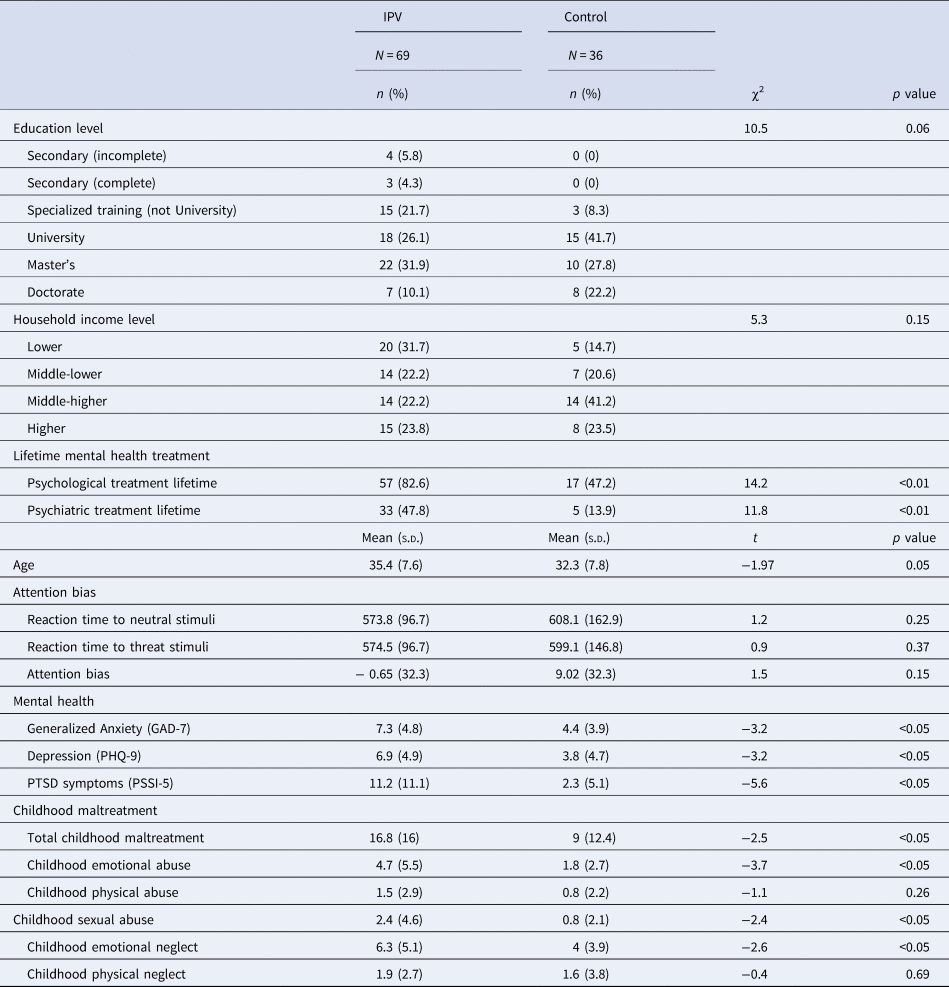
Our sample included 69 IPV-exposed women (age 22–50 years) and 36 non-exposed controls (age 21–46 years). See Table 1 for socio-demographic characteristics by group. The IPV-exposed group was oversampled to account for variability in terms of exposure to other experiences of abuse, in particular childhood maltreatment. Following a-priori sample size calculation [see (Goldberg, Espelt, Palao, Nadal, & Armario, Reference Goldberg, Espelt, Palao, Nadal and Armario2020)], a total of 120 women were recruited; two of them declined the initial interview, 12 did not complete the assessment, and data from 1 woman could not be retrieved due to a technical error.
Sample characteristics and unadjusted group comparisons

All participants were recruited through advertisement posters and institutional communication channels including social media. Women interested in participating contacted the research team and were interviewed by phone to assess eligibility. IPV was defined following WHO guidelines: ‘IPV refers to any behaviour within an intimate relationship that causes physical, psychological and sexual harm to those in the relationship’ (WHO, 2005) and included physical violence, sexual violence, emotional/psychological abuse and controlling behaviors. To warrant chronic exposure to stress as proposed in the rationale of the study, the minimum duration of the violent relationship was set at 6 months. Only women who had already ended the violent relationship for at least 12 months were included. Exclusion criteria were: age below 18, having any pituitary and/or adrenal gland disorder, currently using steroid-based medications, being currently pregnant, lactating, menopausal or post-menopausal, and having a severe illness affecting cognitive performance and/or consciousness. These exclusion criteria were applied to all potential participants, and those accepting to participate were assigned to a group according to whether they were exposed to IPV or not.
Measures
Socio-demographic characteristics
A questionnaire was used to collect information on age, level of education, current household income level (calculated from the income per capita reported by participants), and lifetime history of psychological and psychiatric treatment.
Intimate partner violence
Screening was conducted using the Partner Violence Screen (Feldhaus et al., Reference Feldhaus, Koziol-McLain, Amsbury, Norton, Lowenstein and Abbott1997) adapted to assess lifetime exposure. The instrument was designed to explore physical violence and perception of safety through three yes/no questions. The Spanish adaptation (Garcia-Esteve et al., Reference Garcia-Esteve, Torres, Navarro, Ascaso, Imaz, Herreras and Valdés2011) has high specificity and sensitivity. Women screening positive in at least one of the three items were further presented with an in-depth structured interview (WHO, 2005). The questions collected information on the onset and duration of the relationship of reference, and presence (yes/no) and frequency (once/sometimes/frequently) of IPV by type including control, psychological, physical, and sexual IPV. Women were identified as IPV-exposed and assigned to this group if any type of IPV was detected during this assessment.
Attentional bias
Threat-related AB was assessed using a variant of the dot-probe task (MacLeod et al., Reference MacLeod, Mathews and Tata1986; Sipos, Bar-Haim, Abend, Adler, & Bliese, Reference Sipos, Bar-Haim, Abend, Adler and Bliese2014). Briefly, women were presented with a pair of face stimuli, one threat-related (angry) and one neutral, followed by a target probe (< or >) that replaced one of the two faces. Participants were asked to indicate the direction of the arrowhead as accurately and quickly as possible by pressing one of two prespecified keys. Mean reaction time (RT) per trial type was extracted and AB scores were calculated by subtracting the mean RT of emotion trials from the mean RT of neutral trials. Positive values indicate bias toward threat stimuli (vigilance AB), and negative values indicate bias away from threat stimuli (avoidance AB). See online Supplementary materials for details.
Acute stress response task
The Trier Social Stress Test (TSST) (Kirschbaum, Pirke, & Hellhammer, Reference Kirschbaum, Pirke and Hellhammer1993) was used to induce acute stress response. In this task participants are instructed to imagine that they have been invited to an interview for their ‘dream job’, where they have to argue why they are the best candidate for the job in front of a selection committee consisting of two members. The complete task includes three successive phases: (1) preparation period in which participants prepare their speech (5 min), (2) speech task (5 min), (3) mental arithmetic task in which participants have to sequentially subtract an odd two-digits number from an odd four-digits number (e.g. 17 from 2023; 5 min). The interview is video recorded and the researchers conducting the TSST are blind to the participants' group. Neurobiological responses were assessed through saliva samples collected immediately before the TSST (T0), immediately after (T1, 20 min after the start of TSST), and at 40 min after the start of TSST (T2). Emotional responses were assessed through two scales completed before and after the TSST: (1) The State subscale of the State-Trait Anxiety Inventory (STAI) (Guillén-Riquelme & Buela-Casal, Reference Guillén-Riquelme and Buela-Casal2011; Spielberger, Gorsuch, Lushene, Vagg, & Jacobs, Reference Spielberger, Gorsuch, Lushene, Vagg and Jacobs1983) and (2) the arousal score of the Self-Assessment Manikin (SAM).
Mental health
Levels of generalized anxiety, depression, and symptoms of PTSD were assessed at baseline. Generalized anxiety was measured with the Generalized Anxiety Disorder Scale (GAD-7) (Spitzer, Kroenke, Williams, & Löwe, Reference Spitzer, Kroenke, Williams and Löwe2006), a self-reported scale consisting of seven questions that evaluate worry, nervousness and unease. The participant is asked to respond to these questions using a 4-point Likert scale and the sum of responses provides the total anxiety score ranging from 0 to 21. Scores of 5, 10 and 15 are considered cut-off scores for mild, moderate, and severe anxiety, respectively. Depression was assessed with the Patient Health Questionnaire (PHQ-9) (Kroenke, Spitzer, & Williams, Reference Kroenke, Spitzer and Williams2001), which collects self-reported information regarding severity of symptoms of major depression through 9 questions that are rated using a 4-point Likert scale. Scores of 5, 10, 15 and 20 are considered cut-off scores for mild, moderate, moderately-severe, and severe depressive symptoms. PTSD symptoms were measured with the PTSD Symptoms Scale-Interview Version for DSM-5 (PSSI-5) (Foa et al., Reference Foa, McLean, Zang, Zhong, Rauch, Porter and Kauffman2016), a 24-item semi-structured interview that allows a systematic assessment of PTSD symptoms according to DSM-5 criteria. The scale begins with a trauma screen, followed by 20 questions. The total PSSI-5 ranges from 0 (no symptoms) to 80 (severe PTSD symptoms). A total score over 31 suggests the person could benefit from PTSD treatment. The validity of the Spanish versions of GAD-7, PHQ-9 and PSSI-5 are high (Diez-Quevedo, Rangil, Sanchez-Planell, Kroenke, & Spitzer, Reference Diez-Quevedo, Rangil, Sanchez-Planell, Kroenke and Spitzer2001; Echeburúa et al., Reference Echeburúa, Amor, Sarasua, Zubizarreta, Holgado-Tello and Muñoz2016; García-Campayo et al., Reference García-Campayo, Zamorano, Ruiz, Pardo, Pérez-Páramo, López-Gómez and Rejas2010), and reliability in our sample was high (GAD-7 and PHQ-9 Cronbach's alpha = 0.86; PSSI-5 Cronbach's alpha = 0.90).
Childhood maltreatment
This was assessed through the Childhood Trauma Questionnaire-Short Form (CTQ-SF) (Bernstein et al., Reference Bernstein, Stein, Newcomb, Walker, Pogge, Ahluvalia and Zule2003), a self-reported retrospective measurement of 5 types of maltreatment experienced before the age of 18: emotional abuse, physical abuse, sexual abuse, emotional neglect and physical neglect. The items of the questionnaire are rated on a 5-point Likert. Score on the subscales by type of maltreatment range from 0 to 20. A total childhood maltreatment score was calculated as the sum of the scores of the subscales. This total score ranged from 0 to 100. The validity of the Spanish version of CTQ-SF has been proven (Hernandez et al., Reference Hernandez, Gallardo-Pujol, Pereda, Arntz, Bernstein, Gaviria and Gutiérrez-Zotes2013) and reliability in our sample was high (Cronbach's alpha = 0.80).
Physiological variables
Saliva samples were obtained by means of Salivette© Cortisol collection devices (Sarstedt AG & Co., Germany). Salivary cortisol levels were determined by means of a competitive radio-immunoassay (RIA) technique developed in our laboratory and validated against a standard salivary cortisol enzyme immunoassay kit, Expanded Range High Sensitivity (Salimetrics, Ref: 1-3002-5, UK). Salivary α-amylase (sAA) was determined by a standard Salivary α-amylase kinetic enzyme assay kit (Salimetrics, Ref: 1-1902-5, UK). Hair cortisol (HC) was extracted following a standard procedure (Scorrano et al., Reference Scorrano, Carrasco, Pastor-Ciurana, Belda, Rami-Bastante, Bacci and Armario2015) and was subsequently determined with the above salivary cortisol Salimetrics kit. All samples were processed in the same assay to avoid inter-assay variability.
Procedures
The authors assert that all procedures contributing to this work comply with the ethical standards of the relevant national and institutional committees on human experimentation and with the Helsinki Declaration of 1975, as revised in 2008. All procedures involving human subjects/patients were approved by the Ethics Committee of Parc Taulí University Hospital (approval number 2018551) and followed World Health Organization's recommendations for research on violence against women (WHO Department of Gender Women & Health, 2001). The study has been registered at the ClinicalTrails.gov database (Identifier number: NCT03623555).
A first face-to-face session was scheduled for an in-depth interview. Written informed consent was obtained from all participants after a full description of the study's aims and design. Hair samples were collected, questionnaires were completed, and AB was assessed. A second session was scheduled two weeks later to assess response to the TSST. For this second session, participants were required to refrain from caffeine or engaging in rigorous exercise two hours before lunch. All participants had a light lunch (salad, fruit and water) in the cafeteria of the center between 1pm and 2pm. 30 min after the start of lunch, participants were accompanied to the laboratory facilities, where they waited alone in a quiet room for another 30 min. Only water intake was allowed at this point. Participants did not brush their teeth after the meal. Immediately after this acclimation period (T0), salivary samples were collected, the data from STAI and SAM assessed and the instructions of the TSST provided. A second salivary sample was collected after the TSST (T1, 20 min after the start). Participants were accompanied to the same waiting room, where the team responded to any questions the TSST may had raised and the post-TSST STAI and SAM data were collected. Finally, the third salivary sample was obtained in the waiting room 40 min after the start of the TSST (T2).
Statistical analysis
All statistical analyses were conducted using SPSS ((IBM, 2012) version 21.0, Armonk, NY). Data distribution was explored and group comparisons were examined using standard statistical methods as appropriate. Logarithmic transformations were performed on cortisol and sAA measurements. The capacity of the TSST to induce cortisol and sAA response over time was explored using repeated-measures ANOVAs with three time points (T0, T1, and T2) and Group as between-subjects factor (unadjusted). We further examined cortisol non-response following the alternative proxies as proposed in previous guidelines for effective classification (Miller, Plessow, Kirschbaum, & Stalder, Reference Miller, Plessow, Kirschbaum and Stalder2013).
Baseline differences between groups were further examined for HC and physiological and emotional levels at T0 using univariate ANOVA with Group and AB as main independent variables. The model was explored both unadjusted and adjusted by the following covariates: age, education level, lifetime psychological and psychiatric treatment, total childhood maltreatment score, and levels of anxiety, depression and symptoms of PTSD.
We used repeated-measures ANCOVAs to describe the patterns of physiological and emotional responses to acute stress in association with AB (Objective 1). For physiological outcomes (salivary cortisol and sAA levels), three time points were available: T0, T1, and T2. For emotional outcomes (STAI and SAM), two time points were available: pre- and post-TSST. Group was entered as between-subjects factor (two levels: IPV and control) and AB as the independent variable. Age, education level, lifetime psychological and psychiatric treatment, total childhood maltreatment score, and levels of anxiety, depression and symptoms of PTSD were entered as covariates.
Finally, we used a series of regression models to explore Group, AB, and stress response in relation to mental health (Objective 2). We first calculated the area under the curve of cortisol response (AUCi_cortisol) and the area under the curve of sAA response (AUCi_sAA) to account for separate composite scores of cortisol and sAA stress response. We used the ‘Area under the curve with respect to increase’ (AUCi), which is calculated with reference to the first value and ignores the distance from zero for all measurements, emphasizing the changes over time (Pruessner, Kirschbaum, Meinlschmid, & Hellhammer, Reference Pruessner, Kirschbaum, Meinlschmid and Hellhammer2003). Three step-wise regression models were run using Group, AUCi_cortisol, AUCi_sAA and AB as independent variables and with the following outcome variables: anxiety (GAD-7), depression (PHQ-9), and PTSD symptoms (PSSI-5).
Results
Sample characteristics
The description of the sample by Group is shown in Table 1. As expected, women in the IPV-exposed group presented a higher frequency of lifetime psychological and psychiatric treatment than the control group, more frequent exposure to childhood maltreatment and higher levels of anxiety, depression and PTSD symptoms. The mean duration of the IPV relationship was 6.7 years (range 6 months to 30 years), with a mean age of start at 21.8 years (range 18–41.5), and a mean of 7.2 years passed since the end of the relationship to the date of the study (range 1–20 years). 97.1% of the IPV group reported exposure to psychological IPV, 91.3% control IPV, 53.6% physical IPV, and 65.2% sexual IPV. 94% of women experienced more than one type of IPV during the course of the relationship and 94.2% reported that they were frequently or very frequently exposed to IPV.
HC levels were similar for the IPV-exposed and control groups (See online Supplementary Table (ST) S1). Adjusted analysis showed that HC was only associated with childhood maltreatment [F (1, 92) = 5.59, p < 0.05]. We found no effect of Group on baseline (T0) salivary cortisol [F (1103) = 0.30, p = 0.59], in line with the HC results. Baseline sAA presented a trend toward lower levels in the IPV-exposed group in unadjusted analysis [F (1, 103) = 2.8, p = 0.1] and Group, GAD-7 and PHQ-9 scores were associated with sAA at T0 after full adjustment [Group: F (1, 93) = 7.4, p < 0.05, GAD-7: F (1,93) = 5.5, p < 0.05, PHQ-9: F (1,93) = 4.4, p < 0.05)].
To determine whether the TSST induced stress in our study, we explored the cortisol and sAA response across time in the whole sample (repeated-measures ANOVA, between-subject factor: Group, unadjusted). A significant change from T0 to T1 and T2 was observed for sAA levels [F (1.898,189.8) = 55.43, p < 0.01] and a non-significant increased response was found for cortisol levels [F (1.324,133.7) = 1.60, p = 0.21] supporting the capacity of the TSST to induce stress, although with lower effect on cortisol (See online ST1 and SF1). Increased emotional response after TSST was also confirmed for both STAI [F (1, 103.0) = 66.46, p < 0.01] and SAM [F (1, 103.0) = 42.09, p < 0.01). No effect of Group was evident in these analyses, neither in the examination of the response as assessed with AUCi_cortisol and AUCi_sAA. We further explored cortisol non-response in both groups following established recommendations (Miller et al., Reference Miller, Plessow, Kirschbaum and Stalder2013). 58.3% of the women in the control group were classified as non-respondent, v. 68.1% in the IPV group (non-significant difference). No differences were detected in sAA levels between cortisol responders and non-responders (See online ST2.1 and ST2.2).
Patterns of physiological and emotional response to acute stress.
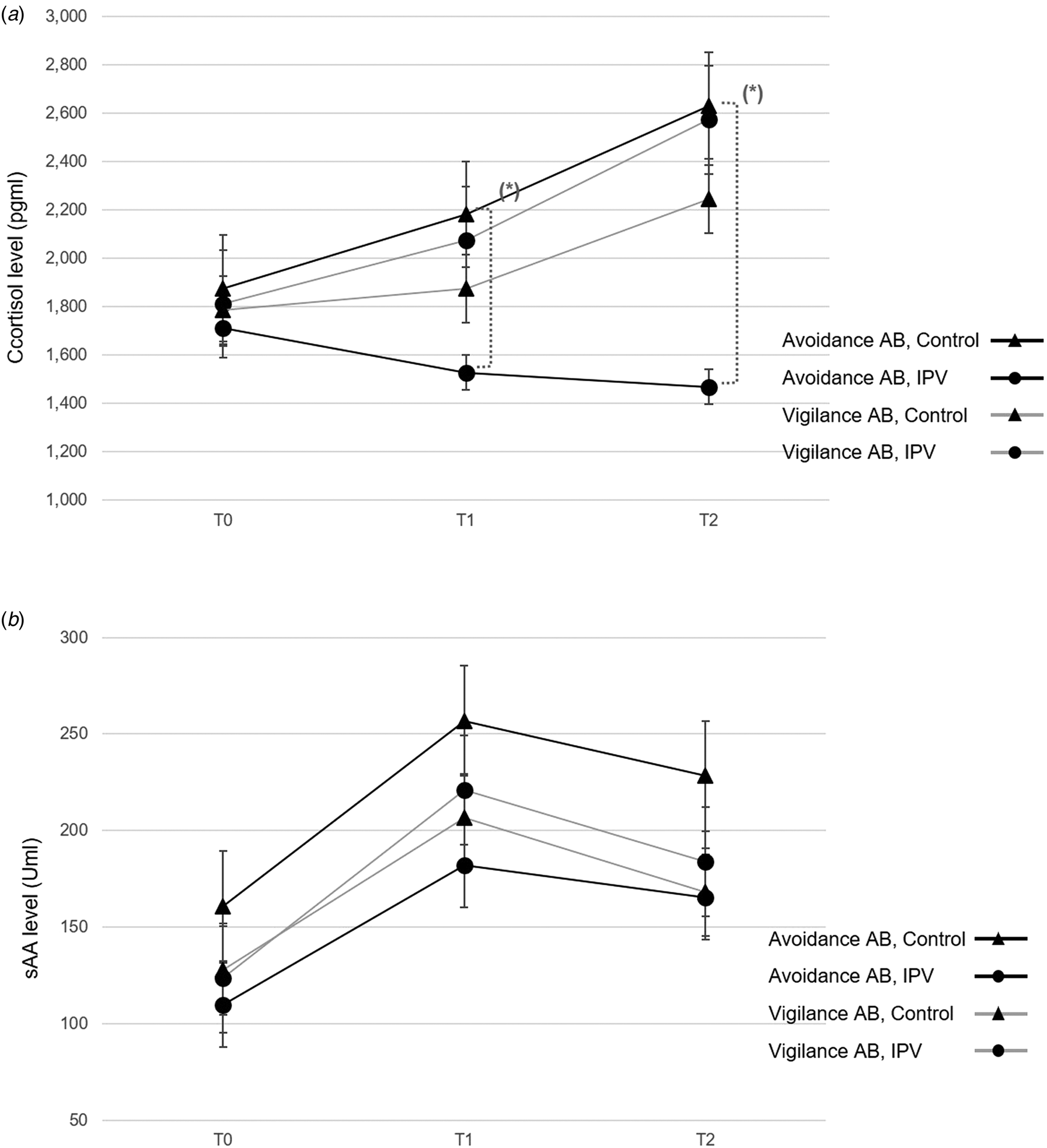
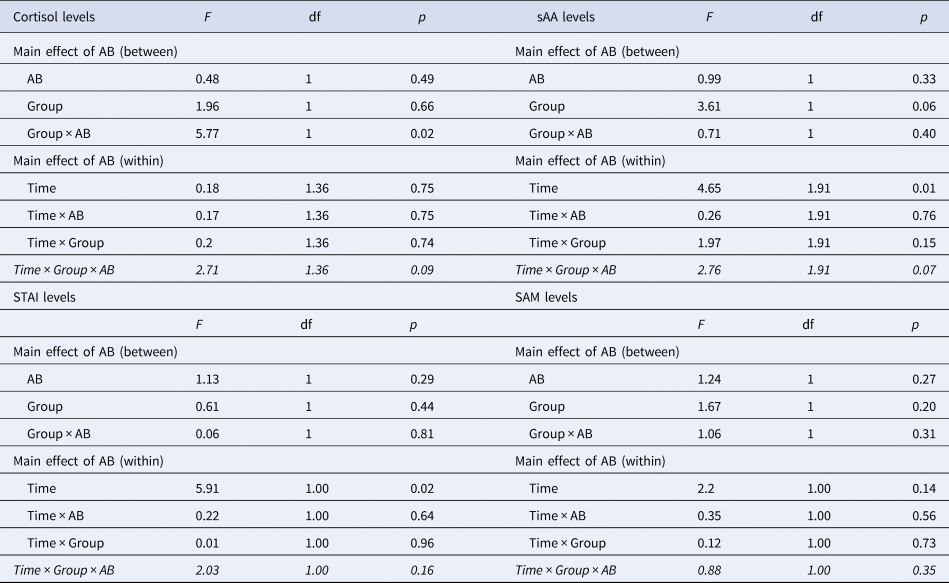
We used repeated-measures ANCOVAs to explore the associations between Group and AB with the physiological and emotional response to the TSST as outcomes. In relation to cortisol, the interaction between Group and AB was significant [F (1,90) = 5.77, p = 0.02], whereas the three-way interaction of Group × AB × time approached significance [F (1.4,122.2) = 2.71, p = 0.09]. All other main and interaction effects were non-significant. Due to the marginal significance of the Group × AB × time interaction and the importance of the time effect, additional exploratory decompositions of the Group × AB interaction were performed by time points. There were no effects of interaction at T0, the interaction approached significance at T1 [F (1,92) = 3.87, p = 0.05], and was statistically significant at T2 [F (1,92) = 5.6, p = 0.02]. To further describe the effects in cortisol response, each participant was assigned to a category according to the direction of AB: ‘avoidance AB’ or ‘vigilance AB’ depending on whether she presented a negative score, or a positive score. The effect of Group remained significant among the participants with an avoidance AB [F (1,39) = 5.21, p = 0.03], with IPV women presenting a blunted cortisol response compared to controls [T1: F (1,39) = 5.23, p = 0.03; T2: F (1,39) = 5.62, p = 0.02]. No group differences were observed among participants with a vigilance AB (Fig. 1a).
Neurobiological response to acute stress. a: Cortisol reactivity. Cortisol levels (pgml) by Group (IPV, control) and AB category (avoidance, vigilance) before the start of the TSST (T0), immediately after (T1) and 40 min after (T2). (*): p < 0.05 adjusted for age, education level, lifetime psychological and psychiatric treatment, total childhood maltreatment score, and levels of anxiety, depression and symptoms of PTSD. b: sAA reactivity. sAA levels (Uml) by Group (IPV, control) and AB category (avoidance, vigilance) before the start of the TSST (T0), immediately after (T1) and 40 min after (T2). Only among the participants with an avoidance AB the results indicated a trend toward lower sAA levels in IPV women relative to controls, regardless of time.

For sAA, the analysis showed significant time effect [F (1.9, 170) = 4.65 p = 0.01], whereas Group and the interaction Group × AB × time approached significance [F (1.9, 170) = 3.61 p = 0.06 and F (1.9, 170) = 2.76. p = 0.07, respectively]. All other main and interactions effects were non-significant. Given the marginal significance of the Group × AB × time interaction in sAA, we run further exploratory decompositions similar to cortisol-response analyses. When the interaction was further explored, results indicated a non-significant trend to lower sAA levels in IPV women relative to controls only among participants with an avoidance AB, regardless of time [F (1, 38) = 3.13, p = 0.085] (Fig. 1b)
Similar models were used to explore the emotional response to the TSST in association with Group, AB, and the relevant covariates. State anxiety increased in both groups after the TSST [TIME: F (1, 92) = 5.91, p = 0.02] and there were significant main effects of GAD-7 total score [F (1, 92) = 6.25 p = 0.01] and childhood maltreatment [F (1, 92) = 5.72 p = 0.02], whereas all other factors and interaction effects were non-significant. Likewise, emotional arousal (as measured with SAM) was only associated with GAD-7 total score [F (1, 92) = 6.25 p = 0.01].
Associations with mental health status
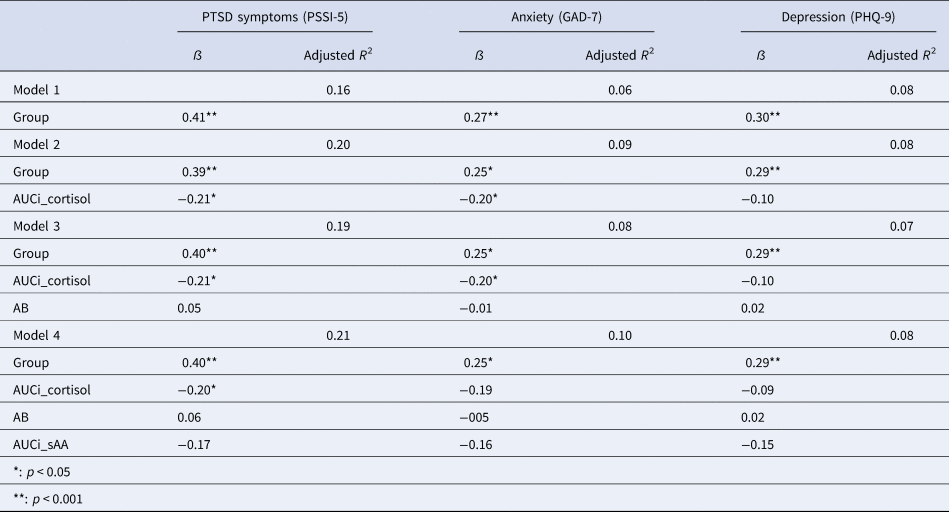
The association between Group, AB, cortisol, and sAA (AUCi) regarding mental health status was explored in three separate regression models using PTSD symptoms, trait anxiety, and depression as outcomes. The models and results are presented in Table 2. A model including Group and cortisol explained 20% of the variance in PTSD symptoms [F (2, 98) = 13.3, p < 0.001]. The model remained significant when AB and sAA were included, but the main effects of AB and sAA were not significant. 9% of the variance in generalized anxiety symptoms was explained by the model including Group and cortisol [F (2, 98) = 6.11, p < 0.01]. Finally, only the effect of Group was statistically significant in the model with symptoms of depression as outcome [F (1,99) = 9.55, p < 0.01].
Results of the main analysis exploring the associations between acute stress response, Group and attentional bias

Repeated-measures ANCOVAs were run for each outcome of interest. Between- and within-subjects results are reported. Decompositions by time-point were further performed where relevant (Fig. 1, 1A and 1B)
Results of the regression analyses exploring Group, AB and stress response (cortisol and sAA AUCi) in relation to mental health

Separate analyses were run using generalized anxiety (GAD-7), depression (PHQ-9) and PTSD symptoms (PSSI-5) as outcomes.
Discussion
The analysis of the physiological reactivity to acute stress identified strong neurobiological correlates linked to AB to threat and stress-related disorders among women survivors of IPV. While there was no clear attentional profile associated with IPV, the interaction between AB and IPV exposure emerged as a relevant factor for the understanding of the trajectory of cortisol response to stress. Women exposed to IPV who presented threat avoidance AB showed a blunted cortisol response to stress, in contrast to women in the IPV group with threat vigilance AB, and to control women. Exposure to IPV and the trajectory of cortisol response were in turn associated with symptoms of PTSD (20% of explained variance) and anxiety (9%). Symptoms of depression were mainly associated with exposure to IPV.
We did not observe a differential cortisol response to the TSST between groups, and we found a trend toward a lower sAA response in IPV survivors. There are no previous studies addressing acute stress response in this population that would allow direct comparison of our results and therefore a replication of the current results would be of great value. In other vulnerable groups, the impact of prior chronic stress exposure on biological response to acute stressors has provided inconclusive findings (Chida & Hamer, Reference Chida and Hamer2008; Epel et al., Reference Epel, Crosswell, Mayer, Prather, Slavich, Puterman and Mendes2018). Adverse experiences during childhood are consistently associated with blunted salivary cortisol measures of stress reactivity across the lifespan (Brindle, Pearson, & Ginty, Reference Brindle, Pearson and Ginty2022). Because women exposed to IPV more commonly present with previous exposure to childhood maltreatment, we adjusted for this expected effect in our analysis. The direct association between adversity and reduced cortisol reactivity seems to be particularly evident when events are experienced prior to age 15 (Lovallo, Farag, Sorocco, Cohoon, & Vincent, Reference Lovallo, Farag, Sorocco, Cohoon and Vincent2012), while other influences need to be considered in relation to exposures during adulthood.
Three critical factors are traditionally reported to underwrite the discrepancies across studies of chronic stress: age of chronic exposure, severity/duration of chronic stress, and time elapsed between chronic stress and testing (Miller, Chen, & Zhou, Reference Miller, Chen and Zhou2007). However, other not yet characterized factors are likely to contribute. We found an interaction between Group and AB in cortisol response. Whereas threat avoidance AB in IPV-exposed women resulted in lower cortisol response than in threat vigilance AB IPV-exposed women, the opposite pattern was found in controls. As a result, only a clear difference was observed in controls v. IPV participants showing threat avoidance AB. This finding supports a regulatory role for implicit cognitive processes involved in the emotional modulation of attention away from threat among women survivors, and points to threat avoidance AB as a contributing factor for abnormal cortisol response in this group. As such, reducing threat avoidance in women exposed to IPV present a potential target for intervention.
The relation between AB and the neuroendocrine system in this vulnerable group should be interpreted under the light of findings on cognitive mechanisms implicated in emotion regulation, coping, and mental health. Vigilance to threat early in attentional processes has been linked to increased cortisol responses among healthy undergraduates (Dandeneau, Baldwin, Baccus, Sakellaropoulo, & Pruessner, Reference Dandeneau, Baldwin, Baccus, Sakellaropoulo and Pruessner2007), in line with other studies examining automatic information processing in male volunteers presented with social threat paradigms (Fox et al., Reference Fox, Cahill and Zougkou2010; Van Honk et al., Reference Van Honk, Tuiten, Van Den Hout, Koppeschaar, Thijssen, De Haan and Verbaten2000). However, it is now known that coping can modulate this association. For example, a recent study exploring the electrophysiological response to the TSST suggests that attentional resources may be redirected toward internal threat-related thoughts during acute psychosocial stress exposure (Palacios-García et al., Reference Palacios-García, Silva, Villena-González, Campos-Arteaga, Artigas-Vergara, Luarte and Bosman2021). The processes involved in generating and triggering thoughts associated with previous threat exposures and responses are particularly relevant for the neurobiological and attentional response to acute stress in IPV-exposed women.
Stressful experiences can lead to changes in AB, and the direction of the effect (i.e. avoidance, vigilance) is dependent on the magnitude and duration of the exposure (Bar-Haim et al., Reference Bar-Haim, Holoshitz, Eldar, Frenkel, Muller, Charney and Wald2010). This is relevant because avoidance AB has been specifically associated with mental health conditions (Shechner & Bar-Haim, Reference Shechner and Bar-Haim2016). Avoidance AB and low cortisol response under acute stress have been found in association with anxiety symptoms in healthy participants (Applehans & Luecken, Reference Applehans and Luecken2006), and among survivors of highly stressful and chronic exposures with symptoms of PTSD (Sipos et al., Reference Sipos, Bar-Haim, Abend, Adler and Bliese2014). IPV women showed enhanced anxiety and PTSD symptoms in the present study. Possible paths toward mental health prevention in women survivors of IPV may involve AB modification treatments targeting aberrant attentional patterns to reduce vulnerability to stress-related psychopathology (Wald et al., Reference Wald, Bitton, Levi, Zusmanovich, Fruchter, Ginat and Bar-Haim2017). Indeed, attentional tasks that train participants toward disengagement and shifts of attention have been shown to induce changes in cortisol and α-amylase reactivity, and anxious mood, in response to acute stress (Pilgrim, Ellenbogen, & Paquin, Reference Pilgrim, Ellenbogen and Paquin2014).
Hair levels of glucocorticoids represent an integrated measure of release over long periods of time (months) and have been demonstrated to increase in highly stressful situations in humans (Rajcani, Vytykacova, Solarikova, & Brezina, Reference Rajcani, Vytykacova, Solarikova and Brezina2021; Stalder et al., Reference Stalder, Tietze, Steudte, Alexander, Dettenborn and Kirschbaum2014), primates (Teng et al., Reference Teng, Shively, Li, Jiang, Neigh, Yin and Xie2021), and laboratory animals (Scorrano et al., Reference Scorrano, Carrasco, Pastor-Ciurana, Belda, Rami-Bastante, Bacci and Armario2015). In the present study, no difference was found across groups with respect to HC. Because this integrated measure reflects hormone release under a period of continuous stress, time since end of the IPV needs to be carefully consider in the interpretation of HC levels in IPV survivors. Current exposure was an exclusion criterium in our study and IPV-exposed women reported a mean of 7.2 years passed since the end of the relationship to the date of the study (range 1–20 years). Only two previous reports have included this measure in studies of IPV survivors. One reported higher HC level in women leaving in shelters, but time after leaving the relationship was probably low, although this was not indicated (Boeckel, Viola, Daruy-Filho, Martinez, & Grassi-Oliveira, Reference Boeckel, Viola, Daruy-Filho, Martinez and Grassi-Oliveira2017). In a more recent study in women recruited from primary health centers in Saudi Arabia and living with the perpetrators, a negative association was found between HC and the severity of IPV (Alhalal & Falatah, Reference Alhalal and Falatah2020).
Regarding response to the TSST, we did not observe an overall statistically significant effect of time on cortisol, suggesting that the protocol was not as potent as expected to markedly activate the HPA axis. Data in the literature considering other forms of severe chronic stressors (i.e. caregiving) reveal that the TSST protocol is able to induce a potent activation of cortisol secretion in some studies, but not in others (Kirschbaum et al., Reference Kirschbaum, Prussner, Stone, Federenko, Gaab, Lintz and Hellhammer1995; Wand et al., Reference Wand, Oswald, Mccaul, Wong, Johnson, Zhou and Kumar2007). The reason for this differential response is unknown. Friendly behavior of the investigators delivering the TSST (as opposed to neutral behavior, as indicated in the task guidelines) can lead to lower activation of the HPA axis response (Wiemers, Schoofs, & Wolf, Reference Wiemers, Schoofs and Wolf2013). This behavior was closely supervised in our study to avoid such bias. The staff was trained before the start of assessment both in the use of TSST and following the recommendations for research with women survivors of IPV (WHO Department of Gender Women and Health, 2001). In our study, stress-induced increase in sAA was observed in almost all subjects, indicating actual physiological reactivity to the TSST, in accordance with the subjective measures. The greater overall sAA response to the TSST – in comparison to cortisol response – can be, at least in part, explained by its greater sensitivity to low stress compared with cortisol (Noto, Sato, Kudo, Kurata, & Hirota, Reference Noto, Sato, Kudo, Kurata and Hirota2005; Skosnik, Chatterton, Swisher, & Park, Reference Skosnik, Chatterton, Swisher and Park2000). However, cortisol non-response is frequent and is under scrutiny as a particular characteristic of individual differences in the HPA axis (e.g. (Dimitrov et al., Reference Dimitrov, Demin, Fehlner, Walter, Erk and Veer2018; McLaughlin et al., Reference McLaughlin, Schutze, Pennell, Henley, Robinson, Straker and Smith2022; Oskis, Smyth, Flynn, & Clow, Reference Oskis, Smyth, Flynn and Clow2019). Of note, women commonly show higher rate of non-response than men (Dimitrov et al., Reference Dimitrov, Demin, Fehlner, Walter, Erk and Veer2018; McLaughlin et al., Reference McLaughlin, Schutze, Pennell, Henley, Robinson, Straker and Smith2022). The exact characteristics determining this trait remain elusive and more research is warranted.
As sAA is progressively being included in studies of stress-reactivity to provide a more comprehensive understanding of the multiple biological processes implicated in response to psychosocial stress (Granger et al., Reference Granger, Kivlighan, Blair, El-Sheikh, Mize, Lisonbee and Schwartz2006; Man et al., Reference Man, Shao, Hou, Xin Li, Yan Liu, Lee and Lee2023), the dissociation between cortisol and sAA responses to psychosocial stressors is being repeatedly reported (e.g. (Nater et al., Reference Nater, La Marca, Florin, Moses, Langhans, Koller and Ehlert2006)). In our study, the fast-acting response of the SNS was evident in the trajectories shown for sAA, with peak levels just after the TSST, whereas maximum average cortisol levels were found 40 min from the TSST (Fig. 1a and 1b). The findings in sAA indicate a reaction that is not redundant with HPA axis processing, and these two time points are likely to capture responsiveness of the two systems. Interestingly, the patterns of trajectories were associated with AB in a trend that is consistent with the findings for cortisol response. However, none of the groups showed blunted sAA response. This contrasts with the findings for cortisol reactivity in the group of IPV women with avoidance AB. Taken together, these results provide further support to specific alterations in HPA axis regulation that are associated with inter-individual differences in psychological processes in IPV-exposed women.
Our study has several strengths, most noteworthy the laboratory-based assessment of acute stress response in this vulnerable group. Limitations include the cross-sectional nature of the data that prevents causal readings. We have no information previous to exposure to IPV that could confirm a causal relation between blunted cortisol reactivity and IPV. This limitation does not affect the validity of the findings or the strong association observed between blunted cortisol response and current mental health status in women survivors of IPV. The frequency of lifetime psychological treatment was higher than the reported for women from the general population in Spain (Subdirección General de Información Sanitaria, 2021). This was expected as people who ever needed counseling for mental health conditions are more prone to participate as volunteers in mental health studies. However, women in the control group did not present current mental health conditions. Moreover, all analysis included lifetime treatment as covariate to adjust for potential effects. Finally, the stability over time of AB measures is supported albeit they may change under certain circumstances (McNally, Reference McNally2019). Replication studies using larger sample sizes are needed to increase generalizability and to allow a more detailed examination of the effects of covariates.
In summary, the examination of cognitive mechanisms involved in the early processing of emotionally-salient information allowed us to identify key factors associated with neuroendocrine response to acute stress among women exposed to IPV. Research on AB to threat and physiological stress response can help better understand the pathways implicated in the women's resources to cope with new stressors and their neurobiological correlates. Our approach can help explain the inconsistent findings in previous studies, and advance knowledge toward the development of effective strategies to prevent the onset of mental health disorders in this vulnerable group. Further research is warranted to test neurocognitive-driven assistance for improved course of treatment and recovery of survivors.
Supplementary material
The supplementary material for this article can be found at https://doi.org/10.1017/S0033291723000910
Financial support
This work was supported by ‘La Caixa’ Foundation (ID 100010434) under grant agreement 2017ACUP00277 to XG and AA. RN and AA were supported by Spanish grants from Ministerio de Economía y Competitividad and FEDER European Funds (SAF2017-83430-R) and Generalitat de Catalunya (SGR2017-457). RN was a recipient of an ICREA-ACADEMIA award (Generalitat de Catalunya, 2015–2019).
Conflict of interest
DP has received grants and also served as consultant or advisor for Angelini, Janssen, Lundbeck and Servier. The rest of authors have no conflict of interest to declare.