Family welfare and child protection practices are at the cornerstone of welfare systems in all post-industrial societies. How social workers understand family is a serious matter because they are critical actors in executing state settlements with families (Morris et al., Reference Morris, White, Doherty and Warwick2017). Since the family constitutes a central premise for the purpose and arrangement of familial control and support, critical reflections about social workers’ understandings of, and intervention into, families are important (Morris et al., Reference Morris, White, Doherty and Warwick2017). The aim of this article is to expand previous research by exploring Chilean, Mexican and Norwegian social workers’ conceptualisations of family and family responsibilities and how their understandings impact on social work practice. Internationally, increasing emphasis is placed on the state's responsibility for protection of, and support for, vulnerable children and families, not least because of the ratification of the United Nations’ Convention on the Rights of the Child (CRC, 1989). Norway, Mexico and Chile have ratified the CRC, and acknowledge the need for secure protection, provision and participation of children. Nevertheless, social work research (Gilbert et al., Reference Gilbert, Parton and Skivenes2011) reveals that the ways in which children's rights and family situations are assessed, and the levels of state involvement in families, varies between countries. Over the last decade, there has been growing interest in cross–national comparisons of child protection systems and social work practices, particularly between different European countries and between European and Anglo-American countries (Gilbert et al., Reference Gilbert, Parton and Skivenes2011; Berrick et al., Reference Berrick, Dickens, Pösö and Skivnes2017). This research shows that child protection systems and interactions with families vary across contexts. However, with a few exceptions (Quiroga and Hamilton-Giachritsis, Reference Quiroga and Hamilton-Giachritsis2014; Ursin et al., Reference Ursin, Oltedal and Muñoz2016), cross-national comparisons between European countries and other parts of the world, including Latin America, are rare.
Child protection workers from Latin America (Mexico and Chile) and Europe (Norway) operate within different welfare regimes (Franzoni, Reference Franzoni2008). Hantrais (Reference Hantrais2004)Footnote 1 distinguishes between four family policy patterns in Europe. Norway fits within the subgroup ‘de-familialised’, whereby the government minimises reliance on individual family members. There is strong legitimised public support for state intervention and a commitment to redistributive policy interventions (Forsberg and Kröger, Reference Forsberg and Kröger2010). Chile and Mexico are considered to be ‘familialised’ regimes, characterised by a non-interventionist approach by the state and people's well-being is deeply embedded in, and supported by, family relationships. It is, however, an overgeneralisation to position Latin American countries as in a homogenous region and comparisons within Latin America consider Chile and Mexico's state welfare regimes to differ; Mexico is defined as ‘protectionist’ and Chile as a ‘productivist’. In Chile, there is a greater allocation of public expenditure to the poor, than in Mexico (Franzoni, Reference Franzoni2008).
This article examines how social workers’ conceptualisations of family, ‘family members’ and state responsibilities, impact on social work practice. By comparing social work practice in two continents, and three countries, we show similarities and differences between welfare contexts and that social worker's conceptualisations reflect the national welfare regimes within which they operate; professionals in various national contexts held different orientations regarding the role of the state in relation to the family and children. The study therefore contributes by highlighting how macro level policy impacts on social worker's engagement with and understanding of families.
Contexts and child protection systems
Most child protection systems are grounded in a basic set of principles relating to public responsibility for children at risk. Gilbert et al. (Reference Gilbert, Parton and Skivenes2011) recognise the existence of two orientations – a ‘child protection orientation’ and a ‘family service orientation’ – but argue that these distinctions are inadequate. Over the last decade, child protection oriented states have increasingly developed systems characterised by early intervention and family support, whilst states identified as family service oriented focus on the harm that family conflict and dysfunction may cause to children. Gilbert et al. (Reference Gilbert, Parton and Skivenes2011) suggest a third orientation – a ‘child-focused orientation’ – where the child is viewed as an individual with an independent relation to the state. This leads to de-familialisation, limiting family and parental responsibility for raising children.
Norwegian Child Welfare Services (CWS) are identified as moving from a ‘family service system’ towards a ‘child focused’ system (Gilbert et al., Reference Gilbert, Parton and Skivenes2011) and in Chile and Mexico, child protection services – traditionally characterised by a child protection approach – have recently adopted practices that are more family service orientated and focus on family dysfunction and therapeutic orientations (Ursin et al., Reference Ursin, Oltedal and Muñoz2016). For Cabiati (Reference Cabiati2015), however, only families with complex needs come to the attention of the services in Mexico, and out-of-home placements are often the only measure used to safeguard children. This implies a child protection orientation. These three contexts, therefore, appear to have three different child welfare approaches. That said, it is difficult to locate national policies on child protection within these typologies, as they shift and blend (Gilbert et al., Reference Gilbert, Parton and Skivenes2011). Furthermore, social work practice does not fit easily within the predetermined categories and social work varies as much within systems as between them (Berrick et al., Reference Berrick, Dickens, Pösö and Skivnes2017).
Mexico
Inequality has deep historical roots in Mexico. Despite economic growth in the 1990s, Mexico still has high levels of poverty and inequality – that directly affect children. Furthermore, violence and corruption in politics, and justice and law enforcement, strongly affect everyday life (Cabiati, Reference Cabiati2015). The middle and upper classes pay taxes which are fully offset by the subsidies given to lower-income workers (Martínez, Reference Martínez2006), and a residual model of social policy positions the family and the market as primarily responsible for welfare. The state only participates (temporarily) when neither the family nor the market can provide welfare. Consequently, in Mexico, neoliberal social policies can result in exclusion, selectivity and temporality (Portilla, Reference Portilla2005). The traditionalist culture of the Mexican state, and profound social problems related to the conflict of drug war, have contributed to a welfare structure that follows a bureaucratic statist model (Cabiati, Reference Cabiati2015). Each state has relative autonomy over social welfare, although national regulations exist, for example, ‘Ley de Asistencia Social’ (Diario Oficial de la Federación, 2013) and the ‘Ley para la Protección de los Derechos de Niñas, Niños y Adolescentes’ (Diario Oficial de la Federación, 2010). These laws recognise children's rights, ’the best interests of the child’, and highlight a child's right to live within a family (not necessarily the biological family). In 2015, there were 40,163,748 children under the age of eighteen, representing 33.19 per cent of the total population. Among these, 25,667 children lived in residential care, representing 0.06 per cent of the total population of Mexican children (INEGI, 2015: 7–9). Hence, national legislation and social work practice aims to keep children in families, rather than in institutional care.
Chile
The Republic of Chile has adopted privatisation and neoliberal economic and social policies as strategies for economic growth and social equity (Marcus, Reference Marcus2004). The neoliberal model of development has increased long-standing social and economic stratification, negatively affecting the perception of economic and social security, equity and trust among the Chilean people (Marcus, Reference Marcus2004). According to Marcus (Reference Marcus2004), Chile's labour market is organised roughly into two segments: permanent, more skilled and better-paid employees, and temporary, less skilled and poorly paid workers. These differences underlie a persistent inequity in access to social security and health insurance (services privatised in the 1980s) for a group of the population, since access to social security is mediated by permanent and formal employment. Nevertheless, the OECD (2015) shows that Chile has made significant progress over the last decade in terms of improving the quality of life of its citizens and has taken important steps to protect children, by incorporating children's rights into domestic laws (Fuentes, Reference Fuentes2007).
Child protection for children and young people in Chile is primarily managed by private institutions but supervised and partly financed by the National Service for Minors (the Servicio Nacional para los Menores de Edad- SENAME), which is part of the Ministry of Justice and has responsibilities for: dealing with child protection, adoption, and young people in conflict with justice (Quiroga and Hamilton-Giachritsis, Reference Quiroga and Hamilton-Giachritsis2014). Moreover, the Chilean social protection subsystem for vulnerable children comprises a set of benefits and actions, guaranteed by law, and performed by various state institutions and agents, also responsible for monitoring related coverage, focus, and quality of social benefits (Arcos et al., Reference Arcos, Muñoz, Sanchez, Vollrath, Gazmuri and Baeza2013). In 2013, there were 4,414,927 children (25 per cent of the total population), and 2.1 per cent of them were child protection users (92,713 children). Among these 15.8 per cent (14,648) were in residential care, representing 0.3 per cent of Chilean children (Muñoz et al., Reference Muñoz, Fisher and Chía2013). Hence, child protection systems in Chile employ a broader range of measures than in Mexico, and figures show that more children are removed from their families, and placed in institutional care.
Norway
As a socio democratic welfare state, Norway has strong egalitarian values, characterised by a redistributive policy; there is an acceptance of high taxation, which allows the state to provide a wide range of public welfare services, such as education, health, and social services (Forsberg and Kröger, Reference Forsberg and Kröger2010). National laws regulate child welfare services, and the state and the municipalities share responsibility for child welfare, with the aim of promoting a healthy childhood and to safeguard children and young people. Whilst, historically, children and families were considered as a single unit, the status of children has changed (Gilbert et al., Reference Gilbert, Parton and Skivenes2011) and although emphasis is still on family support, the child is the central focus of any case (Gilbert et al., Reference Gilbert, Parton and Skivenes2011). Approximately 22 per cent of the Norwegian population are children (1,127,400 children in total) (Statistics Norway, 2016) and, in 2016, 4.2 per cent (47,768) of children received support from child welfare services. 80 per cent (38,281 children) received assistance measures (such as financial support, personal support contact, or ‘voluntary’ out-of-home placements) and 20 per cent (9,487 children) received care measures (compulsory out-of-home placements) of which the majority were placements in foster care (Statistics Norway, 2017). Children receiving care measures make up 0.84 per cent of the total population of children in Norway. Hence, the relative volume of CWS measures and percentage of children in out-of-home care are substantially higher than in Mexico and Chile countries.
Method
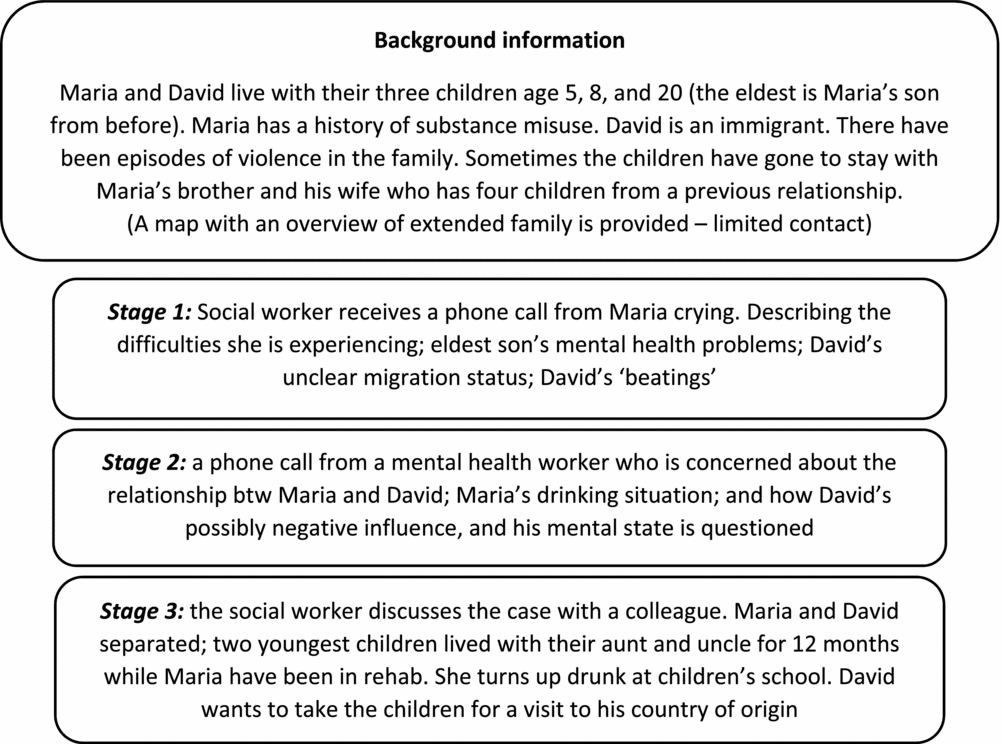
The data presented are taken from the broader international research project ‘Family Complexity and Social Work’ (FACSKFootnote 2), which aimed to examine conceptualisations of family in eight different countries. The findings presented are based on focus group interviews conducted with twenty-eight child welfare workers in Chile (two focus groups), Mexico (one focus group) and Norway (two focus groups). Participants were recruited from local CWS at municipal level, and all received oral and written information about the study before the interview started and written consent was obtained. In the focus groups, participants were asked to deliberate on a vignette describing a complex family case (see Figure 1).
Synopsis of vignette used in the FACSK project.

This vignette was presented in three stages, between which participants were asked to reflect upon the family situation, and to discuss how they understood the situation and how they would approach the case. Vignettes are a powerful instrument for investigating professional perceptions, beliefs and attitudes in relation to complex work tasks and for exploring professional decision-making (Kriz and Skivenes, Reference Kriz and Skivenes2013). They also capture contextual conditions for professional work, since barriers and facilitating structures can become visible in relation to each case presented in a vignette (Nygren and Oltedal, Reference Nygren and Oltedal2015). There are pitfalls and challenges for researchers designing a vignette for cross-contextual comparisons, for example in making a valid and realistic problem for social work in varied contexts. Nevertheless, the approach did support the examination of professional decision making in comparative contexts (see Nygren and Oltedal, Reference Nygren and Oltedal2015).
Focus groups are a guided, collective conversation (Berg and Lune, Reference Berg and Lune2012) and, in order to stimulate similar discussions in each group, a pre-agreed focus group schedule was developed, outlining the questions to be addressed. All focus groups were transcribed and professionally translated into English, making it possible for all researchers to be actively involved in data analysis. Thematic analysis was conducted to identify patterns or themes within the data (Braun and Clarke, Reference Braun and Clarke2006); we familiarised ourselves with the data, then identified codes, which were systematically applied to the data. This process highlighted three areas of interest: a broadening of the concept of family; reliance on extended family; and the position of children in a case.
This study has several limitations. Collection of data is from a relatively small sample of social workers and, therefore, findings are not representative of these countries, but show how participating social workers address a complex family case. The vignette was designed to be applicable for all countries, and participants confirmed the relevance of the case in their context. Still, suggested actions from participants may reflect a mixture of ‘real practice’ and ‘ideal practice’; on occasion, participants asked peers if they would do as they suggested. Vignettes, thereby, also represent the values and the impact of the social political context on participants’ actions in the real world (Nygren and Oltedal, Reference Nygren and Oltedal2015) and it is reasonable to assume that the data represent collective perceptions of certain problems and solutions.
Findings
Thematic analysis revealed three themes related to social workers’ conceptualisations of ‘family’ and how they relate to ‘family’ in their practices, the first being social workers’ acknowledgment of a wider family understanding, and furthermore, how this relates to current national policies. The second theme concerns how CWS workers, in the different contexts, approach family complexity in terms of reliance on extended family. The third theme relates to the position of the child in a case. In the following, we elaborate on these themes and discuss possible implications.
A broadening of the conceptualisation of ‘family’
Participants from all three countries, but particularly from Chile and Norway, express that their understanding of family has changed over time and has become broader and more inclusive. When talking about family, they acknowledge a wide range of family forms, such as single families, cohabitation, same sex marriages and so on:
I understand family. . . not in the traditional way like it's been seen lately here in Chile, which is; man, woman, child, but rather. . . there's been an evolution in terms of societal changes too, where families are constituted by same sex, and also different sexes [Chile].
Social workers from Norway also explain how this shift influences the services provided by the CWS:
Well, we do accept same-sex couple foster home placements now; we probably would not have done that before. [. . .]
The broadening of the conceptualisation of ‘family’ may reflect a shift to a more individualised society that is more accepting of individual difference and choice and allows for family forms other than the traditional nuclear family.
Accounts indicate that changes in conceptualisations of ‘family’ may also reflect a more global world, where families are formed across ethnic and national borders:
The concept of family has in a way become much broader as well, it's not like. . . the nuclear family is . . . rare now, there is so much there, it's, yeah. . . It is often the case that they . . . each come from their own culture and have different nationalities [Norway]
Participants also highlight that, for them, different cultural groups within a country may define ‘family’ in different ways, and some have a more conservative understanding of family than others. A Chilean social worker sees some migrant families as having a more traditional understanding of family than indigenous Chileans:
[. . .] there are various, lots of migrant populations, and in some way they understand the concept of family in a more traditional way than we do, but in some way the Chileans have become used to types of couple relationships that weren't seen before in Chile.
Participants also show that a number of people are recognised as members of the family. All participants refer to the nuclear family, but also note the importance of extended family, such as aunts, uncles, grandparents and, as one Mexican social worker expresses it: ‘It is not about them living in the same place’, suggesting that ‘family’ includes more than the co-resident nuclear family.
Participants from Chile and Norway argue that families’ legal rights and national policies have an impact on how social workers’ conceptualise and approach families. If CWS policy is unclear, or corresponds weakly with practice, the threshold for receiving services may be higher. The question of ‘who are the recipients of the services’ and ‘who is to be involved in a CWS case’ may rest on such regulations. Participants from Chile felt that contemporary policies and CWS measures did not reflect the complexity of existing family formations and current family practice. Instead, they felt that family policy still conserved family as a biological unit, and thus, did not acknowledge ‘new’ family formations:
I think that it has been a lot more dynamic in terms of the process of change that we're going through, and so I feel like the public policies are at fault. In fact, this new type of family isn't envisioned [. . .] politics isn't paying any attention to that. . . [Chile]
Consequently, the Chilean social workers explain that they are unable to work with some families that they feel need support because they are not acknowledged in the system within which they work. In Norway, participants express a closer relationship between policy and practice; when discussing the vignette, they reference laws and national guidelines more frequently than social workers in Chile and Mexico.
Reliance on extended family
Participants from all countries aim to include the extended family in decision making but they do so in different ways. In Chile and Mexico, social workers consider the extended family to have responsibility for family members. As such, much of their work encourages family members, such as grandparents, or other relatives, to take responsibility. Indeed, in Chile and Mexico, the immediate response to the case discussed is to identify members of the family network that can offer support:
[. . .] grandparents, uncles/aunts, the closest family, closest to the minors [. . .] evaluate that area, [and] the paternal family [Mexico]
[. . .] I would also pay attention to the extended family, because our networks aren't only made up of the primary networks of health and institutions, but also the family network, which is very important, at least in this country [Chile]
By contrast, the Norwegian participants indicate that they would intervene themselves, rather than pass responsibility to other family members:
So of course, I thought that, the poor mother. This is a crisis for the mother. [. . .] I would have probably visited the home. Checked out how things are. How can I help the mother? Because I'm thinking, if she falls now, too, then there is no one holding the family together.
Despite working with a variety of family forms and acknowledging the importance of diverse family formations, Norwegian participants express that biological ties remain salient in child welfare practice; the investigation of a CWS begins by focusing on the ‘nuclear’ family, before looking for resources in the broader family network:
You could say, it starts with a bit narrower view of the family, and as you work your way into families, get to know them better, then one often extends, I think [Norway]
That said, the Norwegian social workers also place less trust in the extended family and position the family as both a resource and a risk:
We do think a lot about family, for better or worse. Hence, it is always the family that is the main focus here, and if there is someone [. . .] Is there anything to gain, or is there nothing to gain? [Norway]
This quote highlights that client families vary; some have more resources than others, and social workers need to look for resources in the family. That said, possible risk factors were clearly pronounced, such as domestic violence, mental health problems, lack of parenting skills and drug misuse. Possible resources were not considered (except for searching for the existence of a possible family member), suggesting that a risk orientation may override a resource orientation.
The emphasis placed on the biological family reflects legal frameworks for work in the Norwegian CWS. As indicated above, the Norwegian social workers initially focus on the circumstances within the immediate nuclear family, before widening the scope to find potential sources of support in the child's network, for example, in the case of out-of-home placement:
[. . .] but the Child Welfare Act does say that we should always check out the family and network in relation to where children should be placed [Norway]
Norwegian social workers further describe an increased focus on sources of support in a child's broader familial and informal networks, such as neighbours, teachers and friends. Moreover, recent political initiatives also place emphasis on considering international networks when reviewing relatives that can be involved in helping the child:
[. . .] after all, policy is reflected in the guidelines that are laid down. Right? So, guidelines have now been issued saying we should go abroad to check whether we can initiate cooperation with child welfare services in other countries. After all that is something that is decided by politicians [Norway]
In Mexico, and to a lesser extent Chile, involving extended family is seen as a way of preventing children from being enrolled in the CWS system. By contrast, in Norway, participants report doubts about the extended family's capacity to deal with the family's challenges, and that involving the extended family is considered a CWS intervention in itself. Social workers from Chile and Mexico do prefer to, but also have to, rely more extensively on the extended family when the nuclear family lack resources or need help due to limited economic and social means. Despite social workers in all three countries acknowledging a broad and inclusive conceptualisation of ‘family’, the way in which they apply this to families with whom they work differs.
Children's position
Findings suggest that social workers in all three countries aim to protect children from possible harm and risk:
The children's role in the family? I mean, here we, it is the central point, that is, he or she is who we need to protect, whom we must protect. The children. We obviously work with the family and all this is for the minors, right? [Mexico]
However, findings show that participants have differing views of when and how to include children, and the influence they should have in decision making. The Norwegian participants frequently address the importance of talking with children, without being prompted:
We are at least much better at talking with children, from when I started to work up to now, we have become much more aware about this and better at doing it. [. . .] [Norway]
They also trust the children's views and emphasise that it is important to know the child's interests and needs. For participants from Latin America, listening to children is, however, secondary to listening to family adults. When asked directly ‘would you talk with the children?’ they would agree, and say that they would ‘interview’ the children to gain information related to the case. Despite this, Mexican participants state that, although they may listen to children, statements from teenagers are often unreliable:
Yes, they are listened (to), for example, the younger children [. . .] then, if a teenager comes, it depends much also of the assessment and the psychosocial evaluation, and truly detect if he or she is saying the truth, right? Because, they are teenagers, and they lie a lot. They are manipulators. . . very manipulative [Mexico]
Findings therefore suggest that, in Norway, social workers acknowledge the child's right to be heard, as noted in the Convention of the Rights of the Child, whilst this is not the case in Chile and Mexico. All participants do share a risk and protection approach, but they differ in the importance they place on, and how they include, children's knowledge.
Discussion
This article set out to explore how child protection social workers in Chile, Mexico and Norway conceptualise ‘family’, and how they relate to ‘family’ in their practice. Similarities between social workers’ understandings of ‘family’ are prominent; particularly their recognition that family forms have diversified, and that families’ legal rights and policy guidelines influence their social work practice. Despite these similarities, findings show that social work policies in Norway do reflect recent changes in family compositions and conceptualisations, whereas in Chile and Mexico they do not.
When discussing family and family practices, the Mexican social workers do not refer to policy and Chilean social workers describe a lack of coherence between policy and practice and, therefore, a lack of sufficient policy support. These findings correspond with studies – in Mexico (Cabiati, Reference Cabiati2015) and in Chile (Arcos et al., Reference Arcos, Muñoz, Sanchez, Vollrath, Gazmuri and Baeza2013) – that suggest a gap between objectives set out in national and regional laws and regulations and the practice of social work. This supports Htun's (Reference Htun and Hagopian2009) argument that, despite increasing religious pluralism in Latin American countries, the role of the church may prevent politicians from advocating for liberal views and change, as there is a risk of being labelled by the church as an immoral politician. This traditionalist culture in Mexico may, therefore, ‘pull back’ familial change (Cabiati, Reference Cabiati2015). By contrast, Norwegian participants report several areas where policy ‘pushes’, or recognises, new family practices and encourages an expansion of family involvement.
Despite this, the ‘push’ is not always apparent and, in Norway, there is a reluctance to involve the extended family, whilst participants from Chile and Mexico willingly hand over responsibility to the extended family and other networks. This may be reflective of the different welfare contexts. In the ‘de-familialised’ Norwegian regime, the affluent state plays an active and supporting role in family life, although this results in strong regulation of private family life and the state has a paternalistic interest in children's needs and well-being (Gilbert et al., Reference Gilbert, Parton and Skivenes2011); when extended families are included CWS continue to be involved and when families are formalised as ‘foster homes’, they are monitored and economically supported by the state. By contrast, social workers in Chile and Mexico readily allow, and expect, extended family to take responsibility; the state is involved temporarily when neither the family nor the market can provide welfare. Although there are differences between Chile and Mexico's welfare regimes, in both, most citizens are unable to access state services and have to rely heavily on family arrangements. Since ‘familialised’ welfare regimes are underfunded and weakly legitimised (Hantrais, Reference Hantrais2004), involvement of extended family is crucial in order to help the child.
Finally, social workers from all countries see protection of children as central to their work, although their approach to achieving this varies; in Chile and Mexico this involves engaging extended family whilst, in Norway, the emphasis is heavier on the state. All acknowledge children as objects to be protected, as is emphasised in the Convention on the Rights of the Child, but their view of children as subjects, or competent actors, differs. The Norwegian participants emphasise a child's rights to involvement in their case, whereas this is less present in the Chilean accounts and less so amongst Mexican social workers. The child's right to participate in CWS decisions that affect them is also a central tenant of the UN Convention on the Rights of the Child (CRC, 1989). This therefore suggests that, whilst all three countries have adopted the Convention, throughout much of Latin America the discourse of children's rights is fraught with ambivalence and ambiguity (Maclure, Reference Maclure2014). Here, the ‘best interest of the child’ is narrowly defined and synonymous with assurances of child protection, particularly in Mexico (Maclure, Reference Maclure2014).
These findings show that social workers in all three countries have an important role in supporting families to access services. All participants report an expansion in understandings of various family forms. Nevertheless, findings indicate that, as noted in previous research (Gilbert et al., Reference Gilbert, Parton and Skivenes2011), professionals hold different orientations regarding the role of the state vis-à-vis the family and children. It is argued here that the differences in social workers’ interactions with families is reflective of the national welfare regimes within which they operate. Mexican and Chilean social workers, as enablers within a familialised regime, primarily rely on the extended family and the state is secondary. By contrast, the Norwegian workers, as enablers within a de-familialised regime, primarily place trust and reliance on the state, and emphasis on family and broader networks is secondary. The views of the Norwegian workers support arguments that Norway has a child-focused orientation and treats children as agentic individuals and not only as a part of the family. This prioritises children's rights above parents’ rights, and the state has a paternalistic role. The findings from Chile indicate a stronger family service orientation, in that their actions aim to support parents and to strengthen family relations (Gilbert et al., Reference Gilbert, Parton and Skivenes2011: 255). When balancing rights, professionals here emphasise a parents’ rights to family life. Finally, the reports of the Mexican social workers indicate that they operate within a child protection orientation. The aim of intervention is protection and harm reduction, and unless the child is defined as being at significant risk of abuse, social workers will provide little or no support.
Participants explicitly state that families’ (Norwegian and Chilean) and children's (Norwegian) legal rights, and policy guidelines, influence their social work practice. Furthermore, when welfare services are scarce, or not trusted, social workers are left with no option but to rely on the extended family. The findings suggest that policy can be a ‘push’ mechanism that drives new understandings and new CWS practices, such as involving the extended family and including children's perspectives in CWS work. However, policy can also act as a ‘pull back’ mechanism, in which practices stagnate, despite societal change.
Acknowledgements
We would like to thank participants who took time to speak with us and to share their reflections, and the research team who carried out the research and Dr Julie Walsh and Dr Will Mason from the University of Sheffield for their valuable support and advice. We would also like to thank Welfare State Futures, the NORFACE program for research founding.