INTRODUCTION
Avian trichomonosis caused by the flagellated protozoan parasite Trichomonas gallinae is a well-documented disease that most commonly affects pigeons and doves (Columbiformes) and birds of prey which predate them (Accipitriformes and Strigiformes); although it has been reported to occur occasionally in other avian orders, including songbirds (Passeriformes) and parrots (Psittaciformes) (Cooper and Petty, Reference Cooper and Petty1988; Garner and Sturtevant, Reference Garner and Sturtevant1992; Boal et al. Reference Boal, Mannan and Hudelson1998; Saleem et al. Reference Saleem, Khan, Chaudry and Samad2008; Anderson et al. Reference Anderson, Grahn, Van Hoosear and BonDurant2009). The reservoir host of this parasite is believed to be the rock dove or feral pigeon (Columba livia), and the worldwide introduction of this host is implicated in the spread of trichomonosis to novel or naïve host populations (Stabler, Reference Stabler1954). A clonal strain of T. gallinae has recently emerged as the cause of an epidemic disease of finches in Europe (Lawson et al. Reference Lawson, Cunningham, Chantrey, Hughes, John, Bunbury, Bell and Tyler2011a, Reference Lawson, Robinson, Neimanis, Handeland, Isomursu, Agren, Hamnes, Tyler, Chantrey, Hughes, Pennycott, Simpson, John, Peck, Toms, Bennett, Kirkwood and Cunninghamb). This emerging infectious disease was first reported in 2005 in Britain; since then unprecedented large-scale mortality, with consequent population declines, of greenfinches (Chloris chloris) has occurred (Robinson et al. Reference Robinson, Lawson, Toms, Peck, Kirkwood, Chantrey, Clatworthy, Evans, Hughes, Hutchinson, John, Pennycott, Perkins, Rowley, Simpson, Tyler and Cunningham2010; Lawson et al. Reference Lawson, Robinson, Colvile, Peck, Chantrey, Pennycott, Simpson, Toms and Cunningham2012). Since 2007, trichomonosis has been reported in finch species in the Canadian Maritime provinces as well as in southern Fennoscandia and northern Germany (Peters et al. Reference Peters, Kilwinski, Reckling and Henning2009; Forzan et al. Reference Forzan, Vanderstichel, Melekhovets and McBurney2010; Neimanis et al. Reference Neimanis, Handeland, Isomursu, Agren, Mattsson, Hamnes, Bergsjo and Hirvela-Koski2010; Lawson et al. Reference Lawson, Cunningham, Chantrey, Hughes, John, Bunbury, Bell and Tyler2011a). Large-scale morbidity and mortality caused by T. gallinae infection continues to occur in British finch populations with an estimated 1·5 million greenfinches, representing c. 35% of the national population, having died of the disease (Lawson et al. Reference Lawson, Robinson, Colvile, Peck, Chantrey, Pennycott, Simpson, Toms and Cunningham2012) and with spillover to other British passerines having occurred (Robinson et al. Reference Robinson, Lawson, Toms, Peck, Kirkwood, Chantrey, Clatworthy, Evans, Hughes, Hutchinson, John, Pennycott, Perkins, Rowley, Simpson, Tyler and Cunningham2010; Lawson et al. Reference Lawson, Robinson, Neimanis, Handeland, Isomursu, Agren, Hamnes, Tyler, Chantrey, Hughes, Pennycott, Simpson, John, Peck, Toms, Bennett, Kirkwood and Cunningham2011b). Since some British raptors feed on passerine species (Cotgreave, Reference Cotgreave1995), there is potential for an increase in raptor morbidity and mortality due to trichomonosis as a result of the finch epidemic.
Polymerase chain reaction (PCR) amplification and sequencing of the 5.8S ribosomal RNA (rRNA) and surrounding internal transcribed spacer regions 1 and 2 (ITS1, ITS2) has been increasingly used to confirm the presence of T. gallinae infection (Gaspar da Silva et al. Reference Gaspar da Silva, Barton, Bunbury, Lunness, Bell and Tyler2007) and to identify genetic heterogeneities (Felleisen, Reference Felleisen1997; Gerhold et al. Reference Gerhold, Yabsley, Smith, Ostergaard, Mannan, Cann and Fischer2008; Anderson et al. Reference Anderson, Grahn, Van Hoosear and BonDurant2009; Grabensteiner et al. Reference Grabensteiner, Bilic, Kolbe and Hess2010). Sequence analyses of the ITS1/5.8S/ITS2 region (hereafter called ITS region) have identified marked variation between sequences obtained from a wide geographical region and from different host taxa, with some 15 distinct ITS region sequences identified as distinct ITS region types (Gerhold et al. Reference Gerhold, Yabsley, Smith, Ostergaard, Mannan, Cann and Fischer2008; Anderson et al. Reference Anderson, Grahn, Van Hoosear and BonDurant2009; Sansano-Maestre et al. Reference Sansano-Maestre, Garijo-Toledo and Gomez-Munoz2009; Grabensteiner et al. Reference Grabensteiner, Bilic, Kolbe and Hess2010).
We recently reported that the finch trichomonosis epidemic is caused by a clonal strain of T. gallinae (Lawson et al. Reference Lawson, Robinson, Neimanis, Handeland, Isomursu, Agren, Hamnes, Tyler, Chantrey, Hughes, Pennycott, Simpson, John, Peck, Toms, Bennett, Kirkwood and Cunningham2011b). ITS region sequences obtained from 11 species of affected British passerines showed that they had 100% identity to each other and to ITS region type A isolates from the USA (Gerhold et al. Reference Gerhold, Yabsley, Smith, Ostergaard, Mannan, Cann and Fischer2008; Anderson et al. Reference Anderson, Grahn, Van Hoosear and BonDurant2009), Mauritius (Gaspar da Silva et al. Reference Gaspar da Silva, Barton, Bunbury, Lunness, Bell and Tyler2007), Brazil (Kleina et al. Reference Kleina, Bettim-Bandinelli, Bonatto, Benchimol and Bogo2004), Spain (Sansano-Maestre et al. Reference Sansano-Maestre, Garijo-Toledo and Gomez-Munoz2009) and Austria (Grabensteiner et al. Reference Grabensteiner, Bilic, Kolbe and Hess2010). Using the (hydrogenosomal) Fe-hydrogenase gene as a second genotyping marker (one which is particularly useful for amitochondrial protists which lack widely used mitochondrial house-keeping protein encoding genes; Voncken et al. Reference Voncken, Boxma, Van Hoek, Akhmanova, Vogels, Huynen, Veenhuis and Hackstein2002), we detected finer-scale genetic variation between T. gallinae sequences (Lawson et al. Reference Lawson, Robinson, Neimanis, Handeland, Isomursu, Agren, Hamnes, Tyler, Chantrey, Hughes, Pennycott, Simpson, John, Peck, Toms, Bennett, Kirkwood and Cunningham2011b). Although we found no variation amongst British samples at this locus, when we compared British samples with columbid isolates collected from the Seychelles or the reference strain ATCC 30230, marked sequence diversity at the Fe-hydrogenase gene was observed.
In our previous study (Lawson et al. Reference Lawson, Robinson, Neimanis, Handeland, Isomursu, Agren, Hamnes, Tyler, Chantrey, Hughes, Pennycott, Simpson, John, Peck, Toms, Bennett, Kirkwood and Cunningham2011b), only 10 isolates were obtained from columbids and only four from birds of prey. This highlighted the lack of baseline molecular epidemiological data for T. gallinae, particularly with respect to British columbid and bird of prey species. Here we address that deficit directly and investigate T. gallinae strain diversity in birds of prey and columbids in Britain. In doing so, we characterize several new strains and start to compile a background against which the potential origins, transmission pathways, and risks posed by the finch epidemic strain of T. gallinae can be inferred.
MATERIALS AND METHODS
Archived tissue and culture samples
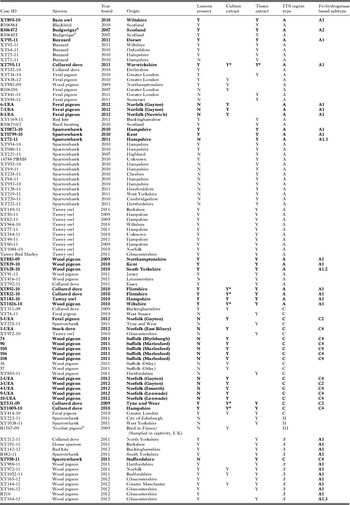
In this study, 33 wild columbids and 41 wild birds of prey found dead in England and submitted for post-mortem examination under the Garden Bird Health initiative (Robinson et al. Reference Robinson, Lawson, Toms, Peck, Kirkwood, Chantrey, Clatworthy, Evans, Hughes, Hutchinson, John, Pennycott, Perkins, Rowley, Simpson, Tyler and Cunningham2010) were investigated. Additionally, one blackbird (Turdus merula), one house sparrow (Passer domesticus), one reed bunting (Emberiza schoeniclus), two captive budgerigars (Melopsittacus undulatus) and one captive Nicobar pigeon (Caloenas nicobarica) held in our frozen archive were included. These birds all died between 2009 and 2012, except for the captive budgerigars, a single feral pigeon and a sparrowhawk (Accipiter nisus) which had all died in 2007 (see Table 1 for details).
List of species, year found, origin, evidence of upper alimentary tract lesions consistent with trichomonosis, and designated type for ITS region sequences and subtype using the Fe-hydrogenase sequence. Origin refers to UK counties where the bird was found, unless otherwise noted. Bold font refers to samples that have been sequenced at both ITS region and Fe-hydrogenase loci. Asterisks denote whether sequences were obtained from culture and/or tissue extracts. Samples of type Ά are presumed ITS region type A on the basis of Fe-hydrogenase gene data only. b indicates captive birds

Trichomonas gallinae cultures were derived from infected birds during standard post-mortem examinations at the time of initial presentation. Necrotic oropharyngitis/ingluvitis lesions (c. 5 mm diameter) were inoculated into Trichomonas Media No. 2. (Oxoid, UK), incubated at 30 °C and screened for motile trichomonads at 24, 48, 72 h and 5 days to obtain parasite cultures (Robinson et al. Reference Robinson, Lawson, Toms, Peck, Kirkwood, Chantrey, Clatworthy, Evans, Hughes, Hutchinson, John, Pennycott, Perkins, Rowley, Simpson, Tyler and Cunningham2010). Oesophageal samples were also taken from birds with necrotic oropharyngitis/ingluvitis and from birds with no gross lesions and were stored frozen at −20 °C. DNA was extracted from positive T. gallinae cultures, from necrotic oropharyngitis/ingluvitis lesions in birds with disease, and from oesophageal tissue with normal appearance in birds with no evidence of disease but possible aclinical parasite carriage. DNA extraction was performed using the Biosprint 15 DNA Blood Kit (Qiagen, UK) according to the manufacturer's protocol.
Field sampling
Seventeen isolates were obtained from culture of oropharyngeal swabs collected from hunter-killed columbids in the English counties of Suffolk and Norfolk (East Anglia) in April 2011 and in April 2012, respectively (Table 1 for details). The swabs were taken within 8 h of death to ensure viability of T. gallinae parasites (Erwin et al. Reference Erwin, Kloss, Lyles, Felderhoff, Fedynich, Henke and Roberson2000) and were inoculated into InPouch TV and TF culture packs (BioMed Diagnostics, USA) according to the manufacturer's instructions. Culture packs were transported to the laboratory within 2 h, incubated at 37 °C and screened for T. gallinae as above. Infection status was determined as culture positive if one or more parasites were observed; conversely, samples were considered culture negative if no parasites had been detected after 1 week of incubation.
Genomic DNA was extracted from fresh parasite cultures using DNAzol (Invitrogen, UK) following the manufacturer's protocol. InPouch media containing T. gallinae parasites were transferred to 1·5 mL Eppendorf tubes and spun for 5 min at 10 000 × g in an Eppendorf (5418) centrifuge. Culture medium was removed, and 0·5 mL of DNAzol was added to each sample and briefly pipetted to lyse cells.
ITS region PCR amplification
Following the protocol from Robinson et al. (Reference Robinson, Lawson, Toms, Peck, Kirkwood, Chantrey, Clatworthy, Evans, Hughes, Hutchinson, John, Pennycott, Perkins, Rowley, Simpson, Tyler and Cunningham2010), PCR was used to amplify the ITS region using TFR1 (TGCTTCAGTTCAGCGGGTCTTCC) and TFR2 (CGGTAGGTGAACCTGCCGTTGG) primers (Felleisen, Reference Felleisen1997; Gaspar da Silva et al. Reference Gaspar da Silva, Barton, Bunbury, Lunness, Bell and Tyler2007). Each PCR reaction consisted of 3 μL of 10× buffer (Qiagen, UK), 3 μL of 25 mm MgCl2 (Qiagen, UK), 0·4 μL of 100 mm dNTP mix (Bioline, UK), 0·5 μL of 5 U μL−1 HotStar Taq Plus DNA polymerase (Qiagen, UK), 3 μL each of 10 μ m forward and reverse primer (Invitrogen, UK), and 35·1 μL of nuclease-free water (Promega, USA) to complete a 50 μL reaction. A negative control of water and a positive control of purified T. gallinae DNA from an infected greenfinch were included in each PCR run under the following temperature cycle: 94 °C for 15 min, 35 cycles of 94 °C for 1 min, 65 °C for 30 s, and 72 °C for 1 min, followed by 72 °C for 5 min.
PCR amplicons (10 μL) were loaded into 1·5% agarose gels stained with ethidium bromide, and visualized using a UV transilluminator. Successful amplification of target resulted in a band of approximately 400 bps, referenced using Ready-Load 100 bp DNA ladder (Invitrogen, UK). In preparation for sequencing reactions, PCR products were cleaned using the QIAquick PCR purification kit (Qiagen, UK) and suspended in 50 μL of nuclease-free water. 20 μL of DNA template and 30 μL of each 2 μ m primer were submitted for conventional sequencing to The Genome Analysis Centre, Norwich, UK (TGAC).
Fe-hydrogenase gene PCR amplification
DNA from T. gallinae cultures, and extracts from a subset of tissue samples, were examined for a fragment of the Fe-hydrogenase gene using TrichhydFOR (GTTTGGGATGGCCTCAGAAT) and TrichhydREV (AGCCGAAGATGTTGTCGAAT) primers, as published by Lawson et al. (Reference Lawson, Robinson, Neimanis, Handeland, Isomursu, Agren, Hamnes, Tyler, Chantrey, Hughes, Pennycott, Simpson, John, Peck, Toms, Bennett, Kirkwood and Cunningham2011b). Each PCR reaction consisted of 5 μL of 10× buffer (Qiagen, UK), 3 μL of 25 mm MgCl2 (Qiagen, UK), 0·4 μL of 100 mm dNTP mix (Bioline, UK), 0·5 μL of 5 U/μL HotStar Taq Plus DNA polymerase (Qiagen, UK), 3 μL each of 10 μ m forward and reverse primer (Invitrogen, UK), and 33·1 μL of nuclease-free water (Promega, USA) to complete a 50 μL reaction. A negative control of water and a positive control of purified T. gallinae DNA from an infected greenfinch were included in each PCR run. Reactions were run using a thermal cycler under the following temperature cycle: 94 °C for 15 min, 35 cycles of 94 °C for 1 min, 53 °C for 30 s, and 72 °C for 1 min, followed by 72 °C for 5 min. Expected product size was around 1 Kb, and was visualized in ethidium-bromide-stained 1·5% agarose gels using a UV transilluminator. High-quality bands were excised from gels and cleaned using the QIAQuick Gel Purification Kit (Qiagen, UK), following the manufacturer's instructions. Purified products were submitted for sequencing with both TrichhydFOR and TrichhydREV primers either to TGAC or to Beckman Coulter Genomics (UK). To address the occurrence of non-specific amplification in some samples, we implemented standard primer optimization techniques, in this case using 10 μL of HotStar Taq Plus PCR Master Mix (Qiagen, UK), 1·5 μL of 10 μ m forward and reverse primers, and nuclease-free water to complete a 20 μL reaction. Annealing temperature was increased to 57 °C for 60 cycles. We also devised a nested PCR protocol to reduce non-specific amplification in tissue extracts. Using the Primer-BLAST primer design tool from the National Centre for Biotechnology Information (NCBI) website (http://www.ncbi.nlm.nih.gov/tools/primer-blast/), primers were designed based on the GenBank entry AF446077.1 for the T. gallinae Fe-hydrogenase gene (partial cds from Voncken et al. Reference Voncken, Boxma, Van Hoek, Akhmanova, Vogels, Huynen, Veenhuis and Hackstein2002). DNA was amplified with the original primers (TrichhydFOR and TrichhydREV) as described above. PCR amplicons were diluted 1:100 with nuclease-free water. 2 μL of the diluted product was re-amplified using the new forward FeHydFOR (CTTTGCGGCCGTTGCATCCG) and reverse FeHydREV (TGGAGCTCTGGGCGCTCGAT) primers. PCR cycles were the same as described above with a modified annealing temperature of 57 °C and yielded an expected product of approximately 650 bp. Samples where non-specific amplification could not be improved following such PCR optimization steps were not included in the analyses.
Sequence and phylogenetic analyses
All sequences were initially trimmed manually to an area of unambiguously called bases. Sequences from each primer of each sample were aligned and trimmed to the region of overlap and checked to ensure there were no mismatches in sequence. These consensus sequences from all samples were then aligned and trimmed further to give the common sequence used in the comparisons.
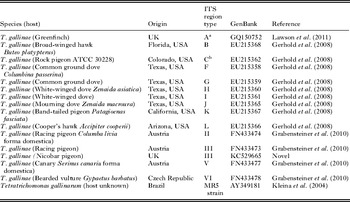
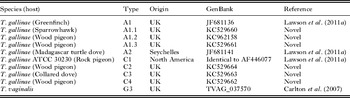
Molecular and phylogenetic analyses were conducted using Molecular Evolutionary Genetics Analysis version 5 (MEGA 5) (Tamura et al. Reference Tamura, Peterson, Peterson, Stecher, Nei and Kumar2011). Chromatograph files were manually inspected and refined using the MEGA 5 TraceEditor extension. All sequences were aligned using the forward and reverse complement of the reverse primer. ITS region and Fe-hydrogenase gene sequences from this study were aligned with published T. gallinae sequences obtained from the NCBI GenBank database (Tables 2 and 3). A single consensus sequence was used to represent identical sequences in phylogenetic analyses. Novel sequences were submitted to GenBank. Phylogenetic trees for ITS region and Fe-hydrogenase gene sequences were generated with the Tamura–Nei model (Saitou and Nei, Reference Saitou and Nei1987; Tamura et al. Reference Tamura, Nei and Kumar2004). Topologies were tested using maximum likelihood, neighbour-joining and maximum parsimony methods. Felsenstein's bootstrap test was used to calculate bootstrap values with 2000 replicates (Felsenstein, Reference Felsenstein1985).
List of Trichomonas gallinae ITS region types used as reference strains in this study. Tetratrichomonas gallinarum was included as an outgroup

a Type A includes sequences from Brazil (AY349182, Kleina et al. Reference Kleina, Bettim-Bandinelli, Bonatto, Benchimol and Bogo2004), Spain (EU881913, Sansano-Maestre et al. Reference Sansano-Maestre, Garijo-Toledo and Gomez-Munoz2009), Mauritius (EF208019, Gaspar da Silva et al. Reference Gaspar da Silva, Barton, Bunbury, Lunness, Bell and Tyler2007), USA (EU215369, Gerhold et al. Reference Gerhold, Yabsley, Smith, Ostergaard, Mannan, Cann and Fischer2008), and Austria (FN433476, Grabensteiner et al. Reference Grabensteiner, Bilic, Kolbe and Hess2010).
b Type C includes sequences from Spain (EU881912, Sansano-Maestre et al. Reference Sansano-Maestre, Garijo-Toledo and Gomez-Munoz2009), USA (EU215364, EU215363, Gerhold et al. Reference Gerhold, Yabsley, Smith, Ostergaard, Mannan, Cann and Fischer2008), Austria (FN433475, Grabensteiner et al. Reference Grabensteiner, Bilic, Kolbe and Hess2010), and the reference strain U86614 (Felleisen, Reference Felleisen1997).
List of existing and new T. gallinae Fe-hydrogenase sequences that were used for Fig. 2. Trichomonas vaginalis was included as an outgroup

RESULTS
ITS region sequence analyses
ITS region sequences were obtained from 41 columbids, comprising: wood pigeons (Columba palumbus, n=20), feral pigeons (n=11), collared doves (Streptopelia decaocto, n=8), one stock dove (Columba oenas) and a captive Nicobar pigeon. Sequence data were obtained from 39 birds of prey, comprising: sparrowhawks (n=20), tawny owls (Strix aluco, n=12), common buzzards (Buteo buteo, n=5), one barn owl (Tyto alba) and one red kite (Milvus milvus) (summarized in Table 1).
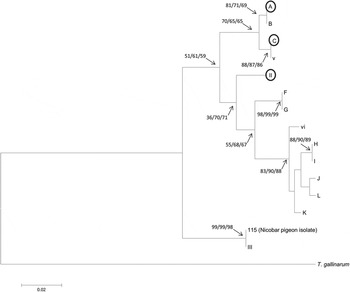
ITS region sequences discriminated four distinct sequence types. Neighbour joining, maximum likelihood and maximum parsimony methods (Fig. 1, reference sequences listed in Table 2) produced phylogenetic trees with similar topologies and bootstrap values. ITS region type A (Gerhold et al. Reference Gerhold, Yabsley, Smith, Ostergaard, Mannan, Cann and Fischer2008) (GenBank GQ150752) comprised the largest number of isolates with 58 sequences that were identical to each other and to the UK finch epidemic strain (Lawson et al. Reference Lawson, Robinson, Neimanis, Handeland, Isomursu, Agren, Hamnes, Tyler, Chantrey, Hughes, Pennycott, Simpson, John, Peck, Toms, Bennett, Kirkwood and Cunningham2011b): 87·2% (n=34) of the bird of prey sequences, 48·8% (n=20) of the columbid sequences, 100% (n=2) of the passerine sequences and 100% (n=2) of the budgerigar sequences. For each such group from which ITS region type A sequence was obtained, at least some individuals showed characteristic trichomonosis lesions as evidence of parasite-mediated pathology. ITS region type C (Gerhold et al. Reference Gerhold, Yabsley, Smith, Ostergaard, Mannan, Cann and Fischer2008) (GenBank EU215362) formed the second largest number of isolates: 23 sequences were identical to each other and to an isolate of T. gallinae from a rock pigeon in Colorado, USA. These comprised 7·7% (n=3) of the bird of prey sequences (none of the birds from which these were obtained showed evidence of disease), and 48·8% (n=20) of columbid sequences. All seven of the hunter-shot columbids from Suffolk were in this subset, none of which showed evidence of disease. Two sparrowhawk isolates, both from birds with lesions, comprised a third group, with 100% identity to an ITS region type II (GenBank FN433474, Grabensteiner et al. Reference Grabensteiner, Bilic, Kolbe and Hess2010) isolate from an Austrian racing pigeon (Columba livia forma domestica). Finally, the Nicobar pigeon isolate showed marked divergence from the previous three types, being most similar to an isolate from an Austrian racing pigeon in ITS region type III (297 of 298 bp) (GenBank FN433473, Grabensteiner et al. Reference Grabensteiner, Bilic, Kolbe and Hess2010).
Trichomonas gallinae phylogeny using the neighbour-joining method for the ITS region from the sequence data listed in Table 2. Trichomonas gallinarum is included as an outgroup. Letters and numerals represent previously described ITS region sequence of T. gallinae. Encircled letters indicate the ITS region types identified from freshly cultured and archived samples as part of this study. The bootstrap consensus tree was constructed using 209 aligned positions using the Tamura–Nei model and 2000 replicates. Numbers at nodes represent the percentage of bootstrap replicates in which associated taxa were clustered together from the maximum likelihood, neighbour-joining and maximum parsimony methods, respectively. Bootstrap values are shown where at least one of these values >60%. Evolutionary distances are in units of number of base substitutions per site.

Fe-hydrogenase gene sequence analyses
Fe-hydrogenase gene sequences were obtained from 33 columbid isolates of T. gallinae (22 wood pigeons, six collared doves, four feral pigeons, and one stock dove), nine bird of prey isolates (five sparrowhawks, one barn owl, one buzzard, one red kite, and one tawny owl), one budgerigar isolate and one house sparrow isolate. Of these 44 Fe-hydrogenase gene sequences, 32 had also been sequenced at the ITS region: 24 columbids (14 wood pigeons, five collared doves, four feral pigeons and one stock dove), seven birds of prey (four sparrowhawks, one barn owl, one buzzard and one tawny owl), and one captive budgerigar (summarized in Table 1).
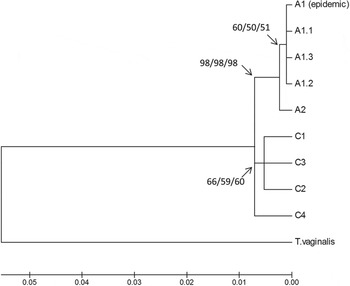
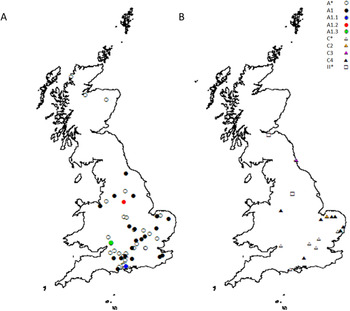
Phylogenetic analyses of the Fe-hydrogenase gene sequences showed further stratification within the ITS groups (Reference sequences detailed in Table 3). Within ITS region type A isolates, Fe-hydrogenase gene sequencing discriminates the subtype A1 as the largest single group sequence with 25 isolates comprising 77·8% (n=7) of the bird of prey sequences, 51·5% (n=17) of the columbid sequences and the single house sparrow sequence; these were identical to that of the previously published UK finch epidemic strain (GenBank JF681136) (Lawson et al. Reference Lawson, Robinson, Neimanis, Handeland, Isomursu, Agren, Hamnes, Tyler, Chantrey, Hughes, Pennycott, Simpson, John, Peck, Toms, Bennett, Kirkwood and Cunningham2011b). Three isolates varied from this subtype by only one single nucleotide polymorphism (SNP) (which was different in each case); these isolates were from a single sparrowhawk (strain variant A1.1 (case no. XT72-11)) and two different wood pigeons (strain variant A1.2 (case no. XT628-10) and A1.3 (case no. XT164-12)) (Fig. 2). One ITS region type A isolate from a captive budgerigar was found to be considerably more divergent at the Fe-hydrogenase gene, showing complete sequence identity to one of our previously reported Seychelles isolates from a Madagascar turtle dove (GenBank JF681141, Lawson et al. 2011) and was ascribed to subtype A2. Fe-hydrogenase gene sequencing further resolved four subtypes within ITS region type C isolates: subtype C1 – the ATCC reference strain (GenBank AF446077); subtype C2 – two identical sequences from a Norfolk wood pigeon (case no. 3-UEA) and a feral pigeon (case no. 5-UEA) sampled from the same site on the same date; subtype C3 – a single sequence from a collared dove (case no. XT531-09); and subtype C4 – an identical set of sequences obtained from all five of the hunter-shot wood pigeons from Suffolk as well as from five Norfolk columbids (four wood pigeons and one stock dove), a collared dove from Hampshire (case no. XT1009-10) and a sparrowhawk from Staffordshire (case no. XT958-11). The geographical distribution of the typed isolates is summarized in Fig. 3, which illustrates the widespread distribution of the finch epidemic strain relative to the other endemic strains characterized. The marked variation apparent between the groups unresolved by ‘ITS only’ typing, not only supports the ITS region findings but illustrates the additional resolution enabled by subtyping with Fe-hydrogenase as a second locus.
Trichomonas gallinae phylogeny using the neighbour-joining method for the Fe-hydrogenase region from the sequences described in Table 3. Trichomonas vaginalis is included as an outgroup. The bootstrap consensus tree was constructed using 591 aligned positions using the Tamura–Nei model and 2000 replicates. Tree topology was tested using maximum likelihood, neighbour-joining, and maximum parsimony methods, respectively. Bootstrap values less than 50% are not shown. Evolutionary distances are in units of number of base substitutions per site. The finch epidemic strain is indicated (epidemic).

Geographical distribution of T. gallinae ITS1/5.8S rRNA/ITS2 region types and Fe-hydrogenase (Fehd) gene subtypes for native British birds (captive birds not shown). (A) Black circle=ITS region type A+Fehd subtype A1 (25 birds, 22 sites); Blue circle=ITS region type A+Fehd subtype A1.1 (1 bird, 1 site); Red circle=ITS region type A+Fehd subtype A1.2 (1 bird, 1 site); Green circle=ITS region type A+Fehd subtype A1.3 (1 bird, 1 site); Open circle=ITS region type A no Fe-hydrogenase data available (34 birds, 30 sites). (B) Black triangle=ITS region type C+Fehd subtype C4 (12 birds, 8 sites); Yellow triangle=ITS region type C+Fehd subtype C2 (2 birds, 1 site); Purple triangle=ITS region type C+Fehd subtype C3 (1 birds, 1 site); Open triangle=ITS region type C no Fe-hydrogenase data available (8 birds, 7 sites). Open square=ITS region type II no Fe-hydrogenase data available (2 birds, 2 sites). Location details were not available for six of the British birds therefore data not shown.

DISCUSSION
We demonstrated the presence of multiple T. gallinae types circulating in British avifauna based on ITS sequence typing. We confirmed and elaborated upon these findings using Fe-hydrogenase gene sequencing, notably resolving new subtypes within ITS region type C in isolates from East Anglian columbids. The clustering of cases from each subtype observed here, considered together with our previous comparison to RAPD data (Lawson et al. Reference Lawson, Robinson, Neimanis, Handeland, Isomursu, Agren, Hamnes, Tyler, Chantrey, Hughes, Pennycott, Simpson, John, Peck, Toms, Bennett, Kirkwood and Cunningham2011b), indicates that sequencing of the Fe-hydrogenase locus lends sufficient resolution to provide a working definition for T. gallinae strains. We optimized Fe-hydrogenase subtyping providing new PCR protocols for improved, specific amplification of DNA from cultured isolates and archived tissue lesions. Our results support the use of the Fe-hydrogenase gene as a second locus for genotyping trichomonad parasites due to its ability to detect neutrally evolving fine-scale variation in amitochondrial protists (Voncken et al. Reference Voncken, Boxma, Van Hoek, Akhmanova, Vogels, Huynen, Veenhuis and Hackstein2002; Lawson et al. Reference Lawson, Robinson, Neimanis, Handeland, Isomursu, Agren, Hamnes, Tyler, Chantrey, Hughes, Pennycott, Simpson, John, Peck, Toms, Bennett, Kirkwood and Cunningham2011b).
Sequence analyses of trichomonad parasites from the USA and Austria have identified at least 15 distinct ITS region groups that are clustered into three clades: T. gallinae-like, Trichomonas tenax-like, and Trichomonas vaginalis-like (Gerhold et al. Reference Gerhold, Yabsley, Smith, Ostergaard, Mannan, Cann and Fischer2008; Anderson et al. Reference Anderson, Grahn, Van Hoosear and BonDurant2009; Grabensteiner et al. Reference Grabensteiner, Bilic, Kolbe and Hess2010) and recent work suggests the more-divergent parabasalids may also cause trichomonosis-like avian disease that can be discriminated on the basis of ITS region typing (Ecco et al. Reference Ecco, Preis, Vilela, Luppi, Malta, Beckstead, Stimmelmayer and Gerhold2012).
In this study, T. gallinae isolates from 41 columbids, 38 birds of prey, two passerines and two budgerigars were typed according to established polymorphism at the ITS region. Of these 83 sequences, 58 were ITS region type A (Gerhold et al. Reference Gerhold, Yabsley, Smith, Ostergaard, Mannan, Cann and Fischer2008) and were identical to the UK finch epidemic strain. This group included both of the typed passerine and 89·5% (n=34) of the bird of prey samples, including all 22 birds of prey with trichomonosis lesions. Twenty-two sequences from columbid and bird of prey T. gallinae samples, including isolates from seven Suffolk wood pigeons and five Norfolk columbids, were typed as ITS region type C. This demonstrates the presence of distinct ITS region types of T. gallinae in sympatric British columbids. Whilst no objective measurements of body condition were made for the pigeons shot in Suffolk or Norfolk, subjective assessment determined the birds to be in good nutritional status based on pectoral muscle bulk and none had evidence of oropharyngeal lesions consistent with trichomonosis.
Sequencing of the Fe-hydrogenase gene identified further genotypically distinct Fe-hydrogenase subtypes within the ITS region types. Nevertheless, 25 of 44 sequences were identical to the UK finch epidemic strain, while three sequences, one from a sparrowhawk and two from wood pigeons, possessed single SNPs that suggested minor divergence from that strain. Interestingly, in neither this nor our previous study (in which isolates from 18 additional cases, including nine different passerine species were sequenced (Lawson et al. Reference Lawson, Robinson, Neimanis, Handeland, Isomursu, Agren, Hamnes, Tyler, Chantrey, Hughes, Pennycott, Simpson, John, Peck, Toms, Bennett, Kirkwood and Cunningham2011b)), were any finch or other passerine cases with even a single SNP observed. We speculate that this relative lack of passerine isolate sequence variation reflects the very recent emergence of the aetiologic agent of finch trichomonosis as a clone drawn from a genetically somewhat more heterogeneous strain pre-existing within the susceptible non-passerine populations. We present this interpretation cautiously though, because our environmental isolates are subject through culture and PCR to a high degree of amplification prior to the sequences being obtained and it is possible for SNPs of this kind to have been generated as artefacts during the process.
The proportion of the diet that consists of avian prey and the relative importance of columbid and passerine prey vary amongst British birds of prey (Cotgreave, Reference Cotgreave1995). Consequently, we would predict that certain species would be most at risk of infection from finch trichomonosis; for example, the sparrowhawk consumes a high proportion of avian prey (98% of diet), of which 76% consists of passerines (Cotgreave, Reference Cotgreave1995). The tawny owl diet comprises a smaller proportion of birds (15% of diet), but passerines consist of 98% of its avian prey (Cotgreave, Reference Cotgreave1995). Sparrowhawks and tawny owls made up the majority of our bird of prey samples; however, it is not clear whether this reflects the raptor species most commonly affected by trichomonosis since there was sampling bias for suspected bird of prey cases. The majority of bird of prey samples were from two regional wildlife rehabilitation centres, thus limiting the geographic scope. In summary, our results on archived samples indicate the presence of the UK finch epidemic strain of T. gallinae in wild bird of prey populations since at least 2009. The Breeding Bird Survey demonstrates a recent significant decline in the UK sparrowhawk population with onset in 2006 (Baillie et al. Reference Baillie, Marchant, Leech, Renwick, Joys, Noble, Barimore, Conway, Downie, Risely and Robinson2010), which is contemporaneous with the emergence of epidemic finch trichomonosis. The possibility that finch trichomonosis may have adversely impacted the sparrowhawk population, therefore, requires urgent investigation.
We found more diversity in ITS region type C isolates than had been previously appreciated. Three subtypes distinct from our reference (C1) were apparent from sequencing of our isolates (C2–4) based on 12 discriminating SNPs, indicating that there are multiple strains currently present in the British wild and captive avifauna. Isolates within ITS region type A were largely homogenous in respect to their Fe-hydrogenase gene sequence, identifying these as the clonal UK finch epidemic strain consistent with the limited heterogeneity previously observed by RAPD analysis (Lawson et al. Reference Lawson, Robinson, Neimanis, Handeland, Isomursu, Agren, Hamnes, Tyler, Chantrey, Hughes, Pennycott, Simpson, John, Peck, Toms, Bennett, Kirkwood and Cunningham2011b). A small number of SNPs at the Fe-hydrogenase locus were present in a few of the ITS region type A isolates, consistent with genetic drift which may pre-date the emergence of the passerine epidemic. In summary, these results show the presence of multiple T. gallinae strains circulating within British avian populations and provide evidence that the UK finch epidemic strain is virulent in non-passerines and is currently the most prevalent strain in British birds, including columbids and birds of prey.
ACKNOWLEDGEMENTS
We thank members of the public and participants in the British Trust for Ornithology Garden BirdWatch scheme for assistance with reporting of garden bird mortality incidents. We thank Nick and Lily Elsdon (Anglia Sporting); Iain Barr, Audrey Dubourg, Mohammed Albeshr, Momodou Job and Ellie Fairfield (UEA); Nancy Bunbury (Seychelles Island Foundation); Campbell Murn (Hawk Conservancy Trust); Tom Pennycott (Scottish Agricultural College); Paul Holmes and Paul Duff (Animal Health and Veterinary Laboratories Agency); Denis Chorlton (Waterside Owl Rescue); Isobel Jenkins (Royal Veterinary College); Shaheed Macgregor, Matthew Perkins, Tony Sainsbury, Elspeth Chaplin, Dena Richards and Ilona Furrokh (Zoological Society of London); Elaine Potter and Lee Walker (Predatory Bird Monitoring Scheme); Mike Toms (British Trust for Ornithology), Kirsi Peck (Royal Society for the Protection of Birds) and Dr Benoît Quintard (Parc zoologique et botanique, Mulhouse, France) for their assistance.
FINANCIAL SUPPORT
This project was generously funded by the Erasmus Mundus Masters Course (European Master in Applied Ecology), Thrigby Hall Wildlife Gardens, the Chester Zoo Wildlife Fund, The John and Pamela Salter Trust and the Saudi Cultural Embassy, London. The Garden Bird Health Initiative was supported by the British Veterinary Association Animal Welfare Foundation, CJ Wildbird Foods Ltd, Cranswick Pet Products, Defra, Gardman Ltd, the RSPB, The Birdcare Standards Association and the Universities Federation for Animal Welfare. A.A.C. is supported by a Royal Society Wolfson Research Merit Award.