I. Introduction
Pseudogapping (PG), illustrated in (2),Footnote 2 is a construction similar to Verb Phrase Ellipsis (VPE) in that it involves ellipsis after an auxiliary (Aux). However, in VPE the entire VP complement of the Aux is ellipted, as in (1), whereas in PG the Aux is followed by an XP, the remnant, namely me in (2a) and (2b) and to me in (2c).Footnote 3

The remnant me in (2a) and (2b) is an NP. As is made clear by the way the example is marked up, this remnant corresponds to a subcategorized complement of the antecedent verb bother, namely its direct object you, which we call its ‘correlate’. In (2c), the remnant is the PP[to] to me, corresponding once again to its correlate, the subcategorized complement of the antecedent verb speak, namely to you. Footnote 4
Because the remnant in PG appears without an appropriate overt governor, it can be taken to be a type of fragment. PG is thus relevant to the general issue of the status of fragments in syntax, along with constructions like Bare Argument Ellipsis and Sluicing (e.g. Ginzburg & Sag Reference Ginzburg and Sag2000; Merchant Reference Merchant2001, Reference Merchant2004, Reference Merchant2013; Culicover & Jackendoff Reference Culicover and Jackendoff2005; Chung Reference Chung, Cover and Kim2006, Reference Chung2013; Ginzburg & Miller Reference Ginzburg, Miller, van Craenenbroek and Temmerman2019; Nykiel & Hawkins Reference Nykiel and Hawkins2020; Nykiel & Kim Reference Nykiel and Kim2021).
As is typical of fragment constructions, two main analyses of PG have been developed. The first is a transformational analysis, initially proposed by Jayaseelan (Reference Jayaseelan1990) – anticipated in N. Levin (Reference Levin1986) and Kuno (Reference Kuno, Hendrick, Masek and Miller1981) – and refined by Lasnik (Reference Lasnik, Lappin and Benmamoun1999) and Gengel (Reference Gengel2013), where the remnant is raised out of the VP, feeding deletion of the rest of the VP by VPE. The second is a direct generation approach (i.e. monostratal licensing of ellipsis, see Van Craenenbroek & Temmerman Reference Van Craenenbroek and Temmerman2019, for introductions to a variety of such approaches; in particular, Ginzburg & Miller Reference Ginzburg, Miller, van Craenenbroek and Temmerman2019; Jacobson Reference Jacobson, van Craenenbroek and Temmerman2019, which are especially relevant here) initially proposed by Miller (Reference Miller1990) in a Generalized Phrase Structure Grammar framework and also adopted by Hoeksema (Reference Hoeksema2006). A more recent direct generation account in terms of hybrid type-logical categorial grammar is developed in Kubota & Levine (Reference Kubota and Levine2017).
Under Gengel’s remnant-raising analysis, the remnant is raised leftward out of the VP by Focus Movement (a form of A’-movement), feeding deletion of the rest of the VP by VPE, under syntactic identity with the antecedent:

Such an analysis makes three central predictions: (i) there must be a syntactically identical antecedent; (ii) remnant movement should respect the relevant island constraints; and (iii) remnant movement should preserve connectivity (the case-marking or preposition marking of the remnant should be what is expected on the basis of the antecedent verb).Footnote 5
Miller (Reference Miller and Piñón2014a) cites naturally occurring examples from the COCA that constitute counterexamples to each of these predictions (see, e.g. his examples of locality violation (12a–f)Footnote 6 and absence of a syntactically identical antecedent (16a–c)). Of specific interest to the present paper are the examples of connectivity violations in (4a) and (4b) (in Miller Reference Miller and Piñón2014a: ex. (15a) and (16) respectively), to which we add further examples found in the COCA, (4c) and (4d):

These examples are intuitively highly acceptable, yet in (4a), the remnant is a PP[of], whereas the correlate is a PP[about]; similarly, in (4b), (4c) and (4d), the remnant is a PP[to] complement of give or tell, whereas the correlate is the first NP direct object in the double direct object construction.
Under the direct generation approach, proposed by Miller (Reference Miller1990), auxiliaries are claimed to be verbal proforms, which can recover as antecedent any sufficiently salient predicate of the appropriate type present in the discourse.Footnote 7 They allow arbitrary subcategorization frames, i.e. in HPSG terms, auxiliaries can take any COMPS list which the grammar makes available. Setting up the syntax this way will generate all of the examples exhibited by Miller (Reference Miller and Piñón2014a), as this analysis does not make the predictions (i), (ii), and (iii). But it leads, of course, to massive syntactic overgeneration. Miller (Reference Miller1990) claimed that unacceptable instances of pseudogapping are grammatical and should be accounted for in semantic and pragmatic terms. Specifically, focusing on connectivity, on the basis of examples similar to (4a) and (4b) (Miller Reference Miller1990: ex. (38)–(40)), he suggested that in cases where connectivity is violated, examples will be acceptable if the same semantic role is assigned by the antecedent verb to both complements. Thus, Miller (Reference Miller1990) claims that an example like (5a) is acceptable because speak assigns the same semantic role (the addressee) to a PP[to] and a PP[with] complement. Example (5b), however, is not acceptable because a PP[for] complement of speak has the semantic role of beneficiary, rather than addressee.Footnote 8

It should be noted that the attested examples of nonconnectivity given in (4) provide some initial corroboration for Miller’s hypothesis.
In this paper we will address this question of remnant connectivity through controlled acceptability judgment experiments. Specifically, we provide evidence that the acceptability of PP remnants is not predicted by syntactic connectivity, but rather by proximity of semantic roles, thus supporting the claims of the direct generation approach as opposed to the remnant-raising approach.
2. Remnant connectivity
In this section we will have a closer look at remnant connectivity and its theoretical consequences for the competing analyses of pseudogapping (PG). We also provide a preliminary description of the experiments that we conducted to further our understanding of the role of connectivity in PG.
To avoid possible confusion, it should first be pointed out that in PG a PP complement as correlate in the antecedent does not necessarily correspond to a PP complement as remnant after the Aux. Specifically, as has been known since N. Levin (Reference Levin1986), the preposition is often omitted, as in (6) (what she calls ‘deprepositionalized PG’; see also Miller Reference Miller and Piñón2014a: sect. 4.1, for corpus-based information on the frequency and variety of deprepositionalized PG cases):

Such examples do not raise any connectivity problems for Gengel’s remnant-raising account, since Focus Movement can strand the preposition:Footnote 9

Remnant connectivity holds in such cases, since what is moved is an NP.
In cases where the remnant is a PP, however, remnant-raising analyses lead to the prediction that the antecedent must also have a PP complement, otherwise examples like (8b) and (9b), with verbs subcategorizing either a direct or indirect object, would be predicted to be grammatical. That is, the category of the trace t
 $ {}_i $
, NP or PP, must be relevant in determining whether syntactic identity holds in (8b) and (9b), making ellipsis impossible.Footnote
10

Thus, syntactic identity of the antecedent must include identity of the subcategorization frame for the verb.
Beyond broad categorial identity, the question arises as to whether, in the case of PP remnants, identity should be further required between the preposition marking the remnant and that marking its correlate in the antecedent clause. If preposition identity is required, then only the matched (to-to) version of (10) is grammatical. If preposition identity is not required, all of the preposition pairings in (10) are predicted to be grammatical:

Though this specific issue is generally not directly addressed in the literature, it seems that the default assumption is that preposition match is required.Footnote 11
The problem with this position is that there seems intuitively to be variable acceptability depending on the choice of mismatched preposition, as first noted by Miller (Reference Miller1990). Defenders of the remnant-raising approach might attempt to explain this situation by claiming that only strict identity leads to grammaticality, but that cases of mismatch can be repaired (see Frazier and her colleagues’ theory of ‘recycling’, e.g. Arregui et al. Reference Arregui, Clifton, Frazier and Moulton2006; Frazier Reference Frazier, Cheng and Corver2013) and that acceptability correlates with ease of repair, assuming that similarity in semantic roles makes repair easier.
As noted above, Miller’s (Reference Miller1990) analysis proposed that identity of semantic roles established by the prepositions was the factor determining acceptability. In this paper, we propose to evaluate a modified variant of this hypothesis that considers a gradient notion of semantic similarity which can be measured experimentally. In addition to this measure of semantic similarity, we conducted two acceptability judgment experiments to test whether PG with mismatched prepositions is degraded compared to preposition-matched cases. The first experiment considers verbs allowing PP[to] and PP[with] complements, namely verbs of speaking and verbs of combining and attaching (see B. Levin Reference Levin1993: 159–164). The second acceptability judgment experiment examined verbs participating in the dative alternation (B. Levin Reference Levin1993: 45). The specific verbs used are respectively listed in (11a) and (11b):

With experimental measures of acceptability and semantic similarity in hand, we can then evaluate the gradient reformulation of Miller’s (Reference Miller1990) hypothesis, i.e. that preposition-mismatched PG is only degraded to the extent that the two prepositions express different semantic relations with respect to the antecedent verb. More specifically, we aim to address the following three questions:
-
— Is there a penalty for preposition mismatch?
-
— If such a penalty exists, to what extent is it correlated with similarity of semantic roles?
-
— If such a penalty exists, is it specific to ellipsis, or does it also appear in the corresponding non-elliptical sentences?
3. Experiment 1: Remnant connectivity with verbs exhibiting a pp[to]/pp[with] alternation
The purpose of Experiment 1 was two-fold: (i) to investigate the acceptability of PP remnant pseudogapping and its non-elliptical counterpart with matched and mismatched prepositions by examining verbs that allow both PP[to] and PP[with] complements; and (ii) to test whether the semantic similarity between the mismatched prepositions explains the mismatch penalty (if it exists) on an item-by-item basis.
3.1. Methods
The construction of materials, the experimental procedure, as well as the statistical analysis described below were pre-registered on aspredicted.org prior to data collection.Footnote 12
3.1.1. Materials
As illustrated in (12), experimental items were constructed on the basis of two factors, ellipsis – pseudogapping vs. non-elliptical controls – and preposition condition, spanning two preposition-matched variants, labeled with-with and to-to, and four preposition-mismatched variants: to-with, with-to, with-for, and to-for. The sentences involving for were included in an attempt to increase variability in semantic similarity between prepositions.Footnote 13

We constructed 20 items following this pattern, which can be found in Appendix A, 2 for each of the 10 verbs listed in (11a).
3.1.2. Participants and procedure
In line with the pre-registration prior to data collection, we recruited 153 participants through Amazon.com’s Mechanical Turk crowd-sourcing platform and presented each with one variant of each experimental item, which were interspersed with 40 distractors of variable acceptability. Participants were asked to judge the acceptability of each sentence on a 7-point Likert scale.
3.1.3. Norming experiment, semantic similarity
In order to examine the effect of semantic similarity on acceptability, we recruited a separate set of participants (N = 90) to estimate the semantic similarity associated with the sentences in both Experiment 1 and Experiment 2 (reported below). The materials for this norming experiment were derived from the materials in the acceptability judgment experiment in a straightforward fashion: participants were presented with sentence pairs like the one in (13), derived from (12), and asked to use a 7-point Likert scale to indicate how similar they are in terms of their meaning.

The sentences in each pair were presented in a random order and the experimental items were preceded by three practice items and interspersed with 20 distractors. As anticipated, the preposition mismatches in the experimental materials were associated with variable degrees of mean semantic similarity, which ranged from 2.1 to 6.4 (see Figure 1). Note that this way of setting up the experiment ensures that what we are measuring is the semantic similarity between the relations established by the two prepositions with respect to the governing verb, on the basis of a given subject, not simply the semantic similarity between the prepositions in general. In some cases, for brevity, we simply talk about ‘semantic similarity between prepositions’. But this should always be understood as shorthand for the more specific, sentence-level similarity relation established here.Footnote 14
Results from the norming experiment: mean semantic similarity score of each item variant used in Experiment 1. Error bars indicate standard errors.

3.2. Results
Two participants were excluded because they reported being non-native speakers of English at the end of the experiment. Another 64 trials were excluded because the response time was below 500 ms – a pre-registered exclusion criterion based on the reasoning that half a second would be too little time to read and judge the sentences faithfully.
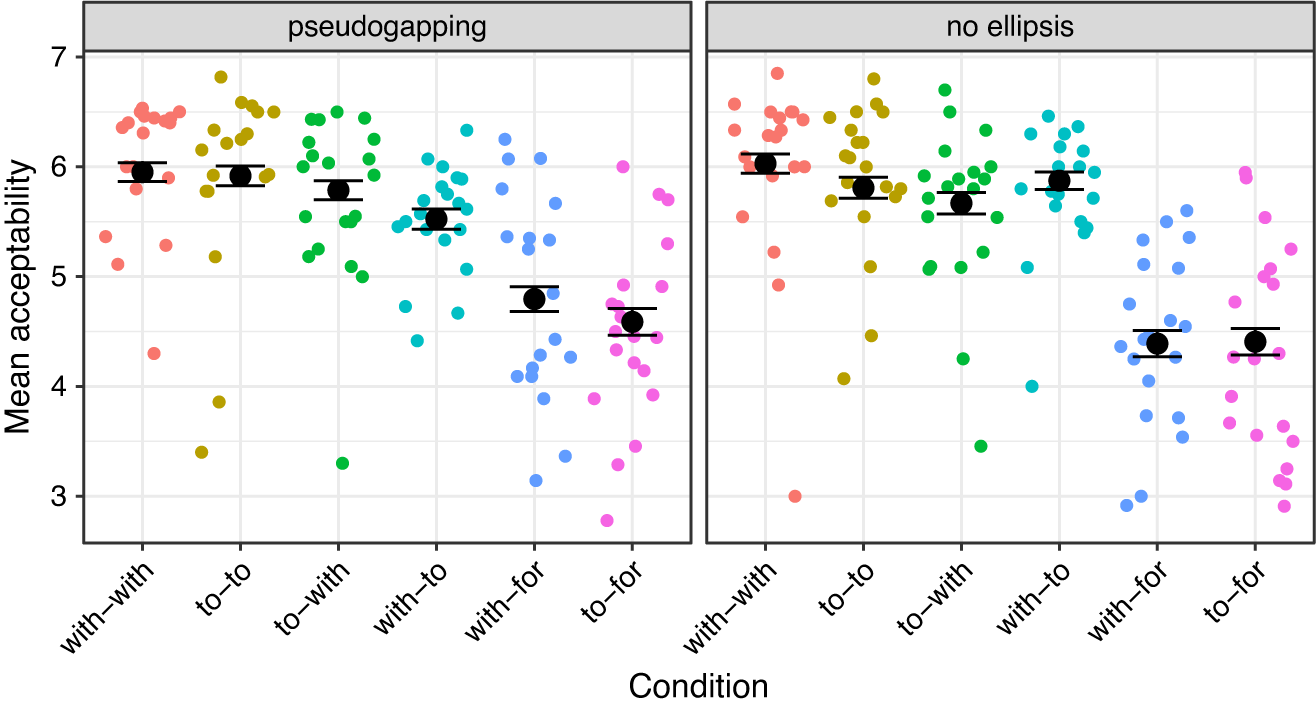
The data from the remaining 151 participants are summarized in Figure 2 and were analyzed in a hierarchical linear regression (using the R package brms; Bürkner Reference Bürkner2018) with preposition condition, ellipsis, and their interaction as fixed effects along with the maximal random-effect structure including all by-item and by-participant group-level intercepts and slopes (Barr et al. Reference Barr, Levy, Scheepers and Tily2013). Condition was treatment-coded, whereas ellipsis was contrast-coded so that main effects of condition indicate effects averaging over elliptical and non-elliptical variants and interaction coefficients indicate whether any main effects varied across ellipsis.
Mean acceptability of experimental items under pseudogapping (left panel) and unellipted variants (right panel) as a function of preposition-mismatch condition (X axis). Each point represents one variant of the 20 experimental items. Error bars indicate standard errors around the condition averages.

With this model in place, we then compared each mismatch condition to its respective preposition-matched baseline: with-to and with-for variants were both significantly degraded compared to the with-with baseline (
 $ \Delta =-0.37 $
,
 $ CI\left(\Delta \right)=\left[-0.62,-0.13\right] $
,
 $ P\left(\Delta <0\right)=0.99 $
, and
 $ \Delta =-\hskip-0.35em 1.33 $
,
 $ CI\left(\Delta \right)=\left[-1.67,-0.98\right] $
,
 $ P\left(\Delta <0\right)=1 $
, respectively); and to-with and to-for mismatches were less acceptable than their to-to counterpart, although the former comparison was only marginally significant (
 $ \Delta =-\hskip-0.25em 0.31 $
,
 $ CI\left(\Delta \right)=\left[-0.59,-0.03\right] $
,
 $ P\left(\Delta <0\right)=0.96 $
, and
 $ \Delta =-\hskip-0.35em 1.46 $
,
 $ CI\left(\Delta \right)=\left[-1.88,-\hskip-0.15em 1.05\right] $
,
 $ P\left(\Delta <0\right)=1 $
, respectively).Footnote
15 Note that this analysis compares each preposition-mismatch condition to its specific no-mismatch baseline condition, and that each mismatch penalty is independent from the others.
As for interactions with ellipsis, three of the four mismatch penalties were either statistically indistinguishable or ameliorated under pseudogapping compared to non-elliptical variants: with-for (
 $ \Delta =0.18 $
,
 $ CI\left(\Delta \right)=\left[\mathrm{0.03,0.21}\right] $
,
 $ P\left(\Delta >0\right)=0.98 $
), to-with (
 $ \Delta =0.07 $
,
 $ CI\left(\Delta \right)=\left[-\mathrm{0.08,0.21}\right] $
,
 $ P\left(\Delta >0\right)=0.77 $
), and to-for (
 $ \Delta =0.1 $
,
 $ CI\left(\Delta \right)=\left[-\mathrm{0.05,0.26}\right] $
,
 $ P\left(\Delta >0\right)=0.88 $
). Only one mismatch penalty – the degradation of with-to items relative to their with-with counterparts – was exacerbated under pseudogapping, and this difference was only marginally significant (
 $ \Delta =-\hskip-0.15em 0.14 $
,
 $ CI\left(\Delta \right)=\left[-\mathrm{0.29,0.002}\right] $
,
 $ P\left(\Delta <0\right)=0.95 $
).
The results reported thus far indicate that mismatched prepositions negatively affect both elliptical and non-elliptical variants of the sentences in question, with only minor differences between the two: the penalties in question are not systematically exacerbated under pseudogapping, and indeed in one case the mismatch penalty may be ameliorated under ellipsis.Footnote 16
We now turn to the critical test of Miller’s (Reference Miller1990) hypothesis, which concerns the effect of semantic similarity on acceptability. To evaluate this hypothesis, we conducted a second analysis, which was identical to the first one with one exception: we added the semantic similarity scores estimated in the norming experiment as a fixed effect into the model (as well as the corresponding by-item and by-participant group-level effects), thereby allowing them to explain away the variance that was previously explained by the presence of a preposition mismatch. In order to align maximal similarity with the preposition-matched variants, we transformed semantic similarity to range from
 $ - $
6 to 0, where
 $ - $
6 means ‘maximally dissimilar’ and 0 means ‘maximally similar’ (corresponding to ‘1’ and ‘7’ on the Likert scale, respectively). The results reveal that semantic similarity is indeed positively correlated with acceptability (
 $ \Delta =0.49 $
,
 $ CI\left(\Delta \right)=\left[\mathrm{0.32,0.66}\right] $
,
 $ P\left(\Delta >0\right)=1 $
; see Figure 3). Crucially, once item-by-item semantic similarity is statistically controlled for, all mismatch penalties disappear (with-to:
 $ \Delta =0.27 $
,
 $ CI\left(\Delta \right)=\left[-\mathrm{0.02,0.57}\right] $
,
 $ P\left(\Delta <0\right)=0.06 $
; with-for:
 $ \Delta =0.28 $
,
 $ CI\left(\Delta \right)=\left[-\mathrm{0.22,0.77}\right] $
,
 $ P\left(\Delta <0\right)=0.17 $
; to-with:
 $ \Delta =0.33 $
,
 $ CI\left(\Delta \right)=\left[-\mathrm{0.02,0.7}\right] $
,
 $ P\left(\Delta <0\right)=0.06 $
; to-for:
 $ \Delta =0.17 $
,
 $ CI\left(\Delta \right)=\left[-\mathrm{0.38,0.74}\right] $
,
 $ P\left(\Delta <0\right)=0.3 $
). It thus appears that the variance that was at first glance associated with the presence of a preposition mismatch is better explained by the perceived semantic (dis)similarity between the two prepositions.
Average mismatch penalty as a function of mean semantic similarity. Each point represents a particular item variant used in Experiment 1.

3.3. Discussion
Experiment 1 examined the acceptability of pseudogapping as well as non-elliptical controls in preposition-matched and preposition-mismatched sentences. The results reveal three novel findings that speak to the theoretical underpinnings of pseudogapping. First, while every type of preposition mismatch was associated with reduced acceptability, elliptical and non-elliptical variants were affected in similar ways. Recall that deletion under identity approaches predict mismatch penalties to arise as a result of the grammatical requirements of pseudogapping and they should therefore manifest in an ellipsis-specific way. Our experiment, however, revealed only minor differences between elliptical and non-elliptical variants, some of which favored cases involving pseudogapping while others indicated an advantage for the non-elliptical variants.Footnote 17
Second, we found a positive effect of semantic similarity, an item-by-item predictor that was independently measured in a norming experiment. This finding is consistent with a gradient reformulation of Miller’s (Reference Miller1990) hypothesis, according to which the degree to which two prepositions are perceived to contribute different meanings to the sentence in question determines the acceptability of mismatching prepositions.
Finally, and most importantly, the penalties associated with mismatched prepositions disappeared once semantic similarity was statistically controlled for, indicating that the latter ‘explained away’ the variance that had at first glance been associated with the mismatch.
4. Experiment 2
The purpose of Experiment 2 was to further investigate the role of preposition mismatches in pseudogapping, this time leveraging verbs that participate in the dative alternation, listed in (11b). Specifically, we examined the effect of mismatch where the antecedent involves a double direct object construction and the ellipsis clause contains a mismatched prepositional object remnant corresponding to the NP direct object correlate:

Unfortunately, it is not possible to investigate the converse mismatch configuration, where the antecedent involves an indirect object correlate and the ellipsis clause features a direct object remnant:

The possibility of ‘deprepositionalized’ PG (as in (6)) creates an insurmountable confound that makes it impossible to guarantee that (15b) is interpreted as the mismatched variant of (15a), since it could just as easily involve a matched antecedent with an ellipted preposition:

4.1. Methods
4.1.1. Materials
In parallel to Experiment 1, our experimental materials were constructed on the basis of two factors, ellipsis and preposition condition. The first is binary, with the values pseudogapping and no ellipsis, whereas the second features four variants: a preposition-matched condition (to-to), and three mismatch conditions (none-to, to-for, and none-for). These are illustrated in (17), where the pseudogapping variants differ from the no ellipsis conditions in that they do not include give books after the auxiliary will.

As in Experiment 1, we included the conditions with for in order to increase variability in semantic similarity. This was even more important with verbs undergoing the dative alternation, since the alternating constructions exhibit much less semantic variability than the to/with alternating verbs used above, which will be reflected in the experimental results of Experiment 2.
Using the 10 verbs given in (11b), we constructed 20 items following the pattern shown in (17), which are listed in Appendix B.
4.1.2. Participants and procedure
We recruited 36 participants via Amazon.com’s Mechanical Turk crowd-sourcing platform. Each participant was presented with one variant of each of the 20 experimental items – as well as 40 interspersed distractor items – and rated their acceptability on a seven-point Likert scale.
4.1.3. Semantic similarity norming
Just as we did for Experiment 1, we collected semantic similarity estimates for all preposition-mismatched items used in Experiment 2. This was done in the same norming experiment described in the context of Experiment 1 (
 $ N=90 $
), and the distribution of ratings that correspond to the items in Experiment 2 are shown in Figure 4. Overall, the items exhibit less variability in semantic similarity than the items in Experiment 1, with average ratings ranging from 3.52 to 6.57 and a greater proportion of ratings near the upper end of the scale.
Results from the norming experiment: mean semantic similarity score of each item variant used in Experiment 2. Error bars indicate standard errors.

4.2. Results
We excluded one participant who failed to report English as their native language, and two additional trials with response times below 500 ms. The statistical analysis of the data from the remaining 35 participants will proceed analogously to Experiment 1: we first fit a hierarchical regression model including ellipsis, preposition condition, and their interaction as population-level effects along with all by-item and by-participant group-level slopes and intercepts. As before, the purpose of this model is two-fold: it allows us to test whether there are any mismatch effects, and if so, whether they vary across elliptical and non-elliptical variants; and it will further also serve as the baseline for the next analysis, which examines the role of semantic similarity.
The results are summarized in Figure 5. As in Experiment 1, ellipsis was contrast-coded and the main effects of preposition condition are thus to be interpreted as overall penalties, averaging across elliptical and non-elliptical variants. All three types of mismatch were significantly degraded compared to the to-to preposition-matched variants:
 $ \Delta =-1.42 $
,
 $ CI\left(\Delta \right)=\left[-1.88,-0.97\right] $
,
 $ P\left(\Delta <0\right)=1 $
(none-for);
 $ \Delta =-0.5 $
,
 $ CI\left(\Delta \right)=\left[-0.76,-0.24\right] $
,
 $ P\left(\Delta <0\right)=1 $
(none-to); and
 $ \Delta =-1.23 $
,
 $ CI\left(\Delta \right)=\left[-1.69,-0.78\right] $
,
 $ P\left(\Delta <0\right)=1 $
(to-for).
Results from Experiment 2: mean acceptability ratings by preposition condition and ellipsis. Error bars indicate standard errors around condition averages.

As for the interaction with ellipsis, all three mismatch effects were either indistinguishable across elliptical and non-elliptical variants (none-to:
 $ \Delta =-0.05 $
,
 $ CI\left(\Delta \right)=\left[-\mathrm{0.34,0.23}\right] $
,
 $ P\left(\Delta <0\right)=0.61 $
) or ameliorated under pseudogapping (none-for:
 $ \Delta =0.33 $
,
 $ CI\left(\Delta \right)=\left[\mathrm{0.04,0.62}\right] $
,
 $ P\left(\Delta >0\right)=0.97 $
; to-for:
 $ \Delta =0.45 $
,
 $ CI\left(\Delta \right)=\left[\mathrm{0.19,0.71}\right] $
,
 $ P\left(\Delta >0\right)=0.99 $
), strongly suggesting that the effect of mismatch is not specific to pseudogapping.
Finally, we conducted a second analysis that introduced population- and group-level effects for item-by-item semantic similarity (estimated in the norming experiment described above) into the model. The results resemble those for Experiment 1, however they are not as crisp (see Figure 6): the main effect of similarity (averaging across elliptical and non-elliptical variants), while trending in the predicted direction, did not reach significance (
 $ \Delta =0.24 $
,
 $ CI\left(\Delta \right)=\left[-\mathrm{0.11,0.57}\right] $
,
 $ P\left(\Delta >0\right)=0.88 $
), but it nonetheless explained some of the variance previously associated with mismatch. Specifically, the magnitude of all mismatch effects was reduced substantially after controlling for similarity, and only one of them remained statistically significant (none-for:
 $ \Delta =-0.89 $
,
 $ CI\left(\Delta \right)=\left[-1.66,-0.15\right] $
,
 $ P\left(\Delta <0\right)=0.97 $
; none-to:
 $ \Delta =-0.34 $
,
 $ CI\left(\Delta \right)=\left[-\mathrm{0.7,0}\right] $
,
 $ P\left(\Delta <0\right)=0.95 $
; and to-for:
 $ \Delta =-0.59 $
,
 $ CI\left(\Delta \right)=\left[-\mathrm{1.43,0.23}\right] $
,
 $ P\left(\Delta <0\right)=0.89 $
).
Average mismatch penalty as a function of mean semantic similarity. Each point represents a particular item variant used in Experiment 2

4.3. Discussion
The results from Experiment 2 are less clear than those from Experiment 1: there is only weak evidence for a main effect of similarity and at least one of the mismatch penalties – the reduced acceptability of none-to variants relative to their to-to counterparts – cannot be explained fully in terms of similarity since the penalty remains significant after similarity is statistically controlled for. Although they may be less clear, however, all of the results from Experiment 2 go in the same direction as those from Experiment 1: all mismatch effects are reduced in magnitude once semantic similarity is entered into the model and two of them fall below the significance threshold, indicating that similarity does capture some of the variance associated with mismatching prepositions.
One possible reason behind the reduced impact of semantic similarity in Experiment 2 compared to Experiment 1 is the fact that variants of the dative alternation express more similar meanings than the to/with alternation we examined in Experiment 1. As a result, the similarity norming experiment identified fewer items at the lower end of the similarity scale (compare Figure 4 to Figure 1), while at the same time indicating that a greater proportion of items were perceived as highly similar. This reduced variance in the predictor may be a contributing factor in the results from Experiment 2, although this possibility remains speculative at present.
5. General discussion
We have reported two acceptability judgment experiments that investigate the effect of syntactic mismatches between the remnant and correlate on the acceptability of elliptical utterances involving pseudogapping with PP remnants, as well as the corresponding non-elliptical variants. In the first experiment, we studied cases where the mismatch is due to the presence of differing prepositions in the remnant and correlate. In the second, the mismatch involved having an NP correlate to the PP remnant. Across both experiments, several novel findings emerged. First, we confirmed that sentences exhibiting mismatches are consistently associated with reduced acceptability compared to the corresponding matched baseline sentences. However, we found no evidence that these mismatch penalties were specific to pseudogapping, and in fact several of them were exacerbated in the absence of ellipsis. Finally, we found that the perceived semantic similarity of the mismatched prepositions was positively correlated with acceptability, which was particularly pronounced in Experiment 1 and which explained away a substantial part of the penalty associated with the mismatch.
The finding that the mismatch penalty is not specific to ellipsis suggests that the present case is different from various other types of mismatch, for which acceptability experiments have shown that there is an ellipsis-specific penalty, e.g. Kim et al. (Reference Kim, Kobele, Runner and Hale2011) for voice and category mismatches in VPE; SanPietro, Xiang & Merchant (Reference SanPietro, Xiang, Merchant, Arnett and Bennett2012), Kim & Runner (Reference Kim and Runner2018), and Poppels & Kehler (Reference Poppels and Kehler2019) for voice-mismatch in VPE; and Kertz (Reference Kertz2013) on argument structure mismatches in VPE (some of these studies also report a penalty for mismatch in the non-elliptical controls, but it tends to be exacerbated under ellipsis).Footnote 19
Our findings are thus consistent with the possibility that the effect of mismatch on acceptability is in fact simply due to a previously observed general preference for parallelism that exists independently of ellipsis – see, e.g. Frazier, Munn & Clifton (Reference Frazier, Munn and Clifton2000) for evidence from non-elliptical coordinate structures and Dubey, Sturt & Keller (Reference Dubey, Sturt, Keller, Mooney, Brew, Chien and Kirchhoff2005) for more general evidence. In particular, Dubey et al. (Reference Dubey, Sturt, Keller, Mooney, Brew, Chien and Kirchhoff2005: 834) conclude that ‘the parallelism effect is an instance of a general processing mechanism, such as syntactic priming… rather than specific to coordination’. The present paper provides further experimental evidence in this direction, showing two cases where lack of parallelism may be responsible for reducing acceptability in a way that is not specific to ellipsis. Furthermore, the ameliorating effect of semantic similarity on mismatch suggests that the preference for parallelism may go beyond strict syntax.
Our findings raise difficulties for the predictions made by currently existing remnant-raising approaches to pseudogapping. As discussed in Section 2, these approaches predict that only matching prepositions in the correlate and remnant are grammatical and treat conditions with mismatched prepositions as connectivity violations produced by remnant movement. While the fact that mismatches are consistently degraded in acceptability might initially seem to support remnant-raising approaches, we found no evidence that the mismatch penalties are specific to pseudogapping. In fact, in several mismatch configurations – including those involving a mismatch with the semantically dissimilar preposition for – ellipsis significantly improved acceptability relative to the corresponding non-elliptical utterances.Footnote 20 The remnant-raising analysis offers no insight into why this should be the case.
Beyond this, remnant-raising approaches provide no natural explanation for the semantic similarity findings, summarized in Figures 3 and 6. Specifically, they offer no obvious explanation for the fact that some mismatches come with a greater cost in acceptability than others, which we found across both experiments, nor for the fact that a significant amount of this variance was captured by the semantic similarity associated with the mismatched prepositions. A common rescue strategy for identity-based theories of ellipsis in the face of gradience is to explain it in terms of processing, that is, in terms of the competence/performance distinction (e.g. Arregui et al. Reference Arregui, Clifton, Frazier and Moulton2006; Grant, Clifton & Frazier Reference Grant, Clifton and Frazier2012; Frazier Reference Frazier, Cheng and Corver2013). In particular, this strategy maintains a non-gradient grammatical constraint on ellipsis and explains gradient acceptability as the result of the same syntactic repair processes that allow the parser to recover from garden-path sentences by reanalyzing ungrammatical parses. Crucially, to avoid rampant overgeneration, the repair mechanism is constrained such that it has to be triggered by a grammatical violation (Arregui et al. Reference Arregui, Clifton, Frazier and Moulton2006), such as the violation of the identity constraint that governs ellipsis, and it is this aspect of the approach that makes it inapplicable to our data: while the gradient effect of semantic similarity on mismatched cases of pseudogapping could be explained by positing that similarity in meaning (gradiently) facilitates repair, no such repair processes can be posited for the non-elliptical variants. Nonetheless, the semantic similarity effect we found does apply independently of ellipsis and thus cannot be explained by appealing to repair. More generally, as suggested above, our results call for an explanation that is independent of ellipsis, and invoking a general preference for parallelism that operates independently of ellipsis provides a more parsimonious explanation for our findings.
An alternative strategy to account for the data presented here within a remnant-raising framework would be to modulate connectivity requirements between remnant and correlate so that they ignore prepositions, i.e. so that verbs selecting different subcategorization frames should be treated as identical. This would make all of the examples used in Experiment 1 and 2 grammatical,Footnote 21 and acceptability could be accounted for in terms of semantic similarity, along the lines sketched here. This would provide a natural explanation for the parallelism in the judgments between elliptical and non-elliptical cases, since the former can simply be assumed to keep the same judgments as the latter after ellipses. However, it should be noted that such a move is incompatible with most current Minimalist analyses of similar fragment constructions, specifically Sluicing and Bare Argument Ellipsis. Allowing a different preposition on the elliptical fragment in our PG data would clearly violate, for instance, the lexico-syntactic identity condition on sluicing (known as the ‘no new words’ constraint) proposed by Chung (Reference Chung, Cover and Kim2006), which was influential in shaping many subsequent proposals including Chung (Reference Chung2013), Merchant (Reference Merchant2013), and Rudin (Reference Rudin2019). Thus, re-defining identity to square our PG results with a deletion account would seem to hamper the pursuit of a unified account of ellipsis with respect to mismatch effects, which goes against the general suppositions in the literature.
However, our results seem to be relatively easy to integrate into a direct generation approach, specifically, within the most explicitly worked out approach in this line, that developed by Kubota & Levine (Reference Kubota and Levine2017) in hybrid type-logical categorial grammar.
They discuss the following example from Miller (Reference Miller and Piñón2014a), repeated from (4a):

and propose to explain its grammaticality by assigning the following category to speak:

They propose to limit such entries involving
 $ \wedge $
to cases where the two complementations have related yet distinct meanings. This proposal is unlikely to fully account for our findings because it fails to capture the gradient effect of semantic similarity: either the remnant and its correlate are sufficiently similar to warrant a lexical entry involving
 $ \wedge $
, as in (19), in which case the mismatch is grammatical, or they are not, in which case the mismatch is ungrammatical. There is thus no reason to expect any gradient effects of the kind we observed. Finally, their proposals do not provide any insight as to why the corresponding non-elliptical constructions should exhibit similar patterns of acceptability degradation.
Obviously, however, the Kubota and Levine analysis could be revised to account for our data. This might involve one of two strategies. The simplest move would be to drop the idea of relying on lexical entries of the type given in (19) and to simply claim, that all of the examples of preposition mismatch are grammatical. Acceptability could then be explained in terms of semantic similarity along the lines of Miller (Reference Miller1990). However, Kubota and Levine specifically argue against this aspect of Miller’s proposal. They maintain that it is not sufficiently constrained syntactically and that it would be difficult to provide a principled account for the unacceptability of the wide variety of cases where it overgenerates. They argue, however, that remnant-raising approaches are too syntactically restrictive to account for the variety of attested pseudogappings and that their hybrid type-logical categorial grammar approach allows them to ‘augment the interpretive analysis of Miller (Reference Miller1990) with the insight from transformational approaches that syntactic information is also relevant in the licensing of pseudogapping, resulting in a synthesis of the seemingly antithetical transformational and nontransformational approaches’ (Kubota & Levine Reference Kubota and Levine2017: 214).
In this spirit, one could imagine different ways of implementing gradient grammaticality into their hybrid type-logical framework. An anonymous reviewer suggests a particular extension of Kubota & Levine’s (Reference Kubota and Levine2017) analysis that injects gradience into the lexicon by way of computational models of distributional semantics (see Lewis & Steedman Reference Lewis and Steedman2013 and Asher et al. Reference Asher, van de Cruys, Bride and Abrusán2016 for proofs-of-concept for such an approach). To the extent that vector representations might capture sentence-level semantic similarity in a way that resembles our behavioral norming measures, such an extended analysis may account for the results that we have reported here. However, we are not aware of any such analysis of pseudogapping at present, though one might be developed in future work.
6. The ameliorating effect of pp[for] remnants in pg
As mentioned above, three of the four conditions where the remnant was a mismatched PP[for]Footnote 22 showed a small but significant amelioration under pseudogapping as compared to the non-elliptical counterparts. This was an unexpected result that led us to do further corpus research in order to see if it might be accounted for.
Specifically, it occurred to us that the classically assumed contrast between orphans and remnants (briefly mentioned in Section 2, Note 10) might not be as clear-cut as we thought. Recall that remnants in pseudogapping have been contrasted with orphans with VP anaphors (VPA; e.g. do it, do this, do that, do so, do the same; see Culicover & Jackendoff Reference Culicover and Jackendoff2005: 284–295; Mikkelsen et al. Reference Mikkelsen, Hardt, Ørsnes and Choi2012; Miller Reference Miller and Girard2014b). As mentioned above, it is clear that VP anaphors allow PP orphans, corresponding to a subcategorized complement of the antecedent, but for which preposition choice is not at all linked to the syntactic form of the correlate, but rather predicted in semantic terms. As Mikkelsen et al. (Reference Mikkelsen, Hardt, Ørsnes and Choi2012: 180) put it: ‘In orphans, the preposition is not determined by the antecedent, but loosely restricted by the thematic relations of the orphan to the VP hosting it.’ They claim (with the qualification that further research is needed to make the details more precise) that for introduces benefactive orphans, to introduces patient orphans and with introduces themes, illustrating with naturally occurring examples like the following:

Note that, contrary to remnants in pseudogapping, orphans with VPA do not have a syntactic form that allows them to occur in the corresponding sentences where the VPA is replaced by its antecedent. Compare (20) to their non-anaphoric counterparts:

In this context, we decided to check to see whether there was any evidence to support the idea that pseudogapping might actually allow similar PP orphans, with similar semantic relations, corresponding to direct objects, and similarly unable to occur grammatically in the non-elliptical counterparts. As it turns out, there is clear evidence from the COCA that such examples do occur, as illustrated in (22):Footnote 23

Notice that the non-elliptical counterparts, given in comparison, appear to be simply ill-formed.
In conclusion, it appears that pseudogapping does in fact allow mismatched PP orphans introduced by the same prepositions as those introducing orphans after VP anaphora, namely for, to, and with, with the same type of semantic links. It similarly turns out that the corresponding non-elliptical utterances are typically ill-formed (as is the case in the attested examples provided in (22)), as opposed to the classical and far more frequent case of mismatched PP remnants, where the non-elliptical counterpart is grammatical.
It is thus possible that the ameliorative effect of ellipsis (as opposed to the non-elliptical counterparts) in cases with a mismatched PP[for] in the elliptical clause is due to the possibility of interpreting such cases as orphans in pseudogapping, rather than as remnants, contrasting with the impossibility of a parallel interpretation in the non-elliptical cases.
Beyond providing a plausible explanation for this ameliorative effect, the data provided in (22) constitute a serious challenge to both remnant raising and hybrid type-logical categorial grammar, specifically because both approaches require that the non-elliptical counterparts be grammatical. Though such cases are not mentioned in Miller (Reference Miller1990), his analysis naturally lends itself to an extension accounting for these cases. The pre-elliptical auxiliary is taken to be a verbal proform whose denotation is a variable of type v
 $ {}_{\left\langle \mathrm{NP},\mathrm{VP}\right\rangle } $
, v
 $ {}_{\left\langle \mathrm{NP},\left\langle \mathrm{NP},\mathrm{VP}\right\rangle \right\rangle } $
, etc.Footnote
24
These variables can be instantiated to any sufficiently salient predicate of the appropriate type present in the discourse. This will immediately extend to the cases discussed in (22): in the case of (22d), for instance, the variable will be of type v
 $ {}_{\left\langle \mathrm{NP},\mathrm{VP}\right\rangle } $
, instantiated by the discourse given predicate: ‘
 $ x $
co-write and co-produce
 $ y $
’.
7. Conclusion
Overall, the findings presented here appear to lend support to the intuitions on acceptability put forth in Miller (Reference Miller1990) and to his idea that the acceptability of mismatched PP remnants in pseudogapping is determined by the degree of similarity between the semantic relations established by the remnant and by the correlate with respect to the governing verb. Miller (Reference Miller1990) did not discuss the acceptability of the non-elliptical counterparts and we can assume that he did not have the intuition that similar mismatches would have similar effects on their acceptability. Thus, the finding that mismatched PPs similarly affect pseudogapping and its non-elliptical counterparts is an original and surprising finding of this paper.
We noted at the outset that our experimental materials would be restricted to cases of comparative pseudogapping. It has been well known since N. Levin (Reference Levin1986) that non-comparative PG is more restricted than comparative PG (in particular, the latter allows a wider range of categories as remnants). Because of this, it has been suggested (in particular by Thoms Reference Thoms2016) that non-comparative and comparative pseudogapping require separate analyses. If this is true, then our experiments might not directly shed light on the more restrictive non-comparative case. Note, however, that among the attested examples of remnants with mismatched prepositions given in (4), the fourth, (4d), is a case of non-comparative PG. Intuitively, it does not seem to be degraded with respect to the other cases in (4). This suggests that our experimental results on comparative PG might carry over to the non-comparative case, though obviously further experiments would be necessary to corroborate this idea.
As far as we are aware, this paper is the first to report standard acceptability experiments on PG.Footnote 25 It thus sheds some light on the question of the acceptability of pseudogapping in general. The lack of any significant difference in judgments between the matched pseudogapping stimuli and their non-elliptical counterparts shows that it is simply not true that pseudogapping is marginal in general, as is often claimed (e.g. by Lasnik Reference Lasnik, Lappin and Benmamoun1999: 150, who says that ‘[t]he construction has a certain marginal character’). Miller (Reference Miller and Piñón2014a) showed that comparative pseudogapping is a very frequent construction, and our results further confirm that it is highly acceptable as well. By contrast, Hoeksema’s findings on non-comparative PG suggest that it is degraded in acceptability relative to comparative PG.
More generally, the findings reported here have implications for theories of ellipsis in general. These fall into two broad categories: identity-based theories, which require some form of identity between the ellipted material and its antecedent (see, among many others, Merchant Reference Merchant2001, Reference Merchant2013; Chung Reference Chung2013; Rudin Reference Rudin2019), and referential theories of ellipsis, which consider that ellipses simply involves an unpronounced proform whose referent is recovered through general means of anaphora resolution (see, among others, Dalrymple, Shieber & Pereira Reference Dalrymple, Shieber and Pereira1991; Hardt Reference Hardt1993; Kehler Reference Kehler2002; Miller & Pullum Reference Miller, Pullum, Hofmeister and Norcliffe2014; Poppels & Kehler Reference Poppels and Kehler2019; Poppels Reference Poppels2020). Although our findings certainly do not allow us to settle the complex issues involved in the ongoing debate between these two positions, it is clear that the absence of any ellipsis-specific mismatch penalty is hard to understand in the context of identity-based theories. However, our findings are consistent with referential theories that allow elliptical fragments to be directly generated rather than derived from their non-elliptical counterparts since identity of prepositions is not required under such theories.
A. Experimental materials used in Experiment 1

B. Experimental materials used in Experiment 2