The development of self-regulation – a set of intrinsic processes involved in managing and expressing emotions, directing attention, and initiating and inhibiting behavior (Eisenberg, Spinrad, & Eggum, Reference Eisenberg, Spinrad and Eggum2010) – is a critical component of successful social, emotional, and cognitive functioning across the lifespan (Best & Miller, Reference Best and Miller2010; Blair & Diamond, Reference Blair and Diamond2008; Cole, Ram, & English, Reference Cole, Ram and English2018; Vohs & Baumeister, Reference Vohs and Baumeister2016). Self-regulation skills enable children to focus their attention, recognize and correct mistakes, make decisions, solve problems, and control impulses (Center on the Developing Child at Harvard University, 2011). Disruption in the development of self-regulation in early childhood can result in psychopathology, behavioral misconduct, substance abuse, and school failure, the effects of which often continue into adolescence and adulthood (Blair & Raver, Reference Blair and Raver2015; Cole et al., Reference Cole, Ram and English2018; Posner & Rothbart, Reference Posner and Rothbart2000). Early exposure to multiple risk factors has been shown to compromise self-regulation development and leave children at risk for poor academic and socioemotional outcomes (Cipriano, Skowron, & Gatzke-Kopp, Reference Cipriano, Skowron and & Gatzke-Kopp2011; Kim & Brody, Reference Kim and Brody2005; Kim, Brody, & McBride Murry, Reference Kim, Brody and McBride Murry2003; Lengua et al., Reference Lengua, Moran, Zalewski, Ruberry, Kiff and Thompson2015; Pears, Fisher, Bruce, Kim, & Yoerger, Reference Pears, Fisher, Bruce, Kim and Yoerger2010). Likewise, links between parenting quality and children's regulatory development are well established, with numerous studies documenting the role of sensitive, responsive, autonomy-promoting parenting in fostering children's regulatory control (Grolnick & Farkas, Reference Grolnick, Farkas and Bornstein2002; Kopp, Reference Kopp1982; McCabe, Rebello-Britto, Hernandez, & Brooks-Gunn, Reference McCabe, Rebello-Britto, Hernandez, Brooks-Gunn, DelCarmen-Wiggins and Carter2004; Sroufe, Reference Sroufe1996; Thompson, Reference Thompson1994).
Effortful control is one component of self-regulation that involves attentional shifting, attention focusing, inhibitory control, and perceptual sensitivity (Rothbart & Rueda, Reference Rothbart, Rueda, Mayr, rotAwh and Keele2005). Effortful control is defined as one's ability to inhibit a dominant response and instead perform a subdominant response, as well as detect errors and engage in planning (Rothbart & Rueda, Reference Rothbart, Rueda, Mayr, rotAwh and Keele2005). Effortful control is linked to a variety of adaptive developmental skills, including sympathy/empathy (Eisenberg et al., Reference Eisenberg, Michalik, Spinrad, Hofer, Kupfer, Valiente and Reiser2007; Valiente et al., Reference Valiente, Eisenberg, Fabes, Shepard, Cumberland and Losoya2004), conscience and moral development (Kochanska & Knaack, Reference Kochanska and Knaack2003; Kochanska, Murray, & Harlan, Reference Kochanska, Murray and Harlan2000), social competence (Eisenberg et al., Reference Eisenberg, Valiente, Fabes, Smith, Reiser, Shepard and Cumberland2003; Fabes et al., Reference Fabes, Eisenberg, Jones, Smith, Guthrie, Poulin and Friedman1999; Spinrad et al., Reference Spinrad, Eisenberg, Cumberland, Fabes, Valiente, Shepard and Guthrie2006, Reference Spinrad, Eisenberg, Gaertner, Popp, Smith, Kupfer and Hofer2007), and school competence (Fabes, Martin, Hanish, Anders, & Madden-Derdich, Reference Fabes, Martin, Hanish, Anders and Madden-Derdich2003; Valiente, Lemery-Chalfant, & Castro, Reference Valiente, Lemery-Chalfant and Castro2007; Valiente, Lemery-Chalfant, Swanson, & Reiser, Reference Valiente, Lemery-Chalfant, Swanson and Reiser2008). Additionally, higher levels of effortful control have been linked to lower rates of internalizing and externalizing disorders (Eisenberg et al., Reference Eisenberg, Cumberland, Spinrad, Fabes, Shepard, Reiser and Guthrie2001, Reference Eisenberg, Sadovsky, Spinrad, Fabes, Losoya, Valiente and Shepard2005a, Reference Eisenberg, Zhou, Spinrad, Valiente, Fabes and Liew2005b, Reference Eisenberg, Valiente, Spinrad, Cumberland, Liew, Resier and Losoya2009).
Inhibitory control represents another key component of self-regulation that develops rapidly between 2 and 5 years of age (Diamond & Taylor, Reference Diamond and Taylor1996; Kochanska et al., Reference Kochanska, Murray and Harlan2000; Kochanska, Coy, & Murray, Reference Kochanska, Coy and Murray2001). Inhibitory control is defined as the ability to inhibit a prepotent response and engage in nondominant, less automatic responding (e.g., raising one's hand in class before speaking; Diamond & Taylor, Reference Diamond and Taylor1996; Kochanska et al., Reference Kochanska, Murray and Harlan2000, Reference Kochanska, Coy and Murray2001). Inhibitory control skills are essential for successful school adjustment, positive peer relations, and socioemotional functioning (Bell & Deater-Deckard, Reference Bell and Deater-Deckard2007; Blair, Reference Blair2002; Coie, Lochman, Terry, & Hyman, Reference Coie, Lochman, Terry and Hyman1992; Crandall, Deater-Deckard, & Riley, Reference Crandall, Deater-Deckard and Riley2015; Lewit & Baker, Reference Lewit and Baker1995; Rueda, Posner, & Rothbart, Reference Rueda, Posner and Rothbart2005). Inhibitory control and effortful control both represent key aspects of self-control for children. Thus, self-control will be referred to throughout the present study when referring to these aspects of regulatory functioning concurrently.
The development of self-control skills is fostered or compromised in the early years, when children are particularly sensitive to the influence of environmental stressors and supports (Center on the Developing Child at Harvard University, 2011). Numerous studies show that early exposure to risk factors (i.e., poverty, harsh, unresponsive parenting, parent psychopathology, and chaotic home life) has a direct, negative effect on children's developing self-control skills (e.g., Blair & Raver, Reference Blair and Raver2015; Hostinar, Stellern, Schaefer, Carlson, & Gunnar, Reference Hostinar, Stellern, Schaefer, Carlson and Gunnar2012; Lengua, Honorado, & Bush, Reference Lengua, Honorado and Bush2007; McDermott, Westerlund, Zeanah, Nelson, & Fox, Reference McDermott, Westerlund, Zeanah, Nelson and Fox2012; Pears et al., Reference Pears, Fisher, Bruce, Kim and Yoerger2010; Skowron, Cipriano-Essel, Gatzke-Kopp, Teti, & Ammerman, Reference Skowron, Cipriano-Essel, Gatzke-Kopp, Teti and Ammerman2014). When conceptualizing exposure to multiple overlapping and independent risk factors, the cumulative risk framework is a particularly effective measure of developmental risk exposure and a better predictor of adverse developmental outcomes than singular risk exposures (Evans & Kim, Reference Evans and Kim2007; Evans, Li, & Whipple, Reference Evans, Li and Whipple2013; Rutter, Reference Rutter1979; Sameroff & Rosenblum, Reference Sameroff and Rosenblum2006). Cumulative risk captures exposure to multiple, overlapping environmental or individual risk factors that often lead to a host of negative outcomes later in life (i.e., Rutter, Reference Rutter1979, Reference Rutter1981), and is conceptualized in this study to include sociodemographic risk, psychosocial risk, and child maltreatment risk. Further, cumulative risk confers a dose–response effect, such that as exposure to risk factors increases, so too does the severity of adverse outcomes (Evans et al., Reference Evans, Li and Whipple2013).
A growing body of research is focusing on elucidating proximal candidate pathways through which cumulative risk exerts its negative effects on children's outcomes. These include child characteristics such as temperament (Cipriano-Essel, Skowron, Stifter, & Teti, Reference Cipriano-Essel, Skowron, Stifter and Teti2013; Kochanska & Kim, Reference Kochanska and Kim2013), parenting beliefs and practices (Candelaria, Teti, & Black, Reference Candelaria, Teti and Black2011; Kim & Brody, Reference Kim and Brody2005; Kim et al., Reference Kim, Brody and McBride Murry2003; Lengua et al., Reference Lengua, Honorado and Bush2007; Mistry, Benner, Biesanz, Clark, & Howes., Reference Mistry, Benner, Biesanz, Clark and Howes2010), and the home environment (Brody & Flor, Reference Brody and Flor1998; Brooks-Gunn & Duncan, Reference Brooks-Gunn and Duncan1997; Obradović, Yousafzai, Finch, & Rasheed, Reference Obradović, Yousafzai, Finch and Rasheed2016). Given the malleability of parent–child interactive processes, we view the parent–child relationship as a particularly promising candidate pathway for understanding how cumulative risk exposure affects children's outcomes.
Dyadic synchrony, rupture, and repair processes
Dyadic synchrony
There is increasing recognition that parent–child relationships are built and maintained through bidirectional processes that are reciprocally shaped by a parent and their child, beginning very early in a child's life (Combs-Ronto, Olson, Lunkenheimer, & Sameroff, Reference Combs-Ronto, Olson, Lunkenheimer and Sameroff2009; Sameroff & MacKenzie, Reference Sameroff and MacKenzie2003). Studied primarily among mother–child dyads, positive dyadic synchrony represents prosocial coordination characterized by an observable pattern of mutually regulated, reciprocal, and harmonious interaction between parent and child (Cohn & Tronick, Reference Cohn and Tronick1989; Harrist & Waugh, Reference Harrist and Waugh2002; Skowron, Kozlowski, & Pincus Reference Skowron, Kozlowski and Pincus2010). During positive synchronous interactions, parents and children may engage in reciprocal nonverbal behaviors, such as laughing and smiling, as well as verbal behaviors including expression of positive affect and positive verbal appraisals of their dyadic partner (Harrist & Waugh, Reference Harrist and Waugh2002). Research suggests that children's experience of positive synchrony is critical in promoting healthy development across several domains. Specifically, children who experience regular synchronous states with their caregiver show greater interpersonal skills with peers (Kennedy & Bakeman, Reference Kennedy and Bakeman1984) and have better behavioral and academic adjustment (Harrist, Pettit, Dodge, & Bates, Reference Harrist, Pettit, Dodge and Bates1994; Pettit & Mize, Reference Pettit, Mize and Duck1993). Children's experiences of positive synchrony with caregivers are also thought to support self-control development beginning in infancy, when parents foster basic security, bonding, and homeostatic regulation (Beeghly & Tronick, Reference Beeghly and Tronick2011; DiCorcia & Tronick, Reference DiCorcia and Tronick2011; Feldman, Reference Feldman2007; Kopp, Reference Kopp1982; Skowron, Reference Skowron, Noone and Papero2015; Tronick, Reference Tronick1989). Positive interactive synchrony has been linked with improved self-control outcomes for children across development, such that children who experience more mutually positive and prosocial interactions with their caregivers demonstrate better behavioral and emotional control (Davis, Bilms, & Suveg, Reference Davis, Bilms and Suveg2017; Kim & Kochanska, Reference Kim and Kochanska2012; Lindsey, Cremeens, Colwell, & Caldera, Reference Lindsey, Cremeens, Colwell and Caldera2009; Olson & Lunkenheimer, Reference Olson, Lunkenheimer and Sameroff2009; Sameroff, Reference Sameroff and Sameroff2009). For example, dyadic synchrony observed during mother–toddler play was associated with the toddlers’ ability to delay gratification and engage in self-control strategies (Raver, Reference Raver1996). Similarly, positive mother–infant synchrony has been found to predict children's self-control two years later (Feldman, Greenbaum, & Yirmiya, Reference Feldman, Greenbaum and Yirmiya1999).
The present study aims to replicate previous findings linking dyadic synchrony to children's self-control by examining this dyadic process in relation to children's behavioral inhibitory control and parent-reported effortful control. We posit that positive dyadic synchrony functions to support a child's developing capacity for self-control by providing the child with safety and support for his or her emerging efforts to manage arousal and maintain relational engagement (Harrist & Waugh, Reference Harrist and Waugh2002). Conversely, lower rates of positive parent–child synchrony are thought to impede the development of children's self-control skills, as relationships characterized by frequent negative arousal and caregiver disengagement undermine adaptive efforts by the child to assume control of their own behavior (Harrist & Waugh, Reference Harrist and Waugh2002). We aim to study the association between dyadic synchrony and children's self-control in a sample of families in which children have significant exposure to early life risk. Positive dyadic synchrony may be a particularly important mechanism for supporting children's self-control among dyads with significant risk exposure due to the negative impact that cumulative risk has consistently shown on children's self-control development (Cipriano et al., Reference Cipriano, Skowron and & Gatzke-Kopp2011; Kim & Brody, Reference Kim and Brody2005; Lengua et al., Reference Lengua, Honorado and Bush2007, Reference Lengua, Moran, Zalewski, Ruberry, Kiff and Thompson2015; Pears et al., Reference Pears, Fisher, Bruce, Kim and Yoerger2010). Further, positive dyadic synchrony has previously demonstrated important associations with early life risk. For example, mother–child dyads with a history of maltreatment have been shown to exhibit decreases in positive synchrony over the course of a single interactive exchange (Giuliano, Skowron, & Berkman, Reference Giuliano, Skowron and Berkman2015). Thus, it is particularly important to examine these associations in a high-risk sample.
Rupture-repair processes
While the experience of positive interactive synchrony provides important benefits for children's development, we posit that rupture and repair processes may also be associated with self-control skills in early childhood. Research demonstrates that positive synchrony occurs less than 50% of the time in parent–infant and parent–preschooler exchanges (e.g. Cohn & Tronick, Reference Cohn and Tronick1989; Harrist & Waugh, Reference Harrist and Waugh2002), and that ruptures in synchrony are quite common, even in healthy mother–child dyads (Skowron et al., Reference Skowron, Kozlowski and Pincus2010). Ruptures occur when one member of the dyad interrupts a sequence of positive interaction with a negative verbalization, such as attacking, blaming, controlling, or ignoring the other member of the dyad (Skowron et al., Reference Skowron, Kozlowski and Pincus2010). Such ruptures are repaired when the dyad enters back into a mutually positive synchronous state, where both members of the dyad are engaging in the interaction in a positive and affirming manner (Skowron et al., Reference Skowron, Kozlowski and Pincus2010). We theorize that relationship ruptures are manageable to the extent that they are repaired quickly. When ruptures in positive synchrony with one's caregiver are relatively brief, they may provide young children with age-appropriate opportunities to manage themselves in the midst of interactive stress. Together, we reasoned that young children's experiences with brief ruptures in dyadic synchrony that are soon repaired may provide children with opportunities to experience negative affect in brief doses, which subsides following returns to positive relational engagement with their caregiver. These repeated experiences in caregiver-child synchrony–rupture–repair transactions help to support a growing child's confidence in their ability to cope, trust in their caregiver's availability, and over time, internalize the self-control functions that caregivers previously served (Ryan & Deci, Reference Ryan and Deci2000; Skowron, Reference Skowron, Noone and Papero2015; Tronick, Reference Tronick1989).
Though fewer studies have examined dyadic rupture and repair processes and their links to children's self-control, there is some evidence supporting the healthy nature of rupture–repair processes in parent–child dyads. Shorter latencies to repair ruptures in mother–infant synchrony predicted better infant cortisol regulation (Müller, Zietlow, Tronick, & Reck, Reference Müller, Zietlow, Tronick and Reck2015), and higher rates of interactive repair observed in mother–preschooler dyads correspond to better child emotion regulation and fewer behavior problems (Kemp, Lunkenheimer, Albrecht, & Chen, Reference Kemp, Lunkenheimer, Albrecht and Chen2016). Further, there is some prior research which suggests that when ruptures in positive synchrony do occur, successful repairs and quicker returns to dyadic synchrony serve as important interactive processes for fostering children's self-control development (Kemp et al., Reference Kemp, Lunkenheimer, Albrecht and Chen2016; Skowron et al., Reference Skowron, Kozlowski and Pincus2010; Tronick, Reference Tronick and Tronick2007). In regard to early adversity, research suggests that broad parenting skills may help to explain whether and how cumulative risk adversely impacts children's developing self-control skills (Best & Miller, Reference Best and Miller2010; Cipriano-Essel et al., Reference Cipriano-Essel, Skowron, Stifter and Teti2013; Evans et al., Reference Evans, Li and Whipple2013; Harrist & Waugh, Reference Harrist and Waugh2002; Kochanska, Aksan, Penney, & Boldt Reference Kochanska, Aksan, Penney and Boldt2007). Additionally, some research suggests that greater risk may be associated with maladaptive rupture–repair processes. For example, families at higher risk for maltreatment show patterns of greater dyadic discord with more ruptures and fewer successful repairs, as compared to families with lower levels of risk (Skowron et al., Reference Skowron, Kozlowski and Pincus2010). However, it is unknown whether cumulative risk is associated with deficits in children's self-control skills through disruptions in parent–child co-created dyadic synchrony and rupture–repair processes. To our knowledge, little work to date has examined whether dyadic rupture–repair experiences are associated with child self-control skills in a high-risk sample of families.
Thus, in the current study, we sought to test the mediating effects of dyadic synchrony and rupture–repair processes on links between cumulative risk exposure and children's self-control skills in a cross-sectional sample of high-risk families. We reasoned that (a) dyadic interactive synchrony and (b) latency to repair following a rupture each represent theoretically grounded pathways through which exposure to cumulative risk is associated with deficits in children's self-control. First, we predicted direct associations between cumulative risk and lower child self-control, evidenced in performance on two inhibitory control tasks and parent-reported effortful control. Second, we tested the mediating effects of observations of dyadic interactive synchrony and latencies to repair on links between children's cumulative risk exposure and self-control. We predicted the linkage between cumulative risk and lower child self-control skills would be mediated by lower positive dyadic synchrony and lengthier latencies to repair following interactive rupture.
Method
Participants
Participants were 238 mother–child dyads recruited from five rural counties in the mid-Atlantic region of the United States. Approximately half of the families in the present study (58.2%) had prior involvement with CPS (Child Protective Services), in which participating mothers were documented perpetrators of maltreatment. Study children were between the ages of 3 and 5 (M = 3.74) and 51.5% female. Study mothers ranged in age from 19 to 45 (M = 29.25, SD = 6.42). The majority (71.2%) of mothers had an annual income of $30,000 or less, were married or in a committed relationship (63.7%), and had obtained a high school education or less (72.7%). Mothers identified as White (90.0%), Bi- or Multi-Racial (3.2%), Hispanic/Latina (3.2%), African American (2.4%), and Asian (0.4%). Mothers identified their children as White (78.9%), Bi- or Multi-Racial (16.7%), African American (2.0%), and Hispanic/Latino (1.6%).
Procedure
Mothers and children completed two home visits and one 2.5-hour laboratory visit over a 2–3-week period. During the lab visit, parent–child processes were assessed during a 3–5 minute joint-challenge task (Hoffman, Crnic, & Baker, Reference Hoffman, Crnic and Baker2006), during which children were instructed to build a replica three-dimensional block figurine and mothers were instructed to assist their child as they might typically do at home (though without physically handling the blocks). Mothers provided demographic information and completed several questionnaires used to assess their child's exposure to risk factors while their children participated in two solo lab tasks to assess self-control skills. Families received $150 for their participation, were compensated for transportation, and received a small gift for the participating child.
Measures
Cumulative risk
Cumulative risk was operationalized as a composite variable consisting of eight individually coded dichotomous risk factors. Factors were coded into three categories – sociodemographic, psychosocial, and child maltreatment risk – and each factor within these categories was given a score of one when present or a score of zero when absent.
Sociodemographic risk
Sociodemographic risk factors included annual low income (<$30,000 annually), single-parent status, and maternal high-school dropout.
Psychosocial risk
Psychosocial risk factors included family turmoil and community violence exposure. Family turmoil was assessed using the 60-item Life Experience Survey (LES; Sarason, Johnson, & Siegel, Reference Sarason, Johnson and Siegel1978). Scores within the top quartile of negative events experienced within the past year (endorsing four or more items) were given a score of one on the cumulative risk index, while scores of three or fewer negative life events within the previous year were given a score of zero. Children's exposure to community violence was assessed using the 54-item Child Exposure to Community Violence (CECV) survey (Richters & Saltzman, Reference Richters and Saltzman1990), which assesses the frequency with which a child has been a victim of or experienced community violence and related activities. Scores within the top quartile (endorsing eight or more items) were given a score of one on the composite cumulative risk index, while scores of seven or fewer received a score of zero.
Child maltreatment risk
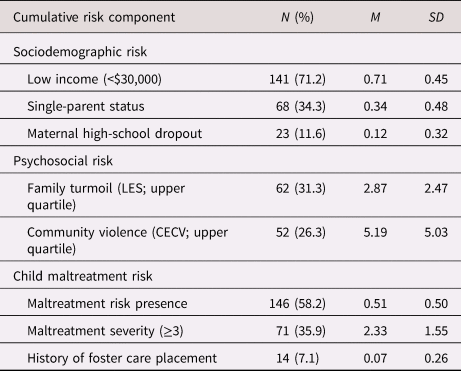
Child maltreatment risk included maltreatment risk presence, maltreatment risk severity, and child separation from the home due to foster care placement. CPS record data were coded using the Maltreatment Classification System (MCS; Barnett, Manly, & Cicchetti, Reference Barnett, Manly, Cicchetti, Cicchetti and Toth1993) to determine maltreatment risk presence and severity. Children who had any previous experience with child welfare documented by CPS, including previous abuse, neglect, or involvement with child welfare without a codable instance of maltreatment, received a score of one. No information was available on whether maltreatment instances were substantiated. Thus, this variable is best characterized as maltreatment risk rather than maltreatment experience, as it encompasses a wide variety of maltreatment risk exposures, ranging from a single unsubstantiated report to multiple substantiated reports. Children who had no documented history with child welfare received a score of zero on this variable. Children with a documented maltreatment experience received an additional point on the cumulative risk index if the severity of the maltreatment they had experienced received a score of three or higher on a five-point maltreatment severity scale, with five indicating the most severe maltreatment experiences. Finally, children who had been placed in foster care during their lifetime received a score of one, while those who had no foster care placement received a score of zero. Composite scores on the cumulative risk index comprised of all eight risk factors were available for 227 participants (M = 2.70, SD = 1.83; range = 0–7). Descriptive statistics of cumulative risk responses are presented in Table 1, including the prevalence of each individual cumulative risk factor in the present sample.
Descriptive statistics for components of cumulative risk

Note: For the frequency and percentage values reported, all variables are dichotomously coded, 1 = present, 0 = absent. Family turmoil was considered to be present for families who scored within the top quartile of negative events experienced in the last year on the Life Experience Survey (LES). Community violence exposure was considered to be present for families who scored within the top quartile of the Child Exposure to Community Violence (CECV) survey. Low income was considered to be present for families with an annual income of $30,000 or less. Child maltreatment severity was considered to be present when children had a maltreatment history coded as 3, 4, or 5 using the Maltreatment Classification System (MCS), indicating moderately severe to the most severe maltreatment. For variables which were initially continuous (e.g., LES, CECV, and maltreatment severity), the mean and standard deviation reflect true variable values. For all other variables, the mean and standard deviation are reflective of the dichotomous variable values.
Children's self-control
Children's self-control was assessed using two behavioral measures of inhibitory control and one parent-report measure of effortful control, described below.
Behavioral inhibitory control
Children's behavioral inhibitory control was measured using two Stroop-like tasks administered by a trained research assistant. The Shapes task (Kochanska, Murray, & Coy, Reference Kochanska, Murray and Coy1997) consists of children first being shown pictures of three large fruits and three small fruits and then being shown pictures of three small fruits embedded within a different larger fruit (e.g., a small orange embedded in a large banana). Children were instructed to point to each small fruit embedded within the larger fruit, thus being asked to inhibit their dominant response of pointing to the large fruit and instead engaging in a subdominant response to point to the smaller fruit. Each trial was scored as a zero (incorrect response), one (spontaneous self-correct), or two (correct initial response). Final scores for the Shapes task ranged from zero to six (M = 4.78, SD = 1.77). The Day/Night task (Gerstadt, Hong, & Diamond, Reference Gerstadt, Hong and Diamond1994) consists of children being instructed to say “day” when shown a card with a moon and stars and say “night” when presented with a card with a sun. Children completed 16 trials and scores for each trial were again scored as zero (incorrect response), one (spontaneous self-correct), or two (correct initial response). Final scores for the Day/Night task ranged from zero to 32 (M = 16.12, SD = 10.13). Scores from the Shapes and Day/Night tasks were found to be significantly correlated, r(195) = .26, p < .001, and thus were converted to z-scores and added together to create a composite measure of participating children's behavioral inhibitory control (M = −.05, SD = 0.86; range = −2.86 to 1.44).
Parent-reported effortful control
Mother-reported effortful control was assessed using the effortful control factor of the Child Behavior Questionnaire short-form (CBQ; Rothbart, Ahadi, Hershey, & Fisher, Reference Rothbart, Ahadi, Hershey and Fisher2001). The CBQ was administered to each mother by a trained research assistant. Items are scored on a seven-point Likert scale and range from one (extremely untrue of my child) to seven (extremely true of my child). Items on the CBQ contributing to the Effortful Control factor assess areas of attentional focusing, inhibitory control, low-intensity pleasure, and perceptual sensitivity. Scores for the effortful control factor are computed by averaging the scale scores for each of these sub-scales. Scores for the Effortful Control factor ranged from 3.40 to 6.83 (M = 5.01, SD = 0.65).
Dyadic processes
The Structural Analysis of Social Behavior (SASB; Benjamin, Reference Benjamin1996) assessment methodology includes an observational coding system (Benjamin & Cushing, Reference Benjamin and Cushing2000) for dyadic interpersonal behavior, along the orthogonal dimensions of affiliation and interdependence to yield eight behavioral blends along a circumplex. Affiliation describes communications on a continuum ranging from loving to hostile, and Interdependence describes communications on a continuum ranging from differentiated (i.e., autonomy-granting) to enmeshed (i.e., controlling/submitting). Communications that are transitive focus on the other and are prototypically parent-like, whereas communications that focus on self in reaction to the other are intransitive in nature, and prototypically child-like. The SASB has been used to meaningfully code brief segments of interaction in parent–child relationships.
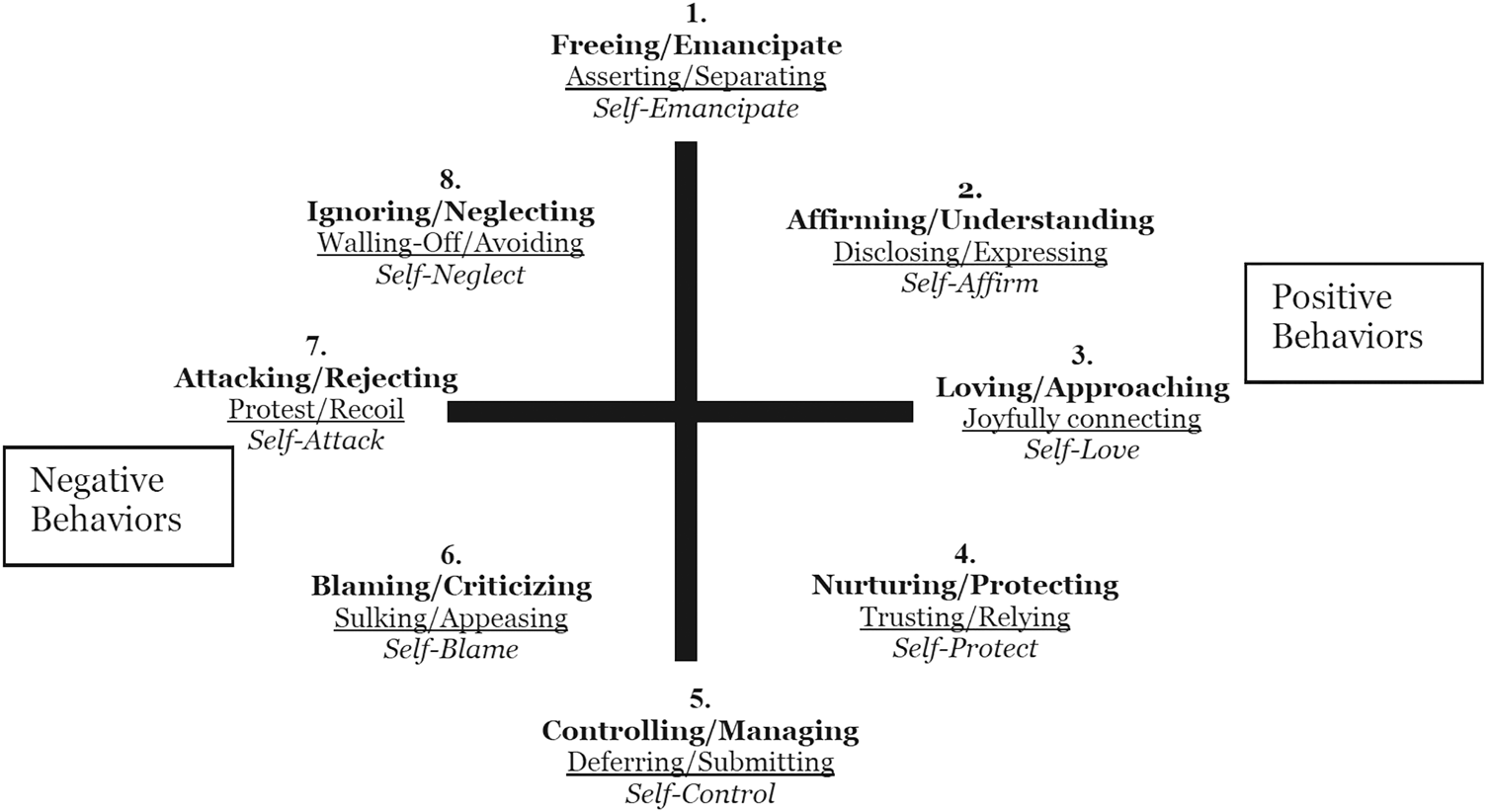
We used the SASB observational coding system to code mother–child interactions during the standard joint Duplo task, assessing two dyadic process codes: (a) the extent of dyadic interactive synchrony, and (b) latency to repair ruptures in synchrony. The process of SASB coding a unit of behavior involves three steps (Benjamin & Cushing, Reference Benjamin and Cushing2000): determining focus, degree of warmth/affiliation, and degree of interdependence. As shown in Figure 1, transitive and intransitive behaviors in Clusters 2, 3, and 4 were identified to form a constellation of positive behaviors (i.e., Affirm/Understand, Disclose/Express; Love/Approach, Joyfully Connect; and Nurture/Protect, Trust/Rely). In contrast, transitive and intransitive behaviors in Clusters 6, 7, and 8 (i.e., Blame/Criticize, Sulk/Appease; Attack/Reject, Protest/Recoil; and Ignore/Neglect, Wall-Off/Avoid) form the set of negative behaviors.
The Structural Analysis of Social Behavior (SASB) simplified cluster model (Benjamin, Reference Benjamin1996). Bold labels represent transitive behaviors, underlined labels represent intransitive behaviors, and italicized labels represent introject behaviors.

Mothers’ and children's videotaped interactions during the Duplo task were transcribed, unitized, and then subjected to SASB observational coding by a team of trained coders with over 80 hours of training. Verbatim transcripts of video-recorded tasks were prepared. Individual speaking turns were further unitized into separate units on the transcript to facilitate coding of discrete speech acts. For example, a mother might praise her child for handling the blocks gently then provide guidance to try the red block next, all in a single speaking turn. Unitization allowed each of these discrete speech acts to be coded separately. Using the unitized transcript and video recording, SASB coding began with the first codable event (i.e., first utterance by mother or child) in the sequence of mother–child interactions and ended with the last codable behavior that occurred in the task. Mother and child transactions were assigned SASB cluster codes and interrater reliability was calculated on 15% of tapes, with weighted kappas ranging from .73 to .84. SASB codes from proximal speaking turns were reviewed to identify all sequences of dyadic interactive synchrony and latency to repair.
Positive Dyadic Synchrony
We defined positive dyadic synchrony as a sequence of three or more positive mother–child behaviors, that is (M+, C+, M+ and so on) or (C+, M+, C+, and so on) from SASB Clusters 2, 3, and 4 (see Figure 1). Thus, the lower bound for dyadic synchrony scores was three contiguous speaking turns up to and until positive synchrony was interrupted by a rupture or the end of the task. Ruptures were defined as a single SASB-coded negative behavior, that is, M− or C− expressed by mother or child, interrupting a sequence of positive synchrony. Raw dyadic synchrony scores equaled the total number of M+ and C+ contiguous speaking turns during the task. Total speaking turns in positive dyadic synchrony was divided by the total number of speaking turns in the task to obtain a proportion score to control for between dyad differences in rates of speech. Thus, positive dyadic synchrony scores were calculated as the proportion of the total number of speaking turns in which a dyad was in dyadic synchrony, from 0.0 to 1.0.
Latency to repair
Relationship repairs were defined as a three-step sequence of SASB-coded contiguous positive mother and child speaking turns (M+, C+, M+ or C+, M+, C+) that occurred after a relationship rupture, initiated by mother or child (i.e., M− or C− from SASB Cluster 6, 7, or 8: criticize, sulk; attack, recoil; ignore, wall off). In other words, a relationship repair reflects a return to positive synchrony following a relationship rupture. Notably, dyads ranged in the amount of time following a rupture that they began repair efforts. We calculated latency to repair scores as the number of total speaking turns that elapsed following a rupture in synchrony to successful repair. Latency to repair scores were averaged for dyad who experienced multiple synchrony–rupture–repair sequences during the task, and then log transformed.
Results
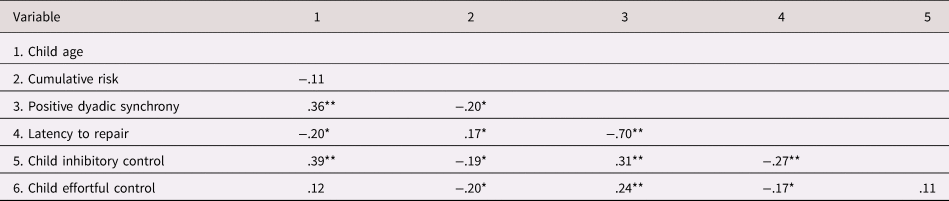
Child age was significantly associated with behavioral inhibitory control (r(211) = 0.39, p < .001), but not with parent-reported effortful control (r(218) = 0.12, p = .09). Lower cumulative risk scores were significantly associated with higher behavioral inhibitory control scores on the Day/Night and Shapes task composite (r(201) = −0.19, p < .01) and greater parent-reported effortful control scores on the CBQ-EC scale (r(209) = −0.20, p < .01). Cumulative risk was still significantly associated with the child inhibitory composite after controlling for child age (r(175) = −0.17, p = .02). Lower cumulative risk scores were also significantly associated with higher positive dyadic synchrony scores (r(210) = −0.20, p < .01) and shorter latencies to repair (r(173) = 0.17, p = .03). Greater positive dyadic synchrony was significantly associated with both inhibitory control (r(209) = 0.31, p < .001) and effortful control (r(216) = 0.24, p < .001) scores. The relationship between dyadic synchrony and inhibitory control was still significant after controlling for child age (r(209) = 0.19, p = .005). Shorter latencies to repair were associated with higher inhibitory control (r(172) = −0.27, p < .001) and effortful control scores (r(176) = −0.17, p = .03). The relation between latency to repair and children's inhibitory control was still significant after controlling for child age (r(172) = −0.20, p = .007). Correlations between all variables of interest are presented in Table 2.
Correlations between cumulative risk, dyadic processes, and child self-control
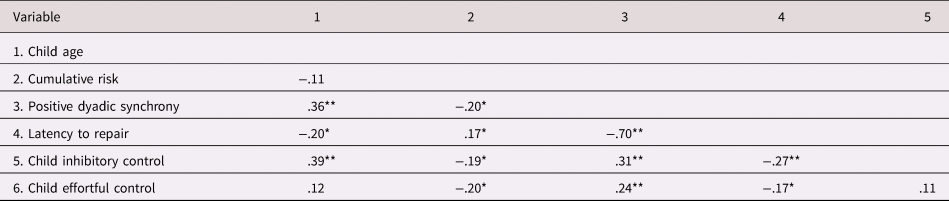
Note: Positive dyadic synchrony was recorded as a proportion of the total number of speaking turns during a 5-minute joint problem-solving task. Latency to repair was recorded as the average number of speaking turns a dyad took to enter back into positive synchrony after one member ruptured a positive synchronous state. The latency to repair variable was log transformed. The child inhibitory control score is represented by a z-score composite of child performance on the Day/Night and Shapes tasks, with higher scores indicating greater inhibitory control. The Effortful Control factor from the Child Behavior Questionnaires (CBQ) was used to represent parent-report of child effortful control, with higher scores indicating better effortful control abilities.
*p < .05, **p < .001.
Analytic strategy
After confirming expected associations between all variables of interest, a model was specified and tested using structural equation modeling (SEM) in AMOS version 23 (Arbuckle, Reference Arbuckle2014). Little's test for missing completely at random (MCAR) was used to examine all variables included in the present analyses and revealed that data did not meet criteria for missing completely at random (Little's MCAR χ2 [42] = 60.24, p = .03). Full information maximum likelihood (FIML) estimation was used in estimating model parameters in order to account for missing data. FIML maximizes the likelihood of missing data values based on observed data values, resulting in more statistically reliable standard errors when compared list-wise deletion, pair-wise deletion, and mean-imputation (Wothke, Reference Wothke, Little, Schnabel and Baumert1998). A latent variable of dyadic process was created with loadings onto both positive dyadic synchrony and latency to repair ruptures in synchrony in order to represent these processes as a single construct. Due to low latent factor loadings, children's behavioral and parent-reported self-control were examined as separate outcomes in the model. Child age was controlled for in all analyses. Model fit was assessed using the χ2 fit statistic, the comparative fit index (CFI), and the root mean square error of approximation (RMSEA). Values consistent with good fit include non-significant χ2 values, CFI values >.95, and RMSEA values within or below the .05–.08 range (Hu & Bentler, Reference Hu and Bentler1999).
Model associations were further examined using mediation analyses (MacKinnon, Reference Mackinnon2008). Mediation requires a direct effect of cumulative risk on both dyadic process and each self-control outcome. Additionally, dyadic processes must be related to each self-control outcome and result in a reduction in significance of the relationship between cumulative risk and dyadic processes. Monte Carlo simulated confidence intervals calculated in RMediation were utilized to estimate significance of indirect effects, as recommended (Tofighi & MacKinnon, Reference Tofighi and MacKinnon2011).
Mediation analyses
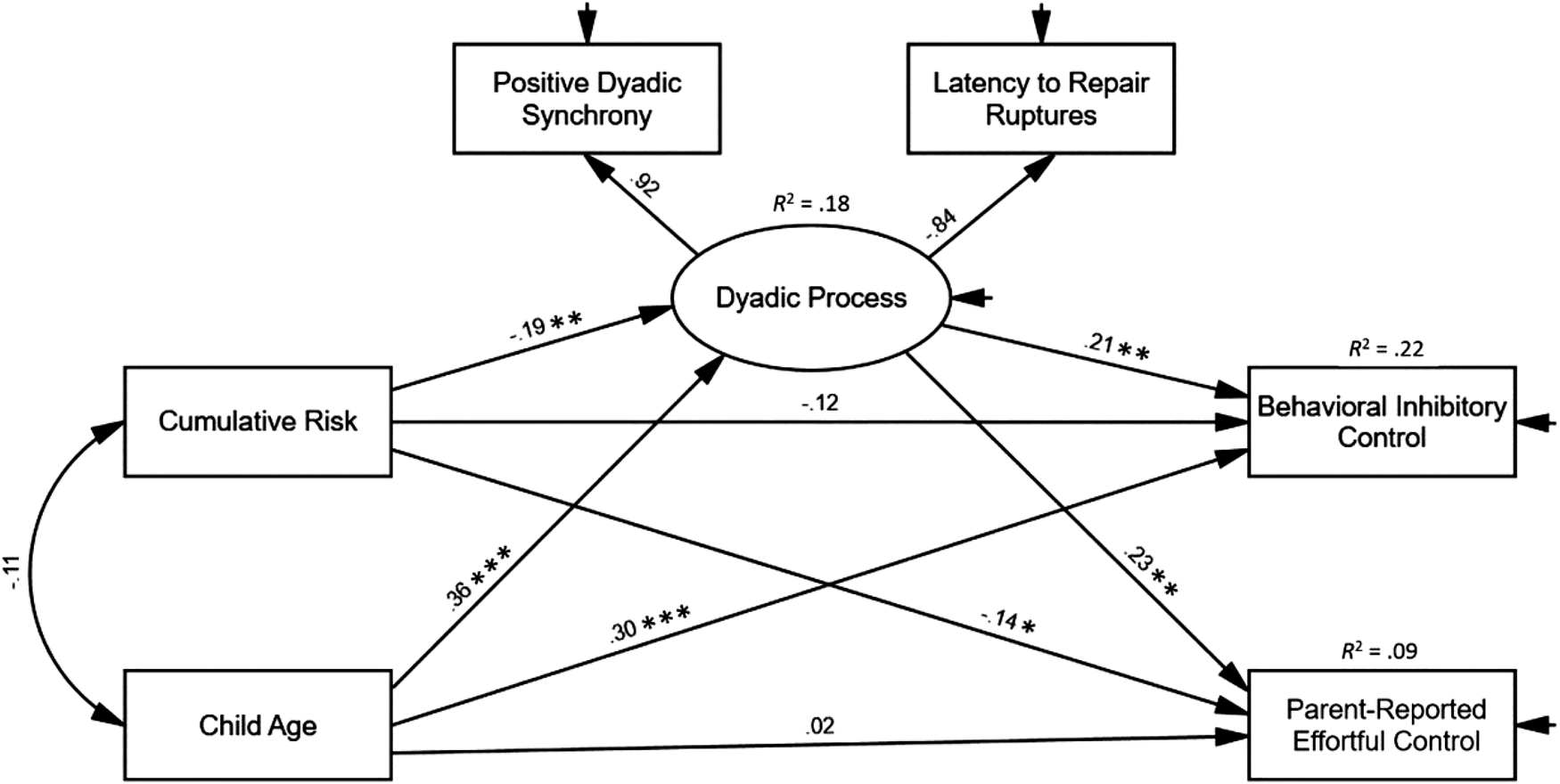
The present model examined dyadic process as a partial mediator of the relationship between cumulative risk and children's observed and parent-reported self-control abilities, controlling for child age. Results are shown in Figure 2. Findings suggest that partial mediation, in which cumulative risk shows direct and indirect associations with children's self-control abilities through dyadic processes, demonstrates excellent model fit (χ2 = 3.86, df = 4, p = .43, CFI = 1.00, RMSEA = 0.00). Model estimates showed that greater cumulative risk was associated with less positive dyadic interactions and longer ruptures (b = −.19, p = .005). Additionally, dyadic processes were significantly associated with both children's observed (b = .21, p = .006) and parent-reported (b = .23, p = .005) inhibitory control. Model predictors accounted for 21.7% of the variance in children's observed inhibitory control and 9.1% of the variance in parent-reported effortful control. The indirect effect of cumulative risk on children's observed inhibitory control was significant (Cumulative Risk → Dyadic Process → Behavioral Inhibitory Control) = −.04, p < .05; 95% CIs [−.02, −.005], as was the indirect effective of cumulative risk on children's parent-reported effortful control (Cumulative Risk → Dyadic Process → Parent-Reported Effortful Control) = −.04, p < .05; 95% CIs [−.03, −.003]. The direct associations between cumulative risk and parent-reported effortful control remained significant (p = .04), suggesting both direct and indirect effects of cumulative risk on this aspect of children's self-control abilities. In contrast, the direct association between cumulative risk and behavioral inhibitory control was nonsignificant (p = .07), suggesting behavioral inhibitory control was primarily associated with cumulative risk exposure through dyadic processes in the present model.
Structural equation path model examining direct and indirect effects of the mediation hypothesis. Paths are standardized estimates. Model fit: χ2(238) = 3.86, df = 4, p = .43; CFI = 1.00, RMSEA = 0.00. Standardized indirect effects of cumulative risk on children's observed inhibitory control (Cumulative Risk → Dyadic Process → Behavioral Inhibitory Control) = −.04, p<.05; 95% CIs [−.02, −.005], and parent-reported effortful control (Cumulative Risk → Dyadic Process → Parent-Reported Effortful Control) = −.04, p < .05; 95% CIs [−.03, −.003] were significant. * p < .05, ** p < .01, *** p < .001

Discussion
In the current study, we sought to clarify pathways through which cumulative risk is associated with children's self-control. We tested whether dyadic coordination patterns in parent–preschooler interactions mediated the association between cumulative risk and children's self-control skills. Results confirmed that the relation between risk exposure and children's self-control skills varied by (a) the extent of positive interactive synchrony that parent–child dyads exhibited during a standard lab task, and (b) the length of time it took dyads to repair ruptures in synchrony. Specifically, greater cumulative risk exposure was associated with less time spent in positive dyadic synchrony and longer latencies to repair. Additionally, dyadic processes, including less dyadic synchrony and lengthier ruptures, were related to lower self-control scores for children, whether those skills were assessed via child performance or parent-report methods.
The present findings are consistent with prior research demonstrating that exposure to contextual risk is negatively associated with children's self-control skills (Berthelsen, Hayes, White, & Williams, Reference Berthelsen, Hayes, White and Williams2017; Blair & Raver, Reference Blair and Raver2012, Reference Blair and Raver2015; Brown, Ackerman, & Moore, Reference Brown, Ackerman and Moore2013; Lengua et al., Reference Lengua, Moran, Zalewski, Ruberry, Kiff and Thompson2015; Perry, Braren, & Blair, Reference Perry, Braren and Blair2018; Tomalski et al., Reference Tomalski, Marczuk, Pisula, Malinowska, Kawa and Niedźwiecka2017), and supports the role of dyadic synchrony and rupture–repair processes as dyadic processes closely associated with children's self-control in early childhood (Blair et al., Reference Blair, Granger, Willoughby, Mills-Koonce, Cox, Greenberg and Fortunato2011; Lengua et al., Reference Lengua, Honorado and Bush2007, Reference Lengua, Moran, Zalewski, Ruberry, Kiff and Thompson2015; Merz, Landry, Montroy, & Williams, Reference Merz, Landry, Montroy and Williams2017; Ruberry, Klein, Kiff, Thompson, & Lengua, Reference Ruberry, Klein, Kiff, Thompson and Lengua2018). Findings contribute to the growing body of evidence suggesting that quality of parent–child interactions (Davis et al., Reference Davis, Bilms and Suveg2017; Kim & Kochanska, Reference Kim and Kochanska2012; Lindsey et al., Reference Lindsey, Cremeens, Colwell and Caldera2009; Olson & Lunkenheimer, Reference Olson, Lunkenheimer and Sameroff2009; Sameroff, Reference Sameroff and Sameroff2009), including repair processes (Kemp et al., Reference Kemp, Lunkenheimer, Albrecht and Chen2016; Skowron et al., Reference Skowron, Kozlowski and Pincus2010; Tronick, Reference Tronick and Tronick2007) are associated with the development of child self-control. The current results offer new evidence that early risk may be negatively associated with children's self-control development through their experiences with briefer periods of positive synchrony and lengthier ruptures or breakdowns in those positive synchronous states between caregiver and child. Thus, findings contribute to previous literature examining the self-control skills of children exposed to significant early life adversity (Gach, Ip, Sameroff, & Olson, Reference Gach, Ip, Sameroff and Olson2018; Labella, Narayan, McCormick, Desjardins, & Masten, Reference Labella, Narayan, McCormick, Desjardins and Masten2017; Song, Miller, Leung, Lumeng, & Rosenblum, Reference Song, Miller, Leung, Lumeng and Rosenblum2018). Specifically, the present study: (a) utilizes a cumulative risk model to examine the association of a variety of early risk factors with study outcomes, (b) examines specific dyadic transactional processes rather than examining parenting behaviors alone, and (c) explores self-control processes specifically in contrast to broader social-emotional adjustment or the development of internalizing/externalizing behavior disorders. Thus, the constellation of specific variables examined in the present study provides cross-sectional evidence that experiences with greater interactive synchrony and more efficient repair of relational ruptures may reflect a set of mechanistic pathways through which early adversity exposure bears on children's self-control skills.
In the sample studied here, parents and children exposed to greater cumulative risk spent less time in positive interactive synchrony, and those same children showed greater deficits in their self-control abilities. In early childhood, positive relational patterns with one's caregiver are especially important due to age-related increases in exploration and independence, which require increased parental monitoring and limit-setting (Shaw, Bell, & Gilliom, Reference Shaw, Bell and Gilliom2000; Trentacosta et al., Reference Trentacosta, Hyde, Shaw, Dishion, Gardner and Wilson2008). As warm, nurturing parenting behavior may be inherently challenging at times when parenting one's preschooler, the presence of cumulative risk may further exacerbate a parent's ability to manage difficult parent–child interactions. In addition, research suggests that children exposed to greater cumulative risk often show more externalizing behaviors and behavioral problems (Appleyard, Egeland, van Dulmen, & Sroufe, Reference Appleyard, Egeland, van Dulmen and Sroufe2005; Blanz, Schmidt, & Esser, Reference Blanz, Schmidt and Esser1991; Jones, Forehand, Brody, & Armistad, Reference Jones, Forehand, Brody and Armistad2002), which may further contribute to reduced time that children and parents spend in harmonious, reciprocal transactions. Thus, these findings suggest that the presence or absence of cumulative risk are associated with parents’ abilities to co-create a relational context that may support or impedes the development of children's self-control skills. Positive dyadic synchrony has previously emerged as a factor associated with self-control development in childhood (Beeghly, Perry, & Tronick, Reference Beeghly, Perry, Tronick and Maltzman2016; Feldman, Reference Feldman2007, Reference Feldman2009), and the current findings extend this knowledge by documenting the role of bidirectional parent–child interactions for self-control in early childhood among families exposed to high levels of cumulative risk. More specifically, warm, responsive parent–child relationships may contribute to improved child self-control by providing a context for children to experience developmentally appropriate successes and failures in a growth-promoting manner, although longitudinal evidence is needed to confirm the directionality of this association. As environments characterized by adversity are often marked by fear and hypervigilance that create lasting changes in the brain areas responsible for self-control skills (Brown et al., Reference Brown, Ackerman and Moore2013), our results suggest that the experience of nonharmonious parent–child relationships are also correlated with deficits in children's self-control.
In the present study, parents and children exposed to greater cumulative risk also showed lengthier times between relational ruptures and repairs, which was associated with deficits in child self-control. In addition to being associated with a parent's ability to maintain positive interactive synchrony with their child, greater contextual risk was also related to a parent's ability to quickly repair challenging parent–child interactions. Longer times spent between relational ruptures and repairs prolong states of negative affect, arousal, and conflict that children experience, de facto reducing the time spent with their caregiver in positive interactive synchrony. Our results suggest that shorter time to repair after a relationship rupture is related to child self-control development in the face of adversity, where children are already at risk for deficits in self-control. Longitudinal and intervention research is necessary to identify the directionality of these associations and confirm hypotheses postulated in this theory-driven work. For example, parents who facilitate quicker interactive repairs following a rupture (i.e., speedier returns to dyadic synchrony) may be strengthening their children's self-control development while supporting and gaining trust of their child. These opportunities for quick repairs after ruptures may enable children to learn to manage their negative arousal and behaviors, and thus provide a context where they can begin to internalize self-control abilities initially performed by their caregivers (Beeghly et al., Reference Beeghly, Perry, Tronick and Maltzman2016, Feldman, Reference Feldman2007, Reference Feldman2009; Skowron et al., Reference Skowron, Kozlowski and Pincus2010; Tronick, Reference Tronick1989). Among children who experience multiple risk factors, lengthy ruptures may serve to extend time children spend experiencing strong negative affect, further impacting their ability to regulate their arousal and leaving them at risk for emotional and behavioral dysregulation. Longer episodes between ruptures and subsequent repairs could leave children in a state of uncertainty, unpredictability, and feeling overwhelmed. Thus, such extended episodes may result in children managing negative arousal without support and could provide children with fewer opportunities with caregiver scaffolding, depriving them of modeling that supports self-control skill development. These questions await further investigations using longitudinal designs to strengthen directional, causal claims that extend beyond conclusions that can be drawn from the current study.
Taken together, these results highlight positive dyadic synchrony and prompt repairs of ruptures as important areas for further study and potential targets for early intervention in families with exposure to significant early life risk. Although previous research has demonstrated that general parenting skills are related to cumulative risk, including caregiver responsiveness and warmth, the present study expands on these findings by documenting specific, bidirectional processes between parents and children that are linked with cumulative risk exposure and variations in children's self-control development. Interventions that target parent and child mutual interaction patterns rather than parenting behaviors alone may represent an effective approach for strengthening children's self-control.
While these results provide new insights into how parents and children co-create optimal relationships related to the development of self-control in the context of adversity, it is important to note several limitations of the present study. First, participants were predominantly White, lower-income, and living in rural communities, perhaps limiting the generalizability of these findings to more diverse samples. However, given that rural samples are often understudied, the present study may offer an important contribution in examining the intersection of risk, dyadic process, and self-control in this population. Though we found support for the hypothesized model (i.e., dyadic synchrony and repair processes mediate links between cumulative risk exposure and deficits in children's self-control), the directionality of associations between study variables cannot be assumed due to the cross-sectional nature of the data. It is plausible that children raised in low-risk contexts are better regulated and are thus better able to contribute to creating more mutually positive interactions with their caregivers and help to repair ruptures when they occur. Further longitudinal research is needed to confirm if cumulative risk exerts a negative causal impact on dyadic interactional processes, which then results in impaired self-control skills among children. Because levels of cumulative risk and positive dyadic interaction cannot be randomly assigned, experimental intervention designs can be employed to test causal associations between these variables by randomly assigning participants to receive an intervention that strengthens interactive synchrony and promotes quicker repair processes. Researchers can then assess whether interventions that strengthen dyadic coordination between a parent and their child lead to stronger self-control in children. Alternatively, longitudinal studies repeatedly assessing both dyadic synchrony and children's self-control abilities as children develop these skills between the ages of 2 and 5 years would provide valuable information for confirming the present findings in the absence of intervention. Finally, although the cumulative risk model utilized in the present analyses has many strengths, there are also some limitations to this approach. These include lack of information on intensity or impact of individual risk factors and interactions between risk factors. For example, it is possible that experiencing severe maltreatment has a much greater impact on dyadic processes and subsequent self-control skills compared to living in a single-parent household. Therefore, despite the strengths of the cumulative risk approach, it may also be important for risk factors to be examined as individual predictors of dyadic interaction and self-control outcomes in future research.
A variety of interventions exist that have already been shown to improve self-control among children exposed to early life adversity. Such interventions include high-quality Montessori programs, Tools of the Mind, Promoting Alternative Thinking Strategies (PATHS), and the Chicago School Readiness Project (CSRP; e.g., Diamond & Lee, Reference Diamond and Lee2011). However, given the present findings and body of prior literature highlighting the importance of parenting and dyadic interaction for children's self-control outcomes, parent–child interventions present themselves as an important area for further examination, particularly among populations experiencing high levels of early adversity. Programs such as Parent Child Interaction Therapy (PCIT; Eyberg, Reference Eyberg1988) may be deserving of closer inquiry given their focus on promoting mutually positive dyadic interaction and practice of coaching parents to mastery on skills that promote such interactions (Chaffin et al., Reference Chaffin, Silovsky, Funderburk, Valle, Brestan, Balachova and Bonner2004; Goldfine, Wagner, Branstetter, & McNeil, Reference Goldfine, Wagner, Branstetter and McNeil2008; Thomas & Zimmer-Gembeck, Reference Thomas and Zimmer-Gembeck2011). Given that parenting is a proximal factor that influences children's development in an ongoing manner, such programs may be uniquely equipped to promote the development of self-control among children with early adverse life experiences. For instance, PCIT targets parenting behavior through live, individualized coaching and teaches caregivers to generate nurturing, positive interactions with their child while also reinforcing warm, positive child behaviors in return. Throughout PCIT, parents and children reinforce warm interactions with each other, thus co-creating positive interactive synchrony and perhaps fostering children's self-control skills. PCIT also facilitates a healthy rupture-repair process by teaching parents to impose predictable, consistent limits and age-appropriate consequences, and encouraging quick returns to synchrony after expected ruptures occur. These aspects of PCIT may strengthen children's self-control skills by giving them opportunities to manage their negative arousal in the context of positive special time play and supporting caregiver-facilitated repairs to ruptures in dyadic synchrony. However, research is needed to examine if PCIT enhances self-control skills through these processes. Thus, randomized clinical trials of PCIT and other parenting interventions will help to identify whether increased positive dyadic interaction and ability to repair ruptures promoted by these interventions is responsible for improving self-control outcomes in families where children are exposed to significant early life risk.
Future research should also continue to explore how specific aspects of dyadic synchrony and rupture-repair processes vary from family to family and how they support or hinder the development of self-control. It will be particularly important to identify interaction sequences that enable children and parents to return to positive synchrony following a rupture and to investigate what aspects of these sequences enable dyads to repair ruptures quickly and efficiently. Alternatively, exploring the nature of ruptures (i.e., interactions that lead to longer amounts of time between repairs; how and why ruptures go unrepaired) reflects another important next step. Further study of dyadic repair mechanisms underlying successful and unsuccessful post-rupture returns to mutually positive interactions will be important to identify individual and dyad-level characteristics that shape these interactive processes and whether these vary based on a family's exposure to cumulative risk. For example, in dyads with lower risk exposure, parents may be more likely to repair interruptions to positive dyadic interactions, while in higher-risk families this responsibility may more often fall on the child (Skowron et al., Reference Skowron, Kozlowski and Pincus2010). Identifying thresholds that differentiate shorter latencies associated with healthier developmental outcomes from longer latencies that are more strongly associated with problematic child outcomes may also help to characterize at what point rupture lengths become problematic for long-term child outcomes. Although higher rates of repairing interactive ruptures have been linked to better emotion regulation in children (Kemp et al., Reference Kemp, Lunkenheimer, Albrecht and Chen2016), other aspects of interactive rupture and repair, such as onset and timing of repair-initiation and caregiver versus child-specific roles in repair processes could be examined to continue clarifying impacts on children's developing self-control. Given that weaker self-control is associated with lower academic achievement, difficulties forming positive peer relationships, and deficits in social-emotional functioning, further research should explore the ways in which interactive coordination helps to support healthy developmental outcomes for children (Bell & Deater-Deckard, Reference Bell and Deater-Deckard2007; Blair, Reference Blair2002; Coie et al., Reference Coie, Lochman, Terry and Hyman1992; Crandall et al., Reference Crandall, Deater-Deckard and Riley2015; Lewit & Baker, Reference Lewit and Baker1995; Rueda et al., Reference Rueda, Posner and Rothbart2005).
Acknowledgments
We would like to thank Dr. Dave DeGarmo for his consultation to support our statistical analyses, and Rose Jeffries for her careful copyediting of this manuscript.
Financial support
This research was supported by NIH Research Grant R01 MH079328 to Dr. Skowron and funded by the National Institute of Mental Health and Administration for Children and Families/Children's Bureau of the Administration on Children, Youth and Families as part of the Federal Child Neglect Research Consortium.