Introduction
In most sectors, failure rates of new firms are significantly higher than those of established companies (Jones, Reference Jones1987). According to Eurostat (2021), around 60% of firms survived at least 3 years and fewer than half survived 5 years over the previous decade. The effects of the conditions in which firms are founded have been shown to have a substantial influence on exit rates and subsequent performance. Indeed, these can persist for several years and may even matter more than current conditions (Farinha, Reference Farinha2005; Geroski, Mata, & Portugal, Reference Geroski, Mata and Portugal2010). They can be conceptualised at micro and macro levels (Davidsson & Wiklund, Reference Davidsson and Wiklund2001). Researchers have emphasised individual- and micro-oriented factors in explaining post-entry success, focusing on financial performance, firm-specific factors and strategic choices.
The theory of organisational ecology (Hannan & Freeman, Reference Hannan and Freeman1977; Hannan & Freeman, Reference Hannan and Freeman1984) highlights how environmental conditions at the time of a firm's founding can impact survival. It argues that weak companies (e.g., because they have financial difficulties) disappear through a process of market natural selection; firms that are healthy at their founding tend to last longer (Coad, Reference Coad2007; Delmar, McKelvie, & Wennberg, Reference Delmar, McKelvie and Wennberg2013; Fuertes-Callén, Cuellar-Fernández, & Serrano-Cinca, Reference Fuertes-Callén, Cuellar-Fernández and Serrano-Cinca2022).
Empirical research on the effect of the macroeconomic environment on firms' success has received less attention than the impact of micro determinants. Scholars have focused on the study of its influence on firm survival. Romanelli (Reference Romanelli1989); Honjo (Reference Honjo2000); Box (Reference Box2008); Geroski, Mata, and Portugal (Reference Geroski, Mata and Portugal2010) and Chatzoudes, Chatzoglou, and Diamantidis (Reference Chatzoudes, Chatzoglou and Diamantidis2022), amongst others, have shown that macroeconomic conditions at firms' founding (and over time) have an impact on their capacity to survive. Thus, those established in adverse environments have lower survival rates. Some studies have shown that firms that manage to survive under adverse conditions have lower mortality rates than those founded in more favourable environments (Swaminathan, Reference Swaminathan1996). Organisational resilience, which has been defined as the property of an organisation to withstand severe shock and rebound (Mokline & Abdallah, Reference Mokline and Abdallah2021), can be the explanation. Organisational resilience, in its two dimensions, relational and operational, contributes to organisational and sustainability survival (Yılmaz Börekçi, Rofcanin, Heras, & Berber, Reference Yılmaz Börekçi, Rofcanin, Heras and Berber2021). Adverse external conditions may induce firms to restructure processes, for example, adjusting costs or increasing productivity, which then makes them more competitive and resilient.
Economic recession can also influence the relationship between firm-specific factors and post-entry performance. Thus, the size, liquidity or financial structure of a new firm can be decisive in turbulent environments. Recent studies have shown that the 2008 global financial crisis impacted the growth and performance of companies, particularly small and young ones (Ferrando, Marchica, & Mura, Reference Ferrando, Marchica and Mura2017). Profit effects are likely to be positive in an environment that encourages investment and growth. If the business climate is not favourable to investment, the link between profits and growth becomes weaker (Lee, Reference Lee2014). Some researchers have argued that small firms have high failure rates in downturns (Box, Reference Box2008; Peric & Vitezić, Reference Peric and Vitezić2016), though Varum and Rocha (Reference Varum and Rocha2012) claimed that large size may be responsible for firm inertia and an inability to adapt optimally to adverse conditions. Though the latter can impose severe constraints, they may impel companies to reorganise. In severe downturns, some firms grow rapidly but many fail (Peric & Vitezić, Reference Peric and Vitezić2016). According to the resource-based view (RBV) (Wernerfelt, Reference Wernerfelt1984), companies own heterogeneous resources that contribute to differences in performance, such that some can deal with crises better than others (Coad & Hölzl, Reference Coad, Hölzl, Dietrich and Krafft2012; Naidoo, Reference Naidoo2010; Wernerfelt, Reference Wernerfelt1984).
Therefore, numerous studies have demonstrated that macro factors at the time of a firm's establishment, its characteristics, and the strategies it adopts can affect survival and performance. However, the literature has yet to address the joint effects of environmental conditions and organisational characteristics on the success of new firms. The present study uses organisational ecology theory to fill this gap. It integrates the macro and micro determinants of new firms' success and considers whether the economic climate at the time of their founding is a moderator of the relationship between initial organisational factors and survival and performance.
The study analysed the evolution over 8 years of a sample of 3,722 new Spanish agrifood manufacturing companies (created at different periods). Our model, which was based on the survival of the fitter principle, included profitability and financial strength at the firms' founding as determinants of success. It also took into account the firms' strategies. Two aspects of the success were examined: survival and profitable growth.
The study's contribution to the literature is threefold. First, it used two cohorts of newly created companies in two different periods (of economic stability and economic crisis) to show that founding conditions were an important determinant of a new firm's success. Second, the economic environment at founding was examined and shown to moderate the relationship between a firm's characteristics and strategies and its success. Third, founding factors had long-lasting effects on the performance of new firms, though these differed according to the dimensions of success that were being analysed.
The study is organised as follows: second section comprises a literature review and an outline of the development of the hypotheses; third section, the findings; and fourth section, a discussion and a conclusion.
Literature review and hypotheses development
Literature review
Numerous theories have been developed that explain the growth and survival of companies. All of them seek to uncover the determinants of firm success. Two of the most widely referenced theories are organisational ecology and the RBV. Studies based on the perspective of the latter have stressed the importance of firm-level resources as predictors of firm performance, while those based on the former have highlighted the impact of environmental conditions (Geroski, Mata, & Portugal, Reference Geroski, Mata and Portugal2010). The RBV, which was posited by Wernerfelt (Reference Wernerfelt1984), is built upon the idea that a firm's success is largely determined by the resources it possesses and controls (Galbreath, Reference Galbreath2005). Firms represent heterogeneous bundles of resources and capabilities that are the result of their strategic choices and commitments over time, and these can be significant factors in securing sustainable competitive advantage and superior performance (Barney, Reference Barney1991; Coleman, Cotei, & Farhat, Reference Coleman, Cotei and Farhat2013; Wernerfelt, Reference Wernerfelt1984). Firms succeed or fail according to their ability in obtaining and combining critical assets that offer a temporary advantage (Heine & Rindfleisch, Reference Heine and Rindfleisch2013).
The organisational ecology approach has its theoretical basis in the structural and functional assumptions of organisational change. It applies evolutionary theory to explain how natural selection within a population of organisations – which is the main driving force of change – influences their social behaviour and structure (Carroll, Reference Carroll1984; Hannan & Freeman, Reference Hannan and Freeman1977). The business environment selects fit companies and removes the unfit ones. Numerous studies have tested this principle (Coad, Reference Coad2007; Delmar, McKelvie, & Wennberg, Reference Delmar, McKelvie and Wennberg2013; Dosi, Pugliese, & Santoleri, Reference Dosi, Pugliese and Santoleri2017; Fuertes-Callén, Cuellar-Fernández, & Serrano-Cinca, Reference Fuertes-Callén, Cuellar-Fernández and Serrano-Cinca2022).
Organisational ecology underlines the effect of the initial founding conditions of organisations on their future development. This concept has its theoretical roots in Stinchcombe's (Reference Stinchcombe and March1965) study. The author suggested that the social environment at the time of founding imprints initial structures on organisations. These persist because of inertia and institutionalisation, despite subsequent significant environmental changes (Marquis & Tilcsik, Reference Marquis and Tilcsik2013). Organisational ecologists elaborated on Stinchcombe's work by investigating the effect of the environment on the survival of new ventures (Soto-Simeone, Sirén, & Antretter, Reference Soto-Simeone, Sirén and Antretter2020) arguing that environmental forces are the main drivers of organisational selection processes (Brüderl, Preisendörfer, & Ziegler, Reference Brüderl, Preisendörfer and Ziegler1992). An organisation's success is not only the product of internal resources; internal factors play a role in how it adapts to the external environment, thereby influencing its survival (Bertoni, Colombo, & Quas, Reference Bertoni, Colombo and Quas2019).
Several studies focused on identifying the determinants of new firms' success from a macro- and a micro-perspective. Most of them based their evidence on samples of established firms. Table 1 draws together the main studies on success factors in the performance of new firms and their conclusions. After reading the literature reviews by Santisteban and Mauricio (Reference Santisteban and Mauricio2017) and Soto-Simeone, Sirén, and Antretter (Reference Soto-Simeone, Sirén and Antretter2020), we grouped the determinants of new firms' success into three categories: environmental factors; attributes, structural characteristics and strategies; and individual characteristics.
Studies on determinants of new firms survival and performance

As can be seen, numerous studies have examined the positive influence of characteristics such as size, profitability, liquidity and solvency. However, the effect on growth and profitability is not so defined; some studies show a positive impact and others the opposite; this is also the case with size. The role played by leverage is also unclear; some authors have argued that debt is an indication of the promising nature of a start-up, even though it increases risk. Numerous studies have referred to the competitive advantage wrought by internationalisation and innovation while stressing the risk and costs involved.
As has been noted, research has shown that the environment at the time of a firm's founding can have a critical impact on post-entry performance. Numerous studies (Bhattacharjee, Higson, Holly, & Kattuman, Reference Bhattacharjee, Higson, Holly and Kattuman2009; Box, Reference Box2008; Chatzoudes, Chatzoglou, & Diamantidis, Reference Chatzoudes, Chatzoglou and Diamantidis2022; Honjo, Reference Honjo2000; Varum & Rocha, Reference Varum and Rocha2012) have indicated that macro-economic instability raises the probability of exit during slowdowns and recession periods. Industry, as a contextual condition, has also been considered a key determinant of new firm survival. The specific characteristics of the industry, particularly the underlying technological regime, its location in the value chain, the extent of economies of scale, and capital intensity can explain the variation in survival rates across industries (Audretsch, Reference Audretsch1991 and Stearns, Carter, Reynolds, & Williams, Reference Stearns, Carter, Reynolds and Williams1995). Such evidence seems to corroborate the organisational ecology theory.
The literature has also investigated the role of founding teams. This has usually been measured in terms of abilities, education and experience, each of which can help a new venture overcome birth pangs.
Model and hypotheses
By applying the organisational ecology perspective to our study, we hypothesised that two sets of factors – initial firm characteristics and strategies and environmental conditions – would significantly influence new firms' success. In the case of the former, we examined performance, financial strength and internationalisation. In the case of the latter, we examined the economic environment.
It is important to define the concept of success in the present context. It seemed logical that survival would be the main consideration. However, thereafter, the goal became less clear. Economic theory often assumes firms wish to maximise profits, but this is contingent on growth (Davidsson, Steffens, & Fitzsimmons, Reference Davidsson, Steffens and Fitzsimmons2009). For small firms, growth may require economies of scale, network externalities, outsourcing and so on (Markman & Gartner, Reference Markman and Gartner2002). But growth is a risky strategy that requires investment and changes in organisational structures. Research has shown that companies that prioritise growth maximisation in the beginning often perform poorly and are less profitable in subsequent years (Davidsson, Steffens, & Fitzsimmons, Reference Davidsson, Steffens and Fitzsimmons2009).
As numerous researchers have stated (Davidsson, Steffens, & Fitzsimmons, Reference Davidsson, Steffens and Fitzsimmons2009; Raisch, Reference Raisch2008; Zhou, Ho Park, & Ungson, Reference Zhou, Ho Park and Ungson2013), profitable growth (the most desirable goal) should be considered simultaneously, so we define new firm success as the survival and achievement of profitable growth.
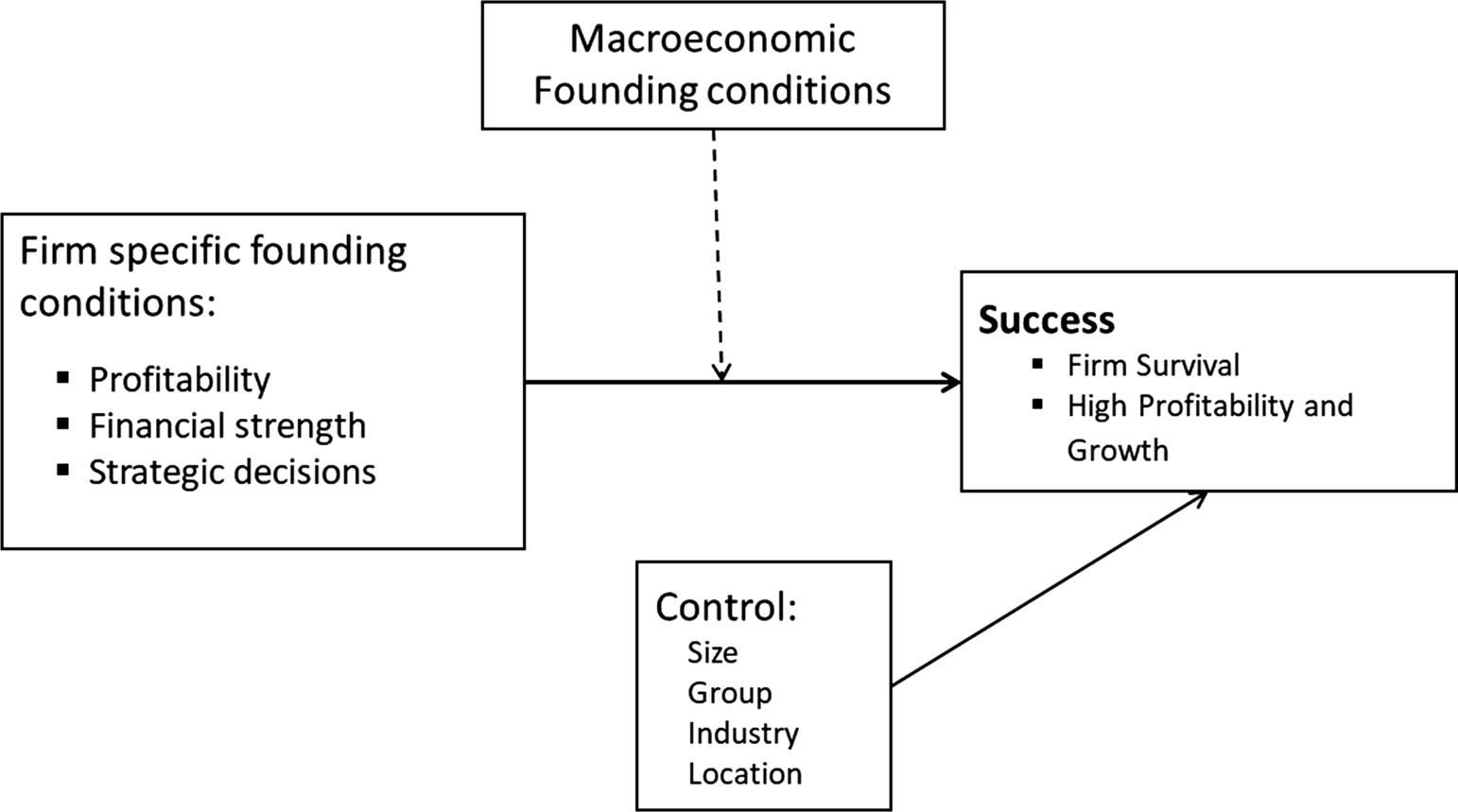
Figure 1 provides a summary of our framework. It comprises two categories of hypotheses: organisational orientation and environmental moderation.
Proposed framework for success of newborn firms.

In the firm-specific factors category, the first hypothesis concerned the influence of initial profitability. As has been noted, organisational ecology theory argues that the market will eliminate weak companies through natural selection. Thus, the survival of the fitter principle suggests that firms that are healthy at the beginning (e.g., in financial terms) are more likely to survive (Coad, Reference Coad2007). According to Penrose (Reference Penrose1952), positive profits can be regarded as a criterion for natural selection.
The concept of resilience (Holling, Reference Holling1973), which is drawn from organisational ecology theory, is another factor in success. Making early profits, having a comfortable liquidity position and exhibiting financial strength to deal with future risks lead to organisational resilience (Cuellar, Fuertes, & Serrano, Reference Cuellar, Fuertes and Serrano2021).
The obtaining of profits is an element in most models of survival and bankruptcy. Profitable firms are less likely to fail, as they are more able to generate positive cash flows and accumulate slack resources to fund competitive actions such as exporting and R&D investment, which in turn provide them with greater growth potential (George, Reference George2005; Geroski, Reference Geroski1995). Delmar, McKelvie, and Wennberg (Reference Delmar, McKelvie and Wennberg2013) state that increases in profitability indicate the efficiency of operation of a new firm by achieving a match between cost structures and market acceptance of prices. In light of the above, the following hypothesis was proposed:
Hypothesis 1a: Initial profitability has a positive influence on a new firm's success.
Profitable companies fail occasionally due to a lack of liquidity. Liquidity difficulties make new firms more vulnerable to external shocks. Saridakis, Mole, and Hay (Reference Saridakis, Mole and Hay2013) argued that liquidity constraints in the first year were critical to survival and subsequent resilience. Studies on the survival of start-ups have found that higher liquidity is associated with a lower probability of failure (Huyghebaert, Gaeremynck, Roodhooft, & VandeGucht, Reference Huyghebaert, Gaeremynck, Roodhooft and VandeGucht2000; Saridakis, Mole, & Hay, Reference Saridakis, Mole and Hay2013; Wiklund, Baker, & Shepherd, Reference Wiklund, Baker and Shepherd2010). Liquidity indicators also indicate the ability of a start-up to grow. If a firm has considerable cash reserves, it may expand rapidly (Santisteban & Mauricio, Reference Santisteban and Mauricio2017).
Solvency, as liquidity, measures a company's financial health, but the focus is on long-term stability. Solvency is, therefore, a core measure since it indicates a company's capacity to manage its operations in the future and represents its capital structure (Robinson, Henry, Pirie, & Broihahn, Reference Robinson, Henry, Pirie and Broihahn2015). The capital structure choices that firms make in their initial year play also an important role in post-entry success (Robb & Robinson, Reference Robb and Robinson2014). A higher proportion of capital relative to debt can be interpreted as a defence that can make access to external financing easier in cases of adverse shock, and may even enable a firm to survive during a period of temporarily negative profits. On the other hand, a high percentage of shareholder capital contributions may indicate that a bank does not support the firm's business plan (Cole & Sokolyk, Reference Cole and Sokolyk2018).
A lack of external financing is usually a reason why entrepreneurs abandon the start-up process. However, as Fotopoulos and Louri (Reference Fotopoulos and Louri2000) suggested, new firms may not survive if they immediately expose themselves to excessive liabilities. The theory of organisational ecology explains the positive relationship between debt and failure: a negative business cycle combined with an unfavourable environment could mean that a highly leveraged firm is unable to meet its debt service requirements, leading to bankruptcy (Miller, Reference Miller1988).
Considering the financial strength of new companies measured by their liquidity, and solvency, the following hypothesis was proposed:
Hypothesis 2a: Initial financial strength has a positive influence on a new firm's success.
Some authors have tested the resilience of unfit firms by examining the reasons why some underperforming firms do not exit the market (Dosi, Pugliese, & Santoleri, Reference Dosi, Pugliese and Santoleri2017; Gimeno, Folta, Cooper, & Woo, Reference Gimeno, Folta, Cooper and Woo1997). They have argued that organisational survival is not strictly a function of economic performance; other micro founding conditions must be considered, such as initial strategic choices.
Many new firms consider beginning their activities as internationalised companies. International entrepreneurship research has shown that new ventures initiate international activities earlier in their life cycle in pursuit of growth opportunities by taking advantage of their ability to innovate (Sapienza, Autio, George, & Zahra, Reference Sapienza, Autio, George and Zahra2006).
The effect of the early internationalisation of new ventures on survival and performance has attracted the attention of a growing number of researchers (see Fariborzi & Keyhani, Reference Fariborzi and Keyhani2018 for a literature review), though the findings have been inconclusive. The process theory of internationalisation and the new venture internationalisation framework (McDougall, Shane, & Oviatt, Reference McDougall, Shane and Oviatt1994) are two of the most widely employed theories in this area. While the former warns of the potentially negative consequences of early internationalisation for firm survival (due mainly to the new costs associated with the liability of foreignness; Johanson & Vahlne, Reference Johanson and Vahlne1990), the latter focuses on the positive results that can pertain, arguing that indecision may mean lost opportunity. Sapienza et al. (Reference Sapienza, Autio, George and Zahra2006) posited that the earlier a firm internationalises, the more deeply imprinted its dynamic capability for exploiting opportunities in foreign markets will be.
Organisational ecology theory provides further justifications. In an environment characterised by increasing competition, many companies find a niche by exporting local products to distant markets or importing products from abroad. Having several logistics providers also increases resilience and the probability of survival (Hazen & Byrd, Reference Hazen and Byrd2012). Similarly, if the internal market fails, foreign markets can provide sufficient revenue for the company.
Consequently, the following hypothesis was proposed:
Hypothesis 3a: Internationalisation strategy has a positive influence on a new firm's success.
The second category of hypotheses in our proposed framework concerns the role of environmental conditions. Firms, whether new or mature, interact with the environment, which provides both opportunities and challenges (Box, Reference Box2008). The concept of organisational imprinting stresses the importance of external environmental forces in shaping firms' initial structures and the persistence of these patterns over time. Thus, organisations founded in the same period tend to display similar features. Audretsch (Reference Audretsch1991) stated that the determinants of new firms' survival depended on the period in which survival is measured. Similarly, Wagner (Reference Wagner1994) highlighted the convenience of analysing several cohorts, since the year of foundation may be important in explaining their success (Esteve-Pérez & Mañez-Castillejo, Reference Esteve-Pérez and Mañez-Castillejo2008).
The ecological perspective does not deny the role of the actions of individual firms. Indeed, it emphasises the limits on the influence of firm choices and actions and the principal role of the environment (Baum, Reference Baum, Clegg, Hardy and Nord1996). In conditions of uncertainty, implementing changes that improve organisational success and the chance of survival can be difficult (Baum & Amburgrey, Reference Baum, Amburgrey and Baum2002).
Mellahi and Wilkinson (Reference Mellahi and Wilkinson2004) stated that there are significant differences in the outcomes of the same internal factors across firms in different business environments and vice versa. Therefore, any effort to explain organisational failure would not be complete without taking into account the interaction between contextual forces and organisational dynamics.
There is extensive literature on economic downturn and firm performance. Authors such as Alvarez and Görg (Reference Alvarez and Görg2012), Bhattacharjee et al. (Reference Bhattacharjee, Higson, Holly and Kattuman2009) and Cheong and Hoang (Reference Cheong and Hoang2021) found that macroeconomic instability had a more significant impact on a firm's performance than internal factors. Another stream of studies considered that in periods of decline, macroeconomic factors such as industry and country, and their interaction effect, weaken, firm-specific characteristics being the most important determinants of their survival (Bamiatzi, Bozos, Cavusgil, & Hult, Reference Bamiatzi, Bozos, Cavusgil and Hult2016). Therefore, authors stress the need for firms' better management of internal resources as a survival mechanism in times of crisis (Chatzoudes, Chatzoglou, & Diamantidis, Reference Chatzoudes, Chatzoglou and Diamantidis2022; Naidoo, Reference Naidoo2010).
Firm characteristics and decisions that are recommended in one economic phase may not be appropriate in another. Thus, the firm size advantage might disappear in a period of economic downturn, as large firms cannot adapt quickly to the changing situation due to their complex structure (Smallbone, Deakins, Battisti, & Kitching, Reference Smallbone, Deakins, Battisti and Kitching2012). Bărbuță-Mișu, Madaleno, and Vasile (Reference Bărbuță-Mișu, Madaleno and Vasile2019) investigated how the 2008–2009 global crisis influenced the relationship between financial variables (profitability, leverage, liquidity and solvency) and firm performance, finding that, when the effect of the crisis is taken into account, the explanatory power of these internal factors is modified.
The financial crisis resulted in greater obstacles to firms' access to credit, along with a contraction in domestic demand that had a deep impact on firms' performance. There is evidence that a lack of liquidity or high dependence on external financial sources worsen firms' chance of resisting the pressures of an economic recession (Bărbuță-Mișu, Madaleno, & Vasile, Reference Bărbuță-Mișu, Madaleno and Vasile2019; García-Appendini & Montoriol-Garriga, Reference García-Appendini and Montoriol-Garriga2013). Debt financing during the crisis made companies more susceptible to refinancing risks and to borrowing at higher costs, which, in turn, could worsen their performance. However, the tightening of access to bank debt caused its use to decrease significantly for start-ups founded in crisis years relative to start-ups founded in pre-crisis years, forcing them to seek alternative sources of funding (Deloof & Vanacker, Reference Deloof and Vanacker2018). This may explain why the debt factor dilutes its explanatory capacity during downturns, other internal factors being the true determinants of company performance (Cressy, Reference Cressy1996a).
The role of strategic business decisions, such as innovation and internationalisation, for firm performance can also differ in a recession. The economic literature underlines the existence of a positive relationship between competitiveness and the degree of internationalisation of a company, as well as higher performance in terms of productivity and profitability. Thus, internationalisation could help new firms manage unfavourable periods, providing them with some flexibility to adapt to unexpected downward shifts in demand by shifting sales from less profitable markets to new customers in other more beneficial markets (Lee & Makhija, Reference Lee and Makhija2009). However, it depends on the form of internationalisation adopted, the geographical structure of export activities, and the conditions of the economic cycle abroad. The 2008–2009 global crisis led to drastic changes in environmental conditions, which had a major impact on international demand and consumers' purchasing behaviour. Spanish agri-food firms had to operate outside their traditional European zones, which were also immersed in the crisis, facing much more protected markets with more entry barriers, increasing the risk of this strategy (Serrano, Fernández-Olmos, & Pinilla, Reference Serrano, Fernández-Olmos and Pinilla2018).
In view of previous evidence, the environmental context must therefore be considered in the relationship between micro and macro factors and the success of a company, without being able to hypothesize the extent of the possible moderating effect. Consequently, the following hypotheses were proposed:
Hypothesis 1b: The macroeconomic context at foundation moderates the positive influence of initial firm profitability on success.
Hypothesis 2b: The macroeconomic context at foundation moderates the positive influence of initial financial strength on new firm success.
Hypothesis 3b: The macroeconomic context at foundation moderates the positive influence of internationalisation strategy on new firm success.
Empirical study
Sample, variables and methodology
The present study analysed a sample of Spanish agrifood manufacturing companies. The agrifood industry is the main manufacturing sector in the European Union (EU), both in terms of employment and value added (Eurostat, 2022). Spain is the fourth largest agrifood power in Europe in terms of turnover, representing 9% of the added value of the industry. It is the largest manufacturing sector, with a turnover of more than €119,000 million (2% of GDP) and an active population of close to 500,000 people (Spanish Institute of Foreign Trade [ICEX], 2021).
In the agrifood industry, internationalisation is becoming a crucial strategy for success. Spain is the fourth largest exporter in the sector in the EU. The increase in internationalisation in the past decades has been due mainly to technological innovations, lower transaction costs resulting from the removal of trade barriers and the uniformity of food safety regulations in the EU (Schiefer & Hartmann, Reference Schiefer and Hartmann2008; Serrano, Fernández-Olmos, & Pinilla, Reference Serrano, Fernández-Olmos and Pinilla2018).
The Spanish agrifood sector comprises more than 31,000 food and beverage companies, of which 96% are small to medium-sized enterprises (Spanish Federation of Food and Drink Industries, 2020). It is a very dynamic sector. In the last decade, around 5,800 companies have been created. In general, the agrifood industry is characterised by a low cyclicality because demand for food products is inelastic (Lienhardt, Reference Lienhardt2014), the sector is open to foreign markets, and companies exhibit a high degree of resilience in adverse periods. In the last decade, the survival rates of new companies in the European agrifood manufacturing industry were, on average, 5% higher than those of other sectors (Eurostat, 2021). However, the sector has suffered from external shocks, such as the COVID-19 pandemic and the global financial crisis of 2008, when there was a large increase in bankruptcy rates (Aleksanyan & Huiban, Reference Aleksanyan and Huiban2016). The survival rates of agrifood start-ups in Spain were in line with those of countries with above-average survival rates of start-ups in the sector in Europe-27 during the crisis period (Eurostat, 2021).
The determinant role of the agrifood sector in the economy, the dynamism of its firms and its specific characteristics make it an interesting subject for study. We selected a sample of companies created over two different periods, the first covering the years 2000−2002 and the second covering the years 2008−2010. These two cohorts, therefore, experienced an economic upswing and a severe downturn resulting from significant external variations.Footnote 1
The data for the present study were obtained from the Spanish database Sabi of Bureau van Dijk (BVD), distributed worldwide by Moody's, which takes accounting information from the national commercial register (Spanish Companies House) as well as non-financial information from other official sources. We selected code numbers 10, 11 and 12 of the Statistical Classification of Economic Activities (NACE), which correspond to food, drink and tobacco production. All the companies were filtered and a maximum of 8 years of annual statements were selected. The final sample comprised 3,722 companies (2,340 firms founded between 2000 and 2002 and 1,382 between 2008 and 2010). This sharp decrease of 60% is a reflection of the impact of the crisis on the creation of new companies.
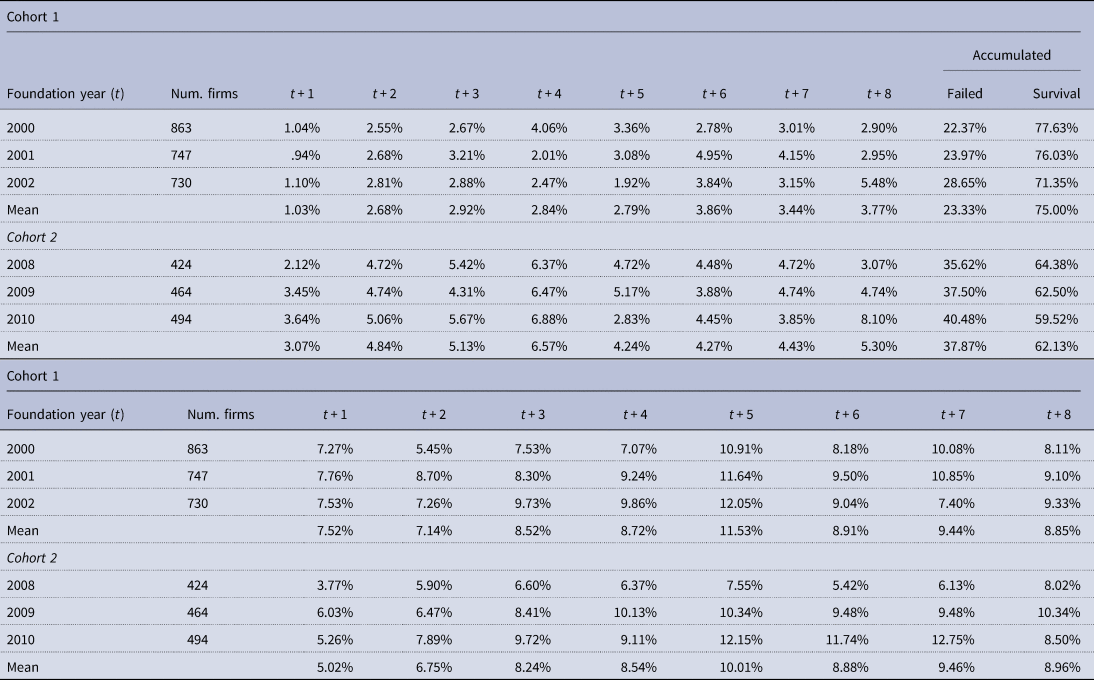
For the survival analysis, a company was considered to have failed if it had entered statutory bankruptcy proceedings. The Sabi database provides details about companies' administrative status. Table 2 shows the number of new firms and the percentage of bankruptcies each year according to the time of foundation. The crisis period (cohort 2) saw the founding of around 50% fewer companies than in the period 2000−2002. On average, 3.1% of the companies went bankrupt each year in cohort 1 and 4.7% in cohort 2. The cumulative percentage of companies that survived for 8 years after their foundation was 62.13% during the economic crisis and 75% in the period of stability. The date of foundation of the companies correlated with their survival.
Number of newborn firms and percentage of bankruptcies (panel A) and high profitable growth firms (panel B), n-years after foundation year (t)

To measure firm success, we focused on firm growth and profitability, defining the status of the high profitable growth of a firm (HPrGr). To identify a company in the HPrGr category, we divided the sample according to the variables sales growth and profitability. Highly profitable growth companies belong simultaneously to quartiles 3 and 4 in both categories. The rest of the companies were categorised as non-high profitable growth firms (Non-HPrGr). We ruled out companies that were in the highest quartile for one of the variables and in the lowest quartile for the other indicator, given that their more radical strategies may have distorted the results by either growing with losses or being profitable without growing. Table 2 (panel b) presents the number of new firms and the percentage of high profitable growth firms each year at the time of foundation. The percentage of HPrGr companies is slightly lower in cohort 2 than in cohort 1 until year t + 5, after which the percentages are equal.
Following Davidsson, Steffens, and Fitzsimmons (Reference Davidsson, Steffens and Fitzsimmons2009) and Delmar, McKelvie, and Wennberg (Reference Delmar, McKelvie and Wennberg2013), we operationalised financial performance by the most common measure used as a proxy for financial performance: return on assets (ROA). We also use PROFIT, a dummy variable that indicates the presence of profits. Beaver, Correia, and McNichols (Reference Beaver, Correia and McNichols2012) included the same dummy variable in their bankruptcy prediction model, arguing that the indicator variable permitted different intercepts and different slopes for loss versus non-loss firm years.
Financial strength was operationalised by ratios (Fuertes-Callén, Cuellar-Fernández, & Serrano-Cinca, Reference Fuertes-Callén, Cuellar-Fernández and Serrano-Cinca2022) that measure the percentage of debt (DEBT), the initial capital relative to debt (E/D), a sufficiency of profits to pay interest (EBITDA/D) and liquidity. Liquidity was measured by the working capital to total assets ratio (WC/TA). Negative working capital may indicate the presence of financing constraints, as firms whose current liabilities are higher than their current assets may be unable to pay back creditors in the short term. In other words, it is a symptom of insufficient liquidity, and it can lead to bankruptcy (Ding, Guariglia, & Knight, Reference Ding, Guariglia and Knight2013).
A dummy variable equal to 1 if the company performed import/export activities was used to measure internationalisation (INTER). We investigated the influence of the date of founding on survival and success using a dummy variable (FY) that indicated cohorts of different economic periods. FY is equal to 1 if the firm was founded in the 2008–2010 period and zero otherwise.
The analysis also included several control variables: size, business group affiliation, shareholder and board structure, industry sub-sectors and location. While small companies face severe cost disadvantages, suffering from the liability of size and greater restrictions on access to finance, large companies have positional advantages, such as economies of scale and scope, which provide monetary reserves they can use to cope with periods of difficulty. Entry size might also be interpreted as a signal of self-awareness of entrepreneurial capability (Aldrich & Auster, Reference Aldrich and Auster1986; Mata & Portugal, Reference Mata and Portugal1994).
Second, affiliation with a business group is often considered to be beneficial to a new firm. It can provide financing advantages, improve operating efficiency, promote R&D investment and knowledge spillovers, leverage the group's internal capital market and reputation and share risk amongst group members (Ahmad, Oláh, Popp, & Máté, Reference Ahmad, Oláh, Popp and Máté2018; Khanna & Yafeh, Reference Khanna and Yafeh2005). Several studies have suggested that business groups are beneficial in firms' success, especially during adverse economic conditions (Bamiatzi, Cavusgil, Jabbour, & Sinkovics, Reference Bamiatzi, Cavusgil, Jabbour and Sinkovics2014; Santioni, Schiantarelli, & Strahan, Reference Santioni, Schiantarelli and Strahan2020). Previous literature also has evidenced the relevance of board structure and ownership structure for the survival and performance of companies (Chancharat, Krishnamurti, & Tian, Reference Chancharat, Krishnamurti and Tian2012; Ghahroudi, Hoshino, & Fakhraei, Reference Ghahroudi, Hoshino and Fakhraei2019; Parker, Peters, & Turetsky, Reference Parker, Peters and Turetsky2002). In general, a larger board increases the resources and expertise available to the firm, in addition to reducing the ability of CEOs to control it. The ownership structure could reduce agency costs. A more diversified and independent ownership structure will avoid excessive power of control over the executives and interference by larger shareholders of start-up companies, where sometimes there may even be overlapping of functions. Finally, we controlled for effects on subsectors and location. Industry characteristics (e.g., economies of scale, sunk cost, barriers to entry and concentration) have been shown to impact failure rates and profitability (Mahmood, Reference Mahmood2000; Mata & Portugal, Reference Mata and Portugal1994; Mata, Portugal, & Guimaraes, Reference Mata, Portugal and Guimaraes1995; Rannikko, Tornikoski, Isaksson, & Löfsten, Reference Rannikko, Tornikoski, Isaksson and Löfsten2019). Location affects access to external resources, costs, transportation, human resources and so on. The present study focused on a single but broad local industry consisting of multiple and varied subsectors in different regions. For this reason, we considered it important to control their effect on the survival and success of new firms.
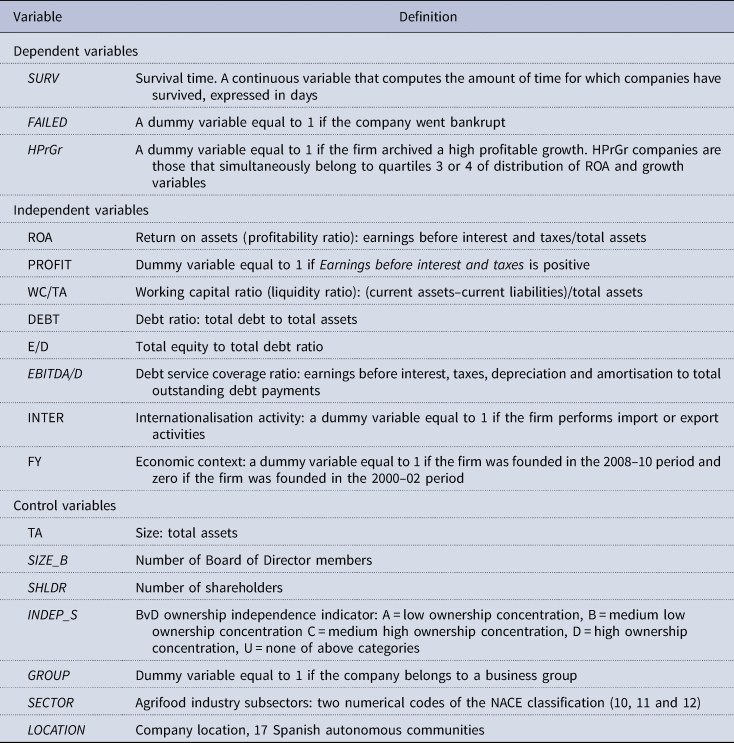
Firm size was measured by total assets (TA). GROUP was a dummy variable equal to 1 if the company belonged to a business group and zero otherwise. The control variables for industry subsectors (SECTOR) were two numerical codes of the NACE classification and the LOCATION variable referred to the 17 Spanish autonomous communities. SIZE_B (size of the board) is the number of directors that compose it. SHLDR (shareholders) is the number of shareholders. The independence of shareholders (INDEP_S) is measured by the ownership BvD independence indicator available from SABI. The BvD independence indicator classifies companies into five levels, considering the number of shareholders and the percentage of their individual and collective holdings. The ‘A’ independence indicator denotes independent companies, where no shareholder has more than 25% ownership of the ultimate voting rights. Independence indicator ‘B’ (medium–low ownership concentration) denotes companies in which there are no shareholders with more than 50% but there is one shareholder with voting rights of between 25.1 and 50%. For a company to be classified with independent indicator ‘C’ (medium–high ownership concentration), the company must have a registered shareholder with total or calculated ownership of 50.1% or more, while independence indicator ‘D’ denotes concentrated companies – i.e. when a registered shareholder demonstrates direct ownership of more than 50% with foreign subsidiaries and companies. Finally, independent indicator ‘U’ is applied when a company does not fall into the previous categories. Table 3 shows the variables used to test the hypotheses and their definitions.
Variables employed for the hypotheses' testing and their definition

For survival analysis, we used the Cox (Reference Cox1972) proportional hazards model. This enabled us to examine how several factors could influence simultaneously the probability of an event (failure) happening at a particular point. This probability, referred to as the hazard rate, is estimated as follows:

where h(t/Z) is the hazard function, t is the survival time, Z represents the covariate, and β = (β1, β2,…, βp) are the estimated coefficients. h0(t) is the baseline hazard function at the time t. It is the value of the hazard if all covariates are zero.
The quantities exp (βiZi) are the hazard ratios (HR). A hazard ratio above 1 indicates a covariate that is positively associated with the event probability, and hence negatively associated with survival. A HR equal to 1 indicates that the covariate has no effect and a HR of less than 1 indicates that as the value of the covariate increases, the hazard of the event declines and the probability of survival increases.
We estimated Cox models in which a failure event could occur 2 (in the short term), 5 (medium term) or 8 years (long term) after foundation. Thus, the dependent variable could reach a maximum of 730, 1,825 and 2,920 days in the case of a 2-, 5- and 8-year survival period, respectively. The covariates were the financial ratios and the remainder of the indicators measured at the end of the first year of a firm's life.
We also assessed the extent to which the founding conditions and decisions of newly created companies could be integrated into models that might predict whether they would achieve high profitable growth. Multivariate logistic regressions were carried out. The dependent variable took a value of 1 when the company was classified as a high profitable growth company at 2, 5 or 8 years after foundation.
Results
Tables 4–6 display the results of the exploratory analysis of the independent variables. The data correspond to 1 year after the food companies were founded. They have been winsorised at the 99th percentile to avoid the pernicious influence of atypical values.
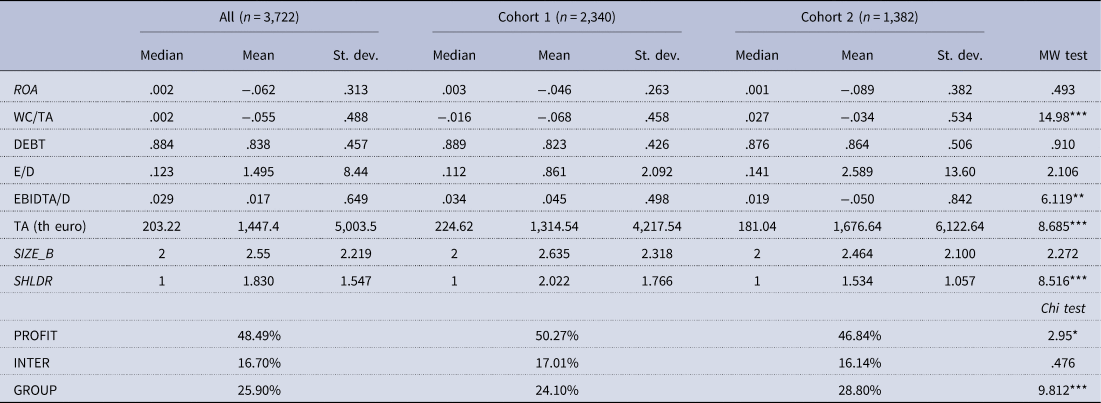
Descriptive statistics for all sample and the two temporal cohorts

The variables (defined in Table 3) were measured at the end of the first year of a firm's life. MW test: Mann–Whitney U test. Chi test: Pearson's χ2 test. *p < .10; **p < .05; ***p < .000.
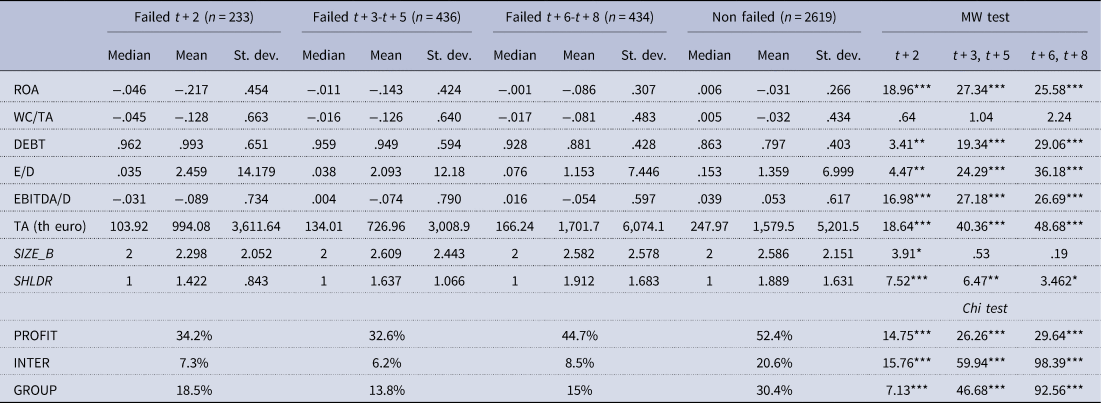
Descriptive statistics for failed and non-failed firms

The variables (defined in Table 3) were measured at the end of the first year of a firm's life. MW test: Mann–Whitney U test. Chi test: Pearson's χ2 test. *p < .10; **p < .05; ***p < .000.
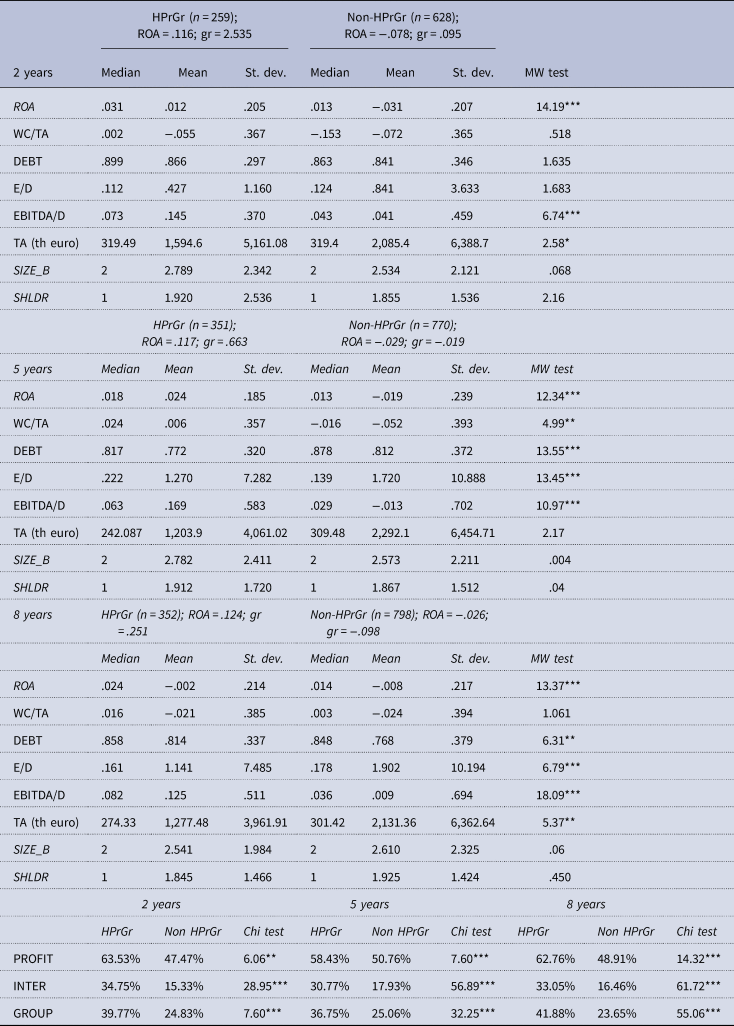
Descriptive statistics for HPrGr and non-HPrGr firms

The variables (defined in Table 3) were measured at the end of the first year of a firm's life. MW test: Mann–Whitney U test. Chi test: Pearson's χ2 test. *p < .10; **p < .05; ***p < .000.
Table 4 shows the descriptive statistics for the complete sample of companies and the two cohorts. The results indicate that differences were statistically significant across most of the variables. The companies founded in cohort 2 were more liquid than firms created in cohort 1 and their mean ratio E/D was higher. Cohort 2 firms also had a smaller median size but a higher dispersion in the data for total assets. Finally, the percentage of profitable new firms was higher in cohort 1; no differences were observed in the rates for internationalised companies.
Table 5 provides descriptive evidence on whether surviving and failed firms 2, 5 and 8 years after foundation showed systematic differences in their first year financial ratios and indicators. Those that survived were larger and more profitable and had less external financial support. Internationalised companies had a greater probability of survival than those that neither exported nor imported. The survival rate for companies belonging to a business group was also higher.
Table 6 displays the differences between HPrGr companies and Non-HPrGr companies at 2, 5 and 8 years after foundation. HPrGr firms were more profitable and more internationalised and belonged in greater proportions to a business group than Non-HPrGr companies. There were no significant differences in liquidity ratio between the two categories. In the short term, companies that achieved high profitable growth in 2 years had more debt than Non-HPrGr companies, but there were no differences of note between the 5- and 8-year analyses.
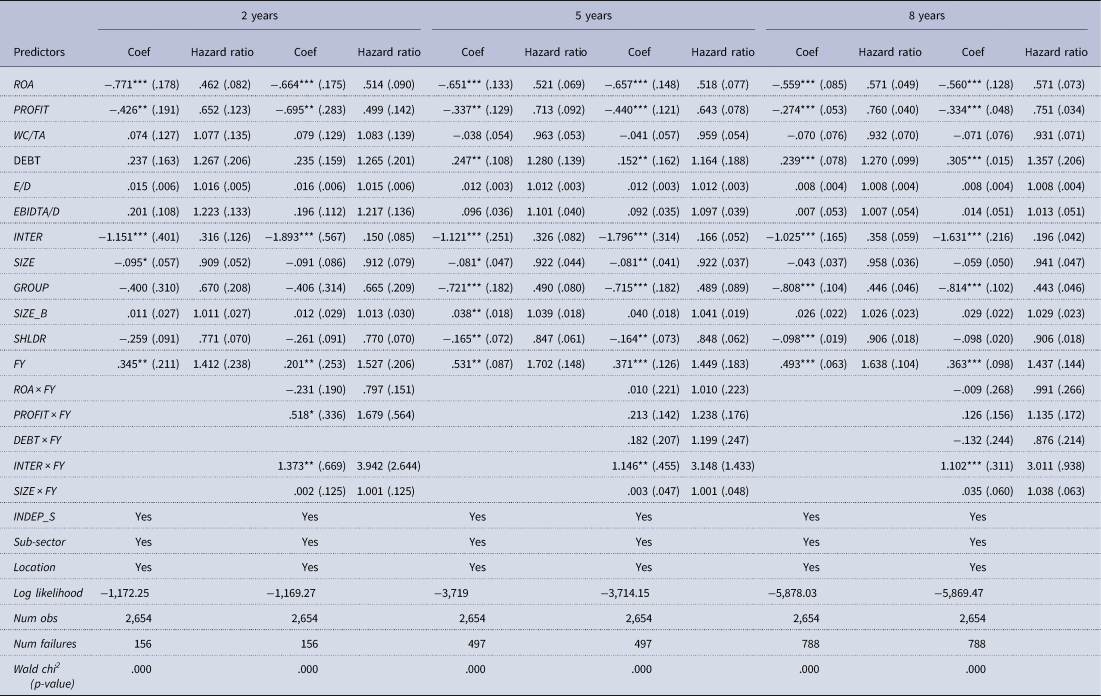
Table 7 shows the results of the Cox models estimations (i.e., the estimated coefficients, hazard rates and significance). A hazard ratio lower than 1 indicates that as the variable increases, the probability of survival increases. Columns 1, 3 and 5 show the results for the estimation of multivariate models without interaction terms.
Estimated coefficients and hazard ratios for the Cox proportional hazard model

Predictors were measured at the end of the first year of a firm's life. *p < .10; **p < .05; ***p < .000.
The regression coefficients estimated for ROA, SIZE, PROFIT and INTER were significant in the 2-year survival model (column 1). The more profitable and larger the companies were in the beginning, the greater the probability of survival. The risk of failure for profitable food firms (PROFIT) was 34.8% lower than for unprofitable firms, keeping the rest of the variables constant. Internationalised companies were 68.4% less liable to go bankrupt (100−hazard ratio × 100) than domestic companies; this result was highly significant (p < .000).
When extending the survival analysis to 5−8 years (columns 3 and 5), the results show that, in addition to the above variables, DEBT and belonging to a business group (GROUP) were also statistically significant. The relationship between DEBT and default was positive, indicating that the greater the external financing, the lower the probability of survival. An increase of 1% of the debt to assets ratio increased the probability of exit in 5 or 8 years by 21.87 and 21.2%, respectively.
To establish whether the main effects of independent variables on survival were contingent upon the economic context in the foundation year (FY), we included interaction terms in the models. If the interaction terms were statistically significant, differences in estimated coefficients across both cohorts were significant. Hence, the environment moderated the relationship between independent variables and survival. Columns 2, 4 and 6 show the results.
In the 2-year model, the interaction between profits and year of foundation is significant at the 10% level (estimated coefficient = .518, p < .10), and the interaction between internationalisation strategy and year of foundation was significant at the 5% level (estimated coefficient = 1.373, p < .05). These findings reveal that economic context at firm foundation moderated significantly the relationship between initial profits and short-term survival and the relationship between internationalisation and survival.
The estimated coefficient for profits for firms created in the 2000−2002 period was −.695 (hazard rate = .499) and the estimated coefficient for profits for firms created during the crisis was calculated as −.695 + .518 = −.177 (hazard rate = .838). Unfavourable economic context lowered the effect of achieving profits on survival. To evaluate the magnitude of the moderation effect, we compared the estimated coefficients of PROFIT × FY and PROFIT and tested the statistical significance of PROFIT in the crisis period by drawing on standard errors of their estimated coefficients, as calculated from the variance−covariance matrix of regression coefficients. The t-test was calculated as following:

where s2PROFIT is the variance of estimated coefficient for PROFIT; s2PROFIT × FY is the variance of estimated coefficient for PROFIT × FY; and sPROFIT,PROFIT × FY is the covariance between PROFIT and PROFIT × FY. The value of the t-test was −1.030, p > .10, so making a profit 1 year after birth was not a firm-specific factor relevant to survival in firms established during the economic crisis.
Our findings also revealed that FY moderated the impact of internationalisation strategy on post-entry firm survival. The estimated coefficient for internationalised new firms in the crisis period was −1.893 + 1.373 = −.520 (hazard rate = .595), which was lower than the estimated coefficient for internationalised new firms in the expansive context. We then evaluated the magnitude of the moderation effect. The t value for INTER + INTER × FY regression coefficients was −1.11, p > .10, so the unfavourable economic context decreased the effect of internationalisation strategy on new firms' survival; being an import and/or export company was not a relevant strategic factor for survival in the short term.
In the 5- and 8-year models, the estimated coefficient for INTER × FY was positive and significant and its absolute value was smaller than the coefficient of INTER. This result shows that the negative economic context reduced the differences in the probability of survival between internationalised and local new firms. The t value for the sum of estimated coefficients INTER + INTER × FY was −2.03 and −2.54 p < .010 in the model at 5 and 8 years, respectively. These results suggest that internationalisation was a relevant factor for survival in both economic environments, but its impact was less in companies founded in the crisis. In the 5-year model, the probability of bankruptcy of internationalised firms in cohort 1 was 83.4% (100−hazard rate × 100) lower than the probability of domestic firms. In cohort 2, this probability fell to 47.8%. The results were similar in the 8-year survival model. The probability of bankruptcy of internationalised firms created in cohort 1 was 80.4% (100−hazard rate × 100) lower than of domestic firms. In cohort 2, this probability decreased to 41.1%.Footnote 2
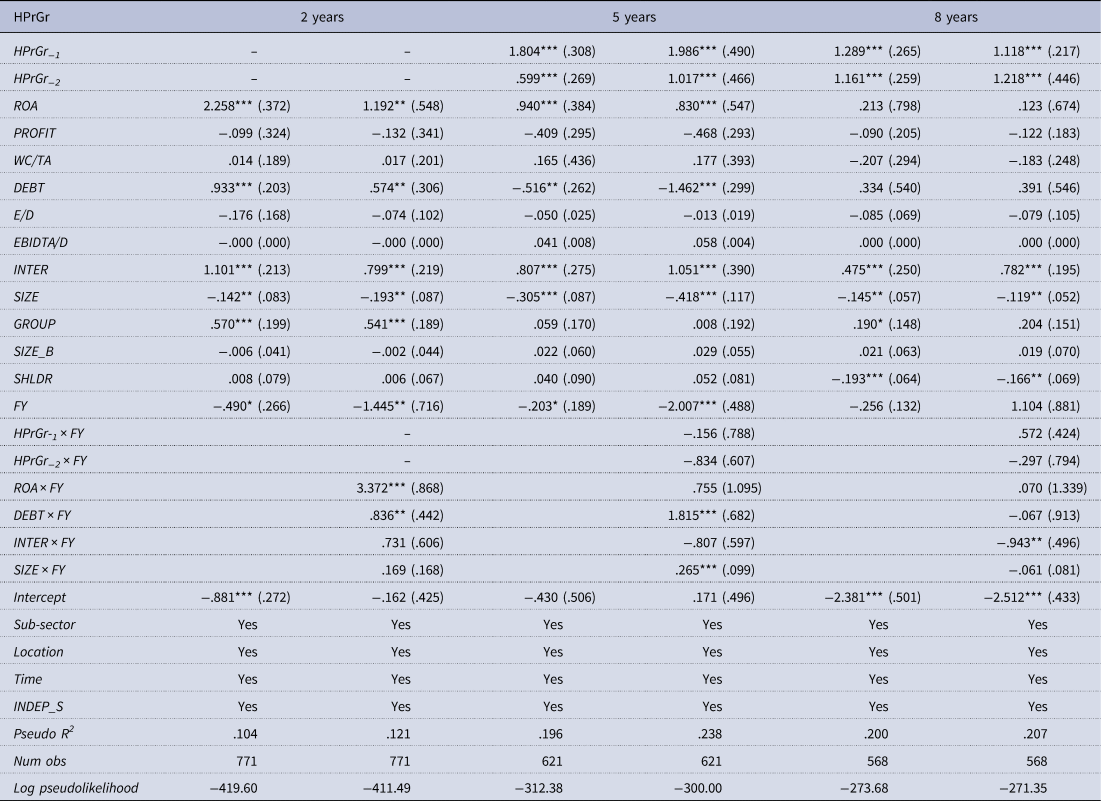
Table 8 displays the results of our multivariate logistic regressions. The dependent variable took a value of 1 when the company was classified as a high profitable growth (HPrGr) company and zero otherwise. As in the survival analysis, the first columns of Table 8 show the results for the 2-year term, the following columns for the 5-year term and the last two columns for the 8-year term.
Results of the logit regression

Dependent variable HPrGr, equal 1 if firms is a HPrGr firm (3 or 4 quartile of both ROA and growth rates simultaneously) and 0 otherwise. Firms that were in the highest quartile for one of the variables and in the lowest quartile for the other indicator where eliminated. Predictors were measured at the end of the first year of a firm's life. *p < .10; **p < .05; ***p < .000.
For the 2-year term, the estimated coefficients ROA, DEBT, INTER and GROUP were positive and statistically significant. A company that was immediately profitable, internationalised and belonged to a business group was more likely to become a HPrGr company in 2 years. Having more external financing was also found to be important. The estimated coefficient for SIZE was negative (−.142, p < .05), indicating that small size facilitated profitable growth. The next column presents the results for the model that includes the multiplicative terms with FY. The coefficient of FY is negative, showing that the probability of achieving high profitable growth status was lower during the economic crisis.
The ROA × FY and DEBT × FY terms were positive and statistically significant in terms of their moderating effect. These results indicate that for the companies created during the crisis, profitability and external debt increased the probability of a company achieving high profitable growth.
The next two columns display the estimation results for the 5-year time horizon. In these models, in addition to the independent variables already defined, the first and second lags of the dependent variable (HPrGr-1 and HPrGr-2) were included to test the persistence over time of high profitability and growth. Both HPrGr lags were positive and statistically significant (1.804 and .599, p < .001), so persistence was verified. ROA, INTER, SIZE and DEBT were also statistically significant. ROA and INTER presented the positive expected sign. The SIZE estimated coefficient was negative. With respect to financial strength, the debt ratio estimated coefficient, in contrast to the above, was negative (−.516, p < .05), suggesting that, for the 5-year period, the more solvent a company was in its first year of life the more likely it was to become a HPrGr company. More external financing, which in the first years of a company's life helps it to grow and be profitable, seemed to be a limitation for sustaining high profitability and growth in the medium term.
When the models included interaction terms, the estimated coefficient for FY was negative and significant (−2.007, p < .001). The relationship between SIZE and the probability of being a HPrGr firm for companies created in the crisis was negative, as it was for companies founded in the expansionary period, but the effect of this variable was smaller (estimated coefficient = −.418 + .265 = −.153, t = −1.80, p < .05). The effect of external financing (DEBT) to become a HPrGr firm was different for firms created in the two periods. In the non-crisis period (FY = 0), DEBT significantly reduced the probability of becoming a highly profitable growth firm (estimated coefficient = −1.462, p < .001); however, in the crisis period (FY = 1), the joint estimates of DEBT + FY × DEBT (−1.462 + 1.815 = .356; t = .617, p > .10) revealed that when entry took place during a recession, the effect of DEBT changed completely and there was no longer an overall negative effect. During the financial crisis, the credit crunch made it difficult for companies, especially start-ups, to access financing. Banks opted to finance companies with a healthier economic and financial position and better prospects. In this context, the DEBT variable could be a proxy for the potential of companies during the crisis period, a latent variable not directly observable which would explain why higher indebtedness does not have a negative effect on the profitable growth of companies.
Finally, for the 8-year term, three results are remarkable. First, the variables performance and financial strength in the first year were no longer relevant factors in HPrGr status; that is, being fitter no longer mattered. However, it was more important to have reached HPrGr status in previous years, because this led to higher profitability and growth in the later years; in other words, current performance was more relevant than during the early months of foundation. Second, FY was not statistically significant in long-term high profitable growth. Third, international strategy effect was moderated by FY. The estimated coefficient of INTER was positive and statistically significant in the model without interactions (.475, p < .001). When incorporating the multiplicative term, the estimated coefficient of INTER for firms established during the crisis became negative and statistically insignificant (.782–.943 = −.164; t = −.30; p > .10). In sum, internationalisation helped firms founded in the expansive economic cycle to reach HPrGr, but not those founded during the crisis.
When interpreting the results of the long-term models, the possibility of survival bias had to be considered. We selected all the population of Spanish agrifood companies founded in the periods 2000−2002 and 2008−2010 to avoid potential selection bias. However, in the long-term estimated HPrGr models, survival bias may have been present because survival was a necessary (but not sufficient) condition to achieve high profitability and growth. Table 7 shows that achieving profits and ROA increased the probability of survival and DEBT reduced it. However, in the 8-year model (Table 8), the estimated coefficients were not statistically significant. We conclude that higher profitability and lower leverage in the first year enabled some firms to survive but were not sufficient to reach high profitable growth amongst the surviving companies represented in the present analysis.
In sum, Hypotheses 1a, 2a and 3a were confirmed; early profitability and international orientation explained particular firms' survival, the effects of which persisted for up to 8 years. Indebtedness as a variable of financial strength was statistically significant in the 5- and 8-year survival models. Meanwhile, international activity increased the probability of high growth and profitability in the short and long term. The hypotheses relating to profitability and financial strength were confirmed for the 2- and 5-year models. Finally, the results support the moderation hypothesis, although the moderating effect of the environment depended both on the moderated variables and on the particular measure of success that was being analysed.
Discussion, implications and conclusions
Discussion
There appears to be a consensus that the success of a new business is conditioned by contextual (e.g., economic) factors that vary over time. The particular stage of the economic cycle in which a firm is established plays an important role in performance. The food industry has traditionally exhibited low sensitivity to external environments, mainly because of the inelastic character of its markets and its importance beyond economies (Lienhardt, Reference Lienhardt2014). Despite this, our findings confirmed the results of previous studies of other countries, such as the bankruptcy risk faced by agrifood companies during the 2008 economic crisis (Aleksanyan & Huiban, Reference Aleksanyan and Huiban2016). The mean for exit rates in the years of crisis was 14.5% higher than the mean in the expansive period. We also found evidence that the macroeconomic context and companies' decisions were determinants of survival and profitable growth.
Decisions and conditions had long-lasting effects on the post-entry performance of new firms. In the former, early internationalisation was the most significant factor in long-term survival. Crises positively impacted this relationship, albeit decreasing the probability that firms during such times would survive. Credit constraints and a decrease in demand (the result of poor international trading performance) meant that domestic-orientated firms tended to be less resilient. Internationalisation may have been an effective strategy for risk diversification.
Early profitability reduced the risk of failure at 2, 5 and 8 years. Initial financial strength was less relevant; only indebtedness had a significant impact. Firms that relied more on debt than equity financing were more likely to fail within the medium and long term. The results show that the effects of these factors on survival were important in different economic contexts. This is consistent with the idea that properly managed internal resources and the current environment determined survival.
According to our results, if a new company wishes to achieve high profitable growth in the short term, it should commit to early internationalisation, external financing and excellent performance, and resist the temptation to expand. Financial resources and profitability were more relevant in the adverse economic context, and the banks seemed focused on approving business projects that were promising in the short term.
The effects of founding conditions vanished over time and according to particular contexts; for instance, current performance mattered more than initial values. Initial leverage, while having a positive benefit for the 2 years after foundation, had a limiting influence in sustaining high profitability and growth at 5 years. Internationalisation decisions or small size only helped companies to grow in an expansive economic cycle (when, in general, the environment encouraged investment and growth).
The present study's short-term (within 2 years of a firm's finding), medium-term (up 5 years) and long-term (up to 8 years) analysis ensured its robustness. In line with the results showed by Geroski, Mata, and Portugal (Reference Geroski, Mata and Portugal2010), we have provided evidence that the effects of initial conditions and decisions on survival persisted up to 8 years after foundation. By contrast, while initial financial performance was important for predicting short- and medium-term high profitable growth, its effect gradually disappeared over time. In sum, the persistence of the effects under study varied.
Theoretical and practical implications
The present study expands on existing research on organisational ecology. The findings show that organisational ecology theory can be applied to explain the dynamics of new firms, supporting the survival of the fitter and growth of the fitter principles. Making profits and exhibiting financial strength in the early stages lead to success in favourable economic contexts and organisational resilience in adverse conditions.
Stinchcombe's (Reference Stinchcombe and March1965) imprinting concept showed that, at the time of founding, entities develop characteristics that reflect the environment and persist, even in the face of any subsequent changes to said environment. The present study indicates that firm success is not only the product of the external context; internal factors play a key role in how firms adapt to the external environment and influence survival and profitable growth over the short, medium and long term. This accords with findings in organisational ecology (Bertoni, Colombo, & Quas, Reference Bertoni, Colombo and Quas2019).
The results of the study have practical implications for new entrepreneurs in the agrifood sector, external investors and policymakers. Attention should be focused on how initial decisions and profit-making amongst newly created firms contribute to their success. Examining accounting information for the first few years has been questioned (Miloud, Aspelund, & Cabrol, Reference Miloud, Aspelund and Cabrol2012) in favour of the use of other types of data. We found it worthwhile for analysts to examine the accounting statements provided by companies in their early years.
Concentrating on companies in a single sector also allowed us to draw conclusions that might help policymakers. For instance, public funding programmes should target internationalising projects with the highest survival rates. Insights into how adverse environments impact firm dynamics could be used to make decisions that improve economic conditions for new firms.
Conclusions
Using data from newly created companies in the Spanish agrifood manufacturing industry, the present study extended existing research on the influence of founding conditions on firms' survival and profitable growth, focusing on the interaction between organisational and environmental factors. The results show the effects of initial performance, financial strength and strategic decisions 2, 5 and 8 years following establishment and the moderating effects of existing environmental conditions. Initial founding conditions had long-lasting effects on survival and post-entry performance. Finally, adverse environmental conditions were an important determinant of success, making surviving firms more competitive and resilient.
The present study indicates the need for multidimensional research on survival and profitable growth constructs. Future studies might focus on different national contexts, especially emerging countries, and evaluate the extent to which our findings can be generalised by controlling for cultural, political and institutional factors and assessing other periods characterised by economic crisis, such as the recent pandemic. Exploring different configurations of environmental conditions and inherent factors in the current global economic system would allow for the identification of taxonomies of success and the design of roadmaps to achieve this. Finally, future researchers might evaluate sustainable strategies in the innovation, production, commercialisation and distribution that could give agrifood firms a competitive edge.
Acknowledgements
The study was funded by the Spanish Ministry of Education (code ECO2013-45568-R) and by the Government of Aragon (code S38_17R).
Yolanda Fuertes-Callén is a lecturer at the University of Zaragoza. She has been a research visitor at the Universities of Sheffield (UK) and Stern at New York (USA). Her research interests include: E-business, information technologies in accounting and finance, multivariate mathematical models, intellectual capital and analysis of business growth. Dr. Fuertes has published articles in journals such as Social Indicators Research, Applied Economics, Innovation: Management, Policy & Practice Online Information Review, Journal of Media Economics, Decision Support Systems, European Accounting Review, Journal of the Operational Research Society or The International Journal of Digital Accounting Research.
Beatriz Cuéllar-Fernández is a lecturer at the University of Zaragoza, Spain. Her main areas of research are information and communications technology industries, corporate finance, use of financial information in capital markets and analysis of business growth. She has published several papers in journals such as Social Indicators Research, Applied Economics, Innovation: Management, Policy & Practice Journal of Media Economics, Review of Economic Applied-Spain, Environmental and Resource Economics, European Accounting Review and The Journal of High Technology Management Research.
Carlos Serrano-Cinca is a professor in accounting and finance at the University of Zaragoza (Spain). He has been visiting scholar at the Department of Management at the University of Southampton (UK). His research interests include accounting information systems, E-business, artificial intelligence, and intangible assets. He has published widely in journals such as Decision Support Systems, The Journal of Forecasting, Omega, Online Information Review, Global Finance Journal, the European Journal of Finance, the Journal of the Royal Statistical Society (D), Journal of the Operational Research Society and others. He currently coordinates the Centre for Research in E-business at Walqa Technology Park (http://www.ptwalqa.com). Google Scholar profile: https://scholar.google.es/citations?user=NAW_YAMAAAAJ&hl=es