Introduction
A defect of the incus long process is one of the most frequent causes of ossicular discontinuity.Reference Somers, Van Rompaey, Claes, Salembier, van Dinther and Andrzej1–Reference Siddiq and East4 There are several aetiological factors for incudostapedial joint discontinuity, including chronic middle-ear disease with or without cholesteatoma, adhesive otitis media, retraction pockets, tympanosclerosis, and temporal bone trauma. Separation of the incudostapedial joint may lead to conductive hearing loss. Various techniques have been described with which to reconstruct incudostapedial joint continuity, including interposition of a biological autograft or homograft, and use of partial ossicular replacement prostheses (PORPs) and bone cements.Reference Somers, Van Rompaey, Claes, Salembier, van Dinther and Andrzej1, Reference Siddiq and East4
In this study, we compared patients' hearing results following incus interposition or bone cement ossiculoplasty as treatment for incus long process defects.
Materials and methods
The medical records of 99 patients who had undergone ossiculoplasty for incus long process defects were reviewed retrospectively. The collected data included patients' age and gender, surgical indications, surgical findings, types of surgery, complications of surgery, and types of graft used for tympanic membrane closure.
We excluded from the study any patients with chronic otitis media with cholesteatoma, traumatic incudostapedial joint dislocation, immobile or defective stapes and/or malleus, incudomalleolar joint fixation, or failed tympanic membrane closure.
All patients were followed up for at least one year.
All patients underwent tympanoplasty via a postauricular approach under general anaesthesia. Canal wall up mastoidectomy was performed when necessary. The patients were divided into two groups based on the ossicular reconstruction method. In group 1, incus interposition was performed, while in group 2 glass ionomer bone cement was used to re-establish ossicular continuity. In cases with an incudostapedial gap larger than two-thirds the length of the incus long arm, incus interposition was performed for the reconstruction. If the gap between the incus remnant and the stapes head was less than one-third the length of the incus long arm, bone cement was used. In cases with an incudostapedial gap between one-third and two-thirds of the incus long arm, bone cement ossiculoplasty was preferred. If we could not achieve complete removal of the mucosa, granulation tissue or blood over the ossicles, incus interposition was performed.
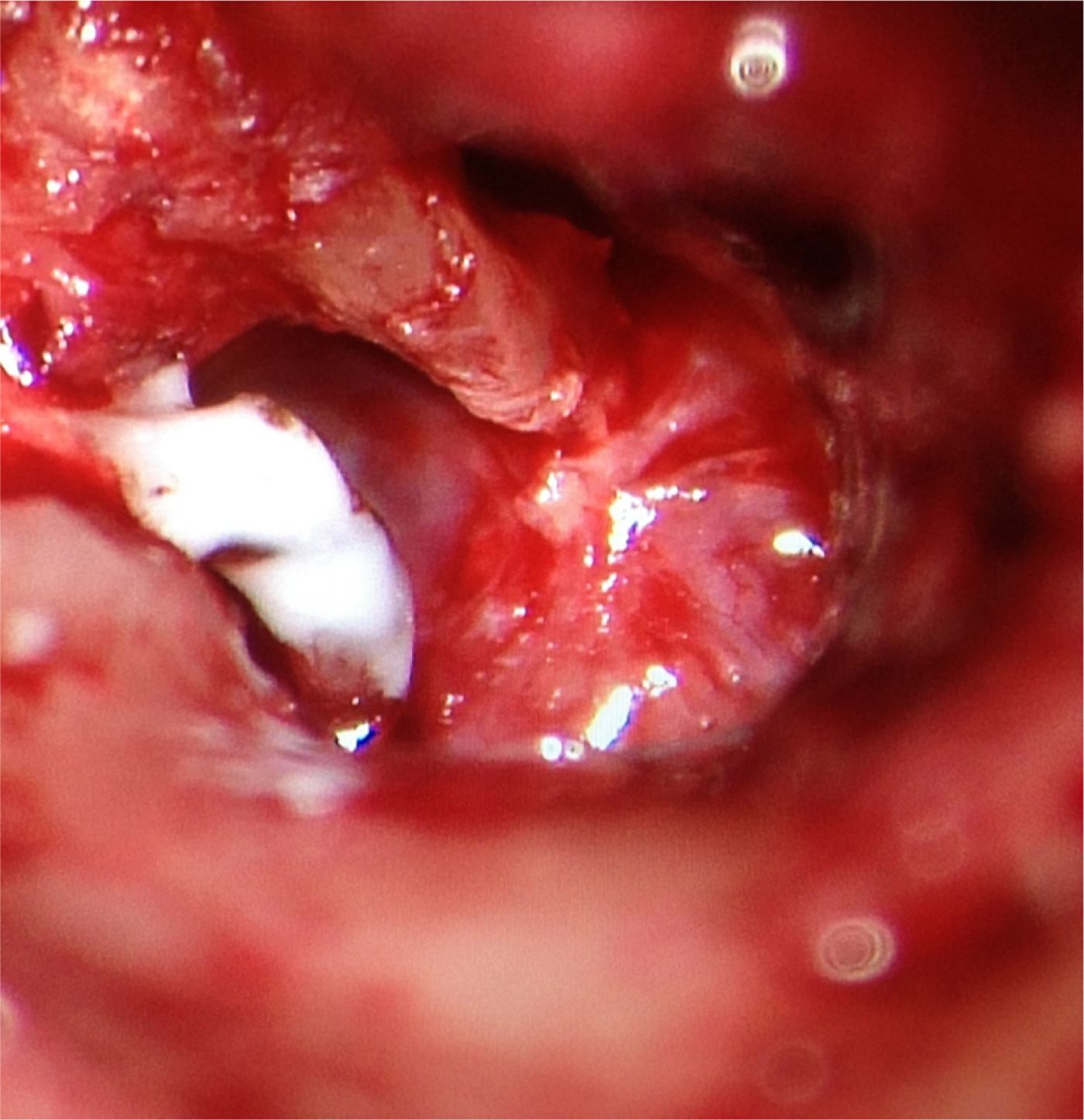
Glass ionomer bone cement is composed of a formulated powder and a dissolving liquid; these were stored separately in sterile bottles. A small amount of powder and a few drops of liquid were placed on a metal plate and mixed with a curved pick for approximately 1 minute until the mixture became homogeneous. The powder to liquid ratio was adjusted to obtain a ‘muddy' mixture. Before application of the bone cement, we removed the mucosa overlying the head of the stapes and the remnant of the incus long process, together with any blood on either ossicle, in order to achieve the dry bony surfaces required for proper adherence of the glass ionomer bone cement. Small pieces of sponge were introduced into the middle-ear cavity to prevent inadvertent contamination of the middle-ear structures. The prepared cement was then introduced into the gap between the ossicles with a curved pick and left undisturbed until it hardened (Figure 1).
Operating microscope surgical photograph showing incudostapedial rebridging achieved using glass ionomer bone cement.

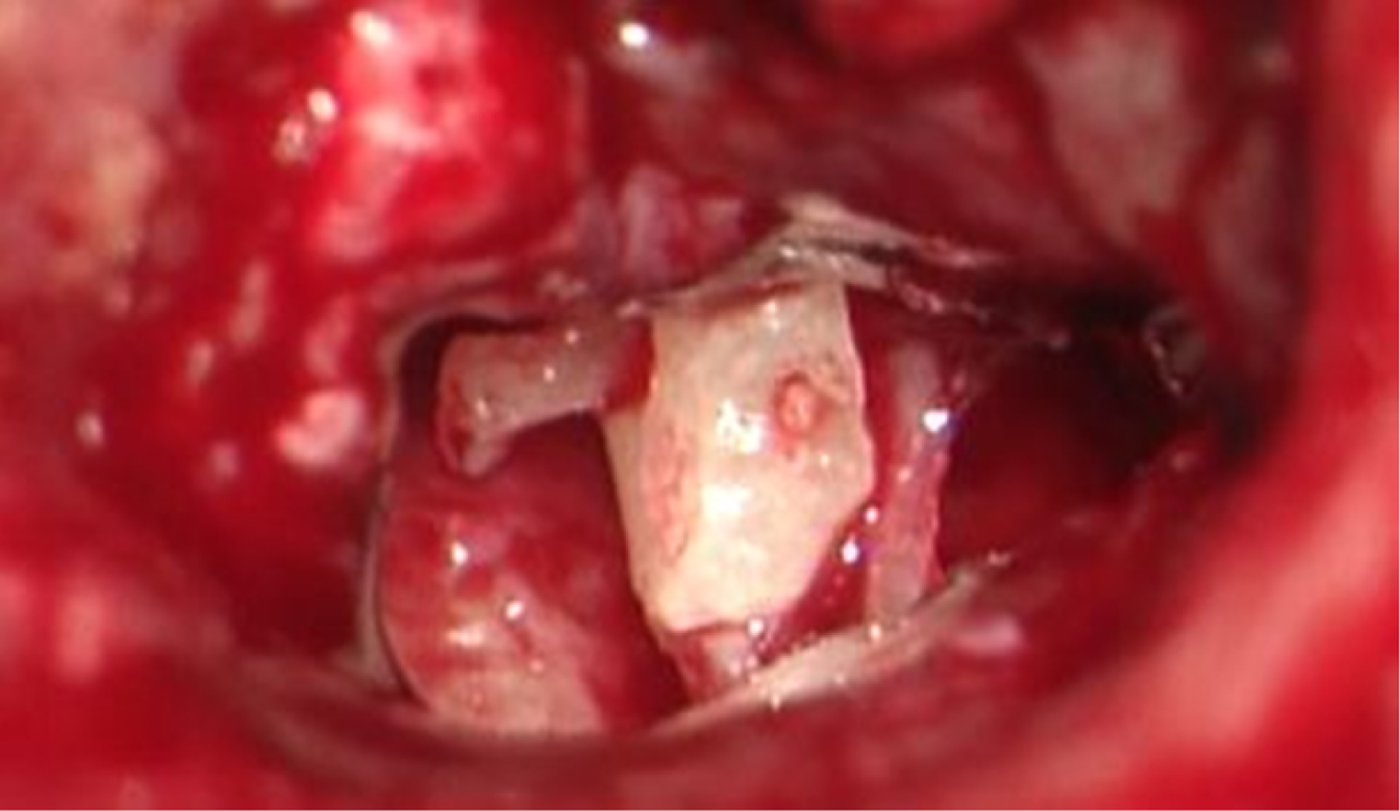
During the incus interposition procedure, the incus was removed using an angled pick. When necessary, the scutum was removed by drilling or using a curette to expose the body of the incus. Drilling was used to create a hole in the short or the long process of the incus, for the stapes head, and to create a groove in the body of the incus, for the handle of the malleus. The reshaped incus was placed between the stapes head and the malleus handle (Figure 2).
Operating microscopy surgical photograph showing placement of the reshaped incus between the malleus handle and the stapes head, during the incus interposition procedure.

For closure of the perforated tympanic membrane, temporalis muscle fascia was used as graft material in patients with chronic otitis media, and auricular cartilage was used as graft material in patients with adhesive otitis media.
Audiological evaluation was based on comparison of a pre-operative audiogram and a post-operative audiogram performed at least one year after the operation. Results for pure tone average (PTA), bone conduction threshold and air–bone gap (ABG) were recorded. The PTA was calculated using thresholds at 0.5, 1, 2 and 3 kHz. Pure tones were used to calculate the ABG and hearing gain. A post-operative ABG of less than 20 dB was used as the criterion for a successful ossiculoplasty, in accordance with the recommendation of the American Academy of Otolaryngology-Head and Neck Surgery Committee on Hearing and Equilibrium guidelines.5
The Mann–Whitney U test and paired t-test were used for statistical analysis. A p value of less than 0.05 was considered statistically significant. Results are presented as means ± standard deviations.
The study was approved by the relevant institutional ethics committee.
Results
Ninety-nine patients with incus long process defects were included in the study. Incus interposition was performed in 49 patients (group 1) and bone cement ossiculoplasty in 50 patients (group 2). Group 1 included 29 female and 20 male patients, with a mean age of 29.43 ± 12.5 years (range, 8–58 years). Group 2 comprised 32 female and 18 male patients, with a mean age of 29.1 ± 14.89 years (range 8–67 years).
The indication for surgical intervention was chronic otitis media with tympanic membrane perforation in 88 patients and adhesive otitis media with conductive hearing loss in 11 patients. Temporalis muscle fascia was used as graft material for 43 patients in group 1 and 45 patients in group 2. A composite island cartilage graft was used for six patients in group 1 and five patients in group 2. A cartilage graft was used only for patients with adhesive otitis media. Canal wall up mastoidectomy was performed on 34 patients in group 1 and 22 patients in group 2.
There were no serious complications. In a patient who had undergone bone cement ossiculoplasty, the bone cement was found to have separated from the head of the stapes on revision surgery. In another patient requiring revision surgery after bone cement ossiculoplasty, granulation tissue was encountered around the ossicles.
All patients were followed up for at least one year. The mean follow-up period was 26.13 ± 1.1 months in group 1 and 25.8 ± 1.01 months in group 2.
In group 1, the mean PTA value was 57.73 ± 14.6 dB pre-operatively and 43.71 ± 14.7 dB post-operatively. In group 2, the mean PTA value was 60.2 ± 14.3 dB pre-operatively and 40.08 ± 14.5 dB post-operatively. There was significant improvement in the mean post-operative PTA in both groups, compared with the mean pre-operative PTA (p < 0.05) (Figure 3).
Comparison of pre- and post-operative mean pure tone averages in both groups. *p < 0.05.

The mean ABG in group 1 was 37.48 ± 8.2 dB pre-operatively and 21.56 ± 7.3 dB post-operatively. The mean ABG in group 2 was 37.6 ± 9.4 dB pre-operatively and 18.32 ± 6.8 dB post-operatively. There was significant improvement in the mean post-operative ABG in both groups, compared with the mean pre-operative ABG (p < 0.05) (Figure 4).
Comparison of pre- and post-operative mean air–bone gaps in both groups. *p < 0.05.

The mean hearing gain was 15.2 ± 9.01 dB in group 1 and 19.36 ± 9.08 dB in group 2. Hearing gain was significantly greater in the bone cement group compared with the incus interposition group (p = 0.0186) (Figure 5). Successful hearing results (i.e. ABG < 20 dB) were achieved in 63.2 per cent of the group 1 patients and 78 per cent of the group 2 patients. Patients' mean follow-up times, ages and hearing results are summarised in Table I.
Comparison of mean hearing gain in both groups. *p = 0.0186.

Patient ages, follow-up periods and audiological parameters

Data represent means ± standard deviations unless otherwise specified. *p = 0.0186, group 1 vs 2. Yr = years; FU = follow-up period; mth = months; PTA = pure tone average; ABG = air–bone gap; HG = hearing gain; Pre-op = pre-operative; Post-op = post-operative
Discussion
Erosion of the incus long process is the most commonly encountered ossicular defectReference Sismanis, Glasscock and Gulya6, Reference Elsheikh, Elsherief and Elsherief7 because the incus is the most vulnerable ossicle to both trauma and infectious processes, due to its poor blood supply.Reference O'Reilly, Cass, Hirsch, Kamerer, Bernat and Poznanovic8, Reference Goycoolea, Goycoolea, Paparella and Nissen9 Incus long process defects which occur with an intact stapes and malleus can be treated either by bypassing the defect or by rebridging the ossicular gap.Reference Huttenbrink, Luers and Beutner10
There are three main types of prosthesis available for replacing or bypassing defects of the incudostapedial joint: autografts, homografts and allografts.Reference Elsheikh, Elsherief and Elsherief7, Reference O'Reilly, Cass, Hirsch, Kamerer, Bernat and Poznanovic8, Reference Yung, Hildmann and Sudhoff11
Homografts have been less frequently used for ossicular reconstruction due to the risks of transmission of infectious diseases, such as Creutzfeldt–Jakob disease, hepatitis and acquired immunodeficiency syndrome.Reference Schwager and Geyer12, Reference Glasscock, Jackson and Knox13
Allografts are biocompatible synthetic materials. Polyethylene, Teflon, porous plastics, ceramics and various metal prostheses (e.g. titanium and gold) have all been used for reconstruction of the ossicular chain.Reference Tos14 These materials are readily available and do not require shaping, but they do have several disadvantages, including higher extrusion rates, displacement, and necrosis of the part of the ossicle that is in contact with the prosthesis.Reference Somers, Van Rompaey, Claes, Salembier, van Dinther and Andrzej1, Reference O'Reilly, Cass, Hirsch, Kamerer, Bernat and Poznanovic8 Covering the surface of the prosthesis facing the tympanic membrane with a piece of cartilage may reduce the likelihood of extrusion.
Previously used autograft materials include the incus, the head of the malleus, cortical bone and cartilage. The incus is the most commonly used autograft during ossicular reconstruction.Reference Elsheikh, Elsherief and Elsherief7 Autografts work especially well in cases with an intact stapes.Reference Yung, Hildmann and Sudhoff11 Autografts have important advantages, namely lower extrusion rates, biocompatibility, low cost and no risk of disease transmission.Reference O'Reilly, Cass, Hirsch, Kamerer, Bernat and Poznanovic8, Reference Emir, Kizilkaya Kaptan, Göcmen, Uzunkulaoglu, Tuzuner and Bayiz15 However, although they have proven long-term stability, autografts have several disadvantages that may result in unfavourable hearing outcomes, including extrusion, necrosis, displacement and absorption of the graft, and bony adhesion.Reference Yung, Hildmann and Sudhoff11, Reference Nikolaou, Bourikas, Maltas and Aidonis16 In addition, it is difficult to separate the ossicular graft from the stapes head during revision surgery, and a longer operative time is required to reshape the autologous graft.
Incus interposition consists of placing a reshaped incus between the head of the stapes and the malleus manubrium.Reference Fisch17 O'Reilly et al. Reference O'Reilly, Cass, Hirsch, Kamerer, Bernat and Poznanovic8 reviewed 137 patients who had undergone autologous or homologous incus interposition; after a mean follow-up period of 15.8 months, the mean post-operative ABG was 18.6 dB, and 66.4 per cent of patients had an ABG of less than 20 dB. Mann and HoffmannReference Mann and Hoffmann18 performed incus interposition using an autograft or homograft incus in 44 patients, 75 per cent of whom achieved ABG closure of between 1 and 10 dB. Albu et al. Reference Albu, Babighian and Trabalzini19 used either an auto- or alloplastic incus to reconstruct the ossicular chain, and reported a mean ABG of 14.58 dB. Siddiq and EastReference Siddiq and East4 assessed long-term results following 24 incus transposition procedures, and found that 71 per cent of patients had a post-operative ABG of less than 20 dB. In the current study, we performed incus interposition in 49 patients, 63.2 per cent of whom had an ABG of 20 dB or less.
In a study of autologous incus interposition in 27 patients, Neudert et al. Reference Neudert, Zahnert, Lasurashvili, Bornitz, Lavcheva and Offergeld20 compared 3 different types of PORP; the mean post-operative ABG was 19.1 dB, and none of the prostheses used for ossicular reconstruction resulted in significantly better performance in terms of pre- to post-operative ABG improvement. Sanna et al. Reference Sanna, Gamoletti, Scandellari, Delogu, Magnani and Zini21 compared autologous incus versus Plastipore prostheses with or without cartilage, and found a post-operative residual ABG of less than 25 dB in 84 per cent of patients with fitted incudes, 63 per cent of patients with PORPs with cartilage, and 44 per cent of patients with PORPs without cartilage. Nikolaou et al. Reference Nikolaou, Bourikas, Maltas and Aidonis16 compared hearing results for incus transposition and for polyethylene and hydroxylapatite prostheses, and observed that 74 per cent of the incus transposition cases were successful; other prostheses showed less favourable results.
Rebridging ossiculoplasty is considered to be superior to interposition techniques because it enables preservation of both the anatomy and the physiological function of the ossicular chain.Reference Huttenbrink, Luers and Beutner10, Reference Babu and Seidman22 Various techniques have been used for rebridging ossiculoplasty, including placement of cortical bone or cartilage between the incus remnant and the stapes head,Reference Celik, Aslan Felek, Islam, Demirci, Samim and Oztuna23 use of an angular clip prosthesis,Reference Huttenbrink, Luers and Beutner10 and bone cement ossiculoplasty.Reference Bayazit, Ozer, Kanlikama, Durmaz and Yilmaz24, Reference Baglam, Karatas, Durucu, Kilic, Ozer and Mumbuc25
Bone cement ossiculoplasty has several advantages, including cost-effectiveness, maintenance of normal anatomy, easy application and satisfactory hearing results.Reference Babu and Seidman22, Reference Baglam, Karatas, Durucu, Kilic, Ozer and Mumbuc25, Reference Ozer, Bayazit, Kanlikama, Mumbuc and Ozen26
Because glass ionomer bone cement is potentially neurotoxic, contact with neural structures, perilymph or dura should be avoided.Reference Baglam, Karatas, Durucu, Kilic, Ozer and Mumbuc25, Reference Ozer, Bayazit, Kanlikama, Mumbuc and Ozen26 Contamination of the surrounding structures can be prevented by introducing small pieces of sponge prior to application of the bone cement. Reference Bayazit, Ozer, Kanlikama, Durmaz and Yilmaz24 If contamination of neural structures occurs, bone cement should be aspirated and the middle-ear cavity irrigated with serum. Reference Baglam, Karatas, Durucu, Kilic, Ozer and Mumbuc25 Subacute but eventually fatal aluminium encephalopathy has been reported after the use of aluminium-containing bone cement for bone reconstruction.Reference Reusche, Pilz, Oberascher, Lindner, Egensperger and Gloeckner27 In the present study, we used glass ionomer bone cement in 50 patients and did not encounter any serious complication.
Babu and SeidmanReference Babu and Seidman22 performed bone cement ossiculoplasty in 18 patients and achieved successful results in 17 patients. BraskReference Brask28 used glass ionomer bone cement in 22 patients with incus long process defects and reported a post-operative mean ABG of 16 dB, with an ABG of less than 20 dB in 81.3 per cent of patients. Ozer et al. Reference Ozer, Bayazit, Kanlikama, Mumbuc and Ozen26 performed incudostapedial rebridging ossiculoplasty in 15 patients, 9 of whom achieved a successful hearing result after 1 year. Celik et al. Reference Celik, Aslan Felek, Islam, Demirci, Samim and Oztuna23 compared hearing results for glass ionomer cement and for autologous cortical bone in patients with a small incudostapedial joint defect; after a mean follow up of 22.8 months, both groups had successful hearing results, with no statistically significant difference. Somers et al. Reference Somers, Van Rompaey, Claes, Salembier, van Dinther and Andrzej1 compared hearing outcomes for hydroxyapatite bone cement versus incus remodelling in patients with incudostapedial discontinuity, and observed a statistically significant difference in ABG gain at 6 and 12 months, favouring the hydroxyapatite bone cement cases. Dere et al. Reference Dere, Ozdogan, Ozcan, Selcuk, Ozcan and Gokturk29 compared glass ionomer cement and incus interposition in the reconstruction of incus long process defects, and found that the two groups were similar with respect to post-operative hearing gain. Demir et al. Reference Demir, Karaca and Basut30 compared the functional results of incus interposition and the use of bone cement, and found no statistically significant difference in functional gain between these two groups.
The present study represents one of the largest published series of patients with incus long process defects in whom incus transposition and bone cement ossiculoplasty were compared for the reconstruction of incus long process defects. Hearing gain was significantly greater in the bone cement group than in the incus interposition group. In addition, the success rate was higher for bone cement ossiculoplasty than for incus interposition. However, the success rates for both groups were comparable with rates reported in the literature.
• Incus long process defects are a frequent cause of ossicular discontinuity
• Incus interposition and bone cement ossiculoplasty are safe and reliable management methods
• Bone cement ossiculoplasty is preferable for small incudostapedial gaps, and adequate for defects up to two-thirds the length of the incus long arm
• For larger defects, incus interposition is preferred
• In appropriate cases, bone cement ossiculoplasty gives a greater hearing gain than incus interposition
Patient selection criteria for bone cement ossiculoplasty and incus interposition are extremely important to the achievement of satisfactory hearing results. Bone cement ossiculoplasty is more effective in cases with a minor defect in the long process of the incus. Because the application of bone cement in large defects may be associated with disintegration of the bridge, the use of bone cement in larger defects is not recommended. Patients who have defects less than one-third the length of the incus long arm are ideal candidates for bone cement ossiculoplasty. However, bone cement ossiculoplasty may be performed for incus defects up to two-thirds the length of the incus long arm. Following bone cement ossiculoplasty, hearing results may be reduced by any of the following: immobile stapes and/or incudomalleolar joint, tympanosclerosis, hypertrophic middle-ear mucosa, separation of bone cement from the ossicles, and granulation tissue. During one revision surgery case, we encountered granulation tissue around the ossicles. In another case, the bone cement was found to have separated from the stapes head. Bone cement ossiculoplasty has the advantage of preserving the anatomy and physiology of the ossicular chain. This may explain the better hearing results and higher success rates (i.e. ABG < 20 dB) of bone cement ossiculoplasties in the present study. In patients with a defect larger than two-thirds the length of the incus long arm and an immobile incudomalleolar joint, incus interposition would be a more appropriate choice for ossicular reconstruction. This method can result in failure in cases with a lateralised and immobile malleus. The prolonged operative time required for shaping the incus by drilling is one of the disadvantages of the incus interposition technique. In addition, the likelihood of disrupting the reconstructed ossicular system is greater in the incus interposition method.
In general, the long-term functional results of any ossicular reconstruction technique are worse than the short-term results. Persistent disease, such as cholesteatoma, atelectasis and eustachian tube dysfunction, is one of the most important factors affecting the long-term outcome of ossiculoplasty.Reference Mishiro, Sakagami, Kitahara, Kondoh and Kubo31 In addition, extrusion or absorption of prosthetic material may occur over a long period of time.Reference Yung32 Mishiro et al. Reference Mishiro, Sakagami, Kitahara, Kondoh and Kubo31 analysed the outcomes of ossiculoplasty after six months and after five years, and found a significant difference between results at these two time points. Our study included patients who had been followed regularly for at least one year post-operatively. The mean follow-up period was more than two years in both groups. Although this study had a relatively long follow-up period, longer follow up is required to confirm the reported outcomes.
Conclusion
Incudostapedial joint discontinuity is the most common ossicular chain defect encountered during middle-ear surgery. Various techniques of resolving this problem have been described. Incus interposition and bone cement ossiculoplasty are safe and reliable methods with which to manage incus long process defects. For small defects between the incus remnant and the stapes head, bone cement ossiculoplasty is the better choice because this method enables preservation of the ossicular chain, which is associated with better hearing results. For larger defects, it is difficult to construct a stable bridge between the ossicles with bone cement. The present study showed that bone cement ossiculoplasty produces greater hearing gain in appropriate cases, compared with incus interposition.