




No CrossRef data available.
Emotion understanding and theory of mind among maltreated children in foster care: Evidence of deficits
Published online by Cambridge University Press: 07 April 2005
Abstract
Children in foster care are at heightened risk for poor psychosocial outcomes. This study examined differences in two areas that may be associated with many of these outcomes, emotion understanding and theory of mind, using a sample of 3- to 5-year-old maltreated foster children (n = 60) and a comparison group of same-aged, low-income, nonmaltreated children living with their biological families (n = 31). Being in foster care was significantly associated with worse emotion understanding and theory of mind capabilities, even when accounting for age, intelligence, and executive function. There were no significant associations between length of time in foster care, number of transitions, and emotion understanding and theory of mind. Results help to expand knowledge about the cognitive and affective deficits of children in foster care and suggest that interventions targeted at these deficits include an emphasis on emotion understanding and theory of mind.
Support for this research was provided by grants from NIMH (R01 MH59780 and R01 MH65046), NIMH and Office of Research on Minority Health (P30 MH46690), and NICHD (R01 HD34511). The authors express appreciation to Lou Moses and Seth Pollak for their comments on an earlier draft of the paper, to the staff and families of the Early Intervention Foster Care project, and to Matthew Rabel for editorial assistance.
Information
- Type
- Research Article
- Information
- Copyright
- © 2005 Cambridge University Press
Maltreated children in foster care are at exceptionally high risk for poor psychosocial outcomes, including psychopathology, substance abuse, juvenile delinquency, academic failure, and problems with peer relations (Child Welfare League of America, 1997; Clausen, Landsverk, Ganger, Chadwick, & Litrownik, 1998; Klee, Kronstadt, & Zlotnick, 1997; Landsverk & Garland, 1997). Their poor prognoses may result from their maltreatment experiences being compounded with issues of separation and loss related to removal from the care of their biological parents and to subsequent relationship disruptions within the child welfare system (Eagle, 1994). Given the poor long-term outcomes observed in these children, knowledge about deficits in their cognitive and affective functioning may assist in the development of more adequate preventive interventions and psychotherapeutic treatment services.
We explored emotion understanding and theory of mind among maltreated foster children. Although numerous researchers (e.g., Camras, Sachs–Alter, & Ribordy, 1996; Rogosch, Cicchetti, & Aber, 1995) have documented deficits in emotion understanding in maltreated children, only one previous study (Cicchetti, Rogosch, Maughan, Toth, & Bruce, 2003) has shown deficits in theory of mind abilities (which involve the understanding that others may have differing perspectives, desires, and beliefs) in maltreated children. However, evidence suggests that these abilities are linked to social competence in children (Capage & Watson, 2001; Dunn & Cutting, 1999). Additionally, theory of mind and emotion understanding have been shown to be related but distinct aspects of social cognition (Cutting & Dunn, 1999; Dunn, 1995). Thus, theory of mind may have important implications for other psychosocial outcomes.
Emotion Understanding in Maltreated Children
Over the past 2 decades, many researchers have examined how maltreatment experiences affect children's emotional development. Maltreated children exhibit difficulty correctly identifying facial expressions of emotion (Camras, Grow, & Ribordy, 1983; During & McMahon, 1991), difficulty producing recognizable facial affect (Camras, Ribordy, Hill, Martino, Spaccarelli, & Stefani, 1988), and difficulty understanding emotional expressions and responding appropriately to others' affective expressions (Howes & Eldredge, 1985; Klimes–Dougan & Kistner, 1990; Main & George, 1985).
Maltreated children also appear to manifest difficulties with more complex affective processing, such as choosing appropriate emotions based on situational cues (Camras et al., 1988; Rogosch et al., 1995). More recently, Smith and Walden (1999) found that maltreated and nonmaltreated children did not differ on emotion recognition or appropriate emotion selection for a character based on contextual cues once receptive verbal abilities were controlled. Thus, they concluded that deficits in emotion knowledge were mediated by language abilities.
Pollak and colleagues (Pollak, Cicchetti, Hornung, & Reed, 2000; Pollak, Cicchetti, Klorman, & Brumaghim, 1997) have documented that particular subgroups of maltreated children may be able to discriminate some emotions more easily than other emotions. For example, Pollak et al. (2000) reasoned that children who had been physically abused would be more likely to recognize anger for two reasons. First, anger would convey information about the threat of possible harm. Second, such children were likely to have been socialized to recognize and quickly respond to negative affect. Pollak et al. (2000) found that physically abused children were as accurate at detecting anger as nonmaltreated control children but showed a more liberal bias for selecting angry faces. Neglected children, by contrast, were less accurate at emotion recognition than nonmaltreated or physically abused children.
As is noted previously, the observed deficits in maltreated children's emotion understanding can be expected to affect their concurrent and future psychosocial functioning. For example, studies have linked affect recognition and affective perspective taking to social competence (Denham, McKinley, Couchoud, & Holt, 1990; Dunn & Hughes, 1998; Garner, 1996). More specifically, maltreated children's difficulties in affective processing have been shown to negatively impact their peer relations and social functioning (Rogosch et al., 1995).
Theory of Mind in Maltreated Children
Theory of mind, which is the ability to recognize that other people may hold different ideas, desires, and beliefs that may affect their behaviors, is an important precursor to many areas of social development (Dunn, 1995; Dunn & Cutting, 1999). The ability to recognize that others may have differing desires and beliefs appears to be related to the more basic ability to understand that others may have differing perspectives (i.e., visual perspective taking; Pears & Moses, 2003). Prior research examining theory of mind in children has documented normative developmental acquisition of these capabilities, including an understanding of simple desire at about 2 years of age (Wellman & Woolley, 1990), belief at 3–4 years of age (Wellman, Cross, & Watson, 2001; Wimmer & Perner, 1983), and more advanced aspects of theory of mind beginning in middle childhood (Carpendale & Chandler, 1996). However, much of the initial work on theory of mind focused on typically developing middle-class and upper middle-class children (Cutting & Dunn, 1999) or clinical populations (e.g., children with autism; Baron–Cohen, Tager–Flusberg, & Cohen, 1994). More recent investigations have examined children from higher risk backgrounds (usually defined as lower socioeconomic status [SES]), finding that lower SES and less parental education are associated with poorer theory of mind performance (Cutting & Dunn, 1999; Hughes, Deater–Deckard, & Cutting, 1999; Pears & Moses, 2003).
There are several reasons to suspect that maltreatment might be linked to deficits in theory of mind abilities. Research has shown that the effects of power assertive parenting techniques (e.g., physical punishment, yelling, and direct commands) are negatively associated with the understanding of belief in preschool-aged children (Hughes et al., 1999; Ruffman, Perner, & Parkin, 1999) even when family background characteristics and the child's age and cognitive abilities, including language, are controlled (Pears & Moses, 2003). Power assertive practices may be ineffectual for theory of mind development because they fail to give children information about the effects of their behavior, especially effects on the thoughts and feelings of others. Abusive parenting practices, an extreme form of power assertion, might be expected to produce similar effects.
An additional source of support for the hypothesis that maltreatment is associated with deficits in theory of mind abilities can be derived from studies of intention attribution in physically abused and maltreated children. The tendency for children who have been exposed to harsh physical discipline or physical abuse to attribute hostile intent to others is well documented (Dodge, Pettit, Bates, & Valente, 1995; Weiss, Dodge, Bates, & Pettit, 1992). Dodge et al. (1995) proposed that children who have experienced harsh discipline might defensively attribute hostile intent to others even in ambiguous situations. To make an accurate attribution, a child must have some sense that others are capable of differing thoughts, feelings, and intentions (i.e., theory of mind). If children in abusive environments are best served by attributing hostile intent to others, they may not learn how to accurately attribute other intentions and beliefs.
Finally, researchers have shown that joint attention in infancy, the ability to share attentional focus with a social partner, may be a precursor of theory of mind abilities (Charman, Baron–Cohen, Swettenham, Baird, Cox, & Drew, 1995). Children who show disorganized attachment to their caregivers evidence deficits in their joint attention skills with the caregiver; for example, fewer bouts of joint attention and bouts of shorter duration (Claussen, Mundy, Mallik, & Willoughby, 2002; Scholmerich, Lamb, Leyendecker, & Fracasso, 1997). Children with maltreating caregivers often show disorganized attachment to those caregivers (Carlson, Cicchetti, Barnett, & Braunwald, 1989; Crittenden, 1988), suggesting that maltreated children might have poorer joint attention skills and, thus, eventually experience difficulties with theory of mind.
The link between maltreatment and deficits in theory of mind may operate through child–caregiver interactions, specifically attachment to the caregiver. According to Bowlby (1969), during the preschool period, a critical period for theory of mind development (Flavell, 1999), the child and caregiver should engage in a “goal-corrected” partnership. For example, in a secure relationship, the parent and child can negotiate about activities and goals. In this manner, the child should come to understand that the caregiver might have different goals, feelings, and ideas than the child. The securely attached child should also learn, with the help of the caregiver, how to successfully negotiate with others who may have different goals than him or herself. Along these same lines, Fonagy, Redfern, and Charman (1997) propose that the attachment figure helps the child develop theory of mind by acting toward the child in ways that can only be interpreted as meaning that the child has beliefs, thoughts, and ideas that guide his or her actions. This is likely to include negotiating shared goals. In support of this, caregivers of securely (vs. insecurely) attached children are more likely to describe their child in terms of mental characteristics (Meins, Fernyhough, Russell, & Clark–Carter, 1998).
The attachment relationships between children and maltreating caregivers are likely to be insecure (Carlson et al., 1989; Crittenden, 1988; Lyons–Ruth, Connell, & Zoll, 1989). Such children get little or no information about the goals, ideas, and beliefs of their attachment figures or receive extremely inconsistent, often changing, or bizarre and frightening information. Thus, the children's abilities to interpret others' thoughts, beliefs, and feelings are likely to suffer. Fonagy et al. (1997) found that, the more insecure a child's attachment was, the poorer his or her theory of mind abilities were even when age, language, and social maturity were accounted for. Similarly, Meins et al. (1998) found that attachment security at age 12 months predicted theory of mind abilities at age 4 years, with more secure attachment predicting better skills.
Only one study to date has examined potential links between theory of mind and maltreatment. Cicchetti and colleagues (Cicchetti et al., 2003) examined false belief understanding in maltreated children and in two groups of nonmaltreated children (low and middle SES). They found that, when age, language abilities, and SES were controlled, maltreated children performed significantly worse on measures of false belief than did children in the other two groups, thus supporting a link between maltreatment and theory of mind. Additionally, maltreatment occurring during the toddler period was linked to greater deficits in false belief understanding than maltreatment that occurred during other developmental periods. (The toddler period involves significant developments of internal state language and self-representation abilities, skills that may be critical to theory of mind development.) Finally, they demonstrated that physically abused children showed the greatest deficits in theory of mind abilities when age, language, and SES were controlled. This supports findings noted above that power assertive and abusive discipline might be especially detrimental to theory of mind abilities.
Like emotion understanding, theory of mind abilities have been linked to social skills in children (Capage & Watson, 2001; Dunn & Cutting, 1999). Dunn and Cutting found that theory of mind abilities were positively associated with cooperative pretend play turns and talking with friends and were negatively associated with conflict with friends and failed bids for friends' attention. Capage and Watson found that theory of mind performance was negatively associated with teacher ratings of child aggressiveness and that theory of mind was positively associated with teacher-rated social competence even when they accounted for age, language ability, and teacher ratings of aggressiveness.
Relevance of Emotion Understanding and Theory of Mind to Maltreated Children in Foster Care
The studies described above provide strong evidence of the link between maltreatment and compromised emotional development. Given this evidence, it was expected that the deficits would be as severe or greater among maltreated foster children, who have experienced separation from and loss of their primary caregivers, and perhaps multiple placements in foster care in addition to the effects of maltreatment. Separation from a primary caregiver and multiple foster care placements may be particularly salient in the development of emotion understanding and theory of mind given the importance of the caregiver–child attachment relationship. For example, emotion understanding is related to maternal emotion expression production (Daly, Abramovitch, & Pliner, 1965), to mother–child attachment (Laible & Thompson, 1998; Steele, Steele, Croft, & Fonagy, 1999), and to maternal talk about emotions (Denham, Zoller, & Couchoud, 1994; Dunn, Brown, & Beardsall, 1991). Theory of mind development has been linked to mother–child attachment (Fonagy et al., 1997; Meins et al., 1998), to the mother's ability to view her infant as capable of his or her own thoughts very early in development (Meins & Fernyhough, 1999), and to maternal use of mental state language (Ruffman, Slade, & Crowe, 2002). Given the importance of the caregiver–child relationship in the development of emotion understanding and theory of mind and the likelihood that maltreated foster children experienced less than optimal parent–child relationships in their families of origin, separation from the primary caregiver and the possibility of multiple placements may render maltreated foster children even more vulnerable to atypical emotion understanding and theory of mind development. This is not to say that these children might not benefit from features of the foster home. However, aspects of placement history, particularly those related to the potential for multiple transitions, such as number of foster care transitions experienced and length of time spent in foster care (because of the possible positive association with number of transitions and greater uncertainty about final placement), might be related to the development of these skills.
Goals of the Study
This study examined emotion understanding and theory of mind abilities in maltreated children in foster care. Previous work on emotion understanding and theory of mind in maltreated children has not examined factors related to foster care (e.g., number and duration of placements) as independent variables. In addition, consistent with the work of Pollak et al. (2000), we examined whether maltreated foster children are more sensitive to anger. A range of theory of mind abilities were also explored in these children, including visual perspective taking, desire reasoning, and belief reasoning. We hoped to build upon the work of Cicchetti et al. (2003) to clarify whether theory of mind is problematic specifically for maltreated children in foster care and to extend their work by statistically controlling for executive function abilities.
We statistically controlled for cognitive abilities and executive function abilities, as these domains have been shown to be associated with theory of mind in prior research (Smith & Walden, 1999; Carlson & Moses, 2001). Emotion understanding and theory of mind abilities have been linked to language and to general intelligence (Carlson, Moses, & Breton, 2002; Jenkins & Astington, 1996). The Vocabulary and Block Design subscales of the Wechsler Preschool and Primary Scales of Intelligence–Revised (WPPSI-R; Wechsler, 1989) were used to statistically control for intelligence. The WPPSI-R vocabulary subscale tests expressive vocabulary, a more stringent test of language than the measures of receptive language used in many other studies. Furthermore, the two subscales represent a more comprehensive test of cognitive ability than has been used in other research; language might not be the only such ability to be related to theory of mind.
Prior research has documented a positive association between tasks involving executive function, particularly inhibitory control, and successful performance on theory of mind tasks (Carlson & Moses, 2001). Tasks involving conflict between a child's prepotent response and the correct response appear to be most strongly linked to theory of mind tasks (Carlson et al., 2002). We thus included two measures of executive function that involved such conflict, a modified Stroop task (Gerstadt, Hong, & Diamond, 1994) and the Dimensional Change Card Sort (Frye, Zelazo, & Palfai, 1995). Finally, we explored whether two aspects of the foster children's placement histories (total number of days spent in care and number of transitions) were linked to their emotion understanding and theory of mind.1
We also obtained information on the child's age at first placement into foster care. However, for 73% of the sample, there was little time (M = 4 months) between their first foster care placement and the time of assessment of theory of mind and emotion understanding abilities. In these children, the age at first placement and age at assessment variables were highly confounded (r = .74, p < .001). Given that theory of mind and emotion understanding abilities develop during the preschool period and are strongly linked to age, it would be difficult, if not impossible, to disentangle the effects due to age at first placement from those of the age of the child at the assessment. Thus, this placement variable was not used in our analyses.
We had three sets of hypotheses. First, in terms of group differences on emotion understanding and theory of mind between the maltreated foster children and nonmaltreated children living with their biological families, we predicted the following: (a) maltreated foster children would show poorer emotion understanding, as indexed by emotion recognition and affective perspective taking; (b) maltreated foster children would show poorer theory of mind abilities, as indexed by visual perspective taking, desire, and belief understanding, and appearance–reality understanding; and (c) the negative association between being in foster care and emotion understanding and theory of mind would be evident even when accounting for intelligence, executive functioning, and age.
The second set of hypotheses pertained to group differences in recognizing emotions and in response biases toward certain emotions under conditions of uncertainty (i.e., when children did not know the correct answer). We hypothesized that, in an affective perspective-taking task, maltreated foster children would as accurately identify anger but would less accurately identify happiness, sadness, and fear from contextual cues than their nonmaltreated peers and that, under conditions of uncertainty, foster children would show a response bias toward anger.
The third set of hypotheses pertained to the associations between characteristics of the child's placement histories and emotion understanding and theory of mind. We hypothesized that number of days spent in foster care and number of transitions would be negatively associated with emotion understanding and theory of mind.
Method
Participants
Data were collected from two groups of children: maltreated foster children (FC; n = 60) and a community comparison (CC) group of nonmaltreated children living with their biological families (n = 31). As shown below, FC and CC samples were comparable in age and SES. For the FC sample, all children within the selected age range (3–5 years) entering new foster placements were referred to the study by the local child welfare system office. This included children who were new to the foster care system, children who were reentering foster care, and children who were being moved from a prior foster placement. At the time of the assessments, the FC children had been in their placements an average of 1.25 months (SD = 0.41).
For each FC child, placement records up until the time of entry into the study were obtained. These included the dates of the child's entry into and exit from all foster placements in the state child welfare system. From these records, the child's age at first foster placement and the total number of days spent in foster care were calculated. Number of transitions was calculated by counting the number of exits from all living situations, including foster placements. The mean age of entry into foster care was 3.39 years (SD = 1.13, range = 0.05–5.84). FC children had been in foster care for 192.93 days on average (SD = 228.53, range = 22–1,060) and had experienced an average of 3.43 transitions prior to entering the study (SD = 1.93, range = 1–8).
To verify that the FC children had been maltreated, the reason for the current foster care placement was coded from child protective services case files. The categories of reasons for foster care placement included sexual abuse, physical abuse, emotional abuse (i.e., parental rejection or witnessing domestic violence), threat of physical abuse, threat of sexual abuse, neglect, parent death, parent incarceration, abandonment, parental substance use, parent not utilizing social services, disrupted foster or adoptive placement, and “other.” Approximately, 66% of the cases were double coded, and there was high interrater reliability (κ = .89).
To reduce the number of possible categories, threat of physical abuse was coded as physical abuse, and threat of sexual abuse as sexual abuse. Further, following the guidelines of Barnett, Manly, and Cicchetti (1993) parental abandonment was coded as emotional abuse. Parental substance use and failure of the parent to utilize social services were coded as neglect. Parental substance use was coded as neglect because children were generally removed from the home only when such behavior led to neglect. In all of the cases in which parental substance use was coded, either neglect or emotional abuse was coded as well. In the two cases coded for parental incarceration, there were also histories of neglect. In the two cases coded for adoptive or foster placement disruption, the rationale for removal from biological parental care was determined from a further review of case records and was used to classify the children's maltreatment experience.
Seventeen children fell into two categories and 7 children fell into three categories. To arrive at the child's final classification, sexual abuse was coded above physical abuse, physical abuse coded above neglect, and neglect coded above emotional abuse: sexual abuse (n = 9), physical abuse (n = 9), neglect (n = 40), and emotional abuse (n = 2). Because of the small numbers of children in the maltreatment categories other than neglect, analyses based on type of maltreatment could not be conducted.
The CC children were recruited via advertisements in local newspapers and newsletters and via flyers posted at local supermarkets, daycare centers, and Head Start classrooms. Families needed to fit the following criteria for inclusion: child had lived consistently with at least one biological parent, household income was no more than $30,000, parental education level was less than a 4-year college degree, and the family had no previous involvement with child welfare services. The family's report of no child welfare services was verified via child protective records. No founded reports of abuse or neglect existed for any of the children or their families.
All children were part of a larger efficacy trial to evaluate a treatment foster care program. As the measurements discussed in this paper were taken at the initial assessment, before the intervention began, the treatment group assignments of the foster children were not considered in this paper. (No differences existed between the treatment and control foster care groups on any variable included in the current study.)
The FC and CC groups did not differ on mean child age, proportions of male and female participants, or ethnicity. The mean ages were 4.29 years (SD = 0.70 years) in the FC group and 4.40 years (SD = 0.62 years) in the CC group. Males made up 48% (n = 29) of the FC group and 45% (n = 14) of the CC group. European Americans made up 88% of the FC group and 83% of the CC group. In addition, in the FC group, 2% were African American, 5% were Latino, and 5% were Native American; and, in the CC group, 7% were African American, 7% were Native American, and 3% were Pacific Islander.
Because the foster children were no longer with their biological parents at their entry into the study, and because many children did not return to their biological parents, it was difficult to obtain demographic information about the FC children's families of origin. However, in the few cases of children returning to their biological parents (n = 14), demographic information was obtained. The gross family income, number of social services utilized (e.g., food stamps and Section 8 housing), and mean caregivers' education were compared between the FC's biological families and those of the CC children. There were no significant differences on gross income between the FC children's biological families (Mdn = $15,000–19,999) and the CC families (Mdn = $20,000–24,999) or on the number of social services utilized between the FC children's biological families (M = 3.29, SD = 1.59) and the CC families (M = 2.65, SD = 1.80). There was, however, a significant difference on the highest level of education attained by the caregivers (CC Mdn = some college or vocational school courses; FC biological families Mdn = GED), t (43) = −2.90, p < .01. Because data were not available on the highest level of education for even a majority of the biological FC caregivers, it was not possible to include this as a control variable in the analyses.
Procedure
Data were gathered in a laboratory-based setting during three visits over a 4-week interval. This assessment was part of a larger battery that was administered to participating children and their caregivers in laboratory and home settings shortly after the child enrolled in the intervention study. At the beginning of their participation in the study, the FC children had been in their placement for an average of 1 month. As is detailed below, measures for the present study included a Stroop task, an emotion understanding task, and theory of mind tasks during the first assessment. Additionally, caregivers completed a short questionnaire that was used in one portion of the emotion understanding task (detailed below). Children were administered the Block Design and Vocabulary subscales of the WPPSI-R (Wechsler, 1989) during the third assessment and the card sort task (Frye et al., 1995) during the fourth assessment. (The second assessment featured neuropsychological measures that were not used in the present study.)
Measures
Emotion understanding tasks
These tasks were adapted from Denham (1986). The emotion recognition task was divided into two parts. For the four expressive emotion recognition items, children were shown four line drawings of faces depicting happy, sad, angry, and scared emotions (taken from Denham's manual for the puppet task). The assessor pointed to each face in turn and asked, “How does s/he feel?” (matching the gender of the face to the child's gender). Children were not corrected for giving wrong answers. For the four receptive emotion recognition items, children were shown the same four faces in different positions and told to “Point to the happy face,” “Point to the mad face,” and so on. In this part of the task, children's wrong answers were corrected. Following Denham's scoring conventions, children received 2 points for every correctly answered question and 1 point if they chose the wrong face but a face with the correct emotional valence (i.e., positive for happy and negative for sad, mad, and scared).
The affective perspective-taking tasks consisted of scenes performed by three puppet characters: a main character (same gender as the child), a sibling (opposite gender of the child), and a mother. The puppets performed 16 scenes portraying various events that might provoke happiness, fear, sadness, or anger (e.g., getting an ice cream cone, seeing a big dog, being left out of an outing, or having a fight with a sibling, respectively). For the eight stereotypical stories, the main character acted out an emotion that most people would be expected to feel in the situation. The eight nonstereotypical stories consisted of a series of standard vignettes in which the main character's emotional reaction could vary. The puppets acted out a different emotion than the child would typically display to determine if the child could still accurately identify the emotion. To determine the child's typical reaction to these situations, caregivers were asked before the assessment began to indicate how their children would react to the given situations (e.g., “Please circle the emotion that your child would be most likely to display [in situation X]: Happy or Sad.”). The puppet then acted out the opposite emotion.
After each story, children were asked to choose a face that described how the puppet was feeling from among the line drawings of the faces depicting happy, sad, angry, and scared. Four different cards were used with the faces in different orders to minimize location biases. Vocal cues to emotion were stressed. The experimenter was trained not to exaggerate facial affect so as to avoid turning the task into one of simply matching the experimenter's face to the choices given. Children received 2 points if they matched the puppet's expressed emotion to the correct face and 1 point if they chose the wrong face but correctly identified the emotional valence.
Two additional scores were computed for the emotion understanding tasks: proportion correct in each emotion category and proportion of false alarms in each emotion category. Proportion correct scores were computed for each emotion by dividing the number of times that the child correctly named the emotion by the number of times that the emotion was the correct answer for the stories. False alarm scores were obtained by dividing the number of times that a child incorrectly guessed an emotion by the number of times that the emotion was not the right answer for stories. This score measured the child's tendency to guess a given emotion when uncertain about the right answer.
Theory of Mind tasks
The Theory of Mind tasks are described in the order that they were presented to the children.
Perception tasks
Two Level 1 Perspective-Taking tasks (Flavell, Botkin, Fry, Wright, & Jarvis, 1968) were utilized to assess children's understanding that two people see different things if there are differences in their physical positions or physical barriers to prevent them from seeing what the other sees. In the first task, children were shown a picture of a mouse. A piece of cardboard was then placed vertically, such that the experimenter could only see the mouse's head, and the child could only see its feet. The experimenter then asked, “Now, can you tell me what I am looking at? Am I looking at the mouse's head or at the mouse's feet? What are you looking at? The mouse's head or the mouse's feet?” The second question was a control question to determine if the child could answer correctly about his or her own perspective. If the child could not answer that question, he or she did not get credit for the test question. Thus, children received credit only if they answered both questions correctly. The second task consisted of a card with a picture of a cat on one side and a picture of an ice cream cone on the other. The child first viewed both sides of the card and then it was held so that the cat was visible only to the child and the ice cream was visible only to the experimenter. The child was told, “In this game, I am looking at a picture. See if you can tell me what picture I am looking at. Am I looking at a cat or an ice cream cone?” Children received 1 point for each correct answer.
Desire tasks
These tasks, derived from Wellman and Woolley (1990), assessed children's understanding of how fulfilled and unfulfilled desires might affect a story character's feelings. The stories described a character's search for a desired object in a particular location. In each story, the character found the object, did not find the object, or found a different object. For example, in one story, the character was looking for her dog because she wanted to take it to the park. She looked in the garage and found it. The experimenter then asked, “Does she feel happy or does she feel sad?” There were six stories, two in which the character found the desired object and so should be happy, two in which he or she did not find anything and so should be sad, and two in which he or she found another object and so should be sad. The stories were accompanied by drawings in a book in which flaps could be opened so that the children could see whether the character found the desired object. The characters in the desire stories (and in the belief stories described below) matched the child's sex. For each correct answer, children received 1 point.
Belief tasks
These included discrepant belief tasks. For the three discrepant belief tasks (Wellman & Bartsch, 1988), illustrations depicted identical objects in two different locations. For example, in one story, children were shown and told that there were bananas in a cupboard and bananas in a refrigerator. Then a character who wanted bananas but thought that they were only in the cupboard was introduced. Children were asked, “Where will Jimmy look for a banana?” followed by, “Are there bananas in the (location that the child did not indicate), too?” If children answered the second question incorrectly, they failed the task because that would indicate that they did not realize that there were bananas in both locations.2
There were also four explicit false belief tasks (Siegal & Beattie, 1991; Wellman & Bartsch, 1988) included in the measurement battery. However, a preliminary examination of the theory of mind measures indicated that the mean performance for both the FC (M = 1.08, SD = 1.37) and CC groups (M = 1.20, SD = 1.30) was below chance performance on explicit false belief (total possible score = 4); thus, they were excluded from the analyses reported here. When the analyses were run with the explicit false belief tasks as part of the theory of mind composite, the patterns of significant results did not differ from those reported here.
Appearance–Reality task
In this task (Flavell, Flavell, & Green, 1983), children were shown a sponge that was designed to look like a rock. They were asked to look at the sponge-rock for 30 s. Then they were given the sponge-rock and allowed to hold it for 1 min. The experimenter took the sponge-rock away and placed it so the child could see, but not touch, it. The child was then asked, “When you first saw this, before you touched or squeezed it, what did you think it was? Did you think it was a rock or did you think it was a sponge?” The child was then asked, “What does this look like? Does it look like a rock or does it look like a sponge?” Finally, they were asked, “What is this really? Is it really a rock or is it really a sponge?” For the appearance–reality score, children received 1 point only if they answered both the appearance question and the reality question correctly.
WPPSI-R Block Design and Vocabulary subscales
These tasks are considered to be the strongest of the performance and verbal subscales, respectively, because they correlate most highly with other measures of general intelligence (Wechsler, 1989). The average reliabilities for Block Design and Vocabulary given in the WPPSI-R manual are α = .85 and .84, respectively (Wechsler, 1989).
Executive function tasks.
Stroop task
In this modified Stroop task developed by Gerstadt et al. (1994), two types of cards were used. The “sun” cards featured a line drawing of a sun on a white background, and the “moon” cards featured a white moon and stars on a black background. Children were instructed to say “night” whenever they saw a sun card and “day” whenever they saw a moon card. After giving the instructions, the assessor completed a practice trial with the child. If the child did not give the correct answer to both cards, another practice trial was given. The assessor then administered 16 test trials. The cards were presented in a pseudorandom sequence (Gerstadt et al., 1994). Children received 1 point for each correct answer.
Card sort
This task was based on that of Frye et al. (1995). Children were asked to sort a series of cards according to the shape depicted on the card or to the color of the shape. They sorted first according to one criterion and then according to another criterion (thus having to inhibit their tendency to respond according to the first criterion). Children were shown two containers, one with a picture of a red circle attached and the other with a picture of a blue triangle. The assessor then showed the children a stack of cards, each featuring one of the following figures: a red circle, blue circle, red triangle, or blue triangle. For the preswitch trials, children were told that they were going to play the shape game and that they needed to put all of the circles in the container with the picture of the circle and all of the triangles in the container with the picture of the triangle. The assessor then handed the child one card at a time. Prior to giving the child the card, the assessor repeated the rule and, after the child placed each card in a container, gave feedback. Children had to correctly complete five consecutive trials before completing the postswitch trials. For the postswitch trials, children were told that they were going to play the color game and that they needed to put all of the red shapes into the container with the red circle and all of the blue shapes into the container with the blue triangle. The assessor repeated the rule before handing each card to the child but did not provide any feedback on performance. For two of the postswitch trials, the cards were compatible with the rules for the preswitch trials (i.e., a red circle and a blue triangle); for three of the trials, they were not (i.e., red triangle or blue circle). The mean score correct for the incompatible trials was used as the critical score for the card sort task.
Results
The results are presented as follows: descriptive analyses and data reduction for the emotion understanding and theory of mind tasks, analyses of the associations between foster care status and performance on the emotion understanding and theory of mind tasks, group differences in the ability to correctly identify and in the tendency to guess specific emotions, and associations between child placement history and emotion understanding and theory of mind. Different group sizes across data analyses reflect limited missing data that resulted from scheduling difficulties and other logistical problems.3
There were 10 sibling pairs in the study: 7 in the FC group and 3 in the CC group. When analyses were run without the oldest sibling in a pair, the patterns of significant results did not vary from those reported here. Thus, to avoid reducing sample size (and statistical power), data from sibling participants were retained in the analyses.
Descriptive analyses and data reduction
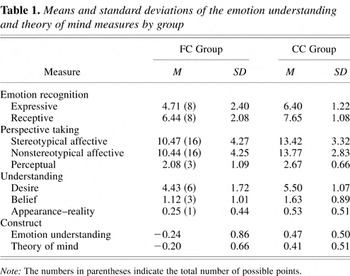
The means and standard deviations for all of the individual emotion understanding and theory of mind measures for each group are presented in Table 1. To group the theoretically similar measures together and to reduce redundancy in the measurement, constructs were created using the individual emotion understanding and theory of mind measures. In building these constructs, the general strategy described by Patterson and Bank (1986) was utilized and two criteria were used: (a) items included in the scale had to show acceptable internal consistency (i.e., α = .60, item-total correlation = .20, p < .05), and (b) a scale had to converge with other indicators designed to assess the same construct (i.e., the factor loading for a one-factor solution had to be .30 or higher).
Means and standard deviations of the emotion understanding and theory of mind measures by group

For the emotion understanding construct, the expressive and receptive emotion recognition and stereotypical and nonstereotypical affective perspective-taking scores were combined. The standardized alpha for the construct was .84. The indicators had item-total correlations ranging from .57 to .79, and all loaded on a single factor with loadings ranging from .75 to .87. To create the construct, the scores on each measure were standardized and averaged.
For the theory of mind construct, the measures of perceptual perspective taking, desire understanding, belief understanding, and understanding of appearance–reality were combined. The standardized alpha for the construct was .58, slightly below the criterion of .60. However, all of the measures showed total-item correlations above .20 (range = .22–.53) and all loaded on a single factor with loadings ranging from .42 to .84. Because the construct met these criteria and because the individual measures were all theoretically associated, the individual measure scores were standardized and then averaged to produce an overall construct score.
Associations between foster care status, emotion understanding, and theory of mind
Next, analyses were conducted to examine the association between foster care status and emotion understanding and theory of mind. It was hypothesized that emotion understanding and theory of mind would be negatively associated with foster care status even when age, intelligence, and executive function were controlled. Descriptive information on the associations between the measures is followed by regression analyses. Age was included in analyses to account for possible differences in emotion understanding and theory of mind resulting from maturation.
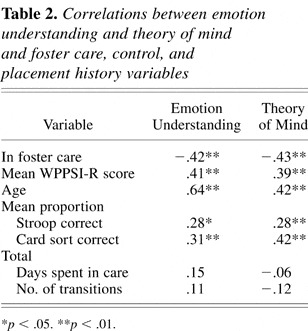
The correlations between the emotion understanding and theory of mind scores and foster care status (dummy coded so that a score of 1 indicated membership in the FC group), intelligence, age, and executive function scores are presented in Table 2. Being in the FC group was moderately negatively associated with emotion understanding and theory of mind. Each child's mean WPPSI-R score was significantly positively associated with emotion understanding and theory of mind, as was the child's age. The Stroop and the card sort scores were significantly positively correlated with emotion understanding and theory of mind.
Correlations between emotion understanding and theory of mind and foster care, control, and placement history variables

Regression analyses
Two hierarchical regression analyses were conducted, one with emotion understanding as the dependent variable and one with theory of mind understanding as the dependent variable. For both regressions, mean WPPSI-R score, age, mean Stroop score, and mean card sort score were entered into the equation in the first step. In the second step, foster care status was entered to determine if this explained additional variance above that explained by the control variables. Although the two executive function tasks were conceptually similar, they were only weakly correlated (r = .16, p = .13). Thus, although it had been planned to combine the two scores into one executive function composite, the two scores remained separate in the analyses.
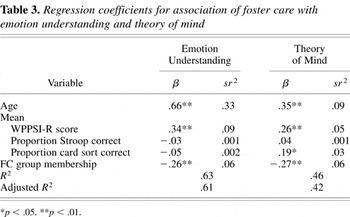
The first step of the regression equation for emotion understanding was significant, F (4, 79) = 26.98, p < .001. When foster care status was added to the equation in the second step, the overall equation was again significant, F (5, 78) = 26.85, p < .001. There was a significant change in R2 with the addition of foster care status (ΔR2 = .06, p < .01). The standardized regression weights and the squared semipartial correlations for the predictors and the R2 and the adjusted R2 for the final step of this analysis (and that of the analysis for theory of mind) are presented in Table 3. Consistent with the hypotheses, foster care involvement was significantly negatively related to emotion understanding even after WPPSI-R score, age, and executive function performance were included in the analysis. WPPSI-R score and age were significantly positively related to emotion understanding; performance on the Stroop task and card sort was not.
Regression coefficients for association of foster care with emotion understanding and theory of mind

The first step of the theory of mind regression equation was significant, F (4, 80) = 12.97, p < .001. The addition of foster care status resulted in a significant increase in R2 (ΔR2 = .06, p < .01) and a significant overall equation, F (5, 79) = 13.22, p < .001. In the final step of the regression, foster care involvement was significantly negatively related to theory of mind. WPPSI-R score and age were significant predictors. Again, although significantly related to theory of mind in the correlations, the Stroop task score was not a significant predictor. However, the card sort score was a significant predictor.
Group differences on proportion correct and false alarm scores in emotion categories
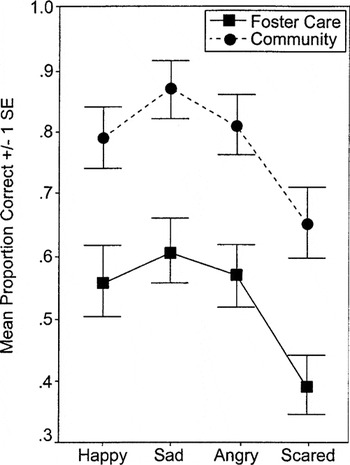
It was hypothesized that FC children would correctly identify a smaller proportion of happy, sad, and fearful emotions (but an equal proportion of angry emotions) from contextual cues than the CC children. Additionally, FC children were expected to show a response bias toward guessing anger, that is, more false alarms for anger, but not toward guessing the other emotions. To determine if there were group differences in proportion correct scores and proportion false alarms in each emotion, repeated-measures analyses of covariance (ANCOVAs) were run. For the first ANCOVA, the within-subjects factor included the proportions of times that the child correctly named happy, sad, angry, and scared. Group was the independent variable, and age, WPPSI-R score, Stroop task score, and card sort score were covariates. Because the assumption of sphericity was not met for this analysis, all probability levels were adjusted using the Huynh–Feldt adjustment. There was no interaction between group and proportion correct on any emotion, indicating that neither group was better at correctly identifying any emotion above the others. There was, however, a significant between-subjects effect for group, F (1, 76) = 8.84, p < .01. As is shown in Figure 1, over all of the emotions, the CC group scored higher than did the FC group. Age and WPPSI-R scores were significant covariates in the analysis, whereas the Stroop task and card sort scores were not.

The mean proportion correct for each Emotion × Group.
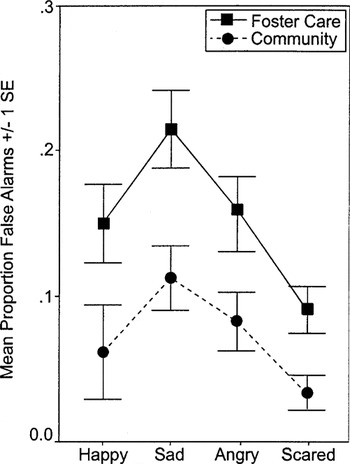
A second repeated-measures ANCOVA was performed to test whether there were group differences in the proportions of times that children guessed each emotion when it was not the correct answer. The proportions of false alarms in each emotion category were the levels of the within-subjects factor. Group served as the independent variable, and age, WPPSI-R score, Stroop task score, and card sort score served as covariates. Once again, the assumption of sphericity was not met, and all probability levels were adjusted using the Huynh–Feldt adjustment. Results indicated that there was a marginally significant within-subjects effect for emotion, F (3, 309) = 2.61, p = .06. Bonferroni post hoc analyses indicated that the false alarm rate for scared (M = 0.07, SD = 0.10) was less than that for sad (M = 0.18, SD = 0.17) or angry (M = 0.14, SD = 0.17).
There was also a between-subjects effect for group status, F (1, 76) = 8.29, p < .01. As is shown in Figure 2, the FC children uniformly had more false alarms than did the CC children. The lack of an interaction between false alarm scores and group indicates that, contrary to hypotheses, the FC children did not show a greater tendency than the CC to assume anger. Age and WPPSI-R score were, as expected, significant covariates in the analysis.

The mean proportion of false alarms for each Emotion × Group.
Associations between emotion understanding, theory of mind, and foster care placement history
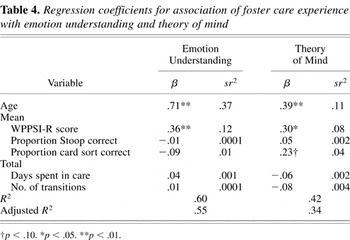
It was hypothesized that the greater the number of days spent in foster care and the greater the number of transitions that a child experienced, the poorer his or her emotion understanding and theory of mind would be. As is shown in Table 2 (shown previously), in correlational analyses, these variables were not significantly associated with emotion understanding and theory of mind. To determine whether these associations changed when age, intelligence, and executive function were controlled, two hierarchical regressions were performed. Emotion understanding and theory of mind served as dependent variables in two separate equations. The child's age at the assessment, and WPPSI-R, Stroop task, and card sort scores were entered into the equation at the first step of the analysis. The number of days that the child had spent in foster care prior to the study and the number of transitions that the child had experienced were entered in the second step of the analysis. The final overall equations for emotion understanding, F (6, 46) = 11.42, p < .01, and theory of mind, F (6, 48) = 5.68, p < .001, were significant. However, the inclusion of the placement variables did not explain any additional variance after the control variables had been accounted for. The standardized regression weights and the squared semipartial correlations for the predictors and the R2 and the adjusted R2 for the final step of both analyses are presented in Table 4. Only age at assessment and WPPSI-R score significantly predicted emotion understanding and theory of mind. (The card sort score was a marginally significant predictor of theory of mind.)
Regression coefficients for association of foster care experience with emotion understanding and theory of mind

Discussion
This study of emotion understanding and theory of mind in maltreated preschool children in foster care had two primary goals: (a) to determine if there were differences in emotion understanding and theory of mind between maltreated foster children and nonmaltreated children living with their biological families, and (b) to explore whether there were group differences in accuracy and in the tendency to guess one emotion above the others when uncertain. Additionally, the associations between emotion understanding, theory of mind, and two aspects of the foster care children's placement histories were explored.
In regard to the first goal, there were significant differences between groups on emotion understanding and theory of mind. Additionally, being in foster care was negatively associated with these abilities even when age, WPPSI-R scores, and executive function were controlled. The finding that being in foster care is negatively associated with emotion understanding is in line with previous work showing that maltreated children (in general) have difficulty selecting appropriate emotions when they are given contextual cues for those emotions (Rogosch et al., 1995; Smith & Walden, 1999). Results reported here extend the prior research by examining these skills specifically in maltreated foster children. As is noted previously, these children have experienced the added stress of removal from primary caregivers and multiple living transitions (three on average). Our results suggest that the deficits demonstrated by maltreated children in general are similar to those in the maltreated foster care population.
Only one prior study has examined the effects of maltreatment on theory of mind (Cicchetti et al., 2003); it was found that maltreated children living with their families evidenced poorer false belief understanding than did nonmaltreated low and middle SES children. The current study built upon the prior study by examining a wider range of theory of mind skills in maltreated children in foster care. When compared to a group of nonmaltreated children living with their biological families, the maltreated foster children exhibited deficits across a range of related abilities. As with emotion understanding, the negative association between foster care status and theory of mind remained even when two sets of skills that have been related to theory of mind (cognitive ability and executive function) were controlled.
That deficits in emotion understanding remain apparent even after intelligence and inhibitory control are accounted for is in contrast to the work of Smith and Walden (1999), which demonstrated that the effects of maltreatment status on emotion understanding were mediated by children's receptive language scores. In that study, the children in the maltreated group had a record of past maltreatment but were not in foster care. It is possible that, for children who have experienced maltreatment but not the disruptions attendant with foster care, delays in emotion understanding are more closely linked to delays in language. Against such an explanation, however, our findings agree with those from studies of the recognition of facial expressions of emotions, in which maltreated children show poorer recognition of emotions even when cognitive ability is controlled (e.g., Rogosch et al., 1995).
The second goal of the study was to explore the possibility that maltreated foster children were more sensitive to the emotion of anger. This did not prove to be the case. Rather, maltreated foster children's deficits in emotion understanding appear to be pervasive. They are neither selectively better at recognizing anger above the other emotions nor more likely to guess anger under conditions of uncertainty. This is not completely consistent with the Pollak et al. (2000) finding that physically abused children show a bias toward guessing anger when they are uncertain. However, the majority of the children in this study had a history of neglect, and Pollak et al. found that neglected children performed worse than either physically abused or nonmaltreated children at identifying emotions overall. Unfortunately, the small numbers of children who had experienced physical abuse in the study precluded testing the maltreatment groups individually.
The third goal of the study was to explore the possibility that foster care placement histories (as measured by time spent in foster care and number of transitions) influenced emotion understanding and theory of mind. Neither placement variable was significantly associated with emotion understanding or theory of mind, which suggests that the experience of maltreatment may have the most significant impact on the development of these skills. The majority of these children experienced neglect during the preschool years, when such skills are developing. Children who have been neglected are unlikely to have interacted with adults who talk to them using “mind-minded” language or who engage in negotiations that would allow the children to understand that people can have different points of view. As is noted in the introduction, such parent behaviors have been linked to better theory of mind understanding in children. However, the lack of a relationship between the placement variables and emotion understanding and theory of mind does not eliminate the possibility that the experience of separation or multiple placement changes affects the development of these skills. Directions for future research that could further explore this question are suggested below.
Several limitations to the current study should be noted. First, the sample was quite specific in that it included only maltreated children who had been removed from their homes. Thus, the results may not be completely generalizable to all maltreated children. However, as noted above, the results are consistent with prior work showing deficits in theory of mind in maltreated children living with their biological families (Cicchetti et al., 2003). Second, although the limited available data on the biological families of the foster children indicated that there were no income differences between the maltreated foster children and the community comparison children, there were differences in caregiver education. Other researchers (e.g., Cutting & Dunn, 1999; Pears & Moses, 2003) have found that higher maternal education is associated with better theory of mind and emotion understanding in children. Thus, some of the negative association between foster care and these skills could result from lower levels of education in the foster children's families of origin. Unfortunately, because data were not available on all of the foster children's biological families, the demographic variables could not be controlled in the analyses. Finally, because the groups of children who had experienced maltreatment other than neglect were too small, it was not possible to examine the effects of specific types of maltreatment on emotion understanding and theory of mind.
Directions for Future Research
This study has established that children in foster care show deficits in emotion understanding and in theory of mind. Because the placement into foster care was inherently tied to maltreatment, it is not possible to determine how much of the negative effect of foster care status on emotion understanding and theory of mind results from maltreatment (vs. separation from their primary caregivers or multiple placements). Future research could examine the specific effects of maltreatment and separation using a sample of children who experience multiple separations but little maltreatment: for example, children removed from their biological parents at birth. These children are unlikely to have been maltreated but may have multiple foster care placements. Studies should also attempt to compare maltreated children in foster care with children who have not been removed from their maltreating families, as patterns of deficits might differ by group. It is also possible that maltreated children who remain in their families are more hypervigilant to anger than children who have been removed from such families.
Additionally, future work should focus on delineating whether different types of maltreatment produce different deficits in theory of mind, as evidence indicates that type of maltreatment might affect emotion recognition (Pollak et al., 2000). The work of Cicchetti and colleagues (2003) suggests that children who have experienced physical abuse evidence the greatest deficits in false belief understanding. Further work in the area of how atypical rearing conditions affect the development of emotion understanding and theory of mind could reveal much about the necessary conditions for typical development of these abilities.
Finally, future research should focus on foster care conditions that might moderate the effects of maltreatment and relationship disruptions on the development of children's emotion understanding and theory of mind. Although this study suggested that time in foster care and the number of placements were not associated with emotion understanding and theory of mind, foster caregiver qualities and the caregiving environment might impact these skills. For example, children who are placed in foster families in which there is more emotional expressiveness might show greater emotion understanding skills than children in less expressive families (Dunn et al., 1991). Additionally, children who form more secure attachments to their foster caregivers might develop better emotion understanding and theory of mind.
Overall, this study demonstrated that there are deficits in maltreated foster children's emotion understanding and theory of mind compared to nonmaltreated children in the care of their biological families. These difficulties appear to be independent of other deficits in cognitive ability and executive function. The results of this study have clear implications for interventions with preschoolers in foster care. As the deficits in emotion understanding and theory of mind do not appear to result wholly from delays in intelligence or inhibitory control, remediation efforts may need to be specific to these skills. Thus, interventions should focus on helping children to learn cues to emotions. Additionally, intervention efforts could help children learn that different people might have different thoughts and beliefs. Such interventions may help to prevent later difficulties with peer relations and peer rejection for children who have already experienced multiple relationship disruptions.
References
REFERENCES
Barnett, D.,
Manly, J. T., &
Cicchetti, D.
(1993).
Defining child maltreatment: The interface between policy and
research.
In
D. Cicchetti &
S. Toth (Eds.),
Child abuse, child development, and social policy
(Vol. 8, pp.
7–73).
Norwood, NJ:
Ablex.
Baron–Cohen, S.,
Tager–Flusberg, H., &
Cohen, D. J.
(1994).
Understanding other minds: Perspectives from autism.
Oxford:
Oxford University Press.
Bowlby, J.
(1969).
Attachment and loss: Vol 1. Attachment.
New York:
Basic Books.
Camras, L. A.,
Grow, G., &
Ribordy, S.
(1983).
Recognition of emotional expression by abused children.
Journal of Clinical Child Psychology
12,
325–328.Google Scholar
Camras, L. A.,
Ribordy, S.,
Hill, J.,
Martino, S.,
Spaccarelli, S., &
Stefani, R.
(1988).
Recognition and posing of emotional expressions by abused children
and their mothers.
Developmental Psychology
24,
776–781.Google Scholar
Camras, L. A.,
Sachs–Alter, E., &
Ribordy, S. C.
(1996).
Emotion understanding in maltreated children: Recognition of facial
expressions and integration with other emotion cues.
In
M. Lewis &
M. W. Sullivan (Eds.),
Emotional development in atypical children (pp.
203–225).
Mahwah, NJ:
Erlbaum.
Capage, L., &
Watson, A. C.
(2001).
Individual differences in theory of mind, aggressive behavior, and
social skills in young children.
Early Education and Development
12,
614–628.Google Scholar
Carlson, S. M., &
Moses, L. J.
(2001).
Individual differences in inhibitory control and children's
theory of mind.
Child Development
72,
1032–1053.Google Scholar
Carlson, S. M.,
Moses, L. J., &
Breton, C.
(2002).
How specific is the relation between executive function and theory
of mind? Contributions of inhibitory control and working memory.
Infant and Child Development
11,
73–92.Google Scholar
Carlson, V.,
Cicchetti, D.,
Barnett, D., &
Braunwald, K.
(1989).
Disorganized/disoriented attachment relationships in maltreated
infants.
Developmental Psychology
25,
525–531.Google Scholar
Carpendale, J. I., &
Chandler, M. J.
(1996).
On the distinction between false belief understanding and
subscribing to an interpretive theory of mind.
Child Development
67,
1686–1706.Google Scholar
Charman, T.,
Baron–Cohen, S.,
Swettenham, J.,
Baird, G.,
Cox, A., &
Drew, A.
(1995).
Testing joint attention, imitation, and play as infancy precursors
to language and theory of mind.
Cognitive Development
15,
481–498.Google Scholar
Child Welfare League of America.
(1997).
Alcohol and other drug survey of state child welfare
agencies.
Washington, DC:
Author.
Cicchetti, D.,
Rogosch, F. A.,
Maughan, A.,
Toth, S. L., &
Bruce, J.
(2003).
False belief understanding in maltreated children.
Development and Psychopathology
15,
1067–1091.Google Scholar
Clausen, J. M.,
Landsverk, J.,
Ganger, W.,
Chadwick, D., &
Litrownik, A.
(1998).
Mental health problems of children in foster care.
Journal of Child and Family Studies
7,
283–296.Google Scholar
Claussen, A. H.,
Mundy, P. C.,
Mallik, S. A., &
Willoughby, J. C.
(2002).
Joint attention and disorganized attachment status in infants at
risk.
Development and Psychopathology
14,
279–291.Google Scholar
Crittenden, P. M.
(1988).
Distorted patterns of relationship in maltreating families: The role
of internal representation models.
Journal of Reproductive and Infant Psychology
6,
183–199.Google Scholar
Cutting, A. L., &
Dunn, J.
(1999).
Theory of mind, emotion understanding, language, and family
background: Individual differences and interrelations.
Child Development
70,
853–865.Google Scholar
Daly, E.,
Abramovitch, R., &
Pliner, P.
(1965).
The relationship between mothers' encoding and their
children's decoding of facial expressions of emotion.
Merrill–Palmer Quarterly
26,
25–33.Google Scholar
Denham, S. A.
(1986).
Social cognition, prosocial behaviors, and emotion in preschoolers:
Contextual validation.
Child Development
57,
194–201.Google Scholar
Denham, S. A.,
McKinley, M.,
Couchoud, E. A., &
Holt, R.
(1990).
Emotional and behavioral predictors of preschool peer
ratings.
Child Development
61,
1145–1152.Google Scholar
Denham, S. A.,
Zoller, D., &
Couchoud, E. A.
(1994).
Socialization of preschoolers' emotion understanding.
Developmental Psychology
30,
928–936.Google Scholar
Dodge, K.,
Pettit, G. S.,
Bates, J. E., &
Valente, E.
(1995).
Social information-processing patterns partially mediate the effect
of early physical abuse on later conduct problems.
Journal of Abnormal Psychology
104,
632–643.Google Scholar
Dunn, J.
(1995).
Children as psychologists: The later correlates of individual
differences in understanding of emotions and other minds.
Cognition and Emotion
9,
187–201.Google Scholar
Dunn, J.,
Brown, J., &
Beardsall, L.
(1991).
Family talk about feeling states and children's later
understanding of others' emotions.
Developmental Psychology
27,
448–455.Google Scholar
Dunn, J., &
Cutting, A. L.
(1999).
Understanding others, and individual differences in friendship
interactions in young children.
Social Development
8,
201–219.Google Scholar
Dunn, J., &
Hughes, C.
(1998).
Young children's understanding of emotions within close
relationships.
Cognition and Emotion
12,
171–190.Google Scholar
During, S., &
McMahon, R.
(1991).
Recognition of emotional facial expressions by abusive mothers and
their children.
Journal of Clinical Child Psychology
20,
132–139.Google Scholar
Eagle, R. S.
(1994).
The separation experience of children in long-term care: Theory,
research, and implications for practice.
American Journal of Orthopsychiatry
64,
421–434.Google Scholar
Flavell, J. H.
(1999).
Cognitive development: Children's knowledge about the
mind.
Annual Review of Psychology
50,
21–45.Google Scholar
Flavell, J. H.,
Botkin, P. J.,
Fry, C. L.,
Wright, J. W., &
Jarvis, P. E.
(1968).
The development of role-taking and communication skills in
children.
New York:
Wiley.
Flavell, J. H.,
Flavell, E. R., &
Green, F. L.
(1983).
Development of the appearance–reality distinction.
Cognitive Psychology
15,
95–120.Google Scholar
Fonagy, P.,
Redfern, S., &
Charman, T.
(1997).
The relationship between belief-desire reasoning and a projective
measure of attachment security (SAT).
British Journal of Developmental Psychology
15,
51–61.Google Scholar
Frye, D.,
Zelazo, P. D., &
Palfai, T.
(1995).
Theory of mind and rule-based reasoning.
Cognitive Development
10,
483–527.Google Scholar
Garner, P.
(1996).
The relations of emotional role-taking, affective/moral
attributions, and emotional display rule knowledge to low-income
school-age children's social competence.
Journal of Applied Developmental Psychology
17,
19–36.Google Scholar
Gerstadt, C. L.,
Hong, Y. J., &
Diamond, A.
(1994).
The relationship between cognition and action: Performance of
children 3-1/2–7 years old on a Stroop-like day–night
test.
Cognition
53,
129–153.Google Scholar
Howes, C., &
Eldredge, R.
(1985).
Responses of abused, neglected, and non-maltreated children to the
behavior of their peers.
Journal of Applied Developmental Psychology
6,
261–270.Google Scholar
Hughes, C.,
Deater–Deckard, K., &
Cutting, A. L.
(1999).
“Speak roughly to your little boy?” Sex differences in
the relations between parenting and preschoolers' understanding of
mind.
Social Development
8,
143–160.Google Scholar
Jenkins, J. M., &
Astington, J. W.
(1996).
Cognitive factors and family structure associated with theory of
mind development in young children.
Developmental Psychology
32,
70–78.Google Scholar
Klee, L.,
Kronstadt, D., &
Zlotnick, C.
(1997).
Foster care's youngest: A preliminary report.
American Journal of Orthopsychiatry
67,
290–299.Google Scholar
Klimes–Dougan, B., &
Kistner, J.
(1990).
Physically abused preschoolers' responses to peers'
distress.
Developmental Psychology
26,
599–602.Google Scholar
Laible, D. J., &
Thompson, R. A.
(1998).
Attachment and emotional understanding in preschool children.
Developmental Psychology
34,
1038–1045.Google Scholar
Landsverk, J., &
Garland, A. F.
(1997).
Foster care and pathways to mental health services. In
P. Curtis &
J. G. Dale (Eds.),
The foster care crisis: Translating research into practice and
policy
(pp.
193–210).
Lincoln, NE:
University of Nebraska Press.
Lyons–Ruth, K.,
Connell, D. B., &
Zoll, D.
(1989).
Patterns of maternal behavior among infants at risk for abuse:
Relations with infant attachment behavior and infant development at 12
months of age.
In
D. Cicchetti &
V. Carlson (Eds.),
Child maltreatment: Theory and research on the causes and
consequences of child abuse and neglect
(pp.
464–493).
New York:
Press Syndicate of the University of Cambridge.
Main, M., &
George, C.
(1985).
Response of abused and disadvantaged children to distress in
agemates: A study in the day care setting.
Developmental Psychology
21,
407–412.Google Scholar
Meins, E., &
Fernyhough, C.
(1999).
Linguistic acquisitional style and mentalising development: The role
of maternal mind-mindedness.
Cognitive Development
14,
363–380.Google Scholar
Meins, E.,
Fernyhough, C.,
Russell, J., &
Clark–Carter, D.
(1998).
Security of attachment as a predictor of symbolic and mentalising
abilities: A longitudinal study.
Social Development
7,
1–24.Google Scholar
Patterson, G. R., &
Bank, L.
(1986).
Bootstrapping your way in a nomological thicket.
Behavioral Assessments
8,
49–73.Google Scholar
Pears, K. C., &
Moses, L. J.
(2003).
Demographics, parenting, and theory of mind in preschoolers.
Social Development
12,
1–20.Google Scholar
Pollak, S.,
Cicchetti, D.,
Hornung, K., &
Reed, A.
(2000).
Recognizing emotion in faces: Developmental effects of child abuse
and neglect.
Developmental Psychology
36,
679–688.Google Scholar
Pollak, S.,
Cicchetti, D.,
Klorman, R., &
Brumaghim, J. T.
(1997).
Cognitive brain event-related potentials and emotion processing in
maltreated children.
Child Development
68,
773–787.Google Scholar
Rogosch, F. A.,
Cicchetti, D., &
Aber, J. L.
(1995).
The role of child maltreatment in early deviations in cognitive and
affective processing abilities and later peer relationship
problems.
Development and Psychopathology
7,
591–609.Google Scholar
Ruffman, T.,
Perner, J., &
Parkin, L.
(1999).
How parenting style affects false belief understanding.
Social Development
8,
395–411.Google Scholar
Ruffman, T.,
Slade, L., &
Crowe, E.
(2002).
The relation between children's and mother's mental state
language and theory-of-mind understanding.
Child Development
73,
734–751.Google Scholar
Scholmerich, A.,
Lamb, M. E.,
Leyendecker, B., &
Fracasso, M. P.
(1997).
Mother–infant teaching interactions and attachment security in
Euro-American and Central-American immigrant families.
Infant Behavior and Development
20,
165–174.Google Scholar
Siegal, M., &
Beattie, K.
(1991).
Where to look first for children's knowledge of false
beliefs.
Cognition
38,
1–12.Google Scholar
Smith, M., &
Walden, T.
(1999).
Understanding feelings and coping with emotional situations: A
comparison of maltreated and nonmaltreated preschoolers.
Social Development
8,
93–116.Google Scholar
Steele, H.,
Steele, M.,
Croft, C., &
Fonagy, P.
(1999).
Infant–mother attachment at one year predicts children's
understanding of mixed emotions at six years.
Social Development
8,
161–178.Google Scholar
Wechsler, D.
(1989).
Manual for the Wechsler Preschool and Primary Scales of
Intelligence–Revised.
San Antonio, TX:
Psychological Corporation.
Weiss, B.,
Dodge, K. A.,
Bates, J. E., &
Pettit, G. S.
(1992).
Some consequences of early harsh discipline: Child aggression and a
maladaptive social information processing style.
Child Development
63,
1321–1335.Google Scholar
Wellman, H. M., &
Bartsch, K.
(1988).
Young children's reasoning about beliefs.
Cognition
31,
239–277.Google Scholar
Wellman, H. M.,
Cross, D., &
Watson, J.
(2001).
Meta-analysis of theory of mind development: The truth about false
belief.
Child Development
72,
655–684.Google Scholar
Wellman, H. M., &
Woolley, J. D.
(1990).
From simple desires to ordinary beliefs: The early development of
everyday psychology.
Cognition
35,
245–275.Google Scholar
Wimmer, H., &
Perner, J.
(1983).
Beliefs about beliefs: Representation and constraining function of
wrong beliefs in young children's understanding of deception.
Cognition
13,
103–128.Google Scholar
Means and standard deviations of the emotion understanding and theory of mind measures by group
Correlations between emotion understanding and theory of mind and foster care, control, and placement history variables
Regression coefficients for association of foster care with emotion understanding and theory of mind
The mean proportion correct for each Emotion × Group.
The mean proportion of false alarms for each Emotion × Group.
Regression coefficients for association of foster care experience with emotion understanding and theory of mind
 You have
Access
- 191
- Cited by