1. Introduction
During the Ordovician to Silurian closure of the Iapetus Ocean, continental basement and overlying sediments were deformed and metamorphosed during oblique collision of the Laurentia, Baltica and Eastern Avalonia continental blocks (Soper et al. Reference Soper, Strachan, Holdsworth, Gayer and Greiling1992; Torsvik et al. Reference Torsvik, Smethurst, Meert, van der Voo, McKerrow, Brasier, Sturt and Walderhaug1996; McKerrow, MacNiocaill & Dewey, Reference McKerrow, MacNiocaill and Dewey2000; Dewey & Strachan, Reference Dewey and Strachan2003). The resulting Caledonian orogenic belt extends from Scandinavia and East Greenland, through the British Isles and beyond to the Appalachians of North America. Scotland and Ireland (within Laurentia) underwent an early orogenic phase, the Grampian arc–continent collision, with a later Silurian Baltica–Laurentia–Avalonia collision known as the Scandian event (c. 435–425 Ma) (Coward, Reference Coward, Hardman and Brooks1990). Caledonian deformation within the NW Highlands was due to this Scandian event. In the Northern Highlands of Scotland, the Caledonian belt is sharply delineated by the Moine Thrust Zone (extending from Loch Eriboll to the Sound of Iona). To the east of this feature the Caledonides comprise Neoproterozoic metasedimentary rocks of the Moine Supergroup (including the Loch Eil, East Moine and Morar groups) with some inliers of basement gneiss. To the west, Archaean gneisses of the Lewisian Gneiss Complex, overlain by unmetamorphosed Neoproterozoic and Cambro-Ordovician strata, form a stable foreland block (Johnstone & Mykura, Reference Johnstone and Mykura1989).
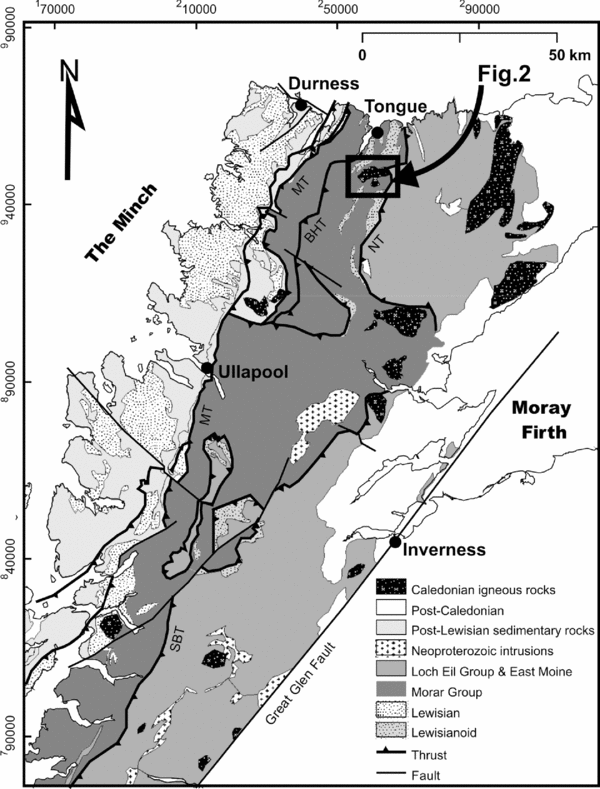
During the Scandian event, numerous magmatic intrusions were emplaced along the Moine Thrust Zone. These are predominantly alkaline in composition, and range from mafic and ultramafic early phases, to diorites and high Ba–Sr granites and syenites (Thompson & Fowler, Reference Thompson and Fowler1986; Tarney & Jones, Reference Tarney and Jones1994; Fowler & Henney, Reference Fowler and Henney1996; Fowler et al. Reference Fowler, Kocks, Darbyshire and Greenwood2008). The most northerly, and youngest, of these intrusions is the late-tectonic Loch Loyal Syenite Complex (Parsons, Reference Parsons, Stephenson, Bevins, Millward, Highton, Parsons, Stone and Wadsworth1999; Fig. 1). In this paper we present detailed mapping, petrological study and three-dimensional modelling of the Cnoc nan Cuilean intrusion, the smallest body within the Loch Loyal Syenite Complex, which has been little studied since the work of King (Reference King1942). The Cnoc nan Cuilean intrusion is of particular interest at the present time for its notably high rare earth element (REE) contents (Shaw & Gunn, Reference Shaw and Gunn1993), and our work investigates how these elements are concentrated within different zones of the intrusion. A new approach for 3D modelling of an igneous intrusion has aided interpretations of its structure, petrogenesis and REE metallogenesis.
Simplified regional geological map of NW Scotland, displaying the main faults, thrusts and Caledonian intrusions. Major thrusts include: Moine Thrust (MT), Naver Thrust (NT), Ben Hope Thrust (BHT) and the Sgurr Beag Thrust (SBT). Location of Figure 2 indicated in boxed area. Figure adapted from Goodenough et al. (Reference Goodenough, Millar, Strachan, Krabbendam and Evans2011). British National Grid coordinates (NC) provided.

2. Regional setting
The NW Highlands alkaline plutons are part of a wider suite of high Ba–Sr plutons that occur across the Northern Highlands (Tarney & Jones, Reference Tarney and Jones1994). Petrographically, these igneous complexes can be divided into a western zone (syenite-dominated complexes, e.g. Glen Dessarry, Loch Loyal, Loch Borralan and Loch Ailsh) and an eastern zone (e.g. the granite-dominated suites of Strontian, Rogart, Helmsdale, Cluanie and Strath Halladale) (Fowler et al. Reference Fowler, Kocks, Darbyshire and Greenwood2008). Of the alkaline magmas, the Loch Loyal Syenite Complex is dominated by quartz syenites, whereas the Loch Ailsh and Loch Borralan plutons show a wider range of compositions, including undersaturated syenites. It is thus likely that more than one magmatic source is represented by these plutons (Parsons, Reference Parsons1972).
Recent work on the high Ba–Sr granites and syenites of the NW Highlands has led to the recognition of the Caledonian Parental Magma Array (Fowler et al. Reference Fowler, Kocks, Darbyshire and Greenwood2008). This incorporated a range of magma sources formed by metasomatism of the mantle wedge by various fluids, including those from subducted pelagic carbonates as well as the down-going slab. Differentiation of magmatic products from the Caledonian Parental Magma Array via fractional crystallization and concurrent small magma batch assimilation ultimately led to the extensive array of intrusion compositions observed throughout this region. Minor country rock contamination is thought to have occurred throughout this process, affecting the geochemistry of individual intrusions (Fowler, Reference Fowler1988, Reference Fowler1992; Fowler et al. Reference Fowler, Kocks, Darbyshire and Greenwood2008).
The Loch Loyal Syenite Complex is part of the NW Highlands alkaline plutonic suite, comprising volumetrically small yet highly variable alkaline intrusions of Caledonian age that occur along, and on both sides of, the Moine Thrust Zone. This suite also includes intrusions at Loch Borralan and Loch Ailsh in Assynt (Johnstone & Mykura, Reference Johnstone and Mykura1989; Parsons, Reference Parsons, Stephenson, Bevins, Millward, Highton, Parsons, Stone and Wadsworth1999; Atherton & Ghani, Reference Atherton and Ghani2002; Fowler et al. Reference Fowler, Kocks, Darbyshire and Greenwood2008; Goodenough et al. Reference Goodenough, Millar, Strachan, Krabbendam and Evans2011). These magmatic events were related to the subduction of Iapetus oceanic crust below Laurentia, resulting in the production of ultramafic, mafic, granitic and syenitic magmas (Thompson & Fowler, Reference Thompson and Fowler1986; Fowler et al. Reference Fowler, Henney, Darbyshire and Greenwood2001, Reference Fowler, Kocks, Darbyshire and Greenwood2008; Atherton & Ghani, Reference Atherton and Ghani2002). Thus, there is an association between strongly alkaline magmas and a zone of active crustal shortening, rather than extension, in the NW Highlands (Goodenough, Young & Parsons, Reference Goodenough, Young and Parsons2004). This magmatism occurred during and immediately after the Scandian collisional event at 435–425 Ma (Goodenough et al. Reference Goodenough, Millar, Strachan, Krabbendam and Evans2011).
The ages of the alkaline intrusions have been used to constrain the timing of regional deformation and development of the Moine Thrust Zone (Halliday et al. Reference Halliday, Aftalion, Parsons, Dickin and Johnson1987; Goodenough et al. Reference Goodenough, Millar, Strachan, Krabbendam and Evans2011). An early magmatic pulse in the Assynt area was emplaced syntectonically at 430.7 ± 0.5 Ma, and was followed by the post-tectonic late suite of the Loch Borralan Pluton at 429.2 ± 0.5 Ma (Goodenough et al. Reference Goodenough, Millar, Strachan, Krabbendam and Evans2011). Zircons from the Cnoc nan Cuilean syenites have been dated at 426 ± 9 Ma (Halliday et al. Reference Halliday, Aftalion, Parsons, Dickin and Johnson1987), assumed to be a representative age for all Loch Loyal Syenite Complex intrusions. More recent attempts at 206Pb–238U zircon dating of Cnoc nan Cuilean have suggested an approximate age of 425 Ma. However, the majority of zircons indicate the presence of inherited age components from 1000–2500 Ma (Goodenough et al. Reference Goodenough, Millar, Strachan, Krabbendam and Evans2011). The age of the Loch Loyal Syenite Complex is thus within error of the only other post-tectonic alkaline intrusion in the NW Highlands (the late suite of the Loch Borralan Pluton).
The Loch Loyal Syenite Complex is situated in the Tongue district of NW Scotland (Holdsworth, Strachan & Alsop, Reference Holdsworth, Strachan, Alsop and British Geological Survey2001) to the east of the Moine Thrust Zone (Fig. 1). The country rocks in this area are chiefly metasedimentary rocks of the Neoproterozoic Moine Supergroup, with some inliers of amphibolite-facies basement gneiss that show similarities to the Lewisian Gneiss Complex of the Caledonian foreland and are termed ‘Lewisianoid’ (Tanner, Reference Tanner1970; Moorhouse & Moorhouse, Reference Moorhouse and Moorhouse1977). The Moine rocks of this area belong entirely to the basal Morar Group of the Moine Supergroup, and comprise greenschist- to amphibolite-facies psammites and pelites. During the Scandian orogenic event these rocks were metamorphosed, folded and thrust WNW over the Caledonian Foreland along the Moine Thrust.
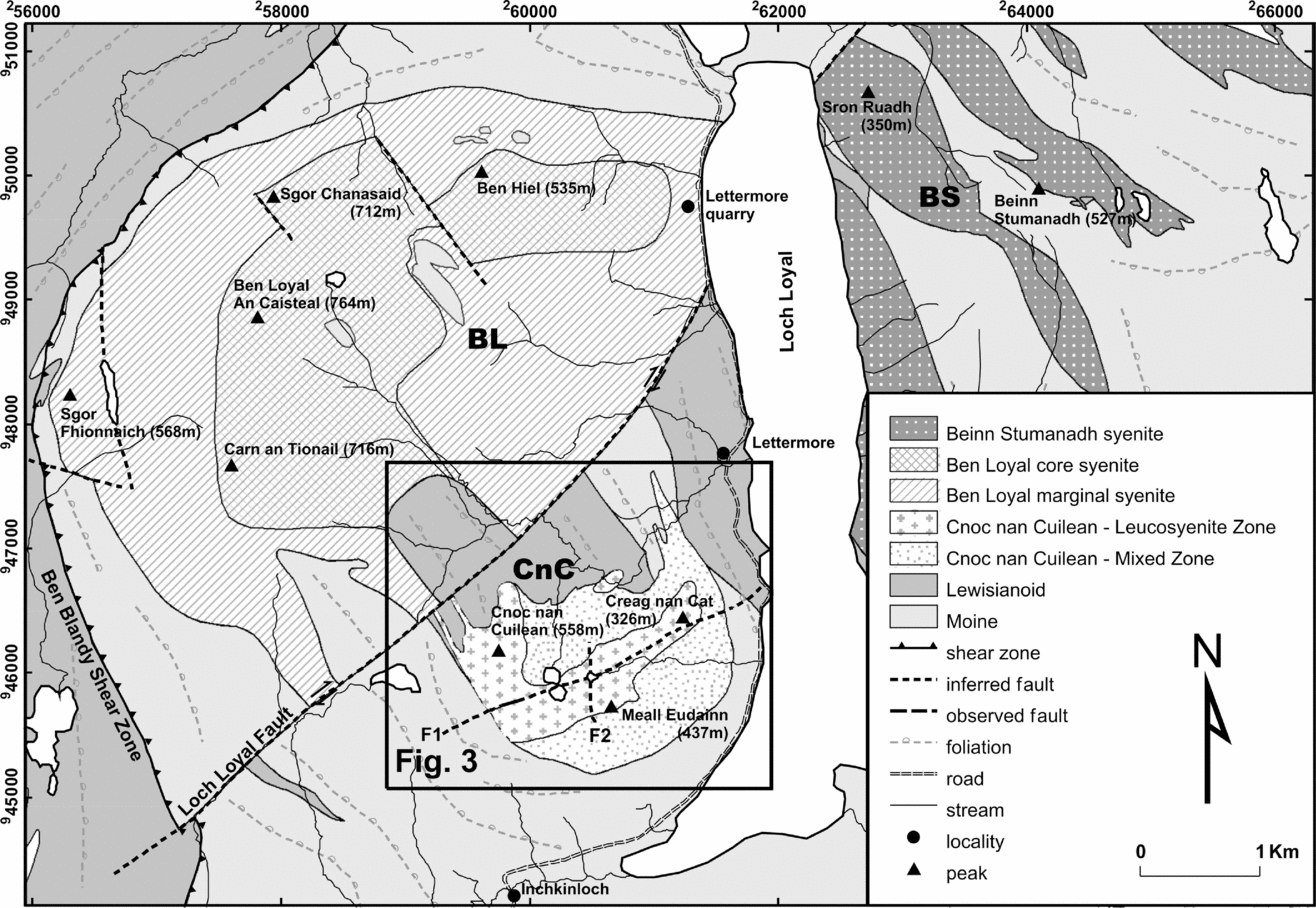
The Loch Loyal Syenite Complex consists of three syenitic masses (Fig. 2): the Ben Loyal, Cnoc nan Cuilean and Beinn Stumanadh intrusions (Read, Reference Read1931; King, Reference King1942; Robertson & Parsons, Reference Robertson and Parsons1974; Johnstone & Mykura, Reference Johnstone and Mykura1989). It represents the largest area of alkaline rocks in the UK (Parsons, Reference Parsons, Stephenson, Bevins, Millward, Highton, Parsons, Stone and Wadsworth1999). The Loch Loyal Syenite Complex lies within late Caledonian large cross-folds (Fig. 2) resulting in NW–SE-trending country rock foliation, oblique to the region's NNE–SSW orogenic strike (McErlean, Holdsworth & Stachan, Reference McErlean, Holdsworth and Strachan1992; Holdsworth, McErlean & Strachan, Reference McErlean, Holdsworth and Strachan1999). This zone of folding is underlain by the ESE-dipping Ben Blandy shear zone. There is little evidence of country rock deformation as a direct result of the syenite intrusion. However, limited top-to-the-SE extension may have occurred on the NW margin of the Ben Loyal intrusion. This indicates that the overall geometry of the Loch Loyal Syenite Complex intrusions has been controlled primarily by the pre-existing country rock structures into which they were intruded (Holdsworth, McErlean & Strachan, Reference Holdsworth, McErlean and Strachan1999). Throughout the region, Caledonian compressional features are post-dated by a series of low-angle faults, probably the result of late-orogenic extension of the Caledonian nappe pile (Holdsworth, Strachan & Alsop, Reference Holdsworth, Strachan, Alsop and British Geological Survey2001).
Geology of the Loch Loyal Syenite Complex based on King (Reference King1942), Robertson & Parsons (Reference Robertson and Parsons1974), Holdsworth, McErlean & Strachan (Reference Holdsworth, McErlean and Strachan1999), Holdsworth, Strachan & Alsop (Reference Holdsworth, Strachan, Alsop and British Geological Survey2001), published BGS 1:50000 geological maps of the area and the new mapping presented here. Three individual intrusions: Ben Loyal (BL), Beinn Stumanadh (BS) and Cnoc nan Cuilean (CnC). Faults include the Loch Loyal Fault and two faults (F1 and F2) within the Cnoc nan Cuilean intrusion. Surrounding country rock foliations are delineated from field measurements and adapted from Holdsworth, McErlean & Strachan (Reference Holdsworth, McErlean and Strachan1999). Location of Figure 3 indicated by boxed area. British National Grid coordinates (NC) provided.

The largest intrusion within the complex, Ben Loyal, is separated from the Beinn Stumanadh and Cnoc nan Cuilean intrusions by the Loch Loyal Fault, a major NE–SW-trending dextral oblique fault (Holdsworth, Strachan & Alsop, Reference Holdsworth, Strachan, Alsop and British Geological Survey2001). It has been suggested that the Ben Loyal intrusion may represent a deeper erosion level, and Beinn Stumanadh and Cnoc nan Cuilean the upper sheeted levels (Holdsworth, McErlean & Strachan, Reference Holdsworth, McErlean and Strachan1999). However, the Cnoc nan Cuilean intrusion (c. 3 km2) is significantly chemically different to the Ben Loyal syenites (Parsons, Reference Parsons, Stephenson, Bevins, Millward, Highton, Parsons, Stone and Wadsworth1999). This contrast is further accentuated by the heterogeneous nature of Cnoc nan Cuilean rocks (King, Reference King1942; Gallon, Reference Gallon1974). The shape of the intrusion has been debated in the past, with suggestions of a rounded outline (King, Reference King1942), a squat ellipsoid (Gallon, Reference Gallon1974) or a series of NW-trending dykes (Holdsworth, Strachan & Alsop, Reference Holdsworth, Strachan, Alsop and British Geological Survey2001).
Prior to this investigation, little detailed work had been carried out across the Cnoc nan Cuilean intrusion, with early study identifying essentially two broad zones. A relatively homogeneous coarse-grained massive pink syenite in the centre of the intrusion was separated from a structurally complex, heterogeneous ‘variable syenite zone’ forming the lower marginal slopes of the intrusion (King, Reference King1942). Mafic material within the mixed syenite zone was originally considered to be country rock-derived (King, Reference King1942). All syenites of this intrusion have lower normative quartz contents, higher orthoclase and are significantly richer in clinopyroxene and amphibole (Parsons, Reference Parsons, Stephenson, Bevins, Millward, Highton, Parsons, Stone and Wadsworth1999) than Ben Loyal lithologies. A significant radiometric anomaly was also discovered over the eastern flank of the intrusion owing to high concentrations of thorite (Gallagher et al. Reference Gallagher, Michie, Smith and Haynes1971). This paper presents new data arising from mapping and petrographical study of the Cnoc nan Cuilean intrusion.
3. Field relationships at Cnoc nan Cuilean
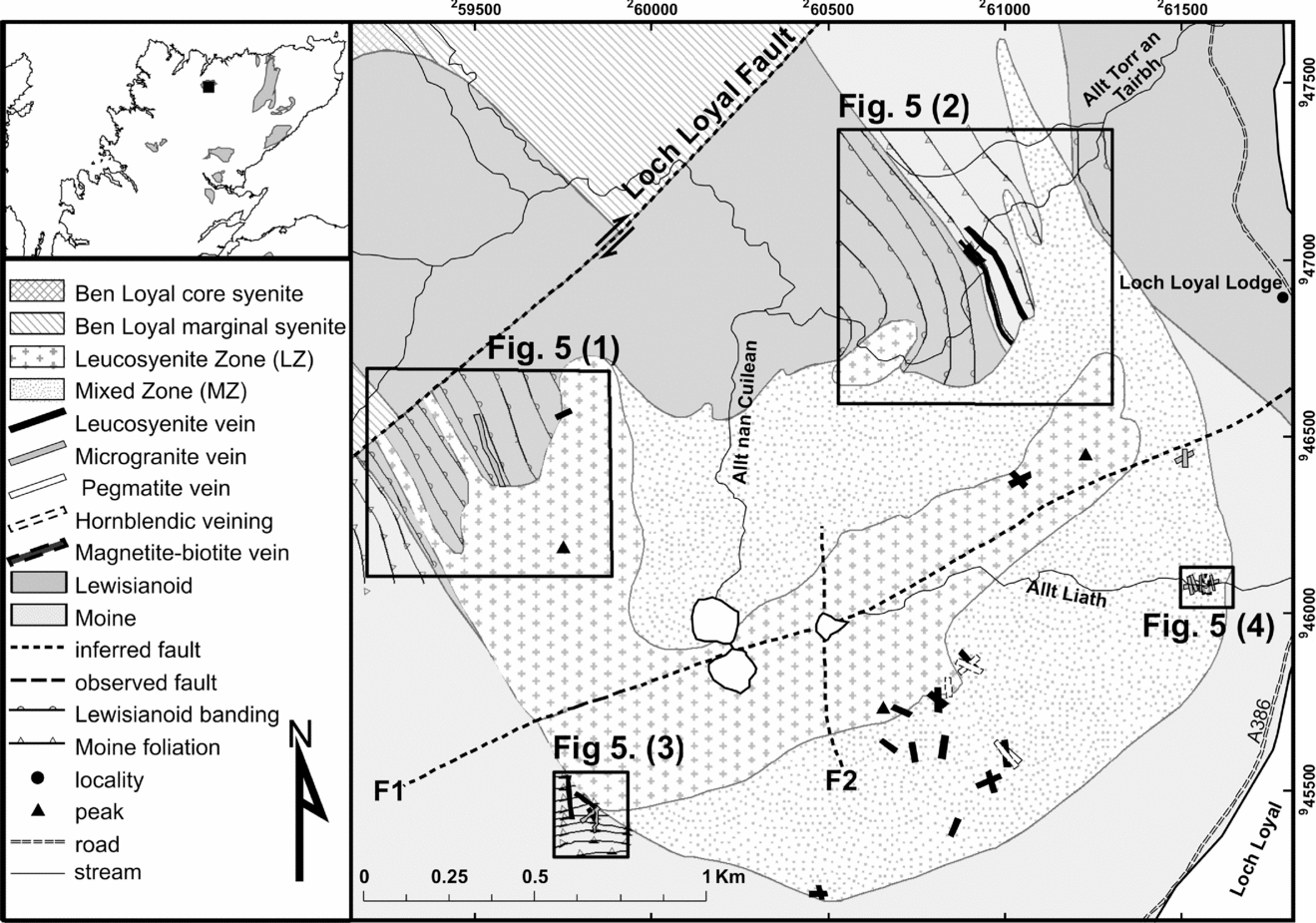
A new geological map for the Cnoc nan Cuilean intrusion is presented in Figure 3. On the basis of new field data, the syenites of the Cnoc nan Cuilean intrusion are subdivided into two main zones: a ‘Mixed Syenite Zone’ (MZ) and a ‘Massive Leucosyenite Zone’ (LZ) (Fig. 3). Discrete episodes of later veining have also been identified. The LZ is defined as an area of massive leucosyenite with less than 10% of the mafic melasyenite lithology. By contrast, the MZ contains leucosyenite with abundant enclaves of melasyenite, country rock xenoliths (with varying degrees of alteration and assimilation) and other mafic material. The boundary between these zones is gradational (over c. 50–100 m).
Detailed geology of the Cnoc nan Cuilean intrusion. Inset boxes indicate positions of close-up maps (Fig. 5) around the intrusion margins. Vein size has been over-emphasized for clarity in figure. Fault 1 (F1) and Fault 2 (F2) displayed. British National Grid coordinates (NC) provided.

3.a. The Mixed Syenite Zone (MZ)
The MZ, which occurs on the lower eastern and southeastern slopes of Cnoc nan Cuilean (Fig. 3), is a complicated zone that includes both melasyenitic and leucosyenitic lithologies, as well as xenoliths of country rock. This zone is broadly similar to the ‘Variable Marginal Syenite’ zone of King (Reference King1942). Leucosyenites are generally equigranular, medium- to coarse-grained and pinkish-white in colour. They comprise plagioclase, K-feldspar and minor quartz, and black-greenish-brown pyroxene and amphibole, locally with coarse euhedral titanite (with red-brown staining surrounding crystals). In contrast, the darker-coloured melasyenites have higher modal proportions of pyroxene and amphibole (30–65% mafic minerals), are equigranular (crystal sizes normally ranging up to 1 mm) and are generally finer-grained than leucosyenites.
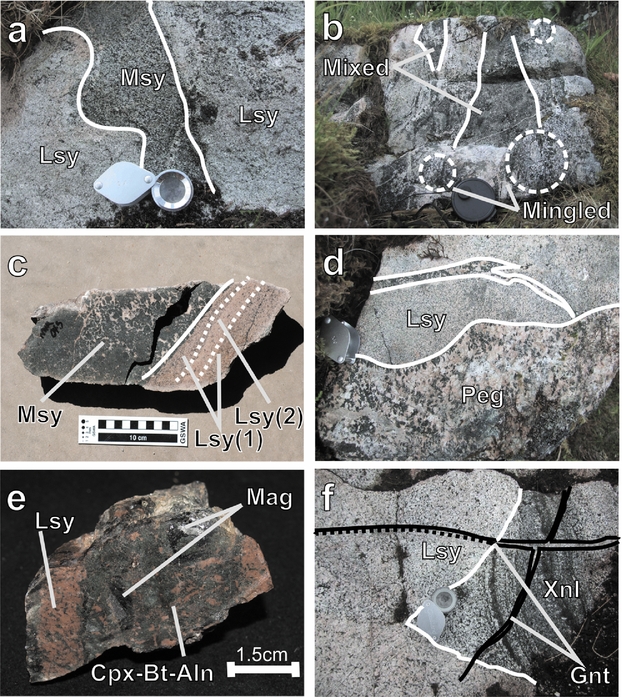
The two main lithologies show complex interrelationships, with examples of mingling (the physical coexistence of the two liquids), veining and a more gradational relationship between the mela- and leucosyenites more indicative of magma mixing. Parts of the MZ comprise veins of pink leucosyenite and microgranite cutting through massive melasyenite and enclosing polygonal melasyenite enclaves, in some places resembling a stockwork. The MZ melasyenite can appear as centimetre- to metre-scale enclaves, or as more massive bodies cut by a few veins of leucosyenite. Leucosyenite vein contacts here are generally sharp (often with millimetre-scale clinopyroxene selvages) but some gradational contacts (grading over 1–20 mm) are encountered, often with wisps of leucosyenite fingering into melasyenites, implying partial assimilation or mixing. Microgranite vein contacts with mela- and leucosyenites are always sharp and well defined. Microgranite is distinguished from leucosyenite by its lack of any mafic mineral phases, instead consisting of medium- to coarse-grained quartz and feldspars only. In some areas, enclaves of melasyenite have lobate contacts against the leucosyenites (Fig. 4a) that indicate extensive magma mingling. Elsewhere, more gradational contacts are seen, indicating mixing resulting in chemical interaction of the syenite magmas (Fig. 4b). Some larger bodies of melasyenite (up to c. 10 m wide) have little or no leucosyenite veining. Thus, within the MZ as a whole, there is complete textural variation from angular, blocky melasyenite enclaves that were solid before intrusion of the leucosyenites, through well-defined rounded melasyenite enclaves with lobate contacts indicating physical mingling of two magmas, to blurred, gradational and indistinct zones of chemical mixing between the two main magmas. It is evident that the melasyenites pre-date the leucosyenites, but that the leucosyenites were intruded while the melasyenite magmas were only partly crystallized. The field evidence for two co-existing magmas indicates that the majority of the mafic material in the MZ was not derived from the country rock, as originally suggested by King (Reference King1942). Similar features occur in the Loch Ailsh pluton further south, where syenites cross-cut and enclose xenoliths of pyroxenite and melasyenite (Parsons, Reference Parsons1968, Reference Parsons1999). Xenoliths of country rock also occur throughout the MZ, and typically retain their original foliation.
Field and hand sample photographs of mixing/mingling textures observed throughout the Cnoc nan Cuilean intrusion. (a) Lobate contact of dark-coloured melasyenites (Msy) with lighter leucosyenites (Lsy) (contact highlighted by white lines). (b) Examples of melasyenite–leucosyenite complex mixing and mingling textures (solid lines indicate mingling between melasyenite and leucosyenite, while dashed circles highlight gradational relationships between these two lithologies, suggesting mixing). (c) Cut hand sample of melasyenite and leucosyenite contact. Note the later leucosyenite vein (Lsy(2)) within Lsy(1) earlier leucosyenite unit. (d) Pegmatite (Peg) within leucosyenite (pegmatite contacts shown by white lines, with pyroxene selvage at margin). (e) Hand sample of nodule from a biotite-magnetite vein (Allt Liath) showing leucosyenite veining, coarse and vuggy magnetite (Mag) and dark-coloured mineral phases including clinopyroxene (Cpx), biotite (Bt) and allanite (Aln). (f) Leucosyenite with altered and metasomatized country rock (?Lewisianoid) xenolith (Xnl) displaying relict foliation. Black lines highlight cross-cutting microgranite (Gnt) veinlets. Hand lens for scale is 3 cm long; camera lens cap is 5 cm diameter.

3.b. The Massive Leucosyenite Zone (LZ)
The LZ occurs towards the western edge of the intrusion and as the topographically higher outcrops on Meall Eudainn and Creag nan Cat (Fig. 3). This zone comprises massive, coarse-grained, pink, equigranular pyroxene and hornblende-bearing leucosyenite. The LZ consists mainly of the same type of leucosyenite as seen in the MZ, but here it accounts for more than 90% of igneous lithologies present. Both here and in the MZ, finer-grained light-coloured leucosyenite veins are observed cross-cutting the main leucosyenite (Fig. 4c). Country rock xenoliths are also observed within this zone, although less commonly than in the MZ. The LZ grades into the MZ over 50–100 m, with gradually increasing amounts of the melasyenite component as enclaves and larger bodies.
3.c. Pegmatites and volatile-rich veining lithologies
Syenitic pegmatites are commonly encountered in both the MZ and LZ, although pegmatites only occur within the leucosyenites of these zones (Fig. 4d) and not within melasyenite. Pegmatite can occur as discrete pockets or veins generally < 20 cm wide and typically with coarse hornblende- or clinopyroxene-rich selvages. The restriction of pegmatite to the leucosyenite lithology suggests that a volatile-rich liquid stemmed from this later felsic magma. Leucosyenite of the LZ contains variable patches of pegmatite, and in turn pegmatite veins and lenses are cross-cut by later leucosyenite and microgranite veins.
Pyroxene- and allanite-rich stringers or veinlets are observed throughout the intrusion. Veinlets are discontinuous, up to 5 mm wide, and cross-cut leucosyenites, melasyenites, xenoliths and biotite-rich inclusions. Pyroxene/allanite-rich stringers have also been observed being cross-cut by microgranite veins in the Allt Liath stream section of the MZ (Fig. 3). Therefore, stringers are likely to have formed from a similar or the same volatile-rich fraction as the pegmatites. In addition, pegmatitic veins on the southern slopes of Meall Eudainn contain clots of rhombic pyroxene.
3.d. Microgranite veining
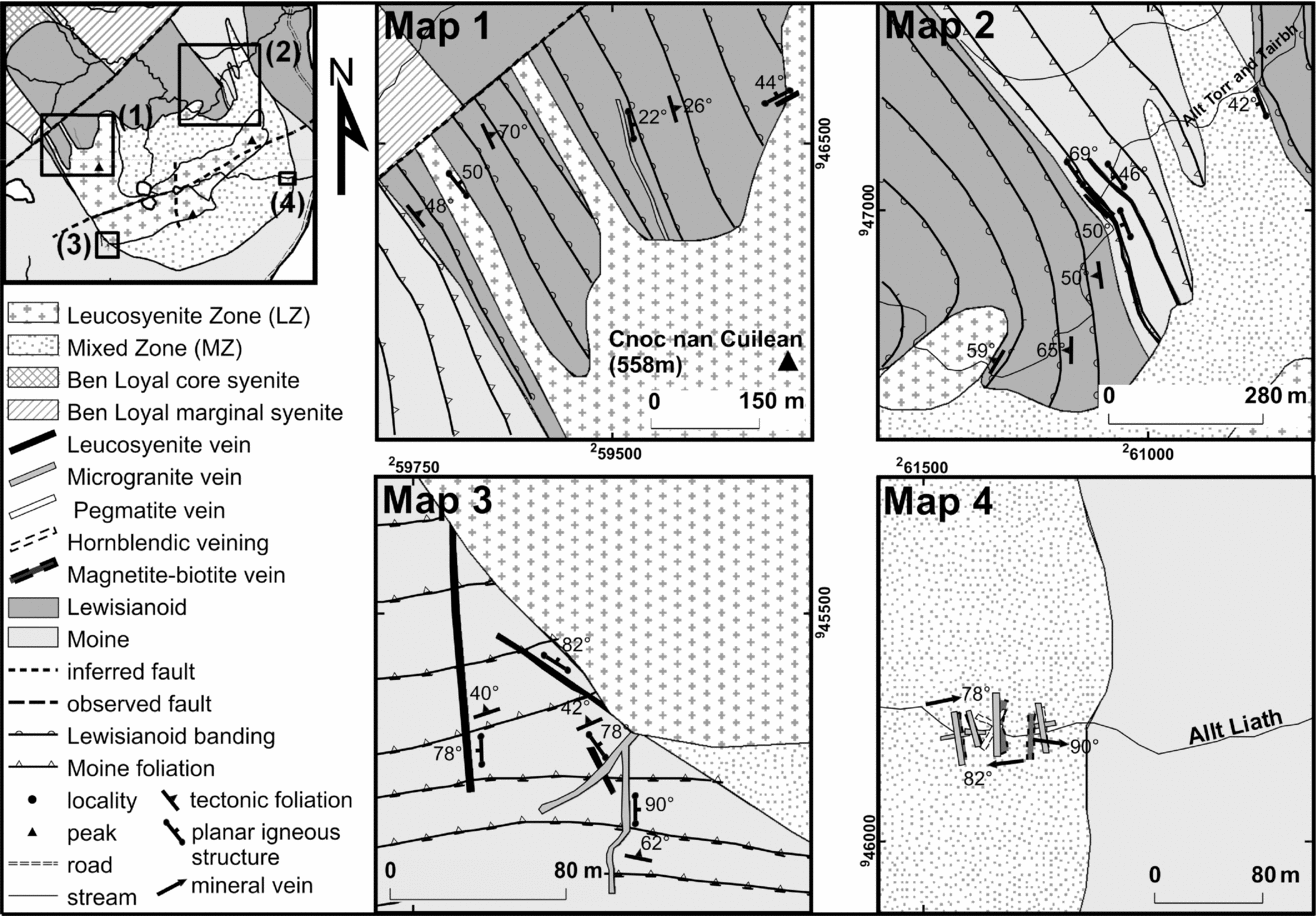
Medium- to coarse-grained, pink microgranite veins (containing abundant quartz and no mafic minerals) cross-cut all other magmatic lithologies. This is thought to be the last magmatic event within the intrusion. The veins are generally narrow (up to a few tens of centimetres wide), discordant and well defined with sharp, planar, intrusive margins. Veining commonly offsets earlier syenites and pegmatite veins, or cross-cuts country rock foliation. This is displayed at [NC 597 465] where 10–40 cm wide bifurcating veins trend almost perpendicular to Lewisianoid country rock banding.
3.e. Biotite-magnetite alteration veins and areas of syenite alteration
Allt Liath, on the eastern side of the Cnoc nan Cuilean intrusion, provides a c. 100 m E–W-trending section through the MZ. These exposures demonstrate a variety of textures and cross-cutting relationships between all the magmatic lithologies, and provide evidence for alteration of syenites by late fluids. Of particular interest are three highly friable, approximately N–S-trending vein systems composed primarily of vuggy or rounded clots of magnetite and flaky biotite books (Fig. 4e). The locations and orientations of these veins are indicated in Figure 5.
Close-up maps of the Cnoc nan Cuilean intrusion margins delineating country rock foliation, structural measurements, and concordant and discordant veins. British National Grid coordinates (NC) provided.

These biotite-magnetite veins are up to 40 cm wide, steeply dipping, sharply bounded and black in colour. They are characterized by high total radioactivity and locally high magnetic susceptibility. The biotite-magnetite veins cross-cut all other igneous vein types and syenites, with the exception of some pink microgranite veinlets (usually on the millimetre scale but sometimes up to 10 cm wide) that anastomose within and across these alteration zones. The biotite-magnetite vein infill observed in situ comprises a friable biotite and magnetite ‘matrix’ with some more coherent blocks (up to fist sized) of highly recrystallized, but still recognizable, melasyenite. Thus the veins themselves are not deemed to be of primary igneous origin; they appear to have been the result of intense syenitic alteration, with the vein boundaries delineating the main pathway of late fluid.
Although biotite-magnetite vein contacts are clearly delineated visually by their black colour, polygonal blocks of biotite-rich altered syenite up to tens of centimetres in size are also common outside the biotite-magnetite vein margins within the immediately surrounding leucosyenites of the Allt Liath stream section. These ‘biotite-rich inclusions’ are characterized by coarse biotite crystals overprinting primary magmatic phases. Their field relations indicate that these too are highly altered melasyenite blocks but appear distinct from the main biotite-magnetite veins owing to the possible splaying of these veins in three dimensions. The MZ ‘protolith’ is very variable and it is possible that the leucosyenites of the MZ were less dramatically altered owing to their lower mafic mineral content, instead only suffering feldspar seritization and/or kaolinization.
The biotite-magnetite veins formed late in the intrusion's history after the main syenites had fully crystallized, and are the result of pervasive alteration by late-magmatic or hydrothermal fluids. The late microgranite veins were unaffected by this fluid alteration, but may have themselves been the source of the metasomatizing fluids.
3.f. Country rocks and xenoliths
Country rocks to the Cnoc nan Cuilean intrusion include both Moine and Lewisianoid lithologies. Moine psammites are medium-grained, well-foliated, quartz-rich with varying amounts of biotite. In contrast the Lewisianoid gneiss consists of banded hornblendic tonalite gneiss with some hornblende-rich mafic bands (or ‘hornblendites’).
Country rock xenoliths are common throughout the MZ, most particularly at marginal zones [NC 614 465] with both Moine and Lewisianoid examples at varying scales. In outcrop some of these xenoliths clearly resemble the surrounding country rock, with little or no evidence of recrystallization and alteration, often with leucosyenite or microgranite veining and relict banding or folding. Some have sharp contacts, whereas in others the contacts are gradational, indicating partial assimilation of the xenoliths by the surrounding magma. However, some xenoliths are almost completely recrystallized, retaining their foliation but with their mineralogy dominated by biotite (Fig. 4f). These are usually angular, with well-defined and sharp contacts with the host syenite; however, these xenoliths have been metasomatized by potassic fluids, resulting in alteration to biotite.
In outcrop, Lewisianoid and Moine xenoliths typically occur either as discrete polygonal blocks (up to a few tens of centimetres wide), or as metre-scale blocks fractured to form mosaics of angular inclusions filled in by leucosyenite veining. Lozenge-shaped xenoliths with narrow cross-cutting leucocratic veinlets (1–2 mm thick) are also observed in conjunction with tightly crenulated xenoliths composed chiefly of coarse biotite and hornblende [NC 593 463]. These probably originated from mafic bands within the Lewisianoid rocks. Source Lewisianoid hornblendites do not contain biotite, but extensive alteration of xenoliths by potassic fluids within the magma body could have led to this significant biotite overprinting. Thus, in combination with other clearly banded Lewisianoid xenoliths, evidence exists for a continuum of xenolithic material varying between almost unaltered non-assimilated blocks to completely metasomatized and replaced inclusions. Moine xenoliths are also observed, displaying similar attributes to the Lewisianoid examples as regards their contacts, size, veining and alteration.
3.g. Syenite, microgranite and country rock relationships at the intrusion margins
The Moine and Lewisianoid country rocks are folded into an open, upright NW-plunging synform in the immediate vicinity of the intrusion, within a series of major Caledonian cross-folds (Holdsworth, McErlean & Strachan, Reference Holdsworth, McErlean and Strachan1999; Holdsworth, Strachan & Alsop, Reference Holdsworth, Strachan, Alsop and British Geological Survey2001).
Owing to poor exposure, particularly at the margins of the Cnoc nan Cuilean intrusion, the outline shape and contact orientations for the intrusion have been deduced from a few key localities (as outlined below) and inferred from significant changes in topography around the intrusion margins. Although when taken individually very few of these localities may appreciably inform us of the overall shape of the intrusion, cumulatively these have proven most instructive during the interpretation of field data and the construction of cross-sections. Such localities tend to occur at similar topographic heights around the intrusion, in concentrated zones of basal country rock xenoliths.
The NW margin of the intrusion shows a series of massive leucosyenite sheets intruding the Lewisianoid gneisses parallel to their gneissose banding (Fig. 5, Map 1). Key localities demonstrating this concordant relationship (where syenite veins intrude country rocks parallel to their banding and foliation) occur at [NC 593 464], [NC 594 464] and [NC 595 465]. At [NC 593 464] highly crenulated biotite-rich Lewisianoid xenoliths can also be observed just a few centimetres away from the leucosyenite/Lewisianoid contact. Rare examples of discordant minor microgranite veins are also observed ([NC 595 464] and [NC 598 466]), suggesting that this youngest magmatic episode did not necessarily conform to the overall country rock structure to which the main intrusion is constrained.
The marginal zone of the intrusion around the stream of Allt Torr an Tairbh (NE margin; Fig. 5, Map 2) has a series of small exposures of Lewisianoid gneisses and Moine country rocks, cut by microgranite veins (such as those seen between [NC 609 470] and [NC 609 471]) and leucosyenite veins, ranging from centimetre-scale up to 5 m thick, and extending northwards from the lower MZ. Two larger sheets of mixed mela- and leucosyenites are seen from [NC 610 471] to [NC 612 472] inferred to be approximately 30 and 150 m wide, respectively (although the syenite sheet/country rock contacts are not always visible) and interpreted as northwards extensions of the lower MZ. Contacts between the Lewisianoid/Moine country rocks and intrusive sheets are sharp, with little or no evidence of country rock melting and no xenoliths observed. Grain size within these sheets is generally finer (< 1 mm) than the main intrusion. This stream section provides a succession of contacts between intrusive units and country rock, demonstrating that in this marginal zone, syenite sheets and microgranite veins have been intruded as a series of concordant bodies (varyingfrom centimetre to metre scale) parallel to Lewisianoid banding and Moine foliation (Fig. 5, Map 2).
No exposure of the intrusion margin exists in the area of Bealach na Beiste (SW intrusion margin; Fig. 5, Map 3) or along the lower ground on the south side of Meall Eudainn. Therefore, the contact marked on Figures 3 and 5 is inferred from a change in slope approximately 500 m SW of Lochan nan Cuilean, along with a single locality [NC 605 452] consisting of Moine country rock in contact with leucosyenite and cross-cut by numerous narrow leucosyenite and microgranite veins (3–20 cm wide) discordant to Moine foliation.
On the eastern margin of the intrusion, the change in hillside gradient below the crags west and northwest of the Loch Loyal Lodge (Fig. 3) has been used to infer the location of the intrusion/country rock contact. In addition craggy exposures such as those at [NC 615 465] show abundant tightly folded and/or foliated Lewisianoid xenoliths (up to 70 cm long) hosted and veined by leucosyenites. Numerous smaller-scale country rock xenoliths are visible throughout this marginal section of the intrusion, associated with leucosyenite, melasyenite and pegmatites.
4. 3D modelling of the pluton geometry
The Cnoc nan Cuilean intrusion is moderately well exposed, but in many areas the contacts are obscured by superficial deposits, and for this reason there has been debate about the three-dimensional shape of the intrusion (e.g. Holdsworth, McErlean & Strachan, Reference Holdsworth, McErlean and Strachan1999). In order to understand the extent of the MZ – and thus the potential scale of the REE-enriched area – we have created a Paradigm GOCAD™ 3D model of the Cnoc nan Cuilean intrusion, which aids visualization of the internal and external intrusive relationships. This is one of the first instances that a 3D model has been used to help communicate a research study of a complex igneous pluton in a scientific journal.
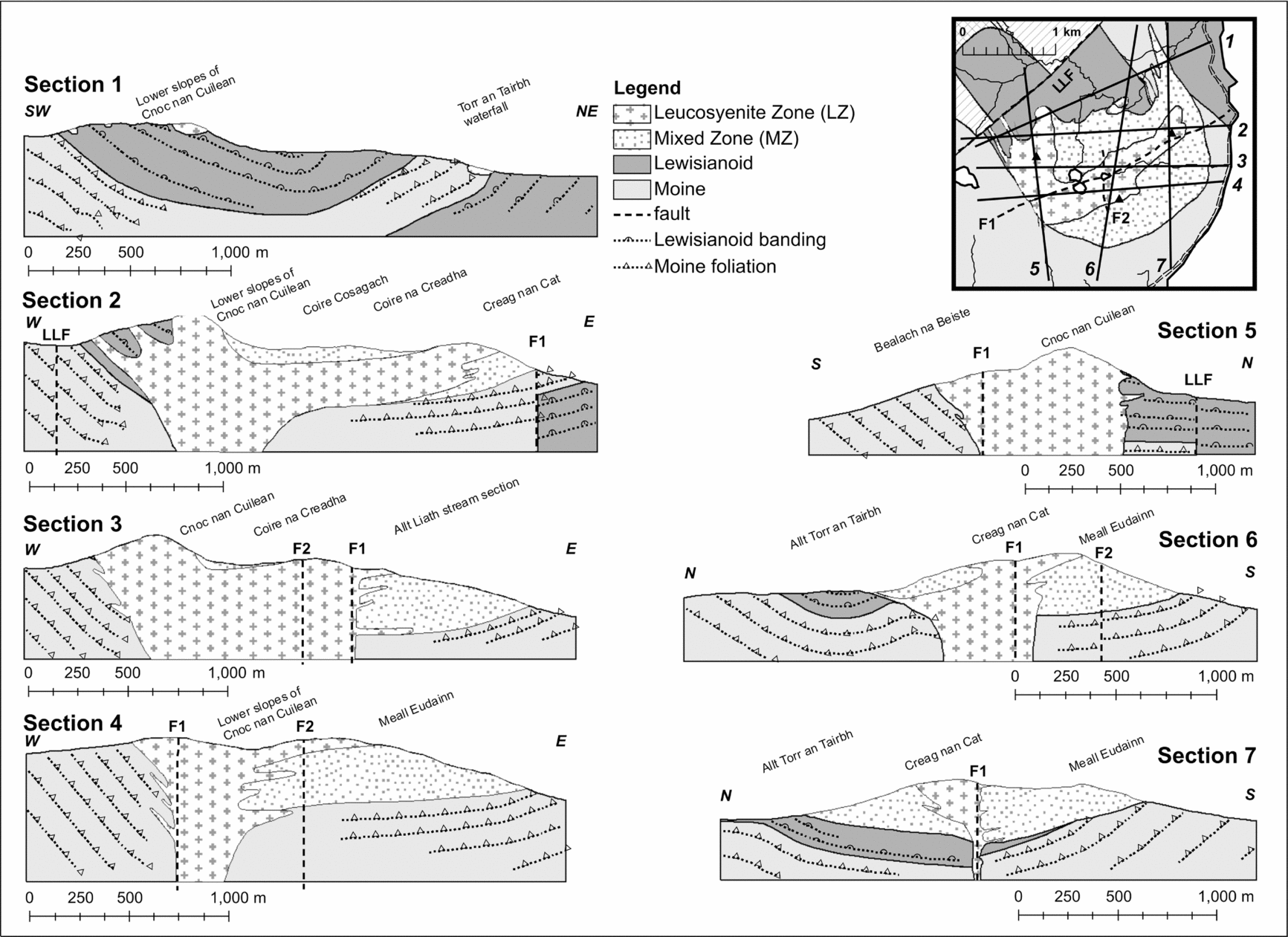
The model was built using GOCAD™ software (Paradigm GOCAD™ 2009.3 Patch 3) and represents a rock volume approximately 9 km2 in area and extending to c. 200 m below the topographic surface. The primary dataset consisted of a three by four rectilinear grid of hand-drawn vertical structural cross-sections digitally captured in ESRI® ArcGIS™ (Fig. 6). Creating the model (Fig. 7) required several iterations, as the cross-sections that were initially drawn on the basis of field relationships did not produce a reasonable 3D shape for the intrusion. The cross-sections, and our understanding of the 3D size and shape of the intrusion, thus evolved significantly during creation of the model, although always being tied back to the primary field evidence at surface level.
Cross-sections of the Cnoc nan Cuilean intrusion showing a broad synform within the country rocks, into which the lopolith form of the MZ sits, overprinted by later intrusive events associated with the LZ. LLF – Loch Loyal Fault; F1 and F2 – Faults 1 and 2 respectively, within the Cnoc nan Cuilean intrusion.

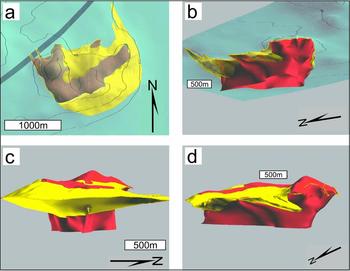
Snapshot views of the 3D GoCAD™ model of the Cnoc nan Cuilean intrusion. (a) Plan view of the intrusion showing contoured topographic surface. (b) View from beneath the NW corner of the intrusion. (c) View from E of the intrusion, demonstrating the lopolith shape of the MZ and more elongate vertical body of the MZ (white line indicates ground level of the margin of the intrusion). (d) View from N of the intrusion. MZ is the yellow body (or lighter grey in print); LZ is the red body (or darker grey in print).

4.a. Summary of field evidence used in cross-section and model construction
The overall surface outline of the LZ was based on the prevalence of massive leucosyenite and absence of melasyenite on higher exposures of Meall Eudainn and Creag nan Cat. Based on exposures at [NC 598 457] and satellite imagery, two faults have been interpreted within the intrusion (mapped as Faults 1 and 2). An elongate zone of massive leucosyenite, exposed around Meall nan Eudainn and Creag nan Cat, extends along Fault 1 and is inferred to have been the result of leucosyenite magma being fed along this fault. Thus cross-sections 5, 6 and 7 (Fig. 6) document this leucosyenite body narrowing eastwards from Cnoc nan Cuilean along Fault 1 and Creag nan Cat. In turn, a similar system along Fault 2 may go some way to explaining why a small zone of LZ can be observed to the north of the intrusion at [NC 606 467].
The steeper LZ sheets on the west of the intrusion (particularly around Cnoc nan Cuilean itself) are seen in the field as previously described in Section 3.g. However, the detailed deeper relationship between the MZ and LZ, as shown on the eastern side of cross-sections 3 and 4 (Fig. 6), is interpretive and based on the field evidence of surrounding country rock structure (a northward-plunging synform), which indicates that the MZ and LZ are generally constrained to a lopolithic shape concordant with this structure. Therefore, the later introduction of massive leucosyenites to the earlier melasyenites resulted in the LZ fingering into the MZ. These veining relationships internal to the intrusion are likely to be more complicated than can be shown by this model, and those shown here are intended as representative, to demonstrate the processes forming the intrusion.
4.b. The modelling process
To create the model, the geo-referenced cross-section shapefiles were imported directly into GOCAD™ along with the crop limit lines of the two syenite bodies (the MZ and LZ) and a set of 10 m topographic contours. Shapefiles were converted within GOCAD™ to depth (Z) attributed point sets, thereby providing a ‘data cage’ to constrain the model surface geometry of the two syenite bodies. However, the intrusive surfaces proved problematic to model directly from the cross-section data, as they were too widely spaced to define the convoluted surface structure in three dimensions. To work around this, a stack of structure-depth contours was constructed by linking matching elevation points on the cross-section lines.
Approximations to the outer subsurface limits of the two syenite bodies were then created by manual GOCAD™ surface construction functions, building the surface in upward steps between adjacent depth contours. The resulting, approximately cylindrical, surface objects were then fitted to the original cross-section line data using the GOCAD™ Discrete Smoothing Interpolation algorithm (Mallet, Reference Mallet1997, Reference Mallet2002). A smoothing and manual surface edit operation was carried out to clean irregular artefacts and self-intersections in the surface mesh, and the modelled shape and extent of the major intrusive apophyses were refined. It should be noted that many of the minor sheets, veins and irregularities portrayed on the cross-sections were at the limit of the practical resolution scale of the model and are represented in simplified form. The top surface of the model intrusion, which corresponds to the ground surface outcrop, was created separately from the Digital Terrain Model and merged with the subsurface model surfaces.
4.c. Model results
Figure 7 displays a variety of snapshot views from the final 3D model of the Cnoc nan Cuilean intrusion. It demonstrates the saucer-shaped lopolith of the MZ (Fig. 7c) broadly following the northward-plunging synformal structure of the Lewisianoid and Moine country rocks (although these have not been included in the model for clarity). Through this initial shallow intrusion, the LZ was intruded from a feeder zone located at the southwestern or western edge of the intrusion, with leucosyenitic magma becoming channelled along faults within the intrusion (particularly Fault 1 trending NE–SW, Fig. 6). This resulted in the elongated shape of the LZ in a NE direction (Fig. 7a). In addition, leucosyenites formed a series of sheets approximately concordant to host Lewisianoid or Moine fabrics, as displayed on the northern and NW sides of the intrusion, and best displayed by the underside snapshot view of Figure 7b.
This 3D model is undoubtedly an interpretation, based on the observed field relationships and our understanding of the processes that formed the Cnoc nan Cuilean intrusion. It is, of course, constrained by only the available data from limited surface exposures. However, the iterative process of building a 3D model has helped our understanding of the intrusion shape to develop. We are confident that the model presented here provides a best estimate of the 3D shape of the intrusion on the basis of the existing data, and it can be used as a template for further investigation of Cnoc nan Cuilean.
5. Petrology of intrusion lithologies
5.a. Melasyenite
Melasyenites of the MZ comprise c. 45–60% feldspar and more than 30% mafic minerals. Although the amount of mafic minerals is very variable, there is no systematic trend or zonation across the intrusion. Most melasyenites are medium- to coarse-grained, but some finer-grained examples are encountered on the south side of Meall Eudainn and the east side of Creag nan Cat. They are not porphyritic, but locally feldspars can be notably coarser than mafic phases. Some are foliated, owing to alignment of elongate pyroxenes.
Both plagioclase and K-feldspar are present in the melasyenite, but plagioclase is generally less than 15% of the rock. K-feldspars are typically subhedral and interstitial to mafic minerals and generally show perthitic exsolution lamellae. Quartz is present, but at less than 5%, and often has undulose extinction.
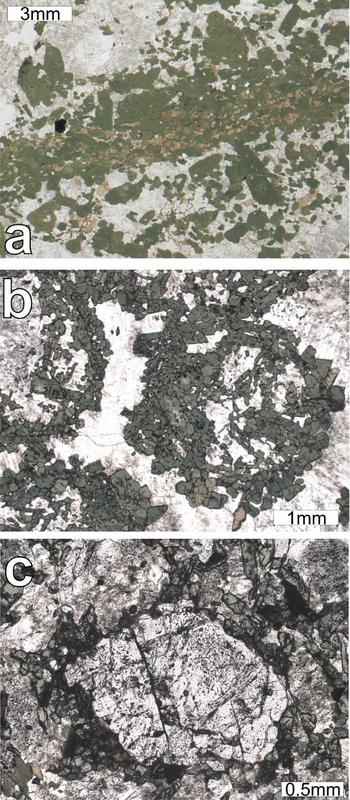
Mafic minerals include clinopyroxene (aegirine-augite to diopside), alkali amphibole and titanite. Biotite does not occur as a primary magmatic phase, but patchy alteration of syenites by late fluids is highlighted by the occurrence of tabular biotite crystals. Minor magnetite flecks are observed, particularly as inclusions within clinopyroxene crystal rims. Pyroxenes occur at much higher concentrations than amphiboles (usually > 3:1). Titanite, commonly exceeding 5% content, occurs as euhedral rhombs up to 0.5 mm long, and is frequently found clustered with clinopyroxene and apatite (Fig 9a). Generally, mafic minerals often cluster together. Examples of both clinopyroxene with euhedral prismatic titanite inclusions and large subhedral titanites with rounded pyroxene inclusions are observed. Pyroxene clusters may be rounded (sometimes in an orbicular texture) or as stringers through the sample (Fig. 8a). One orbicular melasyenite (south Meall Eudainn) shows individual rounded pyroxene crystals delineating the outer edge of the orbicules (Fig. 8b). The orbicule interiors contain similar shaped pyroxene crystals, titanite and interstitial K-feldspar. Coarse perthitic K-feldspar (and minor plagioclase) fills in between the orbicules. The origins of this texture are uncertain but they may have resulted from the replacement of large primary rounded crystals, or have been formed during movement of crystal mush.
Photomicrographs of textures for syenites. (a) Clustered clinopyroxene, titanite and apatite in melasyenite stringer. Fine dark brown allanite interstitial within this stringer. Coarse perthitic K-feldspar either side of mafic mineral stringer. (b) Example orbicular texture in melasyenite, with green clinopyroxene, amphibole and titanite forming rounded clusters between coarse K-feldspar crystals. Orbicule centres also with coarse perthitic K-feldspar. (c) Coarse rounded apatite crystal (from melasyenite) with a partial allanite rim and surrounded by K-feldspar (with albite exsolution) and prismatic clinopyroxene. Apatite is inclusion-rich (often magnetite flecks) with allanite filling in fractures.

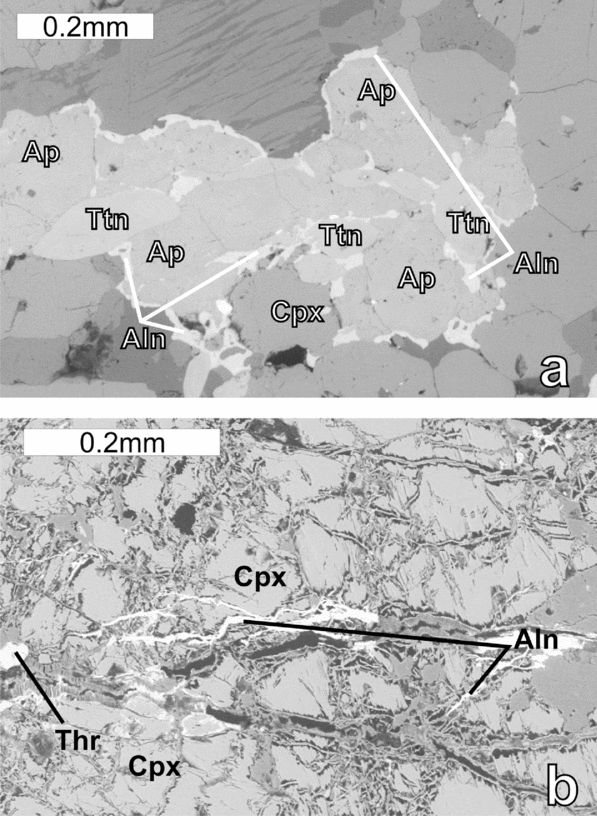
Rounded or granular, anhedral apatite crystals are common in melasyenites, often clustered with pyroxenes or titanite. They often have a rim of allanite, are associated with more blocky crystals of allanite, or have allanite filling in fractures (Fig. 8c). Allanite is also observed as a late-magmatic phase interstitial to pyroxenes, titanite and apatite, or in veins in some samples.
5.b. Leucosyenite
The leucosyenites of Cnoc nan Cuilean are white-pink, generally unfoliated medium- to coarse-grained massive syenites with less than 30% summed total of pyroxene, amphibole and titanite. Feldspars account for more than 50% of the leucosyenite, with higher proportions of K-feldspar (perthite) than plagioclase; 5–15% quartz is generally present. Allanite and apatite occur in markedly lower concentrations, with samples rarely displaying the late-magmatic relationship of rounded apatite crystals rimmed by allanite. Allanite only occurs as a rare fracture infill in some samples (predominantly from the Allt Liath area).
5.c. Microgranite
Microgranite occurs as veins throughout the Cnoc nan Cuilean intrusion, characterized by its lack of mafic and accessory minerals. In rare cases mafic minerals are entrained from host syenites. The microgranites are medium-grained, unfoliated and consist of equigranular plagioclase, K-feldspar and quartz. Plagioclase is the dominant feldspar (50–60%) with lesser K-feldspar (c. 20%).
Some recrystallization (typically associated with the introduction of biotite, allanite or clinopyroxene) occurs along the contacts of the microgranite veins with the mela- and leucosyenites, indicating a higher volatile content within these younger granitic melts.
5.d. Pegmatites
Pegmatites contain large (5–15 mm) euhedral zoned clinopyroxenes (aegirine-augite to diopside), ranging from colourless at the core to green at the rim (in plain polarized light) and typically growing inwards from pegmatite vein margins. These phenocrysts are commonly twinned and have abundant inclusions of magnetite and fine apatite, particularly concentrated towards crystal rims. Additionally, finer subhedral clinopyroxene (0.25–1 mm) occurs as a selvage, commonly clustered around apatite. Acicular or bladed coarse apatite crystals grow orthogonal to vein margins and also occur as inclusions within clinopyroxene phenocrysts. They frequently have thin rims of allanite and allanite as fracture infill. Fractures through pyroxene phenocrysts are filled in by fine K-feldspar or allanite.
Feldspars are predominantly coarse K-feldspar, typically with perthitic exsolution with rare inclusions of magnetite or clinopyroxene (< 0.1 mm). Titanite is common, often clustered amongst the finer marginal clinopyroxene phases, and is generally subhedral to prismatic.
5.e. Allanite veinlets
Allanite is observed as a veining phase within syenite samples (usually restricted to syenites within the MZ, particularly near the hydrothermal biotite-magnetite veins of the Allt Liath stream section). Such fracture infills (Fig. 9b) are interpreted as evidence for a period of volatile-rich magmatic-hydrothermal allanite growth, which occurred late in the history of the intrusion and after crystallization of host syenites, perhaps due to fluids introduced to the intrusion during pegmatite crystallization. It is likely that this stage resulted from remobilization of accessory minerals and allanite of primary magmatic origin within syenites. Brown-orange allanite veinlets vary from < 1 mm to 4 mm thick, and are cross-cut and offset by microgranite veins, indicating that this granitic veining stage occurred after the allanite veins. Overall, multiple episodes of late fluid-related veinlets of allanite have formed within the Cnoc nan Cuilean intrusion.
Selection of scanning electron microscope back scattered electron images of samples from the Cnoc nan Cuilean intrusion. (a) Interstitial allanite between euhedral and subhedral clinopyroxene, titanite and apatite (with K-feldspar and albite exsolution lamellae in top of view) in melasyenite. (b) Allanite filling in fractures through coarse clinopyroxene crystals within melasyenite sample. Bright thorite also seen as rounded crystals filling in vugs or fractures. Mineral abbreviations: Ap – apatite; Cpx – clinopyroxene; Ttn – titanite; Aln – allanite; and Thr – thorite.

6. Biotite-magnetite REE-rich veins and metasomatized melasyenites
Material from the biotite-magnetite veins of the Allt Liath stream section in the MZ (as mentioned in Section 3.e) is extremely heterogeneous. In outcrop, moderately altered melasyenitic wall rock (‘biotite-rich inclusions’) is observed within the leucosyenites and microgranite outside of these vein boundaries. Melasyenites included within the biotite-magnetite veins themselves are completely metasomatized and nodules of this material are suspended in a highly friable matrix of coarse biotite and magnetite.
6.a. Biotite-magnetite vein mineralogy
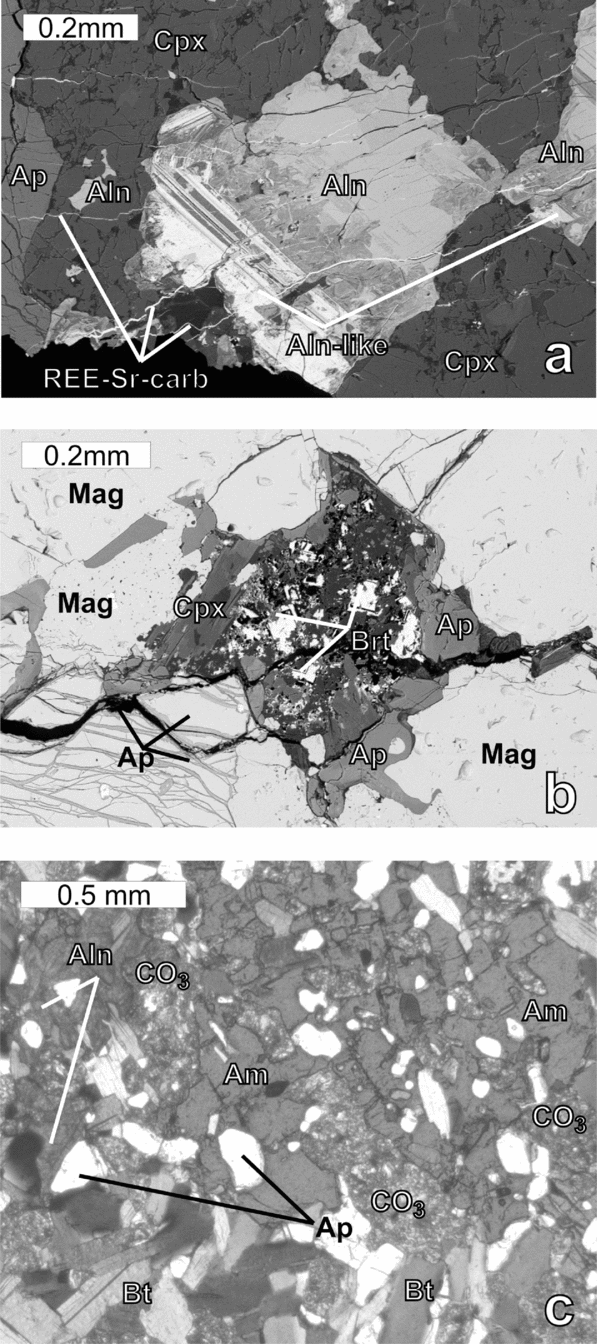
Biotite-magnetite veins are chiefly composed of biotite, magnetite, clinopyroxene, allanite, apatite, baryte, amphibole and rare perthitic K-feldspar. In addition, a large array of accessory minerals is also observed, including an allanite-like mineral (a lighter yellow-brown colour in thin-section forming repetitively zoned rims around true allanite crystal cores; Fig. 10a), strontianite, thorite, and U–Th and U oxides. Various REE- and REE-Sr-carbonates have also been found as minor veinlets through allanite, the allanite-like mineral and apatite in this lithology (Fig. 10a).
Scanning electron microscope back scattered electron image of biotite-magnetite vein material showing (a) allanite with an allanite-like banded mineral and (b) baryte, thorite and apatite filling in a large vug within a fractured magnetite crystal. (c) Photomicrograph of a metasomatized melasyenite sample exposed adjacent and external to biotite-magnetite veins. Poikilitic amphibole has abundant inclusions of apatite, while small tabular biotite and cryptocrystalline carbonate replace and overprint the original feldspar component of the syenite. Mineral abbreviations: Ap – apatite; Cpx – clinopyroxene; Am – amphibole; Bt – biotite; Ttn – titanite; Aln – allanite; Aln-like – allanite-like mineral; Mag – magnetite; Thr – thorite; Brt – baryte; REE-Sr carb – REE-Sr carbonate veining mineral; and CO3 – carbonate.

Multiple stages of mineral growth are observed in biotite-magnetite vein material. Zoned green clinopyroxene is widespread, varying from coarse crystals to fine clustered and highly fractured phases. In some cases, small granular pale green clinopyroxene inclusions occur within coarse tabular biotite. Biotite is widespread with multiple generations. For example, small tabular brown biotite crystals (< 0.5 mm long) occur within coarse subhedral dark green biotite. Biotite also occurs in clustered patches or veins, and as discrete tabular crystals replacing other originally melasyenite mafic minerals (predominantly pyroxenes) and is commonly associated with amphibole. Magnetite (comprising up to 20% of the lithology) occurs in two main forms: as a massive vuggy phase with common inclusions of biotite, apatite, allanite and baryte (Fig. 10b), and as smaller crystals typically concentrated at well-defined margins in contact with primary syenites. K-feldspar is normally found between clinopyroxene clusters and has typically undergone sericitic alteration, but perthitic exsolution is still locally evident. Allanite and its alteration products are prevalent, locally composing 25% of the lithology. This mineral also occurs in several generations ranging from coarse or blocky core crystals, to highly zoned and complex allanite and allanite-like mineral layers on crystal rims and filling in fractures. Apatite occurs as massive rounded clusters of coarse and highly fractured crystals (often with allanite and other REE-bearing minerals filling in cracks).
External to the biotite-magnetite veins, moderately altered melasyenite blocks (usually polygonal) are hosted within leucosyenite or surrounded by microgranite. These still display relict syenite mineralogy and textures, but carbonate and clays have pervasively and completely replaced the feldspar component (Fig. 10c). Tabular biotite occurs throughout (up to c. 50% biotite) locally becoming coarse-grained in proximity to microgranite veinlets which cross-cut these altered blocks. Rounded apatite crystals appear unaltered and occur in carbonate alteration patches and amongst biotite. Apatite commonly has allanite at its margins, although some coarser examples of allanite (interstitial to apatite and biotite) are also present. Rare relict amphibole and pyroxene are now poikilitic (Fig. 10c) and display partial overprinting by fine tabular biotite. Unlike material from within the biotite-magnetite veins, however, these metasomatized melasyenites do not display such a wide variety of accessory minerals (no baryte, strontianite, thorite, U–Th oxides or REE-carbonates have been observed) and nor do they contain any significant magnetite. In addition, the main minerals within the biotite-magnetite veins tend to be coarsely crystalline, while these partially metasomatized rocks external to the veins are generally finer grained.
6.b. Melasyenite alteration and veining by late fluids
Overall, the textures seen within and around these veins provide evidence of widespread and variable fluid alteration of the original melasyenites present in this area. Original primary magmatic mafic minerals have been largely replaced by secondary biotite and the growth of allanite and magnetite, while feldspars have either been sericitized, kaolinized or replaced by carbonates. The high proportion of replacement minerals (biotite ± magnetite ± allanite ± carbonate ± clays > 80%) indicates significant metasomatism of melasyenites. The fluids causing this alteration could have been late-magmatic or hydrothermal in origin. The variation observed between altered melasyenites within, and external to, biotite-magnetite veins is likely the result of lesser fluid-present alteration in syenites external to the main fluid pathway (now inferred by the friable veins themselves), such that the original lithology is still recognizable in some places. This interpretation is further supported by the frequent occurrence (within 30 m of biotite-magnetite veins) of leucosyenites and hybrid or mixed leucosyenite-melasyenites, whose feldspars have undergone extensive sericitization and kaolinization, carbonate replacement and partial replacement of pyroxenes by magnetite. It may be that further biotite-magnetite veins are present within this area, and that the structural features of this ‘alteration zone’ are not fully displayed by the limited and unidirectional exposures of the Allt Liath stream section.
7. Discussion
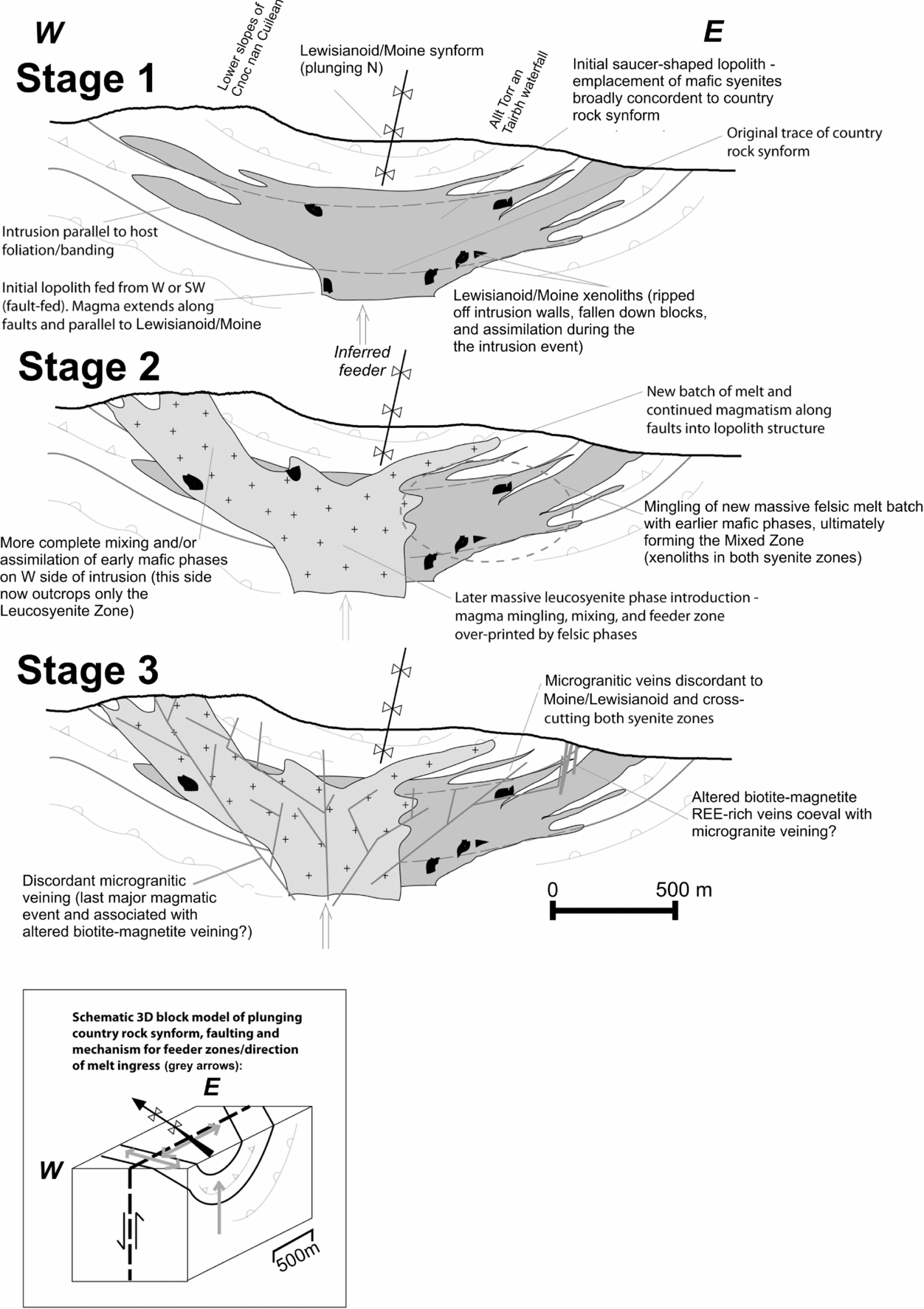
The Cnoc nan Cuilean intrusion is the smallest (c. 3 km2) and most heterogeneous body within the Loch Loyal Syenite Complex (Robertson & Parsons, Reference Robertson and Parsons1974; Parsons, Reference Parsons, Stephenson, Bevins, Millward, Highton, Parsons, Stone and Wadsworth1999; Holdsworth, Strachan & Alsop, Reference Holdsworth, Strachan, Alsop and British Geological Survey2001), containing multiple igneous lithologies and zones of alteration. We have divided the intrusion into two main zones as described in Section 3: the MZ and the LZ. The field mapping, derived cross-sections and 3D modelling (Fig. 7) indicate that the structure of the Cnoc nan Cuilean intrusion was initially that of a saucer-shaped lopolith. The first intrusive episode involved passive and largely concordant emplacement of earlier melasyenitic magmas into a broad plunging synform within Lewisianoid and Moine rocks. This structural interpretation differs from previously proposed models of a simple NW-trending set of steeply dipping sheets through country rock (Holdsworth, McErlean & Strachan, Reference Holdsworth, McErlean and Strachan1999). Our models clearly show that the main structure within the intrusion is the gradational contact between the MZ and LZ, which extends across the whole pluton, and is not compatible with emplacement as a series of coalescing sheets. Sheeted contacts are evident in some of the northern marginal areas of the intrusion (for the LZ in the NW margin, and MZ and LZ in the NE margin) where sheeting and minor veining of melts occurs and is most typically concordant with the gently dipping fabric in the country rock. Xenoliths were incorporated as magma fingered out into the surrounding host rock from a feeder zone, thought to be situated towards the western side of the intrusion, just south of Cnoc nan Cuilean itself. During a second intrusive episode, felsic syenitic magmas were emplaced, intruding into and mixing with the earlier melasyenite lopolith to ultimately form the MZ. Textural evidence suggests that the melasyenites of the MZ were a crystal mush of variable melt fractions, hence producing a variation from lobate blebs of the mingled syenitic magmas to gradational changes from one syenite lithology to another, suggesting a chemical as well as a physical interaction and assimilation during mixing. This would, therefore, imply no major break in the magmatic replenishment of the Cnoc nan Cuilean intrusion (between Stages 1 and 2, Fig. 11). During this episode, country rock xenoliths within the melasyenites were fractured and veined by leucosyenite, and additional new country rock xenoliths became entrained.
Schematic diagram demonstrating the formation events of the Cnoc nan Cuilean intrusion.

Continuing leucosyenite intrusion into higher levels of the lopolith eventually led to the formation of the LZ (Stage 2, Fig. 11) with magma being fed along two main faults (trending approximately N–S and NE–SW) resulting in the observed elongate structure of the LZ forming the high ground of Creag nan Cat. In areas closer to the inferred feeder zone, homogeneous LZ syenites were formed as the intrusion inflated from the centre of the leucosyenite intrusion, such that early mafic material became inundated or fully assimilated, leaving little evidence of the early melasyenites in these western, central and higher areas of the intrusion. However, this was a variable process, and hence the boundary between what is now the MZ and LZ is a gradual one. Evidence of emplacement of two (or more) magma batches distinguishes the Cnoc nan Cuilean intrusion from the other more homogeneous intrusions within the Loch Loyal Syenite Complex (Parsons, Reference Parsons, Stephenson, Bevins, Millward, Highton, Parsons, Stone and Wadsworth1999) and suggests a prolonged magmatic history involving multiple episodes of magma replenishment.
Overall, the entire intrusion process was likely initially facilitated by late Caledonian gravity-driven extension of Moine Thrust sheets (Holdsworth, McErlean & Strachan, Reference Holdsworth, McErlean and Strachan1999). Melt ingress was aided by extensional faulting observed across the pluton, particularly in an E–W direction (Stage 1, Fig. 11). All magmatic units were fed from a deeper evolving and replenishing magma chamber up to the lopolith level. This mechanism has been inferred for the Ben Loyal intrusion, with the foliations observed in its marginal zones thought to have developed during the movement of a nearly solid crystal mush (Robertson & Parsons, Reference Robertson and Parsons1974). This supports the hypothesis of mobile partially crystalline melts moving to higher crustal regions.
Throughout magma batch replenishment, the variable volatile content led to patchy and variable forms of pegmatite veining, allanite stringers or a combination of the two occurring as long narrow veins and irregular inclusions within syenites, often cross-cut and offset by later microgranite veins. These microgranite veins post-date all other lithologies within the Cnoc nan Cuilean intrusion and thus represent the last magmatic event.
In the waning stages of magmatism, an episode of fluid-present alteration led to the crystallization of coarse biotite, magnetite, hornblende and allanite in discrete sub-vertical veins within the MZ. The Allt Liath stream section displays three N–S-trending, steeply dipping narrow veins of this type. The fluids responsible for the alteration may be late-magmatic metasomatic, or may be derived from a hydrothermal system. In some cases, a fine anastomosing network of microgranite veinlets can be observed within these zones. It is therefore suggested that the modifying fluid phase and the invasive microgranite veining lithology are broadly coeval (Stage 3, Fig. 11), perhaps with the replenishing batch of magma ultimately introducing a large volume of metasomatic fluids, resulting in fluid-rich alteration. Thus, given the extensive occurrences of microgranitic veins, it is possible that biotite-magnetite veins may be more extensive in the MZ than currently suggested by surface exposure. However, owing to their friable nature and vulnerability to erosion, these are not exposed on the highly vegetated and peat-covered surfaces of the intrusion.
During biotite-magnetite vein formation in the MZ, host syenites were variably metasomatically altered. During this process, syenites underwent almost complete replacement of the primary magmatic mineralogy by coarse biotite, magnetite, clinopyroxene, allanite, apatite and carbonates. These highly altered biotite-magnetite lithologies are most commonly found within the N–S veins, but also occur in discrete patches in the surrounding MZ syenites of Allt Liath, often associated with microgranite. This may indicate the presence of more biotite-magnetite veins in this area, since eroded or forming a more complex 3D arrangement.
The apparent scarcity of these biotite-magnetite veins may be owing to their weathering propensity and extreme friability, and thus it is likely that these have been preferentially eroded. We consider it likely that a much more extensive network of these veins exists; however, these will only be identifiable by geophysical studies owing to the lack of exposure. Overall the structural control on this alteration event remains unclear. The biotite-magnetite vein occurrence at the intrusion margin may have resulted from the potentially greater mobility of fluids in this region, with veins trending parallel to the intrusion edge. Alternatively the veins could be filling in a N–S-trending fracture system.
The Loch Loyal Syenite Complex is enriched in REEs relative to other intrusions in the UK, even in the more homogeneous syenites of its three constituent intrusions (Plant, Gallagher & Smith, Reference Plant, Gallagher and Smith1969; Shaw & Gunn, Reference Shaw and Gunn1993). It represents an enriched member of the Caledonian Parental Magma Array (Halliday et al. Reference Halliday, Aftalion, Parsons, Dickin and Johnson1987; Fowler et al. Reference Fowler, Kocks, Darbyshire and Greenwood2008). At Cnoc nan Cuilean, REE-bearing minerals (predominantly LREE-rich allanite) are concentrated in the melasyenites of the MZ, and particularly in the altered biotite-magnetite veins. The REEs are incompatible, and so REE-bearing minerals might generally be expected to be found in more-evolved magmatic lithologies, such as pegmatites. However, at Cnoc nan Cuilean, the REEs are concentrated in accessory minerals (particularly allanite), which are most abundant in the more mafic, less-evolved lithologies (melasyenites) and are then further concentrated through alteration by late-stage fluids of magmatic or hydrothermal origin. The MZ is not well exposed and may potentially contain more areas of alteration that have similarly high REE contents. It is likely that similar processes operate in other intrusions, and therefore this has important consequences for our understanding of how REE-bearing minerals form, and hence for REE exploration.
The alkaline intrusions of NW Scotland are unusual in their emplacement setting within a collisional zone. Their alkaline mineralogy and geochemical traits more closely resemble complexes expected in extensional continental rift zones. However, structural evidence at Cnoc nan Cuilean indicates that this complex was emplaced into structures relating to compression in the vicinity of the Moine Thrust Zone, at the end of the collisional period (Holdsworth, McErlean & Strachan, Reference Holdsworth, McErlean and Strachan1999). In contrast, granites dominate post-collisional magmatic suites in many other orogenic belts, such as the East African Orogen (Goodenough et al. Reference Goodenough, Thomas, De Waele, Key, Schofield, Bauer, Tucker, Rafahatelo, Rabarimanana, Ralison and Randriamanajara2010). Elsewhere in the world, a similar situation with alkaline intrusions emplaced into a collisional zone occurs in the Sichuan Province of China. Here, Cenozoic collision has resulted in the intrusion of a series of syenite-carbonatite complexes (Hou et al. Reference Hou, Tian, Yuan, Xie, Yin, Yi, Fei and Yang2006, Reference Hou, Tian, Xie, Yang, Yuan, Yin, Yi, Fei, Zou, Bai and Li2009). Examples of alkaline magmatism emplaced within a zone of active compression can also be found in the Tokdal Complex and Gwangcheon intrusion of Korea (Peng et al. Reference Peng, Zhai, Guo, Zhang and Zhang2008; Seo, Choi & Oh, Reference Seo, Choi and Oh2010), and at Mt Vulture close to the Apennine Front in Italy (Beccaluva et al. Reference Beccaluva, Coltorti, Di Girolamo, Melluso, Milani and Siena2002). In all of these cases, an enriched lithospheric mantle has been invoked as the magma source region for these intrusions. Causes for such enrichment are likely multi-stage and range from extensional carbonatite-related metasomatism modified by later subduction-related metasomatism in Italy (Beccaluva et al. Reference Beccaluva, Coltorti, Di Girolamo, Melluso, Milani and Siena2002) to contamination of the melting lithosphere by a carbonate-rich pelagic sediment during subduction in China (Hou et al. Reference Hou, Tian, Yuan, Xie, Yin, Yi, Fei and Yang2006). A similar magma generation process in a compressional tectonic environment is foreseen for the Caledonian syenite intrusions of NW Scotland, including the Cnoc nan Cuilean intrusion.
This work has allowed us to develop a clearer picture of the structure of the Cnoc nan Cuilean intrusion, aiding future exploration for REE mineralization in this and other similarly poorly exposed intrusive bodies. Key to this success has been the development of a working and interactive 3D model, constructed from field mapping data equivalent to that obtained during early-stage mineral reconnaissance and exploration programmes. The intrusion may further be used to understand the processes by which REEs become concentrated in magmatic and post-magmatic settings.
8. Conclusions
New mapping presented here contributes to a new interpretation of the structure of the intrusion, demonstrating that an initially lopolith-shaped melasyenite magma body was inundated by leucosyenites during its crystallization. Thus the intrusion can be divided into two zones according to melasyenite content, with a gradational boundary in between them. In addition, pegmatites, allanite and pyroxene stringers, and microgranite veins are widespread throughout the intrusion. This alkaline syenite intrusion is unusual in its occurrence of alkaline mineralogy within a collisional tectonic environment. The intrusion has high concentrations of REEs in all magmatic lithologies. LREE-bearing minerals, predominantly allanite, are particularly concentrated in melasyenites rather than in the more-evolved leucosyenites. In turn, allanite has been further concentrated in biotite- and magnetite-rich veins on the eastern side of the intrusion by late fluid alteration. This has significantly enriched REEs in these structures.
Together with cross-sections, mapping has been used to build an interactive 3D GoCAD™ model of the Cnoc nan Cuilean syenite body. The model has allowed for the testing of structural interpretations and cross-section validity relative to known field observations. This provides a low-cost working visualization process that can be employed at a very early stage in exploration or mineral reconnaissance in complex igneous geology settings suffering from limited exposure. With the novel and innovative use of a 3D intrusion model, a more detailed understanding of the intrusion's shape and thus the areas of potential interest for REE mineralization can be established. Overall, this intrusion contributes to our understanding of processes important to critical metal metallogenesis.
Acknowledgements
The authors would like to thank colleagues at BGS (Keyworth and Edinburgh) for help and discussion during this research. M. Fowler (University of Portsmouth) and an anonymous reviewer are thanked for their helpful comments towards the manuscript. Thanks are extended to M. Styles, T. Milodowski, J. Rushton and M. Allen (Keyworth). C. Richie, T. Kearsey and R. Terrington are thanked for their part in the production of the 3D model. Lastly, J. Hughes and D. Paterson are thanked for their logistical aid in the field, along with the staff and proprietors of the Tongue Hotel for such a pleasant stay during fieldwork. H.S.R.H. acknowledges the financial support of the Natural Environment Research Council (NERC); the BGS University Funding Initiative (BUFI); and the Schools Competition Act Settlement Trust (SCAST) for sponsorship of this research.