INTRODUCTION
The supply of recruits from the plankton is usually a critical process that determines structure in benthic assemblages (Underwood & Denley, Reference Underwood, Denley, Strong, Simberloff, Abele and Thistle1984; Underwood & Fairweather, Reference Underwood and Fairweather1989), since competitive interactions (Connell, Reference Connell1961) and predation (Paine, Reference Paine1971) may be key factors only in locations where recruitment is high (Gaines & Roughgarden, Reference Gaines and Roughgarden1985). Several studies have analysed monthly recruitment patterns on artificial substrata immersed in harbours (e.g. Chalmer, Reference Chalmer1982; Satheesh & Wesley, Reference Satheesh and Wesley2008), as this variation has important implications from both theoretical and applied points of view (Sutherland & Karlson, Reference Sutherland and Karlson1977; Dean & Hurd, Reference Dean and Hurd1980; Underwood & Anderson, Reference Underwood and Anderson1994). Timing of panel immersion and the seasonal pattern of initial recruitment was found to influence the competitive outcome and succession of sessile organisms (Nandakumar, Reference Nandakumar1995, Reference Nandakumar1996). Orientation of substrata has also important effects, since epibiotic assemblages on upper and lower surfaces are often significantly different (Barnes, Reference Barnes, Gordon, Smith and Grant-Mackie1996; Glasby & Connell, Reference Glasby and Connell2001; Stark, Reference Stark2008).
On the coast of Argentina (south-western Atlantic), the composition and temporal changes of fouling assemblages have been explored mainly in warm-temperate harbours of Buenos Aires Province (see e.g. Bastida, Reference Bastida1971; Bastida et al., Reference Bastida, Spivak, L'Hoste and Adabbo1974, Reference Bastida, Trivi de Mandri, Lichtschein de Bastida, Stupak and Aritio1980; Brankevich et al., Reference Brankevich, Bastida and Lemmi1988), but the available information on the macrofouling of cold-temperate Patagonian harbours is scarce (Bastida, Reference Bastida, Acker, Brown, De Palma and Ivarson1973; Rico et al., Reference Rico, Lanas and López Gappa2005; Rico & López Gappa, Reference Rico and López Gappa2006 and references therein; Schwindt et al., Reference Schwindt, Orensanz, Raffo, Lovrich, Tatián, Piriz, López Gappa, Alonso, Doti, Genzano, Diez, Spivak, Bortolus, Casas, Darrigran, Romero, Tapella, Pérez Barros, Almada, Volpedo, Lo Nostro and Reilly2008). Therefore, the aims of this study are: (1) to identify the macrofouling taxa and describe their recruitment periods on artificial substrata in the Patagonian harbour of Comodoro Rivadavia; and (2) to compare the fouling assemblages which developed on upper and lower surfaces of experimental panels.
MATERIALS AND METHODS
Study area
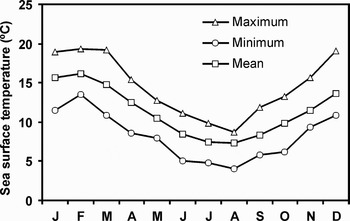
Comodoro Rivadavia harbour (Figure 1; 45°51′35″S 67°27′23″W) was built between 1924 and 1929. A new breakwater was added in 1996 using natural rocks and man-made concrete blocks. Tidal amplitude during spring and neap tides are 6.21 and 4.34 m, respectively. Sea surface temperatures at Comodoro Rivadavia harbour were provided by Centro Argentino de Datos Oceanográficos (CEADO). The range of surface temperatures is around 15°C, with maximum and minimum values recorded during February (summer) and August (winter), respectively (Figure 2). Salinity shows minor variations, due to the absence of freshwater courses and the scarcity of precipitation in the area (Paruelo et al., Reference Paruelo, Beltrán, Jobbágy, Sala and Golluscio1998; Bertness et al., Reference Bertness, Crain, Silliman, Bazterrica, Reyna, Hidalgo and Farina2006). Oceanographic surveys in San Jorge Gulf confirm this pattern for the coastal zone, where the extreme values recorded between 1999 and 2000 ranged between 33.07 and 33.80 psu (Fernández et al., Reference Fernández, Carreto, Mora and Roux2005).
Location of study area.

Sea surface temperatures at Comodoro Rivadavia harbour.

Sampling
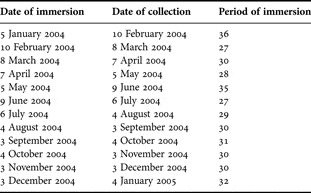
Artificial substrata were immersed in the harbour 4 m below mean low water and were never exposed during low tides. They consisted of 20 cm × 20 cm × 0.4 cm (400 cm2) low-density polyethylene panels screwed to horizontal supporting structures of galvanized iron lying around 10 cm above the bottom. Panel surfaces were roughened to promote the settlement of sessile organisms. For the analysis of recruitment, we deployed 5 monthly replicates separated from each other by around 2 m. They were replaced at approximate monthly intervals from January 2004 to January 2005 (Table 1). During the collection of samples, each panel was placed in seawater within a zip-locked plastic bag to prevent the loss of organisms. Samples were then fixed in a solution of 4% formaldehyde in seawater and later preserved in 70% ethanol. To avoid any border effect, only the central 10 × 10 cm (100 cm2) of the upper and lower surfaces was analysed. Thus, a total of 120 sampling units were examined (12 months × 5 replicates × 2 surfaces). Organisms were identified to the lowest taxonomic level possible without disturbing their spatial distribution on the panels. Specimens found outside the central 100 cm2 were collected and used for taxonomic purposes. Coverage of each taxa was quantified by superposing a transparent plastic sheet with a grid of 100 regularly spaced points. The density of the small but very abundant spirorbid polychaete Romanchella scoresbyi was also quantified by counting the number of calcareous tubes in the central area.
Sampling scheme for the study of recruitment at Comodoro Rivadavia harbour.

Data analysis
The basic data matrix was analysed with the PRIMER package (Clarke & Warwick, Reference Clarke and Warwick2001). The DIVERSE routine was used to calculate richness and the Shannon–Wiener diversity index (loge) of each sample. Coverage data were fourth-root transformed to reduce the influence of dominant taxa. A triangular similarity matrix was obtained applying the Czekanowski index (identified as the Bray–Curtis index in the PRIMER package, see Yoshioka, Reference Yoshioka2008). An ordination of samples was later produced by non-metric multidimensional scaling. The stress value indicates to which extent the bidimensional ordination is a satisfactory representation of the distances among samples in the similarity matrix. The hypothesis that the structure of assemblages developed on upper and lower surfaces differs significantly was tested by a one-way ANOSIM test (Clarke & Warwick, Reference Clarke and Warwick2001). The SIMPER routine was then applied to obtain a list of taxa whose differences in coverage best discriminate between both surfaces.
Rank correlations between sea surface temperature and richness of taxa or Shannon–Wiener's diversity were calculated with the Spearman index (Sokal & Rohlf, Reference Sokal and Rohlf1981) using Statistica® 6.0.
RESULTS
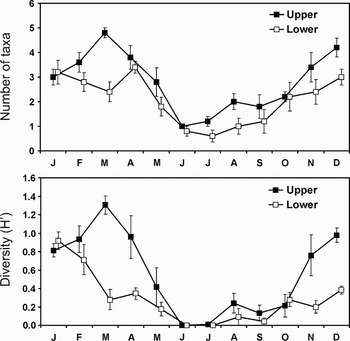
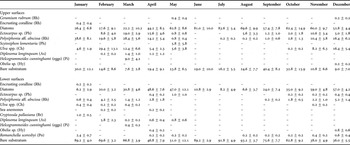
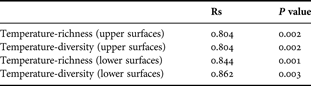
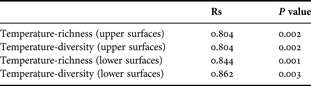
The total number of taxa recruited during the whole study period was similar on upper and lower surfaces (10 to 11; Table 2). The fouling assemblage consisted of filamentous seaweeds, encrusting coralline algae, spirorbid polychaetes, compound ascidians, hydrozoans, cheilostome bryozoans and egg masses spawned by the small tripterygid fish Helcogrammoides cunninghami (Smitt) (Table 2). Monthly changes in number of taxa and Shannon–Wiener's diversity (Figure 3) were significantly correlated with sea surface temperature (Table 3) and followed a similar pattern on upper and lower surfaces, with the exception that a second peak in richness was observed on the lower surfaces during the autumn (April) (Figure 3).
Monthly changes in the number of taxa and Shannon–Wiener's diversity (mean±SE, N = 5) of fouling assemblages on upper and lower surfaces.

Coverage (mean±SE, N = 5) on upper and lower surfaces.

Rh, Rhodophyta; Ph, Phaeophyta; Ch, Chlorophyta; As, ascidian; Pi, fish; Hy, hydrozoan; Br, bryozoan; Po, polychaete.
Spearman rank correlations (Rs) between sea surface temperatures (°C) and richness of taxa/Shannon–Wiener's diversity on upper and lower surfaces.
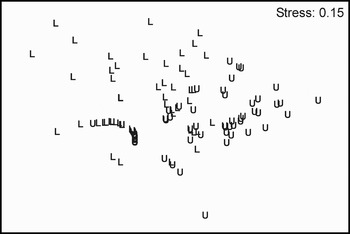
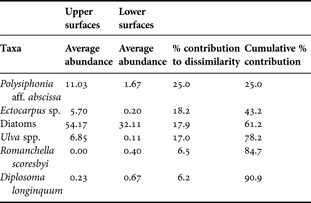
Fouling assemblages on upper and lower surfaces were significantly different (Figure 4; one-way ANOSIM test, global R = 0.2, P = 0.001). The SIMPER routine (Table 4) showed that this difference was mainly due to the abundance of filamentous algae on upper surfaces, particularly the rodophyte Polysiphonia aff. abscissa J.D. Hooker & Harvey, the phaeophyte Ectocarpus sp., diatoms and chlorophytes belonging to the genus Ulva (formerly Enteromorpha, see Hayden et al., Reference Hayden, Blomster, Maggs, Silva, Stanhope and Waaland2003). On the other hand, filter-feeding invertebrates such as spirorbids and compound ascidians were more abundant on lower than on upper surfaces.
Multidimensional scaling ordination based on fourth-root transformed coverage data of monthly assemblages on upper (U) (N = 60) and lower (L) (N = 55) surfaces. Five lower panels sampled from June to September were excluded from this analysis due to complete absence of macrobenthic organisms.

SIMPER analysis based on fourth-root transformed coverage data of fouling assemblages developed on upper and lower surfaces.

The list was truncated when cumulative percentage reached 90%. Average dissimilarity = 43.38.
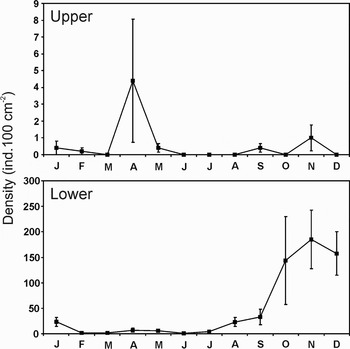
The density of the calcareous tubes of Romanchella scoresbyi (Harris) (Figure 5; recorded as R. perrieri (Caullery & Mesnil) and Paralaeospira levinseni (Caullery & Mesnil) in Rico & López Gappa, Reference Rico and López Gappa2006) was 2 orders of magnitude higher on lower than on upper surfaces. Its recruitment on lower surfaces began on late winter (August), reaching maximum values in spring. A much smaller recruitment peak was observed during the autumn (April–May). Romanchella scoresbyi was almost absent on panels deployed during late summer (February–March) and early to mid-winter (June–July).
Density (mean±SE, N = 5) of the spirorbid polychaete Romanchella scoresbyi on upper and lower surfaces. Note the change of scale between both graphs.

DISCUSSION
The present study shows that orientation of the experimental panels was a critical factor determining the composition and structure of the fouling assemblages which developed on them. Previous studies also found significant differences between fouling assemblages on upper and lower (Stark, Reference Stark2008) or vertical and horizontal surfaces (Glasby & Connell, Reference Glasby and Connell2001). The identity of the dominant species and the competitive hierarchy were shown to be markedly different on sunlit or shaded surfaces of panels immersed in Tomioka Bay, Japan (Nandakumar, Reference Nandakumar1995). A widespread pattern observed on most shallow subtidal substrata is that upward-facing surfaces are monopolized by algae, whereas downward-facing surfaces are dominated by sessile invertebrates. Light and sedimentation interact in complex ways with surface orientation to maintain this pattern of habitat heterogeneity (Irving & Connell, Reference Irving and Connell2002). In the first few months after settlement, mortality of coral larvae was highest on highly sedimented upper surfaces of experimental substrata (Babcock & Mundy, Reference Babcock and Mundy1996). Preference for lower surfaces may also be due to active larval behaviour during settlement, since larvae of sponges and other invertebrates settle mainly on the undersurfaces of artificial substrata they were offered, regardless of which microhabitat they were placed in (Maldonado & Young, Reference Maldonado and Young1996). Bryozoans were almost entirely confined to the undersurfaces of rocks in encrusting communities from the Antarctic sublittoral, and the proportion of colonies occurring on the upper surfaces decreased in the deepest samples, where silt deposition apparently became a major influence (Barnes et al., Reference Barnes, Rothery and Clarke1996). Acrylic panels immersed in Antarctica were dominated by encrusting bryozoans and spirorbid polychaetes (Bowden et al., Reference Bowden, Clarke, Peck and Barnes2006). Recruitment rates of these taxa on upward-facing surfaces were comparable with that to downward-facing surfaces, but reduction in the number of recruits on upper surfaces suggested that post-settlement mortality may be important (Bowden, Reference Bowden2005).
The filter-feeding polychaete Romanchella scoresbyi was originally described from Tristan da Cunha (Harris, Reference Harris1969) and later recorded for Marion Island and the Patagonian coast, where it was found on the fronds of the kelp Macrocystis (Knight-Jones & Knight-Jones, Reference Knight-Jones, Knight-Jones and Hutchings1984). The biology of this species is almost completely unknown, except for the fact that up to 16 embryos can be incubated simultaneously in its tube (Harris, Reference Harris1969). The existence of a bimodal recruitment in R. scoresbyi agrees with the temporal variability of the phytoplanktonic biomass of San Jorge Gulf, which shows the typical cycle of temperate water masses, with a main peak during spring and a secondary one during autumn (Cucchi Colleoni & Carreto, Reference Cucchi Colleoni, Carreto, Boschi, Bremec, Cousseau, Elías and Roux2003; Fernández et al., Reference Fernández, Mora, Roux, Cucchi Colleoni and Gasparoni2008).
The cheilostome Cryptosula pallasiana (Moll), a very common non-indigenous fouling bryozoan of worldwide distribution (Gordon & Mawatari, Reference Gordon and Mawatari1992), was already known from warm-temperate localities in the south-western Atlantic. It was found in Rio de Janeiro (Vieira et al., Reference Vieira, Migotto and Winston2008), Uruguay (see Scarabino, Reference Scarabino, Menafra, Rodriguez-Gallego, Scarabino and Conde2006) and the Argentine harbours of Mar del Plata, Quequén and Puerto Belgrano (Lichtschein de Bastida & Bastida, Reference Lichtschein de Bastida, Bastida and Aritio1980), and had been recorded for the first time in Comodoro Rivadavia during a previous study (Rico & López Gappa, Reference Rico and López Gappa2006).
The feeding habit of the small carnivorous fish Helcogrammoides cunninghami (=Tripterygion cunninghami) has been studied at the temperate coast of central Chile, where this species is a permanent resident of the intertidal zone. Its diet seems to be rather constant during ontogeny, as it consists mainly of amphipods (Muñoz & Ojeda, Reference Muñoz and Ojeda1998).
This is the first record of the compound ascidian Diplosoma longinquum (Sluiter) for the Patagonian coast (see also Varela, Reference Varela2007). It is not clear whether this species should be regarded as exotic, because it was previously recorded for the Antarctic Peninsula and near the Burdwood Bank, a relatively shallow area lying just south of the Malvinas/Falkland Islands (Kott, Reference Kott1969, Reference Kott1971).
During a preliminary study of the fouling assemblages of Comodoro Rivadavia harbour based on stones immersed during 84 to 100 days we found 31 taxa at the subtidal level (Rico & López Gappa, Reference Rico and López Gappa2006). At least 29 sessile taxa have been identified in annual successions developed in this harbour (Rico, unpublished), a much higher figure than the 13 taxa found in the present study on surfaces replaced on a monthly basis (Table 2). This suggests that the length of the immersion period is a critical factor regulating biodiversity in this macrofouling assemblage, probably due to facilitation mechanisms by which pioneering species create suitable conditions for the settlement and establishment of later recruits (Connell & Slatyer, Reference Connell and Slatyer1977).
ACKNOWLEDGEMENTS
We are grateful to Consejo Nacional de Investigaciones Científicas y Técnicas (CONICET) for financial support during different stages of this study (PIP No. 02126 to J.L.G.), to Walter Mazza and CEADO for sea surface temperatures at Comodoro Rivadavia, and to Prefectura Naval Argentina, Horacio It and Gringo Durbas for logistic support and SCUBA diving. Thanks to Marcos Tatián, Cristian Lagger and Mercedes Varela for the identification of the ascidian. The egg masses of H. cunninghami were identified by Atila Gosztonyi.