Introduction
Parkinson's disease (PD) is a progressive neurological disorder accompanied by various motor impairments such as tremor, rigidity and akinesia (Jankovic, Reference Jankovic2008), and non-motor impairments, such as autonomic and sensory impairments and neuropsychiatric disturbances (Löhle et al. Reference Löhle, Storch and Reichmann2009; Rodriguez-Oroz et al. Reference Rodriguez-Oroz, Jahanshahi, Krack, Litvan, Macias, Bezard and Obeso2009). Deep brain stimulation of the subthalamic nucleus (STN-DBS) can significantly improve PD motor symptoms (Deuschl et al. Reference Deuschl, Schade-Brittinger, Krack, Volkmann, Schäfer, Bötzel, Daniels, Deutschländer, Dillmann, Eisner, Gruber, Hamel, Herzog, Hilker, Klebe, Kloss, Koy, Krause, Kupsch, Lorenz, Lorenzl, Mehdorn, Moringlane, Oertel, Pinsker, Reichmann, Reuss, Schneider, Schnitzler, Steude, Sturm, Timmermann, Tronnier, Trottenberg, Wojtecki, Wolf, Poewe and Voges2006), but may also influence neuropsychological and psychiatric parameters (Funkiewiez et al. Reference Funkiewiez, Ardouin, Caputo, Krack, Fraix, Klinger, Chabardes, Foote, Benabid and Pollak2004; Witt et al. Reference Witt, Daniels, Reiff, Krack, Volkmann, Pinsker, Krause, Tronnier, Kloss, Schnitzler, Wojtecki, Bötzel, Danek, Hilker, Sturm, Kupsch, Karner and Deuschl2008). This could be due to an effect of STN-DBS on neuronal regions, such as the limbic system (Funkiewiez et al. Reference Funkiewiez, Ardouin, Caputo, Krack, Fraix, Klinger, Chabardes, Foote, Benabid and Pollak2004; Mallet et al. Reference Mallet, Schüpbach, N'Diaye, Remy, Bardinet, Czernecki, Welter, Pelissolo, Ruberg, Agid and Yelnik2007; Ulla et al. Reference Ulla, Thobois, Llorca, Derost, Lemaire, Chereau-Boudet, De Chazeron, Schmitt, Ballanger, Broussolle and Durif2011; Gilbert, Reference Gilbert2012). Furthermore, studies have shown that patients can experience postoperative psychological changes, influencing their self-image, working life, socio-familial relations and identity (Agid et al. Reference Agid, Schüpbach, Gargiulo, Mallet, Houeto, Behar, Maltête, Mesnage and Welter2006; Schüpbach et al. Reference Schüpbach, Gargiulo, Welter, Mallet, Béhar, Houeto, Maltête, Mesnage and Agid2006; Witt et al. Reference Witt, Kuhn, Timmermann, Zurowski and Woopen2013). Also, patients are known to have complained about subjective negative STN-DBS outcome (Maier et al. Reference Maier, Lewis, Horstkoetter, Eggers, Kalbe, Maarouf, Kuhn, Zurowski, Moro, Woopen and Timmermann2013) and subjectively perceived personality changes (Schüpbach et al. Reference Schüpbach, Gargiulo, Welter, Mallet, Béhar, Houeto, Maltête, Mesnage and Agid2006). As a result, personality and mood changes under STN-DBS in PD are currently one of the most discussed clinical side effects and ethical issues of this treatment method (Glannon, Reference Glannon2009; Müller & Christen, Reference Müller and Christen2010; Jotterand & Giordano, Reference Jotterand and Giordano2011; Mathews, Reference Mathews2011; Gilbert, Reference Gilbert2012; Lipsman & Glannon, Reference Lipsman and Glannon2012; Witt et al. Reference Witt, Kuhn, Timmermann, Zurowski and Woopen2013). However, empirical studies systematically looking at the effects of STN-DBS on personality are still missing.
As personality is a complex system (Mischel, Reference Mischel2004), personality changes might be difficult to identify. One issue might be identifying the most appropriate tools for assessment. Also, the definition of personality changes could be different for health professionals and patients, especially regarding a differentiation between personality and mood changes. Specific personality disorders or personality change diagnosable along the guidelines of the Diagnostic and Statistical Manual of Mental Disorders, fourth edition (DSM-IV-TR) (APA, 2000) might not be expected as side effects of STN-DBS in PD patients (Witt et al. Reference Witt, Kuhn, Timmermann, Zurowski and Woopen2013), as a more subtle personality change is likelier that might be difficult to differentiate from mood change. The aim of the ELSA-DBS study group therefore was to examine patients’ perceptions of personality and mood changes by conducting a prospective mixed-method study. Additionally, we aimed to characterize patients perceiving personality changes and mood changes, by relating neurological and psychiatric questionnaire data to subjectively perceived outcomes of STN-DBS, measured with semi-structured interviews 1 year after surgery. Emphasis was also put on quality of life (QoL), an important outcome in clinical studies, as measured with the Parkinson's Disease Questionnaire-39 (PDQ-39; Jenkinson et al. Reference Jenkinson, Fitzpatrick, Peto, Greenhall and Hyman1997). Furthermore, as a form of validation, we considered the caregivers’ views of patients’ personality changes under STN-DBS, as these reflect a different perspective (Schüpbach et al. Reference Schüpbach, Gargiulo, Welter, Mallet, Béhar, Houeto, Maltête, Mesnage and Agid2006; Carlson et al. Reference Carlson, Vazire and Oltmanns2013), leading to additional information.
Personality and mood changes were not specified, as patients’ and caregivers’ individual perceptions were analysed. We hypothesized that personality and mood changes under STN-DBS are subjectively perceived by patients and caregivers (hypothesis 1). We also examined whether changes subjectively perceived by patients are reflected in changes of quantitative data under STN-DBS (hypothesis 2). Furthermore, in an exploratory approach, we searched for predictors concerning these changes, for potential clinical use.
Method
This prospective study was conducted at the Department of Neurology, University of Cologne (Germany), as part of the research on ethical, legal and social aspects of DBS (ELSA-DBS study) and was funded by the German Ministry of Education and Research (BMBF). All participants gave written informed consent. The study was approved by the local ethics committee (09-064) and is registered at the German Clinical Trials Register (DRKS-ID: DRKS00003221). The data entries of the primary outcome parameter (PDQ-39) of all patients, as well as 20% of the remaining data, were audited externally by the Center for Clinical Trials Cologne (Zentrum für Klinische Studien Köln; ZKS Köln; www.zks-koeln.de), an independent clinical research organization.
Participants and study design
A total of 33 PD patients, receiving STN-DBS during the course of this study, were recruited together with 33 caregivers (online Supplementary Fig. S1). Patients’ inclusion criteria equalled the German Neurological Society's inclusion criteria for STN-DBS surgery (Hilker et al. Reference Hilker, Benecke, Deuschl, Fogel, Kupsch, Schrader, Sixel-Döring, Timmermann, Volkmann and Lange2009): patients between 40 and 75 years with medication-refractory motor symptoms and a good levodopa (l-dopa) response were included. Patients with dementia and severe psychiatric or additional neurological disorders were excluded. Caregivers with dementia, psychiatric or neurological disorders were also excluded.
The 33 PD patients were operated on between July 2009 and April 2011 at the Department of Stereotaxy and Functional Neurosurgery of the University of Cologne (M.M.). Postoperatively, six patients dropped out of the study (online Supplementary Fig. S1). One patient was explanted due to infection related to the DBS system. In the case of one patient, the caregiver refused participation, also preventing the patient from participating, and another patient refused participation at the 1-year follow-up. A further two patients dropped out of the study who could not be adequately neurologically assessed and interviewed and who were unable to fill out questionnaires, due to cognitive deterioration. One patient died after an accident (unrelated to the DBS procedure).
The remaining 27 patients and caregivers were tested between 6 weeks and 3 days before surgery (baseline), and 3 months and 1 year post-surgery, by two trained clinical neuropsychologists (C.J.L., F.M.).
Semi-structured interviews
To gain knowledge about patients’ subjective perspective on DBS and its impact on their disease, interview guidelines, in the form of semi-structured interviews, were developed by the ELSA-DBS study group (Maier et al. Reference Maier, Lewis, Horstkoetter, Eggers, Kalbe, Maarouf, Kuhn, Zurowski, Moro, Woopen and Timmermann2013). The interview included domains such as motor, emotional, social, behavioural and cognitive functioning, activities of daily living and QoL. To analyse feasibility and understanding, the interviews were pre-tested with five patients, who were not part of the current study. All interviews were recorded, transcribed and categorized according to theory-based content analysis (Mayring, Reference Mayring2008) by two coders (N.H., C.J.L.). Caregivers were also interviewed using the same questions as those used in the patient interview, but adapted to the caregivers’ perspective. For this study, the categorization of the semi-structured 1-year follow-up interviews was used and therefore analysed and enumerated by two raters (C.J.L., A.Z.). Two categories were analysed in this study, namely personality changes and mood changes.
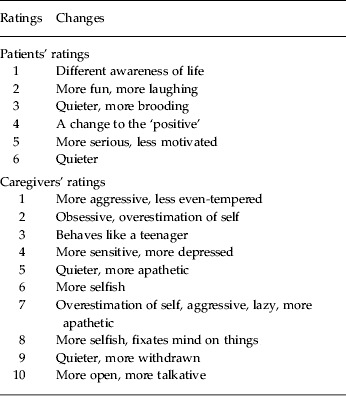
To evaluate potential personality changes, both patients and caregivers were asked if STN-DBS changed the patient's personality. According to patients’ and caregivers’ answers of either ‘yes’ or ‘no’, patients were then divided into change and no-change groups. The term ‘personality changes’ was not defined by the interviewer, so patients’ and caregivers’ definition of personality, not an expert's definition, was used, as not to influence the subjective perception. If their answer was ‘yes’, patients and caregivers were subsequently asked to describe the perceived changes. The descriptions of perceived ‘personality changes’ were documented (Table 1).
Descriptions of subjectively perceived personality changes

To evaluate potential mood changes, patients were asked how their mood was at the time of the 1-year follow-up and whether it had changed after STN-DBS surgery, and were, accordingly, sorted into positive-change and negative-change groups.
Patients’ data were excluded from a further analysis of mood changes if they were unable to define a specific direction of change or did not comment on mood at all.
Additionally, patients were asked if they would redo surgery again. The answers to this question were also categorized for this study.
Neurological assessment
Pre- and postoperatively, motor performance was assessed with the Unified Parkinson's Disease Rating Scale Part III (UPDRS-III; Fahn et al. Reference Fahn, Elton, Fahn, Marsden, Calne and Goldstein1987). Pre-operatively, movement was measured in medication on- and off-states. The off-state was defined as at least 12 h without anti-Parkinsonian medication, whereas the on-state was defined as the patient's best response to 1.5 times their morning dose or at least 200 mg soluble l-dopa after the off-state. Dopamine agonists were stopped 72 h prior to the off-state evaluation. Postoperatively, the UPDRS-III was measured with stimulation on optimized stimulation parameters and medication in the off-state. Also, the l-dopa equivalent daily dose (LEDD) was assessed (Diener & Putzki, Reference Diener and Putzki2008).
Primary outcome parameter
The PDQ-39 (Jenkinson et al. Reference Jenkinson, Fitzpatrick, Peto, Greenhall and Hyman1997), measuring disease-related QoL, was the primary outcome parameter in the ELSA-DBS study (range 0–100). Standardized scores of the summary index were used.
Standardized psychiatric and cognitive assessments
Current affective state was assessed at baseline and at the 1-year follow-up with the Beck Depression Inventory-II (BDI-II; Beck et al. Reference Beck, Steer and Brown1996; range 0–63), Apathy Evaluation Scale (AES; Lueken et al. Reference Lueken, Seidl, Schwarz, Völker, Naumann, Mattes, Schröder and Schweiger2006; range 18–72), the state subtest of the State-Trait Anxiety Inventory (STAI-state; Laux et al. Reference Laux, Glanzmann, Schaffner and Spielberger1981; range 20–80), the Self-Report Manic Inventory (SRMI; Bräunig et al. Reference Bräunig, Shugar and Krüger1996; Krüger et al. Reference Krüger, Bräuning and Shugar1997; range 0–48) and the Barratt Impulsiveness Scale (BIS-11; Patton et al. Reference Patton, Stanford and Barratt1995). Higher scores correspond to higher depression, apathy, anxiety, mania and impulsivity.
As a quantitative measure of personality changes, the Hypomanic Personality Scale (HPS; Eckblad & Chapman, Reference Eckblad and Chapman1986; Meyer et al. Reference Meyer, Druke and Hautzinger2000; range 0–48) was used, where higher values correspond to a more overactive and gregarious personality style characterized also by positive affect, extraversion and openness to experience (Meyer, Reference Meyer2002).
Cognition was analysed at baseline and at the 1-year follow-up with the Mini Mental Status Examination (MMSE; Folstein et al. Reference Folstein, Folstein and McHugh1975) and at baseline with the Mattis Dementia Rating Scale (MDRS; Mattis, Reference Mattis1988).
Assessment of caregivers
Depression of caregivers was measured with the BDI-II at all assessment points. Cognition was measured at baseline and the 1-year follow-up with the MMSE.
Surgical procedure
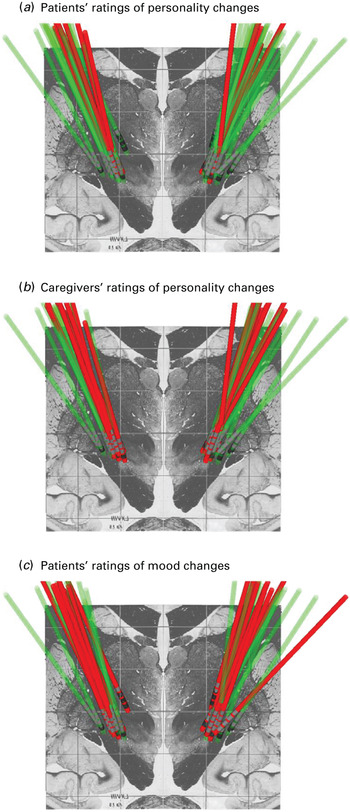
During DBS surgery, stereotactic computed tomographys (CTs) and stereotactic 1.5 T magnetic resonance images were used to determine the coordinates of the target structure. Additionally, microelectrode recordings and macroelectrode test stimulation determined the optimal area for implantation. To verify the target coordinates for the electrodes, STN-typical local field potentials and microelectrode activity were derived during surgery through microelectrode recordings. Electrodes were implanted bilaterally in the STN. Intra-operative and also postoperative two-planar stereotactic X-rays with markers were conducted, whilst the patient was still in the stereotactic frame, to confirm electrode locations. The electrodes were then connected to a pulse generator. At 3 to 5 days after surgery, STN stimulation was first activated, combined with a stepwise reduction of anti-Parkinsonian medication during an average hospitalization period of 10 days. Fig. 1 shows the location of the electrodes, colour-coded according to ratings of personality changes and mood changes. The individual anterior commissure–posterior commissure coordinates of the patients’ electrodes were localized using STP3 software (Stryker Leibinger, Germany).
Individual colour-coded anterior commissure–posterior commissure coordinates of the patients’ electrodes, localized using STP3 software (STP3; Stryker Leibinger, Germany). (a) Patients’ ratings of personality changes (red = personality change yes, green = personality change no). (b) Caregivers’ ratings of personality changes (red = personality change yes, green = personality change no). (c) Patients’ ratings of mood changes (red = negative mood change, green = positive mood changes).

Statistical analysis
The data were analysed with SPSS version 20.0 (IBM, USA). Descriptive statistics were analysed for patients and caregivers separately and baseline and 1-year follow-up values were compared with paired-samples t tests. Also, patient and caregiver baseline depression ratings were compared with a paired-samples t test.
For hypothesis 1, the semi-structured interviews were analysed concerning two categories: ‘personality changes’ and ‘mood changes’. Patients were grouped according to subjectively perceived personality (change and no-change groups) and mood changes (negative-change and positive-change groups).
For hypothesis 2, repeated-measures analyses of variance (rmANOVAs), with group as the between-subjects variable and standard neurological and psychiatric data over time as within-subjects variables, were performed. The within-subjects effect (time), between-subjects effect (group) and interaction effect (time × group) were examined. Additionally, the two groups were compared at baseline and at 1-year follow-up using standard neurological and psychiatric data, with independent-samples t tests.
In an exploratory approach, to examine potential preoperative predictors, binary logistic regression analysis (forwards LR method) was calculated, with the groups as dependent variables and the standard neurological and psychiatric data as predictors.
To indicate statistical significance, p < 0.05 was chosen.
Results
Patients: baseline characteristics and clinical changes
Mean age of the 27 patients was 61.1 (s.d. = 9.1) years at baseline, with an average of 11.15 (s.d. = 4.14) years of education. Average disease duration of PD was 12.7 (s.d. = 6.7) years. The primary outcome, QoL, as measured with the PDQ-39, improved significantly under STN-DBS [baseline: 37.59 (s.d. = 13.46), 1-year follow-up: 30.74 (s.d. = 14.07), t 26 = 2.51, p = 0.019].
At baseline the mean MDRS score was 140.95 (s.d. = 4.67) and the mean MMSE score was 28.52 (s.d. = 1.83), which did not change significantly between baseline and the 1-year follow-up [28.76 (s.d. = 1.39), t 24 = −0.862, p = 0.397]. Also, the mean BDI-II score did not change significantly between baseline and the 1-year follow-up [12.59 (s.d. = 8.72) and 10.19 (s.d. = 6.59), t 26 = 1.41, p = 0.168], but was on average below the cut-off of 13 for mild depression. Clinical improvement with respect to PD-related motor symptoms was observed: the UPDRS-III scores significantly improved by 41% under STN-DBS [baseline off-state: 43.4 (s.d. = 13.8); 1-year follow-up off-state with stimulation on: 25.6 (s.d. = 13.9); n = 21, t 20 = 6.53, p < 0.001]. The LEDD significantly decreased under STN-DBS [baseline: 831.5 (s.d. = 425.91), 1-year follow-up: 359.23 (s.d. = 264.46), t 25 = 6.08, p ⩽0.001].
The question of whether patients would do surgery again was answered with ‘yes’ by 25 patients, and with ‘no’ by only two patients.
Caregivers: baseline characteristics and clinical changes
Mean age of the 27 caregivers was 56.26 (s.d. = 14.91) years at baseline. Of the caregivers, 24 were spouses, one caregiver was the daughter-in-law of the patient and two caregivers were adult children of a patient. Except for three, all caregivers knew the patient before the onset of the disease. The mean MMSE score was 28.91 (s.d. = 0.94) at baseline and did not change between baseline and the 1-year follow-up [29.00 (s.d. = 0.63), t 10 = −0.25, p = 0.810 for n = 11]. The mean BDI-II score did not change significantly between baseline and the 1-year follow-up [11.59 (s.d. = 9.75) and 12.00 (s.d. = 9.80), t 21 = −0.46, p = 0.653 for n = 22] and was therefore on average below the cut-off of 13 for mild depression. Of interest as well is that patients and caregivers did not differ significantly with respect to their baseline depression score [patients: 13.24 (s.d. = 8.65), caregivers: 10.76 (s.d. = 9.47), t 24 = 1.0, p = 0.330].
Personality changes
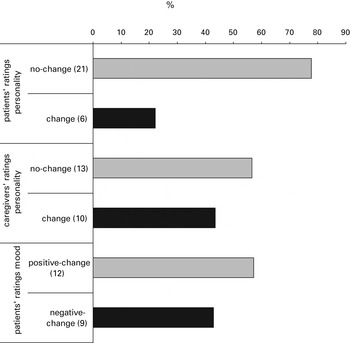
Of 27 patients questioned whether a ‘personality change’ had occurred postoperatively, six (22.2%) patients affirmed this, whereas 21 did not (77.8%) (Fig. 2). In comparison, 10 of the 23 caregivers (43.5%) perceived a postoperative ‘personality change’ in the patients. Of these 10 patients, three had also rated themselves as changed. Therefore, in the case of three patients who perceived a personality change, this was not reflected by their caregivers. Four caregivers were not able to be interviewed at the 1-year follow-up. Table 1 depicts patients’ and caregivers’ descriptions of perceived personality changes, ranging from ‘more open, more talkative’ to ‘quieter, more apathetic’.
Group enumerations of subjectively perceived personality and mood changes at the 1-year follow-up. Values are given as percentages, showing the quantity of participants of one particular answering category in respect to the whole group. Numbers of participants are given in parentheses.

The following citations illustrate the subjectively perceived ‘personality changes’ by a patient and a caregiver:
Citation 1: Patient X (male, married)
Interviewer (I): ‘Have you noticed a change of mood since the operation?’
Patient (P): ‘It has become more fun for me.’
I: ‘What does that mean?’
P: ‘I can afford not to go by the rules, which my wife does not like. I have to admit that. And I can take part in the social aspects of life a lot more. […]’
I: ‘In your opinion, has your personality changed since the operation?’
P: ‘Yes. The awareness of living and being connected to life has changed. So the most difficult things in life don't always seem the most difficult.’
Citation 2: Caregiver X (female, spouse of patient X)
I: ‘Would you say that your husband has changed his personality through the stimulation?’
Caregiver (C): ‘Yes, absolutely! He is so very positive, but overestimates himself. Getting him to behave in a way I can cope with is very difficult.’
I: ‘OK, so he overestimates himself. Which other personality traits have emerged that perhaps weren't so distinctive before the operation?’
C: ‘He is now so very obsessive with certain things. When we are sitting down, reading or watching TV, he suddenly wants to do this or that. But he then has to do it at that exact moment. And during discussions, he cannot concentrate that well anymore or his thoughts just drift. […] I am reminded of my pupils who were always looking for excuses. But maybe I am too sensitive…’
With respect to disease duration, patients of the no-change group were significantly longer affected by PD than patients of the change group [14.10 (s.d. = 6.60) v. 7.83 (s.d. = 4.79), t 25 = 2.15, p = 0.041].
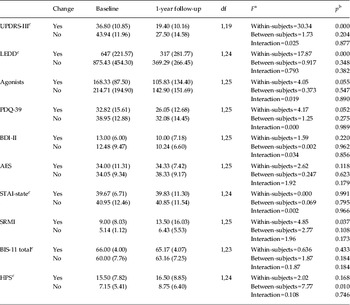
Results of the rmANOVAs concerning subjective perceived personality changes are depicted in Table 2. As reflected by a significant effect of time for the UPDRS-III, motor symptoms improved significantly, while no significant effect of group or interaction was found. The LEDD showed a significant decrease over time, whilst no significant effects for group or interaction were found. Concerning dopamine agonists, no significant effects for time, group or interaction were found. Also, no significant effects of group or interaction were discovered for QoL. However, there was a tendency for QoL to improve over time.
ANOVA: personality changes

Values are given as mean (standard deviation).
ANOVA, Analysis of variance; df, degrees of freedom; UPDRS-III, Unified Parkinson's Disease Rating Scale Part III; LEDD, levodopa equivalent daily dose; PDQ-39, Parkinson's Disease Questionnaire-39; BDI-II, Beck Depression Inventory; AES, Apathy Evaluation Scale; STAI, State-Trait Anxiety Inventory; SRMI, Self-report Manic Inventory; BIS-11, Barratt Impulsiveness Scale; HPS, Hypomanic Personality Scale.
a Values by repeated-measures ANOVA with group (change v. no-change) as the between-subjects variable.
b A p value of < 0.05 was taken as statistically significant.
c Missing values.
A significant effect of time was identified for the SRMI, suggesting an increase in mania scores at the 1-year follow-up. Again, no group difference or interaction effect was registered. Finally, a significant group effect was revealed for the HPS, showing that patients of the change group had an overall higher score on the HPS compared with patients of the no-change group. No significant effect of time or interaction was found for the HPS. Moreover, no significant effect of time, group or interaction was identified regarding depression (BDI-II), apathy (AES), anxiety (STAI-state) or impulsivity (BIS-11).
In the binary logistic regression analysis, baseline scores of the UPDRS-III, BDI-II, AES, STAI-state, SRMI, BIS-11 and HPS were covariates, whilst the personality change grouping (no-change and change) was the dependent variable. The baseline hypomania trait was a significant predictor for the patients’ ratings of personality changes, explaining 32.8% of the variance (Nagelkerke R 2) and correctly classifying 74.1% of the patients (p = 0.031; 95% confidence interval 1.02–1.43). This shows that the higher the preoperative hypomania personality score, the higher the risk of perceiving a personality change. No significant predictors for personality changes rated by caregivers were found, when using the same covariates and caregivers’ personality ratings as the dependent variable.
Mood changes
Mood changes were noted by 21 patients in the interviews, of which 12 (57.1%) described a positive change in mood, whereas nine (42.9%) rated it as negatively changed (Fig. 2).
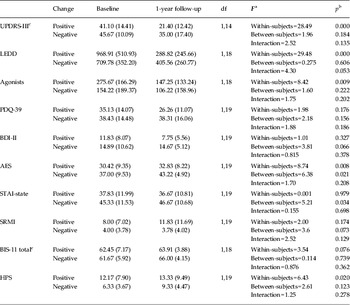
Results of the rmANOVAs concerning subjective perceived mood changes are presented in Table 3. As shown by a significant effect of time for the UPDRS-III, motor symptoms improved significantly, while no significant effect of group or interaction was found. Also, the LEDD and the dopamine agonists showed a significant decrease over time; however, no significant effects for group or interaction were found. No significant effects were discovered for QoL. As shown regarding a significant effect of time for the AES, apathy significantly worsened. Also a significant effect for group was found for the AES, with overall higher apathy scores in the negative-change group. Moreover, the group effect was significant for anxiety, also showing higher ratings in the negative-change group. Also, a significant effect for time was seen in the HPS, showing an increase of hypomanic personality traits for the whole group.
ANOVA: mood changes

Values are given as mean (standard deviation).
ANOVA, Analysis of variance; df, degrees of freedom; UPDRS-III, Unified Parkinson's Disease Rating Scale Part III; LEDD, levodopa equivalent daily dose; PDQ-39, Parkinson's Disease Questionnaire-39; BDI-II, Beck Depression Inventory; AES, Apathy Evaluation Scale; STAI, State-Trait Anxiety Inventory; SRMI, Self-report Manic Inventory; BIS-11, Barratt Impulsiveness Scale; HPS, Hypomanic Personality Scale.
a Values by repeated-measures ANOVA with group (positive v. negative) as the between-subjects variable.
b A p value of <0.05 was taken as statistically significant.
c Missing values.
No significant effect of time, group or interaction was identified regarding depression (BDI-II), mania (SRMI) or impulsivity (BIS-11).
With respect to disease duration, patients of the negative-change group were significantly longer affected by PD than patients of the positive-change group [14.67 (s.d. = 5.43) v. 8.5 (s.d. = 4.30), t 19 = −2.91, p = 0.009].
With the binary logistic regression analysis, baseline scores of the UPDRS-III, BDI-II, AES, STAI-state, SRMI, BIS-11 and HPS were covariates, whilst the mood-change grouping (negative-change and positive-change) was the dependent variable. No significant predictors were found.
Discussion
This prospective mixed-methods study analysed personality and mood changes under STN-DBS, subjectively perceived by patients as well as caregivers. To the best of our knowledge, this approach has not before been systematically investigated. Also, predictors concerning patients’ personality and mood changes were analysed. Our study sample showed a vast improvement of motor symptoms under STN-DBS, in accordance with large multi-centre trials (Deuschl et al. Reference Deuschl, Schade-Brittinger, Krack, Volkmann, Schäfer, Bötzel, Daniels, Deutschländer, Dillmann, Eisner, Gruber, Hamel, Herzog, Hilker, Klebe, Kloss, Koy, Krause, Kupsch, Lorenz, Lorenzl, Mehdorn, Moringlane, Oertel, Pinsker, Reichmann, Reuss, Schneider, Schnitzler, Steude, Sturm, Timmermann, Tronnier, Trottenberg, Wojtecki, Wolf, Poewe and Voges2006; Follett et al. Reference Follett, Weaver, Stern, Hur, Harris, Luo, Marks, Rothlind, Sagher, Moy, Pahwa, Burchiel, Hogarth, Lai, Duda, Holloway, Samii, Horn, Bronstein, Stoner, Starr, Simpson, Baltuch, De Salles, Huang and Reda2010; Schuepbach et al. Reference Schuepbach, Rau, Knudsen, Volkmann, Krack, Timmermann, Hälbig, Hesekamp, Navarro, Meier, Falk, Mehdorn, Paschen, Maarouf, Barbe, Fink, Kupsch, Gruber, Schneider, Seigneuret, Kistner, Chaynes, Ory-Magne, Brefel Courbon, Vesper, Schnitzler, Wojtecki, Houeto, Bataille, Maltête, Damier, Raoul, Sixel-Doering, Hellwig, Gharabaghi, Krüger, Pinsker, Amtage, Régis, Witjas, Thobois, Mertens, Kloss, Hartmann, Oertel, Post, Speelman, Agid, Schade-Brittinger and Deuschl2013). Also, at the 1-year follow-up, 25 of 27 patients stated that they would redo the surgery, thereby showing that despite some undesirable side effects, the benefits of surgery dominate.
Personality changes
The data confirm our first hypothesis, showing that personality changes are subjectively perceived by patients and caregivers. The evidence that 22% of patients perceive an influence on their personality under STN-DBS can be seen as a finding of ethical relevance. The impact of this result is increased by the fact that nearly 50% of the caregivers perceive a personality change in a patient.
Looking at the descriptions of personality changes by patients and caregivers, one could argue that they do not follow a standard psychiatric definition of personality change, which is a difficult issue also for professionals (Mischel, Reference Mischel2004; Witt et al. Reference Witt, Kuhn, Timmermann, Zurowski and Woopen2013). Being quieter, more aggressive or even happier might not be changes that would be analysed as ‘personality changes’ by established psychiatric tests. However, they are nevertheless of obvious interest to patients’ families and all those concerned with follow-up care of STN-DBS patients. The citations of the 1-year follow-up interviews show how such changes can endanger relationships and family life. Not meeting standard criteria for personality change does therefore not count against the ethical relevance of our results and this should be a serious call for the medical community to further investigate this topic.
Furthermore, it should be noted that the impact of the pre-morbid personality (Glosser et al. Reference Glosser, Clark, Freundlich, Kliner-Krenzel, Flaherty and Stern1995; Poletti & Bonuccelli, Reference Poletti and Bonuccelli2012), dopaminergic deficits (Tomer & Aharon-Peretz, Reference Tomer and Aharon-Peretz2004) and PD medication (Bódi et al. Reference Bódi, Kéri, Nagy, Moustafa, Myers, Daw, Dibó, Takáts, Bereczki and Gluck2009) on personality changes in non-stimulated PD patients has been noted in previous studies. The personality changes could thus be due not only to the STN-DBS, but to medication reduction or disease progression, or are attributable to changed motor and social behaviour (Specht et al. Reference Specht, Egloff and Schmukle2011). However, research has linked personality to brain regions, such as the medial orbitofrontal cortex (extraversion) and the medial temporal lobe and basal ganglia (neuroticism) (DeYoung et al. Reference DeYoung, Hirsh, Shane, Papademetris, Rajeevan and Gray2010), which might be stimulated by DBS through the basal-ganglia cortex loops (Benarroch, Reference Benarroch2008; Obeso et al. Reference Obeso, Rodríguez-Oroz, Benitez-Temino, Blesa, Guridi, Marin and Rodriguez2008). This could show a neurological basis for a possible influence of STN-DBS on ‘personality’, as described by patients and caregivers.
Furthermore, the question remains whether a personality change approaches or perhaps further estranges a patient from his pre-morbid personality.
According to our interview data in Table 1, patients were not described as ‘returning to their former selves’, but as having changed furthermore, in positive and negative directions. The citations show how patients can be influenced by these personality changes, how they disrupt relationships and family life, and how remarkably different the changes are perceived by patient and caregiver. The patient in this case is happy about his new look on life, whereas his wife has trouble coping with him. Discrepancies between patients’ and caregivers’ view on DBS outcome has also been shown in other studies (Schüpbach et al. Reference Schüpbach, Gargiulo, Welter, Mallet, Béhar, Houeto, Maltête, Mesnage and Agid2006).
Concerning the characterization of patients from each group through quantitative data (hypothesis 2), solely the HPS, a quantitative measure of a hypomanic personality trait, supports the interview statements by differentiating between the yes-change and no-change groups. QoL as well as motor symptoms show an overall improvement in time, which is a finding similar to other studies (Deuschl et al. Reference Deuschl, Schade-Brittinger, Krack, Volkmann, Schäfer, Bötzel, Daniels, Deutschländer, Dillmann, Eisner, Gruber, Hamel, Herzog, Hilker, Klebe, Kloss, Koy, Krause, Kupsch, Lorenz, Lorenzl, Mehdorn, Moringlane, Oertel, Pinsker, Reichmann, Reuss, Schneider, Schnitzler, Steude, Sturm, Timmermann, Tronnier, Trottenberg, Wojtecki, Wolf, Poewe and Voges2006). The significant time effect of mania might show an inducement of mania state through STN-DBS, which could be perceived as positive by some patients and negative by others (Schüpbach et al. Reference Schüpbach, Gargiulo, Welter, Mallet, Béhar, Houeto, Maltête, Mesnage and Agid2006).
It is important to note that patients in the yes-change group were characterized by a significantly shorter disease duration. One might speculate that the disease progressed faster in these patients (Rajput et al. Reference Rajput, Voll, Rajput, Robinson and Rajput2009), thereby influencing different neurological correlates. Furthermore, self-awareness could be dissimilar in both groups (Leritz et al. Reference Leritz, Loftis, Crucian, Friedman and Bowers2004; Maier et al. Reference Maier, Prigatano, Kalbe, Barbe, Eggers, Lewis, Burns, Morrone-Strupinsky, Moguel-Cobos, Fink and Timmermann2012).
The EARLYSTIM study (Schuepbach et al. Reference Schuepbach, Rau, Knudsen, Volkmann, Krack, Timmermann, Hälbig, Hesekamp, Navarro, Meier, Falk, Mehdorn, Paschen, Maarouf, Barbe, Fink, Kupsch, Gruber, Schneider, Seigneuret, Kistner, Chaynes, Ory-Magne, Brefel Courbon, Vesper, Schnitzler, Wojtecki, Houeto, Bataille, Maltête, Damier, Raoul, Sixel-Doering, Hellwig, Gharabaghi, Krüger, Pinsker, Amtage, Régis, Witjas, Thobois, Mertens, Kloss, Hartmann, Oertel, Post, Speelman, Agid, Schade-Brittinger and Deuschl2013) showed that shorter disease duration leads to good QoL results under STN-DBS. In this study, however, patients with longer disease duration perceived fewer personality changes than patients with shorter disease duration. Therefore we suggest careful monitoring of the patients, especially those with shorter disease duration, post-surgically and to help them and their caregivers adapt to the new situation more easily, if complications, such as personality changes, should occur.
However, patients subjectively perceiving personality changes could not be characterized by any other standard quantitative measure used in this study, meaning that the standard test instruments do not pick up all topics that matter to patients and caregivers. Additional measures, perhaps focusing more on personality changes, should therefore be used in deciding on STN-DBS treatment and outcome for PD patients.
Also, the HPS might be a relevant preoperative rating scale, as it predicts subjectively perceived personality changes. This result shows that patients with a high baseline hypomania trait score should be monitored closely by a psychologist or psychiatrist, that medication should be adapted carefully and stimulation in the ventral parts of the STN should be avoided, as not to enhance hypomania through stimulation (Mallet et al. Reference Mallet, Schüpbach, N'Diaye, Remy, Bardinet, Czernecki, Welter, Pelissolo, Ruberg, Agid and Yelnik2007). These measures could protect the patients and their environment, as hypomania could lead to social difficulties such as patients losing money through gambling or destroying their family life (Schüpbach et al. Reference Schüpbach, Gargiulo, Welter, Mallet, Béhar, Houeto, Maltête, Mesnage and Agid2006; Maier et al. Reference Maier, Merkl, Ellereit, Lewis, Eggers, Pedrosa, Kalbe, Kuhn, Meyer, Zurowski and Timmermann2014).
Mood changes
Concerning mood changes, hypothesis 1 was also confirmed. About the same amount of patients perceived mood as positively or negatively changed.
Hypothesis 2 seems confirmed to some degree, as apathy and anxiety ratings differed significantly between the two groups. Patients with negative mood changes had overall higher apathy and anxiety ratings. Whereas anxiety is not influenced by STN-DBS, apathy, which tends to worsen in STN-DBS patients (Funkiewiez et al. Reference Funkiewiez, Ardouin, Caputo, Krack, Fraix, Klinger, Chabardes, Foote, Benabid and Pollak2004), also increased in our patients. According to other studies, depression as well as anxiety reduce under STN-DBS (Funkiewiez et al. Reference Funkiewiez, Ardouin, Caputo, Krack, Fraix, Klinger, Chabardes, Foote, Benabid and Pollak2004; Houeto et al. Reference Houeto, Mallet, Mesnage, Tezenas du Montcel, Béhar, Gargiulo, Torny, Pelissolo, Welter and Agid2006), which was not the case in our cohort. However, patients in the negative-change group had a significantly longer disease duration, which probably influenced their perception of symptoms and might have led to more negative mood. However, no significant interaction effects were shown, leading to the conclusion that STN-DBS does not really have an influence on mood, but that negative mood is not improved under STN-DBS. A possible agonist withdrawal syndrome as an underlying factor for mood changes was not confirmed by our data (Thobois et al. Reference Thobois, Ardouin, Lhommée, Klinger, Lagrange, Xie, Fraix, Coelho Braga, Hassani, Kistner, Juphard, Seigneuret, Chabardes, Mertens, Polo, Reilhac, Costes, LeBars, Savasta, Tremblay, Quesada, Bosson, Benabid, Broussolle, Pollak and Krack2010), as no significant differences between the groups were found concerning the reduction of the LEDD or dopamine agonists. Also, research has shown that apathy and depression are predictors for a subjective negative outcome of STN-DBS (Maier et al. Reference Maier, Lewis, Horstkoetter, Eggers, Kalbe, Maarouf, Kuhn, Zurowski, Moro, Woopen and Timmermann2013). Therefore, enhancing mood preoperatively, for instance through psychotherapy (Macht et al. Reference Macht, Pasqualini and Taba2007; Dobkin et al. Reference Dobkin, Menza, Allen, Gara, Mark, Tiu, Bienfait and Friedman2011) or medication, could lead to a more positive STN-DBS outcome for patients. This should be further analysed.
Strengths and limitations
Strengths of this study are that it was externally audited and prospective, as well as following a novel, multidimensional and highly up-to-date approach. Additionally, the use of both semi-structured interviews and quantitative data might reveal different aspects of the outcome of STN-DBS in PD (Keel et al. Reference Keel, Crow, Davis and Mitchell2002). Limitations of this study are the relatively small study cohort, in part due to the unfortunate large number of drop-outs. A reason for this could be the demanding amount of data collected and the confrontation of patients and caregivers with very personal interviews. The per-protocol analysis excluding data of drop-outs is a potential bias. Also, it remains unclear which factor, STN-DBS, medication reduction or disease progression, underlies the subjectively perceived personality and mood changes. Comparative studies, medication versus DBS, are therefore needed. Also, the classification in ‘personality changes’ or ‘no personality changes’ is simplified; however, it depicts patients’ and caregivers’ individual subjective perception of personality changes under STN-DBS. Furthermore, of the quantitative data used as a comparison to subjectively perceived personality, only the HPS is a measure of personality trait. This was used due to accounts of hypomania as a side effect of STN-DBS (Mallet et al. Reference Mallet, Schüpbach, N'Diaye, Remy, Bardinet, Czernecki, Welter, Pelissolo, Ruberg, Agid and Yelnik2007; Ulla et al. Reference Ulla, Thobois, Llorca, Derost, Lemaire, Chereau-Boudet, De Chazeron, Schmitt, Ballanger, Broussolle and Durif2011). Further studies comparing interview data with more general personality measurements are needed.
Conclusion
We conclude that patients, as well as caregivers, perceive changes of personality under STN-DBS. Also, mood-shifts in positive and negative directions were described. Some changes are reflected by standard measurement scales, but it is unclear in what way STN-DBS really influences these changes. The relevancy of this ethical difficulty is thereby suggested. Knowing that some patients perceive a personality change could be of clinical use, as it could be helpful for preoperative illustrations of STN-DBS outcome (Wilson et al. Reference Wilson, Bladin and Saling2001). Perhaps the HPS would be a useful preoperative screening method. Also preoperative and postoperative rehabilitation could be adapted to the needs of patients and caregivers (Macht et al. Reference Macht, Pasqualini and Taba2007; Witt, Reference Witt2013). A more individualized preoperative screening of mood and preparation with patients and caregivers, as well as postoperative support and advice, could be helpful in coping with these subjectively perceived changes.
Supplementary material
For supplementary material accompanying this paper visit http://dx.doi.org/10.1017/S0033291714001081.
Acknowledgements
This study was performed under the control of ZKS Köln. C.L., F.M. and L.T. gratefully report funding from the German Parkinson's disease foundation (Deutsche Parkinson Vereinigung e.V.; dPV). This work was supported by the German Ministry of Education and Research (BMBF) and by the Canadian Institute of Health Research (grant no. 01GP0806). This study was part of the international and interdisciplinary project ‘Ethical, Legal, and Social Aspects of Deep Brain Stimulation (ELSA-DBS)’.
Declaration of Interest
C.E. has received speaker's honoraria from Medtronic Inc., TEVA Pharma and UCB Pharma. T.D.M. has received speaker's honoraria from Lundbeck and Bristol-Myers Squibb. M.M. has received speaker's honoraria from Medtronic Inc. E.M. has received honoraria from Medtronic for consulting services and lecturing. She has also received research support from St. Jude Medical, CurePSP, CIHR and educational grant support from Medtronic in the past 12 months. J.K. has received honoraria from AstraZeneca, Lilly, Lundbeck, and Otsuka Pharma for lecturing at conferences and financial support to travel. J.K. received financial support for IIT-DBS studies (not the present investigation) from Medtronic GmbH (Meerbusch, Germany). L.T. is consultant for Medtronic Inc., Boston Scientific, Bayer Healthcare, UCB Schwarz Pharma, received honoraria in symposia sponsored by TEVA Pharma, Lundbeck Pharma, Bracco, Gianni PR, Medas Pharma, UCB Schwarz Pharma, Desitin Pharma, Boehringer Ingelheim, GlaxoSmithKline, Eumecom, Orion Pharma, Medtronic, Boston Scientific, Cephalon, Abbott and GE Medical. The institution of Professor Timmermann, not Professor Timmermann himself, received funding from the German Research Foundation (DFG) via the Clinical Research Group 219, the German Ministry of Education and Research (BMBF), Manfred und Ursula Müller Stiftung, Klüh Stiftung, Hoffnungsbaum e.V., NBIA Disorders Association USA, the medical faculty of the University of Cologne via the ‘Köln Fortune program’, Medtronic Inc. and the German Parkinson Foundation (Deutsche Parkinson Vereinigung).