On 4 May 1928 representatives of the Hungarian Parliament gathered to discuss the government's budget for the upcoming year. On this day the debate was focused on the financial needs of the Ministry of Religion and Public Education (Vallás- és Közoktatási Minisztérium; VKM). Kuno Klebelsberg, minister of VKM, was accused of recklessly driving up the budget ‘at 80 kilometres per hour even though the state resources could handle only 40 kilometres per hour’.Footnote 1 Klebelsberg did not deny the fact that he was pursuing an increased speed. On the contrary, he embraced the analogy of an automobile race. He argued that on the road of history there were four race cars. For now, he continued, the first car – Hungary – was still in the lead. However he warned that the other three cars – Romania, Yugoslavia (referred to as Serbia) and Czechoslovakia – were catching up and threatening to overtake and leave Hungary behind.Footnote 2 Klebelsberg's analogy of an automobile race indeed allows us to understand and illustrate at least two of the essential characteristics of interwar Hungarian cultural diplomacy: urgency and anxiety-ridden competition. Both of these features of Hungarian cultural diplomacy were rooted in the traumatic event of the post-war Treaty of Trianon. Hungary lost nearly three-quarters of its pre-war territory and two-thirds of its pre-war population, about three million of them ethnic Hungarians. The treaty also severely damaged the country's economy, for it lost a great deal of its infrastructure, including railway lines, roads and waterways, not to mention the loss of natural resources, such as timber, iron, coal and the like. Politicians, intellectuals and other contemporary observers attributed the treaty's severity to a lack of Western knowledge and understanding of Hungary and its contributions to Western culture and civilisation, as well as the damage caused by wartime enemy propaganda. Thus, Hungarian efforts to craft a cultural diplomacy were founded on an anxiety about the perceived disconnect between Hungary's view of itself and its foreign image. The architects of the country's cultural diplomatic campaign felt that the nation and its accomplishments were marginalised at best. Their goal was to preserve and portray Hungary's alleged cultural superiority (kultúrfölény) in the region intact. Convincing the international community that the country was the principal European power in the region aimed to secure international recognition for the newly reconstituted country, as well as international support for Hungary's revisionist ambition to alter the post-war international order.
The race – to carry on with Klebelsberg's analogy – was a cultural diplomatic race that took place on the stage that was provided by the emergence of cultural internationalism. As historian Philip M. Taylor explained, by the beginning of the twentieth century ‘attempts to inform, cultivate, control and manipulate public opinion [had] resulted in the scientific development of the new arts of publicity, public relations, advertising and propaganda conducted through organisations designed specifically to influence the audience to respond in a manner desired by those in power or by those wish to be in power’.Footnote 3 The real turning point was the First World War, for in its aftermath cultural diplomacy first began to emerge as a significant tool in international relations.Footnote 4 The earlier established French Alliance Française (1883) was soon joined by similar German institutions, the Italian Dante Alighieri Society, the Soviet Union's Soviet Society for Cultural Relations with Foreign Nations, the Japanese Kokusai Bunka Shinkokai, the British Council and similar institutions and efforts in Bulgaria, Spain and Sweden.Footnote 5 Until recently, interwar cultural diplomacy – especially that of East-Central Europe – received very little scholarly attention. The vast majority of studies examined Cold War cultural diplomacy from the vantage point of the Soviet Union and the United States.Footnote 6 Others investigated Soviet and US practices beyond the Cold War.Footnote 7 Philip M. Taylor's study of interwar British publicity and propaganda, Jessica C. E. Gienow-Hecht's call for decentralising the study of cultural diplomacy and Andrea Orzoff's trailblazing examination of interwar Czechoslovak cultural diplomacy reshaped the way we think of the role and practices of cultural diplomacy.Footnote 8 My previous publications and my recent monograph examining interwar Hungarian cultural diplomacy also sought to examine the importance of the period's cultural diplomacy as it was utilised by a small nation.Footnote 9
The arrival of cultural internationalism – the name Akira Iriye gave to the explosion of post-First World War cultural organisations and activities that sought to bring forth international cooperation and mutual understanding – provided a fertile ground for practitioners of cultural diplomacy.Footnote 10 Glenda Sluga further explained that ‘the stimulant for this popular and intellectual interest in a new internationalism was not only the transnational spread of ideas and power of “public opinion” that accompanied mass literacy, but also the constant threat of war and the evidence of atrocities in the name of nationalism’.Footnote 11 Yet, as she and others clearly illustrated, the emergence of internationalism did not weaken nationalism and the primacy of the nation state. Fear and anxiety about the future of the nation state remained. Internationalism, more specifically, cultural internationalism, afforded new spaces, reshaped old and created new avenues for governments to continue with national competition in different ways. To achieve the goals of the nation state, governmental and non-governmental organisations aided by artists and intellectuals carried out a range of different cultural diplomatic campaigns on the international stage.
This article examines the four stages of interwar Hungarian cultural diplomacy, or to build on minister Klebelsberg's metaphor, the grand prix. The first stage (1918–27) examines the origins and the impetus behind the cultural diplomatic campaign. The second stage (1927–33), by focusing on the 1930–1 St. Imre Year and the 1933 Fourth World Scout Jamboree, illustrates Hungarian efforts to solidify the nation's status in the new world order and the emergence of cultural diplomacy as a tool of the country's newly activated foreign policy. The third stage (1933–8), highlighted by the Hungarian exhibition at the 1937 Paris Exposition Internationale, represents the apogee of interwar Hungarian cultural diplomacy. The fourth and final stage (1938–41) exemplifies the limitations of interwar Hungarian cultural diplomacy and its demise.
The present article contributes to our understanding of the practice of cultural diplomacy in Europe's twenty-year crisis from the small nations’ vantage point. The Hungarian case offers a unique angle to study the practice. Cultural diplomacy, while surely available to all, was not the great equaliser. There was a clear difference in the existing and available cultural and financial capital of the large and powerful countries and the small and powerless countries even if the goals were similar. Unlike Germany and Italy, with their own aspirations for treaty revisions, Hungary was not only a small and mostly powerless country but also a nation whose historical and cultural influence could not compete with the recognition afforded to German and Italian culture. On the other hand, not all small countries were the same either. Hungary, unlike its regional competitors – the likes of Czechoslovakia, Romania and Yugoslavia – was a defeated country and, even more importantly, in contrast to them, it desired to amend or even entirely revise the post-war status quo. Despite these challenges, practitioners of interwar Hungarian cultural diplomacy built a robust campaign, for they believed that in the absence of economic power, coupled with the lack of military power and foreign influence, cultural diplomacy was a viable alternative in the nation's pursuit of international recognition and territorial revision. Focusing on the Hungarian efforts, I argue, helps us understand both the possibilities and the limitations of interwar small-nation cultural diplomacy.
Stage One: Traumatic Start and Hesitant Acceleration, 1918–27
The traumatic event that provided the necessary impetus for Hungary's cultural diplomatic campaign was the Treaty of Trianon. This is not to say that Hungarians had entirely ignored the importance of public opinion before. As Alice Freifeld has shown, Hungarians turned the 1848 revolutionary defeat into a narrative of martyrdom and used it to fortify the nation state within the multi-ethnic empire.Footnote 12 However, the target audience here was mainly the domestic public. With the 1867 Ausgleich – the compromise between Austria and Hungary that allowed total domestic autonomy for Hungarians and control over the Transleithanian part of the Dual Empire – Hungarian festivities, commemorations and other public gathering sought to justify and solidify the Magyars’ privileged position within the empire and the Hungarian Kingdom itself. By the 1890s the vision of a ‘Hungary of Magyars’ came to prominence.Footnote 13 At the same time the idea of ‘Hungarian liberal imperialism’ also emerged, which situated Hungary at the strategic position on the border of East and West, and which praised the Hungarian nation's ability to assimilate other non-Magyar groups and to carry out a sort of a ‘civilising mission’ in the region – a concept that was to be the centrepiece of interwar cultural diplomacy, too.Footnote 14 Yet, in the late nineteenth century, as was evident at the 1896 Millennium Exhibition in Budapest, Hungarians decided to showcase the country's supposed Eastern heritage, as they celebrated the figure of Chieftain Árpád – who at the end of the ninth century conquered the land for the Magyars – and used this origin myth to justify the existence of an independent Hungarian Kingdom and to further separate themselves from Catholic Austria.Footnote 15
Defeat in the First World War and the subsequent dissolution of the Austro-Hungarian Empire changed everything. The new state, independent for the first time since 1526, experimented with various forms of government from the bourgeois democratic republic of Mihály Károlyi through Béla Kun's Hungarian Soviet Republic to the establishment of a conservative nationalist-led Hungarian Kingdom under the leadership of the former admiral of the Dual Empire's naval forces, Regent Miklós Horthy. Through revolutions and the violence that accompanied them, the various factions all hoped to maintain the country's territorial integrity.
The signing of the Trianon Treaty on 20 June 1920 ended these hopes. The nation's frame of mind was perhaps most aptly illustrated by the one-word headline in the Budapesti Hírlap: ‘Elvégeztetett’.Footnote 16 By employing John 19:30, ‘it is finished’, the newspaper made a not too veiled comparison between the martyrdom of Jesus Christ and the martyrdom of the nation ‘that took on the cross of peace’.Footnote 17 A day of national mourning followed. It commenced at 10 a.m. with the chiming of all the church bells in Budapest. The shops and restaurants closed, streetcars stopped on their tracks and people gathered in churches and mass rallies to express a ‘mixture of pain and defiance’.Footnote 18 It is not an exaggeration to state that Hungarians – regardless of political and social status – reacted with incredulity and anger. Even the Népszava, a social democratic daily, called the treaty a clear act of ‘vengeance’.Footnote 19 The day was not only the birth of revisionism as the country's civic religion, but it also marked the start of Hungarian foreign policy's persistent revisionism.Footnote 20
After the shock of Trianon, the Hungarian political elite clearly came to believe in the significance of constructing and maintaining a positive foreign image. The Foreign Ministry established a basic foundation for cultural diplomacy by creating a political intelligence division in 1920. The organisation, previously tasked with data collection for making the Hungarian case for maintaining the country's geographical integrity at the Paris Peace Conference, was transformed into a new unit. Under the leadership of Zoltán Gerevich, the section took charge of ‘scientific propaganda’. While this phrase was not clearly defined, the section's practice suggests that the government in its official capacity sought to avoid conducting emotionally charged propaganda and instead focused on coordinating with other governmental and non-governmental organs to produce historical, political and economic arguments that would justify the need for treaty revision.Footnote 21 Subsequent documents indicate that the main task of the unit was to connect Hungary with ‘universal European social, cultural and scientific life’, to bring about ‘friendly relations’ between the country and the international community and to ‘represent Hungarian life from the correct point of view’.Footnote 22 The ‘correct point of view’ was the one that represented Hungary as the nation, which, unlike its neighbours, had historically safeguarded Europe and embodied Europeanness – thus showing how unjustly Hungary had been treated at Trianon. Indicative of the importance the governing elite attributed to the country's foreign image was the widely shared belief that the severity of Trianon was a result of Hungary's being a terra incognita – or at the least a misjudged nation. The principal perpetrator of the false image, most argued, was the wartime propaganda conducted on behalf of or by the neighbouring nationalities. As Klebelsberg put it, ‘slandering’ the Hungarian nation had led the ‘public opinion of the world’ to view Hungary's aspiration and cause as ‘odious’.Footnote 23 Yet, he was also willing to take responsibility for past failures. One of the single largest errors of the past, he argued, was Hungary's excessive focus on domestic issues, while paying no attention to its foreign reputation, ‘as if Hungary were not in the centre of Europe but an island in the Pacific’.Footnote 24 The Hungarian elite were determined not to make the same mistake again.
Despite the righteous indignation, the government was not at this point in a position to make good on its revisionist goals nor was it able to conduct a meaningful cultural diplomatic campaign. The primary focus of the government in the early 1920s, after the short intermezzo of Pál Teleki's cabinet, was the consolidation of the country's domestic and international situation. At home the new prime minister, István Bethlen, led his Christian nationalist political party to make a pact with the Social Democrats, aimed at curtailing the influence of the ultra-right, and also outlawed the communist party.Footnote 25 On the international stage, the newly independent country found itself isolated. Hungary, despite being one of the founding members of the modern Olympic Games, was not allowed to participate at the 1920 Antwerp Olympics. By 1921 Czechoslovakia, Yugoslavia and Romania – under French tutelage – formalised a set of treaties aimed at preventing the return of the Habsburg Monarchy and sought to keep Hungarian revisionism at bay in order to maintain their significant territorial gains. Czechoslovak, Romanian and Yugoslav publicists, and those working closely with them, justly pointed toward the violent nature and political persecution of the White Terror that solidified Horthy's rule, or the fact that the Hungarian National Assembly passed Act XXV of 1920 (more commonly referred to as numerus clausus), which in essence sought to reduce the number of Jewish students in institutions of higher learning and, as some historians argue, not only created the first anti-Jewish law of this kind in Europe, but also produced a precedent for later anti-Jewish legislation of 1938, 1939 and 1941.Footnote 26 Investigations and interventions of various international organisations, including the League of Nations and the British Labour Party, furthered the validity of the Little Entente's criticism of Hungary.Footnote 27 International recognition was necessary for embarking on the economic and financial reconstruction of the country, which most importantly meant securing foreign loans even if they came with the price that the government's budget was overseen by foreign entities.Footnote 28
Despite the prevailing anti-liberal, anti-democratic and, for a while, clearly anti-Semitic character of the Bethlen regime, the West recognised the government and, in turn, provided it with both internal and external legitimacy. Maybe Thomas Lorman explains this best in reference to British policies toward Hungary: ‘the failings of the Bethlen government, its illiberal policies, its grudging acceptance of the peace treaty and its unwillingness to cultivate good relations with its neighbours were all a price worth paying for the economic, social and political stability that were hallmarks of the Bethlen consolidation’.Footnote 29 This new stability made it possible for the government to embark on Klebelsberg's reform programme (neonacionalizmus), which sought to revitalise and restructure the country's cultural and intellectual life.Footnote 30 Besides sweeping domestic reforms in education, he proposed a programme to maintain and even further Hungarian cultural supremacy – which he and others assumed as a given – in the region. Although there was a certain degree of opposition because of the cost associated with the programme, Klebelsberg was able to double the Ministry of Culture's budget of the by 1923 and to triple it by 1927, making it slightly more than ten percent of the entire state budget.Footnote 31 It is worth noting – and Klebelsberg certainly did – that the neighbouring countries, especially Czechoslovakia and Romania, also invested significant amounts in education and culture.Footnote 32 With the financial support Klebelsberg was able to establish a system of Hungarian academic institutions abroad, the flagship institutions being the Collegium Hungaricum in Vienna (1924), Berlin (1924) and Rome (1927). With these institutions, Klebelsberg hoped to create a new, Western educated Hungarian elite as well as to provide places to educate the foreign public about the ‘power of Hungarian culture and knowledge, thus convincing Western audiences about the “injustice of Trianon”’.Footnote 33
Nevertheless, 1927 was the real breakthrough in the history of Hungarian cultural diplomacy. Three key events made this breakthrough possible. On 31 March 1927 the Allied Military Commission, which had supervised Hungarian affairs since 1921, relinquished its role, returning full control to the government. The next momentous event was the signing of the Hungarian–Italian Friendship Treaty on 5 April 1927. It provided Hungary an outlet onto the international stage and the support of Benito Mussolini, who portrayed himself as the champion of Hungarian revisionist goals. Lastly, the publication on 21 June 1927 of ‘Hungary's Place in the Sun’ on the pages of the British Daily Mail brought the issue of Hungarian revisionism to the attention of the foreign media.Footnote 34 With the domestic political and economic situation stabilised, the country's full sovereignty returned and its international isolation ended, Prime Minister Bethlen felt that it was time to officially announce that Hungary was seeking with all peaceful means to revise the Treaty of Trianon.Footnote 35
By 1927 the Hungarian political elite, as part of the new foreign policy, built up its basic support network for a successful cultural diplomatic campaign. Non-governmental organisations, private and semi-private enterprises, from the tourism sector to radio and film and the leaders of Hungarian industry – among them, the Jewish industrial barons, Manfréd Weiss, Ferenc Chorin Jr., Móric Kornfeld and Leó Goldberger – were all behind the ‘cause’, as the goal of revisionism was often referred to in the press and in government circles.
Stage Two: The Race Begins in Earnest, 1927–33
When the government announced its active foreign policy in 1927, educating international public opinion became an even more essential part of cultural diplomacy. The Act XIII law (‘Hungarian Institutions Abroad and the Scholarship Programme Serving High Cultural Aims’) passed by Parliament in 1927 boosted Klebelsberg's effort to create a Hungarian academic presence abroad. It called for the development of existing institutions and for the establishment of new ones.Footnote 36 The creation of the Collegium Hungaricum institutes in Vienna, Berlin and Rome was followed by the foundation of other cultural and academic institutions from Paris to New York City.Footnote 37 By 1941 the country had developed a remarkable network of sixty-four foreign cultural and academic institutions in fifteen different countries.Footnote 38 Cultural diplomatic efforts were not limited to activities abroad. On the contrary, as the following two examples illustrate, by organising international festivals and other large gatherings, Hungarians sought to showcase the nation to foreigners at home.
The St. Imre Year was one of the first large-scale international gatherings in post-war Hungary and was designed to carry both religious and secular messages to the attendees. The Catholic Church designated the period between May 1930 and May 1931 for commemoration of the 900th anniversary of the death of St. Imre, St. Emeric or St. Emery in English. The celebration of one of the earliest of the Hungarian saints allowed organisers to showcase Hungary's Christian character and its professed role as the ‘shield and bastion of Christendom’, which would remain and continue to develop as one of the key elements of cultural diplomacy.Footnote 39 During the interwar period historians, diplomats and, not surprisingly, Catholic priests often recalled Hungary's role as the true Shield of Trinity or Shield of Faith (scutum fidei).Footnote 40 According to this view, Hungary's role as the Eastern bastion of Western Christianity against the Mongols and Ottomans demonstrated the Europeanness of the country.Footnote 41 This message was embraced and promoted by various means. For example, a Foreign Ministry memorandum, entitled ‘Guidelines for Contact with Americans’, reasoned that the subject of ‘Hungary's historical role as the protector of Western culture and Christianity’ was an ‘effective’ topic. The instruction cautioned would-be diplomats to make audiences aware that ‘the reason Western European culture could develop in peace’ was the ‘five-centuries-long’ sacrifice of the Hungarian nation.Footnote 42
The celebration also had a secular character. It was intimately connected with the state's concept of St. Stephen. In the national pantheon Chieftain Árpád gave way to St. Stephen, Hungary's first king and the father of St. Imre. The state-concept argued that the founding of the Hungarian Kingdom was not only clear evidence of the Hungarians’ unique ability of state-building – unlike the neighbouring nationalities – but also signified the Hungarian nation's ‘civilising mission’: the medieval Kingdom of Hungary, according to this argument, under the leadership of the Hungarians had established a multinational political unit, which was Western European in essence and structure. Consequently, the ensuing period of pax Hungarica cemented Hungary's role as the protector of European and Western civilisation against Asiatic dangers.Footnote 43
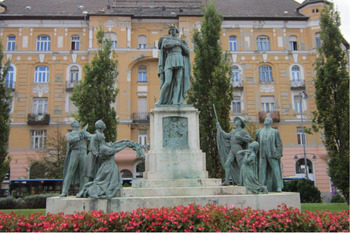
The organisers timed the centrepiece of the St. Imre Year festivities for August 1930. It started with the unveiling of Zsigmond Kisfaludi Strobl's statue of St. Imre (Figure 1).Footnote 44 The piece itself represents well the relationship between Christianity and the secular state. The bronze relief at the base of the statue depicts the moment when St. Stephen offers up the Holy Crown to Mary, thus symbolically forging the connection between the newly founded Hungarian Kingdom and Christianity. The young prince at the centre of the composition is wearing his princely crown and is holding a lily, representing his devotion and humility. He is surrounded with figures portraying Hungary's youth: female figures depicting both city and countryside, a praying boy scout, a levente (interwar Hungarian paramilitary youth organisation with entirely domestic membership) and a university student—all suggesting continuity between past and present. The next highlight was the 19 August open-air Catholic Mass with 150,000 in attendance. This was followed by the Hungarian and foreign religious and secular elite, together with holy relics, sailing down the Danube on illuminated ships. The pinnacle of the celebration was on 20 August – St. Stephen's Day – with the procession of the ‘Holy Right Hand’ (the mummified right hand of St. Stephen) that attracted a crowd of some 800,000. The day ended with fireworks and a joint session of the Hungarian parliament.Footnote 45
Kisfaludi Strobel Zsigmond's 1930 Statue of St. Imre
Author's Photo

The Catholic Church, the government and the public all viewed the St. Imre Year as a success. Archival documents and contemporary newspapers testify that the festivities were appreciated not only for their importance to the religious community, but for their significance in the country's cultural diplomatic campaign, for it allowed Hungary to shine the spotlight on its historical achievements in tactful ways that did not leave audiences with the impression of a propaganda event.Footnote 46 The Vatican's recognition of 1930–1 as a Holy Year celebrating St. Imre allowed Hungary to return to the international stage. The attendance of foreign religious and secular elites – including cardinals and bishops, ambassadors and other foreign delegates – raised the event's importance. Pilgrims in the thousands from all over the world visited Budapest. Amongst them were pilgrims from the United States, led by Justice Victor J. Dowling of the New York State Supreme Court. The solemnness of the celebrations guaranteed that the charge of conducting propaganda could not be levelled against the organisers. According to the reports in the Hungarian dailies, the neighbouring countries certainly understood the significance of the event. For example, reviewing the coverage of the event in the Czechoslovak press, the Budapesti Hirlap explained that Czechoslovak circles – with their competing historical figure of St. Wenceslas – were concerned about the international attention that the St. Imre Year received and argued that it was a clever plot to popularise Hungarian plans (i.e. revisionism) abroad. They went further and stated that Hungary was winning the race for the sympathy of the world and that Czechoslovak leadership could learn from the Hungarian example.Footnote 47
Interwar internationalism, and with that the growing number and prominence of international organisations, offered another avenue for cultural diplomacy to showcase the nation and gather sympathy. One of the Hungarians’ key aspirations was to organise events that would aid Hungary's integration or reintegration into the international community. The Fourth World Scout Jamboree, held in Budapest and in neighbouring Gödöllő in August 1933, was just such an event.
The Hungarian Scout movement was officially established in 1912 and largely based on British and German models. After the tumultuous years of revolutions and counterrevolutions, with the support of Klebelsberg and, after his untimely death in 1932, his successor Bálint Hóman, the Hungarian Scout movement was reorganised. Despite lack of government support and competition with the levente movement, the Hungarian scout movement was able to grow and establish significant ties with similar organisations abroad.Footnote 48 In the figure of former Prime Minister Pál Teleki – the Chief Scout of the Hungarian Boy Scouts – the movement also gained an influential supporter. Hosting the jamboree, the central event of the Scout movement, was a way for Hungary to highlight its leadership position in the region.
Ferenc Gergely's study of the planning of the jamboree shows that – despite early hesitations about the financial cost of the international gathering – Hungarian organisers ascribed great cultural diplomatic importance to this event.Footnote 49 Teleki sought to establish a competitive edge vis-à-vis the rival proposals of the Unites States and Czechoslovakia by asking the government to send an official invitation to the international organising committee, which would include financial guarantees by the state.Footnote 50 The Hungarian application won. Recently unearthed documents make it apparent that the government, in spite of the financial difficulties caused by the Great Depression, indeed committed significant money to see the event succeed.Footnote 51 Gödöllő, a town thirty-seven kilometres from Budapest, was selected as the home of the jamboree. The former royal palace, at this time the residence of Admiral Horthy, provided the necessary grandeur, but there was a great deal that needed to be done before the opening ceremony. New infrastructure – roads, train stations and service buildings – had to be built, security forces for the festivities had to be designated and supplies of all kinds needed to be acquired.Footnote 52
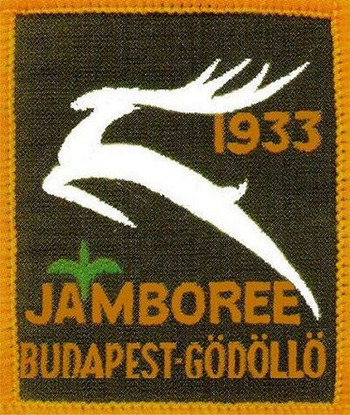
Organisers saw this event as a tool to gain the support and trust of the foreign public. The underlying message was that the Trianon Treaty had unjustly punished a country that deserved a better fate. The planners sought to illustrate that despite the financial hardship experienced by Hungary, the country remained the region's cultural leader.Footnote 53 The organisers left nothing to chance. The Foreign Ministry utilised its foreign connections to secure press exposure. The state's film and radio companies scheduled live reports from the Jamboree. Teleki, in order to counter possible charges of propaganda, made it clear that open irredentism had no place in Gödöllő. The symbol of the jamboree – The Miracle Stag of Hungarian legends – was reproduced not only on commemorative badges, but posters and stamps (Figure 2).Footnote 54 The Hungarian Scouts’ inaugural magazine – Hungarian Scout (Magyar Cserkész) – printed fourteen special editions that were to report all aspects of the activities with articles written in Hungarian, English, German and Polish. The organisers attempted to solve some of the more difficult issues, such as addressing the sensitive issue of Girl Scouts attendance (600 were expected), the attendance of Jewish Scouts (Jewish scouts enjoyed equal representation in the Hungarian movement until 1940, when Jewish scouts were banned from the organisation) and the conduct in reference to Czechoslovak, Yugoslav and Romanian Scouts.Footnote 55 The thorny questions of Trianon and revisionism were specially addressed by the directions given to the Hungarian Scouts. They were not to bring up the issue, but if asked they were to explain the pain that the decision caused to the Hungarian nation, while, at the same time, they were to declare their hope for a peaceful solution that would allow regional understanding and cooperation.Footnote 56
Scout Badge at the 1933 Gödöllő Jamboree
From the 1999 Online Exhibition of SZTE Klebelsberg Library. http://www.bibl.u-szeged.hu/ha/. Used with Permission.

The opening ceremony took place on 2 August 1933. Horthy's welcoming speech in English was followed by a speech from Robert Baden-Powell, founder and Chief Scout of the Boy Scout movement. Both speeches emphasised the power of the youth to bring forth world peace. Listening in the audience of over 25,000 were young people representing over fifty different nationalities. The day also included worship services for scouts of various faiths and ended with a flyover of planes.Footnote 57 The Scouts spent the next two weeks with camping, water and air shows, theatre performances, film screenings and various excursions that were designed to present the rest of the country to this international audience.Footnote 58 As Teleki said, in his introduction to Hungary's Boy Scouts, ‘do more with brain than with brawn! Whoever comes here shall leave as our friend.’Footnote 59
Both domestic and foreign observers praised the gathering and called it a success. But how could one measure the success of such an event? Did the positive coverage in the worldwide media make it a success?Footnote 60 Did the far-reaching radio reports broadcasting from the gathering make it a success?Footnote 61 Did the thousands of boys returning home with tales of Hungary make it success? The Hungarian press and officials certainly believed that the jamboree had achieved these goals. One influential Hungarian daily claimed that the significance of the event for the national interest could not be overestimated, for it had introduced Hungary and the Hungarians to thousands of boys who only knew of Hungary (if they knew about it at all) from flawed sources.Footnote 62 On the pages of the Magyar Szemle – which functioned as the government's unofficial journal – geographer and historian Ferenc Fodor argued that without even uttering the term ‘Trianon’ the Hungarian Scouts, through making friendships and conducting themselves well, could do more for the ‘cause’ than ‘helpless and wailing’ propaganda could.Footnote 63 It is difficult to gauge the Fourth World Scout Jamboree's immediate influence on international public opinion. I would argue, however, that in order to appreciate the role of this event as a practice of interwar cultural diplomacy, it is enough to know that the Hungarians saw it as a success, for to them all positive international exposure was a triumph.
Stage Three: Racing Full Throttle Down a Winding Path, 1933–8
When the Nazis seized power in Germany in 1933 the Hungarian political leadership hoped to secure Berlin's support for the country's revisionist goals. And while traditional diplomacy and, especially, the economy indeed moved closer and closer to Berlin, cultural diplomacy continued to work to enhance Hungary's international image worldwide. More than ever, architects of the country's cultural-diplomatic campaign, after taking note of the changing international landscape, viewed the small-nation character of the country as a source of danger. They aimed to highlight Hungarian achievements to differentiate Hungary from other small countries of the region. This rationale was best explained by one of the theoreticians of Hungarian cultural diplomacy, János Hankiss: ‘Once there are vultures circling above the destiny of small nations, it matters whether it is called Holland or Abyssinia, Switzerland or Montenegro, Belgium or Panama’.Footnote 64 Hungary sought to achieve a status similar to that of Holland, Switzerland and Belgium – while certainly not great powers, these countries were valued and respected by the international community. Hungarians were concerned that the international community viewed their country in the same way as it viewed Abyssinia, Montenegro and Panama: as weak and inconsequential states. The task was to display Hungary as a ‘first-class small nation’ and the 1937 Paris Exposition Internationale was an ideal place to do it.
The most famous photograph of the 1937 Paris Expo showcases the Eiffel Tower, from the Trocadéro, framed by the towering pavilions of Hitler's Germany and Stalin's Soviet Union. As Danilo Udovički-Selb explains, Boris Iofan's design for the Soviet pavilion ‘emulated the Eiffel Tower's bold vertical ascent’ and represented the ‘dynamic, “futuristic” energy of the Soviets’.Footnote 65 In contrast, Albert Speer's National Socialist design – utilising the very latest of technological innovations – countered the Soviet project through its rigid monumentality and ‘static character’.Footnote 66 The juxtaposition of the contrasting styles – not to mention the placement of the two pavilions – was a clear indication of the opposing ideologies of Stalinism and Nazism. It was a message that was evident to the contemporary public. As one observer noted, the two buildings ‘faced each other most conspicuously and suggestively’ and together with the contents of their exhibitions ‘told the story of two experiments and two cultures’.Footnote 67 The 1937 Architectural Record lamented that ‘this militant pair of pavilions’ were ‘overshadowing the modest efforts of the more numerous democracies’.Footnote 68
Hungary was present at the Paris Expo – officially named the International Exposition of Art and Technology in Modern Life (Exposition Internationale des Arts et Techniques dans la Vie Moderne) – as one of the forty-five nations on display. The expo, like other ‘mega-events’, argues Maurice Roche, illustrated ‘the use and promotion of emotionality and aestheticisation in politics and culture, involving heavy emphasis on symbols and myths’.Footnote 69 Exemplifying the zeitgeist, these international events reflected the growth of modernity (technological innovations, as well as progressive social and cultural norms) as much as they provided space for exhibiting national identities to mass audiences.Footnote 70 As the Hungarian artist and Bauhaus great, László Moholy-Nagy (an émigré who was forced to leave Horthy's Hungary) argued at the time, these expos were not designed to be simple ‘museum displays’. Rather, they were to ‘bring spectator and exhibition together in the closest relationship’.Footnote 71 Contemporary Hungarians associated with the 1937 Paris expo most certainly agreed. Dénes Györgyi, architect of the Hungarian pavilion, saw the expo as a ‘world-wide competition of cultures’ (kulturális világverseny), where the nation had the ability to speak to the millions of foreign visitors and to gain recognition that could aid the national cause.Footnote 72
Hungary signalled its interest in participating in the expo on 13 July 1935. After some delays there was an architectural design competition. The winning scheme was that of Dénes Györgyi.Footnote 73 His success was not really all that surprising, since he had been the official architect on (or had contributed to) a number of state projects, including the Hungarian pavilions at the world's fairs in Turin (1911), Philadelphia (1926), Barcelona (1929) and Brussels (1935). His designs sought to combine traditional elements of Hungarian folk design with modern functionality. His desire to illustrate that traditional and modern styles could coexist in harmony determined his success in the competition. Through his design, the Hungarian pavilion embodied a dual aim that characterised Hungarian cultural diplomacy: to epitomise Hungarian modernity on the one hand and to depict the country's long historical and cultural traditions on the other.
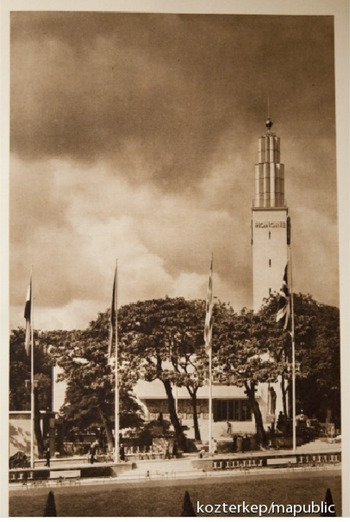
The main building, with its 38 metre tall tower and cone-like glass top that was illumined at night, was situated in the park section of the Trocadéro between the Egyptian and Romanian pavilions (Figure 3).Footnote 74 The plan called for twelve rooms that were to showcase the country's rich past and the progressive nature of its present. The main entrance was adorned with statues of the Virgin Mary (the patron saint of Hungary) and of St. Stephen. Visitors entered through the ceremonial hall, decorated by Vilmos Aba-Novák's monumental painted wood panels. The 28 by 8 metre piece – Hungarian-French Historical Relations – depicted some of the key historical and cultural moments in the country's relations to France and Western Europe. The central panel told the story of the 1456 Battle of Belgrade (Nándorfehérvár in Hungarian historical writing) at which the Hungarians, led by the towering figure of St. John of Capistrano, defeated the Ottoman forces and halted, if only temporarily, their advances. The not-too-subtle message, depicting Hungary's role in safeguarding the West, was further illustrated by a French-language historical text and a giant bell, depicting the supposed papal order that the victory was to be commemorated by the ringing of the bells at noon. Similarly suggestive motifs recalled Hungary's contribution to religious tolerance (through the 1568 Edict of Torda) and to the royal relations between the French Capetian House of Anjou and the Hungarian throne, as well as long-standing cultural connections (portraying Hector Berlioz composing the Rákóczi March commemorating the eighteenth-century Hungarian revolutionary, Ferenc Rákóczi) and military cooperation (Hungarian nobles’ role in the establishment of France's Bercsényi Hussar regiment), to name few of the key themes.Footnote 75 At the end of the main hall was a small room featuring religious art decorated by Lili Árkay Sztehlo's large stained-glass window, further exemplifying Hungary's Christian character. The adjoining rooms focused on the modern and progressive side of the country. One room featured the Hungarian tourism industry and Budapest, presented as a tourist destination and ‘thermal bath capital’. The rest of the rooms presented the countryside and other cities. Some introduced modern agriculture and viniculture, others highlighted products of industry (textile, transportation, electrics), while others featured products of folk and applied arts. The pavilion's last room was a restaurant with a garden terrace that served up the best of Hungarian cuisine with Gypsy music late into the evenings.Footnote 76 The Hungarian pavilion, not unlike those of other nations, largely ignored the expo's main theme (‘Art and Technology in Modern Life’) and mainly utilised the space to provide publicity for the country's cultural and historical achievements, which was certainly more in line with the main themes of Hungarian cultural diplomacy.Footnote 77
The Hungarian Pavilion at the 1937 Paris Exposition Internationale.
https://www.kozterkep.hu/28041/Szent_Istvan_Parizs_1937.html#vetito=240762. Uploaded by Vera Göröntsér. Photo is licenced under Creative Commons Attribution 4.0 International Licence.

Hungarian organisers and the public both saw the event as a success. Over thirty-one million people visited the expo.Footnote 78 Commentaries and reports were delighted to point out that despite the country's financial difficulties, the Hungarian pavilion brought home a number of awards, including a Grand Prix Prize to Aba-Novák (presented by Pablo Picasso, to ‘the barbarian genius’).Footnote 79 Throughout the event, the Hungarians kept a close eye on the Czechoslovak, Yugoslav and Romanian pavilions and their activities and accused them of distributing ‘propaganda literature’.Footnote 80 At Paris, the last peacetime expo, Hungarians sought to represent a historical country with rich culture and tradition, a modern, technologically and economically progressive European nation that was a ‘first-rate small country’ that should not be marginalised.
Stage Four: Toward the Precipice and the End of the Race, 1938–41
The March 1938 Anschluss, and, especially, the Munich Agreement that autumn indicated to the Hungarian leadership that Germany was the new leader of European affairs. Hungarian government circles were divided over the degree to which Hungarian foreign policy and economy should gravitate toward Berlin. Hungary's cultural diplomacy, at any rate, did not limit its mission to Germany and Italy. On the contrary, in 1938 Hungary was gearing up for another mega-event: a set of celebrations connected with the ninth centenary of the death of St. Stephen (Year of St. Stephen), which was combined with the Thirty-Fourth International Eucharistic Congress in Budapest. The celebration was intended as the crowning achievement of Hungarian cultural diplomacy. But the organisers’ lofty dreams were crushed. Despite their best efforts – and staggering expenses that essentially bankrupted one of the country's main tourist organisations – the events were ill-timed to secure the world's attention. The international public was waiting to see how the precarious situation in Austria and Czechoslovakia would play out. With the threat of a new war looming, the ‘soft power’ of cultural diplomacy was quickly losing its utility.
After the First Vienna Award (2 November 1938), which granted 4,605 square miles and one million inhabitants to Hungary, domestic pressure on Hungary's leaders to continue their pro-German orientation increased even further. Pál Teleki was, once again, at the helm. He sought to balance between Hungarian revisionist desires and keeping Hungary out of the war. Once he famously grumbled:
Public opinion has gone mad. Return it all! In any way, by anyone, at any price . . . the Germans know this well, and they prey on this . . . the soldiers want to fight side by side with the Germans, and the regent listens to them . . . everybody makes politics based on emotions. No one wants to believe me that this is going to be the end of us. It is the revisionism that will ruin us and that is going to carry us into war.Footnote 81
Teleki was not alone in his hesitance about the country's German orientation. Others, like the former Prime Minister István Bethlen, also warned against a Hungarian–German alliance, but to no avail. Hungary continued to use cultural diplomacy to target audiences in the United States and the United Kingdom. For example, the Hungarian pavilion at the New York World's Fair opened its door in 1939–40, with exhibits that sought to convey that the territorial gains of Hungary were the rightful adjustments of past wrongs and that the nation sought peace above all.Footnote 82 After the Second Vienna Award of August 1940, which granted Northern Transylvania to Hungary, the country's military was blinded by the promise of further territorial gains. There was growing influence and pressure of the ultra-right – with its faith in Germany and the German victory, not to mention its rabid anti-communism and anti-Semitism. Hungary was heading towards disaster. Teleki, once again in the seat of the prime minister, still hoped that he could maintain Hungarian neutrality. He failed. On 11 April 1941 Hungarian forces invaded Yugoslavia. On 26 June Hungary declared that the nation was at war with the Soviet Union. The guiding principle of Hungary's cultural diplomacy had been peaceful revisionism. With that project abandoned, cultural diplomacy lost its utility.
Conclusion
Hungarians experienced the end of the First World War and the subsequent Treaty of Trianon as one of the most traumatic events in the country's thousand-year history. Admitting defeat and resigning itself to the post-war realities was not really an option, for most historians agree that the domestic public – regardless of political ideology – would not have accepted it. Hungary was most certainly not a ‘first-rate small country’. Dramatically reduced in territorial and demographic terms, economically weak and largely marginalised, cultural diplomacy was seemingly a viable option to gain recognition for the newly independent nation and to revise the Trianon Treaty. Hungarians also understood that the goals of cultural diplomacy placed them in direct competition with its neighbouring countries, many of them with established ties to important international figures and organisations. Consequently, the architects of Hungarian cultural diplomacy – politicians, diplomats, intellectuals and leaders of industries – worked tirelessly to alter the country's foreign image. It was a practice that was shaped by material and ideational factors. Financial issues limited how much money could be spent on cultural diplomacy. There was not one idea or concept that framed Hungarian cultural diplomacy. Celebrating the nation's Christian character and past deeds, its perceived cultural superiority and its modern and progressive nature were as much part of the practice as was embracing interwar internationalism. Nor was there one specific target for Hungary's cultural diplomatic activities. Throughout the period – even when traditional diplomacy turned toward Nazi Germany – Hungarian cultural diplomacy aimed to be wide-reaching and was directed worldwide.
To what degree was Hungarian cultural diplomacy an effective tool to deal with the challenges of the period? There is no easy way to answer this question. The twofold goals of cultural diplomacy were to gain recognition for the newly independent nation and to revise the Trianon Treaty. Hungarian cultural diplomacy succeeded in the former and failed in the latter. Revisionist goals were only achieved because of Hungary's alliance with Nazi Germany. Hungarians were certainly not simply victims of circumstances. They were obsessed with the idea of revising the Trianon Treaty. From the very start this goal of their cultural diplomacy limited its effectiveness. Yet, on the other hand, the twenty-year crisis was particularly pronounced in East and East-Central Europe. The Great Powers remapped the region and then left the countries they created largely to their own devices. Architects of cultural diplomacy in Hungary and in the neighbouring countries failed to appreciate the realities of Great Power politics. The League of Nations was unable, and perhaps even unwilling, to tackle post-war challenges. Power and Great Power interests drove international politics. No cultural diplomacy, no matter how clever, could change that – especially not one that was not accompanied by realistic foreign policy aims. However, Hungary's interwar programme of cultural diplomacy did help the country to gain legitimacy in the international arena. Prior to the outbreak of the Second World War Hungary placed representatives in a wide variety of international organisations. An indication of the success of Hungary's outreach might be the fact that after the conclusion of the Second World War there were no questions about the legitimacy of an independent Hungarian nation state, allowing the Hungarians to avoid the fate of the Estonians, Lithuanians, Latvians, Ukrainians, Slovaks and the like to whom sovereignty came only a half-century later. A final assessment of interwar Hungarian cultural diplomacy – and small state cultural diplomacy in general – might conclude that cultural diplomacy was certainly not an all-powerful tool in international relations and could not significantly alter existing power relations. However, this does not mean that it was irrelevant; it only means that it had limitations, which most contemporaries did not – or did not want to – recognise.
Acknowledgements
I would like to thank Michael L. Miller and the editors of this special issue, Elisabeth Piller and Benjamin Martin, for their useful comments and encouragements. The assistance of archivist János Kalmár at the Hungarian National Archive was invaluable. I would also like to thank the University of St. Thomas's History Department, Cathy Cory and the Dean's Office for the financial support that made the research possible. Last, but not least, my sincerest appreciation to the three anonymous reviewers for their thoughtful criticism.