


%20--%3e%3c!DOCTYPE%20svg%20PUBLIC%20'-//W3C//DTD%20SVG%201.0//EN'%20'http://www.w3.org/TR/2001/REC-SVG-20010904/DTD/svg10.dtd'%3e%3csvg%20version='1.0'%20id='Layer_1'%20xmlns='http://www.w3.org/2000/svg'%20xmlns:xlink='http://www.w3.org/1999/xlink'%20x='0px'%20y='0px'%20width='64px'%20height='64px'%20viewBox='5.5%20-3.5%2064%2064'%20enable-background='new%205.5%20-3.5%2064%2064'%20xml:space='preserve'%3e%3cg%3e%3ccircle%20fill='%23FFFFFF'%20fill-opacity='0'%20cx='37.785'%20cy='28.501'%20r='28.836'/%3e%3cpath%20fill='%23595959'%20d='M37.441-3.5c8.951,0,16.572,3.125,22.857,9.372c3.008,3.009,5.295,6.448,6.857,10.314%20c1.561,3.867,2.344,7.971,2.344,12.314c0,4.381-0.773,8.486-2.314,12.313c-1.543,3.828-3.82,7.21-6.828,10.143%20c-3.123,3.085-6.666,5.448-10.629,7.086c-3.961,1.638-8.057,2.457-12.285,2.457s-8.276-0.808-12.143-2.429%20c-3.866-1.618-7.333-3.961-10.4-7.027c-3.067-3.066-5.4-6.524-7-10.372S5.5,32.767,5.5,28.5c0-4.229,0.809-8.295,2.428-12.2%20c1.619-3.905,3.972-7.4,7.057-10.486C21.08-0.394,28.565-3.5,37.441-3.5z%20M37.557,2.272c-7.314,0-13.467,2.553-18.458,7.657%20c-2.515,2.553-4.448,5.419-5.8,8.6c-1.354,3.181-2.029,6.505-2.029,9.972c0,3.429,0.675,6.734,2.029,9.913%20c1.353,3.183,3.285,6.021,5.8,8.516c2.514,2.496,5.351,4.399,8.515,5.715c3.161,1.314,6.476,1.971,9.943,1.971%20c3.428,0,6.75-0.665,9.973-1.999c3.219-1.335,6.121-3.257,8.713-5.771c4.99-4.876,7.484-10.99,7.484-18.344%20c0-3.543-0.648-6.895-1.943-10.057c-1.293-3.162-3.18-5.98-5.654-8.458C50.984,4.844,44.795,2.272,37.557,2.272z%20M37.156,23.187%20l-4.287,2.229c-0.458-0.951-1.019-1.619-1.685-2c-0.667-0.38-1.286-0.571-1.858-0.571c-2.856,0-4.286,1.885-4.286,5.657%20c0,1.714,0.362,3.084,1.085,4.113c0.724,1.029,1.791,1.544,3.201,1.544c1.867,0,3.181-0.915,3.944-2.743l3.942,2%20c-0.838,1.563-2,2.791-3.486,3.686c-1.484,0.896-3.123,1.343-4.914,1.343c-2.857,0-5.163-0.875-6.915-2.629%20c-1.752-1.752-2.628-4.19-2.628-7.313c0-3.048,0.886-5.466,2.657-7.257c1.771-1.79,4.009-2.686,6.715-2.686%20C32.604,18.558,35.441,20.101,37.156,23.187z%20M55.613,23.187l-4.229,2.229c-0.457-0.951-1.02-1.619-1.686-2%20c-0.668-0.38-1.307-0.571-1.914-0.571c-2.857,0-4.287,1.885-4.287,5.657c0,1.714,0.363,3.084,1.086,4.113%20c0.723,1.029,1.789,1.544,3.201,1.544c1.865,0,3.18-0.915,3.941-2.743l4,2c-0.875,1.563-2.057,2.791-3.541,3.686%20c-1.486,0.896-3.105,1.343-4.857,1.343c-2.896,0-5.209-0.875-6.941-2.629c-1.736-1.752-2.602-4.19-2.602-7.313%20c0-3.048,0.885-5.466,2.658-7.257c1.77-1.79,4.008-2.686,6.713-2.686C51.117,18.558,53.938,20.101,55.613,23.187z'/%3e%3c/g%3e%3c/svg%3e)
%20--%3e%3c!DOCTYPE%20svg%20PUBLIC%20'-//W3C//DTD%20SVG%201.0//EN'%20'http://www.w3.org/TR/2001/REC-SVG-20010904/DTD/svg10.dtd'%3e%3csvg%20version='1.0'%20id='Layer_1'%20xmlns='http://www.w3.org/2000/svg'%20xmlns:xlink='http://www.w3.org/1999/xlink'%20x='0px'%20y='0px'%20width='64px'%20height='64px'%20viewBox='5.5%20-3.5%2064%2064'%20enable-background='new%205.5%20-3.5%2064%2064'%20xml:space='preserve'%3e%3cg%3e%3ccircle%20fill='%23FFFFFF'%20fill-opacity='0'%20cx='37.637'%20cy='28.806'%20r='28.276'/%3e%3cg%3e%3cpath%20fill='%23595959'%20d='M37.443-3.5c8.988,0,16.57,3.085,22.742,9.257C66.393,11.967,69.5,19.548,69.5,28.5c0,8.991-3.049,16.476-9.145,22.456%20C53.879,57.319,46.242,60.5,37.443,60.5c-8.649,0-16.153-3.144-22.514-9.43C8.644,44.784,5.5,37.262,5.5,28.5%20c0-8.761,3.144-16.342,9.429-22.742C21.101-0.415,28.604-3.5,37.443-3.5z%20M37.557,2.272c-7.276,0-13.428,2.553-18.457,7.657%20c-5.22,5.334-7.829,11.525-7.829,18.572c0,7.086,2.59,13.22,7.77,18.398c5.181,5.182,11.352,7.771,18.514,7.771%20c7.123,0,13.334-2.607,18.629-7.828c5.029-4.838,7.543-10.952,7.543-18.343c0-7.276-2.553-13.465-7.656-18.571%20C50.967,4.824,44.795,2.272,37.557,2.272z%20M46.129,20.557v13.085h-3.656v15.542h-9.944V33.643h-3.656V20.557%20c0-0.572,0.2-1.057,0.599-1.457c0.401-0.399,0.887-0.6,1.457-0.6h13.144c0.533,0,1.01,0.2,1.428,0.6%20C45.918,19.5,46.129,19.986,46.129,20.557z%20M33.042,12.329c0-3.008,1.485-4.514,4.458-4.514s4.457,1.504,4.457,4.514%20c0,2.971-1.486,4.457-4.457,4.457S33.042,15.3,33.042,12.329z'/%3e%3c/g%3e%3c/g%3e%3c/svg%3e)
Introduction
Five classes of seed dormancy have been distinguished (Nikolaeva, Reference Nikolaeva1969; Baskin and Baskin, Reference Baskin and Baskin2021), and with minor exceptions, each class, as well as nondormancy, is represented in all the major vegetation regions on Earth (Baskin and Baskin, Reference Baskin and Baskin2014; Rosbakh et al., Reference Rosbakh, Carta, Fernandez-Pascual, Phartyal, Dayrell, Mattana, Saatkamp, Vandelook, Baskin and Baskin2023; Zhang et al., Reference Zhang, Liu, Sun, Baskin, Baskin, Cao and Yang2023b). However, the relative importance of each dormancy class (and nondormancy) varies between vegetation regions (Baskin and Baskin, Reference Baskin and Baskin2014). Another consideration about seed dormancy in a region is that some classes of dormancy are subdivided into levels and types, which may differ in the environmental conditions required to break dormancy and promote germination (Baskin and Baskin, Reference Baskin and Baskin2021). That is, in a given vegetation region, a single class of dormancy, e.g. physiological dormancy, may be represented by more than one level or type of dormancy (Baskin and Baskin, Reference Baskin and Baskin2023).
In an attempt to better understand how nondormancy and dormancy classes, levels and types are distributed in the major vegetation regions on Earth, we have undertaken a series of reviews of large, widely distributed flowering plant families, looking at how classes, levels and types of dormancy within the family are distributed geographically and phylogenetically, i.e. in the various subfamilies and tribes of the family. The families reviewed include Asteraceae (Baskin and Baskin, Reference Baskin and Baskin2023), Rubiaceae (Baskin and Baskin, Reference Baskin and Baskin2024), Myrtaceae (Baskin and Baskin, Reference Baskin and Baskin2025a), Malvaceae (Baskin and Baskin, Reference Baskin and Baskin2025b) and Solanaceae (Baskin and Baskin, Reference Baskin and Baskin2026). The central questions addressed in these reviews are as follows. (1) What is the palaeohistory of the family and its present geographical distribution? (2) What are the characteristics of the family, including life form; kind of flowers, fruits and embryos; and ability to form a persistent seed bank? (3) Do species have special adaptations to their habitat, such as cold and drought tolerance? (4) What classes, levels and types of dormancy are present? (5) What are the dormancy-breaking and germination requirements?
The subject of the present review is the Ranunculaceae, which is widely distributed in the temperate zone, especially at high northern latitudes, but it also is found at high southern latitudes and in cool-climate zones on tropical mountains and to a limited extent in wet lowland tropical/subtropical areas (Ziman and Keener, Reference Ziman and Keener1989). The Ranunculaceae consists of c. 2525 species in 50 genera. Seeds of Ranunculaceae have small (underdeveloped) embryos and thus either morphological dormancy (MD) or morphophysiological dormancy (MPD). Since all nine known levels of MPD occur in the Ranunculaceae (Baskin and Baskin, Reference Baskin and Baskin2014), this is an important family to consider in relation to the distribution of the levels of MPD in the world vegetation regions in which the family occurs. We review the position of the Ranunculaceae in the Ranunculales and the embryo morphology of members of the Ranunculales. For Ranunculaceae, we cover life forms and world distribution, palaeohistory and provide an overview of the family that includes general characteristics, soil seed banks, phenology of plant growth and flowering and cold/frost resistance. Much attention is given to embryos of Ranunculaceae, MD and MPD, dormancy-breaking requirements of seeds with MPD and levels of MPD in relation to subfamilies, timing of germination and occurrence of multiple levels of MPD in many vegetation regions.
Ranunculales
The Ranunculaceae is a member of the Ranunculales, which also includes six additional families: Berberidaceae, Circaesteraceae, Eupteleaceae, Lardizabalaceae, Menispermaceae and Papaveraceae (APG). Wikström et al. (Reference Wikström, Savalainen and Chase2001) estimated that the crown age of this order was 140 Ma, but it has also been estimated to be 123–112 Ma (Magallón et al., Reference Magallón, Gómez-Acevedo, Sánchez-Reyes and Hernández-Hernández2015; Sun et al., Reference Sun, Deng, Zhang, Moore, Landis, Lin, Zhang, Zhang, Huang, Zhang, Sun and Wang2020). The Ranunculales are ‘early-diverging eudicots’ and belong to the basal grade of angiosperms along with Sabiaceae, Proteales, Buxales and Trochodendrales (Friis et al., Reference Friis, Crane, Pedersen, Friis, Crane and Pedersen2011; Stevens, Reference Stevens2001 onward); they are sister to the other eudicots (Soltis et al., Reference Soltis, Soltis, Endress and Chase2005). Teng et al. (Reference Teng, Wang, Zhang, Wei, Shen, Xiao, Yue, Hao, Ge and Wang2022) concluded that the Ranunculales diverged from the core eudicots 129–123 Ma, after which tetraploidization occurred in the Ranunculales, which Zhang et al. (Reference Zhang, Ge, Teng, Yang, Wang, Yu, Wang, Xiao, Zhao, Shen, Feng, Bao, Li, Li, Lei, Pan, Zhang and Wang2024) have described as a likely allotetraploidization event.
The oldest fossils (tricolpate pollen) of eudicots are from 127 to 125 Ma (Wang et al., Reference Wang, Dilcher, Sun, Wang and Chen2016a), and these authors suggested that rapid diversification of eudicots occurred in the latest Barremian and earliest Aptian of the Cretaceous. The Menispermaceae, Berberidaceae and Ranunculaceae form a clade, with Ranunculaceae in the basal position. The Berberidaceae and Ranunculaceae diverged from the Menispermaceae 105 Ma (Anderson et al., Reference Anderson, Bremer and Friis2005), and Berberidaceae is sister to Ranunculaceae (Hoot et al., Reference Hoot, Magallón and Crane1999). Wefferling and Hoot (Reference Wefferling and Hoot2018) estimated the stem and crown age of Ranunculaceae as 104.2–87.3 and 96.4–75.0 Ma, respectively.
The Ranunculaceae consists of five subfamilies: Coptidoideae, Glaucidioideae, Hydrastidoideae, Ranunculoideae and Thalictroideae (Cossard et al., Reference Cossard, Sannier, Sauquet, Damerval, de Craene, Jabbour and Nadot2016; POWO, website). Glaucidium (Glaucidioideae) is sister to the other subfamilies of Ranunculaceae, and it differs from them in having four petals (vs. five), two carpels united at the base (vs. one to many nonfused carpels) and marginally winged seeds (Wang et al., Reference Wang, Lu, Ren, Endress and Chen2009).
Life forms of Ranunculaceae
Members of the Ranunculaceae are herbaceous perennials (Aconitum, Delphinium), annuals (Nigella, some species of Ranunculus), rarely biennials (some species of Ranunculus), rarely subshrubs (Xanthorhiza) and vines/lianas (Clematis) (Tamura, Reference Tamura, Kubitzi, Rohwer and Bittrich1993). It should be noted that some species of Clematis, i.e. C. integrifolia, C. heracleifolia, C. recta and C. stans, are herbaceous perennials, while other species, i.e. C. armandi, C. montana, C. terniflora and C. virginiana, are vines (POWO, website). In addition to temperate habitats, various species of Clematis grow as vines in both wet and dry lowland tropical habitats (Ziman and Keener, Reference Ziman and Keener1989; Mabberley, Reference Mabberley2017).
World distribution of Ranunculaceae
Most species of Ranunculaceae grow in temperate areas of the world, ranging from the Arctic to subantarctic islands, and in cool-climate zones on tropical mountains (Tamura, Reference Tamura, Kubitzi, Rohwer and Bittrich1993; POWO, website). Ranunculus, with c. 600 species, is the largest and most widely distributed genus of Ranunculaceae, and it is found on all continents except Antarctica (Emadzade et al., Reference Emadzade, Gehrke, Linder and Hörandl2011; Emadzade and Hörandl, Reference Emadzade and Hörandl2011). It is most common in moist temperate regions, and in the tropics it usually grows in the cool-climate zones on mountains, e.g. the Andes; African, Himalayan and Irano-Turanian mountains; and those in New Guinea (Hörandl and Emadzade, Reference Hörandl and Emadzade2011). A few species of Ranunculus grow in open, wet tropical/subtropical sites (Lourteig, Reference Lourteig1956; Ziman and Keener, Reference Ziman and Keener1989). Species of Ranunculus are also common on mountains in the temperate zone, i.e. North America, Central Asia (Emadzade et al., Reference Emadzade, Lebmann, Hoffman, Tkach, Lone and Hörandl2015), Europe and the Mediterranean (Paun et al., Reference Paun, Lehnebach, Johansson, Lockhart and Hörandl2005).
Ziman and Keener (Reference Ziman and Keener1989) provide a summary of the number of genera and species of Ranunculaceae in various regions and provinces of the six kingdoms of distribution of the Ranunculaceae: Holarctic (49 genera, 2000 species), Palaeotropical (11, 100), Cape of South Africa (7, 30), Neotropical (9, 70), Holantarctic (i.e. Chile-Patagonian, Fernandezian, Neozeylandic and South Subantarctic islands) (8, 100) and Australian (5, 50). These authors refer to species of Clematis, Ranunculus and Thalictrum as occurring in the tropical kingdoms. The Palaeotropical Kingdom has climbing species of Clematis such as C. antonii, C. javana, C. horripilata, C. korthalsii, C. mollissima, C. pickeringii and C. smilacifolia in wet tropical forests. In the Neotropical Kingdom, C. dioica and C. haenkeana are lianas in dry tropical forests, and C. brasiliana is a climber in seasonally dry tropical forests (Ziman and Keener, Reference Ziman and Keener1989; POWO, website).
The species of Ranunculus listed by Ziman and Keener (Reference Ziman and Keener1989) in the Palaeotropical Kingdom mostly grow in mountains. In the Neotropical Kingdom, three of five species of Ranunculus have been collected in mountains, while two species, R. apiifolius and R. platensis, are annuals (weeds) native to subtropical to temperate regions of South America (southern Brazil to Argentina and Uruguay) (Lourteig, Reference Lourteig1956; POWO, website). The eight species of Thalictrum mentioned by Ziman and Keener (Reference Ziman and Keener1989) as occurring in the tropical kingdoms have been collected in cool-climate zones (e.g. T. javanicum, T. punduanus) or in wet subtropical regions (e.g. T. dalzellii, T. hintonii) (Lourteig, Reference Lourteig1956; POWO, website).
The Ranunculaceae is well represented in East Asia (44 genera, of which 13 are endemic), Europe (24 genera) and North America (24 genera) (Tamura, Reference Tamura, Kubitzi, Rohwer and Bittrich1993). Some genera such as Coptis are found in Asia and North America (Xiang et al., Reference Xiang, Erst, Xiang, Jabbour and Wang2018); Hepatica in Asia, North America and Europe (Pfosser et al., Reference Pfosser, Sun, Stuessy, Jang, Guo, Taejin, Hwan, Kato and Sugaware2011); Trautvetteria in Asia and eastern and western North America (Xiang et al., Reference Xiang, Soltis and Soltis1998); Halerpestes in North America, Asia and South America (Xiang et al., Reference Xiang, Soltis and Soltis1998); Myosurus/Ranunculus in North America, Europe, South America, Australia and New Zealand (Xiang et al., Reference Xiang, Soltis and Soltis1998); Hamadryas in South America (Hoot et al., Reference Hoot, Kramer and Arroyo2008); Peltocalathos in South Africa (Manning and Goldblatt, Reference Manning and Goldblatt2013) and Kingdonia in China (Ziman and Keener, Reference Ziman and Keener1989).
Fine-scale habitats/distribution of Ranunculaceae
Various species of Ranunculaceae grow in the understory of forests, but others grow in grasslands, meadows, wetlands and disturbed areas where they are not shaded by trees.
Ranunculaceae growing in deciduous forests are exposed to nearly full sunlight in early spring before leaves emerge on the deciduous trees, and soil moisture is high (Baskin and Baskin, Reference Baskin and Baskin1994; Manzaneda et al., Reference Manzaneda, Sperens and García2005; Fortner et al., Reference Fortner, Jolls and Goodwillie2016; Pinker et al., Reference Pinker, Degischer, Rath and Schenk2021). In the matorral, shoots of perennial species emerge from the soil (Herranz et al., Reference Herranz, Copete, Ferrandis and Copete2010a,Reference Herranz, Ferrandis and Martinez-Durob), and seeds of annuals germinate (Maleki et al., Reference Maleki, Baskin, Baskin, Kiani, Alahdadi and Soltani2022) in autumn-early winter when the soil is moist. In steppe, temperate and tropical montane regions, as well as woodland vegetation regions, Ranunculaceae grow in open areas that often are wet/boggy (Cook, Reference Cook1963; Inouye et al., Reference Inouye, Morales and Dodge2002; Biganzoli and Zanott, Reference Biganzoli and Zanott2010; Carta et al., Reference Carta, Bedini, Foggi and Probert2012) that may help prevent growth of tall, shade-producing species.
Ranunculaceae such as Caltha, Ranunculus and Peltocalathos grow in aquatic, marsh or boggy habitats in various temperate vegetation regions (Tamura, Reference Tamura, Kubitzi, Rohwer and Bittrich1993; Paun et al., Reference Paun, Lehnebach, Johansson, Lockhart and Hörandl2005; Manning and Goldblatt, Reference Manning and Goldblatt2013; Wefferling and Hoot, Reference Wefferling and Hoot2018; Di Stefano et al., Reference Di Stefano, Puglia, Onofri, Blandino and Cristaudo2025), and there are many calciphilous species (Tamura, Reference Tamura, Kubitzi, Rohwer and Bittrich1993). Also, boreal/subalpine and Arctic/alpine species of Ranunculaceae may grow in wet habitats, including snow beds (Galen and Stanton, Reference Galen and Stanton1991; Forbis and Diggle, Reference Forbis and Diggle2001; Kawai and Kudo, Reference Kawai and Kudo2021). In lowland tropical areas, herbaceous and annual species of Ranunculaceae grow in open, well-lighted habitats that may be wet, e.g. stream banks (Lourteig, Reference Lourteig1956; Keener and Park, Reference Keener and Park1988). The various species of Clematis growing in lowland tropical sites can climb, which places their leaves in full sunlight (Ziman and Keener, Reference Ziman and Keener1989).
Ranunculus section Batrachium consists of about 30 aquatic species, often with submerged and floating leaves. Wiegleb et al. (Reference Wiegleb, Bobrov and Zalewska-Gałosz2017) distinguished four clades: West European, Eurasian-amphi-Beringian, Holarctic and Central Asian. According to Cook (Reference Cook1963), ‘most species are annuals or short-lived perennials’, but there are some long-lived perennials. Species such as R. aquatilis, R. peltatus and R. tripartitus behave as annuals if the habitat becomes dry in summer, but they are perennials if the habitat remains wet all year. Section Batrachium includes diploids, allopolyploids, autopolyploids, hybrids and introgressants (Koutecký et al., Reference Koutecký, Prančl, Košnar, Koutecká, Hanzlíčková, Lučanovó, Nejedlá and Kaplan2022). These authors concluded that the section is ‘remarkable due to the coexistence of well-defined lineages with recently evolved biotypes arising due to hybridization and polyploidization’.
Palaeohistory of Ranunculaceae
Diversification
In general, few fossils of Ranunculaceae have been found in Cretaceous-aged rocks, and often it is hard to be sure if fossils belong to the Ranunculaceae or to some other family (e.g. Sun et al., Reference Sun, Dilcher, Wang and Chen2011; Manchester et al., Reference Manchester, Golovneva, Sokoloff and Friis2018; Gobo et al., Reference Gobo, Kunzmann, Lannuzzi, Bachelier and Coiffard2022). Nonetheless, achenes similar to those of Thalictrum have been collected from the Early Cretaceous (Early Barremian-Aptian), follicles of Hyrcantha from the Middle Aptian (Krassilov et al., Reference Krassilov, Shilin and Vachrameev1983), seeds of Eocaltha from the Late Cretaceous (Campanian) (Rodriguez-de la Rosa et al., Reference Rodriguez-de la Rosa, Cevallos-Ferriz and Silva-Pineda1998) and loosely-fused carpels of Leefrutus mirus from the Late Aptian to Early Albian (Sun et al., Reference Sun, Dilcher, Wang and Chen2011; Wang et al., Reference Wang, Dilcher, Sun, Wang and Chen2016a). Fossils from the Late Cretaceous (Santonian, 85.5–83.5 Ma) have a syncarpous gynoecium (capsule) and stylar extensions (Axsmith et al., Reference Axsmith, Stults, Wang and Boucher2024). After an analysis of fruits in the basal eudicot orders Buxales, Ranunculales, Proteales and Trochodendrales, Axsmith et al. (Reference Axsmith, Stults, Wang and Boucher2024) concluded that the Santonian fossils were ‘a close relative to Nigella’. Fossils of various genera of Ranunculaceae are known from the Eocene, Oligocene and Miocene (see Pigg and DeVore, Reference Pigg and DeVore2005). Also, molecular studies have determined the time when various genera of Ranunculaceae split from each other, e.g. Anemone and Pulsatilla, c. 25 Ma (Sramkó et al., Reference Sramkó, Laczkó, Volkova, Bateman and Mlinarec2019); Ranunculus and Xanthorhiza, 24.0 Ma (Paun et al., Reference Paun, Lehnebach, Johansson, Lockhart and Hörandl2005); and Coptis and Xanthorhiza, 15.47 Ma (Xiang et al., Reference Xiang, Erst, Xiang, Jabbour and Wang2018), and this information is useful in the construction of phylogenies.
Some of the early-reported crown ages for Ranunculaceae are 87–73 Ma (Anderson et al., Reference Anderson, Bremer and Friis2005), 85–65 Ma (Wikström et al., Reference Wikström, Savalainen and Chase2001) and 59–55 Ma (Bell et al., Reference Bell, Soltis and Soltis2010). However, when Wang et al. (Reference Wang, Dilcher, Sun, Wang and Chen2016a) used the fossil Eocaltha zoophila (Ranunculaceae) from Cretaceous Campanian deposits in Mexico (Rodriguez-de la Rosa et al., Reference Rodriguez-de la Rosa, Cevallos-Ferriz and Silva-Pineda1998) to validate a node on the phylogeny, they estimated that Caltha diverged from its sister clade 76.18 Ma, and Aconitum split from Gymnaconitum 26.02 Ma. Thus, Wang et al. (Reference Wang, Dilcher, Sun, Wang and Chen2016a) estimated the crown age of Ranunculaceae to be 108.79 Ma. Further, Wang et al. (Reference Wang, Lin, Xiang, Ortiz, Liu, Xiang, Yu, Xing and Chen2016b) concluded that the Hydrastidoideae and Coptidoideae were the first subfamilies to originate (at 104.85 and 89.9 Ma, respectively), and these plants were herbs that grew in the understory of angiosperm-dominated forests.
Genera of Ranunculaceae diversified at different times; for example, diversification of Caltha is estimated at c. 50.5 Ma (Cheng and Xie, Reference Cheng and Xie2014). The ancestral range of this species was in Eurasia and North America, and species in western North America were dispersed to South America and Australasia, where additional species diverged at c. 14.2 Ma. Speciation within the Mediterranean group of Ranunculus species occurred during the Pliocene and Pleistocene (Paun et al., Reference Paun, Lehnebach, Johansson, Lockhart and Hörandl2005). In North America and Central Asia, five subclades of Ranunculus developed: two in North America and one each in southern Central Asia, northern Central Asia/Arctic and Europe/Asian lowland (Emadzade et al., Reference Emadzade, Lebmann, Hoffman, Tkach, Lone and Hörandl2015).
Dispersal
Meyer et al. (Reference Meyer, Hoot and Arroyo2010) suggested that anemones evolved in the Northern Hemisphere and then spread to the Southern Hemisphere. These authors placed Anemone antucensis in clade Anemonidium as sister to A. tenuiculis in New Zealand. It should be noted that Mosyakin and de Lange (Reference Mosyakin and de Lange2018) have placed both of these species in the genus Anemonastrum.
Cheng and Xie (Reference Cheng and Xie2014) noted that the dispersal vector of Caltha to Australasia is not known, but it could have been by water. In western North America, the hexaploids C. biflora and C. chinophila diverged in the Upper Miocene to Lower Pleistocene when the Cascade and Sierra Nevada mountains were being formed. When these two hexaploid species came in contact, the decaploid C. leptosepala was formed, with one lineage now in the Cascades and Coast Range mountains and another one in the northern Rocky Mountains (Wefferling and Hoot, Reference Wefferling and Hoot2018).
The alpine zone on mountains in East Africa, New Zealand and Taiwan has been colonized repeatedly by Ranunculus arriving via long-distance dispersal (Hörandl and Emadzade, Reference Hörandl and Emadzade2011). In particular, Ranunculus species on mountains in East Africa also are derived from Holarctic ancestors from the Northern Hemisphere (Gehrke and Linder, Reference Gehrke and Linder2009). According to Hörandl et al. (Reference Hörandl, Paun, Johansson, Lehnebach, Armstrong, Chen and Lockhart2005), the success of genus Ranunculus may be due to ‘…a combination of morphological plasticity and adaptations, hybridization and polyploidy as important factors for regional diversification…’.
There are 41 species of Ranunculus in New Zealand, and they grow in both alpine and lowland habitats. According to phylogenetic analyses by Lehnebach (Reference Lehnebach2008), the closest affinities of Ranunculus species in New Zealand are with species that grow in Australia, Eurasia, islands in the southern oceans, North America, southern South America and in the Euro-Mediterranean region. After the arrival of Ranunculus in the alpine zone of New Zealand, diversification has occurred, and Lehnebach (Reference Lehnebach2008) identified four lineages of this genus in the alpine, which were not closely related to each other.
Habitats with cold winters
The Palaeocene-Early Eocene Climatic Optimum was a world-wide period of moist, warm conditions with temperatures c. 10°C higher than today (Zachos et al., Reference Zachos, Pagani, Sloan, Thomas and Billups2001, Reference Zachos, Dickens and Zeebe2008). This hothouse period was followed by a 7–11°C decrease in temperatures at the Eocene-Oligocene transition (35–34 Ma). However, near the end of the Oligocene (27–26 Ma), temperatures increased, and the early part of the Miocene was warm. In the mid- to late Miocene–early Pliocene (10–6 Ma), significant cooling occurred (Zachos et al., Reference Zachos, Pagani, Sloan, Thomas and Billups2001, Reference Zachos, Dickens and Zeebe2008; O’Brien et al., Reference O’Brien, Huber, Thomas, Pagani, Super, Elder and Hull2020; Westerhold et al., Reference Westerhold, Marwan, Drury, Liebrand, Agnini, Anagnostou, Barnet, Bohaty, De Vleeschouwer, Florindo, Frederichs, Hodell, Holbourn, Kroon, Lauretano, Littler, Lourens, Lyle, Pälike, Röhl, Tian, Wilkens, Wilson and Zachos2020). The Late Miocene period of global cooling (c. 7–5.4 Ma) occurred in both the northern and southern hemispheres and was marked by a decrease in temperatures from the equator to the poles and by increased seasonality of temperatures (Herbert et al., Reference Herbert, Lawrence, Tzanova, Peterson, Caballero-Gill and Kelly2016). Annual precipitation decreased in mid-continental areas, and forests were replaced by deserts, grasslands and shrublands.
The cool period of the Late Miocene was a time of much change in angiosperm plant families, including the Ranunculaceae. For example, in Actaea (Ling et al., Reference Ling, Xiang, Peng, Erst, Lian, Zhao, Jabbour and Wang2023), Aquilegia (For et al., Reference For, Li, Oxelman, Viola, Hodges, Ometto and Varotto2013), Coptis (Xiang et al., Reference Xiang, Erst, Xiang, Jabbour and Wang2018), Dichocarpum (Xiang et al., Reference Xiang, Zhao, Erst, Yu, Jabbour and Wang2017) and Ranunculus (Paun et al., Reference Paun, Lehnebach, Johansson, Lockhart and Hörandl2005), diversification and/or dispersal occurred in the Late Miocene, which increased not only the number of species but also the geographical distribution of the genera. However, the Delphineae originated in the Early Oligocene (Jabbour and Renner, Reference Jabbour and Renner2012) and Eranthis at the Oligocene-Miocene boundary (Xiang et al., Reference Xiang, Erst, Yang, Peng, Ortiz, Jabbour and Wang2021). Brochmann and Brysting (Reference Brochmann and Brysting2008) found that speciation of some Arctic plant groups occurred during Pleistocene periods of glaciation.
The source of species of Ranunculaceae in Arctic/alpine regions is varied but is related, in part, to lineage divergences in the Oligocene and Miocene when temperatures were relatively low. During the cool periods, various lineages of plant species, including Ranunculaceae, originated, and these lineages were able to grow in Arctic/alpine conditions (Paun et al., Reference Paun, Lehnebach, Johansson, Lockhart and Hörandl2005; Hoffman and Röser, Reference Hoffman and Röser2009; Hoffman et al., Reference Hoffman, von Hagen, Hörandl, Röser and Tkach2010; Ding et al., Reference Ding, Gee, Spicer and Xing2020). Hoffman and Röser (Reference Hoffman and Röser2009) found that multiple species of a genus within the Arctic were derived independently from different lineages of the genus. For example, the Ranunculus species in the Arctic ‘arose from seven phylogenetic lineages of Ranunculus and also in the genera Coptidium and Halerpestes’ (Hoffman and Röser, Reference Hoffman and Röser2009). These authors found that lineages of Ranunculus with species that grew in wet, cool habitats were well represented in the Arctic flora. They concluded that migration of phylogenetic lineages into the Arctic region occurred at different times and that the lineages had no special characteristics that would have facilitated their adaptation to the Arctic environment. That is, the lineages that emigrated to the Arctic already were well suited to grow in cold, wet habitats.
Wang et al. (Reference Wang, Li, Yu, Guo, Zhou and Yang2025) concluded that various angiosperm families have independently evolved/developed life history traits such as herbaceous perennial vs. woody life form, leaf deciduousness, overwintering of dormant buds in the soil in winter, rapid flowering and fruiting and frost resistance, as well as undergoing molecular/gene changes that help plant species survive in Arctic/alpine habitats. Also, Körner (Reference Körner2021) noted that plants in the Arctic/alpine environments may not be very tall, and some species grow as compact ‘cushions’ on the soil surface. Thus, significant convergent evolution has occurred among angiosperms regarding plant survival and reproduction in winter-freezing climates (Wang et al., Reference Wang, Li, Yu, Guo, Zhou and Yang2025). Zanne et al. (Reference Zanne, Tank, Cornwell, Eastman, Smith, Fitzjohn, McGlinn, O’Meara, Moles, Reich, Royer, Soltis, Stevens, Westoby, Wright, Aarssen, Bertin, Calaminus, Govaerts, Hemmings, Leishman, Oleksyn, Soltis, Swenson, Warman and Beaulieu2014) concluded that the lineages of plant species that survived after migration into Arctic/alpine habitats were herbs that shed their leaves in autumn and were dormant during winter. That is, the lineages probably had acquired many of the traits that facilitated their survival in cold environments before they migrated into them (Zanne et al., Reference Zanne, Tank, Cornwell, Eastman, Smith, Fitzjohn, McGlinn, O’Meara, Moles, Reich, Royer, Soltis, Stevens, Westoby, Wright, Aarssen, Bertin, Calaminus, Govaerts, Hemmings, Leishman, Oleksyn, Soltis, Swenson, Warman and Beaulieu2014).
Characteristics of Ranunculaceae
Leaves are simple or compound and alternate or opposite (Clematis), and petioles mostly are sheathing at the base (Simpson, Reference Simpson2006; POWO, website). Flowers usually are bisexual but can be unisexual (Hamadryas) and are mostly actinomorphic (Tamura, Reference Tamura, Kubitzi, Rohwer and Bittrich1993; Mabberley, Reference Mabberley2017). The typical number of petals is five, but it can be 0–50 (Tamura, Reference Tamura, Kubitzi, Rohwer and Bittrich1993). Petals may have a basal nectary, or they can be reduced to small nectar-producing scales (Tamura, Reference Tamura, Kubitzi, Rohwer and Bittrich1993). Nectar also can be produced by stamens or staminodes in some genera (Becker et al., Reference Becker, Bachelier, Carrive, Silva, Damerval, Del Rio, Deveaux, Dei Stilio, Gong, Jabbour, Kramer, Nadot, Pabón-Mora and Wang2024). The calyx has five sepals, which often are showy and petaloid (Tamura, Reference Tamura, Kubitzi, Rohwer and Bittrich1993). Flowers have five to numerous stamens that are attached spirally to the receptacle (Zomlefer, Reference Zomlefer1994). The gynoecium consists of one-to-many carpels (1–3–100), and multiple carpels usually are not fused to each other and are spirally attached to the receptacle (Zomlefer, Reference Zomlefer1994).
The ovary is superior with one locule, which has one (Aphanostemma) to many ovules (Tamura, Reference Tamura, Kubitzi, Rohwer and Bittrich1993). Fruits usually are follicles or achenes, but they may be berries (Actaea, Hydrastis) or capsules (Nigella) (Tamura, Reference Tamura, Kubitzi, Rohwer and Bittrich1993; Cheng et al., Reference Cheng, Liu, Shi, Zhang and Ru2015). The capsule of Nigella results from fusion of follicles throughout their length, i.e. a syncarpous gynoecium (Axsmith et al., Reference Axsmith, Stults, Wang and Boucher2024). The achene in Ranunculaceae likely is derived from a follicle, i.e. follicle reduction (Chute, Reference Chute1930; Kosuge et al., Reference Kosuge, Sawada, Denda, Adachi and Watanabe1995). The endosperm is oily and proteinaceous or starchy, and the embryo is small/underdeveloped (Zomlefer, Reference Zomlefer1994; Engell, Reference Engell1995; Lee et al., Reference Lee, Rhie, Kim and Kim2012). The seed coat does not have a palisade layer of macrosclereids with a light line (Corner, Reference Corner1976), which would indicate the presence of a water-permeable seed coat; thus, physical dormancy does not occur in the Ranunculaceae. In fact, seeds of this family imbibe water readily (e.g. Song et al., Reference Song, Kim, Lee and Lee2025).
Ancestral flowers of Ranunculaceae had petals, and there has been a transition to petal-less sepaloid flowers at least six times (Carrive et al., Reference Carrive, Domenech, Sauquet, Jabbour, Damerval and Nadot2020). Ancestral flowers had flat petals with a short claw, and various petal morphologies have evolved independently in different tribes of Ranunculaceae (Delpeuch et al., Reference Delpeuch, Jabbour, Damerval, Schönenberger, Pamperl, Rome and Nadot2022). Flower spurs have evolved twice in Ranunculaceae, and an increase in the number of stamens (from 13 to 49 to >50) has occurred several times (Carrive et al., Reference Carrive, Domenech, Sauquet, Jabbour, Damerval and Nadot2020). Ancestral flowers apparently did not have nectaries, but they have evolved on the petals of flowers (Carrive et al., Reference Carrive, Domenech, Sauquet, Jabbour, Damerval and Nadot2020). Fusion of carpels has evolved once, i.e. in Nigella (Carrive et al., Reference Carrive, Domenech, Sauquet, Jabbour, Damerval and Nadot2020). Wang and Ren (Reference Wang and Ren2008) determined that the primitive traits of ovule morphology are bitegmic, a hood-shaped outer integument and an endostomal micropyle (i.e. delimited by only the inner integument). The derived traits are unitegmic, cup-shaped outer integument and a bistomic micropyle.
Various species of Ranunculaceae are classified as weeds. Holm et al. (Reference Holm, Pancho, Herberger and Plucknett1979) list the following species in their compendium of world weeds: Aconitum napellus, Actaea rubra, Adonis (8 species), Anemone (4 species), Caltha palustris, Clematis (7 species), Delphinium (16 species), Nigella (3 species) and Ranunculus (29 species). On the other hand, species of Ranunculaceae such as Aconitum, Anemone, Aquilegia, Caltha, Delphinium, Helleborus, Hepatica, Pulsatilla and Trollius have beautiful flowers and are of high horticultural value www.plantsgalore.com/plants/family/R/family-Ranunculaceae.htm). Depending on the genus, plants of Ranunculaceae may contain benzylisoquinoline alkaloids, cyanogenic compounds, quinolizidine alkaloids, diterpene alkaloids, ranunculin and/or saponins that are toxic to humans and other animals (Jensen, Reference Jensen1995; Mabberley, Reference Mabberley2017; poisonousplants.ansci.cornell.edu/toxicagents/ranunculoside.html). Compounds from plants of Ranunculaceae have long been used in traditional medicine (Turner, Reference Turner1984; Hazrat et al., Reference Hazrat, Shah, Ali and Iqbal2007; Heller et al., Reference Heller, Zahedifard, Doskocil, Pamfil, Zoltner, Kokoska and Rondevaldova2024; Bajpay et al., Reference Bajpay, Nainwal and Singh2019; Goo, Reference Goo2022). Further, some compounds found in Ranunculaceae are being considered for development of new medicines, especially for treatment of cancer (Hao et al., Reference Hao, Xiao, Ma, Yong and He2015, Reference Hao, He, Shen and Xiao2017; Yan et al., Reference Yan, Li, Wang, Yang and Yin2022).
Ranunculales and embryo morphology
Some species in each of the seven families in the Ranunculales except the Menispermaceae have seeds with a small (underdeveloped) linear, i.e. linear-underdeveloped (L-ud), embryo and copious endosperm. A L-ud embryo in freshly-matured seeds is longer than broad, and often it is less than one-half the length of the copious endosperm. Prior to germination, the L-ud embryo grows inside the seed. Seeds of Eupteleaceae, Lardizabalaceae and Circaeasteraceae have only a L-ud embryo. Depending on the species, seeds of Ranunculaceae and Papaveraceae have a L-ud embryo or a rudimentary embryo. A rudimentary embryo is small (underdeveloped), heart-shaped with organs and grows inside the seed prior to germination. One species of Papaveraceae, Eschscholzia caespitosa, has a spatulate-underdeveloped embryo (Gunn and Seldin, Reference Gunn and Seldin1976). Seeds of Menispermaceae have large (fully developed) embryos, e.g. linear-fully developed, spatulate, folded or investing, which do not grow inside the seed prior to germination, and those of the Berberidaceae have a L-ud, rudimentary, spatulate or spatulate-underdeveloped embryo (Diels, Reference Diels and Engler1910; Martin, Reference Martin1946; Corner, Reference Corner1976; Gunn and Seldin, Reference Gunn and Seldin1976; Goldberg, Reference Goldberg1986; Takhtajan, Reference Takhtajan1988, Reference Takhtajan1991; Engell, Reference Engell1995; Kirkbride et al., Reference Kirkbride, Gunn and Dallwitz2006).
Embryos of Ranunculaceae
We began collecting information from the published literature on embryo morphology of seed plants in c. 1988. For Coptidoideae, Glaucidioideae, Hydrastidoideae, Ranunculoideae and Thalictroideae, information has been found for the kind of embryo (L-ud and/or rudimentary) in 2, 1, 1, 24 and 5 genera, respectively, and 4, 1, 1, 133 and 24 species, respectively (Supplementary Table S1). Species of Coptidoideae and Glaucidioideae have seeds with a L-ud embryo, and those of Hydrastidoideae have a rudimentary embryo. A L-ud and rudimentary embryo were found in 94 and 39 species, respectively, of Ranunculoideae and in 15 and 9 species, respectively, of Thalictroideae. Various genera of Ranunculoideae (e.g. Aconitum, Clematis and Pulsatilla) and Thalictroideae (e.g. Aquilegia and Thalictrum) have some species with a L-ud embryo and others with a rudimentary embryo (Supplementary Table S1).
The first stage in embryo development in Ranunculaceae is formation of an undifferentiated (no organs) proembryo (Tamura and Mizumoto, Reference Tamura and Mizumoto1972; Babis, Reference Babis1973; Jang and Heo, Reference Jang and Heo2005). With additional cell division and growth, the embryo becomes globular, then heart-shaped (rudimentary), and eventually it may be torpedo-shaped (L-ud) at the time of seed dispersal (Earle, Reference Earle1938; Babis, Reference Babis1973; Xuhan and Van Lemmeren, Reference Xuhan and Van Lemmeren1997; Jang and Heo, Reference Jang and Heo2005; Lee et al., Reference Lee, Rhie and Kim2015, Reference Lee, Rhie and Kim2018; Bartoli et al., Reference Bartoli, Felici and Castiglione2017; Zielínska et al., Reference Zielińska, Kaźmierczak and Michalska2021; Zhang et al., Reference Zhang, Xu, Liu, Wu, Tao and Zhang2023a). Depending on the species, mature seeds may have an undifferentiated embryo, e.g. Adonis amurensis, Coptis japonica and Hepatica nobilis (Tamura and Mizumoto, Reference Tamura and Mizumoto1972), a rudimentary embryo, e.g. Helleborus (Engell, Reference Engell1995) or a L-ud embryo, e.g. Thalictrum (Engell, Reference Engell1995).
In a few species, e.g. Pulsatilla vernalis (Zielínska et al., Reference Zielińska, Kaźmierczak and Michalska2021), the collected seed lot consists of some seeds with a rudimentary embryo and others with a L-ud embryo. Seed lots of Coptis chinensis consist of seeds with heart-shaped embryos ranging from almost globular to distinctly heart-shaped (Li et al., Reference Li, Lee and Li1985). The mixed seed lots of P. vernalis and C. chinensis suggest that seeds were collected (or plants senesced) before embryo development was completed, resulting in some seeds with a rudimentary embryo and others with a L-ud embryo. Although seed lots of Ranunculaceae species may have a diversity of underdeveloped embryos, all seeds in the seed lot would have either MD or MPD. It is possible that having a rudimentary vs. a L-ud embryo could vary the length of the embryo-growing period, but this has not been tested.
After seed dispersal, undifferentiated and rudimentary embryos grow/develop into L-ud embryos, which then grow into linear-fully developed embryos (Li et al., Reference Li, Lee and Li1985; Nomizu et al., Reference Nomizu, Niimi and Watanabe2004; Gong et al., Reference Gong, Gao, Chen, Peng, Zhang and Shi2024). In Actaea racemosa (Pinker et al., Reference Pinker, Degischer, Rath and Schenk2021), Glaucidium palmatum (Tamura, Reference Tamura1972) and Hepatica asiatica (Chon et al., Reference Chon, Jeong, Lee and Yun2015), embryo growth during dormancy-break results in embryos reaching the full length of the endosperm, at which time the embryo is spatulate (spoon-shaped).
Morphological and MPD
The presence of underdeveloped (small) embryos in all subfamilies of Ranunculaceae suggests that embryo growth occurs inside the seed prior to root emergence from the seed. Embryo growth has been measured in one or more species in each of the five subfamilies of Ranunculaceae (Table 1). Nineteen of the 29 studies on embryo growth reported a 46.3–650.0% increase in length, and one study reported a 180% increase in embryo area. Nine studies found an increase in the embryo length (E): seed length (S) ratio, which ranged from 130.3 to 1769.2%.
Examples of amount of embryo growth that occurs in mature, fresh seeds of Ranunculaceae species prior to seed germination

Table 1 Long description
Ranunculaceae species are listed with their subfamily and how embryo length changes from fresh mature seed to the point measured before germination, including a percent increase and a literature source. Increases vary widely across species, from modest growth in Thalictrum mirabile and Trollius ledebourii (both under fifty percent) to very large gains in several taxa. The largest reported increase is for Clematis hexapetala, rising from 0.13 to 2.43 millimeters, about a seventeen-fold increase. Other high-growth examples include Actaea racemosa (0.15 to 1.28 millimeters, about a seven-and-a-half-fold increase), Adonis flamnea and Eranthis hyemalis (each about a six-and-a-half-fold increase), and Coptis chinensis (about a five-and-a-half-fold increase). Many Aconitum, Delphinium, and related Ranunculoideae entries show multi-fold growth, commonly around three- to five-fold, while some species such as Ranunculus baudotii double in length. Most entries are in the Ranunculoideae subfamily, but large increases also occur in Thalictroideae (for example Aquilegia oxysepala and Thalictrum uchiyamae) and other subfamilies. Values come from multiple studies, including some unpublished sources, so methods and measurement timing may differ; the footnote indicates growth was assessed via embryo area increase even though the column reports length change.
Embryo length: Seed length ratio shown in parentheses.
a Growth was measured as an increase in embryo area.
MD vs. MPD
If embryo growth and germination occur in fresh seeds within c. 4 weeks after sowing, the seeds have MD (Baskin and Baskin, Reference Baskin and Baskin2014). However, if embryo growth and germination are delayed for more than c. 4 weeks and seeds require moist cold (c. 0–10°C) and/or warm (≥15°C) treatments before they germinate, seeds have MPD. It should be noted that if embryo growth and germination do not occur in c. 4 weeks, it may be several months before seeds germinate (Baskin and Baskin, Reference Baskin and Baskin2014). Information was obtained for 251 species of Ranunculaceae and 22 and 229 species had MD and MPD, respectively. Regardless of how widely a species is distributed, each species was listed in only one (its primary) vegetation region. MD was found in Coptidoideae (1 species), Ranunculoideae (17) and Thalictroideae (4) (Table 2; Supplementary Table S2). The mean temperature at which the seeds of Ranunculaceae with MD germinated at high percentages is 16.0°C (Supplementary Table S2).
Number of Ranunculaceae species with MPD and MD in each subfamily in various vegetation regions in the tropical and temperate zones on Earth

Table 2 Long description
Counts of Ranunculaceae species with MPD and MD are listed by vegetation region, split across five subfamilies. Overall totals are 251 species, with Ranunculoideae contributing 196 MPD and 17 MD, and Thalictroideae 29 MPD and 4 MD; the other subfamilies appear only rarely. The largest regional total is boreal and subalpine with 82 species, mainly Ranunculoideae (64 MPD and 2 MD) plus Thalictroideae (12 MPD and 1 MD) and Coptidoideae (2 MPD). Arctic and alpine is next with 38 species, including Ranunculoideae (30 MPD and 6 MD) and Thalictroideae (2 MPD and 1 MD). Deciduous forest is also high at 57 species, with Ranunculoideae (42 MPD and 3 MD) and Thalictroideae (8 MPD and 2 MD), plus single MPD entries for Glaucidioideae and Hydrastidoideae. Tropical regions are sparse: tropical montane has 3 species and savanna has 1, all in Ranunculoideae. Several temperate regions show moderate totals, such as matorral with 25 species (mostly Ranunculoideae, with a small Thalictroideae presence) and steppe with 17 species (mostly Ranunculoideae). Interpretation should be cautious because the underlying species coverage differs by subfamily, and one species recorded with both traits was counted only under MPD.
a Sclerophyllous woodland in regions with winter rain, i.e. a Mediterranean climate.
b Pulsatilla vernalis with both MPD and MD was counted as MPD.
c Estimated percentage coverage of species in each subfamily: Coptidoideae, 1.2; Glaucidioideae, 100; Hydrastidoideae, 100; Ranunculoideae, 84.0; and Thalictroideae, 13.1.
In some species with MD, temperature in the habitat at the time of seed dispersal is above that required for germination. For example, seeds of the deciduous forest herb Enemion biternatum mature in spring (May), but freshly-matured seeds incubated at a simulated summer (30/15°C) temperature regime did not germinate (Baskin and Baskin, Reference Baskin and Baskin1986). However, fresh seeds incubated at a simulated autumn (15/6°C) temperature regime began to germinate in 30 days, with 53% germination after 45 days. Thus, germination of seeds with MD may be delayed in the habitat until temperatures decrease enough in autumn to overlap with those required for embryo growth and germination. After 105 days of incubation at 15/6°C, seeds of E. biternatum reached 95% germination, suggesting that 47% of the seeds had MPD that was slowly broken during the long period of incubation. Seeds of the perennial Delphinium carolinianum subsp. calciphilum with MD mature in early summer, but germination is delayed until temperatures in the habitat decrease to 10–15°C and the soil is moist in autumn (Baskin and Baskin, Reference Baskin and Baskin1974). Interestingly, plants of D. carolinianum subsp. calciphilum require vernalization during winter to break bud dormancy and promote shoot emergence and flowering in the subsequent spring (Baskin and Baskin, Reference Baskin and Baskin1974).
MPD was found in all five subfamilies of Ranunculaceae (Table 2). It should be noted that various genera have some species whose seeds have MD, and other species whose seeds have MPD, e.g. Anemone, Aquilegia, Clematis, Delphinium, Pulsatilla, Ranunculus and Thalictrum. In Pulsatilla vernalis, however, some seeds have MD and others have MPD (Fossati, Reference Fossati1980; Tudela-Isanta et al., Reference Tudela-Isanta, Fernández-Pascual, Wijayasinghe, Orsenigo, Rossi, Pritchard and Mondoni2018).
Seed dormancy, subfamilies and vegetation regions
Information was found on seed dormancy for 213 and 33 species belonging to the Ranunculoideae and Thalictroideae, respectively, and for 3, 1 and 1 species of Coptidoideae, Glaucidioideae and Hydrastidoideae, respectively (Table 2). Species of Ranunculaceae occur in 11 vegetation regions (9 temperate and 2 tropical), but regions with 10 or more species of Ranunculaceae are in the temperate zone, i.e. matorral, deciduous forest, steppe, boreal/subalpine and Arctic/subalpine. Regardless of vegetation region, most species belong to the Ranunculoideae and have seeds with MPD. Species of Ranunculoideae with MPD occur in 11 vegetation regions, while those with MD are in 7 temperate vegetation regions. Species of Thalictroideae with MPD and MD are in 8 and 3 temperate regions, respectively. Coptidoideae (MPD in boreal/subalpine and MD in montane), Glaucidioideae (MPD in deciduous forest) and Hydrastidoideae (MPD in deciduous forest) are only in the temperate zone.
Dormancy-breaking requirements of seeds with MPD
Based on temperature requirements to break the PD component of MPD and promote embryo growth, the ability of gibberellic acid (GA3) to promote germination and the timing of shoot emergence following root emergence, nine levels of MPD have been distinguished (Nikolaeva, Reference Nikolaeva1969; Baskin and Baskin, Reference Baskin and Baskin2014, Reference Baskin and Baskin2021). The level of MPD has been determined for 96 species in 19 genera of Ranunculaceae and for one or more species in each of the five subfamilies (Table 3).
Species of Ranunculaceae in each of the nine levels of morphophysiological dormancy and subfamily and vegetation region in which the species occurs

Table 3 Long description
Species in the buttercup family are listed by morphophysiological dormancy level, alongside each species subfamily, vegetation region, and supporting references. The nine dormancy levels include nondeep simple, intermediate simple, deep simple, nondeep simple epicotyl, deep simple epicotyl, deep simple double, nondeep complex, intermediate complex, and deep complex. Nondeep simple contains many species across Ranunculoideae and Thalictroideae and spans several regions, including steppe, matorral, boreal or subalpine, arctic or alpine, deciduous forest, broad-leaved, and cold desert. Deep complex is also heavily represented and is dominated by Ranunculoideae, with many species occurring in boreal or subalpine and deciduous forest regions, plus some steppe and matorral entries. Intermediate simple has only a few species, all in Ranunculoideae and all from boreal or subalpine regions. Epicotyl dormancy levels are mostly tied to deciduous forest species, especially within Actaea and related genera, while deep simple double includes two Clematis species and Glaucidium palmatum, all from deciduous forest. Subfamily coverage is uneven: Ranunculoideae appears most often, while Hydrastidoideae, Glaucidioideae, and Coptidoideae appear only once each. Interpretation should note that dormancy level assignments may depend on how authors distinguish closely related deep simple categories, and the table compiles classifications from multiple sources.
a See text for discussion of level of MPD: is it deep simple or deep simple epicotyl?
Nondeep simple MPD
In the six levels of simple MPD, embryo growth occurs during incubation at moist, warm (c. 15–20°C) conditions after PD has been broken. PD can be broken during either moist cold (c. 0–10°C) or warm (>15°C) stratification (or, in some cases, dry afterripening at high temperatures), depending on the species. For spring-germinating species, cold stratification during winter breaks PD, and embryo growth occurs when temperatures increase in spring (Walck et al., Reference Walck, Baskin and Baskin1999; Lee et al., Reference Lee, Rhie and Kim2015, Reference Lee, Rhie and Kim2018; Zhang et al., Reference Zhang, Ji, Fu, Yao, Liu, Tao and Walck2021a). GA3 may substitute for cold stratification in breaking PD (Nikolaeva, Reference Nikolaeva1969; Walck et al., Reference Walck, Baskin and Baskin1999; Lee et al., Reference Lee, Rhie and Kim2015, Reference Lee, Rhie and Kim2018; Picciau et al., Reference Picciau, Porceddu and Bacchetta2017; Zhang et al., Reference Zhang, Ji, Fu, Yao, Liu, Tao and Walck2021a).
Seeds of the herbaceous perennial Aquilegia oxysepala were buried in soil under natural temperature regimes in China, and some seeds were exhumed and tested in light at monthly intervals from October 2017 to September 2019 (Zhang et al., Reference Zhang, Ji, Fu, Yao, Liu, Tao and Walck2021a). Embryo growth and germination occurred after seeds were cold-stratified, which broke PD, and incubated in light at spring-early summer temperature regimes. With the onset of high summer temperatures, PD was induced in the buried seeds. PD was broken the following winter, and exhumed seeds could germinate in light in spring. Thus, the PD part of MPD in seeds of this species can undergo an annual dormancy cycle with dormancy-break in winter and dormancy-induction in summer.
Some species of Ranunculaceae behave as annuals, e.g. five Adonis species in Israel (Heyn and Pazy, Reference Heyn and Pazy1989), Ranunculus sceleratus in Japan (Okuda and Kadono, Reference Okuda and Kadono2007), Consolida and Aconitella (an annual clade of Delphinium) in the Mediterranean Basin (Jabbour and Renner, Reference Jabbour and Renner2011) and Nigella sativa in the Mediterranean region (El-Mahrouk et al., Reference El-Mahrouk, Maamoun, Dewir, El-Banna, Rihan, Salamh, Al-Aizari and Fuller2022; Maleki et al., Reference Maleki, Baskin, Baskin, Kiani, Alahdadi and Soltani2022), and they may be weedy winter annuals (Torra et al., Reference Torra, Royo-Esnal and Recasens2016; PPQ, 2019; Maleki et al., Reference Maleki, Baskin, Baskin, Kiani, Alahdadi and Soltani2022). Seeds of these annuals mature in late spring-early summer, and PD is broken while seeds are exposed to high temperatures during summer. Embryo growth and germination occur in autumn when temperatures decrease to 15–20°C, and the soil is moist (e.g. Okuda and Kadono, Reference Okuda and Kadono2007; Park et al., Reference Park, Park, Lee, Lee, Jang, Lee and Cho2024). In addition, seeds of the perennial Ranunculus bulbosus mature in summer in Wales and germinate in ‘late-September to mid-November’ (Sarukhán and Harper, Reference Sarukhán and Harper1973). Thus, we assume that the seeds of this perennial have nondeep simple MPD and that PD is broken during summer; therefore, embryo growth and germination can occur during autumn.
Intermediate simple MPD
Seeds require warm summer conditions for part of the PD to be broken, after which embryos grow at 15–20°C in autumn. However, germination does not occur until after seeds with an elongated embryo (inside the seed) are cold stratified during winter, which breaks the remainder of the PD, allowing seeds to germinate in spring (Nikolaeva et al., Reference Nikolaeva, Rasumova and Gladkova1985; Fu et al., Reference Fu, Qi, Gu and You1998). GA3 substitutes for the cold stratification requirement (Nikolaeva et al., Reference Nikolaeva, Rasumova and Gladkova1985). This level of MPD has been found in seeds of Aconitum decipiens, Actaea nanchuanensis, Delphinium hohenackeri and Delphinium persicum (Table 3).
Deep simple MPD
Seeds require warm stratification (summer) to break part of the PD, and then cool autumn (15–20°C) conditions for the embryo to grow. After the embryo has grown, seeds require cold stratification to break the remainder of PD; germination occurs in spring (Nikolaeva et al., Reference Nikolaeva, Rasumova and Gladkova1985). Unlike seeds with intermediate simple MPD, GA3 does not substitute for cold stratification in seeds with deep simple MPD. However, in seeds of Adonis flammea, GA3 substituted for warm stratification but not for cold stratification (Kołodziejek, Reference Kołodziejek2018).
Nondeep simple epicotyl MPD
In epicotyl dormancy in the Ranunculaceae, the root emerges several weeks or even months before the epicotyl does. PD of the root is broken by warm stratification, after which embryo growth and root emergence occur. After root emergence, PD of the epicotyl is broken by warm stratification or by a short period of cold stratification (Baskin and Baskin, Reference Baskin and Baskin2014). The epicotyl emerged (c. 65% within 30 days) from root-emerged seeds of Anemone ranunculoides incubated at 10°C (Mondoni et al., Reference Mondoni, Probert, Rossi and Hay2009), suggesting that little or no cold stratification was needed to break PD of the epicotyl. The effects of GA3 on root and epicotyl emergence from seeds with nondeep simple MPD have not been determined.
Deep simple epicotyl MPD
Both the root and epicotyl have PD. PD of the root is broken during warm stratification in summer, and PD of the epicotyl is broken by cold stratification during winter. Embryo growth may occur during summer as PD is being broken (Ali et al., Reference Ali, Probert, Hay, Davies and Stuppy2007), or it may be delayed until autumn, which would be after PD was broken (Baskin and Baskin, Reference Baskin and Baskin2014). Regardless of when embryo growth occurs, the radicle emerges from the seed with the onset of decreased temperatures (15–20°C) in autumn, and a root system becomes established. Many species with deep simple epicotyl MPD grow in deciduous forests, and root establishment begins in autumn when leaf-fall is occurring. Cold stratification of root-emerged seeds is required to break PD of the epicotyl (Baskin and Baskin, Reference Baskin and Baskin1985; Chon et al., Reference Chon, Jeong, Lee and Yun2015; Ferrer et al., Reference Ferrer, Carreño, Carreño, Gotor and Sanz2023; Gong et al., Reference Gong, Gao, Chen, Peng, Zhang and Shi2024). GA3 decreased the length of the warm and cold stratification periods required to break PD of the root and epicotyl, respectively, in seeds of Helleborus thibetanus (Zhao et al., Reference Zhao, Wang, Wang, Wang, Liu and Li2024).
Deep simple double MPD
Both the root and epicotyl have PD, and cold stratification is required to break PD, first in the root and then in the epicotyl. After cold stratification during winter breaks PD of the root, a root system develops in spring. However, the epicotyl does not emerge/develop until the second spring, after the seed with an attached root system is cold stratified during winter. Since Platt (Reference Platt1951) observed that ‘the root developed the first spring, while the shoot did not develop until the second spring’ for seeds of Clematis albicoma and C. viticaulis, we conclude that these two species have deep simple double MPD.
Nondeep complex MPD
=If seeds exhibit embryo growth only at temperatures suitable for cold stratification (c. 0–10°C), they have one of the three levels of complex MPD. In seeds with nondeep complex MPD, a period of warm stratification (≥15°C) in summer breaks PD, after which the embryo grows when seeds are cold stratified (Frost-Christensen, Reference Frost-Christensen1974; Nikolaeva et al., Reference Nikolaeva, Rasumova and Gladkova1985; Tipirdamaz and Gomurgen, Reference Tipirdamaz and Gomurgen2000). Warm stratification for 2–4 weeks must precede cold stratification (Baskin and Baskin, Reference Baskin and Baskin2014); otherwise, embryo growth does not occur during cold stratification, i.e. the embryo cannot grow until PD is broken. GA3 substitutes for warm stratification but not for cold stratification in seeds of Eranthis hyemalis (Frost-Christensen, Reference Frost-Christensen1974; Tipirdamaz and Gomurgen, Reference Tipirdamaz and Gomurgen2000), and it substituted for warm stratification in seeds of Megaleranthis saniculifolia (Lee et al., Reference Lee, Jang, Yoo and Ryu2003).
Intermediate complex MPD
Seeds require only cold stratification to break PD and promote embryo growth. Further, PD-break and embryo growth occur simultaneously during cold stratification, as has been shown for several species of Ranunculaceae (Hepher and Roberts, Reference Hepher and Roberts1985a, Reference Hepher and Roberts1985b; Herranz et al., Reference Herranz, Copete, Ferrandis and Copete2010a, Reference Herranz, Ferrandis and Martinez-Duro2010b; Zhang et al., Reference Zhang, Xu, Liu, Wu, Tao and Zhang2023a). Another distinguishing feature of intermediate complex MPD is that GA3 may substitute for cold stratification in promoting embryo growth (Herranz et al., Reference Herranz, Ferrandis and Martinez-Duro2010b) or in promoting both PD-break and embryo growth (Hitchmough et al., Reference Hitchmough, Gough and Corr2000; Herranz et al., Reference Herranz, Copete, Ferrandis and Copete2010a).
Deep complex MPD
Seeds require cold stratification to break PD and promote embryo growth, and various species of Ranunculaceae have this requirement for dormancy-break and germination (Table 3). Unlike seeds with intermediate complex MPD, those with deep complex MPD do not exhibit embryo growth or an increase in germination percentage when treated with GA3 (e.g. Baskin and Baskin, Reference Baskin and Baskin1994; Okada, Reference Okada2004; Vandelook et al., Reference Vandelook, Lenaerts and Van Assche2009; Srivastava et al., Reference Srivastava, Sharma, Dobriyal, Kamal, Gupta and Jadon2011; Zhang et al., Reference Zhang, Ji, Song, Yao, Liu and Tao2021b).
Levels of MPD
Subfamilies of Ranunculaceae in vegetation regions
One or more species of Ranunculoideae have seeds with each of the nine levels of MPD (Table 3). Seven species of Thalictroideae have seeds with nondeep simple MPD, and five have seeds with deep simple MPD. Seeds of Coptis chinensis (Coptidoideae; boreal/subalpine) have intermediate complex MPD, and those of Glaucidium palmatum (Glaucidioideae; deciduous forests) have deep simple double MPD. Seeds of Hydrastis canadensis (Hydrastidoideae; deciduous forests) basically have deep simple MPD because the embryo grows (inside the seed) during autumn; however, the seed coat breaks open in autumn, revealing the endosperm that surrounds the embryo during winter (Baskin and Baskin, Reference Baskin and Baskin1998). Normally, embryo growth in autumn in seeds with deep simple MPD does not result in splitting of the seed coat, and there is no radicle protrusion. This pattern of germination morphology/phenology in seeds of H. canadensis is somewhat like deep simple epicotyl MPD in that there is root growth in autumn and shoot growth in spring. However, in H. canadensis, root growth in autumn does not result in development/growth of roots in the soil, as it usually does for seeds with deep simple epicotyl MPD.
Nondeep simple MPD is found in the nine temperate vegetation regions, intermediate simple is only reported from the boreal/subalpine and deep simple is found in six temperate regions (Table 4). Nondeep simple epicotyl is known only from the deciduous forest, while deep simple is from four temperate regions and is most commonly found in the deciduous forest. Deep simple double is known in three species of the deciduous forest. Nondeep complex MPD is reported in five species, three in the deciduous forest and one each in boreal/subalpine and Arctic/alpine. Intermediate and deep complex MPD are in the matorral, deciduous forest, steppe, boreal/subalpine and Arctic/alpine, and deep complex also is found in temperate montane. It should be noted that the level of MPD was recorded for only 96 of the c. 2525 (3.8%) species of Ranunculaceae; thus, clearly more research is needed to determine the level of MPD in species throughout the world range of this family.
Geographical distribution of the nine levels of morphophysiological dormancy (MPD) in Ranunculaceae

Table 4 Long description
Whether each of nine morphophysiological dormancy levels is reported in different vegetation regions is recorded, along with counts of how many dormancy levels occur per region. No dormancy levels are reported for tropical montane or savanna, and the tropical row has no entries. In temperate regions, deciduous forest has the broadest coverage, with all nine dormancy levels present, totaling eight levels recorded for that region. Boreal or subalpine also shows wide coverage, with seven of nine levels present, including the only region marked for intermediate simple. Matorrala and steppe each have five levels present, while arctic or alpine also has five, mainly in non-deep simple, deep simple, and the complex categories. Broad-leaved, cold desert, and woodland each show only one level present, limited to non-deep simple. Across all regions, non-deep simple appears in nine regions and deep simple and deep complex each appear in six regions, while non-deep simple epicotyl and deep simple double appear in only one region each. Dashes indicate no information available, so absence may reflect missing data rather than true absence.
Note: +, yes, present in region; −, no information available; number in parentheses is the number of species with each level of MPD.
a Sclerophyllous woodland in regions with winter rain, i.e. a Mediterranean climate.
Soil seed banks
Collection of published papers on soil seed bank studies began in c. 1980, and it has continued with the use of web searches using the terms buried seeds, persistent seed banks, seed longevity and soil seed banks. We have found 190 published soil seed bank studies in which soil samples were collected after completion of the germination season but before dispersal of mature seeds, i.e. studies that potentially included persistent soil seed banks. Twenty-five of these studies had information on seeds of Ranunculaceae for a total of 21 species in five genera (Table 5). Seventeen of the 21 species belong to the genus Ranunculus, and six studies found seeds of R. repens in the soil and five studies seeds of R. sceleratus.
Seed banks for Ranunculaceae

Table 5 Long description
Published seed bank density estimates for multiple Ranunculaceae species are listed, paired with habitat and country, and a literature reference. Most entries report density as seeds per square meter, but a few use other sampling bases such as seeds per liter, seeds per cubic centimeter, or seedlings found in soil samples. The highest value is for Ranunculus repens in urban domestic gardens in England at 13,865, far exceeding other Ranunculus repens records from woodlands, volcanic deposits, grazed grassland, and shoreline wetlands. Ranunculus sceleratus also shows very high densities, including 9,337 in ephemeral wetlands within arable fields in Germany, while other sites for the same species range from about 59 to 110 in North America. Several species have low densities in cold or high latitude habitats, such as Ranunculus nivalis and Ranunculus pygmaeus in Svalbard with values in the low single digits to low twenties, and Ranunculus gmelini in Alaska at 53. Some species show moderate ranges across sites, for example Ranunculus bulbosus in coastal grassland in Wales from 286 to 514, and Halerpestes cymbalaria in Finnish coastal meadows from 7 up to 201. One entry, Ranunculus peltatus in temporary pools in France, is reported as present without a numeric value. Comparisons should be made cautiously because habitats, methods, and units differ across studies, and some rows list multiple values that likely reflect different samples or conditions within the same study.
Note: Density is seeds m−2 unless otherwise noted.
Seeds of R. repens have been found in various open habitats such as grasslands, gardens and wetlands and in woodlands (Table 5). Ødum (Reference Ødum1965) found seeds of R. repens in soils from the Asmild B and Soroø B sites in Denmark, which were archaeologically dated as not being disturbed for 1300 and 1800 years, respectively. R. repens was the only species of Ranunculaceae recorded/germinated from these ancient sites.
A few studies have been conducted on species of Ranunculaceae in which seeds were buried in soil in the natural habitat (Table 6). In the Roberts and Boddrell (Reference Roberts and Boddrell1985) buried seed study of Ranunculus species in a field in England, seeds of R. flammula germinated over a period of 3 years; R. acris, 4 years; and R. repens and R. sceleratus, 5 years. However, regardless of burial depth for seeds of R. repens in Wales, 48–55% of them were viable after 20 years (Lewis, Reference Lewis1973). Although the study on buried seeds of Thalictrum flavum in Germany lasted for 5 years, only 13 and 0.7% of the seeds were viable after 2 and 5 years, respectively (Jensen, Reference Jensen2004).
Survival of seeds of species of Ranunculaceae buried in soil in the field

Table 6 Long description
Seed survival after soil burial is reported for multiple Ranunculaceae species, listing country, burial depth, time buried, and percent of seeds still viable, with a reference for each record. At 5 cm depth, Anemone multifida and Caltha appendiculata in Chile remain highly viable after 2 years at 95.8 percent and 96.8 percent. Two Italian Aquilegia species at 5 cm remain high after 1 year, at 95.0 percent for Aquilegia bargaricina and 87.3 percent for Aquilegia nugorensis. Ranunculus repens in Wales shows moderate long-term survival after 20 years, with viability around half at 13 cm, 26 cm, and 39 cm, ranging from 48 to 55 percent and with no clear advantage of deeper burial. Several Ranunculus species from England list burial time from 3 to 5 years, but burial depth and viability values are not provided in the table for those entries. Thalictrum flavum in Germany has very low survival after 5 years at 8 to 10 cm, with only 0.7 percent viable. Comparisons across studies should be cautious because methods and missing values differ, and final viability was not determined for all trials.
a 1000 seeds were mixed with soil in each of two cylinders (23 cm diameter x 30 cm long) that were sunk into the ground. Soil was mixed (stirred) in early spring, early summer and autumn each year for 5 years.
b Number of years seedlings emerged.
c Final seed viability was not determined.
In a nonheated greenhouse in Lexington, Kentucky (USA), we sowed seeds of seven species of Ranunculaceae on the soil surface and covered all of them, except those of the non-forest species Ranunculus minimus and R. sardous, with deciduous leaves to simulate forest conditions. Soil was kept moist by watering as needed from 1 September to 1 May, but it was only watered once per week during summer. All seeds were exposed to natural temperature regimes. The number of years in which germination (i.e. appearance of seedlings with cotyledons) was recorded is: Actaea pachypoda, 1; A. racemosa, 2; Anemone virginica, 3; Enemion biternatum, 1; Hepatica americana var. acuta, 1; R. minimus, 1; and R. sardous, 1. All seeds that germinated did so in the first, second or third year after planting.
Seed germination and survival in climates with cold winters
Phenology of plant growth and flowering
An important phenological event in the yearly life cycle of herbaceous perennial Ranunculaceae in the temperate zone is that the shoot dies before, or at, the beginning of winter (Ennis, Reference Ennis1928). Thus, overwintering buds are in the soil, and those of Ranunculus glacialis in the Alps are several centimetres below the soil surface (Körner, Reference Körner2021). Not only do buds overwinter in the soil, but they may contain small leaves and flowers. For example, leaves of Caltha leptosepala are initiated one or two growing seasons before they mature and flowers one season before they open (Aydelotte and Diggle, Reference Aydelotte and Diggle1997). Flower buds of Ranunculus glacialis are formed 2–3 years before they open; thus, there is a persistent underground pool of flower buds (Mauracher and Wagner, Reference Mauracher and Wagner2021).
The timing of bud emergence in spring is correlated with soil warming. In habitats such as the deciduous forests, shoot emergence and flowering occur in early spring before leaves emerge on the deciduous trees. In habitats with long periods of snow cover during winter, bud emergence follows snowmelt. For example, buds of Ranunculus adoneus in the alpine zone do not emerge until snow on the soil surface has melted (Galen and Stanton, Reference Galen and Stanton1991). If snow has accumulated in a depression, it melts at the edge of the depression first. Thus, buds emerge from plants of R. adoneus at the outer edge of a depression earlier than those of plants in the centre of the depression, resulting in early- and late-flowering plants. After shoots emerge in spring, the warm season in alpine/subalpine habitats and the high-light season in deciduous forests are relatively short. Many species of Ranunculaceae can flower and set seeds rapidly. On the north slope of Mt. Everest, for example, the time from first flowering to peak of fruiting for Delphinium albocoeruleum is about 27 days (Zhang et al., Reference Zhang, Turkington and Tang2010). Thus, a short reproductive window may constrain the time available for embryo development prior to dispersal, resulting in rudimentary and L-ud embryos among the collected seeds.
In contrast to the synchronized flowering of alpine species in temperate regions, Křenová et al. (Reference Křenová, Kindlmann, Shelly, Skenář, Sivila, Bilá and Jaramillo2022) found that flowering of plants in tropical alpine habitats was not synchronized and occurred over many months. Plants of Caltha sagittata in Ecuador (mean annual air temperature of 3.7°C) and Bolivia (6°C) flowered and produced seeds and buds almost continuously throughout the year, while its sister species C. leptosepala in Colorado (USA) (−4.1°C) and Montana (USA) (−2°C) flowered for only 1–2 months and thus had strong seasonality and synchronization. Perhaps the strong seasonality of C. leptosepala is related to the lower temperatures in the temperate than in the tropical alpine habitats.
In the High Arctic (Svalbard), it is estimated that a temperature increase of 2ºC would extend the period of time when temperatures were favourable for seed germination/seedling establishment by 1–3 weeks (Osaki et al., Reference Osaki, Uchida and Nakatsubo2024). Further, climate models predict that the length of winter in alpine areas will decrease in the future (Jonas et al., Reference Jonas, Rixen, Sturm and Stoeckli2008). No studies have been conducted to determine the effects of a decrease in the duration of the cold stratification period in winter on dormancy-break and germination of seeds with different levels of MPD. In addition to affecting the length of the seed germination season, global warming and early snowmelt at high elevations and latitudes may impact the general growth and fitness of herbaceous perennial Ranunculaceae. Warming can potentially advance the time of flowering and increase seed production and the longevity of seeds buried in the soil (Briceño et al., Reference Briceño, Hoyle and Nicotra2015). A meta-analysis of data from warming experiments revealed that increased temperatures may enhance vegetative growth of plants in Low Arctic sites and seed production in High Arctic sites (Arft et al., Reference Arft, Walker, Gurevitch, Alatalo, Bret-Harte, Dale, Diemer, Gugerli, Henry, Jones, Hollister, Jónsdóttir, Laine, Lévesque, Marion, Molau, Mølgaard, Nordenhäll, Raszhivan, Robinson, Starr, Stenström, Stenström, Totland, Turner, Walker, Webber, Welker and Wookey1999). On the other hand, with early snowmelt, or in years with low snow cover, there is a possibility that early-emerging plants will be damaged by frost, e.g. Delphinium barbeyi (Inouye et al., Reference Inouye, Morales and Dodge2002) or stressed by drought, e.g. Anemone narcissiflora ssp. sachalinensis (Kawai and Kudo, Reference Kawai and Kudo2021). Also, early germination may subject young seedlings to an increased risk of death due to damage by frost (Briceño et al., Reference Briceño, Hoyle and Nicotra2015).
Snowpack in winter promoted seedling survival of Thalictrum dioicum (Ósvaldsson et al., Reference Ósvaldsson, Chesler and Burns2022). Snow removal after every snow event during winter resulted in freezing and thawing at the soil surface, which caused failure of seed germination and seedling death of T. dioicum. However, snow removal had few negative effects on adult plants of T. dioicum, which produced larger seeds than plants with no snow removal.
Cold/frost resistance
During winter, buds of Ranunculaceae growing in habitats with long periods of sub-zero temperatures are below the snow and thus are protected. However, buds do have some sensitivity to sub-zero temperatures. Only about 10% of the flower buds of Ranunculus glacialis subjected to −30°C for 5 hr were killed, but almost all the buds were killed after 1 week at −30°C (Wagner et al., Reference Wagner, Gruber, Ladinig, Buchner and Neuner2021).
After snowmelt, frost events potentially can injure/kill plants; thus, resistance of plants to frost has received research attention. In general, seedlings and young juveniles are less freeze-resistant than seeds or adult plants (Marcante et al., Reference Marcante, Sierra-Almedia, Spindelböck, Erschbamer and Neuner2012). The summer frost resistance of Ranunculus glacialis in the Alps was determined by Taschler and Neuner (Reference Taschler and Neuner2004) to be −7.9°C, i.e. this is the lowest treatment temperature that did not cause frost damage to the plants. Resistance to frost in summer of other herbs in the Alps ranged from −4.5°C for Oxyria digyna (Polygonaceae) to −8.5°C for Cerastium uniflorum (Caryophyllaceae) (Taschler and Neuner, Reference Taschler and Neuner2004). In the subalpine zone of the Rocky Mountains (Colorado, USA), plants of Delphinium nuttallianum reach peak flowering on 18 June and those of D. barbeyi on 23 July (CaraDonna and Bain, Reference CaraDonna and Bain2016). Leaves and flowers of D. nuttallianum were not damaged after 2 hr at −10°C, but the leaves and flowers of D. barbeyi were damaged (50% killed) at −8.0 and −5.6°C, respectively. Thus, the early-flowering D. nuttallianum was more frost tolerant than the late-flowering D. barbeyi, and the leaves of the latter species were more tolerant of frost than the flowers.
Plants of Ranunculus nipponicus growing in nonfreezing waters on the north coast of the Sea of Okhotsk were active all year, although water temperatures ranged from 0.1 to 5.8°C (Andriyanova et al., Reference Andriyanova, Mochalova and Movergoz2019). Plants produced cleistogamous flowers, but they rarely formed any mature seeds. The authors speculated that low seed production was due to low water temperatures.
Ranunculus kuepferi in the alpine zone of the Alps is a perennial herb with diploid and tetraploid cytotypes, with the diploids growing in the southwestern borders of the Alps that were not glaciated in the last glaciation event and tetraploids in areas of the Alps that were glaciated (Cosendai and Hörandl, Reference Cosendai and Hörandl2010). Diploids flower earlier than tetraploids, and in general diploids grow better in warm conditions and tetraploids in cool conditions (Klatt et al., Reference Klatt, Schinkel, Kirchheimer, Dullinger and Hörandl2018; Syngelaki et al., Reference Syngelaki, Daubert, Klatt and Hörandl2020). Although cold reduces reproductive fitness of both cytotypes, tetraploids grow at higher elevations than diploids (Syngelaki et al., Reference Syngelaki, Daubert, Klatt and Hörandl2020). When exposed to cold stress, the diploids form seeds by apomixis, while the tetraploids maintain facultative apomixis (Klatt et al., Reference Klatt, Schinkel, Kirchheimer, Dullinger and Hörandl2018). Ladinig et al. (Reference Ladinig, Bertel, Hörandl and Wagner2025) found that tetraploid plants of R. kuepferi were larger and their leaves had greater freeze resistance than those of the diploids.
The Euro-Siberian complex of Ranunculus auricomus consists of c. 800 taxa ranging from diploids (2n = 16) to the 9-ploid level (2n = 72) polyploids. Four diploid and one tetraploid species produce sexual seeds, whereas polyploids in general produce seeds via apomixis (Izmaiłow, Reference Izmaiłow1996; Hörandl, Reference Hörandl2008; Dunkel et al., Reference Dunkel, Gregor and Paule2018; Bradican et al., Reference Bradican, Tomasello, Vollmer and Hörandl2024). The five sexually reproducing (progenitor) species are endemic to central and western Europe (Bradican et al., Reference Bradican, Tomasello, Boscutti, Karbstein and Hörandl2023). After the last glaciation, hybrids of the progenitor species (polyploids with apomictic seed production) became established from southern Europe to Greenland and eastward to northern Asia and the Seward Peninsula (western Alaska, USA) (Bradican et al., Reference Bradican, Tomasello, Boscutti, Karbstein and Hörandl2023). These authors conclude that polyploids have higher stress tolerance and vigour than diploids, which helps explain their presence in the Arctic region.
Levels of MPD and timing of seed germination
In winter-cold climates, if seeds germinate at the beginning of the warm growing season, seedlings will have the maximum period for establishment and growth before onset of the next winter. With the possible exception of some seeds with nondeep simple epicotyl MPD (see above), seeds with the other eight levels of MPD that germinate in spring require a period of cold stratification to break part or all of the PD of the embryo. After PD is broken in seeds with nondeep simple MPD, embryos grow at either autumn or spring temperatures, depending on the species, but not at cold stratifying temperatures. Thus, in spring-germinating seeds with nondeep simple MPD, the embryo does not grow until temperatures increase in spring, which may be after snowmelt. Warm conditions for embryo growth would help ensure that temperatures in the habitat are high enough to promote seedling establishment. However, in seeds with a level of complex MPD, the embryo grows during cold stratification. It is notable that in the levels of MPD in which both warm and cold stratification are required to fully break PD and promote embryo growth, cold stratification must follow warm stratification, which means that cold stratification precedes onset of the warm growing season.
The mean temperature for high germination percentages of Ranunculaceae seeds with MPD is 15.6°C (Supplementary Table S2). Seeds of various species of Ranunculaceae exposed to natural season temperature regimes have been reported to germinate in spring: Anemone patens in Saskatchewan, Canada (Kricsfalusy, Reference Kricsfalusy2016); Clematis morefieldii in Alabama, USA (Paris et al., Reference Paris, Burgess, Wright and Boyd2016); Coptis aspleniifolia in Alaska, USA (Tappeiner and Alaback, Reference Tappeiner and Alaback1989); Helleborus foetidus, Spain (Manzaneda et al., Reference Manzaneda, Sperens and García2005); Pulsatilla grandis, Slovenia (Kaligarič et al., Reference Kaligarič, Škornik, Ivančič, Rebeušek, Sternberg, Kramberger and Senčič2006); Ranunculus eschscholtzii, Montana, USA (Luna et al., Reference Luna, Evans and Wick2008); R. platanifolius, Norway (Vandvik et al., Reference Vandvik, Elven and Töpper2017); Thalictrum uchiyamae, Korea (Lee et al., Reference Lee, Rhie and Kim2018); and Trollius europaeus, Norway (Vandvik et al., Reference Vandvik, Elven and Töpper2017) and Sweden (Lindgren et al., Reference Lindgren, Eriksson and Moen2007).
The mean temperature for the week of first germination of several species of Ranunculaceae has been determined in Kentucky (USA), which is in the deciduous forest region: Actaea pachypoda, 15.8; Actaea racemosa, 6.5 and 13.9; Anemone virginica, 12.0; Enemion biternatum, 20.0; Hepatica americana var. acuta, 17.9; Ranunculus minimus, 17.5; and Ranunculus sardous, 23.4 (Baskin et al., Reference Baskin, Baskin, Hu and Zhang2022). Further, seeds of Thalictrum uchiyamae in Korea germinated at 14.4°C (Lee et al., Reference Lee, Rhie and Kim2018). Seeds of eight species of Ranunculaceae (Aconitum pendulum, Clematis tangutica, Delphinium kamaonense, Eriocapitella rivularis, Gymnaconitum gymnandrum, Ranunculus brotherus var. tanguticus, Thalictrum minus and T. przewalskii) in subalpine meadows on the Tibetan Plateau in China germinated in spring/summer when mean monthly temperatures at the field study site ranged from 8.24 in May to 13.03°C in August (Cao et al., Reference Cao, Liu, Du, Baskin, Baskin, Bu and Qi2018).
In seeds of Ranunculaceae with deep simple epicotyl dormancy, warm stratification breaks PD of the radicle, which allows a root system to develop in autumn and early winter. However, the epicotyl requires cold stratification for PD to be broken, which delays shoot emergence until spring, at which time it is supported by a well-developed root system. Likewise, in double simple MPD, when the shoot emerges in spring, it is supported by a root system that developed the previous growing season.
PD in seeds of some species of Ranunculaceae with nondeep simple MPD is broken by warm stratification in summer, resulting in embryo growth, seed germination and seedling establishment in autumn. If the species are annuals that grow in habitats that do not have prolonged periods of temperatures below freezing in winter, plant growth, flowering and seed set will occur before the onset of high temperatures and drought in summer (Okuda and Kadono, Reference Okuda and Kadono2007; PPQ, 2019; Maleki et al., Reference Maleki, Baskin, Baskin, Kiani, Alahdadi and Soltani2022). The level of MPD in seeds of the Ranunculaceae that grow in wet lowland tropical/subtropical regions is not known, but nondeep simple MPD in which PD is broken by warm stratification with embryo growth and germination occurring at relatively high temperatures seems likely.
Although MD is widely distributed in temperate zone vegetation regions, including the boreal/subalpine and Arctic/alpine, we know little about the timing of germination of seeds of Ranunculaceae with MD outside the deciduous forest. Also, does MD occur in seeds of Ranunculaceae growing on tropical mountains and in wet lowland tropical/subtropical habitats?
Multiple levels of MPD in a vegetation region
Ranunculaceae in the matorral, deciduous forest, steppe, boreal/subalpine and Arctic/alpine have 5, 8, 5, 7 and 5 levels of MPD, respectively (Table 4). Broad-leaved evergreen forest, cold desert and woodland have one level of MPD each (i.e. nondeep simple MPD). However, the single level in these three regions may be due in part to the relatively few species that have been studied in each region, which are 8, 4 and 3 species, respectively. The only levels of MPD in which dormancy is broken entirely by cold stratification are intermediate and deep complex, and these are found in Ranunculaceae growing in matorral, deciduous forest, steppe, boreal/subalpine and Arctic/alpine, which have 3, 7, 2, 5 and 3 additional levels of MPD, respectively (Table 4).
Except for nondeep simple MPD in which PD is broken during summer, and seeds germinate in autumn, all levels of MPD result in seedling emergence in spring, at the beginning of the growing season. Thus, many species of Ranunculaceae can grow in a vegetation region, but they may differ with respect to the level of MPD that seeds have. For example, Aconitum, Actaea, Anemone, Anemonella, Aquilegia, Caltha, Clematis, Delphinium, Hepatica, Hydrastis, Ranunculus, Thalictrum, Trautvetteria and Xanthorhiza grow in deciduous forests of Kentucky (USA) (Jones, Reference Jones2005), and seeds of all these genera have MPD. It should be noted that the deciduous forests of eastern North America also are a favorable habitat for herbaceous species with MPD belonging to many plant families, including Apiaceae, Araceae, Araliaceae, Aristolochiaceae, Asparagaceae, Berberidaceae, Colchicaceae, Convallariaceae, Dioscoreaceae, Liliaceae, Melanthiaceae, Papaveraceae and Tofieldiaceae (Baskin and Baskin, Reference Baskin and Baskin2014). In all the families and genera whose seeds have MPD, dormancy-break is completed by spring, and seedlings grow and become established in early spring before leaves expand on the deciduous trees.
Concluding thoughts
For Ranunculaceae, no strong relationship has been found between level of MPD and vegetation region, and several levels of MPD can be present in the same region and even in the same habitat. Similarly, a given vegetation region may have species with various classes of dormancy, all growing in the same site (Baskin and Baskin, Reference Baskin and Baskin2014). We do not know why the same vegetation region or habitat would have more than one level of MPD in a family such as Ranunculaceae. One possibility is that lineages of Ranunculaceae diverged in various kinds of habitats, which resulted in different levels of MPD that each included cold stratification as part of the dormancy-breaking protocol. Then, lineages with different levels of MPD migrated, as shown for Ranunculaceae in the Arctic flora (Wang et al., Reference Wang, Li, Yu, Guo, Zhou and Yang2025), to a new vegetation region, e.g. the deciduous forest and either persisted or gave rise to new species that retained the level of MPD in the ancestor. Since all levels of MPD in Ranunculaceae can germinate in spring, perhaps there was no disadvantage to the species in its new vegetation region, regardless of the level of MPD. Another possibility suggested by one of the reviewers is that there was divergence within the same vegetation region. That is, under the selective pressure of cold winters, several lineages of Ranunculaceae developed different levels of MPD with dormancy-break in winter followed by germination in spring.
In some plant families, such as the Asteraceae with six types of nondeep physiological dormancy, richness of kinds of dormancy helps to ‘fine-tune’ seed dormancy-break and germination to environmental conditions in a wide range of habitats (Baskin and Baskin, Reference Baskin and Baskin2023). We do not know if the presence of more than one level of MPD in Ranunculaceae growing in a vegetation region results in fine-tuning of dormancy-break and germination to the habitat.
The phylogenetic relationships between MD and MPD have not been explored in Ranunculaceae, and the relationships between the levels of MPD in this family are not known. Since the Ranunculaceae includes species with MD and others with all the known levels of MPD, this is an appropriate family to use for future studies on the ecological and evolutionary relationships of the diversity of seed dormancy in species with underdeveloped embryos. Ideally, we would like to map MD and the levels of MPD on a phylogenetic tree for the Ranunculaceae, such as the one by Xiang et al. (Reference Xiang, Ling, Lian, Peng, Jabbour, Erst, Gao and Wang2026). Using this phylogenetic tree, we attempted to map the information for the 96 Ranunculaceae species for which the level of MPD is known. The nine levels of MPD are in Ranunculoideae, two levels in Thalictroideae and one level each in Coptidoideae, Glaucidioideae and Hydrastidoideae; MPD was only in Ranunculoideae, Coptidoideae and Thalictroideae. Nondeep simple MPD, the level with the most studies (23), was found in tribes Adonideae, Anemoneae, Cimicifugeae, Delphinieae and Ranunculeae of Ranunculoideae. We suggest that lack of information for the other four tribes of subfamily Ranunculoideae is due to lack of studies on species belonging to these tribes. We predict that much will be learned in the future about the relationships between MD and MPD and the levels of MPD when (1) the kind of dormancy is determined in additional species, and (2) mapping of the information is conducted using detailed phylogenetic trees of the Ranunculaceae.
Supplementary material
The supplementary material for this article can be found at https://doi.org/10.1017/S0960258526100294.
Competing interests
The authors have no conflict of interest to declare.

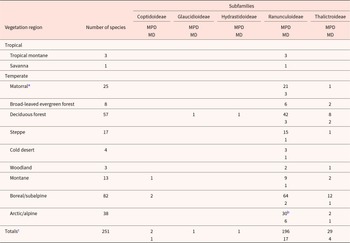


 Open access

