1 INTRODUCTION
Considerable progress has been made in variationist research on the French of France since Gadet (Reference Gadet1996: 89) observed in the mid-1990s that it had barely begun at that time, and yet much still remains unknown. More empirical research is needed in different parts of France and elsewhere in francophone Europe, in order to test the validity of general theories of language variation and change and to examine what may (or may not) be distinctive about European and especially metropolitan French, including the characteristics of its varieties. In this context, we present findings from a sociolinguistic survey carried out in a region which has not previously been the object of variationist study and which, moreover, is distinctive in its language contact situation: Alsace.
With regard to the theoretical framing, particular attention is paid to the question of extensive and ongoing supralocalization of regional dialects, especially accents, in France, resulting in the attrition of traditional regional features and, concomitantly, increased phonological uniformization (Boughton, Reference Boughton2003, Reference Boughton2005; Pooley, Reference Pooley2006; Armstrong and Pooley, Reference Armstrong and Pooley2010). We adopt the term supralocalization rather than levelling since the latter is sometimes confused with, or used as shorthand for, regional dialect levelling. In their summary of Kerswill (Reference Kerswill, Britain and Cheshire2003), Britain and Cheshire (Reference Britain, Cheshire, Britain and Cheshire2003: 5) observe that: ‘the term “dialect levelling” […] became something of a catchphrase in the late 1990s, and needs to be deconstructed. [Kerswill, Reference Kerswill, Britain and Cheshire2003] carefully distinguishes between the process of levelling, defined by Trudgill [Reference Trudgill1986] as the long-term result of accommodation between speakers, and its measurable outcome, which may result from a number of processes including levelling, standardisation and geographical diffusion’. The ‘measurable outcome’ of regional dialect levelling, Kerswill (Reference Kerswill, Britain and Cheshire2003: 223) notes, is ‘the loss of localised features in urban and rural varieties […], to be replaced with features found over a wider region’. Kerswill (Reference Kerswill, Britain and Cheshire2003) presents a range of evidence pertaining to British English in order to examine the motivating mechanisms of (i) geographical diffusion, ‘by which features spread out from a populous and economically and culturally dominant centre’ (p. 223) and (ii) levelling as a social psychological speech accommodation process resulting in linguistic convergence between interlocutors.
While Kerswill (Reference Kerswill, Britain and Cheshire2003) does not explicitly deal with the sometimes allied process of standardization, despite its evocation by Britain and Cheshire, above, in their introductory summary of his chapter, the interaction between supralocalization and standardization has been a notable focus of debate in relation to metropolitan French. Armstrong (Reference Armstrong2002) and Armstrong and Pooley (Reference Armstrong and Pooley2010, Reference Armstrong and Pooley2013) grapple with these processes, contrasting them with the regional dialect levelling observed in British English in particular. Armstrong and Pooley (Reference Armstrong and Pooley2013: 142) propose the term ‘advergence’ (‘or uplevelling’) to express the observation that supralocalization in French – or rather, northern French – involves a kind of ‘convergence towards a “prestige” norm’ but which is not accurately characterized as standardization either, since the norm has itself been subject to evolution and become more informal. For this reason, they refer to this norm as the ‘supralocal variety’ rather than standard or ‘Reference’ French. Different processes may be taking place in southern varieties, however (cf. Durand, Eychenne and Lyche, Reference Durand, Eychenne, Lyche, Jones and Hornsby2013; Mooney, Reference Mooney2016); we return to this question below.
The process of supralocalization, in which ‘localised features are eroding in favour of a very widely distributed, socially neutral norm’ (Armstrong and Pooley, Reference Armstrong and Pooley2013: 141), carries the implication that features of regional French are ‘ephemeral and will be lost in favour of more standard features as time advances’ (Mooney, Reference Mooney2016: 4). We aim to address these contentions by a quantitative analysis of some key phonological variables in a new corpus of regional French gathered in Alsace, which will allow us to assess the extent to which traditional accent features persist. In addition, since the sample incorporates speakers of different socioeconomic backgrounds, both genders and from a rural as well as an urban location, we can examine the patterns of variation which characterize our corpus in order to provide fresh insights into this geographically peripheral variety of regional French. In doing so, we seek also to join a broader theoretical debate regarding the nature of variation and change in regional varieties of the language (cf. Hornsby, Reference Hornsby2006; Armstrong and Pooley, Reference Armstrong and Pooley2010; Mooney, Reference Mooney2016).
We begin by setting out the research context, with a review of some recent work on the contemporary state of regional accents in France, before describing the corpus on which the present article is based and summarizing the methods adopted in its collection. We then present and discuss some results of an analysis of selected features regarded as emblematic of the Alsatian accent, namely the variable realization of word-initial [h] and consonant devoicing phenomena, focusing on /ʒ/. Finally, we offer a synthesis of the patterns observed and conclude with some reflections on variation and change in the regional French of Alsace, on regional French more generally, and on some results which appear surprising in the light of general sociolinguistic theory.
2 CONTEXT: SUPRALOCALIZATION AND REGIONAL FRENCH
As noted above, the turn of the millennium saw an increase in variationist research on regional dialect levelling (or, more accurately, regional accent levelling (Foulkes and Docherty, Reference Foulkes, Docherty, Foulkes and Docherty1999b: 5)). A number of studies in the late 1990s and early 2000s examined varieties of British English, such as Foulkes and Docherty (Reference Foulkes and Docherty1999a), Watt and Milroy (Reference Watt, Milroy, Foulkes and Docherty1999), Williams and Kerswill (Reference Williams, Kerswill, Foulkes and Docherty1999) and Dyer (Reference Dyer2002) (and cf. Kerswill (Reference Kerswill, Britain and Cheshire2003), discussed above); and in the early 2000s, several UK-based researchers applied a similar perspective to their work on the regional French of France. (For example, Armstrong (Reference Armstrong2001, Reference Armstrong2002), Temple (Reference Temple, Hintze, Pooley and Judge2001), Hornsby (Reference Hornsby, Jones and Esch2002, Reference Hornsby2006, Reference Hornsby2007), Pooley (Reference Pooley, Jones and Esch2002) and Boughton (Reference Boughton2003).)
The project reported in Boughton (2003; see also Reference Boughton2005) was undertaken in this scientific context as well as in response to a growing number of impressionistic observations in the literature alluding to the attrition of diatopic variation in metropolitan French, especially since the mid-twentieth century. To give but one example, Léon (Reference Léon1993: 222) remarks that a study carried out in 1980 involving perceptual judgements of speakers from a number of regions already showed a high degree of convergence with the supralocal norm at that time. In order to test such remarks by empirical means, Boughton (Reference Boughton2003) carried out fieldwork in Nancy and Rennes in 1997–1998 to gather a large corpus of interviews from 64 speakers (32 from each city) stratified according to age, gender and social class in addition to region. The principal findings, both behavioural and perceptual, led to the conclusion that supralocalization was indeed quite advanced in the Nancy–Rennes corpus, especially in Rennes, and that this was probably also the case in other similar cities and therefore in northern, urban French more generally.
This hypothesis was taken up by Pooley (Reference Pooley2006) in a survey article which sought to examine the progress of regional accent levelling in French in the langue d’oïl area and Franco-Provençal zone by comparing well-known accounts based on speakers born in the first half of the twentieth century – such as Martinet (Reference Martinet1945), Walter (Reference Walter1982) and Carton et al. (Reference Carton, Rossi, Autesserre and Léon1983) – with more recent analyses of speakers born after 1965, who would have been aged 40 or under at the time of writing in 2006. These analyses were drawn from studies of locations in eastern France, plus Brittany, Normandy, the Nord–Pas-de-Calais, Picardy, Paris and the Auvergne. Some of these, e.g. Tifrit’s (Reference Tifrit2003) study of Dijon and Guézennec’s (Reference Guézennec2003) investigation of the Ⓘle-de-Sein, Brittany, were carried out under the aegis of the Phonologie du Français Contemporain (PFC) project which, while not primarily variationist in its original intent (Durand, Laks and Lyche, Reference Durand, Laks, Lyche, Pusch and Raible2002: 96; see also Pooley, Reference Pooley2006: 369), has done much in recent years to provide new data relating to regional phonological variation in French. In a series of related maps, based partly on Pottier (Reference Pottier and Martinet1968) and Armstrong (Reference Armstrong2001), Pooley illustrates his proposed metaphor of an ‘oïl slick’ representing the diffusion of supralocal French in areas where divergence was previously much more entrenched. He concludes that ‘[e]ven allowing for the peripheral resistant areas of northern France (both east and west), the loss of regiolectal features and the consequent convergence towards Oïl or supra-local French is remarkable. Nowhere else in western Europe are phonological regiolectal features levelled to such a degree over such a large area’ (p. 386). It is notable that Alsace is marked as one of the ‘peripheral resistant areas’ where ‘divergent forms occur variably’ among speakers born in or after 1965. Pooley (Reference Pooley, Jones and Hornsby2013: 196) later notes that this conclusion was drawn ‘partly on the basis of a lack of evidence and partly on informal communication with colleagues’. Indeed, it was in this context that the research reported here found a key element of its motivation: to break new ground by carrying out an extensive variationist survey in a border region of the Hexagon that had not been previously studied in the Labovian framework (and was little studied from any theoretical perspective). We return to this shortly below.
Research investigating supralocalization in French has continued in recent years. It is, for example, the chief focus of Armstrong and Pooley (Reference Armstrong and Pooley2010), which extends the debate to francophone Europe; and within France, the frame of reference has been pushed beyond the northern two thirds of the country to consider southern and central regions of the langue d’oc. While Pooley (Reference Pooley2006) offers some consideration of the linguistic situation in the Limousin and the Auvergne and concludes, on the basis of studies by Potte (Reference Potte, Taverdet and Straka1977) and Sobotta (Reference Sobotta2003), that the available evidence suggests ‘considerable levelling’ (p. 382) in the northern langue d’oc area, in a companion piece, Pooley (Reference Pooley2007) provides a review of levelling in more southerly regions. A number of accounts are synthesized to build a picture of a ‘Dominant Southern Pattern’ (p. 43), marked primarily in vocalic features (such as schwa, nasal vowels and mid-vowels), which Pooley concludes is ‘very much alive’ despite ‘many indications that it is markedly regressive’ (p. 61): ‘convergence towards supra-local norms appears to have gained ground among speakers born in the latter part of the 20th century to the point where many young adults from the region are no longer immediately recognisable as southern’ (pp. 62–63).
Durand, Eychenne and Lyche (Reference Durand, Eychenne, Lyche, Jones and Hornsby2013), responding in part to Pooley (Reference Pooley2006) and Armstrong and Pooley (Reference Armstrong and Pooley2010), bring to bear on the question of convergence an authoritative overview of 10 years of PFC data, focusing on southern varieties. They argue that ‘while southern French is indeed changing in the direction of northern-based norms, substantial differences still exist’, and ‘even within northern France, we do not observe the homogeneity which is often assumed in the literature’ (see also Boughton, Reference Boughton, Jones and Hornsby2013; Hall and Hornsby, Reference Hall, Hornsby, Davies and Ziegler2015). The authors propose examples of features which do not currently appear to be aligning straightforwardly with supralocal norms, namely the loi de position constraint on mid-vowels, and variable schwa. This prompts us to reflect that a focus on supralocalization can lead us to imply that the overall phonological picture is purely one of loss of variation, of simplification and homogenization. Of course, this is certainly not the case: variation is persistent and is often more complex than it might first appear. Even if there is general agreement regarding the loss of vestigial localized features, this does not mean that all speakers in all regions of France simply adopt the supralocal norm, or in the same way (cf. Armstrong and Pooley, Reference Armstrong and Pooley2013).
Mooney (Reference Mooney2016) demonstrates this amply by way of a sociophonetic analysis of a corpus gathered in the Béarn region. Inspired by Hornsby’s (Reference Hornsby2006) re-evaluation of the concept of regional French, Mooney examines outcomes of both language contact and dialect contact in an area that could be expected to be among the most resistant to processes of convergence: the peripheral southwestern corner of the Hexagon. While Mooney observed evidence for the adoption of supralocal features, this was not entirely straightforward: younger speakers were found to combine supralocal and regional features in an innovative way that led to increased, rather than decreased, linguistic diversity (pp. 109–110, 124).
It seems therefore that the processes and outcomes of linguistic change may differ according to factors such as whether the regional variety in focus is located in the supralocal area or outside it, whether in the south or in peripheral areas of the north of France, and perhaps also according to the nature of the accent features studied (in particular, whether they are vocalic or consonantal). While the majority of studies of regional French over recent decades provide evidence in support of the related ongoing processes of (i) attrition of traditional accent features and (ii) diffusion of supralocal norms and behaviour, we have seen that it is not always the case. But what of Alsace?
Relatively little is known about accent variation and change in the regional French of Alsace, in spite of its unique sociolinguistic profile. A border zone from both the political and linguistic viewpoints, several varieties are in contact there, including: French; various sub-dialects of the Germanic regional language, Alsatian; standard German; a Romance variety known locally as Welsch; and a number of immigrant languages. It is therefore a prime site for the observation of language contact phenomena. For this reason, much previous research has tended to focus on issues such as language choice, use and attitudes, and code-switching between French and Alsatian (Gardner-Chloros, Reference Gardner-Chloros1991; Vassberg, Reference Vassberg1993; Vajta, Reference Vajta2004) as well as on Alsatian itself (Philipp, Reference Philipp1965; Beyer and Matzen, Reference Beyer and Matzen1969; Bothorel-Witz et al., Reference Bothorel-Witz, Philipp and Spindler1984) and rather less on the characteristics of the French spoken in the region.
Pooley (Reference Pooley2006: 371) refers to the ‘continued vitality’ of the Alsace accent. However, he cites only ‘informal confirmation’, along with the work of Bickel-Kauffmann (Reference Bickel-Kauffmann1983), as evidence of the continued use of regional features described in key sources which also date from the early 1980s (Walter, Reference Walter1982; Carton et al., Reference Carton, Rossi, Autesserre and Léon1983) and which are based on very small numbers of speakers (three and one respectively). This results in what might be described as a ‘maximalist’ account of regional French in Alsace in the 1980s. Features nevertheless mentioned by Pooley, citing Bickel-Kauffmann (whose primary focus was in fact phonological transfer from French to Alsatian rather than vice versa (Gardner-Chloros, Reference Gardner-Chloros1991: 8)), are: aspiration of initial voiceless plosives in stressed syllables; realization of initial orthographic <h> as [h]; and the voicing of voiceless plosives, especially when word-initial.
With regard to studies of the substrate influence of Alsatian on the pronunciation of French, in addition to Walter (Reference Walter1982: 115–118) and Carton et al. (Reference Carton, Rossi, Autesserre and Léon1983: 14–18), the principal contribution is that of Philipp (Reference Philipp1965, Reference Philipp1967, Reference Philipp and Salmon1985), whose work on the variety of Alsatian spoken in the village of Blaesheim, near Strasbourg, also encompassed features of the French spoken there by bilingual individuals. Philipp (Reference Philipp1967, drawing on Reference Philipp1965) focuses on the distinctive prosody of five of her Blaesheim speakers rather than on segmental features and emphasizes the perceptual salience of non-standard stress patterns: ‘[c]’est probablement l’accentuation caractéristique du bilingue alsacien qui le “trahit” plus que toutes les autres interférences’ (p. 67), an aspect of regional French in Alsace which has also been the object of more recent research (Boula de Mareüil et al., Reference Boula de Mareüil, Adda-Decker, Woehrling, Bardiaux, Simon and Simon2012). Philipp (Reference Philipp and Salmon1985), based on the same fieldwork, provides details of some other features. These include the devoicing of voiced plosives and fricatives in word-final position (whereby, for example, vide and vite become [viːt] and [vit], demonstrating also that a lengthened vowel is realized before a plosive that would be voiced in standard French); and inversion of schwa and liquid in final obstruent-liquid clusters, as in faible [fεːpəl] and coudre [kʰuːtəʀ]. The latter examples also show devoicing of medial plosives with concomitant lengthening of the preceding vowel. Finally, Philipp observes the neutralization of voicing opposition in initial plosives (differentiated by the aspiration of canonically voiceless segments, as in un beau pot [œ̃popʰo]) and fricatives, of which the most remarked-on example concerns /ʒ, ʃ/, whereby joue and chou are both realized as [ʃu].
Devoicing of obstruents, along with aspiration and non-standard stress, is one of the features analysed by Bonnot, Bothorel-Witz and Huck (Reference Bonnot, Bothorel-Witz, Huck and Lüdi1993) in the scripted speech of two bilingual informants, one female aged 49 and one male aged 51, both of whom had left school at the age of fourteen. Consonant devoicing showed a gender difference, with the male speaker devoicing 78 tokens and the female, 31; the authors therefore suggest the possibility that ‘le marqueur phonétique “régional” le plus sensible est la désonorisation’ (p. 36). Gardner-Chloros (Reference Gardner-Chloros1991: 8) also notes the ‘apparent confusion’ of voiced and voiceless plosives, attributing this to ‘a transfer from Alsatian lenis stops’, alongside initial stress, as the principal characteristics of the regional accent.
Other aspects of the variety, such as morpho-syntactic and lexical interference (see, for example, Matzen, Reference Matzen1973; Jadin, Reference Jadin and Salmon1985, and other papers in the same volume) have received attention, and more recently, Marchessou (Reference Marchessou2018) has reported on an ethnographic study of the speech of 24 young Strasbourgeois.e.s (aged 16–21) in a multi-ethnic working-class neighbourhood, with a focus on lexical innovations, indirect interrogatives, quotatives and discourse markers. However, to our knowledge, no other large-scale quantitative study, based on a stratified sample, has been carried out on the phonology of the regional French of Alsace; and most existing research on the regional accent is based on rural varieties, while urban usage remains relatively neglected (cf. Durand, Eychenne and Lyche, Reference Durand, Eychenne, Lyche, Jones and Hornsby2013: 68).
The present study addresses this neglect. In particular, we focus on the following research questions: (i) do we observe in Alsace the increased diversity in regional French found in other recent work outside the supralocal area (cf. Durand et al, Reference Durand, Eychenne, Lyche, Jones and Hornsby2013; Mooney, Reference Mooney2016), or supralocalization?; (ii) what is the effect of the fundamental extra-linguistic variables of age, gender and socioeconomic status?; and (iii) are there differences in patterns of sociolinguistic variation according to whether the speech community is urban or rural? We present and discuss selected results which seek to shed light on these questions, after first setting out some methodological information in the following section.
3 THE ALSACE CORPUS
The data on which the present analysis is based are drawn from a large corpus of spoken French resulting from surveys (carried out by Pipe, under the supervision of Boughton) at two research sites in AlsaceFootnote 1 in 2011–2012. The primary survey location was the conurbation of Strasbourg, or Communauté Urbaine (since renamed the Eurométropole) de Strasbourg, which, in 2019, is the eighth largest city in France by population size.Footnote 2 The principal urban centre in the region, Strasbourg was chosen as it has not previously been the object of variationist research and for the important practical reason that the fieldworker had lived there previously for seven months while working as a lectrice at the university and had subsequently returned to carry out a pilot study for a prior related project (Pipe, Reference Pipe2010). She was therefore well acquainted with the context and had built up a substantial network of personal contacts, invaluable for successful sociolinguistic fieldwork.
This consideration also played a role in the selection of the second fieldwork site, the small village of HelsheimFootnote 3 (population approximately 700), located to the north of Strasbourg in a rural part of the same department, the Bas-Rhin, and where the fieldworker had contacts willing to provide accommodation and personal introductions to other inhabitants of the village. In addition, the two locations are in the same Alsatian dialect area,Footnote 4 minimizing the likelihood of linguistic differences due to substrate factors, but they are extremely different with regard to population size. The rural context was chosen as offering the greatest contrast to the urban centre, to test the hypothesis that the extent of supralocalization may be conditioned by the size and type of speech community and to investigate potential differences in patterns of variation according to the urban–rural dimension. Furthermore, Helsheim is situated in the area north of the Forest of Haguenau, known as the Outre-Forêt, which has the reputation of being the part of Alsace in which the local dialect and cultural traditions have been preserved to the greatest extent. During the fieldwork, it was observed that Alsatian was indeed regularly spoken by the villagers to one another, including within the younger generation. We might therefore reasonably expect supralocalization to be less advanced there, since Alsatian is frequently used and may influence the local variety of French (cf. Mooney’s (Reference Mooney2016: 43) discussion of linguistic transfer in a situation of Béarnais–French bilingualism).
In both locations, quota (or judgement) samples of speakers were for the most part contacted through personal networks, using the ‘friend of a friend’, or ‘snowball’ method (Milroy and Gordon, Reference Milroy and Gordon2003: 32), a technique which can serve to reduce the risk of refusal to participate and also to encourage a more informal speech style during interviews. This approach was very successful in Helsheim, where the villagers all knew each other and where a member of the host family accompanied the fieldworker on a first visit to all potential participants. It was equally effective among the existing network of contacts in Strasbourg, though these were predominantly middle class. The samples were stratified by age and gender, and in Strasbourg, also by socioeconomic group: participants were categorized as broadly working class or middle class according to whether their occupation (or parents’ occupation in the case of young people still in education) was manual (‘blue collar’) or non-manual (‘white collar’) (cf. Trudgill, Reference Trudgill1974; Chambers and Trudgill, Reference Chambers and Trudgill1998: 49). While a simplification of the complex web of factors that determine socioeconomic status, it is generally agreed among social scientists that occupation remains ‘the best single indicator’ of social class (Chambers, Reference Chambers2009: 51; see also Harrison, Reference Harrison, Jones and Hornsby2013: 14), even though many sociolinguistic surveys in francophone contexts have preferred level of formal education as a proxy measure, or have not attempted to sample for social class at all (cf. Durand, Eychenne and Lyche, Reference Durand, Eychenne, Lyche, Jones and Hornsby2013: 59). The rural sample, however, was not differentiated according to class. In part this was in order to keep the overall sample size manageable, but chiefly it was because in the tightly-knit social network of the village, the majority of inhabitants were employed either in agriculture or in unskilled industrial jobs and there was little division of the speech community into groups based on occupation or other indicators of social status. In Strasbourg, it proved difficult to obtain a full quota of working-class participants, females especially, partly owing to network factors – the fieldworker’s contacts (or their parents) were predominantly employed in white-collar jobs, as were the further participants those contacts were able to suggest – and partly to the demographic characteristics of the city, which thrives on tourism, the university and the European institutions. Many blue-collar jobs are carried out by immigrant workers and there is little industry, which is concentrated rather in Mulhouse, so the population of manual workers is relatively small in general (Howiller, Reference Howiller2008: 23, 45, 121). The additional sampling criterion of ‘nativeness’ also restricted the potential pool of participants: to enhance comparability across the sample, all speakers were born in Alsace (preferably at the research site, or at least in the Bas-Rhin department) or had moved there before their fifth birthday (cf. Labov, Reference Labov, Hungerford, Robinson and Sledd1970: 288–289). Their native language was either French or Alsatian: French for the urban speakers aged 30 and under, Alsatian for almost all the others.
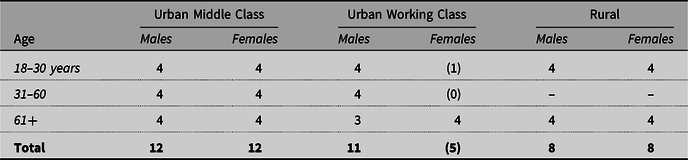
In all, data were collected from 40 informants in Strasbourg and 16 in Helsheim, resulting in an overall sample of 56 speakers, structured as shown in Table 1. The three age groups represent three broad life stages (Milroy and Gordon, Reference Milroy and Gordon2003: 38–39). In Helsheim, only the youngest and oldest groups were sampled. Again, this approach served to keep the overall sample size and data collection manageable, but it also helps to draw out any age contrasts (previous studies of supralocalization which have adopted a similar sampling procedure include Watt and Milroy (Reference Watt, Milroy, Foulkes and Docherty1999); Docherty and Foulkes (Reference Docherty, Foulkes, Foulkes and Docherty1999)). As mentioned above, the urban working-class (female) sample is incomplete and so results for those cells are hereafter treated with due circumspection, and shown in parentheses. A near-full sample was nevertheless obtained for participants aged over 61 in all sub-groups, and the rural sample is comparable with the urban middle-class upper and lower age groups, which is useful with a view to contrastive analysis of variation in the corpus.
Size and structure of the Alsace speaker sample

Data were collected in sociolinguistic interviews, conducted in French, with either one or two participants. (The fieldworker is a completely fluent non-native speaker of French). These were relatively informal conversations, usually taking place in the participant’s home or, occasionally, their workplace. The same topic was proposed in each case: Alsatian cultural and linguistic practices. This had the advantage of placing the interviewer in the position of a learner (as recommended originally by Labov (Reference Labov, Baugh and Sherzer1984: 40)) and also allowed for the elicitation of qualitative data relating to such issues as language use and attitudes, as well as life histories. Full information and the set of guiding questions used are given in Pipe (Reference Pipe2014: 230–232). Scripted speech styles (e.g. reading passages, word lists) were not elicited, in order to keep the conversations as informal as possible, to minimize the effect of the Observer’s Paradox by avoiding the closer monitoring of pronunciation that is entailed by reading aloud, and because the primary focus of the study is the analysis of linguistic variables in spontaneous speech according to the participants’ social characteristics.
4 RESULTS
We turn now to the results of a quantitative analysis of two phonological variables, chosen as representative of an Alsatian regional accent: the realization of word-initial [h], denoted here (h), and non-assimilatory devoicing of /ʒ/, denoted (ʒ). Since they are consonantal variables, both lend themselves more readily to auditory analysis, the method employed here, than do continuous vocalic variables; and, as mentioned above, the devoicing of /ʒ/ in particular has been described as especially emblematic of the regional French spoken in Alsace.
4.1 Variable realization of word-initial [h]
In this section we set out and discuss our results for the variable realization of initial <h> as the voiceless glottal fricative [h]. Variable (h) involves contexts referred to as h aspiré, which is word-initialFootnote 5 in a particular lexical set beginning with orthographic <h>, and blocks elision, liaison and enchaînement. Most such words are of Germanic stock, and thus the [h] was probably pronounced originally. This has not been the case in standard French for several hundred years: it appears to have been lost as early as the sixteenth century (Southworth, Reference Southworth1970: 65; Gabriel and Meisenburg, Reference Gabriel, Meisenburg, Kügler, Féry and van de Vijver2009: 164). Although non-realization was deemed incorrect at that time (Coveney, Reference Coveney2001: 54), that is certainly no longer the case; indeed, it is its pronunciation that is now stigmatized and excluded from reference usage (Léon, 1983: 22; Reference Léon1993: 225; Green and Hintze, Reference Green, Hintze, Coveney, Hintze and Sanders2004: 262). Nevertheless, it persists as a feature in a number of regional varieties and could be described as an archaism, since it is attested in peripheral areas of the Hexagon (as well as in Belgium and Quebec), a characteristic of vestigial, or relic, variants (Chambers and Trudgill, Reference Chambers and Trudgill1998: 94). In addition to Alsace and Lorraine, [h] is noted as present in the ‘west of France’ (Armstrong and Pooley, 2010: 165; Reference Armstrong and Pooley2013: 145): in Normandy, Brittany, Maine-Orléans, Poitou, Saintonge and Gascony (Fouché, Reference Fouché1957: 252; Walter, Reference Walter1982; Carton et al., Reference Carton, Rossi, Autesserre and Léon1983; Bennett, Reference Bennett1988: 2). In Alsace, however, it is less likely that it is an archaism, since French was barely used in the region when [h] was prescribed in the standard variety; it is more probably a substrate feature whose maintenance has been supported by the influence of local Germanic dialects.Footnote 6
As a regional feature, [h] has received little systematic attention, though it has in recent years been studied within the PFC framework. In the Basque Country, it was found to be recessive in St Jean Pied de Port, where it was used only by a 92-year-old female in the standard PFC sample of 12 speakers (Tarrier, Reference Tarrier, Detey, Durand, Laks and Lyche2010: 75); similarly, in two PFC samples from Normandy, ‘it is only older informants (the so-called NORMs, non-mobile old rural male speakers) who retain this feature’ (Durand, Eychenne and Lyche, Reference Durand, Eychenne, Lyche, Jones and Hornsby2013: 60). With regard to the regional French of Alsace, [h] is attested widely in the literature, including normative, pedagogical and descriptive treatments as well as more scientific studies (De Dietrich, Reference De Dietrich1917; Suiter, Reference Suiter1920; Philipp, Reference Philipp1965; Walter, Reference Walter1982; Carton et al., Reference Carton, Rossi, Autesserre and Léon1983; Bickel-Kauffmann, Reference Bickel-Kauffmann1983 (cited by Gardner-Chloros, Reference Gardner-Chloros1991 and Pooley, Reference Pooley2006); Bennett, Reference Bennett1988; Coveney, Reference Coveney2001; Weiss, Reference Weiss2004; cf. Armstrong and Pooley, Reference Armstrong and Pooley2010, Reference Armstrong and Pooley2013). Despite all of the above, it remains the case that rather little is known about its sociolinguistic significance and distribution. The (h) variable in Alsace is above the level of conscious awareness, at least for the younger speakers who commented on it during interviews and in other metalinguistic conversations in the field, and considerable interspeaker variation in the use of h aspiré in standard French has been notedFootnote 7 (Green and Hintze, Reference Green, Hintze, Coveney, Hintze and Sanders2004: 257), but few attempts have been made to examine the structure of this variability according to extra-linguistic factors.
With regard to the present study, only h aspiré contexts were analysed; [h] was not found to occur in h muet words in the Alsace corpus. Two variants of (h) were coded, namely a binary division between realization of [h] as a voiceless glottal fricative and non-realization. (Standard ‘aspirate h’ is not necessarily a phonetic zero, but its finer acoustic details are not in focus here, and have in any case already been studied (Green and Hintze, Reference Green, Hintze, Coveney, Hintze and Sanders2004; Boersma, Reference Boersma2007; Gabriel and Meisenburg, Reference Gabriel, Meisenburg, Kügler, Féry and van de Vijver2009).) (h) is a relatively infrequent variable in spontaneous speech (Gabriel and Meisenburg, Reference Gabriel, Meisenburg, Kügler, Féry and van de Vijver2009: 166); for example, Green and Hintze (Reference Green, Hintze, Coveney, Hintze and Sanders2004: 3) found that it occurred on average only approximately every 11 minutes in their corpus – as opposed to liaison which occurred about every seven seconds. In the present corpus, the rate of frequency of (h) is slightly higher, due to: (i) the large number of Alsatian toponyms and related words (such as Haguenau, le Haut-Rhin and haut-rhinois(e)), including a syllable-initial context in place names ending in –heim, in which [h] was realized variably; (ii) some regional French words of Alsatian origin (for example, le Hans Trapp, equivalent to le Père Fouettard Footnote 8 ); and (iii) the rather frequent occurrence of Hitler and hitlérien(ne) in speaking about the history of Alsace. As is usual, the number of tokens varied according to the individual speaker, and group total observed frequencies are used below.
The total number of tokens analysed is 932, with an overall rate of realization of [h] for the corpus as a whole of 44.53% (415/932). While the standard variant is therefore more frequent in the corpus, it is clear that use of the regional pronunciation is still widespread in this sample of 56 speakers, certainly in comparison to the PFC findings for the Basque Country and Normandy cited above and contrary to Armstrong and Pooley’s (Reference Armstrong and Pooley2013: 145) proposal that it is ‘highly marginal’. We turn now to its distribution according to the major demographic variables sampled here.
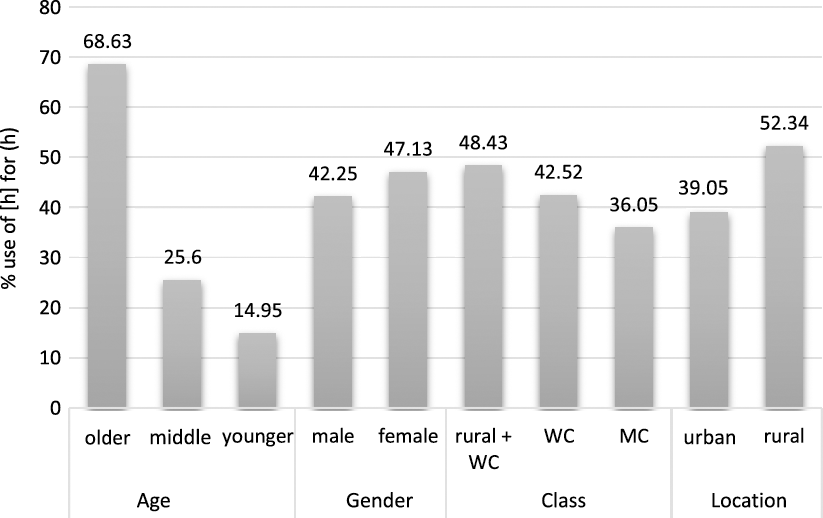
Figure 1 shows the rates of realization of the non-standard, regional [h] variant according to the key extra-linguistic variables of age, gender, socioeconomic status (in Strasbourg only) and urban or rural location. A number of observations are immediately apparent. Speaker age stands out as the most important variable affecting use of [h]: comparing the differences between the three age groups, we note a substantial and statistically highly significant (chi-square (df, 2) = 253, p = 0.000)Footnote 9 decline in apparent time, with a major drop between the older (61+) and middle (31–60) age groups. Though this seems indicative of a change in progress, it is notable that the feature persists in the usage of the 18–30 age group and is not completely absent. One factor distinguishing the oldest speakers from those aged 30 and under is length of time spent in formal education:Footnote 10 many of the older speakers, especially in the rural sample, left school at 14, which is no longer possible. More time spent in formal educational settings increases exposure to and awareness of standard French and supralocal norms. The results for gender are interesting and unexpected: contrary to the usual ‘sociolinguistic gender pattern’ (Fasold, Reference Fasold1990: 92; Labov, Reference Labov1990, Reference Labov2001), the females use less of the incoming prestige variant than the males. However, this apparent difference is not statistically significant (chi-square (df, 1) = 2.23, p = 0.135) and may in fact reflect a pattern observed previously in the French of France and Belgium, namely a lack of gender difference in variable phonology (Armstrong et al., Reference Armstrong2001; Bauvois, Reference Bauvois2002: 45; cf. Coveney and Dekhissi Reference Coveney, Dekhissi, Tyne, Bilger, Cappeau and Guerin2017: 194), itself an intriguing finding in the context of general sociolinguistic theory. With regard to social class in the urban sub-sample, we note the expected pattern of usage: those in white-collar occupations use [h] less frequently than those in manual jobs, though the difference is not significant (chi-square (df, 1) = 2.39, p = 0.122).Footnote 11 When the observed frequency for the urban working-class sample is taken together with that for the predominantly blue-collar rural sample, giving a combined rate of [h] of 48.43%, the class difference emerges more clearly and is highly significant (chi-square (df, 1) = 12.5, p = 0.000). The social class and age differences already mentioned are also reflected in the highly significant difference (chi-square (df, 1) = 16.2, p = 0.000) for location: unsurprisingly, the rural speakers use the regional form more frequently, as noted above for [h] in Normandy and as observed by Coveney (Reference Coveney2001: 54). In addition, the rural participants are all fluent in Alsatian, which is not the case for the younger urban speakers. It seems plausible that this, along with other demographic and network factors, may have a bearing on the maintenance of [h] in this community.
Relative frequency of regional [h] variant according to four social variables.

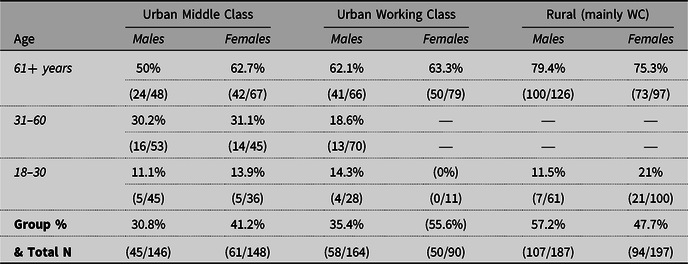
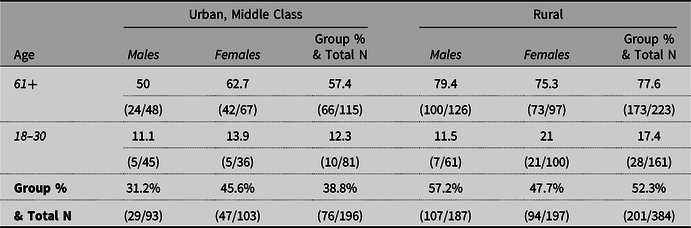
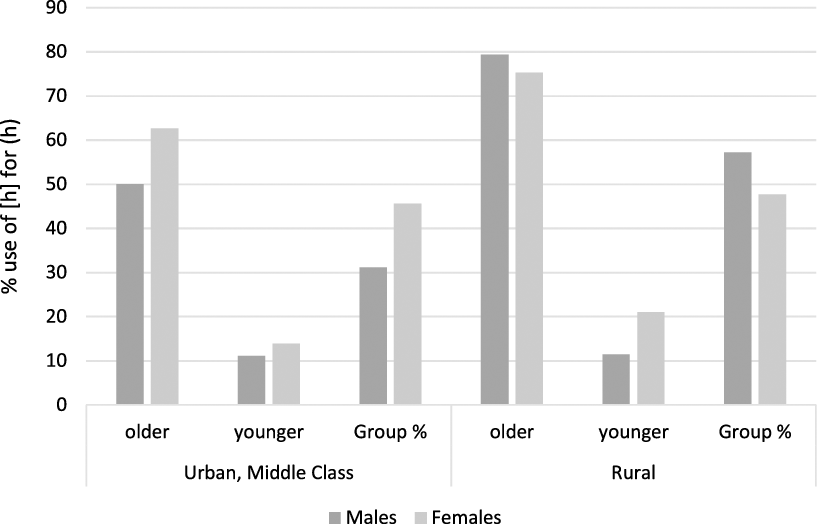
In Table 2, we display the rates of [h] realization according to each sub-group of the overall speaker sample, to provide further detail of the patterns found in the data; the same information is displayed in the alternative form of a graph in Figure 2. It will be recalled that observed frequencies and derived percentages are grouped and that each cell contains four participants, in all but three cases: the younger urban working-class females (one speaker only); the middle-aged urban working-class females (no participants); and the older urban working-class males (three participants). It will also be recalled that the middle age group was not sampled in the rural location. With due circumspection regarding the group results for the incomplete sample of urban working-class females, we may nevertheless draw out some key observations. With regard to age, the decrease in [h] in apparent time is seen consistently for all groups in both locations, confirming this as an essential finding. The decline is particularly stark for the rural sample, though again we see that use of the variant is maintained by the younger speakers, at least to some extent. We observe also more detailed evidence of the gender pattern noted above, whereby differences between males and females are generally not statistically significant. It is nevertheless surprising that the behaviour of the older middle-class females mirrors that of the older urban working-class speakers, since middle-class females are often found to conform most closely to reference norms (cf. Chambers and Trudgill, Reference Chambers and Trudgill1998: 61). However, since (h) is a relatively infrequent variable, it would be unwise to extrapolate too far. The overall result for class seen in Figure 1, whereby the middle-class speakers generally have lower rates of [h] than the working-class (and rural) speakers, is for the most part borne out by the results for individual cells; the middle-aged working-class males’ rate of 18.6% is surprisingly low in comparison with their middle-class counterparts’ 30.2%, although the difference is not significant statistically (chi-square (df, 1) = 2.26, p = 0.133). Finally, we focus on a comparison of the older and younger speakers in the urban middle-class and rural sub-samples, where all cells are of equal size.
Rates of realization of regional [h] by speaker group

Rates of realization of regional [h] by speaker group.

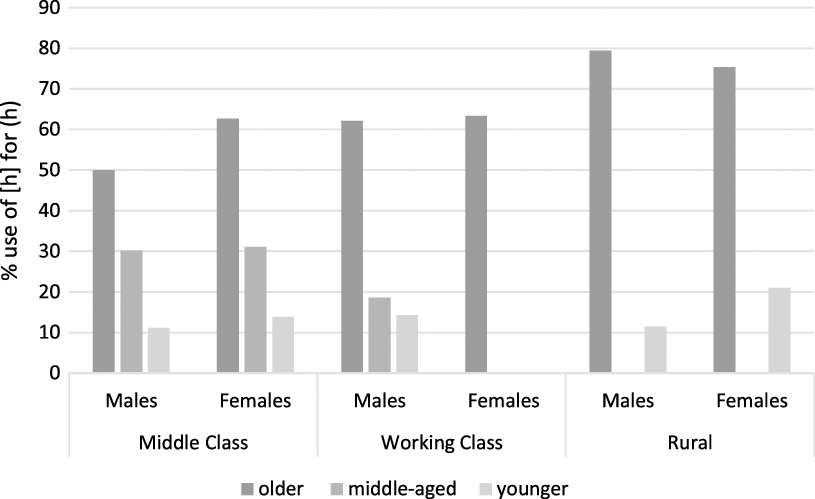
The data shown in Table 3 (and, as a chart, in Figure 3) enable us to focus in greater detail on the broad difference between the urban and rural samples – namely, that the rural speakers have significantly higher overall rates of [h] than the urban sample – as well as to offer further insights regarding age and gender patterns. We note that the urban–rural difference is more marked for the older participants here, at over 20% (chi-square (df, 1) = 14.9, p = 0.000, highly significant); the rate of [h] for the younger rural group is only 5% greater than that of the urban 18–30s (chi-square (df, 1) = 1.04, p = 0.309, not significant), which seems to indicate an alignment of behaviour among the most recent generation of adults such that the younger rural speakers are close to urban norms for this variable. The similarity between the younger males (11.1% and 11.5%) is striking in this regard. As for gender, the group totals for the females are very similar overall (urban, 45.6%; rural, 47.7%; chi-square (df, 1) = 0.118, p = 0.731, not significant), a somewhat surprising finding which may indicate a lack of awareness or at least of stigmatization of this feature among (older) female speakers. For the rural sub-sample, the usual sociolinguistic gender pattern appears to emerge: the males have a rate of [h] almost 10% higher than the females, though this is not quite statistically significant, as p = 0.062 (chi-square (df, 1) = 3.47). By contrast, for the urban sub-sample, an unexpected reverse gender pattern is clearly seen: the middle-class males’ rate of [h] is 14.4% lower than that of the females, a significant difference (chi-square (df, 1) = 4.30, p = 0.038). Since decades of variationist research has demonstrated a strong tendency for (especially middle-class) females to prefer standard variants and males non-standard, this result is puzzling, but it may at least imply that the (h) variable can have a different social meaning depending on speaker age,Footnote 12 and on size and context of the speech community, even within the same part of Alsace.
Comparison of rates of [h] for urban middle-class and rural oldest and youngest speaker groups

Comparison of rates of [h] for urban middle-class and rural oldest and youngest speaker groups.

4.2 Variable devoicing of /ʒ/ in non-assimilatory contexts
We turn now to the second variable: the total or partial devoicing of the canonically voiced postalveolar fricative /ʒ/, with a focus on phonological contexts which usually disfavour regressive assimilatory devoicing, namely preceding a vowel or a voiced consonant. Of course, assimilatory devoicing of this and other voiced obstruents, especially before a voiceless consonant, is widespread and unremarkable in everyday spoken French; but when non-assimilatory, it is likely to index aspects of sociolinguistic and/or regional identity.
Devoicing as a regional feature has been attested in the Nord–Pas-de-Calais (now part of the Hauts-de-France region) and in Belgium as well as in Alsace, Lorraine and celtophone Brittany (Armstrong and Pooley, Reference Armstrong and Pooley2010: 164). Previous variationist studies have focused predominantly on consonant devoicing in word-final position among working-class speakers in the Nord (specifically Roubaix (Pooley, Reference Pooley1994) and Avion (Hornsby, Reference Hornsby2006)), and in Belgian varieties (Bauvois, Reference Bauvois2002; Hambye, Reference Hambye2005, Reference Hambye, Beeching, Armstrong and Gadet2009). There are nevertheless distinctive, perhaps unique, aspects to the non-standard voicing patterns found in the regional French of Alsace. One factor is that /ʒ/ does not exist in the Germanic substrate variety and speakers of the regional language may therefore replace it with the closest equivalent in their phonemic repertoire, /ʃ/. There is also a lack of clear distinction between voiced and voiceless plosives: voicing of voiceless obstruents (as well as the more common devoicing of voiced obstruents) can also occur; and (de)voicing has been observed in all positions in the word, i.e. initial and medial as well as the more frequently-studied final context, which can mean that loss of phonemic opposition is a more widespread and far-reaching phenomenon than in other metropolitan and European French varieties.
In the present study, devoicing was selected for analysis primarily because it is mentioned throughout the literature on the regional French of Alsace, from the nineteenth century to the present day, and also because it is above the level of speaker awareness and therefore likely to be imbued with social meaning. Impressionistically, non-standard (de)voicing was frequently observed by the fieldworker in conversation with participants and often mentioned directly by them when questions were posed about the Alsatian accent. It is attested in written ‘folk’ sources such as Winter (Reference Winter2000), a humorous ‘life manual’ for newcomers to Alsace, who are warned that beurre may sound like peur, and that jabot and chapeau are pronounced in the same way. In addition, a local joke has it that in Alsace the SP written on fire engines stands for ‘ça prûle’ (= brûle) rather than sapeurs-pompiers. While such voicing patterns can have comedic value and even covert prestige for some members of the speech community, the other side of the same coin, a high level of awareness, can involve stigmatization and overt proscription (cf. Labov, Reference Labov2001: 196–197).
Indeed, there is a long history of negative metalinguistic comment on the phenomenon. It features prominently in early normative works aimed at helping Alsatians to rid themselves of their non-standard (read: unpatriotic) accent, including their ‘confusion’ of voiced and voiceless consonants. For example, D’Hauteville (Reference D’Hauteville1852) refers to errors with ‘nos durs et nos doux’ (p. 4), i.e. our voiceless and voiced consonants, and gives invented examples which illustrate this perceived problem, such as, ‘Ponchour, Monsieur, comment fous portez-fous? […] Chai mal au cou […] Che voudrais foir de Neptune la crotte’ (= grotte!), and the following often-repeated quotation from a contemporary minister, ‘nos brochets sont des truites’ (= nos projets sont détruits). Such examples demonstrate the loss of phonemic opposition that can result from these non-standard voicing patterns. D’Hauteville (Reference D’Hauteville1852: 11) describes the pronunciation of joues as choux as ‘blessant partout l’oreille’ and De Dietrich (Reference De Dietrich1917: 81) singles out devoicing of fricatives for particular criticism: ‘rien n’enlaidit le français comme les consonnes chuintées douces, prononcées dures […] le défaut capital des Alsaciens est la prononciation dure des consonnes douces, et surtout s pour z et ch pour j’.
More recently, dialectological and sociolinguistic studies have provided some objective evidence of such patterns. Devoicing as an Alsatian substrate feature is mentioned by Philipp (Reference Philipp1965: 123–124) in her work on the village of Blaesheim, now a suburb of Strasbourg, in which the examples of jour [ʃuʀ] and chose [ʃos] are given; and it was observed almost 40 years later by Vajta (Reference Vajta2004: 110–111) in a study of linguistic change over three generations of an Alsatian family: ‘les consonnes sonores en position finale […] sont désonorisées (sud [syd] devient [syt], village [vilaʒ] devient [vilaʃ] et, en général, l’opposition entre consonnes sourdes et consonnes sonores […] tend à disparaître’. Vajta (p. 111) also cites Bonnot et al.’s (Reference Bonnot, Bothorel-Witz, Huck and Lüdi1993: 36) claim, mentioned in section 2, that devoicing is the most salient regional pronunciation feature.
This brief review cements the impression of non-standard voicing patterns as a longstanding and widespread feature of the Alsatian regional French accent, and one which seems to have reached a high level of conscious awareness, but which has not yet been the object of large-scale quantitative research. We therefore now present selected results of an analysis of devoiced /ʒ/ in the corpus with a specific focus on non-assimilatory contexts, in order to separate regional pronunciation from supralocal assimilatory devoicing. Initially, a pilot study of all voiced obstruents produced by one older urban working-class male was carried out in order to investigate variation according to segment, position in the word, and preceding and following phonological context. This yielded a total of 1,339 voiced obstruents of which 19% were /ʒ/, illustrating its frequency of occurrence; /ʒ/ also had by far the highest devoicing rate of any obstruent at 54.2% (the average for all obstruents was 14.2%). For these reasons, the subsequent full analysis of the corpus focused only on /ʒ/.
With all positions in the word (initial, medial and final) grouped together (cf. Pipe, Reference Pipe2014: 191), in non-assimilatory (prevocalic and pre-voiced consonant) contexts the total number of tokens analysed is 9,581; of these, 8.85% were totally or partially devoiced. This may seem a relatively low proportion, but compared with a global rate of 16.5% for all devoiced tokens, i.e. including assimilatory contexts, it is arguably non-negligible. Moreover, an examination of its distribution according to our extra-linguistic variables reveals interesting patterns within this overall picture.
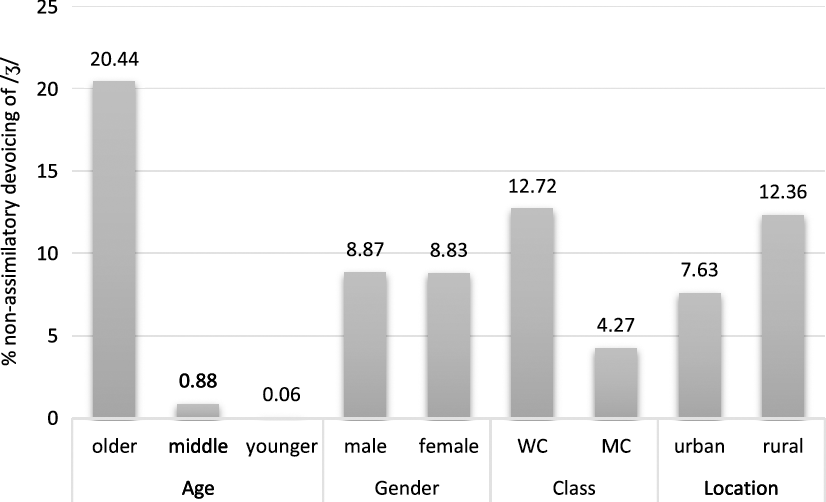
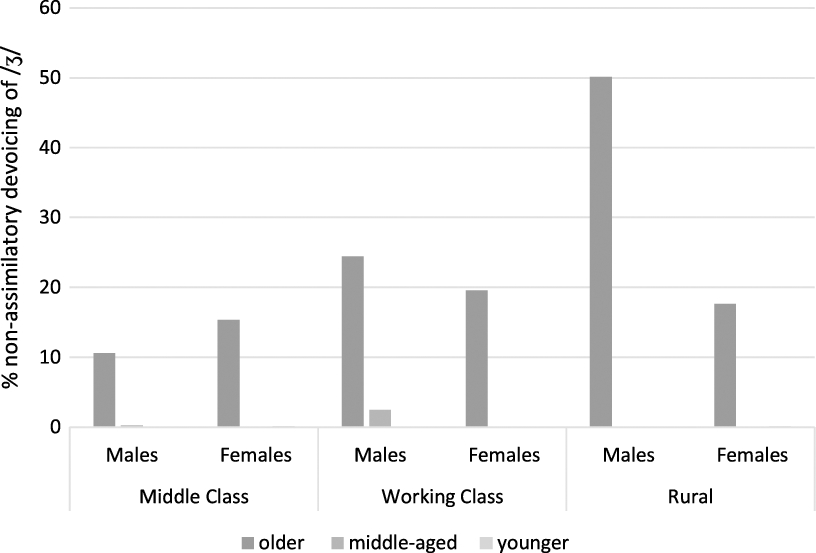
In Figure 4 we display the rates of devoicing of /ʒ/ in non-assimilatory contexts according to the social variables sampled in this study: age, gender, socioeconomic status in the urban sample indicated by blue- or white-collar occupation, and fieldwork site (urban/Strasbourg, rural/Helsheim). We contend that such non-assimilatory devoicing is not an accepted feature of supralocal French and that it is characteristic of traditional non-standard voicing patterns present in the regional French of Alsace. The most striking result shown here is the very steep decline in such devoicing in apparent time (chi-square (df, 2) = 0.117E+04, p = 0.000, highly significant): the almost complete absence of this feature in the speech of those aged under 60 appears to indicate that a change has already taken place and that we are witnessing the loss of this frequently-occurring component of the traditional regional accent. This result recalls Pooley’s (Reference Pooley1994: 224) observation of ‘a considerable degree of obsolescence’ in word-final consonant devoicing in Roubaix (see also Hornsby (Reference Hornsby2007: 80) with similar reference to Lens). However, since non-standard voicing patterns have been noted as a more widespread and complex phenomenon in Alsace than in other metropolitan French regions, the almost complete loss of non-assimilatory devoicing for this segment seems to provide further compelling evidence of accent supralocalization, even in the Germanic periphery of the Hexagon.
Relative frequency of regional non-assimilatory devoicing of /ʒ/ according to four social variables.

Alongside the stark division according to age, we note the expected differences for socioeconomic status, and fieldwork location (among older speakers, predominantly, since devoicing rates are negligible for those under 60): urban working-class participants have significantly higher rates of devoiced /ʒ/ than urban middle-class participants (chi-square (df, 1) = 172, p = 0.000), and the (predominantly working-class) rural sub-sample shows significantly greater devoicing than that from Strasbourg (chi-square (df, 1) = 51.1 and again, p = 0.000), with a rate of 12.36% – remarkably similar to the 12.72% found for the blue-collar urban group, and a difference which is not statistically significant (chi-square (df, 1) = 0.155, p = 0.694). The results for age, class and location of speech community thus line up with expectations for a traditional non-standard regional feature. Once more, however, it is gender which stands apart: the lack of significant difference in the behaviour of males and females (chi-square (df, 1) = 0.489E-02, p = 0.944) runs counter to the usual pattern; but a more detailed examination of the results for gender by sub-group, shown in Table 4, is, if anything, more intriguing still.
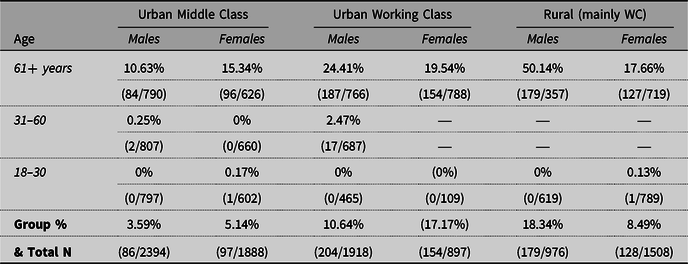
Rates of non-assimilatory devoicing of /ʒ/ by speaker group

Table 4 shows the rates of non-assimilatory devoicing of /ʒ/ for each sub-group of the Alsace sample; observed frequencies and the percentages derived from them are again grouped for each cell. Figure 5 shows the same data in the form of a chart. We see that the sharp decline according to age is reflected in the results for all sub-groups: below 60 years, almost all cells have rates of 0% or very close to it; one slight exception is the middle-aged urban working-class males’ 2.47%, although this is chiefly owing to one individual with a rate of 9.72%, probably explained by the fact that this speaker’s age is close to the middle/older group boundary. Since the rates for the middle and younger age groups are so low, the patterns for the other extra-linguistic variables apply chiefly to the older speakers, so we concentrate now on the results for those aged 61 and over. Here we see again the expected effect of socioeconomic status within the Strasbourg sample: working-class speakers of both genders have significantly higher rates of non-assimilatory devoicing than the middle-class speakers and, perhaps surprisingly, this social class effect is particularly strong for the males (chi-square (df, 1) = 51.3, p = 0.000, highly significant; for the urban females, chi-square (df, 1) = 4.24, p = 0.039, significant). The expected urban–rural difference emerges again and is reflected in higher group percentages for both the rural males and females in comparison with the urban speakers (leaving aside the urban working-class females, where the sample is incomplete for those aged 60 and under). We note in connection with this that it is the older rural males who have by far the highest rate of devoicing at 50.14% – which makes the loss of this feature in the younger rural males (0%) all the more striking, whilst at the same time underlining its status as a (vestigial) traditional regional variant. With regard to gender, however, a more subtle picture emerges. All three sub-groups of older females have quite similar devoicing rates (chi-square (df, 2) = 4.24, p = 0.120, no significant difference), in the range 15.34% (older middle-class females) to 19.54% (older working-class females); this is at odds with their male counterparts’ considerably more varied rates of 10.63%, 24.41% and 50.14% (chi-square (df, 2) = 214, p = 0.000, highly significant difference). Moreover, we observe the classic sociolinguistic gender pattern for the more conservative speakers – the rural (chi-square (df, 1) = 124, p = 0.000) and urban working-class (chi-square (df, 1) = 5.38, p = 0.020) sub-groups – and a reverse gender pattern for the urban middle-class sub-sample (chi-square (df, 1) = 6.96, p = 0.008, highly significant). This may be interpreted to mean that in (urban and rural) blue-collar communities, /ʒ/-devoicing is associated with masculine identity for older speakers, but that this meaning may have been disrupted among urban white-collar networks where, among the older generation, attrition of the feature may have been more advanced. It appears on the other hand that for those aged under 60, non-assimilatory devoiced /ʒ/ is no longer used to signal any aspect of social or regional identity.Footnote 13
Rates of non-assimilatory devoicing of /ʒ/ by speaker group.

5 SYNTHESIS AND CONCLUSION
In this final section, we synthesize the patterns observed for each of the two variables, noting similarities and differences between them, and in doing so we revisit the research questions set out at the end of section 2: (i) do we observe in Alsace the increased diversity in regional French found in other recent work outside the supralocal area (cf. Durand et al., Reference Durand, Eychenne, Lyche, Jones and Hornsby2013; Mooney, Reference Mooney2016), or do we observe supralocalization?; and (ii) what is the interaction between linguistic behaviour on the one hand and our speaker variables (age, gender, class and urban or rural location) on the other? We conclude by reiterating our principal findings and suggest some potential avenues for further research.
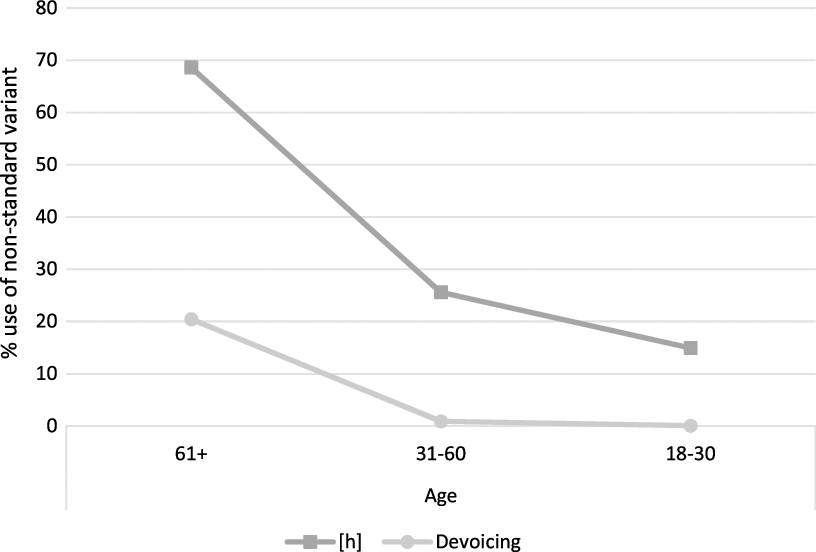
The findings of the quantitative analyses of (h) and (ʒ) are broadly in line with expectations for traditional, non-standard regional accent features: rural and working-class speakers generally have higher rates of the non-standard variants, while middle-class and urban participants tend to use more of the standard variant in each case. While the results for gender appear rather more unusual – an observation we revisit below – it is incontrovertibly speaker age that has the greatest interaction with behaviour in the Alsace corpus. For both variables, we find a very striking decrease in rates of the traditional regional variant, in apparent time. This result is illustrated by Figure 6, which allows us to compare these trajectories of decline.
Relative frequencies of [h] and non-assimilatory devoicing of /ʒ/ according to speaker age groups.

While we observe in Figure 6 a similar pattern for both variables, we see also that the dramatic decline in non-assimilatory /ʒ/-devoicing, which now appears at best vestigial but more probably lost, is not fully reflected for (h): the non-standard variant is still maintained to some extent even by the youngest age group. This difference in the findings for the two variables may indicate a degree of complexity in this variety of regional French, as opposed to a straightforward picture of supralocalization across the board. In addition, it may be the case that [h]-realization has become more restricted in its lexical as well as social distribution, but analysis of the linguistic constraints on the variable is needed to test this hypothesis. For both variables, we note in particular the considerable difference between those aged over and under 60 years. Many of the participants in the 61+ group had spent less time in formal education than is now possible, and all of them spoke Alsatian as a first language. Those aged 61 at the time of the fieldwork in 2011 were born in 1950; participants older than 61 were born in the first half of the twentieth century. The many social differences between this and subsequent generations have undoubtedly had an important impact on various aspects of behaviour, including linguistic (cf. Armstrong and Pooley, Reference Armstrong and Pooley2010); and as we noted at the outset, it is especially since the second half of the twentieth century that regional dialect levelling processes in metropolitan French have gathered pace. The results for the variables analysed here therefore provide new evidence in support of the hypothesis that supralocal French continues to gain ground, both geographically and socially, though with some differences in usage and in the degree of attrition according to the feature studied.
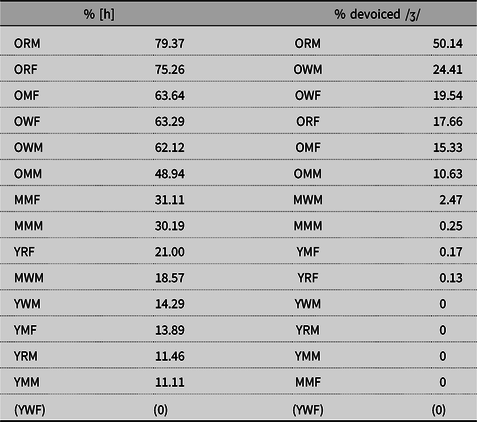
The predominant importance of age is illustrated further by Table 5, which shows the speaker groups arranged in hierarchical order by rate of use of each traditional variant, from highest to lowest percentage. In both cases, it is the older rural males who have the highest rate. For (h), there is a greater spread in rates of usage; for (ʒ), all of the younger groups and most of the 31–60 groups have (near-) zero rates of the localized variant. The dotted line in bold represents the averages for the sample as a whole: (h), 44.53% and (ʒ), 8.85%. While the patterns for gender, class and location are not so readily discerned in the rank order, for both variables, all groups aged 61+ have above-average rates of both non-standard variants, and all groups aged 60 or younger have below-average rates.
Rates of [h] and non-assimilatory devoicing of /ʒ/ by speaker group arranged in order from highest to lowest relative frequency

(Key: ORM = older rural male; MMF = middle-aged middle-class (urban) female; YWM = younger working-class (urban) male; etc.)
While these results for age point clearly to a decline in traditional regional features and a concomitant increase in the adoption of supralocal variants, our findings in relation to gender appear atypical. Some previous studies of supralocalization have shown females, especially younger, middle-class females, to be at the forefront of the adoption of supralocal norms (see, for example, Armstrong and Unsworth, Reference Armstrong and Unsworth1999 on southern French schwa; and Armstrong and Low, Reference Armstrong and Low2008 on the spread of /ɔ/-fronting) and yet our data show certain females – urban females including those from white-collar backgrounds – with significantly higher preferential rates of non-standard variants when compared with their male counterparts. This reverse gender pattern (cf. Armstrong and Pooley, Reference Armstrong and Pooley2010: 256) is highly significant (chi-square (df, 1) = 6.96, p = 0.008) for (ʒ) among the older, middle-class Strasbourg participants (males 10.63%, females 15.34%; cf. Table 4) and is also significant (chi-square (df, 1) = 4.30, p = 0.038) for (h) for the older and younger middle-class speakers from Strasbourg grouped together, where all cells are of equal size (males 31.2% [h], females 45.6%; cf. Table 3). We note the partially similar ‘distribution sexolectale atypique’ observed by Pooley (Reference Pooley, Armstrong, Bauvois, Beeching and Bruyninckx2001) for word-final consonant devoicing among older women in Roubaix. He accounts for this with reference to specific social network factors affecting women born before 1938, who worked predominantly in the textile industry alongside Flemish-speaking Belgians. In this case, there is a clear link between gender, age and occupation-based networks; in the present study, however, such conditions do not seem to apply. Indeed, in the Helsheim data, where speaker networks are dense and multiplex, we find the usual gender pattern for (ʒ) among the older group and not the reverse (older rural males 50.14%, older rural females 17.66%; chi-square (df, 1) = 124, p = 0.000, highly significant). In addition, it is notable that in our Alsace data we observe reverse gender patterns for middle-class rather than working-class females, as was the case in Roubaix.
It is difficult to offer a conclusive explanation of these atypical findings without further research on degrees of social awareness of the regional accent, and of these features in particular (Labov, Reference Labov2001: 196–197). Both seem to be above the level of conscious awareness, but their relative salience and indexical meaning may nevertheless differ. As we have noted, non-standard voicing patterns, including (ʒ), are frequently mentioned both in the linguistic literature on the regional French of Alsace and in folk sources and metalinguistic discussions, to the extent that they have attained the status of stereotype or even shibboleth (Chambers and Trudgill, Reference Chambers and Trudgill1998: 75–76). In some senses it is strange that awareness of (h) seems lower, since application of the variable involves the introduction of an additional segment, albeit one that is represented orthographically, and can also occur in standard French, such as in hop(-là)!: both aspects which might render it less stigmatized. It is also the case that /ʒ/-devoicing can occur much more frequently than h aspiré, notably in the pronoun je (+verb), and, in Alsace, in all word positions, so there is an increased chance of its being noticed and remarked on, and therefore potentially censured and avoided. A relevant piece of qualitative data is provided by one of the older, working-class Strasbourg females. Her rate of non-assimilatory devoicing of /ʒ/ was near-zero (0.04%) and yet she had one of the highest rates of [h] in the whole sample, at 88.6%. This elderly informant had lived and worked in Paris for a few years as a young adult, so it is plausible that processes of accommodation had led to the adoption of supralocal norms for voicing while (h) was retained. Further research is needed to tease out a more precise understanding of both variables. For example, a targeted study could include scripted styles to explore levels of awareness, and attitudinal experiments could be devised to elicit direct and indirect perceptions and evaluations of these and other accent features to ascertain their status in relation to both overt and covert prestige.
It is known that gender preferential patterns are disrupted when linguistic change is in progress. If the change is above the level of awareness, women prefer the standard variant; if below, women tend to show higher rates of the innovative variant than men, even if that form is non-standard. The latter tendency has been referred to as the ‘gender paradox’, whereby ‘[w]omen conform more closely than men to sociolinguistic norms that are overtly prescribed, but conform less than men when they are not’ (Labov Reference Labov2001: 293). However, with regard to the features of the regional French of Alsace examined here, the long history of proscription and high level of overt awareness is somewhat at odds with this theory. While our principal findings relating to the attrition and loss of traditional regional features in apparent time emerge clearly, the results concerning female–male differences (and the lack of them, where these are not statistically significant) require further investigation, in order better to understand the nature of the interaction between speaker gender and processes of supralocalization in regional varieties of metropolitan French.