In this paper, we compare avoidable hospital condition (AHC) rates among three cities as a way of assessing the extent to which their residents have timely and effective access to primary care. AHC is a well-established indicator of access to primary care (Weissman et al., Reference Weissman, Gatsonis and Epstein1992; Casanova and Starfield, Reference Casanova and Starfield1995; Billings et al., Reference Billings, Anderson and Newman1996; Parchman and Culler, Reference Parchman and Culler1999; Billings and Weinick, Reference Billings and Weinick2003; Starfield et al., Reference Starfield, Shi and Macinko2005), but a number of different factors may influence the use of such care. Therefore, we also investigate the individual and neighborhood-level factors associated with AHC to help policy makers better understand how they might improve access to primary care and decrease expensive hospitalisations that result from these barriers. Building on a previous assessment of access to primary care in Manhattan, Inner London and Paris (Gusmano et al., Reference Gusmano, Rodwin and Weisz2010), we evaluate access to primary care in these world cities by comparing residence-based hospital discharge rates for AHC (henceforth referred to as ‘AHC rates’) among Hong Kong, Greater London and New York.
These cities are similar in size and face similar challenges associated with population ageing, including the burden of managing the increasing prevalence of chronic diseases and adapting their systems of health care provision. In contrast, their primary care systems differ greatly as do their residents’ health status. Thus, a comparative assessment of access to timely and effective primary care can shed light on each system's relative strengths and weaknesses.
In the following section, we provide an overview of the three health care systems. Next, we review the concept of AHC and explain how this measure can be used to assess access to primary care. Because AHC rates may reflect differences in health status as well as access to care, we compare the health status among residents of the three cities. Residents of Hong Kong are healthier than their counterparts in Greater London and New York City (NYC), so if AHC rates are driven primarily by population health status, they should be lowest in Hong Kong. We find that, while Hong Kong does have the lowest AHC rate for the entire adult population, the rate among older people (65+) is only slightly lower than NYC and Greater London has the lowest rate among older people. Finally, we conclude that older residents of Hong Kong and NYC have poorer access to timely and effective primary care compared with residents of Greater London and we identify barriers to care in each city.
Three contrasting urban health systems
The health care systems in these world cities present interesting contrasts. Greater London, like the rest of the United Kingdom, is well known for its universal, comprehensive, ‘cradle to grave’ national health service (NHS). In contrast, NYC, like the rest of the United States has no universal coverage and a health system that is composed of a complex patchwork of public and private insurance with large gaps in coverage. Hong Kong falls somewhere between London and New York in that the public sector provides comprehensive hospital services, but the ambulatory care system is dominated by private fee-for-service general practitioners (GPs).
The English NHS emphasises free care at the point of delivery and aims to provide services on the basis of patient ‘need’. The NHS places great emphasis on the role of GPs as the patient's first point of contact with the system (Gusmano and Allin, Reference Gusmano and Allin2011). Since 2002, Greater London has had more GPs per 1000 than the rest of England, but there are long-standing inequalities in supply within Greater London, with particularly low rates in the eastern part of Outer London (Evandrou, Reference Evandrou2006). Greater London also has a higher concentration of acute-care hospital beds than the rest of the nation (Gusmano et al., Reference Gusmano, Rodwin and Weisz2010). There is also a well-developed primary care system in the form of primary care trusts, which act as a gatekeeper to hospitals through their control of referrals. Also, they are responsible for preventive screening programmes such as cervical smear, blood pressure and diabetes screening. Residents living in a defined area register with one of the primary care trust in their area. Comprehensive coverage of all registered patients is encouraged through financial incentives to achieve specific performance targets. Clinicians working in primary care trusts therefore engage in outreach activities to encourage all registered patients to participate in preventive programmes. Although payment is required for prescription drugs, for pensioners it is waived (NHS, 2011).
In NYC, most adults under the age of 65 are insured through their employers. Medicaid, the nation's largest health insurance programme, covers nearly 60 million people. In contrast, Medicare covers the population 65 years and over and many other adults with disabilities (nearly 45 million). NYC, despite its extensive Medicaid programme, has about twice the national average rate of people without health insurance. To care for the uninsured, the United Sates relies on a patchwork ‘system’ of safety-net providers, including public and not-for-profit hospitals, federally qualified community health centers, school-based health centres, municipal/local health clinics, non-profit Visiting Nurse Associations, family planning clinics and public dental clinics. NYC has the largest public hospital system in the United States. The NYC Health and Hospitals Corporation (HHC) operates 11 of NYC's 65 acute-care hospitals, and is responsible for almost 20 percent of all hospital admissions in NYC. HHC is also responsible for delivering primary as well as specialist services in its outpatient departments, emergency rooms and a network of health care centres (Rodwin et al., Reference Rodwin, Brecher, Jully and Baxter1992).
In Hong Kong, the Hospital Authority (HA) was established in 1990 as an independent statutory body and is now accountable to the Hong Kong Special Administrative Region Government. HA manages over 40 public hospitals, covering about 90 percent of inpatient services in Hong Kong. HA also manages dozens of outpatient clinics, including general and specialist. Aside from the outpatient clinics operated by HA and the immunisation and other public health programmes operated by the Department of Health, most outpatient medical services, in Hong Kong, are provided by private physicians in fee-for-service practice.
Population health status and access to primary care
How can we evaluate access to primary care among residents of these three cities? Some studies compare ‘inputs’ (e.g. numbers of primary care doctors or clinics), but it is difficult to compare systems that rely on private office-based physicians (New York) and those that rely on a combination of private office-based physicians and public primary care clinics (Hong Kong). More importantly, there is little agreement about what constitutes a sufficient number of providers and a great deal of evidence that the number of doctors and clinics in a geographic area is only one factor that influences access to care. Financial, cultural and transportation barriers may all limit access to primary care even if a sufficient number of medical professionals are working in a particular neighbourhood or city (Kirby and Kaneda, Reference Kirby and Kaneda2005). Population health surveys can provide helpful information about access to and use of health care services, but there are no local or national surveys that would allow us to compare access to primary health care services across or within metropolitan areas in most countries. Instead, health services and policy researchers often rely on hospital administrative data and indirect measures of access to care.
Residence-based hospital discharge rates for AHC are a well-accepted indicator for assessing access to timely and effective primary care, including disease prevention services (Millman, Reference Millman1993; Purdy et al., Reference Purdy, Griffin, Salisbury and Sharp2009). AHC includes congestive heart failure, bacterial pneumonia, complications of asthma and diabetes and many more conditions. Primary care serves as the first point of contact with a health care system. When it is continuous, comprehensive and coordinated, it should reduce the onset and complications of chronic diseases and promote better use of health care resources (Starfield, Reference Starfield1994).
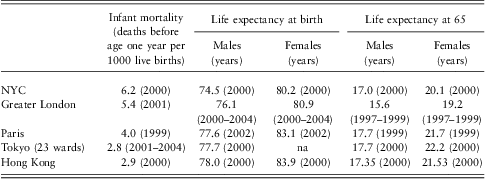
Although access to primary care may explain differences in AHC rates among these cities, it is also possible that they are explained by differences in population health status. As a result, we first compare differences in health status among Greater London, Hong Kong and NYC. Hong Kong stands out among world cities as having some of the best indicators of population health since the 2000–2003 period. Whether one examines infant mortality, life expectancy at birth, or at 65 years of age, Hong Kong has some of best results (Table 1). Beyond these more widely available measures, however, it is difficult to find other comparable measures of population health status. Those that exist, however, do indicate that residents of Hong Kong are, on average, healthier than residents of Greater London and NYC. Premature mortality, defined as death due to any cause before the age of 74, is another useful measure of population health status. According to Roos and Mustard (Reference Roos and Mustard1997), premature death is ‘one of the most valid single indicators of health status capturing a population's need for health care’. The age-adjusted rate of premature mortality in Hong Kong during the 1999–2003 period was 2.51 per 1000, which is significantly lower than for Inner London (3.86) and Manhattan (3.4; Chau et al., Reference Chau, Woo, Chan, Weisz and Gusmano2011).
Population health status in Hong Kong and other world cities
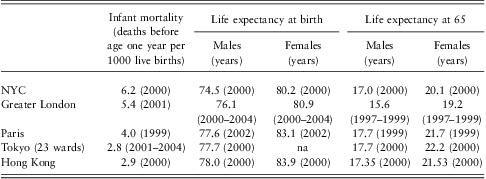
NYC = New York City.
Sources: NYC and the United States: National Center for Health Statistics/Centers for Disease Control; Greater London and England: Office of National Statistics, London Health Observatory; Paris and France: INSEE, Observatoire Régional de la Santé de l'Ile de France; Japan and Tokyo: Tokyo Metropolitan General Affairs, Ministry of Health, Labor and Welfare; Hong Kong: Census and Statistics Department.
More recent data (2008) for Hong Kong, Greater London and NYC indicate that life expectancy at 65 years of age is similar for men and significantly higher for women – 18.1 and 22.9 in contrast to 18.4 and 21.2 in Greater London and 18 and 21.3 in NYC (Bureau of Vital Statistics, New York City Department of Health and Mental Hygiene, 2010; Census and Statistics Department, Hong Kong SAR Government, 2010; Office of National Statistics, United Kingdom, 2010). Differences in rates of obesity and self-reported chronic disease among residents of these cities are even greater. Based on community health survey data, <28 percent of the population 65 years and over, in Hong Kong, is obese or overweight (2003/2004), compared with nearly 60 percent in NYC (2006; Department of Health, Hong Kong SAR Government and Department of Community Medicine, The University of Hong Kong, 2005; New York City Department of Health and Mental Hygiene, 2009). In Greater London we only have 2006 survey data for the population 55 years and older, which indicate that nearly 65 percent of older Greater London residents are obese (Coyle and Fitzpatrick, Reference Coyle and Fitzpatrick2009), but these findings are consistent with the literature that documents high rates of heart disease, hypertension, stroke and diabetes among residents of England and the United States (Banks et al., Reference Banks, Marmot, Oldfield and Smith2006). The community health surveys in Hong Kong and NYC (2008) also provide information about self-reported chronic conditions. A lower percentage of older persons in Hong Kong report having hypertension (41.6 vs 61), diabetes (17.3 vs 21.8) and asthma (2.3 vs 10.8) than in NYC (Census and Statistics Department, Hong Kong SAR Government, 2009; New York City Department of Health and Mental Hygiene, 2009). Older Hong Kong residents are also healthier than their counterparts in Greater London or NYC with respect to prevalence of cardiovascular diseases. These differences are due, in part, to ethnic and/or lifestyle factors (Chau and Woo, Reference Chau and Woo2008). If differences in AHC rates among these three cities are driven primarily by differences in population health status, we would expect rates to be lowest in Hong Kong and highest in NYC.
Methods
Definitions
Although selection of AHC conditions varies in the literature, most studies concur that identification of areas where there are access barriers to timely and effective primary care are not sensitive to differences in selected conditions. In this paper, we adopt the list of AHC conditions used by Weissman et al. (Reference Weissman, Gatsonis and Epstein1992) because this is consistent with previous international comparisons. The conditions include ruptured appendix, asthma, cellulitis, congestive heart failure, diabetes, gangrene, hypokalemia, immunisable conditions, malignant hypertension, bacterial pneumonia, pyelonephritis and perforated or bleeding ulcer. These principal discharge diagnoses taken from administrative hospitalisation data were identified based on the International Classification of Diseases, 9th Revision, Clinical Modification (ICD-9-CM) in Hong Kong and New York City and International Classification of Diseases, 10th Revision, Clinical Modification (ICD-10-CM) in Greater London.
Data
For Hong Kong, we obtained residence-based hospital discharge data from the Hong Kong Hospital Authority's (HA) Clinical Management System (CMS) database. We calculate AHC rates for the Hong Kong population aged 15 years and over for the three-year period, 2006–2008, to provide more stable estimates at the neighbourhood level. The CMS is a computerised system for all aspects of clinical management established by the HA in 1995; by 1999, it was adopted by all HA hospitals. The diagnoses for hospital admission were verified by experts at the HA. Over 90 percent of all hospital bed-days were provided by HA hospitals with private hospitals accounting for the rest (Leung et al., Reference Leung, Wong, Chan, Choi and Lo2005). We consider hospital admissions immediately following the last discharge as part of the same episode and day admissions.
For Greater London, hospital data are from the Department of Health's Hospital Episode Statistics database for the years 2003–2006, which includes information for all residents of Greater London on all hospitalisations (in NHS and private hospitals paid for by the NHS). For NYC, the hospital data are from the Statewide Planning and Research Cooperative System for the years 2006–2008, which includes information for all residents of NYC discharged from all non-federal hospitals in New York State. Since inter-hospital transfers are not common in London and New York, there is no need to exclude admissions occurring on the same day of discharges, as in the case of Hong Kong.
In calculating AHC rates, we rely on population estimates by age, sex and district of residence from the Hong Kong, British and U.S. Census.
Statistical analysis
We calculate age–sex-specific AHC rates by dividing the corresponding age–sex-specific numbers of episodes by the population. We rely on the direct method to calculate age-standardised rates using the World Health Organization World Standard Population (Ahmad et al., Reference Ahmad, Boschi-Pinto, Lopez, Murray, Lozano and Inoue2001).
We use multiple logistic regression models to examine the possible association between AHC rates and a range of different individual and neighbourhood-level independent variables. In a previous work (Gusmano et al., Reference Gusmano, Rodwin and Weisz2006), age, sex, ethnicity, payer source, number of diagnoses on record (as a measure of co-morbidity), as well as neighbourhood-based income quartile, physician density, hospital density, education level and linguistic isolation were examined. Here, we include all of these variables in the NYC model, but due to differences in data availability, the variables included in the models for Hong Kong and Greater London differ slightly. For Hong Kong, the model includes age, sex and number of diagnoses on record. At the district level, we control for income quartile and proportion of people without upper secondary education (obtained from Census and Statistics Department of Hong Kong). However, as these two variables are highly correlated (ρ = 0.6), to avoid multi-collinearity, we include only income quartile in the analysis. Finally, the Hong Kong model includes the density of public general outpatient clinics and the density of public hospital beds. For Greater London, our model includes age, gender, race/ethnicity, number of diagnoses on the record. We also control for three neighbourhood-level variables at the borough level: deprivation quartile, physician density and hospital bed density.
To assess the heterogeneity in the effect of these factors on age, we include all pair-wise interaction terms with age in the model, but we do not present all of interaction terms in the final tables. Finally, we estimate odds ratios (OR) from the model. An OR larger than one, indicated by the 95 percent confidence interval, implies that the corresponding level of that variable is associated with greater risk in comparison to the reference level. We relied on SPSS, version 17.0, for all analyses.
Results
Hospitalisation rates
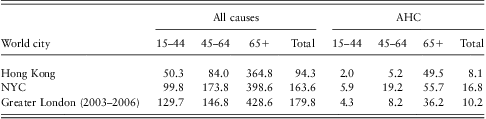
In 2006–2008 (2003–2006 for Greater London), the standardised hospitalisation rates for all causes (per 1000 population 15 years and over) in Hong Kong, NYC and Greater London are 94.3, 163.6 and 179.8, respectively, and the standardised AHC rates for these populations are 8.1, 16.8 and 10.2, respectively (Table 2). Based on the standardised population, AHC rates account for 8.6 percent of hospitalisations in Hong Kong, 5.7 percent in Greater London and 10.3 percent in NYC. In all three cities, age-standardised AHC rates are higher for men than for women and substantially higher among people aged 65 years and over compared with younger adults.
Age-standardized hospitalization ratesFootnote * (per 1000 population) among the population aged 15 years and over in Hong Kong, NYC and Greater London, 2006–2008
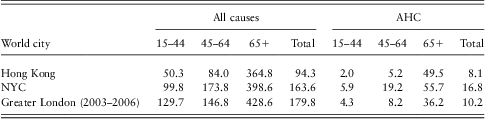
NYC = New York City; AHC = avoidable hospital condition.
* Rates were standardized by the 2000 World Health Organization Standard Population.
Factors associated with AHC rates
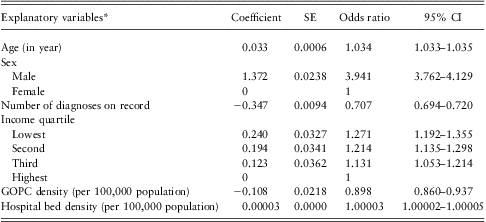
Table 3 presents the results of the multiple logistic regression of the AHC rates for Hong Kong. All variables are statistically significant (p < 0.05), except interaction between age and hospital bed density, which has been removed from the final model. For every increase of 10 years of age, the risk of a hospital admission for AHC increases by 40 percent. Men, in comparison to women, have almost four times the risk of a hospital admission for AHC (OR = 3.94), but the gender difference narrows with increasing age. Patients with one or more diagnoses on record are associated with a near 30 percent reduced risk of admission for AHC. However, this reduced risk decreases with increased age.
Logistic regression results for characteristics associated with AHC admissions (dependent variable) in Hong Kong for adults aged 15+ years
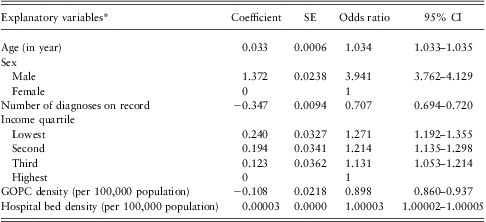
AHC = avoidable hospital condition; SE = standard error; CI = confidence interval; GOPC = general outpatient clinics.
* All explanatory variables were statistically significant at p < 0.05.
People living in areas with the lowest to the third income quartiles have higher risk of an admission for AHC in comparison with those living in areas with the highest-income quartile (OR = 1.27, 1.22 and 1.13) and the effect diminishes with increasing age. The difference among the lowest three quartiles is not statistically significant.
People living in areas with a higher density of public general outpatient clinics have a lower risk of admission for AHC. An increase in the density of public general outpatient clinics by 1 per 100,000 population reduces the risk admission for AHC by 10 percent. Once again, this effect diminishes with increasing age.
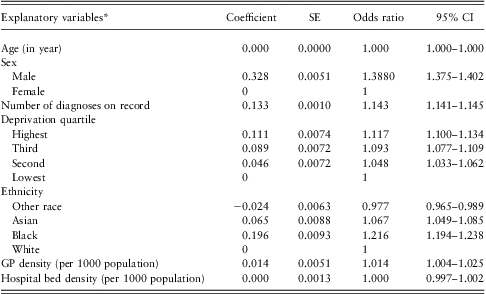
In Greater London (Table 4), we find that the odds of being hospitalised with an AHC are higher among men and residents of higher deprivation neighbourhoods. The odds of AHC are 39 percent higher among men than women. The OR for residents of the most deprived neighbourhoods (second, third and fourth quartiles), as compared with those living in neighbourhoods with the lowest deprivation (first quartile), are 1.12, 1.09 and 1.05, respectively. Every additional diagnosis on the record increases the odds of admission for AHC by 14 percent. The odds of admission for AHC are higher for ethnic minorities compared with Whites (Gusmano et al., Reference Gusmano, Rodwin and Weisz2010). Although interaction terms with age are statistically significant, the effects are so small that they do not give meaningful interpretations.
Logistic regression results for characteristics associated with AHC admissions (dependent variable) in Greater London for adults aged 15+ years
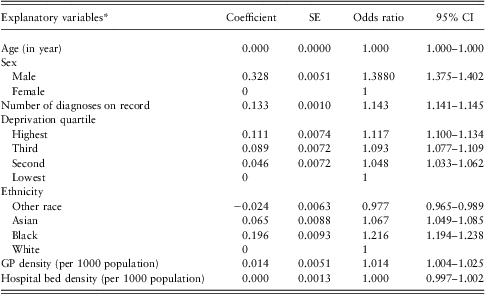
AHC = avoidable hospital condition; SE = standard error; CI = confidence interval; GP = general practitioners.
*All explanatory variables except age were statistically significant at p < 0.05.
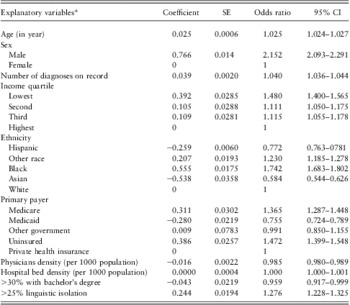
In NYC (Table 5), we identify several barriers to primary care. The odds of being hospitalised with an AHC are more than twice as high among men compared with women. The odds are also higher among people living in lower-income neighbourhoods compared with the highest-income neighbourhoods of NYC. People without health insurance and those on Medicare have greater odds of being hospitalised with an AHC compared with people with private health insurance, but adults on Medicaid have lower odds of being hospitalised with AHC. Blacks and people living in linguistically isolated neighbourhoods have greater odds of AHC hospitalisation. Older people, people with additional diagnoses on the record have higher odds of AHC hospitalisation. Finally, people living in neighbourhoods in which at least 30 percent of the population has a high level of education have lower odds of being hospitalised with an AHC compared with those living in neighbourhoods in which the population is less well educated. Unlike Hong Kong, these effects do not always diminish with increasing age. Neither the neighbourhood density of physicians and hospital beds influence the odds of being hospitalised with AHC.
Logistic regression results for characteristics associated with AHC admissions (dependent variable) in NYC for adults aged 15+ years

NYC = New York City; AHC = avoidable hospital condition; SE = standard error; CI = confidence interval.
*All explanatory variables were statistically significant at p < 0.05.
Limitations
Our study has a number of limitations. By using administrative data, our results may be affected by the reliability and validity of the recording systems. By using database from HA, our study included only hospital admissions to public hospitals. Nevertheless, the market share of inpatient services by the public sector is 90–95 percent in Hong Kong (Leung et al., Reference Leung, Wong, Chan, Choi and Lo2005). The hospital data for Greater London do not include private hospitalisations that are not paid for by the English NHS. The hospital data in NYC do not include federal hospitals operated by the Veterans Health Administration. Our adoption of the definition of AHC used by Weissman et al. (Reference Weissman, Gatsonis and Epstein1992) does not suggest that all the conditions sensitive to primary care were included, or that those excluded from the list were not affected by primary care.
Discussion
For the entire adult population, Hong Kong has the lowest rate of hospital admissions for AHC, but among older people (65+) Hong Kong's AHC rate is only slightly lower than NYC, while Greater London has a substantially lower rate than both cities. This suggests that older residents of Hong Kong and NYC have poorer access to timely and effective primary care compared with residents of Greater London, which is consistent with previous findings on avoidable mortality (Chau et al., Reference Chau, Woo, Chan, Weisz and Gusmano2011). These findings are striking because older residents of Hong Kong appear to be healthier than residents of these other cities. To the extent that AHC rates reflect population health rather than access to primary care, we would expect AHC rates among older people to be lower in Hong Kong, but this is not the case.
As we found previously, the density of primary care doctors among neighbourhoods in Greater London and NYC has little influence on AHC rates (Gusmano et al., Reference Gusmano, Rodwin and Weisz2006). Although some other studies have found that the number of primary care physicians in a region can influence the rate of AHC (Parchman and Culler, Reference Parchman and Culler1994, Reference Parchman and Culler1999), having a sufficient number of physicians is a necessary, but not a sufficient condition for access to care. In cities with a high concentration of primary care doctors and excellent public transportation systems, other barriers may limit the use of these services. Our findings indicate that, in NYC, financial and racial barriers are important barriers to access. In contrast, our findings show that neighbourhoods in Hong Kong with a higher density of general outpatient clinics have lower rates of AHC. Consistent with existing literature (Ricketts et al., Reference Ricketts, Randolph, Howard, Pathman and Carey2001; Magán et al., Reference Magán, Alberquilla, Otero and Ribera2011), we find that the effect of primary care provision is comparatively small (a reduction of 10 percent risk by increasing 1 clinic per 100,000 population) when compared with the effects related to socio-economic status. Nevertheless, it may be possible for the HA to improve access to primary care and reduce hospitalisations by increasing the number of primary care clinics in underserved neighbourhoods.
Some studies suggest that people living in areas with lower income are more likely to be hospitalised with AHC (Billings et al., Reference Billings, Anderson and Newman1996; Pappas et al., Reference Pappas, Hadden, Kozak and Fisher1997; Gusmano et al., Reference Gusmano, Rodwin and Weisz2006; Agabiti et al., Reference Agabiti, Pirani, Schifano, Cesaroni, Davoli, Bisanti, Caranci, Costa, Forastiere, Marinacci, Russo, Spadea and Perucci2009). As we suggest above, we find that people living in the lowest income quartile (or highest deprivation quartile in Greater London) neighbourhoods have a higher risk of hospital admission for AHC in all three cities, but the reasons may vary among them.
Some researchers argue that AHC may vary with access to hospital care (Saha et al., Reference Saha, Solotaroff, Oster and Bindman2007). Given that the hospital care services are heavily subsidised in Hong Kong, one may question if the relatively high AHC rate in Hong Kong is related to the inexpensive and easily accessible inpatient services. We believe that this is unlikely because the hospitalisation rate from all causes is actually lower in Hong Kong than in NYC and London. If the heavily subsidised hospital care were attracting people to overuse inpatient services, which should apply to all causes, not just AHC. Furthermore, neighbourhood density of hospital beds was not a significant influence on AHC rate in any of these cities.
In both Greater London and NYC, the odds of being hospitalised with an AHC are higher among people with additional diagnoses on the record. Curiously, there is a negative relationship between AHC and number of diagnoses on the record in Hong Kong. This may be due to the inconsistent practice of recording secondary diagnoses on record in Hong Kong. Another possibility is that in Hong Kong, frail elderly people admitted to hospital may have non-specific geriatric syndromes such as falls, decline in mobility, which are currently not coded. Nevertheless, this finding requires further investigation.
The Hong Kong Government is actively considering government-regulated health insurance to provide better choices to those who choose private health care services (Food and Health Bureau of Hong Kong, 2010). Although Hong Kong Government's policy is to provide comprehensive care by heavily subsidising public services so that out-of-pocket charges are very low (and may be waived altogether if income falls below a certain level), there have been no evaluation studies to assess whether existing services meet the needs of the aging population. Recent reports suggest that there are unmet needs (Woo et al., Reference Woo, Mak, Cheng and Choy2011) and our findings are consistent with this conclusion.
In summary, we find that despite the fact that older residents of Hong Kong are significantly healthier than older residents of Greater London or NYC, the AHC rate among older people in Hong Kong is higher than the rate in Greater London and nearly as high as the rate in NYC. There are important concerns about access to primary care among residents of the most deprived neighbourhoods of Greater London, but overall, residents of this city enjoy the best access to primary care. In NYC, barriers to access faced by racial and ethnic minorities, along with barriers related to insurance, produce the highest AHC rates among the cities we examine. In Hong Kong, residents living in neighbourhoods with fewer primary care clinics have significantly higher AHC rates. This finding suggests that primary care infrastructure in Hong Kong is inadequate to meet the needs of its ageing population. The financial barriers to accessing primary care providers in Hong Kong appears to result in expensive hospitalisations that could be avoided.
Acknowledgements
This study is a collaboration of the project entitled “CADENZA: A Jockey Club Initiative for Seniors” funded by The Hong Kong Jockey Club Charities Trust and the “World Cities Project” supported by the International Longevity Center-USA (ILC-USA). The authors would like to thank the late Dr. Robert N. Butler, President of the ILC-USA, for his support of the World Cities Project, including the research that led to this article. We would also like to acknowledge the Strategy and Planning Division of the Hong Kong Hospital Authority for the provision of data for this study.