Two of five freshwater turtle species occurring in Turkey are the members of the family Trionychidea that are called soft-shelled turtles. The Euphrates soft-shelled turtle, Rafetus euphraticus Dauden, 1802, is endemic to the Middle East and known from the Tigris and Euphrates Rivers and their tributaries in Turkey, Syria, Iraq and Iran (Taskavak & Atatur, Reference Taskavak and Atatur1998). No record of Rafetus euphraticus exists yet on the occurrence of the species in the marine environment, i.e. from the Persian Gulf where the Tigris and Euphrates Rivers empty their waters.
The Nile soft-shelled turtle, Trionyx triunguis (Forskål, Reference Forskål1775), has a much larger distribution range than R. euphraticus. Trionyx triunguis range over most of the continent, except for the waterways of southern, north-western, and northern Africa (Gray, Reference Gray1855; Deraniyagala, Reference Deraniyagala1948; Lanza & Sassi, Reference Lanza and Sassi1966; Iverson, Reference Iverson1992; Largen, Reference Largen1997; Spawls et al., Reference Spawls, Howell, Drewes and Ashe2002). They are also known from the riverine and coastal environments of Turkey, Syria, Lebanon and Israel (Siebenrock, Reference Siebenrock1913; Gruvel, Reference Gruvel1931; Haas, Reference Haas1951; Serruya, Reference Serruya and Serruya1978; Sella, Reference Sella and Bjorndal1981; Ilani, Reference Ilani1983; Ilani & Shalmon, Reference Ilani and Shalmon1984; Werner, Reference Werner, Yom-Tov and Tchernov1988; Yom-Tov & Mendelssohn, Reference Yom-Tov, Mendelssohn, Yom-Tov and Tchernov1988). Moreover, recent literature suggests that it has been exterminated in its type locality, the Egyptian Nile (Nada, Reference Nada2002). In Turkey, it is found along the southern coast with important nesting populations between Samandag and the Dalyan Delta including Koycegiz Lake (Atatur, Reference Atatur1979, Reference Atatur1991; Gramentz, Reference Gramentz1993; Kasparek, Reference Kasparek1994).
The Nile soft-shelled turtle is a mainly freshwater species adapted to moderately deep to shallow streams, rivers, estuarine systems, and lakes with sandy to muddy bottoms. According to Flower (Reference Flower1933), frequent and excessive floods of the Nile (especially the Bahr Basandila and Damietta branches) and strong costal flows towards to the east were the main factors that swept away T. triunguis to the littoral Palestine area/region where the species found estuaries and marshes to survive. Thus, the ability of the soft-shelled turtles to tolerate salt water enabled the species to colonize streams in the eastern and north-eastern Mediterranean (Flower, Reference Flower1933; Kasparek & Kinzelbach, Reference Kasparek and Kinzelbach1991). Trionyx triunguis, like Malaclemys terrapin, Pelochelys bibroni and Pelochelys cantori, is one of the known freshwater turtles observed from the marine environment.
As compared to the description of the species more than two centuries ago, the data on the presence of this species in the marine environment are rather recent and considerably scattered. Loveridge & Williams (Reference Loveridge and Williams1957) were the first scientists who gave the record of a large Trionyx specimen caught at sea, two or three miles from the mouth of the Gabon River. Pritchard (Reference Pritchard1979) mentioned the frequent occurrence of the species off the Senegal coast. Griffin (Reference Griffin2002) noted the occurrences of Trionyx at the Cunene River mouth and Torra Bay of Angola and Namibia. He mentioned that they were frequently hooked by fisheries' biologists and occasionally seen in the adjacent sea. No records of the species are available from the Indian Ocean or from the Red Sea. For the Mediterranean basin, the first observation of the species from saltwater was given by Hathaway (Reference Hathaway1972) in Turkey. He mentioned a population of strong, vigorous animals living in 6–15 fathoms (11–27 m) of seawater with a salinity of at least 38 parts per thousand. Kinzelbach (Reference Kinzelbach1986) gave a record near Netanya, Israel. Taskavak et al. (Reference Taskavak, Reimann and Polder1999) recorded a specimen from Kos, Greece. While there were several tracks of Trionyx heading for the Mediterranean from the lagoon in the Goksu Delta, Mersin (Van der Winden et al., Reference Van Der Winden, Bogaerts, Strijbosch and Van Den Berck1994), Nile soft-shelled turtles, together with some dead loggerhead turtles and green turtles, were washed onto the shore of Kazanli (Mersin) between June and September 2001 (Kasparek et al., 2001). During the 1995/1996 and 1996/1997 trawling seasons in the region between Mersin and Iskenderun, Oruc et al. (Reference Oruc, Demirayak and Sat1996) recorded 437 adult Nile soft-shelled turtles entrapped in trawling nets (mid-water and bottom trawls together).
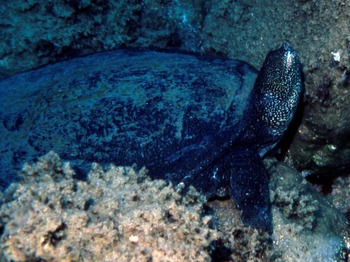
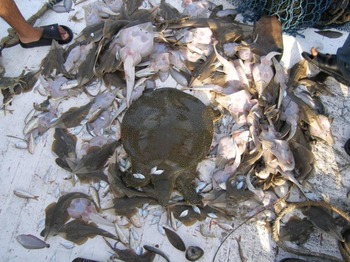
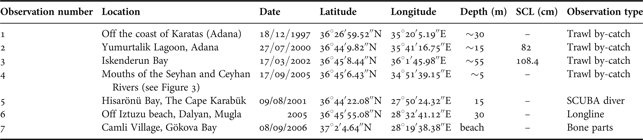
Here, we present seven recent marine records of Trionyx in Turkey (Table 1). An overview of the literature scanned in detail indicated that the underwater photographs and behavioural observation of the species given in this paper may be for the first time (Figure 1). Without giving a substantiated record, Kasparek (Reference Kasparek2001) mentioned that Trionyx triunguis is a large (>1.2 m long), but little known turtle species. However, a Liberian specimen that was kept in captivity for 53 years at the United States National Zoological Park (Washington, DC) had a carapace length of 101.5 cm when it died (Ernst et al., Reference Ernst, Altenburg and Barbour2002). It seems that the specimen we caught as by-catch with a bottom trawl in Iskenderun Bay, a male of 108.4 cm straight carapace length (SCL), is likely to be the biggest on record (Table 1). Another specimen was observed by Alp Can while SCUBA diving at 0730 h in Hisaronu Bay, Mugla. At first sight, the turtle was inactive at a depth of about 15 m in the sea. The animal started to move very slowly and when prodded, the Trionyx protracted its head. When disturbed by flashlights, it moved deeper and came to rest on sandy ground at 22 m depth. The observation may also suggest they are well adapted to the marine environment (Figure 1). In addition to the records, a specimen was obtained during a scientific fisheries survey trawl between the mouths of the Seyhan and Ceyhan Rivers (Figure 3).
An adult Trionyx triunguis at about 15 m depth, Hisaronu Bay, Cape Karabuk, Turkey, 9 August 2001. The individual belongs to the 5th observation in Table 1. Photograph: Alp Can.

Former and present records of Trionyx triunguis in Turkey.

A young Trionyx triunguis trapped in a bottom trawl. The individual belongs to the 4th observation in Table 1. Photograph: Melih Ertan Çınar.

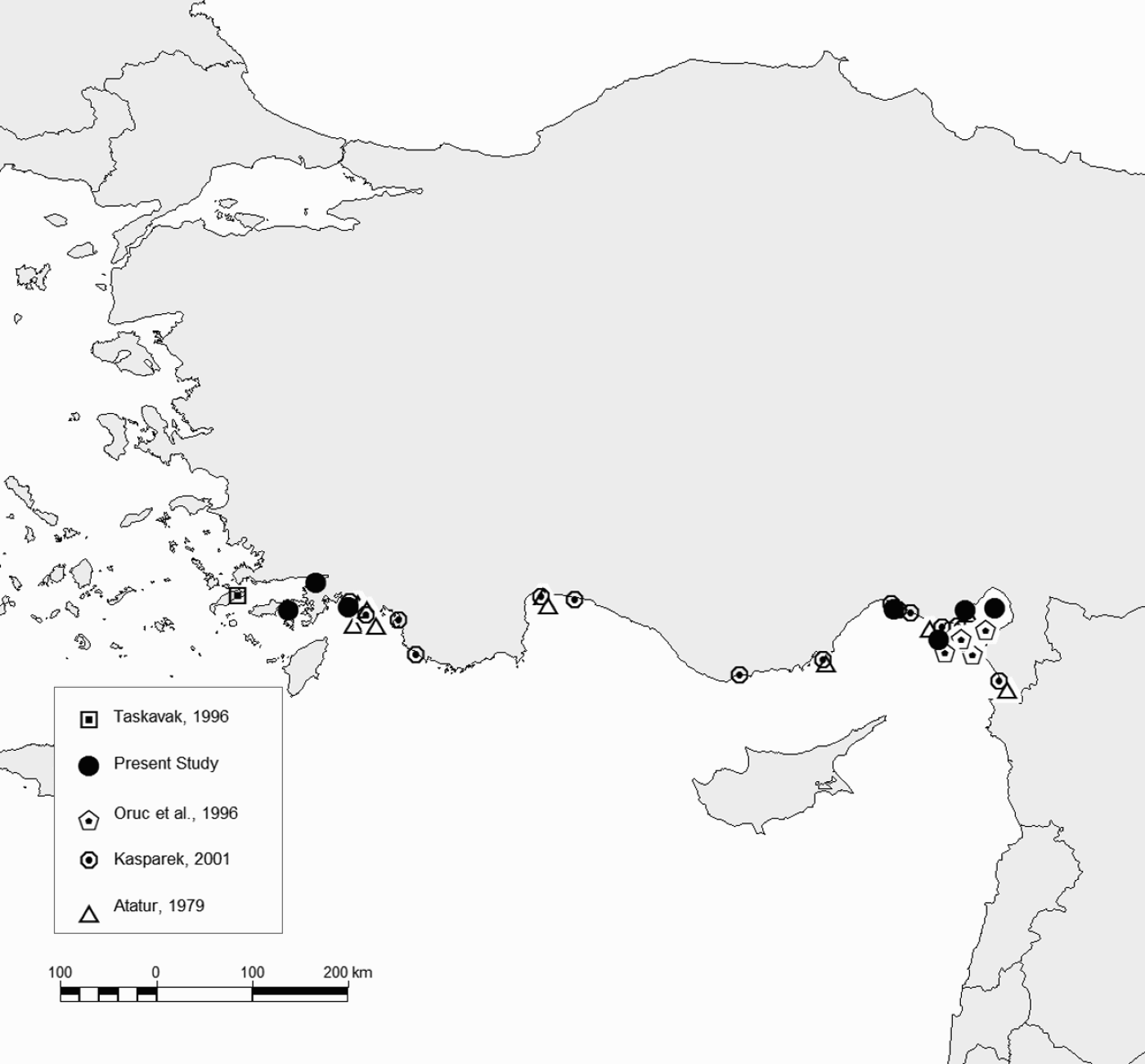
Various marine records of Trionyx triunguis from the Mediterranean and Aegean coasts of Turkey.

Western marine records presented here are not further offshore than the previous record from Kos, Greece (Taskavak et al., Reference Taskavak, Reimann and Polder1999). While eastern records given in this paper confirm that Trionyx soft-shells have morphological and/or physiological adaptations to survive and thrive in the marine environment, western records (more than 200 km from the nesting area) may also indicate how far the species disperses (Figure 2). The African sub-populations are mostly living inland; however, at least certain individuals of the Mediterranean sub-population apparently spend a significant part of their life cycle in the sea. Thus, the period spent by the species in the sea is an important point for better understanding the biology of Trionyx and elaborating the needs for conservation and management.
ACKNOWLEDGEMENTS
We would like to thank our colleagues Alp Can, Melih E. Cinar, Murat Bilecenoglu and Ahmet Eryigit, who gave us valuable data and pictures. Most of the data presented here were provided by various projects (Ege University-AFS Project-97-SUF-008; TUBITAK-YDABÇAG-568; TUBITAK-104Y065).