When Miss Peru wore the diablada (devil dance) costume at the 2009 Miss Universe pageant, the Bolivian Minister of Cultures accused her of appropriating cultural heritage and also issued a statement that Bolivia’s office for the registration of intellectual property would begin an international campaign to reclaim this dance as part of the nation’s cultural heritage. Footnote 1 In support of its case, Bolivian officials cited the UN Educational, Scientific and Cultural Organization’s (UNESCO) 2001 proclamation of Bolivia’s Carnival in Oruro as the intangible heritage of humanity (Oruro’s Carnival is a ritual context that prominently features the devil dance). Official Bolivian statements of indignation even included talk of turning to the International Criminal Court in The Hague. Footnote 2 In 2014, officials from the Bolivian Ministry of Cultures were miffed when several dances they considered to be their own appeared in a video that Peru had presented to UNESCO as part of a petition to have Puno’s Festival of the Virgen de Candelaria inscribed in the country’s officially recognized list of intangible heritage. The Candelaria festival is celebrated in a southern region of Peru that borders Bolivia—a region that might be thought to share Aymara and Quechua indigenous histories before colonial and republican ones carved out national borders.
In the Bolivian context, the devil dance evokes a complex array of indigenous, non-indigenous, and nationalist meanings, making it a compelling case through which to examine in practice the thorny issues behind state-level intangible heritage governance and indigenous politics of the region. Within UNESCO’s framework, “indigenous heritage” poses something of a paradox because recognition instruments operate through UN member states. On this point, indigenous rights activists fault the 2003 Convention for the Safeguarding of Intangible Cultural Heritage (Intangible Heritage Convention), adding that many nation-states that have indigenous populations whose intangible heritage might be recognized through this instrument have been slow to ratify the Convention. Footnote 3 Most Latin American states, however, many with significant indigenous populations, have ratified UNESCO’s Intangible Heritage Convention, in spite of the critiques that indigenous rights activists have leveled against it. Peru and Bolivia fall into this camp of ratifiers.
Bolivia provides an intriguing case for highlighting the complexities of indigenous and national intangible heritage issues. First, a significant part of the population self-identifies as indigenous. Second, starting in 2006, Bolivians began living under their first indigenous president, Evo Morales, who oversaw the drafting of a new constitution (2009) that on paper granted significant rights to indigenous peoples. Footnote 4 Third, in the country’s unique present historical moment, the Bolivian government has attempted to decolonize the state through an officially declared “process of change,” which is a complex constellation described by some scholars as a “social movement state.” Footnote 5 In the midst of these processes, Bolivia has experienced a veritable intangible heritage “fever,” taking a rather protectionist stance toward “culture” as a potential “resource.” Finally, Bolivia has played a long-term role in intangible heritage politics. Since the 1970s, the country has been involved in international discussions that have led to UNESCO’s instruments on “intangible heritage.” Footnote 6 Under Morales’s government, and especially in the aftermath of the Miss Peru incident in 2009, Bolivians at the center of national government have privileged proprietary nationalist approaches to intangible heritage. Within Bolivia, the legislature has taken a piecemeal approach, passing laws that have declared specifically named ritual dances to be intangible heritage and “national property,” something akin to what John and Jean Comaroff might call “lawfare. Footnote 7
However, Bolivian processes of intense cultural nationalism also need to be understood within the broader context of the country, which is taking control of its natural resources to ensure greater benefits for its citizens. From the perspective of many Bolivians, outsiders have always profited from the country’s resources, whether those are silver, tin, gas, lithium, or dances. If anything, state attempts to claim heritage as property have intensified since the rise to power of Evo Morales, who—as demanded by the social movements that swept him to power—nationalized gas extraction soon after entering office. Footnote 8 Such details should be seen as part of an “ecological perspective” that attempts to grasp holistically the meanings of intangible heritage claims in Bolivia. Footnote 9
In this article, we set aside the local heritage dynamics within Bolivia—something we address in other writings—and emphasize the Bolivian national and state-level proprietary intangible heritage claims on music and dance forms, placing these twenty-first-century concerns in relation to the country’s twentieth-century non-indigenous nationalist projects that championed indigenous expressions (indigenismo). We argue that Bolivian enthusiasm for intangible heritage protections emerged not as a major part of the country’s pro-indigenous anti-neoliberal “process of change” but, rather, as a product of the mestizo nationalist projects of indigenismo. Furthermore, we argue that the Morales administration’s policies on “culture” hardly mark a departure from this mid-twentieth-century nationalist project but, rather, that Bolivia’s contemporary cultural politics have emerged in part through indigenismo’s processes—that is, the twentieth-century incorporation of indigenous cultural expressions into a non-indigenous nationalist project.
What is left in indigenismo’s wake thus poses challenges for contemporary attempts at state-directed decolonization. The rise in proprietary nationalism under Morales’s presidency, we argue further, may be attributed in part to the accelerated circulation of images made possible by the digital age. At diverse intersections of new media platforms, visual aspects of cultural expressions, such as dance costumes, often carry greater symbolic, representational, and discursive weight than auditory and kinesthetic ones, like musical sound and choreographed movements. In this sensory shift, which once again begs the question of the tangible/intangible distinction in heritage, we note how some non-indigenous Bolivian attitudes reflect a hyperreal sense of scarcity about “culture” as a resource. Footnote 10
In the following sections, we first locate the complexities of Bolivian indigenismo and indigeneities. Next, we explore the layered meanings of the devil dance as one example of contested national heritage. We then interpret two recent ethnographic interactions related to Bolivian heritage discussions (a participatory workshop and a Departmental Council of Cultures meeting in 2012). This is followed by some historical background to the contemporary state’s proprietary heritage policies. Finally, we briefly touch on the 2014 Peru–Bolivia heritage spats that exploded over social media in relation to Peru’s Candelaria festival heritage claim.
BOLIVIAN INDIGENISMO AND INDIGENEITY
What is indigenismo? In the first half of the twentieth century, Andean indigenous cultural expressions in Bolivia went from being disdained by mestizos to being the core of a national project. The category of “mestizo,” which is slippery and context sensitive, may refer literally to “mixed race,” but is more often understood as “non-indigenous” and, in practice, more related to culture and class. Footnote 11 Indigenismo refers to processes through which mestizo-led governments mined indigenous expressions for their potential as nationalist culture—often transforming and reframing these expressions so as to appeal to Western-oriented aesthetics. Footnote 12 Indigenismo nationalized and celebrated these indigenous expressions, but without challenging the structures that continued to marginalize the country’s indigenous peoples. Ideologies of mestizaje (that the nation consists of homogeneous liberal citizens) and indigenismo went hand in hand and became the centerpiece of the cultural politics of the 1952 Revolution. This historic reference to mid-twentieth-century indigenismo should be distinguished from what some authors have referred to as the “indigenista” tendency of the Morales government, which is a decolonizing project that attempts to bring indigenous ideas into the very organization of government. Footnote 13
While indigenismo was a specific twentieth-century national cultural project, multiple indigeneities are at work in twenty-first-century Bolivia. The country’s indigenous populations comprise Aymaras and Quechuas, who generally live in the western highlands, and over 33 different ethno-linguistic groups who live in the eastern lowlands. In the 2001 census, 62 percent of Bolivians self-identified as indigenous, but only 48 percent did so in 2012 (following six years under Evo Morales). Neither census included the option of “mestizo,” a point of considerable controversy. Since the Morales administration attempted to institutionalize indigenous discourses through constitutional and legislative reforms, it faced the challenge of articulating these multiple and shifting indigeneities.
Shortly after Morales’s election in 2005, the new president called for a constituent assembly to write a new constitution that would better represent the country’s significant indigenous populations. Bolivia has been operating under the new constitution, which was approved by referendum vote in 2009. Having officially titled the country the “Plurinational State of Bolivia,” the government claimed to represent indigenous interests and to be working against the problems of the homogenizing mestizo nationalist frame.
Being indigenous in Bolivia is not about blood quantum, tribal rolls, or rural peasanthood. It is related to colonial structures that shaped separate “Spanish” and “Indian” republics and that today continue to color marginalizing structures and racist practices in many Latin American national contexts. Footnote 14 Ongoing and often blatant racism remains a reality in Bolivia. For example, the notorious attacks on indigenous authorities in Sucre in May 2008 hastened the 2010 anti-racism law. Footnote 15 Many of Bolivia’s self-identified indigenous peoples live in cities and speak Spanish as their first language, and their experiences of indigeneity sometimes have more to do with difference, rights, and opposition to global forces than to connections with the land or descent from pre-conquest populations. Footnote 16
Indigeneities in Bolivia differ significantly from those of North America, as the intercultural dynamics of the former are not fundamentally structured through a politics of native sovereignty. Rather, they are shaped in Bolivia by questions of social inequality, marginalization, autonomy, rights to prior consultation, and specific practices of social organization that can move with people as they leave rural contexts. Therefore, the Bolivian case promotes a somewhat different political location from which to revisit the “in defense of property” debates. Footnote 17 In the Bolivian case at hand, the very cultural expressions under dispute may have indigenous roots, but they also have become synonymous with Bolivian nationalist claims through the historical processes of the fraternal twin discourses of indigenismo and mestizaje. Footnote 18 We argue that indigenismo’s effects have remained strong under Morales’s government in spite of the supposedly radically different moment the Bolivian state has been experiencing.
Whose indigeneity is represented in Morales’s government? Can the state ever move beyond the framings of the “authorized” and “unruly” Indian (terms coined by Bolivian scholar Silvia Rivera Cusicanqui and then circulated in the North American academic context by Charles Hale)? Footnote 19 Tensions have surrounded the perceived dominance of highland Aymara indigeneity as represented by the Morales government. Other fissures of indigeneity have appeared. In 2011, major indigenous organizations that previously supported Morales’s government split with him over key struggles like the demand for prior consultation in the building of a road through lowland indigenous areas of the Isiboro Sécure National Park and Indigenous Territory. Footnote 20
Within the officially labeled “process of change,” the state has replaced the “Vice-Ministry of Culture” (singular) with the “Ministry of Cultures” (plural). A branch of this state apparatus even includes a “Vice-Ministry of Decolonization.” However, Bolivian national sovereignty, rather than indigenous cultural rights or indigenous sovereignty, may be seen to motivate much of the government’s cultural policy work, particularly in the area of specific dances that the state has moved under “intangible heritage,” a rubric that, in direct contradiction with UNESCO’s principles, has fostered ideas about exclusive forms of property-like protection.
WHAT MAKES THE DEVIL DANCE
The devil carries multiple meanings within Andean studies. It represents a spirit of the underworld or ukhu pacha and can go by various names (supay, diablo, tío, and so on). These spirits share features: they are dangerous and they are associated with artistic creativity, fertility, and wealth to be found deep in the mines. Footnote 21 Henry Stobart’s work on the sirenas (spirit beings from which musicians receive new tunes) locates these spirits in a similar world of supays, devils, and demons—all-powerful but ambiguous beings from the underworld. Footnote 22 When it comes to the devil dance in urban festivals, however, the dance’s meanings also need to be considered within the social webs of its performances. June Nash’s ethnography located this dance with ties to miners who worshipped both the Virgin of mineshaft and the god of the mountain (momo, supay, el Tío). Footnote 23 In subsequent ethnographic work, Thomas Abercrombie discussed the “Indian within” the non-Indian dancer, as expressed in these Carnival performances of urban folk nationalism. Footnote 24
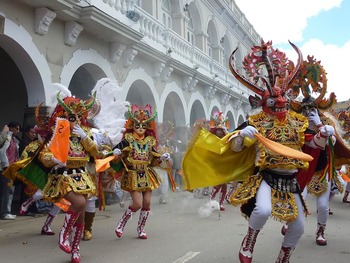
As performed today, the devil dance involves Andean cosmologies, mestizo nationalism, forms of collective organizing, and local artisan economies (Figure 1). The other dances of Bolivia’s various urban ritual processions (morenadas, caporales, llameradas, tinkus, and so on), which are similarly perceived by Bolivians to be under siege by neighboring countries, thrive within the same social fabric of layered meanings and organizations, some with greater participation by urban Aymaras (such as in morenadas) and others with greater participation by mestizos (such as in caporales), but many of them, in a way, standing in for Bolivian mestizo nationalism, folklore, and intangible heritage relative to the international stage.
Devil dancers during Carnival in Oruro, Bolivia. Photograph by Baptiste Lavat, used with kind permission.

Bolivia’s urban ritual dance processions unfold over months of rehearsals and planning, showcasing vibrant social structures that go far beyond the narrow time-space of the ritual dance processions themselves. The work of Rossana Barragán and Cleverth Cárdenas highlights the social order necessary to move 30,000 costumed participants, all moving in choreographed steps, through the streets of La Paz in the Entrada del Gran Poder, a celebration similar in format to that which occurs in Oruro’s Carnival. The authors set up this argument about order in direct contestation to the sometimes over-zealous Bakhtinian interpretations of fiestas as moments of social disorder and the world turned upside down. Footnote 25 In his work with Aymara traders in La Paz, Nico Tassi has shown how principles of abundance, rather than scarcity, motivate exchanges and structure everything from market presentation to a ritual parade like the Gran Poder. Footnote 26 In contrast, the idea that another country could “steal” or “appropriate” these performances—a perspective often voiced by mestizo folklore workers (especially dancers)—seems to overlook completely the social orders that sustain them. Such concerns of “theft” and “plagiarism” reflect hyperreal ideas about culture as a scarce resource.
To specify, the hyperreal rests on simulacra, which are copies that have no originals in reality, but that still have social effects because of their perceived existence. Footnote 27 These devil dance wars reflect how some Bolivians have come to see “culture” as a scarce resource, when it is anything but scarce. In this case, culture is imagined within a zero-sum equation with neighboring countries. If Peru names as heritage something Bolivians see as “theirs,” Bolivians lose, and vice versa. While the potentially real returns of tourism are in the mix of these concerns, more research is needed to show any direct correlation between heritage declarations of one country and the corresponding tourism losses of a neighboring country.
This hyperreal scarcity of culture emerges precisely as the spectacular digital images of costumed dancers proliferate and circulate widely. As a way to distinguish the present highly digitized devil dance wars under President Evo Morales, it should be noted that Miss Chile wore a diablada costume at the Miss Universe pageant in 1983, 1984, and 1989, and these moments of “appropriation” did not draw the same heated reactions. Footnote 28 Indeed, the uptick in devil dance fever, we argue, has more to do with the greater facility with which images of these dances circulate in today’s Internet and social media arenas. In these cyber-spatial circulations, the visually apprehended overwhelms other realms of cultural experience—what might be heard in music, felt in the choreography, or expressed as abundance. Footnote 29
In 2014, the devil dance wars were ignited once again after Peru petitioned UNESCO to have Puno’s Festival of the Virgen de Candelaria entered on Peru’s representative list of intangible cultural heritage of humanity. Arguments about the shared historic transformations and continuities of the indigenous Aymara and Quechua regions that extend across contemporary national borders did not enter the Bolivian online discussions that occurred in relation to this expression of possessive mestizo nationalism. The peculiarity of these devil dance wars was one reason we decided to organize the following workshop.
A WORKSHOP AND A MEETING OF THE DEPARTMENTAL COUNCIL OF CULTURE
In July 2012, we convened a four-day participatory workshop in Coroico entitled Rethinking Creativity, Recognition and Indigeneity with 20 Bolivians involved in various aspects of culture and media, including representatives of indigenous groups. Footnote 30 We began to plan this workshop after both of us were drawn, independently, into discussions with our respective Bolivian musician friends who raised concerns about intellectual property, piracy, and heritage policies. The workshop aimed to serve as a space where Bolivians from diverse backgrounds, who would not usually meet, could discuss their concerns and share experiences. The country’s new constitution and its wake of developing policies on culture, intellectual property, and heritage formed an important backdrop to these conversations. Footnote 31
For the present discussion, we briefly consider just one aspect of the workshop—heritage—a topic that touched a particularly raw nerve among the participants who expressed great concern about the “fever” of heritage registration sweeping the country and the conflicts that it provoked. For example, in 2011 alone, 11 dances were legally declared part of Bolivia’s national heritage, comprising a campaign to assert ownership that was set in motion by the devil dance controversy. Workshop participants described the confusion and lack of communication between regional and national bodies involved in heritage registration procedures, and they discussed how heritage was being widely misunderstood as property. Participants mentioned that some Bolivians were even talking about “patenting” cultural expressions as “heritage.” We heard how declarations of “cradle” and “capital” status for cultural expressions had sparked conflicts not only between neighboring countries, but also between adjacent communities.
Through the comment threads on YouTube music videos and dances, Peruvians and Bolivians had already waged a xenophobic war of words about conflicting heritage claims. Footnote 32 However, the extent of these heritage-derived conflicts within the country was new to us. In the days following the workshop, and together with our Bolivian colleagues, we found ourselves reflecting upon the idea of de-heritagization and even drafted—but never published—an article for a Bolivian national newspaper proposing this idea. In the midst of having serious misgivings about the benefits of Bolivia’s proprietary and nationalistic approaches to heritage policy—shaped by old indigenismo nationalism rather than decolonizing tendencies—we were invited to a meeting of the La Paz Departmental Council of Cultures.
On the evening of 24 July 2012, a workshop participant whom we will call “Juana” had arranged to have the workshop organizers talk with the La Paz Departmental Council of Cultures. Juana was an employee of the Ministry of Cultures and headed up the office of the Departmental Council of Cultures, an organization that had emerged from the processes of the 2010 Law to Frame Autonomies and Decentralization. Footnote 33 The meeting marked a relatively new local political time-space in which Bolivians performed the politics of their new autonomies, which, in this case, concerned the cultural policies in the Department of La Paz. Footnote 34 After the president of the council touched on a few points and gave a brief introduction, we were asked to speak about some of the issues we had been discussing in the 2012 workshop. We had not been given much advance notice as to the purpose of the meeting or the reason for our invitation to speak. We—Michelle Bigenho, Henry Stobart, and Juan Carlos Cordero (one of the Bolivian members of the organizing team)—focused on heritage problems, introduced the idea of deheritagization, and also spoke about seeking a balance in intellectual property between users’ rights and creators’ rights.
In response, we listened to impassioned, mixed, and sometimes contradictory interventions by council members, some of which we reconstruct here from notes. Footnote 35
An actor we will call “Antonio” seemed quite peeved by our presence. He minced no words in his interventions. He said: “It’s no bad thing that heritage becomes seen as property. But this doesn’t happen here. And because we are not conscious about what is ours, they steal from us.” In what seemed to be a response to part of our presentation that included a discussion of indigenous case studies in other parts of the world and alternatives to intellectual property, such as the application of protocols, Antonio explained: “That might be what happens over there. But I have to publish with my own money. We need to dialogue with the context in which we live.” We were not sure if this reaction was aimed at the foreigners in the room (Stobart, Bigenho, and an undergraduate student from Bigenho’s institution) or against any alternative indigenous proposals that might come from outside Bolivia. In any case, we could hear in his statement the strong echoes of the individual creator of art whose interests tend to diverge from collective indigenous concerns: “I have to publish with my own money.”
Cordero, the one Bolivian workshop organizer who was able to attend this meeting, reminded the council that the current models of intellectual property and heritage were indeed coming from outside Bolivia. However, Antonio responded: “Knowledge is the property of the world. But there is nothing wrong with it being under intellectual property. Bolivians are lacking in this way of thinking.” At another point, he added: “Property is not synonymous with prohibition. There should be benefits for the creator.” In our presentation, we raised the issue of Guaraní nationhood, a point that had emerged in the workshop discussion, which questioned the Bolivian national borders that divided this indigenous nation. Antonio insisted: “As for the Guaraní, it’s a lie that they are Brazilian and other nationalities. They are Bolivian and they have to be defended as such.” Furthermore, he critiqued the workshop’s preliminary conclusions that called for a summit of cultures. He stated: “There should be a summit of arts and cultures.”
The workshop’s suggestions equally unsettled “Marina,” a dancer who had been involved in folklore performances under international touring contracts and whom Bigenho has known since the 1990s. She said:
I’m disappointed. In the dance world, they are taking our property, our culture. The Ministry should take a wider view (ser más amplia). They complain about the movements when they say that borders didn’t exist before. They should be saying ‘these things are Bolivian,’ like caporales … The problem is in the denomination. There are devil dancers in many countries. We need to do something like brand it for the country. It is our cultural capital. I have traveled to other places and I’ve seen people wearing the dress of the chola paceña [chola woman from La Paz]. I have to correct them and say this dress is not from Puno [Peru], but from La Paz [Bolivia]. Others, like the Chileans, are taking care of their property. The problem is the recognition of origin. The problem is the appropriation by other countries … What heritage do they have? Don’t the Chileans have the Mapuche? Instead, Chile is doing things with our dances and they are doing this through the media (mediaticamente).
We note here how, under this folklorist’s perspective, indigenous peoples and, by extension, their creative expressions have become literally national possessions: “Don’t the Chileans have the Mapuche?” As a folklore dancer whose cultural work comes from representing Bolivia’s dances to the world, Marina has a personal interest in seeing clearly defined lines as to what belongs within Bolivian claims. During a 1996 tour of France, a Bolivian dance troupe with which Marina participated took the Chaco dances out of their presentation repertoire when they were performing alongside an Argentine ensemble, because these genres (chacarera, triunfo, gato) looked so much like the Argentine performance. Bolivian folklore performers boast a wide variety of music and dance genres they can call their own. Not performing “the Chaco set” did not diminish the Bolivian presentation. One can imagine, however, a dancer’s concern at the possibility of other national folklore groups taking up other “Bolivian dances” as their own. We call attention to Marina’s awareness of the media circulation of these dances. As more people see, post, and exchange images, via YouTube, Facebook, and other forms of social media, the visuals—and, even more specifically, those of clothes and costumes—seem to be the points of contention rather than the sonorous and musical accompaniments or the dance steps.
Marina’s husband, “David,” a musician who also had worked on international tours in Europe and Japan intervened, trying to distinguish between regimes of authors’ rights and those of heritage. He marked the importance of recognizing artists who might have distinct interests in these debates, and he also suggested that other countries have more “advanced” cultural policies than Bolivia. Cordero intervened at this point, referencing the example of an empanada (a cheese or meat-filled pastry that might be eaten at afternoon tea in Bolivia). If the empanada is part of Bolivian “culture,” how should Bolivians respond to demands to patent this culinary specialty?
Cordero drew on recent positions articulated at the workshop by a businessman we will call “Ramiro”—a man who owns a chain of shops that sells cheese pastries. At the workshop, Ramiro drew on his experiences in radio and as an independent record producer. He was one of the few workshop participants who favored an aggressive intellectual property agenda, including the patenting of his famous pastries. Cordero, on the other hand, suggested Bolivians should backtrack to point zero, to consider if this is really the direction they want to go. Cordero, a well-known Bolivian musician with national and international experience, once worked for Bolivia’s royalty collection society. He then became active with the transnational working group called CopySouth/CopiaSur. Footnote 36 Through these discussions, he started to take a critical view of how copyright has been administered in Bolivia. At this council meeting, his ideas were met with somewhat puzzled looks. Perhaps the hypotheticals he presented about culture as being overly protected by intellectual property law did not yet resonate with personal experiences, particularly in a contemporary context where Bolivians are looking fervently to the emancipatory potential of law-making, something we, along with other ethnographers of Bolivia, have noticed. Footnote 37
Within the array of voices that represented primarily mestizo artists and folklore workers, an Aymara man, “Tomás,” intervened, also responding to the proposal for a national summit of cultures: “Tawantinsuyo [Inca empire] has been forgotten. I am Aymara and they have imposed this on us. The system is to blame … But then they call us ‘Indian,’ then ‘poor,’ then ‘national sellout’ (vendepatria) … A summit? Congress? But what is our identity?” Tomás’s words, distant from the concerns of folklore workers who found themselves facing off with other international folklore troupes, brought the conversation back to internal colonial relations and the question of discriminatory practices against those who might identify as indigenous before or at least as much as they identify as Bolivian.
After the meeting, the workshop’s organizing team commented on the overpowering voices that represented “artists” and their concerns. We wondered if the councils of cultures in other departments were so skewed to the interests of people making a living in folklore performance, people who tended to be urban-based mestizos for whom different forms of indigeneity represented potential material to be nationally branded. The most prominently heard voices at this meeting called for precisely what workshop participants had found problematic; they definitely wanted heritage to be property and to be the property of the Bolivian nation.
The lone voice of the Aymara man reminded us all of the colonial impositions and the subsequent national boundaries that had divided Tawantinsuyo. His statement glossed over at least two moments of empire, that of the Inca rule over the Aymara kingdoms and then that of the Spanish over Tawantinsuyo. For Tomás, the collective histories of discrimination were far more important than any sense of ownership over cultural expressions. He was the only one who asked the “who are we” question, implicitly querying the nationalist umbrella that was supposed to cover everyone. Footnote 38 The story of the La Paz council meeting demonstrates how indigenous Bolivian heritage is entangled with nationalism and the economy. Bolivian governments, however, have also played consistent roles in the country’s heritage policies.
INDIGENOUS HERITAGE AS PROPERTY OF THE STATE
In 2003, the presidents of Andean countries put forward the Declaration of Quirama. Footnote 39 Among other things, this document instructed national authorities to rally behind UNESCO’s newly established Intangible Heritage Convention. The application of this international instrument was seen as being important for protecting “the memory and identity of Andean cultures.” The Bolivian president at the time, Gonzalo Sánchez de Lozada, a figure with a long political trajectory as the architect of Bolivia’s neoliberal policies, signed this document. Four months later, he was ousted from office by a broad array of social movements that shut down the country, demanded his resignation, clamored for the nationalization of hydrocarbon resources, and called for radical transformations in the country’s governing structures. In 2005, Bolivians elected Evo Morales as the country’s first indigenous president, and he came to power with a people’s mandate for a constitutional overhaul. During this historical moment of political transformation, however, the politics of intangible heritage continued on the same path. Within the first year of Morales’s administration, the government wrapped up Sánchez de Lozada’s unfinished business with intangible heritage, formally ratifying UNESCO’s Intangible Heritage Convention. These seemingly radically different political regimes of Sánchez de Lozada and Morales actually coincided considerably on intangible cultural heritage policies.
We argue that since the mid-twentieth century Bolivian governments have consistently tied folklore or intangible heritage to nationalism and to the economic promise of tourism. Culture framed as heritage has become more readily available for consumption. Footnote 40 Regardless of political color, Bolivian governments have read heritage instruments as one more way to rework indigeneity into the nationalist project—an extension of the twentieth-century projects of indigenismo. Indeed, it is notable that the music and dance genres that have been registered as heritage in Bolivia are rarely endangered indigenous expressions with narrow localized aesthetic appeal. Rather, in the name of proprietary nationalist claims, mestizo actors and indigenismo processes frame a narrative of scarce cultural resources that actually reference dynamic national folklore traditions.
UNESCO histories and documents often cite Bolivia’s 1973 request that a protocol be added to the Universal Copyright Convention to protect “popular arts and cultural patrimony of all nations.” Footnote 41 Where does such a request fit within Bolivia’s own history? When the Bolivian government raised its voice on this issue, the country was under the dictatorship of General Hugo Banzer Suárez (1971–78), but his cultural politics have been interpreted as a continuation of the nationalist project that began with the 1952 Revolution. Footnote 42 The 1952 national revolutionary project was broad in scope but ultimately liberal in outcome. It included an agrarian reform law in 1953 that aimed to dismantle large land holdings. Footnote 43 It brought universal suffrage by including all people as homogeneous mestizo citizens. The negative term indio was banished and replaced officially with the term campesino (“peasant”). In this national revolutionary process of universal liberal citizenship, indigeneity took a special place on stage as the raw materials of a nationalist identity; non-indigenous mestizos staged indigenous events and presented them with pride as Bolivian nationalist expressions. Footnote 44 Within these arrangements, however, the Bolivian state maintained the coloniality that was implicit within the mestizo-dominated state. Footnote 45
During his dictatorship in the 1970s, Banzer Suárez moved this nationalist cultural project forward by bringing popular anonymously authored folkloric expressions not only under the realm of “property of the state” but also as “cultural heritage of the nation.” In addition, he emitted a supreme decree that called for maintaining the purity of folkloric expressions because they were like a “touristic good [commodity].” The decree not only prohibited carrying folklore to “other foreign places” in order to shield it from “alteration and usurpation,” but other passages of the document also encouraged, in a seemingly contradictory manner, the dissemination of folklore. Footnote 46 Through this decree, Banzer Suárez pushed for national control over cultural elements that happened to include mostly indigenous music and dance. In doing so, he facilitated the mining of these expressions for their economic potential in tourism.
A 1989 UNESCO document even suggested that Bolivia’s 1973 call for an international protocol on cultural expressions was linked to the economic success of Simon and Garfunkel’s 1970 cover of “El cóndor pasa” (known by its very different English title “If I Could,” on the album Bridge over Troubled Water), which lacked copyright protection. Footnote 47 Until quite recently, certain Bolivian musicians dedicated efforts to proving that “El cóndor pasa” was of national origin. However, others have argued that it was composed by the Peruvian Daniel Alomía Robles in 1913 as part of a zarzuela (the piece was originally scored for orchestral instruments, rather than the folkloric ones with which it has become associated). Footnote 48 Within the layered ironies of this tune’s history, its “composer” was said to have been inspired by the indigenous music—read “unauthored” and “uncopyrightable”—that he heard in the Peruvian countryside, and in proper indigenista refashioning, he made this music his own. Footnote 49 In 2004, the tune was officially declared Peruvian national heritage. In the wake of the 2009 devil dance controversy, and in an effort to distinguish Bolivian and Peruvian cultural expressions, Bolivia’s Minister of Cultures, Pablo Groux, held out an olive branch by officially acknowledging the Peruvian origins of “El cóndor pasa.” Footnote 50
Bolivia’s 1973 request for a protocol also can be located in relation to a film called Argentinísima, which was screened that year in Bolivia. Even though Argentina has indigenous Andean populations, primarily in the north, Bolivians began drawing nationalist cultural boundaries when Jaime Torres, an Argentine-born musician of Bolivian parentage was featured in this film. Torres’s performance in Argentinísima caused an uproar and sparked nationalist reactions in relation to the instrument and the musical repertoire he played in this film. Footnote 51 Torres performed on the charango, a small mandolin-like instrument that is heard in many Andean music performances. The national origins of this instrument were, and continue to be, a major point of contention among Andean countries.
UNESCO histories then recount the endless ping-pong effect that followed Bolivia’s 1973 request, as different entities of global governance weighed in on the matter—UNESCO, the Berne Convention (agreement that seeks to make uniform the intellectual property laws within different nation-states), and the World Intellectual Property Organization (WIPO). Footnote 52 Discussions went back and forth as to whether or not folklore and heritage should be connected at all to the intellectual property regimes implied by economic motivations or whether they should remain in the realm of cultural rights. Footnote 53 When intellectual property problems emerged specifically in UNESCO’s debates on intangible cultural heritage, they were cordoned off as the appropriate realm for WIPO and the World Trade Organization. Thus, the “economic rights” of intellectual property were separated from the “cultural dimension” of intangible cultural heritage, and UNESCO directed its attention to the latter realm. Footnote 54 Now, however, WIPO is also engaging with issues of what it has labeled “traditional cultural expressions,” even though the ethnographic record shows that WIPO’s well-intentioned attempts to translate these expressions to intellectual property frames have come up short. Footnote 55 While the global governing entities were attempting to segregate the economic and the cultural, Bolivian governments were already marrying economic interest to a framing of heritage as property and the potential commodity of a nation-state eager to mine its tourism future.
Bolivia’s neoliberal era, beginning in 1985, would not shift entirely from this liberal national cultural project. For example, in spite of the talk about a shrinking state, the 1992 Authors’ Rights Law (which is still in force at the time of writing) considers un-authored music to be the property of the state. Footnote 56 The present “anti-neoliberal” government continues on the same path of considering traditional cultural expressions as potential economic resources, although, in some cases, privatizing cultural heritage has been interpreted as a calculated decision within Bolivia’s still ongoing neoliberal approaches. Footnote 57
In other areas, however, President Morales has taken a position against proprietary approaches to cultural knowledge, even if only at the level of strong rhetoric. For example, in the name of food sovereignty, he has taken a position against the Agreement on Trade Related Aspects of Intellectual Property Rights, which permits proprietary approaches to biological materials, such as seeds. Footnote 58 In the interest of collective “food sovereignty,” a concept now enshrined in the new constitution, cultural knowledge about seeds must be shared and intellectual property regimes forestalled. Footnote 59 While one can see a convergence in these policies around the theme of national sovereignty, Bolivia’s approach to intangible heritage seems more like its approach to mineral resources. With an eye on its economic future in the global market, the government seeks to control these resources. Its rhetorical approach is quite different in the area of seeds, which is a realm in which commodification is supposed to be held at bay and priority is given to the idea of nourishing the population and ensuring people will “live well” (sumaq kawsay)—a key discursive idea in the Bolivian state’s decolonizing rhetoric. Food sovereignty potentially points beyond national borders and suggests concern for the global stakes in the future of food production and access. The Bolivian government’s desire to control intangible heritage, however, implies the inscribing of propertied logics and the drawing of clear boundaries with its geographic neighbors.
SEEN AND NOT HEARD
Transforming embodied performances into intangible heritage involves a specific inscription of the “repertoire” into the “archive,” a specific meta-cultural process that brings its own problems. Footnote 60 UNESCO’s intangible heritage list provides just such a vehicle for this transformation. When national cultural expressions are placed on this list, they are perceived as accruing greater transnational value. Footnote 61 As mentioned earlier, in 2014, the devil dance wars—our catch-all phrase for the arguments about several different dances under dispute—once again flared up, online and offline, in response to Peru’s attempt to present Puno’s Festival of the Virgen de Candelaria to UNESCO as another Peruvian contribution to the Representative List of Intangible Heritage of Humanity. The materials that Peru presented for its case were placed on UNESCO’s website and included its application form, representative photos, community consent forms, and a documentary video. Footnote 62
Peru’s documentary video features images of several dances, but they are shown in quick succession and with a poor quality soundtrack. Images of religious devotion, elaborate costumes, masks, and indigenous wind instruments catch the eye, but the few seconds of the different musical sound examples hardly put music at the center of this disagreement. Providing a singular exception in the video, the final 38 seconds feature images taken at night (brilliant costumes shadowed under darkness) that are accompanied by one continuous track of morenada music—a song that accompanies another dance that some Bolivians perceive to belong nationally to them and that they believe Peruvians have appropriated. This is the longest uninterrupted stretch of music in the entire 10-minute video.
In late October and early November 2014, several images, articles, and posts circulated via Facebook feeds, as Bolivians in the country as well as outside the country (notably Bolivians in Britain, Argentina, and Japan), started mobilizing online against Peru’s case. In discussing these ethnographic details from social media exchanges, we do not pretend to represent the multiple sides of this dispute, and we recognize the skewed nature of our Facebook feeds since they are constructed from our Bolivian “Facebook friends” in music and folklore. Since we followed many of these threads through personal Facebook feeds, and not simply through openly posted public comments to digital articles, we registered passionate postings, pleas to join causes, and few “uncivil” exchanges. These postings were made to an imagined, but restricted, public of Facebook audiences—a very distinct kind of “public” framed through social network spheres. Footnote 63 We have no intention of weighing in on the dispute itself but, rather, wish to point to how these disputes became focused on what was seen rather than on what was heard. In addition, the terms of discourse about national ownership or authorship were also of interest, as well as the language of legal and ethical recourse through the Intangible Heritage Convention itself and, ultimately, the hyperreal framing of such ubiquitous cultural materials as scarce.
Here are some of the Internet examples that surfaced through Facebook feeds. An article from the Bolivian paper Página siete was circulated that carried the headline: “In Five Years, There Have Been Denouncements of 10 Cases of Plagiarism of Bolivian Music and Dance.” The article featured a spectacular photo of a devil dance costume from 28 October 2014. Footnote 64 A Facebook comment to the shared article read: “We have to defend our heritage from delinquents who seek to benefit economically from Bolivia’s common cultural property (acervo).” A time-yellowed newspaper clipping of a 1968 Peruvian article was shared, and for those who do not have the superpowers of microscopic vision, a link was included to Oruro’s Departmental Committee of Ethnography and Folklore, which had posted a blog of the article in 2010. The Peruvian article, which is essentially a complaint about invasive Bolivian dances, was presented as evidence that a few years before 1968 the Candelaria festival did not include diabladas or morenadas, which are the two key dances at the center of this dispute. Footnote 65
In another Facebook post, the Bolivian Organization for the Defense and Dissemination of Folklore called for a protest in front of UNESCO’s office in Calacoto, La Paz. They protested the Peruvians’ “indiscriminate theft” of their dances, music, and traditions. The call to protest was prefaced with mention of the “negligence, indifference, and passivity” of the Bolivian authorities. Another post called for a worldwide simultaneous protest at UNESCO offices in “every city and country possible.” We note the transnational implications, real and imagined, of these comments. Through postings and comments, people emphasized that Bolivian dances have an origin that needs to be recognized. A Facebook group even formed with the name “Bolivian dances don’t have borders, but they do have origins and they are Bolivian.” Throughout this visually encountered dispute, intangible heritage claims were being read as markers of geographic origin, as Facebook users slapped tricolored national flag-themed “Made in Bolivia” stickers on stunning photos of costumed dancers.
The Bolivian Minister of Cultures, Pablo Groux, eventually did respond, and a YouTube video of his statement was posted. Footnote 66 In an 18-minute video, he justified Bolivia’s formal objection to Peru’s petition, detailing specific articles of the Intangible Heritage Convention that he believed to be compromised in Peru’s petition process. He said that four minutes of the 10-minute documentary video contained dances that came from Oruro’s Carnival. In his point-by-point justification for Bolivia’s objection, he faulted Peru’s petition because it did not mention the Bolivian origin of many of the dances in the Candelaria festival, did not mention Bolivians’ participation in the festival, and did not include a specific inventory of the dances encompassed under the umbrella of the festival, other than the fact that they included Quechua and Aymara communities as participants. He said that the Bolivian musicians, choreographers, and artisans were not recognized for their creative contributions to what Peru was claiming as their folklore, and he closed the video with a formal request for Bolivian participation at UNESCO’s November 2014 meeting in Paris. Groux’s call for an inventory of dances brings to mind Michael Brown’s cautionary note about the problems of such lists in “a world of permeable borders.” Footnote 67 In this case, Peru left out the list, but Groux’s knowledge of global governance led him to demand it.
An article from Infodiez (which is pitched as a digital newspaper for the Bolivian community in Argentina) was shared on 12 November 2014, and it featured the Bolivian ambassador to UNESCO, Sergio Cáceres, weighing in with a position quite different from Groux’s. Footnote 68 Cáceres states that the Peruvian inscription was basically a done deal and that Bolivians did not need to do anything because the country’s national heritage was “not at risk.” He also aims to clarify for Bolivians the fact that “inscribing something in this list of intangible heritage does not grant a certificate of property, origin, or exclusivity about any kind of cultural practice.” The article is followed by a comment thread that almost uniformly expresses some form of chauvinistic Bolivian nationalism and questions the patriotism of the Bolivian ambassador.
Another article posted on Facebook features a discussion of how the Oruro bands, in possible protest, considered not traveling to Puno for the Candelaria festival. However, the president of the Departmental Federation of Bands and Professional Musicians of Oruro stated that he wished to avoid getting in the way of musicians’ rights to seek work contracts, even when these might take them across the border. Footnote 69 Comment posts in Facebook call for musicians to “put on the Bolivian T-shirt.” During Oruro’s Carnival in 2015, the authors followed online discussions that critiqued the Bolivian bands that had taken contracts to play in the Candelaria festival. Working musicians were publically shamed for seeking these work contracts across the Peruvian–Bolivian border.
The Internet and, even more specifically, social media circulations have added a heightened awareness around nationalist cultural boundary maintenance. These boundary projects are being promoted by those who have access to the Internet on a regular basis and who quickly latch onto the visual images associated with folklore dance and, even more specifically, with dance costumes. In this case, the Bolivian culture boundary vigilantes tend to be mestizos, who are far from identifying as any circumscribable indigenous community that might be struggling for greater control over haphazard digital circulation of their culture’s images. Footnote 70 Although the ambassador tried to clarify that the intangible heritage list does not operate as a registration for exclusive use, many Bolivians continued to read heritage in this way, imagining a scarcity of cultural resources as competitively claimed by culturally warring countries.
We heard about the same concerns at the Departmental Council of Cultures meeting, when Marina insisted on the need to “correct” dancers from other Andean countries when they used clothing she associated with La Paz (Bolivia), even though such dress also is worn in Puno (Peru). Some of the posts mentioned specific concerns about Bolivia losing tourism to Peru in the wake of this declaration. As noted above, more research would be needed to address any real economic losses to Bolivia on this front, and this research could consider why tourists might choose one destination over another (time of possible travel and coincidence with fiesta dates, visa requirements, cost of an airline ticket to the capital of the country, infrastructure to accommodate tourists, and so on). We argue that a hyperreal sense of scarcity fuels many of these devil dance wars and that this sensitivity extends from sensory media intersections that privilege the visual mode, a mode that too easily blocks out sounds, choreography, and the complex social relations that make any of these fiestas possible in the first place.
CONCLUSIONS: THE DEVIL IN NATIONALISM
President Morales requested Groux’s resignation shortly after the Candelaria festival debacle. In fact, during his presidency, several different people have held the post of Minister of Culture(s) and Tourism—one reason for caution when it comes to reading state outcomes as clear expressions of specifically stated policies. States are not single black boxes. Nor are nationalist projects consistently coherent. However, the Morales pro-indigenous government has set out to decolonize what has been a long-standing mestizo-centered state, and they have done so through a major constitutional overhaul and an explicit decolonizing project. Early in the Morales regime, skeptics and champions of the new government argued over whether or not it was even possible to decolonize a state. Footnote 71 Even those who worked within the regime saw the limits of this project. For example, David Aruquipa, who served as the country’s Director of Cultural Heritage over the first four years of Morales’s presidency (2006–10) reminisced: “Decolonization quickly became a slogan rather than the substantive center of all we did.” Footnote 72 This movement, he suggested, related to the legacy of neoliberalism, the constraints on his team from the presidential palace, and the socially conservative forces within the then Vice Ministry of Culture. He went on to propose that the cultural heritage laws his team was tasked to create fed “a new form of hegemony that reduces the possibilities of innovative kinds of cultural constructions and threatens to create new forms of exclusion,” where culture is reduced to “the production of ‘indigenous’ handicrafts, music, and dress.” Footnote 73 Disillusionment with the decolonial framework is even more trenchantly expressed by Silvia Rivera Cusicanqui, who has stated that it is “practically useless for action in the streets and for engaging with concrete indigenous struggles. It has, nevertheless, been cleverly adopted by new aspirants to internal colonialist power, in Bolivia and elsewhere, and this is an even more pressing reason for remaining outside its lure.” Footnote 74
In spite of the officially reframed Bolivian “Plurinational State,” indigenous sovereignties are anything but given in the country. Rather, the government has taken a national proprietary approach to Bolivia’s expressive cultures—a policy that, as we have argued, has its roots in indigenismo, the culturally performative flipside of the mestizo nation as promoted through the 1952 Revolution. Bolivia’s defense of its cultural expressions cannot be easily extricated from a history of twentieth-century indigenismo, filtered through the unfinished work of building a mestizo nation and the dark days of Banzer Suárez’s dictatorship in the 1970s. While Bolivia’s neoliberal policies have been implemented since 1985 and recent heritage-making case studies in other ethnographic work have reflected neoliberal approaches (with their own contradictions that are beyond the scope of this article), we point to the liberal nationalist project that continues to haunt many of Bolivia’s internationally prominent cultural heritage disputes. Scholars continue to assess whether or not President Morales could ever really decolonize a state or effectively promote an anti-neoliberal project in the contemporary global context, Footnote 75 but, in this article, we underscore that a liberal mestizo/indigenista nationalist project lives on in the mestizo-driven heritage politics of this self-described decolonizing government. Footnote 76 While decolonizing the state has been a central concern in the process of change, less attention has been paid to the need for decolonizing the still predominant mestizo nationalist project.
The La Paz Departmental Council of Cultures, which is part of the new local autonomous governments, strongly reflects the interests of mestizo folklore artists, according to whom Bolivia’s indigeneity should be nationally branded. This position does not look all that different from the mid-twentieth-century indigenismo, which has been the main act of Bolivian cultural nationalism. We note some differences, however, primary among them being the overt language of intellectual property: “We’re going to patent it like patrimony” and “brand it for the country.” Footnote 77 During the November 2014 Facebook interactions, one dancer even referenced Bolivian dances as being related to her own registered trademark: “This is my cultural identity, my Origin, my Essence, my Registered Trademark.” In spite of UNESCO’s official readings of heritage (that is, that it is not supposed to be about property), some Bolivians interacting internationally online and offline have come to see heritage as being threatened by a hyperreal scarcity of cultural resources.
Heritage governance, even under a supposedly pro-indigenous regime, inevitably gets caught in the bureaucratic and nationalist nets already cast since the mid-twentieth century. We argue that the present government, in spite of its decolonizing intentions, has not managed to decouple heritage politics from the legacies of mestizo-centered indigenismo and its accompanying nationalist project. Indeed, in the present context, heritage politics has started to look like a form of updated indigenismo, only this time it is digitally charged, visually focused, much more proprietary, and under the simulacrum of scarcity. That is the devil in Bolivia’s nationalism.