The concept of ‘regime complex’ is drawing increasing attention in the field of International Relations.Footnote 1 A regime complex could be defined as ‘a network of three or more international regimes that relate to a common subject-matter, exhibit overlapping membership, and generate substantive, normative or operative interactions recognized as potentially problematic, whether or not they are managed effectively’.Footnote 2 Regime complexes are structures, made of institutions, within which states and non-state actors interact.
When Raustiala and Victor introduced the notion, they rightly criticised earlier literature for presuming ‘that regimes are negotiated on a largely clean institutional slate’.Footnote 3 Some of their followers, however, have taken this criticism so seriously that, while giving great weight to the power of institutions, they have discarded the detailed analysis of agency. Although the research programme on regimes was heavily state-centric in the 1980s, it became institution-centric when its research questions, initially centred on regime creation, turned to regime evolution. It is only recently that authors tried to reintegrate states in the equation of regime complexes. This article builds on this literature to offer a detailed conceptualisation of the role of agents in the evolution of regime complexes and provides an empirical illustration based on the genetic resources complex.
This article seeks more specifically to make two contributions to the ongoing debate on regime complexes. Firstly, it argues that, from a state perspective, the problem of regime complexes is expressed in terms of national policy coherence. States may have a number of different attitudes toward a regime complex, ranging from the less coherent (erratic) to the more coherent (systemic), and these attitudes shape the evolution of the regime complex. As a result, variations in the density of regime complexes, from the more fragmented ones to the more integrated ones, is partly a function of national governance and the result of specific types of governmental coherency.
Secondly, this article argues that the level of policy coherency is partly a product of states' perception and interaction within a regime complex. The more the State interacts with interest groups active in the entire complex, the more it will be pressured to have coherent policies on its subject-matter. Like other structures, regime complexes are not only shaped by agents, they are also constraining on them. As the constraining effect of regime complexes on states increases, one can hypothesise that states become more aware of their existence, adjust their behaviour in response, and attempt to shape their evolution. In a nutshell, structure and agents continuously impact one another.
To be clear, this article engages in theory-building rather than theory-testing. A comparative assessment of several regime complexes would be necessary to fully confirm the hypotheses put forward in this article. The emerging literature on regime complexes is not yet sufficiently developed to undertake such a scientific endeavour. Even the number of regime complexes explored so far remains limited. As a first step in this direction, the objective of this article is to develop a number of conceptual and methodological tools that could later be mobilised by comparative studies.
To illustrate our theoretical argument, we build on the example of the genetic resources regime complex.Footnote 4 This case, frequently used to discuss regime complexes, is one of the few complexes that are almost indisputably recognised as such in the literature.Footnote 5 It is thus a readily accessible illustration to exemplify the links between policy coherence and regime complexes.
The article is divided into four parts. The first presents the theoretical argument on the co-evolution of policy coherence and regime complexes. The second draws from the available literature to introduce the genetic resources regime complex, which serves as an illustration of the theoretical model in the following parts. The third part quantitatively assesses the level of policy coherence of four governmental actors, individually, and links these various levels of coherence to relative support for greater integration of the genetic resources complex. The fourth considers these same governments in interaction and shows that levels of policy coherence are related not only to negotiation position, but also to exposure to other state and non-state actors active in several elemental regimes of the complex. Finally, the conclusion discusses the implications of these reciprocal ties linking regime complexes and policy coherence.
I. Policy coherency in regime complexes
Analysts have correctly noted the important role of states in regime complexes. Regime complexes provide opportunities for states to engage in forum shifting, or more appropriately in ‘regime shifting’ behaviour.Footnote 6 Exactly how the elemental regimes of a complex came to overlap in the first place, however, is often left unspecified. A frequent implicit assumption is that overlaps among elemental regimes are an unavoidable phenomena resulting from growing institutional density. References to the increasing number of international organisations and to treaty congestion became a writing habit in the literature. Raustiala and Victor argue that ‘international institutions proliferate and inevitably bump against one another’.Footnote 7 These overlaps generate what Johnson and Urpelainen called ‘negative spill-overs’, referring to situations when ‘cooperation in one area undermines the pursuit of objectives in another area, and thus, there is an impetus to integrate multiple areas under a common umbrella’.Footnote 8 Oberthür and Gehring express a common assumption in this literature when they argue that these regulatory conflicts ‘drive the institutions toward an accommodation even in the absence of a coordinating institution’.Footnote 9
An incremental and pragmatic approach is certainly at play in the development of regime complexes. The hypothesis that cooperation induces further cooperation is at the core of regime theory and is well documented.Footnote 10 Feedback loops fuelling this path dependent motion, however, remain to be fully articulated. International regimes cannot be perceived as trees, growing naturally upward, towards the sun, to the point where several grown trees create a dense forest of international politics with overlapping foliage, with each tree naturally adapting to its surrounding environment. The creation and development of regime complexes is nothing but a natural process; they are actively constructed by agents.
Indeed, understanding the evolution of regime complexes requires taking agents seriously. As Gehring and Oberthür noted, ‘an international institution will rarely influence another institution directly without intermediate adaptation of preferences or behaviour by relevant actors’.Footnote 11 While most intergovernmental organisations undoubtedly have the capacity to act autonomously, a regime cannot in itself strategise, compete, collaborate, or specialise with regards to other regimes. Rather, it is necessary to introduce states and non-state actors into the analysis.Footnote 12
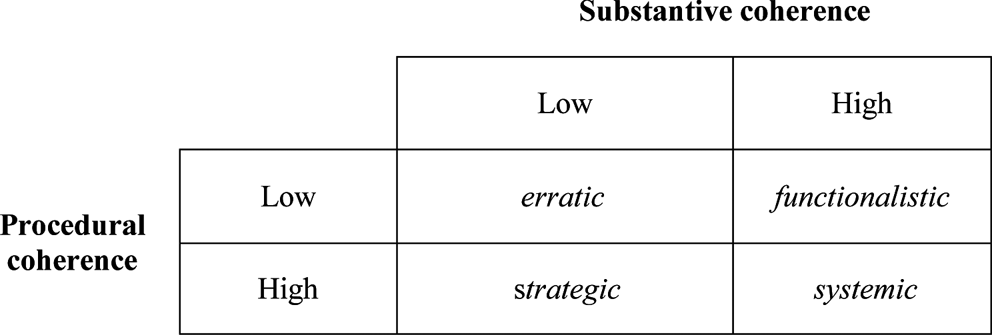
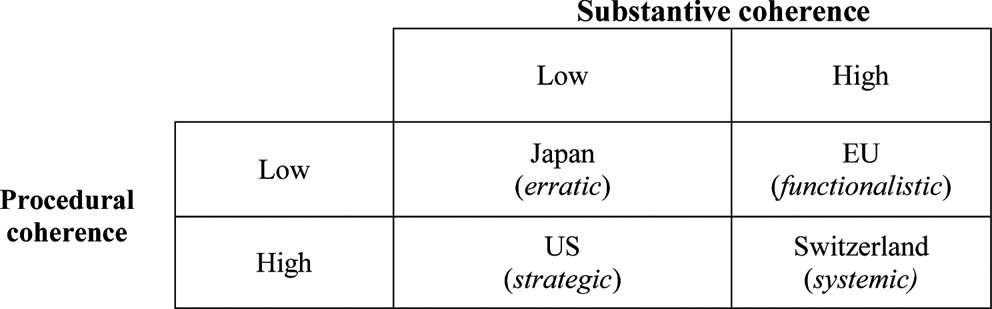
We argue that, from a state perspective, problems raised by regime complexes are expressed in terms of policy coherence and the greater the policy coherency, the stronger the actions of states to integrate regime complexes.Footnote 13 The concept of policy coherence, however, is difficult to apprehend. As noted in the review of the literature conducted by Di Francesco, two definitions are available, one coming mainly from the policy-oriented literature (notably the OECD) and the other from more classical academic studies (notably Rod Rhodes).Footnote 14 According to the former, policy coherence is understood as a process, referring to the degree of internal coordination in policymaking, and according to the second, it is understood as an outcome, referring to the degree of complementarities between adopted policies. Yet, these two definitions are complementary, and rather than favouring one over the other, we consider them as two dimensions operationalising the same concept. Under this perspective, full coherence in a given issue-area requires both the institutional capacity for procedural coherence and the political commitment for substantive coherence. More common are situations where both dimensions are absent, or one dimension prevails over the other. Under this original 2X2 typology, illustrated in Figure 1, four ideal types of foreign policies appear: erratic, strategic, functionalistic, and systematic.Footnote 15
Typology of governmental coherence

Erratic policies are based on the assumption that each international regime and associated negotiations are unrelated to one another, even when the regimes are part of the same complex. States with erratic policies have minimal internal coordination and no commitment to improve this situation. As bureaucratic units involved in different venues vary, positions expressed can appear inconsistent to outsiders. Two conditions increase the risk of erratic policymaking: (1) the lack of leadership, exercised by the head of government, the department of foreign affairs, or any coordinative bureaucratic unit; and (2) the strong specialisation of the various governmental units involved in policymaking, all driven by their own ideational missions.Footnote 16 Under these circumstances, bureaucratic politics prevail and externalities on neighbouring regimes are likely to be exacerbated, leading to a highly fragmented regime complex.
Under the ideal-type of strategic policymaking, a state has the institutional capacity but not the political commitment for greater foreign policy coherence for negotiating complexes. Governmental authorities are very well aware of potential connections between elemental regimes, but deliberately try to play one against the other. When a complex is in creation, substantive incoherence can be a rational strategy to seek simultaneous gains (material or reputational) from diverse and fragmented audiences. A state could also express opposition to one proposal in one forum and support the same proposal elsewhere with the objective of operating a forum shift. Several features can make a forum more attractive, including its membership, its negotiation procedures, its existing norms and principles, and its mechanisms to monitor and enforce compliance. Alternatively, a state can strategically operate a forum shift to expel one inextricable controversy to a setting where it will not obstruct negotiation.
Functionalist policymaking operates in policy chimneys or policy silos. This situation happens when states are politically committed to greater substantive coherency in negotiating several related regimes, but do not have strong institutional mechanisms to ensure intra-governmental coordination, as federations, large bureaucracies, and coalition cabinets frequently lack these. In these circumstances, states can reduce substantive incoherency by establishing clear boundaries between issue-areas and attributing a single bureaucratic unit to each of these issue-areas.
Finally, systematic policymaking scores high on both substantive and procedural coherence. States having a systematic approach perceive the regime complex as a single regime and consequently institutionalise coordination mechanisms among bureaucratic units. These units then deliver a coherent message across all the elemental regimes of a complex. Systemic policymaking deals with a complex as if it were a single coherent regime.
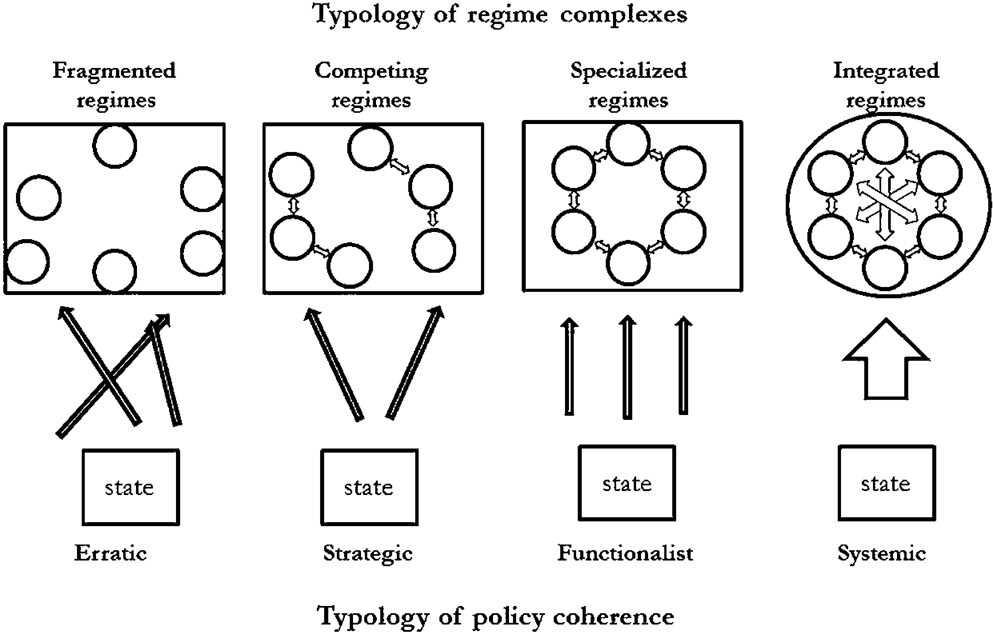
Considering this typology, we contend that the more a government is substantively and procedurally coherent, the more it is likely to promote greater density in the complex. If bureaucratic units of a government have the institutional capacity and political willingness to have coordinated and complemented policies, they will likely develop shared knowledge and commitment on related issue-areas. They will end up with a comprehensive view of the negotiated point, a view encompassing all the individual regimes shaping a given regime complex. Their negotiation mandates will then likely ask for greater regime connections. To the contrary, States with unorganised foreign-policy goals or processes will end up neglecting or favouring one regime complex component over the others, whether intentionally or not. Obviously, not all states participating in a complex simultaneously reach the same level of coherence at the same time. Erratic, strategic, functionalist, and systematic policymaking can coexist, leading to conflicting pressures on the complex. However, we contend that when most participants move toward greater coherence, the complex is likely to be less fragmented and more integrated, as illustrated in Figure 2.
Linking policy coherence and regime complexes
Conversely, the development of regime complexes is likely to favour policy coherency. As Robert Keohane argued at the beginning of regime analysis, for a government ‘to break the rules of a regime, the net benefits of doing so must outweigh the net costs of the effects of this action on other international regimes’.Footnote 17 In a regime complex setting, inconsistency does not merely affect compliance and reputation in one regime, but in several. This is why a regime complex in creation has the capacity ‘to increase the value of loyalty’Footnote 18 as well as to decrease the threat of defection.Footnote 19 The importance of compliance and loyalty can be underlined by other national delegates but also by non-state actors that often register as observers to the negotiations of the complexes. With time, audiences are likely to become more cohesive, expectations to converge, the complex to get denser, and the fungibility of states' reputation to increase.
The causal relation between external cohesion and policy coherence has already been demonstrated elsewhere.Footnote 20 States tend to be incoherent when their public, such as stakeholders or other states, is fragmented among numerous issue-areas rather than supporting one common claim. In those circumstances, states lack the incentive to coordinate their policy and tend to seek simultaneous gains from conflicting audiences. However, once the various publics associated to a precise issue-area are coordinated and develop a common organising idea, states tend to become more coherent, notably to avoid reputation costs associated with bold incoherence. Therefore, states rationally increase their coherence as they feel the pressure to do so in their negotiation environment.
Misperception of others' political positions can amplify this calculation in favour of greater policy coherence and put a feedback process in motion for the complex to move toward greater integration. Robert Jervis has famously demonstrated that a common misperception in foreign policy ‘is to see the behaviour of others as more centralized, planned, and coordinated than it is’.Footnote 21 This inclination, Jervis explains, is a ‘manifestation of the drive to squeeze complex and unrelated events into a coherent pattern’. We can thus assume that the perception of an integrated institutional environment, either accurate or not, induces more policy coherence, which, in turn, favours dense complexes. Other actors will react similarly, by increasing their own coordination and coherence. As the complex gets denser, the group of negotiators builds greater cohesion. This dialogue between agents and structures establishes and feeds cooperation efforts. This partly explains why complexes, once the first steps toward integration are achieved, are more likely to move forward toward even greater integration than to move backwards toward fragmentation.
To avoid tautological reasoning, however, this interrelation between regime complexes and agents can only be conceptualised in its joint evolution across time, in accordance with a morphogenetic approach. By morphogenetic dynamics, we mean that agents and structures co-evolve together, though on a different time scale.Footnote 22 Increased policy coherence can lead to abrupt jumps in the integration of a regime complex, while the density of the complex favours coherent policymaking in a more incremental manner. The next section investigates these conceptual developments on the empirical case of the genetic resources complex.
II. Setting the scene: the genetic resources complex
The genetic resources complex has evolved in the last three decades toward greater density. Until the early 1980s, the trade, the agricultural, the environmental, and the intellectual property rights (IPRs) regimes, despite being related to genetic resources, were highly fragmented.Footnote 23 The Union for the Protection of New Varieties of Plants (UPOV) was established in 1961 in the IPRs regime without disturbing the 1947 General Agreement on Tariffs and Trade (GATT) at the core of the trade regime. Likewise, the International Undertaking on Plant Genetic Resources (IU) was adopted by the Food and Agriculture Organization (FAO) in 1983 without getting much attention from environmentalists.
Yet, in the mid-1980s, biotechnology appeared as a promising sector that would generate substantial revenues in the near future. Biodiversity-rich as well as biotechnology-rich countries claimed new property rights to secure their share of this revenue stream. On one side, developing countries succeeded to include in the 1992 Convention on Biological Diversity (CBD) a formal recognition of their sovereignty over genetic resources and the principle of ‘fair and equitable sharing of the benefits arising out of the utilization of genetic resources’.Footnote 24 In parallel, developed countries included in the Agreement on Trade-Related Aspects of Intellectual Property Rights (TRIPs) of the newly born World Trade Organization (WTO) an obligation to protect new microorganisms and new plant varieties by IPRs.Footnote 25
The debate was then framed in terms of binary antagonisms, opposing bioprospection to biopiracy, farmers' rights to breeders' rights, and modern inventions to traditional knowledge.Footnote 26 Arguments raised in both camps were based on notions of exclusive property rights, which rendered compromise unlikely. The most radical players took strongly opposing stances: the United States (US) did not ratify the CBD, arguing that it challenged IPRs, while Brazil called for the amendment of the TRIPs agreement on the grounds of incompatibility with the CBD.Footnote 27 Regimes were competing to be located at the centre of the complex.
This opposition between sovereignty and IPRs over genetic resources triggered new links between the elemental regimes. Although, the CBD principle of sovereignty clearly opposes the principle of common heritage of mankind embodied in the FAO 1983 IU, the FAO aligned itself with the CBD, first with the 1991 annex to the IU, and later with the 2002 International Treaty on Plant Genetic Resources for Food and Agriculture. The treaty is explicitly ‘in harmony with’Footnote 28 the CBD, provides that its objectives could only ‘be attained by closely linking’Footnote 29 it with the CBD, and requires its governing body to ‘establish and maintain cooperation with’Footnote 30 the Conference of the Parties (COP) to the CBD.
Following the same dynamics, ties were progressively put in place between the WTO and the World Intellectual Property Organization (WIPO). In 1995, a cooperation agreement between the two organisations was signed, covering data collection, implementation, and technical assistance. The TRIPs agreement, which requires compliance with several IPRs agreements, even had the net effect of increasing WIPO membership.
As the level of controversy decreased, regimes specialised.Footnote 31 An arbitration centre, hosted by WIPO, was established in 1994 but left state to state disputes to the WTO. Ex situ crops and plants were handled by the FAO, while in situ resources were left to the CBD. Meanwhile, the parties to the CBD recognised that IPRs were out of the scope of the CBD and commissioned a report on the WTO in 1996 and to the WIPO in 2002. WTO members, for their part, refrained from strengthening its IPR obligations for biological material despite specific negotiations scheduled for 1999 in the TRIPs agreement.
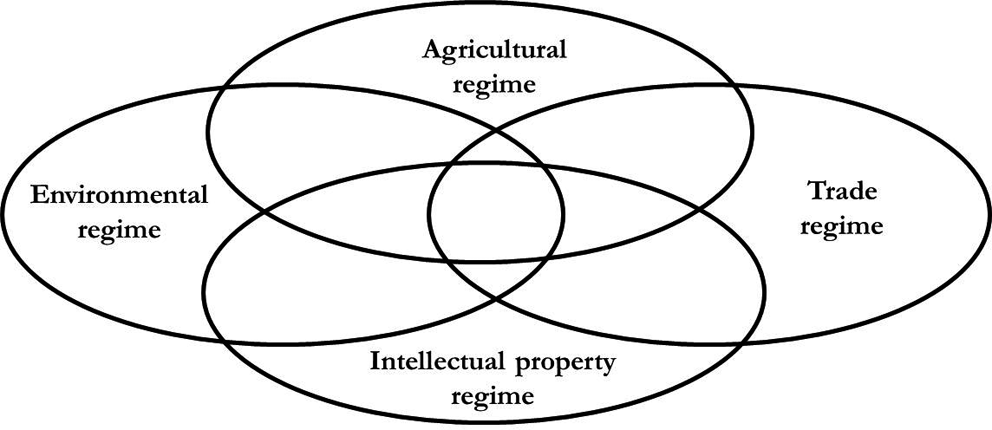
Today, the global consensus on genetic resources is ‘relatively clear’Footnote 32 and the four main elemental regimes of the complex, presented in Figure 3, share a common conceptual framework known as ‘environmental liberalism’.Footnote 33 Although actors still disagree on the best solution to avoid a ‘tragedy of the commons’, most assume that resources, whether biological or biotechnological, face this risk. Moreover, they recognise that clear property rights are necessary policy instruments for the valorisation of the ‘global markets’ of genetic resources.Footnote 34
The genetic resources complex
Several policy instruments are consensually recognised as being at the interplay of several elemental regimes of the genetic resources complex, such as public gene banks, farmers' rights, traditional knowledge databases, and prior informed consent procedures. Some of these instruments were explicitly designed to facilitate synergies between two or more regimes. For example, some recent bilateral free trade agreements require the disclosure of the origin of genetic resources in patent applications to facilitate compliance with the CBD.Footnote 35 Also, the 2010 Nagoya Protocol on Access and Benefit Sharing acknowledges ‘the fundamental role’ of the FAO Treaty and implicitly refers to the TRIPs agreement when it calls for implementation ‘in a mutually supportive manner with other international agreements’.Footnote 36 Tensions unsoundly remain, in particular on the mechanism and the basis on which to allocate the benefits from genetic resources. The current emphasis, however, is on the development of potential synergies rather than the denunciations of fundamental incompatibilities.Footnote 37
III. From policy coherence to the regime complex
Several studies have noted the apparent incoherence of governmental actors involved in the genetic resources complex. Some have suggested that states have exhibited an erratic behaviour on this issue-area, characterised by a poor coordination between bureaucratic units.Footnote 38 Other studies have considered that states, rather than being erratic, were strategically incoherent and promoted forum shifting.Footnote 39 De Briève and Thomann, for example, have observed that several developed countries pleaded for flexibility on genetic resources at the TRIPs Council, a forum in which they usually advocate high standardised norms, because they wanted to deviate the debate to a less judiciarised setting.Footnote 40 Being erratic or strategic, these incoherent behaviours have certainly contributed to creating and sustaining fragmentation among regimes of the complex, at least in its initial stages. Though, most studies focus on the negotiations held in the 1990s and neither investigates in detail recent convergences in the complex nor assesses systematically policy coherence.
In order to fill this gap, we systematically assess the policy coherence of four governmental actors: the European Union (EU), Japan, Switzerland, and the US on the issue of genetic resources. Several considerations influence our selection of governmental actors. By limiting our investigation to countries with similar (high) industrial capacity in the biotechnological sector,Footnote 41 with similar (high) IPR protection for biotechnologies, with similar (low) biological diversity in their domestic ecosystems, and with similar (high) protectionist measures for agriculture, we are able to control for some of their material interests, which could otherwise introduce biases in the analysis. Moreover, their economic importance means that the participation of these actors to the complex is crucial for the enforcement of the rules it develops. Finally, among developed countries, our selected governmental actors have been the four most active governmental actors of the complex,Footnote 42 as documented by the number of submissions they sent to intergovernmental organisations. This also ensures sufficient data availability.
The timeframe for our analysis of policy coherency ranges from 2001 to 2010. The starting year marks the creation of the Intergovernmental Committee on Intellectual Property and Genetic Resources, Traditional Knowledge and Folklore (IGC), hosted by WIPO. Therefore, in the period studied, four fora are crucial in the complex, namely the CBD, FAO, WIPO, and WTO.Footnote 43
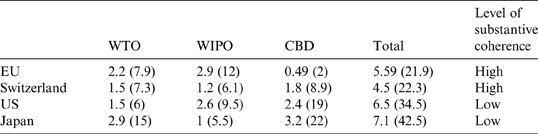
As levels of coherence are difficult to compare qualitatively, we rely on quantitative methods. More specifically, substantive coherence is assessed by a lexicometric analysis of the written submissions on genetic resources sent by the four governmental actors to the CBD, WIPO, and WTO.Footnote 44 The corpus includes 21 documents from the EU, 22 from Switzerland, 15 from the US, and 14 from Japan.Footnote 45 To assess substantive coherency, we compare words included in written submissions sent by one governmental actor to one intergovernmental organisation with other written submissions sent by the same governmental actor to the two other intergovernmental organisations. We did so with the help of the software SATO and its function based on chi-square (Chi2) distance to measure variations in the choice of words between two groups of texts: the higher the Chi2 distance, the greater the difference in submissions and the lower the substantive coherence.Footnote 46 These results help us to assess the extent to which one actor significantly adjusts the content of the submissions according to the setting.
To offer richer support to our results, we also ran a second lexicometric analysis, based on semantic fields rather than actual words. We classified 607 keywords from the corpus in 27 different semantic fields such as ‘agriculture’ (grouping keywords like crops, farmers, seeds, food, etc.), ‘moral justice’ (grouping keywords such as fair, wrong, legitimate, etc.) and ‘conflict’ (grouping keywords such as combat, dispute, enemies, struggling, etc.).Footnote 47 The complete list of semantic fields, as well as the results obtained for our sample of governmental actors, is available in Appendix 1. Such a classification in semantic fields enables to exclude noises from irrelevant words, to neutralise variations resulting from synonyms, writing styles, and verb tenses, and to obtain clearer results.
Table 1 presents the results obtained before (values out of brackets) and after (value in brackets) categorisation in semantic fields. Based on these indicators, the EU and Switzerland appear more substantively coherent than the US and Japan. This ranking order remains the same, whether the analysis takes into account every word individually or focuses on semantic fields grouping several keywords.
Chi2 distance with submissions presented in other fora
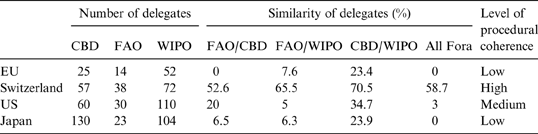
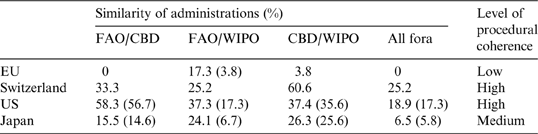
Procedural coherence is assessed by examining the composition of the abovementioned delegations to the negotiations of the genetic resources regime complex at CBD, FAO, and WIPO.Footnote 48 Two indicators are elaborated. The first, called ‘similarity of delegates’, measures the percentage of a country's delegates sent to two or three negotiation processes (the greater the number, the greater the similarity). For instance, if the same American delegate attended one CBD meeting and one WIPO meeting, then it has been included in the share of similar delegates CBD/WIPO for the United States. The second, called ‘similarity of administrations’, measures the percentage of a country's administration sent to two or three negotiation processes (the greater the number, the greater the similarity).Footnote 49 For instance, if two different American delegates attended respectively one CBD meeting and one WIPO meeting, but were both from the US Patent Office, then they have been included in the share of similar administrations CBD/WIPO for the United States. Appendix 2 details the mathematical formulas developed for both indicators.
Table 2 and Table 3 bellow summarise the results obtained on procedural coherence for our sample. It appears that Switzerland is the country that is the most procedurally-coherent actor of the sample, while the EU and Japan are the least procedurally-coherent governmental actors. The US occupies a middle position, with an intermediary score of procedural coherence.
Governmental procedural coherence on the issue of genetic resources, first indicator
Governmental procedural coherence on the issue of genetic resources, second indicator
Numbers in parenthesis exclude the permanent missions of Foreign Affairs ministries (in Geneva for WIPO, in Rome for FAO).
By crossing results on substantive and procedural coherence, as summarised in Figure 4, each governmental actor can be associated with one of the ideal types of policy coherence evidenced earlier.Footnote 50 Moreover, consistent with our theoretical model, levels of policy coherency are associated with negotiating positions regarding the complex integration. The more a country is coherent, the more it supports greater integration of the genetic resources complex. These negotiating positions were documented by a qualitative analysis of available documents and interviews conducted with key negotiators of the identified countries.Footnote 51 They were asked to express themselves on their country's first best option for the genetic resources regime complex and their perception of the three other governmental actors.
Synthesis on governmental coherence
First, Japan, with its relatively low score on procedural and substantive coherence, appears erratic. It lacks both the political commitment and the institutional capacity to be coherent on the issue of genetic resources. On substance, Japanese submissions to one forum highly differ from Japanese submissions to other fora. Moreover, the analysis of the semantic fields used by Japan neither reveals a semantic field that would be common to all negotiating fora nor a group of lexemes that Japan would specifically propose at one particular forum. In the same way, procedurally, no pattern emerges from the analysis of the Japanese delegation. Even for the same forum, the Japanese representation is irregular in terms of bureaucratic units – at CBD and WIPO more than ten bureaucratic units are present during the period studied. Unsurprisingly, given this erratic coherence, Japan is neither a strong supporter nor the fiercest opponent of greater integration in the genetic resource complex. In international negotiations over genetic resources, Japan is perceived by most of our interviewees as an unpredictable player. The only breakthrough of the Japanese delegation took place during the 2010 CBD meeting in Nagoya, for the adoption of the corresponding protocol. At that time, the Japanese presidency was notable for its efforts to propose a final consensual negotiating text.Footnote 52 Previously and otherwise, Japan has often appeared as reactive or apathetic.
The US, with a relatively high procedural coherence but a low substantive coherence, appears strategic. Results show that the US sent similar delegations to all fora, mostly from the State Department and the Patent Office. These delegates have a global picture of the regime complex that helps them rationalise and strategise. However, the US did not translate this procedural coherence into substantive coherence. This results in a strategic approach consistent with the US active resistance of deeper integration of the complex. For example, the US has not ratified the CBD and is opposed to granting observatory status to the CBD secretariat at the TRIPs Council.Footnote 53 Nevertheless, the US had to paradoxically recognise CBD principles at the TRIPs Council to sustain its strategy. In order to resist proposals to negotiate an amendment to the TRIPs agreement restricting the patentability of plant and animals, the US insisted on a contract-based approach – as opposed to an international regulatory approach – for access and benefit sharing, which is the original CBD approach. In other words, the US strategically defends the principles of a convention it refuses to ratify.
In contrast, the EU has a strong political commitment to coherence but little institutional capacity. Very few representatives of the EU attended meetings of two or three fora on genetic resources and EU delegations do not typically include representatives of various bureaucratic units. This irregular and unbalanced participation reflects a strong division of labour between DG Environment at CBD, DG Health at FAO, and DG Internal Market at WIPO. This division of labour, however, has not affected the EU's substantive coherence, presumably as a result of inter-bureaucratic coordination and individual leadership among the different directorates of the Commission. Interestingly, the Commission published a document on substantive coherence, including the issue of GR, as a ‘reply to the Council request to look at options in the area of policy coherence’.Footnote 54 In this document, as well as in other policy documents, the EU advocates a deeper integration of the regime complex. It has been relatively supportive of the idea of requesting the disclosure of the origin of the biological material used in the invention in patent applications, a policy proposal aimed at increasing CBD compliance through the patent system. However, few European countries have yet implemented this disclosure policy in their domestic patent system and the EU itself has long been hesitant on the most appropriate forum to recognise this disclosure requirement internationally. It seemed to favour WIPO, despite its slow negotiating pace, but was apparently ready to consider the TRIPs Council as an appropriate forum for disclosure if developing countries supported European proposals on geographical indications. This consensual position was put forward by a handful of individuals, from the three directorates mentioned above, at the initiative of DG environment.Footnote 55 That said, according to some accounts, the EU has gradually moved from a functionalist to a systemic policymaking. According to Oberthür and Rabitz, ‘In contrast to earlier times, the EU now also by and large acted in a united, well-organized and proactive way trying to push the international negotiations toward their successful conclusion’.Footnote 56
Switzerland, which scores high on procedural and substance coherence, has a systemic approach. Swiss delegations to CBD, FAO, and WIPO are stable and balanced. They almost systematically include delegates from the Federal Office for the Environment, the State Economy Secretariat for Economic Affairs, or the Federal Institute of Intellectual Property. Instead of generating distrust, the important number of bureaucratic units involved is the result of the Swiss objective to promote balanced policies taking into account environmental, trade and intellectual property dimensions.Footnote 57 In the late 1990s, Switzerland even put in place an inter-departmental group that ensures collaboration between the different bureaucratic units on IPRs-related issues.Footnote 58 Moreover, our analysis of the semantic fields used by Switzerland indicates that this government promotes WIPO as the appropriate negotiation fora both at the WTO and CBD. Its submissions are also articulated around the notion of disclosure requirements in patents applications. In 2003, it suggested to amend a major WIPO treaty, the Patent Cooperation Treaty, to include disclosure of source. Recently, the government has expressed its will to further the synergies between IPRs and environmental goals.Footnote 59 Switzerland is widely recognised as a leader in the genetic resources complex. A recent study on the negotiation of the Nagoya Protocol concludes, for example, that ‘Switzerland was able to play the role of an intellectual leader, by steadily promoting innovative ideas at key moments of the negotiations’.Footnote 60
Given similar material interests of Japan, the US, the EU, and Switzerland on genetic resources, one could have anticipated that they would have similar views and preferences regarding the integration of the complex. Despite the similarities that our sample actors share, our results and interviews show that Switzerland, and to a lesser degree the European Union, are self-identified and recognised by their peers as active promoters of an integrated complex, while the US and Japan are less enthusiastic about integration and are sometime perceived as working for the fragmentation of the complex.
We have argued in this section that variation in the degree of integration promoted by each governmental actor taken individually is related to their degree of policy coherence and to the level of integration of the complex. The next section reverses the equation and argues that policy coherence is partly a function of exposure to the regime complex, and as such also evolves through interactions.
IV. From the regime complex to policy coherency
One can be surprised by the results obtained on the policy coherence of the four governmental actors. Notably, we found that Switzerland is more coherent than Japan on genetic resources negotiation, both in terms of procedural and substantive coherence. This finding appears counterintuitive: Switzerland, a country deeply decentralised, is more coherent than Japan, a country known to be centralised and socially cohesive.
Several variables can contribute to explaining variation in policy coherence. Geographical distance with negotiation location, the size of the administration, and the bureaucratic culture are presumably important factors. Therefore, the Swiss coherency could have been favoured by the small size of its administration, its culture of consensus, and the location of the WTO and WIPO in Geneva. As explained by one Swiss interviewee: ‘In Switzerland we have a culture of consensus which is very useful when we try to move toward the highest level of coherence.’Footnote 61 Another Swiss interviewee acknowledged the benefit of working in a small administration to favour coherency: ‘We have only a limited number of people working on this issue at the governmental level and we have … always tried to work together.’Footnote 62 That said, the larger European administration has not impeded European coherence and the Japanese culture of consensus did not prove sufficient to ensure a coherency on genetic resources.
As described in the theoretical model, we argue that one factor that contributes to favouring greater coherence is the willingness to avoid the reputational costs associated with incoherence. All the interviewees who came from a country scoring high on coherence felt that they could not revert to incoherent behaviour without suffering severe credibility losses. As one explained: ‘I think it is nowadays not too difficult for other parties to point out the incoherence and inconsistency of a country and then it loses credibility.’Footnote 63 While incoherence could affect credibility, coherence enhances predictability and reliability.Footnote 64 According to interviewees, the Swiss coherence has been a major asset contributing toward Switzerland becoming an important international player.Footnote 65
The reputational costs of incoherence, however, vary from one country to another according to their domestic audiences. As underlined by one negotiator, non-state actors play a key role in shaping the negotiation environment and, therefore, governmental reputation.Footnote 66 Reputational costs will likely be higher for countries with domestic audiences comprising several non-state actors monitoring all regimes related to genetic resources. Conversely, the government will have less incentive to craft a coherent policy for the entire complex when the domestic audience is fragmented along regime lines. In those cases, incoherence might remain unnoticed.
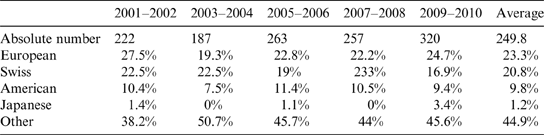
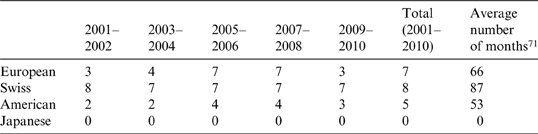
In order to analyse the level of awareness that domestic audiences have on the genetic resources regime complex, we use the lists of participants at the CBD, FAO, and WIPO negotiations, just as we did with national delegates. We elaborate two indicators describing the domestic audiences: the origin of the observers present during the negotiations (Table 4) and their follow-up at parallel fora, which we call multi-fora non-state actors (Table 5).
Percentage of observers from selected countries and absolute number, all fora included, two-year intervals and average value
Number of multi-fora non-state actors and duration of their attendance to the complex
Table 4 shows that, on average, very few observers of the genetic resources complex come from Japan (1.2 per cent), few come from the US (9.8 per cent), while a quite important fraction of them are either Swiss (20.8 per cent) or European (23.3 per cent), presumably favoured by the proximity of negotiating venues.Footnote 67 We can infer from Table 4 that European and Swiss delegates will be put under more pressure by their constituents than Japanese and American delegates. It is particularly interesting to note that Japanese stakeholders became involved at a rather late stage, just as the CBD COP 10 was announced to take place in Nagoya.Footnote 68 One could anticipate that, as the Japanese audience became more involved in these regimes, the Japanese government had an increased incentive for procedural and substantive coherence.
Table 5 informs on the regularity of observers' attendance and their follow-up at several fora. It shows that an increasing number of multi-fora non-state actors are following the complex.Footnote 69 Follow-up of Swiss observers is especially regular and comprehensive.Footnote 70 More than seven observers followed the negotiations taking place in several regimes of the complex simultaneously over the whole period studied. Moreover, their average follow-up of the negotiation is more than seven years (87 months). Japanese observers, however, are totally absent from Table 5 and American observers seem less consistent than those in Europe or Switzerland.
With time, the audience size increases (see Table 4), the audience's expertise widens to the entire complex (see Table 5), and the audience's geographical origin diversifies. The EU and Switzerland, which already score high on procedural and substantive coherence, are also presumably more exposed to public pressures. This reputation burden acts as a guardrail for actions aimed at further integrating the complex.
But the story does not end up here as states and regime complexes also interact through a perception game. The tendency of states to increase coherence as they perceive their environment as more integrated has already been noted. Ahmed Abdel Latif, for example, a former Egyptian negotiator on GR, gave evidence of developing countries deliberately sending the same delegates to WIPO and WTO as their perception of the complex matured.Footnote 72 As long as the complex is not perceived as such, it is hard for observers and delegates to foster attention on the issue of coherence. However, as the complex gets denser and becomes visible, it places reputation at the core of the political game.
Even the laggards have been forced to improve their coherence due to external pressures. When the US administration faces partners who are engaged in the integration of the complex, it can no longer ignore its increasing density. Bilateral free trade agreements with biodiversity-rich Peru and Colombia have included ‘understandings’ reaffirming CBD's principles of prior informed consent before accessing genetic resources and of equitable sharing of the benefit arising from their use.Footnote 73
Japan was also put under pressure as the negotiations of the CBD Protocol on access to genetic resources were taking place in Nagoya. The adoption of the protocol on genetic resources was largely fostered by the Japanese presidency. One interviewee noticed that the Japanese position became more flexible, going from a strict refusal of payments to provider of genetic resources, to an acceptance of conditional payment ‘if it is written adequately’.Footnote 74
All these elements explain why the complex is increasingly integrated. Controversies are likely to persist inside the complex, but they tend to be resolved as the audiences of the various elemental regimes become more homogenous and the reputation costs associated with incoherence increase. In turn, more coherence governmental actors will likely favour a more integrated complex.
Conclusion
This article argues that the density of regime complexes and the coherence of governmental policies are interlinking and co-evolving phenomena. Agents negotiate the evolution of regimes and complexes structure the evolution of policymaking. Analytically, we have built a typology of governmental coherency, closely linked to different levels of integration of regimes complexes. We have also mixed qualitative and quantitative analysis of various data sources to illustrate the morphogenetic co-evolution linking policymaking of four governmental actors with similar material interests and the genetic resources regime complex.
An important finding of this study is that policy preferences and administrative coordination at the agency level are as diverse as the interactions of regimes at the structural level. That being said, some regimes are institutionally connected before others, and some states increase their policy coherence before others. Evolutions are jerky and uneven. Regimes with normative affinities are linked before regimes competing for centrality, despite similar membership. States with more opportunities to perceive the complex in creation become coherent earlier than those that are isolated, despite similar material interests.
It is important to bear in mind, however, that the example of genetic resources was provided as an illustration, not as a definitive demonstration. The objective of this article was to provide conceptual and methodological tools for further hypothesis-testing research. As the number of different case studies increases, the emerging literature on regime complexes will likely and hopefully turn to comparative approaches. In order to foster this scientific endeavour, the article introduced a typology that could become a useful heuristic device, conceptualised processes linking agents and structures that can be translated into specific hypotheses, and developed quantitative methods that might allow for comparison across cases.
If the theoretical model presented here is confirmed by further studies, it would allow for one prediction: if most participants move toward greater coherence, audiences become more cohesive, expectations converge, the complex gets denser, and the pressure increases on erratic and strategic states. In the genetic resources complex, Japan and the US might soon not be able to afford being erratic or strategic for long without suffering reputation costs.
Appendix
Appendix 1
Proportional frequency of given semantic fields based on a Z value (A Z value of greater than 2.0 or less than −2.0 is considered significant)
Appendix 2 Indicators of national procedural coherence (calculated for each selected governmental actor)
SWIPO=Number of delegates sent to WIPO meetings
SFAO=Number of delegates sent to FAO meetings
SCDB=Number of delegates sent to CBD meetings
nWIPOi=Number of WIPO meetings followed by delegate i
nFAOi=Number of FAO meetings followed by delegate i
nCDBi=Number of CBD meetings followed by delegate i
j=Number of delegates having followed at least one FAO and one CBD meeting
k=Number of delegates having followed at least one FAO and one WIPO meeting
l=Number of delegates having followed at least one CBD and one WIPO meeting
m=Number of delegates having followed at least one CBD, one WIPO and one FAO meeting
a=Number of different administrations
mFAOi=Number of delegates from administration i sent to FAO meetings
mCDBi=Number of delegates from administration i sent to CBD meetings
mWIPOi=Number of delegates from administration i sent to WIPO meetings
Appendix 3
List of interviewees (in alphabetical order)