The early modern period has been characterised as one of renaissance in manorial court keeping. Harrison highlighted its resurgence after the dissolution and the importance of sixteenth- and seventeenth-century manorial court records for our understanding of early modern social history.Footnote 1 Winchester showed the increased recording of orders and byelaws.Footnote 2 More recently, Waddell has stressed the importance of the manor court in local governance, its resilience in a period of change and its relative neglect by historians of the period.Footnote 3 Contemporaries and Tudor parliaments did not view them as defunct. Of fifty-one statutes relating to leet jurisdiction identified between 1225 and 1887, twenty date from the sixteenth century.Footnote 4 The large body of records generated by manorial courts has been underused as a source, despite courts being not merely a means of preserving the lord's interests, but also of regulating relations between tenants and upholding ‘good neighbourhood’.Footnote 5 In the varied topography of local administrative units and jurisdictions the manor calls for scrutiny through a similar lens to that applied to the parish and a closer appreciation of the relationship between the manor and parish/township is needful.Footnote 6
The manorial court was a private court, held in the name of the lord, recording seignieurial control and exploitation and, in the case of a leet, exercise of a royal franchise. Much of its business is nevertheless communal in nature, not involving the lord's immediate interests. Even profits of the court due to the lord in the form of fines and amercements were not set by him directly, fines being generally regulated by custom and amercements assessed by officers appointed by the jury or the entire homage. This duality in the court's functioning was reflected in two aspects of the manor itself; its territoriality and its communal identity. Kerridge pointed to its duality, as on the one hand, a territorial unit and on the other a collection of mutual obligations resulting in what Norden in The Surveiors Dialogue called ‘a little commonwealth’.Footnote 7 The manor was more than a territorial unit. The lord had the right to hold a court, but this was more than a means of imposing his will. It was also a mechanism for communal oversight of those matters contingent on mutual obligation, upholding ‘good neighbourhood’ and community cohesion.Footnote 8 Tenants meeting to enact orders and present their neighbours for breach of them built a body of customary law affirming both the physical and social boundaries of their community.
The manor saw itself as a community of a fixed number of land holdings with appurtenant rights over common resources, regulation of access to which loomed large in the workings of manorial courts. Recent environmental debates centred on sustainability and preservation of surviving common land have stimulated study of the manor court's role in management of common resources such as grazing and fuel, access to which formed a nexus of self-interest, around which both endogenous and exogenous tensions were played out in the decision-making of early modern manorial courts. Pressure on resources is reflected in both the number and quality of court orders and presentments in the period, which show growing tensions between the authority of the courts and individual actions.Footnote 9 A major factor in increased pressure was increasing numbers of migrant poor, to which Tudor vagrancy laws were a response. Prominent among them was the 1589 Act against the erecting of cottages and taking of inmates, which gave manorial courts a statutory basis for regulating inward migration.Footnote 10 However, orders and presentments regulating inmates and subletting stemmed not just from concerns of Tudor legislators with vagrancy and poverty, but from the self-regulating operation of the manor in its pursuit of stability and controlled access to common resources. The Elizabethan poor laws, placing responsibility for poor relief on parishes, caused bureaucratised poor relief, funded from rates paid by the settled tenantry, to be added to the list of common resources over which manorial communities might wish to exercise control.
Clark and Souden recognised the existence of short distance, seasonal and ‘circular’ mobility and their importance for the agrarian economy. They also pointed out the ability of landowners to bring cottage regulation and the poor laws to bear on the unwanted, forcing them to move by tightening control of settlement. However, the agency of manorial leets and manorial court records as a potential source are not touched on.Footnote 11 Beier drew the necessary distinction between the vagrant and the migrant, while correctly noticing that those forced to move through poverty and in search of betterment were always liable to be caught up in the vagrancy laws, but he makes no mention of the role of the manor in regulating movement through implementation of the 1589 Act in the matter of inmates.Footnote 12 Accounts of the operation of the Elizabethan Poor Laws have mentioned the use of the 1589 Act by manorial courts in controlling settlement and mobility. Oxley identified manorial control of access to housing through the implementation of the 1589 act as a key element in the evolution of the law of settlement in rural south-west Lancashire before the coming of the 1662 Act of Settlement.Footnote 13 Styles also pointed out its centrality in regulating availability of accommodation as a means of alleviating pressures of inward migration in early modern Warwick.Footnote 14 More recently Hindle has emphasised the lack of investigation of the 1589 Act's workings, highlighting the disjunction, recognized by contemporaries, between its legitimising the eviction of inmates and the Elizabethan poor laws, which placed responsibility on parishes to house and maintain the poor.Footnote 15 In effect the 1589 Act was the only statutory basis for removal prior to the 1662 Act of Settlement and therefore in the period of the early poor laws leading up to it, when practices relating to settlement and removal were being formulated locally. Taylor, in his discussion of the history of pauper settlement, indicates that removals took place before parish officers could legitimately remove, but does not cite the 1589 act as a mechanism by which it could be achieved by denial of housing through orders in manorial leets. Footnote 16
This article will examine the response of manorial courts, in the light of the 1589 Act, to an increasingly mobile population in a period of stress. The focus will be on manor courts in Lancashire examining four aspects of their workings: the volume of court business dealing with issues of mobility; the quality of court orders regulating it; the place of the manor court in the topography of local governance; and aspects of continuity and change in the courts' functioning in the period.
I
Little has been published quantifying manorial courts’ business in matters of migration. Styles's account of manorial involvement with the regulation of immigration and inmates in Warwick considered the issue in the context of the development of the law of settlement.Footnote 17 Holdsworth quantified orders and presentments in some Westmorland manors, but not specifically in relation to inmates.Footnote 18 Oxley and Hindle touched on the issue but did not quantify manorial order making in the matter of inmates.Footnote 19
For this we will examine orders and presentments of the manor of Rishton, north-west of Blackburn, whose court books survive in an almost unbroken sequence from 1581 to the late seventeenth century. An eighty-year period from 1581 to 1660 is analysed here with a view to establishing the magnitude of inmate regulation in the overall business of the court as well as the chronological distribution of orders and presentments relating to inmates over the period. The following data, while limited, allows an overview, first of the magnitude of inmate regulation as an issue in the context of the overall work of the court and thus as a concern of the community of the manor, and second of the distribution of orders and presentments over time.
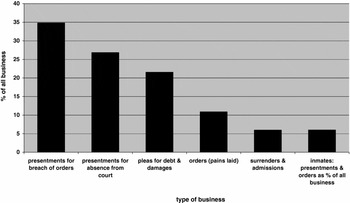
Ninety-five courts were held, only six years, 1596, 1643 to 1645, 1648 and 1649 having no record.Footnote 20 Courts were generally held annually and from 1650 biannually. The court books record procedure in clear sections: the preamble, giving the date of the court; the call list naming tenants owing suit; the jurors sworn, who made orders and to whom those in breach of them were presented; presentments of absentees; pleas for debt; presentments of individuals for breach of orders and byelaws; orders of the court or ‘pains laid’, being either general, forming byelaws regulating the life of the manor, or orders against individuals for performance obligations arising from a previous order or presentment; finally, names of officers appointed by the court. Among the presentments are also listed the surrenders and admissions resulting from inheritance or sale and purchase of copyholds. It is therefore possible to analyse the proportion of the various aspects of court business by calculating a total number of items of business and totals for various types. The results are presented in Figure 1, which shows that among the 1,793 items of business recorded for the period the 99 presentments and orders concerning taking inmates (including a very small number of presentments for lodging beggars) represent only about 6 per cent of all business. Seen within the totality of proceedings this seems relatively insignificant, but total business is inflated by, among other items, 428 presentments for absence from court and the 386 pleas for debt, amercements and fees for which produced a steady income for the lord.
Business in Rishton Manor Court 1581–1660.

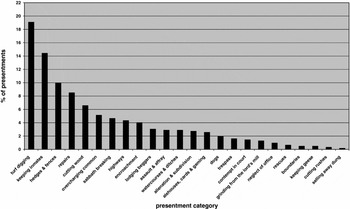
A more representative perspective of the manorial community's preoccupations with regulating incomers is offered by considering presentments for keeping inmates as a proportion of a subset of business items represented by all presentments for breach of manorial bylaws, since they form the staple of the courts involvement in communal relations. This appears in Figure 2. Of the 624 presentments over the period, 90 were for keeping inmates representing almost 14.5 per cent of the total, the second largest group after presentments for breaches of byelaws relating to the digging of turf. In this period of growing population it is unsurprising that tight control of access to turbary rights resulted in many being presented for breach of bylaws relating to their use. That presentments for keeping inmates form the second largest group might, therefore, be expected, since regulation of inmates was a means to control inward migration and protect resources valuable to the settled inhabitants of the manor.
Presentments in Rishton Manor Court 1581–1660.

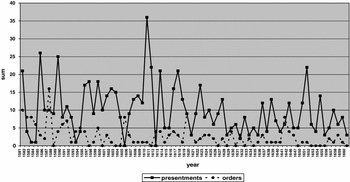
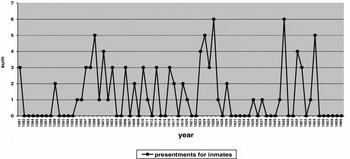
Turning to the distribution of presentments and orders over time, despite limited data extractable from the court books of one manor, some striking features emerge. The total number of orders and presentments each year for the eighty years considered, excluding surrenders and admissions, is plotted in Figure 3 and the annual sum of presentments for keeping inmates over the same period in Figure 4. As the number of orders in any one year was generally small, there was little correlation between order making and presentments. This is natural as general orders (‘pains laid’), once made, gave rise to presentments for their breach over a long period thereafter, as particular circumstances dictated, and might be reiterated periodically. Peaks at the start of the period when records began may have been due to reiteration of manorial custom and tightening of court keeping practice in the early years after a change of lord, though later peaks did not correlate to changes in ownership. Increased presentments are more readily attributable to heightened social tensions within the manor resulting from economic stress. Peaks in total presentments occurred at and immediately after periods of known bad harvests, thus high food prices, and high mortality, notably 1585 and 1586, 1594–7, 1608, 1622–4, 1647–50.Footnote 21 The crisis of 1622–3 is well known. Most recently, using records of the demesne estates of the manor of Rishton at Dunkenhalgh, Hoyle has described the effects of a poor harvest in 1621 followed by a still more deficient one in 1622, resulting in an ‘agricultural catastrophe’, the effects of which persisted for several years.Footnote 22 The peak in presentments beginning in 1623, and persisting through to 1626, mirrored the effects of dislocation at this time and the heightened vigilance of the manorial community in the face of pressure on resources. A peak in the early 1640s reflected dislocations due to the civil wars, which affected parts of Lancashire badly and the absence of courts in the early 1640s may also have arisen from this. The pattern of presentments therefore acts as a barometer of pressures on the community. Neither the coming of the 1589 act against keeping inmates or the Elizabethan poor laws of 1597–8 appear to have had a marked impact. It would be natural to assume that, in the light of the latter, presentments for keeping inmates might mention the likelihood of chargeability, but such formulations are absent from the Rishton presentments, probably because beaurocratised poor relief was a later development in this township.
Chronology of orders and presentments in Rishton Manor Court 1581–1660.

Chronology of presentments for keeping inmates in Rishton Manor Court 1581–1660.

II
The forgoing has shown the volume of manorial court business concerning inmates, but has told us nothing of those against whom regulation was directed or how. The following is a general overview of the objects of manorial regulation and the penalties incurred, taking examples from various manorial courts in Lancashire. What is evident is enormous variation and a highly nuanced approach to inmate regulation.
The mechanism by which the manor court dealt with inmates was by the making of orders (pains) setting a penalty (amercement) on the taker or keeper, that is the settled tenant of the manor, for allowing the presence of others, who might impugn the manor's integrity by placing, or potentially placing, a burden on communal resources. However, the actions of the court were generally not rigidly, but subtly applied. At Ulnes Walton 1578 saw five presentments for keeping inmates, the keepers being amerced. There was a further presentment for keeping three inmates, but in this instance the keeper was licensed.Footnote 23 There was no wholesale ban on inmates. If the steward agreed, the keepers were permitted to take them. Orders concerning inmates made by the Leyland manor court manifested the same reservation of discretion to the lord. They were to be removed ‘within ten days after the Lord or his heirs shall manifest their pleasure’ or else were permitted to remain with ‘the free Consent of . . . [the] Lord of this Mannor’.Footnote 24 This ambivalent or rather just self-interested attitude towards inmates is further revealed at Billington in an order of 1605 stipulating at once that none were to be entertained, but also that inmates were forbidden to dig turves on the lord's common. Existing inmates appear here to be spared, perhaps as needed labourers, tradesmen or craftsmen, though denied the privileges of manorial tenants, while new incomers were to be excluded. This tendency emerges again in the court orders against specific individuals considered later. The order against turf digging was repeated in 1609, and a further order was made preventing tenants from letting land to any ‘owte man’.Footnote 25 This last crystallises the problem of defining the inmate as it introduces the question of subtenants being defined as inmates as well as those merely ‘lodged’. The inmate might therefore be defined as one occupying a holding (or newly subdivided holding) separately as well as one forming a separate household (a byefire) within an existing holding. The aversion of manorial lords to the subdivision, or at least uncontrolled subdivision, of holdings becomes apparent in orders and presentments for inmates and it is clear that the term included not only lodgers but also subtenants themselves. For now the complexities of the manor court's reactions to inmate taking will be looked at in more detail with reference to Billington.
Forty-four courts were held at Billington in the forty-year period 1579–1618, seventeen in the twenty years between 1579 and 1598, and twenty-seven from 1599 to 1618. In the former period there was generally one per year in September or October with no court in 1592, 1595–7 and in 1599, perhaps reflecting disturbances to the manorial routine in dearth years. In the latter they were held usually twice yearly in April/May and September/October with only one year, 1601, with no court. There was a change of lord in 1602 and the impression is of more efficient court keeping thereafter with more attention to inmates and strangers in the orders and presentments.
For convenience, and as they are recorded separately in the court books, presentments, general orders (pains/bylaws) and orders against individuals are summarised separately here too. In the forty-year period from 1579 to 1618, sixteen individuals were presented for keeping inmates and two for ‘lodging strange beggars’. Thus a distinction was made between the two. In 1603 the description was ‘subtenentes anglice inmates’Footnote 26 and then ‘subtenants’ and ‘inmates’ were used synonymously in expressions such as ‘subtenants or inmates’ or ‘subtenants, in English inmates’. At least twenty-eight inmates were enumerated, though there were more, as the number of children in a family was not always specified. In six cases a man, wife and child or children were indicated and two pregnant women appeared among the total. The amercements ranged from 12d to 20s, most being 6s 8d. Three tenants were presented twice or even three times, suggesting that the penalties inflicted were sometimes worth paying in order to take in inmates as hired labour and increase productivity or else simply to benefit from their rent and risk the penalty.
In the same period six general orders concerning inmates and itinerants were recorded in 1591, 1598, 1606, 1609 and 1617, as opposed to those against specific individuals for performance in some matter relating to an earlier presentment. Two, in 1591 and 1617 were specifically against keeping or lodging itinerant beggars. The earlier referred to ‘suspicious beggers who are wanderers’ and the later to ‘strange vagabonds and beggers’. The penalty was 12d for each offence in 1591, which was probably not deterrent enough, since it was raised to 3s 4d for every night so lodging in 1617. The remainder were directed against ‘undertenents or inmates’ and ‘subtenents or inmates’. In 1598 an order recorded that no inmates or under-tenants were to be kept, who were unable to live by themselves, in other words without receiving alms or relief. This is highly suggestive of a reaction to the 1598 statute placing responsibility for relief on the parish, though here it was clearly felt that the cost would fall to the lordship, in effect the settled residents of the township. Those already kept were to be removed, illustrating the manner in which manorial jurisdictions were able to implement the provisions of the 1589 Act against inmates to rid themselves of those regarded as possible charges, a power not available to the justices in quarter sessions under the terms of the poor laws, which stipulated the poor were to be relieved where they resided, only vagrants being removable. However, the order set up a distinction between some inmates, who were not to be tolerated and others who were, at least for a time. The Billington court did not regard all inmates and their keepers with equal opprobrium. Differential amercements and differing periods allowed before removal was to be effected reveal that some were more acceptable than others. Removals were to some extent balanced by acquiescence in the presence of those inmates not regarded as an immediate problem, either morally or economically. A firm distinction is drawn between itinerant poor, beggars and vagrants, and inmates and subtenants.
There were thirty-one specific orders against individuals in the period 1579–1618, of which twenty-seven were for removal of inmates (in one case the word used as subtenant). The other four comprised two for ‘lodging strange beggers’ and, again somewhat ambivalently, two orders against ‘the inmate or the under tenent’ of two named manorial tenants to the effect that they ‘shall delve noe turves upon the common’. Inmates were tolerated, maybe over long periods and were doubtless indispensible to the functioning of the manor for the labour they provided, but denied the common rights enjoyed by full tenants of the manor, especially rights over access to fuel.Footnote 27 Of the twenty-seven, ten referred simply to inmate or inmates, but in the others something about their condition emerges. Thus one was a female servant, two referred to a pregnant woman, and another two to ‘other men's sons’. One referred to a named woman and the remainder comprised three married couples, five married couples with one child and three couples with two or more children. This reinforces the impression gained from the presentments that the majority of inmates were hired servants, labourers and families renting subdivided tenements.
Some were afforded more tolerance than others, as the differential penalties and varying time allowed before enforcement reveal. Penalties ranged from 3s 4d to 33s 4d and were always imposed, as per the 1589 statute, on the keeper. The most frequent penalty was 13s 4d. Harsh penalties were reserved for those perceived to be most troublesome or potentially so. Thus the pregnant woman was to be removed on penalty of 10s for the keeper and an order made that anyone housing her should forfeit 20s, as clearly her child would have achieved a settlement in the township if born there.Footnote 28 Beggars lodged incurred a penalty of 3s 4d per offence or per night lodged.Footnote 29 The highest penalty of 33s 4d was ordered in September 1614 for a man and wife to be removed or else the landlord to ‘fynd and put in good securitie to discharge the towne of theime and theire issue’, an early example of the imposition of a security bond, a subject returned to later.Footnote 30 A harsh penalty was imposed on Robert Foster in the court of 1st September 1609 for keeping an inmate ‘which dwelleth in a parcell of howseing of the said Robert’, but he was given until the 3rd May 1610 to remove him.Footnote 31 The severity was not so clear cut for many, as the penalty for the keeper has to be viewed together with the length of time permitted before removal was to be made, and this, like the penalty itself, varied, the most objectionable to the community being dealt with more harshly. In 1615 a family deemed already troublesome was ordered in a court of 19th September to be removed by 29th September on penalty of 10s.Footnote 32 Again a landlord was ordered on 3rd April 1616 to remove his inmates by 13th May (Pentecost),Footnote 33 and still another on 20th April 1617 to remove by 8th June (Pentecost).Footnote 34 The interval between order and latest date for removal might vary from a few weeks to many months. The autumn courts in September or October were likely to order removal by the following spring. The dates for removal were in general May Day, 3rd May or Pentecost. There was then considerable variability of action based on the perceived threat to communal stability and on the extent to which the court viewed inmates as socially and/or economically acceptable.
A problem with the court rolls as a source is that there is no direct evidence of actual removal, only the imposition of a penalty on the inmate taker and a date by which removal should occur, often some time hence. Actual removal would have been carried out by the relevant officers of the manor court (constables) and bailiffs where a manor appointed them, but since the inmates are not named, they remain untraceable. The length of time before a removal was stipulated in the court orders, together with some repeat offenders appearing among those against whom orders are made, raises a suspicion that the process operated as a licensing of inmates, much as the assize of bread and ale, albeit with the threat of actual removal in the background, acting as a limitation on inmates. That this was a real threat and that some were actually removed, however, is not in doubt, as appeals to justices in quarter sessions make clear. Of 142 petitions to Lancashire quarter sessions between 1626 and 1661 dealing with settlement and removal, 25 reveal specifically the action of manorial stewards or courts in threatening or effecting removal, and more imply it.Footnote 35 The threat was real and removal did occur.
III
Sustained activity on the part of the manor courts and their communities in the regulation of inmates is readily apparent and predates the 1589 act, which crystallised in statute measures already deployed in the localities. The continuity of the manorial court's purview was guaranteed by its constant striving to maintain equilibrium between available resources and demands made on them. It was made apparent in the charge to the jury, the articles under which the court operated and into which the jury, from court to court, year to year, was bound to inquire and make their presentments. It represented a body of customary law regulating the manor. Winchester has published one such for the manor of Windermere dating at the latest from the early fifteenth century and probably earlier, which includes an article relating to ‘byfires’, that is the keeping of inmates or the presence of more than one household on one tenement.Footnote 36 The existence of a similar charge or checklist of items to be inquired into for the manor of Rishton is evidenced by the court book entry for 1652, in which the presentments were given in a numbered list corresponding to each article of the charge, no presentments under a given article also being recorded, thus: ‘15 concerneing inmates wee know none’.Footnote 37
Examples of resulting orders and presentments relating to inmates and inward migration throughout the period considered here are not difficult to find in Lancashire's extant manorial court records. Manchester court leet was active in order making throughout the period. Here the first orders appeared in 1577 and 1578, against lodging strangers, unless they could be vouched for and against taking inmates, unless they were able to live without begging, respectively. Orders were then frequently reiterated, seemingly with ever increasing alarm at a growing influx of incomers.Footnote 38 In 1638 and annually thereafter, officers were elected for six divisions of the town to seek out strangers and by 1660 the boroughreeve was permitted to impose penalties not only on landlords taking inmates without giving notice to the town, but also on strangers themselves.Footnote 39 Few presentments for breaches of orders appear, probably because they were made in the ‘three weeks court’ or ‘lesser court leet’, alluded to in the court leet records more than once up to 1655, the records of which have not survived.Footnote 40 Similar continuity in the purview of the court predating the 1589 act is apparent at Ulnes Walton where the earliest evidence appears in a presentment for keeping ‘divers subtenants called inmates’ of 1504.Footnote 41 In 1508Footnote 42 and 1534Footnote 43 there were orders against subdivision and subletting followed by six presentments for keeping inmates in 1578.Footnote 44 The manorial court at Billington was held forty-four times between 1579 and 1618 and made four orders (bylaws) against inmate keeping (in 1598, 1606 and 1609) resulting in twenty-nine presentments for the offence. Byelaws against taking inmates must predate 1589 however, since individuals were presented and ordered to remove their inmates in 1580, 1581 and April 1589. There were eighteen courts between 1652 and 1660 with seven byelaws and two presentments for inmates.Footnote 45
While continued regulation of inmates over a long period evidences customary oversight from an early date independent of statutory involvement, this is not to say that manorial courts were limited by custom. Custom constantly reiterated in new orders changed in response to new circumstances. Notably there was a shift from penalties on the keeper of inmates, which seems to have been the early practice and which was stipulated in the 1589 act, to penalties on the inmate themselves or in some cases both. In the seventeenth century bonds began to be used to guarantee that the ‘town be saved harmless’, as it was often put, from the presence of the inmates. From the 1580s the orders at Billington against named manorial tenants were always for them to remove their inmates on pain of amercement in sums ranging from 3s 4d to 33s 4d, there being no amercement of the inmate. The highest penalty of 33s 4d was ordered in September 1614 for removal of a man and wife or else the taker to ‘fynd and put in good securitie to discharge the towne of theime and theire issue’.Footnote 46 This order is notable on two accounts. Firstly, it indicates that some form of bureaucratised poor relief may have been implemented under the provisions of the Elizabethan poor laws by this time and secondly it exemplifies an early instance of the possibility of some kind of bond being entered into by the inmate taker to guarantee his inmates not to be a burden on the community. Styles charted the development of the bond of security in matters of settlement and poor relief before the 1662 Act of Settlement in Warwickshire and a similar process was doubtless under way in Lancashire in the first half of the seventeenth century.Footnote 47 At Billington the situation was further formalised by a general order (bylaw) of 1653:
Wee order according to former orders that no tenantant [sic] take in any Inmate or other Tenant without Consent of the lords Bailiffe and fower of the next neighbours and that those neighbours so Consenting to give bond to beare the towne harmles.Footnote 48
Again this suggests that poor relief by rate may have become the norm in the township by this date. However, this is not the only interpretation of the phrase ‘to beare the towne harmles’. The term implied a wider circumspection than just preventing the incoming of those who might become poor. The involvement of the ‘neighbours’ in giving security also indicated a tighter control of the practice of requiring a bond of security, as a bond from these tenants of the manor would have been much more readily enforced and the tenants themselves would have been obliged to exercise a much more self-interested view of who might be permitted to reside among them. A similar order was made at Walton le Dale in 1638Footnote 49 and at Leyland in 1637 there was an explosion of activity resulting in twenty-six orders for the removal of inmates and subtenants, of which three placed bonds on the taker of inmates to remove them and in the meantime not allow them to become burdensome or chargeable to the town. A further two placed the bond directly on the inmate or subtenant who were not to beg or become chargeable.Footnote 50 The Manchester leet also introduced security bonds. By 1622 landlords were required to give security for their inmates’ good behaviour and non-chargeability and three years later, reacting to outbreaks of plague, the landlord's bond was set at £10. Tenants taken were not to be chargeable for seven years. In 1629 the system of security bonds was formalised by an assize court order enabling defaulters, on notice to the justices of the peace, to be committed to the assizes to answer their contempt.Footnote 51 The impression is nevertheless of a battle constantly lost. Later orders implied that oversight of bonds was far from efficient. Those defaulted on were ordered to be put in suit in 1638 and again in 1659, when an order admitted that many had come into the town, given security and nevertheless become chargeable. The following year the boroughreeve was permitted to take action not only against landlords taking inmates without giving notice to the town, but also against strangers not giving security.Footnote 52 The temptation for landlords, and maybe also court officers, to ignore the court orders for their own gain was perhaps too great in a period of inexorable inward migration. There was a clear shift in the focus of orders away from the customary practice of amercing the taker (the manorial freeholder or tenant) and onto the inmate or subtenant to find security, later formalised in the 1662 Act of Settlement.
IV
The manor's place in a jurisdictional topography in our period throws matters of administrative complexity into relief. In Lancashire the shire overlay older ecclesiastical structures, which had themselves undergone reorganisation in the first half of the sixteenth century. Administrative units were delineated for different functions each with their respective hierarchies. On the one hand the shire and its subunits administered civil functions such as taxation, rates and aspects of royal justice, while on the other the diocese and its constituents administered the cure of souls, registration of baptism, burial and marriage, as well as tithes, wills and intestate estates. At the base of this hierarchy there were in the seventeenth century some 480 townships in Lancashire.Footnote 53 Tudor legislation complicated matters by placing civil functions on ecclesiastical parishes as well as on manors and their courts. The Elizabethan poor laws put the parish in charge of poor relief and housing the poor, while, as we have seen, manors were permitted to regulate housing supply and thus mobility.
There was frequently a close correspondence between the township and an estate or manor, reflecting the early partition of land and resources between communities. The townships of Much and Little Hoole in Leyland Hundred exhibited a boundary pattern giving each township a share of marsh for rough grazing, peat moss for fuel and higher farmland.Footnote 54 The constable was appointed for the township in the manorial court. At Euxton, one of the nine townships in the extensive parish of Leyland, even overseers of the poor are recorded as appointed for the township in the manorial court in 1618 and 1619.Footnote 55 Thus the manor court naturally assumed the position of a kind of township meeting, something noted by Oxley discussing the early administration of the Old Poor Law, who describes the township as ‘the manor in its non-manorial capacity’ and a tendency for manorial courts to use the words ‘manor’ and ‘township’ interchangeably.Footnote 56 Though township and manor or lordship were distinct institutions many of their functions, as units of taxation or for the appointment of constables, coincided closely.Footnote 57 The township lived as a community ‘conscious and active in its own right’,Footnote 58 and where the manor and the township closely coincided as in many large multi-township parishes in Lancashire, the manorial court assumed a function wider than purely agrarian administration and the upholding of lordly interest. The status of the manor, and thus the township, as a unit of belonging and an arena of shared social interaction emerges in perambulations, similar to the familiar beating of the parish bounds. In 1614 the Billington manor court required all tenants to walk the bounds ‘according to custom’, serving to reinforce the manor's boundaries in the shared life of the community.Footnote 59 In Manchester the manorial court provided the effective administration of the town, continuing well into the nineteenth century, long after the settlement had burst through the boundaries of the original township. Orders regulating inmates obliged landlords to ensure that they ‘shall not bee chargeable to this Towne’ regularly from 1622.Footnote 60 So in a given locality the manorial court, even though not strictly coterminous with the township, might nevertheless provide a convenient forum for the regulation of township affairs. The attenuated nature of parochial control in areas where parishes were extensive, as in most of Lancashire, reinforced this tendency. In 1681 (and again in 1700) the Walton le Dale court reiterated a manorial byelaw made in 1638 that landlords should take no ‘Inmates or Insitters . . . but those that are born within the Sd. Mannor . . . unless sufficient bond be given . . . that none shall . . . be chargeable to the town . . .’.Footnote 61 Likewise orders made at Billington in 1614 and 1615 made specific reference to inmates’ chargeability to the town.Footnote 62 In these localities the manor court, in the absence of any other documentary evidence, is a useful indicator that the township had probably begun to operate a system of rated poor relief. The wording of manorial byelaws with reference to the township reveals its function in the regulation of affairs not only agrarian and seigneurial but in a wider township context.
An outburst of order making in the manorial court of William Farrington at Leyland in 1637 sharply focused the tension between the Elizabethan poor laws and the 1589 cottages act on the one hand and the expedience of the manor court as a township forum on the other. The township and manor lay at the western extremity of the parish and included large areas of mossland, low lying poorly drained marginal land, which had long been the subject of disputes as to its boundaries and use rights and had been subject to gradual improvement, enclosure and partition from the time of the Dissolution into the seventeenth century.Footnote 63 There were influxes of landless poor to these areas in the early seventeenth century. When the adjacent township of Mawdesley petitioned quarter sessions in 1636 against having to relieve an ‘incomer’, it claimed that the poor of the township had increased by sixty or more, ‘the gretter parte wherof are comen . . . by Inmates; and such as are admitted into new cottages, latelie erected’.Footnote 64 Leyland township doubtless experienced this influx also, perhaps exacerbated by the Farrington's having begun a process of converting copyhold of their manor to leasehold for life potentially stimulating subletting and loosening seigneurial control over the subdivision of holdings and their occupancy.Footnote 65 The court held on 13th December 1637 recorded twenty-four orders imposing a bond of ten pounds on individual tenants for the performance of specific conditions. Thirteen stipulated removal of subtenants or inmates, either before a specified date (usually May Day next), at the expiry of the subtenant's term or ‘within ten days after the Lord or his heirs shall manifest their pleasure’. Six referred to houses being inhabited ‘as a cottage’, which seemed to indicate occupancy on the part of an inmate or subtenant and seven referred specifically to the question of chargeability of occupants to the township.Footnote 66 This represented not only assertion of lordly and court authority over migration into the manor, the court also exercised a jurisdiction in the interests of the township, performing the function of a quasi-township meeting. The lord and homage, representing the ‘better sort’ of the township, moved to oversee subletting closely in the interests, from their point of view, of social stability. Influxes of migrants put pressure not only on physical resources but also on tolerance in the new era of rate-funded relief. Here the manor court provided an expedient forum for the oversight of inward migration.
Conclusions
It should be no surprise that manorial courts were active in the regulation of incomers and mobility in the early modern period, a role heightened by central impositions concerned with poverty and vagrancy. The role stemmed not just from central legislation but also from the close association of the manor and its courts with the local perception and memory of the vill and its community. Manorial preoccupations with mobility cannot be seen simply in the context of early modern demographic and economic developments. On the one hand they represent aspects of continuity and custom in the operation of the manor and on the other heightened reaction of local communities in our period to changed circumstances and the impositions of central legislation.
The regulation of inmates through access to housing and resources, and thereby the control of mobility, was a significant preoccupation of manorial courts not only in urbanising centres, where intense pressure of inward migration in an age of demographic and economic upheaval might be taken for granted, but also in rural areas. In the latter, the example of Rishton shows regulation of inmates represented a significant proportion of business in the manorial court. This was not merely a response to legislation since the preoccupation predated not only the Elizabethan poor laws but also the act of 1589 regulating cottage building and inmates. Neither the Rishton nor the Manchester courts showed a marked increase in activity directed against inmates in the period immediately after the act. Manorial order making must be considered a continuation of ancient custom aimed at preserving the integrity of the manor as a communal unit, the manorial court exercising a view over matters of settlement.
In a county with many very large multi-township parishes the manorial court provided a natural and convenient forum of first instance for administration of township affairs including those relating to mobility and settlement. The attenuated parochial topography of early modern Lancashire meant that manorial jurisdictions were often more closely identified with the township than the parish. The township assumed greater relevance than the parish here as a unit of belonging, in which rights to settlement might inhere and in which the individual's sense of community and belonging might be grounded. The manorial court of William Farrington in Leyland behaved in this way, as an overarching assembly acting for the township, when it imposed tighter regulation of inmates in 1637.
The approach was nuanced, some incomers being more readily tolerated than others, shown for instance in the differential amercements imposed by the Billington manor court. After the enactment of the Elizabethan poor laws there was a marked tendency for future chargeablity to be used as a test in considering the limits of acceptability and this represents a tightening of control. From the 1620s bonds of security became a mechanism. As this stemmed from requirements of bonds for ‘good abearing’ issued by justices in quarter sessions, it was less an innovation than the application to new circumstances of a practice already commonly used in another setting.Footnote 67 Such bonds, originating in statutes of the fourteenth century, could be required from anyone perceived to be ‘not of good fame’.Footnote 68 Their use extended the tendency of the mobile to be subject to measures originally intended for use against the vagrant and criminal.Footnote 69 Their use by manorial courts, evidenced here, represents incorporation of apparatus from other jurisdictions into their procedures, which broadened their scope of action and attests continued vitality of the manorial court in the early modern period. It demonstrates that in their action vis-à-vis inmate taking the early modern courts discussed here were anything but in decline. Since the entire corpus of order making over time within the manor served to inform the accumulated body of manorial custom, innovative order making against inmates and the taking of bonds therefore created ‘new custom’ within the manor.
Before a legal means for removal of incomers other than those who could be shown to be vagrant was enshrined in the 1662 Act of Settlement, the regulation of access to housing under the terms of the 1589 act by manorial courts formed a key mechanism for controlling mobility. Statute, however, only took up practices long customary in the localities. Manorial courts were engaged in close regulation of inmates and the subdivision of holdings before the act. While the 1589 act gave a statutory basis on which manorial leets might act against inmates, this only partially explains the vigour with which action was taken when necessary. The Ulnes Walton court acted in this way long before 1589. Manorial courts’ adoption of security bonds demonstrates a willingness to innovate independently of statutory stimulus. Their actions, stemming from the court's close association with the community of the vill, show an ability to act in response to new pressures and, more importantly, an ability to re-mould ancient and customary practices to suit changed circumstances in an era of upheaval. Continuity and change moved together.
Individual social and economic horizons constantly clashed not only with the jurisdictional limits imposed through legislation, particularly the poor laws after 1601, but also with the manor and the township's view of itself as a self-regulating entity, controlling access to its own resources, especially in those areas with a parochial structure based on large multi-township parishes. Close examination of the workings of the early modern manorial court is therefore an indispensible concomitant to a better understanding of communal identities in a period of accelerating social and economic change.
Acknowledgements
I am very grateful to Professor A. J. L. Winchester (University of Lancaster) for his encouragement and very helpful comments on an earlier draft of this work and also helpful comment from Professor K. D. M. Snell of the University of Leicester. All remaining shortcomings are entirely my own.