INTRODUCTION
Estuaries are sheltered, shallow and highly productive regions. Consequently, they represent resting areas for many organisms because of the limited presence of predators and an abundance of food (Blaber, Reference Blaber2000). These characteristics strongly attract human settlement, resulting in a wide range of impacts on these ecosystems and their fish fauna (Rosenfelder et al., Reference Rosenfelder, Lehnert, Kaffarnik, Torres, Vianna and Vetter2012; Silva-Júnior et al., Reference Silva-Júnior, Carvalho and Vianna2013). The importance of tropical estuaries has been increasingly recognized in the last 10 years, resulting in the development of studies of the biology and ecology of fishes (Blaber, Reference Blaber2013). However, few studies have examined the ecological aspects of Tetraodontiformes because this taxon is rarely among the most abundant fish taxa in these transition areas, even though Tetraodontiformes are often members of these tropical ecosystems.
Studies of Tetraodontiformes have focused on topics such as cytogenetics (Noleto et al., Reference Noleto, Vicari, Cestari and Artoni2012), phylogeny (Santini et al., Reference Santini, Sorenson and Alfaro2013; Matsuura, Reference Matsuura2015), anatomy (Konstantinidis & Johnson, Reference Konstantinidis and Johnson2012), population biology (Denadai et al., Reference Denadai, Santos, Bessa, Bernardes and Turra2012) and fishing (Kawata, Reference Kawata2012). However, information about the role of these fishes in estuarine function is scarce. The great morphological and physiological diversity of this order suggests that it might occupy numerous niches and contribute directly and indirectly to ecological processes in estuarine regions (Wootton, Reference Wootton1998).
In this work, we studied Guanabara Bay, an important tropical estuarine complex along the south Atlantic coast that is subject to increasing anthropogenic activity (Castro et al., Reference Castro, Bonecker and Valentin2005; Silva-Júnior et al., Reference Silva-Júnior, Carvalho and Vianna2013). Despite the relevance of this tropical estuary, information about its ichthyofauna is deficient and mostly within the last decade (e.g. Rodrigues et al., Reference Rodrigues, Lavrado, Falcão and Silva2007; Andrade-Tubino et al., Reference Andrade-Tubino, Fiore-Correia and Vianna2009; Rosenfelder et al., Reference Rosenfelder, Lehnert, Kaffarnik, Torres, Vianna and Vetter2012; Silva-Júnior et al., Reference Silva-Júnior, Gomes, Linde-Arias and Vianna2012, Reference Silva-Júnior, Carvalho and Vianna2013; Mulato et al., Reference Mulato, Correa and Vianna2015), hindering the development of strategies for sustainable management as well as the settlement of fishing disputes and the drafting of more effective legislation (Jablonski et al., Reference Jablonski, Azevedo and Moreira2006; Begot & Vianna, Reference Begot and Vianna2014). Preliminary data on the diversity of local estuarine fishes indicate that this ecosystem is very important for the breeding, feeding or growth of various populations of fish species (Castro et al., Reference Castro, Bonecker and Valentin2005). Studies of structural changes in fish populations to complete knowledge gaps and enable the use of fish fauna to inform water body management are on-going (e.g. Silva Júnior et al., Reference Silva-Júnior, Carvalho and Vianna2013; Mulato et al., Reference Mulato, Correa and Vianna2015).
The aim of this study was to characterize the species of Tetraodontiformes in the tropical estuary of Guanabara Bay with respect to their use of the estuary. In addition, these species were categorized into functional groups. The study of community-based guilds enables a broader and more functional view of species as ecosystem components, which might function as an important tool in the environmental assessment of estuaries (Blaber & Barletta, Reference Barletta and Blaber2007). The species that occur in the estuary were identified, spatial changes in richness and evenness were observed, and the spatio-temporal variation in abundance and its relationship with abiotic parameters were determined.
MATERIALS AND METHODS
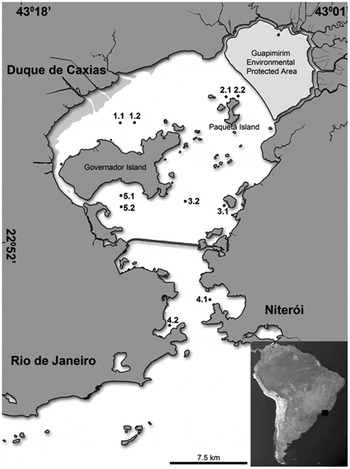
Guanabara Bay (Figure 1) is a shallow estuarine complex located on the south-western Atlantic Coast (22°24′–22°57′S 42°33′–43°19′W) in which 56% of the 381 km2 water surface is less than 5 m deep but can reach up to 30 m in the central channel. The length of the bay measures 28 km, its greatest width is 27 km, and the mouth opening is 1.8 km. The volume of water, estimated at 2 billion cubic meters, is influenced by the rainfall in the region and the semi-diurnal tidal cycle, which has maximum amplitude of 1.4 m and results in a strong seasonal effect on water quality (Mayr et al., Reference Mayr, Tenenbaum, Villac, Paranhos, Nogueira, Bonecker, Bonecker and Neves1989). The study area has a rainy season in summer (December through February) and is dry in the winter (July and August). Because of the size of the drainage basin, 4000 km2, this seasonal weather pattern greatly influences local hydrological conditions. During the summer, vertical stratification of the water column occurs due to the dilution of surface waters, resulting in the formation of thermoclines and haloclines. In the winter, the conditions become more homogeneous (Paranhos & Mayr, Reference Paranhos and Mayr1993). In addition, there is a hydrological gradient from the outer to the inner bay areas due to natural rainfall and tidal conditions as well as the discharge of domestic and industrial sewage (Valentin et al., Reference Valentin, Tenenbaum, Bonecker, Bonecker, Nogueira, Paranhos and Villac1999).
The estuary of Guanabara Bay (22°24′–22°57′S 42°33′–43°19′W); the locations of all 10 sampling stations are indicated.

Samples were taken every 2 weeks over 2 years (July 2005 to June 2007) from 10 points in the estuary using a vessel operating with bottom trawls. Each trawl lasted 30 min for a total of 240 h of fishing effort over the 48 campaigns (480 hauls). The net was 7 m long and 14 m wide at the mouth, with a mesh size of 18 mm and trawl doors of 23 kg each. The tows were conducted at a speed of approximately 1.5 km h−1. The geographic coordinates of the beginning and end points of each trawl were obtained using a GPS device. The temperature, salinity, saturation and dissolved oxygen content on the surface and at the water bottom were measured using a multiparameter sonde. At the end of each drag, sediment samples were obtained with the aid of an Ekman bottom grab sampler for analysis of particle size distribution and organic matter content, as described by Suguio (Reference Suguio1973). Rainfall data were acquired for the entire period of the study from a local weather station (C.P. Rio de Janeiro – Praça Mauá) and grouped into trimesters.
In the laboratory, the fish were identified and measured and weighed to accuracies of 0.1 cm and 0.1 g, respectively. The main references used for identifying the fish fauna were Fischer (Reference Fischer1978), Figueiredo & Menezes (Reference Figueiredo and Menezes2000) and Leis (Reference Leis2006). Voucher specimens of each species were deposited in the ichthyological collection of the Museum of Zoology, University of São Paulo (MZUSP).
General analysis
For each species, the frequency of occurrence (FO%) per campaign and the index of relative importance (IRI) were calculated as absolute and percentage values (Pinkas et al., Reference Pinkas, Oliphant and Iverson1971) The catch-per-unit-of-effort (CPUE) was obtained by dividing the sum of capture (number of specimens or total weight) by the sum of effort (hours trawling). A hierarchical cluster analysis was applied in Q mode to the CPUE data for each sampling station. The choice of the most appropriate grouping was based on the cophenetic correlation (minimum value >0.85), the stability of the clusters using the bootstrap method (100 replicates), and the biological coherence of the clusters.
All subsequent spatial analysis were calculated using the CPUE data and grouped into six areas as determined by the cluster analysis: BOT (station 4.2), NIT (station 4.1), CC (station 3.2), ME (stations 3.1, 5.1 and 5.2), AEL (stations 2.1 and 2.2) and AEO (stations 1.1 and 1.2). The diversity of the Tetraodontiformes in all six areas was compared graphically using their dominance-diversity curves (Magurran, Reference Magurran2004). To better understand the ecological components of these areas and identify possible overlaps in the distributions of key species, a correspondence analysis (CA) was applied to standardized, spatiotemporal CPUE data (N/trimester/area) after removing rare species (Legendre & Legendre, Reference Legendre and Legendre1998). This analysis was performed excluding data for the extremely abundant species Chilomycterus spinosus (Linnaeus, 1758) to facilitate the detection of links between other species. Spatiotemporal correlations between abundances and environmental gradients in the bay were analysed using canonical correspondence analysis (CCA) (Legendre & Legendre, Reference Legendre and Legendre1998). The abundance matrix was composed of the number of individuals of the six most abundant species. Rare species were removed from this analysis to minimize deviations.
Population analysis
The population aspects of the most representative species in the tropical estuary were investigated to clarify issues identified in the general analysis. Rare species were not included in this analysis due to a lack of data. The monthly samples were organized by trimesters to increase the sampling period and help visualize seasonal differences. The seasonal variation in abundance was assessed using CPUE data, the number of individuals and weight per hour of trawling, grouped into trimesters. When possible, the structure of the catch was outlined by the frequency distribution by size class per trimester. The difference between the 2 years of sampling was tested using the Kolmogorov–Smirnov test to compare the frequency distributions (Siegel, Reference Siegel1956). For very small samples, seasonal analysis was not performed, and the data were grouped into a single histogram representing the entire sampling period. All histograms were drawn with the aid of the Sturges algorithm (Sturges, Reference Sturges1926) to determine the number and amplitude of the size classes. The same procedure was applied to data grouped by area to denote the spatial distribution of abundance and the size range of the Tetraodontiformes.
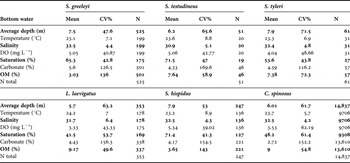
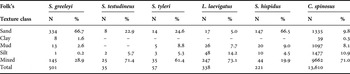
The range of environmental parameters occupied by the six major species was calculated using the weighted average and the coefficient of variation (CV) of the abiotic factors recorded at the time of the catch (Zar, Reference Zar1999). The relative proportion of each size fraction of the sediment was also calculated (Folk's texture classification). Seldom-selected classes of sediments (i.e. silty sand, sandy silt) were grouped into a single class denoted ‘Mixed’.
The classification of each species into functional guilds based on their use of the estuary considered all the results obtained in the analysis above along with information from the scientific literature. To this end, the classification and recommendations proposed by Elliott et al. (Reference Elliott, Whitfield, Potter, Blaber, Cyrus, Nordlie and Harrison2007) were followed.
RESULTS
Spatiotemporal distribution of species
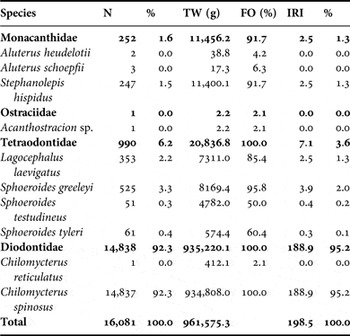
Ten species of Tetraodontiformes distributed in four families were identified: Aluterus heudelotii Hollard, 1855 – MZUSP 94704; Aluterus schoepfii (Walbaum, 1792) – MZUSP 94705, 94706, 94707; Stephanolepis hispidus (Linnaeus,1766) – MZUSP 94704; Acanthostracion sp. – MZUSP 94708; Lagocephalus laevigatus (Linnaeus, 1766) – MZUSP 94714; Sphoeroides greeleyi Gilbert, 1900 – MZUSP 94715; Sphoeroides testudineus (Linnaeus, 1758) – MZUSP 94713; Sphoeroides tyleri Shipp, 1972 – MZUSP 94716; Chilomycterus reticulatus (Linnaeus, 1758) – MZUSP 94712; and Chilomycterus spinosus (Linnaeus, 1758) – MZUSP 94710, 94711. The pufferfish C. spinosus was the dominant species, with an IRI value greater than 95% (Table 1).
Absolute frequency (N), total weight (TW), frequency of occurrence (FO) and index of relative importance (IRI), of Tetraodontiformes, in Guanabara Bay between July 2005 and June 2007.

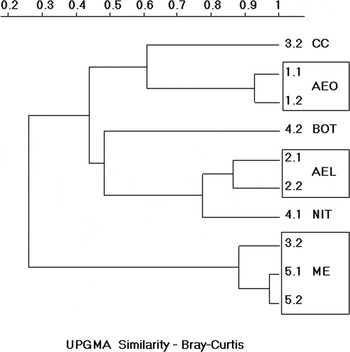
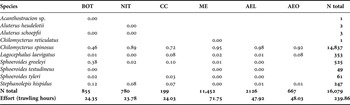
Six areas were of particular interest with respect to the numerical abundance of Tetraodontiformes (Figure 2 and Table 2). Of the lower estuary stations, 4.1, 4.2 and 3.2 were very distinct from each other and could not be grouped; therefore, these stations were treated as independent areas: Botafogo inlet – BOT (station 4.2), Niterói Coast – NIT (station 4.1), and Central Channel – CC (station 3.2). By contrast, stations 3.1, 5.1 and 5.2 formed a cohesive group in the middle estuary (ME). The upper estuary was divided into two areas: one to the east (AEL) incorporating stations 2.1 and 2.2 and another to the west (AEO) comprising stations 1.1 and 1.2.
Hierarchical analysis of the CPUE-n data by area for Tetraodontiformes caught in Guanabara Bay between July 2005 and June 2007 (cophenetic correlation = 0.8029).

Relative frequency and sampling effort of Tetraodontiformes, by area in Guanabara Bay, between July 2005 and June 2007.

The six areas established by the hierarchical analysis (Figure 2) exhibited distinct ecological patterns, but the strong dominance of C. spinosus was evident in all areas (Table 2). BOT was the only station in which evenness was slightly higher and was also the richest in number of species. The other areas of the lower estuary (NIT and CC) were notably less diverse. The average estuary (ME) exhibited a high degree of species richness (seven species) but strong C. spinosus dominance, in contrast to BOT. The separation of the upper estuary into two areas by cluster analysis was corroborated by the dissimilar ecological patterns between AEL and AEO, in which the eastern region exhibited the lowest evenness but twice the number of species compared with the western region, which had only three taxa.
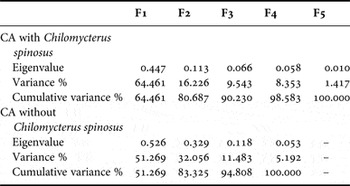
Correspondence analysis considered both spatial and temporal components of the samples. The removal of C. spinosus from the analysis did not change the significance of the axes; explicability was greater than 80% in both cases (Table 3). We chose not to include the third axis, which would have increased the explicability beyond 90%, due to its low eigenvalue and the difficulty of interpreting ordination in three dimensions.
Eigenvalue, variance and cumulative variance of the eigenvectors generated by correspondence analysis of the spatiotemporal CPUE-n data, for Tetraodontiformes, in Guanabara Bay, between July 2005 and June 2007.

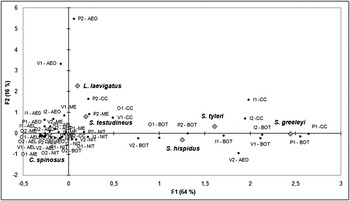
The high abundance of C. spinosus greatly influenced the correspondence analysis (Figure 3). The dominance of this species in most of the samples is evident in concentrated points in the lower left corner of the graph, particularly those corresponding to samples from the AEL, AEO, ME and NIT areas. Areas in which C. spinosus was less abundant included BOT and CC; in addition, C. spinosus was less abundant than L. laevigatus in the spring of the second year and summer of the first year in AEO. In BOT, an alternation in the abundance of S. greeleyi, S. tyleri and S. hispidus was observed throughout the seasons, although with no distinct seasonal pattern. The disparity between the two sampling years is evident by the distance between points in different years that were associated with the same areas and seasons.
Spatiotemporal analysis of Tetraodontiformes in Guanabara Bay between July 2005 and June 2007. BOT (station 4.2), NIT (station 4.1), CC (station 3.2), ME (stations 3.1, 5.1 and 5.2), AEL (stations 2.1 and 2.2) and AEO (stations 1.1 and 1.2); P = spring; V = Summer; O = autumn; I = winter; 1 = year 1; 2 = year 2.

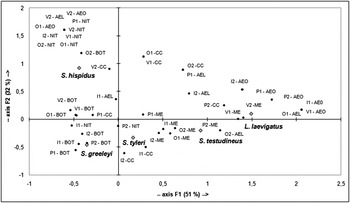
Removal of the C. spinosus data enhanced the spatial segregation between the other species (Figure 4). There was a gradient in species composition along the main axis (F1) of the outermost stations (BOT and NIT) from the left side of the figure to the innermost stations (AEL and AEO) on the right side that passed through the central regions of the tropical estuary (ME and CC) at the centre of the graph. The lower estuary stations were characterized by a higher contribution of S. hispidus and S. greeleyi throughout the study period. However, the second axis shows a clear distinction between BOT and NIT. Sphoeroides greeleyi was associated with the first, while S. hispidus favoured the latter. Furthermore, S. hispidus mainly appeared during the summer and autumn seasons, whereas S. greeleyi and S. tyleri were predominant during the winter and spring. The ME and CC stations appeared as transition areas between the upper and lower estuaries with greater participation of S. tyleri, S. testudineus and L. laevigatus. The latter contributes to the samples from the upper estuary (AEL and AEO).
Spatiotemporal analysis of Tetraodontiformes in Guanabara Bay between July 2005 and June 2007, excluding the dominant species Chilomycterus spinosus. BOT (station 4.2), NIT (station 4.1), CC (station 3.2), ME (station 3.1, 5.1 and 5.2), AEL (stations 2.1 and 2.2) and AEO (stations 1.1 and 1.2); P = spring; V = summer; O = autumn; I = winter; 1 = year 1; 2 = year 2.

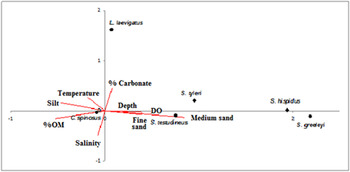
Based on the length of the CCA vectors, the abiotic variables that influenced the structure of the Tetraodontiformes assembly were medium sand, percentage of organic matter (OM%) and silt (Figure 5), emphasizing the importance of the sediment for these demersal fish. Medium sand exhibited a strong positive association with depth, OD, and fine sand with silt and a negative association with OM%. These parameters all exhibited a higher correlation with axis 1. Therefore, this axis separated fish populations depending on their sediment preference. The second axis separated the species based on hydrological factors, such as salinity, temperature, and percentage of carbonates, but with lower explicability. The only species clearly positioned on the ordination axis, L. laevigatus, had a tendency to occupy areas with lower salinity. Close to the origin of the vectors, C. spinosus was the only species to display no preference for environmental conditions, in agreement with its dominance in all areas of the bay. By contrast, the preference of S. greeleyi and S. hispidus for the lower estuary was confirmed by their strong association with sand with low organic matter content, high DO and low temperature. The other two Sphoeroides species displayed greater tolerance to higher temperatures and OM% but remained in intermediate areas.
Canonical analysis of the absolute frequencies, of Tetraodontiformes and environmental variables, in the tropical estuary of Guanabara Bay, between July 2005 and June 2007. Axis 1 (abscissa) = 13.9%; Axis 2 (ordered) = 4.4% of the variation in the data.

However, this interaction between fish fauna and physicochemical variables explains little of the variation in the distribution of the assemblage. Although the three canonical axes of the CCA were significant in the Monte Carlo test (P > 0.01 after 99 permutations), its total explicability was only 19.5% of the variation in the data. Temperature and salinity exhibited CV values of less than 10%, making the mean more representative as a centralizing measure. However, the mean values of temperature and salinity varied little between species regardless of the spatiotemporal distribution of the sample, indicating homogeneity of the water conditions at the bottom (Table 4).
Weighted averages and coefficients of variation of abiotic parameters at the time of capture of the main Tetraodontiformes species in Guanabara Bay between July 2005 and June 2007.

The frequency distribution with respect to particle size (Table 5) was more heterogeneous. The lower estuary species, such as S. greeleyi and S. hispidus, exhibited a clear preference for a thicker sediment composed primarily of sand (67% of specimens captured). By contrast, S. testudineus, L. laevigatus and C. spinosus, which were most common in the middle estuary, exhibited little preference for poor-quality sediment (>70% ‘mixed’) consisting of a mixture of silt, mud and sand. Sphoeroides tyleri exhibited intermediate values, consistent with its distribution within the bay. Lagocephalus laevigatus was seldom captured on sandy bottoms but had a strong presence on finer sediments such as silt.
Distribution of the absolute and percentage frequencies, of the major Tetraodontiformes species, by sediment according to Folk's textural classification, in Guanabara Bay, between July 2005 and June 2007.

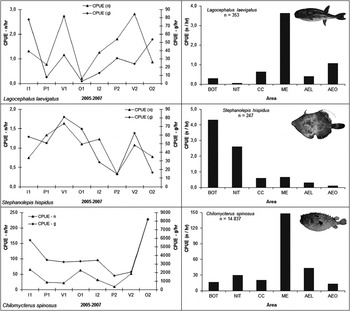
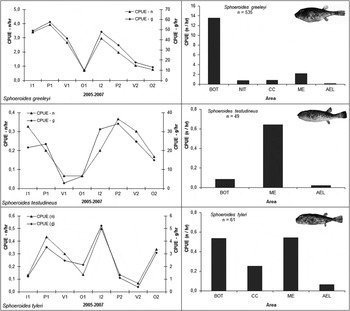
The spatiotemporal distributions of the six main Tetraodontiformes species, based on total number and total weight help visualize the patterns described by the hierarchical and correspondence analysis, specially the population peak for C. spinosus observed during the austral summer and autumn of 2007, and its preference for the middle estuary (Figures 6 and 7). A similar preference can be seen in L. laevigatus and S. testudineus. In contrast, S. hispidus and S. greeleyi were more commonly found in the lower estuary. Only S. tyleri showed no distinction in total capture between middle and lower estuary.
Spatiotemporal distributions of Lagocephalus laevigatus, Stephanolepis hispidus and Chilomycterus spinosus, based on total n/CPUE and total w/CPUE, in Guanabara Bay between July 2005 and June 2007.

Spatiotemporal distributions of Sphoeroides greeleyi, S. testudineus and S. tyleri, based on total n/CPUE and total w /CPUE, in Guanabara Bay between July 2005 and June 2007.

Functional guilds of the estuary
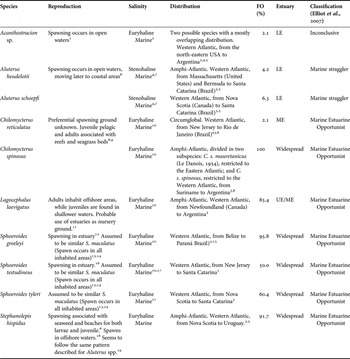
The analysis of each species population pattern was compared with the existing data in the specialized literature. Seven species can be classified as Marine estuarine opportunist, a subdivision of Marine migrants, due to the constant presence as indicated by their high frequency of occurrence and wide use of the estuary. Only two species, Aluterus heudelotti and A. schoepfi, are considered Marine stragglers, due to the low occurrence and restriction to the lower estuary (Table 6).
Classification of the identified species of Tetraodontiformes within functional groups, according to the analyses of a 2-year twice-monthly sampling effort, in five distinct areas of Guanabara Bay (July 2005 to June 2007).

a In Brazil, known only from few specimens from Rio de Janeiro (Menezes et al., Reference Menezes, Buckup, Figueiredo and Moura2003).
The classification was further complemented with published data for the species or, if unavailable, a congeneric species. References: 1Schärer et al., Reference Schärer, Nemeth and Appeldoorn2009; 2García-Hernández et al., Reference García-Hernández, Ordóñez-López, Hernández-Vázquez and Álvarez-Cadena2009; 3Menezes et al., Reference Menezes, Buckup, Figueiredo and Moura2003; 4McEachran & Fechhelm, Reference McEachran and Fechhelm2005; 5Matsuura, Reference Matsuura2015; 6Zapfe & Lyczkowski-Shultz, Reference Zapfe, Lyczkowski-Shultz and Richards2006; 7Figueiredo & Menezes, Reference Figueiredo and Menezes2000; 8Leis, Reference Leis2006; 9Sommer et al., Reference Sommer, Schneider and Poutiers1996; 10Vilar et al., Reference Vilar, Spach and Souza-Conceição2011; 11Denadai et al., Reference Denadai, Santos, Bessa, Bernardes and Turra2012; 12Schultz et al., Reference Schultz, Favaro and Spach2002; 13Sibunka & Pacheco, Reference Sibunka and Pacheco1981; 14Lyczkowski-Shultz, Reference Lyczkowski-Shultz and Richards2006; 15Shipp, Reference Shipp and Carpenter2003; 16Rocha et al., Reference Rocha, Favaro and Spach2002; 17Azevedo et al., Reference Azevedo, Araújo, Cruz-Filho, Pessanha, Silva and Guedes2007; 18Mancera-Rodríguez & Castro-Hernández, Reference Mancera-Rodríguez and Castro-Hernández2015; 19Mancera-Rodríguez & Castro-Hernández, Reference Mancera-Rodríguez and Castro-Hernandez2004; LE: Lower estuary; ME: Middle Estuary; UE: Upper estuary.
DISCUSSION
The distribution and abundance of fishes in tropical estuaries are controlled by a complex combination of factors acting simultaneously and directly or indirectly on ichthyofauna (Sosa-López et al., Reference Sosa-López, Mouillot, Ramos-Miranda, Flores-Hernandez and Do Chi2007; Blaber, Reference Blaber2013). The type and duration of the response to these parameters are unique for each species and generate spatiotemporal variations in patterns of diversity and the usage of the estuary by each taxon (Barletta-Bergan et al., Reference Barletta-Bergan, Barletta and Saint-Paul2002; Silva-Júnior et al., Reference Silva-Júnior, Carvalho and Vianna2013). The species of Tetraodontiformes captured in the tropical estuary of Guanabara Bay exhibited diverse modes of occupation of the estuarine complex. The distinctions identified in the present study may reflect the variety of morphological, physiological and behavioural adaptations exhibited by fishes of this order.
Of the taxa recorded in this study, the genus Aluterus was solely associated with the pelagic environment of the coastal areas. This genus is of commercial importance, is part of the diet of large pelagic predators (Rosas-Alayola et al., Reference Rosas-Alayola, Hernández-Herrera, Galvan-Magaña, Abitia-Cárdenas and Muhlia-Melo2002) and inhabits floating Sargassum beds (Rooker et al., Reference Rooker, Turner and Holt2006). However, specimens of Aluterus are also captured by shrimp trawlers along the coastal reefs (López-Peralta & Arcila, Reference López-Peralta and Arcila2002), which indicates that these species have a demersal habit at some point in their life cycle, possibly an ontogenetic segregation. Their presence in shrimp bycatch confirms their vulnerability to bottom trawl nets. Moreover, in shallow estuaries such as Guanabara Bay, trawl fishing on the bottom captures a significant portion of the community due to the small pelagic water column (Selleslagh & Amara, Reference Selleslagh and Amara2008). In addition, catch also occurs during the ascent and descent of the net (Vianna & Almeida, Reference Vianna and Almeida2005). Therefore, it is safe to assume that both species of Aluterus are not part of the estuarine ichthyofauna of Guanabara Bay, being limited to be only occasional visitors.
The length of the study period enabled the observation of a population explosion of Chilomycterus spinosus. The few available previous studies indicate that this is a recent event because such high numbers of this species have not been previously recorded. Furthermore, the absence of records of similar behaviour by Diodontidae species in other estuaries in Brazil and other parts of the world indicates that this may be a unique feature of the Guanabara Bay. In a recent study conducted in a nearby tropical estuary (23°S), C. spinosus was only identified in the middle part of the estuary and did not exhibit the dominance observed in the present study (Neves et al., Reference Neves, Teixeira and Araújo2011). These results suggest an environmental imbalance in the bay that favoured this species, which is usually less prevalent. However, the identification of the factors that favour this species is hampered by a lack of knowledge about the fish fauna in the bay and their interactions with this tropical estuarine complex. Thus, while this initial investigation of the distribution of Tetraodontiformes and the factors regulating this distribution clarifies some aspects of the ecology of Tetraodontiformes in estuarine environments, it primarily raises new questions and hypotheses.
The structure of an estuarine fish assemblage depends on various interrelated factors. In tropical estuaries, salinity is often viewed as the most relevant parameter for fish diversity due to different levels of tolerance to the salt gradient exhibited by species (Spach et al., Reference Spach, Santos and Godefroid2003; Whitfield & Harrison, Reference Whitfield and Harrison2003; Vega-Cendejas & Santillana, Reference Vega-Cendejas and Santillana2004; Sosa-López et al., Reference Sosa-López, Mouillot, Ramos-Miranda, Flores-Hernandez and Do Chi2007). Such studies, however, often observe a wide range of variation in this parameter, including extremes of hypo- and hypersalinity. Such extremes were not observed in the estuary of Guanabara Bay. The lowest and highest salinity values were 15 and 34, respectively, and the seasonal variation in salinity followed local rainfall patterns (inversely related) (Silva-Júnior et al., Reference Silva-Júnior, Carvalho and Vianna2013). However, water dilution in the bay during the rainy season is confined to the superficial layers, creating a vertical gradient in the water column that results in a halocline. Therefore, the minimum salinity near the seabed does not reach 26 and does not exhibit marked seasonality (Paranhos & Mayr, Reference Paranhos and Mayr1993). Thus, the influence of salinity on temporal variations in the fish fauna of the tropical estuary is reduced, while its contribution to the spatial distribution of species is enhanced.
However, the present study reveals that the main species of Tetraodontiformes were exposed to an even smaller range of variation in salinity. This suggests that, in addition to being good osmoregulators, Tetraodontiformes possess mechanisms to avoid diluted waters, such as moving to more stable regions in response to strong discharges of fresh water during the rainy season, as suggested by Barletta et al. (Reference Barletta, Amaral, Corrêa, Guebert, Dantas, Lorenzi and Saint-Paul2008), or following tidal movements and only exploring the inner regions during high tide. In a nearby estuary, the Sepetiba Bay (23°S), Sphoeroides testudineus and S. greeleyi were associated with low tide and high transparency (Pessanha & Araújo, Reference Pessanha and Araújo2003), suggesting that these species primarily use the lower estuary regardless of the tide. Emigration to more hydrologically stable regions, such as the coastal area, may explain the reduction in abundance of Sphoeroides spp. at the end of the rainy season. The lack of a correlation between rainfall and species abundance indicates that other factors likely regulate immigration during the summer.
However, fish can be indirectly influenced by salinity, i.e. by affecting the distribution of species that feed the fish fauna. In Guanabara Bay, the abundance and distribution of the shrimp Farfantepenaeus brasiliensis (Latreille, 1817) (Gomes et al., Reference Gomes, Keunecke, Silva-Júnior and Vianna2013) and the crab Callinectes ornatus (Ordway, 1863) (Keunecke et al., Reference Keunecke, D'Incao, Verani and Vianna2012) fluctuate in response to environmental changes, such as changes in the salt gradient caused by rainfall. Hence, the distributions of carcinophagous species should change in response to the displacement of its preferred prey. Despite the lack of information on the feeding habits of the local Tetraodontiformes, this pattern may apply to the Tetraodontidae species, as S. testudineus and L. laevigatus, already known as shellfish feeders (Santos & Rodriguez, Reference Santos and Rodriguez2011; Denadai et al., Reference Denadai, Santos, Bessa, Bernardes and Turra2012).
Despite the greater academic interest in the environmental health of the different ecosystems along the estuarine complex, as well as the public outcry for the improvement of the environmental conditions of the bay, Guanabara Bay remains a highly impacted environment. While the lower estuary enjoys greater exposure to cleaner coastal waters, the upper portions of the bay, especially the western and north-western sectors, receive the majority of the drainage from metropolitan Rio de Janeiro (Ribeiro & Kjerfve, Reference Ribeiro and Kjerfve2002). Furthermore, the concentrations of heavy metals (Fe, Mn, Zn, Cu, Pb, Cr and Ni) were found to be very high in urban street sediments, which are a potential source of these pollutants in the bay, being higher in densely populated areas (Pereira et al., Reference Pereira, Baptista-Neto, Smith and McAllister2007). The sediment is also severely impacted by the continuous input of domestic sewage and industrial effluent; the surface sediment layer is suboxic or anoxic (Silva et al., Reference Silva, Pereira, Nuñez, Krepsk, Fontana, Neto and Crapez2008). The existing facilities for sewage treatment and waste disposal are insufficient to halt the environmental degradation. Ribeiro & Kjerfve (Reference Ribeiro and Kjerfve2002) estimated that in order to achieve pre-1950 conditions, it would be necessary to properly treat 80–90% of all domestic and industrial sewage, far from the 15% that is presently treated.
Despite the spatiotemporal segregation between species, it was not possible to characterize their preferred habitats in terms of abiotic factors. The low explicability of the CCA (Figure 5) can be attributed to the wide variation in parameters such as depth, OD, saturation, carbonates and organic matter (Table 4). Therefore, the core values presented were not informative and could not be used to characterize the habitat occupied by each species. However, the large deviation provided important information on the tolerance of these fish to factors indicative of eutrophication. Tetraodontiformes species exhibited a wide tolerance to conditions of eutrophication resulting from pollution, such as changes in OD, saturation and OM% in the sediment. However, the majority of these species avoid extreme conditions, as evidenced by the higher fish abundance in the low and medium estuaries. The higher level of occupation of the lower estuary by Stephanolepis hispidus and S. greeleyi and of the middle estuary by S. testudineus, L. laevigatus and C. spinosus might reflect variations in levels of tolerance to these inhospitable conditions, leading to the hypothesis that water renewal and not isolated variables determines the distribution of estuarine species (Bouchereau & Chaves, Reference Bouchereau and Chaves2003). According to this reasoning, L. laevigatus and C. spinosus are the species most tolerant to eutrophic conditions because they consistently occur in the most affected regions of the bay. Oziolor & Matson (Reference Oziolor, Matson, Riesch, Tobler and Plath2015) published a thorough review on fish population adaptation to anthropogenic pollution, where they support the idea that euryhaline species, as C. spinosus and L. laevigatus, are naturally adapted to a stressed environment. These conditions produce robust species that may be able to adapt to levels of pollution that are lethal to other species, as observed for Fundulus heteroclitus in urban estuaries of the Atlantic coast of the USA (Whitehead et al., Reference Whitehead, Pilcher and Champlin2012). As environmental conditions in the bay deteriorate, this physiological trait could be highly beneficial to these species. However, the abundances of species in the central channel, which undergoes constant water renewal that reduces its susceptibility to the cumulative effects of pollution, are comparable with those in internal, eutrophic areas.
The low capacity of abiotic parameters to explain the distribution of estuarine fish species has also been observed in environments in which variations in these factors are sharper and more seasonal (Maes et al., Reference Maes, Van Damme, Meire and Ollevier2004; Selleslagh & Amara, Reference Selleslagh and Amara2008). In the present study, the small spatial and temporal variations in parameters such as salinity and temperature, combined with the possible tolerance of species to variations in other factors, minimized the influence of these variables on this group of fish. Moreover, these results indicate a major role of other elements in structuring the community as well as a crucial role of biotic phenomena in this process, as previously recorded by Kupschus & Tremain (Reference Kupschus and Tremain2001) in a subtropical estuary.
Spatiotemporal variations in fish assemblages tend to reflect peaks in the abundances of the main species (Selleslagh & Amara, Reference Selleslagh and Amara2008). The interference of C. spinosus with the frequencies of other species of Tetraodontiformes is quite clear. During the autumn of both years of the study, the high capture rate of C. spinosus was accompanied by a decline in the CPUE for other species. Even S. greeleyi and S. hispidus, which exhibited a preference for the lower estuary, in which C. spinosus was less dominant, became scarce during these periods. The other Diodontidae, Chilomycterus reticulatus was completely excluded from the system, despite being a euryhaline species.
Such conflicts exist due to the competitive interaction between species for food and space. In the studied tropical estuary, C. spinosus appears to exploit its broad tolerance of environmental changes as well as its larger size and morphological characteristics. Its permanently erect spines and large capacity to inflate make this puffer unlikely to be found within multispecific schools. To a lesser extent, some of the other species also appear to interact competitively. However, the high degree of spatial segregation between species is evident in the fact that none of the areas harboured all of the species.
The spatial and temporal segregation between species results in the sharing of resources and, consequently, a reduced probability of competition between them if resources become scarce (Wootton, Reference Wootton1998). Therefore, the taxa that share the most densely populated areas rarely overlap in time. Stephanolepis hispidus, for example, seems to avoid BOT when S. greeleyi is very abundant and occupies the other side of the lower estuary (NIT) at these times of the year. Sphoeroides testudineus also becomes rarer in the middle estuary during the summer, when L. laevigatus appears in large numbers in this area. Seasonal movement patterns, however, usually have a reproductive motivation or are ontogenetic (Wootton, Reference Wootton1998). Therefore, for fish species that use the estuary, the pattern of occurrence within that environment depends both on variations in the parameters of the ecosystem and on the phenomena that occur along the coast.
Guilds and the occupation of the estuary
Estuarine fish guilds are primarily determined by the spatial and seasonal occurrence of the species in these environments. These settlement patterns reflect short- and long-term migrations, physiological adaptations and multiple interactions between fish and the ecosystem (Elliott et al., Reference Elliott, Whitfield, Potter, Blaber, Cyrus, Nordlie and Harrison2007; Blaber, Reference Blaber2013). Most fish associated with estuaries use these environments opportunistically, and Tetraodontiformes in the studied estuary are no exception. A dependent relationship with the estuary could not be detected in any of the species analysed because even those more closely associated with the environment were also captured in the coastal region (e.g. Vianna & Almeida, Reference Vianna and Almeida2005). Therefore, seven of the 10 species were grouped together in the guild of Marine Estuarine Opportunist species. Only Aluterus heudelotii and A. schoepfii were considered marine stragglers due to their strong association with the coastal pelagic environment, their restriction to the lower estuary stations and their absence in any other list of estuarine fish species found in Brazil. The boxfish Acanthostracion sp. could not be classified due to being represented by a single unspecified juvenile.
Although they belong to the same functional group, the estuarine-opportunist species exhibited distinct uses of the estuary. However, all had been previously recorded in other Brazilian estuaries (e.g. Chagas et al., Reference Chagas, Joyeux and Fonseca2006; Queiroz et al., Reference Queiroz, Spach, Sobolewski-Morelos, Santos and Schwarz-Junior2006), suggesting that their relationship with the estuarine environment is not exclusive to the studied bay. The puffers Sphoeroides spp. have also been reported as estuarine residents in Paranaguá Bay, another coastal estuary of the south-western Atlantic (25°S) (Spach et al., Reference Spach, Santos and Godefroid2003).
These small puffers seem to be able to close their life cycle in the estuary, indicating a complex system of segregation by age and depth migrations between the main channel and the marginal regions. Sphoeroides testudineus has even been recorded in the larval stage in the tropical estuary of Guanabara Bay (Castro et al., Reference Castro, Bonecker and Valentin2005), suggesting that reproduction occurs within the estuary. An Acanthostracion sp. larva was also collected by the authors in the central channel of the bay. However, this fixed sampling station at the entrance of the bay does not confirm the occurrence of reproduction inside the bay. On the contrary, in these early stages of life, individuals of Tetraodontiformes migrate from the sea into the estuary using the strong tidal flow in the central channel.
The puffer L. laevigatus is considered estuarine-dependent in the Patos Lagoon (30°–31°S), the southernmost estuary of the Brazilian coast. Its distribution in the studied estuary could confirm this classification if the occurrence of the young stratum sampled here was unique to estuarine environments. However, this is not the case, as shown by Vianna & Almeida (Reference Vianna and Almeida2005), because specimens of this stratum were caught in the coastal zone. This evidence does not exclude the possibility that species could be using the bay as a feeding ground more extensively, indicating the adaptability of the young to estuarine conditions. As for S. hispidus and C. spinosus, the strong association of these species with the estuary is not indicative of dependence per se. These two taxa use the bay as a nursery and remain inside the bay until they reach sexual maturity.
The filefishes Aluterus spp. and S. hispidus are sensitive to the progressive worsening of environmental conditions from the estuary's opening towards the innermost parts of the bay, but C. spinosus uses different ecological domains of this water body. The environmental, biotic and abiotic conditions within the bay during the 2 years examined in this study were extremely favourable to C. spinosus and permitted their interaction with a tropical estuarine complex in a form never before reported. Aside from the complex hydrobiological dynamics already expected for an estuary of its size, the current state of the bay reflects centuries of human interference. Therefore, the relative importance of the species most sensitive to pollution and fishing pressure will decrease within the estuarine ichthyofauna over time. By contrast, robust, resilient and commercially unimportant fishes, such as the species of Tetraodontiformes identified in this study, particularly C. spinosus, will begin to dominate these communities. This trend is indicative of an imbalance in ecosystem dynamics.
The diagnosis of the causes and consequences of a phenomenon such as the population explosion of a species of Diodontidae in an estuarine environment requires further study. Data concerning Tetraodontiformes in ichthyofaunal studies are usually limited to checklists. Their low abundance and lack of commercial interest rarely inspire studies of this morphologically unique order. However, the diversity of relationships between these fishes and the estuarine environment, as well as the range of uses demonstrated by a single guild, indicates that the group has great ecological potential. The lack of studies of the tropical estuaries of the Brazilian and South American coast in general, as demonstrated by Blaber (Reference Blaber2013), hinders an understanding of the complex interactions between these systems.
ACKNOWLEDGEMENTS
We thank all who were directly or indirectly involved in this study, especially the colleagues of the Laboratory of Biology and Fishery Technology for their assistance in collecting samples and biometrics.
FINANCIAL SUPPORT
This study is part of the program ‘Environmental Assessment of Guanabara Bay’ coordinated and funded by CENPES – PETROBRAS, and was supported by the Long Term Ecological Programme – CNPq (403809/2012-6) and FAPERJ (E-26/110.114/2013).