This is the next and the more profound stage of the battle for civil rights. . . . We seek not just legal equity but human ability, not just equality as a right and a theory but equality as a fact and equality as a result.
—President Johnson, “To Fulfill These Rights,” June 4, 1965
Twelve years after the ratification of the Voting Rights Act of 1965 [VRA], Richmond, Virginia, elected a historic majority black city council. The 5–4 majority quickly appointed an African American lawyer named Henry Marsh III to the mayoralty. Marsh, a nationally celebrated civil rights litigator, was not only the city’s first black mayor, but the council election of 1977 was also Richmond’s first since 1970.Footnote 1 In 1972, a federal district court used the VRA’s preclearance clause in Section 5 to place a moratorium on council contests.Footnote 2 This moratorium lasted until the Supreme Court and the Department of Justice (DOJ) determined whether Richmond’s 1970 annexation of portions of Chesterfield County had diluted the black electorate’s power by adding nearly forty-four thousand white suburban residents.Footnote 3 While the Court upheld the capital city’s boundary expansion, it demanded in return that Richmonders abandon at-large elections and implement an electoral system that allowed African Americans, who represented more than 50 percent of Richmond’s population prior to annexation, to vote within almost exclusively black districts. Districts immediately led to the election of Richmond’s majority-black city council. By the mid-1970s, these majority-minority districts demonstrated that national officials (liberals and conservatives alike) planned to defend the “equality of results” standard that Johnson articulated at Howard University in 1965.Footnote 4
By illustrating Richmonders’ drive for an unimpeded vote and Washington’s defense of the VRA, this article outlines how local people influenced national voting rights policy. Much has been made of southern African Americans’ appeals to political empowerment and the ways whites parried these appeals after the VRA’s ratification. Scholars contend that 1965 was the beginning of a complex, policy-oriented era in America’s struggle for racial equality.Footnote 5 Yet the solutions Washington devised (e.g., racial redistricting) to prevent resistance to the VRA had unintended consequences for local southern politics.Footnote 6 Historians, beginning with Steven Lawson (and, later, Hugh Davis Graham), have spent decades interrogating developments in voting rights after 1965.Footnote 7 Lawson and Graham not only demonstrated how Washington policy elites actually ratified civil rights legislation, they also highlighted the ways policymakers defended the civil rights bills beyond 1965.Footnote 8 A number of relatively recent studies by scholars such as Morgan Kousser and Richard Valelly place the electoral reforms of the 1960s within the larger context of American political development—both trace the contention over suffrage expansion from the Reconstruction amendments to the civil rights movement and beyond.Footnote 9 These efforts contend that while institutional political stability in Washington (particularly Congress and the courts) was critical to the initial preservation of the Second Reconstruction, whites continued to resist blacks’ appeals for political parity. Frank Parker’s Black Votes Count, which emphasized Mississippi’s local voting rights struggles after 1965, was one of the first endeavors to specifically demonstrate how the dialectic between local black suffragists and white detractors influenced the VRA’s development.Footnote 10 By focusing on the border South, this article also shows that local southerners, not merely national policy elites, were central to the creation of district systems.Footnote 11
The rights embodied in the VRA cannot be explained by separating local minority mobilization, on one hand, and federal policy directed toward race, on the other. Southern localities became seedbeds for voting rights litigation during the 1960s and this litigation often supplanted direct-action protests and civil disobedience strategies. Everyday people not only helped instigate this litigation, but they were responding to a brand of white recalcitrance that rivaled massive resistance to public school integration in the wake of Brown v. Board of Education (1954). Footnote 12 As it happened, whites were just as skeptical about the rise of blacks in politics as they were about blacks attending segregated schools. And when it came to combating this backlash, it turned out that history mattered. Richmond’s black voters were effectively organized under the Richmond Crusade for Voters (the Crusade or RCV) nearly a decade prior to 1965. In Richmond, where blacks made up nearly 50 percent of the capital city’s population during the 1960s, the VRA reenergized an already organized black electorate. Local political mobilization and federal voting rights mandates also intensified white resistance. Although blacks made up 42 percent of Richmond’s population after annexation, the city elected only one African American councilperson, Henry Marsh, to its nine-member council in 1970.Footnote 13
Washington’s suspension of Richmond’s city council elections typified a growing problem after the VRA’s ratification—southern anxiety about black governance led to widespread vote dilution. As African Americans began to vote in record numbers after 1965, the process of diminishing minorities’ political power—in this case, weakening a group’s ability to elect candidates of their choice— gained new momentum.Footnote 14 In 1968, federal investigators noticed that African Americans exercised a “tyranny over the mind of the white South, which has found continuous expression in the politics of the region.”Footnote 15 Richmond’s elites, who embraced segregation but rejected maintaining the color line through violence, sustained their long-standing skepticism of open democracy by enacting poll taxes.Footnote 16 These power brokers not only believed—like their southern counterparts—that African Americans lacked the intellectual capacity for politics, but they used poll taxes to affirm the notion that good government was synonymous with elite whiteness.Footnote 17 As Richmond’s African Americans began to register in higher numbers than whites and, occasionally, elect African American officials in the 1960s, white council members carried on the politics of elitism: they enacted a series of ostensibly color-blind initiatives that made it increasingly difficult for blacks to elect more than a handful of public officials.Footnote 18 While this process of cancelling out black votes happened throughout the South, Richmond’s whites publically maintained that these political directives were meant to maintain the integrity of political continuity. In actuality, whites designed these policies, which culminated in annexation, to ensure a white majority on Richmond’s city council. Richmond’s Mayor Phil Bagley, the architect of Chesterfield annexation, privately contended, “I did what I did in reference to the compromise because the niggers are not qualified to run the city of Richmond.”Footnote 19 These power brokers, who were unwilling to let go of the entrenched political privileges segregation and political overrepresentation engendered, eventually met firm resistance in Richmond and Washington.Footnote 20
Richmonders, led by civic activist Curtis Holt and a core group of white suburbanites (who were trying to preclude public school integration), brought a series of de-annexation suits against Richmond. These suits plugged the former capital of the Confederacy into the circuitry of a litigation-based voting rights revolution. This so-called reapportionment revolution went beyond safeguarding access to the suffrage; it also protected a minority group’s right to elect preferred representatives in a manner that was commensurate with their total voting-age population.Footnote 21 Although Nixon’s administration initially attempted to defang the VRA’s Sections 4 and 5 (in large part to win the favor of the South’s emergent Republican constituency), the Burger Court and John Mitchell’s Department of Justice became unlikely allies in the process of strengthening the VRA.Footnote 22 As antidilution cases inundated Washington after 1965, the Court acknowledged that the discriminatory effect of electoral laws mattered just as much as discriminatory intent. The Burger Court, which recognized that resistance to the VRA might be characterized as antidemocratic, eventually parlayed an employment-based affirmative-action remedy known as “disparate impact analysis” (established to defend proportional representation in workplaces) to achieve equal representation.Footnote 23 Justices held that facially neutral actions could have disproportionate and disparate impacts on minorities. In terms of voting rights, the Court applied this logic to policies that allowed blacks to vote but diluted the impact of those votes.Footnote 24 In Richmond’s case, it took local and federal officials nearly five years to chew through three cases that interrogated the nature of Chesterfield County’s annexation.Footnote 25 The Court held that annexation strengthened whites’ voting power by diminishing the number of Richmond’s black inhabitants and, as such, African Americans had less opportunity to elect preferred candidates.Footnote 26 In lieu of returning Chesterfield County, justices expressed a growing preference for implementing majority-minority districts—these districts, in terms of American political development, finally instigated a durable shift in redistributing southern political authority along racial lines.Footnote 27
By following black voter mobilization to its logical conclusion, black empowerment and governance, this story complements current endeavors to expand the civil rights movement’s chronology. This article, like a growing body of literature on the movement’s timeline, explains civil rights policies that played out far from the movement’s direct action tactics.Footnote 28 Recently, much has been made of the fight for civil rights prior to the 1950s and the organizing strategies civil rights advocates devised prior to Brown. Footnote 29 We now know that during the Montgomery to Selma era in civil rights, the so-called classical phase, African Americans fought against institutionalized racism by tapping the wellspring of previous organizing traditions and activating the machinery of black churches.Footnote 30 We also know a great deal more about the significance of whites’ reaction to this movement and the subsequent ratification of the civil rights bills.Footnote 31 While the VRA gave rise to dramatic changes in southern politics, it fell short of eliminating, according to Supreme Court Justice Ruth Bader Ginsburg, “all vestiges of discrimination against the exercise of the franchise by minority citizens.”Footnote 32 On one hand, this story illustrates how local people and the federal government pushed the rights revolution well into the 1970s—on the other hand, it is also a cautionary account of the political abuses that often follow American electoral reforms.Footnote 33 After 1965, African Americans defended the value of their hard-won right to vote and insisted that their votes mattered by working quietly within the democratic system.Footnote 34 In the late 1960s and early 1970s, a deluge of litigation (more than fifty cases) concerning vote dilution inundated state and federal court systems.Footnote 35 This litigation sought to neutralize structural barriers (e.g., annexations) that, on the surface, denied no one the right to vote.Footnote 36 Washington supported blacks’ appeals: they not only mandated that locals implement majority-minority district systems, but federal officials embraced the centrality of racial discourse in American politics. They eventually used districts to protect black folks from the continuation of racist political trends in southern life.Footnote 37 District systems, by allowing blacks to elect preferred candidates in “safe” wards, were an attempt to finally “redress present, institutionalized manifestations of historical injustices against blacks as a group.”Footnote 38 These solutions changed the complexion of southern city halls and moved America toward an unprecedented period of explicitly defined racial politics.Footnote 39
Systematically Done In
On August 6, 1965, Congress signed what President Johnson thought was “the goddamnedest, toughest, voting rights bill” in U.S. history.Footnote 40 The VRA prevented direct disenfranchisement and sanctioned federal intervention into, and enforcement over, southern voting.Footnote 41 Section 2 of the VRA suspended discriminatory tests and devices as prerequisites for voting.Footnote 42 Section 4 froze voting laws in states and political subdivisions with less than 50 percent of the voting age registered to vote on and/or after November 1, 1964. Section 4 then suspended voting laws and/or election-based changes after the triggering date. This section also authorized the Department of Justice to supervise and register voters in covered areas. Section 5 required preclearance (permission) from federal officials to change election and registration laws. By 1966, Washington had deployed nearly six hundred federal examiners throughout nine southern states including Virginia.Footnote 43
The VRA transformed southern politics. By 1969, nearly three-fifths of all southern African American adults were registered to vote.Footnote 44 One year after the VRA’s ratification, black officeholders and legislators reached approximately 159 and 200 by 1967.Footnote 45 Yet African American voters and candidates met opposition from whites at nearly every phase of the political and electoral process.Footnote 46 Shortly after the act’s ratification, southern whites became increasingly anxious about losing control of city councils, police forces, municipal courtrooms, and school boards, the administrative apparatus used to control the color line. White power brokers, who often did the bare minimum to maintain black communities, realized that southern black politicians actually wanted more than symbolic political victories and, with the avalanche of African American registration, had the votes to realize these ends.Footnote 47 In the 1965 article “From Protest to Politics,” Bayard Rustin argued that blacks “now sought advances in employment, housing, school integration, police protection, and so forth.”Footnote 48 Southern jurisdictions met these demands by crafting a variety of structural barriers that made it harder for blacks to elect candidates.Footnote 49 White power brokers combined white and black districts, relocated polling places to white neighborhoods, threatened economic reprisals against black voters and candidates, switched to at-large election systems, and continued to intimidate voters with violence. In 1968, the U.S. Commission on Civil Rights compiled a 222-page progress report on southern black voting. More than half of the report explained the methods whites devised to maintain control over local politics.Footnote 50 Many of the demands southern blacks sought to achieve after 1965 had been on the table in Richmond for years.
Richmond’s case is significant because the city’s African Americans organized a black electorate prior to the VRA. Black politics in Richmond had roots in black gradualism and the National Association for the Advancement of Colored People’s (NAACP) litigation strategy against segregation. Led by NAACP lawyers such as Oliver W. Hill (who in 1948 was the first African American elected to Richmond’s city council) and ministerial gradualists such as Gordon Blaine Hancock, Richmond’s black leadership resolved to modulate Jim Crow through interracial cooperation after World War II.Footnote 51 The racial polarization that followed Brown, however, ended moderates’ attempts to cautiously improve segregation. Hill left politics and became integral to the NAACP’s litigation strategy to integrate public schools. After 1954, Richmond’s blacks also rejected the black gradualists that had hitched their wagons to white moderates. These white moderates, it turned out, signed up with the massive resistance campaign in the late 1950s. Created in 1956 by well-heeled NAACP members Dr. William Ferguson Reid, Dr. William Thornton, and Johnny Brooks, the Crusade believed that the racial polarization brought on by the Court’s Brown decision called for more robust political organization.Footnote 52 Virginia’s poll tax, enacted during the Constitutional Convention of 1901–2, not threats of mob brutality, dictated who voted in the commonwealth.Footnote 53 Once the Crusade realized that winning local elections hinged on a group’s ability to pay others’ poll taxes, African Americans began to register an unprecedented number of voters. By 1960, the Crusade’s leadership registered roughly sixteen thousand African American voters.Footnote 54 The organization’s initial registration efforts eventually led to Brooks’s appointment as the NAACP’s national voter-registration director.Footnote 55 In 1961, the Crusade had registered so many black voters that the political action director for the southeast region of the AFL-CIO, Earl Davis, asserted, “The Crusade has the largest group of volunteer workers of any place that I have ever been.”Footnote 56
Richmond’s African Americans were also able to challenge Jim Crowism through electoral politics because Virginia’s white power brokers, under the auspices of Senator Harry F. Byrd and his reputed “machine,” maintained segregation through paternalistic elitism rather than violent rigidity.Footnote 57 By the 1950s, Byrd had assumed almost total control over Virginia politics and his organization’s political power, which derived from an elaborate system of patronage, circuit court appointments, and disenfranchisement.Footnote 58 While these power brokers used poll taxes to divest most African Americans of their constitutional rights and preserve Virginia’s place as an elite white man’s commonwealth, they also maintained white privilege by practicing a genteel brand of racist paternalism.Footnote 59 According to J. Douglas Smith, “Interracial cooperation was always governed according to terms dictated by whites whose concern stemmed less from humanitarian obligations toward blacks than from the desire to do the bare minimum to keeps black happy.”Footnote 60 Richmond’s white elites maintained segregation by de-emphasizing violence and handing out piecemeal concessions to black leaders like Hancock.Footnote 61 When it came to black voting, Byrd Democrats knew they could pay lip service to limited black political participation without conceding substantive political power.Footnote 62 Yet even Byrd understood that if more blacks paid poll taxes, they might swing the balance of power in local elections because the levies also suppressed large white voter turnout.Footnote 63 As Richmond’s post–World War II interracialism disintegrated during massive resistance, the Crusade affirmed Byrd’s fears: they challenged Virginia’s constricted electorate by out-organizing white voters.
Black voting in Richmond continued to grow in size and influence by the early 1960s. The Crusade eventually created a self-sustaining network of precinct-based clubs throughout the city’s black neighborhoods.Footnote 64 Precinct units, which were comprised of officers and organizers, elected two delegates to a board of directors that served on the citywide Crusade. A research committee selected by the organization’s president advised the board of directors. The organization, which was financially independent of white patronage, held block parties to raise funds for poll taxes, advised voters on when to pay the tax, and instructed the electorate on how to fill out ballots. Between 1960 and 1964, the Crusade increased the number of registered black voters from 15,739 to 18, 355.Footnote 65 In 1964, Richmond’s black voters made up roughly 34.5 percent of Richmond’s eligible voters.Footnote 66 The Crusade’s research committee eventually convinced African Americans to bloc-vote for a slate of nine candidates at-large in lieu of throwing the electorate’s muscle behind one particular candidate (i.e., single-shot voting).Footnote 67 The objective was to place the black community’s support behind nine of the least disagreeable white candidates.Footnote 68 Blacks’ votes were meant to indebt white politicians to the RCV’s demands and preclude the election of white candidates that opposed integration.Footnote 69 These balance-of-power strategies eventually led city council to pass a fair-employment resolution in 1962.Footnote 70 Two years later, in 1964, Richmonders elected an African American real estate agent, B. A. “Sonny” Cephas, to city council. Cephas garnered 9,835 black votes and 6,677 white votes and finished second of twenty-one candidates.Footnote 71
By the mid-1960s, Richmond’s black population had not only grown, but African Americans had out-registered and out-organized whites. In 1960, Richmond had a total population of 219, 958. By 1968, the Census Bureau estimated that the capital city’s population had shrunk to 216, 451.Footnote 72 During that same period, however, the total number of black Richmonders increased from 92, 331 to 108, 053. In 1966, approximately 30,000 blacks and 58,000 whites (approximately half of Richmond’s white population) were registered to vote.Footnote 73 Between 1964 and 1966, black registrants increased 65 percent; in the same period, white registrants increased 13 percent.Footnote 74 While the VRA lifted traditional restrictions to the franchise, the U.S. Supreme Court’s decision to abolish poll taxes in state/local elections in Harper v. Virginia State Board of Elections (1966) significantly influenced the number of Richmond’s black registrants.Footnote 75 In 1966, Richmond elected two more African American council members, Henry Marsh III and Winfred Mundle—and 25,500 African Americans voted in that election.Footnote 76 One year later, the Crusade contended that their mailing list consisted of roughly 32,000 black voters.Footnote 77
Underneath the facade of Richmond’s 6 to 3 white-majority council, new federal voting rights mandates piqued whites’ long-standing fears about black governance. Because Byrd Democrats faced little political opposition, Virginia’s whites were decidedly unprepared for actual political competition during the 1960s. Although Richmond’s City Charter of 1948 mandated that all city elections be nonpartisan, Byrd’s “machine” made politics an endeavor in which few white people participated; Byrd’s death in 1966 heightened the already prevalent anxiety about the state of interracial politics in the Old Dominion.Footnote 78 Of the six white city council members in 1966, five represented Richmond’s elite circles. Robert J. Habenicht (attorney), Eleanor Sheppard (self-described housewife of the affluent Ginter Park neighborhood), Morill M. Crowe (pharmacist), James C. Wheat (VMI graduate, banker, and president of J. C. Wheat and Co.), and Mayor Phil J. Bagley (city councilman since 1952) garnered a sizable number of their votes from exclusively white enclaves such as Richmond’s North Side, the West End, and the Fan District.Footnote 79 These five council members also belonged to a predominantly white, nonpartisan political organization called Richmond Forward.Footnote 80 Richmond Forward recognized the considerable change in city council voting patterns. African Americans made up 43 percent of the vote in 1966. More ominously, whites made up 68 percent of the vote in the city council election of 1964, but only 56 percent of total voters in the election of 1966.Footnote 81 White council members knew that it took five votes (of nine) to pass a city budget and six votes for special appropriations. Court testimony later revealed that whites understood very well how close they were to losing a numerical advantage on city council—especially if the demographic and political trends continued.Footnote 82 These fears expedited the push for annexation.
In early 1966, the city council majority introduced its first measure to dilute black votes—a supposedly race-neutral referendum to stagger local council terms. Several months before the Warren Court’s Harper decision, white council members Eleanor Sheppard, Henry Miller, and James Wheat Jr. recommended a change in the city charter to replace two-year council terms.Footnote 83 Anticipating that the abolition of poll taxes would dramatically increase the number of black registrants, the trio planned to manipulate the city’s at-large election system by rewarding the highest four vote-getters with four-year terms. The five candidates who finished behind the four winners (presumably black candidates) were to serve two-year terms. During the next election, the five council seats up for grabs were to be filled for four-year terms by the top vote-getters and the fifth place candidate would serve a two-year term (and so on). Whites maintained that the plan was a color-blind initiative designed to combine experienced candidates with newcomers. As it stood, blacks had just enough registrants to place candidates in the middle or bottom of the top nine vote-getters. A Richmond Forward campaign memo to candidates read, “When explaining the stagger system give a clear, simple explanation so as to eliminate doubt in the minds of the Negro public that it was designed and approved solely to keep Negro candidates from being elected to city council.”Footnote 84 The plan not only represented Richmond’s first attempt to dilute African American votes but also was an attempt to stack city council with individuals more agreeable to commandeering portions of a predominantly white suburb. Voters rejected the proposal. While 58 percent of whites voted in favor of the referendum, an overwhelming 87 percent of African Americans voted no on the ballot.Footnote 85 In the end, African Americans demonstrated that without inordinate white support of an initiative, Richmond’s black community had the electoral muscle to vote down key policies.
The failed attempt to stagger elections crystallized the Crusade’s resolve to influence policy outcomes. The effort to manipulate council terms also convinced blacks that whites would go to great lengths to maintain a council majority. Local leaders realized that blacks needed more than symbolic electoral victories. The Crusade doubled its registration efforts in 1968 and presented a fourteen-point list of demands to city council and the General Assembly of Virginia that same year. They called for a moratorium on annexations, the city to “fix time and place” for voting registration, state-based minimum-wage laws, labor union negotiations for city employees, free textbooks for students, fair busing plans, and more. Many of these demands were in line with the claims Rustin put forward in 1965 and virtually all of them were designed to dismantle the apparatus of white control.Footnote 86 In the wake of Dr. Martin Luther King Jr.’s assassination, the Crusade endorsed a slate of candidates they called the “Poor People’s Ticket” in remembrance of King’s Poor People’s Campaign.Footnote 87
In 1968, the Crusade’s agenda amplified whites’ anxieties about an African American council coup d’état. Richmond’s black electorate reelected Marsh and two racially moderate whites, lawyer Attorney Howard Carwile and Reverend Jim Carpenter.Footnote 88 These councilmen immediately held a series of rallies and special council sessions on blacks’ behalf. They also supported a citizens’ review board for the Richmond Police Department, sought to procure contracts for black businesses, and lobbied to stop the construction of an expressway designed to cut directly through black neighborhoods.Footnote 89 Many white political leaders associated these demands with the radicalization of Richmond’s black communities. After a local race riot following King’s assassination, state Senator Edward E. Willey passed a referendum to protect Confederate statues on Monument Avenue should blacks attempt to destroy them.Footnote 90 Councilman James Wheat openly avowed that if Richmond was not allowed to annex, the city would become a ghetto.Footnote 91 Court testimony later showed that Mayor Bagley repeatedly stated, “niggers won’t take over this town.”Footnote 92
The “Poor People’s Ticket” further motivated local elites into concerted action to commandeer a surrounding suburb. The question of expanding Richmond’s boundaries for financial reasons had been on the table throughout the 1960s. Richmond had attempted to annex portions of Henrico County in 1962. Local officials in the early 1960s, however, sought to obtain vacant land and expand the city’s tax base. Although a special annexation court authorized the annexation of sixteen square miles of Henrico County, Richmond’s city council determined that the cost of the annexation, $55 million, was not in the city’s best financial interest.Footnote 93 These monetary anxieties were not a concern in the late 1960s. While whites publically maintained that revenue expansion drove the Chesterfield annexation question, Bagley, white members of council, and Richmond Forward resolved to harvest the disproportionately white vote living in Chesterfield County before the election of 1970. Chesterfield County’s population stood at nearly sixty-eight thousand in the late 1960s.Footnote 94 The portion of Chesterfield County that Richmond planned to annex contained roughly fifteen hundred African American residents.Footnote 95
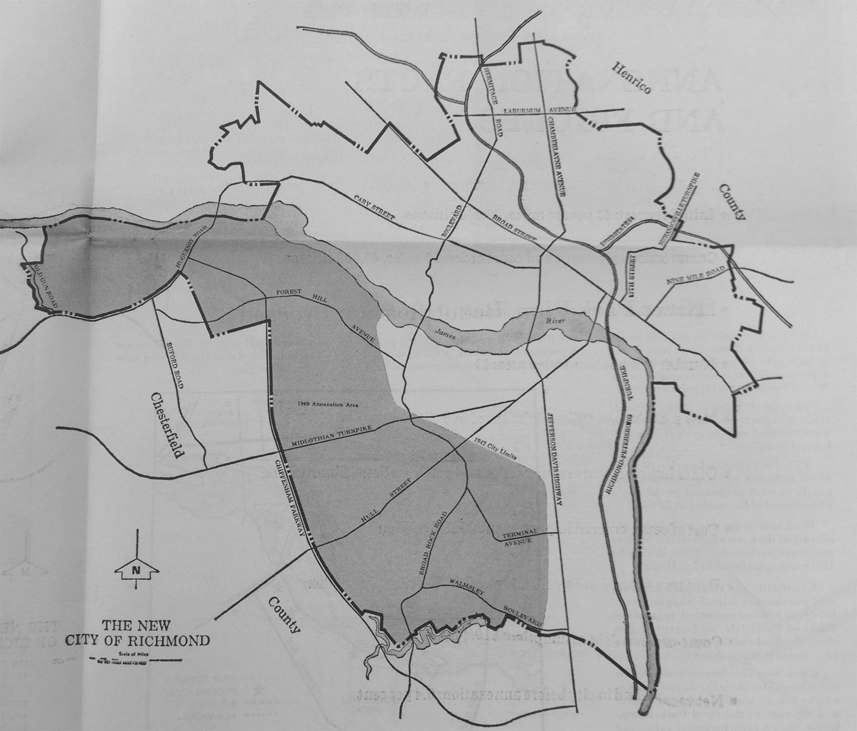
Mayor Bagley and Irvin G. Horner, Chesterfield County executive secretary, secretively began to iron out a boundary agreement in 1968. The proposed Horner-Bagley line was to run across Richmond’s southwestern border (see Figure 1).Footnote 96 Mayor Bagley held boundary-agreement sessions privately and city council voted to shut out third parties—despite the fact that twelve thousand members of Chesterfield County, eleven civic organizations, and a number of corporations filed petitions to stop annexation.Footnote 97 Bagley also barred Carpenter, Carwile, and Marsh from merger talks. In time, city council voted (6–3) to float city bonds to pay for the merger—the city agreed to pay Chesterfield’s County’s School Board costs, proposed a five-year capital improvement program, absolved Chesterfield’s sewage and water facility debt that the county owed the City of Richmond (to the tune of more than $24 million), and paid for a host of other transitional costs.Footnote 98 Remaining a majority-white jurisdiction would not only be expansive—it would be expensive as well. Yet at least the revenue would serve whites under the proposed plan. The annexed area’s eleven schools were to enroll 8, 017 whites and a mere 206 African Americans. The median family income in the annexed area was roughly $4,700 per year higher than residents in the city; Chesterfield’s median family income stood at $12,400, while the median family income in Richmond was $7,692.Footnote 99 Richmond garnered $19,648,975 in real estate tax the year before annexation: in the fiscal year of 1970–71, one year following annexation, the city procured $30,424,500.Footnote 100
Map of Chesterfield County’s annexation, Richmond News-Leader, 8 September 1969, A-7.

During the annexation process, the Crusade emerged as boundary expansion’s most vocal critics in Richmond proper. The Crusade recognized that white flight during the 1960s had severely weakened Richmond’s tax base and it spent the better portion of the late 1960s considering the possibilities for recapturing lost tax assessments without diluting black votes. Preston Yancy, a weekly Richmond Afro-American columnist and head of the Crusade’s merger study commission argued in favor of a single-member district system that might guarantee some African American representation on city council if Richmond and a portion of Chesterfield merged—particularly since decades of residential segregation had packed African Americans into almost exclusively black enclaves. The switch to a district-based system, the Crusade believed, might improve the possibility of electing black candidates and better approximate blacks’ strength in the general electorate. Blacks could maximize votes in precincts heavily concentrated with African Americans.Footnote 101 Yancy contended that “any plan to merge or consolidate Richmond . . . should have equitable apportionment and geographic integrity. This method of district or ward election of local and also state officials should be employed to help assure that areas of any merged complex be fairly represented.”Footnote 102 Every candidate on the “Poor People’s Ticket” openly renounced boundary expansion without overhauling Richmond’s at-large system.
After Richmond and Chesterfield County officials privately ironed out an agreement, a state-level, three-judge court rushed through the annexation decision on July 1, 1969. Virginia’s statutes specified that cities could only annex surrounding areas under the authority of specially convened three-judge annexation courts. The annexation took effect at midnight on December 31. On January 1, 1970, Chesterfield ceded twenty-three square miles and forty-seven thousand new citizens—97 percent of the annexed area was comprised of white residents.Footnote 103 Annexation summarily reduced Richmond’s black population from 52 percent to 42 percent. The proportion of voting-age African Americans dropped from 45 percent to 37 percent.Footnote 104 Annexation gutted blacks’ ability to elect a council majority. Marsh was the only black candidate to win in 1970 under the at-large election system.
Unscrambling the Egg
On Monday, June 30, 1969, Virginia Judge Earl L. Abbott rubber-stamped Richmond’s annexation of Chesterfield County. The Richmond Times-Dispatch’s Bill Sauder observed that as Abbott read the opinion, he—for the first time during the annexation trial—seemed noticeably nervous while sipping a glass of water.Footnote 105 Abbott’s uneasiness symbolized growing concern about the legality of voting-related changes. Annexationists failed to acknowledge the Supreme Court’s Allen v. State Board of Elections (1969) decision four months prior to Abbott’s verdict.Footnote 106Allen expanded the federal government’s capacity to intervene in local politics in the case of voting-related changes. Had Abbott applied Allen to the question before him, he surely would have been even more nervous about Richmond’s failure to seek preclearance.Footnote 107
The Supreme Court in Allen obliged African Americans’ pleas to neutralize vote dilution.Footnote 108 Prior to Allen, Section 5’s preclearance clause covered registration procedures exclusively and the case represented the first time the high court questioned whether Section 5 should reach beyond equal-access statutes. Allen consisted of four appeals: three from Mississippi and one from Virginia. In Virginia and Mississippi, whites used various mechanisms to dilute blacks’ votes and litigants contended that these changes to election laws were subject to preclearance. In all four cases, African Americans made up less than half of the total voting-age population but could be expected to elect a significant number of black representatives in ward-by-ward voting. Should Section 5, federal justices pondered, include electoral policies that made it more difficult for voters to elect preferred candidates?Footnote 109 In Allen (7–2), the Court contended that procedures like the qualification of candidates, the switch from elective to appointive offices, and conversion to at-large from single-member-district elections fell under Section 5. More broadly, Chief Justice Warren held that Section 5 applied to election laws even if those laws had no direct connection to voter registration or voting.Footnote 110 Following the Court’s lead in Allen, the DOJ, now under the Nixon administration, sent out letters to covered states that they intended to enforce Section 5.Footnote 111
When Chief Justice Warren stepped down in the summer of 1969, President Richard Nixon looked to Warren Burger to reverse the jurisprudential permissiveness that characterized Warren’s tenure. Burger’s appointment to the chief justiceship in the summer of 1969 (Harry Blackmun in 1970, Lewis Powell in 1972, and William Rehnquist in 1972 followed Burger) represented an integral phase in the realization of the Nixon-Phillips “Southern Strategy.”Footnote 112 Powell was a prominent Richmond attorney who had played a positive role behind the scenes in desegregating Richmond’s schools. His presence on the Court no doubt helped shape the ultimate outcome of the annexation case.Footnote 113 Nixon not only intended to gain political capital by attacking the previous Court’s latitudinarian approach to civil and social justice, but Burger claimed that he had every intention to overrule cases like Allen.Footnote 114 Burger’s appointment was also meant to signify a movement toward “judicial conservatism.” Nixon believed that Burger would advance a type of constitutional jurisprudence predicated on restraint, which was exemplified by loyalty to the framers’ original understanding of the Constitution.Footnote 115 Yet no counterrevolution to the Warren Court’s “reapportionment revolution” transpired during the 1970s. The Burger Court further affirmed the previous Court’s penchant for permissiveness, and it transformed the franchise from an abstract right to a concrete measure of power that could not be diluted through majoritarian manipulation.Footnote 116
Arguably, no case had a more profound impact on the Burger Court’s civil rights legacy and the future possibility of voting rights litigation than Griggs v. Duke Power Company (1971). Footnote 117 In Griggs, fourteen African Americans claimed that North Carolina’s Duke Power Company relegated blacks to lower-paying labor jobs before the effective date of Title VII of the Civil Rights Act of 1964. The company’s intradepartmental transfer policy required a high school diploma and a minimum score on two aptitude exams. Plaintiffs claimed that even though the policy did not discriminate explicitly on racial grounds, it did so implicitly, because African Americans had systematically been denied equal access to high school degrees and the quality of the education that they had obtained was demonstrably inferior to that of whites. This, in turn, negatively influenced Duke Power’s personnel policies toward African Americans.
In March 1971, the Court found (8–0) that no relationship existed between the company’s criteria for advancement and job performance. These policies, though racially neutral, disparately affected African Americans and reinforced disproportionate representation in higher-paying positions.Footnote 118 In fact, the Court contended that poor quality of segregated black public schools made workplace competition inherently unfair. Griggs not only employed the logic that the Warren Court used to claim that segregated schools negatively affected black school children, but the case also signified the Burger Court’s evolution from an equal-treatment standard to an equal-results standard of case law.Footnote 119 Prior to Griggs, plaintiffs needed to show discriminatory intent in things like hiring practices; following Griggs, plaintiffs needed to demonstrate the inequitable effects in hiring or promotional practices.
The Supreme Court eventually applied the belief in “disparate impacts” to voting rights in Perkins v. Matthews (1971).Footnote 120 In 1969, a group of appellants from Canton, Mississippi, represented by Armand Derfner (who later represented the Crusade in the city’s suit to defend annexation), sought to enjoin local elections after city officials changed election rules without preclearance from Washington. Canton moved polling places from black neighborhoods, annexed a predominantly white suburb, and switched from a ward-based system to at-large elections in 1969. A state appeals court dissolved a district court’s injunction and held that none of Canton’s changes had “a discriminatory purpose or effect.”Footnote 121 The Supreme Court disagreed. The Court voted 8 to 1 in Perkins’s favor and held that Canton should have submitted the changes for preclearance.Footnote 122 All of Canton’s electoral alterations, the Court argued, diluted blacks’ votes under Section 5. More specifically, the high court argued that changing boundary lines, moving polling places, and switching electoral systems disparately affected African Americans’ ability to elect candidates of their choice. While African Americans were still relatively free to partake in the electoral process, Canton’s political machinations, the Court held, diluted the power derived from the process.
As the Burger Court defended minorities’ rights to elect preferred candidates in the early 1970s, African Americans and Washington elites began to use Section 5 more thoroughly. Between 1969 and 1974, African American voting rights advocates inspired the DOJ to lodge 150 objections to southern electoral systems. Of these roughly 150 objections, 20 concerned the switch to at-large election systems, 8 grappled with term staggering, and 6 dealt directly with annexation.Footnote 123 These developments had profound implications for Richmond politics.
Strange Bedfellows
In 1971, an African American civic activist named Curtis J. Holt Sr. filed a suit against the city citing the authority of the Voting Rights Act of 1965 and the Fifteenth Amendment.Footnote 124 Holt alleged that Richmond’s recent annexation of Chesterfield County purposefully diluted black voting strength and cost him a seat on city council during the election of 1970. Holt, who lived in Richmond’s Creighton Court housing projects, eventually transformed Richmond’s political landscape.Footnote 125
Curtis Holt Sr. had been integral to Richmond’s struggle for political equality for nearly a decade. Holt assisted the Crusade’s registration drives during the 1960s by organizing fellow public housing tenants and was a member of Richmond’s Human Relations Commission. Holt, who failed to crack the top sixteen vote-getters in the 1970 council election, charged in the wake of the annexation gambit that boundary expansion diluted blacks’ voting strength and prohibited a Crusade council majority. He eventually called for complete de-annexation. The Crusade refused to support Holt’s claim because it wanted a ward system that might guarantee a 5 to 4 black council majority. The RCV also recognized that de-annexing portions of Chesterfield County might compromise Richmond’s dwindling tax base. The organization’s merger study committee was aware of the Court’s recent condemnation of annexations and at-large elections. After the Court ruled that at-large elections coupled with annexations diluted minority voting strength in Perkins, the Crusade believed that it was closer to getting the district-based system it preferred.
Holt, who lacked resources to support a suit, found improbable allies. His first attempt at legal involvement in Richmond’s annexation case came in the form of a telegram to Supreme Court Justice William O. Douglas. It was later revealed during oral arguments in City of Richmond v. United States (1975) that Holt asked Douglas to “intercede and prevent the annexation from taking place on the first of January” 1970.Footnote 126 Two years later, Holt filed a class-action suit in Richmond’s U.S. District Court on February 24, 1971. As it happened, a young white lawyer named W. H. C. “Cabell” Venable, who had a sense for viable cases, agreed to take Holt’s case pro bono.Footnote 127 Initially Venable argued that annexation diluted black votes and subsequently violated Section I of the Fifteenth Amendment. The two also contended that annexation violated Holt’s due process rights under Section I of the Fourteenth Amendment. The suit sought to declare annexation void, nullify the election of 1970, and declare the present council unconstitutionally convened.
The idea of repatriating Chesterfield County made for strange bedfellows.Footnote 128 A contingent of white residents, led by the Chesterfield Civic Association from the annexed area, joined Holt in an improbable de-annexation alliance. Chesterfield residents and their civic organization had lodged a series of petitions against annexation during the late 1960s, but Mayor Bagley and Irvin Horner ignored their appeals. As it happened, they aligned with Holt after a district court ordered Richmond to speed up public school integration.Footnote 129 Chesterfield residents believed that de-annexation would prevent their kids from being bused to Richmond’s predominantly black schools.Footnote 130 These suburbanites eventually helped fund Holt’s litigation and put Richmond on a complicated litigation trajectory that brought the city face to face with the Supreme Court and the DOJ.
By the early 1970s, the Justice Department emerged as a vocal critic of Richmond’s annexation of Chesterfield County.Footnote 131 Section 10 of the VRA gave the U.S. attorney general the authority to bring suits against states and political subdivisions that violated the VRA. After Congress stopped Nixon’s attempt to repeal Section 5 during the act’s renewal in 1970 (Nixon wanted to make litigation minorities’ sole recourse for voting-related changes), Mitchell and Nixon believed that they could win over southerners by attacking Section 4’s triggering formula.Footnote 132 Mitchell intended to reorganize the DOJ’s Civil Rights Division so that the division no longer exclusively covered the South. This restructuring had the unintended consequence, however, of not only creating a Voting Rights Section, but concentrating in that newly created section liberal holdovers from Johnson’s administration that were committed to enforcing Section 5.Footnote 133 By 1975, the Justice Department had instigated forty-five suits under Section 5 and took part in a host of private suits like Holt’s.Footnote 134 These CRD lawyers and the Supreme Court were instrumental in shaping the future of Richmond politics.
In 1971, local officials clung nervously to the hope that Perkins had no jurisprudential application to Richmond’s annexation. City Attorney Conrad B. Mattox Jr. contended that “the ruling leads me to believe that it would not deal retroactively with the city’s annexation of . . . Chesterfield County. I do not believe that the award will be overturned.”Footnote 135 Yet Mattox wrote Attorney General John Mitchell concerning the legality of annexation in light of the Perkins decision. Chief of the CRD and assistant attorney general, David Norman’s response left little doubt about the DOJ’s position:
The Supreme Court recently held . . . that [c]hanging boundary lines by annexations . . . constitutes the change of a “standard, practice, or procedure with the respect to voting” within the meaning of Section five. . . . The Attorney General is obliged under Section five to be concerned with the voting changes produced by an annexation. . . . In the circumstances of Richmond, where representatives are elected at large, substantially increasing the number of eligible white votes inevitably tends to dilute the voting strength of blacks voters. Accordingly, the Attorney General must interpose an objection to the voting change, which results from the annexation. You may, of course, wish to consider means of accomplishing annexation, which would avoid producing an impermissible adverse racial impact on voting, including such techniques as single-member districts.Footnote 136
Beyond turning the tables on the use of “interposition” in a states’ rights context, Norman’s response to Mattox underlined deliberations through the 1970s. First, the assistant attorney general held fast to the Court’s recent rulings on vote dilution. As far as the Justice Department was concerned, boundary expansion along with at-large elections diluted black votes. Next he suggested that reversing annexation was not the Justice Department’s major objective as long as Richmond fashioned single-member districts, a position that paralleled exactly the Richmond Crusade’s stance on the matter. Norman’s response confirmed much of black Richmond’s long-standing contention (Holt notwithstanding) that keeping Chesterfield County was a viable option as long as policymakers implemented a voting system that guaranteed black city council seats. Norman also reflected the Court’s emerging preference for single-member districts: the Court established in Connor v. Johnson (1971) that single-member districts were preferable to at-large districts in court-fashioned reapportionment plans. Footnote 137
Holt, however, was driven by a different set of concerns. Just as city officials were piecing together an acceptable compromise, Holt’s de-annexation coalition filed its first suit against the City of Richmond. In September 1971, U.S. District Court Judge Robert Merhige concluded that racism and minority disenfranchisement motivated Richmond’s annexation of Chesterfield County.Footnote 138 Merhige, who had been influenced by Mayor Bagley’s comments about a black takeover, ruled that Richmond hold a special council election in September 1972 based on a seven-two plan; the plan involved an at-large election of seven candidates from the city and a district-based election of two candidates from Chesterfield County.Footnote 139 City attorney Mattox traveled to Washington after Merhige’s decision in September but found little sanctuary. In a letter addressed to Mattox, David Norman wrote: “In our view, the annexation of a large, almost exclusively white area does have a discriminatory racial effect on voting in the context of an emerging black majority electorate. . . . It is therefore objectionable under Section 5.”Footnote 140 The attorney general’s office not only refused to deviate from its previous objection, but it also rejected a proposal the city drafted for five white districts and four black districts.
In late 1971, Holt changed litigation strategies and this led to the suspension of council elections. Venable initially argued that the addition of large numbers of whites violated Section I of the Fifteenth Amendment and the Fourteenth Amendment’s due process. Venable’s second suit tapped into the CRD’s recent interpretations of statutory law. He maintained that Richmond had not acquired the proper authorization from the Department of Justice for annexation, thus violating the terms of Section 5. When combined with at-large elections, Richmond’s new boundaries made it impossible for Holt to win a council seat.Footnote 141 On April 27, 1972, seven of the nine Supreme Court justices voted to indefinitely postpone Richmond’s May 2 city council election for Section 5 violations. The Court, along with the Department of Justice, also agreed that the use of at-large elections also made it harder for blacks to elect preferred candidates.Footnote 142 Given the momentum encouraged by Holt’s second case and the DOJ’s refusal to authorize annexation, Richmond officials had little choice but to file a suit in the defense of annexation.
In the meantime, the Supreme Court reaffirmed its growing preference for mandating single-member districts in a Petersburg, Virginia case. The city of Petersburg had also annexed a surrounding territory.Footnote 143 Petersburg sought a declaratory judgment from Washington that annexation did not deny or abbreviate black electoral strength. The Court found that the annexation of a majority-white area combined with at-large elections purposefully diminished the possibility of black representation on city council.Footnote 144 A lower court then ruled that it would approve Petersburg’s annexation if the city devised districts that returned the electoral clout that blacks had prior to the annexation. Following Petersburg’s implementation of the suggested ward-based system, the Department of Justice approved the annexation.
By the spring of 1973, the Crusade and white council members were so exhausted by the annexation dilemma that both groups agreed to resolve the crisis amicably. By the mid-1970s, three members of Richmond’s city council had resigned and the council appointed replacements without holding elections. An interracial contingent of councilmen and local officials began also working on a district plan that the DOJ might approve. Local officials eventually drafted this plan in light of the Supreme Court’s decision in White v. Regester (1973).Footnote 145 Although the Court struggled to find a standard for vote dilution, in White it found that a “presence of factors” often made it less likely for minority groups in a jurisdiction to elect preferred candidates. According to Richard Valelly, “The Court held that an accumulation of indirect evidence . . . sufficed to show discriminatory intent. This became known as the Court’s ‘totality of circumstances’ test.”Footnote 146 Richmond fit the ‘totality of circumstances test’— the city used at-large elections, had a history of disenfranchisement, and annexed portions of Chesterfield County without preclearance. By 1973, local leaders recognized that adopting a district system was the only way to end the annexation crisis. On August 25, 1973, the DOJ approved a nine-ward plan that consisted of four districts with a majority-black voting-age population, four districts with a majority-white voting-age population, and one district comprised equally of whites and blacks.Footnote 147 The Court denied the DOJ’s endorsement because it had not made a decision in Holt’s de-annexation suit. By late 1974, the city moved to offset Holt II by filing a case defending the annexation of Chesterfield County.
On April 23, 1975, the Court heard twenty-minute arguments from Holt’s attorney Cabell Venable, the Crusade’s representative, Armand Derfner, the Department of Justice, and attorney Charles S. Rhyne representing Richmond. Venable argued for full de-annexation, while Derfner and the Crusade proposed that a ward-based system could offset annexation’s dilutive aspects. Richmond’s attorney, Charles Rhyne, agreed with the Crusade. He argued, “An election under the nine ward plan which we feel is the only fair election where the black citizen of Richmond will have full representation and participation in the political process because they are there guaranteed four seats.”Footnote 148 Burger, Stewart, Blackmun, White, and Rehnquist held that “an annexation reducing the relative political strength of the minority race in the enlarged city as compared with what it was before the annexation is not a statutory violation as long as the post-annexation electoral system fairly recognizes the minority’s political potential.”Footnote 149 During testimony in Holt I and II, Richmond Forward representatives, including councilman and future vice-mayor Henry Valentine, acknowledged that Richmond annexed Chesterfield County to prevent the election of a black-majority council.Footnote 150 All nine members of the Court believed that racism motivated annexation. While the Court upheld Richmond’s annexation of portions of Chesterfield County, it did so only if the city implemented the preferred district system. A district court eventually allowed Richmond to implement four presumably white and black districts each and a swing district that might favor either whites or blacks. Given the Court’s decision in Richmond v. United States, Holt recognized that de-annexation was impractical after the Court allowed Richmond to keep Chesterfield under the four-four-swing ward plan. To the chagrin of Chesterfield residents, Holt abruptly ended his suit.
On Wednesday, March 5, 1977, the Richmond Afro-American’s front-page headline read “Power to the People.”Footnote 151 Four days earlier three African Americans joined six incumbents (two of whom were black) on city council. In a district system that Henry Marsh helped design, Richmond elected Mrs. Willie J. Dell, H. W. “Chuck” Richardson, Walter T. Kenney, Henry L. Marsh, and Claudette McDaniel.Footnote 152 African American candidates ran in every district except one. Conspicuously absent from the list of victors, however, was Curtis Holt. Holt, who ran in Marsh’s district, finished last with 687 votes. The Crusade failed to endorse his candidacy.Footnote 153
Richmond’s black-majority council embodied the movement from protest to electoral politics and the culmination of majority-minority districts. New black council members included a civil rights lawyer (Marsh), a postal workers union official (Kenney), two social workers (McDaniel and Dell), and a twenty-eight-year-old Vietnam veteran (Richardson) who was completing a bachelor’s degree.Footnote 154 Among those whites departing city council after 1977 were the president of a Main Street brokerage firm, a retired oil company executive, the president of a prominent real estate firm, the owner of a successful automobile dealership, a building materials company executive, and the president of a major funeral home. Although it took nearly seven years to find a solution to Richmond’s annexation, the election was a testament to local people and national officials’ commitment to racial equality.
Conclusion
Despite the historic election that delivered Richmond’s first majority black city council, this account is not simply one of triumph. It is also a cautionary tale about African Americans’ protracted struggle for political parity. During the five years following the VRA’s ratification, white campaigns to dilute blacks’ votes grew in size and scope. It took local and federal officials nearly seven years to devise a solution to Richmond’s annexation. White resistance to suffrage expansion not only led to strange bedfellows, but post-1965 disenfranchisement once again fueled an effective black response. Vote-dilution mechanisms like annexations not only helped instigate a voting rights revolution that changed the meaning of representative democracy in America, but district-based representation changed the racial equation in southern electoral politics. By the early 1980s, Richmond underwent a political complexion revolution—the capital city laid claim to a black mayor, city manager, school superintendent, fire chief, treasurer, and a five-to-four black city council majority.Footnote 155 The commonwealth’s capital, during the mid-1980s, was one of thirteen U.S. cities with populations of more than one hundred thousand to be controlled by a solid black council majority.Footnote 156
Leading voting rights scholars agree that the Second Reconstruction initially succeeded in large part because of jurisprudential and congressional backing.Footnote 157 Bayard Rustin contended, “But in arriving at a political decision, numbers and organizations are crucial, especially for the economically disenfranchised. Neither that movement nor . . . black people can win political power alone. We need allies.”Footnote 158 In Richmond, majority-minority districts led to the election of even more black officeholders in subsequent decades. African American voters continue to elect local officials (including Lawrence Douglas Wilder, who served as mayor from 2005 to 2009) in proportion to their voting-age numbers.Footnote 159 On one hand, Richmond’s story is a testament to how local people and federal officials used disparate impact theories to overcome generations of political exclusion and institutional discrimination. By the mid-1990s, the federal government made hundreds of southern cities and state-level jurisdictions switch to single-member district systems.Footnote 160 On the other hand, Richmond’s story reminds us of the unintended consequences and political abuses that often accompany American electoral reforms.Footnote 161 Recently we have seen efforts to roll back not merely racial redistricting but also the VRA.Footnote 162 Given the Court’s recent decision in Shelby County v. Holder (2013) that Section 4 “can no longer be used as a basis for subjecting jurisdictions to preclearance” and the current proliferation of electoral impediments such as voter identification laws, it is imperative that we remember America’s long history of cloaking disenfranchisement in the garb of “good government.”Footnote 163