INTRODUCTION
Chronic kidney disease (CKD) is an increasing prevalent multi-symptom illness complex associated with a progressive loss of renal function (Levey et al., Reference Levey, Eckardt, Tsukamoto, Levin, Coresh and Rossert2005). If left untreated, CKD typically leads to a dramatic decrease in number and filtration rate of the active nephrons, resulting in the development of end-stage renal disease (ESRD). This takes place when the glomerular filtration rate (GFR)—an indicator of kidney function—is consistently lower than 15 ml/min per 1.73 m2. Hence, to enable waste and fluid removal, patients with ESRD are in need for kidney replacement therapy (dialysis vs. kidney transplantation) (Danovitch, Reference Danovitch2001; Jacobs, Reference Jacobs2000). Nevertheless, the mortality among these subjects remains very high. For example, although in 2005 the United States spent approximately $20 billion on medical expenditure for CKD, the death rate of patients ≥ 65 years treated with dialysis was 7 times greater than in subjects in the general medical population (Levey et al., Reference Levey, Schoolwerth, Burrows, Williams, Stith and McClellan2009). Additionally, both the accumulation of toxic substances resulting from significantly reduced metabolic rates, as well as chronic dialysis, have been shown to impair functions of the central nervous system. Thus, patients with CKD have been demonstrated to develop uremic or dialysis encephalopathy, accompanied by frontal and basal ganglia abnormalities on neuroimaging (Burn & Bates, Reference Burn and Bates1998; Fazekas et al., Reference Fazekas, Fazekas, Schmidt, Kapeller, Offenbacher and Krejs1995; Kamata et al., Reference Kamata, Hishida, Takita, Sawada, Ikegaya and Maruyama2000; Okada, Yoshikawa, Matsuo, Kanno, & Oouchi, Reference Okada, Yoshikawa, Matsuo, Kanno and Oouchi1991). Moreover, CKD typically leads to the emergence of cognitive impairment (e.g., Kurella, Chertow, Luan, & Yaffe, Reference Kurella, Chertow, Luan and Yaffe2004; Kurella et al., Reference Kurella, Chertow, Fred, Cummings, Harris and Simonsick2005) that further compromises an individual’s quality of life, increases mortality, dementia risk, resource utilization, as well as costs of medical care (Pereira, Weiner, Scott, T., & Sarnak, Reference Pereira, Weiner, Scott and Sarnak2005; Tarter & Switala, Reference Tarter, Switala, Trzepacz and Demartini2000). Importantly, however, cognitive problems in patients with CKD may also independently result from comorbid conditions like cardiovascular disease and diabetes (Koren-Morag, Goldbourt, & Tanne, Reference Koren-Morag, Goldbourt and Tanne2006; Sarnak & Levey, Reference Sarnak and Levey2000), especially since diabetes mellitus and hypertension are still among the most frequent underlying risk factors for CKD (Levey et al., Reference Levey, Schoolwerth, Burrows, Williams, Stith and McClellan2009; Rutkowski & Król, Reference Rutkowski and Król2008).
Among all patients with CKD, the prevalence of cognitive deficits is particularly high in subjects with ESRD (see Pliskin, Kiolbasa, Hart, & Umans, Reference Pliskin, Kiolbasa, Hart, Umans, Tarter, Butters and Beers2001). The most frequently reported cognitive problems in this population include memory deficits, reduced mental efficiency, decreased psychomotor speed, as well as impaired attention (e.g., Altmann, Barnett, Finn, & Lanthanum Carbonate Study Group, Reference Altmann, Barnett and Finn2007; Harciarek, Biedunkiewicz, Lichodziejewska-Niemierko, Dębska-Ślizień, & Rutkowski, Reference Harciarek, Biedunkiewicz, Lichodziejewska-Niemierko, Dębska-Ślizień and Rutkowski2006; Kurella et al., Reference Kurella, Chertow, Luan and Yaffe2004). Furthermore, although dialysis may reduce neuropsychological deficits associated with ESRD (Hart, Pederson, Czerwinski, & Adams,Reference Hart, Pederson, Czerwinski and Adams1983; Pliskin, Yurk, Ho, & Umans, Reference Pliskin, Yurk, Ho and Umans1996, Umans, & Pliskin, Reference Umans and Pliskin1998; Ryan, Souheaver, & DeWolfe, Reference Ryan, Souheaver and DeWolfe1981; Teschan et al., Reference Teschan, Ginn, Bourne, Ward, Hamel and Nunnally1979), a majority of recent studies have shown that cognitive impairment persists even in adequately dialyzed patients (Evans, Wagner, & Welch, Reference Evans, Wagner and Welch2004; Murray et al., Reference Murray, Tupper, Knopman, Gilbertson, Pederson and Li2006; Vos et al., Reference Vos, Zilch, Jennekens-Schinkel, Salden, Nuyen and Kooistra2006; Wolcott et al., Reference Wolcott, Wellisch, Marsh, Schaeffer, Landsverk and Nissenon1988). Additionally, the dialysis process itself may directly contribute to a new brain pathology and, thus, can add to already existing neuropsychological deficits, possibly by inducing cerebral ischemia or cerebral edema through intravascular volume loss, as well as fluid shifts (Altmann et al., Reference Altmann, Barnett and Finn2007; Griva et al., Reference Griva, Newman, Harrison, Hankins, Davenport and Hansraj2003; Kamata et al., Reference Kamata, Hishida, Takita, Sawada, Ikegaya and Maruyama2000). Therefore, despite a well-documented role of dialysis as a kidney replacement therapy, its ability to decrease cognitive impairment in patients with ESRD may be relatively limited.
Instead, it has been suggested that a successful kidney transplant may significantly improve cognitive abilities of patients with ESRD and that the magnitude of this improvement is much greater than that associated with the use of dialysis. Nevertheless, evidence supporting these hypotheses comes almost entirely from studies of pediatric transplant populations (e.g., Mendley & Zelko, Reference Mendley and Zelko1999), because only a few attempts to evaluate the effects of kidney transplant on cognition in adults have been made (Griva et al., Reference Griva, Hansraj, Thompson, Jayasena, Davenport and Harrison2004, Reference Griva, Thompson, Jayasena, Davenport, Harrison and Newman2006; Kramer et al., Reference Kramer, Madl, Stockenhuber, Yeganehfar, Eisenhuber and Derfler1996; Teschan, Ginn, Bourne, & Ward, Reference Teschan, Ginn, Bourne and Ward1976; Teschen et al., Reference Teschan, Ginn, Bourne, Ward, Hamel and Nunnally1979). Moreover, studies of adults with kidney transplants have not always provided consistent evidence regarding cognitive function after graft surgery. For example, Kramer and colleagues (1996) demonstrated that kidney transplant may improve the performance on measures of psychomotor speed, such as the Trail Making Test A. Alternatively, Griva and coworkers (2006) reported a significant improvement only in memory function, whereas Gelb, Shapiro, Hill, & Thornton (Reference Gelb, Shapiro, Hill and Thornton2008) showed that cognition following kidney transplantation may be similar to that observed in persons with CKD, and worse than in healthy controls. Most of these findings come from cross-sectional comparisons, however. Other methodological limitations include small sample sizes and insufficient control of demographics, as well as comorbid conditions associated with ESRD and dialysis. Additionally, in the few prospective studies that have been reported, there was often a large variation in the timing of post-transplantation cognitive testing. Furthermore, some studies did not include a comprehensive assessment of all cognitive domains or well-matched controls to control for learning effects associated with repeated administration of neuropsychological measures. Thus, definite conclusions regarding the potentially beneficial effect of kidney transplantation on cognition in adults with ESRD are difficult to draw. This is an important issue, however, because cognitive limitations may significantly affect the adherence to complex post-transplant medication regimens. Also, determining the influence of kidney transplantation on neuropsychological performance may help to better understand the etiology of intellectual difficulties in ESRD. For example, if cognitive impairment in subjects with ESRD is related to the accumulation of toxins and dialysis-specific factors, it could be expected that it would improve shortly after successful kidney transplantation. Alternatively, if cognitive deficits in this population are predominantly caused by ESRD comorbid conditions (e.g., cardiovascular disease), it is unlikely that they recover following transplantation. Additionally, it is unknown whether some demographic and/or medical factors (e.g., time spent on dialysis) can be potentially associated with the degree of the neuropsychological improvement after kidney transplant surgery. Therefore, the main purpose of this study is to prospectively assess and characterize the cognitive performance of adequately dialyzed patients with ESRD before and after kidney transplantation, as well as to determine what pre-, intra-, and postoperative factors may be related to the extent of a presumptive change in cognitive performance after kidney transplant.
METHODS
Participants
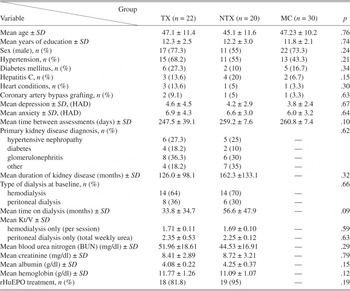
Twenty-two dialyzed patients with ESRD who subsequently received kidney transplant (TX), 20 dialyzed patients with ESRD who were medically qualified and awaiting kidney transplant but, because of a lack of an appropriate donor, did not receive it (NTX), and 30 matched controls (MC) were the participants for this study. The detailed demographic and clinical characteristics of these three groups are presented in Table 1. Additionally, specific clinical and medical measures at baseline associated with ESRD (primary kidney disease diagnosis, duration of CKD, time spent on dialysis, type of dialysis, blood urea nitrogen (BUN), creatinine, hemoglobin, albumin, dialysis adequacy as assessed by a calculated kinetic transfer/volume urea measurement (Kt/V)) are also described. Importantly, Kt/V was calculated for patients on hemodialysis (HD) (single pool Daugirdas formula), performed 3 times a week, and subjects on peritoneal dialysis (PD) (total weekly Kt/V urea), separately. Also, only measurements of adequacy obtained within 1 month from the assessment were included in the analyses. Blood samples for biochemical data of patients with ESRD were always obtained shortly after completion of cognitive assessment, thus, the venopuncture pain did not interfere with the neuropsychological performance.
Baseline group characteristics

Note
TX = Patients with Kidney Transplant; NTX = Patients without Kidney Transplant; MC = Matched Controls; HAD = Hospital Anxiety and Depression Scale; Kt/V = Kinetic transfer/Volume; rHuEPO = recombinant human erythropoietin.
Eligible participants were enrolled if they were between 21 and 65 years of age, had no malignancies or clinically evident cerebrovascular disease as reflected by neurological deficits, had no uncontrolled hypertension, diabetes and/or anemia, mental retardation, psychiatric disorders, psychoactive drug treatment (e.g., benzodiazepines), dementia, or alcohol abuse. Additionally, subjects who had clinically relevant visual or hearing difficulties, as well as other major organ failure (e.g., end-stage liver disease), were not included. The fulfillment of these criteria was determined by interviewing both participants and their relatives, as well as by reviewing participants’ medical records. All subjects underwent a complete neurological and cardiological evaluation. Also, during baseline testing, all patients with ESRD had estimated GFR < 15 ml/min/1.73m2 (stage 5 of chronic kidney disease), calculated with the widely used 4-variable equation (Levey et al., Reference Levey, Bosch, Lewis, Greene, Rogers and Roth1999), and had received at least 1 year of dialysis. All 42 participants with ESRD were from a regional waitlist of 47 dialyzed patients awaiting kidney transplant; 5 remaining patients were not included, because they were either on psychoactive medications or received a kidney transplant shortly after being enrolled in the transplantation waitlist, so that the cognitive assessment could not be conducted. Patients with ESRD were recruited from the Department of Nephrology, Transplantology and Internal Medicine, Medical University of Gdańsk, from January 2005 to December 2007. All MC individuals, with no history of nephrological problems (mean GFR = 116.18 ml/min/1.73m2; SD = 10.70), were citizens of Gdańsk and were subjected to the same exclusion criteria as patients with ESRD. Importantly, to control for hypertension and diabetes, 16 MCs were recruited from the Outpatient Hypertension and Diabetology Clinic, Medical University of Gdańsk.
None of the participants was ill or hospitalized at the time of the assessment. Subjects treated for diabetes and/or hypertension at baseline were still on their antidiabetic and/or antihypertensive medications at the follow-up testing. All individuals were right-handed and native Polish speakers. Before testing, informed consent was obtained from each study participant.
Patients from the TX group received a kidney transplant within 10 months from the baseline testing (range: 202 to 297 days). In all of these cases, it was a cadaver transplant. Following kidney transplantation, the renal function in all graft recipients was adequate (mean GFR = 53.22 ml/min/1.73m2; SD 18.46). All kidney recipients were treated with immunosuppressive drug therapy: cyclosporine or tacrolimus, mycophenolate mofetil or mycophenolate sodium, and steroids. Subsequent to transplantation, 2 TX patients developed diabetes and 1 developed hypertension. Thus, they were additionally treated with antidiabetic or antihypertensive agents.
Neuropsychological assessment
The neuropsychological tests used in this study were selected on the basis of their sensitivity, acceptance, and extensive use in renal populations (see Pliskin et al., Reference Pliskin, Kiolbasa, Hart, Umans, Tarter, Butters and Beers2001). To assess the general cognitive status of patients with ESRD, the Mini-Mental State Examination (MMSE) (Folstein, Folstein, & McHugh, Reference Folstein, Folstein and McHugh1975) was used.
Acquisition and recall of verbal material were assessed with a Polish standardized version of the Rey Auditory Verbal Learning Test (RAVLT) (Choynowski & Kostro, Reference Choynowski and Kostro1980). A list of 15 concrete nouns was presented orally 5 times in succession. Subjects attempted to recall orally as many words as they could remember at the end of each trial. Following the 5 learning trials, a delayed recall trial was given 25 minutes later, and a recognition test was given immediately after the delayed trial. For the recognition trial, 15 target words and 15 frequency-matched distractor words were presented orally one at a time, and subjects were asked to indicate whether or not each word was from the study list. The variables of interest were recalled words summed across all 5 learning trials (total learning), words recalled after a delayed interval (delayed recall), as well as words correctly recognized.
Visual learning was assessed with Brief Visual Memory Test-Revised (BVMT-R) (Benedict, Reference Benedict1997). For BVMT-R, the stimulus material is a matrix of 6 visual designs, shown to the participant for 10 seconds. Subjects are asked to draw the designs using paper and pencil. Each design receives a score of 0, 1, or 2, based on accuracy and location scoring criteria. There are 3 free-recall trials preceded by stimulus exposure. Similarly to RAVLT, there is a 25-minute interval following the final learning trial, after which delayed recall and recognition trials are performed.
Additionally, visuo-spatial memory, construction, and organization ability was assessed with Rey-Osterrieth Complex Figure test (RCF) (Lezak, Reference Lezak2004; Strupczewska, Reference Strupczewska1990). Participants were asked to copy and recall (after 3–4-min interval) a complex geometric figure consisting of 18 defined elements. In this study, variables of interest were overall accuracy scores (range 0–36), counted separately for a copy and a recall.
Attention and working memory was assessed using the Digit Span subtest of the Polish adaptation of the Wechsler Adult Intelligence Scale – Revised (WAIS-R-PL) forwards and backwards, respectively (Brzeziński, Gaul, Hornowska, Machowski, & Zakrzewska Reference Brzezińzki, Gaul, Hornowska, Machowski and Zakrzewska1996). The Digit Symbol subtest of the WAIS-R-PL, and the Trail Making Test (TMT; Part A and B) derived from the Polish adaptation of the Halstead-Reitan Neuropsychological Test Battery (H-RNTB) (Kądzielawa, Mroziak, Bolewska, & Osiejuk, Reference Kądzielawa, Mroziak, Bolewska and Osiejuk1990) were used to measure visuo-mental processing and psychomotor speed. For the TMT (Part A and B), the score was the number of seconds needed to complete the task; the higher the score, the slower, more impaired the performance. Motor abilities were additionally assessed with the Finger Tapping Test from H-RNTB. The Similarities subtest of the WAIS-R-PL was used to evaluate the ability to generalize and form verbal concepts, as well as abstract thinking. For all these measures, raw scores were calculated according to the standardized procedures for each test that was used to conduct the analysis.
Phonemic and semantic verbal fluency was also assessed. Based on previous works (e.g., Jodzio, Reference Jodzio2006), we have used the letter “K” for phonemic fluency and names of animals for semantic (category) fluency. The letter “K” was chosen because in Polish, words beginning with this letter have a relatively high frequency of usage, similar to that of the letter “F” in English (see Lezak, Reference Lezak2004). The dependent variables were total number of words generated in 60 seconds for each fluency task. Supplementary to semantic fluency, semantic knowledge was additionally measured by the Vocabulary subscale of the WAIS-R-PL (Brzeziński et al., Reference Brzezińzki, Gaul, Hornowska, Machowski and Zakrzewska1996).
Depressive and anxiety symptoms were measured by a Polish adaptation of Zigmond and Snaith’s Hospital Anxiety and Depression Scale (HAD) (Majkowicz, Reference Majkowicz, de Walden-Gałuszko and Majkowicz1994). This questionnaire consists of 14 items: 7 questions refer to anxiety and the remaining 7 items assess depression, with the summed score of each subscale indicating the severity of anxiety and/or depression.
Procedure
The cognitive performance in all three groups was assessed twice, with the follow-up testing approximately 256 days (8.5 months) from baseline (mean = 256.29; SD = 22.89). In the TX group the mean time between the date of kidney transplantation and the follow-up testing was 30 days (SD = 25.22). Importantly, for all TXs, the follow-up assessment took place shortly after patients were discharged and when none of them presented with any post-operative complications: mean BUN = 31.32 (SD = 14.97), mean creatinine = 1.68 (SD = .61), mean albumin = 4.21 (SD = .19), mean hemoglobin = 11.97 (SD = 1.13).
Subjects from all groups were tested in the same standardized way and the neuropsychological measures were given in the same order to all 72 participants. Additionally, each subject was evaluated at the same time of the day (+/– 3 hours) to control for variations in performance caused by possible diurnal effects. Because of temporal fluctuations in cognitive performance in patients on HD (see Griva et al., Reference Griva, Newman, Harrison, Hankins, Davenport and Hansraj2003), they were tested approximately 24 hr after receiving the last HD. All participants were examined in the same, specially designated room.
We acknowledge that all data included in this was article were obtained in compliance with regulations of our institutions, and human research was completed in accordance with the guidelines of the Helsinki Declaration (http://www.wma.net/e/policy/17-c_e.html).
Statistical analysis
All statistical analyses were performed using the Statistical Package for the Social Sciences (SPSS version 14 for Windows) and all the differences were tested at an alpha level of .05 (2-tailed).
A series of one-way analysis of variance (ANOVA) (for continuous data) and chi-square (χ2) tests (for categorical data) were performed to compare all three groups (TX vs. NTX vs. MC) on demographics and selected clinical measures. In addition, clinical and biochemical factors specific only for groups with ESRD were compared using t tests for independent samples or χ2 tests (for categorical variables).
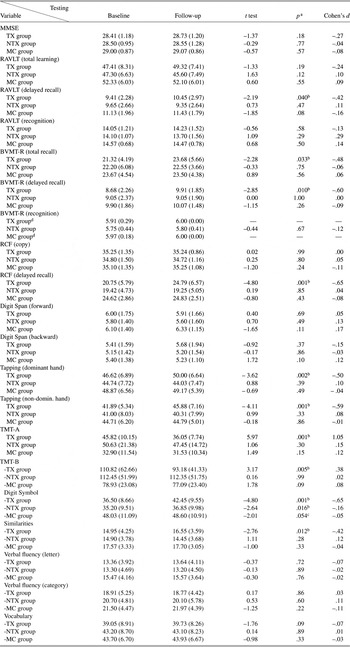
Comparisons of raw cognitive, as well as depressive and anxiety, scores of all three groups between baseline and the follow-up assessment were performed using (2 × 3) ANOVAs with repeated measures, with the within-subject factor being time of testing (baseline vs. follow-up), and the between-subject factor being group (TX vs. NTX vs. MC). The dependent variable was a mean score obtained in each cognitive measure. Post-hoc comparisons of between-group effects were conducted using a Tukey’s test and the dependent t test was used for within-group comparisons. Estimates of Cohen’s d in pairwise comparisons were calculated using dependent t-test values, n (paired), and correlations for paired values (see Lipsey & Wilson, Reference Lipsey and Wilson2001), whereas effect sizes in ANOVA (partial eta-squared) were computed using the procedure implemented in SPSS.
To determine whether some baseline, intra- and/or postoperative factors may be associated with the extent of change in cognitive performance pre- to post-transplantation, an index of improvement (IOI) for each cognitive task in which TXs’ performance changed significantly over time (see Table 2) was created. The IOI was calculated using the following formula: (raw score follow up – raw score baseline) / raw score baseline. An exception was the TMT in which scores reflect time needed to complete the task. Overall, the higher the IOI value, the more improved the performance. Next, Spearman rank order correlation analyses were performed between each IOI and 18 selected baseline (age, sex, education, illness duration, type of dialysis, time on dialysis, BUN, creatinine, Kt/V, hemoglobin, albumin, hypertension, diabetes, depression, anxiety), intraoperative (duration of cold and warm organ ischemia), as well as postoperative (GFR), factors.
Within-group comparisons of cognitive performance between baseline and follow-up testing: means and standard deviations (in parentheses)

Note
TX = Patients with Kidney Transplant; NTX = Patients without Kidney Transplant; MC = Matched Controls; MMSE = Mini-Mental State Examination; RAVLT = Rey Auditory Verbal Learning Test; BVMT-R = Brief Visual Memory Test-Revised; TMT = Trail Making Test; RCF = Rey-Osterrieth Complex Figure.
a p values not corrected for multiple comparisons.
b Statistically significant difference between baseline and the follow-up testing.
c Trend towards statistical significance.
d Pairwise comparisons not performed because of a ceiling effect and no variance at the follow-up.
RESULTS
Demographics, clinical, and biochemical factors
There were no statistically significant group differences in demographics, as well as anxiety and depression, at baseline (see Table 1). Additionally, groups did not differ significantly from each other in number of subjects with hypertension, diabetes, hepatitis C, heart conditions, and coronary artery bypass grafting. Also, the comparison of factors specific for the kidney population did not show any group differences in the duration of CKD, type of dialysis, time on dialysis, BUN, creatinine, Kt/V, albumin, hemoglobin, and recombinant human erythropoietin (rHuEPO) treatment. Importantly, there was also no statistically significant group difference in time between baseline and the follow-up assessment.
Prospective cognitive assessment
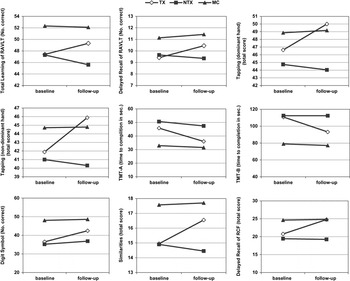
As expected, a number of statistically significant main effects and interactions were found (see Table 2 and Fig. 1). For the RAVLT total learning score, a main effect of group (F = 5.13; p < .01; ηp2 = .13) and a significant interaction (F = 3.23; p < .05; ηp2 = .09) emerged. Regardless of the assessment (baseline vs. follow-up), NTX patients had lower scores than MCs (p < .05). The baseline performance of the TX group was also worse than that of MCs (p < .05) and did not differ from that of NTXs. No significant difference between TXs and MCs was observed during the follow-up testing, however. A main effect of group (F = 4.56; p < .05; ηp2 = .12) and an interaction (F = 3.45; p < .05; ηp2 = .09) were also observed for the Delayed recall score of the RAVLT. Regardless of the time of testing, MCs performed better than the NTX patients (p < .05). Patients from the TX group also presented with lower scores on Delayed verbal recall prior to kidney transplantation (p < .05), but did not differ from MCs at the follow-up.
Statistically significant main effects and group interactions revealed during longitudinal neuropsychological assessment.
Note. TX = Patients with Kidney Transplant; NTX = Patients without Kidney Transplant; MC = Matched Controls; RAVLT = Rey Auditory Verbal Learning Test; BVMT-R = Brief Visual Memory Test-Revised; TMT = Trail Making Test; RCF = Rey-Osterrieth Complex Figure.

A significant interaction was also observed for delayed recall on the BVMT-R (F = 4.20; p < .05; ηp2 = .11), with TXs being the only group that showed an increase in score over time.
For the RCF, the main group effect was revealed only for the recall condition (F = 8.54; p < .001; ηp2 = .21). Patients from the NTX group scored lower than MCs, regardless of the time of the assessment (p < .001). In addition, a significant interaction was revealed (F = 10.89; p < .001; ηp2 = .25). Patients from the TX group, despite initial difference (p < .05), did not differ from MCs during the follow-up testing. Moreover, although the baseline performance of NTXs and TXs was similar, TX patients outperformed subjects from the NTX group during the follow-up visit (p < .01).
A group effect (F = 3.31; p < .05; ηp2 = .09) and an interaction (F = 8.47; p < .001; ηp2 = .20) were observed for the Finger Tapping Test (dominant-hand). Overall, NTX patients obtained lower scores than MCs. Nevertheless, despite no baseline difference between NTXs and TXs, at follow-up the TX group performed better than the NTXs (p < .05). For a nondominant hand condition of the Finger Tapping Test a significant interaction emerged (F = 11.66; p < .001; ηp2 = .25). In contrast to the baseline performance, during the follow-up, TXs performed better than the NTXs (p < .05).
For the TMT-A, a group effect (F = 11.63; p < .001; ηp2 = .25) and interaction (F = 6.03; p < .01; ηp2 = .15) emerged. Overall, TX (p < .05) and NTX patients (p < .001) needed more time then MCs to complete this task. Nevertheless, despite no baseline difference between TXs and NTXs, during follow-up, TXs completed the TMT-A faster than the NTX group (p < .01). The main group effect (F = 4.61; p < .05; ηp2 = .12) and interaction (F = 4.77; p < .05; ηp2 = .12) were also observed for the TMT-B. Again, both NTX (p < .05) and TX groups (p < .09, a trend towards statistical significance) needed more time than MCs to complete the task. Nevertheless, despite no initial difference between the TX and NTX groups, during the follow-up, TXs completed the TMT-B faster than NTX patients (p < .01).
For the Digit Symbol subtest, two main effects were noted. Regardless of the assessment, both the TX (p < .01) and NTX groups (p < .001) performed below the level of MCs (F = 14.45; p < .001; ηp2 = .23). Moreover, in comparison to baseline, all three groups obtained higher scores during the follow-up testing (F = 38.51; p < .001; ηp2 = .36). This was, however, limited by a significant interaction (F = 10.34; p < .001; ηp2 = .29). Although there was no baseline difference between TXs and NTXs, during the follow-up, TXs outperformed patients from the NTX group (p < .05).
Main group effect was also observed for the Similarities subtest (F = 4.69; p < .05; ηp2 = .12). Patients from the NTX group scored lower than MCs, regardless of the time of the assessment (p < .05). Additionally, a significant interaction emerged (F = 7.11; p < .01; ηp2 = .17). Patients from the TX group obtained better results than NTXs during the follow-up testing (p < .07, a trend towards statistical significance), though no baseline difference between these groups was noted. Moreover, the initial difference between the TX and the MC group (p < .05) was no longer present during the follow-up testing.
Depression and anxiety at baseline and follow-up
A repeated-measures ANOVA was also used to assess potential changes in depression and anxiety, as measured by the HAD Scale, but no significant effects or interactions emerged.
Index of improvement and its relation with baseline and intraoperative factors
From a total of 180 exploratory correlations that were performed, only 10 significant associations were found. Analysis revealed a significant association between the IOI for the Digit Symbol subtest and age at baseline (rho = .44; p < .05), indicating that older TX patients showed more improvement following transplantation. Better postoperative outcome on the Digit Symbol subtest was also related to higher GFR at the follow up (rho = .21; p < .05). The duration of illness was, however, inversely correlated with the IOI for a nondominant condition of the Finger Tapping Test (rho = –.47; p < .05), suggesting less improvement in patients with longer duration of CKD. In addition, less improvement in the TMT-A was observed in patients with higher BUN prior to transplantation (rho = –.44; p < .07, a trend towards significance) and lower postoperative GFR (rho = .28; p < .05). The IOI for delayed recall of RAVLT was positively correlated with baseline serum creatinine (rho = .57; p < .05) and postoperative GFR (rho = .62; p < .05). Additionally, the IOI for delayed recall of RAVLT was inversely associated with the duration of cold organ ischemia (rho = –.66; p < .05). Hence, the shorter the cold kidney ischemia and the higher the postoperative GFR, the better the auditory delayed recall after receiving a kidney transplant. Cold organ ischemia was also correlated with the IOI for delayed recall of BVMT-R (rho = –.61; p < .05). In addition, the IOI for the TMT-B was inversely associated with baseline albumin level (rho = –.59; p < .05), indicating more improvement in patients with less albumin prior to transplantation.
DISCUSSION
The main purpose of this study was to assess the early effects of kidney transplant on cognition in adequately dialyzed patients with ESRD. Overall, our results demonstrate that a successful kidney transplant leads to a significant improvement of performance in cognitive domains typically impaired in ESRD (see Pliskin et al., Reference Pliskin, Kiolbasa, Hart, Umans, Tarter, Butters and Beers2001). Specifically, individuals who received kidney graft had improved performance on measures of psychomotor speed, visual planning, retrieval of learnt material, and abstract thinking. Additionally, the cognitive performance of adequately dialyzed patients without kidney transplant, although often below that of matched controls, remained relatively stable over time.
The finding that cognitive performance in adult patients with ESRD improves following kidney transplant confirms previous research indicating a positive effect of kidney transplantation on cognitive performance (Griva et al., Reference Griva, Hansraj, Thompson, Jayasena, Davenport and Harrison2004, Reference Griva, Thompson, Jayasena, Davenport, Harrison and Newman2006; Kramer et al., Reference Kramer, Madl, Stockenhuber, Yeganehfar, Eisenhuber and Derfler1996; Teschan et al., Reference Teschan, Ginn, Bourne and Ward1976, Reference Teschan, Ginn, Bourne, Ward, Hamel and Nunnally1979). Nevertheless, the results of earlier studies were not always consistent with respect to which cognitive domain improves most after kidney transplant. In addition, most of the previous research was based on cross-sectional findings, and lacked well-matched control groups, which made the interpretation of their otherwise promising findings somewhat limited. In the present study, two control groups were included and all groups were assessed twice. Therefore, the improved psychomotor speed, abstract thinking, and memory after kidney transplant cannot be explained by learning effects associated with repeated administration of neuropsychological tasks, although in the Digit Symbol subtest all three groups obtained higher scores at follow-up. Moreover, all participants were tested within an approximately similar extent of time. Additionally, the follow-up assessment in patients with TX was always conducted in a relatively equal and optimally shortest postoperative time, to control for variations in timing of the cognitive testing and for the potential late adverse effects of the immunosuppressive therapy (see Wijdicks, Reference Wijdicks2001). Also, the improved neuropsychological performance observed in the present study could not be attributed to a change in depression and anxiety, because there was no statistically significant difference in number of affective symptoms pre- to post transplantation.
Some previous studies have suggested that cognitive problems in adequately dialyzed patients may be predominantly the results of comorbid conditions of ESRD. For example, it has been demonstrated that brain and cognitive function of dialyzed patients is related to anemia, because it improves with rHuEPO treatment (Grimm et al., Reference Grimm, Stockenhuber, Schneeweiss, Madl, Zeitlhofer and Schneider1990; Lee et al., Reference Lee, Lee, Kim, Kim, Kim and Lee2004; Marsh et al., Reference Marsh, Brown, Wolcott, Carr, Harper and Schweitzer1991). In addition, Pliskin and coworkers (1996) suggested that impaired neuropsychological function in dialyzed patients may result from poor dialysis adequacy. Nevertheless, in the present study, individuals who were previously anemic were on erythropoeitin and, thus, the level of hemoglobin in all patients was adequate (>10 g/dl). Additionally, dialysis delivery was also adequate. Therefore, it is doubtful that cognitive problems seen in our ESRDs were a result of depressed level of hematocrit or inadequate dialysis. Moreover, because these deficits emerged when the neuropsychological performance of two groups of dialyzed patients was compared to that of well-matched controls without renal insufficiency, it is likely that defective psychomotor speed, impaired visual planning, poor memory retrieval, and impaired abstract thinking in subjects with ESRD are specifically related to the accumulation of toxins in the brain and/or to the adverse effects of dialysis. This hypothesis is further supported by the observation that in the present study the performance on measures of most of these functions improved shortly after kidney transplant, despite no change in the level of hemoglobin.
Nevertheless, the improvement of psychomotor speed, although significant, was not absolute and the performance on the Digit Symbol or TMT in patients with kidney transplant was still below that of MCs. This observation is partly consistent with some recent findings indicating that cognitive limitations may still be present in TX patients (Gelb et al., Reference Gelb, Shapiro, Hill and Thornton2008). In the present study, however, the failure of kidney transplant to fully reverse cognitive problems associated with ESRD and/or dialysis could have been a result of the early adverse effects of high doses of immunosuppressive therapy, as well as to a relatively short time between the surgery and the follow-up assessment. Alternatively, it is possible, though unlikely, that a tendency of controls to display a learning effect on the Digit Symbol subtest could have contributed to maintained group differences.
Our research also demonstrates that the extent of cognitive improvement following kidney transplant may be associated with some pre-, intra-, and postoperative factors. For example, the results of this study suggest that the older the patient, the more improvement in psychomotor speed can be seen after kidney transplantation. This finding stands, however, in contrast to recently published findings suggesting less cognitive improvement in older patients with ESRD (Griva et al., Reference Griva, Thompson, Jayasena, Davenport, Harrison and Newman2006). Indeed, it is known that younger age may positively contribute to the recovery of neuropsychological function (see Kertesz & Gold, Reference Kertesz, Gold, Heilman and Valenstein2003). Cognitive improvement may, however, appear only in those patients who initially present with neuropsychological deficits, and it has been recently shown that individuals with CKD aged ≥ 61 are particularly susceptible to developing cognitive impairment (Thornton, Shapiro, Deria, Gelb, & Hill, Reference Thornton, Shapiro, Deria, Gelb and Hill2007). Thus, in our study the positive relationship between age and the IOI could have resulted from the fact that predominantly older individuals with ESRD had developed CKD-related cognitive problems prior to transplantation. Additionally, to the best of our knowledge, this is the first study indicating greater cognitive improvement following kidney transplant in patients with lower pretransplant serum albumin, higher pretransplant creatinine, and better postoperative graft function. Hence, more effective graft would then enable better removal of ESRD-related toxins and, thus, positively influence cognition. Nevertheless, our results also suggest that the degree of the cognitive improvement may be reduced with longer duration of CKD and with higher BUN prior to transplantation. Thus, these factors might specifically contribute to the impaired brain function, helping to explain why some cognitive deficits in ESRD are not fully reversible following kidney transplant. Importantly, the correlation analyses performed in this study were exploratory and preliminary in nature. Moreover, they ranged from weak to moderate and were not consistent across all cognitive measures. Therefore, these results need to be interpreted with caution and replicated in future research.
This study was designed to determine the early effects of TX on cognition. Thus, because of the choice of time-points of our follow-up, firm conclusions regarding the general or late outcomes following kidney transplantation seem to be relatively limited. For example, it is possible that the early beneficial effect of kidney transplant described in this study may continue to develop over time, along with patients continuous medical and functional recovery. On the other hand, some possible late infections and immunosuppressive therapy may significantly reduce the early positive effect of TX. Additionally, because all of our patients received a cadaver transplant, we could not assess a potentially differential impact of the type of graft (donor vs. cadaver) on cognition following transplantation. Nonetheless, Griva and coworkers (2004) did not find any differences in this respect. Also, a relatively small number of participants in each group could have limited the statistical power of this study. Therefore, future longitudinal studies with larger samples are warranted to investigate the impact of kidney transplant on the recovery of cognitive function in dialyzed patients with ESRD in more depth and to determine the potential modifiers of such recovery.
ACKNOWLEDGMENTS
The authors acknowledge that this manuscript is original and has not been under review by any other publication, as well as has never been published either electronically or in print. The corresponding author thanks Dr. Ola A. Selnes from Johns Hopkins Hospital and School of Medicine for his helpful comments on an earlier version of this manuscript. Comments received from Dr. Krzysztof Jodzio from the University of Gdańsk are also appreciated. While preparing this manuscript, the corresponding author was receiving a “START” scholarship from the Foundation for Polish Science (FNP). There are no other relationships with any institution that could be perceived as a potential conflict of interests.