Yarn-type one-dimensional electrochemical energy storage devices which are lightweight, flexible, and even stretchable are gaining much interest due to the development of wearable electronics and flexible energy harvesters.[Reference Weng, Chen, He, Sun and Peng1–Reference Choi, Lee, Kim and Kim3]
Among the various yarn-type energy storage systems, an asymmetric yarn supercapacitor is worth paying attention to. It normally utilizes an aqueous electrolyte which is less harmful and still can operate at a high voltage of up to 2 V due to its asymmetry in electrodes. The high operating potential gives much higher energy density to the device, which is especially important in yarn-type energy storage media because of its limited footprint.
However, there is a limiting factor for applying an asymmetric configuration to yarn supercapacitors, the low capacitance negative electrode materials. Materials which store electrical energy by electrochemical double layer capacitance, such as carbon materials [carbon nanotubes (CNTs), ordered mesoporous carbon, reduced graphene oxide, etc.][Reference Gao, Surjadi, Cao, Zhang, Li, Xu, Jiang, Song, Sun and Lu4–Reference Choi, Park, Kim, Lee, de Andrade, Kim, Gambhir, Spinks, Baughman and Kim6] have often been utilized as negative electrode materials, resulting in a low energy density of the supercapacitor. Recently, other materials (PPy, Fe3O4, VN, MoS2, etc.) that have a higher capacitance than conventional carbon materials have been used to enhance the performance of yarn-type asymmetric supercapacitors.[Reference Yu, Lu, Smith, Booksh, Meng, Huang, Li, Byun, Oh and Chou7–Reference Zhao, Li, Li, Zhang, Sun, Wang, Guo, Xie, Xie, He, Zhou, Lu, Lu, Zhu and Yao13]
MXene, especially Ti3C2Tx in which Tx denotes surface functional groups (–O, –H, –F), is an emerging material for its graphene-like two-dimensional shape and special properties, and a high volumetric capacitance (1500 F/cm3). MXene is a promising material for yarn-type energy storage systems, to reduce their overall sizes.[Reference Lukatskaya, Mashtalir, Ren, Dall'Agnese, Rozier, Taberna, Naguib, Simon, Barsoum and Gogotsi14–Reference Seyedin, Yanza and Razal19] It has a negative potential window versus Ag/AgCl, which means that it is suitable for the negative electrode material in an asymmetric supercapacitor.
In this study, we have co-twisted MXene particles with CNT sheets by the liquid-state biscrolling method to achieve a high capacitance negative electrode. The biscrolling allows increasing the weight fraction of MXene in the yarn while maintaining its electrical conductivity and mechanical strength. The resulted MXene/CNT yarn electrode has achieved high MXene content up to 93 wt%, thus the yarn has exhibited high areal capacitance (1.56 F/cm2) in aqueous 1 M H2SO4 electrolyte. Although the highest capacitance can be recorded in H2SO4, it is more beneficial for asymmetric supercapacitors to utilize LiCl electrolyte due to its more anodic operating potential (−1 V versus Ag/AgCl reference electrode). According to the formula which express stored energy in supercapacitors (E = 1/2CV 2), wider potential range derives higher energy density than larger capacitance. Therefore, the asymmetric yarn supercapacitor which comprises the anode as MXene/CNT biscrolled yarn and the cathode as MnO2/CNT biscrolled yarn could exhibit high energy density in the PVA/LiCl gel electrolyte (100 µWh/cm2). Also, the rate capability increases in the LiCl electrolyte, which gives high power density for the device (26 mW/cm2). For wearable applications, the yarn electrodes are sewn into commercial textiles and the capacitance was well retained under static and dynamic bending tests. Also, four serial-connected yarn supercapacitors could light a set of blue LEDs.
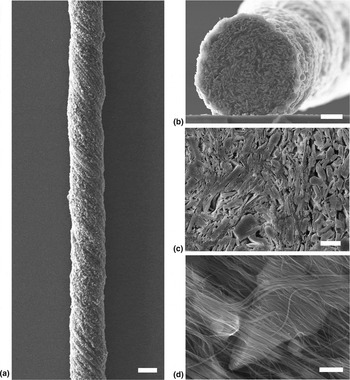
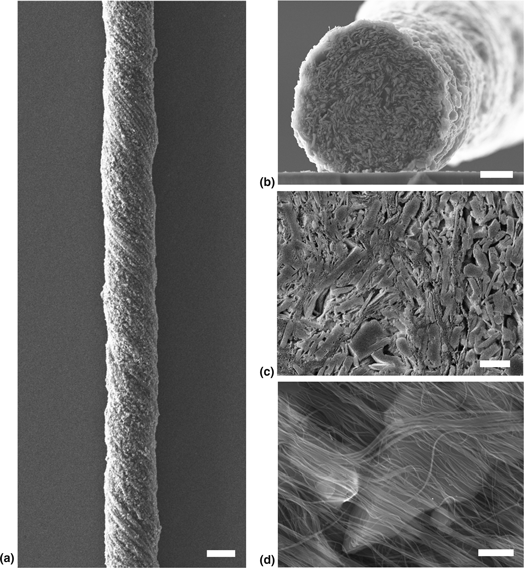
In Fig. 1, the morphology of the fabricated biscrolled MXene/CNT yarn is shown as scanning electron microscope (SEM) images. The MXene/CNT yarn was fabricated by the liquid-state biscrolling method, as is well described in previous literature[Reference Lima, Fang, Lepro, Lewis, Robles, Gonzalez, Martinez, Kozlov, Oh, Stoughton, Zakhidov and Baughman20, Reference Choi, Kim, Kim, Lepro, Spinks, Baughman and Kim21] (Fig. S1). MXene particles (dispersed in ethanol) were dropped onto a single layer of CNT sheet repeatedly to form multilayered MXene/CNT stack. Then the stack was scrolled into yarn by twist insertion to 2000 turns per meter. The surface image of MXene/CNT yarn shows a bias angle, according to the twist insertion in yarn fabrication [Fig. 1(a)]. The diameter of the yarn and the weight fraction of MXene content can be controlled by sheet width, number of stacks, and concentration of MXene dispersion. In the resultant biscrolled MXene/CNT yarn, the active material MXene can be highly loaded up to 93%. The MXene was synthesized in the same way in the literature[Reference Lukatskaya, Mashtalir, Ren, Dall'Agnese, Rozier, Taberna, Naguib, Simon, Barsoum and Gogotsi14, Reference Alhabeb, Maleski, Anasori, Lelyukh, Clark, Sin and Gogotsi22] except for the etching time. The etching time was extended to 96 h in accordance with the size of MAX particles (~75 µm) because the aluminum extraction process is assumed to be diffusion controlled (Fig. S2).[Reference Mashtalir, Naguib, Dyatkin, Gogotsi and Barsoum23] The average particle size of the achieved MXene was ~3 µm. The magnified cross-section and surface image of the MXene/CNT yarn shows that the lamellar MXene particles are well trapped within the CNT bundles [Figs. 1(c) and 1(d)]. Despite of the highly loaded MXene particles which have low mechanical strength, tough CNT fibers hold the active materials firmly. Therefore, 93 wt% MXene containing yarn displays high mechanical toughness 1.3 MJ/m3 which is strong enough to bear mechanical deformations such as bending and twisting (Fig. S4). MXene is known as conductive as graphene, however, the highly aligned CNTs which bridges the MXene particles also bring the entire yarn to have high conductivity (Fig. S5).
Morphology of the MXene/CNT biscrolled yarn. (a) The surface SEM image of MXene/CNT yarn electrode which contains 93 wt% MXene particles (scale bar = 50 µm). (b) Cross-sectional image of the yarn (c) and its magnified image (scale bar = 10 µm, 3 µm). (d) Magnified SEM image of (a), showing MXene particles trapped in CNT bundles (scale bar = 800 nm).

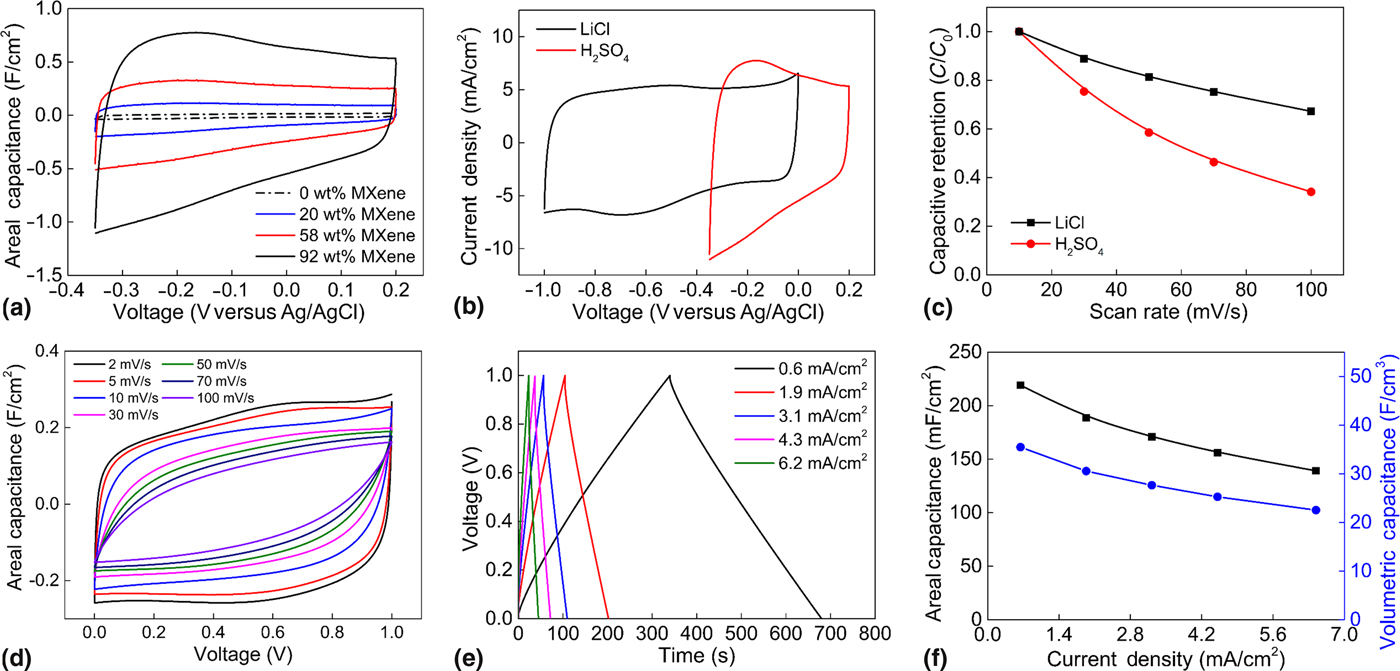
The unique and highly porous structure of biscrolled MXene/CNT yarn allows ions to penetrate into the deeper site of the yarn. Therefore, the MXene particles in core sites can also function well for storing energy. In Fig. 2(a), as the active materials loaded high on the yarn electrode, the capacitance proportionally increases and the highest capacitance 1.56 F/cm2 could be achieved in 1 M H2SO4 (Fig. S6). The linearity of the capacitance versus the content of MXene in biscrolled yarn indicates that all the amount of MXene would participate in storing the electrical energy. There is also an indirect way to check that the ions can reach active materials in the inner part of the yarn. After immersing the MXene/CNT yarn in 5 M LiCl electrolyte for a few hours, the capacitance increases about twice in sulfuric acid electrolyte (Fig. S7). The capacitance increase would be due to the intercalation of Li+ ions into MXenes. When Li+ cations intercalate into the layers of MXene, the distance between the layers are broadened and more ions can approach to the active sites in the interlayers of MXene.[Reference Lukatskaya, Mashtalir, Ren, Dall'Agnese, Rozier, Taberna, Naguib, Simon, Barsoum and Gogotsi14] Therefore, the increase of capacitance indicates that the porous structure allows Li+ ions to penetrated into the yarn even without an external bias voltage and to react with MXene particles in the core sites.
Electrochemical performance of MXene/CNT biscrolled yarn electrode. (a) Areal capacitance in accordance of weight fraction of MXene in the yarn. Data were obtained with 1 M H2SO4 electrolyte. The area of the CV curves linearly increases after the weight ratio of MXene. (b) CV curves of MXene/CNT yarn electrode in 5 M LiCl and 1 M H2SO4 electrolyte (scan rate = 10 mV/s). (c) Capacitance retention while the scan rate increases 10 to 100 mV/s. Capacitance values were normalized by the capacitances in each electrolyte at lowest scan rate. (d) CV curves and (e) galvanostatic charge discharge curves of the all-solid-state PVA/LiCl gel electrolyte coated MXene/CNT symmetric yarn supercapacitor (2–100 mV/s scan rate and 0.6–6.2 mA/cm2, respectively). (f) Areal and volumetric capacitance retention as the discharge rate increases. Platinum mesh was used for counter electrode and Ag/AgCl was used for reference in three electrode experiments.
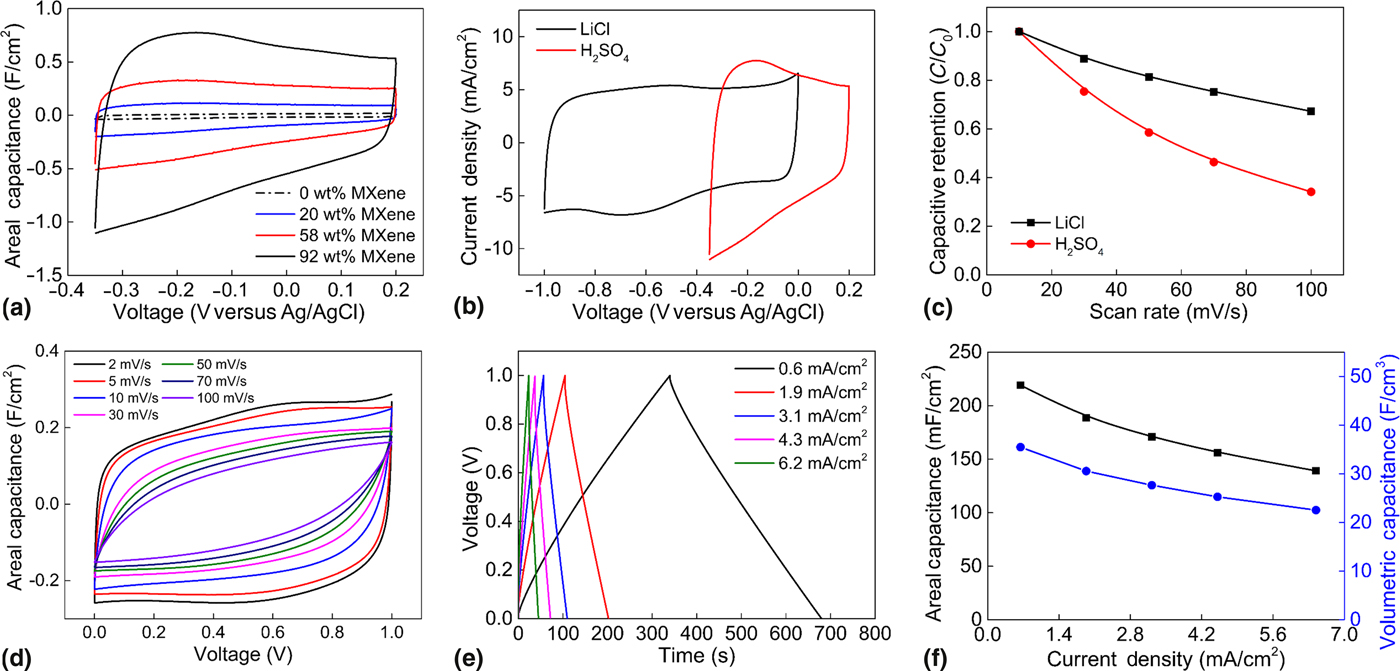
Although MXene can store highest electrochemical charge in H2SO4 by the surface redox reaction, it can store large energy more efficiently in LiCl by the Li+ intercalation process. Since the redox peak of MXene in H2SO4 electrolyte occurs at −0.4 V versus Ag/AgCl, the rectangular cyclic voltammetry (CV) curve could be obtained between −0.35 and 0.2 V.[Reference Lukatskaya, Kota, Lin, Zhao, Shpigel, Levi, Halim, Taberna, Barsoum, Simon and Gogotsi15] However, anodic current is stable until applying −1 V in the LiCl electrolyte. The large anodic potential window is profitable considering the energy density is proportional to square of the potential range. Also, the Li+ ion intercalation process allows the MXene/CNT yarn to maintain the capacitance better at a high discharge rate. This phenomenon is further investigated by power law i = avb, where i is the peak anodic current in CV, and v is the scan rate. In H2SO4 electrolyte, i was linearly dependent on the square root of v at over 50 mV/s, which means the yarn electrode displays diffusion limited behavior. However, in LiCl electrolyte, the electrode yarn displays capacitive behavior, because i was linearly dependent on v for most scan rates (Fig. S8). Therefore, LiCl seems to be more suitable than H2SO4 to be applied with MXene containing electrodes, even for asymmetric supercapacitor with the pseudocapacitive cathode, considering the potential range and rate capability.
A symmetric yarn supercapacitor comprising two identical MXene/CNT electrode and PVA/LiCl gel electrolyte exhibited excellent performance with rectangular CV curves and triangular charge–discharge curves [Figs. 2(d) and 2(e)]. The areal and volumetric capacitances are 219 mF/cm2 and 35.5 F/cm3 respectively, which are remarkable values compared to the present yarn-type MXene containing supercapacitor electrodes (Table S1). Also, the yarn had a high areal capacitance of 139 mF/cm2 at high discharge rate of 6.2 mA/cm2, and there was no significant iR drop at the beginning of the discharging curve (15 mV) [Fig. 2(f)].
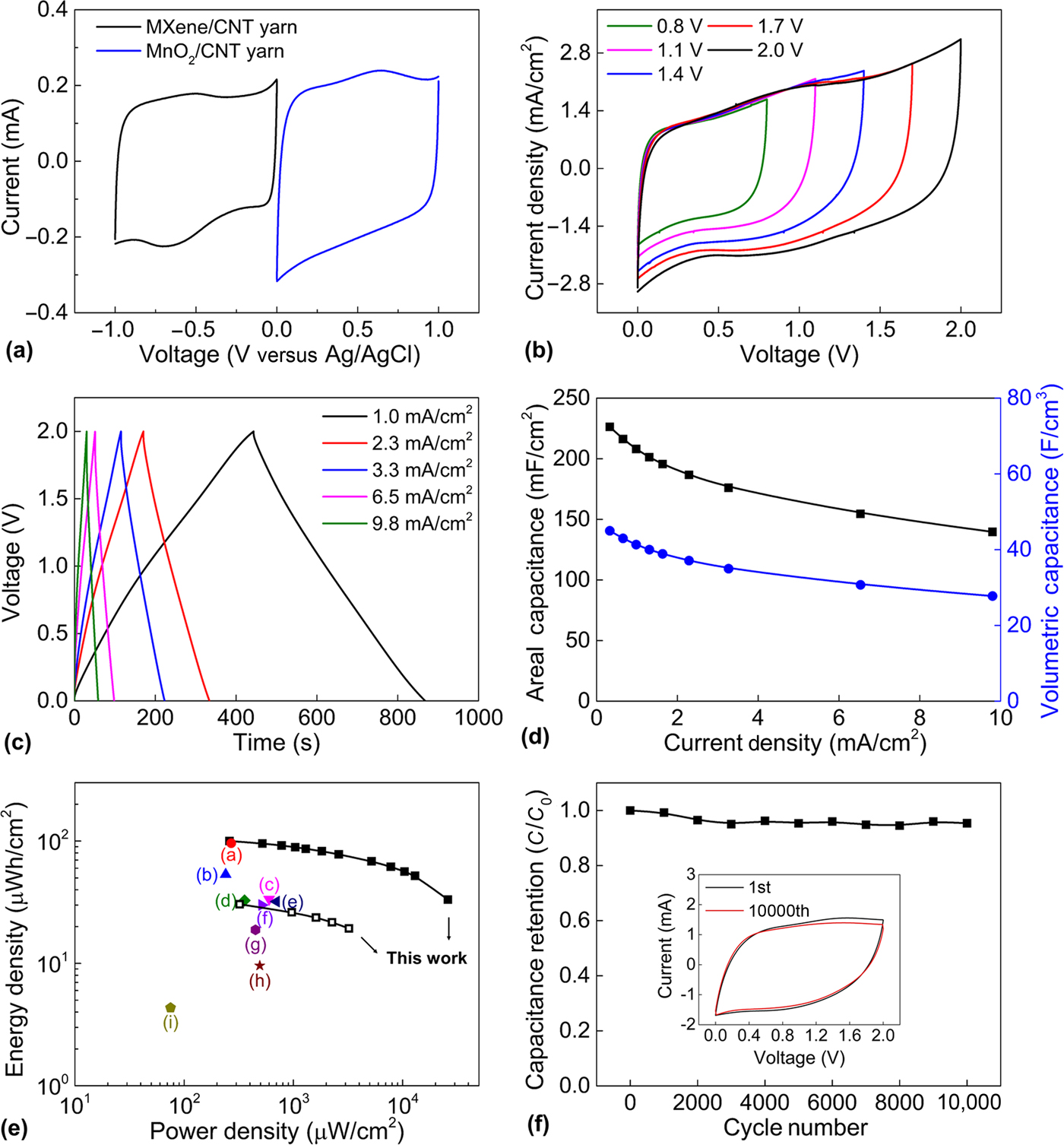
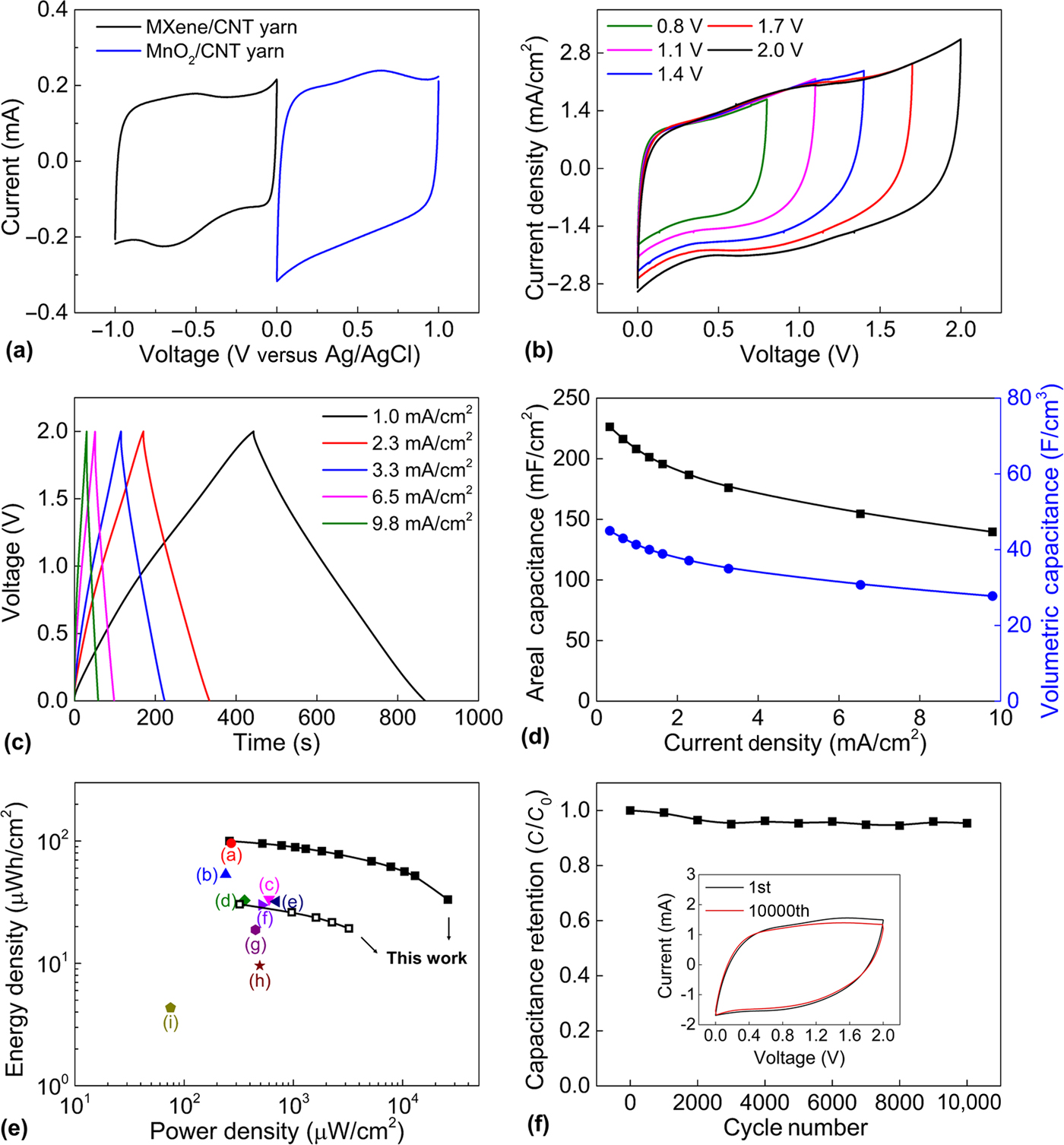
By combining the MXene/CNT yarn as a negative electrode, and a biscrolled MnO2/CNT yarn as a positive electrode, the constructed asymmetric yarn supercapacitor had exhibited excellent performance. The MnO2/CNT biscrolled yarn was fabricated as same as in a previous publication.[Reference Choi, Kim, Kim, Lepro, Spinks, Baughman and Kim21] To perform well in an asymmetric configuration, the weight ratio of MnO2 in the MnO2/CNT biscrolled yarn was controlled to about 82 wt%. The MnO2/CNT yarn exhibited positive 1 V versus the reference electrode in 5 M LiCl aqueous electrolyte [Fig. 3(a), Fig. S10]. Thus, with the PVA/LiCl gel electrolyte, the asymmetric yarn supercapacitor can perform up to 2 V without any redox reactions [Fig. 3(b)]. The asymmetric yarn supercapacitor was fabricated by plying yarn electrodes pre-coated with the gel electrolyte. The coated gel thickness was about 50 µm for each electrode (Fig. S11). Triangular galvanostatic charge–discharge curves were obtained and display no significant iR drops (discharge rate 1–10 mA/cm2). The highest capacitance of the asymmetric supercapacitor was 220 mF/cm2 at 0.3 mA/cm2 discharge rate and it is retained about 80% when the discharge rate was increased tenfold [Figs. 3(b) and 3(c)]. The CV curves retained rectangular shape when the scan rate increased from 10 to 500 mV/s (Fig. S12). The high rate performance is attributed to high conductivities of the electrode yarns and the gel electrolyte. Nyquist plot confirms that the equivalent series resistance of the supercapacitor is 68 Ω/cm. A Ragone plot of areal energy density versus power density shows that the present MXene, MnO2/CNT asymmetric yarn supercapacitor outperforms various asymmetric yarn-type supercapacitors [Fig. 3(e)]. The maximum areal energy density was 100 µWh/cm2 at 260 µW/cm2 and compared fiber-type asymmetric supercapacitors are: (a) VN/C, MnO2/PEDOT:PSS/CNT-based coaxial fiber[Reference Zhang, Wang, Pan, Sun, Zhao, Zhang, Zhang, Tang, Luo, Song, Zhang, Lu, Li, Zhang and Yao9]; (b) VN, Zn-Ni-CoO3/CNT twisted fiber[Reference Guo, Zhang, Sun, Li, Zhao, Zhou, He, Wang, Man, Li, Zhang, Xie, Li and Yao10]; (c) PEDOT/MnO2, C/Fe3O4 on steel fibers[Reference Sun, Huang, Fu, Huang, Zhu, Tao, Zhi and Hu8]; (d) Ni-NiCo2S4, N-rGO-coated nickel wires[Reference Saravanakumar, Jayaseelan, Seo, Kim and Kim5]; (e) ZnCo2O4/Zn-Co-S, H-Co3O4/CoNC at CNT fibers[Reference Choi, Lee, Kim and Kim3]; (f) MnO2, rGO/CNT fibers[Reference Choi, Park, Kim, Lee, de Andrade, Kim, Gambhir, Spinks, Baughman and Kim6]; (g) MnO2, PPy/CNT coaxial fiber[Reference Yu, Lu, Smith, Booksh, Meng, Huang, Li, Byun, Oh and Chou7]; (h) Ni-Co DH/nickel, nickel on carbon fibers[Reference Gao, Surjadi, Cao, Zhang, Li, Xu, Jiang, Song, Sun and Lu4]; and (i) Co3O4/MnO2 on Ni wire, carbon fiber with graphene.[Reference Niu, Zhu, Yin, Dai, Hou, Shao, Huang, Zhang and Dong12] Table S2 further shows an order of the energy and power densities of previous published asymmetric yarn-type supercapacitors with present data. Also, the asymmetric supercapacitor exhibited excellent stability under ten-thousands of charge–discharge cycles [(Fig. 3(f)].
Electrochemical performance of a solid-state two-plied asymmetric yarn supercapacitor comprising an MXene/CNT anode and a MnO2/CNT cathode. (a) CV curves of the MXene/CNT yarn electrode and MnO2/CNT yarn electrode which have voltage ranges −1 to 0 V and 0 to 1 V versus Ag/AgCl, respectively (10 mV/s scan rate). (b) CV curves of the asymmetric yarn supercapacitor at different potential window (0.8 to 2.0 V). (c) Galvanostatic charge–discharge graph of the asymmetric yarn supercapacitor, and (d) areal and volumetric capacitance retention (1 to 10 mA/cm2 discharge rate). (e) Ragone plot showing the highest areal energy of 100 µWh/cm2 at power density of 260 µW/cm2 for the asymmetric device (black filled square), and 30.4 µWh/cm2 at 322 µW/cm2 for the symmetric device (black open square). Previously published data of asymmetric yarn supercapacitors are presented for comparison: (a) VN/C, MnO2/PEDOT:PSS/CNT-based coaxial fiber,[Reference Zhang, Wang, Pan, Sun, Zhao, Zhang, Zhang, Tang, Luo, Song, Zhang, Lu, Li, Zhang and Yao9] (b) VN, Zn-Ni-CoO3/CNT-twisted fiber,[Reference Guo, Zhang, Sun, Li, Zhao, Zhou, He, Wang, Man, Li, Zhang, Xie, Li and Yao10] (c) PEDOT/MnO2, C/Fe3O4 on steel fibers,[Reference Sun, Huang, Fu, Huang, Zhu, Tao, Zhi and Hu8] (d) Ni-NiCo2S4, N-rGO-coated nickel wires,[Reference Saravanakumar, Jayaseelan, Seo, Kim and Kim5] (e) ZnCo2O4/Zn-Co-S, H-Co3O4/CoNC at CNT fibers,[Reference Zhao, Li, Li, Zhang, Sun, Wang, Guo, Xie, Xie, He, Zhou, Lu, Lu, Zhu and Yao13] (f) MnO2, rGO/CNT fibers,[Reference Choi, Park, Kim, Lee, de Andrade, Kim, Gambhir, Spinks, Baughman and Kim6] (g) MnO2, PPy/CNT coaxial fiber,[Reference Yu, Lu, Smith, Booksh, Meng, Huang, Li, Byun, Oh and Chou7] (h) Ni-Co DH/nickel, nickel on carbon fibers,[Reference Gao, Surjadi, Cao, Zhang, Li, Xu, Jiang, Song, Sun and Lu4] (i) Co3O4/MnO2 on Ni wire, carbon fiber with graphene.[Reference Niu, Zhu, Yin, Dai, Hou, Shao, Huang, Zhang and Dong12] (f) Capacitance retention after 10,000 cycles of charging and discharging with CV. The scan rate during the cycle test was 200 mV/s.
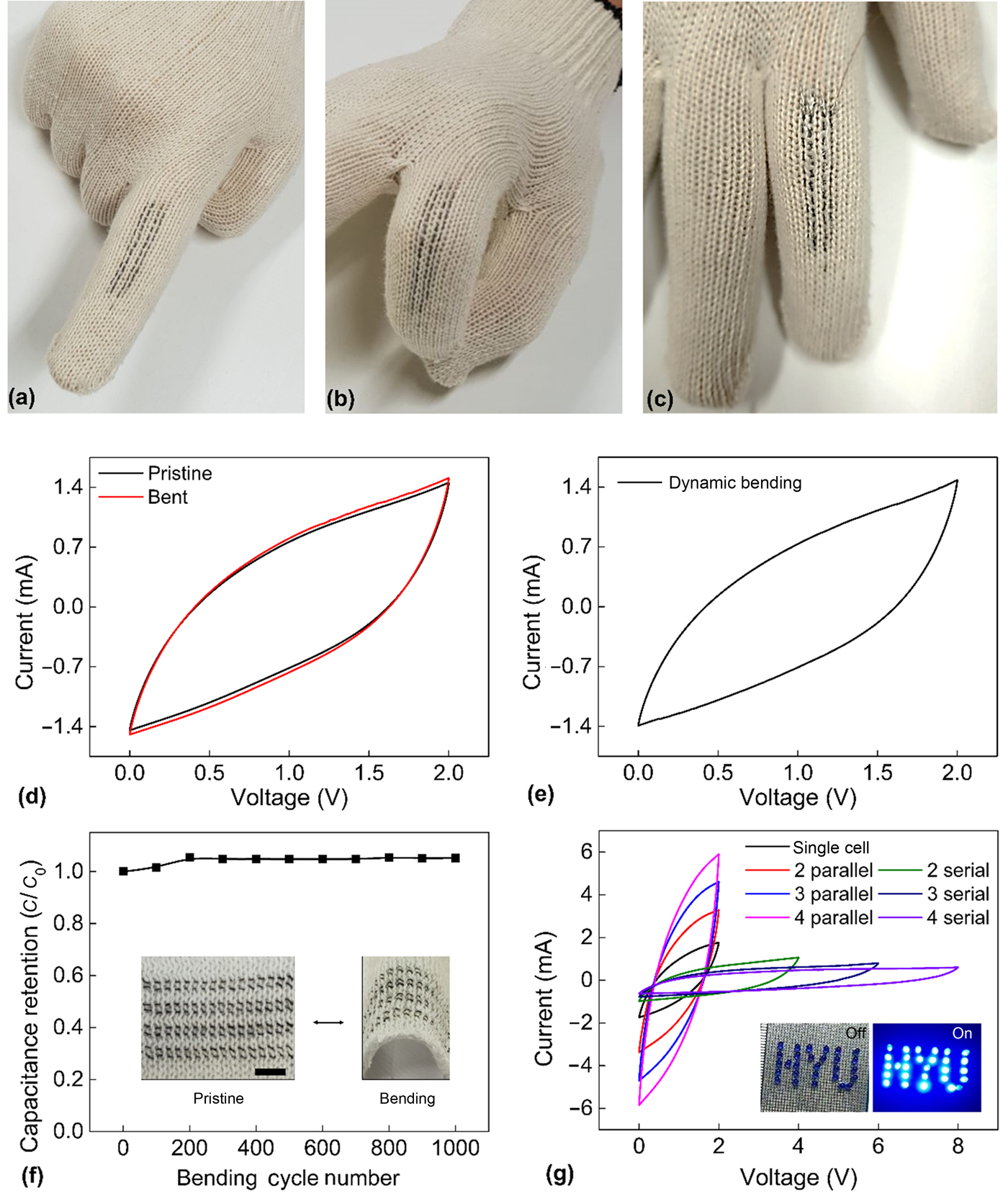
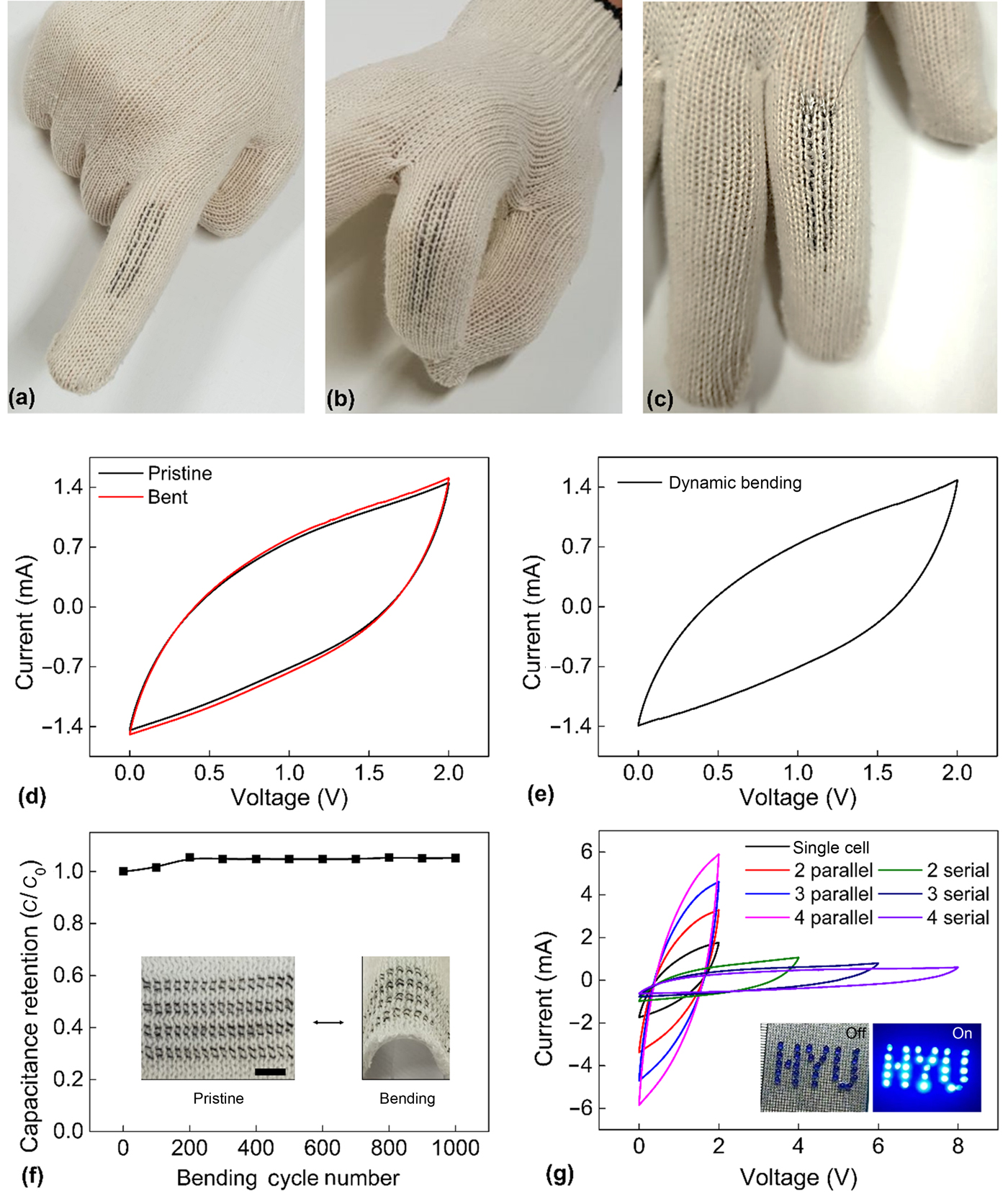
To briefly demonstrate using the asymmetric yarn supercapacitor as a power source of wearable electronics, the electrode yarns were sewn into commercial knit-structured cotton glove. The 4-cm-long MXene/CNT anode yarns and the MnO2/CNT cathode yarns were sewn alternatively, then, the PVA/LiCl gel electrolyte was carefully placed between each set of electrode pairs [Figs. 4(a) and 4(b)]. Unlike plied asymmetric yarn supercapacitor described in above paragraph, there were enough spaces for electrolyte between the electrode yarns due to the distance between wales. To connect woven supercapacitors, copper wires were attached at the end of the electrode yarns with silver paste and epoxy [Fig. 4(c)]. While the index finger was bending and stretching, the supercapacitor was also bent and released, simultaneously. CV curves of the resultant supercapacitor show no effective degradation when static and dynamic mechanical deformations are applied [Figs. 4(d) and 4(e)]. To test the stability, the textile containing four woven supercapacitor cells were fully bent orthogonally to the sewn yarn electrodes by nearly 180° and released. The capacitance retention after 1000 cycles of bending was about 105% [Fig. 4(f)]. The CV curves of four serial and parallel connected woven supercapacitors show that the discharging current increases linearly when the supercapacitors connected to parallel, and the operating potential increases by the supercapacitors connected to serial, which implies the potential to make wearable energy storage device consist of the supercapacitor yarns [Fig. 4(g)]. Also, to confirm the high power, and energy performance of the asymmetric supercapacitor, four supercapacitors, each consist of two paralleled yarns with the gel electrolyte between, were serially connected to power a set of 28 LEDs. They could power the set of LEDs for about 1 min (Fig. S13).
Applications of yarn-type asymmetric supercapacitor comprising MXene/CNT anode and MnO2/CNT cathode. (a, b) Optical images of two sets of the asymmetric yarn supercapacitor woven in commercial cotton glove. The index finger was bent and released repeatedly to test stability of supercapacitors. (c) An optical image that shows wiring the supercapacitor electrodes with silver paste and copper wires. (d, e) CV curves of the woven supercapacitor at static and dynamic bending states (scan rate = 100 mV/s). (f) Capacitance retention of four parallel connected supercapacitors woven in cotton textiles after a thousand times of bending cycle. The inset shows the experimental conditions of released and bent state of the textile (scale bar = 1 cm). (g) CV curves of four asymmetric yarn supercapacitor cells with different connections (scan rate = 100 mV/cm). The inset shows the four serially connected supercapacitor lights 28 blue LEDs.
In conclusion, we have prepared an MXene/CNT yarn electrode which has a high content of MXene (up to 93%) by the biscrolling method. The supercapacitor comprising two symmetric MXene/CNT yarn exhibited great performance of 219 mF/cm2 and 35.5 F/cm3 with PVA/LiCl gel electrolyte. LiCl would be better choice than H2SO4 considering the power and potential window of supercapacitors. The asymmetric yarn supercapacitor which comprises MnO2/CNT biscrolled yarn as the positive electrode and MXene/CNT yarn as the negative electrode can have a large potential range up to 2 V, thus, a high energy density of 100 µWh/cm2 at a power density 260 µW/cm2 can be obtained. The yarn electrodes have enough mechanical strength to be sewn into commercial textiles. The stability under deformations and connectivity without performance degradation have shown the possibility of the yarn asymmetric supercapacitor to be applied in wearable electronics.
Methods
MXene synthesis
The MAX phase material which is the precursor material of MXene (Ti3C2Tx), Ti3AlC2 (from Wuhan Golden-wing) powder was placed in 50% hydrofluoric acid (0.05 g/mL). After 96 h of etching Al layer from Ti3AlC2 (mild stirring under 25 °C maintained within a silicon oil bath), the solution was washed with 1 L of deionized (DI) water with several times of centrifugation (13,500 rpm). Then the sediment was collected and dried in a vacuum chamber (80 °C, overnight). The resultant dried MXene powder was collected and contained in a vial bottle with sealing for experiments. The average size of MXene particles were measured using SEM images of the particles.
Electrode fabrication
Dispersion of MXene was prepared by ultrasonication (1 h with 150 W, VCX 750) in a mixture of ethanol and water (7 mg/mL). Small portion (25%) of water was added to ethanol for better dispersibility of MXene and ethanol acted as both dispersion medium of the MXene particles and densification agent for the CNT sheets. The MXene dispersion (~10 µL/cm2) was drop-cast onto a highly aligned CNT sheet which was drawn from the multiwalled nanotube forest which was fabricated by a chemical vapor deposition method (U053HANYANG-SH158-06, LINTEC Inc.), and after drying for a minute, a new CNT sheet had been stacked onto the MXene/CNT film. The process had been repeated several times and the resulted multilayer MXene/CNT film was scrolled (2000 turns per meter) using an electrical motor to form an MXene/CNT biscrolled yarn. The weight ratio of MXene in the yarn could be controlled with the dispersion concentration and stacking number CNT sheets and the diameter of the biscrolled yarn could be easily controlled by adjusting the width of the CNT sheets. The content of active material (wt%) in the composite yarn was calculated by following formula:  ${\rm wt}\% = (W_1-W_2)/W_1 \times 100$ where W 1 is the weight of the biscrolled yarn and W 2 is the weight of neat CNT yarn made by twisting the same amount of CNT sheet for biscrolled yarn.
Supercapacitor assembly
For the three-electrode experiments, the length of the MXene/CNT yarn was fixed to 1 cm and one end of the yarn was connected to a 100 µm Cu wire using silver paste and epoxy. 1 M H2SO4 solution (from Daejung) and 5 M LiCl liquid electrolyte were prepared and the Pt-mesh counter electrode and Ag/AgCl reference electrode were used for the experiment. For the two-electrode experiments, the aqueous PVA/LiCl gel electrolyte was prepared by heating a mixture of 3 g PVA (Mw 146,000–186,000) and 6 g LiCl in 30 ml DI water at 90 °C for several hours. Also, PVA/H2SO4 gel electrolyte was prepared by using 1 M H2SO4 solution instead of LiCl in water. The 100 µm diameter MXene/CNT anode yarn and 100 µm MnO2/CNT cathode yarn were dip-coated with the PVA/LiCl electrolyte. After drying for several hours, the MXene/CNT anode and the MnO2/CNT cathode yarns were plied and dip-coated with the PVA/LiCl electrolyte afterward. The thickness of the gel electrolyte was ~50 µm. The woven supercapacitor was prepared by removing textile threads from the mock rib structure and then using a needle to sew in their place MXene/CNT yarns and MnO2/CNT yarns, which were then pairwise coated with the PVA/LiCl gel electrolyte. The chemicals for electrolyte synthesis were purchased from Sigma-Aldrich and Alfa-Aesar if not noted.
Characterization
CV and chronopotentiometry measurements for all investigated supercapacitors were performed using an electrochemical analyzer (CHI 627b, CH Instrument). Nyquist curves were measured using another electrochemical analyzer (Reference 600, Gamry Instrument). For cross-sectional image, the 90 wt% MXene/CNT yarn was cut using a focused Ga ion beam (FIB, Nova 200) operated at 30 kV. The clean-cut yarn was transferred to a Zeiss Supra 40 SEM and also elemental mapping analysis was taken. The magnified surface image of the yarn was obtained using a Hitachi S-4800 SEM. The length and weight of each electrode were measured using a digital Vernier caliper (500 series, Mitutoyo) and microbalance (XP2U, Meter Toledo), respectively. Yarn diameters were obtained from optical images collected using a microscope with an attached camera. X-ray diffraction data were measured by an x-ray diffractometer (SmartLab, Rigaku). Mechanical properties were measured by a universal testing machine (EZ-SX, Shimadzu).
Calculation of electrochemical performance
The capacitances of supercapacitors were calculated from galvanostatic charge–discharge curve and CV curves by the following equation: C = I/(dv/dt). For galvanostatic charge–discharge curves, I is the discharge current and dv/dt is the slope of the discharge curve. For CV curves,  $I = (\int i\,{\rm d}v)/2\Delta V$ where ΔV is the potential range and dv/dt is the voltage scan rate. The specific capacitance for the electrode yarn was calculated using C s = C/S, where S could be length (l), area (a), and volume (v) of the yarn. For two electrode systems, the length, area, and volume are the values that contain all the components including both yarn electrodes and the coated gel electrolyte. The specific energy density and power density were calculated from the equation E s = (1/3600)(1/2)CsΔV 2, and P s = E s/Δt, where Δt is the discharging time.
Supplementary material
The supplementary material for this article can be found at https://doi.org/10.1557/mrc.2019.7
Acknowledgments
This work was supported by the Creative Research Initiative Center for Self-powered Actuation in National Research Foundation of Korea. Support at the University of Texas at Dallas was provided by the Air Force Office of Scientific Research grants FA9550-15-1-0089, and the Robert A. Welch Foundation grant AT-0029.