Introduction
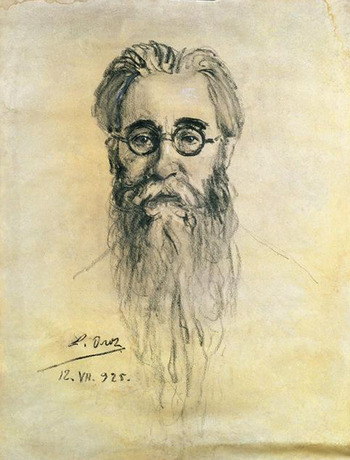
The early-twentieth-century Spanish author Ramón del Valle-Inclán (1866–1936) was a remarkable innovator who wrote poetry, novels, plays, essays, and art criticism. He experimented with the transgeneric potential of literary form in works that include a series of four literary sonatas, a trilogy of “barbaric comedies,” and the esperpento, a genre he created to express his understanding of the grotesque tragedy that characterized Spain in the early twentieth century. Valle-Inclán was a legendary figure in Madrid and his native Galicia, renowned for a carefully cultivated public persona that included a long beard, a nineteenth-century cape, and his fictionalized account of a duel that cost him an arm (fig. 1). From 1903 to 1916, he famously presided over a Madrid tertulia (café conversation) among central modernist visual and literary artists of the period, including Antonio Machado, Julio Romero de Torres, and Santiago Rusiñol. In addition to an extensive group of regular attendees, Rubén Darío, Henri Matisse, Pablo Picasso, and Diego Rivera, among others, joined the conversation when in Madrid (Santos Zas). Valle-Inclán was a strong influence on a generation of literary and visual artists in Spain, and his work prefigures the literary experimentation of other modernists, including T. S. Eliot's Four Quartets, Virginia Woolf's The Waves, and James Joyce's Ulysses.
Portrait of Ramón María del Valle-Inclán (1866-1936), by Luis Oroz. 1925. Museo Romantico-Dibujo, Madrid. Charcoal and chalk. Reproduced with the permission of Album / Art Resource, NY.

In 1916 Valle-Inclán visited the Western Front at the invitation of the French government. La media noche: Visión estelar de un momento de guerra (Midnight: Astral Vision of a Moment of War), a chronicle of this experience, was published serially as Un día de guerra (visión estelar) (A Day at War (Astral Vision)) between October 1916 and February 1917 in the Madrid newspaper El imparcial. The text translated here represents Valle-Inclán's substantial revision of the newspaper account. Published in April 1917, it augments the original thirty-four short chapters with six more and adds a preliminary “Brief Notice” in which Valle-Inclán introduces central problems of time and perspective, explicitly tying the chronicle to his aesthetic treatise, La lámpara maravillosa (1916; The Lamp of Marvels). This treatise, which traces the journey of a pilgrim-poet to aesthetic enlightenment, presents a dense synthesis of occult traditions as varied as gnosticism, Neoplatonism, Spanish mysticism, kabbalah, the Hermetic tradition, and alchemy and is clearly situated within the theosophy inspired by Helena Blavatsky that was in vogue across Europe at the beginning of the twentieth century.Footnote 1 If The Lamp of Marvels represents the consolidation of aesthetic ideas Valle-Inclán had been developing over the previous decade (Vílchez Ruiz), Midnight: Astral Vision of a Moment at War attempts to put these ideas into practice.Footnote 2
Valle-Inclán remarks in the preface to Midnight that any account of war depends on the random perspective of individual witnesses. To capture this partial perspective, Valle-Inclán invokes images of soldiers returning home (the blind, those without legs, those with one arm), whose fragmented bodies metonymically represent a horrific and personal experience. It is the role of the narrator—the “Poet who would be Seer”—to distill these stories into their shared essence. Activating the occult concept of “astral vision” to produce an all-encompassing perspective, the Poet-Seer “close[s] the circle” to recount “the vision of all people who were in the war and saw at the same time all its settings, all its occurrences.” Allowing for a single take on the war as it unfolds across the great expanse of the Western Front, Valle-Inclán's astral vision is accompanied by a zooming in on short episodes that occur simultaneously. The experience of various witnesses meets a view from above to condense the spatial sphere. The return to astral vision and the rhythmic effect created by the repetition of key phrases to describe events as they unfold create an impression of stasis even as time progresses from midnight to dawn.
At the end of the prefatory “Brief Notice,” the narrator pronounces the text a failure, a confession that, perhaps, has caused the relative neglect of Valle-Inclán's fascinating quest to create a view of the whole, outside time and space, from the devastating fragments that characterize individual experiences of war. Valle-Inclán's desire to disengage qualitative experience from its fragmentary expression in language, to express discrete temporalities as simultaneous, and to observe perspectival space from a position of cosmic omniscience demonstrates that the theosophical underpinnings of his aesthetics inspired literary innovations that put him in league with modernists across Europe and the Americas.
Brief Notice
My purpose was to condense into a book the various and diverse occurrences of a day at war in France. When writing about war, the narrator, who was once a witness, provides a purely random chronology, born of the human and geometric limitations that prohibit us from being in more than one place at the same time. And like anyone who must take many days to traverse the enormous battlefront stretching from the Alsatian mountains down to the seacoast, the narrator adjusts the war and its unforeseen events to the measure of his own stride: The battles begin when his eyes begin to see them: The terrible sound of the war stops when he moves away from its tragic settings and returns when he comes closer.Footnote 1 All stories are limited by the geometry of the narrator's position. But he who could be in various places at one and the same time, as the Theosophists claim about Hindu mystics, and characters in novels say of Cagliostro, who, when banished from Paris, exited simultaneously from all entrances to the city, certainly would have a vision, an emotion, and a conception of the war distinct in every sense from that of the wretched witness who is subjected to the geometric laws of corporeal and mortal matter.Footnote 2 Between one mode and the other would be the same distinction as that between the view of the soldier who fights in the trenches and the general who follows the battle hunched over a map. This preternatural intuition of its settings and occurrences, this comprehension that seems to be outside space and time, is not, however, foreign to literature, and one can even claim that it is the origin of primitive poems, religious vessels in which scattered voices and scattered stories have been conjoined, at the end of centuries, into the greatest story, or sign of all, in a supreme, almost infinite vision of the infinite eyes that close the circle. When the soldiers from France return to their villages, and the blind wander down paths with their guides, and those who don't have legs beg at the doors of churches, and one-armed amputees run from place to place in the happy role of go-betweens; when at the family hearth the dead are named and prayed for, each mouth will have a different story and the stories will number hundreds of thousands, an expression of many other visions that in the end will be distilled into one vision, a sign of all. Then the poor gaze of the soldier will dissolve to create a collective vision, the vision of all people who were in the war and saw at the same time all its settings, all its occurrences. The circle, upon closing, engenders its center and out of this cyclical vision the poet is born who deserves to be called Seer.
I, clumsy and vain, wanted to be at the center and to have an astral vision of the war, outside geometry and chronology, as if my soul, already disembodied, were looking at the earth from a star. I have failed in my resolve. On this occasion my Indian drug denied me its marvelous outpouring. The pages that now come to light are no more than the stammering of a dreamed ideal. I will return to France and to the battlefront to refine my emotions, and perhaps I still might achieve that arrogant project of writing the visions and emotions of A DAY AT WAR.
V.-I.
I lit the lamp at the edge of midnight. I placed myself in front of it, and my shadow covered the wall. I opened the book and spelled the words that disembody a soul wanting to look at the world outside geometry. After, I put out the lamp and went to sleep on the ground with my arms crossed as the book directs. Artephius, Astrologer of Syracuse, wrote this book, named in Latin CLAVIS MAYORES SAPIENTIAE.
Chapter 1
It is midnight. The moon sails through skies of bright stars, through blue skies, through cloudy skies. From the mountainous woods of Alsace to the wild coast of the North Sea, two armies lie in wait, crouched in entrenchments that smell like death, as in a hyena's cage. The French, son of the Latin wolf, and the barbarian German, bastard of all tradition, are once again at war. The defense lines stretch two hundred leagues, from the sea's cliffs to the mountains that dominate the green plains of the Rhine. Hundreds of leagues, and only the eyes of stars can see them fight at the same time, at the two tail ends of this long line, every hour filled with the flash of gunpowder and the thunder of cannons rolling through the sky.
Chapter 2
The trenches are muddy and narrow ditches. They are swamped by yellowish waters from storms and floods. One slips while walking. Mice run lively along the inclines, water-loving rats scurry through the muddy bottom, and gusts of wind bring the cold stench of carrion. The trenchers have dug wide shelters into the slopes where squads of soldiers take refuge, and silos with lookouts are concealed among stones and branches in places favorable for monitoring. From these watch towers, enemy lines are discovered and artillerymen, communicating by telephone, order cannons, always placed behind the first defensive line, to fire. In front of the two enemy trenches lay thickets of barbed wire and ditches where the dead from the last few days rot on top of the skinned bones of those who fell in the first days of the invasion. The surrounding land looks like it has been plowed. Shrapnel has cut down trees and burned the grass. From the bottom of the trenches, rockets emerge with red, green, and white lights exploding in the dark night, briefly illuminating that vast battlefield. An alert sounds from the cliffs of the North Sea to the mountainous forests that trace the Rhine.
Chapter 3
In the nighttime shadows, long convoys roll along, carrying ammunition to the front line. Rockets from the trenches open their roses in the air, searchlights explore the battlefield and light up forests and hills in the distance. They suddenly show the remains of a town in ruins, burned and sacked, while, in the beam of a searchlight, a dog without his master runs, limping, along the highway. At the edge of the forest, rows and rows of unmoving trucks await their orders, with soldiers from the convoy resting at the side of the road, smoking pipes filled with Belgian tobacco. Cannons are heard, at times slowly, at times in waves of fire, and the almost indifferent soldiers speculate briefly. A cyclist arrives, persistently sounding a bell: He brings orders that the Sargent makes out by a lantern's light, and the convoy gets moving. All the roads used by the rear guard feel the weight of ammunition trucks that, accompanied by veteran soldiers, bumble along with the grating sound of iron. They move with headlights out, indeterminate forms under the stars, at times submerged in the trees’ shadows and at other times standing out in black lines along a white and naked highway. There are so many that they cannot be counted, there are hundreds and hundreds. They roll toward the trenches slowly, heavily. When they pass near some village, dogs bark and roosters crow.
Chapter 4
And the moon sails through skies of bright stars, through blue skies, through stormy skies: Over the two hundred leagues of muddy trenches, rockets open out their roses, searchlights tremble, and, in the shadows, planes carry their cargo of explosives to destroy, to burn, to kill. … Happy pilots occupy the cockpits, crazed with air-born vertigo, like heroes from old tragedies crazed with erotic vertigo. Dressed in furs, with large, round glasses and round, leather helmets, they have an embryonic form and darkly evoke scientific monsters. They fly against the wind and with the wind, the stars tell them their path. Some travel blind through cloudy hollows, others soar above the smoke and the fire's flames, others go by moonlight, stretching out in squadrons. That one foundering among waves of water and sea winds is from an English airfield in Picardy. And those that return and land in silence are French: Seven left at dusk and now there are not more than five: Behind them burns a train full of German soldiers. The pilots jump to the grass and numbly move away while soldiers with lanterns push the planes into sheds and pour buckets of water on overheated motors. It is an aviation field at the rear of the battlefield, on a flat expanse covered with grasses. Light tents, large sheds, lean-tos, and tack rooms make a ring on the grass that is the color of night and fades into it: Only the moon highlights their silhouettes when it sails through clear, starry skies.
Chapter 5
Hail and gales in the Alsatian and Vosges mountains.—The cock has already crowed twice.—The trenches have a white crest, and, hidden in them, dressed in furs like shepherds, guards spy on the enemy camp, barely leaning out across the snow-covered barricade. There is slow shelling, with long and linked resonance. The beam from a searchlight flies over the peaks, arrives at the bottom of the woods, lights the trunk of silver firs and the white slope of trenches where soldiers move quickly in Indian file to reinforce the defenses of Hartmanwillerkopf.—Le Veil Armand in the slang of the Poilus.Footnote 3—Above the shroud of snow, rockets open many colored roses. Between Thann and Metzeral a burst of enemy fire has begun, and in monitoring posts, dogs watch, crouched beside the soldiers.
Chapter 6
At the top of the mountain, the squad sergeant chooses two scouts: They leave cautiously, dragging themselves along the snow, sinking into the night. The German trench, thatched and defended by a thorny web of wire, is on the other side of a glade, no more than one hundred steps away. Great bullets cross whistling and, from time to time, a silver fir falls to earth with the dull murmur of a surging sea. Soldiers run in small groups, their heads turned, their shoulders raised. Another trunk creaks. The shrapnel is mowing down the forest: Flames ignite where a bomb falls. The two scouts drag themselves cautiously and, when the beam of the searchlight explores the field, lighting it up, they flatten themselves: Shuddering, they step over a pile of cadavers half buried in the snow: They seem to incorporate them into their heels when they take a step. The two scouts cross over the dead, carrying their smell with them: Now they touch the wire fence, and at that moment a violent shock throws them through the air with their clothes on fire: The cartridges that they carry in their belts explode like a rocket blast: They fall burning, like two effigies. A blue flame comes out of their helmets. From their trenches, the French soldiers look on in pain. In the Langenfeldkopf Observatory, a lieutenant murmurs, speaking with his colleague: —The Boches have reinforced their defenses with an electric cable, imitating what we did in Indochina.Footnote 4
Chapter 7
The Germans, taking advantage of the night's darkness, leave their trenches and reach the advance defenses of the French. Suddenly, a dog's bark gives the alert, and a searchlight shows them crawling along the snow, their formation broken and spread out. The French open fire. In a unanimous surge, the Germans get up and run toward enemy lines throwing hand grenades. When some fall, others replace them: They pull themselves up, they fight in waves. The French open fire from defensive shelters. In a few moments, only seventy from an advanced party of alpine veterans remain unharmed. Grenades fall in the trenches. Telephone wires are broken, and two soldiers volunteer to fix the break: A grenade explodes, and one falls on the other: They twist tenderly toward each other, without horror, like two brothers who kiss. The lieutenant from the second company writes a message from inside a telephone sentry booth. Shouts are heard from Germans who have penetrated the trenches. The lieutenant folds the paper and fastens it under the collar of a dog that waits, wagging his tail: He pets him, takes him outside and shows him the trail. The dog takes off in a flash. The lieutenant takes a few steps and trips on a wounded man fallen at the bottom of the trench. Further away, another bandages his forehead. Lieutenant Breal encourages them with his great voice: “Long live France! Up with the dead!”
And the dead rise up, and there is a great shift in that ditch full of darkness, of mud, of chaos. Two French machine guns open fire upon the dry, vacant land through which the Germans advance. Their shots attack methodically, like a mathematical formula, indifferent and cruel to men. Through the snowy forest, the dog's shadow flees: He runs along the side of a ditch, he enters a path where many vehicles wait in line: He appears and disappears: He jumps to escape the branch of a fir tree fallen in the road: He runs with his belly to the ground: Under the searchlights, he crouches like the soldiers. He is seen again along the side of a ditch, follows the trail, descends a slope, gets to the bottom and, wagging his tail, enters a casemate. Two officers write by the pointed light of an oil lamp, and the dog, prancing, comes between them, paws on the table. Lieutenant Russell pets him and takes out the message hidden in his collar. He begins to read it, and the other officer pronounces it syllable by syllable into the telephone: “—Brigade Command Headquarters.—Transmission from Lieutenant Breal.—Second Company of Alpine Hunters.—In a sudden attack, German forces have penetrated our defenses. I am holding on with the men who remain, but I need help urgently. I have the command due to the disappearance of Captain Douchesne.—Lieutenant Breal.”
Chapter 8
Between Thann and Metzeral, the shelling periodically heats up, but then falls into a stubborn and slow rhythm. The two enemy trenches wander through black forests and echoing ravines, sometimes tumbling downward, sometimes moving up to the summit. Trunks of fir trees split, groaning and bowing under the storm of snow and shrapnel, branches block the roads. Metzeral is burning, and the gleam of flames runs over the river: On each bank, houses are red, smoking skeletons: Walls and roofs fall with a dull thud. The inferno at Metzeral has blazed nightly since the beginning of the war. Women and children take refuge in church porticos, under broken arcades. Farm cows wander, lost, their bells ringing. In the abandoned streets, chests, beds, and clothes pile up. A couple with two children watch their house burn, sheltered amid the ruins of other houses. The man holds his younger child in his arms, and the woman cries with her fingers entwined in the child's mop of hair. The infant complains with a whimper, and the father watches him without speaking, his eyes full of sadness. At his side, face up in a basket, a little girl sleeps: The father has covered her with his jacket, and her feet, wearing clogs and blue stockings, stick out. The mother suddenly gets up and uncovers the pale face of the infant. —He's dying! He's dying! Don't you see that he's dying? We've lost our son!
The man is silent, and the woman looks at her husband: —How can you keep holding him. … You must be dead tired. Give him to me!
The man moves his head. Then the woman cries: —This war is a horror! We were so happy!
The little girl moves under the jacket, jumps up, startled, screaming: —Our baby died! Our baby died!
The father whispers weakly: —Not yet!
The infant's sad whimper also responds. The mother grabs the child from his father's arms: The infant screws up his eyes, trembles, and a thin thread of dark blood trickles from his finely shaped nose. His sister continues to shout: —Our baby died! Our baby died!
The father takes her in his arms and presses his face against hers. —Be quiet, my child! Be quiet!
The little girl understands, and, stifling her sobs, kisses gently, gently, the beard of her father. But then she sighs again: —Our baby died!
The mother begins: —God took him! God took him! God took him!
She has a stubborn expression and dry eyes. With two fingers she closes the rigid eyelids of her dead child. Alpine scouts file by heading to the trenches, they pass by without seeing them, bowed under the snowstorm. The roof of a house falls in, and in the deserted street the galloping of lost cows echoes with the bong, bong of cowbells. The shelling, stubborn and slow, doesn't cease between the two infernos that are Thann and Metzeral.
Chapter 9
Echoes of war are linked from the north coast to the Alsatian mountains! Flames emerge from the roar of bombs: The harvest burns, and overwhelmed villages, and cities that cry when cathedral towers collapse. Thousands and thousands of soldiers fall in the great nocturnal battle and lie rigid and cold under trembling stars. Suddenly, squadrons of soldiers appear: At times breaking into two groups to look for an attack on the flank, at times under a bomb that bursts and opens a gap in the ranks like in the strong walls of a castle. Machine guns attack with shots like lightning, they spread shells over a wide area, they level lines of soldiers: Some fall like effigies, grotesquely folding their legs; others open their arms and are flattened against the ground; others bend slowly onto the shoulder of a comrade. And among such diverse modes of dying, the wounded drag themselves, pressing together torn flesh, feeling warm blood flow through their fingers, eyes wide with the horror of being made prisoners. Thousands of cannons fire in succession, and, from the force of the large projectiles, the air opens up with that drawn-out and profound cry of pain that cats have when giving birth.
Orderlies carry the wounded along roads dug by trenchers that reach the line of fire. First aid is given in the trenches, in the shelter of deep casemates that have pools of blood on their earthen floors and air permeated with the smell of chloroform. At the shoulder of the road, in the protection of forests and hills, trucks from the Red Cross wait immobile, in long lines. Ambulances are in the rear guard, distributed among granaries and farm stables, in the rooms of castles, in cafes with scratched mirrors and nets for the flies, in the cellars of towns that are still burning. The pain of the war shakes and restores the soul of France!
Chapter 10
Thick fog on the seacoast.—The cock has already crowed twice.—Stars tremble over the flooded plain of Flanders. In an estuary near Furnes, sailors disembark, forming the vanguard. The sea wind blows, and the undertow drags purplish and swollen corpses of German soldiers toward the shore: A wave carries them in on its foamy crest, another wave swamps them. Their black, flooded boots are buried in the sand, their large, swollen bodies are knocked down with a dull thud. The sailors surrounding the beach are silent, looking at the choppy and bottomless horizon. They are fishermen from Normandy and Brittany, gullible young men, with pale eyes, childlike souls who are brave on the water, open to miracles, and afraid of the dead. Many pray in a low voice, remembering apparitions in the cemeteries and pine forests of their villages; others drink aguardiente and smoke pipes; perhaps another tries to sing. The moon sails through the clouds, and the swollen bodies of German soldiers come and go with the undertow.
Chapter 11
A ship's lieutenant, accompanied by a constable, follows the guard down the shore. He greets the sailors and all, like children, feel the fear of the dead that made them pray and sing dissipate in the presence of their leader. An artillery corporal steps out of line, raises his hand in salute, drawing attention to himself: —With permission, Lieutenant. Will you permit us to rig them up with sails?
And he signals the corpses of the German soldiers run aground on the beach. The lieutenant understands and smiles: —Wouldn't it be better to bury them?
—Unless you command otherwise, Lieutenant, it's better to rig them up with sails and let the wind take them.
The group of sailors shouts in response: —Let the wind take them! Let the wind take them! . . .
They are grave shouts, fearful and astonished: Their murmuring is something like a prayer. A sailor from the Breton coast crosses himself: —The living and the dead shouldn't sleep together!
The officer gestures with indifference: —Then let the wind take them.
—At your order, Lieutenant!
The group of sailors disperses on the beach, one group saying quietly to another: —Come on! Rig them up with sails.
Someone asks:
—And the Lieutenant?
—It's the Lieutenant who orders it.
Chapter 12
The seamen roll up their pants and enter, splashing, the phosphorescent water. Along the beach float more than one hundred inflated and swollen German bodies. There is one that doesn't have a head; others display purplish marks, almost black, in their stomach or legs. The task of making sails of poles and tent canvases begins. Using boat hooks, they make holes in the water-logged flesh and pound in shafts where they put the tarps. Then, both superstitious and skilled, they push them until they find a breeze: They twist the sail so that the wind fills it, and, by the heel or by the neck, they tie up the ropes. The dead move away from the beach like a fleet of feluccas:Footnote 5 They line up under the moon, and head out toward the ocean horizon, pushed by the cool breeze that blows from the third quadrant. A wave of happiness passes over those infantile and gullible souls. A cabin boy, cap in hand, and the light of the stars in his fervent eyes, exclaims in his old Celtic language: —Mother of God! I am no longer afraid of the dead!
Chapter 13
Slow shelling on the side of Ypres. A stream of mud flows at the bottom of the trench; guards huddle together with their rifles leaning against the slope; small squads of soldiers doze in dugout shelters along the trench. From time to time, the steps of an officer moving through the line stop at the entrance: —Look alive, boys!
The soldiers surge in the shadows, they respond as a gang, they feel blindly for their guns. The officer moves away, continuing through the advance line. Many Poilus, covered by waterproof canvas, rest at the bottom of the trenches with their heads reclining on boxes of hand grenades. The officer moves slowly among them, feeling his way with a stick. All of a sudden, a dozing guard startles awake and fires his gun. The alarm sounds. There are sudden gunshots; rockets soar and the Poilus who rest in the back of trenches get up, reaching for boxes of grenades. The fire slowly extinguishes; the line returns to the shadows, shaken and vigilant, in a tense waiting that is more wearying than battle.
[Summary of omitted chapters: chapters 14–19 follow a mother and her two distraught daughters, each impregnated by a German soldier, as they journey from Arras to a hospital in the village of Saint Denis. After recounting the interaction between a doctor and the three distraught women at the hospital, chapters 20 and 21 describe the arrival of a convoy of wounded soldiers and a scene in the operating room. Chapters 22 and 23 follow the collapse of the German line near Picardy, focusing first on the response of French soldiers and then on the Germans as they confront defeat. Chapters 24 and 25 turn to an unnamed village in the rear guard, following a group of French artillery soldiers as they make their way to the front line.]
Chapter 26
The Argonne Forest! Wind and rain! God going all out with wind and rain! A silent squad of French infantrymen advances in Indian file, sloshing through mud in the trenches. The corporal leads the way with a dull lantern that opens waves of light in the blackness of the trench. They are sixteen men, sad and numb, sixteen wills submissive to the destiny of France. They advance through the flooded trench, slipping, falling, getting up covered with muck, resigned to the wind, the rain, and death. From time to time, they hear the clash of shovels and pickaxes amid the muffled whispers of their march. In some places, the foul smell of rot makes their skin crawl. In others, German cannon fire has dug up the earth to such an extent that not even the slightest trace of the trench remains, and the soldiers are lost in a sea of mud. Tomín, the corporal of the squad, inspects the ground, and in a low voice gives orders to open the drain. The soldiers work with somber resignation and a trace of hatred for those who invade French lands: Those snub-nosed and brutal soldiers who sing like savages, fight drunk, tolerate an officer's whip, are slaves in a land where there are still kings and castes! For the French soldiers, feelings of human dignity are rooted in a hatred of hierarchies: The Marseillaise moves them to tears, and they have sentimental ideas about an almost forgotten melodrama from old revolutions, where there are always traitors, princes, and kings.
Chapter 27
The sixteen men in the squad work in silence: They are only a few steps from the German line and the slightest murmur will give them away: They open a ditch that in a few minutes is obstructed by muddy water. Broken and twisted barbed-wire rises out from the mud, ripping up flesh, and they dig, tangled up in it. When rockets light the sky, the Poilus stand still in the lake of mud. From time to time a stray machine gun lets loose its thunder: The sound fades intermittently in gusts of wind and rain, it has deep folds as if taking on the broken form of the terrain: It is suddenly revealed and suddenly diminished in a line full of drama. The soldiers extend the ditch until it meets a ravine, and the water rushes in a torrent. The form of the trench begins to take shape. Some bodies appear rooted in the bottom, and the soldiers take them from the mud, lining them up on the slope. They dig up two machine guns twisted like wood shavings. The corporal shines his lantern into one of the shelters: The light flickers over the sleeping water, and rats scamper, afraid, up the earthen wall, and black and swollen boots break the ray of light on the pool. The water makes a circle around them. The feet of the dead man sway slightly. The corporal whispers: —Let's wait until morning to bail out the water.
An infantryman draws near and sticks his head in, observing from behind the corporal —It seems that no one here was saved.
The corporal looks at him over his shoulder: —The rats!
—Those men are already at rest!
—Well, you wouldn't change places with them. … And in the end, if not today, tomorrow we'll be like this.
They move away, bent beneath the storm. They hear the sound of water going down the ravine. The soldier murmurs: —If only the war would end!
—You, what family do you have over there?
—A wife and three children. And you?
—No one!
—Are you single?
—Divorced.
The corporal puts the lantern in the opening of another shelter. The light flickers over the black water. A sheep dog swims holding the arm of a sinking body in his teeth. They see a pale hand. The dog swims toward the light.
Chapter 28
The dawn stars turn pale and the replacement of troops along the battlefront begins. Columns of soldiers advance along hundreds of roads. Those going to the trenches earnestly smoke their pipes and avert their eyes from the battle, speak with innocent smiles, have faces burned from the cold and a serene look. Along the highways, one can make out large convoys: At times, immobile, stretched out along bombed-out villages; at other times, rolling along; at still others, resting in the shade of a poplar grove. The soldiers returning from the trenches walk in silence, dispersed stragglers covered with clay, their faces very pale and their eyes astonished beneath furrowed, obstinate brows. Forms reveal their contours in the indecisive light of dawn. With a great racket of grating iron, black trains laden with troops cross hazy bridges: They flee across the plains, appear and disappear among thickets, pant up tall embankments. Behind the enormous trench that curls from the sea to the Alsatian Mountains, bombed towns rise out of the night as the tragic manifestation of war. Enclosed cities by serene rivers, villas near provincial roads, villages among fields, display their ruins to the battlefield. Houses, black from fire, with the roof collapsed inside four thick walls and innards crumbling in rubble, are arid and heartbroken ruins. For many, the surrounding land is already full of nettles and lizards. Among burned and sacked towns, military cemeteries extend to the edge of roads.—Fields of crosses, humid fields whose sad and clear green is like the remote and musical emotion issuing from the divine sob of a lover!—Cemeteries mark battle lines, and French and German graves are dug at the same time. The hazy dawn thins out over the ruins, breaks up in the crosses, flies weightlessly over the enormous trench from the Alsatian Mountains to the Flemish Coast, and in this ashen transition from night to day, the forms of the dead begin to show themselves. There are places where they are piled up, and others, many leagues long, filled with the song of birds, as if the killing were forgotten. This cold and gray moment when the soldier leaves the night's darkness and looks around at his dead comrades, the broken machine guns, the collapsed trench, is the most depressing of the war. The troops return from the trenches to their lodgings with an expression of tragic madness. And to the innkeeper in front of the door where they stop to drink a glass of wine; and the old people working the fields; and the women leading covered wagons; to all who ask about the battle, they respond with the same obstinate gesture, with the same passionate voice: —They will not pass!
Chapter 29
At this same hour it is snowing and blizzard-like in the Alsatian Mountains, thick with fog near the sea, white with cold in Champagne. … But in the two hundred leagues of swampy trenches, full of rats and flashes of light, where a Poilu shivers with aching hands on his gun, bombs burst and knock down the bulwarks, machine guns unleash their thunder, the deep echo of land mines opens out. Places full of fervor, rage, and tumult are suddenly left in silence with long rows of dead crushed against the earth. Large flocks of crows swoop down under the dawn's sky. An injured man hidden in the brush moans, as does the one who drags himself along the side of the road, and the one covered in blood who lies on the slope of the trench, and those on stretchers who are so pale with foreheads bandaged and eyes open. The patrols explore the countryside, and through the thousand paths that get to the line of fire, soldiers move in a spread-out, diffuse line. To avoid slipping in the mud, they support themselves on strong sticks, and orderlies come and go by different paths. In one casemate around a stove where water boils for coffee, officers converse about the war and women. They are young, and they have a smile full of an unconscious grace for life and death, like during the time of the Great Revolution.
Chapter 30
In the rear guard, those at General Headquarters keep watch. The telephone rings continuously: Soldiers, covered in mud and the fog's condensation, arrive on bicycles: News from the battlefront is received, orders are transmitted, and officers hunch over, consulting large geographic maps. When they name the Germans, they do so without hatred and without arrogance, but with that intimate disdain that the Latin people had for foreigners.—For the French soul, harmonious and classic, the Teuton continues to be the barbarian.—Electric bells do not stop ringing, and everything is done slowly, with restraint, without nervousness. From time to time an officer, who salutes and stands at attention, appears in the doorway of the vast room: He comes from the darkness, from the mud, from the rain, and he brings a folder. The general shakes his hand and offers him a cup of hot coffee. After, and with the noble courtesy that is traditional in the French armed forces, he asks him to speak. And once again the bells, and the brief orders, and the waiting, the attentive waiting.
Chapter 31
On the great plain of Picardy, the battle heats up. Through the labyrinth of trenches dug to the rear of the first line of trenches and on their way to them, squadrons of English and French infantrymen advance, running in Indian file, slipping and splashing in the mud, longing to arrive. German bombs sound, lighting the air in the fog's gray chaos, and burst, collapsing the embankments. Occasionally, the way is blocked, and the troops scatter and march quickly, exposed under enemy fire. The vast battlefield confronts them all at once, gloomy and profound, shaken incessantly by the fire and thunder of cannons. Crouching, they once again enter the labyrinth of trenches, and walk, buried in mud up to the backs of their knees, but with new courage. Platoons of infantrymen arrive at the front line of the trenches by diverse roads and from distant places; the labyrinthine ditches are a human anthill. On a slope providing a view of the enemy camp, squads line up their guns and fire. The torpedoes, on bursting, destroy bulwarks and bury men; they trace their slow curve in the sky; they fall steaming; they open deep holes. And, at the back of the field, the glow of three villages in flames burns against the black sky.—A line of tragic women hugging their children, and of old people raising their arms.
Chapter 32
At the edge of dawn, the Allied infantry launched itself out of the trenches, assaulting German defenses.Footnote 6 The soldiers run in wing formation with their heads low, made bold by artillery fire; they slip, fall, slosh about, escape the trenches, get torn up by barbed wire. At times, they disappear in sinkholes caused by shelling, submerging slowly, and muddy water swirls around their helmets. The hole in the earth dug by the shells is so deep that only their hands stick out, asking for help. There are places that are true quaking bogs. German machine guns open fire and entire rows of soldiers fall, as if bending in two. In the middle of the cloud of smoke, some soldiers distinguish themselves by advancing very quickly, grenades in hand. Columns of assault troops follow in waves: The dead remain, crushed on the ground, half naked, their clothes torn away by the explosions: The wounded drag themselves along ditches, looking for a place to hide, and, finding safety, raise cries asking for help: —Am I not worth saving? Am I not worth saving?
—A drop of water!
—Orderlies! Orderlies! Orderlies!
—And you're letting me die?
—Ah! Ah! Ah!
—Am I not worth saving? Am I not worth saving?
The fog is full of these lost voices, dulled by pain; but the wave of soldiers keeps crossing the plain, they run facing German trenches filled with the dead, and they throw their grenades and shout with the dramatic happiness of war. The memory of flames from villages blazing against the black sky passes in front of their eyes and covers their souls with a burst of magnificent rage. —Boches! Barbarian Boches!
Chapter 33
What magnificent fury! What crashing and rebounding, what mythic strength demonstrated by the assault in the trenches! And what a blind impulse for life in this contest of pain and death! How the great battle breaks and splits into partial actions, in marches, in flanking actions, in surprises, until the astral vision fades completely in the tumult of body on body, and finishes in a shout like the victorious cry of a rooster! But mathematic thought, stronger than life and death, remains immutable in all forms of battle; it governs the tumult of the trenches as well as artillery fire. All the diverse and unexpected actions occurring without warning find a harmonious link in this formidable accord. The war has an ideal architecture that only the eyes of the initiated can grasp and, thus, is full of telluric mystery and light. No other of men's creations better reveals a profound sense of landscape and is better connected to human destiny. The soul of a people is eternal because of war. Generative desire is rekindled by it, like a torch in a wind that strives to put it out. Only the threat of death perpetuates earthly forms, only death makes the world divine. If children are not begotten in the white core of a crystal because of the illusion of eternity, the wombs of women are fecund because they are mortal. The gigantic monsters that roared before the adamite cavern and threatened all living beings perished because the generative desire in them froze. Because they were full of power and dominion, they were free from death's terror, and no voice in nature could warn them that they were not eternal. Death is the divine causality of the world. And the mystical initiation of this ancient truth is revealed through war! That blind genesic will that provoked heroes in ancient tragedy roars in battle.
Chapter 34
The infantry advances in black waves; the ground trembles beneath the uniform step of iron-clad boots; there is a chorus of profound voices: —Onward! Onward! Onward!
A tremor runs through the trenches, and persists vibrantly in the clinking of bayonets. The Germans shout: —Hurray! Hurray! Hurray!
There are thousands of voices. The point of their helmets barely appears when the French crush them with grenades. The Germans fire repeatedly from the shelter of a trench that is collapsing and filled with the dead. Staying in step, they raise their rifles to their faces and shoot. Innumerable, lizard-like flames rip through the shadows. The wave of assailants, Zouaves, and foreign legionnaires, penetrates the trench, and is greeted by a bestial roar.Footnote 7 The grenades set straw beds and the capes of the dead on fire, and smoke and the smell of burned flesh serve as background for the clamor of the wounded. A German soldier, covered in flames, runs shouting across the field. The fire, climbing stealthily through the back of the trench, intensifies and surges when hit by grenades, reflecting the points of helmets and iron bayonets and revealing the soldiers’ faces, pale, splashed with blood, covered in mud, eyes sharp like knives.—Allied artillery bombards the field extending from the rear of the trench, and carpet shelling cuts off the way for reserves coming to reinforce the front line. Wounded Germans sit up pleading: —Frenchmen! Frenchmen! Comrades!
The uninjured throw down their rifles and raise their arms. —Comrades! Comrades!
They form somber groups, astonished, with a grim expression of abandonment. Defeat stupefies and debases them: —We are not Prussians! We are Bavarians!
And another group, kneeling in mud, with their arms up: —We Bavarians didn't want the war! Frenchmen! Frenchmen! Comrades!
Having lost any hope of victory, blind with a naive and brutal instinct, they are like dispirited oxen. The French grant them mercy with the proud expression of the victorious.
Chapter 35
English troops attack from the left of the Ancre. Hundreds of cannons thundering at the same time open their red throats in the dawn's haze, and an arc of light trembles over the land. The bombardment, as dominant and tenacious as the soul of old England, has lasted three days. The soldiers stationed in the rear guard sleep heavily, in oblivion's stupor, and, when the hour arrives, the sergeant's whistle awakens them: They get up with herd-like rumbling, their eyes full of visions: Before leaving, they drink a cup of hot coffee, surrounded by baggage, rifles on their shoulders, packs on their backs. With uniform step, they move down the roads in columns of four; their wet caps emit an acrid odor, and, shortly after the march begins, no one speaks. The journey seems interminable for the soldier when he walks thus, confined to a row, continuously seeing the back of the one who marches ahead, feeling the water that runs off his helmet dripping down his skin. He wants to get to the battle, to hold tightly in his hands the rifle sleeping on his pained shoulder, to feel it warm and throbbing as though alive. The monotonous rhythm of his steps produces dizzying anguish: Toc! Toc! Toc!
Chapter 36
Under the shelter of mist and darkness, German troops abandon trenches that are collapsed and crushed by enemy artillery. They begin a stealthy retreat, but even when they are disguised by artillery fire in other sectors, English patrols on high alert discover the maneuver. Cannons lengthen their shots and begin bombardment of the second line. Searchlights illuminate the field, and a squadron of airplanes passes through the cloudy, dawn sky. The Germans stretch out on the ground, under siege in a curtain of fire; the planes locate them, and grenades begin to fall. Amid clouds of smoke and turned-up earth, destroyed bodies fly: Arms torn from shoulders, black legs resembling hooks, pointed helmets holding heads by their chin straps, guts that fall over the living, covering them with blood and filth. The Germans, realizing their defeat, begin to shout: —Englishmen! Englishmen! Pity! Have pity, we are men!
It is a frightened roar, like that of bulls in a pasture during an eclipse of the sun. The battle's resplendence trembles continuously over the horizon, and the artillery thunder seems like a voice that emerges from the chasms of the earth.
Chapter 37
Arranged in well-formed squadrons, the Indian Cavalry waits behind the line of attack; a shudder runs through it; spurs and sabers knock together. Horses perk up their ears, open their noses to the wind, some rear up and one runs through the battle jarring the horseman back and forth in the saddle. In the dawn's half-light, turbans whiten and silhouettes full of military harmony move like figures on a frieze. The stars grow pale, and the red splendor of fires rises on the horizon. At this moment the Indian Cavalry charges, unleashed, to take prisoners. Horses gallop and shake the land with a vast rumbling filled with ancient evocation. Horsemen advance with sabers high, eyes burning, mouths trembling in a smile that shows white teeth. The Germans, seeing them arrive, raise their arms: —Mercy! Mercy!
The Indian horsemen pass by, stabbing them, and turn their horses, always with their sabers in the air. The curved blades flash ferociously over their turbans. A shout of surprise and anger pours forth: —They aren't taking prisoners! They aren't taking prisoners!
Gripping their rifles, the Germans retreat; they watch the horsemen arrive amid clouds of smoke and, taking refuge in hollows created by grenades, they open fire. Horses rear and run through the field with a long whinny, lips pounding, eyes facing front, manes raised. One horse gallops, frightened, with loosened reins, dragging from its hind-quarters a fallen horseman who has lost his turban, his long, black hair flowing like a crow's wing and blood bubbling on his chest. The Germans, between shots, raise a terrible cry: —Death to England!
The Indian horsemen turn their horses and cruelly smile beneath the gleam of their sabers. They make one last gallop through the field of death and return to their camp.
Chapter 38
The General Headquarters of Sir Frances Murray, veteran of the colonial wars, is in a neoclassical palace in the depths of Picardy. News from the battle arrives continuously. Along the great avenue of poplars pass automobiles for the Chiefs of Staff. Orderlies speak with soldier-cyclists who, ready to leave, wait at the foot of the stairs. Telephones ring in expansive rooms that are muted and deserted. Four officers work in the library, its wall covered with military maps, and, in the room next to it, a meeting between two generals ends. They appear in the door to the library with lit Havanas and jovial smiles. The older has a large, gray mustache and clear, childlike blue eyes that are cloudy under his eyebrows. His great, white forehead contrasts with tanned checks full of wrinkles. The other is tall, strong, fiery, with gold glasses and an imperious expression on his cleanly shaven face. The old man questions: —Is there news from the French?
One of the officers searches through the papers in front of him, and hands him a sheet:
—Here is the communiqué, my General.
—Good! What does it say?
—They have taken six thousand prisoners since yesterday.
The younger general interrupts: —We haven't taken any. … We haven't taken prisoners in many days.
The officers looked at each other, and one ventured: —Nonetheless, we have had great successes yesterday and today.Footnote 8
General Murray agreed with a nod: —But without prisoners.
Sir William Scott, the older General, laughed with a worn-out laugh at the same time that he poured a glass of whiskey: —Without prisoners! Is it not true, gentlemen, that dispatches without prisoners aren't very impressive?
Sir Frances Murray looked at him as one looks at a child: —Let's leave the theatrical to the Germans. Our dispatches are English dispatches. We haven't taken prisoners for many days because we must punish the crimes of Prussians who shouted surrender and then attacked our trenches with hand grenades without fear of reprisal, certain that the English would not fire against an enemy who turns himself in.
Sir Frances Murray spoke slowly, with a show of disgust. One of the officers asked: —General, how much longer will the order to take no prisoners last?
—It must last until the end. The German Empire has broken its pacts, has broken the laws of war, has broken all traditions of International Law. … But in this instance it was soldiers who forgot and disgraced military honor like savage tribes, and we must inflict on them the punishment inflicted by us many times in Africa and Australia.
The telephone rang and one of the officers got up. All were quiet in the library. The dawn's light shone through the shutters of the windows and the lights flickered: A trace of fatigue was visible on each face. The officer who answered the telephone appeared in the doorway: —Our advance is confirmed. A great victory and without prisoners!
Chapter 39
At the apex of night and day, a fine mist settles over the frozen Catalaunian Plains.Footnote 9 The army's mass is outlined against the mist. Cannons roll and horses gallop with a sonorous sound diffused through the great plain hardened by ice and limited by blue-gray forests in the distance. Command officers prance about on their horses as they stop in front of battalions, lined up under unfurled flags. General GoureaudFootnote 10 reviews the troops and decorates flags with the Legion of Honor. He has one arm amputated and a face hardened by the sun, an exalted and mystic look, full of the blue light of sacred audacity. He kisses the flags as he attaches the medals to them, and the flags, torn by enemy fire, flutter in tatters over the mutilated figure of the general. The tattered flags and that one-armed soldier damaged by the war form a unified and exemplary emotion. Bugles sound clearly, the Cavalry parades at a gallop, cannons salute, and squads of infantrymen advance to the sound of drums. A religious emotion covers the great plain, and ancient shadows offer their laurels to the young heroes of divine France.
Chapter 40
There are great encampments at Ypres and Arras, Verdun and Reims, Thann and Metzeral. Along the highways, under mutilated trees, in the door of taverns, in farm stables, every space surrounding these heroic cities is full of soldiers. Cavalry Patrols gallop over highways and cross sleeping hamlets with an intense and resounding racket. At the edge of forests, soldiers, naked above the waist, sacrifice cows and steers. The dead cattle hang from strong branches, and those that are going to die make a commotion, frightened, jerking their halters. Hospital boats move through green and cloudy rivers. They dock in backwaters to bury the dead, and sail again, sounding their bell. In front of their lodgings, groups of soldiers clean their firearms, brush down their horses, prepare the teams, and load munitions onto wagons. Squads of foot soldiers bivouac at the edge of forests. Some bathe in the streams: Others smoke their black pipes in the doorways of inns, among wagons and teams, while strong Friesian horses, their noses buried in rucksacks, their necks bowed down, grind oat fodder. Convoys roll in the dawn's mist, slowly, with a heavy swaying. The rigid form of cannons is outlined under dirty tarps, and to the left rides a veteran soldier, with a red moustache waxed into two parts and the eyes of a villager, clear eyes accustomed to looking far away, like those of a sailor but less sharp and more full of the love of things. Large convoys roll along all the roads that lead to the battlefront, and tanks are covered with branches to hide them from the scrutiny of enemy planes: They file by, leaving wide tire tracks, and their guards, spread out on either side, march in silence. The green tanks with machine guns clatter alongside those carrying heavy, lead-colored boxes of munitions. To the rear of the trenches are flattened forests burned by suffocating gasses, sacked farms, villages in rubble, churches with their bell towers cut off. … It is a succession of desolate images, uninterrupted from the north coast to the Alsatian mountains. In the atriums of old cities grenades burst, stones fall from cathedrals,
Porticos crowned by saints tremble in their foundations, rose windows break and frightened swallows fly through deserted naves. In the light of the new day, the land, mutilated by war, has a pained expression, intense and terrible.