





1. Introduction
‘Audio-laser synthesis’, as used here, describes an audio-visual practice where audio-rate voltage drives lasers and is simultaneously sonified. This term is proposed to address the descriptive partiality of existing terms, such as ‘vector synthesis’ (Holzer Reference Holzer2019), which focuses on graphic output, or ‘audio-controlled lasers’, which maintains sonic primacy. The term audio-laser synthesis better reflects the integrated compositional methodologies detailed herein, which interrogate the hierarchical ordering of sound and image, and sensory perception more broadly. Rather than positioning either phenomenon as mediating processes (e.g., ‘seeing the sound’), this approach foregrounds modulation as affect, reframing the practice as a primarily kinetic artform.
Visual music discourse is currently dominated by expressions of cross-modal synaesthesia (Friedlander Reference Friedlander1998; Ox and Keefer Reference Ox and Keefer2008), wherein data received by one sense modality is transcoded and received by another. Such reliance on ‘translation’ implicitly maintains the separation of image and sound, limiting audio-visual ‘coupling’ – the perceptual correlation of sound and image – and synchresis – ‘the spontaneous and irresistible weld produced between a particular auditory phenomenon and visual phenomenon … (independent) of any rational logic’ (Chion 63 Reference Chion1994). Conversely, audio-laser synthesis belongs to a lineage of ‘signal-based media’ – a tradition including early video artists such as Nam June Paik, Ralph and Sherry Hocking, and Steina and Woody Vasulka – in which video and audio can be treated as interchangeable voltage. Audio-laser synthesis specifically focuses on the dual utilisation of this signal as a unique form of intermedial composition (Chiaramonte Reference Chiaramonte2024).
For its analysis, we propose a departure from additive or combinatory synaesthesia, now common in audio-visual discourse, foregrounding instead amodal synaesthesia (Stern Reference Stern1985; Massumi Reference Massumi2002). Applying this concept as a technical and compositional framework, this article surveys signal-based media, establishes the techno-aesthetics specific to audio-laser synthesis (Section 2) and then details compositional strategies developed with Phosphene, a custom audio-laser synthesiser (Section 3). Together, these establish amodal structuring principles for the medium. Developing this framework requires first contextualising ‘amodal’ through its usage in affect theory and psychoanalysis.
1.1 Amodal synaesthesia and vitality affects
Writing on amodal synaesthesia, Brian Massumi (Reference Massumi2002) draws from psychoanalyst Daniel Stern’s theorisation of the ‘emergent self’ (1985), a developmental phase spanning from birth to approximately two months of age. In a broader account of pre-representational experience, Stern offers empirical studies demonstrating that infants as young as three weeks perceive sound and light events as unified experiences shared through kinetic, temporal and intensity profiles, rather than separate modalities to be coupled. Distinct from cross- or intermodal synaesthesia, this experience operates prior to sensory differentiation; data ‘transcends mode or channel’ to form a ‘mysterious amodal representation, which can be recognised in any of the sensory modes’ (59).
This is extended through Stern’s vitality affects: ‘forms of feeling’ described in dynamic, kinetic terms, such as surging, fading away, bursting and rushing, that track the ‘vital processes of life’ (contrasting ‘categorical affects’ (e.g., happy, sad)) (54–6). This offers a potent framework for the analysis and composition of visual music, an application Stern explicitly anticipates by identifying abstract dance and music as ‘examples par excellence’ of the expression of vitality affects. This article specifically integrates signal-based media into this aesthetic discourse (detailed in Section 2), but Stern suggests that all creative acts involve a return to ‘this domain of emergent relatedness’ (the amodal, emergent self) (67).
Massumi (Reference Massumi2002) suggests amodal synaesthesia as a ubiquitous layer of all experience. He locates it in the Ganzfeld or ‘total field’ of vision (144–52), studied in mid-century experiments designed to isolate retinal vision by eliminating spatial reference points. Subjects in these experiments – when exposed to unobstructed white light – reported extensive hallucinations and ‘levels of nothingness’. Nearly absent were objects, edges or defined boundaries. Most found their experience difficult to verbalise, leading researchers to classify the experience as ‘non-phenomenal’. Yet, common across reports of this ‘limit-field’ was the perception of an indeterminate motion, a feeling that one might go into the white light and ‘wander in it for hours’, suggesting pure vision as ‘pure kinaesthesis’ and ‘a form of flight’ (147–8).
Both Stern’s account of creative returns to the emergent stage and the Ganzfeld experiments suggest amodal synaesthesia – the undifferentiated experience of modulation – as a constant layer of perception, obscured only by the object-oriented logic of representational self-consciousness. This inversion of the dominant combinatory logic of ‘synaesthesia’ lends itself to audio-visual composition, where coupling, synchresis and sensory fusion are central objectives.
1.2 Vitality affects as a compositional framework, synchresis and source bonding
This article applies vitality affects as a techno-aesthetic (Section 2) and an analytic vocabulary (Section 3), developing methodologies for audio-laser synthesis. This addresses the arbitrary differentiation between sound and image – or any transduction for that matter – in comparative analyses of signal-based media by developing aesthetics from modulation rather than the sensory phenomena it produces. ‘Signal’, used in this way, refers not only to the technical signal but to what Gilles Deleuze (Reference Deleuze1989) has termed signaletic material, ‘which includes all kinds of modulation features, sensory (visual and sound), kinetic, intensive, affective, rhythmic, tonal, and even verbal (oral and written)’ (29). Sensory information is not a differentiated aesthetic object conditioned by a material source of production but takes dedifferentiated signaletic material as both its source and object. In another Deleuzian framing, this orientation encourages ‘capturing forces’ over ‘reproducing or inventing forms’ (Deleuze Reference Deleuze2005, 56). The source tendencies are outlined in Section 3, for instance, background stable formal qualities (periodicity) and foreground liveliness (modulation). This in turn offers an aesthetic orientation that drives our compositional methodology, which asks: is it alive?
To address this question, this article offers an example vocabulary for audio-laser analysis and composition. Its objective is not to discredit emergent sensory aesthetics, but to document compositional orientations as a toolbox for composers faced with the aesthetic and analytic paradox of a unified signal architecture. It offers both a technical paradigm for audio-visual synchresis (Chion Reference Chion1994) in signal-based media and an aesthetic paradigm to assess the emergence of synchresis despite the unified signal-based approach. As we assume practitioners have discovered, coupled media deriving from the same signal, sharing an identical spectral and temporal source, do not necessarily ensure synchresis.
This focus on intrinsic features – ‘motion and growth processes’ that are not exclusive to audio or visual media – is further influenced by Denis Smalley’s spectromorphology (Reference Smalley1997). Following this model, it offers a mode of ‘source-bonding’ for audio-laser synthesis by establishing a triadic intrinsic–extrinsic link between felt modulation qualities and both sound and visuals. In alignment with Smalley, this approach ‘ignores technology’ in these kinetic profiles; however, the dual-transduction process of audio-laser synthesis ultimately recentres technological limitations as a core aesthetic concern. In this way, the analytic framework herein does not replace technical attunement but is in excess of this attunement.
2. Techno-aesthetics of audio-laser synthesis
Throughout Section 2, audio-laser synthesis is differentiated from related signal-based media and broader laser synthesis by outlining what Gilbert Simondon calls the techno-aesthetics shared across and specific to these mediums, an ‘intercategorial fusion’ of technical and aesthetic dimensions (Reference Simondon2012). This is relevant both for defining aesthetics through technological conditions and for refining systems through creative processes. As Simondon writes, ‘Electricity … can become a source of “aesthesis” when mediated by an adequate instrument enabling it to reach the sense organs … Inversely, aesthetic sensibility can be used to optimize a machine. To equalize, or balance out, the tensions of the elastic parts of a catapult, the Romans made them vibrate like the cords of a harp, until they all resonated in harmony’ (5). From this perspective, aesthetic approaches can be used to optimise audio-laser systems, or broader laser-diffusion practices. We map the techno-aesthetics of audio-laser synthesis along a trajectory from mechanics through diffusion to perception. However, this linearity is a heuristic convenience where the experience is a recursive process.
2.1 Signal-based media
‘Signal-based media’ refers to artistic practices that foreground the electrical signal itself as the primary ‘art-making material’ (Hocking and Brewster Reference Hocking, Brewster and Dunn1992, 169). This encompasses analogue audio synthesis alongside both raster-scanned video (common in cathode ray tube (CRT) displays) and vector-plotted imagery (common in oscilloscopes, lasers), functioning as ‘carrier(s) of aesthetic definitions’ where the ‘work’ exists solely as a continuous electrical event. Voltage strength and direction are transduced into perceptible forms; images and sound emerge simultaneously as ‘codes of information conveyed by signals’. Critically, this also means that a single signal can be used to create both visuals and sound. Given these techno-aesthetic parameters, audio-laser praxis can be situated within a broader video art tradition that foregrounds signals and backgrounds imagery.
Robert Arn (Reference Arn and Dunn1992) defines analogue video not through the image, but through an ontology of movement that acknowledges the generative behaviour of photon beams, writing, ‘the basic illusion of film is motion, the basic illusion of video is stillness’ (184). Forms in this medium do not exist as objects but only as what Arn calls a ‘wherewhen’: a performative event defined by the distance in time from one point of the signal to the next. Sustained audio and stable ‘images’ are effectively identical: both are expressions of speed and periodicity. From this perspective, signal-based imagery is not an art of being, but an art of becoming: a continuous modulation of a signal over time. This distinction shifts the analytical focus towards processual frameworks like affect theory, over phenomenological claims regarding media perception.
A resurgence of interest in signal-based media has mobilised an operative media archaeology (Parikka Reference Parikka2012; Holzer Reference Holzer2019; Novello Reference Novello2021), treating the history of technology not as a linear progression but as a reservoir of unrealised potential for contemporary practice. Consequently, the techno-aesthetics of audio-laser synthesis take the reactivation of ‘dead’ media as an opportunity to critique and expand beyond the aesthetic purview of modern technologies.
2.2 Audio-laser synthesis
Laser praxis is a subset of signal-based media, with audio-laser synthesis forming a narrower subset still. Although laser synthesis encompasses diverse techniques ranging from optical diffraction to raster-scanning, audio-laser synthesis is typically predicated on calligraphic vector projection, where an unbroken visual trajectory can be directly sonified as a continuous audio waveform. This locates its imagery within the broader media archaeology of ‘vector synthesis’, situating the laser’s techno-aesthetic with cathode-ray vector displays such as the analogue oscilloscope and early arcade monitors (Holzer Reference Holzer2019).
However, vector synthesis remains a partial descriptor of audio-laser synthesis. First, it is graphically oriented, which may prioritise the image over the audio signal. Moreover, the material specificity of the laser projector necessitates a distinction from the generalised techno-aesthetics of vector monitors.
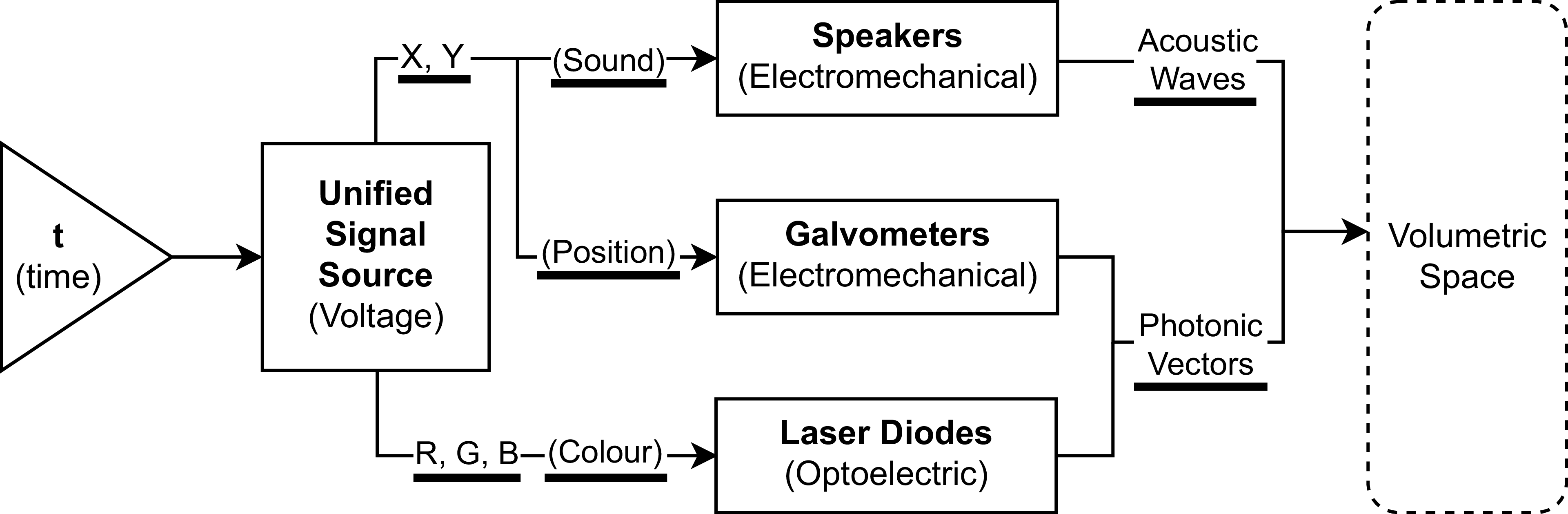
Figure 1 illustrates the synthesis signal flow typical of audio laser synthesis. Mechanically, laser projectors steer a single beam via two mirrors mounted on high-speed galvanometers (‘galvos’). Galvos are capable of operating at audio-rate frequencies, providing the electromechanical basis for the signal duality described above: the same control voltages modulating the X and Y axes are sent to the loudspeakers as audio. Although vector synthesis accurately describes the formal (geometric) graphic output of this process, it fails to capture the medium’s unique five-signal architecture (X, Y, R, G, B), where RGB colour is integrated as a structural parameter alongside spatial coordinates. Finally, unlike screen-based displays, both laser and audio are atmospheric mediums where diffusion is fundamental, distinguishing the phenomenology of audio-laser synthesis from that of broader signal-based media. For these reasons, we propose ‘audio-laser synthesis’ as a unique form of signal-based media that existing vocabulary poorly defines. Its defining characteristic is not the aesthetic of laser light or audio in isolation, but the atmosphere created by their intermedial fusion.
Unified signal architecture of audio-laser synthesis.

Some of the earliest laser lightshows explored the dual utilisation of control voltages as audio (Holzer et al. Reference Holzer, Aron and Holzapfel2023). These experiments typically sonified Lissajous figures; parametric graphs representing phase differences between sinusoidal functions (Lissajous, Reference Lissajous1857). This focus on harmonic relationships situates audio-laser synthesis as a form of visual music, evoking John Whitney’s concept of ‘digital harmony’, which treats graphic wave interference as visualisation of musical counterpoint (Whitney Reference Whitney1980). This endures as an entry point into the practice, with broad connections to cymatics – physical methods of visualising vibrational modes – such as Chladni plates (Chladni Reference Chladni1787).
However, overemphasis on harmonicity might also lead to narrow definitions of music, reinforcing the visual hegemony that audio-laser synthesis resists. Elsa Garmire (Reference Garmire2022), a pioneer of early laser lightshows, described the restriction of working solely with Lissajous figures as, in her words, ‘incredibly boring’, pivoting instead towards diffraction techniques and synchronisation of visual materials with popular music. This primarily temporal coupling of visual components with unrelated soundtracks became the standard for laser lightshows.
Contemporary artists, including Alberto Novello, Robin Fox, Robert Henke, Derek Holzer and Edwin van der Heide, have expanded audio-laser synthesis beyond the constraints of early Lissajous-based practices. This is facilitated by the precision of high-performance projection hardware and modern computer-controlled synthesis, alongside online knowledge mobilisation and improved accessibility of laser equipment.
2.3 Transduction and coupling
Despite technical advances, audio-laser synthesis remains strictly governed by the material limits of its transduction. Here, a critical discrepancy exists between audio and visual domains. Although loudspeakers effortlessly reproduce high frequencies, galvos cannot; the physical mass of the mirrors makes tracking such speeds mechanically destructive. Where such high frequencies are present, audio may lack a visual correlation, since mechanical slew-rate limiting in the laser projector acts as a visual low-pass filter.
This disparity in high-frequency transduction, however, is only one facet of a broader structural asymmetry. Graphic figures drawn too slowly may be inaudible (sub-audio), and visually intricate signals may sound surprisingly simplistic. Inversely, complex sounds (noise) may be uninteresting as graphics. Such disparity limits potential synchresis. Additionally, since waveshape has greater morphological impact than frequency, fundamental pitch changes often create negligible variations in the image. Likewise, the two XY control signals rarely map cleanly onto a left/right stereo field, creating arbitrary or lopsided panning, particularly when figures emphasise diagonal motion or closed loops.
Examples like these, of material asymmetries, fundamentally complicate the perceptual coupling of audio-laser synthesis, a concept that in this context can be rearticulated from its usage in broader audio-visual practice. There, coupling typically involves translating parameters from one media onto another. Techniques to achieve this span from interpretive approaches, limited by subjective bias, to direct mappings, which risk being ‘deterministic and normative’ (Garro Reference Garro2005). However, the methodologies of these processes may be difficult to apply to audio-laser synthesis, simply because in that practice little to no translation occurs. Therefore, perceptual coupling is not the act of synchronising separate streams but of maintaining their inherent unity against hardware asymmetries, like those described above, and sensory limits (detailed in Section 2.5). Crucially, this does not require strict parity or balance between audio and visual domains. Such equality is likely mechanically impossible, and perhaps undesirable. What matters is that both domains express a unified vitality affect, rather than one domain remaining inert or incidental to the other. From this perspective ranges can be established, defined by thresholds of felt integration.
Ultimately, coupling remains a critical aspect of the compositional process, particularly when considering the inherent limitations of audio-visual translation. As Smalley (Reference Smalley1997) observes, regarding the partiality of scores and sonograms, the analyst becomes ‘aware of subjective decision-making’, realising that there is ‘no objective method of achieving a visual spectromorphological representation’ (108). Accordingly, audio-laser composition is best understood as a triadic process where the correlation between audio and visual media is mediated through the signal. Audio or visual components that do not feel coupled are best resolved by remapping to the mediating signal itself, contrasting representational audio-visual approaches.
2.4 Radiance
Laser colour generation is also signal-based, and the control of these signals further nuances audio-laser aesthetics from broader vector synthesis. Modern projectors modulate the intensity of three independent diodes (Red, Green, Blue), which are spectrally combined via dichroic mirrors. Because these RGB inputs also accept continuous waveforms, colour can be treated as an audio-rate signal capable of sonification. Through this parameterisation, colour is more than a secondary component of imagery and can be equally coupled to sound.
This concept of sound-colour is foundational to audio-visual composition, underpinning various synaesthetic colour theories. Whitney (Reference Whitney1980), for instance, envisioned a medium where colour is liberated from the stasis of pigment to become as ‘ephemeral and transient as tones’ (89). In audio-laser synthesis, amodal fusion is rarely achieved through the direct mapping of colour to image or sound, but by leveraging signal behaviours that transcend either domain. For instance, because visual form is defined by frequency relationships rather than absolute frequencies, phase-locked frequency shifting can modulate colour without affecting the image, a decoupling of sound and image that can be mitigated by establishing frequency–colour relationships. Section 3.2 outlines additional strategies for the treatment of colour, with the ultimate goal of collapsing sound, shape and colour into a unified, duophonic system.
Colour in this practice can be folded into the broader notion of radiance, encompassing colour, brightness and volumetric diffusion (as spatial concepts that can be equally applied to visual and aural phenomena). Just as electroacoustic sound is inseparable from acoustics, the techno-aesthetics of audio-laser synthesis are inseparable from its diffusion. The laser’s extension into space renders media and surfaces active components of the work. Atmospheric particulates – most notably smoke or haze – thicken the beam into a volumetric structure; a single point becomes a beam, a closed loop becomes a column, and a rotating form becomes an enveloping spatial gesture. Scale and clarity depend on the medium through which light is projected. Material encounters with curtains, water or architectural features further modulate the beam’s path through scattering, absorption, diffraction or diffusion.
Surface interactions also fundamentally influence the projected imagery: darker surfaces absorb light, altering colour perception, whereas surface texture distorts projected forms. More than a performance limitation, this variability becomes a compositional affordance. For example, Novello’s Black Light (Reference Novello2020) allows surface characteristics to play a central role by projecting laser imagery onto a phosphorescent canvas that holds momentary forms and allows them to slowly decay.
‘Radiance’ is especially useful when accounting for the affective experience of audio-laser synthesis beyond the surface-graphic domain. Diffusion presents both a feature and a challenge for the practice. For instance, spatial characteristics can obscure the strict alignment of audio and graphic media so that a reverberant space weakens precise synchronisation between sound and image. Consequently, audio-laser synthesis is best designed as a site-situated practice that can adapt to, or enhance, the specific features of the performance environment.
This environmental co-constitution is further heightened by colour, representing another departure from strictly graphic AV traditions, and a core point of alignment between audio-laser synthesis and broader light-based arts. Additive RGB colour generation – where variation is achieved not by shifting diode frequencies, but modulating the brightness of individual channels – emphasises the spatiality of colour through brightness, a parameter that functions qualitatively in both aural and visual domains, and their amodal fusion. Gernot Böhme (Reference Böhme2017) writes that in a phenomenology of light this brightness is fundamental, preceding ‘every particular perception, for example of colours, shapes or things’ (147). Focusing on the moment of illumination, he describes the atmosphere of brightness as a ‘cleared space’, a ‘lightening’ opening up from enclosing darkness, modulating felt space.
The concept of radiance unifies potentially heterogeneous elements of audio-laser synthesis through closer focus on spatial diffusion, coupling sound and light rather than just graphics and audio. This presence stems from the medium’s distinct materiality, which Ronald Pellegrino (Reference Pellegrino1983) describes as an ‘incomparable living quality’ to laser light, derived from the quantum physics of stimulated emission (179). Unlike the broad, noise-like spectrum of incandescent light, a laser generates a coherent, monochromatic wavelength that is precise and intense. This constructs virtual spaces when, in moments of relative stability and periodicity, graphics appear as labyrinthine pathways or architectures. Just as Böhme contrasts the atmospheric quality of lightened spaces with those spaces ‘made of light’, seen ‘from the outside … like an object’, coexisting spatial modalities are constructed and inhabited simultaneously in audio-laser composition.
2.5 Projection
Together, brightness and amplitude elicit a visceral, embodied reaction. While laser safety is a pragmatic concern, the felt danger of loud light may also be understood as an aesthetic dimension in its own right. Like the extreme amplitudes of drone or noise music, audio-laser synthesis operates at perceptual thresholds where intensity itself becomes compositional material.
Evoking a primal fear, an affective intensity preceding audio-visual perception, performances recall Erin Manning’s (Reference Manning2013) description of ‘latent potentiality’, where the environment is saturated with affective forces: ‘Take the example of a snake in the context of a phobia. Walking through the desert everything is felt as the force of snakeness’ (26). Fear is only one such force. Therefore, while radiance encompasses the amodal diffusion of audio-laser synthesis, projection acknowledges the many roles of individual perception in composing narrative and form.
This personal dimension of audio-laser works remains bonded to the techno-aesthetics of the medium when considering its direct engagement and manipulation of the perceptual system, exploiting for instance discrepancies between auditory and visual temporal resolution. Although the auditory system can resolve gaps as short as two to three milliseconds, meaningful visual fixation typically requires a minimum threshold of approximately 100 milliseconds (Manor and Gordon Reference Manor and Gordon2003). Because the laser beam traces coordinates at audio rates (thousands of times per second), the signal’s movement effectively outruns this cognitive capture. Where hearing resolves this modulation as timbral detail, vision is physiologically overwhelmed, fusing the trajectory into a stable image. The perceptual ‘object’ is therefore the failure of the visual cortex to resolve the point’s trajectory, just as perceived tones rely on audio-rate periodicity. Through these discrepancies, audio-laser synthesis extends op-arts engagement with perceptual thresholds into multimodal and amodal frameworks.
3. Audio-laser composition: methods and challenges
Section 3 details specific strategies for audio-laser composition derived from our own compositional practice (performing as Augurs’ Wand), outlining insights and challenges from the design and performance of Phosphene, a custom virtual modular laser synthesiser with over 40 modules made specifically for audio-laser synthesis. In this system, all modules are duophonic, matching the XY configuration of the laser projector, and designed around a phasor-centric philosophy as described by Graham Wakefield and Gregory Taylor in Generating Sound & Organizing Time (Reference Wakefield and Taylor2022). A master phasor serves as the single source of temporal truth; most modules require this time (t) input: a 0–10 v ramp from which forms, modulations and synchronisation procedurally derive (further detailed in Cassidy and North Reference Cassidy and North2026a). This temporal foundation ensures strict periodicity and phase-locking, allowing figures to maintain visual stability, whereas rhythmic alterations manifest as morphological transformations.
3.1 Amodal compositional framework
As signal-based media transcends questions of temporal synchronisation by nature of the medium, it foregrounds the qualitative relationship between sound and image. Rather than assessing output through separate audio and visual criteria – asking ‘Does this look good?’ or ‘Does this sound good?’ – the compositional strategies outlined attune to amodal behaviour, allowing sound and image to emerge. Synthesis first discerns what the signal wants to do and then actualises that potential through modulation and diffusion. ‘Vitality affects’ refers to this realisation, establishing an amodal vocabulary applicable in both audio and visual domains, and most critically in their fusion. Following Stern (Reference Stern1985), they are expressed through subjectless present participles rather than adjectives. Although Section 3 offers only a few terms (selected from Stern and developed through practice), any application of this approach should resist differentiated sensory description and objectivity in analysis-synthesis. In graphic terms, the compositional goal of vitality replaces form and iconography with an undifferentiated kinetic encounter. In our experience, this conceptual shift proves highly productive for audio-laser practice.
The technical realisation of this approach starts with a stable form (source), which is obscured through modulation. Phosphene’s source modules function as complex oscillators that couple two or more signals with cross-modulation. Each generates XY voltage pairs as parametric functions of time, creating geometric trajectories with emergent visual and sonic identities. These figures are selected for their behavioural potential, not for their visual appeal or sonic profile in isolation. Some deliberately probe the mechanical limits of the system. The Hilbert curve is one such case: when driven at higher orders and velocities, the galvos cannot resolve its finest turns, effectively collapsing the figure to a lower-order variant. Crucially, this is not a failure of representation but a consequence of the curve’s own logic. As it encodes space-filling efficiency at every scale, the form remains fractal even as its order is physically reduced.
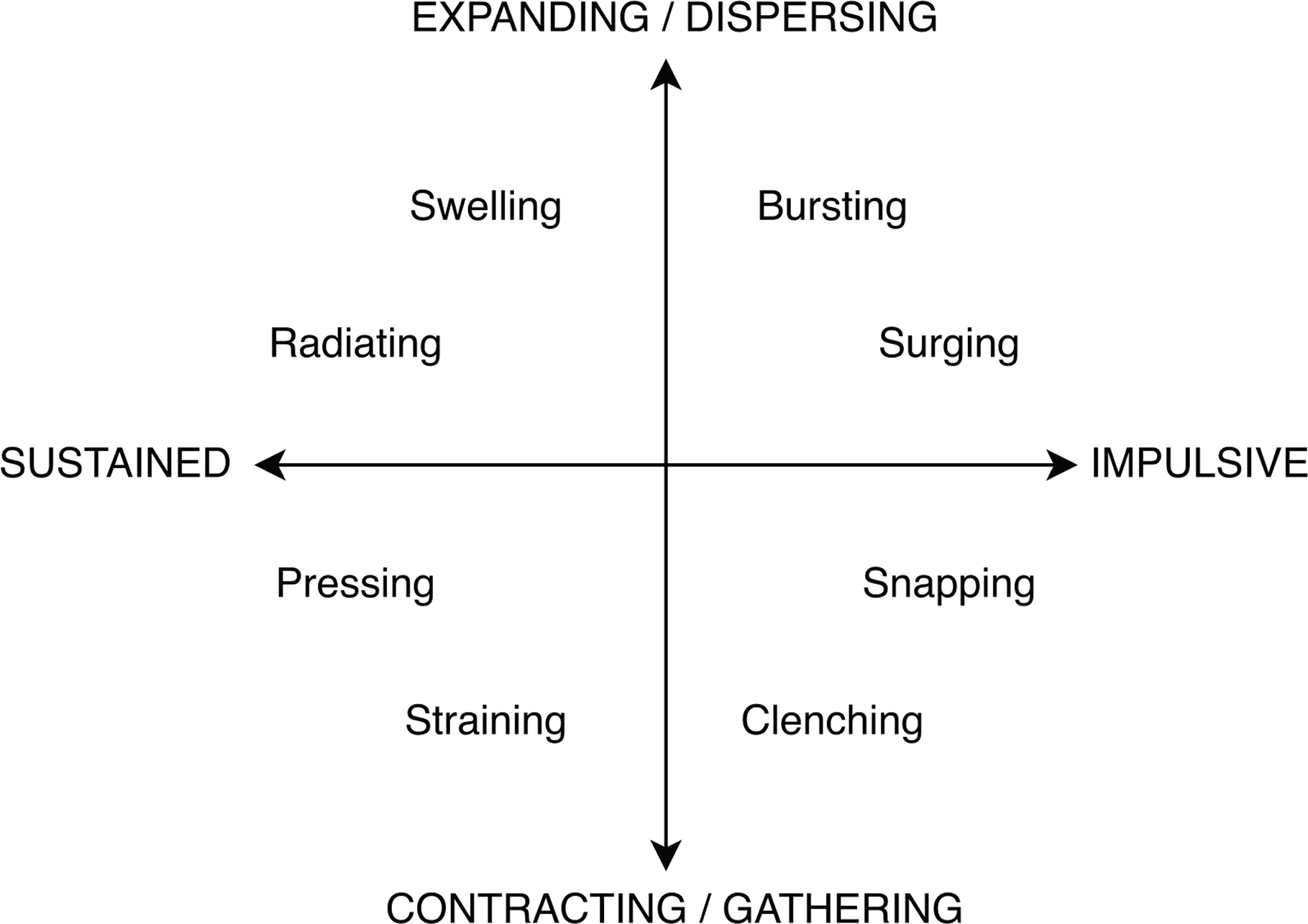
Source tendency describes the intrinsic behavioural disposition of this periodic signal: what it does, dynamically, prior to and across its audio-visual expression. These tendencies are identified with kinetic terms (e.g., interweaving, rotating, accumulating, oscillating, folding) avoiding behavioural descriptors that privilege a differentiated mode of sensory experience (visual or aural). Vitality affects emerge when tendency, shaped through inflection and articulation, becomes atmosphere: straining, pressing, surging, swelling, radiating, bursting (more examples are shown in Figure 2). This mediates the relationship between tendency and affect: the same source tendency, differently inflected, yields different vitality affects. For instance, a contracting tendency with a graduated envelope produces pressing or sinking affects; the same tendency with an impulsive envelope produces snapping or clenching affects, a sudden closure rather than a sustained weight. Figure 2 maps vitality affects along sustained/impulsive and expanding/contracting dimensions, illustrating the affective range available through inflection strategies.
Mapping the vitality affect space.

Despite the amodal nature of this analytic vocabulary, source tendency may be engaged through synthesis entry points that are predictable in one domain (graphic or audio), while immediately implicating emergent outcomes in the other. Generating geometries specifies topology, trajectory and phase relationships that may be more graphically than sonically predictable. By contrast, using an audio-synthesis logic, treating audio channels with filters, envelopes or waveshapers, may create unpredictable graphic consequences. Crucially, these points of entry are not preliminary stages but concurrent modalities of access operating throughout the process. At every point – specifying tendency, applying inflection, evaluating affect – composition leverages an existing audio or graphic synthesis logic, discovers consequences in the other domain and iterates.
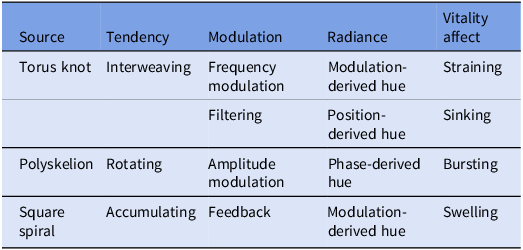
Table 1 illustrates representative paths through this framework, showing how source tendencies, under different modulation and radiance conditions, yield different vitality affects. Figure 3 illustrates the recursive nature of this progression, emphasising the relationship between affect and intention. The video examples show two periodic sources (polyskelion and square spiral) brought to life through this process. A primary composition technique compares reduced and integrated sensing: closing the eyes to listen, then covering the ears to look, then experiencing the unified media. If the signal maintains a coherent behavioural character across these conditions – if behaviour is felt as a single phenomenon rather than as separate coordinated events – the conditions for amodal synthesis begin to emerge. Conversely, if the signal feels compelling in one modality but inert in the other, or if the two domains feel merely synchronised rather than fused, synthesis requires adjustment at the level of tendency or inflection. This process involves a continuous threshold-seeking of precise modulation depths. Ultimately, the goal of amodal audio-laser composition is to match signal unity with perceived unity.
Source tendencies with applied modulation and radiance, resulting in vitality affects

Table 1. Long description
A table with four columns and three rows. The columns are labeled Source, Tendency, Modulation, Radiance, and Vitality affect. Row 1: Source, Torus knot; Tendency, Interweaving; Modulation, Frequency modulation; Radiance, Modulation-derived hue; Vitality affect, Straining. Row 2: Source, Torus knot; Tendency, ; Modulation, Filtering; Radiance, Position-derived hue; Vitality affect, Sinking. Row 3: Source, Polyskelion; Tendency, Rotating; Modulation, Amplitude modulation; Radiance, Phase-derived hue; Vitality affect, Bursting. Row 4: Source, Square spiral; Tendency, Accumulating; Modulation, Feedback; Radiance, Modulation-derived hue; Vitality affect, Swelling.
Generative framework for amodal audio-laser composition.

Modulation, in this framework, is the act of realising latent potential, transforming source tendencies into vitality affects by intervening in the signal’s ‘energy-motion trajectory’ (Smalley Reference Smalley1997). Because the same source tendency, modulated differently, can yield different vitality affects, the compositional challenge lies in negotiating a precise alignment between source and modulation signals. At this stage, modulation contours should respect the phase of the source signal (tendency). Furthermore, this phase relationship determines whether modulation is perceived as changes to a source tendency’s essence or a change in its movement. This is not a causal relationship but a fusion process and an intermediary stage in the composition of a singular vitality affect: inflecting the source signal with spectral-kinetic dynamism.
For instance, by introducing slew-limiting (lag) to a modulation signal, stepped control voltages are forced into fluid curves rather than immediate shifts, conveying elasticity and resistance to acceleration. Contouring regulates this temporal profile. Short, percussive envelopes reduce the tendency to an impulse, appearing as a flash of light and a pulse of sound. Long, sustained envelopes create graduated continuants, allowing the tendency to completely unfold, pressing or surging.
Phase-locked modulation creates new, evolved source tendencies, whereas subtle shifts in phase contribute to a perceptual dialectic between source tendency and vitality affect. Because the audio-laser signal flows through a serial chain of processors, an inflected trajectory becomes the source material for subsequent modulations, which can be locked into new source tendencies, and so on. This navigation – between a stable, periodic form and the vital realisation of its underlying tendency – is a common gesture in our compositional approach (Figure 4).
Source tendencies (L) through inflection (modulation) and articulation (radiance) (R).

3.2 Colour
Unlike the electromechanical unity of the XY-audio pair, where one signal physically drives two outputs, colour generation requires a mapping layer. A voltage describing an X-coordinate does not inherently contain colour information, composition must define the relationship. To avoid the arbitrary ‘translation’ logic of cross-modal synaesthesia common in visual music – such as associative mappings where the pitches of a triad are mapped to red, green and blue – an amodal approach might treat colour as a structural articulation of its modulation, rather than a representation of XY signal parameters (e.g., frequency, waveshape). Consequently, the spatial arrangement of colour spectrums can be treated as a topology for modulation.
Composing in this way anchors colour to the same generative forces creating imagery or audio. Some strategies from this principle include: phase-derived colour, which maps the master phasor to a Hue Saturation Value (HSV) to RGB conversion, cycling hue in lockstep with the figure’s temporal unfolding so that colour aids in the visualisation of phase position itself; position-derived colour, which determines RGB values through spatial equations applied to XY coordinates with gradients and interference patterns emerging from the geometry’s occupation of space; and modulation-derived colour, which maps processing intensity to hue or saturation, making the depth of transformation visible. These strategies can be combined; phase-derived colour might form a baseline coherence, whereas modulation depth pushes towards saturation at intensity peaks, and position-based equations add spatial texture.
As outlined in Section 2.4, our compositional approach includes colour as a component of radiance – an atmospheric parameter driven by the signal’s internal tension. Consider a signal exhibiting compression – a tightening, intensifying behaviour. By mapping this modulation to global intensity, the behaviour manifests simultaneously as a geometric contraction, a spectral brightening and a chromatic concentration towards monochrome. If successful, the audience does not experience the sound getting brighter, the image getting smaller and the colour changing as separate coordinated events, but rather a single compressive intensity. By deriving radiance from the same temporal processes governing form and sound, colour becomes – more than decoration – a core component of signal vitality.
3.3 Temporal zones
Underlying visual music discourse is the notion that music exists beyond sound, foregrounding formal principles. Composing visual music, we have uncovered a variety of temporal zones, higher-level tendencies suited to the techno-aesthetics of audio-laser synthesis.
These include: the sustained zone, characterised by stability and duration. This is the graphic territory of op-art, where endless spirals, radiating fractals and slow geometric breathing are coupled with sustained drones. A compositional danger of this zone is visual dominance over static and repetitive audio, but when successful, the sustained zone can produce meditative and trance-inducing movements; the morphological zone, characterised by continuous flux. This is the zone of becoming, where the signal is in a constant state of transformation. The image is never static, it is always expanding, folding or rotating, establishing a fluid time where the correlation between sonic timbre and visual shape is most explicit; the volumetric zone, characterised by impulse and spatial texture. This zone retreats from the graphic towards bursts of light and sound that articulate space in time. By shattering the continuity of the beam into discrete, high-velocity impulses, composition moves from a qualitative audio-visual logic to a rhythmic logic.
Navigating between zones (transitions) is a central challenge in generating complex musical structures, whether linear or non-linear.
3.4 Multi-laser composition
Musical complexity can be further expanded using multiple laser projectors and therefore voices. When composing for multiple lasers, projections can be panned across the visual field or layered to form a coherent, polyphonic entity. Furthermore, transition between these modes – from superposition to separation – is an effective gesture from monophony to polyphony.
For example, in the second section of our piece Third State (Cassidy and North Reference Cassidy and North2024) three projectors operate as differentiated voices of a single oscillator. Temporal offsets and slight detunings form a spatial counterpoint, analogous to canonic writing. Each voice shares source tendency but receives slightly different inflection; the resulting texture acquires depth and dimensionality unavailable to a single projector voice. The combinatory moment when a quasi-triangular entity emerges from audio-rate crossfading between separately positioned signals demonstrates how multiple tendencies can fuse into a unified vitality affect (Figure 5).
Fusion of three laser signals as one entity in Third State.

In Smoke Screen (Cassidy and North Reference Cassidy and North2025) and Akoniton (Cassidy and North Reference Cassidy and North2026) by contrast, each projector behaves as an independent voice interacting within a shared spatial field. When projectors maintain a distinct voicing, divergence in modulation depth or phase alignment produces developmental tension: one figure may stretch when another contracts, or one may drift out of periodicity when another holds stable. The addition and subtraction of these voices becomes a primary dynamic force of the piece (Figure 6).
Layering of three laser signals functioning as independent voices in Akoniton.

Beyond independent or canonic voicing, multi-laser systems can function through interdependency, where the behaviour of one voice is modulated by the state of another. Phosphene features several multi-laser modules that facilitate this by integrating attraction and repulsion forces between independent Cartesian coordinate sets. By mapping spectral harmonic ratios to these inter-voice distances, the system moves from a collection of discrete objects to a singular dynamic field. A change in one voice’s frequency might physically pull another’s geometry, creating webs of mutual interference and treating the entire audio-laser field as an emergent organism.
Cross-dependent behaviour creates a unified field of intensity. The audience experiences a single atmospheric pressure, rather than separate laser projections, just as a thunderstorm is experienced as a unified climatic intensity rather than separate rain, wind and lightning. The goal remains consistent across single- and multi-laser configurations: to saturate the sensorium with kinetic intensity that resists parsing into component parts, foregrounding amodal experience.
4. Conclusion
This article has proposed amodal synaesthesia as a compositional framework for audio-laser synthesis, through a techno-aesthetic analysis of the artform (Section 2) and by outlining some of the authors’ own compositional methodologies and techniques emerging from artistic practice (Section 3). As a subset of signal-based media, the field offers audio-visual practice a limit-case, where the separation of media exists only in perception. The challenge this poses – matching perceptual unity to signal unity – foregrounds the active role of the composer in constructing vitality affects. The compositional framework proposed here provides both analytical vocabulary and practical methodology for this work, positioning audio-laser synthesis as a genuine intermedial field where the kinetic intensity of modulation itself becomes a singular aesthetic encounter.
Supplementary material
The supplementary material for this article can be found at https://doi.org/10.1017/S135577182610154X


 Open access

