Introduction
Following the United Nations Conference on Environment and Development, which is also known as the ‘Earth Summit’, that was held in Rio de Janeiro in 1992, different governments have adopted the Convention on Biological Diversity (1992). This Convention aims for sustainable preservation of biodiversity through its components, and grants equitable sharing of the benefits of the genetic resources. Agricultural biodiversity, or agrobiodiversity, is a component of biodiversity that has a key role in not just the food sector, but also those of renewable primary products, industrial biomass and bioenergy production (Schröder et al., Reference Schröder, Begemann and Harrer2007; Frison et al., Reference Frison, Cherfas and Hodgkin2011). However, over the last century, around three-quarters of the genetic diversity in agricultural crops has been lost, and this genetic erosion continues today (Jackson et al., Reference Jackson, Pascual and Hodgkin2007; Schröder et al., Reference Schröder, Begemann and Harrer2007; FAO, 2010). As an example of this process, as early as 1990, Miller and Tanksley demonstrated that the cultivated tomato represents <5% of the total genetic variability of the Solanum lycopersicum species (Miller and Tanksley, Reference Miller and Tanksley1990).
The International Treaty on Plant Genetic Resources for Food and Agriculture that was negotiated by the Food and Agriculture Organization of the United Nations (FAO) Commission in 1996 engaged parties for sustainable use of the genetic resources, and recognized the roles and rights of farmers in their conservation, through using and improving the agricultural genetic resources (FAO, 1996). More recently, the importance of varieties at risk of genetic erosion was highlighted in a European Union report ‘Agricultural Genetic Resources – from conservation to sustainable use’ (European Union, 2013), in which the conservation and commercialization of these products was encouraged through the promotion of implementation of policies and programs and the use of marketing strategies to valorize agrobiodiversity. One such incentive might be through the use of labels or logos to indicate the added value of a product and the European certification of geographical origin and quality, such as Protected Designation of Origin (‘PDO’) and Protected Geographical Indication (‘PGI’) (Sacco et al., Reference Sacco, Cammareri, Vitiello, Palombieri, Riccardi, Spigno and Grandillo2017; Oehen et al., Reference Oehen, Meier, Holzherr and Förster2018).
Among the cultivated species, the landraces, also called regional or ancient local varieties, represent the earliest forms of cultivated varieties that were selected by farmers for subsistence agriculture in variable environments. Hence, these landraces constitute an important crop heritage and a precious source of genes that underlie the quality and productive traits that can be exploited in marginal environments (Harlan, Reference Harlan1975; Brush, Reference Brush and Brush2000; Causse et al., Reference Causse, Buret, Robini and Verschave2003; Villa et al., Reference Villa, Maxted, Scholten and Ford-Lloyd2005; Ficiciyan et al., Reference Ficiciyan, Loos, Sievers-Glotzbach and Tscharntke2018). Indeed, for example, Lafitte et al. (Reference Lafitte, Edmeades and Taba1997) identified maize landraces that showed greater nutrient use efficiency than modern varieties, García et al. (Reference García, Piqueras-Aljarilla, Font, Pascual-Asso, Gómez and Del Rio2016) identified a tomato landrace with extra value in terms of fruit yield, weight, firmness, and flavor, and carotenoids and ascorbic acid content, and Fullana-Pericàs et al. (Reference Fullana-Pericàs, Conesa, Douthe, El Aou-ouad, Ribas-Carbó and Galmés2019) reported on several tomato landraces that showed high tolerance to water stress.
While conservation of the landraces has been widely achieved, the aspect of significant importance now is to boost sustainable agriculture and environmental protection, and to increase the performance of some of the most productive crops (Brush, Reference Brush and Brush2000; Ceccarelli et al., Reference Ceccarelli, Grando, Tutwiler, Baha, Martini, Salahieh, Goodchild and Michael2000; McCouch, Reference McCouch2004; Gepts, Reference Gepts2006). Indeed, the use of landraces in domestic markets can contribute to ensuring the sustainability of rural communities and to satisfying consumer demands (Brugarolas et al., Reference Brugarolas, Martínez-Poveda and Ruiz2009; Gracia et al., Reference Gracia, Sánchez, Jurado and Mallor2020; Pérez-Caselles et al., Reference Pérez-Caselles, Brugarolas and Martínez-Carrasco2020).
However, an issue with these landraces when compared to commercial hybrids is their high market price, which is a direct consequence of the added production costs due mainly to both lower productivity and reduced resistance to pathogens (Brugarolas et al., Reference Brugarolas, Martínez-Poveda and Ruiz2009). On the other hand, a wide sector of consumers might be willing to purchase these products, as they are also often characterized by higher quality and better sensory characteristics (Balogh et al., Reference Balogh, Békési, Gorton, Popp and Lengyel2016).
In this sense, consumers and agro-food industries have an important function, as they determine the decisions made across the supply chain, and they thus influence production patterns (Botelho et al., Reference Botelho, Dinis, Lourenço-Gomes, Moreira, Costa Pinto and Simões2018; Lázaro Reference Lázaro2018). Consumer decisions in food purchases are influenced by several factors, including environmental, production, nutritional and qualitative concerns (Moser et al., Reference Moser, Raffaelli and Thilmany-McFadden2011). Consumer perception of quality is influenced by the intrinsic and extrinsic attributes of a product, some of which can be evaluated before the purchase (e.g., price, dimension, size, color), while others can be determined only after consumption (e.g., taste, flavor, convenience) (Moser et al., Reference Moser, Raffaelli and Thilmany-McFadden2011; Oltman et al., Reference Oltman, Jervis and Drake2014).
Among all of these characteristics, the color, size and shape of fruit and vegetables are the main determinants for consumer purchases (Serrano-Megías and López-Nicolás, Reference Serrano-Megías and López-Nicolás2006; Kader, Reference Kader2008; Causse et al., Reference Causse, Friguet, Coiret, Lépicier, Navez, Lee, Holthuysen, Sinesio, Moneta and Grandillo2010). Nonetheless, some recent studies have revealed consumer concerns about standardized products, and about too many ‘food miles’ and the energy use of the supply chain. This has indicated increased consumer distrust in global markets, and the consequent increased attention on product quality and sustainability (Giampietri et al., Reference Giampietri, Verneau, Del Giudice, Carfora and Finco2018). In line with this, consumer demand for ‘niche’ products has significantly increased, especially in terms of demand for organic food, locally grown produce and traditional foods (Annunziata and Vecchio, Reference Annunziata and Vecchio2016; Balogh et al., Reference Balogh, Békési, Gorton, Popp and Lengyel2016; de-Magistris and Gracia, Reference de-Magistris and Gracia2016; Skreli et al., Reference Skreli, Imami, Chan, Canavari, Zhllima and Pire2017; Meyerding et al., Reference Meyerding, Trajer and Lehberger2019; Gracia et al., Reference Gracia, Sánchez, Jurado and Mallor2020).
The emergence of studies on consumer preferences for traditional and ancient local varieties has underlined the importance of valorization of the genetic resources, and suggested that these products can be appreciated by consumers (Pérez-Caselles et al., Reference Pérez-Caselles, Brugarolas and Martínez-Carrasco2020; Bairagi et al., Reference Bairagi, Custodio, Durand-Morat and Demont2021), thereby avoiding loss of income for farmers who produce such landraces (Brugarolas et al., Reference Brugarolas, Martínez-Poveda and Ruiz2009; Botelho et al., Reference Botelho, Dinis, Lourenço-Gomes, Moreira, Costa Pinto and Simões2018). Consumer purchasing attitudes and behavior have been widely explored, primarily using preference techniques such as choice experiments (Moser et al., Reference Moser, Raffaelli and Thilmany-McFadden2011). This method can be used to extend the knowledge of the value of agrobiodiversity that is assigned by consumers, and to design future programs related to such ancient local varieties, to encourage farmers to conserve and cultivate these valuable genetic resources.
On this basis, an analysis of choice experiments that involved 920 Italian consumers was carried out to estimate their willingness to purchase ancient local tomato varieties rather than commercial varieties. We focused on tomato (S. lycopersicum L.) landraces to determine any differences in consumer attitudes and preferences within a more articulated basket of choices available to the consumer, as it is an important horticultural crop that is grown and commercialized worldwide, all year round.
Over the past two decades, tomato production worldwide has almost doubled, in terms of the area dedicated to its cultivation (FAOSTAT, 2020). Obviously, this increase in tomato production corresponds to its increased consumption. Indeed, in Mediterranean countries, the highest average consumption of tomato has reached values between 20 and 100 kg per person per year (FAOSTAT, 2020). In Italy, the cultivation of tomatoes has a long tradition, and Italy is the leader in Europe, with the production of 5,252,690 tons in 2019 (FAOSTAT, 2020). The importance of this species is also confirmed by the wealth of agrobiodiversity heritage that is still present today, which represents an important resource that needs to be further studied and valorized to address this increasing consumer demand. Indeed, Italy is one of the richest countries for ancient tomato varieties (Attene and Rodriguez, Reference Attene and Rodriguez2008; Mazzucato et al., Reference Mazzucato, Papa, Bitocchi, Mosconi, Nanni, Negri, Picarella, Siligato, Soressi, Tiranti and Veronesi2008; Corrado et al., Reference Corrado, Piffanelli, Caramante, Coppola and Rao2013; Scintu, Reference Scintu2014; Attene et al., Reference Attene, Rodriguez, Scintu and Rau2015; Baldina et al., Reference Baldina, Picarella, Troise, Pucci, Roggieri, Ferracane, Barone, Fogliano and Mazzucccato2016; Rodriguez et al., Reference Rodriguez, Scintu, Posadinu, Xu, Nguyen, Sun, Bitocchi, Bellucci, Papa, Fei, Giovannoni, Rau and Attene2020).
In more detail, the aims of this study were to determine the potential value of these local products according to consumer preferences, and the importance (i.e., ‘weight’) that these consumers assign to each of the attributes that describe the goods. Estimation of willingness to pay might define which attributes mainly contribute to consumer preference and what role the characteristics of landraces assume in the (stated or latent) consumer choices. The results obtained through this study will be useful to plan strategies and programs to support the cultivation of ancient local tomato varieties, and to develop regional and national markets that can acknowledge their characteristics. Indeed, the development of niche markets that positively enhance the cultivation and consumption of ancient local varieties makes the activity of farmers profitable, supporting thus the economy of rural areas and, at the same time, preserving important genetic heritages (Brugarolas et al., Reference Brugarolas, Martínez-Poveda and Ruiz2009; Pérez-Caselles et al., Reference Pérez-Caselles, Brugarolas and Martínez-Carrasco2020).
Materials and methods
The choice experiment
A choice experiment approach was used to estimate the value of the ‘local variety’ attribute for tomatoes sold in retail. The choice experiment was applied to initially understand whether there is a willingness on the part of the consumers to pay a ‘premium price’ for ancient local varieties of tomatoes. This then further determines how much this extra might be, and as a consequence, how much the sellers can apply.
The choice of investigating the willingness to pay in terms of premium price was suggested by the need of considering a generic product and not a well-specified typology of tomato. Indeed, the ‘local’ tomato is not a given quality of commercial product, but ‘local’ is an attribute that can be related to different landraces (varieties) that are differently marketable. In this sense, it is hardly possible to individuate a unique reference price—each product would have its own reference price—therefore we carried on an analysis in which respondents were asked their willingness to pay a premium price for a product that shows (or not) given attributes. The stated preferences of the consumers for ancient local tomato varieties were then evaluated on the basis of the different characteristics of the tomatoes.
The methods for ‘choice experiments’ come from the Lancaster characteristics theory of value (Lancaster, Reference Lancaster1991) and from random utility theory (Thurstone, Reference Thurstone1927; Manski, Reference Manski1977). The rationale is that any goods that are marketable or not can be described in terms of inherent attributes and their intensities, including the price, whereby the attributes define the consumer demand, not the goods themselves. Choice experiments involve hypothetical scenarios and the presentation of a ‘choice set’, where the respondents are asked to express their preference among the different alternatives, one of which is a ‘base case’. The alternatives are described by their various characteristics, as the attributes, and the price (Louviere et al., Reference Louviere, Hensher and Swait2000; Holmes et al., Reference Holmes, Adamawicz, Carlsson, Champ, Boyle and Brown2017). This method allows the determination of the relative importance for the consumer choice processes of the various attributes of the products that are compared (Adamowicz et al., Reference Adamowicz, Louviere and Swait1998; Moser et al., Reference Moser, Raffaelli and Thilmany-McFadden2011). First, the attributes and their levels need to be identified; then, experimental design theory is used to generate more profiles of the goods in terms of their attributes and the intensity of their attributes.
Experimental design
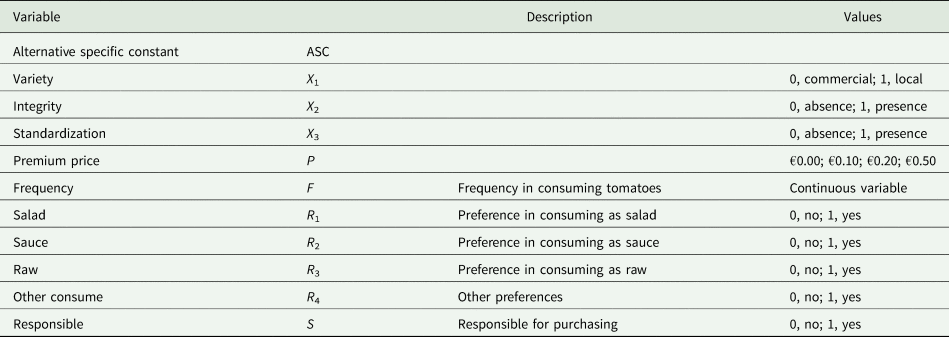
To better promote choice making for the consumer, this study was carried out with the local variety attribute as part of a basket of marketable and independent tomato attributes, which included premium price. Thus, the choice of local vs commercial was combined with fruit integrity and form (standardization) and the possibility of a premium price (Table 1).
Attributes and their levels used in the choice experiment design

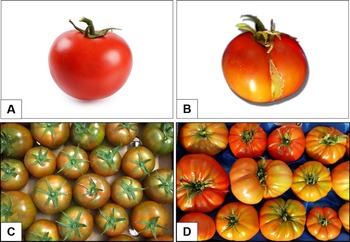
Thus, the first attribute of ‘variety’ was defined as a local tomato variety (i.e., a landrace) or a commercial variety as the alternative, as a generic variety and without any further information supplied. The second attribute of fruit ‘integrity’ was defined as the presence or absence of defects on the fruit surface (Fig. 1A, B), as is often relevant for local varieties of tomato. The third attribute was ‘standardization’, as the uniformity (or not) of the dimensions of the fruit, which represents a characteristic typically looked for in modern commercial varieties (Fig. 1C, D). These variables of integrity and standardization were introduced to better assess consumer preference with respect to the local variety attribute. The integrity and standardization of fruit and vegetables can influence consumer choice, and as common aspects they were treated as independent variables. The presence of imperfections and the lack of standardization are sometimes associated with local tomatoes, and therefore it was necessary to evaluate the preferences with respect to the single attribute of local variety within a likely market context.
Representative examples of the integrity and standardization attributes. (A, B) An intact fruit (A) and a fruit with an imperfection on the surface (B). (C, D) Standardized variety characterized by fruit with a uniform shape and size (C) and by a non-standardized variety with very variable shapes and sizes of the fruit (D).

Finally, the premium price attribute was introduced as it reflects the incremental price that consumers say that they would be willing to pay for a given choice. On the basis of suggestions obtained after discussing an initial outline with a sample of interviewers, the (marginal) prices were set as a willingness to pay an extra €0.00, €0.10, €0.20 and €0.50 per kilogram of tomatoes (Table 1).
After a pilot survey with 50 respondents, a random sample of 920 consumers were interviewed throughout Italy. The pilot survey was used to confirm the study design, the comprehensibility of the content and the premium price attribute. The final questionnaire was an online survey created using the LimeSurvey open-source web application software (http://limesurvey.org/), and it was open to participants for 10 weeks (see Supplementary Note S1). Participation in the survey was anonymous and voluntary, and the participants were mostly recruited by sharing the survey through social media. The sample is not stratified for inherent characteristics (e.g., social, demographic, economic). The choice derives from the need to interview only people interested in the subject of the investigation, thus minimizing the risk of protest votes. We are aware that this choice may not return a representative sample, but at the same time, the survey is more aimed at tomato consumers and/or those really interested in the topic. On the other hand, even by resorting to stratified sampling, the probable exclusion of protest votes still leads to a final sample that may not be fully representative of the reference population. Informed consent was obtained from each participant after reading the survey information sheet to ensure that all of the data would be treated with full respect of privacy and anonymity, and exclusively for the purposes of their statistical processing and publication for scientific purposes.
The survey was divided into five sections (see Supplementary Table S1). The first informed the participants about the relevance of preservation of biodiversity and the importance of valorization and use of the genetic resources, both to illustrate the issue and to describe the characteristics of this kind of product. In the second section, a hypothetical agrobiodiversity program focused on the conservation and valorization of ancient local tomato varieties was presented to the participants. Here, each consumer was invited to participate in the choice experiment (or survey) on the basis of being willing to contribute to the hypothetical program through the payment of a premium price when purchasing an ancient local variety. Some instructions to fill in the survey were also given. The third section contained the cards with the choice options. Then, in the fourth section, five questions were proposed to examine the consumption preferences and general purchasing behavior of the participants (e.g., relevance attributed to local varieties, frequency of consumption, place of purchase). Finally, the fifth section contained some socio-economic questions (i.e., gender, age, region of origin, education level, profession). The survey ended with an open-ended question to collect suggestions, advice, clarification, criticism and anecdotes.
Specifically, in section three, ten random cards were shown to each respondent. Each card included three alternatives, where each showed a random combination of levels for each attribute. Three different options were thus represented on each card:
(i) The ‘status quo’ represented the basic option, and it was always shown on each card. It was defined by the level of ‘commercial’ for the variety attribute, ‘absence’ for the integrity attribute, and ‘presence’ for the standardization attribute. The (premium) price level was set to €0.00.
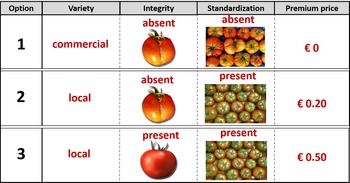
(ii) (ii, iii) The two different relevant alternatives. These were different for the attributes at each level and with respect to the status quo (Fig. 2).
An example card used in the choice experiment.

Each of these three alternatives reported on a card was randomly generated. A full factorial design was generated which consists of all possible combinations of the levels of the attributes and permits an estimation of the main effects and interactions (Mangham et al., Reference Mangham, Hanson and McPake2009). In other terms, we have chosen to show all the possible alternatives, with the strict criteria of being equally represented in the sample. This choice was suggested by the limited number of possible combinations and by the size of the adopted sample. On the other hand, literature on food preferences has reported similar approaches (e.g., Furesi et al., Reference Furesi, Madau, Palomba and Pulina2014).
Considering the numbers of levels (four) and the relative attributes (2 × 2 × 2 × 3), 18 of the 24 possible alternatives were generated (see Supplementary Table S2). Indeed, those excluded were the alternatives where the levels of attributes were equal to the status quo except for the price. These alternatives were excluded because they are not compatible with the rational behavior of a given consumer (no premium price would be paid if the goods show identical characteristics). Furthermore, the options where the only level that varied with respect to the status quo was ‘local’ were also excluded. This is a methodological choice due to the constraint of ignoring the only variance of the attribute that represents the focus of the study (i.e., where ‘local’ varies and the other two attributes do not). The rationale here is to always collocate the local variety attribute in a complex and dynamic framework where it eventually changes together with the other tomato characteristics. This all means that there were 153 possible combinations of the three options (with the status quo as a fixed option; see Supplementary Table S3).
Each participant was presented with ten cards, which were randomly chosen from the 153 combinations for each questionnaire. The respondents were invited to express just one preference per card. The algorithm used to submit the cards was studied to be sure that all of the 153 combinations were equally represented in the samples.
The adopted model
A conditional logit model was used to analyze the findings. This model allows the estimation of the probability of selecting a specific choice set by a part of the consumers interviewed, distinguishing the choice attributes from each individual characteristic. Individual characteristics were used to take into account the heterogeneity of the preferences:

where Vi is the deterministic (observable) component of the utility function, ɑi is the alternative specific constant, ßk is the parameter vector associated to the attributes k (k = 1….K) of alternatives i noted (xik), and δhi is the parameter vector of the h (h = 1…H) characteristics of individual n (shn).
As a dummy variable, the alternative specific constant, ɑi, indicates the utility associated with moving away from the basic alternative. In other words, the value of the alternative specific constant indicates whether an endowment effect (or a bias) associated with the basic alternative exists. In the present case, this would indicate a possible endowment effect to the status quo option. Attributes xik are related to the attributes selected (Table 2). The first variable is 1 for ‘local’ tomatoes, and 0 for ‘commercial’ tomatoes. The second dummy variable is 1 for product integrity and 0 when not shown. The third variable is 1 for a standardized product, and 0 otherwise. Finally, the fourth variable varied according to the four price levels considered. To further investigate the effects of the characteristics of the sample on the consumer willingness to pay, more dummy variables were created, one for each category of a specific characteristic, to reflect the belonging to, or not, for the category itself. Instead, some characteristics were considered as ordinal variables (e.g., age and education level), and others as dichotomous (e.g., gender).
Variables involved in the choice experiment model

The data were processed using the N-logit software (Econometric Software, Inc., NY, USA).
Characteristics of the sample
The descriptive statistics for the heterogeneity of the sample were defined. These respondents showed a mean age of 44 years, as 55.4% female, and 43.1% male. They were representative of the population in terms of mean age (45 years old) and gender (51.3% female, 48.7% male; ISTAT, 2019). For their level of education, 4.9% of the respondents had completed primary and lower secondary education or they did not answer, 24.6% had completed secondary education, and 70.5% had obtained an academic degree. In terms of their occupations, ~60% of the participants were employees, teachers, researchers and students.
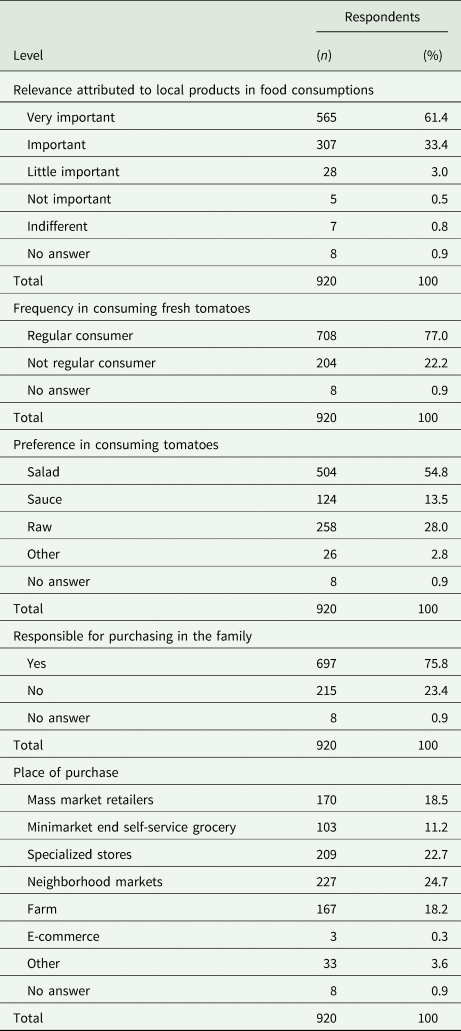
The consuming and purchasing behaviors of the respondents were also investigated, and the descriptive statistics are reported in Table 3. When asked to assign a value to the relevance of local products in their food consumption, 61.4% assigned very high relevance, and 33.4% high relevance, while very few of the respondents attributed low or no importance to local products.
Characteristics of the purchasing and consuming behaviors across the sample

Here, 77% of respondents declared to be regular consumers of fresh tomato, where 54.8% of these preferred tomatoes in salads, 28.0% as a raw product and 13.5% as the tomato sauce (Table 3). Most of the respondents declared to be responsible for food purchasing in the family (75.8%). Twenty-four percent of the sample usually purchased fresh tomatoes in neighborhood markets, 22.7% in specialized stores, 18.5% in the mass market retailers, 18.2% directly from the farm and 11.2% in a minimarket or self-service grocery (Table 3).
Results
The choice experiment model was carried out and the findings are reported in Table 4. The total observations were 27,600, as 920 respondents × 10 cards × 3 alternatives. The conditional logit model is based on the property of a priori assumption of the independence of irrelevant alternatives (IIA) (Hanley et al., Reference Hanley, Wright and Adamovicz1998). This means that the relative probabilities of the two alternatives were not affected by the introduction or removal of other alternatives (Ben-Akiva and Lerman, Reference Ben-Akiva and Lerman1985). Therefore, Hausman and McFadden (Reference Hausman and McFadden1984) tests were applied to estimate the suitability of the conditional logit model for the data. Basically, the adopted model was compared with (from time to time) a restricted model in which an attribute is removed using the generalized log-likelihood ratio test.
Estimated coefficients and values from choice experiment application

The variable ASC × R4 is redundant.
It was estimated that the IIA property was not violated by the conditional logit model adopted. Indeed, the values of the test statistics that were given by comparisons between the coefficients estimated before and after removing one of the alternatives were 4.04, 4.66 and 5.18 for local variety, integrity and standardization, respectively; each value was lower than the corresponding critical value of the χ2 distribution at 99.5% confidence level (Table 5). Therefore, the null hypothesis should not be rejected, implying that the conditional logit model fit the data well (Table 5).
Tests of hypotheses for the proposed model

a Hypothesis on R4 was not tested because the variable is redundant.
The effects of the characteristics of the sample on the consumer willingness to pay for the three attributes considered (i.e., local variety, integrity, standardization) were also investigated. We estimated different models that introduce socio-economic variables to test the homogeneity or less of the consumer preferences. All of the socio-economic characteristics, the consumption preferences and the general purchasing behavior of the consumers investigated here were considered as variables. However, there was a lack of information, and some was not complete; therefore, only a few variables were taken into consideration. Among the others, the lack of information limited the possibility to estimate homogeneous consumer classes using, for example, latent class analysis on the whole sample (Greene and Hensher, Reference Greene and Hensher2003).
Specifically, we introduced the variable ‘Frequency’ to represent the frequency in consuming tomatoes (Table 2). The variable ‘Responsible’ indicates being or not responsible for purchasing in the family (Table 2). In this sense, we would involve in the analysis also not-regular purchasers of tomatoes (and other products). However, the test for each variable suggests that the preferred model would not include both variables (null hypotheses cannot be rejected). The preference in consuming tomatoes was handled by introducing different dummies for each individuated preference (Salad, Sauce, Raw and other; Table 2). Applying the Generalized log-likelihood ratio test, we found that the preferred model would include the ‘preferences in consuming tomatoes’ (in the model, the variable ‘other’ is redundant).
For the model application, all of the estimated coefficients were statistically significant (Table 4). The coefficient related to the price was negative, as expected because the model was based on an inverse relationship between the willingness to pay and the price. The alternative specific constant was statistically significant, which meant that a tendency to switch from the status quo alternative toward other alternatives would exist (i.e., the status quo would not be the preferred alternative by the final consumers).
The economic value related to each attribute was determined by calculation of the inverse ratio of the attribute coefficient over the price coefficient:

where WTP is the willingness to pay related to a specific attribute, ßk is the estimated coefficient related to this specific attribute, and ßp is the coefficient associated to the premium price attribute. All of the calculated values are expressed in € kg−1.
The variety attribute was the highest, which reached €0.90 kg−1. This means that consumers would be willing to pay a premium price of €0.90 kg−1 to purchase ancient local varieties of tomatoes (landraces; Table 4). Considering the market price of tomatoes in Italy in 2019, this represents remarkable additional value.
The estimate for integrity was €0.45 kg−1 (Table 4). The positive sign indicates that consumers would be willing to pay this premium price for tomatoes that do not show imperfections (e.g., on the surface of the fruit). Despite this positive sign as the expected result here, this also suggests that the consumer willingness to pay additional value for local varieties (as indicated above, €0.90 kg−1) would be resized on the basis that imperfections are a marketable aspect that often characterizes local varieties of tomatoes.
Finally, the standardization attribute showed a negative value (with a magnitude of €0.17 kg−1; Table 4). This indicates that consumers would be willing to pay an extra price for varieties with very variable shapes and sizes of fruit (i.e., not standardized fruit; and hence the negative value).
It must be noted here that these were handled as independent attributes in this model, and therefore estimated values can be added according to the level of the attribute. In other words, according to the co-presence of these three attributes, or the presence/absence of each one, a premium price on the whole can be estimated. For a local tomato variety with intact fruit that is not standardized, the premium price reached up to €1.52 kg−1. Conversely, for a standardized supply and the presence of imperfections, the premium price decreased to €0.28 kg−1.
Willingness to pay slightly tends to decrease when respondents prefer to consume raw tomatoes for salad. Vice versa, it increases when the favored modality of consuming is the sauce. Nonetheless, we tried to estimate the value attributed to each variable by applying the econometric model to three sub-samples according to the preferred way of consuming tomatoes.
In more detail, the ‘salad’ and ‘raw’ preferences do not sensitively influence the consumer willingness to pay for all three attributes considered (i.e., variety, integrity, standardization; Tables 6, 7), while the ‘sauce’ preference only affected the attributes of variety and integrity, but not standardization (Table 8). In this last case, the variety attribute showed a premium price of €0.76 kg−1, while €0.46 kg−1 was seen for the integrity attribute, and €0.00 kg−1 for the standardization attribute (Table 8). This means that consumers would be willing to pay a whole premium price of €1.22 kg−1 to purchase local tomato varieties with no imperfections on the surface of the fruits for the preparation of sauce, although for this use the interviewers do not pay attention to the standardization qualitative attribute of the tomatoes.
Estimated coefficients and values from choice experiment application of the category ‘salad’ of the variable ‘Preference in consuming tomato’

Estimated coefficients and values from choice experiment application of the category ‘raw’ of the variable ‘Preference in consuming tomato’

Estimated coefficients and values from choice experiment application of the category ‘sauce’ of the variable ‘Preference in consuming tomato’

Discussion
In this study, a choice experiment approach was carried out to investigate the consumer willingness to pay for ancient local tomato varieties (landraces), and to determine their preferences from among the different characteristics used to describe this product.
This study has allowed us to determine the value that consumers attribute to landraces in general, rather than for any specific variety. Indeed, the results show that consumers are actually willing to pay a considerable premium price for the feature of local variety, rather than for ‘commercial’ tomatoes. This is in agreement with data from Botelho et al. (Reference Botelho, Dinis, Lourenço-Gomes, Moreira, Costa Pinto and Simões2018), who sought to estimate the willingness to pay for the attribute of traditional variety for apples, rather than the consumer willingness to pay for a specific Portuguese apple variety.
Through the present study, the value attributed to a local variety can be extended to a wider concept, and can be considered as a representative value attributable to agrobiodiversity. The results obtained in the present study have therefore allowed us to ascertain that consumers recognize a value (both commercial and historical and cultural) for agrobiodiversity. This has revealed their sensitivity, attention to detail, and knowledge about the subject, and their willingness to contribute to the conservation and enhancement of agrobiodiversity. As a demonstration of this feedback, these data also validate the results from both Rocchi et al. (Reference Rocchi, Paolotti, Cortina and Boggia2016) and Brugarolas et al. (Reference Brugarolas, Martínez-Poveda and Ruiz2009), who focused their studies on the Italian tomato landrace ‘Pomodoro di Marcatello’ and the Spanish tomato landraces ‘Muchamiel’ and ‘De la Pera’, respectively. Both of those studies showed that local market consumers attribute a highly positive value to these varieties, and that they were willing to pay relatively high premium prices, which were higher than those charged in the market. However, those data were strictly connected to the territory and to the specific characteristics of those three local varieties, and it is not possible to extend and attribute their value to the general feature of ‘local variety’.
The results of the present study have also revealed that consumers are willing to pay a premium price for the feature integrity, but not for standardized products. In a valorization perspective for local varieties, this would mean that consumers will also pay the highest premium price for tomato varieties that are characterized by no standardized and intact fruit, i.e., with very variable shapes and sizes of fruit that do not show imperfections on the surface. Therefore, in the case of the co-presence of the three attributes of local variety, integrity and no standardization, the premium price that consumers would be willing to pay can reach up to €1.52 kg−1, which represents a large additional value if we consider the market price of tomatoes in Italy in 2019 of €1.12 kg−1 (ISMEA Mercati, 2020). In this way, the cultivation of traditional varieties of tomato can be proposed as an economically interesting and potentially highly viable alternative for farmers. Any effects on the income of the farmers should be duly assessed, as this was not the objective of the present study. However, it can be said that the whole premium price should be high enough to encourage on-farm conservation, as was suggested by Brugarolas et al. (Reference Brugarolas, Martínez-Poveda and Ruiz2009). These authors determined that consumers would be willing to pay an average price of €2.72 kg−1 for the ‘Muchamiel’ tomato landrace, which represents an 81% surcharge, and €2.37 kg−1 for the ‘De la Pera’ tomato landrace, which represents a 58% surcharge. Such prices would well compensate for the higher costs related to the cultivation of these ancient local varieties. Indeed, the cultivation of tomato landraces involves higher crop management costs than commercial hybrids, due to the lower productivity and resistance to pathogens (Brugarolas et al., Reference Brugarolas, Martínez-Poveda and Ruiz2009).
This represents important information for producers of ancient local varieties, because the additional price can be particularly sensitive in terms of variations according to the presence or absence of the integrity and standardization attributes. Indeed, for standardized products and the presence of imperfections, the premium price can decrease to €0.28 kg−1. Hence, the valorization of such landraces through their cultivation also for marketable reasons might open up the farmers to quite different scenarios in terms of price, and therefore of profitability for the farm and/or the entire supply chain. This latter finding is in agreement with Botelho et al. (Reference Botelho, Dinis, Lourenço-Gomes, Moreira, Costa Pinto and Simões2018), in whose study the participants were willing to pay more for traditional Portuguese apple varieties than for nontraditional ones, but the premium price was not enough to encourage on-farm conservation.
Additionally, the effects of the characteristics of the samples were investigated in terms of consumer willingness to pay for the three attributes considered. Here, the preference of ‘sauce’ of the variable ‘Preference in consuming tomato’ affected only the values of the local variety and integrity attributes, and not standardization. The preferences ‘salad’ and ‘raw’, instead, did not influence consumer willingness to pay. This will probably be because the product must be transformed before consumption for ‘sauce’, while consumers are willing to pay an extra price if local varieties are used for salads and raw consumption, and fruit with no imperfections on the surface and no standardized shapes might be preferred.
Altogether the results are promising, as they suggest the adoption of strategies and programs for valorization and promotion of these products that can be enhanced by their cultivation and the development of regional and national markets that acknowledge the fruit characteristics to a greater extent than supply chains do. Indeed, the enhancement of marketing plans, the adoption of particular recognition symbols, or the creation of specific brands might further stimulate the development of this niche market. For example, as reported by Balogh et al. (Reference Balogh, Békési, Gorton, Popp and Lengyel2016), quality certification was identified as one of the most important attributes for consumer decisions about traditional food products. As another example, the development of appropriate marketing plans based on the promotion of some pre-investigated nutraceutical properties or sustainable characteristics (e.g., low ‘food miles’) might also be exploited (Annunziata and Vecchio, Reference Annunziata and Vecchio2016; de-Magistris and Gracia, Reference de-Magistris and Gracia2016). Further, the promotion of environmental and socio-economic impacts derived from the preservation and cultivation of these traditional food products might be an effective strategy to contribute to more profitable incomes for farmers (Sardaro et al., Reference Sardaro, Girone, Acciani, Bozzo, Petrontino and Fucilli2016). In fact, this research has shown that a segment of the population appreciates the ancient local varieties and, therefore, that a market for this kind of products exists. The cultivation of ancient local varieties represents therefore a valid alternative for producers, who would make their work profitable (Pérez-Caselles et al., Reference Pérez-Caselles, Brugarolas and Martínez-Carrasco2020).
Nonetheless, the successful conservation and use of biodiversity in agriculture requires new types of cooperation among researchers, breeders, agronomists, ecologists, economists and institutions to identify and establish adequate assessment and valorization strategies (Jackson et al., Reference Jackson, Pascual and Hodgkin2007; Polegri and Negri, Reference Polegri and Negri2010; Giupponi et al., Reference Giupponi, Borgonovo, Panseri and Giorgi2019). In this sense, the commercial valorization of the varieties at risk of genetic erosion is also encouraged by international, national and regional organizations who intend to boost these through incentives and measures to support the farmers involved in landraces conservation programs (Spataro and Negri, Reference Spataro and Negri2013).
Conclusions
This study highlights the consumer trend to give value to the attribute of local variety. This value in the real marketplace is obviously connected to the specific and intrinsic characteristics of any specific landrace. For this reason, the effectiveness of the valorization of ancient local varieties will be related to the appreciation that each of them will meet with once on the market. The feedback received from the present study, however, demonstrates the increasing attention of consumers for sustainable food. Characteristics that they can find in landraces need to be adequate to meet their needs and satisfy their preferences. The data from the present study also underline the potential of landraces for the sustainability of rural communities. Indeed, they might represent an opportunity for farmers to access niche markets, and thus differentiate their production without losing income. Indeed, consumers appear to be willing to pay a price that should be sufficient to compensate for the extra costs that farmers can incur for cultivation of landraces. The possibility for producers to cultivate ancient local varieties guaranteeing profits and allowing access to niche markets, could in fact allow the development of local or regional agri-food systems. This would increase the economic activity and the sustainability of rural territory and, at the same time, the farmers would contribute to maintaining on-farm conservation of agricultural biodiversity preventing its loss in these areas.
The results also suggest the need to involve farmers in marketing training programs, whereby they can obtain better placement of local products in the market. Indeed, in this study, the cultivation of ancient local tomato varieties is proposed as an alternative to commercial hybrids. Also, it will be of great interest to investigate the willingness of the farmers to participate in a landrace conservation program, and to involve multidisciplinary groups in the design of strategies that take into account both the needs of the farmers and the consumer preferences.
At the same time, future investigations on consumer preferences according to different market segments might be useful to better understand the real willingness to consume local varieties of tomato. In addition, the analysis of specific socio-economic categories whereas a well-structured market segmentation represents a relevant issue to face in future research studies.
Supplementary material
The supplementary material for this article can be found at https://doi.org/10.1017/S1742170521000491.
Conflict of interest
None.
Financial support
This study includes part of the PhD project carried out by Chiara Maria Posadinu at the PhD School of Agricultural Sciences of the University of Sassari funded by the Italian Ministry of Education, University and Research (MIUR) ‘PON RI 2014 2020’ Azione I.1 Dottorati Innovativi con caratterizzazione industriale. Support to the research activity of Monica Rodriguez was granted by the European Social Fund and Regione Autonoma della Sardegna ‘POR—FSE 2014-2020—Asse Prioritario 3 ‘Istruzione e Formazione’—Obiettivo tematico: 10, Priorità d'investimento: 10ii, Obiettivo specifico: 10.5, Azione dell'Accordo di Partenariato 10.5.12’. The research was also supported by University of Sassari “Fondo di Ateneo per la ricerca 2019” to Monica Rodriguez and Giovanna Attene.