INTRODUCTION
The SSC Society, of which the SSC Library is the major part, was founded in 1784, and during the subsequent 237 years there have been 9 librarians – so an average tenure of 26 years. I have been there for 31 years.
The Society was granted a Royal Charter in 1797 and, it seems to have had a difficult time establishing itself on a par with the WS Society. After disputes about whether solicitors who were not Writers to the Signet were able to represent clients before the courts, there were also further disputes as to whether SSC members were eligible for appointment to various posts (for officers of the courts) and even which door to the courts they were allowed to enter as they did not have the authority to wear gowns. Eventually in 1822 the College of Justice, authorised the SSC Society to wear gowns in the performance of their official duties and they were accorded similar privileges as the Faculty of Advocates and the WS Society.
We are a membership-only library for members of the Scottish legal profession and, given the size of our membership, who are based all over Scotland, have a very well resourced and used library.
EARLY DAYS
The SSC Library is based in a building at the back of the original Parliament House in Edinburgh in the same collection of buildings as houses the Advocates Library, The Signet Library and the Judges Library, so we are all catering to the legal profession in one way or another.
In 1889 an internal bridge was constructed at the top level which connected the SSC building to the Courts of Law in Parliament House and this access is maintained to this day.
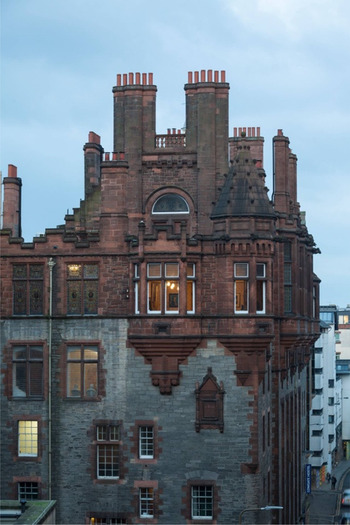
The Cowgate building.

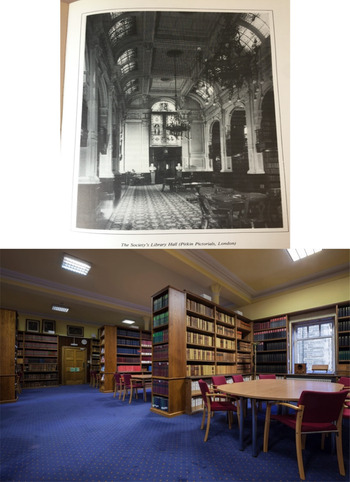
The library was opened on 12th May 1892 with a small collection of books donated by member and others, on the upper floor of the 6 floor Cowgate building which had been purchased in 1888. The building consisted of 20 properties comprising shops and houses and plans were drawn up to convert them into a library and associated rooms for the SSC Society on the upper floors and flats on the lower floors. Over the years these flats have been student accommodation, a back-packers hostel and office space for the Faculty of Advocates. The original library was on the top floor and was a magnificent room but cold and draughty, and in 1967 it was decided to move the library down one floor. It is a smaller room but much more comfortable and manageable and the library is currently still based there.
The original library on the top floor (top photo) and library today (bottom photo).

The earliest librarian was given the remit to purchase Scottish texts but to limit the English ones purchased and this is still my remit today – I purchase all Scottish material but only English ones where they are the standard recognised work on a subject.
Early on in the history of the SSC Library, it was agreed that the judges would be entitled to borrow materials for use on the bench and in fact when I started in 1991 it was often the case that law reports would be borrowed to make up the numbers available for cases being heard. The advent of electronic versions of law reports etc has meant that this service is no longer required, although, as we all know, books do go missing and we help out wherever we can by loaning materials in such instances.
The SSC Library is inextricably linked to the SSC Society and the Society has played a part in several interesting areas of society. For instance, in 1859, when there was a threat of invasion by the French under Napoleon III, the Edinburgh Volunteer Rifle Corps was founded, sanctioned by the British Government. The solicitors in the Society were keen to show their patriotism and later that year the 5th (S.S.C.) Company of the Edinburgh Rifle Volunteer Corps was started. Among other events, they took part in parades when Queen Victoria left Holyrood in October 1859 and we still have the ledger giving details of the volunteers, which also reveals that a portion of the library was fitted out for storing the rifles and swords of the Company!
The Society also formed its own golf club in 1896 with 55 members and over the years amassed 14 trophies for annual competition. The collection of memorabilia is now housed in the museum at the home of golf - St Andrews.
A NEW BROOM
When I started in March 1991 it was a time of big changes in the provision of information. Computers were increasingly taking the place of typewriters, while the Web Wide Web and emails were just in their infancy. I was the first professional librarian to have been appointed and as such saw that changes had to be made. For example, the books were arranged around the library and back to the beginning and then continued on the next shelf down, and behind every book on every shelf there were empty boxes – nothing had ever been thrown away. My first task was to clear out the boxes and then rearrange the order so that groups of law reports, journals, etc, were together and the textbooks were in a separate area and in subject order. It took a while but resulted in a much more usable and user-friendly library space.
For the purists among you, I am afraid that the Dewey Classification Scheme has no place in my library – in my experience solicitors look to find materials by subject heading – damages, contract, road traffic – and have no interest in searching by numbers. I appreciate that this only works for small, specialised collections, but that is what I have and it works very well for my users. The law reports are in one alphabetical sequence, the journals in another and the text books are in a separate area in subject order with the Scottish titles having ‘Scotland’ as part of their label eg Road Traffic: Scotland.
Soon after my arrival we purchased a computer, so no more typing up of catalogue cards, and started to build some databases, which have developed over the years and include the Court of Session and High Court of Justiciary opinions issued from 1981 to 2011 - a very useful resource as a lot of them were never published in the law reports.
Under previous librarians, the door to the library was always closed. The library is at the end of a corridor and a closed door to me suggested we were not open so one of my first changes was to have an open door policy during working hours and to welcome users when they arrive – it took a long time for users to stop closing the door behind them as apparently they were told off if they didn't! It was definitely a ‘ssshhhh’ environment prior to my appointment and whilst I don't encourage partying, talking is allowed!
JACK OF ALL TRADES…
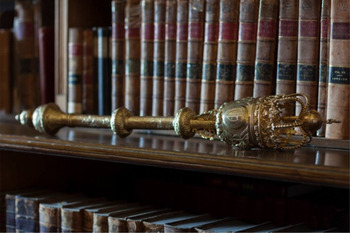
Given the size of our organisation my job extends well beyond the role of a traditional librarian and includes doing all sorts of jobs which other organisations have other people to do: changing lightbulbs, buying furniture, planning the redecoration of the Library and Members’ Lounge, hanging photos of Presidents in the rogues’ gallery, updating the website (something I have to admit I am not very good at), organising CPD events and other Society functions such as dinners when Presidents demit office, and mace carrying for official events, like the installation of new judges and Order of the Thistle services in St Giles Cathedral at which members of the Royal family are often present.
The Society of Solicitors in the Supreme Courts of Scotland.

I am also responsible, on behalf of the Law Society of Scotland, for organising the sitting-in element of the Solicitor-Advocates training. This involves providing details of appropriate cases for them to sit-in on in the Court of Session and providing them with papers so they can follow the cases. On the successful completion of their training they are admitted as Solicitor-Advocates in a ceremony before a judge in the court at which I put their new robes on after they have taken then oath of allegiance. Just another of the many roles I have as librarian of the SSC Society.
THE TIMES THEY ARE A CHANGING…
With changes in the Court structure, courts being moved out of the main building and societal changes, the number of people joining institutions such as ours has diminished and consequently our footfall has fallen over the years so we have had to adapt to ensure we still remain relevant. We have made extensive use of electronic information as far as budgetary constraints allow and this in turn has allowed us to still provide information to our members wherever they are based. Email has become an invaluable communication tool for getting information to our members quickly and reliably especially as a large number of our members are based outwith Edinburgh.
COVID – ARGHHH!
March 2020 arrived and everything changed – initially we thought we could run the service with just the staff in the library but no punters and all the signs were put up, hand sanitiser was purchased in large quantities and I spent a morning on my hands and knees with a 2 metre stick putting ‘keep your distance’ stickers on the floors! However, it soon became apparent that this was not possible, so I moved the library home – remote access to the library computer was set up, some of the main textbooks went home with me and all publishers mail was redirected to my home address. It had become apparent within a few days that mail was going to build up in the mail room, which is also used by many other organisations, and the likelihood of things going missing was pretty high, so I tried to avoid that and instead gave my local postman plenty more mail to deliver on his rounds. I have been able to travel up to the library every 2–3 weeks (essential travel to work) to collect new loose-leaf works to file at home and take up any journals, books etc which had arrived at the house. Consequently, I am confident that when we do re-open, the library will be up-to-date and ready to hit the deck running – however it will need a jolly good clean beforehand.
It has been very heartening to see how many enquiries I have been able to answer despite not having access to everything and the library community has been great in supporting each other – it always has been good but this situation has brought out the best in everyone.
At the time of writing, the library has reopened, and is staffed, on a Wednesday and Friday. The rest of the week we are working from home but we are hopeful that Government advice will allow us to reopen fully fairly soon. In the meantime we are providing the best service we can in the circumstances and fortunately our members understand the difficulties we are facing and are grateful for the service we are providing.