Introduction
Sea turtles form an integral part of many coastal and marine environments as they perform a variety of ecological services, including being nutrient transporters and providing habitat for epibionts (Heithaus, Reference Heithaus, Wyneken, Lohmann and Musick2013; Le Gouvello et al., Reference Le Gouvello, Nel, Harris, Bezuidenhout and Woodborne2017). However, sea turtle species have been severely impacted by human activities globally and consequently many sea turtle populations are in decline (Gibbon et al., Reference Gibbon, Scott, Ryan, Buhlmann, Tuberville, Metts, Greene, Mills, Leiden and Poppy2000; Witherington et al., Reference Witherington, Kubilis, Brost and Meylan2009). Most sea turtle monitoring programmes focus on assessing population trends (Nel et al., Reference Nel, Punt and Hughes2013) or causes of mortality (Seminoff et al., Reference Seminoff, Jones, Resendiz, Nichols and Chaloupka2003). Assessments of the health of individual turtles are rare, despite their importance for improving conservation efforts. The body condition of nesting females is particularly important as this can affect reproductive output and hatchling survival (Perrault et al., Reference Perrault, Miller, Eads, Johnson, Merrill, Thompson and Wyneken2012). A commonly proposed method for assessing body condition of sea turtles is through an examination of epibiont loading, specifically barnacles, on their carapace, and plastron (Deem et al., Reference Deem, Norton, Mitchell, Segars, Alleman, Cray, Poppenga, Dodd and Karesh2009; Flint et al., Reference Flint, Morton, Limpus, Patterson-Kane, Murray and Mills2010).
Ecologists have commonly resorted to using body condition indices as an estimation of an animal's nutritional state and a proxy for its health (Ullman-Culleré & Foltz, Reference Ullman-Culleré and Foltz1999) or reproductive status (Guinet et al., Reference Guinet, Roux, Bonnet and Mison1998). Health is a clinical examination involving laboratory tests as opposed to body condition which is a general examination that can be readily determined. Monitoring sea turtle health using physiological or metabolic approaches can be logistically challenging in remote areas and prohibitively expensive for developing countries. It is therefore useful to develop low-cost methods to monitor sea turtle body condition as a proxy of their health, which are logistically feasible yet reliable and accurate. Several methods have been implemented to determine the body condition of sea turtles. These include mass-length relationships (Bjorndal et al., Reference Bjorndal, Bolten and Chaloupka2000; Jessop et al., Reference Jessop, Hamann and Limpus2004), blood sample analysis (Stamper et al., Reference Stamper, Harms, Epperly, Braun-McNeill, Avens and Stoskopf2005), examination of the plastron (Thomson et al., Reference Thomson, Burkholder, Heithaus and Dill2009) and epibiotic barnacle loading (Deem et al., Reference Deem, Norton, Mitchell, Segars, Alleman, Cray, Poppenga, Dodd and Karesh2009; Flint et al., Reference Flint, Morton, Limpus, Patterson-Kane, Murray and Mills2010; Nájera-Hillman et al., Reference Nájera-Hillman, Bass and Buckham2012). Weighing adult hard-shelled turtles in the field is not easy, and for leatherbacks near-impossible, whereas blood sample analysis is expensive. The probable mechanism of using epibionts is that a turtle of poor health swims slower, which facilitates the settlement of free-swimming larvae on its surface, thereby increasing epibiont loading. Turtles in poor condition also have a reduced ability to self-groom (Deem et al., Reference Deem, Norton, Mitchell, Segars, Alleman, Cray, Poppenga, Dodd and Karesh2009) by actively rubbing their carapace against hard structures, such as reefs or rocks, to remove epibionts (Heithaus et al., Reference Heithaus, McLash, Frid, Dill and Marshall2002). Examination of epibiont communities can therefore be useful in developing a body condition index that can be used in situ as a proxy for turtle health.
The iSimangaliso Wetland Park, a UNESCO World Heritage Site, is situated on the east coast of South Africa and protects the nesting beaches for leatherback (Dermochelys coriacea) and loggerhead (Caretta caretta) sea turtles. Little is known about the body condition of nesting females, despite carapace length and width being routinely monitored, and to date no assessment of health or body condition has been made. Furthermore, sea turtle epibionts from this region are poorly studied with only one report by Hughes (Reference Hughes1974), providing a brief description of six epibiont species. A comprehensive assessment of epibiont communities for nesting sea turtles in this region therefore provides a valuable biodiversity baseline and strengthens insights into the ecological roles of sea turtles as distributing agents and substrates for other species.
The aim of this study was to examine macrofaunal epibiont communities of nesting loggerhead sea turtles and relate these communities to the body condition of individuals. The hypothesis is that turtles in compromised body condition have higher epibiont loading. To examine loggerhead sea turtle body condition in the South-west Indian Ocean a body condition index was developed and assessed using the turtle's epibiont community assemblage.
Methods and materials
Sampling area and seasons
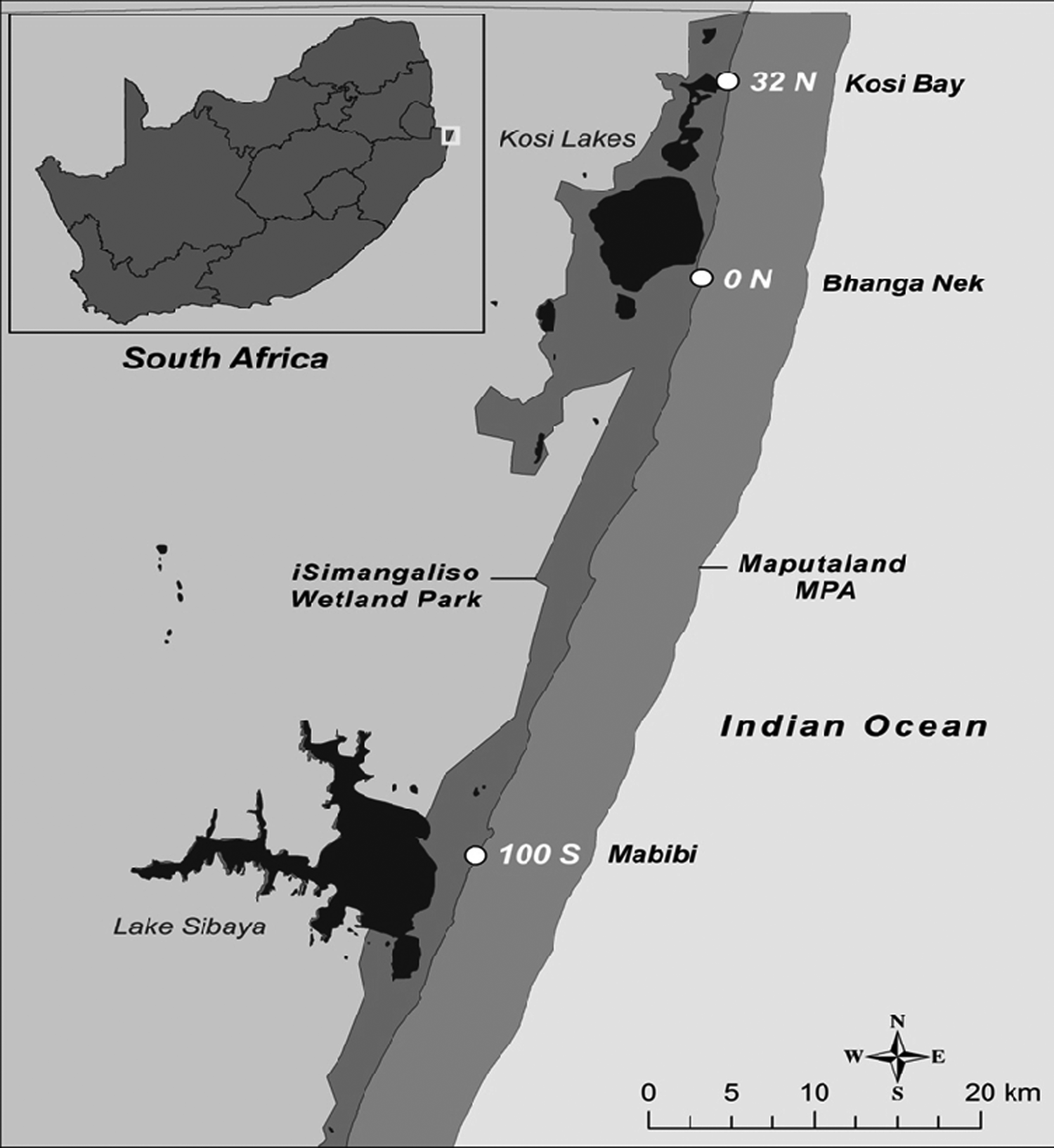
The northern beaches of the iSimangaliso Wetland Park, South Africa (Figure 1), are frequented by loggerhead sea turtles (Caretta caretta) during their nesting periods in the austral summer (November–February). This study focused on the area with highest density of nesting loggerhead turtles, north of the Bhanga Nek field station (Nel et al., Reference Nel, Punt and Hughes2013). Nesting loggerhead turtles encountered during nightly monitoring patrols along a 6-km stretch of beach were sampled for this study. These patrols took place over two nesting seasons from 1 December 2015 to 26 January 2016, and again from 28 November 2016 to 10 February 2017.
The location of the South African loggerhead (Caretta caretta) rookery within the iSimangaliso Wetland Park, a UNESCO World Heritage Site, South Africa. The monitoring area is from Kosi Bay in the north, 4 km from the Mozambique border, to Mabibi in the south. This study was conducted in the high nesting density area north of Bhanga Nek.

Epibiont community sampling and processing
We scraped epibionts from the right side of each turtle's carapace using a plastic paint scraper and stored the samples in vials of 70% ethanol to identify. Although we only sampled the carapace, epibionts occur all over the body of sea turtles and the epibiont community reflected in our study is most likely an under-representation of the full array of taxa found (Hayashi & Tsuji, Reference Hayashi and Tsuji2008; Robinson et al., Reference Robinson, Lazo-Wasem, Butler, Lazo-Wasem, Zardus and Pinou2019). Where necessary, sand was washed off the carapace before collection using seawater. After collection, epibionts were counted and identified to the lowest possible taxonomic level using suitable literature (Day, Reference Day1974; Griffiths, Reference Griffiths1976; Monroe, Reference Monroe1979; Barnard & Karaman, Reference Barnard and Karaman1991; Epibiont Research Cooperative, 2007; Branch et al., Reference Branch, Griffiths, Beckley and Branch2017).
To examine the relationship between barnacle load and body condition, we systematically photographed each turtle (whole carapace, front left/right, back left/right), and the percentage cover of barnacles on the carapace was estimated using ImageJ (Schneider et al., Reference Schneider, Rasband and Eliceiri2012).
Calculation of a turtle body condition index
For each female loggerhead turtle encountered, location and morphometrics including straight and curved carapace length and width were recorded following a standardized protocol used in the South African turtle monitoring programme since 1973 (Nel et al., Reference Nel, Punt and Hughes2013). Where present, flipper tags and internal passive integrated transponders were used to identify individuals to avoid re-sampling.
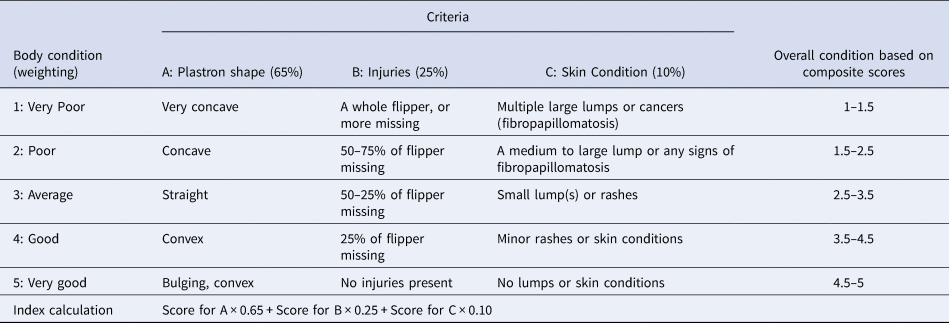
Body condition of nesting loggerheads was quantified using a composite index, incorporating information on: (1) the shape of the plastron; (2) injuries; and (3) visible skin conditions. For each turtle, these parameters were scored on a scale from 1 to 5 using specific criteria (Table 1) with 1 being an individual in suboptimal body condition and 5 reflecting optimal body condition. The composite body condition index was calculated by adding weighted scores for plastron shape, injuries and skin abnormalities to contribute 65, 25 and 10% respectively. The parameters were weighted based on the perceived effect on body condition; as plastron shape is the best predictor (Thomson et al., Reference Thomson, Burkholder, Heithaus and Dill2009) it contributed the most to determining body condition. Turtles with concave (hollow) plastrons have a lower mass to length ratio than those individuals with convex plastrons. The injuries and skin abnormalities have been used elsewhere to classify healthy and unhealthy individuals (Deem et al., Reference Deem, Norton, Mitchell, Segars, Alleman, Cray, Poppenga, Dodd and Karesh2009; Flint et al., Reference Flint, Morton, Limpus, Patterson-Kane, Murray and Mills2010). The extent of limb amputations and/or any other apparent wounds, or injuries were also identified and recorded. Injuries that were recent such as small bleeding wounds and superficial scratches were not incorporated in this study as these occurred recently and would not result in a sudden change in body condition. Where possible, the cause of injuries was identified as either natural – shark attacks – or anthropogenic – boat strikes – (serial cuts or cracked carapace) or interactions with fisheries (foul hooks, line or net chafing). Skin abnormalities were categorized on severity based on the size and number of growths as well as rashes. Each sea turtle was thereby assigned to a body condition class as either very poor, poor, average, good or very good (Table 1).
The composite body condition index calculated as weighted sum after classifying each loggerhead sea turtle (Caretta caretta) according to plastron shape, injuries and skin condition, each scored as five categories (1 to 5) according to set criteria

Statistical analyses
To investigate the relationship between epibiont community assemblages and body condition, a number of univariate and multivariate analyses were used. Only epibiotic macrofauna were used in these analyses because of the ease to quantify abundance (number of individuals per taxa). Species richness was determined for each turtle from the number of taxa per individual. To test for differences in species richness among the different body condition classes, a non-parametric Kruskal–Wallis test was performed since the data failed the assumption of normality (Shapiro–Wilk test; P < 0.05). Following a significant test result, the Nemenyi-test with χ2 approximation for independent samples was performed as a post-hoc test to elucidate the significant differences in species richness between each of the body conditions. The Shannon–Wiener Index was used to assess epibiont community diversity among different body condition groups. This diversity index is a quantitative measure reflecting the species richness and relative abundance of each taxa. Shannon–Wiener Index was calculated per body condition category using untransformed abundance data and number of taxa following the methods of Robinson et al. (Reference Robinson, Lazo-Wasem, Paladino, Zardus and Pinou2017). Epibiont community data (species-abundance) were transformed using the square root function to weight the contributions of common and rare taxa (Clarke & Warwick, Reference Clarke and Warwick2001). These data were used to create a resemblance matrix based on Bray–Curtis similarities. A non-metric Multi-Dimensional Scaling (MDS) plot was used to visualize similarities among epibiont communities and their relationship with turtle body condition categories. Differences in community structure between body condition categories were compared using a one-way permutational multivariate analysis of variance (PERMANOVA). The PERMANOVA design employed a Bray–Curtis index of dissimilarity and used 999 permutations of the residuals, with body condition as a fixed factor. This test was chosen because of its robustness to differences in multivariate dispersion (Anderson & Walsh, Reference Anderson and Walsh2013). A SIMPER analysis examined the contribution of individual epibiont taxa to dissimilarities between significant clusters identified between body condition categories (Clarke & Gorley, Reference Clarke and Gorley2006).
To determine if there were differences in barnacle loading (carapace % cover) among the different body condition categories, a non-parametric Kruskal–Wallis test was performed because the data failed the assumption of normality (Shapiro–Wilk test; P < 0.05). Following a significant test result, the Nemenyi-test with χ2 approximation for independent samples was performed as a post-hoc test to elucidate the significant differences in barnacle loading between each of the body conditions.
All results with P < 0.05 were considered statistically significant. The PERMANOVA + add-on (Anderson et al., 2008) to PRIMER v6 software (Clarke & Gorley, Reference Clarke and Gorley2006) was used to carry out multivariate analyses. Univariate statistical tests were performed in R version 3.5.1 (R Core Team, 2018).
Results
Epibiont community assemblages
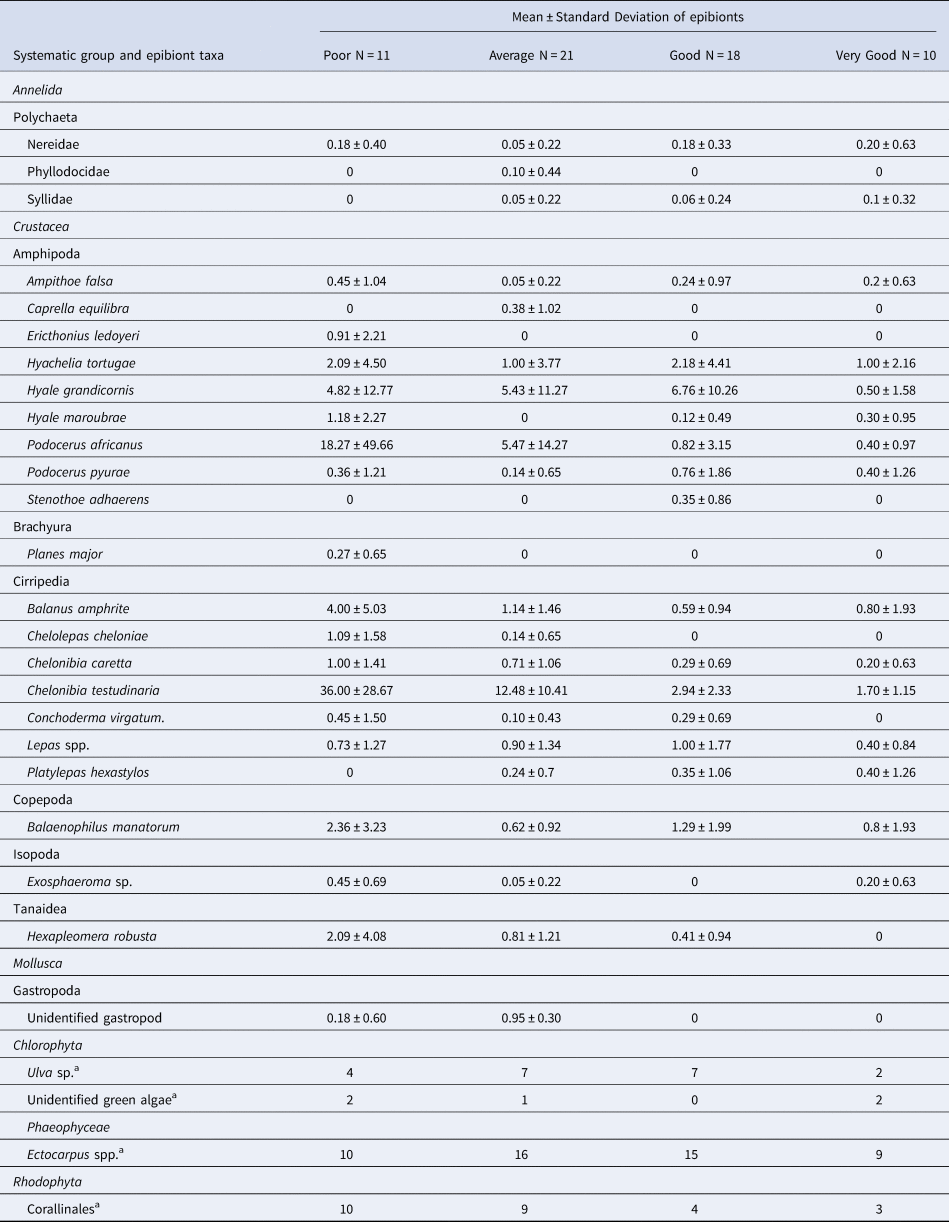
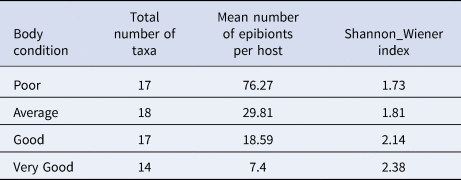
From the 60 nesting loggerhead sea turtles (Caretta caretta) sampled, we collected a total of 28 epibiont species from nine systematic groups (Table 2). Epibiont species richness varied among turtle body conditions (Kruskal–Wallis χ2 = 13.154, df = 3, P < 0.005), showing an increase of species richness with deterioration in body condition. The post-hoc Nemenyi-test showed significant differences between poor and very good (P < 0.005), and average and very good (P < 0.05) body conditions. The Shannon–Wiener Index indicated an increase in diversity of epibiont communities with an increase in body condition (Table 3). The high Shannon–Wiener Index (2.38) of epibiont communities on very good body condition turtles suggests that the epibionts on the carapace had higher evenness than other groups. There was also an increase in the abundance of epibionts per host with a decrease in body condition (Table 3).
Epibiont identification and abundance (mean ± standard deviation) per host condition category (poor, average, good, very good) of loggerhead turtles (Caretta caretta) nesting in the iSimangaliso Wetland Park, South Africa

a Indicates presence only. Individual counts were not undertaken.
Total number of taxa, mean abundance of epibionts and diversity index of epibiont communities of loggerhead sea turtles (Caretta caretta) with different body conditions nesting in the iSimangaliso Wetland Park, South Africa

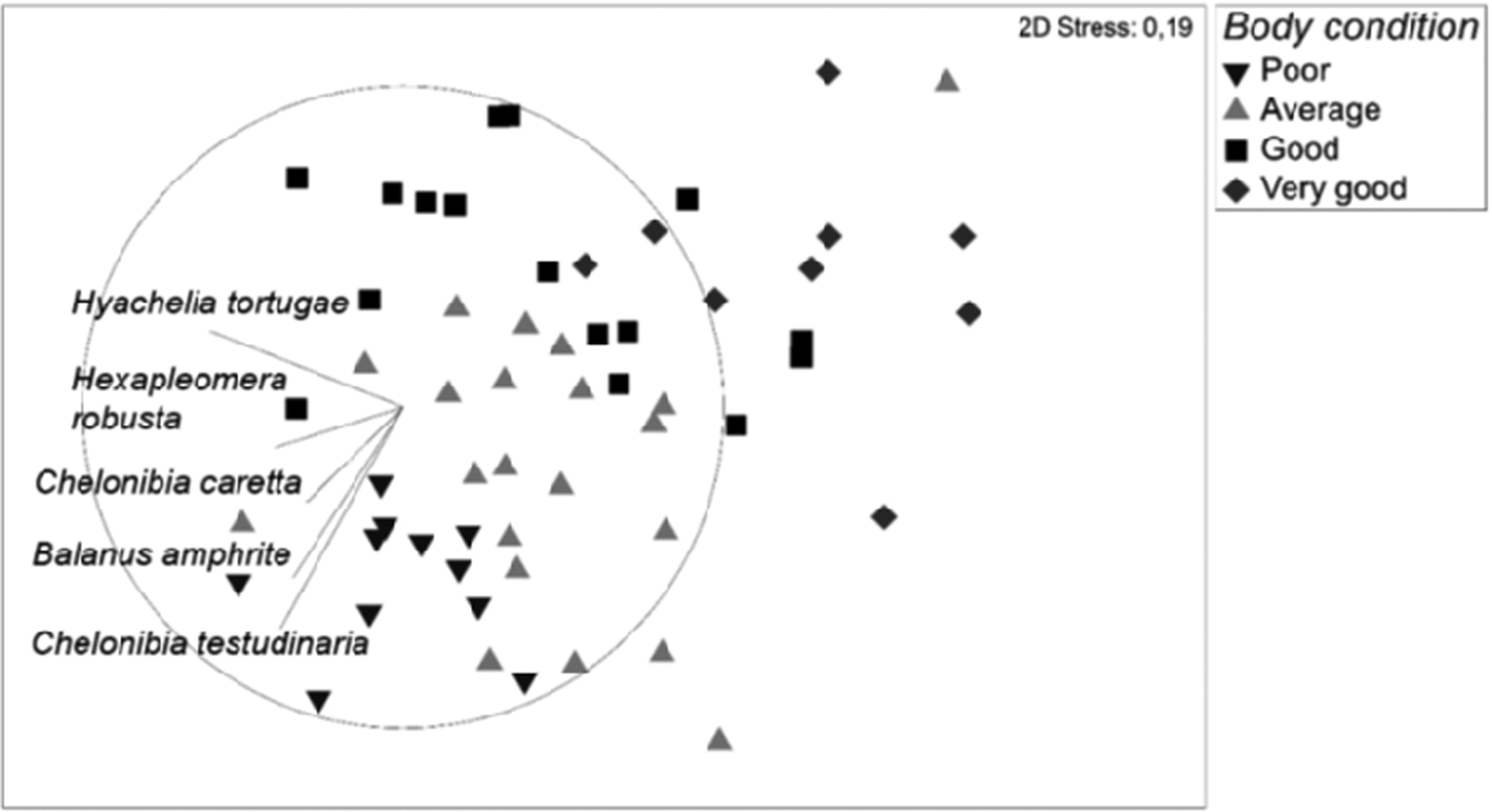
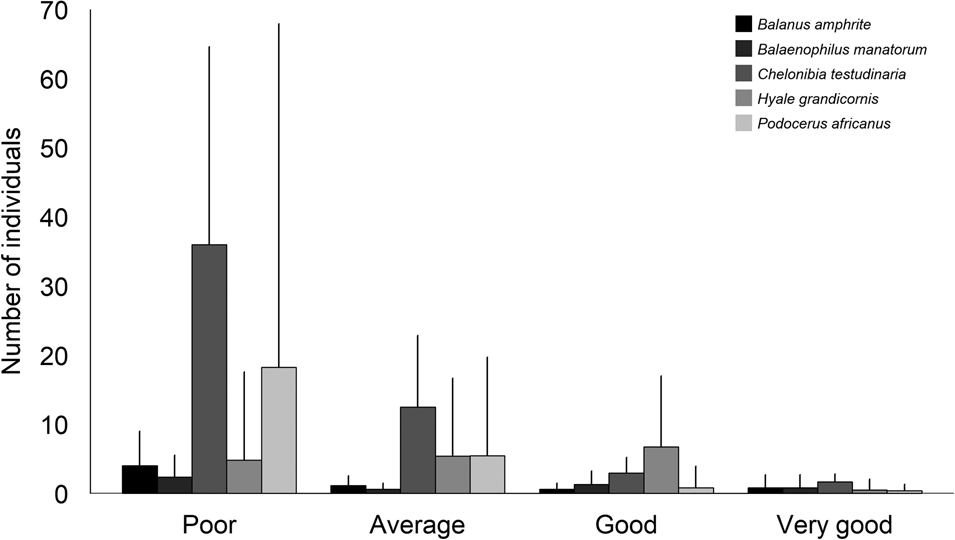
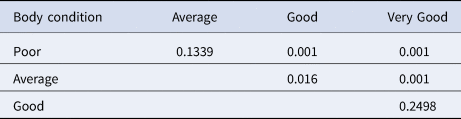
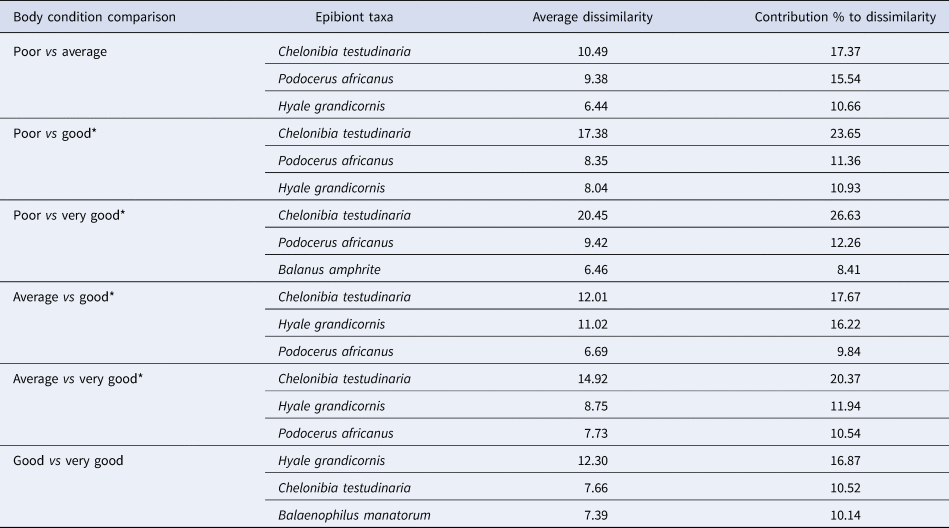
Epibiont community structure gradually changed with the deterioration of host turtle body condition (MDS; Figure 2). PERMANOVA identified statistically different epibiont communities among the four turtle body condition groupings (df = 3, 56, F = 2.8172, P < 0.005). Additionally, post-hoc pairwise comparisons of the PERMANOVA test revealed that epibiont communities of poor condition turtles were statistically different from good (P < 0.005) and very good (P < 0.005) body condition turtles, while, turtles with average body conditions were statistically different from good (P < 0.05) and very good (P < 0.005). However, there were no significant differences between poor and average, and good and very good body conditions (Table 4). SIMPER analysis showed that the dissimilarity between turtle body condition groups was mainly due to five epibiont taxa: Chelonibia testudinaria, Podocerus africanus, Hyale grandicornis, Balanus amphrite and Balaenophilus manatorum (Table 5, Figure 3).
Multidimensional scaling (MDS) of epibiont community abundance data (based on Bray–Curtis similarities) collected from the carapaces of nesting loggerhead sea turtles (Caretta caretta) grouped according to different body condition categories (poor, average, good, very good). The lines indicate which epibiont taxa most influenced the grouping based on Spearman rank correlations. Longer lines correspond to higher R2 values and indicate which species had the greatest influence on driving dissimilarities among communities.

Bar graph of mean number of individuals for the five most common epibionts, per body condition category, on nesting loggerhead sea turtles (Caretta caretta). Error bars represent standard deviation.

P values for the PERMANOVA pairwise comparisons of epibiont communities of nesting loggerhead sea turtles (Caretta caretta) with different body conditions (poor, average, good, very good)

Results of the SIMPER used to identify the relative contribution of the top three epibiont species causing dissimilarity between nesting loggerhead sea turtle (Caretta caretta) epibiont communities with different body condition categories (poor; average; good; very good)

* These communities were significantly different from each other as indicated by the PERMANOVA pairwise comparisons.
Epibiotic barnacle loading
The percentage cover of barnacles also differed significantly among turtle body condition categories (Kruskal–Wallis χ2 = 23.798, df = 3, P < 0.001), with significant differences between poor and good, and poor and very good conditions (Nemenyi-test, P < 0.05). These results reflect a gradual increase in barnacle loading with a subsequent deterioration in turtle body condition.
Body condition
A total of 60 nesting loggerhead sea turtles were assessed for their body condition and epibiont assemblages in this study, 48 and 12 from the 2015/16 and 2016/17 nesting seasons, respectively. None of them had very poor body condition, 11 turtles were categorized as poor, 21 as average, 18 as good and 10 as very good condition. Eight individuals (13%) had up to 25% of a flipper missing. Of the injuries that were identified, two were attributed to boat strikes and three to shark attacks. None of the turtles showed external symptoms of fibropapillomatosis, however, eight of the individuals (13%) had minor skin conditions that ranged from red patchy skin to small growths.
Discussion
This study is the first in the South-western Indian Ocean (SWIO) region to do an assessment of turtle epibionts in relation to body condition of nesting loggerhead sea turtles (Caretta caretta) using external characteristics. It was found that epibiotic species richness, diversity, community structure and barnacle cover gradually change in a consistent manner with deteriorating turtle body condition. The hypothesis that turtles in compromised body conditions have higher epibiont loading was shown to hold true even for nesting females, which are in generally good health, since the total abundance of epibionts as well as barnacle loading gradually increased as body condition deteriorated.
Epibionts assemblages and body condition
There was a vast increase in the epibionts found on the SWIO population when comparing this study (28 species) to the historical report by Hughes (Reference Hughes1974) who reported six species occurring on nesting females, however, the previous study only did a brief examination of epibionts. The occurrence of epibionts reported by Hughes (Reference Hughes1974) for the same population was far lower than this study. For example, Chelonibia testudinaria was present on 91% of the loggerhead turtles sampled in this study as compared with the 47% by Hughes (Reference Hughes1974). The discrepancy could be because the number of nesting turtles has increased in this time (Nel et al., Reference Nel, Punt and Hughes2013) and resulted in a stronger association between the epibiont and its host. A higher population density of hosts allows for increased larval settlement of this barnacle possibly due to a higher spatial overlap of available habitat for the epibiont. This relationship has been reported for a declining leatherback population in the East Pacific, where Stomatolepus elegans is not present even though it occurs on other populations that are stable (Robinson et al., Reference Robinson, Lazo-Wasem, Paladino, Zardus and Pinou2017).
We found notable differences in epibiont community structure among the different sea turtle body condition groups. Balanus amphrite, Chelonibia testudinaria, Hyale grandicornis and Podocerus africanus were identified, through the SIMPER analysis, as the species that distinguished the epibiont assemblages of sea turtles in different body condition categories the most. Higher loads of Chelonibia testudinaria, both in terms of abundance and carapace percentage cover, were associated with a poorer turtle body condition, which has also been noted in other studies. Green (Reference Green, Byles and Fernandez1998) observed emaciated, near-dead and dead green turtles ‘smothered’ in barnacles. While, Flint et al. (Reference Flint, Morton, Limpus, Patterson-Kane, Murray and Mills2010) found that immature green sea turtles with more than 20 barnacles on the plastron were more likely to be unhealthy than those individuals absent of barnacles. The barnacle epibiont loading on the sea turtles sampled in this study was however considerably lower, ranging from 0 to 93 individuals per turtle. In comparison, migratory and resident loggerheads in North Carolina, USA, were found to have accumulations of Chelonibia testudinaria on their carapace ranging from 6–386 and 97–3667 in abundance, respectively (Stamper et al., Reference Stamper, Harms, Epperly, Braun-McNeill, Avens and Stoskopf2005).
Epibiont community succession on the turtle's carapace can explain why turtles with a poor body condition have a greater number of epibionts and higher species richness. Using in situ experiments, Frick et al. (Reference Frick, Williams, Veljacic, Jackson, Knight, Mosier, Foley and Brost2002) examined how epibiont communities change temporally over a nesting season. The epibiont community is generally initiated when barnacles colonize a turtle; they do this by identifying suitable habitat through chemical receptors of the carapace (Zardus et al., 2008). These are ‘pioneer’ species that facilitate the colonization of other epibionts through the creation of microhabitats by increasing surface area and altering water flow patterns on the carapace (Pfaller et al., Reference Pfaller, Bjorndal, Reich, Williams and Frick2006), so that secondary taxa such as algae and hydrozoans can then colonize. Additional taxa such as amphipods and tanaids can colonize the carapace as they have a strong association with algal mats (personal observation). This community succession can be identified in the MDS plot that shows gradual change in epibiont assemblages over body condition categories.
It has been suggested that heavy infestations by epibionts may be detrimental to turtle health (Greenblatt et al., Reference Greenblatt, Work, Balazs, Sutton, Casey and Casey2004) as epibionts increase the energetic cost of the host to swim and forage (George, Reference George, Lutz and Musick1997). Ultimately, turtle health can be compromised by increased weight and drag, which in some cases is excessively large. For example, green turtles in Uruguay were found to have biofouling from an invasive gastropod (Rapana venosa) that accounted for up to 20% of the turtle's mass (Lezama et al., Reference Lezama, Carranza, Fallabrino, Estrades, Scarabino and López-Mendilaharsu2013). For reproductive females, the associated cumulative energetic cost is particularly compromising during long migrations of thousands of kilometres between feeding and nesting habitats. Furthermore, burrowing barnacles embedded in host turtles can cause deep-tissue wounds that cause erosion/necrosis of the underlying bone (Frick & Zardus, Reference Frick and Zardus2010). When barnacles occur on the beak, this can cause deformations that compromise foraging ability and in severe cases even death (Green, Reference Green, Byles and Fernandez1998). The potential effects of epibionts to sea turtle health noted in this study were: (1) the accumulation of epibionts that could increase drag; (2) burrowing barnacles that were deeply buried in the carapace; and (3) barnacles on the beak causing difficulty in foraging.
Turtle body condition
The body condition of an animal is a reference to its energetic state and performance, since an individual in good condition is assumed to have higher energy reserves than one in poor condition (Labrada-Martagon et al., Reference Labrada-Martagón, Méndez-Rodríguez, Gardner, Cruz-Escalona and Zenteno-Savín2010). Body condition is thus a proxy for an animal's health condition and can be quantified by assessing external parameters of an animal (Bjorndal et al., Reference Bjorndal, Bolten and Chaloupka2000; Labrada-Martagon et al., Reference Labrada-Martagón, Méndez-Rodríguez, Gardner, Cruz-Escalona and Zenteno-Savín2010). By contrast, quantifying the health state of an individual refers to its physiological state and would require a more intensive veterinary assessment, including blood testing (for haematological levels, plasma biochemistry, pathogen sampling etc.) (Li et al., Reference Li, Chang, Cheng and Lin2015). It is therefore often not logistically feasible to address the health of wild animals directly, but instead use indicators and proxies, such as body condition to assess if a population thrives or diminishes based on the health of its individuals (Stevenson & Woods, Reference Stevenson and Woods2006). In this context, it is key to create suitable and unambiguous criteria to determine the body condition of wild animals.
In this study, turtle body condition was determined using plastron shape, injuries and skin condition. This method is based on observations that turtles with a concave plastron generally have a lower than average mass-length ratio, while those with a bulging, convex plastron generally have a higher than average mass-length ratio (Thomson et al., Reference Thomson, Burkholder, Heithaus and Dill2009). It has also been suggested that the tissue bulk around the neck and shoulders can be used to rapidly assess the body condition of turtles by measuring neck circumference and skin thickness (Whiting et al., Reference Whiting, Guinea, Limpus and Fomiatti2007; Flint et al., Reference Flint, Morton, Limpus, Patterson-Kane, Murray and Mills2010). This method was originally also applied in this study, but results are not presented here, since both of these measurements were highly biased by the skill of the researcher and the behaviour and position of the turtle. Although this study only examined nesting individuals, differences in body condition were still observed.
None of the turtles sampled in this study showed external symptoms of fibropapillomatosis and to date only one confirmed case of fibropapillomatosis has been reported for a South African green turtle (Nel, unpublished data). Fibropapillomatosis occurs more frequently in green turtles although it has been observed in the other chelonid species, particularly those that frequent polluted areas or of poor water quality (Herbst & Jacobson, Reference Herbst, Jacobson, Lutz, Musick and Weaken2003; Greenblatt et al., Reference Greenblatt, Work, Balazs, Sutton, Casey and Casey2004). In Moreton Bay (Eastern Australia), where levels of terrestrial runoff and other pollutants are high (Aguirre et al., Reference Aguirre, Limpus, Spraker, Balazs, Kalb and Wibbels1999), 40–70% of green and loggerhead individuals are affected by fibropapillomatosis. The absence of this disease here is thus suggestive of a reasonably healthy ocean environment.
Conclusion
This study has shown a consistent relationship between epibiont species richness, epibiont community structure and barnacle loading with turtle body condition. The body condition index developed in this study can be used to readily determine sea turtle body condition. Additionally, because of the difficulties in counting and identifying different macrofauna, epibiotic barnacles on their own can be used as an ancillary indicator to the body condition index developed. In a changing ocean environment, it is important to establish baseline observations on ecosystem and organism health in order to detect the impacts of environmental change. As sea turtles are ‘sentinels of ecosystem health’ (Aguirre & Lutz, 2004), the early detection of increased injuries or outbreaks of diseases would be indicative of a deterioration in ocean health, especially in regions where water quality is not routinely monitored, and this can facilitate the early mitigation of further impacts.
Acknowledgements
All sampling activities were carried out under research permits issued by the South African Department of Environmental Affairs (DEA RES2016/67, RES2017/73) and Threatened and Protected Species Permit and Institutional Standing Permit (TOPS Permit no 29516 & Standing Permit no 03315). Ethical clearance was obtained for this project from the Nelson Mandela University (Ref no. A13-SCI-ZOO-011 and A13-SCI-ZOO-012). We thank Diane le Gouvello, Jacqueline Raw and Linda Harris for their assistance during the research. The iSimangaliso Wetland Park Authority and Ezemvelo KZN Wildlife provided support during the research.
Financial support
The National Research Foundation (NRF, UID: 105975) and Nelson Mandela University provided financial assistance for fieldwork and sample processing to R Nel. Additional funding was provided by the National Research Foundation (UID: 112196), Ernst and Ethel Eriksen Trust, Nelson Mandela University and the Institute of Coastal and Marine Research at Nelson Mandela University to CR Nolte.