The scholarship dealing with security governance in South America treats the balance of power and the security community as if they were dichotomous and mutually exclusive mechanisms (Villa Reference Villa2017). On the one side, those advocating the logic of the balance of power claim that it prevails over the idea of a security community in the region, due to the rising levels of military investment and the persistent use of force in regional power politics. On the other side, the focus on aspects of institutionalized cooperation is used by those to whom the logic of the security community would prevail over the balance of power. With separate views, both sides miss the explanatory power provided by the overlap between, and fusion of, discourses and practices coming from both sets of strategies.
This is especially relevant considering that over the 2000s, several South American countries notably increased their military spending. Critical regional actors, such as Brazil, Chile, Colombia, and Venezuela, engaged in armament and strategic partnerships with global powers; namely, the United States, Russia, and France (Villa and Weiffen Reference Villa and Weiffen2014).Footnote 1
Conventional understandings would expect that one of these mechanisms should prevail over the other at some point (be they associative-dissociative, amityenmity, or conflict-cooperation). Historical evidence, however, points out that the predominant feature in South American regional security dynamics is the existence of a hybrid mechanism—accounting for the overlap between the dual logic embedded in the balance of power and the security community approaches.
Those two traditional approaches to South American security governance are oversimplified and incomplete, given the difficulty in precisely delimiting each phenomenon. This article introduces the concept of hybrid security governance when looking at the overlapping mechanisms of security governance in South American states’ practices and discourses. The coexistence of the logic of balance of power and security community is not a new phenomenon in the regional context. The novelty introduced by the cumulative interaction among South American countries is that the coexistence turns into a hybrid between both practices and discourses.
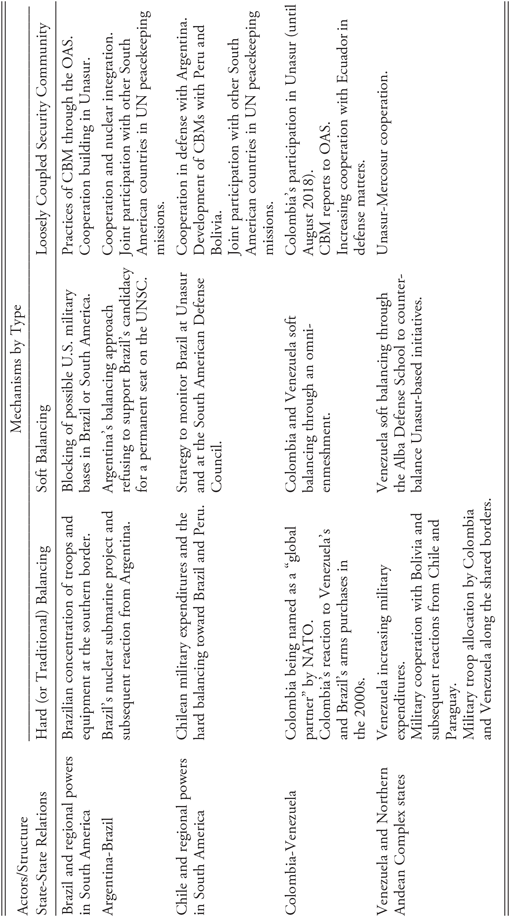
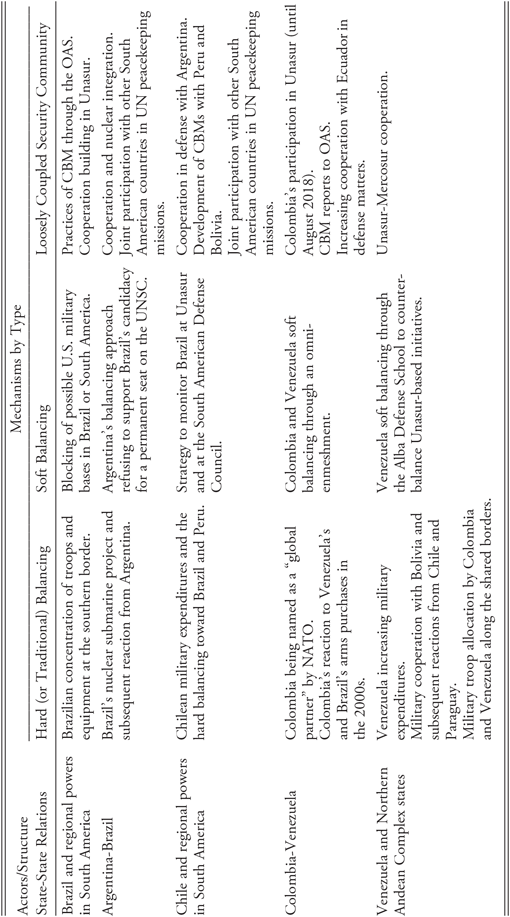
To explain how hybrid formations are produced, this article traces the historical process through which overlapping systems of security governance enact specific practices in conflict formation and resolution. It develops an analytical framework proposing to integrate the balance of power and security community approaches. For the former, we consider its traditional and soft balance variations, and for the latter, the loosely and tightly coupled security community aspects. The use of such nuances is crucial to address the process nature of hybrid security that we describe. To empirically test the hypothesis that a hybrid security governance exists in South America, we analyze the most empirically intense and academically controversial political and security interactions from interstate relations in the two security complexes in the region, the Southern Cone and the Northern Andes (see table 1).
Overlapping Mechanisms in Security Governance, 2000–2018
Source: Prepared by the authors
The article advances in three sections. The first section presents the concept of security governance and its theoretical framework. The next addresses the existing literature on South American security governance, contrasting this contribution to the extant literature on regional security dynamics. The third section presents historical evidence of hybrid security governance to show how the practices of balance of power and security community overlap. The article concludes with suggestions of potential avenues for future research.
Hybrid Security Governance
Hybridity is a marked characteristic of Latin American international thought. Tickner observes that international relations theory in Latin America, for instance, has been built on an eminently practical relationship between theory and “the creation of strategies for improving the region’s maneuverability on a global level” (2003, 346). For theoretical interpretations of international relations, thinkers in the region fused Morgenthauian realism with interdependence and the pragmatic structuralism derived from dependency theory. This patchwork and apparently confusing aspect of international thought in the region is linked to the general Global South’s characteristic of hybrid intellectual activity, which appropriates knowledge on a culturally specific basis but always takes systems of thought from dominant Western centers of knowledge (Chagas-Bastos Reference Chagas-Bastos2017, Reference Chagas-Bastos2018; Tickner Reference Tickner2003, Reference Tickner2008).
Hybridity offers, for our purposes, an alternative analytical framework by addressing systems of security governance in South America as sites of transition and change. This notion of hybridity emerges through these different (and overlapping) practices, which coexist and interrelate in a coconstitutive process. Therefore, hybridity is understood by its processlike nature, as “social formations where formal and informal elements coexist, overlap, and intertwine” (Krause Reference Krause2012, 39).
Taking up Adler and Greve’s 2009 thread, we explain how divergent regional security governance mechanisms—implying associative or dissociative approaches— overlap in practice and discourse. We apply the notion of hybridity to address the dynamics associated with the systemic interactions among actors revolving around security governance issues. According to Adler and Greve, security governance is supported by a mixture of two overarching mechanisms: balance of power and security community.Footnote 2 These mechanisms represent distinct sets of social practices, based on different notions of power and the role of war, alliances, and alignments in creating order and stability. Therefore, security governance is characterized by order-creating mechanisms that seek to shape horizontal and vertical relations among the political and social units through which international and transnational security activities take place. In turn, the mechanisms of security governance are presented as “more or less clearly delineated set of rules, norms, practices, and institutions that coordinate security relations between actors in the international system” (Adler and Greve Reference Adler and Greve2009, 64).
Hybridity, in security governance, forms through social actions and institutionalized practices, drawing on distinct security rationales and practices associated with variations in the balance of power and security community. Still, these points of overlap occur in nuances, such as hard and soft balancing or loosely and tightly coupled security communities.
We argue that hybrid security governance in South America encompasses the overlapping state and nonstate actors’ practices and discourses of security in the region.Footnote 3 Ultimately, it represents the negotiated outcome of multiple nonlinear and nonhierarchical patterns of social practices derived from distinct power relations and the ensuing mechanisms through which power is exercised while addressing common security challenges. In the remainder of this section, we explore the conceptual distinctions within and between balance of power and security community to show how hybridity is a particular feature of security governance in South America.
The Intertwining Logic of Security Governance
Contending rationales of peace and conflict coexist between countries and within regional spaces as conditions that motivate or constrain militarized behaviors. These rationales are represented by two sets of practices (institutional or otherwise): balance of power and security community.
Adler and Greve’s work lays the groundwork for a multiperspective view of security governance that focuses on the overlapping mechanism of balance of power and security community practices. To the authors, balance of power, while conceptualized as a security governance mechanism, “rests on the notion of the international system as being composed of competing centers of power that are arranged according to their relative capabilities and are, in the absence of an overarching authority, locked into the security dilemma” (Adler and Greve Reference Adler and Greve2009, 67). The notion of power embedded in the logic and mechanism of balance of power derives from the material and coercive power capabilities of nation-states. As a mechanism of security governance, balance of power is “predicted on the availability of war as an order-sustaining or -creating tool” (Adler and Greve Reference Adler and Greve2009, 67).
Traditionally, the theory of balance of power predicts that an increasing power gap between a regional power and its immediate competitor should drive them to a counterbalance—by an increase in their capacities (through self-help) or by reorganizing their regional and extraregional alliances (Waltz Reference Waltz1979). Therefore, as long as the possibility of war looms on the horizon, the concept remains critical for analyzing interstate relations.
Some critics point out that balance of power theory is becoming irrelevant, due to the even more relevant role of social forces other than the state. Following this perspective, the notion of balance of power has expanded, conceptually and empirically (Paul Reference Paul, Paul, Wirtz and Fortmann2004), evolving from a hard-balancing approach to a variety of perspectives, ranging from conflict formation (Buzan and Waever Reference Buzan and Waever2003) to soft balancing (Pape Reference Pape2005). Paul argues that “the ultimate purpose of any balancing strategy is to reduce or match the capabilities of a powerful state or a threatening actor; the various means that states adopt, besides increasing their military strength or forming alliances, should be [only] a part of our analysis to better understand today’s balancing strategies” (2004, 2–3).Footnote 4
Friedman and Long (Reference Friedman and Long2015) corroborate Paul’s 2004 notions of balance of power and point out that soft balancing is primarily a nonmilitary strategy that states deploy among other instruments, instead of hard balancing. Soft balancing does not directly challenge the military preponderance of a global or regional military power but instead uses nonmilitary instruments to delay, frustrate, and undermine unilateral policies of superpower (Pape Reference Pape2005). Flemes and Wehner (Reference Flemes and Wehner2015) observe that soft balancing, as a foreign policy strategy, is a rational decision for a secondary power in its relations with the regional great power in those spaces where competitive patterns have replaced rivalry interactions, as in South America. To sum up, the purpose of soft balancing is to even out or ameliorate the existing asymmetric distribution of power and to frustrate the powerful actor’s achievement of foreign policy goals by increasing its costs of action (Pape Reference Pape2005; Paul Reference Paul, Paul, Wirtz and Fortmann2004; Reference Paul2005).
The toolbox for soft balancing expands the narrow idea of hard military balancing. Pape (Reference Pape2005, 36), for instance, notes that “mechanisms of soft balancing include territorial denial, entangling diplomacy, economic strengthening, and signaling of resolve to participate in a balancing coalition.” Flemes and Wehner (Reference Flemes and Wehner2015) also observe that soft balancing includes a pool of discursive and institutional instruments, such as the formation of limited diplomatic coalitions or ententes to constrain the superior power. It may also appear as “binding strategies,” by which a secondary power aims to restrain stronger states through institutional agreements (Ikenberry Reference Ikenberry2003). The most extensive form of binding is “omni-enmeshment,” a process that allows weaker states to tie down several superior powers in multilayered institutional affairs to create overlapping spheres of influence (Goh Reference Goh2008). Soft balancing can also include a “balking approach”—which happens when a secondary power refuses to support the greatest power for a demand, preferring to split the responsibilities for the management of a critical international issue (Flemes and Wehner Reference Flemes and Wehner2015).
In contrast, Adler and Barnett (Reference Adler, Barnett, Adler and Barnett1998) conceptualize security communities as transnational regions comprising sovereign states whose people maintain the expectation that the members of the community will not fight each other physically and will resolve any conflictive issues by peaceful means. They argue that the variations in how these stages are achieved might result in two types of security communities. A tightly coupled security community will show a strong tendency toward cooperation commitments, a high level of military integration, coordination in internal security, shared forms of governance and decision rules, and free movement of people. A loosely coupled security community will assume the same process but in a less institutionalized and intense form. Still, a necessary but not sufficient condition for the emergence of a security community is the absence of war between the member states.
In the same vein, Adler and Greve (Reference Adler and Greve2009) specify five conditions that could be present in a security community. First, the trustworthy expectations of peaceful change when dealing with conflict are based on the practice of self-restraint or the abstention from use of force. Second, the actors who constitute security communities align efforts toward joint ventures, projects, and partnerships, bringing their constitutive members to the day-to-day practice of peace. Third, cooperative security is indivisible and comprehensive and is the natural practice of a security community. Fourth, diplomacy, stable consultation standards, and multilateral decisionmaking are the essential practices in which the community safety mechanism lies; that is, states institutionalize guarantees rather than assure deterrence. Fifth, the security community mechanism includes a provision to spread the community through explicit or implicit practices of learning and socialization. More specific practices would include changes in military planning and the implementation of confidence-building measures, such as military cooperation, planning and joint military exercises, exchange of information, and review of military doctrines, ranging from traditional war to postconflict reconstruction, coordination policy, and border opening.
Considering the rationale of both mechanisms and their intersecting social practices, it is possible to conclude that security community and balance of power might not be entirely mutually exclusive and that at the regional level they can— and indeed do—fuse. Adler and Greve (Reference Adler and Greve2009) also offer four broad ways of thinking about how security mechanisms overlap: temporal-evolutionary, functional, spatial, and relational. In general, these four dimensions offer the structures of causation that could explain why different logics of security order—predominantly balance of power and security community—overlap in regional security governance.Footnote 5 In the following section we address how the practices and discourses of balance of power and security community mechanisms observed in South America account for hybrid configurations of security governance in the region.
South America: Between Security Community and Balance of Power
Literature about South American security has produced two oversimplified approaches to security governance in the region. On the one hand, scholars ground their interpretations on the longstanding “imagined community” sentiment of a shared Latin American identity. According to this perspective, the regional security architecture should be understood as a set of stable and regular patterns of interactions, marked by peaceful conflict resolution and an emphasis on economic growth and development (Kakowicz 2005; Mani Reference Mani2011). On the other hand, scholars have noted that some remaining border conflicts and intensifying transnational threats contribute to the rise of interstate tensions, militarized disputes, and strategic balancing between regional powers (Friedman and Long Reference Friedman and Long2015; Kakowicz and Mares Reference Kacowicz, Mares, Kacowicz and Mares2016).
The analyses focusing on the balance of power emphasize how order and security governance are conceived and sustained. We draw attention in this section to how scholars have articulated these two systemic approaches toward security governance in South America, pinpointing the drawbacks in looking at them as mutually exclusive.
Two factors represent the core of Latin American interstate interactions. One is a strong legalist conciliation culture; the other is the successful consolidation of nation-states after a first postindependence period, marked by the consolidation of national borders and border wars; for example, the Paraguayan War (1864–70) and the War of the Pacific (1879–84). Kacowicz’s Reference Kacowicz2005 argument regarding Latin America”s “long peace” is based on the legalistic approach to security and sovereignty in the region (see also Kacowicz and Mares Reference Kacowicz, Mares, Kacowicz and Mares2016).Footnote 6 Kacowicz holds that the consolidation of regional peace was possible with the emergence of a tradition of peaceful conflict resolution, grounded in the principle of uti possidetis ita possideratum (the one that possesses must keep its possession), which promoted a shared vision of the organization of regional security.
The three pillars established by Kacowicz are the primary tools to analyze the mechanism of security community in practice and the expectations of peaceful change in the region, in particular for those who argue that there is a functional overlap. Although most military institutions adhere to the logic of balance of power and realpolitik toward regional security order, other parts of the policymaking bureaucracy—particularly the diplomatic corps—have deeply internalized the logic of security community in their discursive practices (Flemes and Radseck Reference Flemes and Radseck2009). In recent years, however, with the increasing practical commitments of military and diplomatic bureaucracies to the maintenance of regional order, a significant number of representatives in the military have underwritten the logic of peaceful conflict resolution, turning into proponents of an internationalist grand strategy in line with the logic of security community (Mani Reference Mani2011).
The fact that much of the functional overlap has not led to radical contestations on regional governance in the public realm is a testimony to the idea that “self-restraint” has become a firm disposition in the region.Footnote 7 Furthermore, there is a high adherence to diplomatic channels and international law to solve interstate disputes—accounting for the temporal-evolutionary overlap of security governance mechanisms in the region—which reflects these ongoing dynamics of conflict formation and resolution. Both observations stress the emergence of a hybrid security governance in the region.
Although the security community mechanism offers some grounds for optimism, it is essential to recognize the nuanced debates surrounding the idea and the main issues raised by its critics. Usually, two contending perspectives are presented: on one side, the skeptics, who oppose the very conception of Latin America as a zone of peace; on the other, the scholars who observe a loose or partial security community emerging in South America. It is a central issue in the debate among these scholars whether the region can be conceived as a positive, negative, or hybrid zone of peace (Battaglino Reference Battaglino2012; Holsti Reference Holsti1997; Merke Reference Merke2011).
Some scholars argue that Latin America is indeed a pluralistic society but that it lacks the institutional elements of a security community as established by Adler and Barnett (Reference Adler, Barnett, Adler and Barnett1998). Merke observes that
many of the conflicts that remain today among states [in Latin America] are over territorial issues and natural resources, which means that, in some cases, security dilemmas are unresolved. … the dark side of civil society—drugs, arms, and people trafficking and organized crime—has become a real challenge for regional society. (Merke Reference Merke2011, 29).
In the same context, Merke argues, “if Latin America is a zone of peace in terms of the absence of war between states, Latin America is [also] a very violent zone in terms of the presence of criminal gangs, guerrillas, drug traffickers, and youth violence, which makes it the most violent region on earth” (2011, 15). In direct contrast to the idea of negative peace, Holsti (Reference Holsti1997) argues that South America is better understood as a region transitioning from a negative war zone to a zone of peace.
The second perspective comes from scholars who recognize a loose or partial security community emerging in South America (Buzan and Waever Reference Buzan and Waever2003; Domínguez Reference Domínguez, Acharya and Johnston2007; Herz Reference Herz and Kanet2009; Hurrell Reference Hurrell, Adler and Barnett1998; Kacowicz Reference Kacowicz1998, Reference Kacowicz2005; Kacowicz and Mares Reference Kacowicz, Mares, Kacowicz and Mares2016; Tulchin Reference Tulchin2005; Oelsner Reference Oelsner2007, Reference Oelsner2009a, Reference Oelsnerb, Reference Oelsnerc, Reference Oelsnerd, Reference Oelsner, Kacowicz and Mares2016). Central to this scholarship is examination of the rationale of the security community mechanism rather than offering proof of its existence or unequivocal spread. The idea of a partial or loose security community in South America is a welcome caution against the all-too-optimistic assessment of a pluralistic security community in the region. Buzan and Weaver (Reference Buzan and Waever2003) support the idea that in South America, two well-differentiated security subsystems exist. The first comprises the Andean countries, which show military competition behavior and territorial conflicts, while the second looks at the Southern Cone, where they observe a nascent security community. In the same context, Battaglino develops the notion of South America as a zone of hybrid peace,
characterized by the simultaneous presence of (1) unresolved disputes that may become militarized, yet without escalating to an intermediate armed conflict or war; (2) democracies that maintain dense economic relations with their neighbor countries; and (3) regional norms and institutions (both old and new) that help to resolve disputes peacefully. (Battaglino Reference Battaglino2010, 142, authors’ translation)
There is also an emphasis on low-intensity conflicts that could create an adversarial balancing or even bandwagon actions among states in the region.Footnote 8
If the presence of security communities in South America remains a contentious subject, the same is true, to a lesser extent, for the observation of the ongoing movement in power balancing between regional states. For those working with the English School perspective, the balance of power is one of the core assumptions, similar to international law, great powers, diplomacy, and war. Hurrell (Reference Hurrell and Woods1996) points out that for some regional powers in Latin America, such as Brazil, the balance of power, in the past, represented a central principle of foreign policy.
As outlined earlier, scholarship has paid little attention to the variety of balancing practices of emerging countries, particularly in Latin America. Scholars who engage with the analysis of the balance of power and security dilemma in the region draw mainly on the traditional notions of geopolitical disputes (Battaglino Reference Battaglino2012; Child Reference Child1989; Mares Reference Mares2001, Reference Mares2012; Mello Reference Mello1996; Schenoni Reference Schenoni2014, Reference Schenoni2017; Tulchin et al. Reference Tulchin, Aravena and Espach1998). There is an emphasis on low-intensity wars that could create adversarial balancing or bandwagon actions among states in the region. As for practices and discourses, Mares (Reference Mares2012), in a challenge to the Latin America as a “zone of peace” argument, points to the various sources of tension present in the region, such as border disputes, illegal trade, drugs and the power of organized crime, and conflict over energy and natural resources.
Furthermore, scholars using a neorealist approach argue that balance of power would be the standard behavior in the region, due to the historically competitive nature of bilateral relations between Argentina and Brazil (Lima 2013; Martin 2006). Scholarship also points out that secondary regional powers, such as Argentina, Chile, Colombia, and Venezuela, have undertaken hard- and soft-balancing strategies to counterbalance Brazil’s predominance in South America since the end of the Cold War (Flemes and Wehner Reference Flemes and Wehner2015; Friedman and Long Reference Friedman and Long2015; Schenoni Reference Schenoni2014), as well as reorganizing their alliances to counterbalance Brazilian primacy using external balancing (Gómez-Mera Reference Gómez-Mera2013).
Another focal point in the analysis of the balance of power in the region is the presence of revisionist states. In the past, rising powers were considered “revisionist states,” which expressed general dissatisfaction with their relative position in the international system. It was assumed that they would attempt to alter that position through war (Organski and Kugler Reference Organski and Kugler1980). In contemporary times, soft revisionism seems to be the strategy adopted by some South American countries like Brazil, Chile, and Venezuela, for which the military buildup is just one way to justify their ascension to a regional leadership position or to leverage their position in regional or global decisionmaking processes.Footnote 9 For that purpose, they use military power as a representation of political importance, and except for Venezuela, their participation in multilateral peacekeeping and peace enforcement operations is seen as part of an international insertion strategy (Chagas-Bastos Reference Chagas-Bastos2017, Reference Chagas-Bastos2018); that is, to seek recognition and status.
At the same time, Brazil and Venezuela compete for regional leadership in South America through the mobilization of coalitions and international institution building, with Unasur (Union of South American Nations), Mercosur (Southern Common Market), and ALBA (Bolivarian Alliance for the Peoples of Our America) as the most politically visible projects. Similarly, Chile, since its return to a democratic regime, has tried to reassert itself as an agenda setter in multilateral institutions. In the regional balance of power—particularly between Chile and Venezuela, as well as between Brazil and Venezuela and between Brazil and Argentina (the primary contender for regional leadership)—the competition is framed by political and not military affairs, with nonconflict-driven strategic considerations.
The review of both approaches shows that the meaning of security community in the region remains contested and elastic, while the concept of balance of power has not been adequately explored—weakening and limiting its analytical scope. To demonstrate how a hybrid system of regional security governance emerges in South America, we explore how both rationales and associated mechanisms overlap in South American states’ practices and discourses.
An Empirical Assessment of Hybrid Security Governance in South America
South America has maintained a repertoire of foreign and security policy practices that hold characteristics of the security community and balance of power mechanisms. The events analyzed show that South American states have adopted dual strategies—with different intensities—that could be associated with hard or soft balancing, as well as with security community practices. The occurrence of such events tends to overlap in time, space, and functional aims. In this context, a hybrid system of security governance emerges; that is, the complex system in which these overlapping governance mechanisms create the feature dynamics of regional security.
We explore these hybrid dynamics in light of the two regional security subsystems and their leading actors: the Southern Cone, looking at Argentina, Brazil, and Chile; and the Northern Andes, covering the actions of Colombia and Venezuela. We present evidence for the rationales and practices of hard and soft balancing, as well as of loosely coupled security community, the most empirically intense and academically controversial state interactions within those two complexes. For each of the three variations, we find possible examples of overlapping mechanisms in regional security governance. If those cases sustain the hypothesis of the existence of a hybrid regime of governance, then one could rely on its plausibility (see table 1). This section recounts the events since the beginning of the 2000s that contributed to the formation of a hybrid security governance system in South America.
The Southern Cone: Argentina, Brazil, and Chile
The Southern Cone has usually been addressed as a possible example of emergent or loosely coupled security community. Some ongoing processes contribute to this perspective. Mimicking the Western European diplomatic practice, Brazil and Argentina institutionalized communication channels between presidents and senior officials and have developed regular patterns of security interaction over the last 30 years. The high-level contacts include discussions about defense cooperation, participation in peace operations, and the establishment of cooperative actions in the Triple Border zone between Argentina, Brazil, and Paraguay to address aspects of drug trafficking, smuggling, and terrorism.
Data for 2016 from the Organization of American States (OAS) report that in South America, 92.07 percent of the confidence-building measures (CBM) are bilateral, while 7.93 percent are multilateral.Footnote 10 Of these, almost a third are practiced between Argentina and Brazil. Latin America as a whole has adopted CBM as standard practice for security governance since the end of the Cold War (Tulchin et al. Reference Tulchin, Aravena and Espach1998). The OAS member states have forwarded reports on CBM to the organization, following the resolution AG/RES. 2398 (XXXVIII-O/08) and subsequent discussions started in 2005 (OAS 2008). The annual submission procedure helped to institutionalize the logic of sustained dialogue among states.Footnote 11
Moreover, the joint participation of South American countries (Argentina, Brazil, Chile, Peru, and Paraguay) in the United Nations Peacekeeping Operations (UNPKO) in Haiti also offers additional support to the observed presence of participatory security community mechanisms in the region. Brazil, for instance, has tried to offset the suspicions about practices of balance of power by promoting the joint participation efforts of its South American neighbors in the Haitian mission. The institutionalized cooperation that arises from exchanges between South American soldiers boosts positive interactions and perceptions and broadens the community through explicit and implicit practices of learning socialization (as addressed by Adler and Greve Reference Adler and Greve2009). In the same context, countries across Latin America (such as Argentina, Brazil, Bolivia, Chile, the Dominican Republic, Ecuador, Guatemala, Honduras, Mexico, Nicaragua, Peru, Paraguay, and Uruguay) have engaged in the preparation of Defense White Books as a pathway to widen the community consciousness and to communicate the importance of security dialogue across the region (Barrachina Reference Barrachina, Sepúlveda and Alda2008; D’Araujo Reference D’Araujo2012; Donadio and Tibiletti Reference Donadio and de la Paz Tibiletti2012).
The nuclear deterrence measures between the two largest South American countries are also an example of institutionalized consultation practice on security matters in the region. Both countries had active nuclear programs during the Cold War that provoked suspicions on both sides. Contrary to expectation, in 1991 the two countries decided to establish the Brazilian-Argentine Agency for Accounting and Control of Nuclear Materials (ABACC in the Portuguese or Spanish acronym). The practice of self-restraint by both countries contributed to the normative institutionalization of security issues in the region. This alignment can be seen as the embryo of common enterprises such as Mercosur.
Brazil and Argentina’s joint military endeavors also include the development of military technology, such as the light combat vehicle Gaucho. Before this initiative, the most significant bilateral activity was the signing of the memorandum Understanding Mechanism on Consultation and Coordination of Defense and Security, in April 1997 (see Winand Reference Winand2016). The document confirmed the mutual trust between both countries and mutual respect by their armed forces and indicated that any initiative in the field of defense and security would be previously agreed on between the two governments (Saint-Pierre and Winand Reference Saint-Pierre and Winand2006).
These examples are explicit indications of security community practices in the Southern Cone. Nevertheless, overlapping practices of hard and soft balancing add another level of complexity to the dynamic system of security governance. Brazil, for example, allocates a substantial amount of its troops and military equipment to its borders, especially in the south. This practice of traditional deterrence, associated with hard balancing, symbolizes the remaining threads of past rivalries and suspicions toward Argentina. It is estimated that the Southern Military Command (SMC) accounts for 25 percent of the Brazilian army, 90 percent of the Brazilian armored military equipment, 100 percent of the self-propelled artillery, 75 percent of artillery weapons, 75 percent of engineering equipment, and 75 percent of mechanized cavalry (Defesanet. 2011).
Moreover, the SMC concentrates 25 percent of the workforce of the Brazilian army and all the most modern armored tanks acquired recently by Brazil—such as the Leopard, which was sent to the Southern states of Paraná and Santa Catarina (Defesanet 2011). In contrast, the concentration of troops and military equipment in a region of a mature security community, as seen in Western Europe, for example, is located in the central areas of a country, not at its borders; this is an essential factor for generating mutual confidence among states. The concentration of troops on the border can promote misperceptions, generating unnecessary mistrust, and may be perceived as a threat by the country’s neighbors (Medeiros Reference Medeiros2010). Paradoxically, the Brazilian army announced its intention, from 2004 on, to transfer armored military units from major urban centers to training battalions in the countryside (Saint-Pierre Reference Saint-Pierre2009). The reality, however, is different. The transfer itself was made in the mid-2000s from urban centers in the Southeast (Rio de Janeiro and São Paulo) to destinations in the South—near the borders with Argentina. That only added to the already skewed concentration of armored units in the SMC region.
On the Argentine side, the Brazilian nuclear submarine project had a significant impact on regional nuclear power and gave rise to discourses of hard balancing. In 2010, Buenos Aires senior defense officials made strong statements about how their country should respond to the neighbor’s intentions, stating that Argentina could not stand at the edge of this technology and should never renounce the intention to possess a nuclear submarine (Carneiro Reference Carneiro2012, 12). The same concerns were expressed by bureaucrats in the Ministry of Foreign Affairs, who stated that measurements should be taken toward the potential (but unlikely) event that Brazil leaves the ABACC, or in a worst-case scenario, develops aggressive nuclear tendencies (Wikileaks 2009). This is also consistent with the concerns and complaints coming from diplomats dealing with the Argentine nuclear bureaucracy—that is, the Argentine Ministry of Foreign Affairs’ Directorate for International Security, Nuclear and Space Affairs (DIGAN)—about Brazil’s reluctance on nuclear policy diplomatic coordination, saying that Brazil “does what it wants and when it wants and when it wants to include us” (Gadano Reference Gadano2015, 29; see also Wikileaks 2009).
In the same vein, Argentina has practiced soft balancing on some international multilateral mechanisms and issues, such as those that have involved the UN Security Council. Flemes and Wehner (Reference Flemes and Wehner2015) point out that Argentina’s behavior toward Brazil, although cooperative regionally, assumes a competitive character globally. According to these authors, “since the Fernández government has been in power, Argentina has continued to uphold a balancing approach, refusing to support Brazil’s quest for a permanent seat on the … UNSC” (2015, 15). Argentina proposes, in fact, the creation of a permanent regional seat for Latin America—based on a rotation system—reflecting the country’s view of the competitive partnership and aiming to prevent a greater power asymmetry with Brazil. The strategy is embedded in what Flemes and Wehner (Reference Flemes and Wehner2015, 15) label an omni-enmeshment approach, in which Argentina includes Mexico as a counterbalance to a possible Brazilian hegemonic project.
Chile also has adopted a hybrid strategy of security community, soft and hard balancing. On the one hand, the country continues improving security cooperation with Argentina by strengthening agreements on defense matters. Villar (Reference Villar and Funk2006) notes, for instance, the efforts by both countries to establish measures of mutual trust, such as a binational peace operation force (in 2005), an accord to create a system for homologating defense expenditures, and a joint venture initiative to build military equipment. The country was also one of the chief promoters of regional solutions to regional security problems, such as the United Nations Stabilization Mission in Haiti (MINUSTAH) (see Fuentes Reference Fuentes and Funk2006). On the other hand, Chile has continued to increase its defense expenditures, becoming one of the leading military powers in South America. The country seeks to achieve recognition by the North Atlantic Treaty Organization’s standard and will match Brazil’s and Peru’s air force and tank capacities once it finalizes its arsenal renewal (see Flemes and Nolte Reference Flemes and Nolte2010).Footnote 12
Although Chile did not have a historical rivalry with Brazil, the country indirectly adopted a strategy of military predominance regarding its neighbors and an indirect balance of power strategy toward a potential regional hegemony (Flemes and Wehner Reference Flemes and Wehner2015). During the first half of the 2000s, the Chilean armed forces gained attention when they decided to purchase 10 F-16 fighter aircraft from the United States and several frigates from the Netherlands and the United Kingdom. In the same period, the country also ordered 12 Super Tucano light fighter aircraft from Brazil for military training and 18 additional F-16s from the Netherlands, plus numerous German tanks and 200 U.S. Humvees from General Motors.
At the same time, to balance Brazil, Chile, alongside Argentina, has also deployed soft-balancing actions through a parallel entangling diplomacy strategy on the South American Defense Council. Nolte and Wehner (Reference Nolte, Wehner, Aris and Wenger2014) argue that Chile has set a pragmatic orientation toward the CDS, seeking to monitor Brazilian military ideas and expenditures. Furthermore, Chile adopted a binding strategy while shaping and setting Unasur’s security agenda by bringing its experience of bilateral security cooperation with Argentina into a regional framework. Nolte and Wehner also point out that Argentina and Chile exercised dual leadership to institutionalize the security practices on the council.
The Northern Andes: Colombia and Venezuela
In contrast to the Southern Cone subcomplex, security governance in the Northern Andes has usually been labeled unstable, with insecure borders and conflict escalation practices. Hugo Chávez (1999–2013), for instance, believed that Venezuela would have more political leverage in the region—and eventually a leadership position—if his country increased its military capacity. In this context, since 2005, Venezuela has acquired 100,000 Russian AK-47 assault rifles, 24 Sukhoi Su-30 fighter aircraft, 10 Mi-35M attack helicopters, approximately 40 Mil Mi-17 transport helicopters, and 3 Mil Mi-26 heavy transport helicopters (SIPRI 2008, 306). This accelerated modernization of the Venezuelan armament stock led the French government to refuse to authorize the sale of 3 Scorpène-class submarines, in response to U.S. concerns that those acquisitions would generate a significant imbalance among the region’s navies (IISS 2008, 60).
The most notorious balancing behavior occurred in 2006, when Venezuela signed a military cooperation agreement with Bolivia, aiming at cooperation on crisis management, arms control and disarmament, democratic control of armed forces, and Venezuelan participation in the organization of the Bolivian armed forces. The Venezuelan government would also contribute US$47 million to build a military base in Riberalta, 90 kilometers from the border with Brazil, and a military port in Quijarro, on the Paraguay River (San Miguel Reference San Miguel2016, 9–15). The agreement provoked distrust from neighboring countries, notably Chile and Paraguay—countries with which Bolivia had had disputes in the past and from which Bolivia wishes to reclaim territories lost in those previous conflicts (Malamud and Enzina Reference Malamud and García2007). The immediate consequence of this move was to accentuate the rivalry for influence over Bolivia, which traditionally has been under Brazil’s aegis (Flemes and Wehner Reference Flemes and Wehner2015).
Although Venezuela had backed Bolivia’s hard-balancing behavior toward its neighbors, the country advanced a multilateral cooperation strategy to secure its seat as a full member of Mercosur, thus following a security community logic. This is also true for the Venezuelan support for Argentina and Brazil’s initiative to build up security and defense institutions at Unasur, which later constituted the South American Defense Council. In this context, the council can also be interpreted as mutual soft-balancing behavior between Brazil and Venezuela. Venezuela confronted Brazil and Argentina with a soft-balancing strategy called binding while advancing the construction of institutional agreements in defense matters. To that end, in 2006, Venezuela took the initiative to propose a “deep” agenda for South American defense regional architecture, proposing the creation of a regional defense council based on
A military integration of the 12 South American countries, similar to the one held by NATO members. The new organization would receive the name South Atlantic Treaty Organization (OTAS).
A defense pact, which agreement would include sharing equipment, services, and intelligence cooperation.
A collective defense mechanism.
Preparation of a South American defense and security doctrine (see Medeiros Reference Medeiros2010).
Argentina and Brazil received the proposal with little enthusiasm. The two largest South American countries had already thought of developing the organism in a more pragmatic intergovernmental institution but not strongly tied to concepts of deep integration in defense and security. The Brazilian strategy of constructing a limited diplomatic coalition with Argentina in the South American Defense Council helped to constrain Venezuela as a secondary regional power.Footnote 13
Venezuela tried another form of power balancing though institutional means. During the first term of Dilma Rousseff (2011–14), Brazil had significant concern about the institutionalization of the CDS’s organizational structures, and saw the establishment of the Defense School at Unasur as a critical component of regional security.Footnote 14 The initiative received full support from Argentina and Brazil “after the revelations in 2013 about the spying programs and tracking of the NSA [U.S. National Security Agency] in several South American countries” (Carmo Reference Carmo2015). Venezuela, even while part of Unasur’s Defense School, responded to the Brazilian initiative with a typical balancing strategy. In May 2011, the ALBA Defense School was inaugurated in Bolivia, sponsored by Venezuela.Footnote 15 Time and again, Venezuela used soft-balancing instruments via coalitions to constrain the superior power, Brazil (Flemes and Wehner 2012).
Colombia has also adopted overlapping practices of hard balancing and security community mechanisms. On the power balance side, the Colombian military alliance with the United States, reflected in Plan Colombia (2000–2015), undermined the regional power’s geostrategic interests in South America. In this sense, Flemes and Nolte (Reference Flemes and Nolte2010) argue, the use of seven Colombian military bases by the U.S. armed forces, in particular, shows a “collateral hard balancing” against Brazil’s military influence. Moreover, in the first half of 2018, Colombia acquired the status of NATO’s “global partner” in recognition of its military capacities. With this agreement, Colombia became the first and only country in the region to participate in the organization (Santos Reference Santos2018; La Nación 2018). Moreover, concerning the military balance, this means that NATO transfers to Colombia the possibility of balancing the military advantage that neighbors such as Venezuela and Brazil have had regarding military equipment.
The 2018 SIPRI database for Colombia shows that it is the South American country with the most significant military investment as a percentage of GDP (about 3.1 percent), which is comparatively higher than the military investments of Brazil (1.3 percent), Chile (2 percent), and Venezuela (1 percent).Footnote 16 In this context, Colombia can balance Brazil, but its military investment capacity and the global partnership with NATO also can balance the modern Venezuelan military capacity. Since 2015, Venezuela and Colombia have strongly reinforced the allocation of troops at their borders, with growing signals of distrust and aggressive discourse from both countries.
As for the mechanisms associated with the logic of security community, Colombia was a Unasur member until August 2018, when it withdrew. Also, according to the CBM reports submitted to the OAS, the country has strongly increased its bilateral cooperation in defense with Ecuador and especially with Peru (OAS 2008). It is noteworthy that Colombia has developed few confidence-building measures with Venezuela and Nicaragua—countries with which it has historical and still unresolved territorial litigation.
Flemes and Wehner (2012, 5) also note that Colombia and Venezuela used soft balancing through an omni-enmeshment strategy to develop “a web of sustained exchanges and relationships” in multilateral channels, but mainly through Unasur and the South American Defense Council. The fact that both countries agreed to share responsibility for the Unasur General Secretariat for the period 2011–12 redefined the conflictive identity that characterized the diplomacy between the governments of Álvaro Uribe and Chávez (from 2002 to 2010). In sum, both states used multilateral mechanisms of competition and cooperation until at least 2016, when diplomatic hostilities resurfaced because the Venezuelan government unilaterally closed the border with Colombia.
As these case studies demonstrate, hard- and soft-balancing strategies overlap with cooperation and trust-building processes between South American states. On the one hand, low-intensity security dilemmas have not entirely disappeared from the practices and discourses of South American countries, fueled by historical territorial conflicts, by concentrating troops and military equipment at the borders, and by mutual suspicions about the cycles of arms modernization. On the other hand, since the nineteenth century, norms like the uti possidetis juris and the no intervention principle have been socialized among South American countries, forming a legalist approach to conflict resolution and resulting in the institutionalization of a “long peace.” The security governance system derived from these interrelated sets of practices could not be described as anything but a hybrid.
Final Remarks
This article has argued that to understand the nuances in security governance in South America, one must look at the hybrid security governance system that emerges from the overlapping practices of security community and balance of power. From our historical account, we show the confluence of factors that make it necessary to enact a multilayered approach. Essential elements of security governance in the region cannot be reduced to one or another security governance rationale and respectively associated mechanisms. The conceptual ground advanced in this article shows that practices of security governance in the region have been merging through time, space, functional bureaucracies, and political praxis, in order to create unique and context-specific forms of conflict resolution and to secure regional stability.
The hybridity exhibited by South American security governance contributes to the emergence and durability of weak conflict resolution mechanisms and the fragile institutionalization of security dialogue mechanisms—which are unable to avoid security dilemmas. For this reason, all South American countries involved in territorial conflicts use conflict resolution mechanisms outside the region, such as the UN Secretariat, the International Court of Justice, and even the Vatican.
Territorial disputes such as those faced by Bolivia, Chile, and Peru or by Venezuela and Colombia indicate that “states maintain their ambiguous balancing act between rhetorical trust building and conventional military armament” (Villa and Weiffen Reference Villa and Weiffen2014, 156; see also Villa et al. Reference Villa, Chagas-Bastos and Braga2019). While the balance of power interpretation still is relevant to understanding contemporary security in South America, there are observable patterns of the security community in the region, as demonstrated by the multilateral cooperation initiatives and the regional integration arrangements involving defense and security and as shown by the establishment of the South American Defense Council.
Hybrid security governance means that balance of power and security community mechanisms—and their associated variations—are fused as conditions motivating or constraining militarized behavior within a region. In this sense, avenues for future research would be linked to the establishment of the rationale and mechanisms underlying the hybridization process.