Introduction
Hospital payment systems are one important policy mechanism used to influence the adoption and use of medical technologies in health care (Greenhalgh et al., Reference Greenhalgh, Roberts, MacFarlane, Bate and Kyriakidou2004; Torbica and Cappellaro, Reference Torbica and Cappellaro2010; Cappellaro et al., Reference Cappellaro, Ghislandi and Anessi-Pessina2011), especially as many new innovations are first used in the inpatient sector. Prospective payment systems, mainly the use of diagnosis-related groups (DRGs), are an important means of hospital payment in a majority of OECD countries (Busse et al., Reference Busse, Geissler, Quentin and Wiley2011). In such systems, patients are classified into a limited number of DRGs, which in principle are clinically meaningful and relatively homogeneous in their resource consumption. Each DRG is associated with a specific cost weight or tariff, which is usually based on the average level of resources used to treat patients within that DRG. These fixed, prospective payments aim to encourage hospitals to operate efficiently and with greater financial transparency. In this paper, we use the generic term ‘DRG’ to refer to a range of payment systems that may be labelled differently across jurisdictions.
In the literature, there is general consensus that DRG-based payments incentivize hospitals to reduce the costs per treated patient, increase the revenues per patient, and/or increase the number of admitted patients, in attempts to achieve efficiencies, while maintaining profitability [Office of Technology Assessment (OTA), 1983; Barnum et al., Reference Barnum, Kutzin and Saxenian1995]. However, the available empirical evidence is inconclusive with regard to the impact of these payments systems on the adoption and diffusion of technological innovations. Many studies conclude that they incentivize technology use, especially in situations where it leads to reduced or neutral costs per admission (e.g. through reduced length of stay or decreasing costs in another area of care within the hospital) and do not negatively affect quality of care (Weisbroad, Reference Weisbrod1991; Kesteloot and Voet, Reference Kesteloot and Voet1998). However, when technologies are initially introduced into the health system, information about their performance and costs in routine practice is unavailable (Mowatt et al., Reference Mowatt, Bower, Brebner, Cairns, Grant and McKee1997). This is particularly true in the case of devices and procedures, but is also the case for drugs, as many clinical trials are not conducted under ‘real practice’ conditions. Until sufficient information is generated, hospitals are reimbursed based on historic cost patterns, which may not adequately reflect current service provision and, in particular, the changing use of technology. Some commentators have therefore suggested that such systems disincentivize hospitals from introducing cost-increasing technologies, even if they improve the quality of care, until the reimbursement system is updated to compensate for their additional costs (Cutler and McClellan, Reference Cutler and McClellan2001; Schreyogg et al., Reference Schreyogg, Baumler and Busse2009; MedPAC, 2010).
To help address the aforementioned issues, some countries have developed various short- and long-term mechanisms to better account for technological innovation.
As outlined by Scheller-Kreinsen et al. (Reference Scheller-Kreinsen, Quentin and Busse2011), short-term mechanisms generally take the form of separate payments, supplementary payments and cost-outlier funding. Separate payments involve either additional funding, negotiated nationally or locally, or retrospective reimbursement of hospital reported total costs, typically in cases when information about costs and effects of a technology is still relatively limited. These payments fall outside the DRG system and therefore do not require an assigned procedure code, which allows a high degree of flexibility with regard to the conditions under which payments are granted. Alternatively, supplementary and cost-outlier funding focus on the general DRG system by excluding certain high-cost technologies and reimbursing them separately to alleviate substantial differences between incurred costs and standard payments rates. Supplementary payments are made on top of the standard DRG payment rate, which can be negotiated or take the form of retrospective reimbursement of reported costs above the standard tariff of individual providers. Cost-outlier funding retrospectively reimburses costs above a statistically determined threshold or provides payments based on weighted or negotiated costs.
There are also various long-term approaches to encourage and incorporate new technologies within the DRG system. Such mechanisms include assigning cases to different DRGs, splitting an existing DRG or establishing a new DRG, which are particularly appropriate when technologies increase (or decrease) costs for a well-defined subset of patients falling into one or more DRGs (Scheller-Kreinsen et al., Reference Scheller-Kreinsen, Quentin and Busse2011). Alternatively, when technologies increase the costs of all services bundled in one DRG or of all hospital services, updates to the payment tariff are used, which may involve recalculating either the cost weight or payment rate. In either scenario, these actions are typically put into place during national (or regional) updates to the DRG system and there is sufficient information or agreement on average costs, performance and patient classifications. Technologies may receive both types of funding. For example, a new technology may initially receive a short-term payment until sufficient evidence or expertise is available, after which it can be integrated into the DRG system.
In light of the available evidence and current practices to ensure that beneficial new treatments are sufficiently financed by the health care system, this study aimed to (i) better understand DRG development and implementation across different countries; (ii) explore the use of short- and long-term payment instruments for new medical technologies; (iii) investigate the use of evidence on therapeutic value and cost-effectiveness in determining payments; and (iv) gather expert opinion on the effectiveness of DRG-based systems to support the use of new technologies in health systems. Finally, the study sought to identify any examples of good practice on linking hospital payments for new medical technologies to evidence of value.
The paper is structured as follows. We first provide an overview of our study methods, followed by presentation of the findings. Finally, the paper concludes with a discussion of what could be improved to ensure DRG-based hospital payment systems adequately incentivize the timely adoption of high-value technologies and strategies that could be pursued to meet this end.
Methods
To meet the aims of our study, we adopted a two-stage approach to the research. The first stage of the research involved a review of existing literature to provide a foundation for the study by exploring key issues surrounding use of DRG-based hospital payment systems and identifying ways countries have attempted to support adoption of new technologies through such mechanisms. The literature review also served to inform the development of the second stage of research, which entailed an international survey of experts involved in developing or administering DRG-based payment systems. The international survey aimed to gather expert opinion and experience on the role of these systems in encouraging the adoption and use of new medical technologies. We were particularly interested in the use of evidence on therapeutic benefit and cost-effectiveness in developing and updating the payment system in the various jurisdictions. Therefore, the survey also sought to understand the use of evidence more generally and to identify any specific examples where payments for technologies have been directly linked to evidence of value (e.g. provides therapeutic benefit and is cost-effective).
For the literature review, we searched several key databases, including PubMed, EMBASE, Scopus and EconLit, using the following search terms: ‘diagnosis-related group’, ‘hospital financing’, ‘patient classification system’, ‘health care financing’, ‘costs’, ‘technology’, ‘medical technology’, ‘prospective payment systems’, ‘incentives’, ‘innovation’, ‘evidence’, ‘evidence-based policy’ and ‘health outcomes’. No restrictions were placed on the year of publication. We reviewed 150 abstracts, with duplicate abstracts identified and eliminated. After the abstracts were identified, the full published papers were obtained and reviewed if they discussed a national DRG system (or a comparison of multiple systems) or financing for medical technologies. In total, we reviewed 54 articles (Appendix 1).
Based on the information obtained from the literature review, a survey instrument was developed for dissemination to national experts on hospital payment systems (Appendix 2). The survey entailed a variety of close- and open-ended questions related to the following areas of interest: (1) general characteristics of the DRG system (e.g. developed locally or exported from elsewhere, level of health policy making at which DRGs are defined); (2) frequency of updates to DRG tariffs; (3) role of evidence in determining rates/tariffs and what challenges, if any, arise in this process; (4) the use of different short- and long-term payment mechanisms to support technology adoption (e.g. separate or supplementary payments, creation of new DRG code outside of general update); and (5) the overall impact of such mechanisms and DRG-based payment systems in general on the uptake of innovative technologies.
The survey was first piloted with two experts from the Department of Health in England experienced in the national hospital payment system. Minor revisions were then made to improve the structure, flow and question wording of the survey. The final version of the survey was subsequently disseminated to experts in countries employing DRG-based payment systems, including Australia, Austria, Canada, England, Finland, France, Germany, Ireland, Italy, Norway, Portugal, Spain, Sweden, South Africa and the United States, who attended the 2011 annual Patient Classification Systems International conference in Montreal, Canada. The experts selected for participation had extensive experience in developing, administering or assessing prospective payment systems, and worked in a variety of settings, including for national Ministries or Departments of Health, universities, consulting firms or other private bodies dedicated to health care financing. Respondents were instructed to return the completed surveys via email to the research team; they were not provided remuneration for participation. Fifty-one surveys were disseminated at the conference. Multiple experts from each country were asked to complete and return the survey. In particular, we aimed to survey a minimum of two experts from every country to cross check the responses received.
A total of 34 surveys were returned (67% response rate), including experts from every country except South Africa. The final sample comprised the following: Australia (AUS), n=4; Austria (AUT), n=2; Canada (CAN), n=3; England (ENG), n=3; Finland (FIN), n=2; France (FRA), n=2; Germany (GER), n=3; Ireland (IRE), n=3; Italy (ITA), n=3; Norway (NOR), n=2; Portugal (POR), n=2; Spain (SPA), n=2; Sweden (SWE), n=2; and the United Sates (USA), n=3. The sample reflects a diversity of DRG systems, in terms of their development, approach (e.g. case-based vs budget allocation), and mechanisms used to account for technological innovation.
Responses to close-ended questions were tabulated and entered into a response key. Data from the open-ended questions were analyzed for key themes. Where there were data gaps or discrepancies in responses between two or more respondents from the same country (occurred in two cases), we consulted the available literature and/or followed-up with respondents to clarify the information provided. In the following section, we present the study findings by way of the overarching topics of interest covered by the survey.
Results
General characteristics of DRG systems
DRG systems have been adopted by and evolved in countries differently. For example, half (50%) of the countries surveyed developed their DRG system locally, while the remainder imported or adapted it from elsewhere. Among countries that reported they adopt aspects of their DRG system from other countries, it is most common to import only the grouper, although several countries (Ireland, Italy, Norway and Portugal) import both DRG groupers and codes. In addition, each country has taken a different route and at different times to introduce a DRG-based payment system. For example, in England and France they were developed initially for the purpose of patient classification or to describe hospital activity, and later also for payment purposes (England, France, Germany, Netherlands, and United States). Other countries such as Ireland, Portugal, Spain (certain regions) and Sweden use DRGs principally for budget allocation or benchmarking purposes. Although the majority of countries define DRG cost-weight standards at the national level, the similarities end there. Countries differ with regard to the costing methods used to define tariffs and for those jurisdictions that define tariffs at the regional level (e.g. Italy, Spain, Sweden), variation exists within the country. Such differences are often the result of dissimilarities in the number of hospitals that participate in collecting standardized cost-accounting information and the level of detail required to meet national cost-accounting standards (Schreyogg et al., Reference Schreyogg, Stargardt, Tiemann and Busse2006; Busse et al., Reference Busse, Geissler, Quentin and Wiley2011).
Frequency of updates
Updates to the patient classification system or the payment tariff are not exclusively targeted at incorporating technological innovation into DRG-based hospital payment systems; rather, they are intended to ensure that the systems are continuously modified to reflect current practice patterns and treatment costs. Our survey suggests that the majority (71%) of countries update on an annual basis, although there are exceptions. Italy, for example, generally updates both the patient classification system (at the national level) and payment tariffs (at the regional level) every two to three years, although the latter can vary among regions. While Austria updates its patient classification system annually, the payment rates are adjusted only for specific DRGs when deemed necessary by policy makers. For countries that import their DRG system from other countries, the timing of updates is normally tied to that of the originator country. For instance, Ireland updates its patient classification system and tariffs every four years and annually, respectively, which informs updates to the Australian system. Given that updates are based on available data, several respondents suggested that DRG-based hospital payment systems exhibit a certain time lag, in terms of reflecting current practice patterns and treatment costs.
Use of short- and long-term mechanisms to support technology adoption
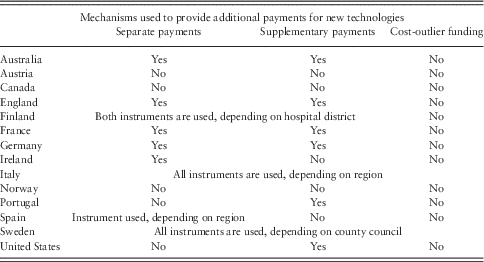
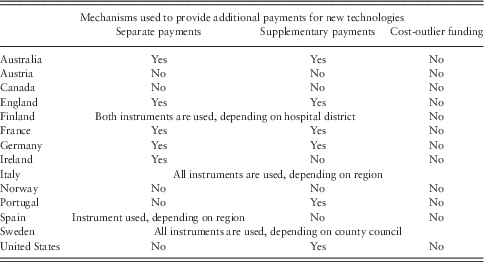
Concern has been expressed that DRG-based payment systems may pose particular disincentives for expensive breakthrough medical technologies, particularly those for which patient benefits are realized over a period of months or years and for which limited evidence exists to sufficiently inform either the development or updating of the system. As illustrated in Table 1, most of the countries (79%) surveyed use some form of short-term payment for specific technologies, which generally entails some type of additional funding to hospitals using certain medical technologies. Only Austria, Canada and Norway do not offer such payments. A majority (64%) of countries offer either separate or supplementary payments for new technologies, with half of those surveyed extending both types of short-term payments. Only Italy and Sweden provide cost-outlier funding.
Overview of the use of short-term payment instruments in 14 countries
Sources: Survey data; Scheller-Kreinsen et al. (Reference Scheller-Kreinsen, Quentin and Busse2011).
Technologies eligible for the aforementioned payments typically meet one or more the following criteria: high costs and/or costs exceeding standard deviation of the respective DRG(s); technology used in defined specialist services/interventions or diagnoses; level of activity associated with technology is found in a number of DRGs (i.e. used in a sufficient number of patients); and a new innovation. Some countries also consider whether the technology provides meaningful clinical improvement or is more cost-effective compared with existing services, which we discuss further below.
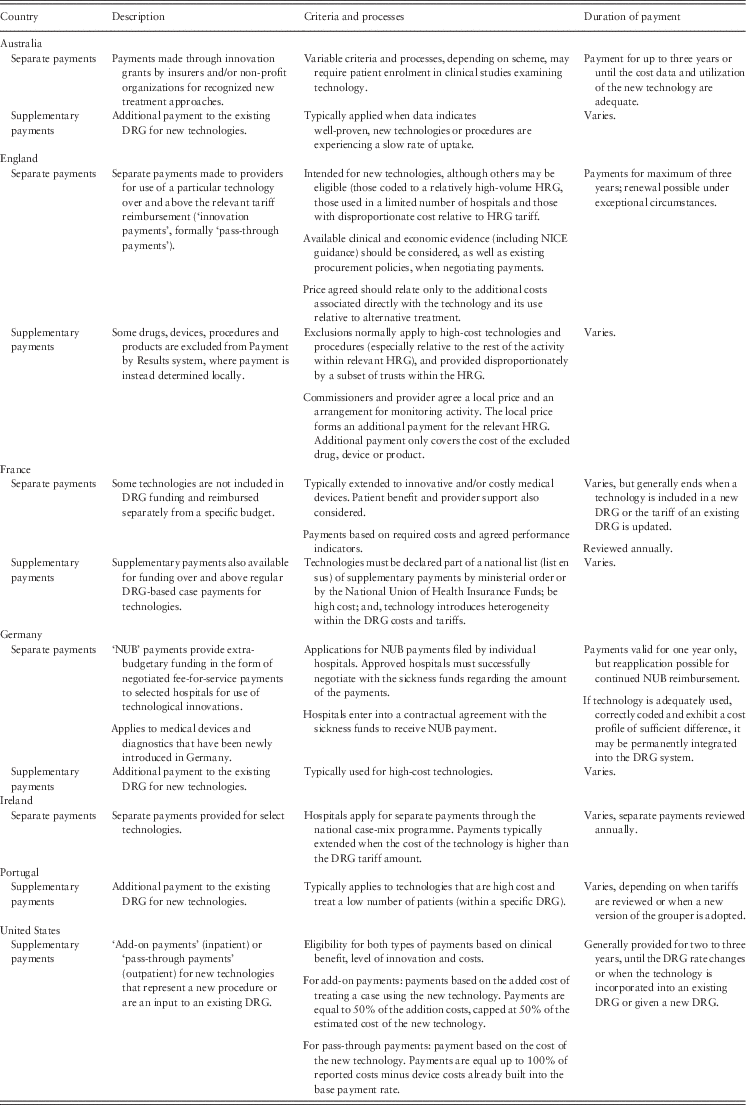
Almost all countries that employ short-term payment arrangements indicated that they are determined through standardized processes, which usually involve some form of application and negotiation process, especially with regard to separate payments. Negotiations around the specifics of the short-term payment (e.g. payment amount, term of payment) typically involve individual hospitals, insurance companies and national bodies, such as Ministries of Health and those involved in setting DRG payments, or regional authorities in decentralized countries (e.g. Italy, Spain). The process for determining the payment amount is by and large informal, via negotiation and agreement between the relevant parties involved. The United States is one exception, where short-term payments (called ‘add-on payments’ for inpatient payments and ‘pass-through payments’ for outpatient payments) are paid based on pre-determined criteria. Add-on payments equal to the lesser of 50% of the amount by which the total covered costs of the case exceed the DRG payment, capped at 50% of the costs of the new technology (Clyde et al., Reference Clyde, Bockstedt, Farkas and Jackson2008). Pass-through payments are equal up to 100% of reported costs minus device costs already built into the base payment rate. This formula essentially requires Medicare and hospitals to share in the financial risk of providing costly new technologies. Survey respondents indicated that it generally takes between several months and one year or more to negotiate and finalize short-term payments.
In most cases where short-term payments are used, they are reviewed on an annual basis, during scheduled updates, to assess if the technology still meets the eligibility criteria or whether it can be adequately incorporated into an existing or new DRG. However, some countries, such as France and the United States, review less frequently, typically every two to three years. French respondents noted that growing funding pressures may result in more frequent reviews of its lists of reimbursed products (‘LPPR’) and supplementary payments; however, there has been some consensus that public authorities should try to ensure some degree of reimbursement predictability or stability for technology manufacturers. In Germany, the agreed short-term (‘NUB’) payment between hospitals and insurance companies applies only for one year, after which hospitals need to reapply if conditions warrant additional, separate reimbursement (Henschke et al., Reference Henschke, Baumler, Weid, Gaskins and Busse2010). England also employs a time limit for ‘innovation payments’; payments can only be agreed for three years. In all other cases, short-term payments cease when a technology is no longer eligible or it is included in the DRG system. For example, in Australia, short-term payments are phased out, with payments absorbed into DRG payments after (1) the full cost of the technology (e.g. a device) is accurately included in the relevant DRG and (2) the technology is well assessed and integrated into clinical practice. Table 2 compares and contrasts different national approaches to short-term separate and supplementary payments.
Comparison of different national approaches to short-term separate and supplementary payments

DRG=diagnosis-related group; HRG=healthcare resource group.
Sources: Survey data; Medpac (2003); Department of Health (2011); Scheller-Kreinsen et al. (Reference Scheller-Kreinsen, Quentin and Busse2011); and Henschke et al. (Reference Henschke, Baumler, Weid, Gaskins and Busse2010).
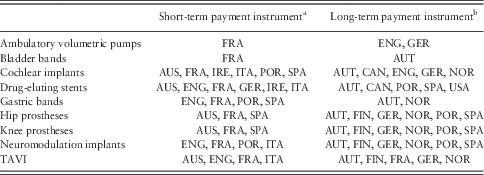
In terms of long-term instruments, a minority (<35%) of countries have created a new DRG outside of a general update in response to innovative technology. In cases where this has occurred, it is because the technology is used at a high volume and/or has a significant cost impact. The example of coronary stents was noted by respondents in Australia, Austria, Canada, Germany and the United States. This has also been applied to date to transcatheter aortic-valve implantation (TAVI) in France and intracranial neurostimulators in Portugal. Otherwise, it was fairly common for the payment tariff to be recalculated when a given technology increased the cost of all services bundled in a DRG or of all hospital services, but this was usually done during the normal updating process, as previously discussed.
Table 3 presents examples of technologies, particularly medical devices, where countries have applied short- and long-term payment mechanisms. For example, in Italy short-term instruments – both separate and supplementary payments – are used in various regions for transcatheter aortic-valve implantation (TAVI). The Lombardy and Basilicata regions employ supplementary payments, although with different characteristics. Lombardy reimburses 95% of the average price paid by regional hospitals (∼€20,000), while Basilicata pays an additional €8000 over the relevant DRG tariff. In contrast, Campania and Puglia regions use separate payments to cover both the cost of hospitalization and the device itself (about €23,000 together), instead of reimbursing TAVI through the DRG system.
Examples of short- and long-term payment instruments applied to devices
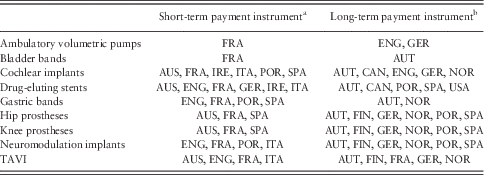
TAVI=transcatheter aortic-valve implantation; DRG=diagnosis-related group.
Sources: Survey data.
a Either a separate or supplementary payment was made.
b Principally relates to creating a new DRG code.
Role of evidence
With increasingly limited health care budgets, policy makers have sought to obtain greater value from investments in new technologies and other interventions. However, there has been limited evidence of whether DRG reimbursement tariffs for new technology are sufficiently linked to evidence of value, namely data on a technology’s therapeutic benefit and cost-effectiveness.
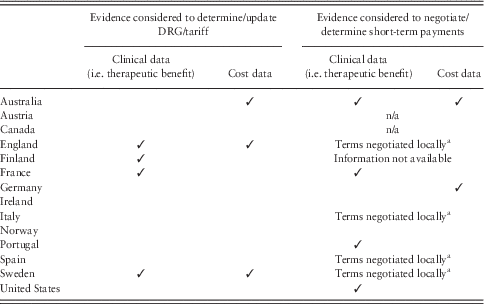
Overall, in practice it appears that evidence is only used in a minority (43%) of countries surveyed, including Australia, England, France, Finland and Sweden to support determinations of or updates to DRG payments (Table 4). Of those jurisdictions that use evidence, Finland and France consider data on therapeutic value only, while Australia only considers costs. The remaining countries (England and Sweden) attempt to consider both therapeutic benefit and costs.
Role of evidence in determining DRG tariffs and short-term payments for new technologies

DRG=diagnosis-related group.
Sources: Survey data.
a Eligibility and terms of short-term payments negotiated at the local level, so consideration of therapeutic benefits and costs may vary across hospital district, region, or county and technology.
It is slightly more common in many countries for the available evidence on the technology to play a role in determining short-term payment arrangements, in particular separate or supplementary payments. The majority (64%) of those countries using short-term payments consider evidence when negotiating or determining payments (Australia, England, France, Germany, Italy, Portugal, Spain, Sweden, and United States). However, in England, Italy, Spain and Sweden, short-term payments are negotiated locally, typically at the hospital level, so the role and use of evidence may differ across hospital and technology. In a few countries (Australia, England and France), additional evidence collection is also required as part of the short-term payment agreement.
Since we were interested in ways to strengthen the link between evidence of value and DRG-based hospital payments, we surveyed respondents on their perceptions of the key challenges in using evidence to determine payments. The main challenges identified included a lack of clear and standard processes for collecting evidence on technologies and subsequently how to obtain access to available data and apply it when determining DRG codes and tariffs. In addition, respondents noted that a lack of clinical data for new medical technologies can hinder evidence-based payment decisions. Analysts have noted several challenges in ensuring a robust evidence base, in particular for devices (Drummond et al., Reference Drummond, Griffin and Tarricone2009; Sorenson et al., Reference Sorenson, Tarricone, Siebert and Drummond2011). For instance, the relative lack of controlled and longer-term clinical studies [e.g. randomized controlled trials (RCTs)] is a particular problem and one that is most prevalent for devices compared with other technologies. RCTs for devices are often small, because the initial patient population is not as large as many target populations for drug treatment. Moreover, for many devices, uptake into clinical practice occurs rapidly and, at times, at a point much earlier than the completion (or initiation) of clinical studies. Of particular importance to hospitals, available evidence on the cost-effectiveness of devices also often overlooks the broader organizational implications (e.g. surgeon/end-user training, associated capital investments) of adoption.
Impact of hospital payments on the adoption of new technologies
As highlighted in our previous discussion, the evidence on the impact of DRG-based hospital payment systems is mixed, with some studies suggesting they serve to support technology adoption, while others proclaim a hindering or neutral effect. When queried about the impact of DRG systems on technology uptake, the majority (70%) of respondents believed such systems do indeed have an impact on adoption. Of these, 87% indicated that DRG systems can act both as an incentive or deterrent to the uptake of new technologies, depending on the circumstances. For example, one Australian respondent indicated that the design of the patient classification system can have a marked influence on the integration of a technology into the system, where the use of broad categories enables hospitals to compensate cost increases (related to the technology) in one area and quickly adopt a technology, while the opposite is true for systems that define DRG narrowly. Others emphasized the importance of setting the tariff at a level appropriate to reflect the costs of new technologies, which would provide the necessary incentives to adopt such technologies into practice. Very few (8%) considered DRG-based hospital payments a deterrent under all circumstances. In these cases, the main deterrents identified were the time lag between introduction of a new technology and integration into the DRG system and the fact that evidence of value for a particular technology is not – in most systems – formally linked to the payment system. Any disincentives for adoption were seen to predominately affect cost-increasing, quality-enhancing technologies, at least temporarily until they could be appropriately reflected in the existing DRG system.
All of the respondents that use short-term payments in their respective country believed that they could be employed to address some of these issues. However, several respondents highlighted that their effectiveness in facilitating the adoption of new technologies was contingent on successful negotiation of the terms of the payment arrangement, especially with regard to separate payments, and some limitations placed on the duration of the payments.
Discussion
This study explores the role and impact of DRG-based hospital payment systems in the adoption of new medical technologies. A key theme arising from the research is the varying implications of such systems on technology uptake, depending on a range of factors, including the length of time taken to obtain appropriate codes and coding guidance, which can then be built into existing or new DRGs; the design and effectiveness of short- and long-term funding mechanisms; and, the availability of evidence to ensure payments adequately reflect the costs and benefits provided by new technologies.
In order to ensure DRG-based hospital payment systems positively impact upon the adoption of beneficial technologies, there are a number of actions to be taken. First, measures are needed to improve the use of short-term payment mechanisms. For instance, these payments can require considerable evidence gathering and administrative processes, which can extend the time and financial resources needed to agree payments. This issue may, in part, be addressed by instituting more transparent and predictable processes for negotiating short-term instruments, especially with regard to separate payments.
Second, as highlighted by the study, payments for technologies are infrequently based on evidence of therapeutic benefit or cost-effectiveness. Ideally, hospitals should adopt and finance cost-effective technologies and not those that offer limited added value. To achieve this aim, it will be important to link short-term payments to requirements for the ongoing collection of health outcome and cost data as well as identify and institute more effective mechanisms for obtaining patient-level data and clinical input to inform DRG development and/or updates. Recent research by Scheller-Kreinsen et al. (Reference Scheller-Kreinsen, Quentin and Busse2011) found that data for updating the patient classification system and adjusting tariffs are two years old or more in most European countries, especially for new interventions. This can create a multi-year delay between the market introduction of a new technology and the recalibration of DRG tariffs to reflect its added cost. During this period, hospitals that adopt the new technology may experience financial losses.
Given the methodological challenges previously noted, new approaches for producing evidence on the value of new technologies, especially devices, also need to be explored. Such approaches include well-designed observational studies or patient registries and pragmatic clinical trials. These approaches allow ‘real-world’ data to be collected on the actual use of the technology in practice. While these methods are increasingly considered viable research tools (Dreyer et al., Reference Dreyer, Tunis, Berger, Ollendorf, Mattox and Gliklich2010; Chalkidou et al., Reference Chalkidou, Tunis, Wicher, Fowler and Zwarenstein2012), there has been relatively little exploration of their use in a decision-making context.
Of particular importance to hospitals is ensuring that data collection efforts sufficiently capture the broader organizational implications required to use technologies effectively and efficiently (Fulop et al., Reference Fulop, Allen, Clarke and Black2003). Such evidence helps local authorities to decide not only whether to adopt a particular technology, but how to appropriately change the delivery system to ensure best practice. Such changes may entail training initiatives, modifications to routines and procedures, new organizational tasks and roles, new mechanisms of coordination and the introduction of complementary technologies. Attempts should be made, where possible, to measure the potential organizational impacts of new technologies. Doing so would be beneficial to help hospitals to obtain the best value from new innovations and ensure they are integrated into clinical practice most efficiently.
Certainly producing robust evidence on and assessment of technologies requires sufficient resources. In many instances, the requisite resources and trained staff are not available for hospitals to meet this end. In addition, a few respondents mentioned that a lack of expertise among local authorities to understand the available evidence hindered short-term payment negotiations, most notably those related to separate payments, and the ability to link evidence of value to payments. Therefore, it is important to ensure that those involved in determining short-term payments are sufficiently trained and equipped to assess the available evidence on the costs and benefits of a given technology under consideration and, ideally, to understand what data gaps need to be addressed during the short-term payment period. It is also important to implement strategies for communicating data to those entities involved in developing and updating DRG systems to ensure that data collection efforts sufficiently inform payment policy. All of these issues could be aided by greater collaboration at national and international levels to develop robust methods of evidence generation, collect and assess relevant data and devise effective methods for integrating and considering new evidence in DRG systems.
Third, the jurisdictions surveyed place different time limits on short-term payments, typically ranging from one to three years. However, the time taken to fully integrate new technologies into the payment system, which involves obtaining a procedure code, mapping it to a DRG, collecting data on clinical activity, and establishing or updating the tariff to accurately reflect the procedure can span three or four years. It may therefore be advisable to adopt more flexible terms, where short-term payments are made until these steps can be attained. Moreover, while most countries rely on the annual updating process to evaluate the status of technologies receiving short-term payments, others wait two to three years to review. It may be more prudent to review these technologies more frequently to ensure that the appropriate data are being collected to help support their timely integration into the DRG system.
Finally, given that separate payments are commonly negotiated locally, with varying criteria and processes for agreement, geographic variations in the funding of and patient access to new technologies may result. Any differences in access may not necessarily be inappropriate if aligned with variations in local patient or organizational needs, but efforts should be made to ensure that differences are not attributable to the variable effectiveness and efficiency of local procedures for determining payments.
There are several limitations of our study. In particular, our respondents comprised a small sample of international DRG experts, which may limit the generalizability of the findings. However, we were able to survey experts from almost all countries using DRG-based payment systems and those who did participate are key leaders in this area. In addition, as previously discussed, we attempted to correct for potential biases by surveying several experts from a given country. Another potential limitation is that our study did not include those involved ‘on the ground’, in terms of hospital personnel and other relevant national or local health authorities. As a result, we were unable to obtain practitioners’ perspectives, which would be particularly pertinent for better understanding the specifics and practical challenges of determining short-term payments and integrating new technologies into DRG systems over the long term in different national contexts. This is an important research gap to address, especially considering the lack of existing literature on this particular policy approach.
Conclusion
The current study provides a greater understanding of the various payment instruments used in different countries to support the introduction of new technologies. Future research is needed to build on this evidence base, particularly in terms of how different national payment policies impact the adoption and use of health technologies. DRG payment will not have a uniform effect on medical technologies, especially considering the diversity in national payment systems (e.g. classification of DRGs used, how prices are set, use of short-term financing mechanisms), and in some instances technologies will be subject to conflicting incentives. For example, the settings of technology use (i.e. use of technology inpatient or outpatient) are likely to be influenced by DRG payment, but the available incentives may work in conflicting directions and be sensitive to key features of the payment design. DRG payment is also likely to influence the specialization of services, but the magnitude and direction of these effects is relatively unexplored. More research in this area would lend to better understanding the intended and unintended effects of DRG payment on the use of new and existing technologies. Best practices should be identified and communicated across countries to ensure hospital payments effectively incentivize the adoption of beneficial new technologies. Perhaps just as important, future research should not only focus on the impact of different DRG payment policies on technology uptake, but on other related outcomes, such as quality of care and the costs of hospital care.
Acknowledgements
This research was undertaken as part of an unrestricted grant to the London School of Economics (LSE) and Bocconi University by Eucomed, the European Medical Devices Association. The LSE and Bocconi University are partners in the European Health Technology Institute (EHTI), an organization supported by Eucomed to further research into the social and economic aspects of medical technology. The views expressed in this article are those of the authors and do not necessarily reflect those of Eucomed. The authors would like to extend their sincere thanks to those experts who completed the survey and addressed any outstanding questions. Their time and input were valuable and much appreciated.
Appendix 2
SURVEY OF THE ROLE OF HOSPITAL PAYMENTS IN THE ADOPTION OF NEW HEALTH TECHNOLOGIES
Introduction
We are conducting an international survey* on the potential role of hospital payments in encouraging the appropriate adoption of new technologies, in particular medical devices. ‘Appropriate adoption’ means that hospitals adopt those new technologies that are known to be cost-effective without delay, while exercising more caution about adopting those technologies for which the cost-effectiveness is uncertain. By conducting the survey, we wish to explore the extent to which various jurisdictions have attempted to use hospital payments, namely rates/tariffs based on patient classification system, to encourage the cost-effective use of medical devices and to identify any examples of good practice that can be shared. In this survey we will use Diagnoses Related Groups (DRGs) as an umbrella term for patient classification systems in use for inpatient care in different countries.
We would appreciate your time and assistance in completing this survey on behalf of your jurisdiction.
Country/jurisdiction …..........................................................
Job title of person completing the survey.................................
Note: If you would like a copy of the survey report, please give a contact email here:
………………………………………………………………………………………
* The survey is being carried out by the London School of Economics and Bocconi University (Milan) and is funded by the European Health Technology Institute for Socio-Economic Research (EHTI). Dr Ceu Mateus of the Nova University of Lisbon is acting as an adviser to the study. The results of the survey will be in the public domain.
General Questions
1 Was the DRG system in your jurisdiction developed locally, or is it imported/adapted from elsewhere?
□ Developed locally
□ Imported/adapted from elsewhere
2 If imported from elsewhere, which aspects were imported?
□ The DRG codes
□ The Grouper
□ Other (to be specified):
…...........................................….................................................................
…...........................................….................................................................
3 In your country, is evidence of value (i.e., therapeutic benefit, value for money) for a given technology (e.g., a new medical device) considered when determining DRG rates/tariffs?
□ Yes
□ No
If yes:
i. Could you expand on what type of evidence is considered?
□ Clinical impact (efficacy/effectiveness; i.e., therapeutic benefit)
□ Economic evidence (cost-effectiveness; i.e., value for money)
□ Other (please specify):
ii. How would you define the process in place for considering evidence in determining DRG rates/tariffs?
□ Formal
□ Informal
iii. In your opinion, what are the challenges in this process?
…...............................................….................................................................
…...............................................….................................................................
4 In your opinion, to what extent do DRG-based rates/tariffs impact the uptake of innovative medical technologies (e.g., medical devices)?
Please express your opinion on a scale from 1 to 5:
1) No impact at all (innovation is adopted regardless of DRG rates/tariffs)
2) Modest impact (uptake of innovation is only marginally dependent on DRG rates/tariffs)
3) Moderate impact (uptake of innovation moderately depends on DRG rates/tariffs)
4) Significant impact (uptake of innovation is mainly influenced by the value of corresponding DRG rates/tariffs)
5) Extremely significant (uptake of innovation is conditioned by the existence of appropriate DRG rate/tariff).
5. If you think DRG rates/tariffs impact the uptake of innovation (answers 2 to 5 in the previous question), what type of impact is exerted?
□ DRG rates/tariffs encourage the uptake of innovation
□ DRG rates/tariff inhibit the uptake of innovation
□ Both, DRG rates/tariffs encourage the adoption of some types of innovation and deter others
Please provide some examples to illustrate your answer:
6 What do you see as the primary drawbacks of the DRG rates/tariffs with respect to encouraging the uptake and diffusion of innovative health technologies?
…...............................................….................................................................
…...............................................….................................................................
DRG Updating
7 At what level of health policy making are DRG rates/tariff defined in your country?
□ National
□ Regional
□ Both
□ Other, please specify
…...............................................….................................................................
…...............................................….................................................................
8 In your country, what is the frequency of the updates of DRG rates/tariffs?
□ Annually
□ Every 2-3 years
□ Every 4-5 years
□ Rarely updated (>5 years) Please specify:
…...............................................….................................................................
…...............................................….................................................................
9 (In the case of decentralised health care systems) What is the frequency of the updates of DRG rates/tariffs in your jurisdiction/region?
□ Annually
□ Every 2-3 years
□ Every 4-5 years
□ Rarely updated (>5 years) Please specify:
…...........................................….................................................................
…...........................................….................................................................
10 To your knowledge, are single DRGs and corresponding rates/tariffs ever created outside of a general update, as a response to innovative technologies? (e.g., new DRG code to reflect the use of drug-eluting stents)
□ Yes
□ No
If yes:
i. What criteria are used to determine the need for a new code?
…...............................................….............................................................
…...............................................….............................................................
ii. Can you give any recent examples?
…...............................................….............................................................
…...............................................….............................................................
11 Is evidence of value (i.e., therapeutic benefit, value for money) for a given technology considered when agreeing a new group and associated DRG rate/tariff?
□ Yes
□ No
If yes:
i. What type of evidence is considered for defining a new DRG?\□ Clinical impact (efficacy/effectiveness; i.e., therapeutic benefit)
□ Economic evidence (cost-effectiveness; i.e., value for money)
□ Other (please specify):
…...........................................….................................................................
…...........................................….................................................................
Special Payments
12 Does the DRG system in your jurisdiction/region provide supplementary payments for specific technologies? [Note: Payments in addition to standard DRG rates for specific technologies].
□ Yes
□ No
If yes:
i. Could you provide us with a brief summary on these payments?
…...............................................….............................................................
…...............................................….............................................................
ii. What criteria are used to apply supplementary payments?
…...............................................….............................................................
…...............................................….............................................................
iii. Is evidence of value (i.e., therapeutic benefit, value for money) for a given technology considered when determining supplementary payments?
□ Yes
□ No
If yes:
a. What evidence is considered?
□ Clinical impact (efficacy/effectiveness; i.e., therapeutic benefit)
□ Economic evidence (cost-effectiveness; i.e., value for money)
□ Other (please specify):
…...........................................….................................................................
…...........................................….................................................................
b. How would you define the process or framework in place for when and how to consider new evidence?
□ Formal
□ Informal
iv. Who is involved in setting supplementary payments?
…...............................................….............................................................
…...............................................….............................................................
v. How long does it normally take to determine these payments?
…...............................................….............................................................
…...............................................….............................................................
vi. When are these payments re-evaluated or withdrawn?
…...............................................….............................................................
…...............................................….............................................................
vii. In your opinion, do supplementary payments provide an effective mechanism to integrate technologies into the health system?
□ Yes
□ No
If no:
i. Are such payments been discussed or considered?
□ Yes
□ No
If yes:
i. What approach is being considered or developed and what is the estimated timeframe for adoption?
…...............................................….............................................................
…...............................................….............................................................
Examples of Arrangements for Specific Medical Devices
13 Were any particular arrangements made to assist hospitals in the adoption of the following medical devices?:
THANK YOU FOR COMPLETING THE SURVEY