INTRODUCTION
The requirement of a broiler breeder hen during the laying period for energy and for each of the essential nutrients is a function of the potential reproductive performance of the bird, of its state, and of the environment in which the bird is kept. These requirements will differ among the birds in a flock, as will their daily food intakes. Consequently, the task of designing feeds and calculating daily feed allocations that will maximize profit over the laying cycle is extremely difficult. The scientific literature on the subject is not entirely helpful in this regard.
Whereas a few publications have addressed the energy and nutrient requirements of broiler breeder hens during the laying period, the literature is fragmented and largely empirical in nature, dealing almost exclusively with short-term trials. Empirical experimental evidence about the relationship between dietary protein supply and production has been reviewed by Lopez & Leeson (Reference Lopez and Leeson1994) and more recently by Fisher & Gous (Reference Fisher, Gous and Hocking2009), while information specific to amino acids was reviewed by Fisher (Reference Fisher1998) . However, the system is more complex than can be addressed by short-term trials because of the changing potential performance and state of each bird over time, requiring trials to be conducted that can be assessed in terms of economic performance over the entire production cycle. It is extremely difficult to determine the response of laying broiler breeders to dietary protein during the whole laying year and experiments of this sort have not been reported recently. Short-term trials have been reported from the University of KwaZulu-Natal (Bowmaker & Gous Reference Bowmaker and Gous1991; Fisher et al. Reference Fisher, Gous, Goddard and Balnave2001), but these are of most value for determining the utilization of amino acids rather than ‘requirements’. Great emphasis has been given recently to methods of calculating requirements that make use of a simple factorial approach (Emmans & Fisher Reference Emmans, Fisher, Fisher and Boorman1986; Fisher & Gous Reference Fisher, Gous and Hocking2009).
In the absence of relevant long-term trials, a mechanistic approach is suggested in the current paper that could be used to develop a model that simulates the response of a broiler breeder hen to a given daily allocation of a given food. Such a model would determine whether the daily allocation was sufficient to meet bird energy and nutrient requirements for maintenance and egg production on that day, what the consequences would be if these requirements were not met or if some were exceeded, how the requirement would differ on laying and non-laying days, and what the consequences would be to the state of the bird given the above. By tracking these changes on a daily basis for each bird, a population response model could be developed which would take account of the variation that exists in all the genetically determined parameters involved in the egg production process. In this way, the long-term effects of feeds and feeding programmes could be more accurately and more speedily evaluated than would be possible with long-term trials.
There are a number of recent publications relevant to the construction of the type of model described above. The most controversial is information relevant to the calculation of the maintenance requirements of broiler breeders, which accounts for approximately one-third of the requirement for amino acids in these birds. Fisher et al. (Reference Fisher, Gous, Goddard and Balnave2001), Sakomura & Coon (Reference Sakomura and Coon2003) and Nonis & Gous (Reference Nonis and Gous2008) have published on this subject, but there remains some uncertainty about how this important component should be calculated. Johnston & Gous (Reference Johnston and Gous2003, Reference Johnston, Gous, Gous, Morris and Fisher2006, Reference Johnston and Gous2007a, Reference Johnston and Gousb, Reference Johnston and Gousc) and Nonis (Reference Nonis2007) have provided information necessary for describing the egg production process, including a model to simulate egg laying sequences, the changes in the proportions of yolk, albumen and shell and hence the chemical composition over time. The latter updates the information published by Spratt & Leeson (Reference Spratt and Leeson1987) . Recent short-term studies on the utilization of amino acids for egg production have been published by Bowmaker & Gous (Reference Bowmaker and Gous1991), Fisher et al. (Reference Fisher, Gous, Goddard and Balnave2001) and Nonis (Reference Nonis2007), and these suggest that broiler breeders utilize amino acids far less efficiently than do commercial laying hens.
The broiler breeder model described is a mechanistic, stochastic and dynamic means of addressing the problem of predicting the long-term effects of nutritional management on the performance of these birds. The objective of the current model is to simulate the response of a broiler breeder hen, with a given potential laying performance and in a given environment, to a given daily allocation of a given food, such that the long-term effects of feeds and feeding programmes on flock laying performance could be more accurately and more speedily evaluated than would be possible with long-term feeding trials.
MATERIALS AND METHODS
The simulation model described is used to support the understanding of the energy and nutrient requirements and performance of broiler breeders during the laying period. The factors of consequence in determining energy and nutrient requirements are body protein weight, for maintenance, and egg output. The obligatory growth in body protein weight of hens after laying their first egg is assumed to be negligible and, in relation to the resources needed for maintenance and egg production, can probably be ignored. Daily requirements for maintenance and egg production are simulated using information about the environment (mean daily temperature), the age at sexual maturity (ASM), body protein and lipid weights at the start of lay, the pattern of laying including mean clutch length, prime sequence length and the rate of decay in ovulation rate, and the relationship between yolk weight and age. Daily nutrient intake is defined in terms of dietary protein and digestible amino acid content, dietary effective energy and daily food allocation. Outputs provide information on potential and actual egg output (rate of laying and egg weight), both daily and weekly, for individuals and for flocks of breeders, with respect to yolk, albumen and shell weights, body lipid deposition and the current state of body protein and lipid. Outputs also include daily body weight, the limiting amino acid in the feed, actual food consumption, heat production, income, expenditure and margin. Each of these aspects is described in greater detail below.
Describing the bird
A laying hen may be characterized by five parameters that describe its potential mature body protein and lipid content, ASM, rate of laying over time and egg weight as a function of age. Hens lay an egg daily for a number of consecutive days before pausing for one or more days, i.e. hens lay in sequences or clutches. An egg is described as a mixture of yolk, albumen and shell, the composition of which will change with time and genotype, but which may be predicted from allometric relationships with yolk weight. A number of double-yolk and soft-shell eggs may be laid during the laying period, reducing the total number of settable eggs. Internal ovulations take place randomly, disrupting oviposition.
Mature body protein and lipid content
The mature size of a broiler breeder should be described in terms of body protein weight (Emmans & Fisher Reference Emmans, Fisher, Fisher and Boorman1986), which may not have been achieved by the time the pullet reaches sexual maturity. However, while the hen continues to produce eggs, body protein weight is assumed to remain constant except for small daily fluctuations due to the synthesis of albumen protein on egg forming days. Body weight (kg) at 20 weeks (BW20) and at sexual maturity (BWSM) and body protein weight (kg) at sexual maturity (BPSM) are inputs to the model, BW20 being used to predict age at first egg (AFE).
Body lipid present in the bird, above a minimum limit, is available as an energy source (Nonis & Gous Reference Nonis and Gousin press) and will therefore fluctuate in response to the excesses and shortages of energy supplied by the daily food allowance. The amount of body lipid in the bird at sexual maturity (BLSM, kg) will vary depending on the restricted feeding programme used during rearing, and therefore needs to be defined. The lower limit to the amount of lipid available as an energy source (BLMIN, g/100 g) is defined as a (user defined) proportion of body weight, the default CMBL being 0·11 (Nonis & Gous Reference Nonis and Gousin press). It is assumed that the bird will attempt to use excess body lipid in preference to dietary energy as a means of returning to the genetically determined lipid to protein ratio in the body.
It is assumed that there is no obligatory increase in body protein weight once the broiler breeder pullet has reached sexual maturity, even if the bird has not yet reached somatic maturity, and that any increase in body weight that occurs thereafter is due to an increase in body lipid content (Fisher & Gous Reference Fisher, Gous and Hocking2009). No provision is therefore made for obligatory growth when calculating the daily nutrient and energy requirements.
ASM
A model proposed by Lewis et al. (Reference Lewis, Gous and Morris2007) for predicting ASM (day) of broiler breeders, based on BW20 and the photoperiod used during rearing, is used to predict AFE (day) of each pullet. The prediction takes account of both constant photoperiods and a single change from 8 to 16 h, and although the output of this model is mean ASM, this may be converted to an AFE for each bird by dividing the ASM by 1·03 (Lewis et al. Reference Lewis, Gous and Morris2007). Variation around this mean is created by generating a population using a Monte Carlo method, with the calculated mean AFE and a user-defined coefficient of variance.
Potential rate of laying
The mechanistic, stochastic population model of egg production for laying hens (Johnston & Gous Reference Johnston, Gous, Gous, Morris and Fisher2006) was adapted for broiler breeder hens to predict the rate of egg production of an individual and hence a theoretical flock of broiler breeders during the laying period, including occurrences of double-yolked and soft-shelled eggs and internal ovulations. The rate of egg production in a hen is determined by the length of her oviposition sequences and by the number and duration of the pauses between sequences, and these must be predicted.
Internal cycle length (ICL)
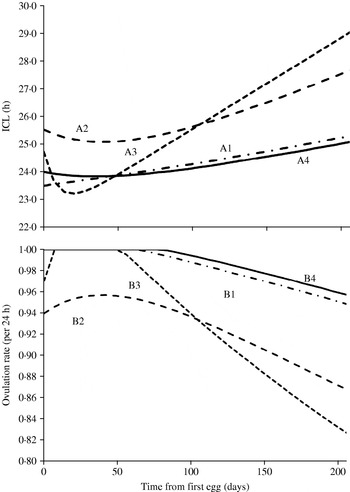
Eggs are laid in sequences of one or more eggs, a sequence being defined as consecutive daily ovipositions separated by a pause of one day or more in duration (Etches & Schoch Reference Etches and Schoch1984). The length of a sequence, or clutch, is dependent on ICL (h) that is described as the lag (in hours) between successive ovulations. Whereas Emmans & Fisher (Reference Emmans, Fisher, Fisher and Boorman1986) suggested that this lag increased linearly over time, Robinson et al. (Reference Robinson, Hardin and Robblee1990) have shown that broiler breeder pullets do not exhibit a linear decline in laying performance from the first egg produced. The longest sequence or prime sequence that follows a number of short egg sequences after the onset of lay is seen in broiler breeders at about 34 weeks of age and is, on average, nine eggs in length (University of KwaZulu-Natal, unpublished data). In order to reproduce this curvilinear effect, the ICL needs to be longer than 24 h initially, before decreasing with advancing time from first egg, in some cases to below the daylength, and subsequently increasing above 24 h (Johnston & Gous Reference Johnston, Gous, Gous, Morris and Fisher2006). The required shape may be adequately simulated for broiler breeders with the use of a linear-plus-exponential function of the form:

where a, b, c and R are constants, and t=time from first egg, in days, and for this reason the latter equation is favoured over the equation suggested by Emmans & Fisher (Reference Emmans, Fisher, Fisher and Boorman1986) . Some examples of trends in ICL produced by these two functions are illustrated in Fig. 1.
To introduce variation in the rate of change in ICL with time within a population, coefficients of variation of between 0·005 and 0·01 (user defined) are used to generate random normal distributions for each parameter in the above equation. ICL and hence the rate of ovulation of individual hens within the population will then differ.
The change in ICL by time from first egg, and predicted ovulation rates for the given ICL's. ICL predicted using the equation of Emmans & Fisher (Reference Emmans, Fisher, Fisher and Boorman1986) (line A1, where ICL0=23·5 h, lag=8·5 h and k=0·0001) and the equation ICL=a+b (R t)+ct. Three examples using the latter equation are illustrated, values of a, b, c and R being for line A2: 23·05, 2·485, 0·0222 and 0·9808; for line A3: 22·25, 2·485, 0·033 and 0·9; and for line A4: 23·0, 1·0, 0·01 and 0·98 respectively.

Hens that lay long sequences usually have very short follicular maturation rates (ICL) of 24 h or less, while hens that have slow rates of follicular maturation, of between 26 and 28 h, lay short sequences of 2–3 days in duration (Etches & Schoch Reference Etches and Schoch1984). If ICL is less than the external cycle length (EXCL) (usually 24 h), rate of lay (R) is given by

If the ICL is greater than EXCL,

where L is the cumulative lag, of between 8 and 9 h. Rates of ovulation corresponding to the ICLs are illustrated in Fig. 1.
Number and duration of pauses between clutches
In order to describe the potential laying performance of each hen constituting a population of broiler breeders, each individual must be described in terms of her potential sequence length, the rate at which this changes over time, and the number and duration of pauses between clutches. Robinson et al. (Reference Robinson, Hardin and Robblee1990) reported that the mean pause length of broiler breeders was about 1·6 days. To simulate a population with such a mean pause length, different proportions of the flock may be allocated different pause lengths: for example, 0·65 of the flock could be allocated one pause 0·78 of the time, or two pauses 0·22 of the time, whereas 0·23 of the flock could be allocated two or three pauses, 0·09 of the flock could be allocated three or four pauses, and that the remaining 0·03 of the flock are allocated four or five pauses. This method creates a small number of low producing hens with frequent long pauses.
Predicting time of lay
It is useful to be aware of the range of oviposition times that will result from the use of lighting programmes of different duration when managing broiler breeders; for example, the number of floor eggs may be increased when the photoperiod used is less than 12 h (Backhouse & Gous Reference Backhouse and Gous2005). Time of lay may be predicted as for laying hens (Johnston & Gous Reference Johnston and Gous2003) assuming that oviposition occurs roughly 30 min before the next ovulation, with a range of 7–75 min (Fraps Reference Fraps and Hammond1955). A normal distribution of oviposition-to-ovulation intervals is produced, for example with a mean of 30 min and a coefficient of variation of 0·3, which would result in a range of intervals from 3 to 57 min. A different method is described by Johnston & Gous (Reference Johnston and Gous2007a) for predicting the time of lay for the last egg of a sequence, since there is no associated ovulation: a lag value is calculated, based on the prevailing sequence length, and this is added to the oviposition time of the penultimate egg. Lag is influenced by sequence length: the shorter the sequence, the greater the lag, and this may be calculated using the following linear-by-linear function derived by Johnston & Gous (Reference Johnston and Gous2007a) :

where y is the lag between the last two ovipositions of a sequence, in hours, and x is the ovulation rate.
Predicting potential egg weight
Egg weight may be predicted as the sum of three components: yolk, albumen and shell. This approach is useful for two reasons: because the component proportions change with increasing age (eggs contain proportionally more yolk and less albumen as the hen ages), and because the amino acid and energy contents of yolk and albumen differ, thus altering the amount of amino acids and energy required per gram of egg.
Potential yolk weight (YWpot, g) is predicted from hen age (HA, day) using the following linear-by-linear function:

Examples of the coefficients a, b and R are 28·1 (±0·60), 34 (±11·6) and 0·0184 (±0·00389) (R 2=0·82). These numbers were derived by fitting the model to data from eggs collected from two broiler breeder strains between 25 and 60 weeks of age at 4- or 5-weekly intervals, the number of eggs at each collection varying from 60 to 110. No differences were observed between strains, hence the data were pooled.
When generating yolk weights in a population of broiler breeders a coefficient of variation of about 0·07, when applied to the coefficient a in the above equation, will produce an acceptable range of weights at each age.
Potential albumen weight (AWpot, g) and shell weight (SWpot, g) are then predicted using the allometric functions defined by Emmans & Fisher (Reference Emmans, Fisher, Fisher and Boorman1986) :


where ECW is the weight of the egg contents, yolk plus albumen (g).
Examples of values for the parameters a and b in the above equations are given in Table 1 for two strains of broiler breeder, these values being derived from the data described above.
Examples of parameter values that may be used in the allometric functions for predicting potential albumen weight from potential yolk weight (a1 and b1) and shell weight from egg content weight (a2 and b2) in two strains of broiler breeder

Mean potential egg weight (EWpot, g) is then estimated from the equation below:

Disruptions to normal laying patterns
The pattern of laying described above for broiler breeders may be disrupted in many ways, especially if the flock has been managed badly during rearing and early lay (Hocking Reference Hocking1993, Reference Hocking1996). Problems encountered include multiple ovulations, internal laying and the production of soft-shelled eggs, and these disruptions will reduce the apparent efficiency of utilization of amino acids by the hen for egg production. Hence, in a model that is required to simulate the response to intakes of energy and amino acids, it is essential to include these disruptions into the laying patterns of the broiler breeder hens simulated.
Double-yolked eggs
Compared with laying hens, broiler breeders lay approximately half as many eggs and have a higher instance of defective eggs (Yu et al. Reference Yu, Robinson, Charles and Weingardt1992). A critical time in the life of a broiler breeder hen is the period from photostimulation to peak production. During this time the number of large yellow follicles may be affected by age at photostimulation, feeding level and body weight (Hocking Reference Hocking1996; Renema et al. Reference Renema, Robinson, Newcombe and McKay1999). Hens that lay earlier than desired or are overfed, causing excessive follicular development, would show reproductive anomalies that include the production of defective eggs (double-yolked and poor shell quality) and internal ovulations.
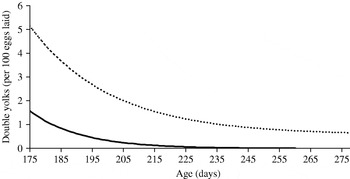
Double-yolked eggs, as simulated here, are the result of the simultaneous ovulation of two follicles in the hierarchy. From individual laying records it has been established that around 0·36 of a flock of broiler breeders at some stage of the laying period is likely to lay double-yolked eggs, and the maximum rate of production of these in a flock has been reported to be between 0·02 and 0·04 of all eggs laid. Yu et al. (Reference Yu, Robinson, Charles and Weingardt1992) recorded 0·023 from 19 to 29 weeks of age; Gous & Cherry (Reference Gous and Cherry2004) recorded between 0·02 and 0·04 of all eggs laid between 25 and 60 weeks and Ciacciariello & Gous (Reference Ciacciariello and Gous2005) reported a rate of approximately 0·04 from 23 to 56 weeks. The rate of production of double-yolked eggs is highest at the start of lay and decreases rapidly thereafter, the pattern being described by a function of the form:

where DY is the double-yolked eggs (proportion), a, b and R are coefficients, HA is the hen age (in days). Values for the coefficients were obtained by fitting the above equation to hypothetical data reflecting low (<0·02) and medium (<0·04) rates of production of double-yolked eggs to 210 days of age. Trends given by this function for different values of the coefficients are illustrated in Fig. 2. The equation is applied to a random selection of females, making up approximately 0·36 of the population only, thereby simulating the observed rate and frequency of production of such abnormalities within the population over time. Coefficients of variation may be applied to both the coefficient a in the above equation and to the proportion of hens in the population that will lay such abnormal eggs.
Two examples of the expected occurrence of double-yolked eggs (DY) (low –––– and medium - - - -) on broiler breeder HA. Values of a, b and R in the two graphs illustrated, for the function DY=a+b (R HA), are −0·00291, 75 438 and 0·940345 for low, and 0·0, 3734 and 0·962421 for medium incidence, respectively.

Internal ovulations
An internal ovulation occurs when the ovulated yolk, instead of entering the infundibulum, falls into the body cavity. The frequency of internal ovulations has been estimated in laying hens by studying sequence data and oviposition times (Johnston & Gous Reference Johnston and Gous2007c). A similar trend was adapted here for broiler breeders, and it assumes that more internal ovulations occur at the onset of sexual maturity and towards the end of lay, due to some asynchrony between the ovary and oviduct. The proportion of eggs ovulated internally at each age is estimated using the following linear plus exponential equation:

where IO is the proportion of internal ovulations and HA is the hen age (in days). Examples of the coefficients a, b, c and R are – 189·7, 200, 0·142 and 0·99899, these being obtained by fitting the above equation to hypothetical data reflecting the observed rate of internal ovulations.
When applied to the above equation, these coefficients produce a maximum rate of internal ovulations at the beginning of lay of about 0·02 and at the end of lay of about 0·01. The equation is applied to a maximum of about 0·4 of the population, reflecting the incidence of such abnormalities in a normal population of broiler breeders. A coefficient of variation of 0·2 is applied to coefficient a in the above equation, as well as to the maximum incidence within a population, to produce different rates of production of internal ovulations within and between populations.
Soft-shelled eggs
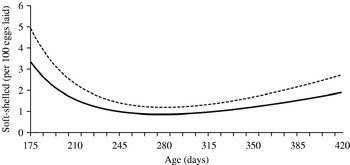
Soft-shelled eggs occur in young hens, especially when photostimulated early, and in older birds as the absorption of dietary calcium and its utilization for shell formation become less efficient (Hansen et al. Reference Hansen, Kittok, Sarath, Toombs, Caceres and Beck2003). Such eggs cannot be utilized for hatching purposes, thus reducing the number of hatching eggs produced per hen. In the model, it is assumed that 0·32 of the flock will produce soft-shelled eggs at some stage of the laying period, this value having been obtained from experimental trials done with laying hens (Johnston & Gous Reference Johnston and Gous2007c). It is assumed that 0·045 of all eggs laid by a broiler breeder flock between 19 and 29 weeks of age will have soft shells (Yu et al. Reference Yu, Robinson, Charles and Weingardt1992). The proportion of soft-shelled eggs produced during the laying period of broiler breeders may be predicted using a quadratic by linear function of the form:

where SE is the proportion of soft-shelled eggs and HA is the hen age (in days). Two examples of the trend produced with the use of this function are illustrated in Fig. 3. These were derived by fitting the above equation to two sets of hypothetical data reflecting the rates of production of soft-shelled eggs during the laying period, the magnitude of the coefficients reflecting the required rate assuming only 0·32 of the flock would produce such abnormal eggs at any one time. Coefficients of variation of between 0·1 and 0·2 are applied to both coefficient a in the above equation and to the maximum proportion of hens exhibiting this trait.
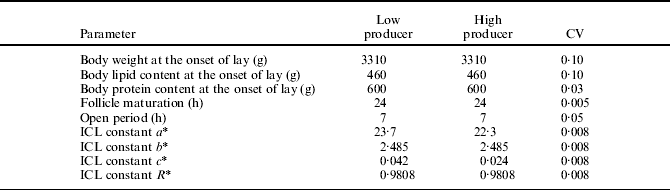
The functions proposed above provide a description of a broiler breeder genotype. Variation between individuals is introduced by generating values for the above descriptors using user-defined variances. The description is of the potential performance of each hen before being subjected to daily allocations of a given feed. Before such constrained performance can be predicted, the amino acid and energy requirements of the broiler breeder need to be predicted. Examples of the most important parameter values for a low- and high-producing broiler breeder, with relevant coefficients of variation, are given in Table 2.
Examples of the predicted proportion of soft-shelled eggs (SE) (low –––– and medium - - - -) and broiler breeder HA. In the two examples, values of the coefficients a, b, c and R in the function SE=a+b/(1−R.HA)+c.HA are (for low) −6·36, −4·509, 0·01607 and 0·009463 and for medium −10·55, −8·45, 0·02544 and 0·010099, respectively.

Values of coefficients used to describe a low- and a high-producing broiler breeder, with estimates of coefficients of variation (CV) for use in a population model
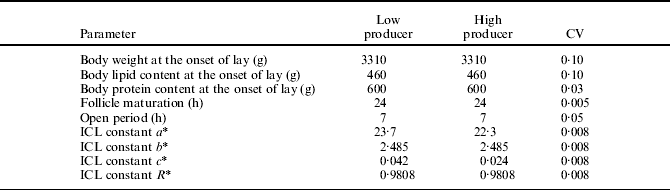
* Constants in the equation ICL=a+b (R t)+ct.
Predicting energy and nutrient requirements
Once the body protein weight and the rate of egg output for a broiler breeder have been predicted, it is possible to calculate the daily energy and amino acid requirements of the bird. By defining these in the same units as those used to describe the feed, it is possible to predict the desired food intake of the bird (Emmans Reference Emmans1994). The effective energy scale (Emmans Reference Emmans1994) is used to define the energy requirements of a broiler breeder for maintenance and egg output, as these account for the deficiencies inherent in the metabolizable energy (ME) system. The efficiency of converting dietary amino acid to egg protein (ep) for laying birds has been calculated to range between 0·47 and 0·85 (McDonald & Morris Reference McDonald and Morris1985; Bowmaker & Gous Reference Bowmaker and Gous1991). In this model, allowance is made for possible differences in net efficiency between amino acids for egg production and maintenance by allowing the user to change these values. The default efficiencies are 0·85 for egg production and 1·00 for maintenance (Fisher Reference Fisher1998). Feeds are defined in terms of their contents of effective energy, digestible (or effective) protein and digestible amino acids.
Predicting maintenance requirements
Energy, protein and amino acids are required to supply the mechanisms and functions that maintain a bird in its current state. The problem is to quantify the rate at which a bird needs to be supplied with each of these nutrients considering its existing state and its genotype. These considerations are taken into account by Emmans & Fisher (Reference Emmans, Fisher, Fisher and Boorman1986) in their adaptation of the Taylor (Reference Taylor1980) size scaling rule that uses the following equation to predict the effective energy (EEm, kJ/day) and effective protein (EPm, g/day) requirements for maintenance of the feather-free body protein weight:

where m is the nutrient requirement per maintenance unit, estimated to be 1·63 MJ/BPm0·73/day for effective energy and 0·008 kg/BPm0·73/day for effective protein (Emmans Reference Emmans1987), BPm is the mature body protein weight (kg) and u=BP/BPm=degree of maturity in body protein (kg/kg).
The breeder hen is considered to be at its mature size, hence u=1. The amino acid composition of ideal protein for maintenance is assumed to be the same as body protein (Fisher Reference Fisher1998).
Under cold conditions, when heat production is insufficient to match the demand of the environment, the bird increases its heat production and less energy is available for productive purposes. When food intake is restricted the bird needs to partition energy differently, reducing rate of laying to accommodate the higher maintenance requirement (Nonis & Gous Reference Nonis and Gousin press). A decrease in temperature from 19·5 to 9·9°C was found to increase the daily maintenance requirement by 1·0 kJ AME/kg body weight/°C (where AME is apparent ME, MJ/kg). The maintenance requirement for energy is given priority over the requirement for egg production.
Predicting requirements for yolk and albumen production
The amount of energy required to produce yolk and albumen is calculated as the product of the energy contained in each of these components and their respective weights. Emmans & Fisher (Reference Emmans, Fisher, Fisher and Boorman1986) suggested values of 25 and 3·6 kJ/g yolk and albumen, respectively. Similarly, the protein required for the production of these two egg components is calculated using values of 0·21 g ideal protein/g yolk and 0·13 g/g albumen (Emmans & Fisher Reference Emmans, Fisher, Fisher and Boorman1986).
The amounts of each digestible amino acid required are calculated from the nitrogen content of the yolk (27 mg N/g) and albumen (17 mg N/g) produced, from the amino acid composition of these two components (Lunven et al. Reference Lunven, Le Colement De St Marcq, Carnovale and Fratoni1973) and the efficiency of amino acid utilization for egg production (ep). The amino acid compositions of yolk and albumen are assumed to be constant across ages and strains.
It is assumed that yolk production is a continuous process as long as an adequate supply of the essential nutrients is available. However, energy and nutrients (and amino acids) for albumen production accumulate in a pool which has some controlling influence over ovulation: if the nutrients in the albumen pool will support the predicted development of the next egg then ovulation will occur otherwise ovulation is delayed until sufficient nutrients are available.
Predicting the desired and actual feed intakes
The desired feed intake (DFI) is the amount of the given feed needed to satisfy the requirement for the most limiting nutrient and is calculated as the requirement divided by the concentration of first limiting nutrient in the feed. In this model, it is assumed that a bird will stop eating once its requirement for the limiting nutrient has been met (Emmans Reference Emmans, Nixey and Grey1989) and that minerals and vitamins are provided in sufficient amounts as so not to be considered limiting.
In the case of broiler breeders, food is not made available ad libitum, thus the actual intake would in most cases be less than the DFI, being that amount decided upon by the farm manager. Other factors that may constrain food intake are the bulkiness of the feed and the inability to lose to the environment the heat generated through the processes of maintenance, food intake and digestion, and egg formation and production (Emmans & Fisher Reference Emmans, Fisher, Fisher and Boorman1986). Depending on the amount of food allocated daily, it is possible that there will be hens whose requirements are lower than the amount of feed allocated, leading to some reasonable distribution of food among the flock. But the social hierarchy prevalent in all bird species may not be correlated with potential egg output and this aggressive characteristic, when displayed at the feed trough, is likely to prevent hens from accessing equal quantities of food each day. This characteristic has been incorporated into the model: an aggressiveness value (Cagr) is randomly specified (user defined) for each hen at sexual maturity such that the total daily intake of the flock remains the amount allocated. The correlation between Cagr and potential egg output is specified by the user, and this value is kept constant for each hen over the laying period.
The adjusted feed intake for each hen is calculated as the product of daily allocation of food specified by the user and Cagr, and the actual feed intake is either the desired intake or the adjusted feed allotment, whichever is the lower.
Response to a daily feed allowance
Having predicted the potential egg output of a broiler breeder hen, and calculated the daily intake of nutrients required to achieve this potential, the next step is to determine the response of the individual to intakes above and below the required amount. Where the intake of the limiting nutrient is insufficient, egg output will be reduced, and the model must determine the extent to which this reduction occurs. However, even where the requirement for the limiting nutrient is met, and the potential egg output is achieved, it is likely that most nutrients will be consumed above the requirement, and the fate of these nutrients must be accounted for. The problem here is to predict both egg output and the change in body lipid reserves as a consequence of the daily allowance of nutrients consumed by the bird.
The breeder model described here is embedded in a windows-based feed formulation program, WinFeed (EFG Software 2007). Feed specifications are set up in the usual way, after which a feed is formulated that will meet these specifications at least cost. The characteristics of this formulated feed are then passed, as input, to the breeder model. A daily allowance of this feed and the number of days over which the feed is to be offered are specified by the user. It is possible to use an unlimited number of feeds, each of which may be fed over an unlimited number of days, thereby adding considerable flexibility to the manner in which the birds are fed during the laying period.
All events are timed within a 24 h day, assuming that feeding is at one time in the morning. Protein partition rules are that maintenance has highest priority, yolk protein deposition second and albumen protein third. Provided that sufficient nutrients are available, yolk protein deposition is assumed to occur continuously to meet the predicted growth rate, unless inter-clutch intervals exceed a defined number of days (default is 2 days), when yolk growth ceases. Nutrients (energy and amino acids) for albumen production accumulate in a pool, which must be full before ovulation can occur. Egg output is dependent on the remainder of the nutrients consumed once the requirements for maintenance and yolk growth have been met, with the proviso that egg size cannot be less than a defined proportion of the potential egg size, the default being 0·86 (Morris & Gous Reference Morris and Gous1988; Bowmaker & Gous Reference Bowmaker and Gous1991). Where the intake of the limiting nutrient on the day cannot sustain this minimum egg size, egg production does not occur.
The requirement for energy may be met from body lipid reserves as well as from the food, but priority is given to those body lipid reserves in excess of a minimum amount on the assumption that the bird strives to maintain its genetically determined body lipid:protein ratio. Where the supply of energy or amino acid is excess to the daily requirement the bird will lay an egg at its potential, the egg weight will be the potential for the age of bird, and the excess energy or protein will be deposited as lipid. The hen may deposit body lipid up to a maximum, user-defined, daily rate, the default being 10 g/day. Body lipid content thus fluctuates daily, dependent on the energy required and consumed.
On pause days, dictated by the ovulatory cycle or caused by an insufficient supply of nutrients, the hen has an opportunity to build up body lipid reserves and to fill the albumen pool, which may be sufficient to allow her to lay an egg of a normal size once more. After a nutritionally induced pause in production the hen is assumed to start laying a new clutch once it again has a sufficient supply of the limiting nutrient.
Because body weight and composition as well as potential egg output varies between individuals within a flock, so too will the nutrient requirements vary. In this model, the population response is calculated as the mean of the responses of individuals making up the population. Each bird is assigned its own characteristic values for the inherited parameters that describe its potential, thus the response to a given daily nutrient supply will differ between these birds. The genetic parameters describing birds within the same population are assumed to be normally distributed, the default coefficients of variation for the various parameter estimates being user defined.
RESULTS AND DISCUSSION
The model described produces a wealth of data relating to daily egg production (both rate of laying and egg weight), egg component weights and composition, desired, constrained and actual food intake, body composition at the end of each day, and the balance of effective energy and amino acids required, consumed and unutilized for maintenance and egg production each day. Some examples of these outputs are given below, but because of space limitations not all the outputs can be presented.
Calculation of the amino acid requirements for yolk and albumen synthesis
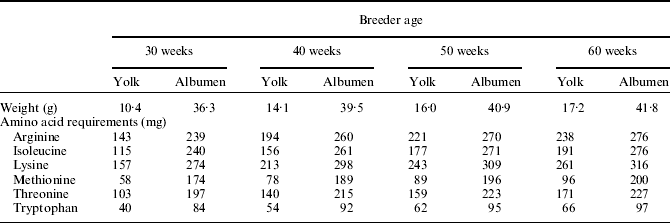
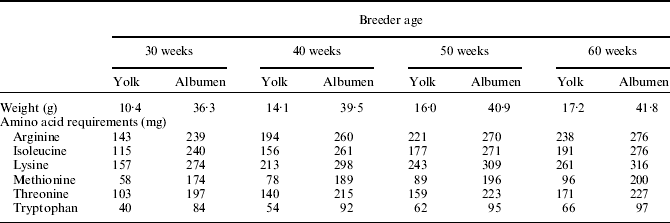
An example of the amino acid requirements for yolk and albumen synthesis over time, simulated by means of the model, is given in Table 3. Maintenance requirements were not included in the table, as the body protein content and hence maintenance requirement is assumed to remain constant over the laying period. However, the combined requirements for yolk and albumen increased on average by 18% in the first 10 weeks, by 28% to 50 weeks and by 34% by 60 weeks, this being related to the increase in the size of the egg being formed. In high-producing broiler breeders, the requirement for amino acids would therefore increase over time, not because of a higher body weight (an increase in lipid weight) or because of a reduced efficiency of utilization of these amino acids, but because of the greater content of amino acids in the egg output. Of course, where the rate of egg production declines with age the daily amino acid requirements would also diminish. The mean requirement for the flock is determined by simulating the responses of a number of individuals over time and integrating this information for each day of the laying period.
The weight of yolk and albumen in eggs of a typical broiler breeder at 30, 40, 50 and 60 weeks of age and the daily intakes of some of the amino acids required for the production of these components
Calculation of the desired food intake by a broiler breeder
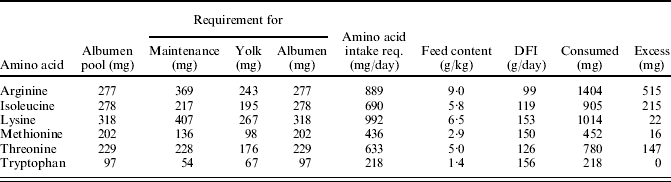
An example of how the DFI of a broiler breeder is calculated is given in Table 4. In this case, the bird was assumed to contain 587 g body protein (for calculation of maintenance requirement) and to be producing an egg of 66 g. Using appropriate values from Emmans & Fisher (Reference Emmans, Fisher, Fisher and Boorman1986), Fisher & Gous (Reference Fisher, Gous and Hocking2009), from Table 1 and from Lunven et al. (Reference Lunven, Le Colement De St Marcq, Carnovale and Fratoni1973), and assuming an efficiency of utilization of amino acids of 0·85, the intake of each amino acid required to meet these requirements was calculated. The theory used here assumes that an albumen pool contains sufficient amount of each amino acid to meet the requirement for albumen formation before ovulation can occur. The DFI is calculated for each amino acid as its requirement/feed content, and the amino acid resulting in the highest DFI is by definition first limiting. In the example given, tryptophan (Trp) is first limiting. The actual amount of each amino acid consumed on the day is calculated as feed content×highest DFI (in this example, 156 g/day). Many amino acids would be consumed in excess of requirement and this excess is calculated as the amount consumed minus that required. These excesses must be deaminated and converted to body lipid which is added to that already stored, the energy used in this process being accounted for in the effective energy (EE) system (Emmans & Fisher Reference Emmans, Fisher, Fisher and Boorman1986).
Calculation of desired food intakeFootnote * (DFI) by a broiler breeder containing 587 g body protein and producing an egg of 66 g, using values referenced in the text
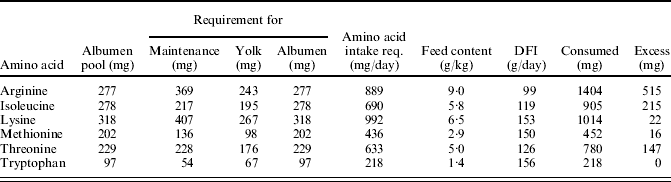
* Desired food intake is calculated for each amino acid as requirement/feed content, and the amino acid resulting in the highest DFI (in this case, tryptophan) is by definition first limiting. The amount consumed is calculated as feed content×highest DFI (in this case, 156 g/day). Excess is calculated as the amount consumed minus that required.
Calculation of lipid stores available to the bird
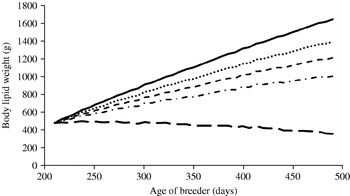
Where energy is not limiting in the feed, the DFI for the limiting nutrient will exceed the DFI for EE, and energy will be consumed in excess of requirement. This is stored as body lipid, which may result from excessive EE intake or from amino acids that have been deaminated because they were consumed in excess. As this lipid is available as an energy source when needed, the lipid stores in the body may increase or decrease. An example is given in Fig. 4 in which the body lipid weight of a broiler breeder hen fed rations containing different amounts of ME are plotted over the laying period. In the example, the hen had an initial lipid content of 480 g at 210 days, while her minimum body lipid content was set at 0·10 (304 g) of the initial body weight. A lysine-limiting feed was offered at a maximum intake of 160 g/day with ME contents of 10·0, 11·0, 11·5, 12·0 and 12·5 MJ/kg.
Simulated body lipid weights of a broiler breeder hen with an initial lipid content of 480 g at 210 days, and offered an amino acid limiting feed at a maximum intake of 160 g/day with ME contents ranging from 10·0 MJ/kg (__ __) through 11·0 (_ . _), 11·5 (_ _), 12·0 (. . . .) and 12·5 (____)MJ/kg. Minimum lipid content was set at 0·1 of the body weight at 210 days (3310 g).

On the three lower energy feeds, body lipid content declined initially because the reserves were higher than the minimum required, thus enabling the bird to consume only sufficient feed to meet the lysine requirement, while making use of some of the lipid reserves each day as an energy source. Once these reserves had declined to the minimum (10·0 and 11·0 MJ ME/kg), energy became a limiting factor on egg-laying days and as egg production declined, so the bird was able to restore these lipid reserves once more. Lipid reserves on the highest energy feed increased throughout the laying period, increasing the initial body weight by about 800 g by the end of the laying period; a not unusual occurrence in broiler breeders fed greater quantities of energy than they can utilize for maintenance and egg production. These changes in lipid content conform to those described in a short-term trial by Nonis & Gous (Reference Nonis and Gousin press).
Broiler breeder managers invariably base their feed management on daily egg production records and occasionally on changes in body weight. An advantage of being able to track changes in lipid reserves of individual breeder hens over time is that the effects of the feed and feeding programme used can be visualized ahead of time and adjusted accordingly.
Simulating the response to dietary lysine to determine efficiency of utilization
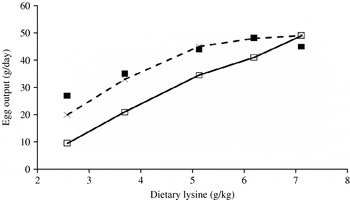
Amino acid utilization for egg production is lower for broiler breeder hens as compared to egg laying hens (Bowmaker & Gous Reference Bowmaker and Gous1991; Fisher Reference Fisher1998). This is assumed to reflect the lower and more irregular pattern of oviposition in broiler breeders (Fisher Reference Fisher and D'Mello1994; Fisher & Gous Reference Fisher, Gous and Hocking2009) and although this is difficult, if not impossible, to measure in practice, it lends itself to theoretical analysis. The model was used to predict the response of a population of laying hens to lysine, which was then compared with the results of a single response experiment (Fisher et al. Reference Fisher, Gous, Goddard and Balnave2001). The result is illustrated in Fig. 5. The important feature here relates to the slope of response and the underlying efficiency of amino acid utilization for egg production. The observed slope is compatible with an efficiency (egg lysine/lysine intake above maintenance) of 0·59. This is effectively simulated by assuming, in the model, that the corresponding biological efficiency (one bird at one time) is 0·85 but the apparent efficiency averaged over birds and over time is much lower because of the intermittent pattern of egg production. Since the estimate of lysine for maintenance in the trial was close to zero (Fisher et al. Reference Fisher, Gous, Goddard and Balnave2001), when this feature was included in the model, the agreement between observed and predicted data was further improved.
Simulation of the trial described by Fisher et al. (Reference Fisher, Gous, Goddard and Balnave2001) using the model developed by Nonis and Gous (Reference Nonis and Gous2008) : response in egg mass to lysine intake (data from the final 4 weeks of a 9-week assay starting at 26 weeks; data for high energy treatments only). The experimental data are shown by closed symbols. Simulation points assuming a maintenance requirement of 75 mg lys/unit of maintenance (Emmans Reference Emmans1987) are shown by open symbols joined by a solid line. Simulation points assuming a zero maintenance requirement for lysine are shown by a cross and joined by a broken line.

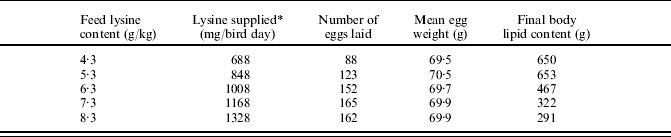
In another simulation of the response to dietary lysine, measured over the entire laying period, and using feeds increasing in lysine content from 4·3 to 8·3 g lysine/kg, at a fixed ME of 11·0 MJ/kg and food intake of 160 g/day, the number of eggs laid increased with lysine intake (Table 5) with little change in the mean egg weight over the 30 weeks of lay. The weight of body lipid at the end of the laying period decreased with lysine content, as has been demonstrated with broiler chickens (Gous & Morris Reference Gous and Morris1985) and broiler breeders (Fisher et al. Reference Fisher, Gous, Goddard and Balnave2001) fed a series of feeds limiting in lysine. At a lysine content of 6·3 g/kg, this amino acid became limiting at 41 weeks of age and remained limiting throughout the rest of the laying period, whereas on lower lysine feeds this amino acid was limiting throughout the laying period, and with contents greater than 6·3 g lysine/kg was never limiting. These results reflect the reality of offering broiler breeders feeds differing in amino acid content, although the responses measured in practice are influenced to a great extent by extraneous factors, making it difficult to determine the optimum method of feeding breeders over the long term.
Simulated responses in number of eggs laid and mean egg weight from 30 to 60 weeks of age, and body lipid content at 60 weeks in broiler breeders allocated 160 g/day of feeds containing 11·0 MJ AME/kg, and lysine content ranging from 4·3 to 8·3 g/kg
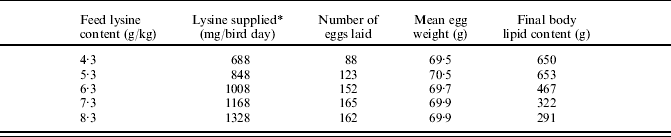
* Hens did not necessarily consume all that was allocated each day.
Simulating the long-term effects of different energy contents and feed allocations on performance and final body lipid content
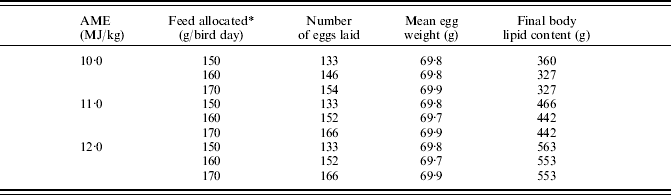
The effects of three levels of energy (10, 11 and 12 MJ AME/kg) and three daily feed allocations (150, 160 and 170 g/bird day) on laying performance over a 30-week laying period (30–60 weeks of age) were simulated using the model. The environmental temperature remained at 20°C throughout. Lysine was made to be the limiting amino acid in the feed, at 6·3 g lysine/kg feed. The results, given in Table 6, suggest that at 150 g food/day a nutrient other than energy was limiting, given that the total number of eggs produced was the same (133) at all three ME levels, while the amount of body lipid present at the end of the laying period increased by about 100 g for each 1·0 MJ/kg increase in feed ME content. The model identified lysine as the limiting factor in these cases. Egg numbers increased with feed intake, reaching a maximum of 166 on a feed allocation of 170 g/day of both the 11·0 and 12·0 MJ/kg feeds.
Simulated responses in number of eggs laid and mean egg weight from 30 to 60 weeks of age, and body lipid content at 60 weeks in broiler breeders allocated 150, 160 or 170 g/day of feeds containing 10·0, 11·0 or 12·0 MJ AME/kg
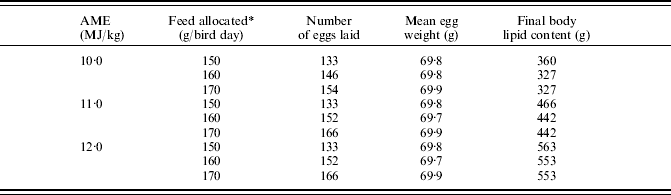
* Hens did not necessarily consume all that was allocated each day. Lysine was the first limiting amino acid in all feeds. Environmental temperature was maintained at 20°C throughout.
These results lend support to the view that a modelling approach has the potential to assist nutritionists to make decisions about feeding broiler breeders more efficiently than is possible at present.
Of all the examples of model outputs given above, the most important is that the model accounts effectively for the apparently lower efficiency of utilization of amino acids by broiler breeders compared with laying hens, through the use of more irregular patterns of egg production. This has been a difficult problem to solve, and has resulted in incorrect assumptions about the efficiency of broiler breeders in converting amino acids to egg. Within the range of commercially acceptable dietary nutrient contents and feed allocations, the model accurately predicts nutrient response, with the result that financial input/output relationships may be compared and used to optimize the feeding process. However, as with most models, some shortcomings still need to be addressed, and some of the more important of these are listed below.
The predicted DFI is often considerably lower than the daily allowance, which is rarely the case with broiler breeders. In the three trials in which a summit dilution trial was used to measure the response of individually caged broiler breeders to a limiting amino acid (Bowmaker & Gous Reference Bowmaker and Gous1991; Fisher et al. Reference Fisher, Gous, Goddard and Balnave2001), food intake on the highest concentrations of protein always equalled the amount supplied, whereas intake was predicted by the model to decrease as nutrient supply was increased. It is difficult to account for the bird over-consuming energy and all nutrients when these are in abundant supply as this is not the case with growing broilers, whose intake is reduced as protein supply is increased (Clark et al. Reference Clark, Gous and Morris1982; Burnham et al. Reference Burnham, Emmans and Gous1992). One possibility is that, when calculating maintenance requirements, the birds are assumed to be at their mature protein weight (u=1) even though this is only about 0·6 kg, whereas Fisher (Reference Fisher1998) assumed that mature body protein=0·863 kg, a figure that would reflect full feeding of the hens. Although the consequence of this difference is not very great, nevertheless, with u=0·69 at sexual maturity (0·6/0·863), the birds might endeavour to achieve their mature state by consuming more feed than is needed only for maintenance and egg production.
Similarly, predicted food intakes diverge from observed intakes when low protein feeds are offered to breeders. In the same experiments as reported above, Bowmaker & Gous (Reference Bowmaker and Gous1991) and Fisher et al. (Reference Fisher, Gous, Goddard and Balnave2001) found that food intake decreased as a summit feed was progressively diluted with a low- or a non-protein feed, resulting in a dramatic reduction in egg output. Although this may still conform to the theory that DFI increases as the limiting nutrient supply is reduced, what needs to be resolved is the reason for food intake to be constrained by these low protein feeds. This cannot be attributed to the bulkiness of the feed, even though no account has been taken of the bulkiness of the feed and the possible constraining effect that gut fill might have on food intake when the birds are given feeds of low nutrient density, because the low protein feeds used in these trials were only marginally more bulky than the high protein summit feeds. It is possible that the reproductive processes in the bird may shut down when feeds that cannot sustain performance are offered, but such a theory has not been reported or tested.
No account has been taken of the constraining effect of high temperatures on either egg production or food intake, although it is known that both are reduced at high temperatures. The relationship between the amount of heat that may be lost to the environment and the environmental heat demand is currently being researched at the University of KwaZulu-Natal.
CONCLUSIONS
The objective of the model described here is to simulate the response of a broiler breeder hen, with a given potential laying performance and in a given environment, to a given daily allocation of a given food, such that the long-term effects of feeds and feeding programmes on the laying performance of a flock of broiler breeders could be more accurately and more speedily evaluated than would be possible with long-term feeding trials. Extensive use has been made of published theories and coefficients, thus obviating the need to test all aspects of the model. For example, the description of the genotype and its potential performance, the use of lipid reserves as an energy source and the concept of a DFI have all been subjected to peer review. Hence, the simulated patterns of ovulation, the changes in egg and component weights, the predicted amino acid and EE requirements on laying and non-laying days and the consequent calculation of DFI can be regarded as established concepts.
Of considerable importance in its evaluation is that the model accounts effectively for the apparently lower efficiency of utilization of amino acids by broiler breeders compared with laying hens, which lends support to the notion of simulating the responses of a number of individuals over time and then integrating their results to obtain a flock response.
Given the accuracy of simulating performance, requirements and predicted food intake of broiler breeders under commercially acceptable conditions, the model may be used successfully to simulate the response of a population of broiler breeders to a given feeding programme. Output from such simulations is in terms of total egg numbers, cost of production, returns and hence margin (including hen depreciation). The logical next step is to optimize the feeding programme, which will be possible once some deficiencies in the model have been eliminated.
These deficiencies involve the food intake responses at both low and high concentrations of amino acids. The theory of food intake regulation needs to be modified at these extreme dietary protein contents.
Given the influence of bird state (the extent of body lipid reserves) on its energy requirement, and that this state is constantly changing in response to the requirements for egg production, long-term feeding trials are unlikely to be of value in assisting nutritionists to feed broiler breeders more efficiently. The absence of such published trials alludes to the problem. Simulation models that address this issue are the most likely means of improving our understanding of the long-term effects of feed management on the performance of broiler breeder hens.