Introduction
Neuropsychiatric symptoms (NPS) are common in dementia and frequently seen in patients with mild cognitive impairment (MCI) (Lyketsos et al., Reference Lyketsos, Lopez, Jones, Fitzpatrick, Breitner and DeKosky2002; Chan et al., Reference Chan, Kasper, Black and Rabins2003; Geda et al., Reference Geda2008). The Neuropsychiatric Inventory (NPI; Cummings et al., Reference Cummings, Mega, Gray, Rosenberg-Thompson, Carusi and Gornbein1994; Cummings, Reference Cummings1997) has been used frequently in population-based studies and clinical trials to assess the severity and treatment-related changes in NPS. An expert panel considered the potential benefits of using the frequency score rather than the composite score for measuring treatment effects, in particular in patients with mild dementia or MCI (Gauthier et al., Reference Gauthier2010). We recently analyzed NPI data from three randomized, placebo-controlled trials in patients with mild-to-moderate dementia to determine whether the frequency score might be more sensitive to change than the composite score in dementia and if the two scores have differential sensitivity in mild compared to moderate dementia (Cummings et al., Reference Cummings, Ihl, Herrschaft, Hoerr and Tribanek2013). We found no difference between the two scores regarding sensitivity to change, neither in mild nor in moderate dementia. We hypothesized that the same may be true in patients with MCI, as this condition is likely to represent a pre-dementia stage of a dementing illness in many patients. Data from a trial in patients diagnosed with amnestic MCI with NPS have become available (Gavrilova et al., Reference Gavrilova, Preuss, Wong, Hoerr, Kaschel and Bachinskaya2014) to allow exploration of this hypothesis and to explore relationships between frequency score, severity scores, and composite scores of the NPI.
Methods
A detailed description of the methods and results of the clinical trial can be found in the paper reporting on the main results of the trial (Gavrilova et al., Reference Gavrilova, Preuss, Wong, Hoerr, Kaschel and Bachinskaya2014). Briefly, 160 patients diagnosed with amnestic MCI in accordance with the international consensus criteria (Winblad et al., Reference Winblad2004), who had clinically relevant NPS were enrolled in a double-blind trial by outpatient clinics of seven academic hospitals in Russia and randomized to receive 240 mg of Ginkgo biloba extract EGb 761® or placebo once daily for a period of 24 weeks. NPS were considered as clinically relevant, if the total (composite) score on the 12-item NPI was at least 6 and the composite item score for at least one of the items “depression/dysphoria,” “anxiety,” “apathy/indifference,” “agitation,” or “irritability/lability” was at least 4. Outcomes of interest were the 12-item NPI, rating scales for anxiety and depression, a cognitive test, and patient- and informant-rated Clinical Global Impression of Change (CGIC). The NPI version used in this study had been culturally and linguistically validated for Russian-speaking populations following standard procedures. We did not collect data on caregiver distress with the caregiver distress scale of the NPI. The trial was registered with the public register of the Russian drug agency Roszdravnadzor under number 2009/225 and Clinical-Trials.ru.
To explore the differences between the NPI composite, severity, and frequency scores to detect treatment-induced changes during the treatment phase, standardized changes between baseline and end of study were calculated (mean change divided by standard deviation). Tests for a statistically significant treatment effect of EGb 761® were performed by an analysis of covariance (ANCOVA) with the change of the composite, severity, or frequency score as dependent variable, the treatment group and centre as fixed effects, and the baseline value of the respective score as covariate. The tests were performed descriptively with the interpretation of a difference as statistically significant effect if the two-sided p-value was less than 0.05.
Results
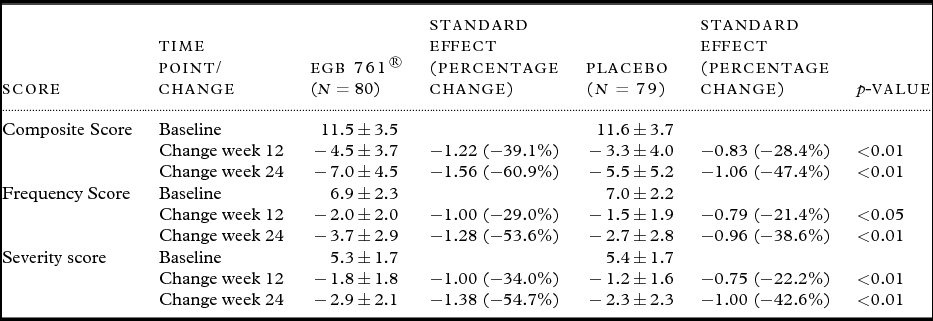
The main results of the trial have been reported elsewhere (Gavrilova et al., Reference Gavrilova, Preuss, Wong, Hoerr, Kaschel and Bachinskaya2014). Changes in NPI composite, frequency and severity scores, standard effects, and statistics are summarized in Table 1.
Changes from baseline to end of treatment (mean ± standard deviation) and within-treatment effect sizes for NPI composite score, NPI frequency score, and NPI severity score. p-values refer to between-treatment comparisons by two-sided ANCOVA (Last Observation Carried Forward – LOCF)

Neither in the EGb 761® group nor in the placebo group, were the effect sizes for the NPI frequency score larger than the effect sizes for the NPI composite score (Table 1). In the active treatment group the effect size for the composite score tended to be larger than those for both sub-scores. The p-values indicate that the sensitivity to separate drug and placebo groups at 12 weeks and at the end of the trial were similar for all three scores of the NPI (Table 1).
Discussion
In the present analysis of data from a study in patients with amnestic MCI we found that the composite score of the NPI better reflected the overall change in placebo and treatment groups compared to the frequency score. The severity score adds valuable information that would be lost by using the frequency score alone. There was no statistical benefit to using the frequency score alone or the severity score alone as the NPI outcome. This finding is consistent with analyses of data derived from patients with mild-to-moderate dementia.
To find out whether the frequency sub-score might have an advantage in the evaluation of short-term treatment, we extended our analyses on the data from the 12-week interim visit. Changes were smaller at 12 weeks than at 24 weeks, but the pattern of effect sizes and p-values was largely the same at both time points, suggesting similar properties of the NPI in short- and long-term measurements.
The MCI patients of the recent trial differed from the patients with dementia enrolled in the earlier trials (Cummings et al., Reference Cummings2013). First, compared to the patients with mild dementia the MCI patients had lower NPI baseline values, which is expected from population-based studies (Lyketsos et al., Reference Lyketsos, Steinberg, Tschanz, Norton, Steffens and Breitner2000; Reference Lyketsos, Lopez, Jones, Fitzpatrick, Breitner and DeKosky2002). The changes for both EGb 761® and placebo are larger in the MCI study than in the three dementia studies. This may indicate a different responsiveness to receiving increased attention during study participation, to study-related measures, and to treatment of patients with MCI and those with dementia. With the progression of cognitive decline and loss of overall mental abilities and personality, both non-specific and specific responses to treatment may diminish. Moreover, an effect of the study setting cannot be ruled out. Improvement with treatment was evident in the MCI group despite a greater placebo effect in these patients compared to those with mild dementia. Of note, in the earlier studies, patients with cognitive scores indicating mild dementia tended to have slightly higher baseline NPI scores than those with moderate dementia (Cummings et al., Reference Cummings, Ihl, Herrschaft, Hoerr and Tribanek2013) and those with MCI enrolled in the present study. Yet, in neither group did we find an advantage of the severity score over the composite score in terms of sensitivity to change.
The sample size of 160 patients in the MCI trial may be seen as a limitation regarding the reliability and generalizability of our findings. It appears reassuring, however, that they are in agreement with our earlier findings from studies in approximately 1,200 patients with dementia which likewise did not show higher sensitivity to change of the frequency score, nor suggested different sensitivity of the composite and frequency scores depending on disease severity.
Another possible limitation is that our data came from clinical sites that were located within a limited geographic area and culture. It would be reassuring to repeat the analyses once data from patients with different geographic and cultural background become available.
MCI is known to be a heterogeneous population; some patients are in the prodromal phase of AD and some will improve, remain stable in the MCI condition, or progress to non-AD dementias. Our findings do not provide insight into the different causes of MCI. Previous studies show that patients with MCI plus apathy, depression, or anxiety are more likely to progress to AD dementia than those without concomitant behavioral symptoms (Teng et al., Reference Teng, Lu and Cummings2007; Rosenberg et al., Reference Rosenberg, Mielke, Appleby, Oh, Geda and Lyketsos2013; Palmer et al., Reference Palmer, Berger, Monastero, Winblad, Bäckman and Fratiglioni2007).
With research in academic settings and industry focusing increasingly on the development of treatments interfering with risk factors and causal pathogenesis of dementing illnesses (Mangialasche et al., Reference Mangialasche, Kivipelto, Solomon and Fratiglioni2012; Cummings et al., Reference Cummings2013) and targeting patients in the early disease stages (Vellas et al., Reference Vellas2012), study methodology must be adapted to the target population and the validity of instruments for outcome assessment must be evaluated. Our findings may therefore help researchers planning new clinical trials in subjects with MCI or early Alzheimer's disease aiming at the prevention or alleviation of NPS. The NPI composite score has been validated and found useful in both population-based studies and randomized controlled clinical trials. This is not the case yet for the frequency score, the use of which might be tempting for reasons of simplicity, but should be discouraged in the absence of the hoped-for higher sensitivity.
In conclusion, the findings of the present study support the hypothesis derived from the analyses of the mild and moderate subgroups of the dementia studies, i.e. the frequency score or the severity score of the NPI are not more sensitive than the composite score to detect treatment-related changes in mild or prodromal stages of dementing disorders. As the severity score adds valuable information, the composite score is the superior trial outcome.
Conflict of interest
J. L. Cummings is the copyright owner of the NPI; he did not receive financial support related to this paper. M. Tribanek received a honorarium for the analyses of the NPI-related data from Dr. Willmar Schwabe GmbH & Co. KG, Karlsruhe, Germany, the sponsor of the clinical trial from which the data were derived. R. Hoerr is an employee of Dr. Willmar Schwabe receiving a fixed salary; his contribution to this paper was done outside working hours and without financial support. This paper was initiated by RH.
Description of authors’ roles
J. L. Cummings contributed to the formulation of the research question, assisted in writing the paper and interpreting the results. M. Tribanek conducted the statistical analyses and assisted in writing the paper and interpreting the results. R. Hoerr contributed to the formulation of the research question and wrote the first draft of the paper.