INTRODUCTION
An important issue in assessing functional status in elders, particularly those with neurodegenerative disorders such as Alzheimer’s disease (AD), is determining whether an individual is safe to drive. This decision has implications for the independence and emotional well-being of the patient and for familial or institutional support. From a neuropsychological standpoint, this determination requires joint consideration of the cognitive deficits characterizing aging and AD and the cognitive processes mediating driving. Although studies investigating driving performance in elderly have often incorporated neuropsychological tests of attention and executive functioning to supplements on-road driving assessments, findings have been mixed with respect to the ability of these instruments to identify unsafe driving (Bedard, Weaver, Darzins, & Porter, Reference Bedard, Weaver, Darzins and Porter2008; Dobbs & Shergill, Reference Dobbs and Shergill2013; see Papandonatos, Ott, Davis, Barco, & Carr, Reference Papandonatos, Ott, Davis, Barco and Carr2015; Vrkljan, McGrath, & Letts, Reference Vrkljan, McGrath and Letts2011). A recent meta-analysis of cognitive and driving simulator assessments found that, despite general consensus regarding the cognitive domains that are related to driving (e.g., attention, executive functioning), there was considerable variability in the specific tests that predicted driving ability (Hird, Egeto, Fischer, Naglie, & Schweizer, Reference Hird, Egeto, Fischer, Naglie and Schweizer2016).
Standard neuropsychological tests of attentional and executive functioning are complex by design, and may lack sensitivity and specificity in detecting driving impairments. Poor discriminatory power is particularly a concern given the heterogeneity of elderly populations (Lam, Masellis, Freedman, Stuss, & Black, Reference Lam, Masellis, Freedman, Stuss and Black2013; Mann, Mohr, Gearing, & Chase, Reference Mann, Mohr, Gearing and Chase1992). Although shortcomings of standardized tests can be addressed in part through experimental tasks designed to assess distinct cognitive functions, such tasks do not necessarily target those processes particularly affected in AD. The assessment of cognitive mechanisms selectively impaired in AD is important not only for effective identification of impaired drivers, but also for better understanding of the relationship between cognition and functional behavior that is critical for the management of dementia (e.g., Aretouli & Brandt, Reference Aretouli and Brandt2010; Farias et al., Reference Farias, Chou, Harvey, Mungas, Reed, DeCarli and Beckett2013; Jefferson et al., Reference Jefferson, Byerly, Vanderhill, Lambe, Wong, Ozonoff and Karlawish2008; Rodakowski et al., Reference Rodakowski, Skidmore, Reynolds, Dew, Butters, Holm and Rogers2014; Schmitter-Edgecombe & Parsey, Reference Schmitter-Edgecombe and Parsey2014; Wadley et al., Reference Wadley, Okonkwo, Crowe, Vance, Elgin, Ball and Owsley2009). Identifying specific cognitive changes related to driving could help bridge the clinical-functional disconnect as reflected in the limited concordance between physician and driving instructor ratings of driving fitness in AD patients (Bixby, Davis, & Ott, Reference Bixby, Davis and Ott2015; Ott et al., Reference Ott, Anthony, Papandonatos, D’Abreu, Burock, Curtin and Morris2005).
Selective attention has been a focus of investigation within the cognitive aging literature (for recent reviews, see Van Gerven & Guerreiro, Reference Van Gerven and Guerreiro2016; Zanto & Gazzaley, Reference Zanto and Gazzaley2014), and has consistently been found to contribute substantially to driving fitness in the aging population (Duchek, Hunt, Ball, Buckles, & Morris, Reference Duchek, Hunt, Ball, Buckles and Morris1997; Parasuraman & Nestor, Reference Parasuraman and Nestor1991; Richardson & Marottoli, Reference Richardson and Marottoli2003). Selective attention is often assessed using visual search paradigms, where targets must be selected among distractor stimuli in an array. Performance on the useful field of view (UFOV) search task developed by Ball and colleagues (Ball & Owsley, Reference Ball and Owsley1993; Ball, Owsley, & Beard, Reference Ball, Owsley and Beard1990; Ball, Owsley, Sloane, Roenker, & Bruni, Reference Ball, Owsley, Sloane, Roenker and Bruni1993), for example, has been a stronger predictor of accident rates in healthy elderly than either general mental status or less attentionally-mediated measures of visual processing (Owsley, Ball, Sloane, Roenker, & Bruni, Reference Owsley, Ball, Sloane, Roenker and Bruni1991). Other studies have confirmed the utility of UFOV and other visual search measures for the assessment of driving safety (Anstey & Wood, Reference Anstey and Wood2011; for a review, see Clay et al., Reference Clay, Wadley, Edwards, Roth, Roenker and Ball2005; Hoffman, McDowd, Atchley, & Dubinsky, Reference Hoffman, McDowd, Atchley and Dubinsky2005; Mathias & Lucas, Reference Mathias and Lucas2009; Wood, Chaparro, Lacherez, & Hickson, Reference Wood, Chaparro, Lacherez and Hickson2012).
Patients with AD display deficits in selective attention beyond those seen in healthy elderly (Baddeley, Baddeley, Bucks, & Wilcock, Reference Baddeley, Baddeley, Bucks and Wilcock2001; Coubard et al., Reference Coubard, Ferrufino, Boura, Gripon, Renaud and Bherer2011; Deiber et al., Reference Deiber, Ibanez, Missonnier, Herrmann, Fazio-Costa, Gold and Giannakopoulos2009; Festa, Heindel, & Ott, Reference Festa, Heindel and Ott2010; for reviews, see Foster, Reference Foster2001; Levinoff, Li, Murtha, & Chertkow, Reference Levinoff, Li, Murtha and Chertkow2004; Parasuraman, Greenwood, Haxby, & Grady, Reference Parasuraman, Greenwood, Haxby and Grady1992; Perry & Hodges, Reference Perry and Hodges1999) that have also been associated with impaired driving performance in this population (Duchek et al., Reference Duchek, Hunt, Ball, Buckles and Morris1997; Duchek, Hunt, Ball, Buckles, & Morris, Reference Duchek, Hunt, Ball, Buckles and Morris1998; Parasuraman & Nestor, Reference Parasuraman and Nestor1991). However, AD patients also demonstrate fundamental deficits in sensory integration (Delbeuck, Collette, & Van der Linden, Reference Delbeuck, Collette and Van der Linden2007; Festa et al., Reference Festa, Insler, Salmon, Paxton, Hamilton and Heindel2005; Festa, Katz, Ott, Tremont, & Heindel, Reference Festa, Katz, Ott, Tremont and Heindel2017; Lakmache, Lassonde, Gauthier, Frigon, & Lepore, Reference Lakmache, Lassonde, Gauthier, Frigon and Lepore1998; Parra, Abrahams, Logie, & Della Sala, Reference Parra, Abrahams, Logie and Della Sala2010) that may both affect performance on selective attention tasks and make unique contributions to driving performance.
AD patients are particularly impaired on visual search tasks that require the integration of multiple features to identify a target (Foster, Behrmann, & Stuss, Reference Foster, Behrmann and Stuss1999; Landy et al., Reference Landy, Salmon, Filoteo, Heindel, Galasko and Hamilton2015; Paxton et al., Reference Paxton, Peavy, Jenkins, Rice, Heindel and Salmon2007; Tales et al., Reference Tales, Butler, Fossey, Gilchrist, Jones and Troscianko2002). Because conjunction searches place greater demands on selective attention processes than feature searches (Treisman & Gelade, Reference Treisman and Gelade1980), this impairment has been interpreted as being a direct consequence of impaired selective attention ability (Foster et al., Reference Foster, Behrmann and Stuss1999). However, recent studies provide compelling evidence for the presence of a specific conjunction deficit in AD patients that is distinct from impairments in selective attention per se (Porter et al., Reference Porter, Leonards, Wilcock, Haworth, Troscianko and Tales2010), and that is due to impaired sensory integration associated with disrupted cortical connectivity in AD (Festa et al., Reference Festa, Insler, Salmon, Paxton, Hamilton and Heindel2005; Tales et al., Reference Tales, Butler, Fossey, Gilchrist, Jones and Troscianko2002).
Neuropathological studies have demonstrated systematic disruption of corticocortical projections connecting distinct cortical regions in AD (Braak & Braak, Reference Braak and Braak1991; Delacourte et al., Reference Delacourte, David, Sergeant, Buee, Wattez, Vermersch and Di Menza1999; Hof & Morrison, Reference Hof and Morrison1999; Lewis, Reference Lewis1997) that should lead to loss of effective interaction between these regions (Delbeuck, Van der Linden, & Collette, Reference Delbeuck, Van der Linden and Collette2003; Morrison, Hof, & Bouras, Reference Morrison, Hof and Bouras1991). Consistent with this view, AD patients behaviorally display deficits in integrating distinct features of stimuli into coherent representations despite intact processing of individual features (Delbeuck et al., Reference Delbeuck, Collette and Van der Linden2007; Festa et al., Reference Festa, Insler, Salmon, Paxton, Hamilton and Heindel2005, Reference Festa, Katz, Ott, Tremont and Heindel2017; Kurylo, Allan, Collins, & Baron, Reference Kurylo, Allan, Collins and Baron2003; Lakmache et al., Reference Lakmache, Lassonde, Gauthier, Frigon and Lepore1998; Parra et al., Reference Parra, Abrahams, Logie and Della Sala2010). Thus, AD patients are impaired at binding features into coherent representations when binding requires cross-cortical interactions (i.e., binding of motion and color information processed in dorsal and ventral visual streams, respectively), but not when binding places lesser demands on such interactions (i.e., binding of motion and luminance information processed within the same dorsal visual stream) (Festa et al., Reference Festa, Insler, Salmon, Paxton, Hamilton and Heindel2005). A subsequent study not only identified distinct contributions of binding and attention to feature integration within visual search, but also provided confirmation of a specific binding deficit in AD (Heindel et al., Reference Heindel, Festa, Davis, Miller, Knott and Ott2010).
Effective sensory integration is critical for performing complex functional activities such as driving, which requires many concurrent environmental stimuli to be rapidly processed and integrated into a coherent visual scene to avoid dangerous situations. However, little is known about the effect of impaired sensory integration on driving performance in elderly populations, since the majority of studies has focused on attention and other cognitive processes assessed by traditional psychometric testing. None have examined the contribution of deficits in sensory integration to driving outcomes in AD.
The current study sought to address this issue by using a novel visual search paradigm to investigate contributions of selective attention and sensory integration to standardized on-road test performance (Davis et al., Reference Davis, Papandonatos, Miller, Hewitt, Festa, Heindel and Ott2012) as well as naturalistic driving performance (Davis et al., Reference Davis, Papandonatos, Miller, Hewitt, Festa, Heindel and Ott2012; Festa, Ott, Manning, Davis, & Heindel, Reference Festa, Ott, Manning, Davis and Heindel2013) in healthy elderly and patients with very mild or mild AD. It was hypothesized that: (1) Driving performance in cognitively healthy elderly would be predicted by visual search efficiency independent of sensory integration demands; (2) Driving performance in early AD would be uniquely predicted by measures of cross-cortical sensory binding; and (3) Measures of visual search and integration may be stronger predictors of driving performance than traditional neuropsychological and clinical screening measures.
METHODS
Participants
Participants were enrolled in a driving behavior study of elderly and cognitively impaired individuals described in previous reports (Davis et al., Reference Davis, Papandonatos, Miller, Hewitt, Festa, Heindel and Ott2012; Ott, Papandonatos, Davis, & Barco, Reference Ott, Papandonatos, Davis and Barco2012). Individuals were 55–80 years of age, held valid driver’s licenses, and had no at-fault accidents within the past year. Only participants who completed both the standardized and naturalistic driving tasks as well as the visual search task were included in this analysis. Healthy elderly controls (EC; n=37) had no history of dementia and scored above 26 on the Mini-Mental State Examination (MMSE; Folstein, Folstein, & McHugh, Reference Folstein, Folstein and McHugh1975). Early AD patients (n=42) were diagnosed using NINCDS-ADRDA criteria (McKhann et al., Reference McKhann, Drachman, Folstein, Katzman, Price and Stadlan1984) and scored 0.5 or 1 on the Clinical Dementia Rating scale (CDR; Morris, Reference Morris1993). Individuals meeting criteria for another neurodegenerative disorder or reversible causes of dementia were excluded.
Anxiolytic and antipsychotic medication dosages were required to be stable for at least 6 weeks before enrollment. Physical or ophthalmologic disorders that might impair driving abilities, intellectual disability, schizophrenia, bipolar disorder, and alcohol/substance abuse within the previous year were bases for exclusion. Informed consent was obtained from all participants, and all study procedures were approved by the Rhode Island Hospital Institutional Review Board in accordance with the Helsinki Declaration.
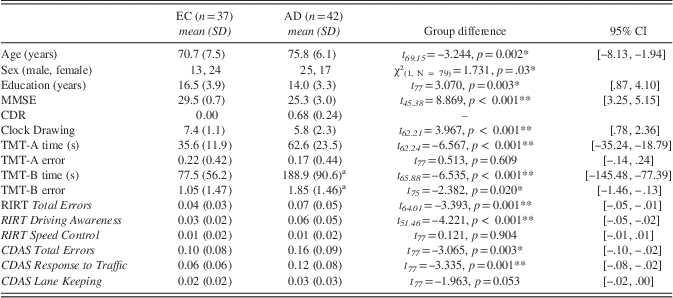
Participants were administered several clinical screening measures to assess cognitive status, including MMSE, CDR scale, Trail Making Test A & B (TMT-A, TMT-B), and Clock Drawing Test (Table 1). Clock reproductions were scored according to criteria from Freund et al. (Reference Freund, Gravenstein, Ferris, Burke and Shaheen2005), and raw scores were used. Completion time (300 s maximum) and error rate was used for the TMT. The EC group was significantly younger and more educated than the AD group (ps < .005), and consisted of more females (p=.03). The EC group performed significantly better than the AD group on all clinical measures (ps≤.01) except TMT-A error rate (p=.43).
Demographic characteristics, clinical/neuropsychological test scores, and driving summary scores of groups

a n=40; Includes 10 participants in the AD group who did not complete the test and were assigned a floor score of 301s; excludes 2 individuals who did not complete the task due to administration error or task comprehension difficulty.
SD=standard deviation; CI=confidence interval; MMSE=Mini-Mental State Examination; CDR=Clinical Dementia Rating; RIRT=Rhode Island Road Test; CDAS=Composite Driving Assessment Scale; TMT-A=Trail Making Test, Part A; TMT-B=Trail Making Test, Part B.
* p<0.05.
** p<0.001.
Driving Assessment
Detailed information has been described previously (Davis et al., Reference Davis, Papandonatos, Miller, Hewitt, Festa, Heindel and Ott2012; Ott et al., Reference Ott, Papandonatos, Davis and Barco2012). In brief, a standardized road test assessment comprised of the Rhode Island Road Test (RIRT), an adaptation of the Washington University Road Test (Hunt et al., Reference Hunt, Murphy, Carr, Duchek, Buckles and Morris1997) that consists of 28 driving behaviors rated trichotomously (0=unimpaired, 1=mildly impaired, 2=moderately-to-severely impaired). Some behaviors were rated multiple times yielding a total of 480 possible event ratings. To correct for events not encountered during the RIRT (e.g., response to pedestrians), an error severity score (RIRT Total Errors) was computed by summing ratings across all observed behaviors (0–960) and dividing that sum by total observed behaviors.
Participants were administered the RIRT by a professional diving instructor, who was blind to diagnosis. The instructor also provided a global assessment of the participant’s overall driving ability (i.e., pass, marginal, fail). Previous research with the same instructor and a backseat instructor (Brown et al., Reference Brown, Ott, Papandonatos, Sui, Ready and Morris2005) demonstrated adequate interrater reliability of RIRT scores, with moderate to substantial agreement for global rating (K=0.83 for linear and K=0.92 for quadratic weighted ratings; Pearson r between two raters for RIRT=0.87).
Cameras were installed in participants’ personal vehicles to record naturalistic real-world driving. The naturalistic assessment comprised examination of video footage from the first 4 h of daytime driving after camera installation. The footage was reviewed by the same driving instructor as used for the RIRT at least 1 month after administration, and rated according to the Composite Driving Assessment Scale (CDAS). The CDAS consists of 30 behaviors rated trichotomously in the same manner as the RIRT. Each behavior was rated once, based on global assessment of all instances observed in the 4 h of video. To correct for events not observed (e.g., response to emergency situation), an error severity score (CDAS Total Errors) was computed by summing ratings across behaviors (0–60) and dividing that sum by the total observed behaviors.
In addition to Total Errors, two composite scores were calculated separately for the RIRT and CDAS based on a published factor analysis of these data (Ott et al., Reference Ott, Papandonatos, Davis and Barco2012). For the RIRT, composite scores were created based on items identified as constituting Driving Awareness and Speed Control. For the CDAS, composite scores were created based on items identified as constituting Response to Traffic and Lane Keeping. Supplementary Table 1 identifies the specific test items that were included in each composite score. Composite scores were computed by summing ratings of items within each factor and dividing that sum by total observed behaviors.
Visual Search Task
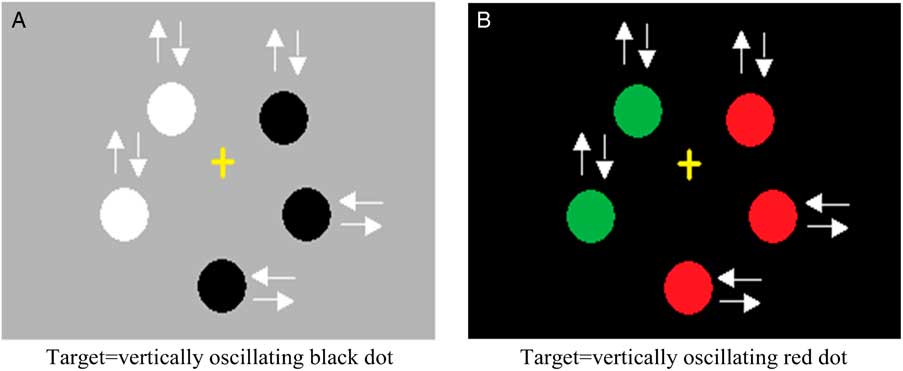
This task was designed to assess sensory binding and selective attention under conditions that placed differential demands on cross-cortical interactions. The luminance-motion (L+M) condition examined search performance for conjunction targets requiring sensory integration solely within the dorsal visual stream, while the color-motion (C+M) condition examined search performance for conjunction targets requiring sensory integration across the dorsal and ventral visual streams (Dobkins & Albright, Reference Dobkins and Albright1998; Merigan & Maunsell, Reference Merigan and Maunsell1993). Participants integrated a target’s direction of motion (up-and-down or left-and-right) with either its luminance contrast (black or white) for the L+M condition or its isoluminant color (red or green) for the C+M condition. Thus, participants were asked to detect a red dot moving up-and-down (target stimulus) among distractors consisting of green dots moving up-and-down and red dots moving left-and-right. In this way, the target cannot be identified by either motion direction or color information alone; rather, both motion direction and color information are crucial for identifying the target and must be integrated together to perform the task (see Figure 1).
Visual search task in the Luminance-Motion (A) and Color-Motion (B) conditions, with set sizes of five in each (one target, four distractors).

The task was administered on a laptop computer using E-Prime 1.3 software with a screen resolution of 1024 × 768 pixels and refresh rate of 60 Hz. Each display consisted of one to five moving dots (15 mm diameter; 30 mm oscillating distance traveled) positioned randomly at six locations (60° angle spacing) around an imaginary circle centered on a yellow fixation cross (5×5 mm). A PR-650 Spectra colorimeter (Photo Research Inc., Chatsworth, CA) was used to measure luminance (Y) and Commission Internationale de l’Eclairage (CIE) coordinates (x,y) of the stimuli. For the C+M condition, luminance-matched red dots (Y=16.10 cd/m2; x=0.595; y=0.353) and green dots (Y=16.10 cd/m2; x=0.304, y=.534) appeared on a black background (Y=2.36 cd/m2; x=0.403; y=0.391). For the L+M condition, black dots (Y=2.36 cd/m2; x=0.403; y=0.391) and white dots (Y=92.30 cd/m2; x=0.293; y=0.315) appeared on a gray background (Y=16.10 cd/m2; x=0.314; y=0.342).
The L+M and C+M conditions were administered in separate blocks of trials, with blocks counterbalanced across participants. In the L+M condition, participants searched for a conjunction target defined as a black dot oscillating in the vertical direction; in the C+M condition, participants searched for a conjunction target defined as a red dot oscillating in the vertical direction. Targets could occur in the presence of either zero, two, or four distractors, thereby creating display sizes of one, three, or five, respectively. For the L+M condition, distractors were either black dots oscillating horizontally or white dots oscillating vertically; for the C+M condition, distractors were either red dots oscillating horizontally or green dots oscillating vertically. Each block consisted of 120 trials (12 practice and 108 real trials). Across each block, the target was present in the display half of the time and absent the other half, and an equal number of trials were shown of each display size. The trial order was randomized in each block for each participant.
Participants were seated ~70 cm away from the screen at eye-level. They were instructed to press the space bar quickly but accurately on only trials in which the target was present. On each trial, a fixation cross appeared on the screen for 1000 ms, followed by a search display for 3500 ms and then a black screen for 750 ms. Correct target-present responses were those in which participants responded before the search display disappeared (3500 ms time limit). No performance feedback was provided during practice or test trials. Summary scores based on responses to trials in display sizes 3 and 5, were calculated separately for the L+M and C+M conditions: (1) median reaction time for correct target trials (Med RT); (2) mean hit rate for target trials (Hit Rate) (i.e., correct detection of target); (3) mean false alarm rate (False Alarm Rate) (i.e., incorrect response to a non-target trial).
Statistical Analyses
To provide context for visual search and driving analyses, we first explored differences between groups and conditions in the search task. For the Med RT and Hit Rate, mixed-design two-way analyses of variance (ANOVA) were constructed with condition (L+M, C+M) as a within-subjects factor and group (EC, AD) as a between-subjects factor. Due to the inherently skewed nature of Hit and False Alarm Rates, non-parametric analyses of group differences (Mann-Whitney U Tests) for these measures were conducted for each condition.
Correlations between demographic variables, clinical test performance, visual search measures, and driving total error/composite scores were obtained using Pearson and Spearman coefficients. We investigated effect sizes and patterns of relationships rather than correlations between specific visual search and driving measures to determine variables of interest for later regression analyses. Multiple linear regression models were constructed for each driving score that was significantly correlated with both clinical and visual search measures, or with multiple search measures. This procedure used hierarchical linear models (HLMs), with demographic covariates entered in the first block and clinical test scores in the second block. To avoid model overfitting associated with an unrestrained number of predictors, we selected clinical test scores based on whether they showed a significant partial correlation with driving when controlling for age and education.
The same procedure was followed for visual search measures correlated with the driving variable of interest; these cognitive predictors were entered in the third block to evaluate their incremental predictive validity. Given some overlap in the cognitive constructs measured by search indices, if more than one search measure was to be entered, we implemented, in only this final block, a stepwise approach to select the best predictor(s), with an entrance threshold of α=0.05. All analyses were performed using IBM SPSS Statistics (Version 22.0).
RESULTS
Driving Assessment
Comparison of the RIRT and CDAS total error and composite factor measures for the groups are shown in Table 1. Supplementary Table 2 provides the range of scores of each group for each measure. No participant failed the RIRT. However, 25 individuals (6 EC, 19 AD) received a marginal pass. The 6 ECs who received a marginal pass did not perform significantly worse on any CDAS or visual search measure than did the rest of the EC group (Welch’s t test ps > .05). The 19 AD patients with a marginal pass score performed significantly worse on the CDAS than the fully passing AD patients (p=.043), but did not show any differences in visual search performance. Independent t tests revealed that the EC group had significantly lower RIRT and CDAS scores (i.e., better performance) than the AD group (ps≤.003), with the exception of RIRT Speed Control (p=.904) and a marginally lower CDAS Lane Keeping score (p=.053). Within-group correlations revealed strong interrelationships between most RIRT and CDAS measures in the AD group, but no significant correlations between RIRT and CDAS in the EC group (Supplementary Table 3).
Visual Search Task
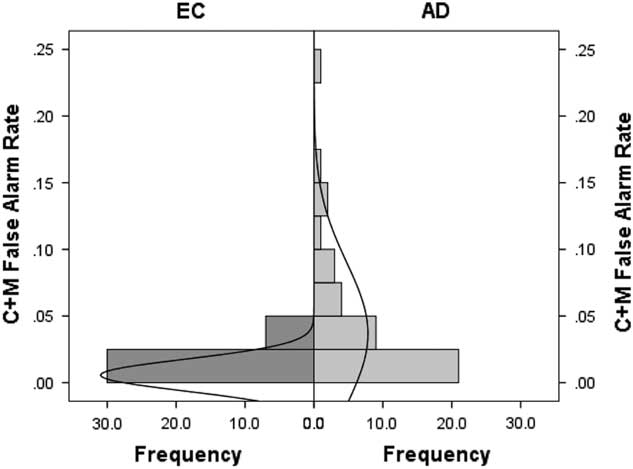
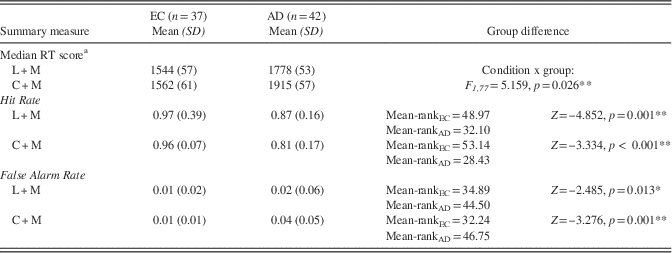
AD patients performed significantly worse than the EC group on all visual search indices (Table 2). ANOVA of Med RT revealed a significant interaction of group and condition (p<.026) along with significant group (p<.001) and condition (p<.001) main effects; while AD patients’ speed was reduced on both conditions relative to the EC group, they performed disproportionately slower than the EC group on the C+M condition. Mann-Whitney U tests on Hit Rate revealed that AD patients showed higher proportions of target misses than the EC group (L+M: Z=−3.334; p=.001; C+M: Z=−4.852; p < .001). There were also higher proportions of false positive responses across conditions in the AD group (L+M: Z=−2.485; p=.013; C+M: Z=−3.276; p=.001). Differences in False Alarm Rate were particularly marked for the C+M condition (Figure 2).
C+M false alarm distribution in controls (left) and AD patients (right). C+M=Color-Motion. Normal curve depicted on graph.

Visual search summary scores of groups

a Marginal means and standard errors reported.
SD=standard deviation; CI=confidence interval; L+M=Luminance-Motion; C+M=Color-Motion; RT=reaction time.
* p<0.05.
** p<0.01.
Relationship Between Driving and Search Measures
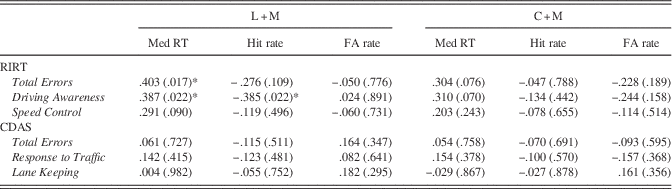
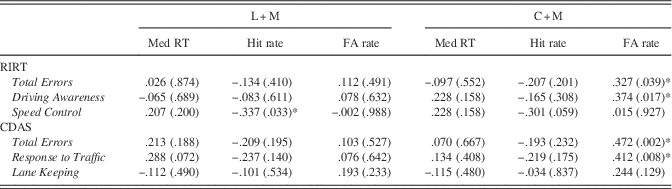
Several correlations between the RIRT and search scores were observed in the EC group (Table 3). Relationships robust to age and education correction included those between RIRT Total Errors and L+M Med RT (r=0.403; p=.017), as well as between Driving Awareness and L+M Med RT (r=0.387; p=.022). Although both Total Errors and Driving Awareness were also correlated with C+M Med RT, these effects were no longer significant after including covariates. Likewise, significant correlations between L+M Med RT and C+M Med RT and Speed Control did not pass covariate adjustment. L+M Hit Rate was moderately correlated with Driving Awareness even after adjustment (ρ=−0.385; p=.022). No other correlations were observed between driving measures and either Hit Rate or False Alarm Rate. In the AD group, relationships between RIRT and visual search that were observed initially and survived adjustment, included C+M False Alarm Rate with Driving Awareness (ρ=0.374; p=.017), and L+M Hit Rate with Speed Control (ρ=−0.337; p=.033). An additional relationship between C+M False Alarm Rate and Total Errors emerged only after covariate adjustment (ρ=0.327; p=.039).
Partial correlations (age/education-corrected) between visual search and driving measures in the EC group

Note. Partial correlations reflect Pearson r (Med RT) or Spearman ρ (Hit rate, FA rate). p-values in parentheses.
* p<0.05.
L+M=Luminance-Motion; C+M=Color-Motion; RIRT=Rhode Island Road Test; CDAS=Composite Driving Assessment Scale; Med RT=Median RT; FA rate=False Alarm Rate.
In contrast to the RIRT results, none of the CDAS scores correlated with any of the search scores in the EC group, but relationships were observed in the AD group (Table 4). These were robust to covariates, and included correlations between C+M False Alarm Rate and Total Errors (ρ=0.472; p=.002) as well as Response to Traffic (ρ=0.412; p=.008).
Partial correlations (age/education-corrected) between visual search and driving measures in the AD group

Note. Partial correlations reflect Pearson r (Med RT) or Spearman ρ (Hit rate, FA rate). p-values in parentheses.
* p<0.05.
L+M=Luminance-Motion; C+M=Color-Motion; RIRT=Rhode Island Road Test; CDAS=Composite Driving Assessment Scale; Med RT=Median RT; FA rate=False Alarm Rate.
Relationship Between Driving and Clinical Measures
Although some relationships between driving and clinical measures were observed, few passed age and education correction, and we discuss only these adjusted correlations here. In the EC group, RIRT Total Errors was related only to TMT-B time (r=0.433; p=.009). Both TMT-B time and MMSE were related to RIRT Speed Control (r=0.487; p=.003 & r=−0.337; p=.047, respectively). No significant relationships were found between clinical and CDAS scores in the EC group.
In the AD group, Clock Drawing performance was related to CDAS Total Errors (ρ=−0.374; p=.018). TMT-A errors correlated with RIRT Total Errors (ρ=0.336; p=.034) and TMT-B errors correlated with CDAS Response to Traffic (ρ=0.365; p=.020), and both TMT error scores were associated with RIRT Driving Awareness (A: ρ=0.322; p=.043; B: ρ=0.413; p=.010).
Prediction of Driving Performance
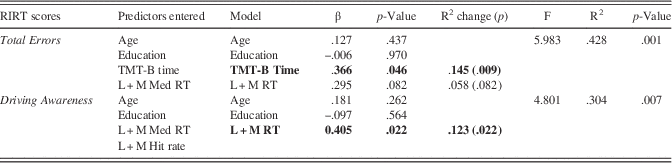
In the EC group, multiple regression of RIRT Total Errors did not reveal a significant independent contribution of L+M Med RT after accounting for the effects of age, education, and TMT-B time, although the overall model remained significant (F 4,32=5.983; p=.001; R 2=0.428). For RIRT Driving Awareness factor, stepwise entering of L+M Med RT and L+M Hit Rate resulted in a model with only L+M Med RT accounting for significant additional variance beyond demographic predictors (F 3,33=4.801; p=.007; R 2=0.304) (see Table 5).
Visual search and clinical predictors of RIRT performance in the EC group

Note. Bold indicates significant predictors.
RIRT=Rhode Island Road Test; TMT-B=Trail Making Test, Part B; L+M=Luminance-Motion; Med RT=median reaction time; FA=false alarms.
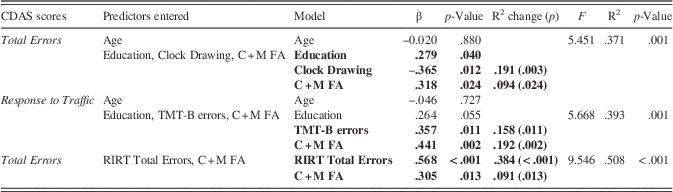
In the AD group, although C+M False Alarm Rate was significantly correlated RIRT Driving Awareness, it did not account for unique variance in this driving measure after the addition of age, education, and errors on the TMT-A/B tasks. By contrast, C+M False Alarm Rate predicted unique variance in CDAS Total Errors after accounting for demographic predictors and Clock Drawing performance (F 4,37=5.451; p=.001; R 2=0.371). C+M False Alarm Rate also significantly predicted CDAS Response to Traffic above and beyond demographics as well as TMT-B errors (F 4,35=5.668; p=.001; R 2=0.393) (see Table 6).
Visual search, clinical, and RIRT predictors of CDAS performance in the AD group

Note. Bold indicates significant predictors.
CDAS=Composite Driving Assessment Scale; TMT-B=Trail Making Test, Part B; C+M=Color-Motion; FA=false alarms; RIRT=Rhode Island Road Test.
Prediction of CDAS Performance From RIRT and Search Scores
Because RIRT and CDAS showed notable concordance in the AD group, a HLM was constructed for CDAS Total Errors with age and education (block 1), RIRT Total Errors (block 2), and C+M False Alarm Rate (block 3) to evaluate the incremental predictive value of the latter in predicting naturalistic driving beyond standardized road test performance. This model revealed a significant additional contribution of C+M False Alarm Rate (F 4,37=9.546; p<.001; R 2=0.508), with the total model accounting for 51% of the variance in CDAS Total Errors.
DISCUSSION
The current study used a novel visual search task to examine the contributions of selective attention and sensory integration to driving performance in healthy elderly and patients with early AD. Participants were administered a conjunction visual search task under two feature binding conditions: (1) A luminance plus motion (L+M) condition which minimized the demand for cross-cortical integration; and (2) A color plus motion (C+M) condition that had the same selective attention demands as the L+M condition but additionally placed greater demands on cross-cortical feature binding. While healthy elderly performed comparably across the two search conditions, AD patients performed significantly worse on the C+M than the L+M condition, indicating a behavioral sensory integration deficit that previous studies have suggested may be due to AD-related disruptions in cortico-cortical connectivity (Delbeuck et al., Reference Delbeuck, Collette and Van der Linden2007; Festa et al., Reference Festa, Insler, Salmon, Paxton, Hamilton and Heindel2005, Reference Festa, Katz, Ott, Tremont and Heindel2017; Kurylo et al., Reference Kurylo, Allan, Collins and Baron2003; Lakmache et al., Reference Lakmache, Lassonde, Gauthier, Frigon and Lepore1998; Parra et al., Reference Parra, Abrahams, Logie and Della Sala2010). Moreover, while selective attention measures were strong predictors of driving performance in healthy elderly regardless of the demands placed on sensory binding, the primary predictor of driving performance in AD patients beyond clinical and demographic variables was visual search under high binding demands rather than selective attention measures more generally.
In healthy elderly, reaction time in the L+M condition and TMT-B completion time were significant predictors of driving performance on the standardized road test. Although a similar effect was observed for reaction time in the C+M condition, only L+M reaction time and TMT-B were robust to demographic adjustment, suggesting that age-related declines in selective attention rather than binding are the primary contributors to driving performance in this population. These results are consistent with previous studies indicating an important role for selective attention in driving performance (for discussions, see Duchek et al., Reference Duchek, Hunt, Ball, Buckles and Morris1997; Trick & Enns, Reference Trick and Enns2004).
Although most studies have assessed selective attention using single-feature search tasks such as the UFOV test (Anstey & Wood, Reference Anstey and Wood2011; Hoffman et al., Reference Hoffman, McDowd, Atchley and Dubinsky2005; Wood et al., Reference Wood, Chaparro, Lacherez and Hickson2012), it is possible that conjunction search tasks requiring individuals to integrate information may be more ecologically valid measures of selective attention during driving. Our results, however, suggest that regardless of the demands placed on sensory integration, it is the selective attentional mechanisms common to these tasks that remains most germane to driving performance in healthy aging.
Our second hypothesis concerned the unique contributions of cross-cortical sensory binding (present in the C+M condition) to driving in AD patients. We found that false alarm rate for the C+M but not L+M condition was associated with driving performance on the naturalistic driving assessment. The association of driving performance with commission errors rather than response time suggests that a breakdown in feature binding (leading to misperceptions) rather than a general impairment in selective attention is more relevant to driving errors in AD patients. This interpretation is consistent with the previous demonstration that AD patients’ errors on conjunction search tasks do not appear to be due to a reduction in generalized cognitive resources (Porter et al., Reference Porter, Leonards, Wilcock, Haworth, Troscianko and Tales2010), and with previous demonstrations of impaired perceptual integration in AD patients (Heindel et al., Reference Heindel, Festa, Davis, Miller, Knott and Ott2010; Lineweaver, Salmon, Bondi, & Corey-Bloom, Reference Lineweaver, Salmon, Bondi and Corey-Bloom2005; Paxton et al., Reference Paxton, Peavy, Jenkins, Rice, Heindel and Salmon2007; Uhlhaas et al., Reference Uhlhaas, Pantel, Lanfermann, Prvulovic, Haenschel, Maurer and Linden2008). To our knowledge, the current study represents the first attempt to quantify the relationship between perceptual integration deficiencies and driving performance in AD, and suggests an important role for cross-cortical feature binding in driving ability.
In addition to these main findings, several additional findings from the present study have implications for our understanding of the relationship between cognition and driving in elderly populations. First, the association in healthy elderly between visual search and driving was found only with the standardized but not the naturalistic driving assessment. The relationship between search and standardized road test performance is consistent with previous studies indicating significant relationships between attentional functioning and driving in structured assessment environments (Carr, Barco, Wallendorf, Snellgrove, & Ott, Reference Carr, Barco, Wallendorf, Snellgrove and Ott2011; Dobbs & Shergill, Reference Dobbs and Shergill2013; Papandonatos et al., Reference Papandonatos, Ott, Davis, Barco and Carr2015; Vaucher et al., Reference Vaucher, Herzig, Cardoso, Herzog, Mangin and Favrat2014). Naturalistic driving has been explored much less often in the literature, perhaps because older drivers tend to compensate for their cognitive and visual diminutions by limiting their driving to familiar streets, avoiding complex driving situations (e.g., high traffic), and reducing night driving (Baldock, Mathias, McLean, & Berndt, Reference Baldock, Mathias, McLean and Berndt2006; Carr, Duchek, & Morris, Reference Carr, Duchek and Morris2000; Festa et al., Reference Festa, Ott, Manning, Davis and Heindel2013; Lesikar, Gallo, Rebok, & Keyl, Reference Lesikar, Gallo, Rebok and Keyl2002; Ott et al., Reference Ott, Heindel, Papandonatos, Festa, Davis, Daiello and Morris2008).
To the extent that driving difficulties in healthy elderly become apparent only in unfamiliar environments (Blanchard & Myers, Reference Blanchard and Myers2010), neurocognitive measures may be associated more with (unfamiliar) standardized road test performance than with (familiar) naturalistic driving performance. In this view, a standardized road test can be considered another neurocognitive task offering good convergent validity with other neuropsychological measures. On the other hand, it may be a poor estimator of functional level, which could be tapped more effectively by naturalistic assessment.
Second, unlike heathy elderly, search performance in the L+M condition was not associated with driving in AD patients despite greater impairment on this task, and despite previous demonstrations of greater declines in selective attention in AD compared to healthy elderly (Coubard et al., Reference Coubard, Ferrufino, Boura, Gripon, Renaud and Bherer2011; Deiber et al., Reference Deiber, Ibanez, Missonnier, Herrmann, Fazio-Costa, Gold and Giannakopoulos2009; Festa et al., Reference Festa, Heindel and Ott2010; Levinoff et al., Reference Levinoff, Li, Murtha and Chertkow2004). It is possible the relationship between attention and driving was degraded in AD patients due to the presence of other cognitive impairments, suggesting that attentional functioning may not be a good index of driving fitness in AD.
This interpretation could help account for previous discrepancies observed between healthy and cognitively impaired groups in the sensitivity of clinical tests to detect poor driving ability (Dobbs & Shergill, Reference Dobbs and Shergill2013; Fitten et al., Reference Fitten, Perryman, Wilkinson, Little, Burns, Pachana and Ganzell1995; Ott et al., Reference Ott, Heindel, Papandonatos, Festa, Davis, Daiello and Morris2008). In this view, additional cognitive impairments may alter or obscure relationships between attention and driving, thereby creating significant challenges when assessing functional ability. In striking contrast to the lack of association between selective attention and driving, however, strong associations were observed between cross-cortical binding and driving in AD, suggesting that sensory integration ability has functional implications distinct from typically measured cognitive domains.
Third, while selective attention was associated with the standardized but not naturalistic driving assessment in healthy elderly, sensory integration made significant contributions to naturalistic but not standardized driving performance in AD patients. This dissociation may be due in part to a greater reliance of naturalistic driving on implicit learning and procedural skills that are relatively preserved in AD (Beaunieux et al., Reference Beaunieux, Eustache, Busson, de la Sayette, Viader and Desgranges2012; Heindel, Festa, Ott, Landy, & Salmon, Reference Heindel, Festa, Ott, Landy and Salmon2013; Hirono et al., Reference Hirono, Mori, Ikejiri, Imamura, Shimomura, Ikeda and Yamadori1997; Machado et al., Reference Machado, Cunha, Minc, Portella, Velasques, Basile and Ribeiro2009; van Halteren-van Tilborg, Scherder, & Hulstijn, Reference van Halteren-van Tilborg, Scherder and Hulstijn2007) along with an even further restriction of naturalistic driving behavior in AD patients beyond those of healthy elderly (Festa et al., Reference Festa, Ott, Manning, Davis and Heindel2013). Performance on familiar or routinized driving routes may be mediated more by overlearned driving behaviors, while driving in unfamiliar environments may require greater attentional and higher order cognitive resources. Naturalistic driving assessments may capture qualitatively different phenomena than standardized road-test data, revealing unique performance vulnerabilities (Davis et al., Reference Davis, Papandonatos, Miller, Hewitt, Festa, Heindel and Ott2012; Porter & Whitton, Reference Porter and Whitton2002).
Accordingly, we demonstrated in our patient data that C+M binding made significant, unique contributions to CDAS performance after accounting for RIRT performance, suggesting that naturalistic driving involves cognitive ability distinct from selective attention in this group. As a perceptual process, sensory binding may be a stronger predictor of AD patients’ driving under familiar naturalistic conditions when attentional demands are minimized, and may, therefore, be sensitive to subtle disturbances in driving fitness that go undetected by traditional neuropsychological testing. These disturbances are particularly likely to be detected in very early stages of the disease, when marked cognitive dysfunction is not yet apparent. Thus, the assessment of binding ability could prove useful in identifying risky drivers before they become dangerous.
The identification of sensory binding as a predictor of driving ability in AD highlights the importance of examining driving fitness within the context of specific cognitive impairments. The present study extends previous findings by demonstrating that binding deficiencies in AD are not only distinct from selective attentional impairments, but also make unique contributions to driving performance. Future studies are needed to further examine the relationships between cognitive impairments and functional ability, and to address some limitations associated with the present study.
First, interpretation of our findings must be qualified by the fact that the healthy elderly group was slightly but significantly younger and more educated than the AD group, and by the fact that this study was restricted to relatively safe drivers (i.e., those who were able to pass the RIRT). Support for the presence of disease-specific cognitive markers of functional decline would also be strengthened through studies that directly examine the neuropathological substrates mediating the relationships between cognition and driving in AD. Additionally, rating approaches and skills operationalization are critical to driving research, and our results should be replicated in studies using multiple raters and comparable indices of standardized and naturalistic driving performance. Such studies will not only provide a better understanding of how specific cognitive components relate to driving performance, but will also help to refine clinical assessments to identify individuals at risk for unsafe driving.
ACKNOWLEDGMENTS
This work was supported by the National Institute on Aging at the National Institute of Health (R01 AG016335 to BRO) and presented at the February 2017 meeting of the International Neuropsychological Society in New Orleans, LA. None of the authors have potential conflicts of interest to disclose. We thank Stephanie K. Knott for assistance in data collection, Timothy Souza from the ABC/ACE Driving School who performed the road tests and rated the naturalistic driving videos, and all of our participants who gave their time to this study.
SUPPLEMENTARY MATERIAL
To view supplementary material for this article, please visit https://doi.org/10.1017/S1355617717001291