




No CrossRef data available.
Information generation during design: Information importance and design effort
Published online by Cambridge University Press: 22 July 2005
Abstract
The present paper studies the process of information generation during design and focuses on the relationship between the information importance and the required effort for its generation. Multiple associative relationships among design entities (handled as design descriptors) are used to represent the design knowledge. The characteristics of the dependent and the primary descriptors are examined and their distinct roles in the design process are discussed. Term definitions concerning the information importance and the design effort are also introduced. The descriptors are used to form a matrix. A number of operations on this matrix results in its transformation, with the final matrix reflecting the quantitative relationship between the information importance and the design effort. From the aforementioned matrix, a unique sorted list for the primary design descriptors is produced. Following this list during descriptor instantiation ensures the production of design information of maximum importance with the least effort in the early design stages. The design of a belt conveyor is used as a basis for a better understanding of the theoretical analysis and for a demonstration of the use of the suggested descriptor list.
Information
- Type
- Research Article
- Information
- Copyright
- 2005 Cambridge University Press
1. INTRODUCTION
Engineering design is an activity of intensive manipulation of knowledge. The goal in design is always the generation of design solutions that satisfy the functional requirements formally stated as engineering measurable quantities. Being an activity of knowledge representation and manipulation, design has been the subject of extended research during the last decades. As a result of this research and in combination with the accumulated design experience and the advances achieved in other scientific fields (artificial intelligence, computer graphics, soft computing, etc.), significant progress has been made toward the establishment of a robust, domain-independent design theory (Suh, 1990), the formation of reliable models for the representation and handling of design knowledge (MacCallum & Duffy, 1987; Yagiu, 1989; Duffey & Dixon, 1990; Dentsoras, 1996; Shaalan et al., 1998), the introduction of machine learning techniques (Lu & Tcheng, 1991; Sim & Duffy 1998), design reuse methodologies, and so forth.
In every design problem, there is always the need to establish associative relations (functional, topological, etc.) among the different design objects (entities). These complex relations form the design knowledge for the problem under consideration. They are tested for their validity through instantiations of the attributes of the design entities interrelated through them. The designer guides this instantiation based on his/her general and specific knowledge, skill, and expertise.
Design knowledge is usually expressed through dynamic and complicated forms and structures, and it is not always easy to establish concise methods and techniques to handle them efficiently. Additionally, design is mainly a data-driven process with the data used for initiating, preserving, and finally completing the design process presenting an interesting variety. Part of this data plays a decisive role from the very beginning of the design process and affects its evolution. It is usually involved in many design tasks, and covers multiple design stages in the sense that it affects value assignment procedures and decision-making processes. In this context, its effects are sometimes traced with difficulty, especially in large-scale design problems. Some other data is less important, and their impact is restricted in small design subspaces, usually in the later design stages.
Concerning the information handled and/or produced during design, Shooter et al. (2000) present a model for the flow of design information that is sufficiently formal to eventually support a semantics-based approach for developing information exchange standards. The model classifies design information into various types, organizes these types into information states and levels of abstraction, and identifies the various transformations that operate within and between the information states.
Within the context of the effort of differentiating among different types of design information, Franceschini and Rossetto (2002) consider the problem of the “prioritization” of the technical design characteristics of a product. An interactive algorithm has been developed with the aim to better support the engineering design process by means of quality function deployment (QFD). The method allows the determination of a ranking order of design characteristics without the artificial conversion of symbols contained in the relationship matrix, and without the use of explicit information concerning the relative degree of importance of customer requirements.
Dentsoras (1996) and Tsalidis and Dentsoras (1997) proposed a design knowledge representation formalism that is based on a separation of the set of design entities in two distinct subsets: the set of dependent and the set of nondependent (primary) entities. The data for the instantiation of the nondependent entities are usually provided by the designer and/or are extracted from other sources such as databases, previous design cases, and so forth. Once instantiated, the primary entities determine, through the established associative relations, the dependent entities. Lee et al. (1998) extend the use of entities to represent both the design information and the activity involved in design. The product and the process model were integrated into a singe model and, to carry out this integration, an entity-based model was used.
In an earlier work done by Warfield (1973), the use of binary matrices in system modeling and the development of such matrices for the representation of structural models of systems were discussed. Steward (1981) was the first to introduce the technique called the design structure system as a method for managing the design of complex systems. This method can assist in cases when there are circuits in the design of systems. The proposed technique can be used to handle design iterations and reviews, to show the information flow during the design work, and to determine the consequences of a change in any variable on the rest of the variables in the system.
The early work by Steward on the design structure matrix (DSM) formed the basis for further research. Kusiak et al. (Kusiak & Park, 1990; Kusiak & Wang, 1993; Kusiak & Larson, 1995) used DSM within the framework of concurrent Engineering for the decomposition and scheduling of design activities, while Eppinger (1991) presented model-based approaches for managing concurrent engineering. Meanwhile, Black et al. (1990) had already used DSM for the design of an automotive break system, and Austin et al. (1994) used the same approach for the manipulation of the flow of design information in order to improve the programming of building design.
Smith and Eppinger (1997) extended further the DSM method to predict those coupled features of the design problem that would require much iteration to reach, and their model was applied to an automotive brake-system development process. Yassine et al. (1999) proposed a qualitative approach to engineering design management from an information structure perspective and enhanced the classical DSM method by introducing the notion of structural sensitivity analysis. Finally, Browning's (2001) review paper discussed the advantages of DSM versus alternative system representation and analysis techniques and posed new research directions.
The DSM method is based on a matrix representation of the digraph that is formed among the design entities, provides insights about how to manage the design complexity, and highlights issues of information needs and requirements, task sequencing, and iterations. This matrix is binary and square, and contains nonzero elements whose number is equal to the number of the edges (associative relationships) in the digraph. In this binary representation of the design problem, the diagonal elements of the matrix do not have any meaning and they are left empty.
One of the most important tasks that can be implemented in a DSM is the removal of interdependencies (loops) among the design parameters. This process, known as partitioning, was introduced by Steward (1981). Furthermore, a variation of the DSM, the numerical DSM, contains attributes that provide more detailed information on the relationships between the design parameters. Steward (1981) proposed two such attributes; the level numbers were used instead of a simple binary mark and the importance ratings that constitute a simple verbal scale able to differentiate between different important levels.
In accordance with the work by Dentsoras (1996) and Tsalidis and Dentsoras (1997), Drakatou and Dentsoras (2001) investigated the possibility of early instantiations for those design entities that present a major importance for the further development of the design. It was assumed that the design knowledge configuration could provide a set of nondependent entities that may be further sorted according to their occurrence in this configuration. Thus, in the aforementioned papers, the relation between this configuration and the corresponding set of nondependent design entities was studied. Through this study it was shown that a unique list of nondependent entities may be derived which, when followed, ensures the derivation of the maximum number of instantiations of dependent entities during the very beginning of the design process. This implies that the instantiation of the nondependent entities should not be a random process in the sense that during the instantiation process of these entities, some of them must be instantiated prior to some others.
In the present paper, the issues treated in Drakatou and Dentsoras (2001) are further elaborated. New terms are introduced (design information importance, required design effort, design cycle, importance–effort curves, etc.) and simpler treatment of the design knowledge configuration is introduced through matrix manipulations and rearrangements. The present work focuses on the following:
- the establishment of a relationship between the importance of the design information and the required effort to achieve it;
- the expression of the above relation in terms of a simple, yet complete dependency matrix between the sets of dependent and nondependent entities;
- the connection of both design information importance and design effort concepts to the design cycle, the latter perceived as a design process measuring unit in design time; and
- the exploration of the assumption that there is a unique instantiation list of nondependent descriptors that ensures the production of design information of maximum importance with the least design effort.
In the last part of the paper a belt conveyor design example has been included. This example, already elaborated in Drakatou and Dentsoras (2001), is again retreated and further elaborated to conform to the new approach and the introduced terms.
2. INFORMATION IMPORTANCE AND DESIGN EFFORT
2.1. Term definitions
For the present approach, the frame representation scheme already used in Drakatou and Dentsoras (2001) has been adopted to express the design problem, the design objects, and the relations between them. The decomposition of a design into relations among descriptors, that in their turn, point to design entities, may be successfully represented as relations among generic frames and instances (Dentsoras, 1996). This correspondence is shown in Figure 1a.

Representations of design knowledge: (a) decomposition through frames and frame relations, (b) typical frames for entities and descriptors, and (c) primary and dependent descriptors.
Drakatou and Dentsoras (2001) defined a design entity as a discrete design object of either a qualitative or quantitative nature that may be instantiated by methods that it contains and a design descriptor as any meaningful, identifiable, and unique word or phrase that describes an entity and points to it (Fig. 1b shows the minimum typical attributes that the frames of entities and descriptors should contain). Generally, descriptors help toward establishing and expressing abstract design relations without any commitment to specific methods, structures, and so forth. Because a descriptor is always textual, it can easily be adopted to different design entities that match the actual common-sense meaning of the descriptor's name, thus enhancing design flexibility. To simplify the present analysis, it is assumed that there is a one to one mapping among descriptors and entities so that the term descriptor or entity may be used equivalently in all circumstances.
A primary descriptor is a descriptor that possesses the unique property to be input (primary, key) object for the design problem under consideration. The data for its instantiation is usually provided by the designer and/or are extracted from other external sources such as databases, previous design cases, and so forth. Once instantiated, the primary descriptor determines (values), through the established associative relationships, the rest, nonprimary, dependent descriptors. In Figure 1c, d4, d5, and d6 are primary descriptors and d1, d2, and d3 are dependent descriptors.
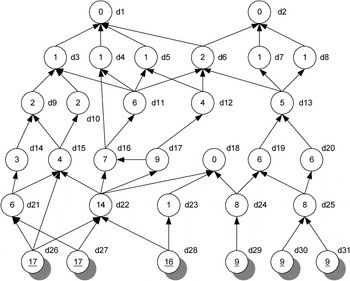
The importance (or importance value) of a dependent design descriptor is defined as the total number of other, dependent descriptors whose instantiation depends upon it. In Figure 2, a digraph is shown representing the relationships (connecting edges) among the design descriptors (nodes) in a design problem. In every node, except the nodes representing primary descriptors, the corresponding importance value is given. The underlined values in the nodes representing primary descriptors correspond to the number of dependent descriptors whose instantiation depends upon this primary descriptor.

An example of a design problem digraph. The importance value is given in every node. The underlined values in the primary descriptor nodes correspond to the total number of dependent descriptors whose instantiation depends upon this primary descriptor.
For the instantiation of a dependent descriptor, a definite number of nonprimary descriptors must be instantiated. Then, through the paths of the digraph representing the design problem decomposition, the dependent descriptor will eventually acquire its value. The instantiation of a primary descriptor is an event that takes place during the design process and constitutes a design cycle. In every design cycle, only one primary descriptor instantiation takes places, and the total number of primary descriptor instantiations needed for the instantiation of a particular dependent descriptor is defined as the required design effort for that descriptor. In addition, in every design cycle it is assumed that a recursive value propagation process is “fired” so that the maximum possible (for that cycle) dependent descriptor instantiations take place. The design process is considered as completed if all (dependent and nondependent) descriptors have been instantiated.
It must be noted that the introduction of the idea of the design cycle serves toward two directions: it forms a simple basis for measuring the design time as a sequence of successive events (primary descriptor instantiations), and it provides a measuring “unit” for defining other important terms (required design effort, importance, etc.). Within the context of the present work, it is assumed that the required effort for acquiring the value of one primary descriptor, prior to its instantiation, is the same for all primary descriptors. In a newer work, currently under elaboration, the possible diversity for this effort is to be taken into account to attain more realistic values for every primary descriptor.
2.2. Information importance and design effort: The dependency matrix
Consider a design problem that can be represented as a digraph of n design descriptors. These descriptors form a set D. For that set,
- |D| = n, n ≥ 2;
- there are m dependent descriptors forming a subset S of set D, with |S| = m, m ≥ 1; and
- there are, at the same time, p primary descriptors forming a subset T of set D with |T | = p, p ≥ 1.
Set D can be considered as the union of the two distinct sets S and T with the following characteristics:

If si, i = 1, 2, … , m is a dependent descriptor in S, then there is a subset Si of descriptors other than si in S, whose instantiations are affected by si. For this subset,

The importance index of si, namely I(si), is defined as the cardinality of Si or

The importance indices of all the dependent descriptors in set S form an importance vector I. For this vector, if Ii, i = 1, 2, … , m, is its i-element, then,

If sk, k = 1, 2, … , m is a dependent descriptor in S, then there is a subset Tk of primary descriptors in T whose instantiations affect the instantiation of sk. For this subset:

The design effort index (or design cycle index) of sk, namely E(sk), is defined as the number of the members of Tk or

The design effort indices of all the dependent descriptors in set S form a design effort vector E. For this vector, if Ek, k = 1, 2, … , m its k-element, then:

If tj, j = 1, 2, … , p is a primary descriptor in T, then there is a subset Sj of S of dependent descriptors whose instantiation depends upon tj. For this subset,

The occurrence index of tj, namely O(tj), is defined as the number of the members of Sj or

The occurrence indices of all the primary descriptors in set T form an occurrence vector O. For this vector, if Oj, j = 1, 2, … , p is its j-element, then,

The sets S and T and the defined subsets can be used in order to form a (|S| + 1) × (|T | + 1) dependency matrix (truth matrix) whose elements may get either true or false values. This matrix and all the subsequent rearrangements of its rows and columns are formed by the following step by step procedure (considering the matrix element (1, 1) as empty):
- Starting from position (1, 2) in the first row, put the names of the primary descriptors in set T.
- Starting from position (2, 1) in the first column, put the names of the dependent descriptors in set S.
- For the row corresponding to dependent descriptor sk, put the value true (T) in the column of tu, u = 1, 2, … , p if the name of tu exists in Tk, otherwise put false (F).
- Repeat step 3 for all the columns (for all members of T).
- Repeat steps 3 and 4 all the rows (for all members of S).
Now, the matrix should look like the following (the Ts and Fs have been arbitrarily positioned):
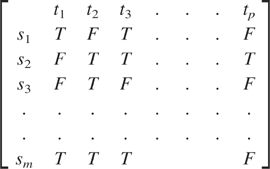
It is obvious that the matrix represents the relations among the design descriptors. This matrix is binary but it is not square (unless the number of the dependent descriptors is equal to the number of the independent ones). It records the existence or nonexistence of relations among the members of S and T as they result from an exhaustive depth-first search of the digraph corresponding to the set D. (From a structural point of view the present approach uses the paths in the digraph to record all the relations while the DSM method uses the edges between adjacent nodes.)
Next, a number of rearrangements will be performed on the rows and columns of the matrix.
2.2.1. Row rearrangement
Consider the importance vector I. If

is the maximum value among all values of its elements, then the normalized importance vector is defined as follows

The same normalization process can be followed for the design effort vector. If

is the maximum value among all values of its elements, then the normalized design effort vector is defined as follows:

For every si, i = 1, 2, … , m the difference between the corresponding elements in In and En can be calculated. Then,

The rows of the dependency matrix can be rearranged in descending order according to the values of di. A second arrangement of the matrix rows may be performed if there are groups of rows that present equal di values. In that case and for every such group, the rows are rearranged in ascending order of design effort values as they appear in En.
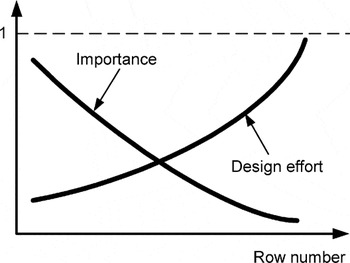
After the rearrangement, the top matrix rows correspond to dependent descriptors that present great importance and can be instantiated with the least design effort and vice versa. Figure 3 is a qualitative representation of the dependency among the row number (x axis) and the normalized importance and design effort (y axis). Because every matrix row corresponds to a dependent descriptor, the graph in Figure 3 actually depicts the importance and the required design effort for every dependent descriptor but in an ordered way.

The importance of the dependent descriptors and the required design effort for their instantiations as a result of matrix rearrangement.
2.2.2. Column rearrangement
Consider the occurrence vector O. If

is the maximum value among all values of its elements, then the normalized occurrence vector is defined as follows:

The columns of the dependency matrix may be rearranged in a descending order according to the values in the normalized occurrence vector On. Now the leftmost columns correspond to primary descriptors that present high occurrence indices and vice versa.
A final arrangement of the matrix columns may be performed if there is at least one subset of On whose elements have equal values. In that case, the total required design effort is calculated for every column in the matrix that corresponds to an element in this subset. Then the columns are rearranged in ascending order of required design effort. The procedure is repeated for every set of equally valued elements in On.
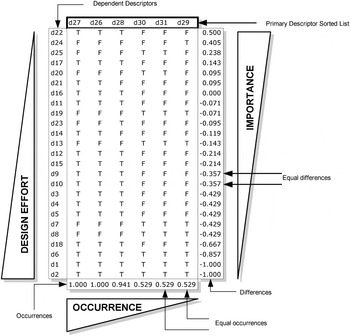
An example of the final rearranged dependency matrix for the design problem of Figure 2 is shown in Figure 4. In this figure, the difference values used for the row rearrangement and the occurrence values used for the column rearrangement are shown for every dependent and primary descriptor correspondingly. Two cases of equal difference values and equal occurrence values are also marked.

The dependency matrix for the design problem in Figure 2.
It has been previously assumed that, within the context of the present approach, the design proceeds with discrete design cycles, and in every design cycle an instantiation of a primary descriptor takes place. The number of these cycles is equal to |T |. The instantiation order may be freely defined by the designer, according to his/her knowledge and experience on the specific problem, and/or may be implemented according to some rules and metrics that may, for example, keep the design effort to a minimum or produce the design information of maximum importance early enough within the design process, and so forth. In the following, an ordered instantiation sequence (list) of primary descriptors is suggested which, when followed, ensures the production of design information of maximum importance with the least effort in the early design stages.
Drakatou and Dentsoras (2001)have treated the basic concept in a previous work. Here, a new approach is presented based on the dependency matrix (see previous analysis). Given that the top rows of this matrix correspond to dependent descriptors of major importance and least design effort, and the leftmost columns in the same matrix correspond to primary descriptors of high occurrence, two requirements arise: the primary descriptors needed for the instantiation of the most important dependent descriptors must be instantiated first, and these primary descriptors must present the highest possible occurrences.
The top row of the dependency matrix contains the primary descriptors of the design problem that may form a list. The order of each primary in this list has been defined by the repetitive rearrangements of the rows and columns. As a consequence, this order complies with the two aforementioned requirements and the elements of the first row, as they appear after all the possible rearrangements, form the required list. Indeed, if the designer starts instantiating the primary descriptors according to their order in this list, the most important dependent descriptors are instantiated first. In addition, the primary descriptors that present the highest possible occurrence are instantiated first and design information of major importance is produced with the least design effort. In other words, the conformation of the instantiation process with the order dictated by the list leads to an optimum treatment of the available design knowledge. All other instantiation sequences produce suboptimum treatments.
The analysis terminates with a short reference to the mean importance of the design information produced per cycle.
Consider design cycle j, j = 1, 2, … , p. If Fj is the set of dependent descriptors that have been instantiated during the j-cycle, then for Fj,



The mean importance of the design information produced during the j-cycle is defined as
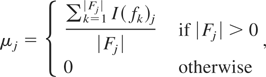
where fk is an instantiated element of set Fj and I(fk)j is its importance. The total importance of the design information produced up to the j-cycle (the j-cycle is included) is defined as
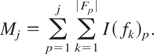
The value of the mean importance is always positive or equal to zero. Therefore, the total importance, when seen as a function, is an increasing one.
The main concern of the DSM-based approaches is the search for circuits in the design graphs to handle design iterations and reviews, the revealing of the information flow during the design work, and the determination of the consequences of a change in any variable on the rest of the variables in the design space (see the extended relevant review in the previous section). However, the present approach focuses explicitly on the exploration of the multiple relations that exist between the two sets of the dependent and nondependent design descriptors (importance, design effort, occurrence, etc.). Then it uses quantified measures of these relations to provide guidance to the designer about how to instantiate his/her independent descriptors during design, always having in mind the generation of information of maximum importance.
3. AN EXAMPLE CASE: DESIGN OF A CONVEYOR FOR UNIT LOAD TRANSPORTATION
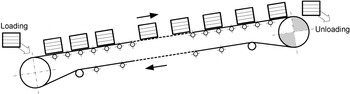
To test the validity of the above analysis, the design of a conveyor for has been considered as an example. The conveyor is straight and inclined, and transports unit loads (see Fig. 5). The design of such a conveyor is considered routine (Dentsoras, 1996), and the associative relationships among the design descriptors are a priori known. In addition, all necessary design knowledge may be derived from textbooks, standards, manufacturers' catalogs, previous design cases, and so forth (Spivakovsky & Dyachkov, 1985; Alles, 1988).

A belt conveyor for the transportation of unit loads.
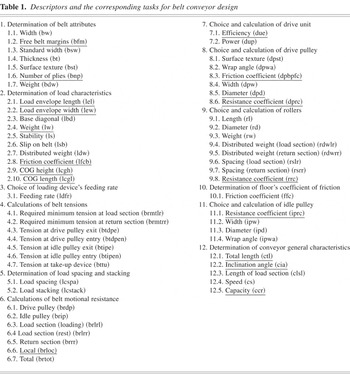
Drakatou and Dentsoras (2001) analyzed the design process for the conveyor in detail in a previous work. For the present design case, 60 design descriptors have been used, grouped into 12 design tasks as it is shown in Table 1. In this table the underlined descriptor names correspond to primary descriptors, while abbreviations are also given for all descriptors (names in parentheses).
Descriptors and the corresponding tasks for belt conveyor design

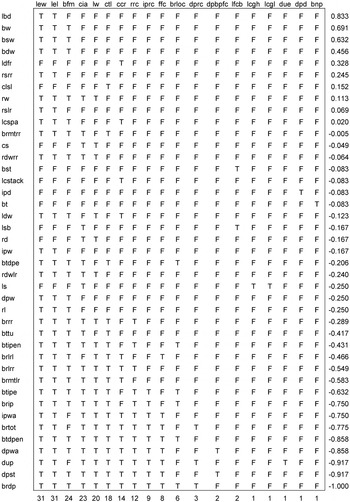
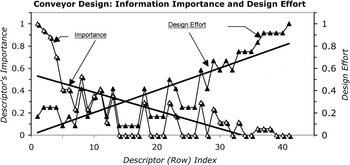
The descriptor set is formed by two separate sets: a set of 19 primary and a set of 41 dependent descriptors. As a result, a (43 × 21) dependency matrix is formed, shown in Figure 6. In this figure, the matrix appears in its final form obtained after a series of successive row and column rearrangements. The relationship between the importance of the dependent descriptors of the current design case and the required design effort versus the row index of this matrix is shown in Figure 7 (compare this figure with Fig. 3). The linear trend lines show that the importance of the dependent descriptor decreases as the row index increases. In the same time, the required design effort increases with the row index. Under the assumption that the order of the suggested primary descriptor list is followed, important information may be produced with the least design effort during the first few design cycles.

The dependency matrix for a belt conveyor design problem.

The belt conveyor design showing the importance of the dependent descriptors and required design effort for their instantiations versus the row index of the dependency matrix.
The aforementioned list is formed by the elements of the first row of the dependency matrix. This means that if the designer accepts the suggested list, he/she should instantiate the primary descriptors as follows:
- load envelope width,
- load envelope length,
- free belt margins,
- conveyor inclination angle,
- load weight,
- conveyor total length,
- conveyor capacity,
- motion resistance coefficient,
- resistance coefficient in the idle pulley,
- friction coefficient between the belt and the support floor,
- local motional resistances,
- resistance coefficient in the drive pulley,
- friction coefficient between the belt and the drive pulley,
- friction coefficient between the belt and the load surface,
- load COG height,
- load COG length,
- drive unit efficiency,
- drive pulley diameter,
- number of belt plies.
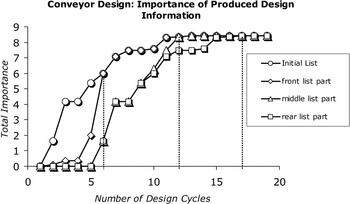
The importance of the produced design information may be related to the number of already completed design cycles. This is shown in Figure 8. In this figure the number of design cycles (x axis) are related with the total importance of the produced design information (y axis). Four distinct series of results are shown. The first one corresponds to the original instantiation list as suggested by the dependency matrix and is shown by a line labeled as “initial list” (see figure). In the second case, it is supposed that the designer modifies the initial list and chooses an instantiation order other than the suggested one. If this modification is allowed for the descriptors belonging to the front part of the initial list, then the result is a second line labeled as “front list part” in the figure. Two more cases produce two corresponding lines (“middle list part” and “rear list part”).

The belt conveyor design showing the total importance of the produced design information versus the number of completed design cycles for various instantiation list configurations.
Among the lines drawn in Figure 8, the line that depicts the calculated importance when the initial list is used is the line of maximum information importance. Any rearrangement of the initial list will produce lines that will always lie “below” or will coincide to some extend with that line (see Fig. 8). This fact can be perceived as a time delay in reaching the line of maximum information importance and the time points where this delay is zeroed is shown by dotted lines in the figure.
Another set of curves corresponding to the aforementioned four cases is shown in Figure 9. These are curves of mean information importance produced per cycle. When the curve corresponding to the first case (initial list) is compared with the curves of the three other cases, it can be easily concluded that the latter present a delay in reaching maximum values (for all cases). For the second case it must be noticed that it never reaches the maximum value obtained in the first case. There is instead a local “peak” occurring during the third cycle. Irrespective of that peak, the delay when compared with the first case is obvious. This delay is more obvious for the other two cases. Actually, no information is produced up to fifth cycle where the peak starts to be formed. Finally, it must be noticed that, for all cases and for the last few design cycles, the mean information importance produced per cycle is almost equal to zero.

The belt conveyor design showing the curves of mean information importance produced per cycle for various instantiation list configurations.
To implement the present design example, an integrated environment was build in Visual Basic 6.0 with the following main characteristics:
- the capability of handling any number of design descriptors together with their definitions (dependent and primary);
- storage of any number of associative relationships among descriptors;
- preservation of the user from redundancies, loops, and so forth, during the relationship definition process;
- the capability of forming the dependency matrix and implementing all necessary rearrangements of its rows and columns;
- storage of integrated design cases and availability of descriptor libraries; and
- production of descriptor lists and files that can be used for graphical representations.
4. CONCLUSIONS
The problems of design knowledge representation and handling are major methodological and practical problems that attract the interest of many researchers from both academia and industry. Within this context, the present paper contributes toward resolving these problems by introducing a simple idea that can be expressed as follows: given an amount of design knowledge for a design problem and a formalism for its representation, there is always an optimum way of handling that knowledge so that the most important design information is produced with the least design effort and relatively early in the design process. This optimum way is always consistent with the associative relationships among the design entities (descriptors), and varies every time a change occurs in these relationships.
The necessity for producing information of high importance early in the design process seems to be obvious for those that perceive design as a process that is characterized by repetitive decision-making steps. The designer can always make better decisions concerning the design route to be followed if design information of high importance is available. The current work is a contribution toward this direction.
The present approach is actually an analysis of the design knowledge in terms of information importance, design effort, and descriptor instantiations. The analysis is based on a mathematical, problem-independent approach of design, and uses extensive search of the design space. Because it explores every least piece of design information, it always ensures that all of the available design knowledge is always taken into account. In addition, the paper attempts the introduction of some terms that could contribute toward a better understanding in the field of design metrics.
From both practical and methodological points of view, the dependency matrix contains the necessary information (instantiation list, importance, effort, etc.) that can be easily extracted and further used for the benefit of the design process. This information may also form a basis for building assisting tools for the designer that could be used in every design problem, and especially for the cases of large design problems when large number of descriptors are involved, the importance of the design descriptors is not a priori visible, and the required effort for their instantiations cannot be easily measured.
Within the scope of the present work and to evaluate the analysis results, an integrated environment was build. Multiple design applications were created and then repeatedly tested in this environment. In all cases, priority lists were formed that gave primary descriptor ordering compatible with the current design practice for the considered design cases.
For most of the design cases and especially when large-scale problems occur, it is not always obvious which are the most appropriate primary descriptors to start the instantiation process from them. In such a case, the present approach could be proven to be valuable, because it is only based upon the existing associative relationships and it can produce, with low computational cost, unique instantiation lists. Additionally, it can automatically update these lists in case of any change in the aforementioned relationships and/or the set of descriptors. This fact makes the proposed approach also effective in the case of creative design where there is always the need for continuous exploration of the design space and for the detection of any change in its structure.
The present work may be easily extended to host and handle additional information for every descriptor participating in a design. This information could express the personal belief, experience, and preference of the designer on the importance of the descriptor and could also provide an additional qualitative measure on the required effort for its instantiation. It is expected that the combination of the mathematical, problem-independent approach of design analyzed in the present work and the handling of the aforementioned additional information will provide a more realistic approach of the design process. This work is currently under elaboration, and its results are expected in the very near future.
References
REFERENCES
Alles, R.
(1988).
Conveyor Belt System Design.
Hanover, Germany:
Continental Aktiengesellschaft Publishers.
Austin, S.,
Baldwin, A., &
Newton, A.
(1994).
Manipulating the flow of design information to improve the
programming of building design.
Construction Management & Economics 12(5),
445–455.CrossRefGoogle Scholar
Black, T.A.,
Fine, C.H., &
Sachs, E.M.
(1990).
A Method for Systems Design Using Precedence Relationships: An
Application to Automotive Brake Systems.
Working Paper No. 3208. Cambridge, MA:
MIT Sloan School of Management.
Browning, T.R.
(2001).
Applying the design structure matrix to system decomposition and
integration problems: a review and new directions.
IEEE Transactions on Engineering Management 48(3),
292–306.CrossRefGoogle Scholar
Dentsoras, A.J.
(1996).
An Approach of routine design based on extensive design space
search.
Proc. IITT Int. Conf. EXPERSYS-96.
Drakatou, S. &
Dentsoras, A.J.
(2001).
A method for the automatic deduction of priority lists of entities
and tasks from the design knowledge.
Artificial Intelligence for Engineering Design, Analysis and
Manufacturing,
15(3),
223–232.CrossRefGoogle Scholar
Duffey, M.R. &
Dixon, J.R.
(1990).
A program of research in mechanical design: computer-based models
and representations.
Mechanical Machine Theory 25(3),
383–395.CrossRefGoogle Scholar
Eppinger, S.D.
(1991).
Model-based approaches to managing concurrent engineering.
Journal of Engineering Design 2,
283–290.CrossRefGoogle Scholar
Franceschini, F. &
Rossetto, S.
(2002).
QFD: an interactive algorithm for the prioritization of
product's technical design characteristics.
Integrated Manufacturing Systems 13(1),
69–75.CrossRefGoogle Scholar
Kusiak, A. &
Larson, N.
(1995).
Decomposition and representation methods in mechanical
design.
ASME Transactions: Journal of Mechanical Design 117(3),
17–24.CrossRefGoogle Scholar
Kusiak, A. &
Park, K.
(1990).
Concurrent engineering: decomposition and scheduling of design
activities.
International Journal of Production Research 28(10),
1883–1900CrossRefGoogle Scholar
Kusiak, A. &
Wang, J.
(1993).
Decomposition of the design process.
Journal of Mechanical Design 115,
687–695.CrossRefGoogle Scholar
Lee, C.-H.,
Sause, & R.,
Hong N.K.
(1998).
Overview of entity-based integrated design product and process
models.
Advances in Engineering Software 29(10),
809–823.CrossRefGoogle Scholar
Lu, S.C.-Y. &
Tcheng, D.K.
(1991).
Building layered models to support engineering decision making: a
machine learning approach.
Journal of Engineering for Industry 113(1),
1–9.CrossRefGoogle Scholar
MacCallum, K.J. &
Duffy, A.
(1987).
An expert system for preliminary numerical design modeling.
Design Studies 8(4),
231–237.CrossRefGoogle Scholar
Shaalan, K.,
Rafea, M., &
Rafea, A.
(1998).
KROL, a knowledge representation object language on top of
Prolog.
Expert Systems With Applications 15(1),
33–46.CrossRefGoogle Scholar
Shooter, S.B.,
Keirouz, W.T.,
Szykman, S., &
Fenves, S.J.
(2000).
A model for the flow of design information in product
development.
Engineering with Computers 16,
178–194.CrossRefGoogle Scholar
Sim, S.K. &
Duffy, A.H.B.
(1998).
A foundation for machine learning in design.
Artificial Intelligence for Engineering Design, Analysis and
Manufacturing 12,
193–209.CrossRefGoogle Scholar
Smith, R.P. &
Eppinger, S.D.
(1997).
Identifying controlling features of engineering design
iteration.
Management Science 43(3),
276–293.CrossRefGoogle Scholar
Spivakovsky, A. &
Dyachkov, V.
(1985).
Conveying Machines.
Moscow:
Mir Publ.
Steward, D.V.
(1981).
The design structure system: a method for managing the design of
complex systems.
IEEE Transactions on Engineering Management 28,
71–74.CrossRefGoogle Scholar
Suh, N.P.
(1990).
The Principles of Design.
Oxford Series in Advanced Manufacturing.
New York:
Oxford University Press.
Tsalidis, S.S. &
Dentsoras, A.J.
(1997).
Application of design parameters space search for belt conveyor
design.
Engineering Application of Artificial Intelligence 10(6),
617–629.CrossRefGoogle Scholar
Warfield, J.N.
(1973).
Binary matrices in system modeling.
IEEE Transactions on Systems, Man, and Cybernetics 3,
441–449.CrossRefGoogle Scholar
Yagiu, T.
(1989).
A predicate—logical method for modeling design objects.
Artificial Intelligence in Engineering 4(1),
41–53.CrossRefGoogle Scholar
Yassine, A.,
Falkenburg, D., &
Chelst, K.
(1999).
Engineering design management: an information structure
approach.
International Journal of Production Research 37(13),
2957–2975.CrossRefGoogle Scholar
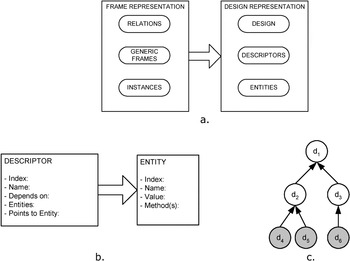
Representations of design knowledge: (a) decomposition through frames and frame relations, (b) typical frames for entities and descriptors, and (c) primary and dependent descriptors.
An example of a design problem digraph. The importance value is given in every node. The underlined values in the primary descriptor nodes correspond to the total number of dependent descriptors whose instantiation depends upon this primary descriptor.
The importance of the dependent descriptors and the required design effort for their instantiations as a result of matrix rearrangement.
The dependency matrix for the design problem in Figure 2.
A belt conveyor for the transportation of unit loads.
Descriptors and the corresponding tasks for belt conveyor design
The dependency matrix for a belt conveyor design problem.
The belt conveyor design showing the importance of the dependent descriptors and required design effort for their instantiations versus the row index of the dependency matrix.
The belt conveyor design showing the total importance of the produced design information versus the number of completed design cycles for various instantiation list configurations.
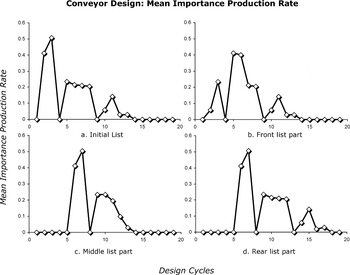
The belt conveyor design showing the curves of mean information importance produced per cycle for various instantiation list configurations.
 You have
Access
- 8
- Cited by