INTRODUCTION
Due to the geographical and hydrographical characteristics of the Sea of Marmara, it represents a peculiar ecosystem as it is a transitional zone between the Mediterranean and the Black Sea (Öztürk, Reference Öztürk, Leppäkoski, Gollasch and Olenin2002). The Sea of Marmara plays a significant and decisive ecological role in the dispersal of living organisms, since it constitutes a barrier, a corridor or an acclimatization zone for marine creatures (Öztürk & Öztürk, Reference Öztürk and Öztürk1996), and thus, it can be defined as an ‘ecological gateway.’ Among the marine fishes that travel through this ecological gateway, several shark species are also included.
Pioneering ichthyological studies on the Sea of Marmara date back to the 1910s (Kocataş et al., Reference Kocataş, Koray, Kaya and Kara1993). Due to the estuarine-like characteristics of this land-locked marine area (Kocataş et al., Reference Kocataş, Koray, Kaya and Kara1993), the Sea of Marmara has a unique fish fauna. Rhasis Erazi (Reference Rhasis Erazi1942) recorded 181 fish species in the Sea of Marmara, and following this mid-20th Century study, Kocataş et al. (Reference Kocataş, Koray, Kaya and Kara1993) recorded 168 fish species from the same region, mostly based on previous studies. According to a recent ichthyological list (Keskin & Eryılmaz, Reference Keskin, Eryılmaz and Öztürk2010), the fish fauna of the Sea of Marmara comprises 235 species. The common aspect shared by the historical and contemporary ichthyological lists of the Sea of Marmara is their low numbers of shark species. In a recent study, based on previous ichthyological collections, Kabasakal (Reference Kabasakal2003a) recorded 20 species of sharks either with questionable or confirmed occurrence in the Sea of Marmara. Following this sub-study of the KANIT project, which started in 2000 and aims to clarify the current status of sharks occurring in Turkish waters as an initiative of the Ichthyological Research Society (IRS), a non-governmental and non-profit institution dedicated to the research of sharks, the senior author, H. Kabasakal, continued observations in the main fishing ports around the Sea of Marmara, together with the examination of fishing records and popular media, to obtain data on contemporary shark catches from Marmaric waters. In light of the data obtained over the last ten years, our understanding of the shark fauna of the aforementioned marine region has significantly increased. Therefore, the aim of the present review is to provide an update on the status of the contemporary sharks of the Sea of Marmara, based on the available literature.
MATERIALS AND METHODS
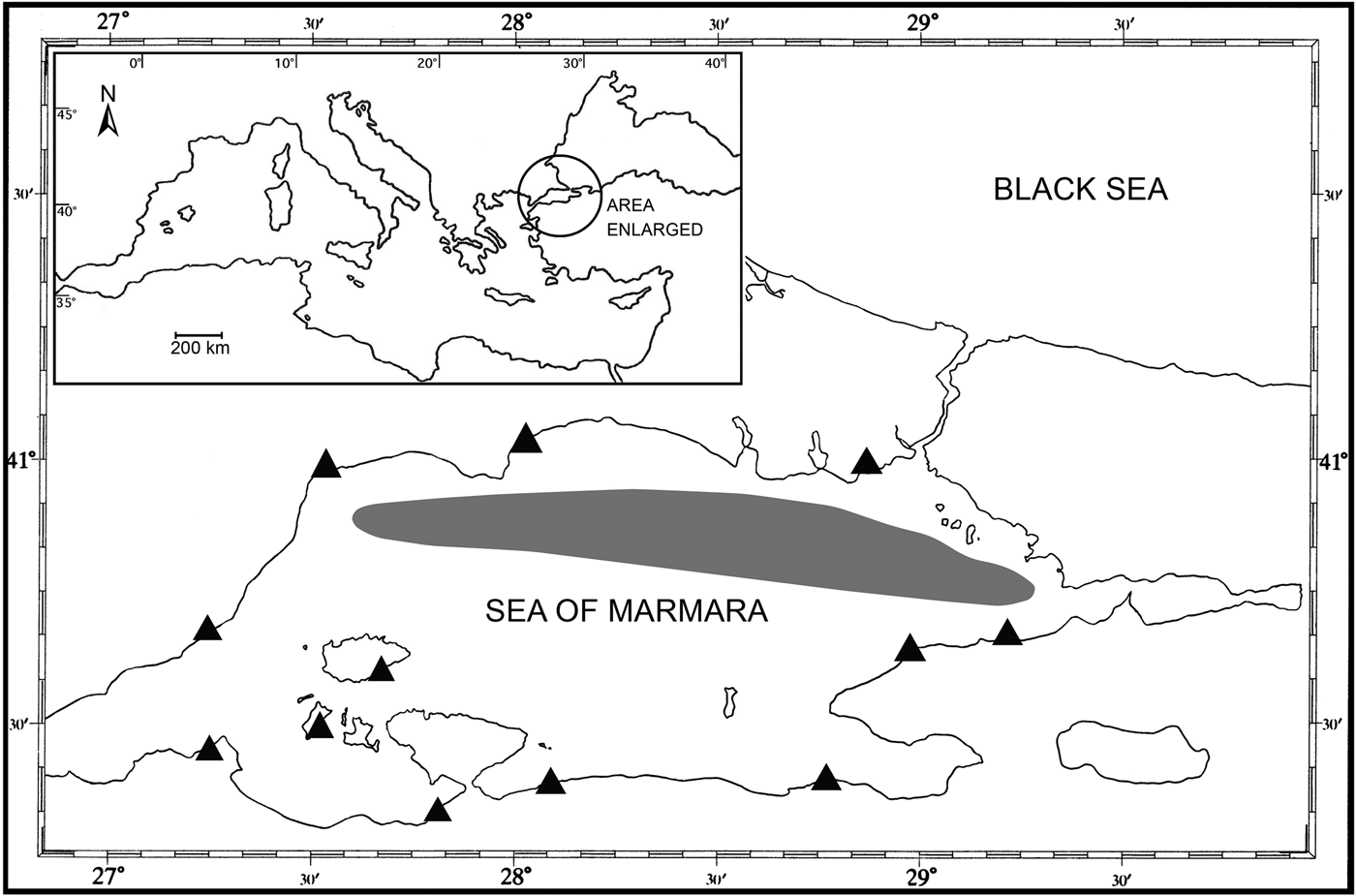
The data used for the present review was obtained through an extensive literature review, which included previous checklists, individual species accounts as well as journalistic documentation. Additional data, accompanied by photographic documentation, were obtained from fishermen in several fishing ports around the Marmaric coastline (Figure 1). Encounters with sharks were also taken into account, if the incident was verified by photographic documentation. For chondrichthyan taxonomy and nomenclature, we followed Serena (Reference Serena2005). IUCN criterion of each species is based on Cavanagh & Gibson (Reference Cavanagh and Gibson2007) and presented in Table 1. The examined material has been stored in the archives of IRS and is available for inspection on request.
Map of the Sea of Marmara and its location in the Mediterranean basin. (▲) denotes the locality of fishing ports along the Marmaric coast where the sharks landed and were examined during the present study. The grey shaded area denotes the approximate location of the Marmaric trench where the majority of the captures of deep-sea sharks occurred.

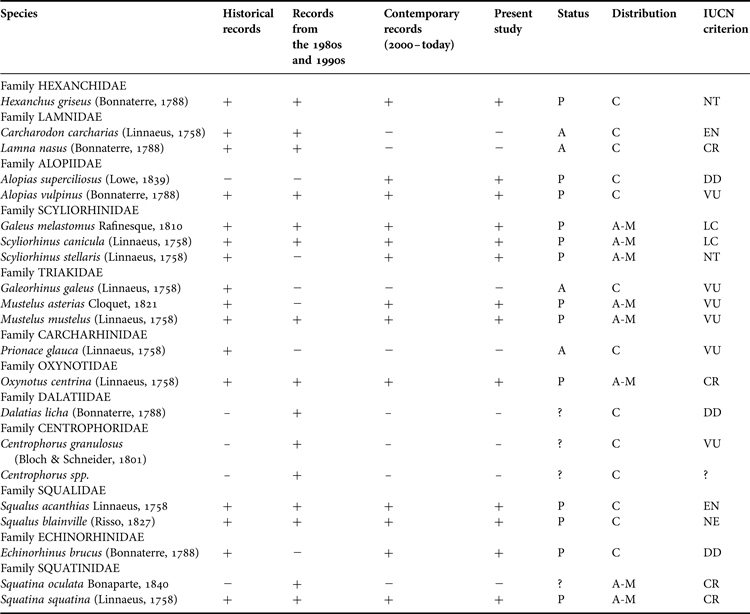
Historical and contemporary records of shark species in the Sea of Marmara and their current status of occurrence. P, present; A, absent; ?, questionable; A-M, Atlanto-Mediterranean; C, cosmopolitan; VU, vulnerable; EN, endangered; NE, not evaluated; DD, data deficient; CR, critically endangered; NT, near threatened; LC, least concern.
RESULTS AND DISCUSSION
Historical notes
The oldest records on the sharks of the Sea of Marmara are limited to a few notes on two great white sharks, Carcharodon carcharias (Linnaeus, 1758), which were caught in the southern part of the Bosphorus Strait by the bluefin tuna (Thunnus thynnus) handliners in February and November of 1881 (Fergusson, Reference Fergusson, Klimley and Ainley1996: Appendix 3, 345). Following these late 19th Century incidents, the Italian ichthyologist Emilio Ninni, who carried out fisheries surveys on board the R/V L.F. Marsigli in the waters of the fallen Ottoman Empire between 1921 and 1922, recorded 13 shark species in Marmaric waters (Ninni, Reference Ninni1923). At the same time, former Ottoman ichthyologist Karakin Deveciyan published his monumentary book on the fishes and fishery of Turkey's waters, predominately based on the fish species that were sold in the Istanbul fish markets, which included 12 Marmaric sharks (Deveciyan, Reference Deveciyan1926). Seven years later, Ayaşlı (Reference Ayaşlı1937) published a detailed report on the fishes of Bosphorus Strait and mentioned the presence of great white shark and cat shark of Scyliorhinus spp. in the prebosphoric region of the Sea of Marmara. Finally, Rhasis Erazi (Reference Rhasis Erazi1942) recorded 181 fish species in this small land-locked sea, which included seven species of sharks.
Contemporary status of Marmaric sharks
A review of the shark-specific or general ichthyology studies of the Sea of Marmara, including daily newspapers that had been published since the beginning of 1900s and provided information on the capture of sharks in Marmaric waters, revealed the historical and contemporary occurrence of 21 shark species in the Sea of Marmara (Table 1). The contemporary occurrence of 13 of the 21 species in the Sea of Marmara is confirmed by recent studies or fishery records; however, due to an absence in any recent surveys or fishery records, eight species are categorized as questionable or absent (Table 1). The status of Marmaric sharks, based on current knowledge, is sumarized in the following.
Family HEXANCHIDAE
Hexanchus griseus (Bonnaterre, 1788).
MATERIAL
Ninni (Reference Ninni1923), Deveciyan (Reference Deveciyan1926), Meriç (Reference Meriç1995), Kabasakal (Reference Kabasakal1998, Reference Kabasakal2009, Reference Kabasakal2013). Teeth samples from lower jaws of several specimens, as well as specimen photographs, are preserved in the collection of IRS, without catalogue numbers.
REMARKS
Although the historical records of the bluntnose sixgill shark, Hexanchus griseus, in the Sea of Marmara date back to the 1920s (Ninni, Reference Ninni1923; Deveciyan, Reference Deveciyan1926), there is a remarkable gap in the specimen records from the 1990s onwards, despite some anecdotal news on the capture of large sixgill sharks in the Sea of Marmara in the 1960s and 70s (Kabasakal, Reference Kabasakal2013). In a late 1990s ichththyological inventory study of Turkey's marine fishes, Mater & Meriç (Reference Mater, Meriç, Kence and Bilgin1996) pointed out the absence of H. griseus in the Sea of Marmara; however, the reoccurrence of the species in Marmaric waters was confirmed following the studies by Kabasakal (Reference Kabasakal1998, Reference Kabasakal2009) and Meriç (Reference Meriç1995). In the Sixgill Shark Data Bank (SSDB) of Turkey, which includes the records of 150 specimens of H. griseus captured in Turkish waters (Kabasakal, Reference Kabasakal2013), 60% of these specimens (90 individuals) were captured in the Sea of Marmara between 1967 and 2013. Thus, H. griseus is one of the large elasmobranchs that has a confirmed contemporary occurrence in the Sea of Marmara.
Family LAMNIDAE
Carcharodon carcharias (Linnaeus, 1758).
MATERIAL
Ninni (Reference Ninni1923), Deveciyan (Reference Deveciyan1926), Fergusson (Reference Fergusson, Klimley and Ainley1996), Kabasakal (Reference Kabasakal2003b, Reference Kabasakal2008, Reference Kabasakal2011a, Reference Kabasakal2014). Several photographs and newspaper accounts of historically recorded Carcharodon carcharias specimens are preserved in IRS archives.
REMARKS
According to Fergusson (Reference Fergusson, Klimley and Ainley1996) and Kabasakal (Reference Kabasakal2003b, Reference Kabasakal2008, Reference Kabasakal2011a, Reference Kabasakal2014), 32 specimens of Carcharodon carcharias have been incidentally captured by tuna handliners in the Sea of Marmara, mostly in prebosphoric and bosphoric waters, between 1881 and 1985. Kabasakal (Reference Kabasakal2003b) emphasized the link between the tuna fishery and the occurrence of great white sharks in the Sea of Marmara. Following the collapse of tuna fishery in this sea in the mid 1980s, no specimen of C. carcharias has been recorded in the area (Kabasakal, Reference Kabasakal2003b, Reference Kabasakal2014). Furthermore, C. carcharias has not been recorded in any of the recent studies, nor in the fisheries records of the last 30 years, and thus, the authors concluded that it is apparently absent in Marmaric waters.
Lamna nasus (Bonnaterre, 1788).
MATERIAL
Ninni (Reference Ninni1923), Deveciyan (Reference Deveciyan1926), Akşıray (Reference Akşıray1987), Mater & Meriç (Reference Mater, Meriç, Kence and Bilgin1996).
REMARKS
Following the historical records of the porbeagle shark, Lamna nasus, in the Sea of Marmara by Ninni (Reference Ninni1923) and Deveciyan (Reference Deveciyan1926), Akşıray (Reference Akşıray1987) has also continued to account for this species in the fish fauna of the region. Moreover, in a recent list of marine fishes from the seas of Turkey, Mater & Meriç (Reference Mater, Meriç, Kence and Bilgin1996) also mentioned the species as a member of the fish fauna of the Sea of Marmara. Besides these early records of L. nasus in Marmaric waters, neither Akşıray (Reference Akşıray1987) nor Mater & Meriç (Reference Mater, Meriç, Kence and Bilgin1996) provided any information on the specimens they might have examined or where the specimens may have been caught and preserved. Since the porbeagle shark is not mentioned in one of the most extensive ichthyological inventories of the Sea of Marmara (Rhasis Erazi, Reference Rhasis Erazi1942), these late 20th Century records of L. nasus in the Sea of Marmara are probably based on historical records by Ninni (Reference Ninni1923) and Deveciyan (Reference Deveciyan1926). The absence of L. nasus in recent fisheries records, as well as during the surveys of the present study, necessitates a clarification of its status in the Sea of Marmara. For the moment, L. nasus appears to be absent in Marmaric waters.
Family ALOPIIDAE
Alopias superciliosus (Lowe, 1839).
MATERIAL
Kabasakal (Reference Kabasakal2007), Kabasakal & Karhan (Reference Kabasakal and Karhan2007), Kabasakal et al. (Reference Kabasakal, Dalyan and Yurtsever2011). The jaws of an individual (female, 450 cm total length (TL); details provided by Kabasakal & Karhan, Reference Kabasakal and Karhan2007) are preserved in the collection of IRS without a catalogue number.
REMARKS
The first record of the bigeye thresher shark, Alopias superciliosus, in the Sea of Marmara is based on the capture of a female off the northern coast in 2007 (Kabasakal & Karhan, Reference Kabasakal and Karhan2007). Subsequent to this record, a second female had been entrapped in a commercial purse-seiner in the northern Sea of Marmara in 2011 (Kabasakal et al., Reference Kabasakal, Dalyan and Yurtsever2011). The contemporary occurrence of A. superciliosus in Marmaric waters is confirmed by recent fishery records and surveys (Kabasakal, Reference Kabasakal2007; Kabasakal & Karhan, Reference Kabasakal and Karhan2007; Kabasakal et al., Reference Kabasakal, Dalyan and Yurtsever2011).
Alopias vulpinus (Bonnaterre, 1788).
MATERIAL
Ninni (Reference Ninni1923), Deveciyan (Reference Deveciyan1926), Akşıray (Reference Akşıray1987), Mater & Meriç (Reference Mater, Meriç, Kence and Bilgin1996), Kabasakal (Reference Kabasakal2007, Reference Kabasakal2011b).
REMARKS
In contrast to the recent occurrence of the bigeye thresher shark in the Sea of Marmara, historical records of the common thresher shark, Alopias vulpinus, in Marmaric waters date back to the early 1920s (Ninni, Reference Ninni1923; Deveciyan, Reference Deveciyan1926; Akşıray, Reference Akşıray1987; Mater & Meriç, Reference Mater, Meriç, Kence and Bilgin1996). Recent fishery records and surveys (Kabasakal, Reference Kabasakal2007, Reference Kabasakal2011b) confirm the contemporary occurrence of A. vulpinus in the Sea of Marmara.
Family SCYLIORHINIDAE
Galeus melastomus Rafinesque, 1810.
MATERIAL
Meriç (Reference Meriç1995), Uysal et al. (Reference Uysal, Yüksek and Okuş1996), Kabasakal (Reference Kabasakal2003a), Oral (Reference Oral and Öztürk2010).
REMARKS
The blackmouth catshark, Galeus melastomus, considered by several authors as rare in the bathyal grounds of the northern slope of the Sea of Marmara (Meriç, Reference Meriç1995; Uysal et al., Reference Uysal, Yüksek and Okuş1996; Kabasakal, Reference Kabasakal2003a), was recorded in very few numbers in Marmaric waters during the present study. In a recent study, Oral (Reference Oral and Öztürk2010) recorded G. melastomus during bottom trawl collections at depths between 1024 and 1213 m in the north-western part of the Sea of Marmara and presented some data on the stomach contents of the examined specimens. An extensive survey is required to clarify the status of G. melastomus occurrence in the Marmaric bathyal grounds. Available data confirms the rarity of the species in the Sea of Marmara.
Scyliorhinus canicula (Linnaeus, 1758).
MATERIAL
Deveciyan (Reference Deveciyan1926), Ayaşlı (Reference Ayaşlı1937), Rhasis Erazi (Reference Rhasis Erazi1942), Kocataş et al. (Reference Kocataş, Koray, Kaya and Kara1993), Meriç (Reference Meriç1995), Okuş et al. (Reference Okuş, Uysal and Yüksek1996), Kabasakal (Reference Kabasakal2003a), Karakulak et al. (Reference Karakulak, Tarkan, Öztürk, Öztürk, Kadıoğlu and Öztürk2000), Keskin & Eryılmaz (Reference Keskin, Eryılmaz and Öztürk2010), Altuğ et al. (Reference Fergusson, Klimley and Ainley2011).
REMARKS
Occurrence of the smallspotted catshark, Scyliorhinus canicula, in the Sea of Marmara has been recorded both in historical and previous studies (Deveciyan, Reference Deveciyan1926; Ayaşlı, Reference Ayaşlı1937; Rhasis Erazi, Reference Rhasis Erazi1942; Kocataş et al., Reference Kocataş, Koray, Kaya and Kara1993; Meriç, Reference Meriç1995; Okuş et al., Reference Okuş, Uysal and Yüksek1996; Kabasakal, Reference Kabasakal2003a). During the present study, several juvenile and adult specimens of S. canicula entangled in bottom-set nets were observed in south-western parts of the Sea of Marmara, where the rich growth of gorgonians and black corals form a suitable spawning ground for the species (Kabasakal, Reference Kabasakal2003a). In our archive of landings, the latest recorded capture of this species from Marmaric waters is of six specimens trawled off the coast of Avşa Island (south-western Sea of Marmara) in October 2011. In addition to present study, S. canicula has been recorded in recent ichthyological surveys on Marmaric fish fauna (Karakulak et al., Reference Karakulak, Tarkan, Öztürk, Öztürk, Kadıoğlu and Öztürk2000; Keskin & Eryılmaz, Reference Keskin, Eryılmaz and Öztürk2010; Altuğ et al., Reference Altuğ, Aktan, Oral, Topaloğlu, Dede, Keskin, İşinibilir, Çardak and Çiftçi2011).
Scyliorhinus stellaris (Linnaeus, 1758).
MATERIAL
Ninni (Reference Ninni1923), Kocataş et al. (Reference Kocataş, Koray, Kaya and Kara1993), Kabasakal (Reference Kabasakal2003a), Bayhan et al. (Reference Bayhan, Çiçek, Ünlüer and Akkaya2006).
REMARKS
The nursehound, Scyliorhinus stellaris, has been known in the Sea of Marmara since the pioneering study by Ninni (Reference Ninni1923), and its occurrence in the region has also been mentioned by Kocataş et al. (Reference Kocataş, Koray, Kaya and Kara1993) and Kabasakal (Reference Kabasakal2003a). However, in a recent survey, only three specimens were recorded in this region (Bayhan et al., Reference Bayhan, Çiçek, Ünlüer and Akkaya2006). Scyliorhinus stellaris is a rare scyliorhinid shark in the Sea of Marmara and this rarity is also emphasized by Keskin & Eryılmaz (Reference Keskin, Eryılmaz and Öztürk2010).
Family CARCHARHINIDAE
Prionace glauca (Linnaeus, 1758).
MATERIAL
Ninni (Reference Ninni1923), Deveciyan (Reference Deveciyan1926).
REMARKS
Since the Marmaric occurrence of the blue shark, Prionace glauca, is mentioned only in the historical records (Ninni, Reference Ninni1923; Deveciyan, Reference Deveciyan1926), and the species has not been recorded in the recent ichthyological surveys carried out in the Sea of Marmara (Keskin & Eryılmaz, Reference Keskin, Eryılmaz and Öztürk2010; Altuğ et al., Reference Altuğ, Aktan, Oral, Topaloğlu, Dede, Keskin, İşinibilir, Çardak and Çiftçi2011), nor in the present study, the authors concluded that P. glauca appears to be absent in this marine region.
Family TRIAKIDAE
Galeorhinus galeus (Linnaeus, 1758).
MATERIAL
Ninni (Reference Ninni1923), Deveciyan (Reference Deveciyan1926).
REMARKS
According to Kabasakal (Reference Kabasakal2003a), Galeorhinus galeus, is a questionable shark species of the Sea of Marmara, and the data on its Marmaric occurrence is based on the historical records by Ninni (Reference Ninni1923) and Deveciyan (Reference Deveciyan1926). Since G. galeus has not been recorded in the ichthyological list of the Sea of Marmara published in the 1940s (Rhasis Erazi, Reference Rhasis Erazi1942), as well as the absence of this species in previous (Kocataş et al., Reference Kocataş, Koray, Kaya and Kara1993) or recent (Karakulak et al., Reference Karakulak, Tarkan, Öztürk, Öztürk, Kadıoğlu and Öztürk2000; Bayhan et al., Reference Bayhan, Çiçek, Ünlüer and Akkaya2006; Keskin & Eryılmaz, Reference Keskin, Eryılmaz and Öztürk2010; Altuğ et al., Reference Altuğ, Aktan, Oral, Topaloğlu, Dede, Keskin, İşinibilir, Çardak and Çiftçi2011; Bök et al., Reference Bök, Göktürk and Kahraman2011; Cengiz et al., Reference Cengiz, Öztekin and Özekinci2012) ichthyological surveys, the authors concluded that G. galeus appears to be absent in the Sea of Marmara.
Mustelus asterias Cloquet, 1821.
MATERIAL
Meriç (Reference Meriç1995), Kabasakal (Reference Kabasakal2003a), Bök et al. (Reference Bök, Göktürk and Kahraman2011).
REMARKS
The starry smoothhound, Mustelus asterias, has been recorded for the first time over the northern slope of the Sea of Marmara (Meriç, Reference Meriç1995). Kabasakal (Reference Kabasakal2003a) reported on the capture of a pregnant female at a depth of 100 m off the northern coast of Marmara Island (south-western Sea of Marmara). A recent study extends the range of its Mediterranean distribution to the Black Sea (Eryılmaz et al., Reference Eryılmaz, Yemişken and Dalyan2011). In our archive of landings, the latest recorded capture of Mustelus asterias from the area is of a single specimen trawled off Şarköy (north-western Sea of Marmara) in October 2011. Compared to its congeneric species, Mustelus mustelus, the starry smoothhound is quite rare in Marmaric waters (Kabasakal, Reference Kabasakal2003a). Recently, Bök et al. (Reference Bök, Göktürk and Kahraman2011) recorded Mustelus asterias during bottom trawl haulings between the depths of 50 and 100 m in the northern Sea of Marmara.
Mustelus mustelus (Linnaeus, 1758).
MATERIAL
Deveciyan (Reference Deveciyan1926), Rhasis Erazi (Reference Rhasis Erazi1942), Meriç (Reference Meriç1995), Okuş et al. (Reference Okuş, Uysal and Yüksek1996), Kabasakal (Reference Kabasakal2003a), Bayhan et al. (Reference Bayhan, Çiçek, Ünlüer and Akkaya2006), Cengiz et al. (Reference Cengiz, Öztekin and Özekinci2012).
REMARKS
Common smoothhound, Mustelus mustelus, is a well-known shark species of the family Triakidae, occurring in the Sea of Marmara. Historical records of the species are based on the reports by Deveciyan (Reference Deveciyan1926) and Rhasis Erazi (Reference Rhasis Erazi1942). According to Okuş et al. (Reference Okuş, Uysal and Yüksek1996), M. mustelus is an abundant shark species in the south-western Sea of Marmara; however, Meriç (Reference Meriç1995) and Kabasakal (Reference Kabasakal2003a) also recorded the species in northern Marmaric waters. Thus, the distribution of M. mustelus in the Sea of Marmara covers the entire region. Several records of M. mustelus in recent ichthyological surveys of the Sea of Marmara (Bayhan et al., Reference Bayhan, Çiçek, Ünlüer and Akkaya2006; Cengiz et al., Reference Cengiz, Öztekin and Özekinci2012) confirm its occurrence in Marmaric waters. In our archive of landings, the latest recorded capture of this species from the area is that of three specimens trawled off the coast of Şarköy in October 2011.
Family OXYNOTIDAE
Oxynotus centrina (Linnaeus, 1758).
MATERIAL
Rhasis Erazi (Reference Rhasis Erazi1942), Karakulak et al. (Reference Karakulak, Tarkan, Öztürk, Öztürk, Kadıoğlu and Öztürk2000), Kabasakal (Reference Kabasakal2003a, Reference Kabasakal2010), Bayhan et al. (Reference Bayhan, Çiçek, Ünlüer and Akkaya2006), Keskin & Eryılmaz (Reference Keskin, Eryılmaz and Öztürk2010), Altuğ et al. (Reference Altuğ, Aktan, Oral, Topaloğlu, Dede, Keskin, İşinibilir, Çardak and Çiftçi2011).
REMARKS
The first record of the angular rough shark, Oxynotus centrina, in the Sea of Marmara, was reported by Rhasis Erazi (1942; as Squalus centrina). Following this historical record, Kabasakal (Reference Kabasakal2003a, Reference Kabasakal2010) reported on the capture of several specimens in the north-eastern Sea of Marmara, underlining more than 50 years of absence of O. centrina in the ichthyological lists of the aforementioned marine area. Additionally, very few specimens of O. centrina have been recorded in the recent studies (Karakulak et al., Reference Karakulak, Tarkan, Öztürk, Öztürk, Kadıoğlu and Öztürk2000; Keskin & Eryılmaz, Reference Keskin, Eryılmaz and Öztürk2010; Altuğ et al., Reference Altuğ, Aktan, Oral, Topaloğlu, Dede, Keskin, İşinibilir, Çardak and Çiftçi2011). During the field surveys of the present study, two specimens were observed during SCUBA dives off Prince's Islands (north-eastern Sea of Marmara) in 2009. An additional record of a single specimen trawled off Avşa Island in October 2011 is also available in our archieve of landings. According to Kabasakal (Reference Kabasakal2009), O. centrina can occur in the shoals around Prince's Islands; however, possible causes of the shallow water occurrence of this deep-sea shark is still unknown. Bayhan et al. (Reference Bayhan, Çiçek, Ünlüer and Akkaya2006) consider O. centrina as a vulnerable bycatch species of the bottom fisheries operating in the Sea of Marmara.
Family DALATIIDAE
Dalatias licha (Bonnaterre, 1788).
MATERIAL
Meriç (Reference Meriç1995).
REMARKS
The occurrence of the kitefin shark, Dalatias licha, is based on a single specimen captured in 1991 in the slope waters of the northern Sea of Marmara (Meriç, Reference Meriç1995). Since the kitefin shark has not been recorded in the last 20 years’ fishing records, and not in the recent ichthyological studies (Bayhan et al., Reference Bayhan, Çiçek, Ünlüer and Akkaya2006; Keskin & Eryılmaz, Reference Keskin, Eryılmaz and Öztürk2010; Altuğ et al., Reference Altuğ, Aktan, Oral, Topaloğlu, Dede, Keskin, İşinibilir, Çardak and Çiftçi2011; Bök et al., Reference Bök, Göktürk and Kahraman2011; Cengiz et al., Reference Cengiz, Öztekin and Özekinci2012), the authors concluded that the Marmaric occurrence of D. licha is questionable and requires confirmation.
Family CENTROPHORIDAE
Centrophorus granulosus (Bloch & Schneider, 1801).
MATERIAL
Benli et al. (Reference Benli, Cihangir and Bizsel1993), Meriç (Reference Meriç1995).
REMARKS
Following the first record of the gulper shark, Centrophorus granulosus, in the Sea of Marmara (Benli et al., Reference Benli, Cihangir and Bizsel1993), Meriç (Reference Meriç1995) recorded the species in a gill-net fishery at depths between 120 and 350 m in the northern parts of the sea. Kabasakal's (Reference Kabasakal2003a) record of Centrophorus granulosus in Marmaric waters is based on the records of Benli et al. (Reference Benli, Cihangir and Bizsel1993) and Meriç (Reference Meriç1995). Centrophorus granulosus was not recorded in the recent ichthyological surveys of the Sea of Marmara (Bayhan et al., Reference Bayhan, Çiçek, Ünlüer and Akkaya2006; Keskin & Eryılmaz, Reference Keskin, Eryılmaz and Öztürk2010; Altuğ et al., Reference Altuğ, Aktan, Oral, Topaloğlu, Dede, Keskin, İşinibilir, Çardak and Çiftçi2011; Bök et al., Reference Bök, Göktürk and Kahraman2011; Cengiz et al., Reference Cengiz, Öztekin and Özekinci2012). Furthermore, the taxonomic status of Centrophorus granulosus is also questionable, since White et al. (Reference White, Ebert, Naylor, Ho, Clerkin, Veríssimo and Cotton2013) considers C. granulosus to be a junior synonym of Centrophorus acus Garman (1906) and Centrophorus niaukang Teng (1959). Therefore, the contemporary occurrence and taxonomic status of Centrophorus granulosus in this region should be confirmed.
Centrohorus spp.
MATERIAL
Meriç (Reference Meriç1995).
REMARKS
Meriç (Reference Meriç1995) reported on the congeneric little gulper shark, Centrohorus uyato (Rafinesque, 1810) in the Sea of Marmara, based on the capture of two specimens in a gill-net fishery in northern Marmaric waters. These two specimens of Centrohorus uyato are the first and only records of the species in the Sea of Marmara. Centrohorus uyato was not recorded in any of the recent ichthyological surveys of the Sea of Marmara (Bayhan et al., Reference Bayhan, Çiçek, Ünlüer and Akkaya2006; Keskin & Eryılmaz, Reference Keskin, Eryılmaz and Öztürk2010; Altuğ et al., Reference Altuğ, Aktan, Oral, Topaloğlu, Dede, Keskin, İşinibilir, Çardak and Çiftçi2011; Bök et al., Reference Bök, Göktürk and Kahraman2011; Cengiz et al., Reference Cengiz, Öztekin and Özekinci2012); therefore, like Centrohorus granulosus, its contemporary occurrence in the region should be confirmed. White et al. (Reference White, Ebert, Naylor, Ho, Clerkin, Veríssimo and Cotton2013) suggested that Centrohorus uyato is not a valid species due to its questionable taxonomic status. Cavanagh & Gibson (Reference Cavanagh and Gibson2007) did not include Centrohorus uyato in the evaluation of the IUCN criterion of Mediterranean elasmobranchs. For this reason, further research is required to clarify the taxonomic status of Marmaric specimens of Centrohorus uyato.
Family SQUALIDAE
Squalus acanthias Linnaeus, 1758.
MATERIAL
Ninni (Reference Ninni1923), Deveciyan (Reference Deveciyan1926), Rhasis Erazi (Reference Rhasis Erazi1942), Kocataş et al. (Reference Kocataş, Koray, Kaya and Kara1993), Kabasakal (Reference Kabasakal2003a, Reference Kabasakal2011b), Bök et al. (Reference Bök, Göktürk and Kahraman2011).
REMARKS
Squalus acanthias is a well-known species, both in historical (Ninni, Reference Ninni1923; Deveciyan, Reference Deveciyan1926; Rhasis Erazi, Reference Rhasis Erazi1942) and contemporary (Kocataş et al., Reference Kocataş, Koray, Kaya and Kara1993; Kabasakal, Reference Kabasakal2003a, Reference Kabasakal2011b; Bök et al., Reference Bök, Göktürk and Kahraman2011) studies. Kocataş et al. (Reference Kocataş, Koray, Kaya and Kara1993) considers S. acanthias as an economically important and targeted shark species in the bottom fisheries operating in the Sea of Marmara. Squalus acanthias was recorded in the recent fisheries surveys of the Sea of Marmara (Bök et al., Reference Bök, Göktürk and Kahraman2011). In our archive of landings, the latest recorded capture of S. acanthias from the Sea of Marmara is that of three specimens trawled off the coast of Şarköy in October 2011.
Squalus blainville (Risso, 1827).
MATERIAL
Ninni (Reference Ninni1923), Deveciyan (Reference Deveciyan1926), Rhasis Erazi (Reference Rhasis Erazi1942), Kocataş et al. (Reference Kocataş, Koray, Kaya and Kara1993), Kabasakal (Reference Kabasakal2003a, Reference Kabasakal2011b), Bök et al. (Reference Bök, Göktürk and Kahraman2011).
REMARKS
Like Squalus acanthias, Squalus blainville is a well-known species, both in historical (Ninni, Reference Ninni1923; Deveciyan, Reference Deveciyan1926; Rhasis Erazi, Reference Rhasis Erazi1942) and contemporary (Kocataş et al., Reference Kocataş, Koray, Kaya and Kara1993; Kabasakal, Reference Kabasakal2003a, Reference Kabasakal2011b; Bök et al., Reference Bök, Göktürk and Kahraman2011) studies. Kocataş et al. (Reference Kocataş, Koray, Kaya and Kara1993) considers Squalus blainville as an economically important and targeted shark species in the bottom fisheries operating in the Sea of Marmara; however, the same authors also emphasized the paucity of Squalus blainville in the catches, in comparison to Squalus acanthias. Squalus blainville was also recorded in the recent fisheries surveys of the Sea of Marmara (Bök et al., Reference Bök, Göktürk and Kahraman2011). In our archive of landings, the latest recorded capture of Squalus blainville from the Sea of Marmara is that of six specimens trawled off Silivri (northern Sea of Marmara) in October 2011.
Family ECHINORHINIDAE
Echinorhinus brucus (Bonnaterre, 1788).
MATERIAL
Ninni (Reference Ninni1923), Deveciyan (Reference Deveciyan1926), Kabasakal et al. (Reference Kabasakal, Öz, Karhan, Çaylarbaşı and Tural2005), Kabasakal & Dalyan (Reference Kabasakal and Dalyan2011), Kabasakal & Bilecenoğlu (Reference Kabasakal and Bilecenoğlu2014).
REMARKS
The bramble shark, Echinorhinus brucus, has been known in the Sea of Marmara since the 1920s (Ninni, Reference Ninni1923; Deveciyan, Reference Deveciyan1926); however, the species has not been accounted for in any other historical fish list of the 1940s (Rhasis Erazi, Reference Rhasis Erazi1942) or in any late 20th Century ichthyological inventory of Marmaric waters (Kocataş et al., Reference Kocataş, Koray, Kaya and Kara1993). Since no specimen of E. brucus has been recorded in the Sea of Marmara between the late 1920s and mid 2000s, as well as the suggestion by Hemida & Capapé (Reference Hemida and Capapé2002) that the bramble shark had possibly disappeared in the eastern Mediterranean, Kabasakal (Reference Kabasakal2003a) concluded that E. brucus had become absent in the Marmaric marine region. However, during a seismic survey of the submarine part of the Northern Anatolian Fault Zone in the Sea of Marmara, a female bramble shark was observed by a remotely operated vehicle at a depth of 1214 m in the Tekirdağ Trench (Kabasakal et al., Reference Kabasakal, Öz, Karhan, Çaylarbaşı and Tural2005), and subsequently, three more specimens of E. brucus were recorded in the northern Sea of Marmara (one specimen caught between 600 and 700 m depth; two specimens caught between 100 and 150 m depth) (Kabasakal & Dalyan, Reference Kabasakal and Dalyan2011). Recently, an additional specimen was recorded in the north-eastern Sea of Marmara (Kabasakal & Bilecenoğlu, Reference Kabasakal and Bilecenoğlu2014). Recent surveys and studies confirm that E. brucus is a rare but contemporarily occurring deep-sea shark in Marmaric waters.
Family SQUATINIDAE
Squatina oculata Bonaparte, 1840.
MATERIAL
Meriç (Reference Meriç1994).
REMARKS
Kabasakal (Reference Kabasakal2003a) reported on Squatina oculata in the Sea of Marmara. The first record of S. oculata in the Sea of Marmara was reported by Meriç (Reference Meriç1994), which is also cited in Kabasakal (Reference Kabasakal2003a) as the reference for the Marmaric occurrence of the species. Squatina oculata was not recorded in any of the recent surveys (Bayhan et al., Reference Bayhan, Çiçek, Ünlüer and Akkaya2006; Keskin & Eryılmaz, Reference Keskin, Eryılmaz and Öztürk2010; Altuğ et al., Reference Altuğ, Aktan, Oral, Topaloğlu, Dede, Keskin, İşinibilir, Çardak and Çiftçi2011; Bök et al., Reference Bök, Göktürk and Kahraman2011; Cengiz et al., Reference Cengiz, Öztekin and Özekinci2012), nor in the present study, and thus, its contemporary occurrence in the Sea of Marmara is questionable and requires confirmation.
Squatina squatina (Linnaeus, 1758)
MATERIAL
Ninni (Reference Ninni1923), Deveciyan (Reference Deveciyan1926), Rhasis Erazi (Reference Rhasis Erazi1942), Mater & Meriç (Reference Mater, Meriç, Kence and Bilgin1996), Kabasakal (Reference Kabasakal2002, Reference Kabasakal2003a), Kabasakal & Kabasakal (Reference Kabasakal and Kabasakal2014).
REMARKS
The Marmaric occurrence of Squatina squatina has been well documented, both in historical reports (Ninni, Reference Ninni1923; Deveciyan, Reference Deveciyan1926; Rhasis Erazi, Reference Rhasis Erazi1942) and in the fish lists of the Sea of Marmara published between the mid 1990s and the early 2000s (Mater & Meriç, Reference Mater, Meriç, Kence and Bilgin1996; Kabasakal, Reference Kabasakal2002, Reference Kabasakal2003a). Furthermore, two specimens of S. squatina were recorded in 2008 and 2012, both in the southern Sea of Marmara (Kabasakal & Kabasakal, Reference Kabasakal and Bilecenoğlu2014), and confirmed the contemporary occurrence of the species in Marmaric waters. Both specimens were caught in the southern part of the sea.
The temporal occurrences of Marmaric sharks in historical or contemporary studies are presented in Table 1.
CONCLUSIONS
According to Keskin & Eryılmaz (Reference Keskin, Eryılmaz and Öztürk2010), the fish fauna of the Sea of Marmara includes 235 species, 13 of which are shark species, with their confirmed contemporary occurrence (Table 1) representing 5.53% of the total ichthyofauna in this region. A recent survey on the sharks of Turkey's waters revealed that 34 shark species occur in the seas of Turkey, and 13 of these species are contemporary Marmaric sharks, representing 38.23% of the total shark fauna. According to Serena (Reference Serena2005), 49 shark species occur in the entire Mediterranean Sea, and thus, the Marmaric sharks represent 26.53% of the total Mediterranean shark fauna.
The remarkable increase in research efforts on the sharks of the Sea of Marmara over the last 25 years has resulted in a better understanding of these species and several reoccurrences of the apex predators of this small land-locked marine area. For example, Echinorhinus brucus, which was once accounted for in historical studies (Ninni, Reference Ninni1923; Deveciyan, Reference Deveciyan1926) and was then assumed to be absent in the Sea of Marmara, due to its absence in the ichthyological records of this sea in the late 20th Century, reoccurred in Marmaric bathyal, following a series of deep-sea imaging surveys in the mid 2000s (Kabasakal et al., Reference Kabasakal, Öz, Karhan, Çaylarbaşı and Tural2005). The discovery of Alopias superciliosus in the Sea of Marmara, which was considered as a rare or occasional shark in the Mediterranean Sea (Serena, Reference Serena2005), was also the consequence of the recent shark surveys in Marmaric waters (Kabasakal & Karhan, Reference Kabasakal and Karhan2007). The occurrence of a rare or occasional pelagic shark species, the bigeye thresher shark, Alopias superciliosus, recorded in surveys of the Sea of Marmara over the last decade, has caused a shift of attention to two other pelagic lamnoid sharks, Carcharodon carcharias and Lamna nasus, both of which are supposed to be absent in the study area and now raise the question; do these two species currently enter into Marmaric waters in pursuit of prey fish? An extensive pelagic fish survey is necessary in order to clarify the contemporary status of the two lamnoid species and Prionace glauca in the Sea of Marmara. The occurrence of several lamniforms, including Carcharodon carcharias and L. nasus, as well as P. glauca near the vicinity of the southern entrance of Dardanelles Strait (Kabasakal & Gedikoğlu, Reference Kabasakal and Gedikoğlu2008; Kabasakal et al., Reference Kabasakal, Yarmaz and Gedikoğlu2009; Kabasakal, Reference Kabasakal2010, Reference Kabasakal2014; Kabasakal & Kabasakal, Reference Kabasakal and Kabasakal2004, Reference Kabasakal and Kabasakal2013), the gateway between the Mediterranean and Marmaric seas, emphasizes the importance of such a survey in Marmaric waters.
The IUCN criterion for the following sharks species, which also occurred in the contemporary shark fauna of the Sea of Marmara, are defined as follows (Cavanagh & Gibson, Reference Cavanagh and Gibson2007): Hexanchus griseus, near threatened; Alopias superciliosus, data deficient; Alopias vulpinus, vulnerable; Scyliorhinus stellaris, near threatened; Mustelus asterias, vulnerable; Mustelus mustelus, vulnerable; Oxynotus centrina, critically endangered; Centrophorus granulosus, vulnerable; Squalus acanthias, endangered; Squalus blainville, not evaluated; Echinorhinus brucus, data deficient; Squatina squatina, critically endangered (Table 1). Regarding the severe decline of sharks in the Mediterranean Sea due to by-catch pressures of commercial fisheries, saving the sharks of the Sea of Marmara is also vitally important for the conservation of several Mediterranean sharks. Thus, this land-locked marine area could provide a sanctuary for these species if conservation and management measures were implemented.
ACKNOWLEDGEMENTS
The authors are grateful to the anonymus referees for their valuable comments, which improved the content of the article. H. Kabasakal extends his profound gratitude to his wife, Özgür and to his son, Derin, for their endless love and support.