Introduction
Several studies have reported that exposure to cannabis during adolescence and young adulthood increases the risk for schizophrenia later in life (Arseneault et al. Reference Arseneault, Cannon, Witton and Murray2004). Recent meta-analyses of prospective studies yielded pooled odds ratios (ORs) of the association between cannabis use and psychosis of 2.1 [95% confidence interval (CI) 1.7–2.5] (Henquet et al. Reference Henquet, Murray, Linszen and Van Os2005b) and 1.4 (95% CI 1.2–1.7) (Moore et al. Reference Moore, Zammit, Lingford-Hughes, Barnes, Jones, Burke and Lewis2007). Although these results are suggestive of an association between cannabis use and psychosis, it has been argued that caution is required in the interpretation of such findings, as they are derived from bias- and confounding-prone observational studies and questions remain with regard to specificity and the possibility of reverse causation (MacLeod Reference MacLeod2007; Collip et al. Reference Collip, Myin-Germeys and Van Os2008). The issue of whether cannabis use is a cause of schizophrenia has not been settled, and there is evidence of underlying heterogeneity of the relative risk associated with other vulnerability factors (Verdoux et al. Reference Verdoux, Gindre, Sorbara, Tournier and Swendsen2003; Henquet et al. Reference Henquet, Krabbendam, Spauwen, Kaplan, Lieb, Wittchen and van Os2005a). In particular, there may be an interplay between genetic liability for psychosis and cannabis use with regard to the development of psychosis (Henquet et al. Reference Henquet, Krabbendam, Spauwen, Kaplan, Lieb, Wittchen and van Os2005a). There are two main types of gene–environment interplay. First, genetic differences between people may change sensitivity to environmental influences (genotype–environment interaction, or G×E) (Eaves et al. Reference Eaves, Chen, Neale, Maes, Silberg, Kendler and Eaves2005). Recent studies reported that a functional polymorphism in the catechol-O-methyltransferase (COMT) gene moderated the effect of cannabis use on the risk for psychosis (Caspi et al. Reference Caspi, Moffitt, Cannon, McClay, Murray, Harrington, Taylor, Arseneault, Williams, Braithwaite, Poulton and Craig2005; Henquet et al. Reference Henquet, Rosa, Krabbendam, Papiol, Fananas, Drukker, Ramaekers and van Os2006), suggesting that G×E may play a role. Second, genetic differences may affect the environments people choose or experience (genotype–environment correlation, or rGE) (Eaves et al. Reference Eaves, Chen, Neale, Maes, Silberg, Kendler and Eaves2005). Genetic predisposition for psychosis thus may directly affect cannabis use. This is an important methodological issue because, in the case of rGE, the association between cannabis and psychotic illness may be considered an epiphenomenon resulting from the ‘true’ association between genetic liability for psychosis and cannabis (Collip et al. Reference Collip, Myin-Germeys and Van Os2008). Caspi et al. (Reference Caspi, Moffitt, Cannon, McClay, Murray, Harrington, Taylor, Arseneault, Williams, Braithwaite, Poulton and Craig2005) did not find evidence that the specific COMT val58met polymorphism predisposes individuals to initiate cannabis use but there is conflicting evidence that general psychometric psychosis liability may predict future cannabis use (Stefanis et al. Reference Stefanis, Delespaul, Henquet, Bakoula, Stefanis and van Os2004; Ferdinand et al. Reference Ferdinand, Sondeijker, Van der Ende, Selten, Huizink and Verhulst2005; Henquet et al. Reference Henquet, Krabbendam, Spauwen, Kaplan, Lieb, Wittchen and van Os2005a). Effect sizes were small and not consistently statistically significant, and because in these studies liability for psychosis was defined as high scores on paranoid ideation and psychoticism at baseline, the association with cannabis use may indicate not only rGE but also self-medication for distress or indeed an early effect of cannabis on symptoms of psychosis.
We conducted a case-control study of first-episode schizophrenia in The Hague, The Netherlands, and included three groups with a different genetic predisposition for psychosis: first-episode schizophrenia patients (highest predisposition), their siblings (intermediate predisposition), and matched general hospital controls (lowest predisposition). We excluded control subjects who had ever had any psychotic symptom, and assessed lifetime cannabis use among participants. Two questions were addressed: (1) is cannabis use associated with the development of schizophrenia (that is, do cases use cannabis more often than both control groups before illness onset) and (2) is there evidence for rGE, independent of phenotypic expression of predisposition for psychosis (that is, do siblings use cannabis more often than general hospital controls)?
Method
Participants
Cases
This paper used data from a study among ethnic minorities in The Hague. All first- or second-generation immigrants from non-Western countries (of whom 85% were from Surinam, Morocco, Turkey or Netherlands-Antilles), aged 18–54 years, who made first contact with a physician in The Hague for a psychotic disorder and received a diagnosis of a schizophrenia spectrum disorder (DSM-IV: schizophrenia, schizophreniform disorder, schizo-affective disorder) between 1 October 2000 and 1 July 2005 were eligible for the study. Case-finding procedures and the diagnostic protocol of the study have been described elsewhere (Veling et al. Reference Veling, Selten, Veen, Laan, Blom and Hoek2006). If the patients had been adopted as a child, they were excluded (n=4).
Controls
For each patient, two control subjects were recruited, matched for 5-year age group, sex and ethnicity (including first- or second-generation immigrant status). They were screened for psychotic symptoms (see Measures) and were excluded if these were present (n=5). The first control group consisted of siblings of the patients. If a patient had more than one sibling, the same-sex sibling closest in age was selected. The second control group was recruited among the general ethnic minority population of The Hague. To minimize selection bias as a result of pathways to care, the controls were selected from immigrants who made contact with non-psychiatric secondary health-care services. Controls were recruited from the out-patient departments of Internal Medicine and Surgery of a general hospital.
All participants gave written informed consent for the study, which was approved by the local ethics committee.
Measures
In the control subjects, the psychosis section of the Composite International Diagnostic Interview (CIDI), version 2.1 (Smitten et al. Reference Smitten, Smeets and Van den Brink1998), was administered. Lifetime use of cannabis and other substances was assessed with the section on drugs of the Comprehensive Assessment of Symptoms and History (CASH; Andreasen et al. Reference Andreasen, Flaum and Arndt1992). Participants were instructed to answer questions about their pattern of use before illness onset, the date of which was determined first. Individuals with lifetime use of five times or more were considered as exposed. Other substances were divided into two groups: (1) psychostimulants and cocaine (substances sharing the potential to cause psychotic symptoms by influencing dopamine release) and (2) opiates and psychedelic drugs. Information was noted on marital status (single or else). Socio-economic status was assessed using level of education (no or primary, secondary, or higher education) and employment status (unemployed or else).
Statistical analysis
Stata Statistical Software release 9.2 (Stata Corporation, College Station, TX, USA) was used for all statistical analyses. To answer the first research question we calculated ORs and 95% CIs for schizophrenia, with cannabis use as the independent variable. Conditional (fixed-effects) logistic regression techniques were required to take the matched case-control design into account. Comparisons were made between cases and general hospital controls (100 pairs), and between cases and sibling controls (63 pairs). To investigate genotype–environment correlation, siblings were compared to general hospital controls, with conditional logistic regression analysis, including cannabis use as dependent variable and genetic predisposition for schizophrenia as predictor of cannabis use. All associations were adjusted (through matching or as covariates in the model) for age, sex, marital status, level of education, unemployment, and the two groups of other drug use.
Results
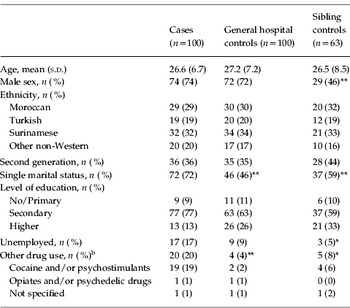
Of the 146 patients who were eligible for the study, two patients died before the study commenced. Twenty-six patients could not be interviewed because they had remigrated to their home country (n=5), they were too ill during the entire study period (n=8) or there was no current address available (n=13). Of the 118 patients who were contacted, 18 refused to participate. Thus, 100 patients were interviewed. Of the 168 subjects in the general hospital control group who were matched to the schizophrenia patients, four subjects were physically too ill to be interviewed, one was mentally handicapped, three were excluded because they had a psychotic disorder, and 60 refused to participate. For 15 patients there was no sibling available because all siblings were too young or lived abroad, patients had no sibling, or patients did not know their current address. Nine patients refused permission to contact their siblings, two patients only had a sibling who had psychotic symptoms. For 14 of the remaining 74 patients, the sibling who was matched to the case refused to participate; in three of these cases, another sibling agreed to participate. Thus, for 63 cases, a sibling could be interviewed. Characteristics of the study sample are shown in Table 1.
Characteristics of study sample, by matched case-control statusFootnote a

s.d., Standard deviation.
a Differences between cases and other groups tested by the Wald test, conditional logistic regression analysis.
b Lifetime use, defined as more than five times. One case used both cocaine and heroin.
* p<0.05, compared to cases, ** p<0.005.
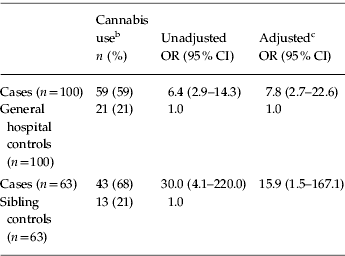
Fifty-nine per cent of the cases, 21% of their siblings and 21% of the general hospital controls had used cannabis (Table 2). Conditional logistic regression analyses showed that the differences between cases and the other groups were statistically significant. After adjustment for confounders, including the variable of psychostimulant and cocaine use, cannabis use remained a statistically significant predictor of schizophrenia (Table 2).
Odds ratios (ORs) of schizophrenia, by cannabis useFootnote a
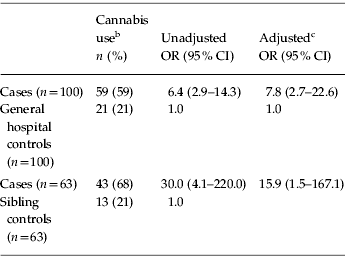
CI, Confidence interval.
a Using conditional logistic regression.
b Lifetime use, defined as more than five times.
c Adjusted for use of psychostimulants and cocaine, use of opiates and psychedelic drugs, (sex), marital status, level of education and unemployment.
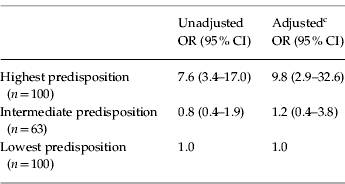
There was no difference between siblings and matched general hospital controls in prevalence of cannabis use (Table 2). Genetic predisposition for schizophrenia did not predict cannabis use, as the OR of cannabis use for siblings versus general hospital controls was 0.8 (95% CI 0.4–1.9) before and 1.2 (95% CI 0.4–3.8) after adjustment (Table 3).
Odds ratios (ORs) of cannabis useFootnote a, by genetic predisposition for schizophreniaFootnote b
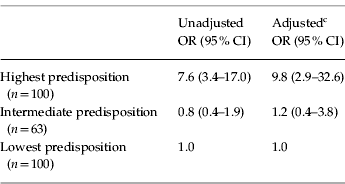
CI, Confidence interval.
a Lifetime use, defined as more than five times.
b Using conditional logistic regression.
c Adjusted for use of psychostimulants and cocaine, use of opiates and psychedelic drugs, sex, marital status, level of education and unemployment.
Discussion
Cannabis use was associated with schizophrenia in this case-control study of first-episode schizophrenia. Cases had used cannabis approximately three times more often than their siblings and matched general hospital controls. Sibling controls had not used cannabis more often than general hospital controls, despite their higher genetic predisposition for schizophrenia.
Our results add to the evidence that cannabis use is associated with an increased risk of schizophrenia (Arseneault et al. Reference Arseneault, Cannon, Witton and Murray2004). The magnitude of the effect was substantially larger than that calculated in the meta-analysis of results from prospective studies (Henquet et al. Reference Henquet, Murray, Linszen and Van Os2005b). Although patients had been instructed to report on cannabis use before illness onset, it is possible that they did not recognize early prodromal symptoms as such, creating the possibility that in some patients the period of cannabis assessment may have overlapped with the onset of schizophrenia. The association between cannabis and psychosis may be bidirectional, that is cannabis may be not only a causal factor in the pathway to schizophrenia but also used as self-medication for distress or early prodromal symptoms, as has been suggested by previous findings (Ferdinand et al. Reference Ferdinand, Sondeijker, Van der Ende, Selten, Huizink and Verhulst2005).
It is very unlikely that the association between cannabis and schizophrenia can be explained by genotype–environment correlation. Unlike other studies (Verdoux et al. Reference Verdoux, Gindre, Sorbara, Tournier and Swendsen2003; Henquet et al. Reference Henquet, Krabbendam, Spauwen, Kaplan, Lieb, Wittchen and van Os2005a), we used unaffected siblings and unrelated controls who had never had any psychotic symptom to classify the degree of genetic predisposition for schizophrenia rather than measures of psychoticism or delusional ideation. This allowed us to investigate genotype–environment correlation independent of a possible self-medication effect. The comparison between siblings and unrelated controls showed that higher genetic predisposition for schizophrenia did not lead to a higher rate of lifetime cannabis use.
The patterns of results with regard to schizophrenia liability and psychostimulants or cocaine was similar to that of cannabis: 19% (n=19) of cases used versus only 2% (n=2) in controls and 6% (n=4) in siblings. Although the number of individuals using these drugs was too small for formal statistical comparison, the findings are very similar to those described for cannabis with cases having much higher rates than both controls and siblings.
Methodological issues
Cannabis exposure was defined as use of cannabis ⩾five times, but the effect of cannabis may be different in someone who used only five times compared to a regular dependent user. When we analysed the group of daily users separately, ORs of schizophrenia were even higher [adjusted OR cases compared to general hospital controls 13.6 (95% CI 2.8–66.4); adjusted OR cases compared to siblings 29.2 (95% CI 1.6–517.3)]. In addition, there was no evidence that the OR of daily cannabis use for siblings compared to controls was increased [adjusted OR 0.3 (95% CI 0.02–5.2)]. These findings similarly indicate the absence of a gene–environment correlation and suggest a dose–response relationship between cannabis use and schizophrenia risk, although the wide CIs preclude firm conclusions.
A limitation of the study is that we did not have reliable information on age at first cannabis use and duration of use, as these factors may also influence the association between cannabis and schizophrenia.
This study only included first- and second-generation non-Western immigrants, which raises the question of whether the findings can be generalized across (other) ethnic groups. It is conceivable that the correlation between genetic factors and cannabis use is different in majority and minority populations, or that some ethnic groups may be more vulnerable to the psychotogenic effects of cannabis than other groups. We did not have data on the Dutch majority population, but when we stratified for ethnicity in our data, the associations between cannabis and (predisposition for) schizophrenia were very similar in the Surinamese, Turkish and Moroccan groups (results available on request).
Difficulties in the recruitment of siblings may have caused selection bias, as the siblings who refused to participate may have used cannabis more often than those who agreed to be interviewed. However, although the difference between cases and siblings in the prevalence of cannabis use was large, there was no suggestion of a difference between the two control groups, making it unlikely that selection bias could have had a major impact on the results. Even if we assumed that all refusing sibs had been cannabis users, the difference in cannabis use between siblings and controls would not have been statistically significant [the rates would have been 35% and 21% respectively, unadjusted OR 1.8 (95% CI 0.9–3.9)]. Instead, the large difference between cases and siblings in the rate of cannabis use is compatible with an underlying mechanism of gene–environment interaction, suggesting that genetic predisposition alone may not be sufficient to cause psychotic disorder.
Drug use was assessed with information provided by the participants themselves. This may have led to under-reporting, although in The Netherlands the attitude towards substance use is quite open. In addition, the researchers were not involved with patients' treatment, and did not provide any information to the physician responsible without the patients' consent.
Participants were asked whether they had ever used drugs before illness onset. There may have been recall bias as a result of this retrospective assessment, particularly in the group of cases, because impaired cognitive functioning is one of the features of schizophrenia (Murray et al. Reference Murray, Jones, Susser, Van Os and Cannon2003). If anything, however, this is likely to have led to underestimation of the prevalence of cannabis use in cases.
The general hospital controls may not have been representative of the general immigrant population, but the choice for a control group selected from immigrants who made contact with non-psychiatric secondary health-care services minimized selection bias as a result of pathways to care, as the schizophrenia cases were also recruited from secondary psychiatric services. Moreover, the very diverse complaints for which the controls made contact (ranging from fractures to anal fissures) makes it unlikely that their somatic illness would be related to cannabis use.
Conclusions
Our findings support the hypothesis that cannabis use is a risk factor for schizophrenia, and suggest that genetic predisposition for schizophrenia does not increase the risk of cannabis use. Associations between cannabis use, genetic predisposition for psychosis, and schizophrenia cannot be attributed to genotype–environment correlation but are most probably due to interactions between genetic factors and cannabis. Replication of these findings in larger samples with other direct and indirect measures of genetic psychosis liability is needed to enable definite conclusions to be drawn.
Acknowledgments
This study was supported by a research grant from the Netherlands Organization for Health Research and Development, grant number 100-002-009.
Declaration of Interest
None.