Introduction
Smoking in Prisons
Worldwide, approximately one billion people smoke tobacco, and over five million deaths per year are directly attributable to tobacco use (World Health Organization, 2015, 2016). In the UK specifically, figures from 2015 indicate that 16.9% of the adult population smoke (Office for National Statistics, 2017), and perhaps even more concerning is that the prevalence of smoking in UK prisons is estimated to be as high as 80% (Public Health England, 2015). Evidence suggests that over a quarter of non-smokers may start smoking on entering prison (Kauffman, Ferketich, Murray, Bellair, & Wewers, Reference Kauffman, Ferketich, Murray, Bellair and Wewers2011), and that around half of those who already smoke may increase the frequency of their smoking during their time in prison (Cropsey, Linker, & Waite, Reference Cropsey, Linker and Waite2008). Some of the reported reasons behind this increased rate of smoking within prisons include using smoking for stress management and as a social aid (Butler, Richmond, Belcher, Wilhelm, & Wodak, Reference Butler, Richmond, Belcher, Wilhelm and Wodak2007; Richmond et al., Reference Richmond, Butler, Wilhelm, Wodak, Cunningham and Anderson2009).
Currently, a phased smoking ban is being rolled out across all prisons in England, with some prisons already implementing partial bans (prisons in Scotland, and more recently in Wales, have already introduced full smoking bans). However, considering the high rate of smoking within prisons, and the use of smoking as a coping strategy in the stressful prison environment (Butler et al., Reference Butler, Richmond, Belcher, Wilhelm and Wodak2007; Public Health England, 2015), it is evident that an intervention accessible across the prison population may be beneficial as a way to help manage symptoms associated with smoking cessation, such as nicotine cravings and social issues.
The prison setting may be an ideal location to deliver a smoking cessation intervention as, despite many offenders starting to smoke during their incarceration (Butler et al., Reference Butler, Richmond, Belcher, Wilhelm and Wodak2007; Richmond et al., Reference Richmond, Butler, Wilhelm, Wodak, Cunningham and Anderson2009), evidence suggests that many offenders are interested in stopping smoking, and that they understand the risks associated with continuing to smoke (Kauffman et al., Reference Kauffman, Ferketich, Murray, Bellair and Wewers2011). Unfortunately, however, introducing a smoking ban may not be sufficient. Whilst a ban may reduce the prevalence of smoking within prisons, without the implementation of an effective smoking cessation intervention delivered alongside it, offenders have been reported to return to smoking following their release from prison (Clarke et al., Reference Clarke, Stein, Martin, Martin, Parker and Lopes2013; Lincoln et al., Reference Lincoln, Tuthill, Roberts, Kennedy, Hammett and Langmore-Avila2009; Pezzino, Remington, Anderson, Lantz, & Peterson, Reference Pezzino, Remington, Anderson, Lantz and Peterson1992). A complete, or even partial, smoking ban may therefore be ineffective without appropriate smoking cessation support being in place.
In UK prisons, offenders are typically offered pharmacological support (Public Health England, 2015), including nicotine replacement therapy (NRT), such as nicotine patches or lozenges, to help them attempt to quit smoking (Condon, Hek, & Harris, Reference Condon, Hek and Harris2008; MacAskill & Hayton, Reference MacAskill and Hayton2006). So far, this approach has demonstrated favourable outcomes for the use of pharmacological support, with evidence suggesting that approximately 54% of offenders who had set a quit date continued to abstain from smoking at the four week follow-up (National Health Service, 2014). Further evidence suggests that the combination of NRT and behavioural support (including keyworking and group sessions), compared to no support, may yield the most favourable outcomes in increasing smoking cessation (Stead et al., Reference Stead, Koilpillai, Fanshawe and Lancaster2016; West & Stapleton, Reference West and Stapleton2008). However, prisons may differ in the use of trained staff and smoking cessation specialists; and whilst the provision of services in some prisons is good, the needs of other prisons may not be met by current smoking cessation services (Public Health England, 2015). Furthermore, interviews with stakeholders revealed that the specific environmental context of prisons – including frequent changes to commissioned services, and issues such as funding cuts, and changes to job roles – may affect the implementation of smoking cessation services (Eadie, MacAskill, McKell, & Baybutt, Reference Eadie, MacAskill, McKell and Baybutt2012). One way to overcome the potential difficulties faced with proving smoking cessation support within prisons may lie in the use of computer-assisted interventions.
Computer-Assisted Interventions
Computer-assisted interventions are a way of delivering psychosocial techniques via digital technologies such as the internet. Such digital interventions may be supervised and can be delivered either in a group setting or individually (Andrews, Cuijpers, Craske, McEvoy, & Titov, Reference Andrews, Cuijpers, Craske, McEvoy and Titov2010). In this way, digital interventions may be more cost-effective than receiving one-on-one support, as multiple users can access the intervention at any one time (Carroll & Rounsaville, Reference Carroll and Rounsaville2010; Olmstead, Ostrow, & Carroll, Reference Olmstead, Ostrow and Carroll2010). Additionally, digital interventions are delivered in a highly standardised manner, thus ensuring treatment fidelity in comparison to the variance often seen in traditional human-facilitated interventions (Borrelli et al., Reference Borrelli, Sepinwall, Ernst, Bellg, Czajkowski and Breger2005; Carroll, Reference Carroll2013; Perepletchikova & Kazdin, Reference Perepletchikova and Kazdin2005).
A Cochrane review of the available research literature has suggested online smoking cessation interventions are effective in helping people stop smoking, for at least up to six months (Civljak, Sheikh, Stead, & Car, Reference Civljak, Sheikh, Stead and Car2010). However, at present there appears to be no evidence of online smoking cessation interventions being implemented within UK prisons.
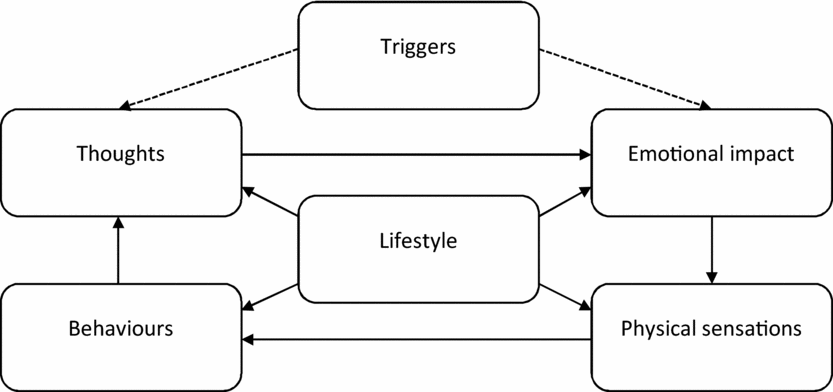
One online intervention which has been successfully implemented within a prison setting is Breaking Free Online. Breaking Free Online is an online treatment and recovery programme for substance misuse, including tobacco use and co-morbid mental health difficulties. The programme incorporates a range of evidence-based intervention techniques (Dugdale et al., Reference Dugdale, Ward, Hernen, Elison, Davies and Donkor2016), including approaches derived from cognitive behavioural therapy (Beck, Wright, Newman, & Liese, Reference Beck, Wright, Newman and Liese2011; Beck, Reference Beck2011), mindfulness (Bowen, Witkiewitz, Chawla, & Grow, Reference Bowen, Witkiewitz, Chawla and Grow2011; Kabat-Zinn, Reference Kabat-Zinn2005; Marlatt, Bowen, Chawla, & Witkiewitz, Reference Marlatt, Bowen, Chawla, Witkiewitz, Hick and Bien2010), and relapse prevention (Marlatt & Donovan, Reference Marlatt and Donovan2005). Intervention techniques within Breaking Free Online are mapped onto the Lifestyle Balance Model (Davies, Elison, Ward, & Laudet, Reference Davies, Elison, Ward and Laudet2015). The Lifestyle Balance Model (Figure 1) is an interactive biopsychosocial domain model, derived from the five factor model used in cognitive behavioural therapy (Greenberger & Padesky, Reference Greenberger and Padesky1995; Williams & Chellingsworth, Reference Williams and Chellingsworth2010; Williams & Garland, Reference Williams and Garland2002). Lifestyle is also included as an additional domain within the model, as this relates to other issues which may affect health and wellbeing, such as relationships, accommodation and employment (Davies et al., Reference Davies, Elison, Ward and Laudet2015). The Lifestyle Balance Model has already been effectively used in the behaviour change programme Breaking Free Online, to conceptualise support pathways for substance misuse within community and criminal justice settings (Elison, Humphreys, Ward, & Davies, Reference Elison, Humphreys, Ward and Davies2014a, Elison et al., Reference Elison, Ward, Davies, Lidbetter, Dagley and Hulme2014b, Elison, Weston, Dugdale, Ward, & Davies, Reference Elison, Weston, Dugdale, Ward and Davies2016).
The lifestyle balance model.

Breaking Free Online is currently being utilised in criminal justice settings in the UK, including prison and probation services. Evidence from mixed-methods analyses suggests that those who completed the programme demonstrated reduced substance use and dependence, and improved quality of life, and some elements of recovery progression within a prison setting (Elison et al., Reference Elison, Weston, Davies, Dugdale and Ward2016). Additionally, qualitative findings reflected these outcomes and confirmed the suitability of the intervention within the prison setting (Elison, Weston, Davies, Dugdale, & Ward, Reference Elison, Weston, Davies, Dugdale and Ward2016; Elison et al., Reference Elison, Weston, Dugdale, Ward and Davies2016). These findings demonstrate the potential for applying the theoretical underpinnings of Breaking Free Online when designing interventions, including those that focus on other types of behaviour change, such as smoking cessation, within a prison setting.
Whilst Breaking Free Online may provide support for those wanting to quit smoking, tobacco is one of 39 substances targeted by the intervention. Although users may wish to focus on tobacco use, the language of the programme is generic to suit the needs of other substances. Therefore, smoking specific triggers and thoughts for example, are not necessarily addressed by the programme. It is evident that a programme focusing specifically on smoking cessation would be of greater potential benefit to offenders as it could provide tailored information to offenders around smoking-specific difficulties. Using the Lifestyle Balance Model may help to conceptualise smoking behaviours and provide a framework by which to understand and target the difficulties associated with smoking, such as being exposed to cues for smoking in the prison environment and managing nicotine withdrawal symptoms. Therefore, a novel online behaviour change intervention for smoking cessation in offenders in the UK has been developed: Breaking Free from Smoking. This paper describes the development process of this behaviour change intervention, which has been informed by the guidance outlined in the Behaviour Change Wheel (BCW) approach to developing complex behavioural change interventions (Michie, Atkins, & West, Reference Michie, Atkins and West2014).
The Behaviour Change Wheel
The BCW provides guidance on the development of behaviour change interventions (Michie et al., Reference Michie, Atkins and West2014), and is derived from behaviour change theory to ensure that the guidance is systematic and targets key areas for behaviour change. The BCW had already demonstrated success in the development and understanding of other smoking cessation interventions and support (e.g. Fulton et al., Reference Fulton, Brown, Kwah and Wild2016; Gould, Reference Gould2014). Content of the behaviour change interventions is ascertained through the BCW, utilising evidence-based behavioural change techniques (BCTs). A BCT can be defined as the smallest observable and replicable component of an intervention which can lead to behaviour change (Michie et al., Reference Michie, Richardson, Johnston, Abraham, Francis and Hardeman2013). The latest BCT taxonomy identifies 93 behaviour change techniques, grouped into 16 categories of change, and was developed by a group of health psychologists and other behaviour change experts (Michie et al., Reference Michie, Richardson, Johnston, Abraham, Francis and Hardeman2013).
At the heart of the BCW is a behaviour change model, demonstrating the interaction between the capability (C) to perform a desired behaviour, along with the opportunity (O) to perform the behaviour, and the individual's motivation (M) to perform the behaviour, and how these three determinants (C, O and M) can impact on the likelihood of the desired behaviour (B) being performed. This is known as the COM-B model (Michie, van Stralen, & West, Reference Michie, van Stralen and West2011), and it allows identification of the components that need to be addressed to achieve the desired behaviour change. The BCW further describes how to select the types of BCTs likely to bring about change, based on an assessment using the COM-B model.
Aims
This study aims to (a) assess offenders’ capability, motivation and opportunity for behaviour change regarding their smoking cessation and to (b) use the BCT taxonomy to report the content of an online smoking cessation intervention within this group; Breaking Free from Smoking, utilising the BCW to map out the content of the intervention based on the initial assessment.
Methods
This study used the BCW to develop an online smoking cessation, behaviour change intervention. Detailed below is the process and the methods, derived from the BCW, that were used to complete the stages of developing the clinical content of Breaking Free from Smoking. Implementation information is also reported for the intervention.
i) Identify what needs to change
The lead author (SD) conducted four focus groups with smoking offenders from prisons across the North of England. A total of 26 male offenders, who identified as current smokers, took part in the focus groups within the prisons, and were asked questions around their perceived triggers to smoking, availability of smoking cessation support, and perceptions of how the ban will affect the prison environment, and those within it. Focus groups were completed as part of a larger research programme, investigating the perceptions of both smoking and non-smoking offenders’ towards the smoking ban in English prisons. Approval for this research was granted by the National Offender Management Service on 18th October 2016 (NRC ref: 2016–298). Further approvals were granted by Staffordshire University's ethics committee on 1st March 2017. For further information on the methodology of this research and sample characteristics, see Dugdale et al. (Reference Dugdale, Semper, Povey, Elison-Davies, Ward and Daviesin preparation).
Qualitative data from the focus group study was recorded onto a Dictaphone. Transcripts were uploaded onto NVivo (NVivo 10, 2012), to support data analysis. Although data collection was combined, this analysis was conducted separately to that described in Dugdale et al. (Reference Dugdale, Semper, Povey, Elison-Davies, Ward and Daviesin preparation). Data from smoking offenders were coded by SD using deductive thematic analysis and were mapped onto the COM-B model, to identify offenders’ physical and psychological capabilities, physical and social opportunities, and reflective and automatic motivations, to understand the barriers specific to offenders in achieving the specified behaviour change. Before data collection, SD noted her assumptions and professional standing in relation to the research, and was aware of her influence on data collection and analysis (Landridge, Reference Landridge2007).
ii) Identify intervention functions
The authors identified the intervention functions that were appropriate to the target behaviour and population, based on the assessment of their capability, opportunity and motivation to change. Intervention functions refer to the ways in which behaviour change may be enacted via the intervention, including education, persuasion, enablement, restrictions, incentivisation, coercion, environmental restructuring, training and modelling. The applicability of the functions identified by the BCW were assessed by the authors using the APEASE criteria, which considers the affordability, practicability, effectiveness, acceptability, safety and equity, given the specific context and population. APEASE criteria are recommended and typically applied to the BCW, to best decide appropriate intervention strategies given the target behaviour and population (Michie et al., Reference Michie, Atkins and West2014). Suitable intervention functions were then mapped onto the identified areas of behavioural change required from Breaking Free from Smoking.
iii) Identify intervention content
The final stage of the BCW maps out the content of the intervention using the BCT taxonomy. This ensures that the content of the intervention considers the specific problem and the needs of the target population, and is based on the intervention functions assessed as appropriate for this behaviour change. Two of the study's authors (SD and EB), who had completed online training for the delivery of smoking cessation advice with the National Centre for Smoking Cessation Training (NCSCT: www.ncsct.co.uk), listed the BCTs identified in this smoking cessation advice that mapped onto the intervention functions identified for Breaking Free from Smoking. These authors then discussed the applicability of all identified BCTs for the intervention in relation to APEASE criteria, and mapped out these appropriate BCTs onto the Lifestyle Balance Model, to conceptualise the content and delivery of the intervention.
iv) Implementation information
The Template for Intervention Description Replication was followed to specify the target behaviour regarding when, where and how often this behaviour will be performed, and who provides this intervention. This guidance was developed to improve the reliability of replicating and evaluating interventions by encouraging better description of intervention content (Hoffmann et al., Reference Hoffmann, Glasziou, Boutron, Milne, Perera and Moher2014).
Results
i) Identify what needs to change
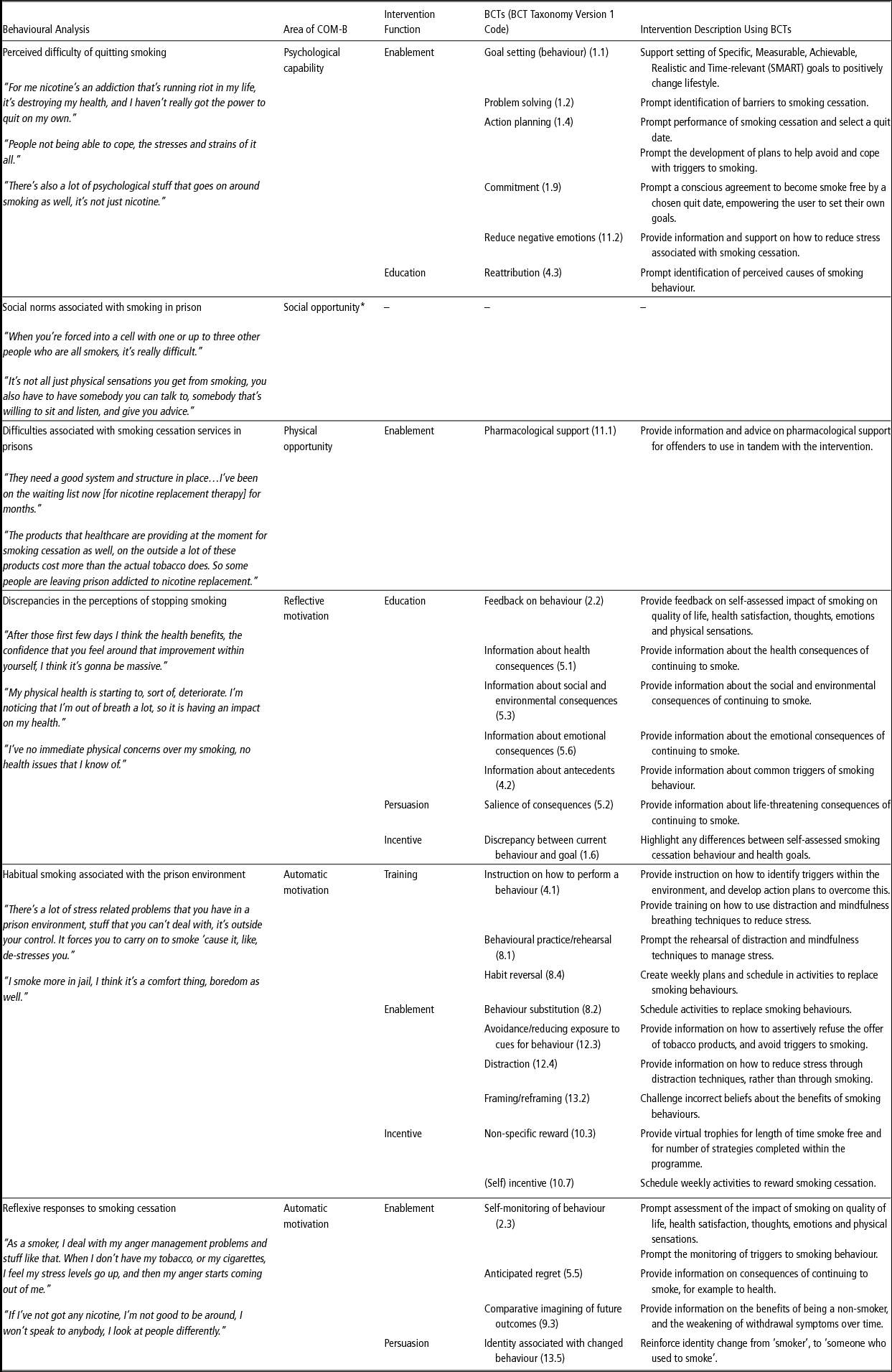
The COM-B model was used to conceptualise qualitative data from focus groups conducted with offenders to examine their perceptions of smoking and understand how their capabilities, opportunities and motivations may impact upon their ability to achieve smoking cessation within the prison environment. Refer to (Table 1) for a summary of this coding exercise, which provides quotes from the focus group participants to highlight potential barriers to achieving this behaviour change. Examples relating to barriers in psychological capability, physical opportunity, reflective motivation and automatic motivation were reported in the focus groups. *Note that although examples of social opportunity were also apparent from the focus groups, this does not afford itself to an online intervention, but was included within the table, as this information may be of utility for future research.
• Psychological capability
Many offenders in the focus group described the difficulties associated with stopping smoking, in particular the impact of stress on their ability to stay smoke free. There was also some recognition of the psychological factors associated with tobacco addiction, noting that these should also be addressed.
• Physical opportunity
Some offenders participating in the focus group reported difficulties in accessing the existing smoking cessation services within their prison. One offender reported that they had been waiting months for NRT, whereas another stated some of the negative effects associated with NRT (for example, addiction to it). The above physical opportunities considered, it was apparent that the existing prison healthcare system was not always able to meet the needs of offenders in supporting their quit attempts.
• Reflective motivation
Some offenders in the focus group recognised the perceived benefits associated with smoking cessation, such as improvements to health, and the deleterious impact that smoking had already had on their health. Conversely, others claimed that they had experienced no health difficulties as a result of their smoking. This highlights potential differences in reflective motivations to stop smoking, suggesting it would be beneficial to ensure that appropriate psychoeducation about the consequences of smoking is available to offenders, to help them to make an informed decision to stop smoking or not.
• Automatic motivation
Offenders interviewed described how the culture of the prison environment was entangled with smoking, primarily to relieve stress and boredom. Also reported were automatic responses experienced by offenders when they went without cigarettes, such as irritability and heightened anger.
ii) Identify intervention functions
Areas of the COM-B model mapped onto barriers to smoking cessation in offenders, related intervention functions and BCTs and translation of these BCTs in the intervention

APEASE criteria were used to assess the applicability of the nine intervention functions described in the BCW, given the specific context of prisons. Education, persuasion, incentivisation, training and enablement were judged as the most appropriate functions for this behaviour change intervention. Further coercion was not considered to be acceptable in the context; offenders may already be coerced into changing behaviour through policy change and the smoking ban being imposed in prisons. Restriction and environmental restructuring were judged as being impractical in this context, as prison settings are already highly structured environments and are subject to specific regimes that may not be changed. Restrictions through the smoking ban will also already be in place without the input of this intervention. Furthermore, modelling may not be practical given the mode of delivery.
iii) Identify intervention content
The BCW was used to explore the specific BCTs that were linked to the intervention functions identified, and APEASE criteria were used to select the most appropriate BCTs for the intervention. A total of 27 BCTs were chosen for this smoking cessation intervention, with at least one BCT identified within 10 of the possible 16 grouping categories within the BCT taxonomy (Tables 1 and 2). The BCTs identified for inclusion in Breaking Free from Smoking (Table 2) were mapped onto the individual domains of the Lifestyle Balance Model, and were used to inform the content of the strategies targeting situations that could trigger the urge to smoke, smoking-related thoughts, emotional impact, physical sensations (including nicotine cravings), smoking and associated behaviours and lifestyle, located on the appropriate Lifestyle Balance Model domains.
iv) Implementation information
Behaviour change techniques mapped onto the lifestyle balance model and other areas of the breaking free from smoking programme

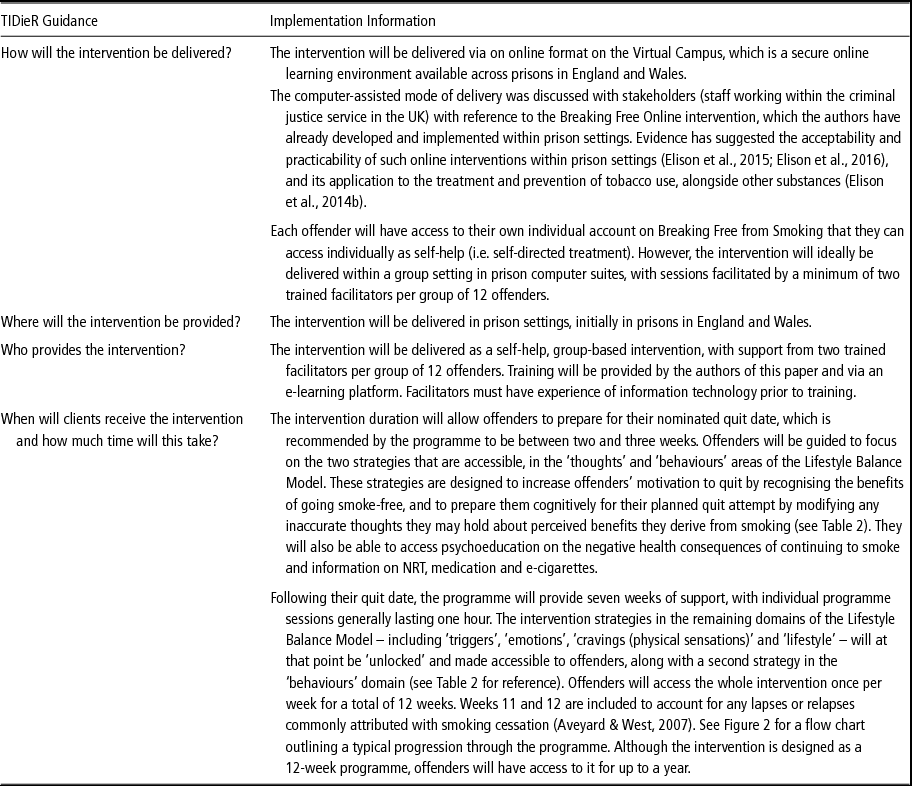
Template for intervention description replication guidelines were used to specify the details of the nature, structure and implementation of the interventions. The results of this exercise are reported in (Table 3).
Implementation of breaking free from smoking using TIDieR

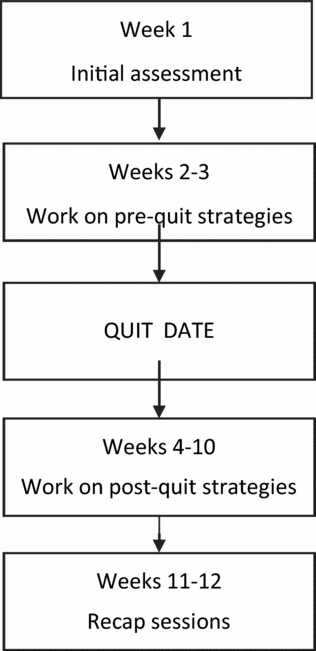
Progress through the breaking free from smoking intervention.

Discussion
This paper describes the development process of an online smoking cessation intervention for offenders in UK prisons, Breaking Free from Smoking. The BCW (Michie et al., Reference Michie, Atkins and West2014) approach to intervention development was used to guide this process, drawing upon evidence from qualitative focus group data and the published literature, to tailor the intervention to the target population and setting, and thus extend the provision of behavioural smoking cessation support in this area. The resulting intervention has a strong focus on overcoming barriers associated with offenders’ psychological capability, physical opportunity, and reflective and automatic motivations to stop smoking and abstain from nicotine.
The use of theory during the development of this intervention could be considered a strength of the process, and of the programme. Using the COM-B model and the Lifestyle Balance Model to conceptualise the clinical content of the intervention, ensured the evidential underpinning of the programme was as strong as possible, whilst using the BCW ensured that this process of development was completed in a systematic way. Generally, the BCW appeared to provide a suitable method for developing a behaviour change intervention, and facilitated the identification of evidence-based behavioural change techniques for inclusion in Breaking Free from Smoking. However, without the use of a model on which to map the identified content of the programme, such as the Lifestyle Balance Model, the BCW is limited in that it does not provide guidance on formulating a complete intervention. Using the TIDieR checklist to inform implementation guidance for the intervention was also vital here in moving past development of the programme through the BCW, to considering how the intervention can be translated into real-world practice.
Following the Medical Research Council's framework for the development of complex healthcare interventions, a continuous cycle of development, feasibility testing and evaluation of implementation and effectiveness is recommended (Craig et al., Reference Craig, Dieppe, Macintyre, Michie, Nazareth and Petticrew2008). This article has detailed the development stages of an online smoking cessation intervention for offenders, and has reported the evidence-based content contained within it. The next steps are to test the efficacy of this intervention within the intended prison environment. A randomised controlled trial is currently planned to evaluate this intervention within the UK, and will be reported separately. If results from the trial indicate that the intervention is effective at improving smoking cessation amongst offenders, there is scope for this intervention to be trialled internationally. Also of interest for future research would be the maintenance of smoking cessation in the long-term, including on release from prison. Exploring this could enhance understanding of the specific factors underlying this behaviour change within the offending population.
Conclusion
By reporting the process of using both the BCW and COM-B approaches to guide the development of Breaking Free from Smoking, this paper provides evidence to support this method for the design of behaviour change interventions. Using the BCW allows the systematic reporting of this design stage, and enables the reporting of BCTs contained within an intervention, allowing for future research to analyse, synthesise and utilise behaviour change interventions (McCleary, Duncan, Stewart, & Francis, Reference McCleary, Duncan, Stewart and Francis2013). This work forms the initial stage of intervention development, with feasibility testing and a randomised controlled trial currently planned to evaluate the outcomes of the intervention.
Acknowledgements
The authors would like to thank the prison staff and governors for providing access to participants and for supporting this research.
Financial Support
This research received no specific grant from any funding agency, commercial or not-for-profit sectors.
Conflict of Interest
SD, JW, SE and GD are employed by Breaking Free Group where Breaking Free from Smoking and Breaking Free Online have been developed.
Ethical Standards
The authors assert that all procedures contributing to this work comply with the ethical standards of the relevant national and institutional committees on human experimentation and with the Helsinki Declaration of 1975, as revised in 2008.