Implications
Supplementing oilseeds (flaxseed or soybeans) at ~0.5% of BW improved weight gain of lactating cows grazing native rangeland. Nevertheless, supplementing flaxseed was not sufficient to reduce the concentrations of prostaglandin metabolite during the time of maternal recognition of pregnancy. Overall, soybeans appear to increase key circulating fatty acids quicker compared with flaxseed and may serve as a better supplement before breeding and up to the time of maternal recognition of pregnancy.
Introduction
The inclusion of fat into beef cattle diets is an effective way to increase the energy density of the diet and provide essential fatty acids. However, the addition of fat can be cost prohibitive. Nevertheless, it is possible to limit the time in which fats are provided to reduce the costs associated with feeding. Recent work has demonstrated that supplemental fat can influence plasma fatty acids within a relatively short time frame (~7 to 9 days; Filley et al., Reference Filley, Turner and Stormshak1999; Scholljegerdes et al., Reference Scholljegerdes, Lake, Weston, Rule, Moss, Nett and Hess2007 and Reference Scholljegerdes, Lekatz and Vonnahme2011).
Of particular importance to reproduction is linoleic acid (18:2n-6), which is the precursor to the 2-series prostaglandins. An increase in dietary 18:2n-6 will increase prostaglandin F (PGF2 α) production (Lammoglia et al., Reference Lammoglia, Willard, Hallford and Randel1997; Filley et al., Reference Filley, Turner and Stormshak1999), which may negatively influence embryonic survival (Mattos et al., Reference Mattos, Guzeloglu, Badinga, Staples and Thatcher2003) owing to decreases in progesterone (Diskin and Niswender, Reference Diskin and Niswender1989). Progesterone plays a critical role in stimulating production of a variety of endometrial secretions that are necessary for successful embryonic development (Diskin and Morris, Reference Diskin and Morris2008). Early embryonic loss ranges from 20% to 30% during the first 30 days of gestation in cattle (Dunne et al., Reference Dunne, Diskin and Sreenan2000). Mann and Lamming (Reference Mann and Lamming2001) demonstrated that poor embryonic development is associated with a delayed postovulatory progesterone rise and low luteal phase progesterone concentrations in cattle. However, n-3 fatty acids such as linolenic acid (18:3n-3) can inhibit 20:4n-6 production and thereby decrease the formation of PGF2 α. The reduction in PGF2 α synthesis is due to the competition between C18:2n-6 and C18:3n-3 for the Δ-6 desaturase enzyme in which either fatty acid is desaturated to C20:4n-6 or EPA, respectively. Ambrose et al. (Reference Ambrose, Kastelic, Corbett, Pitney, Petit, Small and Zalkovic2006) fed lactating dairy cows a barley silage-based diet that contained either rolled flaxseed (source of 18:3n-3) or rolled sunflower seed (source of 18:2n-6) for 8 weeks starting 28 days before the breeding season and reported an early pregnancy loss (32 to 90 day) of 4.8% and 11.4% and an overall pregnancy loss of 9.8% and 27.3% for cows fed flaxseed v. sunflower seeds, respectively.
Timed artificial insemination (AI) is becoming increasingly attractive to livestock producers because of the reduction in labor associated with heat detection; however, AI conception rates are generally lower than protocols using heat detection. Hence, the development of a short-term feeding program that coincides with a timed AI protocol may help increase AI conception rates. Further, the effects of short-term oilseed supplementation on pregnancy rates are unknown in beef cattle. It was our hypothesis that supplementation with C18:3n-3 from flaxseed just before and through maternal recognition of pregnancy, would decrease prostaglandin F metabolite (PGFM) production and increase timed AI pregnancy rates in beef cows owing to its potential to hinder conversion of C18:2n-6 to C20:4n-6. Therefore our objectives were to evaluate the efficacy of a short-term increase in dietary energy and essential fatty acids, in particular linoleic and linolenic acid, on plasma fatty acids, serum progesterone concentrations and plasma PGFM around the time of AI until maternal recognition in lactating beef cows grazing summer range supplemented oilseeds (flaxseed or soybean).
Material and methods
Animal management
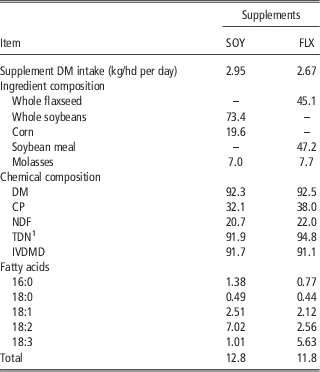
All procedures were approved by the USDA-ARS Northern Great Plains Research Laboratory Animal Care and Use Committee. Twenty-four 3-year-old Angus cows (average initial BW=512 kg and body condition score=5.5 on a 1 to 9 scale; Wagner et al., Reference Wagner, Lusby, Oltjen, Rakestraw, Wettemann and Walters1988; n=8/treatment) and six ruminally cannulated beef heifers (523.1±16.9 kg; n=3) grazing a 12.1 ha native range pasture were randomly allotted to one of three treatments being (1) grazing only and no supplement (CON); (2) supplemented whole soybeans (SOY); or (3) whole flaxseed (FLX). Supplements were formulated to provide similar amounts of protein, energy (TDN) and fat based on National Research Council (2000) predicted forage intake for a 544 kg cow producing 9.1 kg of milk (Table 1). Approximately 60 days postpartum, all animals were confirmed cyclic using ultrasound and serum progesterone as indicators of luteal activity (data not shown). Two days before initiation of estrous synchronization, cattle were removed from feed and water for 12 h before weighing for 2 consecutive days in order to account for any differences in gut fill and its bias on initial BW and were weighed again on day 28 (shrunk) and again on day 117 and 118 (shrunk). Starting on day 10 (day 0=day of AI), a controlled internal-release device (Eazi-Breed CIDR; Pfizer Animal Health, New York, NY, USA) was placed into the vagina and a blood sample was collected via coccygeal venipuncture from all cattle (cows and cannulated heifers). Cattle were also given 100 µg gonadorelin diacetate tetrahydrate (Fertagyl; Intervet USA, Millsboro, DE, USA). Cows that received supplements were gathered from the pasture and sorted from their calves each morning at 0730 h and placed into individual stanchions for feeding. Cattle were given ~30 min to consume their supplement; however, cows rarely took longer than 10 min to consume all supplement offered. On day 3, the CIDR was removed and cattle were given a shot of 25 mg of dinoprost tromethamine (Lutalyse; Pfizer Animal Health). On the day of insemination (day 0; 72±2 h from CIDR removal), cows were given another shot of 100 µg of gonadorelin diacetate tetrahydrate (Fertagyl). The same AI sire (received as frozen semen in 0.5 cc straw and thawed at 94°F for 45 s) and technician was used for all cows. All cows were nursing calves, with the exception of the cannulated heifers, and were considered reproductively sound.
Supplement intake and ingredient and chemical composition (%DM) of supplements fed to lactating beef cows supplemented with oilseeds and grazing native summer range

SOY=Whole soybean supplement fed at 0.57% of BW (DM basis); FLX=whole flaxseed supplement fed at 0.52% of BW (DM basis); DM=dry matter; IVDMD=in vitro DM digestibility.
1 Calculated based on published TDN values (Lardy and Anderson, Reference Lardy and Anderson1999; National Research Council, 2000).
It was important to know how supplements would influence forage intake because we know that fat supplements reduce forage intake (Schauff and Clark, Reference Schauff and Clark1992), so to minimize stress and reduce any influence fecal sampling may have had on hormone production, six ruminally cannulated beef heifers were used to determine forage intake. These heifers were assigned to treatments (n=2) and synchronized in the same manner as cows. Starting on day 12 of the experiment, titanium dioxide (TiO2) was dosed to the cannulated heifers twice daily (5 g) as an external marker fecal dry matter (DM) flow until day 21. Supplementation ceased on day 28 or 18 days after insemination. Supplementation ceased on this day because Dunne et al. (Reference Dunne, Diskin and Sreenan2000) reported that the majority of embryo losses in beef heifers occurred before day 16 postinsemination; therefore, supplement feeding was targeted to end just after maternal recognition of pregnancy. Eighteen days after timed AI, one clean up bull was turned in with the cows for 38 days.
Sampling and laboratory analysis
All cows were bled via coccygeal venipuncture every 3 days, starting at day of CIDR insertion until day 10 after timed AI, then blood was collected every day until 18 days after timed AI. Thereafter, blood samples were collected once weekly for 2 weeks after supplementation ceased. Whole blood was collected into a glass Vacutainer (Becton, Dickinson and Co., Franklin Lakes, NJ, USA) clot tubes for serum harvest, whereas plasma was obtained from blood collected into Vacutainer tubes containing sodium heparin. Blood samples were immediately refrigerated for 4 h, after which serum or plasma was harvested by centrifugation at 2000×g for 30 min.
Cannulated heifers were used to evaluate the impact supplementation had on forage intake. Therefore, on day 11 heifers were completely evacuated of their rumen contents as described by Lesperance et al. (Reference Lesperance, Bohman and Marble1960) and allowed to graze for 1 h. Heifers were then gathered and masticate was immediately collected, placed on ice and ruminal contents were returned to the rumen. Masticate was processed as outlined by Brokaw et al. (Reference Brokaw, Hess and Rule2001). On day 16, rumen fluid was collected from each heifer for masticate in vitro dry matter disappearance (IVDMD). Each masticate sample was incubated in rumen fluid from the heifer from which it was collected. Fecal samples from cannulated heifers were collected twice daily starting on day 17 through day 21. Fecal samples were collected and composited for each heifer.
All supplements, masticate and feces were analyzed for DM (Association of Official Analytical Chemists, 1990), N (Carlo Erba Model NA 1500 Series 2 N/C/S analyzer; CE Elantech, Lakewood, NJ, USA), NDF (ANKOM 200 fiber analyzer; ANKOM Technology, Fairport, NY, USA) and IVDMD (ANKOM DaisyII Incubator, ANKOM Technology). Fecal samples were analyzed for TiO2 according to the procedures of Myers et al. (Reference Myers, Ludden, Nayigihugu and Hess2004).
Feed and masticate was analyzed for fatty acids analysis via direct transesterification (Whitney et al., Reference Whitney, Hess, Kaltenbach, Harlow and Rule1999) with methanolic-HCl (Scholljegerdes et al., Reference Scholljegerdes, Lekatz and Vonnahme2011) and plasma fatty acids were analyzed for fatty acid analysis using the procedures of Lake et al. (Reference Lake, Scholljegerdes, Weston, Rule and Hess2006). Separation of fatty acid methyl esters was achieved by GLC (Model CP-3800; Varian Inc., Palo Alto, CA, USA) with a 100 m capillary column (SP-2560; Supelco, Bellefonte, PA, USA) and H2 gas as a carrier gas at 1.5 ml/min. Initial oven temperature was maintained at 120°C for 2 min and then ramped to 210°C at 6°C/min and then ramped to 250°C at 5°C/min. Injector temperature was 260°C and flame ionization detector temperature was 300°C. Identification of peaks was accomplished using purified fatty acid standards (Sigma-Aldrich, St. Louis, MO, USA; Nu-Chek Prep, Elysian, MN, USA; Matreya, Pleasant Gap, PA, USA).
Only blood from multiparous Angus cows was assayed for plasma nonesterified fatty acids (NEFA), serum progesterone and plasma PGFM analyses. Daily blood samples collected on day 10 to 18 were assayed. Serum was analyzed for NEFA (NEFA HR; Wako Pure Chemical Industries, Dallas, TX, USA) with an inter-assay CV of 4.3%. Serum was assayed for progesterone via Immulite progesterone kits (DPC, Los Angeles, CA, USA), as previously described (Galbreath et al., Reference Galbreath, Scholljegerdes, Lardy, Odde, Wilson, Schroeder and Vonnahme2008). The intra- and inter-assay CV were 5.21% and 5.96%, respectively. Serum samples were analyzed for concentrations of the PGF2 α metabolite, 13,14-dihydro-15-keto PGF2 α by radioimmunoassay (Silvia and Niswender, Reference Silvia and Niswender1984). The samples were analyzed in a single assay with an intra-assay CV of 3.9%.
Calculations and statistical analysis
Fecal DM output was calculated using TiO2 concentration. Intakes were estimated from fecal DM output and in vitro DM indigestibility of both the supplement and masticate. Therefore, cow forage intake was estimated using the average intake for each treatment, which was converted to g of forage DM intake/kg of BW and multiplied by cow BW. Fatty acid intake and growth performance was analyzed as a completely randomized design using the GLM procedures of SAS 9.2 (SAS, 2008). All blood metabolite and fatty acid data was analyzed as a completely randomized design using the MIXED procedure of SAS. The model included diet, day, and any interaction between day and diet. Fixed effects included dietary treatment, day and dietary treatment×day. Animal was used to specify variation between animals using the RANDOM statement and day was the repeated effect. Animal within dietary treatment was the nested effect using the SUBJECT statement. Single degree of freedom orthogonal contrasts were used to compare effects of control v. supplements (SOY and FLX), as well as SOY v. FLX and sampling period effects were tested using orthogonal polynomial contrast. Treatment differences within day were determined by using the PDIFF statement of SAS.
Results
Cow performance and heifer forage intake and digestion
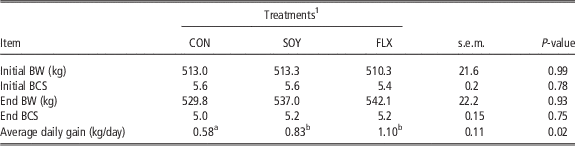
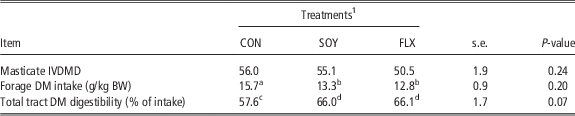
Cow initial and final BW and body condition score was not different (P⩾0.47) across treatments. Despite the lack of statistical difference in final BW, cow average daily gain did differ (P=0.01) between CON and fat-supplemented treatments (Table 2). Conception to timed AI, confirmed with calving dates, was not different (P=0.34) across treatment (62.5%, 25% and 50% for CON, FLX and SOY, respectively). Likewise, overall pregnancy rates did not differ (P=0.77) with dietary treatment (75%, 87.5% and 87.5% for CON, FLX and SOY, respectively). Estimated heifer forage DM intake (g/kg of BW) was lower (P=0.05) for oilseed-fed heifers and no differences (P=0.76) were observed between oilseeds (Table 3). Likewise, total DM intake was lower (P=0.01) for heifers supplemented with oilseeds but did not differ (P=0.34) between SOY and FLX. Total tract DM digestibility (% of intake) was greater (P=0.03) for oilseed supplemented cows and no differences (P=0.96) were observed between SOY and FLX. Dietary intake of all fatty acids measured increased (P<0.001) for fat-supplemented heifers. Cattle fed whole soybeans had slightly greater fatty acid intake for all fatty acids measured (P⩽0.02) compared with flax-fed cattle with the exception of 18:3n-3, where FLX was greater (P<0.001) than SOY.
Effects of supplemental oilseeds on lactating beef cow BW, body condition score and average daily gain when grazing summer range

BCS=Body condition score; DM=dry matter.
n=8.
a,bMeans with different superscripts differ (P<0.05).
1 Treatments: CON=grazing only; SOY=grazing plus whole soybean supplement (73.4% whole soybeans, 19.6% cracked corn and 7.0% dried molasses; DM basis) fed at 0.57% of BW (DM basis); FLX=grazing plus flaxseed supplement (45.1% whole flaxseed, 47.2% soybean meal, 7.7% dried molasses; DM basis) fed at 0.52% of BW (DM basis).
Effects of supplemental oilseeds on heifer forage DM intake and total tract DM digestibility when grazing summer range

DM=dry matter; IVDMD=in vitro DM digestibility.
n=8.
a,bMeans with different superscripts differ (P<0.10).
c,dMeans with different superscripts differ (P<0.05).
1 Treatments: CON=grazing only; SOY=grazing plus whole soybean supplement (73.4% whole soybeans, 19.6% cracked corn and 7.0% dried molasses; DM basis) fed at 0.57% of BW (DM basis); FLX=grazing plus flaxseed supplement (45.1% whole flaxseed, 47.2% soybean meal, 7.7% dried molasses; DM basis) fed at 0.52% of BW (DM basis).
Cow plasma fatty acids
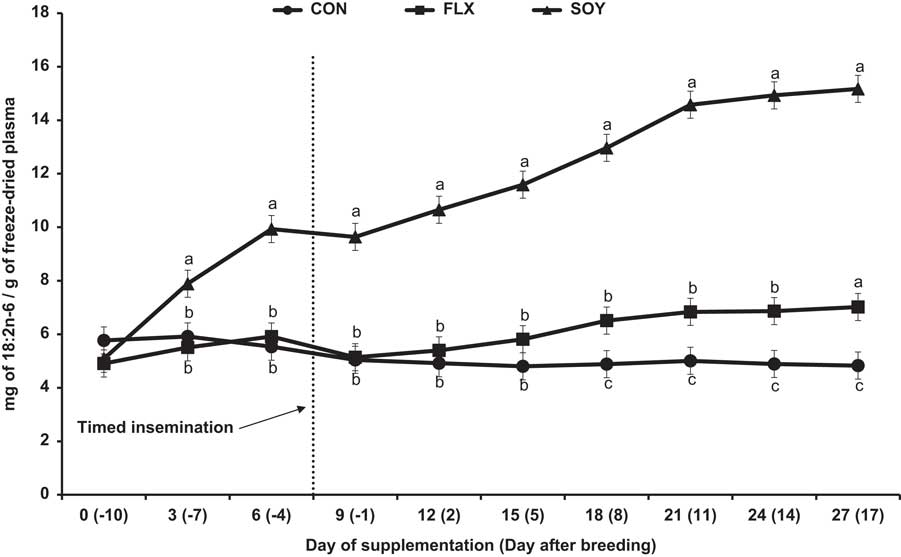
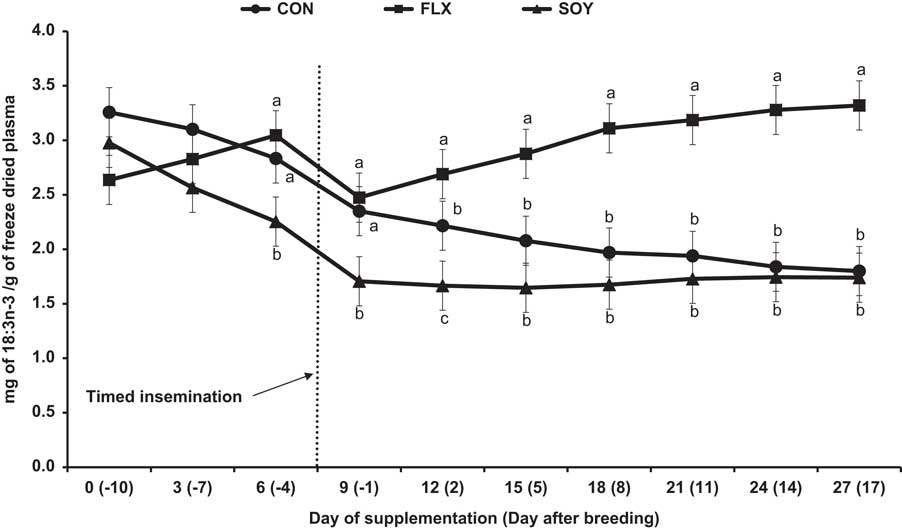
There was a treatment×day interaction for all plasma fatty acids measured (P⩽0.05) with the exception of 20:5n-3 (P=0.99). Plasma concentrations of 18:2n-6 increased (P=0.001) above that of CON and FLX after 3 days of supplementation (Figure 1). Whereas, flax-fed cattle did not exhibit elevated plasma 18:2n-6 concentrations above CON until day 18 (P=0.02). Plasma concentrations of 18:3n-3 was greater (P<0.001) for FLX compared with CON or SOY by day 15 and remained elevated for the duration of the study (Figure 2). Despite higher 18:3n-3 intake for SOY compared with CON, plasma concentrations for 18:3n-3 tended to be lower by day 6 (P=0.07) and were lower (P=0.04) by day 9 for SOY than CON. This difference was short lived and by day 12 plasma concentrations of 18:3n-3 only tended (P=0.09) to differ from CON.
Effects of short-term oilseed supplementation to grazing beef cows before breeding on plasma concentrations of 18:2n-6 over time (treatment×day: P<0.001; s.e.=0.51). a,b,c=Means within day differ if superscript is not the same (P<0.05).

Effects of short-term oilseed supplementation to grazing beef cows before breeding on plasma concentrations of 18:3n-3 over time (treatment×day: P<0.001; s.e.=0.23). a,b,c=Means within day differ if superscript is not the same (P<0.05).

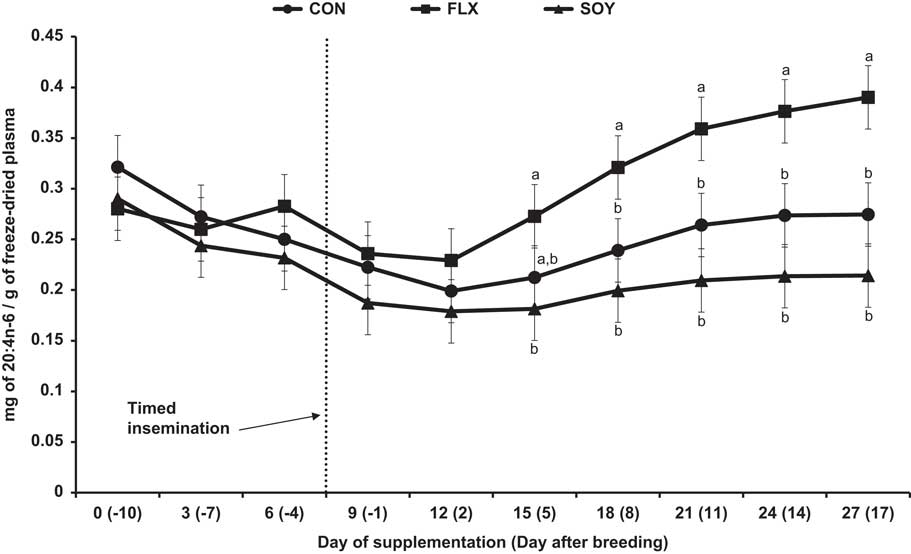
Plasma concentrations of 20:4n-6 for cattle fed whole flaxseed tended to differ (P=0.07) from CON and differed (P=0.04) from SOY by day 18 (Figure 3). Cattle fed flaxseed continued to have elevated plasma concentrations of 20:4n-6 above SOY (P=0.01) 8 days past the end of supplementation. Plasma concentrations of total unsaturated fatty acids (TUFA) increased by day 6 for SOY whereas additional flaxseed did not increase (P=0.08) plasma TUFA concentrations until day 15 (data not shown). Total plasma fatty acid concentration was greater for SOY by day 6 (P⩽0.04) when compared with either FLX or CON (data not shown). Not until day 18 did plasma concentrations of total fatty acids differ (P=0.04) between FLX and CON.
Effects of short-term oilseed supplementation to grazing beef cows before breeding on plasma concentrations of 20:4n-6 over time (treatment×day: P=0.20; s.e.=0.01). a,b,c=Means within day differ if superscript is not the same (P<0.05).

Cow blood metabolites
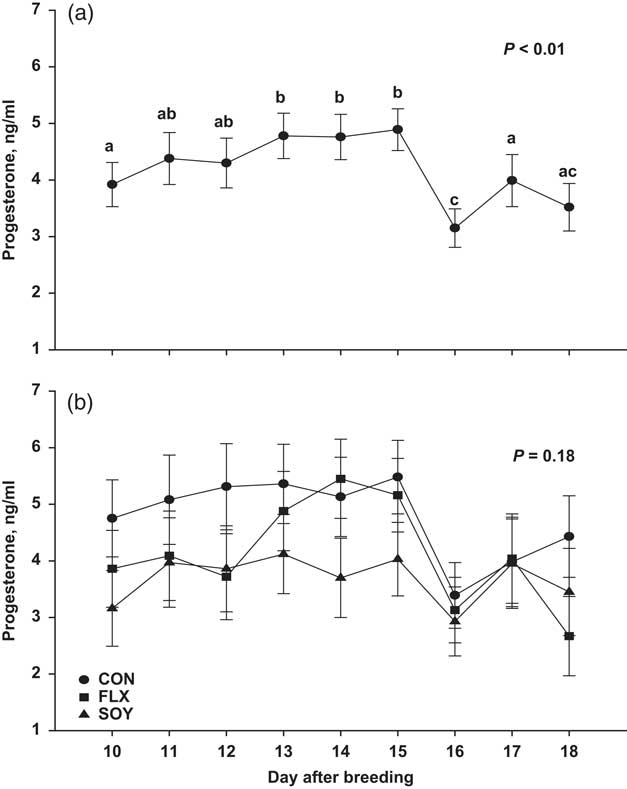
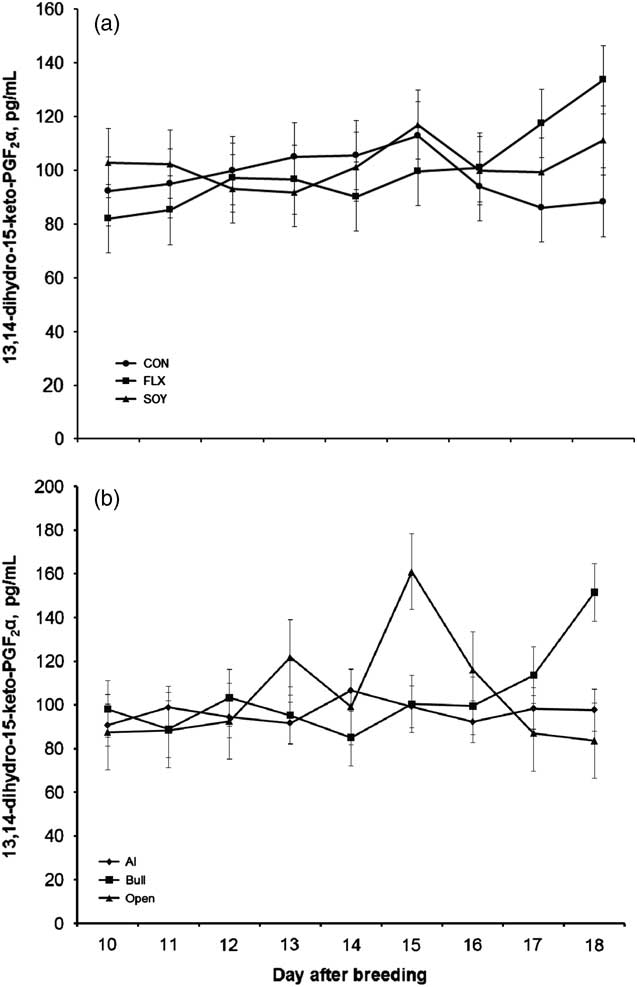
No treatment×day interaction (P=0.18) was observed for serum progesterone (Figure 4). However, serum concentrations increased (P=0.01) until day 15, declined on day 16 and remained lower until day 18. There was a tendency for a treatment×day interaction (P=0.07) for plasma concentrations of NEFA (data not shown). Further, fat-supplemented cows had lower plasma NEFA (P<0.001) compared with CON. Plasma PGFM was not different over time and treatment (treatment×time P=0.81; Figure 5). However, the plasma concentrations of PGFM expressed as the percentage change from day 10 to 18 after breeding did differ (P=0.04) between FLX and SOY on day 17 and 18 (data not shown) with FLX being greater than SOY.
(a) Main effects of day on plasma progesterone in lactating beef cows (P<0.01; s.e.=0.45). (b) Effects of oilseed supplementation on plasma concentrations of progesterone (treatment×day: P=0.18; s.e.=0.79). a,b,c=Means within day differ if superscript is not the same (P<0.05).

(a) Effects of short-term oilseed supplementation to grazing beef cows before breeding on plasma concentrations of 13,14-dihydro-15-keto-PGF2 α over time in lactating beef cows (treatment×day: P=0.81; s.e.=18.1). (b) Serum concentrations of 13,14-dihydro-15-keto-PGF2 α in beef cows conceiving to artificial insemination, bull or not at all (Conceived to×day: P=0.06; s.e.=17.3). a,b,c=Means within day differ if superscript is not the same (P<0.05).

Discussion
The estimated reduction in forage intake with fat supplementation was expected based on previous reports (Schauff and Clark, Reference Schauff and Clark1992; Scholljegerdes and Kronberg, Reference Scholljegerdes and Kronberg2008 and Reference Scholljegerdes and Kronberg2010) where forage intake was reduced with oilseed supplementation compared with unsupplemented controls. Assuming cows experienced a similar reduction in forage intake as cannulated heifers in this experiment; the high-energy content of the fat supplements compensated for lower forage intake, thereby allowing for the improvement in growth performance. This was further substantiated by the fact that serum NEFA did not differ between FLX and SOY, which were lower than CON.
The observed increase in plasma concentrations of 18:2n-6 in the current experiment has been previously reported by others where beef heifers were infused with soybean oil (Filley et al., Reference Filley, Turner and Stormshak1999) or beef cows were fed cracked high-linoleate safflower seeds (Scholljegerdes et al., Reference Scholljegerdes, Lake, Weston, Rule, Moss, Nett and Hess2007). Despite the fact that cattle fed whole flaxseed had higher 18:2n-6 intake compared with CON, it took 18 days for any differences in plasma concentration of 18:2n-6 to develop. Cattle fed whole soybeans saw an increase within 3 days over that of CON and FLX. It is not completely clear as to why there is a different lag phase between these two oilseeds. Supplementary data from the cannulated heifers would indicate that total tract DM digestibility did not differ (P=0.96) between SOY and FLX. Therefore, the difference was not likely because of the variation in digestibility between flaxseed and soybeans.
As expected, cattle fed flaxseed had higher plasma concentrations of 18:3n-3 by day 15 compared with the other treatments. This difference remained high until day 35. Despite greater 18:3n-3 intake for SOY compared with CON, plasma concentrations of 18:3n-3 was lower for SOY compared with CON. We speculate that the reduction in plasma concentration is owing to greater extent of ruminal biohydrogenation of 18:3n-3 from whole soybean than that originating from the forage.
Based on our hypothesis, we expected plasma concentrations of 20:4n-6 to be lower for FLX than SOY because SOY has greater concentrations of 18:2n-6, which is a precursor for the production of 20:4n-6. Furthermore, 18:3n-3 has been shown to be a potent inhibitor of 20:4n-6 production (Mattos et al., Reference Mattos, Staples and Thatcher2000). Nevertheless, lower plasma concentrations of 20:4n-6 in cattle fed whole soybeans may indicate that 18:2n-6 concentrations observed herein were sufficient to cause a reduction in 20:4n-6 production, as reported previously (Kaduce et al., Reference Kaduce, Spector and Bar1982; Jenkins, Reference Jenkins1988), while the plasma concentrations of 18:2n-6 observed for FLX stimulated 20:4n-6 production. This is contrary to what we would have expected because 18:3n-3 will compete with 18:2n-6 for the Δ-6 desaturase enzyme thereby inhibiting 20:4n-6 production. However, because of the extensive biohydrogenation of 18:3n-3 observed in previous work in our laboratory where Scholljegerdes and Kronberg (Reference Scholljegerdes and Kronberg2008) reported that 83% of dietary 18:3n-3 was biohydrogenated when beef cows were consuming a forage-based diet. Therefore, the amount of 18:3n-3 reaching circulation may not have been sufficient to significantly inhibit 20:4n-6 production. The challenges associated with extensive biohydrogenation have been addressed by others with the use of ruminally protected fatty acids. Specifically, in their review, Jenkins and Bridges (Reference Jenkins and Bridges2007) reported successful protection of fatty acids from biohydrogenation using several methods including prilling, calcium soaps of fatty acids, formaldehyde treatment and fatty acyl amides. Therefore, results could have differed if ruminally protected sources of linoleic and linolenic acid were provided in the diet. However, the goal of this experiment was to assess the use of readily available fat sources (oilseeds) to the vast majority of beef producers, who would wish to develop their own ration using commodity feedstuffs.
Greater plasma concentrations of TUFA for cattle fed the SOY supplement was because of a 41.5 g/day increase in TUFA intake over that of FLX. Nevertheless, both supplements increased plasma TUFA concentrations, which have important implications to cow reproduction because increased intake of unsaturated fatty acids has been associated with improvements in reproductive success (Staples et al., Reference Staples, Burke and Thatcher1998).
This supplementation program was developed to coincide with a specific estrous synchronization protocol and provide certain nutrients at key time points during AI and pregnancy establishment. Specifically, it was our goal to provide a flush of energy in the form of fatty acids in order to improve the energy status of the cow, which has been shown to improve cow fertility (Dunne et al., Reference Dunne, Diskin, Boland, O’Farrell and Sreenan1999) with additional benefits being obtained from supplying key essential fatty acids. The improvement in ADG indicates that we were indeed able to improve energy status of the animal regardless of plasma fatty acid composition over that of CON. In addition to a flush of energy, oilseeds provided 18:2n-6 or 18:3n-3, which has been shown to improve follicular development (Thomas et al., Reference Thomas, Bao and Williams1997; Robinson et al., Reference Robinson, Pushpakumara, Cheng, Peters, Abayasekara and Wathes2002) around the time of breeding (day 10). Although we realize that plasma fatty acid composition only gives a brief picture of what fatty acids are circulating in the blood at the time of sampling, it would appear that whole soybeans do a better job of supplying 18:2n-6, TUFA and total fatty acids by day 10 or the day of timed AI than whole flaxseed.
A second major objective of this experiment was to provide increased levels of 18:2n-6 or 18:3n-3 around the time of maternal recognition of pregnancy (around day 15 and 16 post-AI). It is not clear whether an increased supply of 18:2n-6 is beneficial to reproduction, because results of an increasing tissue supply of 18:2n-6 are equivocal. Specifically, PGFM concentrations have been shown to increase (Filley et al., Reference Filley, Turner and Stormshak1999; Robinson et al., Reference Robinson, Pushpakumara, Cheng, Peters, Abayasekara and Wathes2002) or decrease (Burke et al., Reference Burke, Carroll, Rowe, Thatcher and Stormshak1996; Cheng et al., Reference Cheng, Robinson, Pushpakumara, Mansbridge and Wathes2001) with additional 18:2n-6 supply. Elevated levels of prostaglandin after insemination have been linked to an increase in early embryonic mortality because of shortened estrous cycles (Burke et al., Reference Burke, Carroll, Rowe, Thatcher and Stormshak1996). Serum concentrations of progesterone did not differ across treatment; however, day had a significant impact. Namely, on day 16 after breeding, serum progesterone dropped drastically from day 15. This was likely because of the slight numeric increase in plasma PGFM observed on day 15. Overall, PGFM concentrations did not differ by treatment and day, however, the difference observed for percentage change of concentrations of plasma PGFM on days 17 and 18 coincide with the increased plasma concentration of 20:4n-6 observed for FLX. This is in contrast to previous work where increasing the supply of n-3 fatty acids has been shown to decrease prostaglandin metabolite production (Mattos et al., Reference Mattos, Guzeloglu, Badinga, Staples and Thatcher2003; Petit and Twagiramungu, Reference Petit and Twagiramungu2006). The primary differences between the current experiment and published literature is likely the type of cattle used, in that most work with n-3 fatty acids was conducted with dairy-type cattle and various high-quality rations.
Conclusions
In the current experiment, both oilseeds increased the circulating levels of 18:2n-6, whereas only flaxseed increased the circulating levels of 18:3n-3 around the time of maternal recognition of pregnancy. Unfortunately, flaxseed also increased the circulating levels of 20:4n-6 around the time of maternal recognition of pregnancy, which is a precursor for prostaglandin synthesis. This increase in 20:4n-6 may have a negative impact on embryonic survival.
Using whole soybeans in a ‘flushing’ protocol during estrous synchronization and breeding may improve reproductive success more so than whole flaxseed. However, it is important to note that plasma fatty acid concentration does not necessarily reflect the fatty acid composition of reproductive tissues (Scholljegerdes et al., Reference Scholljegerdes, Lake, Weston, Rule, Moss, Nett and Hess2007). Therefore, further investigation into the impact of level of these two oilseeds on reproductive hormone production is warranted.
Although pregnancy data in this experiment should be evaluated with caution owing to very low numbers, an interesting response with plasma PGFM and conception should be mentioned (Figure 5). Specifically, cows that were open after the breeding season (n=4) had a large spike in plasma PGFM on day 15. Whereas, cows that did not conceive to AI but did conceive to the bull (n=9) exhibited a gradual increase in plasma PGFM starting on day 17. Finally, cows that conceived to timed AI (n=11) had plasma PGFM concentrations that remained relatively flat throughout the feeding period. To our knowledge, we are the first to report PGFM data in this way. Although the numbers are too low to make any substantial conclusion, it does suggest that more work to investigate the use of PGFM as a potential tool for early pregnancy diagnosis may be warranted. Because of the extensive biohydrogenation of our two fat sources, a future direction would be to use very long-chain fatty acids such as EPA or DHA to provide improved reproductive results. First, increasing the level of EPA and DHA has been reported to reduce biohydrogenation of these fatty acids (Dohme et al., Reference Dohme, Fievez, Raes and Demeyer2003). Furthermore, fat sources that contain these n-3 fatty acids do not contain appreciable amounts of the n-6 fatty acids and will be metabolized by mammalian tissue to the 3-series prostaglandins compared with the 2-series because of competition for the Δ-6 desaturase responsible for producing PGF2 α from linoleic acid. The use of very long-chain unsaturated fatty acid such as EPA and DHA have been shown to improve the reproductive success in cows (Santos et al., Reference Santos, Bilby, Thatcher, Staples and Silvestre2008) when compared with shorter-chained unsaturated fatty acids and the use of these fat sources would have likely improved the reproductive responses observed.
Acknowledgments
The authors wish to thank Lindsey Voigt, Gordon Jensen, Faye Kroh, Clay Erickson and Dr Scott Kronberg for their assistance with animal care.