Introduction
Besides the cognitive aspects, clinicians often encounter complex disorders of affect and behavior in patients with Alzheimer's Disease (AD), also known as behavioral and psychological signs and symptoms of dementia (BPSD) that are responsible for increased rates of hospitalization, increased morbidity, caregiver stress, and cost of care. The prevalence of these symptoms varies according to the disease stage, the specific population studies, as well as the study context. Applying the Neuropsychiatric Inventory (NPI) to an American population of patients with AD, Mega et al. (Reference Mega, Cummings, Fiorello and Gornbein1996) found that 88% of participants with AD had BPSD, of which apathy was the most frequent, reported to occur in 29% to 72% of patients with AD (Cummings, Reference Cummings1997; Benoit et al., Reference Benoit1999; Lyketsos et al., Reference Lyketsos, Steinberg, Tschanz, Norton, Steffens and Breitner2000; Reference Lyketsos, Lopez, Jones, Fitzpatrick, Breitner and DeKosky2002).
What is apathy?
Apathy has been defined as the absence or lack of feeling, emotion, interest, concern, or motivation not attributable to a decreased level of consciousness, cognitive impairment, or emotional distress (Marin, Reference Marin1990). Starkstein and colleagues (Reference Starkstein, Petracca, Chemerinski and Kremer2001) have proposed diagnostic criteria of apathy which specify the following as the core features of apathy: diminished motivation, diminished initiative and interest, and blunting of emotions. In a recent paper, (Robert et al., Reference Robert2009) by a group of experts with international representation, apathy is defined as a disorder of motivation that persists over time and should meet the following requirements: diminished motivation must be present for at least four weeks; second, two of the three following items (reduced goal-directed behavior; reduced goal-directed cognitive activity, and blunting of emotions) should also be present. Last but not least, there should be functional impairments which can be identified and be attributed to apathy. For a review of all proposals of diagnostic criteria, please see (Robert et al., Reference Robert2009; Mulin et al., Reference Mulin2011).
Apathy is also encountered in several neuropsychiatric disorders; it is present in up to 90% of patients with fronto-temporal dementia, dementia with Lewy bodies, and progressive supranuclear palsy, 40% of those with cortico-basal degeneration, and 20% of those with Parkinson's disease (Cummings et al., Reference Cummings, Diaz, Levy, Binetti and Litvan1996; Cummings, Reference Cummings1997). Some degree of apathy is observed in brain injuries and cerebrovascular lesions concerning frontal lobes and is related in large degree to lesion location (Marin, Reference Marin1990; Cummings et al., Reference Cummings, Diaz, Levy, Binetti and Litvan1996).
Apathy in dementia
In AD, apathy has been associated with reduced daily functioning, caregiver distress, and poor outcome (Landes et al., Reference Landes, Sperry, Strauss and Geldmacher2001). Apathy frequently complicates the course and management of dementia by contributing to functional disability and self-neglect (Landes et al., Reference Landes, Sperry, Strauss and Geldmacher2001) and seems to be prevalent in elderly people even with milder forms of cognitive impairment in clinic-based (Drijgers et al., Reference Drijgers, Verhey, Leentjens, Köhler and Aalten2011) and community-based (Lyketsos et al., Reference Lyketsos, Lopez, Jones, Fitzpatrick, Breitner and DeKosky2002; Onyike et al., Reference Onyike2007; Clarke et al., Reference Clarke, Ko, Lyketsos, Rebok and Eaton2010) samples. The results of a study by Onyike et al. (Reference Onyike2007) suggest that apathy is an early sign of cognitive decline and that delineating phenotypes in which apathy and a mild cognitive syndrome co-occur may facilitate earlier identification of individuals at risk for dementia. The notion emerges of mild cognitive impairment (MCI) plus apathy phenotype that progresses to dementia (Bruen et al., Reference Bruen, McGeown, Shanks and Venneri2008), and it is also possible that apathy precedes MCI.
It should also be underlined that elderly people identified as having apathy are more likely than elderly people who do not have apathy to have impairments in executive domains of cognitive function and be referred for behaviors evoking embarrassment (Ott et al., Reference Ott, Noto and Fogel1996; Politis et al., Reference Politis, Mayer, Passa, Maillis and Lyketsos2004). These impairments are reported to increase considerably the burden of caregivers (Landes et al., Reference Landes, Sperry, Strauss and Geldmacher2001; Politis et al., Reference Politis, Mayer, Passa, Maillis and Lyketsos2004). Caregivers also commonly misinterpret the loss of motivation and engagement as a sign of emotional disturbance or oppositional behavior, leading to additional caregiver distress and dissatisfaction with caregiving (Landes et al., Reference Landes, Sperry, Strauss and Geldmacher2001). Clinicians should always bear in mind that assessment of apathy is important in identifying which patients and families will require additional support and care.
Apathy and depression
Apathy and depression may share some clinical features, such as loss of interest, reduced activity or anhedonia (Landes et al., Reference Landes, Sperry, Strauss and Geldmacher2001), but may have a different pathophysiology and treatment (Landes et al., Reference Landes, Sperry, Strauss and Geldmacher2001; Holthoff et al., Reference Holthoff2005; Kang et al., Reference Kang2012). Differentiating among symptoms of depressed mood, apathy, anhedonia, or anergia is sometimes difficult because of the overlap in clinical features (Lavretsky et al., Reference Lavretsky2008). Clinicians should always bear in mind that these clinical entities may be hard to discern or even coexist (Landes et al., Reference Landes, Sperry, Strauss and Geldmacher2001; Lyketsos, Reference Lyketsos2007; Robert et al., Reference Robert2009). When apathy and depression co-occur, patients may present with symptoms resistant to treatment as usual and so alternative treatment plans may be in order (Robert et al., Reference Robert2009).
The underlying mechanisms responsible for apathy
Motivational circuitry of the brain includes such important structures as the nucleus accumbens, ventral pallidum, and ventral tegmental area with projections to the amygdala, hippocampus, basal ganglia, motor cortex, and anterior cingulate. A more profound state of psychomotor retardation and apathy, or abulia can result from strokes that disrupt fronto-subcortical pathways, such as anterior cingulate and capsular lesions (Lavretsky et al., Reference Lavretsky2008). The concept of apathy is a common feature of prefrontal and basal ganglia lesions or dysfunctions (Mega and Cummings, Reference Mega and Cummings1994; Levy and Dubois, Reference Levy and Dubois2006). It seems that in patients who present apathy the capacity of the frontal cortex to select, initiate, maintain, and shift programs of action is undermined (Levy and Dubois, Reference Levy and Dubois2006). Levy and Dubois (Reference Levy and Dubois2006) propose that the underlying mechanism responsible for apathy is disruption of “emotional-affective” processing probably related to lesions in orbitofrontal cortex (OFC) and related limbic territory, and/or disruption in “cognitive” processing probably related to lesions in the dorsolateral prefrontal cortex and the related caudate nucleus and/or disruption in “autoactivation” processing probably related to lesions in the associative and limbic areas of globus pallidus.
With regard to dementia, Lyketsos proposes that apathy is an aspect of executive dysfunction syndrome (Lyketsos et al., Reference Lyketsos, Rosenblatt and Rabins2004), and is probably caused by damage to frontal-subcortical brain circuits (Craig et al., Reference Craig1996; Benoit et al., Reference Benoit1999).
Apathy is correlated with neuronal loss, higher tangle counts, and white matter hyperintensities in areas that are thought to be essential components of these frontal-subcortical circuits (Benoit et al., Reference Benoit1999; Robert et al., Reference Robert2006). Functional imaging studies find that apathy in AD is associated with hypoperfusion in regions that are involved in frontal-subcortical networks (Craig et al., Reference Craig1996; Ott et al., Reference Ott, Noto and Fogel1996; Benoit et al., Reference Benoit1999). In a study by Marshall et al. (Reference Marshall, Fairbanks, Tekin, Vinters and Cummings2006) involving 29 autopsy subjects with AD, chronic apathy and total NPI composite scores correlated with anterior cingulate neurofibrillary tangle (NFT) counts. The authors proposed that this analysis suggests that chronic apathy in AD correlates with a greater anterior cingulate NFT burden and that chronic behavioral changes are more reflective than acute changes of disease pathology. In a similar study by Tekin et al. (Reference Tekin2001) involving 31 autopsy patients with AD, increasing apathy was also related to greater NFT burden in the anterior cingulate.
Methods
The method we followed was to identify relevant neuroimaging studies from an extensive electronic search from the databases included in the National Library of Medicine for “apathy and dementia” (926 results), as well as PsychInfo and Google Scholar. Further papers for inclusion were identified by searching the references of retrieved papers and by checking the Cochrane library. Papers that involved patients with dementia other than AD or that did not report a specific outcome measure of apathy were excluded. All papers were read in full and their level of evidence and outcome were assessed by all the authors.
Results
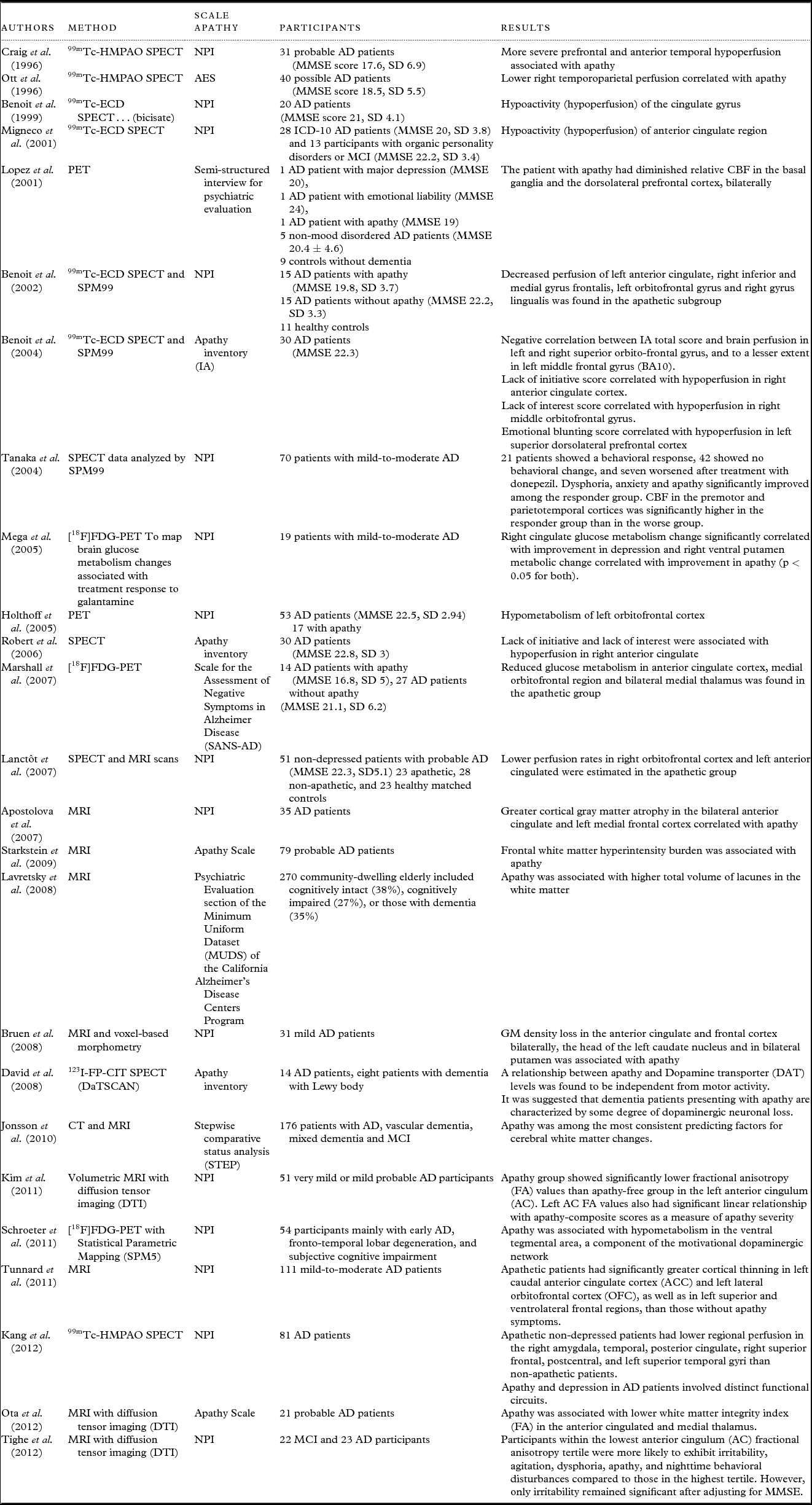
With regard to neuroimaging, several studies have tried to identify the brain areas involved with apathy in AD (see Table 1). Among these studies, ten were conducted with the use of single-photon emission computed tomography (SPECT; Craig et al., Reference Craig1996; Ott et al., Reference Ott, Noto and Fogel1996; Benoit et al., Reference Benoit1999; Reference Benoit, Koulibaly, Migneco, Darcourt, Pringuey and Robert2002; Reference Benoit, Clairet, Koulibaly, Darcourt and Robert2004; Migneco et al., Reference Migneco2001; Tanaka et al., Reference Tanaka2004; Robert et al., Reference Robert2006; David et al., Reference David2008; Kang et al., Reference Kang2012), five with the use of positron emission tomography (PET; Lopez et al., Reference Lopez, Zivkovic, Smith, Becker, Meltzer and DeKosky2001; Holthoff et al., Reference Holthoff2005; Mega et al., Reference Mega2005; Marshall et al., Reference Marshall, Monserratt, Harwood, Mandelkern, Cummings and Sultzer2007; Schroeter et al., Reference Schroeter2011), one with combined use of MRI and SPECT (Lanctôt et al., Reference Lanctôt2007), six with MRI scans (Apostolova et al., Reference Apostolova2007; Bruen et al., Reference Bruen, McGeown, Shanks and Venneri2008; Lavretsky et al., Reference Lavretsky2008; Starkstein et al., Reference Starkstein, Mizrahi, Capizzano, Acion, Brockman and Power2009; Jonsson et al., Reference Jonsson, Edman, Lind, Rolstad, Sjögren and Wallin2010; Tunnard et al., Reference Tunnard2011), and three with diffusion tensor imaging (DTI; Kim et al., Reference Kim2011; Ota et al., Reference Ota, Sato, Nakata, Arima and Uno2012; Tighe et al., Reference Tighe2012). In these studies, apathy was evaluated in 15 of them with the NPI (Craig et al., Reference Craig1996; Benoit et al., Reference Benoit1999; Reference Benoit, Koulibaly, Migneco, Darcourt, Pringuey and Robert2002; Migneco et al., Reference Migneco2001; Tanaka et al., Reference Tanaka2004; Holthoff et al., Reference Holthoff2005; Mega et al., Reference Mega2005; Apostolova et al., Reference Apostolova2007; Lanctôt et al., Reference Lanctôt2007; Bruen et al., Reference Bruen, McGeown, Shanks and Venneri2008; Kim et al., Reference Kim2011; Schroeter et al., Reference Schroeter2011; Tunnard et al., Reference Tunnard2011; Kang et al., Reference Kang2012; Tighe et al., Reference Tighe2012), in three with the apathy inventory (IA) (Benoit et al., Reference Benoit, Clairet, Koulibaly, Darcourt and Robert2004; Robert et al., Reference Robert2006; David et al., Reference David2008), in two with the Apathy Scale (Starkstein et al., Reference Starkstein, Mizrahi, Capizzano, Acion, Brockman and Power2009; Ota et al., Reference Ota, Sato, Nakata, Arima and Uno2012), in one (Ott et al., Reference Ott, Noto and Fogel1996) with the Apathy Evaluation Scale (AES), in one (Lopez et al., Reference Lopez, Zivkovic, Smith, Becker, Meltzer and DeKosky2001) with a semi-structured interview for psychiatric evaluation, in one (Marshall et al., Reference Marshall, Monserratt, Harwood, Mandelkern, Cummings and Sultzer2007) with the Scale for the Assessment of Negative Symptoms in Alzheimer Disease (SANS-AD), in one (Jonsson et al., Reference Jonsson, Edman, Lind, Rolstad, Sjögren and Wallin2010) with the Stepwise comparative status analysis (STEP), and finally in one (Lavretsky et al., Reference Lavretsky2008) with the Psychiatric Evaluation section of the Minimum Uniform Dataset (MUDS) of the California Alzheimer's Disease Centers Program.
Review of neuroimaging studies of apathy in Alzheimer's disease

99mTc-HMPAO SPECT = (Technetium-99m)-hexamethyl-propylene-aminoxime single-photon emission computed tomography; ECD = ethyl cysteinate dimer; [18F]FDG-PET = 2-deoxy-2-[18F]fluoro-D-glucose positron emission tomography; 123I-FP-CIT = (Iodine-123)-fluoropropyl-carbomethoxy-iodophenyl-tropane (123I-Ioflupane); MRI = magnetic resonance imaging; NPI = Neuropsychiatric Inventory; AES = apathy evaluation scale; MMSE = Mini-Mental State Examination; AD = Alzheimer's disease; MCI = mild cognitive impairment; CBF = cerebral blood flow.
Studies with SPECT
In a study by Craig et al. (Reference Craig1996), the use of technetium-99m-HMPAO SPECT, within three months of administration of the NPI, in 31 probable AD patients (mean MMSE score 17.6, SD 6.9; range 0–27) indicated that the presence of apathy was associated with severer prefrontal and anterior temporal dysfunction. These regional cerebral perfusion relationships with apathy were independent of cognitive decline except in the dorsolateral prefrontal cortex. The authors concluded that their findings are consistent with similar ones previously reported in other disorders. In a technetium-99m-HMPAO SPECT study conducted by Ott et al. (Reference Ott, Noto and Fogel1996) in 40 possible AD patients (MMSE score 18.5, SD 5.5), the presence of apathy (evaluated with the AES) was associated with decreased right temporoparietal perfusion. In this study, problem behaviors were highly correlated with apathy and were not with general cognitive impairment as measured by the Mini-Mental State Examination (MMSE). Therefore, the authors suggested that attention to motivation may provide the clinician with a useful indicator of patients who will need close attention to behavior management. Benoit et al. (Reference Benoit1999) have used the NPI to examine BPSD. Sixty-three French patients (mean age 74.7 years, SD 7.9) with a MMSE score higher than 10 were examined. BPSD were detected by the NPI in 95.2% of the patients. The highest frequency severity NPI score was observed for apathy. Twenty of these AD patients underwent a technetium-99m-bicisate SPECT protocol within the same week as the NPI evaluation. The mean age of this population was 74.4 years (SD 5.3) and the mean MMSE score was 21 (SD 4.1). The apathy NPI score was correlated with right cingulate deficit whereas the highest correlation for the MMSE was with the left temporoparietal area. This study by Benoit underlined the close relationship between apathy and hypoactivity of the cingulate gyrus (Benoit et al., Reference Benoit1999). In the study by Migneco et al. (Reference Migneco2001), forty-one participants were studied. According to ICD 10 diagnostic criteria, 28 patients had AD and 13 had organic personality disorders or MCI not attributable to dementia. Apathy was evaluated with the NPI. Patients were divided into two symptomatic subgroups: apathetic or non-apathetic. Brain perfusion was measured by 99mTc-labeled bicisate (ECD) brain SPECT and the images were compared using Statistical Parametric Mapping (SPM96). Twenty-one participants were apathetic (14 in the group with dementia and seven in the group without dementia) and 20 were not apathetic (14 in the group with dementia and six in the group without dementia). The study by Migneco et al. (Reference Migneco2001) included AD participants but also patients with other cognitive disorders at the time of evaluation, such as MCI or organic personality disorders and whatever the stratification (whole population, participants with dementia only, or participants without dementia only), the common feature of the apathetic subgroups was always the anterior cingulate hypoperfusion. The authors underline that cingulate hypoperfusion is more anterior in participants with dementia than in apathetic participants without dementia. However, in both cases, hypoperfusion was located in the same region of the cingulate called the cognitive effector region. The aim of the study by Benoit et al. (Reference Benoit, Koulibaly, Migneco, Darcourt, Pringuey and Robert2002) was to evaluate brain perfusion of AD patients with and without apathy (as determined by the NPI) compared with that in healthy elderly participants. Fifteen AD patients without apathy (mean age 76.6) and 15 AD patients with apathy (mean age 77.6) were studied. Brain perfusion was measured by 99mTc-labeled bicisate (ECD) single-photon emission computed tomography (ECD SPECT). The images of the two AD subgroups were compared by means of SPM99 to corresponding images of 11 healthy elderly control participants. Compared with the healthy elderly participants, the apathy-free AD subgroup had significantly lower perfusion of inferior temporal regions (left fusiform gyrus, left parahippocampal area) and occipital regions (left gyrus lingualis). The apathy subgroup had significantly decreased perfusion of the left anterior cingulate, the right inferior and medial gyrus frontalis, the left orbitofrontal gyrus and the right gyrus lingualis. The authors suggested that the differences in the brain areas with reduced perfusion between the apathy-free participants (mainly the posterior regions) and the apathetic participants (mainly the anterior regions) indicate that behavioral disorders such as apathy participate in the heterogeneity of brain perfusion in AD. The results confirmed the significant cingulate hypoperfusion in apathetic AD patients compared with healthy control participants, but not compared with apathy-free AD patients. In the study by Benoit et al. (Reference Benoit, Clairet, Koulibaly, Darcourt and Robert2004), 30 AD patients were included. Lack of initiative, lack of interest and of emotional blunting were assessed with the IA, a tool designed to provide a separate assessment of the behavioral, cognitive and emotional, aspects of apathy. Brain perfusion was measured by 99mTc-labeled bicisate (ECD) SPECT. The Statistical Parametric Mapping software provided negative correlation between IA total score and brain perfusion in left and right superior orbitofrontal gyrus, and to a lesser extent in left middle frontal gyrus (BA10). Lack of initiative score was negatively correlated with perfusion in right anterior cingulate cortex (ACC). Lack of interest score was negatively correlated with perfusion in right middle orbitofrontal gyrus. Emotional blunting score correlated negatively with in left superior dorsolateral prefrontal cortex activity. The correlation observed (Benoit et al., Reference Benoit, Clairet, Koulibaly, Darcourt and Robert2004) between AI total score and bilateral frontal hypoperfusion confirms previous brain imaging studies in AD which have suggested relationships between apathy and abnormal perfusion in the frontal cortex and in the cingulate area (Craig et al., Reference Craig1996; Benoit et al., Reference Benoit1999; Migneco et al., Reference Migneco2001). Moreover, anterior cingulate area hypoperfusion is reported to specifically relate apathy regardless of the presence of dementia (Migneco et al., Reference Migneco2001)
It was also demonstrated that, compared with healthy participants, the apathetic AD patients had significantly decreased perfusion in the anterior cingulate, the inferior and medial gyrus frontalis, and the orbitofrontal gyrus (Benoit et al., Reference Benoit, Koulibaly, Migneco, Darcourt, Pringuey and Robert2002). Tanaka et al. (Reference Tanaka2004) conducted a study with SPECT (data were analyzed with SPM 99) in order to assess the efficacy of donepezil in 70 patients with mild-to-moderate AD. Among the 21 patients who responded to treatment with donepezil apathy as well as dysphoria and anxiety significantly improved. Cerebral blood flow (CBF) in the premotor and parietotemporal cortices was significantly higher in the responder group than in the worse group. Robert et al. (Reference Robert2006) used SPECT to measure brain perfusion. Thirty-one AD patients were included. Lack of initiative and interest were assessed with the IA. Nineteen AD participants presented a lack of initiative and interest pathological score whereas 12 AD participants did not. The lack of initiative and interest score correlated significantly with altered perfusion in the right frontal and the right inferior temporal lobes. The AD patients with lack of initiative and interest showed a significantly lower perfusion in the right anterior cingulate than the AD patients without lack of initiative and interest. The authors propose that although these results derive from rather small subgroups of patients but have the interest to dismantle the complementary aspects of emotion and motivation in apathy and suggest that the latter one is more related to cingulate area. David et al. (Reference David2008) used 123I-FP-CIT (DaTSCAN) SPECT in 14 AD patients and eight patients with dementia with Lewy body. A relationship between apathy and Dopamine transporter (DAT) levels was found independent from motor activity. It was suggested that dementia patients presenting with apathy are characterized by some degree of striatal dopaminergic neuronal loss. Kang et al. (Reference Kang2012) conducted a study with 99mTc-HMPAO SPECT in 81 AD patients. Apathetic non-depressed patients had lower perfusion in the right amygdala, temporal, posterior cingulate, right superior frontal, postcentral, and left superior temporal gyri than non-apathetic patients. Apathy and depression in AD patients were found to involve distinct functional circuits.
Studies with PET
In a study by Lopez et al. (Reference Lopez, Zivkovic, Smith, Becker, Meltzer and DeKosky2001), one patient with apathy, who was examined with the use of PET, was found to have diminished rel-CBF in the basal ganglia and dorsolateral prefrontal cortex, bilaterally (Lopez et al., Reference Lopez, Zivkovic, Smith, Becker, Meltzer and DeKosky2001). Apathy was assessed with a semi-structured interview for psychiatric evaluation. Holthoff et al. (Reference Holthoff2005) examined 53 patients with AD (MMSE 22.5 ± 2.94 points). Of all symptoms, apathy and depression were most frequently encountered. The patient group with apathy (n = 17) revealed significant cerebral glucose metabolism decreases in left orbitofrontal regions when compared with patients free of apathy. Depression of clinical significance (n = 10) was associated with hypometabolism in dorsolateral prefrontal regions. The authors propose that these findings lend support to the notion that different functional circuits underlie apathy and depression in early AD. According to the authors, in early disease, functional deficits in the specific pathway involved in apathetic symptoms are detectable in orbitofrontal regions first and that dysfunction in additional circuit members becomes apparent as disease progresses or more behavioral symptoms emerge. Mega et al. (Reference Mega2005) conducted a study with Fludeoxyglucose F 18 PET in order to map brain metabolism associated with treatment response to galantamine in 19 patients with mild-to-moderate AD. Right cingulate metabolic change significantly correlated with improvement in depression and right ventral putamen metabolic change with improvement in apathy (p < 0.05 for both). In the study by Marshall et al. (Reference Marshall, Monserratt, Harwood, Mandelkern, Cummings and Sultzer2007), forty-one participants with probable AD underwent [18F] fluorodeoxyglucose positron emission tomography imaging and neuropsychiatric and cognitive assessments. Apathy was assessed with the global subscale scores from the SANS-AD. Twenty-seven (66%) participants did not have apathy, whereas 14 (34%) had apathy. Statistical Parametric Mapping analysis revealed significantly reduced metabolic activity in the bilateral anterior cingulate region extending inferiorly to the medial orbitofrontal region (p < 0.001) and the bilateral medial thalamus (p = 0.04) in participants with apathy. The results of the Statistical Parametric Mapping analysis remained the same after individually co-varying for the effects of global cognitive impairment, depressed mood, and education. The authors propose that the current study extends this distinction to regional brain function and suggests that neurobiologic correlates of apathy in AD are independent of depressed mood and delusional thoughts. Finally, the authors suggest that these results reinforce the confluence of evidence from other investigational modalities in implicating medial frontal dysfunction and related neuronal circuits in the neurobiology of apathy in AD and other neuropsychiatric diseases. In the study by Schroeter et al. (Reference Schroeter2011), FDG-PET data analyzed with Statistical Parametric Mapping (SPM5) were obtained from 54 participants mainly with early AD, fronto-temporal lobar degeneration, and subjective cognitive impairment. Apathy was related to the ventral tegmental area, a component of the motivational dopaminergic network.
Studies with SPECT and MRI
In the study by Lanctôt et al. (Reference Lanctôt2007), SPECT and MRI scans were obtained from 51 non-depressed outpatients meeting criteria for probable AD (age 77.6 ± 6.6 years; MMSE 22.3 ± 5.1; 23 apathetic, 28 non-apathetic) and 23 healthy elderly (75.6 ± 3.8 years) controls. Relative to non-apathetic AD patients, apathetic AD patients had lower perfusion in two regions of interest (ROIs; right OFC and left anterior cingulate) and higher perfusion in five ROIs (right and left hippocampi, left medial superior temporal gyrus, and right and left medial temporal cortex). Comparison of regional cerebral blood flow in these seven ROIs to those of healthy elderly controls confirmed hypoperfusion in the left anterior cingulate and right OFC and suggested a relative sparing of perfusion among apathetic AD patients in the remaining five ROIs.
Studies with MRI
Apostolova et al. (Reference Apostolova2007) analyzed magnetic resonance imaging data of 35 AD patients with and without apathy. There was a significant linear association between apathy severity and cortical gray matter (GM) atrophy in the bilateral anterior cingulate (Brodmann area (BA) 24; r = 0.39–0.42, p = 0.01) and left medial frontal cortex (BA 8 and 9; r = 0.4, p < 0.02). Left mean cingulate cortical thinning predicted the presence/absence of apathy at the trend level of significance. The authors propose that their findings demonstrate a strong association between apathy and the integrity of medial frontal regions in AD. Starkstein et al. (Reference Starkstein, Mizrahi, Capizzano, Acion, Brockman and Power2009) obtained three-dimensional MRI scans from 79 patients with probable AD. Patients with apathy showed a significantly larger volume of frontal white matter hyperintensities than patients without apathy. Patients with depression had a significantly larger volume of right parietal white matter hyperintensities than patients without depression. However, neither apathy nor depression was significantly associated with lobar gray or white matter atrophy. The authors propose that frontal and right parietal white matter hyperintensities were the strongest brain structural correlates of apathy and depression in AD. In the study by Lavretsky et al. (Reference Lavretsky2008), 270 community-dwelling older adults underwent MRI and the distribution of cognitive status included cognitively intact (38%), cognitively impaired (27%), or those with dementia (35%). Forty-one percent of the patients were classified as having subcortical lacunes. Depressed mood, anhedonia, anergia, and apathy apparent at the time of assessment were assessed using Psychiatric Evaluation section of the MUDS of the California Alzheimer's Disease Centers Program. Participants with neuropsychiatric symptoms were more likely to be cognitively impaired or having dementia than those without neuropsychiatric symptoms. In multivariate models controlling for cognitive status, age, gender, and education, higher lacunar volume in white matter was independently associated with the presence of all four neuropsychiatric symptoms. The authors argue for an association between the lacunar volumes in the white matter and depressed mood, anhedonia, apathy, and anergia, thus supporting the role of subcortical ischemic vascular disease in the pathogenesis of late-life neuropsychiatric disorders. Bruen et al. (Reference Bruen, McGeown, Shanks and Venneri2008) used voxel-based morphometry to correlate GM derived from T1-weighted MRI images of 31 patients with mild AD and specific neuropsychiatric symptoms and behaviors were assessed with the NPI. Delusions were associated with decreased GM density in the left frontal lobe, in the right frontoparietal cortex, and in the left claustrum. Agitation was associated with decreased GM values in the left insula, and in ACC bilaterally. Neuropsychiatric symptoms of AD seem to associate with neurodegeneration of specific neural networks supporting personal memory, reality monitoring, processing of reward, interoceptive sensations, and subjective emotional experience. Apathy was associated with GM density loss in the anterior cingulate and frontal cortex bilaterally, the head of the left caudate nucleus, and in bilateral putamen. The authors propose that although AD research has largely concentrated on the study of cognitive decline, the associated behavioral and neuropsychiatric symptoms are of equal importance in the clinical profile of the disease. Jonsson et al. (Reference Jonsson, Edman, Lind, Rolstad, Sjögren and Wallin2010) conducted a study using CT and MRI scans in 176 patients with AD, vascular dementia, mixed dementia and MCI. Apathy was among the most consistent predicting factors for cerebral white matter changes. In the study by Tunnard et al. (Reference Tunnard2011), MRI scans were used to assess 111 mild-to-moderate AD patients. Apathetic patients had significantly greater cortical thinning in left caudal ACC and left lateral OFC, as well as left superior and ventrolateral frontal regions, than those without apathy symptoms.
Studies with DTI
Fifty-one very mild or mild probable AD participants were assessed with volumetric magnetic resonance imaging and DTI (Kim et al., Reference Kim2011). Volume of interest analyses were performed to compare regional fractional anisotropy (FA) between apathy and apathy-free group, and to test a linear relationship between regional FA and apathy severity. Apathy was assessed by the NPI. Apathy group showed significantly lower FA values than apathy-free group in the left anterior cingulum (AC), regardless of concomitant depression and psychotropic medications. Left AC FA values also had significant linear relationship with apathy-composite scores as a measure of apathy severity, even after controlling for GM density of the ipsilateral ACC. The authors suggested that communication failure between the ACC and other brain structures via the AC contributes to the development and aggravation of apathy in AD. In the study by Ota et al. (Reference Ota, Sato, Nakata, Arima and Uno2012), the association between apathy and white matter integrity (FA index) was examined with the use of DTI in 21 AD patients in a voxel-based morphometry manner. Apathy was found to be associated with impaired white matter integrity in the anterior cingulated and medial thalamus. The authors proposed that these results lend support to previous investigational findings that implicate limbic dysfunction and related neuronal circuits in the neurobiology of apathy in AD. Finally, in the study by Tighe et al. (Reference Tighe2012), involving 22 MCI and 23 AD patients, participants within the lowest AC FA tertile were more likely to exhibit irritability, agitation, dysphoria, apathy, and nighttime behavioral disturbances compared to those in the highest tertile. However, in the multivariate model, after adjusting for MMSE, only irritability remained significant.
Discussion
The present neuroimaging findings lend support to the notion that apathy in patients with AD is correlated with alterations in structure and function within distributed frontal-subcortical networks.
Most of the studies described in this review involve the ACC. The ACC (Brodmann areas 24, 32) has major reciprocal or afferent connections with the OFC (Brodmann areas 10, 11, 47), other limbic areas and basal ganglia (Mega et al., Reference Mega, Cummings, Salloway and Malloy1997). A crucial function of the ACC relates to the initiation and motivational drivers for goal-directed activities, particularly when these are effortful, and damage to this cortical structure would likely, therefore, lead to a degree of behavioral and cognitive inactivity (Allman et al., Reference Allman, Hakeem, Erwin, Nimchinsky and Hof2001). Kim and colleagues (Reference Kim2011) found that apathy in AD is associated with microstructural alteration of the AC, left side in particular, independently of concomitant depression, psychotropic medications, and ACC GM changes. They proposed that communication failure between the ACC and other brain structures via the AC contributes to the development and aggravation of apathy in AD, supporting the general notion of disconnection syndrome for clinical manifestation of AD.
Orbitofrontal area seems to be another brain area associated with apathy in AD. Wallis (Reference Wallis2007) proposed that the OFC integrates sensory, affective, and motivational information to derive potential reward outcome values in a model study of neuronal mechanisms underlying decision-making in the prefrontal cortex. A recent model by Guimaraes et al. (Reference Guimaraes, Levy, Teixeira, Beato and Caramelli2008) proposes that the ACC and the OFC are part of a broader frontostriatal circuit, which is involved in decision-making. Specifically, these regions are proposed to be involved in evaluating action and outcomes and, via the basolateral amygdala and nucleus accumbens, feed into an ascending frontostriatal pathway to the dorsolateral prefrontal cortex, which is responsible for selecting and executing behavioral responses. Damage to the ACC and OFC leads to a disruption of this circuit resulting in impaired decision-making and impaired response initiation, which presents as apathy. There is evidence of high levels of apathy subcortical disease, such as Parkinson's disease, resulting from dysfunction at the striatal level, though Tunnard et al. (Reference Tunnard2011) with their recent study suggest than in AD the locus of dysfunction is at the cortical level, namely the ACC and OFC. However, other researchers (Bonelli and Cummings, Reference Bonelli and Cummings2007) consider that the dysfunction of the OFC circuit results in disinhibition syndromes while it is the dysfunction of only the ACC circuit which is responsible for the presentation of apathy. Future neuroimaging studies should aim to elucidate this controversy.
Apart from these two brain areas, there were reports of hypoactivity in prefrontal, anterior temporal, right temporoparietal, right inferior and media frontal gyrus, right gyrus lingualis and subcortical structures among others being associated with apathy in AD. The heterogeneity of the results is owed to numerous effects such as the differential neurobiological process that mediates disease features, the stage at the time of study, the individual brain characteristics and factors pertaining to the imaging procedures followed (type of scanner used, data processing workup, results reporting), study design issues, and the apathy measuring method. It is important to note the inherently indirect relationship between the image signal and the neurobiological process being studied, as well as the variable anatomical correspondence for a given imaging modality (e.g. FA in regions of highly crossing white matter tracts).
Apathy seems to be prevalent both in AD and MCI (Cummings et al., Reference Cummings, Diaz, Levy, Binetti and Litvan1996; Lyketsos et al., Reference Lyketsos, Steinberg, Tschanz, Norton, Steffens and Breitner2000; Reference Lyketsos, Lopez, Jones, Fitzpatrick, Breitner and DeKosky2002; Onyike et al., Reference Onyike2007). It is of great importance to assess and diagnose as sooner as possible apathetic elderly patients within the community since it is proposed that the wider recognition of apathy and its association with mild cognitive syndromes could facilitate earlier diagnosis of dementia (Onyike et al., Reference Onyike2007). Apart from the use of pertinent scales like the NPI, the AES, the IA, the Apathy Scale, etc., the generalization of neuroimaging techniques might be able to offer help in this domain. It should be noted that methodological issues such as the degenerative disease state at the time of study, study population and study design, may confound the assessment of apathy. However, statistical differences should be interpreted with caution given the lack of an integrated knowledge about the structures involved as well as the uncertainty whether the changes represent a primary (due to neuropathology) or secondary (due to pathology effects) process. Despite existing evidence, the pathophysiology of apathy has not been clarified yet. Longitudinal imaging data to add means to cross-sectional results and to integrate the understanding of apathy, although at the expense of cost, are lacking. Tracking changes to make disease trajectories, especially in multisite samples, which is also correcting for the individual brain imaging variation, will broaden the existing knowledge, and along with the use of evolving imaging techniques and image analysis tools, should inform neural network models of apathy and its neurodegeneration and psychiatric co-morbidity. Identifying patterns of timewise quantitative neurobiological information may provide a more solid frame of apathy, and may allow to inferring on various critical issues, namely what is apathy as a distinct syndrome, the association between apathy and neurodegenerative diseases, so to allow predictions, and to test imaging markers for disease and treatments.
Accumulative evidence on the diverse role of ACC and related cortical structures will inform more sophisticated study designs of apathy with the use of neuroimaging, and multimodal assessment studies are in this line. Furthermore, etiopathological studies applying the modern tools of brain imaging, genetics, and neuropathology (Lyketsos, Reference Lyketsos2007) should continue examine the brain correlates of apathy.
Conflict of interest
None.
Description of authors’ roles
CT designed the review and wrote the paper. AP and SK assisted with the writing of the paper. AP and CL supervised the whole process.