Communities around the globe came in contact more routinely and with greater intensity from the sixteenth century onwards. European mariners figured centrally in this dynamic, embodying a new plebeian cosmopolitanism in their habits and their dress, becoming notable agents of change when on shore. These men complicated material hierarchies, shaping the development of western consumer societies, devising material practice unique among plebeian men. In this article, I address their complex cultural agency over the long eighteenth century. The trade route to Asia held particular allure, and about two million men sailed from Europe to Asia in the three centuries after 1500, with half that number returning. Mortality rates varied from 27 to over 50 percent among European crews rounding the Cape of Good Hope, putting the risks of seafaring in perspective.Footnote 1 Hazards were great, as were the dreamt-of rewards. England had a few thousand mariners around the year 1600. But growing mercantile and imperial zeal swelled the population of long-distance seafarers to about 60,000 by 1750, sailing to every compass point.Footnote 2 This was a dynamic period for Britain, as Linda Colley observes, a time when “Imperial greed gave it interests and investments in every . . . ocean and continent.”Footnote 3 Sailors served this agenda, as well as their own. The cultural impact of these men on British society was infinitely greater than numbers alone can tell.
Merchant capitalists and joint-stock companies have been minutely studied for their economic roles in overseas trade.Footnote 4 We must now focus on the ways plebeian men figured in these circuits for they innovated new consumer habits and reshaped societies generally. The catalytic roles of mariners have not received sufficient attention in studies of the remaking of the early modern material environment in Europe and colonial environs. The cultural model of new-style masculinity they provided also demands greater notice. Mariners are routinely cast as essential (sometimes heroic) labor for military, merchant, and fishing fleets, a too-frequent source of social disruption, raucous with a tendency to riot if pressed.Footnote 5 Marcus Rediker describes eighteenth-century Anglo-American mariners as plain dealers, wageworkers, and pirates, as well as “men of the world.”Footnote 6 Military, naval, and seafaring ventures exerted a powerful influence on the understanding of manliness in this era, during seemingly endless imperial conflicts. Yet, as Karen Harvey notes, there is too little attention paid to the nature of these masculinities in eighteenth-century Britain, particularly when compared to the plethora of studies on genteel and middling politeness.Footnote 7 Explorations of this new mode of masculinity are a key theme of this work. Members of this distinctive international work force also functioned as intermediates between world communities—agents of new tastes, instigators of new fashions, the personification of manly nautical endeavor in Britain's burgeoning imperial age. They sampled the world's exotic goods and shared their pleasures with home-loving Britons, reshaping domestic material culture.
Foundational studies of early modern British consumer behavior emphasized the roles of genteel and middle-ranked men and women, especially those in dealing trades. These groups commonly owned and bequeathed fashionable consumer wares in distinctive ways, and their tendencies have been creatively and exhaustively researched.Footnote 8 But we must also recognize agency of a different sort. As I demonstrate here, deep-sea, long-distance mariners were exceptional exponents of consumer innovation in different milieu. Their amphibious lives enabled them to shape plebeian consumer patterns on shore, expanding material networks and defining new trends among their peers. They also claimed material authority in advance of mainstream fashion, showing a mutinous disdain for sumptuary custom. Social theorist Gabriel Weimann identifies the role of “influentials,” “the people who influence other people,” recognizing that this power is not exclusive to one social group or sector.Footnote 9 Weimann notes key factors in the fashion process that can be shaped by “influentials” such as invention, fashion leadership, and the social visibility of new material forms that achieve legitimacy through the social authority of influential advocates in their communities.Footnote 10 Mariners were “influentials” in this foundational era of global trade. They were undoubtedly subjects of social emulation locally and more widely, as popular media of the day captured their generative activities. They shaped important systems of exchange and redefined channels of material culture unique in the early modern world. Their catalyst roles are revealed in this study.
MARINERS, MASCULINITY AND THE POLITICS OF MATERIAL CULTURE
I study a hybrid group—with the exception of senior officers, almost the full complement of ships' crews—to capture the lifecycle patterns of those on board.Footnote 11 The challenge is to understand the roles played by these men beyond their defining physical labor, to include the wider cultural complex of their amphibious worlds. Mariners fit some, but by no means all, categories of early modern manhood. They were exceptional in their recurring absences from home, for example, precluding a normative adulthood that came with marriage, family life, and the steady masculine governance of households.Footnote 12 They lived transient lives, somewhat like peddlers, another suspect group in this era. But their unorthodox ventures were sanctioned on several grounds. “Getting money” was one of men's primary duties and a successful voyage could bring rewards beyond the hopes of routine employment.Footnote 13 Moreover, while sea voyages took men away from homes and families, the social structure of their work environment was recognized for its positive attributes. Maritime missions relied on massed male contingents, emphasizing fraternal bonds, a hallmark of the seafaring life, with a powerful allegiance among shipmates and sometimes equally powerful fidelity to captains. Fraternal groups took many forms in martial, religious, and secular settings, and were esteemed, as Alexandra Shepard notes, “not least because many adult men recognized and even endorsed the potent meanings of manhood to which it was linked.”Footnote 14 Crewmates figured as surrogates for friends and family ashore, despite the potential for punishing shipboard discipline.
For seafarers, manliness was expressed in the skills of seamanship, combined with the stoic endurance necessary during inevitable trials, plus loyalty to crewmates and perhaps even to superiors. As Rediker states: “The chances for survival improved markedly as the ship's company became an effective, efficient collectivity, bound together in skill, purpose, courage, and community.”Footnote 15 Furthermore, there was always the possibility of promotion through the ranks, which was the norm, as the attributes of seamanship trumped politeness and privilege. Material benefits were thus within reach for some, another hoped-for reward that sustained.Footnote 16 Tests of manhood came with exceptionally long and dangerous journeys that included the challenge of resisting excesses once in port, a test too often failed. Sailors were notorious for intemperance in port, behavior largely accepted by their captains in compensation for the rigors they endured at sea. Episodic drunkenness and sexual dissipation colored the reputation of seafaring males.Footnote 17 Thus, the traits displayed by the growing ranks of deep-sea long-distance mariners reflected some, but by no means all, the norms of early modern English manhood. The other features that distinguished these men (some shared with soldiery) were tied to the geopolitical ambitions of their nation.
The era after 1500, following direct European oceanic contact with Asia and the Americas, produced what R. W. Connell terms “a [new] recognizable masculine cultural type in the modern sense.” This new male ideal and practice arose within the tumult of unprecedented imperial and mercantile ventures headed by European nations. “Empire was a gendered enterprise,” as Connell notes, “initially an outcome of the segregated men's occupations of soldiering and sea trade.”Footnote 18 England (later Britain) was somewhat late in the hunt for territorial empire and mercantile riches, compared to her Iberian rivals who, along with the Dutch and French, were ever-present competitors. Imperial advantage was hotly contested, most particularly after 1660 as colonial footholds were consolidated and merchant profits accrued.Footnote 19 Military men shared some of the cosmopolitan experiences of their nautical brothers and their repeated trials in the crucible of conflict distinguished both from civilians.Footnote 20 Loot was another perquisite beloved of seafarer and soldier, who rejoiced at windfalls.Footnote 21 Land-based and sea-based forces also shared experience within regulated hierarchical structures, where new attention to training and disciplined group action redefined everyday life. But while some characteristics were common among those who served on land and sea, there were also distinct differences. Most crucially, no soldiers enjoyed routine access to the most desirable commodities as did long-distance sailors; nor were soldiers routinely compensated through private trade as a component of their wages. Mariners developed distinctive traits in thinking and culture as a result of their material opportunities, consumer practice, and global travels, traits ultimately celebrated during the long eighteenth century. They personified a new category of manly engagement.
Like their land-based cousins, seafarers were enveloped in webs of customary obligation and reciprocity that in their case bridged cultures and regions, land and sea. Early modern society as a whole relied on routine nonmonetary exchange and pawning, which often involved a deep dependence on textiles and clothing as alternate currencies.Footnote 22 These practices formed the wider framework for seafaring life, where further traditions prevailed. The ships themselves were spaces of compound and at times conflicting economic cultures, all of which were in transition.Footnote 23 Fernand Braudel describes a “triple division” of early modern economic activity: the market economy of rural industry, artisanal production, small shops, and fairs, which he saw as the middle level of activity; below this was “a shadowy zone . . . lying underneath the market economy” where barter and alternate currencies flourished, enabling life and petty enterprise; and soaring above these two zones at an “exalted level” was international capitalism, powering long-distance commerce.Footnote 24 Seamen functioned according to precedents founded on each of these systems within their vessels' wooden walls, acquiring, using, and disposing of goods to realize priorities, with exchange networks that intersected with the developing money wage. This context and the goods they handled are critical. Seamen navigated the spaces between administrative fiats and customary routines, defending the “social wage,” a perquisite that defined maritime laboring expectations.Footnote 25 The goods they acquired, the spaces they traversed, their patterns of material acquisition, and their lives once on shore defined these men.Footnote 26
Uncovering the dynamics of the material world is a task well known to historians. A general consensus has emerged on several points. First, locality mattered. Significant variations in resources distinguish one region from another, as well as urban from rural locales in different time periods.Footnote 27 Social rank complicated regional variation.Footnote 28 Craig Muldrew illustrates the differences in earnings and comfort that typified early modern English rural laborers. Research indicates the slow process of material improvement and the gradual accumulation of consumer goods in the 1600s and 1700s.Footnote 29 Gender also played a major role in material practice and expressions of fashion, with recent research emphasizing middle ranked men's gifting, buying, and deployment of goods.Footnote 30 Jan de Vries notes the measurable transformations in this period in his important interpretation of changing material life in early modern northwest Europe and colonial America, where laboring women and children powered the “industrious revolution.”Footnote 31 Evidence for a broad, slow material amelioration is overwhelming, with regional and occupational variants. “Industrious” women and children were vital in this project, but were not the only catalyst population. This study identifies additional agents in the change process, emphasizing not only an exceptional male occupational group, but also the shore-based precincts where their influence abounded.
Mariners complicate accepted hypotheses surrounding plebeian material change and pose important questions about their roles as innovators. They saw and routinely bought things in global ports, trading, gifting, and using these items. The cumulative scale of their traffic was modest when measured against the private trade of ships' captains, or official cargo. But the cultural force of their actions, within their distinct networks, carried weight that far exceeded the volume of their trade. For the items conveyed from distant locales were novel, imbued with social cachet; likewise, the new habits they modeled broke with custom. Asian textiles, ceramics, American tobacco, and the like were rarities in the first half of the seventeenth century, especially within laboring populations, becoming familiar comforts over generations. Attention to consumer practice is crucial to understand the variability among communities and the impact of collective interventions. As Frank Trentmann observes, “[p]ractices have a dynamic force of their own, creating sensations, competencies, and plans of doing more or doing things differently.”Footnote 32 Mariners were among the first group of laboring men to acquire and use what Jan de Vries terms “new luxuries,” goods infused with socially malleable properties that redefined sociability, cultivating new tastes, and enhancing economic activity. Mariners learned about goods like tobacco from indigenous Americans, for example, sharing and spreading the cultural and physical knowledge of its use from port to port and ocean to ocean.Footnote 33 They demonstrated the desirability of substances, some of which were previously unknown to Europeans. The spread of new commodities and the attendant societal transformations over this period have been studied intensely for several decades, most notably among the elite and middling ranks.Footnote 34 Jan de Vries observes of this process that: “for the first time on such a scale and on so enduring a basis, we find a society in which the potential to purchase luxuries and novelties extended well beyond a small, traditional elite and where the acquired goods served to fashion material cultures that cannot be understood simply in terms of [elite] emulation.”Footnote 35 Crews on countless voyages handled the bales, baskets, and barrels loaded on board and worked within zones of commercial possibilities, risking all for the chances founded in journeys to distance lands.
Mary Louise Pratt identifies the importance of what she terms “contact zones” in colonial and imperial encounters. She describes these zones as “social spaces where disparate cultures meet, clash, and grapple with each other.”Footnote 36 Her vantage point is the nineteenth and early twentieth centuries, yet the concept of contact zones applies in interesting ways to an earlier time when Europeans navigated spaces with less assurance, with routinely contested authority during different temporal spans. The sites where westerners anchored and where cargoes were laded represented critical contact zones for mariners, with days, weeks, or months spent mingling on shore, repeated over years, the stuff of seamen's lore. Similarly, the sea routes themselves figured as contact zones involving heterogeneous peoples and unscheduled events. Ships and shipping lanes themselves linked societies and cultures with crews of various ethnicities and backgrounds from Europe, Africa, America, and Asia.Footnote 37 These were the “space and time where,” as Pratt observes, “subjects previously separated by geography and history are co-present.” During the seventeenth and eighteenth centuries, Dutch, English, French, and other European vessels joined the Spanish and Portuguese in commercial contests. Pratt notes: “The term ‘contact’ foregrounds the interactive, improvisational dimensions of imperial encounters so easily ignored or suppressed by accounts of conquest or domination.”Footnote 38 Those who manned these ships were active as more than just laborers. Seamen saw marvels and savored the unfamiliar and while only some profited appreciably, through prizes seized or small ventures, all were touched by their travels. In turn, the shifting materialities of their lives crafted a new category of manliness within wider mercantile and imperial projects.
MARINERS, MATERIAL CULTURE, AND NEW MEN OF THE WORLD
Mariners' wills are revelatory, listing the things these men desired and acquired. The early wills from East India Company mariners sketch the range of items they secured, at a level of detail absent in later testamentary documents. This provides the frame for a more focused study of the period 1660–1760 of seamen on the East India routes, of eighteenth-century Atlantic privateers, and of mariners in the West Indies sea-lanes as well. Wills for men of such modest means are rare, as these documents were typically limited to those with estates valued over £5, at least in land-based communities. However, the Prerogative Court of Canterbury, which proved wills for large swaths of England and Wales, also included those who died overseas in its remit, including soldiers and sailors regardless of their resources.Footnote 39 Because wills were routinely prepared by seaman at the start of a voyage, they offer the historian the opportunity to gauge mariners' access to goods and, importantly, the circulation of bequests from those who did not return. I assessed 1,013 wills from the years 1600 to 1760, ending my sampling before the great naval contests in the later eighteenth century. This is a small percentage of all wills in the National Archives for “mariners” and other nautical trades.Footnote 40 But it is a robust sample of those traversing major trade routes, as for some periods in the 1600s I harvested all surviving Prerogative Court of Canterbury wills for these regions I could find. I focus closely on East India Company trade circuit as it is generally agreed that the new luxuries and semi-luxuries from Asia were among the most culturally influential goods of the early global era.Footnote 41 Aggregate data shows clear evidence of crewmen's commercial activities and their distinct material practices. Details of bequests generally become less precise from the late 1600s through the 1700s as pro forma terms became common and printed testamentary forms came into use.Footnote 42 Generic notations of “chattels,” “goods owned,” “worldly estate,” or “wages and sums of money” recur repeatedly through the 1700s, masking specifics that were evident in earlier documents. Fortunately, the distribution networks arising from bequests are well described, and evidence of seamen's private trade survives in other sources. In combination, the patterns and politics of this material culture are well defined, with vivid evidence of the risks seamen took for these rewards.
Wills from decedents on early voyages to India set the stage. Robert Double was termed “sailor” in his 1603 will, and out of his modest estate bequeathed one friend a pair of violet breeches, another a whole piece of blue [Indian] calico (20 to 30 feet in length), and a third eighteen dishes, most likely Chinese porcelain.Footnote 43 Bequests delineate the trade routes traveled, with goods such as “one looking glass 2 combs, 2 brushes and a case . . . bought at Venice.”Footnote 44 These belongings denote the items hunted out and judged on quality and price, dealing skills informally acquired, focused on things to trade, gift, or enjoy.Footnote 45 Evidence of commercial partnerships among shipmates recurs sporadically, the combined sums enabling speculation. The sailor Ottes Mason, for instance, partnered with a shipmate to buy “3 bundells of cheyney [China] dishes” that he ordered sold at the mast after his death. Auctioning goods at the mast was a customary way to dispose of dead men's wares, with bidding open to all, further dispersing items among ships' crews. The “20 poundes weight of cloves” and “6 pounde weight of mace” also among Mason's possessions were left to a brother living in one of London's Thames-side districts, “3 blue anchors in fishe street.” Mason worked within a complex web of partnerships and obligations, typical of early modern seamen.Footnote 46 Thomas Stelten was a gunner's mate and a resourceful veteran, investing eight shillings received from Anthony Lawrence, a carpenter on the Ascension: “to be by me employed in some commodities which is lawful to be carried home[,] which money I employed at Bantam in 2 peece of cheyney taffityes [taffeta] one red, one watchet [light blue], which cost me 10s.”Footnote 47
These men learned that the surest way to profit from a voyage was through private trade, a shipboard perquisite habitual in European merchant fleets and hotly defended by generations of seamen.Footnote 48 The crew expected “the customary right . . . to carry some cargo on their own account, possibly in their own quarters, but sometimes occupying part of the hold freight free.”Footnote 49 Merchant bodies like the East India Company (EIC) struggled to control their employees and were torn by conflicting impulses: on the one hand wanting to monopolize all profits from overseas voyages, while recognizing, on the other hand, that those risking their lives on these ships had to have incentives. This tension was never resolved. Initially, some in the company accepted the importance of allowing private ventures among ships' crews, with one official in Surat urging directors in London to accept sailors' enterprising ways for “if some toleration for private trade be not permitted, none but desperate men will sail our ships.”Footnote 50 By about 1700 the space allotted for private trade amounted to five tons outbound, with only three tons approved for the homeward passage, limits that grew sharply by mid eighteenth century to twenty-five tons outbound and fifteen on return. In general the EIC directors grudgingly accepted the private trade of their officers, within the limits of regulation.Footnote 51 Thus, all who sailed had a stake in the success of the voyage. As J. H. Parry wrote, “every man in a company ship . . . had his ‘privilege,’ his allotted space, according to rank, for the goods which he might purchase at one end and sell at the other.”Footnote 52 Aside from “privilege” the venture system also made space available to those who could pay freight charges.Footnote 53 The mariner Edward Barlow recorded his life at sea and his ambitions, recounting his activities in the port of Surat on the west coast of India as a “small venture for myself and some . . . friends . . . [with] some small commodities.”Footnote 54 Barlow came from a poor rural family in Lancashire and went to sea in the mid seventeenth century, hoping to earn his fortune, a common tale. He shared interests common among his shipmates—he was always attentive to potential commercial advantage, seeking opportunities at every port.
Private trade or “privilege” was a critical facet of seamen's connections between Europe and global trading zones like Asia; however, only the large ventures of commanders and senior officers have been systematically studied.Footnote 55 The value of this perquisite to early modern seamen was immense, shaping their priorities in every ocean, repayment for the extraordinary risks they faced on dangerous seas. Privilege and “venture” traffic (in addition to habitual smuggling by crew) inserted small, routine parcels among the great cargoes administered by merchant houses.Footnote 56 These informal addendums generated new material dynamics, allowing men with modest resources the possibility of profit, many collaborating with shipmates or investors back home to fund small projects.
The shipping lanes of the world's oceans were at best imperfectly monitored and never more than partially regulated, even by the most assiduous early modern corporations and governments. Seafarers worked to outwit regulatory regimes at every turn.Footnote 57 Some private trade items were hidden in ships' holds or seamen's chests and were likely included by testators under general designations of goods and chattel. However, sailors' aspirations are clear, evident in the things they acquired ranging from spices to textiles to china. A ship's carpenter included in his 1639 will “one small parcel of clothes which I had out of the Mullabarr Prize.”Footnote 58 Plunder from ships seized as prizes was another treasured source of wealth for all who sailed.Footnote 59 Prizes and private trade allowed seagoing men the chance to flourish, representing singular windfalls within large administrative ventures.Footnote 60 Another EIC crewman amassed an interesting miscellany in 1635, all in small quantities, with pieces of nutmeg and cinnamon, remnants of black and white silk, and an array of handkerchiefs.Footnote 61 Indian handkerchiefs became a staple of seamen's attire, produced in India in countless varieties, like the thirty handkerchiefs noted in another sailor's will in 1729. By the 1700s, these accessories were a ubiquitous part of plebeian dress, a global commodity defining occupational, ethnic, and gender performance among European, colonial, and enslaved peoples, whether worn round the neck, as head covering, or in cultural performance. They marked the dynamics of early modern empires and these adaptable, colorful accessories found buyers in virtually every port of call.Footnote 62 Handkerchiefs would sell; so it was little wonder that mariners attempted again and again to stash handkerchiefs for later resale once ashore.Footnote 63
The calculus of risk and reward shaped the seafaring environment where running goods ashore—in defiance of authorities—seemed a logical choice. The men making the reckoning worked within traditional early modern institutions to craft small-scale enterprise combining global and local commercial networks, features of their lives that defined them as much as their nautical skills. Entrepreneurship, along with seamanship in all its guises, characterizes the seafaring men of the long eighteenth century, confirmed in the surviving memoirs of seamen like Edward Barlow.
Barlow gives voice to the common mariner, as one of only a few men of that rank to record his life at sea and on land and his struggle to rise through the ranks. The son of a poor Lancashire husbandman, one of six children, Barlow learned to write in 1672 at age thirty, during his captivity in Batavia during the third Anglo-Dutch war. He chronicled routine voyages and life on shore from 1659 to 1703, also recounting his seaborne projects.Footnote 64 Barlow was sharply observant of local commodities and opportunities. In Tripoli in 1668, for example, on board a merchantman, he remarked on the “striped linen stuffs made here, and very fine dyed leather which is transported into Italy and Spain.”Footnote 65 Later in Sicily, Barlow found that silk stockings were “reasonable and cheap,” buying “five pairs of silk stockings for thirty shillings,” goods easy to sell or barter.Footnote 66 Like most people of the early modern period, sailors lived within a world where clothing had multiple uses and meanings. In one respect, a stock of clothes in a sea chest ensured personal health and survival. Slops, ready-made utilitarian garments, were stocked by ships' pursers and sold to crewmen as needed, the charges tallied up at the end of the voyage and subtracted from wages—a practice followed on merchant and naval vessels. These items offered more than practical comforts, however, as the clothes could be acquired onboard and then traded or sold once ashore. Clothing was negotiable.Footnote 67 Some mariners might drink up whatever they got from the onshore resale. Others sought profits through trade and exchange.Footnote 68 Unlike the land-based men and women who routinely bartered and pawned, bought and sold new and used clothes within a narrow geographic compass, nautical men benefited by travel between distant markets that brought risks and promises. The richly stocked material environment through which they moved encouraged experimentation and innovation of all sorts.
Historians have minutely detailed the mercantile and political strategies of long-distance European trading companies. We know the steps taken to formalize administrative structures and the characteristics of the polite, newly rich, middle ranked men.Footnote 69 But the hands working the ships at the vanguard of global capitalism also sought advantage where they could, acting on their own priorities. On Barlow's first trip to India in the 1670s, he detailed the mechanics of local trading and the well-established practice of the Gujarati merchants of Surat, in a contact zone founded on possibilities.Footnote 70 Barlow wrote:
As [m]any of us came on shore we were presently met with the countrymen which were called ‘Banyanes’, it being their custom that time of year, when ships come up thither, to come down from Surat, being ten miles distant, and bring their goods down to Swallow Road [Suhali], and there they have booths and tents built, which they live in all the time the ships tarry there: and their custom is to come to every man, inquiring what trade he hath to sell, and to see which one of them you will choose to be your merchant, to deal with you for what you have to sell or change for their commodities . . . They are all buyers and sellers, and many of them very rich, and they are apt to learn any language.Footnote 71
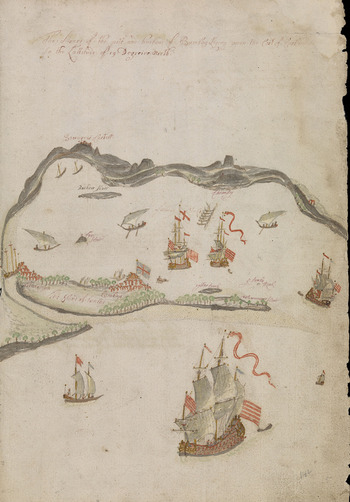
Suhali sands, the shoreline of the river leading to Surat, was a long-established locale for deal-making, one the EIC struggled to monitor, a contact zone with contending actors.Footnote 72 Early on the EIC president in Surat complained to London that “even at Swally Sands and under a court of guard they have found bales opened or clean carried away.” Alliances between local traders and “uncivil seamen” confounded this attempted policing.Footnote 73 New relationships developed in these contact zones and “improvisational” meetings took place, new tastes were acquired and desirable goods sought out, in defiance of rules. Administrators struggled to keep mariners in check, as crewmen learned the potential of each port of call. Over the late 1600s, Barlow visited many parts of the Caribbean, Europe, North Africa, and Asia. Figure 1 is Barlow's drawing of “the manner of the port and harbor of Bombay,” one of numerous sketches he made of the places he visited, some of which he knew intimately. While in China, seeing the array of merchandise and marveling at the local prices, Barlow railed against EIC embargos on buying certain goods for private trade. On one occasion “the China people came on board with commodities to sell, as tea, China roots, and fine earthenware, and wrought silk, which are . . . cheap and would have been good commodities in England.” The proximity of such wares fired ambition. And, like seamen before and after, Barlow schemed to circumvent edicts, denouncing the company that “will not suffer any man that sails in their ships, if they know it, to buy a pennyworth of goods of the same that they buy.”Footnote 74
“The manner of the port and harbour of Bombay: Liying upon the Cost [sic] of India.” Journal of Edward Barlow, 1659–1703. L3427-001. © National Maritime Museum, Greenwich, London.

Men like Barlow acquired worldliness distinct among working men, experiencing a rich medley of cultures, geographies, and peoples, very different from the gloss acquired by elite young men on their European Grand Tours. When Barlow's ship over wintered in Taiwan, he recorded various local customs, including the widespread use of fans and parasols by local elite men and women—fashion items that made their way to Europe.Footnote 75 Seamen paid dearly for their worldly education in the physical discipline of shipboard life, the wear on bodies subjected to punishing labor amidst the recurring perils of sickness, injury, captivity, and death, plus the whims of wind, weather, and officers. Barlow, like others of his kind, wanted more than his wages, seeking opportunities wherever he travelled. In 1694, in one of his most successful forays, the returning EIC ship anchored in Barbados, contrary to regulations. Many on that Caribbean island were happy to buy what the ships' crew offered, as “most of the gentry of the whole island came aboard of our East India ships to see . . . and to buy such things as we had and they wanted.”Footnote 76 Caribbean colonists were famously wealthy in this slave-based sugar-rich territory and lusted after fashionable Asian wares to express their status. And, although such direct trade was proscribed by statute, there were frequent contacts between returning ships from the East Indies and the colonists of the West Indies.Footnote 77
We know some of the goods that mariners' acquired from the details of their wills; but bequests took various forms. Money represented a significant category of bequest in my sample of wills, rising slightly over time. Table 1 demonstrates the comparative prominence of cash bequests. Material bequests annotated as furniture, jewelry, merchandise, linen, china, tobacco, clothing, and silver ware are stipulated only occasionally. Overall, the generic grouping “goods and chattels” represented the largest category of bequest at over 50 percent in wills from 1685 to 1699, declining to about 40 percent in mariners' wills from 1700 to 1729 and then increasing to over 47 percent from 1740 to 1760.
Bequests of Money by Testators

While money remained a significant category of bequest, the movement of goods remained more significant, even if we cannot always determine the nature of these items from the wills, as documents became more formulaic. Full pieces of textiles are rarely itemized in eighteenth-century wills, although they may well have made up part of the “goods and chattels” enumerated by testators. One enterprising EIC ship's carpenter held five varieties of cloth among his personal effects at death in 1729 returning from India, bolts of fabric of various kinds.Footnote 78 A fuller picture comes from ships' diaries kept by supercargoes on EIC passages to China, supercargoes being the officers tasked to manage company business affairs once in Canton (Guangzhou). On occasion documentation survives of the private trade carried by crew, the bulk of which belonged to captains and senior officers. However, supercargoes sometimes itemize the goods stowed onboard by junior officers and seamen. Tea and china predominated in the lists of private trade for seamen on the Winchester in 1738, men without honorifics appended to their names. The small scale of their purchases distinguish them from senior ranks: John Hoar, one box of tea, one box of china ware; William Cole, one tub of tea; Humphrey Rudd, one tub of tea; Robert Stonehouse, two boxes of china ware.Footnote 79 Seafaring men doubtless added to their cache by hiding smaller parcels in the customary way, to elude official detection. In December 1750, John Sutton, seaman on the Grantham carried a box of tea as private trade; Thomas Dale, the sixth mate had two boxes of tea and a box of chinaware for Samuel Torin, perhaps an investor in this venture. John Slacker, another seaman had three boxes listed to his credit, their contents unspecified.Footnote 80
Traffic in global shipping lanes increased decade by decade, as companies, ship owners, and crew labored to profit. For EIC servants, the spirit of “private trade” collided with company fiats that pinched. Barlow defended the tactics men like him employed, writing that it was “a very unreasonable thing that a poor man cannot have the liberty to dispose of what is his own [acquired on a voyage].”Footnote 81 He disputed the company's transcendent claims when they “gain all themselves and none to their servants.” These “hard measures” won no friends among those who served.Footnote 82 In the 1720s, the EIC further infuriated captains and crew when, for a time, their agents manipulated the London auctions where private trade goods were sold, forbidding outside merchants to bid, thereby ensuring the company bought cheaply and unopposed.Footnote 83 These policies, plus the fees and duties routinely added to legally landed goods, encouraged ruses to move private cargo ashore undetected.Footnote 84 The final leg of the long voyage offered the last best chance for surreptitious commerce, either by meeting smugglers' vessels in the Channel or by shifting cargo to watermen's craft when at anchor in port.Footnote 85 These routine wiles served all seeking to avoid company and customs agents.Footnote 86 Young seamen learned the tricks of seagoing peculation from commanding officers and shipmates, practicing “clandestine trade” on a small scale or large. The significance of this flow lay in the wider access to goods for plebeian men and women and at lower cost.Footnote 87
Occasionally, more malleable shore-based officials looked the other way when a plan was afoot, receiving “treats” and “presents” for their pains. John Spencer was charged with this offense in 1718. As an EIC “Surveyor of the River,” his responsibility was to ensure ships were lawfully cleared of cargo, thereafter deposited in company warehouses. Spencer stood accused of taking “several pieces of Stripes [cotton cloth] and a Large Quantity of Romall handkerchiefing, a Quantity of China . . . Cases of Tea and a present of Muslin” in payment for allowing bags of pepper sweepings from the hold to be run ashore. Spencer pleaded his innocence, although acknowledged that he previously received “Six China Plates, two pint Cups, and Six Bottles of Arrack [a South Asian liquor]” as gifts for other unspecified favors.Footnote 88 Simms, “a Bumboat Man at Deptford,” was given little credence at a hearing in the London Custom House where he alleged thefts by the ship's officers, as on previous occasions he was caught with contraband from an Indiaman, including “a Parcel of Muslin Handkerchiefs and some fans” as well as a “Bagg of Sea Shells containing 46 lb.”Footnote 89 Connections were forged between mariners of various ranks and men working as regulatory agents, or as watermen moving freight onshore, or as bumboat men provisioning anchored ships with fruit, sweets, and other dainties. These social ties are further illustrated in bequests by mariners to men in these jobs.Footnote 90 Inevitably such alliances involved reciprocity of one type or another. Working within a complex moral economy, mariners' credo blended a resistance to corporate regulation with a resourceful zeal, even if on occasion they were denominated “smugglers.”
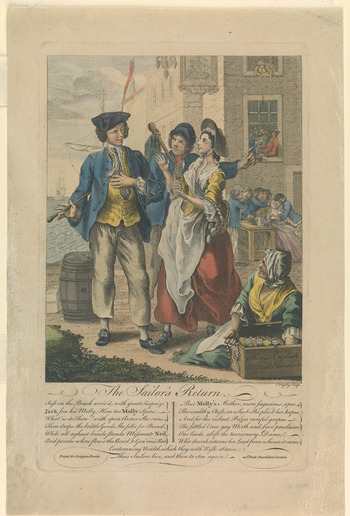
Despite frustrated attempts to regulate them, seamen were also celebrated for their role in the expansion of commerce and empire. In 1707 Lord Haversham proclaimed sailors' inestimable value before the House of Lords, a theme that echoed in the century ahead: “your trade is the mother and nurse of your seamen; your seamen are the life of your fleet, and your fleet is the security and protection of your trade, and both together are the wealth, strength, security and glory of Britain.”Footnote 91 Imperial trade was vital over the eighteenth century, for although Europe absorbed the greatest quantity of British exports, this market grew slowly. In contrast, Colley notes, “the commercial dynamism of the imperial sector . . . seemed boundless.”Footnote 92 The cultural prominence of mariners reached discernable heights by the early decades of the eighteenth century, recorded in novels, ballads, and material forms. Figure 2 is a mid-century depiction of “The Sailor's Return,” a motif repeated in ballads and novels, and deployed visually in popular prints and ceramic tiles, jugs, mugs, bowls, and figurines.Footnote 93 This was a potent theme, portraying a practice deeply familiar to port communities like Liverpool, where a tile maker produced tin-glazed tiles of this topic in the mid-1700s.Footnote 94Figure 2 shows the end of a successful voyage, evident in the shining buckles on the sailor's shoes and his full set of clothing. His handkerchief is in place, his shipmate is by his side, and his welcoming sweetheart is at his elbow, her mother scrabbling greedily in his treasures. “Thomas English” is the name stenciled on his sea chest; his East London neighborhood of “Old Wall” is also traced along with his occupation, “Privateer.”
The Sailor's Return, c. 1750 by Charles Mosley. PW3801. ©National Maritime Museum, Greenwich, London.

Seaborne trade needed defending in times of war, which also presented the chance to ravage enemy vessels. Merchants readily invested in privateering projects, enticing crews with the hope of prizes. The Admiralty issued 25,000 letters of marque for such ventures between 1689 and 1815, and privateering vessels accounted for 23 percent of the merchant fleet in those years.Footnote 95 Crewmen readily circulated between privateers, armed merchantmen and naval vessels, all on the lookout for prizes in times of war. A patriotic ethos pervades this image, suggesting the rewards to be won by plebeian men in defense of their nation.
Linda Colley observes the development of a “selective cult of heroism” in the vogue for paintings of military officers dying in the course of imperial campaigns, first illustrated in The Death of Wolfe (1770), reproduced in thousands of cheap prints. Colley suggests as well that there was an absence of “ordinary soldiers or seamen” in these salutes to imperial heroism.Footnote 96 However, prints based on the works of academicians were not the only visual tributes in circulation. Mariners figured conspicuously in inexpensive illustrated ballads, satires, and decorative wares. Their prominence demonstrates the wider cultural role served by this community, as hero and antihero, presenting a more complex combination of masculine traits than elite self-sacrificing valor. Images of mariners were created and deployed for national, political and commercial purposes, satirizing and celebrating plebeian men unburdened by polite restraints.Footnote 97 Moreover, the disruptive and disorderly traits common to seafaring men were often those most cherished by recipients of their largesse on shore. Enterprise by stealth or under arms infused the culture of seagoing men, who were warmly received by family and friends when they returned laden with goods, even if customs officials and corporate administrators looked at them askance. Images like “The Sailor's Return” stood as metonyms for countless unrecorded encounters that took place over generations, evidence of the cultural impact of these men, an effect that grew with the size of merchant and privateer convoys.
Sailors skimmed from rich commercial waters, whether hiding handkerchiefs in hammocks and sea chests, inserting parcels of handkerchiefs “between the Inside & Outside Plank of the Ship,” tossing parcels of muslin to waiting boats, or manning ships in “Clandestine Trade” across the world's oceans.Footnote 98 Common seamen took every occasion to acquire and dispose of goods wherever they could. So it was with Edward Barlow. In 1674, after imprisonment in Batavia and a fruitless journey back to Amsterdam, in the moments before crossing the Channel for home, Barlow bought “some small commodities for my own use and some to dispose of [when back in England].”Footnote 99 Mariners justified such initiatives given the perils they faced. Indeed, Edward Barlow thought his work “a calling which is accompanied by many crosses and calamities . . . one of the hardest and dangerourest callings I could have entered upon.”Footnote 100 Thus, subterfuge and discretion prevailed, rules were imperfectly enforced, and smuggling was the norm up and down the chain of command.Footnote 101 In this way ships' crews navigated regulatory waters. The culture that evolved over repeated voyages valued shipmates and custom, including fair perquisites that should come to the crew—claims that echo the sentiments of other laboring folk.Footnote 102 Typically there were debts among seamen's “goods, chattels and estate.” The unlucky could not amass more than wages and the contents of their sea chest, if that, and other seamen's chests were among the first targets of victorious privateers.Footnote 103 Nonetheless, the goods these men handled and the things they acquired are practically and discursively distinct for men of this rank. Recognizing this fact adds another dimension to the task outlined by Marcus Rediker decades ago: “[not simply] to ask . . . ‘what was done to these [maritime] working people?’ But rather, ‘what did these working people do for themselves and how did they do it?’”Footnote 104 Unsanctioned, hand-to-hand interactions took place on shore or over the ship's side, with seamen of every station striving to gain from their global contacts. The cumulative results of their agency were profound, for they invested their lives and their associates with exceptional resources, enriching shore-based societies in distinctive ways.
NETWORKS, NEIGHBORHOODS, AND NEW CHANNELS OF EXCHANGE
Mariners' networks and neighborhoods grew in tandem with the tide of seagoing men, whose needs when on shore included the goods and services provided by chandlers' shops, lodging houses, taverns, toddy shops, bawdy houses, secondhand dealers, victuallers, and pawnshops. The growth of international ports was a defining feature of this era, in Europe, Asia, and beyond.Footnote 105 The port of Aden was described by Francis Rogers, when his ship anchored there early in the 1700s: “The Buzza [bazaar] of this Citty is large containing abundance of Stalls & Shops, where is sold every thing the City & adjascent parts affords, as provisions, ffruits, Drugs, Apparell of all sorts us'd w[i]th: ym: [them] . . . here is likewise Coffee rooms where you may have Coffee ready made 8 or 9 dishes.”Footnote 106 In Surat, the great commercial center of northwest India, an even wider range of entertainments and diversions was available for seafarers, including ready access to alcohol. English travelers were reminded of London on their arrival, in the scale and richness of this city, the hubbub of the river traffic, and the distractions on offer. Goan Christian women occasionally partnered with Europeans, some to run taverns, which specialized in arrack punch beloved by sailors, creating sociable enclaves in a richly multicultural metropolis. Suhali sands, Surat's coastal anchorage, also boasted entertainments and liquor for in-coming seamen, “especially Toddy,” as Peter Mundy observed. Many thousands of European sailors passed through these locales, as Surat was initially the principal headquarters for the EIC and local entrepreneurs attempted to profit from this mobile set of men. Rogers noted the Parsees active in this local trade: “Parsis at Sually sell punch, toddy & Liquors for the Sailors [and] are often Canee men . . . & rare pimps:”Footnote 107 Margaret Creighton and Lisa Norling write that “the shore has been vital in shaping seafaring experience,” an occasion to link women and men in different circumstances, to different ends, crafting a complex of aspirations, experiences, and material cultures.Footnote 108
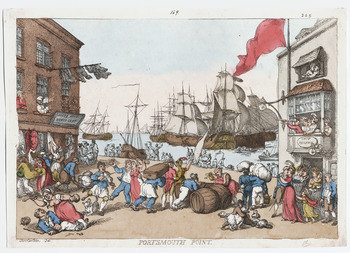
The ports dotting the shoreline of Britain served a range of seagoing and land-based enterprises, employing male and female energies. Portsmouth lay midway along the Channel, a notable anchorage with “the great ships lying at their moorings for three or four miles up, and the harbor for a mile at least on each side covered with buildings and thronged with people.”Footnote 109 Portsmouth supplied the Royal Navy and the East India Company, the two institutions with the greatest global reach, defining the town and its connections. Figure 3 presents a turn-of-the-century satire of Portsmouth Point, with sailors' necessities at hand, from punch bowls and pawnbrokers to prostitutes and public houses. Goods and people are shown cycling on and off the strand, the unlading of ships perhaps cover for judicious smuggling. London's East End and districts south of the Thames were likewise defined by the seamen who resided there, an estimated 20,000 by 1750, along with the businesses and people tied to their adventures.Footnote 110 As with all great ports, East End London was a hybrid community absorbing different ethnicities, the largest maritime quarters in Britain. But there were innumerable harbors in the early modern world of similar character at different latitudes and longitudes, linked by global sea-lanes. The relationships between mariners and their shore-based networks were fundamentally important to the economic and cultural vitality of these regions, as the context of oceanic employment was unlike any other.Footnote 111 In 1776, the magistrate and writer John Fielding described the men who congregated in London's seafaring boroughs as “a generation differing from all the world.” He added that “When one goes to Rotherhithe or Wapping, which places are chiefly inhabited by sailors . . . a man would be apt to suspect himself in another country. Their manner of living, speaking, acting, dressing and behaving are so peculiar to themselves.”Footnote 112 Sailors were almost as often in port as at sea, loading, fitting a ship, and waiting to embark, their lives spent at least as much on land as under sail.Footnote 113 Most importantly, it was during these land-based periods that mariners brought their influence to bear, redirecting goods acquired from afar and modeling new tastes to more sedentary citizens.
Portsmouth Point, 1814 by Thomas Rowlandson. lwlpr11731. Courtesy of The Lewis Walpole Library, Yale University.

Ports functioned as receiving grounds for diverse seaborne peoples, along with their newfangled presents, souvenirs, and sometimes-exotic goods. Indeed, port-side men and women banked on the continuous stream of seafarers in and out of harbor, along with ships' cargoes and the skimmings won from this traffic. What Customs officers saw as smuggling, sailors saw as their privilege, reflecting a moral economy entirely at odds with the directives of the Custom House or East India House. As noted above, mariners schemed to bring goods ashore whether or not this was officially part of their “privilege” or “seaman's portage,” as it was called in Scotland. It was widely acknowledged that this gave common sailors “an interest” in the voyage, for as a Customs agent noted, “it is the general Practice for Sailors to invest in Goods the part of their Wages they receive abroad, or any money they may carry out with them.”Footnote 114 Once ashore, every seaport boasted formal and informal dealers happy to oblige sailors with items to sell or pawn, like the pawnshop prominently placed on the left side of Figure 3. In 1768, an Edinburgh Custom House official described the long-established practice among Scottish sailors, whereby “the Tea, Spirits, India Goods, and Tobacco, [were] continually brought home by them in small Parcells on their own Account . . . and their Wives and Children being interested therein are all anxious for the Successful Smuggling of the Cargo.”Footnote 115 Women in maritime neighborhoods relied on this interchange.
Cecelia Burton was one such enterprising woman with excellent connections, living in London's East End close to the Thames, “reputed for dealing with Hoymen and others who get Goods on Shore without payment of duty.”Footnote 116 My previous research confirms how extensive and essential were systems of barter and the use of alternate currencies, and how routinely retailers took goods in kind. Dealers large and small habitually negotiated with seamen, adapting the flow of ships and men into their patterns of life and business. This material circulation sustained a heterogeneous range of street peddlers and shopkeepers, only some prominent enough to be insured or listed in city directories.Footnote 117
Buying and selling animated these quarters. And before each voyage sailors restocked their sea chests at slop shops, chandlers, and victualler shops, looking as well for lodgings and pubs, venues peopled by women skilled in needle trades and commercial hospitality. Before Jack Cremer's first voyage he relied on the help of his Mate's wife, “a good old humain motherly woman, which was to buy me Shirts, Stockings, Hankerchifs &c, with a Chest, which she did anuf Suitabile [enough suitable] for me for two Years.”Footnote 118 Kindness was tempered by circumstance and women's need to support themselves determined the amenities they provided seamen. In the mid 1700s, Mrs. Bonner furnished “Sea faring people with Cloathes, Liquor & lodgings,” leaving some mariners in her debt and one family unable to recoup anything after their sailor's death, for, as they discovered, “it is the Custom with Sailors to give a Will & power [of attorney] to those who give them Credit.” Further enquires produced “a good account of the woman in her own neighbrood [sic] therefore nothing can be expected from what my Cousin hath left, his brother is likewise in her debt.”Footnote 119
Betty Wright ran a similar London business—lodging housekeeper and ships' chandler—keeping careful records in three surviving account books from the 1740s. She sold more than simply a bed (or part of a bed) for the night, offering food, tobacco, clothing, liquor, and even space for wives to attend their men.Footnote 120 Hers was a substantial concern, with clerical assistants to help with the books, shown in the variety of hands penning the entries with shifting levels of literacy. Some of her clients spent frugally, paying for a couple of mugs of “flip,” a popular punch, or simple board for a few days. Others spent with abandon.Footnote 121 Wright routinely used bonds to secure debts incurred by more free-spending sailors. In the spring of 1743, Will Stock of Dover took out a bond for the nearly £13 he owed her; John Dart, also of Dover, followed a similar course before he left after eating, drinking, and buying clothes.Footnote 122 Wright's business extended to Spithead off Portsmouth and further west to Plymouth, where her agents provided goods to seamen and kept account of these expenses. Wright focused closely on the men she served, in many cases noting their ports of origin, with separate sections for mariners from Sandwich and Dover in Kent or Torbay in Devon. On occasion, she noted when they headed out on a “Cruise” as part of a privateering venture or escorted an Indiaman out of the Channel on its voyage. Women like Cecelia Burton, Mrs. Bonner, and Betty Wright were tied inexorably to these seafarers as their sea chests and punch bowls were filled and emptied with the tide.Footnote 123
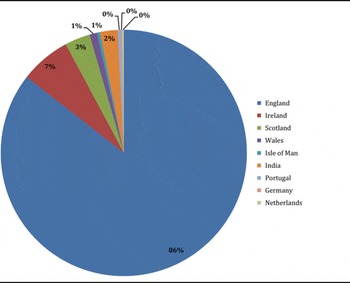
An aggregate of mariners' wills illuminates their formal networks, a temporal snapshot showing the space across which resources traveled. Table 2 summarizes bequests (1700–1760) from my sample of mariners and privateers, identifying the regions where goods were sent when this was stipulated.Footnote 124 The findings are unsurprising, with 86 percent of bequests assigned to family, friends, shipmates, or creditors in England. Four muster lists from 1720 and 1721 for EIC ships show similar patterns of nationality, with from 63 to 84 percent coming from England and the remainder originating in Scotland and Ireland, with a scattering of men from Portugal, Sardinia, Naples, France, Hamburg, Sweden, and Batavia, plus India.Footnote 125 London was at the heart of Britain's maritime empire and was the preeminent city where legatees lived, at over 50 percent of my sample. Beneficiaries resided predominantly in London's seafaring communities north and south of the Thames: Wapping, Rotherhithe, Bermondsey, Limehouse, Tower Hill, Shoreditch, Shadwell, and Ratcliff. Outside the metropolis, bequests traveled to communities along the River Thames from Greenwich to Gravesend, as well as ports and villages on the coast from Kent to Cornwall. A few locales figured a half dozen times or more—major ports like Deptford, Bristol, Liverpool, and Cork. This list includes a multitude of communities adjacent to the sea, for that was where most beneficiaries lived. The conclusions are clear. For the most part, these men emerged from large and small seafaring districts along the coast and riversides of Britain and Ireland. In turn, they channeled their worldly goods back to these neighborhoods with an undoubted impact on the material culture of these locales. An additional 7 percent of bequest went to those in towns and hamlets in Ireland, the County of Cork being particularly important, along with the West Coast of Scotland. Finally, a scattering of goods traveled to coastal Wales, the Isle of Man, and India, with individual legatees in Zeeland, Hamburg, and Lisbon reflecting seaborne connections typical of these men.
Location of Beneficiaries of Mariners' Wills 1700–1760

Source: Mariners' wills, National Archives, UK. Sample of 559 bequests (50 bequests to those on ships at unspecified locations omitted).
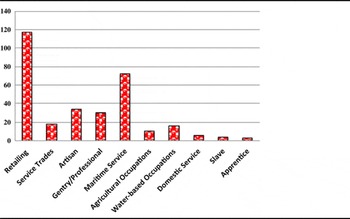
Mariners pumped incalculable quantities of goods and money into great ports and small backwaters. At death, the cumulative results of their labor, evidenced in goods and money, reached a wide cross-section of laborers, artisans, and dealers, plus businessmen and women. These collective interventions unsettled the accustomed material world. In life as in death, seamen funneled money plus delightful and distinctive possessions into the hands of their shipmates, wives, sweethearts, kith, kin, and countrymen, puncturing hierarchical assumptions about socially appropriate consumer practice.Footnote 126 Wills record the social breadth of those receiving mariners’ largesse, including shipmates, family members, plus those in a plethora of dealing, service, maritime, artisanal, and even agricultural pursuits. Table 3 summarizes the occupational categories of beneficiaries from 1700 to 1760, dominated by those in retailing and maritime trades. Among agricultural occupations, gardeners appear more commonly than husbandmen, although both are noted. Water-based trades typically included workers on or about major ports either carrying goods—lightermen and watermen—or inspecting ships to ensure compliance with regulation—waiters and surveyors. The connections to both communities are suggestive.Footnote 127 Among gentry and professionals, surgeons are listed repeatedly, having perhaps earned mention in very practical ways. The number of bequests to nautical men is no surprise as there would be personal and business obligations among that confederacy. As well, several mariners of long term or recurring residency in India left goods to their female slaves, as well as the children of enslaved mothers, with manumission granted on the mariners' deaths.Footnote 128 However, retailing represented the largest heterogeneous occupational group, confirming close and sustained relationships, affective and commercial, linking mariners and dealers more generally. Examples of these trades, in alphabetical order, include: apothecary, baker, brewer, butcher, cordwainer, haberdasher, ironmonger, grocer, mercer, milk woman, music seller, periwig maker, tailor, tobacconist, and victualler, a cross-section of dealing occupations.Footnote 129 Victuallers, male and female, are most numerous among this group at nearly 26 percent of retailers, suggesting their possible role as investors or creditors of seamen in merchant or privateering ventures. Four privateering mariners named White Chapel victuallers Walter and Eleanor Wood as beneficiaries in 1744–45; Erik Bergstrom, victualler of Wapping, was named in three wills in my sample from the 1750s.Footnote 130 Stocking a sea chest could be costly. Giving credit came with expectations of repayment from wages, prize money, or goods on the sailor's return. Retailers likely provided some mariners with a stake or, like Betty Wright and Mrs. Bonner, were owed debts by seamen to be repaid.
Occupations of Beneficiaries, 1700–1760

Source: Mariners' Wills, National Archives, UK, 310 specified occupations.
The provision of small-scale credit was a routine feature of life, sustained by individual reputation and the guarantee of peers, as well as legal instruments.Footnote 131 Sailors were a reasonable investment, especially those on privateering cruises or long distance trips to Asia, given the richly stocked waters they plied. Edward Barlow repeatedly assembled money or goods for himself or from friends and acquaintances for small ventures overseas, complaining on one trip that he was, “taking care of my friends' goods more than I did of my own.”Footnote 132 Barlow functioned as a kind of agent for his network of family and friends, in one case bringing back “India Chints and Culgees and other goods” for his cousin's wife.Footnote 133 In this way, sailors seeded the commons with “new luxuries.” As Jan de Vries observes, the symbolic powers of these goods communicated new “cultural meaning, permitting reciprocal relations—a kind of sociability—among participants in consumption.”Footnote 134 These assorted gifts and consignments far surpassed the usual possessions available to laboring or even artisanal men and women in the later 1600s. In that earlier era, the cumulative impact of the novelties carried home by mariners was surely immense, introducing laboring and lower middling people to a world of new goods, upending hierarchies of consumption. As the numbers of mariners grew, their influence widened, even as the cargos they freighted increased.
Proximity to sea routes shaped the cultures of consumption emerging in early modern Europe. Hester Dibbits identifies the exceptionally rich material culture in the South Holland fishing village of Maassluis in the early eighteenth century, with an abundance of china and Indian cottons among a broad social range, well outside the upper middling sort. Similarly, Anne McCants charts the penetration of Asian niceties and luxuries among poor residents of eighteenth-century Amsterdam.Footnote 135 In Aberdeen, anonymous merchants complained in the 1740s of the rampant smuggling of tobacco, tea, coffee, and Indies goods: “vast Quantities of run and prohibited Goods in their [local traders'] Cellars and Shops . . . to be publickly carried and sold,” making these goods cheap and widely available and perhaps especially to the friends and family of seafarers.Footnote 136 Scottish coastal residents enjoyed prodigious access to smuggled wares, illustrated in the “Chinese gown” and brandy offered as a bribe to a dogged customs officer pursuing a smuggler off the Orkney Islands.Footnote 137
We must rethink assumptions about consumer practice and material culture that presumes plentiful consumer goods in the metropole and declining access as one moves away from London, especially among plebeian buyers. Better account must be taken of unsanctioned seaborne traffic along the shipping routes that circled these islands and the impact on local material culture along these sea-lanes.Footnote 138 Where customs officials were few, goods were landed or smugglers supplied. Consider the description by a Southampton Custom House officer who knew well the opponents he faced: “The Inhabitants of Guernsey . . . Style themselves Merchants, and keep Shops or Warehouses for vending to Smuglers [sic] and others in any Quantity, Wine, Brandy, Rum, Geneva, Tea, Silk Handkerchiefs, Cottons, Callicoes, Chintz, Linnens etc.”Footnote 139 These desirable goods in the hands of seagoing workingmen and their onshore partners signaled shifting material priorities and sparked broad change in these settings. Jan de Vries rightly emphasizes the vital “industrious” role of women and children as waged workers, arguing persuasively that their entrance into the waged work force in greater numbers enabled them to buy and enjoy small pleasures and greater comforts, adding critical dynamism to the economy.Footnote 140 Mariners represent another plebeian cohort within this disruptive, generative, “industrious” consumer process, with gifts, goods, and money channeled to plebeian peoples across the littoral.
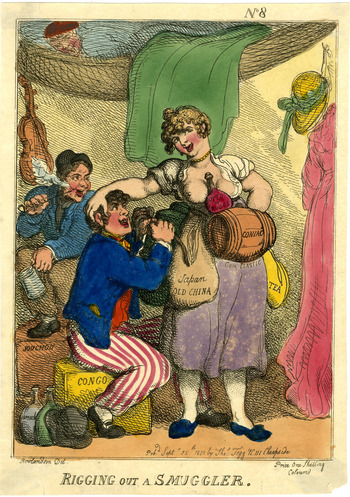
Mariners' sexual partners—commercial and affective, fleeting and recurring—typified additional dynamic connections in ports of call.Footnote 141 Moralists decried the temporal, impermanent unions typical of sailors, whose passing alliances gave a seasonal character to even stable partnerships, whether formally sanctioned or informally agreed. Neither debauchery nor transient matches were approved styles of manliness; but these traits were routine for seafarers and could not be otherwise. Thus, as EIC ships put into port, a stream of family and friends arrived to welcome their safe return, in defiance of authorities, who very rightly saw these visitors as potential allies in running goods onshore, particularly the women. When the Grantham docked in Plymouth in August 1751, people poured on board with local authorities powerless to stem the tide. A hasty note to the directors of the EIC complained that “its now like a Fair being credibly informed that near a Thousand People were on board this day”, concluding that “its impossible to prevent Quantities of China and other Goods . . . run out of her.”Footnote 142 Customs officials styled “waiters” were posted on board to quash attempted smuggling and ships were rummaged to uncover even the smallest package of tea or bundle of handkerchiefs. Yet, even as cargoes were being cleared, seafarers laded female visitors in a bid to get goods ashore untaxed. Figure 4 depicts this intimate opportunism, a practice so widely known it was the butt of satire, the woman's panniers shown stuffed with popular items from perfume to tea.
Rigging out a Smuggler, 1810 by Thomas Rowlandson. 1872, 1012.4954. © Trustees of the British Museum.

In response to this persistent practice, agents were posted in boats alongside EIC vessels at anchor. In one instance they spotted four women being rowed away. When they eventually reached this craft, they insisted on searching the women, who were found to have fifty pieces of silk and eighty-two fans on their persons. On another occasion, an official spied three women “coming from on board” an EIC ship anchored at Deptford with the captain as escort. The agent thought the women “more bulky than usual.” So he “insisted on rumageing them whereupon the said Captain Started up and swore no body in his Boat should be rummaged [and] the Ladies cried out . . . and pretended to be in Fitts.” The search proceeded nonetheless at a public house on shore, revealing 281 India silk handkerchiefs under the women's petticoats. Commercial alliances between seafarers and obliging women probably succeeded more often than they failed, given the legions that descended on ships in port.Footnote 143 Understandably, tensions were rife on these occasions, with one boatswain swearing that if any officials “pretend to rumedge his Wife, he will stab that man that does it.”Footnote 144 An Edinburgh official grumbled that women in Scottish ports were “always ready to assist the Smugglers,” as he termed the returning sailors.Footnote 145 Wives, lovers, and prostitutes understood the benefits of sailors in port, whether in treats, wages, and useful or exotic gifts.
The injection of new resources into endless cycles of make-do was cause for satisfaction or celebration whatever the sailor might provide; every manner of thing could be worn, used, eaten, pawned, bartered, or sold as required.Footnote 146 So substantial was this maritime influence that residents in port cities, if charged with theft, commonly claimed they received disputed items “from a sailor”—seafarers having such untidy circuits of exchange.Footnote 147 The uniqueness of port communities lay in the recurring flows of goods that accompanied sailors' long-distance labors. As a young sailor, Jack Cremer wrote of the things he brought his uncle after a fruitful Mediterranean voyage about 1720, including wine, oil, and “other presents of Small things.”Footnote 148 These slices from the world's cargoes supported shore-going pleasures, sustaining and stimulating shore-based communities, even as they transformed material culture.
Seaports echoed with the nautical idiom of men from near and far, with physiques that set them apart: hardened, tanned, often scarred, sometimes tattooed, their hair queued.Footnote 149 Their enterprising lives were displayed on their bodies and in their dress, with gifts and prizes that distinguished them as well from land-based men. Their shore-going clothes were equally subversive of hierarchies of apparel. The “dynamism” John Styles perceives in eighteenth-century plebeian fashion was exceptionally apparent amongst this population, a group defined by their resplendent handkerchiefs and distinctive striped trousers.Footnote 150 During the eighteenth century, popular culture focused more intently on this significant set of men who modeled a different type of masculinity. Artists drew and modeled figures of seamen, creating collectable, topical representations in innumerable forms, finding extensive markets for their output. The Bow Porcelain Works produced the earliest English ceramic figures of sailors and their choice is noteworthy. Bow was among the first English china works, based in “New Canton” East London amidst the riverine flows of international trade. Bow crafted items for middle-class buyers, termed by a contemporary “the more ordinary sorts of ware,” including two sailor figures made between 1748 and the 1760s.Footnote 151 A hands-width in height, these trouser-clad figures were mnemonics of international and imperial exploits and the men distinguished in this practice.
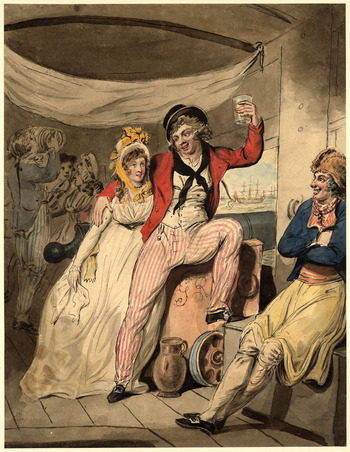
More popular still, and less romantic in tone, were the countless printed satires. The themes addressed were topical and widely understood, pertaining to sailors' lives at sea and on shore, their gifts to women, and their generally unsettling material habits. Figure 5 presents another of the myriad images printed at a time when mariners were defining figures in the imperial age. This seafarer is seated on a gun carriage, his ship safely anchored, and intemperate indulgence in the order of the day. He and his mates rejoice in their survival and perhaps their prize money or smuggled goods, shown with the women they favored—their collective manliness displayed in stance and gesture. Those who purchased the sailor figurines or the sailor-themed satires, and those who learned and sang the sailor-themed songs, sought a tangible connection with an admired group, disruptive of hierarchy, and generative of new cultural forms.
The Sailor's Sweetheart, c. 1790–1811 by Isaac Cruikshank. 1878, 0713.1256. © Trustees of the British Museum.

Not only did seafarers follow an uncommonly daring occupation, but their connections to the “new luxuries” marked them out among plebeian men—connections echoed by graphic artists depicting sailors' pipes, flash handkerchiefs, and bulging sea chests seen in Figures 2–5. The trousered seamen epitomized a robust masculinity, founded on skilled seamanship, expressed within global theatres of action. Their images were deployed in a range of cultural forms from print satires to theatrical representations, an alternative to genteel politeness and middling respectability. Print and ceramic objects reinforced the increasingly iconic status of this group and spread the range of their influence. The experiences of empire, the habits of seafaring life, and the selective idealization of these plebeian men shifted the norms of material culture and manly demeanor.Footnote 152 Mariners' iconic consumer practice was powerfully productive of change. Seafarers, traversing global trade networks, disrupted traditional practice, innovating new discursive material cultures and new forms of masculinity, becoming a recognizable and authoritative community of men.