Introduction
The United Kingdom, like other developed countries, has witnessed significant changes in family structure and relationships in recent decades. Among the well-documented trends are declines in marriage and childbearing, rises in divorce and cohabitation, and increases in births outside marriage and in lone parenthood (Cherlin Reference Cherlin1981, Reference Cherlin1992; Ermisch et al. Reference Ermisch, Francesconi, Berthoud, Gershuny, Berthoud and Gershuny2000). Such changes suggest that today's older people have more diverse family networks than previous generations (Wachter Reference Wachter1997). Nevertheless, it is surprising how little we know about the impact of such trends on intergenerational relationships in later life (and on support in particular). On the one hand, there is a popular perception that increasing rejection of traditional family roles and relationships means that families have become less willing to care for one another. This idea is to some extent supported by empirical research. For example, most researchers have considered that the experience of divorce weakens family ties and thereby reduces mutual support. On the other hand, the notion of what ‘the family’ means has changed, with a more flexible and diverse concept gaining ground, of ‘family members’ among whom reciprocity and affection (in addition to obligation) are key influences on intergenerational relationships and exchanges (Askham et al. Reference Askham, Ferring, Lamura, Bond, Peace, Dittmann-Kohli and Westerhof2007; Finch Reference Finch, Allen and Perkins1995). As the notion of ‘family’ life changes, and as attitudes toward family issues bring greater acceptance of divorce and increasing tolerance of different family forms, the negative impact of such changes for support in later life may be disappearing (Thornton and Young-DeMarco Reference Thornton and Young-DeMarco2001).
Given that the social networks of older people are largely composed of family members, understanding how trends in family life may affect future support and care is a critical issue (Askham et al. Reference Askham, Ferring, Lamura, Bond, Peace, Dittmann-Kohli and Westerhof2007). Moreover, few studies have examined variations in the long-term impact of partnership dissolution (through either widowhood or divorce) or its relationship with support at older ages. This is becoming an increasingly important issue, as the current cohort of older people is more likely to have experienced divorce than those in earlier cohorts, while the incidence of early widowhood is low and likely to remain so. Thus, this study investigates the long-term consequences of partnership dissolution (through divorce, separation or death, i.e. widowhood) for support in later life.
Previous evidence and conceptual issues
Conceptualising and operationalising support
One of the difficulties in studies of support lies in its conceptualisation and operationalisation (see Barrera Reference Barrera1986; Hermalin Reference Hermalin and Hermalin2002; House et al. Reference House, Landis and Umberson1988). Informal support is usually defined in terms of: (i) the structural characteristics of the social support network; (ii) social embeddedness (e.g. the frequency of contact with others); (iii) emotional assistance (which is assumed to reflect the current and future availability as well as the adequacy of practical and emotional support); and (iv) instrumental assistance (e.g. transfers of space, time and money) from family, friends, neighbours and other community members (Barrera Reference Barrera1986; Hermalin Reference Hermalin and Hermalin2002; House et al. Reference House, Landis and Umberson1988; Soldo and Hill Reference Soldo, Hill, Maddox and Lawton1993; Wenger Reference Wenger1996). Help received from public social services, such as meals-on-wheels, home help, health visitors and district nurses are key components of formal support.
Partnership dissolution and late-life support
There is a considerable literature (largely from the United States) on the relationship between older adults' current marital status and patterns of support. The findings suggest that being divorced is negatively associated with contacts and support, particularly for men (but most studies have measured only contacts and few also transfers and co-residence), whereas being widowed generally appears to have either a null or positive relationship (Barrett and Lynch Reference Barrett and Lynch1999; Crimmins and Ingegneri Reference Crimmins and Ingegneri1990; Eggebeen Reference Eggebeen1992; Grundy and Shelton Reference Grundy and Shelton2001; Tomassini et al. Reference Tomassini, Kalogirou, Grundy, Fokkema, Martikainen, Broese van Groenou and Karisto2004). These cross-sectional studies have not been able, however, to distinguish current partnership status from partnership history. Considering marital status at only one point in time is inadequate, because it does not capture the long-term impact of partnership dissolutions on late-life support.
Longitudinal evidence
Most work on the long-term impact of partnership dissolution has focused on outcomes for children, and there have been fewer investigations of the consequences for support in later life. There is growing evidence in the US and The Netherlands, however, that family disruptions over the lifecourse (particularly divorce) have deleterious consequences for support at older ages (Aquilino Reference Aquilino1994; Bulcroft and Bulcroft Reference Bulcroft and Bulcroft1991; Cooney and Uhlenberg Reference Cooney and Uhlenberg1990; Curran et al. Reference Curran, McLanahan and Knab2003; Dykstra Reference Dykstra1997; Furstenberg, Hoffman and Shrestha Reference Furstenberg, Hoffman and Shrestha1995; Kalmijn Reference Kalmijn2007; Lye et al. Reference Lye, Klepinger, Hyle and Nelson1995; Pezzin and Schone Reference Pezzin and Schone1999; Roan and Raley Reference Roan and Raley1996; Shapiro Reference Shapiro2003). It has been shown that, in comparison with those in intact marriages, the experience of divorce and remarriage mostly decreases contacts and relationship quality with adult children as well as perceived support from children (or from any source) (Aquilino Reference Aquilino1994; Bulcroft and Bulcroft Reference Bulcroft and Bulcroft1991; Curran et al. Reference Curran, McLanahan and Knab2003; Kalmijn Reference Kalmijn2007). Fewer studies have focused on transfers between parents and their adult children and the published evidence is less clear: some studies report no association between parental divorce and help given or received (Aquilino Reference Aquilino1994; Pezzin and Schone Reference Pezzin and Schone1999), whereas others report a negative relationship with time and money transfers (Furstenberg, Hoffman and Shresthra Reference Furstenberg, Hoffman and Shrestha1995; Kalmijn Reference Kalmijn2007). Some studies have also investigated the association between widowhood and support. In contrast to the results for parental divorce, most studies show no significant relationship between widowhood and contact (Bulcroft and Bulcroft Reference Bulcroft and Bulcroft1991; Lye et al. Reference Lye, Klepinger, Hyle and Nelson1995); however, the few papers that have studied widowers separately have shown lower levels of contacts for this group when compared with parents in intact marriages (Kalmijn Reference Kalmijn2007). With respect to measures of instrumental assistance, most research shows that widowed parents receive more support from children in comparison to still-married parents (Ha et al. Reference Ha, Carr, Utz and Nesse2006). A recent study, however, showed a negative relationship between widowhood and instrumental assistance for men (Kalmijn Reference Kalmijn2007).
Longitudinal associations with late-life support
Studies have established some variations in the long-term outcomes of partnership dissolution and identified several influential factors. A parent's gender is clearly influential, for partnership dissolution has a greater negative impact for men's than women's late-life support, which is generally explained in terms of mothers being closer to their children than fathers (Furstenberg et al. Reference Furstenberg, Hoffman and Shrestha1995; Kalmijn Reference Kalmijn2007). Secondly, the timing of the dissolution is influential, in that the younger the age of the child at the time of the parental partnership disruption (whether through divorce or widow(er)hood), the lower the level of contacts and exchange reported by elderly parents (Furstenberg et al. Reference Furstenberg, Hoffman and Shrestha1995). Third, the existence of step-children is a factor, for older parents are less likely to receive assistance from step-children than biological children (Pezzin and Schone Reference Pezzin and Schone1999). Few studies of the impact of dissolution on late-life support, however, have directly compared the outcomes of divorce as against widowhood. As an increasing proportion of first marriages ends in divorce, the sequence of a life-long marriage ending in widowhood decreasingly applies. As the experience of divorce is rising (and widowhood in early old age is declining), it is increasingly necessary to distinguish between the different types of partnership dissolution and their implications for late-life support. These different forms of dissolution are not new but their increasing prevalence means that they can no longer be ignored.
The lack of British research on the consequences of partnership dissolution for late-life support reflects, in part, the scarcity of information on life histories (e.g. partnership and parenthood histories), family structures (i.e. number, types and characteristics of kin), and indicators of support in large, nationally representative datasets of older people (Grundy et al. Reference Grundy, Murphy and Shelton1999). A recent exception, however, is the British Household Panel Study (BHPS), which in Waves 11 (in 2001–2) and 12 (2002–3) collected, for the first time, information on living kin and on several key indicators of support. These can be linked to the life-history data obtained at earlier waves. The retrospective partnership and parenthood histories are essential to capture the long-term consequences of partnership dissolution on support in later life.
Using these new data, this study contributes to the literature on the factors influencing intergenerational support in several key ways. First, to our knowledge this is the first UK study to investigate the consequences of partnership dissolution for late-life support using a large nationally representative longitudinal dataset. Secondly, in contrast to some previous work, this study was able to use the comprehensive partnership and parenthood histories in the BHPS to construct several detailed measures of partnership dissolution (Pezzin and Schone Reference Pezzin and Schone1999). For example, in addition to distinguishing between types of past dissolution, we took into account the timing of the dissolution and were able to distinguish short-term and long-term effects – important because the outcomes of dissolution are likely to change over time. For example, a family estrangement following a divorce may, 20 or 30 years later, have given way to a new configuration of relationships and contact. It may also be that the clear difference between reactions to a person's widowhood (perhaps characterised by sympathy), and those to a separation (perhaps with blame attributed to one or both partners), normally moderates with the passage of time, as the merits and demerits of the dissolved partnership and of the behaviour of each former partner are re-evaluated, and also as a surviving partner's subsequent good or ill fortune earns them fresh quotients of sympathy or blame. Thirdly, with few exceptions (Kalmijn Reference Kalmijn2007), most studies have focused either on partnered or unpartnered older people or on only one gender, while many have not included both divorced and widowed older people, or have concentrated on younger age-groups; that is, people less likely to require support (Cooney and Uhlenberg Reference Cooney and Uhlenberg1990; Curran et al. Reference Curran, McLanahan and Knab2003; Pezzin and Schone Reference Pezzin and Schone1999).
The present analysis focuses on two types of support among those aged 70 or more years: (i) informal support from children in the form of contacts and help (e.g. household assistance including care), and (ii) formal support from community-care services (i.e. health visitors or district nurses, home help and meals-on-wheels). In addition, for both sexes, we examined reported support among: (i) all parents aged 70 or more years, and (ii) unpartnered parents in the same age group (i.e. those lacking the most important source of support in later life: a spouse). The underlying hypotheses are that partnership dissolution has a long-term impact on late-life support (particularly from children), and that separation or divorce (i.e. voluntary disruption) has a greater effect than widowhood (i.e. involuntary disruption).
Data and methods
The BHPS is an annual longitudinal survey of a nationally representative sample of private households in the United Kingdom (Taylor et al. Reference Taylor, Brice, Buck and Prentice-Lane2007).Footnote 1 All household members are followed until they die, move permanently into an institution or emigrate. The reported analyses used data from Waves 11 and 12 (which included measures of support) linked to the partnership and parenthood histories available in earlier waves. The sample sizes were around 10,000 adults for the earlier waves and between 15,000 and 18,000 adults for the later waves, a result of the inclusion of additional sub-samples in 1997 (for the European Community Household Panel or ECHP), in 1999 (Scotland and Wales extension samples) and in 2001 (Northern Ireland extension sample) (Taylor et al. Reference Taylor, Brice, Buck and Prentice-Lane2007). As later sub-samples (e.g. ECHP) included respondents from Northern Ireland, analyses of later waves of the BHPS relate to the United Kingdom as a whole, and not just to Great Britain. At Wave 1, interviews with all eligible adults occurred in 69 per cent of households (including proxies). Once ineligible subjects (i.e. those who died or moved out of scope of the study) are excluded, the wave-on-wave response rate has varied between 88 and 97 per cent (Taylor et al. Reference Taylor, Brice, Buck and Prentice-Lane2007). Of the original sample members with a full interview for the first wave, 66 per cent of those still eligible responded at Waves 11 and 12.
Dependent variables
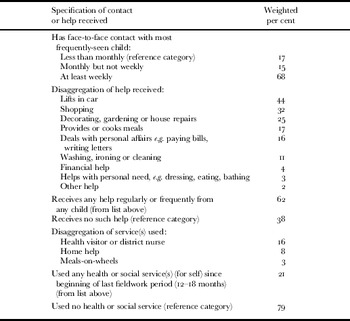
In 2001–2, the BHPS collected information on social support networks (e.g. living kin, contact, and help given and received). This was for the non-extension survey samples only; the module was repeated in 2002–3 for the Wales and Scotland extension samples. The module has never yet been run for the Northern Ireland extension sample, but because Northern Irish respondents were included in the original ECHP sample, which was later incorporated into the BHPS, those still in the survey would have answered the support questions at Wave 11. Two types of informal support were considered: (i) frequency of seeing the child living outside the household with whom respondents reported the most contact; and (ii) receipt of help (household assistance including care) from any child living outside the household. After establishing the number and relationships of living relatives (see ‘Independent variables’ below), the respondents with at least one non-coresident child (whether or not they also had a co-resident child), were asked: ‘Thinking now about your children … if you have more than one son or daughter not living with you, please think about the one you have the most contact with. Please look at this card and tell me how often you see your son/daughter’. The categories on the card were: ‘daily’, ‘at least once a week’, ‘at least once a month’, ‘several times a year’, ‘less often’ and ‘never’. Responses were combined into three categories: ‘2’ (at least once a week, including daily), ‘1’ (at least once a month), and ‘0’ (less often, including never). For those reporting at least one non-coresident child, a question about help received followed: ‘Do you regularly or frequently receive any of the things listed on this card from your children not living here?’ All the types of help listed on the card are shown in Table 2. The respondent mentioned the types of help received (if any); a binary variable was created to distinguish those who received any type of help from those who did not. The analysis was limited to frequency of contact and help received by parents with no co-resident children.
By contrast, questions on the use of formal services are asked annually of the whole sample; respondents were shown a list and asked whether, ‘you yourself have made use of any of these services’ (and which ones) since the first day of the last fieldwork period, i.e. 12 to 18 months ago. A binary variable distinguished those who had used a health visitor or district nurse, a home-help or meals-on-wheels service in the period of interest from those who had not.Footnote 2 A breakdown of the proportions using each service is shown in Table 2.
Independent variables
Partnership dissolutions were assessed by: (i) measures of disruptions through death, separation, divorce and re-partnering; and (ii) their timing, derived from the detailed partnership and parenthood histories (i.e. whether it occurred within the last three years, and whether when it occurred any child was aged 0–17 years). Full partnership and parenthood histories were collected in Waves 2, 11 or 12; shorter question modules were used for some new entrants at Wave 8 and subsequently. The partnership histories were updated wave by wave using indicators of partner in the household and questions on changes in marital status. In this analysis, it was decided to study partnerships without distinguishing legal from consensual bonds. This was partly because the unusual richness of the BHPS data made it clear that respondents themselves did not necessarily make this distinction (see Stuchbury et al. Reference Stuchbury, Glaser, Tomassini and Askham2005). In the same way, the category ‘separated’ included those who considered themselves to be separated or divorced regardless of whether or not they had experienced a legal marriage, separation or divorce.
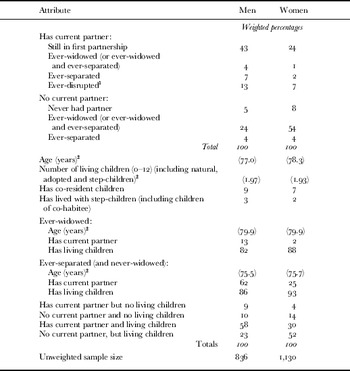
From the partnership histories an indicator was created that combined current partnership status with experience of partnership dissolution. The distribution for those aged 70 or more years is set out in Table 1. People who reported never having had a (co-habiting) partner were omitted from the models because only a tiny percentage had children and the analytical unit was parents. Although the initial multivariate analyses distinguished between all the other categories, for those with a current partner, the differences between them (i.e. the remarried and the first marriage group) were not statistically significant. For this reason, in the analyses reported here, the categories included are: parents with a current partner (the reference category), parents without a current partner who had been widowed at least once (or widowed and separated), and parents without a current partner who had been separated at least once. The analyses of unpartnered parents aged 70 or more years distinguished those who had been separated from the previously widowed (the reference category). With respect to the timing of the disruption, a binary measure based on the partnership histories was created to capture whether or not a disruption had occurred within the last three years (the reference group being those who had not experienced a disruption and those whose disruption occurred over three years ago).
In addition, an indicator of family composition was derived from the parenthood histories (including adopted and step-children) that had been collected from original sample members in Wave 2 of the BHPS.Footnote 3 From these histories, a binary measure was created reflecting whether or not the respondent had ever lived with step-child(ren) (including children of a cohabiting partner and children of any age, not just minors).Footnote 4 These histories also contributed to an indicator of whether or not the respondent experienced either widowhood or separation from a partner while s/he had a biological child (or children) aged less than 18 years.
The respondent's number of children was derived from their current household composition plus the question on number of living children in the ageing and retirement module at Waves 11 and 12 (described under Dependent variables). The module began with a showcard listing relations and asked the respondent ‘which of these types of relatives do you have alive at the moment’ (not including co-resident relatives), and how many of each type. The list included ‘sons/daughters’ without differentiating between natural, adopted, step or foster children or in-laws. It was up to the respondent who they included in the definition of ‘child’.Footnote 5 Other covariates included age, gender, health, possession of an educational qualification, social class and tenure status. These socio-economic characteristics have all been identified as key determinants of late-life support in previous studies (Pezzin and Schone Reference Pezzin and Schone1999).
Analysis plan
The relationship between partnership disruption and late-life support was analysed using both descriptive and multivariate techniques. Descriptive statistics of the 1,966 respondents in Waves 11 and 12 aged 70 or over are presented in Table 1. The analyses reported in Tables 2 and 3 were based on the 1,453 parents aged 70 or more years with no co-resident children. For this latter group, logistic regression models with ordinal response (proportional-odds regression model) were used to estimate the odds of seeing the most-frequently-seen child (Table 3). Proportional-odds regression models estimate the odds of reporting a one-point increase in the frequency of seeing a child for parents who experienced a partnership dissolution compared to those without such characteristics, adjusting for the covariates. Logistic regression models with a binary response were used to model the help received from children and the receipt of formal services (Table 3). All multivariate analyses were conducted in two steps: the first excluded variables representing the experience of any partnership dissolution (largely widowhood) within the previous three years or when the respondent had a child aged under 18 years; these variables were added at the second step. All of the multivariate analyses were repeated for the 700 respondents who lacked a current partner (the base for Table 4).Footnote 6
Results
Sample characteristics
Table 1 presents summary indicators of the partnership and fertility histories of the respondents aged 70 or more years in 2001 or 2002. Women were more likely than men to have experienced partnership dissolution, mainly as a result of widowhood: 54 per cent of women were without a current partner and had been widowed at least once, compared with only 24 per cent of men. Men were more likely to have experienced separation (11%, as against 6% for women) and were more likely to be in a new partnership (Table 1). More women than men had never had a partner (8% versus 5%).
Partnership and fertility by gender, UK population aged 70 or more years, 2001/2002

Note:1. Respondents in this category are known to have had one or more previous partnerships but it is not known whether they ended in widowhood or separation. 2. Figures in brackets are weighted means.
Source: Authors' calculations using British Household Panel Survey (see text).
The mean number of living children was similar for men (1.97) and women (1.93), and there was little difference in the percentage with no living children (19 and 18 respectively). A greater percentage of women (14) than men (10) were in the group most likely to lack family support, with neither a current partner nor living children. Table 2 shows the distributions of the dependent variables for older parents with non-coresident children. More than two-thirds of parents with no co-resident child saw the most-frequently-seen child at least weekly, and almost as many received regular or frequent help from a child; one-half of the sample was in both categories, i.e. saw a child at least weekly and received regular or frequent help from a child. Regarding the types of help received, the most common were lifts in a car, shopping or home maintenance. Twenty-one per cent reported receiving help from health or social services in the previous year. Among the home-care services received, visits from a health visitor or district nurse were most frequently mentioned.
Face-to-face contacts and help received from any child living outside the household and formal services received, parents aged 70 or more years with no co-resident children, UK 2001/2002

Note: The sample size was 1,453.
Source: Authors' calculations using British Household Panel Survey (see text).
Face-to-face contacts with children
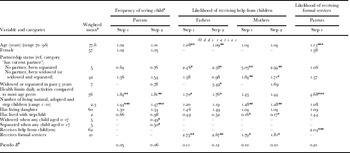
Table 3 refers to parents aged 70 or more years who had living children, none of whom were co-resident. The first set of models in the table presents the results of the logistic regression model with ordinal response of the association between partnership dissolution and face-to-face contacts with the most-frequently-seen non-coresident child. At step one, being a lone widow(er) or a lone separated person showed no significant relationship with frequency of seeing the most-frequently-seen child when compared with older parents with a current partner (the reference group). The addition of the ‘experience of partnership dissolution’ variables at step two did not alter this, but parents who were widowed or separated when at least one child was under 18 years-of-age showed significantly lower odds of seeing a child (odds ratios of 0.49 and 0.50 respectively). There were no variations by age or sex of the respondent. Health, however, was strongly associated with more frequent parent-child contact: among older parents with a health condition that limited their daily activities, the odds of frequent contact with the child were 1.81 times the odds for those without such a health problem. It should be noted that the model accounted for very little of the variation in parent-child contacts (pseudo R 2=0.06), less than was achieved by the models for help from children and receipt of formal services. Overall, the explanatory power of the models is low, but given the multiple influences on people's lives, statistically powerful explanations were unlikely. The outcomes of interest (i.e. frequency of seeing the most-frequently-seen child and help from non-coresident children) are highly influenced by children's characteristics such as socio-economic status, as well as by parental and adult-child migration and occupational histories, for which there is no information in the BHPS or in other British data sets.
Logistic regression models for frequency of seeing most-frequently-seen child (ordinal response) and help from non-co-resident children and use of formal services (binary response): parents aged 70 or more years with no co-resident children, UK 2001/2002

Notes: The models adjust for the following additional characteristics: (1) educational qualifications (reference group none), i.e. Ordinary level General Certificate of Education (normally taken at 15/16 years) or above, or clerical, commercial or trade qualifications; (2) occupational category (reference group ‘professional, managerial, technical or skilled non-manual’), i.e. ‘skilled-manual’, ‘semi-skilled or unskilled manual’ or ‘armed forces’ (using UK Registrar General's classification based on current or last occupation) (Office of Population, Censuses and Surveys 1991); (3) housing tenure (reference group ‘owner-occupied dwelling with or without a mortgage’), i.e. not living in an owner-occupied dwelling. Sample size 1,453. 1. Most-frequently-seen child. 2. All variables except age and number of living children are dummy variables: the mean values are shown as percentages.
Source: Authors' calculations using British Household Panel Survey (see text).
Significance levels: *p<0.05, ** p<0.01, *** p<0.001.
Help received from children
The next logistic regression with binary response examined reported help ‘regularly or frequently’ received from any child not living with the respondent (see Table 2 for the breakdown of the types of help). Although gender was not significant in the model, the patterns of association differed for men and women and are therefore shown separately. As with the model for contacts with a child, the variable for ‘partnership dissolution in the previous three years’ was entered at the second step, but dissolution when a child was aged 0–17 years was omitted from the model as it showed no significant effects in these models or the model on receipt of formal care.
At step one, older separated parents (both fathers and mothers) showed odds of receiving help from a child outside the household that were two to three times those for parents with a partner (see Table 3). Lone widows also showed higher odds, but lone widowers did not. These positive associations were slightly weakened by the addition of the ‘recent partnership dissolution’ variable at step two, but fathers who had had a recent partnership dissolution showed odds ratios 3.49 times of those for their married counterparts. On the other hand, older mothers who had ever lived with a stepchild reported lower odds of receiving help from children (OR=0.17). Once again, health was a key factor in assistance from kin; for example, among older fathers with a health condition which limited their daily activities, the odds of receiving help from children was 1.76 times those who did not report a health problem. A greater number of children increased the odds of receiving help for women (OR=1.28) but not for men.
Receipt of formal services
The third model, a logistic regression, measured receipt of health visitor, district nurse, home-help or meals-on-wheels services since the beginning of the last fieldwork period (12 to 18 months) (see Table 3). Experience of any partnership dissolution (but mostly widowhood) within the previous three years, or when the respondent had a child aged under 18 years, were not added at a second step because neither variable was significant. Measures of partnership dissolution were not significantly associated with the receipt of formal services among older parents. This model was more successful in accounting for the variance than the previous two, and the significant associations may all be regarded as measures of the recipient's need: age, poor health, and receipt of help from children.
Effects of lacking a partner
Table 4 repeats the models of Table 3, except that older parents with a current partner were removed (i.e. the respondents who lacked the main source of support in later life). Comparison of the results in Tables 3 and 4 offers indications of the effects of having a partner, although there are of course other differences between the two groups, most notably in age. Almost all (98%) the unpartnered parents lived alone. Their mean age was greater (79.4 years) than the mean age in Table 3 (77.6 years); moreover, three-quarters were female compared to 57 per cent of the larger group.
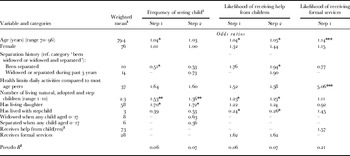
Logistic regression models for frequency of seeing most-frequently-seen child (ordinal response) and help from non-coresident children and use of formal services (binary response): parents aged 70 or more years with no co-resident children and no current partner, UK 2001/2002

Notes: The models also control for educational qualifications, social class status and housing tenure; see note to Table 3. Sample size 700. 1. Most-frequently-seen child. 2. 12 per cent saw the most-frequently-seen child monthly but not weekly, and 72 per cent saw the child at least weekly. 3. All variables except age and number of living children are dummy variables, whose means are shown as weighted percentages.
Source: Authors' calculations using British Household Panel Survey (see text).
Significance levels: *p<0.05, ** p<0.01, *** p<0.001.
The frequency with which lone parents saw the most-frequently-seen child was similar to that for all parents aged 70 or more years: whereas 68 per cent of all parents saw the child at least weekly (Table 2), 72 per cent of the lone parents did so. At step one, lone separated older parents showed significantly fewer frequent contacts with a child compared with lone widow(er)s, the reference category. This variable lost significance at step two, when the variables regarding timing of dissolution were added. Other associations are similar to those found in Table 3, except that the effect of poor health was at this step not significant, while the existence of at least one daughter was significant (and positive).
Help from children among lone older parents, by contrast, showed similar odds ratios but weaker associations than the help received by parents with partners. At step one, the manner of the partnership dissolution was insignificant, but when the variable for experience of dissolution during the previous three years was added, lone separated parents (who had not experienced a recent partnership dissolution) had significantly higher odds (a ratio of 1.94) than widows receiving help from non-coresident children than did lone, widowed parents in similar circumstances. In separate models by sex, not shown, separated men reported significantly greater odds of help from children in comparison with widowers, whereas for women, the odds ratio was not statistically significant. Again, having ever lived with a stepchild lowered the odds of reporting receiving help. In separate models by sex, not shown, odds were significant for women but not for men. In the model of the likelihood of receiving formal services, health status was even more strongly associated with receipt (OR=5.06), while help from children had lost significance, reinforcing the impression that services meet more serious needs in a way that family care may not (the two timing variables were not included at the second step as neither variable was significant).
Discussion
This study's findings show considerable diversity in the partnership experiences of people aged 70 or more years, measured as the experience of separation and widowhood. For example, 11 per cent of men had experienced a separation, and 28 per cent had been widowed. In addition, the results show that partnership dissolution did not have the detrimental association with late-life support that was expected. For example, in all the analyses, separated older parents were significantly more likely to receive help from children living outside the household. Moreover, widowhood for women demonstrated the expected positive relationship with help from children. In contrast to recent results from The Netherlands, British widowed fathers were just as likely to receive help from children when compared to fathers in a current partnership (Kalmijn Reference Kalmijn2007). Our results suggest that in the United Kingdom, family support is activated in accordance with the older person's needs (as indicated by ill health). This is in line with previous evidence from the United States and north-western Europe that, while there is frequent contact between older parents and adult children, there is comparatively little involvement in routine transfers (Eggebeen Reference Eggebeen1992; McGarry and Schoeni Reference McGarry and Schoeni1995; Rosenthal et al. Reference Rosenthal, Martin-Matthews and Matthews1996; Spitze and Logan Reference Spitze and Logan1992). In contemporary welfare states, given the availability of public transfer programmes (i.e. pensions and health care) and good health, it appears that an older person is able to meet his/her own needs. However, once older people experience ill health or bereavement, family members are the main providers of support and care (Soldo and Hill Reference Soldo and Hill1995).
This study's findings nonetheless contradict the (largely) US and Dutch evidence of a detrimental relationship between family disruptions (divorce in particular) and late-life support. With few exceptions, research on this issue has been based on those in mid-life or young elderly age groups (Pezzin and Schone Reference Pezzin and Schone1999). This may help to explain why our findings, for parents aged 70 or more years, differ from previous results: most studies have shown that parents are more likely to provide children with household help than to receive it, and that only at the oldest ages (75 or more years) are older parents more likely to receive than to give help (Spitze and Logan Reference Spitze and Logan1992). Thus, once frail older parents are in need of assistance, it appears that the family does step in to provide help regardless of other parental characteristics. Moreover, as previously mentioned, most studies have focused on the relationship between parental divorce or widowhood and contact with children (Bulcroft and Bulcroft Reference Bulcroft and Bulcroft1991; Lye et al. Reference Lye, Klepinger, Hyle and Nelson1995; Roan and Raley Reference Roan and Raley1996), and fewer studies have examined the relationship between these characteristics and transfers of assistance from which the results are mixed (Kalmijn Reference Kalmijn2007; Pezzin and Schone Reference Pezzin and Schone1999).
Further support for our findings comes from other recent analyses using data from the BHPS and the English Longitudinal Study of Ageing (ELSA). The research on support given to parents from the adult child's perspective using BHPS data showed that children of parents who no longer lived together were more likely to be givers of assistance (using the same measures employed in this study) when compared with children whose parents still lived together (Chan Reference Chan2007). Furthermore, a recent study among parents aged 60 or more years using ELSA data also showed a positive relationship between widowhood and contact with children, and a positive relationship between both widowhood and divorce and the receipt of a child's help with the Activities of Daily Living (ADLs) and/or Instrumental ADLs when compared to the married (Glaser et al. Reference Glaser, Rosero-Bixby, Puga, Castro Martin and Agree2007). In Britain, lone, older parents, whether widowed or divorced, are more likely to receive help from their children than are their married counterparts.
It is difficult to be certain whether this study's findings are a result of biases introduced by sample response and attrition, or a function of the particular characteristics of men aged 70 or more years, without a partner, separated, and still in the study (although the BHPS adds new respondents each year, most of the men in the analysis sample were present at Wave 1). Men living alone are known to be less likely to co-operate with survey research than are men in partnerships, and may therefore be under-represented in the original sample; however, this would apply to widowers as well as separated men. With regard to sample attrition, studies based on the BHPS have shown that men have an enhanced likelihood of dropping out at the time of a separation. Separated men are also hypothesised to be the ones most likely to have lost contact with their children (Rendall et al. Reference Rendall, Clarke, Peters, Ranjit and Verropoulou1999); it could therefore be that those who are still contactable by survey researchers are also those who have maintained good links with their children, and that both are an unusual group among older, lone, separated men. On the other hand, most of the separated older men in our sample were already separated by 1992, when the partnership histories were collected (and when they would have been aged at least 60 years); there seems no obvious reason why those who were already separated and aged 60 or more years in 1992 would be more likely to drop out of the survey in comparison to married or widowed men in this same age group. Further research is required, however, to investigate to what extent older separated men are under-represented in the BHPS and in other national longitudinal studies, and the potential biases this may create for various analyses. Another possible contributory factor is that institutionalised persons are not in the BHPS sample, when those without a spouse are most likely to be institutionalised. However, the proportion in institutions in the age group considered here is small. For example, among all divorced men aged 70 or more years in England and Wales, 3.7 per cent are in institutions (authors' calculations based on the 2001 British Census).
Despite the welcome new UK data on the topic, it is surprising how little we continue to know about the family lives of older people. In the BHPS, only limited information is collected on all children: their age, sex and whether they are biological, adopted or step children. Critical to understanding support in later life is a clear picture of the characteristics of children and other close relatives (Hermalin Reference Hermalin2000). Few British data sets provide information or details about the children of older parents (Grundy et al. Reference Grundy, Murphy and Shelton1999; Henretta et al. Reference Henretta, Grundy and Harris2001). For example, the ‘elderly module’ of the UK General Household Survey (GHS), a main source of data on giving and receiving help to/from older people, does not ask how many children they have. Moreover, without detailed information on children (e.g. whether they live close by, are married, employed, and have children of their own), it is difficult to determine the influence of kin on support. In addition, information is urgently needed on detailed transfers between older people and their kin: relatively little is known about who helps whom in families and how (Hermalin Reference Hermalin2000). Our support measures (i.e. contact with most-frequently-seen child and assistance received from children living outside the household) are broad measures of help received. More specific measures, such as those available in the US Assets and Health Dynamics Among the Oldest Old (AHEAD) study (e.g. hours of informal care received), may be critical for a better understanding of the relationship between partnership disruptions and late-life suppport (Pezzin and Schone Reference Pezzin and Schone1999).
Information on the families of older people is needed as little is known regarding what it is about divorce or post-divorce relationships with parents that, according to many studies, affects adult children's propensity to provide care; for instance, whether it is attribution of blame for the parental marriage break-down, loss of contact with the non-custodial parent, the remarriage of parents, or other factors. Family disruptions may lower support by weakening contact through: (i) greater geographical mobility; (ii) social disapproval from either family or friends; and (iii) loss of reciprocal obligations (Cherlin Reference Cherlin1981, Reference Cherlin1992; Finch Reference Finch, Allen and Perkins1995; Ganong et al. Reference Ganong, Coleman, McDaniel and Killian1998; Goldscheider and Lawton Reference Goldscheider and Lawton1998). On the other hand, family disruptions may have a weaker effect on social support in later life when the older person: (i) is in significantly poor health or disabled; (ii) has financial resources to be bequeathed; or (iii) belongs to a culture which emphasises the right of parents to filial support regardless of individual circumstances (Glaser and Tomassini Reference Glaser and Tomassini2000; Tomassini et al. Reference Tomassini, Glaser, Askham, Arber, Davidson and Ginn2003; Tomassini, Wolf and Rosina Reference Tomassini, Wolf and Rosina2003). It is therefore essential to use a lifecourse perspective to develop our understanding of the impact of family disruptions in earlier adult life on subsequent life trajectories and on the receipt of filial support in old age.
Finally, recent government policies have emphasised domiciliary (rather than institutional) care for older people, policies which implicitly rely on the involvement of family and friends. The changes in family life described above have led to popular concerns regarding the future availability and willingness of family members to provide support and care. While the results reported here indicate that families continue to provide support (even when relationships become disrupted by divorce or widowhood), several factors need to be taken into account when considering the future of family support. First, the size of the population needing care is likely to increase substantially given projected increases in the number of older people with functional limitations (even assuming falling disability rates) (Jacobozone et al. Reference Jacobozone, Cambois, Chaplain and Robine1998). Secondly, while it is expected that spouses will continue to be the main source of support, they too are ageing. Thirdly, increasing survival among those with relatively heavy support needs (such as those with dementia) is likely to mean that some people are too frail (physically and/or mentally) for family care and will need very intensive support (McDonald and Cooper Reference MacDonald and Cooper2007). While this study's findings show that family support remains important, it is unclear how current social trends will affect future family support.
Acknowledgements
The analysis conducted for this paper is part of a UK Economic and Social Research Council (ESRC) funded project on ‘Disruptions in Family and Work Life: Implications for Support in Later Life’ (RES-000-23-0662). The project also benefited from a Visiting Professor Fellowship awarded by the University ‘La Sapienza’, Rome, Italy to the second author in June 2005. We are grateful to the UK Data Archive for permission to access the British Household Panel Study. The authors alone bear sole responsibility for the analysis and interpretation of the data.