For much of the past two centuries German governments encouraged or even sponsored the construction of war monuments. By the turn of the twentieth century Germany was covered in more than a thousand such shrines, most of which had local or regional significance as places of annual celebration or commemoration. Government, media, and business all contributed to an elaborate hagiography of Germany's battles, war heroes, and martyrs, with monuments usually serving as the centerpieces. Millions of middle-class Germans attended or participated in commemoration ceremonies at war monuments all over the country, and/or filled their homes with souvenir trinkets, tableware, wall decorations, coffee-table books, and other quotidian items that reproduced images of the monuments or scenes from the events they memorialized.
After the Second World War the Federal Republic of Germany faced the daunting task of de-militarizing the civil and political culture, even while raising a new army and participating as a NATO ally. Many monuments, damaged during the war, were dismantled. Others remained but were rededicated, in some cases renamed, and/or quietly ignored. But in some localities, particularly where the community had attached a specific local significance to the monument as a symbol of the place itself, or as an indispensable page in the area's history, a struggle ensued over control of the monument, its meaning, and its ultimate fate. Such cases provide us with a fascinating sample of German ideas about militarism, patriotism, and the role of history in the years after Hitler.
This article examines two such cases involving war monuments in the cities of Wesel and Braunschweig. They memorialize different moments in the same historical episode: the failed 1809 revolt of Ferdinand von Schill, the Prussian cavalry major who tried to raise a pan-German insurrection against Napoleon. Although Schill himself became a sort of celebrity martyr in German historiography and pop-culture for the next two centuries, neither of these monuments is dedicated to him personally. (There are others for that purpose in Stralsund and Wilmsdorf, near Dresden.) The Wesel and Braunschweig monuments celebrate the sacrifice of young officers and men who were executed for their parts in Schill's revolt. Each is nonetheless known as the Schill-Denkmal in each city. The controversies surrounding their preservation and re-dedication illustrate several of the problems attending public history in post-war Germany.
Recent years have seen the development of a rich corpus of scholarly work on the intersections of public memory and history. In some ways, historians have reclaimed for themselves a field that had for decades been the province of sociologists and philosophers. One of the classic expositions in this field came from a man who was himself a victim of German history. The sociologist Maurice Halbwachs' distinction between deliberately constructed or “scientific” imagery and the protean, mutable constructions of individuals conditioned by other individuals and their socio-political environment, became a sort of template for subsequent inquiry into the uses of monuments and monumental architecture. Historians and social scientists have revised sections of Halbwachian thought (Jan Assmann, Patrick Hutton), or applied it to specific national cases (John Bodnar, Pierre Nora, to name but a few).Footnote 1
Germany offers a uniquely complex and deeply conflicted national story. Indeed, for all our work since 1945, the historical community had only scratched the surface of German post-war historiography when the Wende of 1989 added an immensely tangled new set of questions about public history and commemoration. Since then, historians have investigated the German understanding of the national past in a variety of ways: the depiction of history in popular media, fiction, and film; the restoration and reconstruction of monuments and historic structures; the public debate surrounding new memorial construction; and the political implications of public history.Footnote 2
Much of this writing has focused upon the twentieth century, or even more narrowly on the post-Nazi or post-Wende periods. Historians often choose 1945 or 1989 as convenient caesurae to demarcate boundaries of public experience, the memories of which are then measured and studied. This article traces the roots of public memory more deeply: by examining the twentieth-century troubles over monuments erected in the mid-nineteenth century for events that transpired during the Napoleonic Wars. The years 1945 and 1989 do indeed remain significant in this narrative, as we shall see. But they are neither the beginning nor the end of the story.
Schill's Revolt
In 1809 the Prussian Major Ferdinand von Schill commanded a regiment of Hussars stationed near Berlin. Having built a reputation in the 1806–07 war as a dashing cavalier whose Freikorps raided and evaded the French for months, by 1809 Schill was at the center of a cult expressed in folk songs and poems about his exploits, souvenir prints and collectibles featuring his image, and a popular acclaim that followed him everywhere he went. He was also intimately involved with the Tugendbund, the semi-secret conspiratorial arm of Prussia's reform movement. Schill, however, lacked the patience or subtlety of many of his superiors in the Tugendbund. Rather than waiting and carefully building both popular support and administrative infrastructure for an eventual German revolt against Napoleon that could be integrated with new Prussian state policy, Schill mistook his fan mail from across Napoleonic Germany as a sign that large numbers of people were ready to rise up against the Napoleonic system if only they had a leader. When Austria launched its war against France in the spring of 1809, Schill decided that the time for the insurrection had come.
The major led his cavalry out of Prussia and, after a brief detour through northern Saxony, entered Westphalia where he expected to raise a huge army of vengeful Germans. Over the course of May he recruited more than a thousand volunteers, a third of whom were Prussian soldiers who deserted their posts to join his movement. Westphalian troops were every bit as shaky as he had suspected they would be. They often turned over local treasuries, stocks of weapons, and supplies without a fight. Several hundred deserted Jerome Bonaparte's service to join Schill's. But the rebels were finally chased down and cornered by the more professional and enthusiastic regiments of the Dutch and Danes, also in French service. Schill fled east through Mecklenburg (where he did more recruiting), and finally to Stralsund, where yet more men joined him. In all, more than two thousand men took part in the revolt, but the outnumbered and outgunned rebels were finally defeated when the Dutch and Danes, led by the French general Gratien, stormed the gates of Stralsund and broke in. Schill was killed in the street-fighting and although a few hundred of his followers escaped by ship, most were captured by Gratien or fled to Prussia and incarcerated there as deserters. The revolt had lasted exactly one month (May 1809), and it seemed an abject failure.
In the decades that followed, Schill became a larger-than-life figure of pan-German significance: a rebel-patriot-martyr and symbol of national pride and courage. By the end of the Second World War, he had been the subject of well over a hundred novels, innumerable poems, more than a dozen stageplays, several operas and films, hundreds of biographies, and dozens of historical studies. He appeared on money and postage stamps. His birthday became a state holiday. Streets and plazas bear his name to this day. Schoolbooks devoted sections to him, to ensure that every student knew his name and his deeds. Schill-collectibles ornamented millions of homes. Ten cities and towns ultimately erected monuments to him or his revolt. Each successive German regime found something useful in his story. For the Kaiserreich he was a symbol of defiance against the hated French. For the Weimar Republic he was a beacon of hope—a reminder from the last time that Germany had been humiliated and occupied by the enemy. For the Nazis he was a blood-and-soil folk hero and man of action. For the Communists he was a progenitor of the concept of a “people's army.” And for the post-war Bundesrepublik, Schill was one of those “good rebels” such as Stauffenberg, who knew that sometimes one had to disobey one's superiors and act with one's conscience.Footnote 3
Thus, by the end of the Second World War there was already a rich historiographic tradition as well as a huge corpus of popular “Schilliana.” Schill's revolt, ubiquitous in high-school history texts and the wider culture, was celebrated on various days in various places, almost always with a military-patriotic formality and quite often with reenactments of his famous exploits.
The Eleven Schill Officers at Wesel
In the wake of Schill's death and the collapse of his revolt, various groups of “Schillschen” were rounded up by French, Prussian, and Westphalian authorities. The cases were particularly embarrassing for Jerome Bonaparte's regime since so many of his men—often still in their Westphalian uniforms—had been found among the rebels. Yet Jerome had no jurisdiction to prosecute or even interrogate these captives; his imperial brother insisted upon dealing with them himself. Thus the highest-profile case of the Schill prisoners, and the one that inspired the first Schill monument, played out symbolically as Napoleon himself administering justice to the rebels.
Eleven Prussian officers from Schill's Hussar regiment were taken by the French under Napoleon's direct instructions to be made examples for any future would-be German rebels. For three months their French captors hauled the eleven young men (their average age was twenty-two) across Germany, stopping in half a dozen major cities.Footnote 4 Along the way they brought out sympathetic crowds. People smuggled letters to and from them, and the tragic, romantic correspondence of several of the men with their young sweethearts and fiancées became a staple of German patriotic literature for the next 150 years.Footnote 5 At last in September they arrived at Wesel where, per Napoleon's instructions, a one-day show-trial and summary execution awaited them.
Wesel had been part of a Prussian enclave since the mid-eighteenth century and although it was an important fortress, the Prussians traded it to Murat's Grand Duchy of Berg in return for the French transfer of Hanover. After less than a year, Napoleon decided to annex the city directly to France to secure this important Rhine crossing himself. Thus in 1806 the people of Wesel became “French.”
But in 1809, playing host to the Schillschen, the town seethed with anger against the French authorities, and Napoleon's police commissioner warned of the widespread support for the rebel/martyrs.Footnote 6 Being annexed to France should have brought a number of practical benefits in administration, but any gratitude for this was dwarfed by the anger over high unemployment (the old Prussian fort had been the city's major employer), conscription, and the declining economy of the Continental System, which removed the other major source of income: British imports shipped up-river from Holland. French agents infiltrated Wesel's Masonic Lodge and sent alarming reports about the resentment of town leaders and their increasing sense of German identity.
A speedy trial and execution was necessary not only for political reasons, but also to prevent the locals from helping them escape, as had happened in so many other places with the Schill rebels. The eleven men were condemned, given ninety minutes to write their farewell letters, and on the morning of September 16 lined up in front of the fortress and executed by a battalion of French infantry. Their bodies were thrown into a pit together and covered with sand.
Although Schill had been a hero to most of the Prussian officer corps, King Frederick William III remained adamant that the rebels were simply “deserters,” and his abiding anger was sufficient to tamp down the obvious enthusiasm for Schill within the army. Of the fifty-three Prussian officers who survived Schill's revolt, however, thirteen ultimately became generals. Most of the others retired with high rank and honors. One (Reyher), rose all the way to become Chief of the General Staff. This fact alone—that so many of the Schillschen went on to run the Prussian army, the most important and powerful institution of the state—goes a long way toward explaining the rehabilitation of Schill and his transformation into an officially accepted hero.
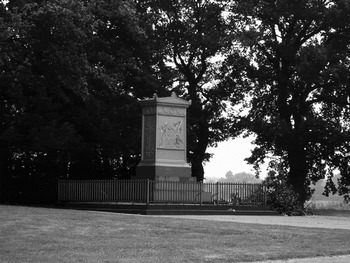
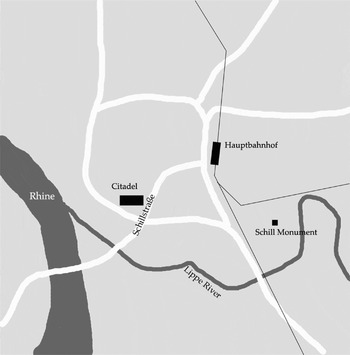
As early as the 1820s Prussian officers stationed at Wesel were conspiring with town leaders to find some way to side-step or even overturn the royal disapproval by erecting a monument to Schill. Sentiment among civilians and military men alike was overwhelming that Schill had been a hero and that his eleven young officers at Wesel had died as martyrs. In 1833 the Wesel officers scored a coup when Karl Friedrich Schinkel, Prussia's most celebrated architect, agreed to design the monument, gratis. Military and civilian authorities had chosen the site: not in front of the old fortress where the Schill officers had been shot, but a mile away in a lush green meadow overlooking the Lippe just before it entered the Rhine. With trees for a backdrop and a gentle slope of long grass in front, the monument sits on a stepped rectangular podium and is topped with a single arch. The face shows two angels: one bent in mourning and placing her hand upon a sarcophagus; the other radiant and hovering as she holds a laurel crown above it. Beneath them a tablet lists the eleven Schill officers, and on the reverse side, the inscription, “They died as Prussians and Heroes on Sept. 16, 1809.”
King Frederick William III looked the other way in June 1834 as the army exhumed the bones of the eleven men and buried them in a ceremony presided over by civilian and religious representatives on September 16, under the site where the monument would be laid. It was the twenty-fifth anniversary of their deaths. The monument was completed over them, with the finishing touches accomplished that winter. A larger public ceremony in March 1835 drew thousands of spectators from across Germany and featured parades, concerts, and a fair-like outdoor festival with costumed reenactors.Footnote 7
For the next century the Schill Monument at Wesel was the site of both solemn commemorations and boisterous festivals, frequently specifically anti-French in tone, as had been the original event, filled with readings of hyper-nationalistic anti-French poetry. Each year on September 16, audiences ate their picnic lunches in the meadow while they booed and hissed the “French” soldiers in the reenactment of the trial and execution. In the 1934 festival (the 125th anniversary of the execution) the new Nazi government of Wesel put on what was arguably the most raucous of these events, in which actors encouraged audience participation because they were filming a documentary at the same time. A pretty blonde “Queen Luise” rode through the midst of the play in an open carriage, and an old Marshal Blücher puffed on his pipe and exhorted the townspeople to rise up—literally—and curse the French.Footnote 8
The Battle for the Monument
The British Bomber Command estimated that Wesel was the most intensely bombed city of the European war.Footnote 9 Ninety-seven percent of its buildings had been destroyed. Fewer than two thousand people remained at the beginning of May: about seven percent of the pre-war population. The annihilation was not just the work of the bombers who had flattened much of the city in February 1945. The Rhine crossing launched by the British army one month later brought Wesel under the bombardment of more than two thousand pieces of artillery.
After the clearing of roads and the restoration of basic water, electrical, and sewage services, the most pressing issues were shelter and employment. For a time the creation of new homes and infrastructure was itself the only real occupation, but Wesel needed something to generate long-term jobs. The population remained substantially lower than the pre-war figures, and the economy stagnated just above subsistence levels as the 1950s began.
Prior to the war an old iron-works had stood on the north bank of the Lippe, about 200 meters behind the Schill monument, concealed from view by a line of trees. When allied bombing wrecked the iron-works, fragments of building and bombs pock-marked the monument and scarred it black. It remained—damaged but not disfigured—sitting in its meadow. The open ground behind it, where the iron-works had been, seemed an ideal place for industrial or commercial development.
At the beginning of the 1950s, town fathers and industrial leaders developed a plan to expand the meadowland into an industrial district. They envisioned a new railway line with a freight depot and switching-yard, a new highway for the heavy trucks that would serve the facilities, and finally a freight harbor on the riverbank of the Lippe where the Rhine barges would dock. For the first time since its Hanseatic heyday five centuries earlier, Wesel would once again become a major import-export center. Accomplishing all of this, however, would require tearing down the Schill monument.Footnote 10
Throughout the early 1950s this plan germinated in the midst of two fundamental questions. On one hand, West Germany was a new republic, rejecting the nationalist, militarist past that had facilitated the country's embrace of Nazism. The Federal Republic of Germany did not need Prussian military heroes. Its new martyrs were pacifists such as Hans and Sophie Scholl, or the July 20 conspirators such as Stauffenberg and Henning von Tresckow.Footnote 11 Philosophers and composers appeared on the national currency and postage, replacing military men. Past victories went unmarked, streets and plazas were renamed, and schoolbooks were rewritten under the supervision of a new United Nations commission on the dangers of nationalism in school instruction.Footnote 12 Thus it was a fair question to ask whether the town of Wesel, or the Federal Republic of Germany as a whole, still had any use for a figure such as Ferdinand von Schill.
The second debate was specifically local. It began among a very small handful of Wesel's elected leaders and the industrialists they courted. For around two years, apparently in secret, they discussed plans to demolish the damaged monument or to move it, either to the citadel or the military cemetery. When these plans finally began to reach the public in late 1953, the politicians were surprised to find themselves vilified by a wide spectrum of their constituents. At issue was not simply the Schill Monument, but the fundamental question of popular democracy and the right of the citizens to make decisions about their community.
People learned of the plans in the winter of 1953–54 as the monument was suddenly disassembled. Most citizens apparently thought that this was merely for repair and restoration, but soon they learned of the scheme to move the monument or dispose of it altogether, and to build the industrial park in its place. Popular opposition to the plan crystallized around the question of whether the city would celebrate, in September 1959, the 150th anniversary of the death of Schill's eleven young officers. It became Wesel's first major test of post-Nazi democracy.Footnote 13
The controversy quickly drew the attention of the local and regional press. Karl-Heinz Reuber, director of Wesel's archives and historical society, demonstrated a facility with the media that far exceeded the modest efforts of the local government to make its views known. Reuber's editorials about the Schill monument and the proposed industrial project appeared in local and regional newspapers and in the regional interest journals and almanacs. He must have had the support or assistance of editors and/or media owners because they gave him, in some cases, multiple-day serials as long as three to four pages at a time, and almost always with explicatory sidebars and illustrations of the Schill monument in happier days.
In these pieces, Reuber consistently repeated five arguments for restoring and preserving the monument. First, the industrial park would destroy the beautiful and peaceful meadow. Second, a very important part of Wesel's history would be destroyed. Third, there was nowhere else within walking distance of the city center where people could enjoy such a lovely balance of trees, field, and riverbank. Fourth, Wesel had been defined by this moment in history (Schill's revolt), and to disrespect that by tearing down the monument and digging up the bones beneath it would be akin to disrespecting Wesel itself. And fifth, the new development would cause congestion and pollution. Reuber often made a quaint appeal to preserve something of the quieter, slower century, “in this hasty, motorized era.”
Helmut Berkel, the Bürgermeister of Wesel, called a town meeting. He was doubtless uneasy about submitting the issue, which had advanced considerably among a small group of planners, to the messy process of local democracy. On July 16, 1954, Berkel presented his case to a “panel of experts” heavily dominated by historians. Then the floor was opened to everybody who wanted to say something.Footnote 14
Some people spoke purely as individual citizens, but in many cases the speakers claimed to represent a specific constituency. A person representing the “Catholic Association of Teachers,” for instance, spoke against moving the monument because they took their students there on field trips and it provided an important history lesson. Other citizens noted that for years the city had called itself the Schillstadt Wesel, and that this title was the first thing visitors saw when they left the platform in the train station. One man even represented a constituency that was no longer alive: an old veteran of the Schill memorial service in 1909, he spoke passionately that he was the last survivor from his group of soldiers in that parade, and on behalf of his dead comrades he begged the town not to move it.
City directors protested that the plans had gone ahead too far already, and it was too late now to debate whether to move the monument. The question was only where to? Most of the citizen speakers apparently ignored that condition. They seemed overwhelmingly in favor of restoring the Schill monument to the meadow, and their arguments were almost always couched in terms of history and identity. The proponents of the industrial plan tended to speak in practical terms: commercial traffic, economic benefit, development, and land use. One councilman spoke about the “demoralization” of the people since 1945, adding that he “hadn't seen any Barons of Industry” in Wesel, and that the new industrial park could double Wesel's population within a decade.
The minutes of this town meeting reveal a local government caught flat-footed by an angry populace who demanded the right to exercise their newly acquired democratic powers. One must wonder whether the population would have warmed to the idea of the development plan had they been consulted at the outset and had the leaders engaged the media on friendlier terms much earlier. By this point, however, the citizens were angrily reclaiming their rights by rejecting a massive public-works initiative in order to save a 120-year-old tombstone. When the representative from the national railroad began to equivocate and admitted that perhaps the new railway didn't need to be built exactly there … the Bürgermeister must have known that his plans were scuttled.
To the great relief of the citizens, the councilmen voted in accordance with their wishes: the Schill monument would be repaired and stay where it was. The industrial development plans were shelved indefinitely. Only one of the major new roads was built. Even more, the wreckage of the old iron-works was to be cleared up to improve the general atmosphere of the meadow.Footnote 15
The tone of the dialogue at the meeting presents a striking contrast with discussions about the monument during previous regimes. No one spoke in terms of military glory, heroism, or sacrifice. The closest anyone dared come to those topics were the citizens who asked for respect for the dead men buried beneath the monument, on the basis that they had already been unearthed once, and that it was disrespectful to do it again, especially just to build a factory. The people of Wesel wanted their own past restored to them: something familiar and comforting from the days before the destruction. They had voted not to lionize Schill, but (as Dr. Reuber had asked) to set aside something from a slower, quieter age.
The monument was, and remains, the centerpiece of a peaceful meadow that people use for recreation, but of course it retained its role as the symbol of a powerfully controversial event. And now that they had been forced by their own citizens to spare it from demolition or removal, the local government had to return to the question of how to mark the 150th anniversary of the death of Schill's eleven officers. The event's planning fell to the team of the new SPD mayor, Kurt Kräcker, and the new West German military.Footnote 16
The Bundeswehr's contribution to the event was carefully scripted. Its “Musical Corps XII” paraded on September 12, 1959, as part of the rededication ceremony for the restored monument. A general shared the reviewing stand with the Bürgermeister, and then gave a speech at the citadel on the themes of freedom and service: those contradictory values that bedevil the consciences of militaries in all democracies. Civilians formed a procession to the gravesite, led by a company of men dressed in the old imperial uniform from 1914, complete with spiked Pickelhaube. They carried replicas of old Prussian battleflags from the era of Frederick the Great and the Napoleonic Wars in a somber, silent column moving slowly past the crowd. At the monument, more speeches ensued, and finally a chorus of local middle-schoolers sang hymns.
One cannot help but note the contrast with the Nazi-era event, twenty-five years earlier. The 1934 ceremony had been very rowdy and interactive, and people seemed to be enjoying themselves. It was visceral patriotism, for better or worse, but without much care given to symbols or implication. The 1959 ceremony, however, was a very serious affair, as if great care was taken to get everything exactly right, as if they were extremely cautious about the choices of symbols and the uses of such ceremonies. It was a much more “official” event, with no crowd participation: a statement on the rehabilitation of Prussian history within the rubric of the new Federal Republic of Germany.
The Schill-Denkmal in Braunschweig
In the aftermath of Schill's revolt, as the French and Westphalians rounded up groups of rebels, more than two hundred former Westphalian soldiers were incarcerated in three large groups, and smaller groups were found later in other places. A majority of these men, who as deserters all faced the possibility of execution, were brought to the fortress of Magdeburg, which was technically in Westphalia but actually controlled by its French military governor. Many of the men were sent on into French captivity and ultimately ended up on prison galleys. But about a hundred Westphalian deserters were given by the French to Westphalian officials for the purpose of organizing cautionary trials and executions, much in the manner of the Schill officers at Wesel.Footnote 17
The Westphalians marched these men to Braunschweig. Local sympathies were such that at nearly every stop people came out to greet them, to feed them or give them water, and in some cases to help them escape.Footnote 18 The Westphalian soldiers guarding them frequently looked the other way as men disappeared, and in some cases they accepted bribes from local citizens to release men who might indeed have been from that town, or had relatives or friends there.Footnote 19
The Schillschen reached Braunschweig on the afternoon of July 17, 1809. The Bürger here were as sympathetic as Westphalians had been elsewhere. One prisoner (who later escaped) recalled that townspeople brought food to them every day, and that local women arrived and set up a laundry right there to wash their filthy clothes.Footnote 20 By the time the other Schillschen marched off and the court-martial convened for the remaining Westphalians, the ranks of the prisoners had already been substantially thinned by escapes.Footnote 21 To satisfy Jerome's government, General von Heldring, who presided over the tribunal, chose to make examples of fourteen soldiers whom he identified as having deserted, while on active duty, to join the rebels.Footnote 22 The condemned men were shot in front of a large crowd the next morning. In the moments before they died, several of them shouted “Long Live Major von Schill!” to the cheering crowd.Footnote 23 As in Wesel, the men's bodies were heaped together in a shallow, unmarked grave.
The impetus to build a Schill Monument in Braunschweig came initially from a single man: Carl Friedrich von Vechelde, a Braunschweig lawyer-turned-poet/essayist whose family had suffered during the wars under French plundering and Westphalian rule. In the early 1830s Vechelde took a keen interest in the Schill story and the fate of the Westphalian soldiers executed at Braunschweig. His idea was to create a monument that would commemorate the martyrs—more or less near the spot where they were killed—but one that would also honor Schill personally. The rebel leader's own body had been stripped and dumped unceremoniously in a pit somewhere outside Stralsund in 1809. But Schill's head had been severed and preserved in alcohol, and sent to Jerome Bonaparte as a trophy. Jerome gave it to a Dutch physician who had worked both for him and his brother Louis Bonaparte in Holland. This man brought Schill's head to the collections of the University of Leyden, where it had remained ever since. Vechelde intended to recover the head and thus bury Schill (or his head, at least) along with those fourteen of his martyred soldiers, capping it all with an impressive monument.
Vechelde had a genius for persuasion and fund-raising, and his correspondence throughout the early 1830s shows a man with remarkable networking skills. He wrote to Napoleonic veterans as humble as common soldiers and as famous as the Duke of Wellington and Austria's Archduke Charles, obtaining money and various souvenirs from the revolt. By 1836 he had raised enough for a monument and persuaded the Dutch to return Schill's head. Prince Frederick of the Netherlands wrote personally to approve the transfer from Leyden as a “gift to the German people.”Footnote 24
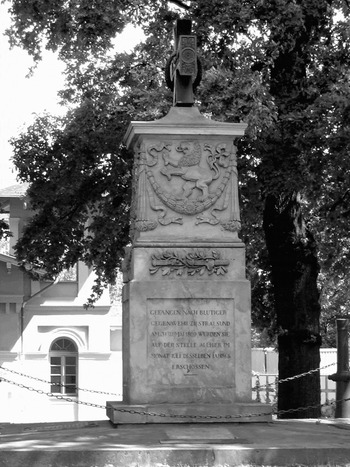
Vechelde's architect, Heinrich Friedrich Uhlemann, chose a more military aspect than that done by Schinkel at Wesel: a square granite column with inscriptions on copper plate on each of the four sides, and a large wreathed iron cross on top. And beneath the iron cross, the words, “They fought and fell for Germany's freedom.” Vechelde began to organize the dedication event which, like that at Wesel, soon swelled with dignitaries, religious groups, and assorted VIPs who wanted some sort of prominent place in the ceremony. As a promoter, Vechelde had few equals. By 1836 he had published a number of patriotic pamphlets about Schill and the men who died at Braunschweig. The city set aside an official holiday.Footnote 25
The parade and ceremony featured veteran soldiers; a chorus singing patriotic songs; speeches by politicians, and military and religious leaders; a concert of patriotic anthems; and the by-now-obligatory poetry readings. One of Vechelde's projects was the establishment of an Invalidenhaus (an old veteran's home) on the grounds of the monument, where an old wounded soldier would live at the city's expense in return for being the caretaker. The house, dedicated in the summer of 1840, was in fact a sort of shrine of Schill-souvenirs such as his saddle, his pipe, a clipping of his hair, even his baptismal cloth. Its first occupant was a former Schillscher who rang the bells on a dozen Napoleonic anniversaries each year, only a few of which were connected with Schill.Footnote 26
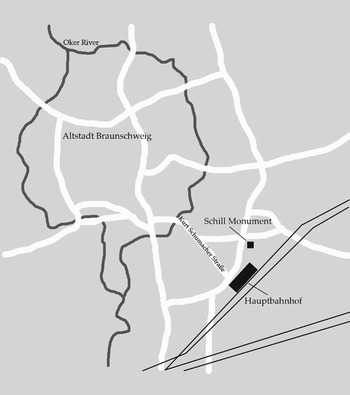
The Schill-Denkmal in Braunschweig became an historical reference point for the city. Along with the two great equestrian statues of the dukes (both killed fighting Napoleon) on what is today Kurt-Schumacher Street, the Schill monument became a site of annual commemoration and celebration. Newspapers ran annual features, often devoting multiple pages and illustrations to remind readers of the historical significance. Given that there is no evidence that Ferdinand von Schill ever set foot in Braunschweig, it is remarkable that by the mid-nineteenth century the city had fully adopted him as a local hero.
The Battle for Memory: Braunschweig and the Schill Monument
For nearly a century after it was built, the Schill-Denkmal in Braunschweig existed in a field. Behind it, gentle hills stretched away to the east. Braunschweig did not grow or develop in that direction until the last decade of the nineteenth century. Such a rural setting is unimaginable today, with the monument surrounded by large public buildings, offices, and apartment blocks, bordered by major highways.
One reason for the change was the decision to move the main train station. Braunschweig's original Hauptbahnhof stood in the south, now the Friedrich-Wilhelm Platz. During World War II the city was heavily bombed, and the station and switching yards were all but obliterated. After a decade of ad hoc and temporary solutions, city planners eventually selected an area just east of the Altstadt, a region that by the 1940s had become a freight yard. The new station stood diagonally across from Schill Street and the site of the monument. Virtually no one mentioned, at least not in writing, that the Hauptbahnhof partially covered the site of a concentration camp.
By the summer of 1944 Braunschweig was the destination for a swelling number of slave-laborers coming to the new concentration camp on Schill Street, whose walls began scarcely twenty meters from the monument. Ultimately more than 90,000 slave-laborers were sent to seven camps in the greater Braunschweig region, although the camp on Schill Street was relatively small (one city block), and housed about two thousand, depending upon the vicissitudes of the Nazi slave-labor market and the corporations that used them. Others were held on site at their places of employment throughout the city. Initially, the majority were French and Soviet prisoners of war. By the autumn of 1944, however, a substantial number of East Europeans of various nationalities arrived, including Jews who had been transferred from Auschwitz and Neuengamme.
By day the prisoners worked in the regional industries. Many of the female inmates were employed clearing the rubble from Braunschweig's bombed streets. In the last month of the war, the Schill Street concentration camp closed. Many of the prisoners (including all of the Jews) began the “evacuations” which were usually death marches to other camps. Most of the Schill camp's survivors ended at Wöbbelin, close to another monument/tomb for another youthful Napoleonic martyr, Theodor Körner, when American troops liberated them on May 2, 1945.
Because Braunschweig closed its camps before allied troops arrived, and because housing was in such desperately short supply in 1945 that local people actually moved into the concentration camp to live, allied authorities did not press the local government on the question of slave-labor. Nor did the populace seem particularly eager to investigate their city's complicity in the Holocaust. Braunschweig had been a fairly “brown” city in the 1930s, one that participated with some enthusiasm in the various Nazi historical and mythological projects. (Despite the prominence of its many fine old cathedrals, the city supported the Nazis' faux-ancient “Germanic” cult and its attendant festivals and ceremonies.Footnote 27) Finally, consciences may also have been salved by the absence of any reminders of the camp's original function. After rudimentary repairs and modifications, the prison buildings remained in use as homes until early 1960, when the last traces of the camp were demolished to make room for a new central post office.
By that time, another layer of memory had settled onto the street corner. In 1955 Braunschweig finally retrieved the last of its prisoners of war. In most of West Germany activism for POWs was an important political force, even generating a national party around the issue of returning these men from the Soviet Union. Braunschweig, like most of the West, had an active veterans' support organization. In 1955 they succeeded in rededicating the Schill Monument to their fallen comrades. The base of the obelisk was expanded to include the Ehrentafeln: four plaques, one on each side, listing the units in which Braunschweig's men had been killed during the war. The army and air force were both represented, but the Waffen SS and other Nazi services were deliberately omitted.
The placing of the tablets was billed as a “rededication” of the monument and occupied two days in September 1955. The official brochure issued by the city declared the ground consecrated by the “sons of all German ancestries … who fought on the fronts of the war from 1939–1945, and are fallen, missing, or did not return from imprisonment.” The first day was dedicated to the Luftwaffe, with formations passing overhead, and a band playing the “Duke of Brunswick March.” The second day was for the army and began with all the city's bells tolling at once. Following prayer services, Bürgermeister Bennemann spoke and introduced comrades of the fallen men.Footnote 28 Photographs show an audience that was overwhelmingly male and middle-aged, most likely veterans of the war, standing at attention in their Sunday best in long lines many ranks deep.Footnote 29
By the early 1960s the Schill-Denkmal had been essentially co-opted by the very powerful veterans' organizations of Braunschweig, which had the support of local government, business, and media. Ernst Mund, veteran of one of the army regimentsFootnote 30 raised from Braunschweig, proud of the Death's Head symbol that he traced back to old Prussia (and blissfully and deliberately unwilling to acknowledge the SS associations of that symbol), served as both director of ceremonies and spokesman for the affiliated groups that ran the annual Day of Mourning (Volkstrauertag).Footnote 31 Taking their rituals from the annual ceremonies that had been held at the monument since the 1830s, the veterans brought together all the local and national VIPs they could muster. The Volkstrauertage were attended (often cosponsored) by representatives from the Federal Defense Ministry; the regional and city governments; the bureau of historic preservation; the local politicians of the SPD, CDU, and FDP; five different veterans' charitable organizations; and individual men from each of the units listed at the monument.Footnote 32 The Minister-President of Lower Saxony attended on several occasions, as did Germany's Defense Minister. Mund juggled correspondence with virtually every powerful institution of West Germany's social fabric. He arranged plays and concerts, brought dignitaries from other German cities affiliated with the Schill story (even across the Iron Curtain, in order to cooperate with the City Museum director of Stralsund), and orchestrated veterans' reunions with groups as far away as Denmark. The annual events featured an infatuation with Schill relics that would have pleased nineteenth-century activists such as Vechelde. Each year the Invalidenhaus brought out Schill's saber, his pistols, his vest and dolman, his pocketbook, even the glass case in which his head had been shipped from Holland. And of course each year the veterans reproduced a veritable library of replicas of old copper prints, lithographs, and various Schilliana such as postcards and trinkets. At twenty deutsche Mark, the promotional booklets were not cheap for 1965.
Mund and the veterans' groups were officially apolitical, and more than once advised visiting politicians not to indulge in any partisanship in their comments. Nonetheless, the veterans were decidedly on the right of Germany's political spectrum and each year the Volkstrauertag provoked a few editorials, usually in Left-wing publications, complaining about glorifying war and militarism. Interestingly, although the city owned the land and the monument itself, the local government had completely abdicated its authority over the site and the rituals, leaving all important decisions in the hands of the veterans' groups. Thus, although a small current of disapproval persisted throughout the 1970s, these complaints rarely filtered upward to the decision-makers such as Ernst Mund.
Cracks in the monument's foundations forced Braunschweig to do some digging and restorative work in 1981. The city leaders asked the veterans if they would be willing to answer some of the critics by expanding the monument's focus, perhaps including a new plaque with a more generic dedication—much like the reimagining of the Neue Wache in Berlin—to “all victims of war and oppression.” The veterans accepted this formulation very reluctantly, and only if they could make clear that they were expanding the monument's dedication to include more military veterans as well, namely those of the First World War.Footnote 33 By 1982 they had conceded only to change a few spoken lines in the ceremony; nothing physical about the monument was altered. At the climax of the ceremony—the ritual wreath-laying by the mayor, the veterans, and the churches—a speaker intoned that they were remembering “all victims of wars and tyranny” (“die Opfer von Kriegen und Gewaltherrschaft”). To the conservative veterans, this meant solidarity with the victims of Communist tyranny in the east. That was, in fact, the intent they expressed in a number of letters and editorials in local newspapers, and the formulation that Braunschweig's media generally supported. It was not an admission of the city's own tyranny against the slave-laborers. And it was certainly not an invitation to diminish the unabashed old-style patriotism of the event, whose musical components continued to include nationalist nineteenth-century songs such as Ich hatt' ein Kamerad, Lützows Wilde Jagd, and the full lyrics of Deutschland Über Alles. Consequently, the supposed “compromise” of the early 1980s neither satisfied those pacifists who found the entire ceremony distasteful nor sounded convincing to the handful of people who pointed out that there had been a concentration camp on the very site that was now being used to honor the soldiers of Nazi Germany.
A few days before the 1990 Volkstrauertag a Lutheran pastor named Fay organized a tiny demonstration of about a dozen people. They handed out leaflets and put up posters, and at the ceremony itself stood at the edge of the monument area with a plaque that declared that Jews had been killed there during the Holocaust. When the Schill ceremony reached its climactic wreath-laying, Fay's demonstrators placed their own wreath on their plaque and offered prayers for the victims. The president of the city council, Dr. Heinrich Kintzi, studiously ignored them in his speech at the Volkstrauertag, speaking in vague terms about victimhood, and noting that “pain and hope always lie close together.” The media reported the event as “a new concept” for the ceremony, but only insofar as that it now seemed to include victims of terrorism.Footnote 34 That interpretation might have been a response to the unexpected and alarming spike of anti-immigrant violence in the newly unified eastern Länder that alarmed Braunschweigers and other Wessis in 1990–91.Footnote 35
German reunification in 1990 generated new debates about symbols of the past and the proper means of remembrance. But for the next few years in Braunschweig, local media were entirely in solidarity with the veterans and their use of the former concentration camp site as a memorial to fallen soldiers. The annual newspaper articles covered the ceremonies in much the ways they always had: a summary of Schill's revolt and Braunschweig's role, photographs of the solemn Volkstrauertag, and the usual aphorisms about sacrifice and devotion offered in quotations from veterans' representatives or local politicians. At the 1991 ceremony, for instance, the guest historian spoke in carefully neutral and passive terms about war as a “man-made catastrophe,” but specifically pointed to the victory over Communism and the liberation of East Germans from “tyranny.” In two segments of his speech he used precisely the same verbiage as the speaker at the 1982 Volkstrauertag, and very similar to previous speakers on several past occasions, a repetition suggesting that neither the intent, the tone, nor the message had changed at all: “. . . the task is to celebrate their deeds and to forget the pain.”Footnote 36
The Schill-Denkmal in Wesel.

Reunification meant that the anti-fascist sensibilities of easterners were now added to the mix of German politics in unpredictable new ways. The Antifaschistische Aktion, for example, was a far-Left pacifist group with connections in the former Communist East. Although they had been protesting the covering-up of slave-labor camps for years, it was only after German reunification that they finally organized and invigorated the opponents of the Schill Monument in Braunschweig. In 1994 they held a demonstration at the monument on the Volkstrauertag, thus finally forcing the mainstream media to cover the opposition—albeit rather unsympathetically.Footnote 37
The Schill-Denkmal in Wesel (Map).

The Aktion was a very different sort of opponent from the gentle Reverend Fay and his quiet protestors. They were loud, flagrantly disrespectful, and ready to use all channels to lodge their protests. When two teenagers were handled roughly by police during the counterdemonstration in 1994, the Aktion sued the city for abuse of police power, citing their proper permits and constitutional rights.Footnote 38 For the first time, the media began to cover the protestors' point of view. This troubled Ernst Mund. He had stepped down from his official leadership position for the veterans' associations in the late 1980s, but was essentially still the director-emeritus, and had the ear of both government and media. A week after the 1994 ceremony he wrote a letter full of angry sarcasm to the Braunschweiger Zeitung, which—in his view—had been too sympathetic to the demonstrators:
Unfortunately [your] eyes and ears were not turned toward the direct, brutal, and spontaneous oppression by the [so-called] “Victims of Fascism” during the memorial service of the All-German Veterans' Welfare Society at the Schill Monument on this last Day of Mourning. … one of our city councilmen was injured and not protected by police from this so-called counterdemonstration. When I see the base of the monument defaced with a hammer and sickle in bright oil paint, and I hear people screaming the words “Germany Perish!” then I think about the horrors that awaited us from the “Progress of the former DDR.”Footnote 39
The Schill-Denkmal in Braunschweig.

Sensing the tide of opinion moving in its favor, the Aktion spent 1995 preparing to reach a broader audience. They produced an impressively comprehensive booklet that spelled out their opposition to the monument and its annual ceremony. This publication struck a blow against the Schill Mythos by pointing out that the nineteenth-century hero-worship had been grossly exaggerated: “Schill wasn't struggling to improve the lives of people … In fact, the old feudal system and its laws had already been reformed by Napoleon.” That paled, however, compared to the brochure's revelations of exactly which companies in Braunschweig had used the slave laborers, when, and in what numbers. (In the seven camps of the greater Braunschweig area this amounted to fifty-eight different companies using altogether more than 20,000 slave workers.) To drive the point home, they printed a map of Braunschweig with black dots over each company's offices.
The Schill-Denkmal in Braunschweig (Map).

The Aktion was first and foremost opposed to German remilitarization (which showed the anachronistic Old-Left roots of their leadership, given that by the mid-1990s Germany was already in the midst of a comprehensive slashing of its military). They were rather loose with the word “Fascist,” which to many of them seemed to mean anyone in a uniform. By the time of the 1995 Day of Mourning, tempers were running high on both sides. The city was on alert: Bürgermeister Werner Steffens, city council president Jürgen Bräcklein, and police chief Udo Ahlers were prominently visible, along with the other leaders of the city government. The Aktion formed a sort of perverse Greek Chorus, chanting “Tear down the Schill Monument!” The media were now fully engaged; by this point it had become normal for newspapers to cover both aspects of the event and to mention that a concentration camp had stood on the grounds of the monument.Footnote 40
The day of the 1995 ceremony was cold and rainy, which helped to suppress many people's ardor. There had also been an important concession from the veterans. One month before the ceremony they agreed to rephrase the traditional words at the wreath-laying so that instead of declaring that the ceremony had been for the “Sons of all Germany who died in war,” they would instead say it was for “the victims of war and oppression.” In essence, they would finally do what they had supposedly agreed to do as early as the 1980s. Ernst Mund wrote two editorials that autumn in which he asserted that, “we concern ourselves with the tragedy of all those who fell in war.”Footnote 41
Two days after the ceremony, Braunschweig-Wolfenbüttel College announced a symposium to discuss the controversy: “a critical examination of the Schill Monument and the commemoration at the location of a former concentration camp.”Footnote 42 The very fact of such a discussion, of course, was a victory for the protestors because it implied the inevitability of some sort of change. Local politicians grasped the expediency of being seen on the side of both civic order and historical justice. The city council was relatively quick to offer a compromise: they agreed to expand the site to include a memorial to the victims of the concentration camp.
The signage at the perimeter of the site now reads “Memorial-Site, Concentration Camp Braunschweig, Schill Street.” It has become a strange mélange of memory and history. Schill's monument still stands at the center: a broad obelisk topped by a large iron cross. One face of the obelisk bears the golden letters F.v.S. while another lists the names of the fourteen men whose bodies share this place with Schill's head. The four Ehrentafeln for the soldiers of the Second World War remain in place around the base of the column. Finally, some forty feet from the monument, is a long, low wall with dozens of plaques, not all of which are inscribed. They cover a variety of topics. Some have general aphorisms about victimization and oppression. Some have specific cases (a Jewish veterinarian from Braunschweig, taken to Auschwitz in 1944, an eleven-year-old boy, and so on.) There are maps, excerpts from testimonies, statistical charts such as one showing the number of homosexuals who were convicted and imprisoned during various years in the Third Reich. And in the midst of this we find excerpts from letters written by Schill's men on the eve of their execution here. The Schill Invalidenhaus is now a miniature museum and “open archive” where visitors can thumb through an encapsulated history of oppression. The large post-office building behind the monument, on the precise site of the camp itself, now broadcasts an old rabbinical proverb in glowing letters on its wall: “The Future Has a Long Past.”Footnote 43
The intent may have been to create an expanding circle of memory, moving outward through history, but it is unclear now what is being commemorated at the Schill-Denkmal. Is it Ferdinand von Schill the German nationalist and patriot? Is it the soldiers who fought the war started by Adolf Hitler? Or is it the victims of German nationalism and Hitler's war? Thus a man who came to symbolize Germany's power to resist a conqueror found his resting place in the midst of those who had been victimized by Germany's own excesses in conquest.
Conclusions
At the time Ferdinand von Schill died, the Bonaparte regimes that ruled Wesel and Braunschweig blamed movements like his on the nefarious influence of outside regimes that sponsored terror and rebellion and had refused to move with the changing times. Those Germans who listened to Prussian propaganda were stubbornly resisting the modernizing progress of Napoleonic France. Two centuries later in Braunschweig, conservative German patriots blamed the former East Germans who could not let go of their old Communist propaganda. In both cases, men of the status quo seemed unable to grasp why anyone would want to revise history, why anyone would have historically or culturally grounded grievances.
Wulf Kansteiner has observed that German historical culture was slow to develop a critical lens due primarily to political factors, and that those instances when Germans were more open to substantial revisions were largely due to “a specific constellation of ideological convictions, political generations, and strategic options.”Footnote 44 The cases of the Schill Monuments in Wesel and Braunschweig, separated by forty years and a great deal of democratic development in the Federal Republic, can be seen as two ends of a thread of evolving historiography, roughly the duration of the “Bonn Republic” of West Germany. But the difference between the public reactions in these two cases has less to do with the evolution of German politics and culture in the intervening years than with the fact that one locale was directly implicated in the Holocaust, while the other wasn't.
In Wesel, as the 1950s opened, a devastated landscape seemed supremely open to reinterpretation. If ever there was a time auspicious for a wholesale reimagining of urban space and the place of public monuments, then Stunde-Null was surely it. The Weselers were not faced with any sort of radical historiographic revision; the proposed industrial development was politically neutral and of course the prospect of new jobs and prosperity held a universal general appeal.
Yet, the Weselers balked at the prospect of selling the historic identity of the city to obtain economic improvement. They preferred an historic monument to a major industrial project. In the new liberal democracy of the Federal Republic, they tried to express this desire using a new vocabulary devoid of the nationalist rhetoric that characterized Germans' discussions of war memorials for more than a century and that had peaked under the Third Reich. The citizens defied their elected officials to protest their right to own the city's history on their terms.
The situation in Braunschweig, forty years later, was infinitely more complicated because of the city's undeniable complicity in the Holocaust, because the political conflict pitted citizens against each other, and because the debate played out against the backdrop of German reunification and the attendant reexamination of both the Nazi and Communist pasts. The protesters in Braunschweig framed their objections in terms of German “nationalism and militarism.” The more robust among them accused the state of “Fascism.” Their primary objection to the Schill monument was that it was a glorification of German militarism. Although they had little use for Schill, they were primarily angry about the Ehrentafeln and the ongoing ceremonies to commemorate fallen soldiers of the Third Reich. As far as they were concerned, the Schill-Denkmal had become a World War Two monument. The fact of the concentration camp was in a sense the punctuation of their statements. The camp's existence and the studious quiet the city observed about its complicity in the Nazi regime were for the demonstrators a case in point of how the Federal Republic was still a “Fascistic,” militarist state.
Taken literally, the activists were of course completely wrong about the nature of the Bundesrepublik. Few modern states can claim to have made such high-profile public attempts to atone for the nation's past sins as has the Federal Republic of Germany. Few nations with a military have been more reluctant to use it or even to elevate it to any position of political clout. Much to the chagrin of the Americans, the Federal Republic slashed its military expenditures in the 1990s to levels barely sufficient to meet its staffing commitments, and arguably insufficient for the Bundeswehr's new role as a peacekeeping force with an increasing list of humanitarian missions. Even something as seemingly innocuous as sending Bundeswehr medical personnel to assist a NATO force in the Balkans routinely caused paroxysms of doubt and painful introspection in the media and the political culture. Given the burden of past crimes, was it acceptable for German soldiers to leave Germany, period?
But if the protesters were simply wrong in their accusations about militarism in 1990s Germany, they had nonetheless raised a larger historical point. The Schill-Denkmal was a monument to nationalism and militarism. Not, perhaps, in its post-1945 iteration, but certainly in its original conception. In nineteenth-century Germany, no one had had any qualms about it: the site was a monument to the glories of war.
The men who, in the 1950s, chose it as a location for the memorial stones of their fallen comrades may not have consciously decided to rank the soldiers of the Third Reich alongside Ferdinand von Schill as German war heroes and mythical martyrs. Perhaps by then the monument was simply such a symbol of the city that it seemed logical to place the stones there without giving the matter deeper historical significance (although Braunschweig was certainly not devoid of nineteenth-century monuments, and the Ehrentafeln might just as easily have gone elsewhere). But wittingly or unwittingly, by adding the dead of 1939–45 to the site they completed a trilogy of German militarism, for the very same sort of militaristic, nationalistic bombast that had once inspired men to create, support, and celebrate a monument to Ferdinand von Schill had made possible the success of a movement such as the Nazis. And thus it facilitated the death not only of the soldiers who were memorialized there, but also the victims of slave labor who were brought there as a result of Germany's conquests in war.
The protestors struck a deeper historical vein than their objections to twentieth-century militarism intended. It is hardly surprising that the Nazi regime had so frequently referenced Schill and others like him as they strove to create their own mythology. The camp's existence on the site of the Schill monument was an almost inescapable historical conclusion: this is what hyper-nationalism had wrought. These were the fruits of a century's glorification of violence and death, having grown from the very spot they were planted in the 1830s.
The citizens of Wesel found a way to contextualize a monument to Prussian and German militarism, to set it aside as a harmless historic artifact. The citizens of Braunschweig, with their monument's story linked to the Holocaust, arguably still have not. In Wesel, the monument still tells a story, although it no longer demands any sort of political or national perspective from visitors. It has become historically neutralized: a reminder, nothing more. The challenge facing Braunschweig will be to dedicate public space to the story of the public space itself. The story of the monument has overtaken any of the three stories that it now tries with such difficulty to tell. It has become a monument not to Ferdinand von Schill and his rebels, but to the troubled history of Germany.