Introduction
Actinomyces are normal constituents of oral flora, found within gingival pockets and tonsillar crypts, especially so in periodontal pockets and dental plaques. The role of actinomyces in the pathogenesis of tonsillar disease has received relatively little attention, although this non-spore-forming, strict anaerobic, gram-positive, non-acid-fast, branching, filamentous bacterium has been observed in tonsillar specimens since 1896. The occurrence rate varies from 1.3 to 24.6 per cent.Reference Slack1 Previous studies have shown a higher occurrence rate in patients with obstructive tonsillar disease but no association with chronic tonsillitis.Reference Janega, Suly and Babal2–Reference Bhargava, Bhusnurmath, Sundaram, Raman, Al Okbi and Al Abri4
The aim of this study was to determine the prevalence of actinomycetes colonization in patients undergoing surgery for recurrent tonsillitis and sleep-disordered breathing, and to determine whether actinomycetes colonization has a role in tonsillar hypertrophy or recurrent tonsillitis.
Patients, methods and materials
A total of 834 patients who had undergone tonsillectomy from 1 January 2000 to 31 December 2001 were retrospectively studied. Patients who had undergone tonsillectomy for suspected malignant disease or previous episodes of peritonsillar abscess were not included in the study. Patients were stratified into two groups. Group A consisted of patients who had undergone tonsillectomy for recurrent tonsillitis, and group B consisted of patients who had undergone tonsillectomy as a singular procedure or as part of uvulopalatopharyngoplasty for sleep-disordered breathing.
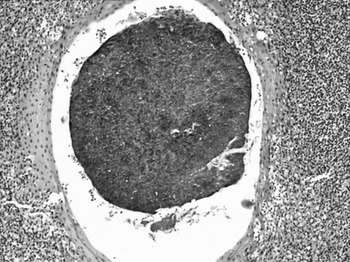
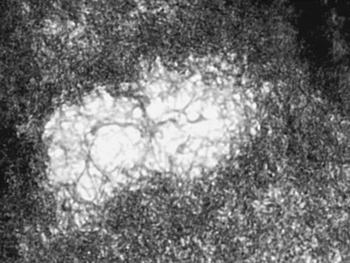
Surgically excised tonsillar specimens were transported to the pathology laboratory in containers filled with sterile saline. The specimens underwent measurement to the nearest 0.1 cm and gross examination, and were then serially sectioned and prepared by formalin fixation, paraffin embedding and microscope slide preparation. The volume of the tonsils was established in cubic centimetres. The slide was stained with haematoxylin–eosin. Specific observations were made regarding the presence or absence of actinomycetes colonization, tissue invasion, and presence or absence of the inflammatory response typical of active actinomycetes infection. An example of actinomycetes colonies in a tonsillar crypt is shown in Figures 1 and 2. The branching filaments characteristic of this organism are shown in Figure 3.
Actinomycetes colonies in tonsillar crypt (H&E; ×10).

Cross-section of tonsillar crypt showing actinomycetes colonies. Note the absence of tonsillar invasion (H&E; ×40).

Branching filament formation characteristic of actinomycetes colony (H&E; ×100).

Statistical analysis
Data were entered into an Excel spreadsheet and were then analysed using the Statistical Package for the Social Sciences version 11.0 software. Where appropriate, 95 per cent confidence intervals (95% CI) were analysed using Confidence Interval Analysis 2.0.0 software.The difference between proportion and mean and relative risk were analysed and relevant 95 per cent CIs were calculated and presented.
Results
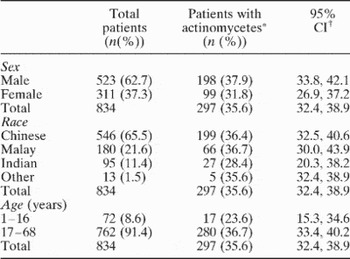
Demographic data for all the patients are presented in Table I. The prevalence of tonsillar actinomycetes did not differ by sex or race. Compared with female patients, the relative risk of tonsillar actinomycetes occurrence in male patients was 1.19 (95% CI 0.98, 1.45). The relative risk of tonsillar actinomycetes occurrence in patients of Malay origin was 1.01 (95% CI 0.81, 1.25) and that in patients of Indian origin was 0.78 (95% CI 0.56, 1.09), compared with patients of Chinese origin. The prevalence of tonsillar actinomycetes colonization was higher in the adult age group (relative risk 1.56; 95% CI 1.02, 2.38) compared with the paediatric age group.
Patient demographics

* Colonization in tonsillar specimen; †for percentage of patients with tonsillar actinomycetes. CI=confidence interval
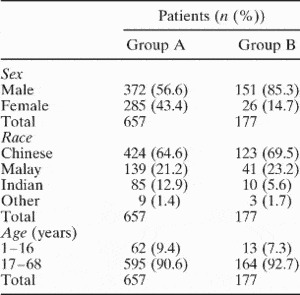
The age of patients in group A ranged from four to 66 years, with a mean of 29.5 years (±standard deviation (SD) of 11.0). The age of patients in group B ranged from seven to 68 years, with a mean of 39.0 years (±SD of 12.6). The distribution of sex, race and age in the two patient groups is shown in Table II.
Patient demographics in groups A & B

Group A=previous tonsillectomy for recurrent tonsillitis; group B=previous tonsillectomy for sleep-disordered breathing (no recurrent tonsillitis).
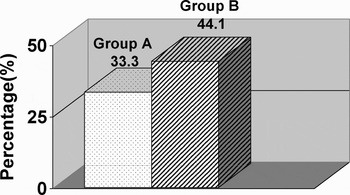
The prevalence of tonsillar actinomycetes in groups A and B is presented in Figure 4. There was a statistically higher occurrence rate of actinomycetes colonization in group B (sleep-disordered breathing; 44.1 per cent) compared with group A (recurrent tonsillitis, 33.3 per cent) (difference of 10.8 per cent; 95% CI 2.7, 19.9).
Patients with tonsillar actinomycetes colonization in group A (previous tonsillectomy for recurrent tonsillitis) and group B (previous tonsillectomy for sleep-disordered breathing, no recurrent tonsillitis).

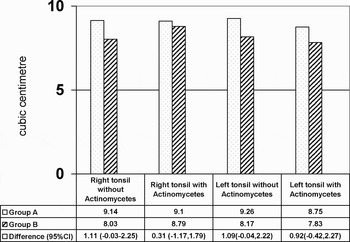
Tonsillar size was not influenced by the presence or absence of actinomycetes colonization. There was no statistical difference in size between tonsils with actinomycetes colonization and those without. There was also no statistically significant difference between tonsil size in group A and B patients (see Figure 5).
Mean tonsil volume in patients with and without tonsillar actinomycetes colonization in group A (previous tonsillectomy for recurrent tonsillitis; stippled bars) and group B (previous tonsillectomy for sleep-disordered breathing, no recurrent tonsillitis; hatched bars).

None of the tonsillar specimens demonstrated the inflammatory response typical of actinomycetes colonization nor had any evidence of tonsillar invasion.
Discussion
Since 1896, actinomyces organisms have been observed in resected tonsillar specimens. Their prevalence varies greatly, from 1.3 to 24.6 per cent.Reference Slack1 In our present study of 834 patients, the prevalence of actinomycetes colonization was 35.6 per cent (95% CI 32.4, 38.9). There was no difference in actinomycetes prevalence regarding gender or race. However, there was a higher prevalence in the adult compared with the paediatric population.
Although actinomyces infection (actinomycosis) of the head and neck region results in abscess formation, draining sinuses, fistulae and tissue fibrosis, the significance of actinomycetes colonization in the tonsils is not clear, and there is surprisingly little information in the literature, given that tonsillectomy is one of the most common operations in otolaryngology. The role of actinomycetes colonization in the pathogenesis of tonsillitis and tonsillar hypertrophy is controversial.
Janega et al. Reference Janega, Suly and Babal2 suggested that actinomyces might play a role in the aetiology of chronic inflammatory tonsillar disease. In their study of 125 patients, they found actinomycetes migration through the epithelium in 16 cases. In 32 cases, the presence of actinomycotic granules was associated with an abundant accumulation of inflammatory cells, although the authors noted that this was not so in the remaining 20 cases with actinomycotic granules.
Gaffney et al. Reference Gaffney, Harrison, Walsh, Sweeney and Cafferkey3 concluded that actinomycetes did not have a causal role in recurrent tonsillitis. In their study of 129 pairs of tonsils, they found actinomyces to be present in 29.5 per cent of patients with recurrent tonsillitis and in 40 per cent of tonsils from 10 patients with no history of tonsillar disease. This study also noted the absence of specific evidence of a tissue reaction to actinomyces.
The use of antibiotics in the treatment of patients with recurrent and chronic tonsillitis has been postulated to explain the lower incidence rate of actinomycetes colonization in these patients.Reference Bhargava, Bhusnurmath, Sundaram, Raman, Al Okbi and Al Abri4
Our study showed a higher prevalence of actinomycetes colonization in patients without a history of tonsillitis, compared with those with recurrent tonsillitis (44.1 versus 33.3 per cent, respectively, a difference of 10.8 per cent; 95% CI 2.7, 18.9). Tonsillar actinomycetes colonization can be found in patients without symptoms or history of recurrent tonsillitis. The patients in our recurrent tonsillitis group had all received prior treatment (i.e. at least one course of oral antibiotics active against actinomyces) for acute tonsillitis. The use of antibiotics may explain the lower prevalence of actinomycetes colonization in this group of patients.
The finding in several studies of a higher actinomycetes occurrence rate in patients with tonsillar hypertrophy compared with patients with recurrent or chronic tonsillitis has led to postulation of actinomycetes colonization as a possible aetiological factor for tonsillar hypertrophy.Reference Bhargava, Bhusnurmath, Sundaram, Raman, Al Okbi and Al Abri4, Reference Pransky, Feldmen, Kearns, Seid and Billman5 Possible pathological mechanisms proposed have included toxin production and lymphoid hyperplasia.Reference Pransky, Feldmen, Kearns, Seid and Billman5, Reference Lord6
However, no previous studies have attempted to correlate the volume of tonsillar tissue with the presence or absence of actinomycetes colonization, or to compare the size of tonsillar tissue in patients with or without actinomycetes colonization. Our study is the first to correlate tonsil size with the presence or absence of actinomycetes colonization and to compare patients with and without recurrent tonsillitis. Analysis of the size of tonsillar specimens removed did not show a statistical difference in mean tonsillar size between patients with recurrent tonsillitis and those with sleep-disordered breathing, or between tonsils with and without actinomycetes colonization. These findings lead us to conclude that actinomycetes colonization has no pathogenic influence on tonsil size.
The typical histological findings in cases of actinomycosis are often acute or chronic inflammatory granulation tissue with neutrophils, foamy macrophages, plasma cells and lymphocytes, with surrounding dense fibrosis. There may be surrounding areas of profound fibrosis in areas of acute suppuration.Reference Lerner7 In our study, no tissue response to actinomycetes or tissue invasion was observed in the specimens, and the mean size of tonsillar specimens with actinomycetes colonization was not larger than those without. We are thus of the opinion that actinomycetes colonization does not have a role in recurrent tonsillitis or tonsillar hypertrophy. It is thus unnecessary to treat patients without recurrent tonsillitis with penicillin empirically, as suggested by some authors.Reference Pransky, Feldmen, Kearns, Seid and Billman5
• This study investigated the prevalence of tonsillar actinomycetes colonization in patients with and without tonsillitis
• The prevalence of tonsillar actinomycetes colonization was higher in patients operated on for sleep-disordered breathing (44.1 per cent) than in those with recurrent tonsillitis (33.3 per cent)
• The presence of actinomyces does not indicate active disease and is not an indicator for recurrent acute tonsillitis
Although we observed a higher occurrence rate of actinomycetes colonization in patients with sleep-disordered breathing without chronic tonsillitis and also in adult compared with paediatric patients, we are unsure of the exact mechanism. The prior usage of antibiotics may reduce the prevalence of actinomycetes in the tonsillar crypts. However, considering that actinomycetes is an anaerobic organism, we postulate that the relatively hypoxic environment in patients with sleep-disordered breathing may predispose to colonization by this anaerobic organism. Further studies are needed to validate this hypothesis. As to the observation of a higher occurrence rate of actinomycetes colonization in the adult than in the paediatric population, we postulate that this may be related to poorer oral hygiene, with a higher incidence of gingival and periodontal pockets, as a person ages.Reference Hugoson, Koch, Gothberg, Helkimo, Lundin and Norderyd8
Conclusion
The existence of actinomyces in the tonsils does not imply active infection or tissue invasion and should therefore not be referred to as actinomycosis. Although a higher occurrence rate is observed in patients with sleep-disordered breathing, compared with patients with recurrent tonsillitis, we are of the opinion that actinomycetes is essentially a saprophyte and does not have a role in recurrent tonsillitis or tonsillar hypertrophy.