Introduction
Low and slow rates of blastocyst formation and poor blastocyst quality still remain persistent problems in porcine in vitro fertilization (IVF) systems (Dang-Nguyen et al., Reference Dang-Nguyen, Somfai, Haraguchi, Kikuchi, Tajima, Kanai and Nagai2011). The major impediments are improper oocyte maturation, both nuclear and cytoplasmic, under in vitro conditions (Sun & Nagai, Reference Sun and Nagai2003, Lee et al., Reference Lee, Kang, Lee and Hwang2005b). Although oocyte competence acquisition is a complex and dynamic process and the major molecular mechanisms involved are not well known, evidence from several studies have suggested that a multitude of growth factors and cytokines, in biological relevant doses, is required to improve oocyte developmental competence (Hardy & Spanos, Reference Hardy and Spanos2002).
In mammalian oocytes, meiosis is arrested for a prolonged period at the diplotene stage due to intrinsic and extrinsic signals until triggered to undergo the final stages of nuclear and cytoplasmic maturation by the surge of luteinising hormone (LH) in a normal reproductive cycle (Mehlmann, Reference Mehlmann2005). Nonetheless, previous studies have shown that epidermal growth factor (EGF) is involved in the action of LH on resumption of oocyte maturation (Conti et al., Reference Conti, Hsieh, Park and Su2006). Accordingly, EGF and its receptor mRNA and protein were shown to be expressed in porcine oocytes, cumulus, granulosa, and theca cells (Singh et al., Reference Singh, Rutledge and Armstrong1995). EGF was shown to exert its effects through activation of EGF receptor signalling, the most prominent being those associated with the activation of the mitogen-activated protein kinase (MAPK) cascade together with inhibition of natriuretic peptide receptor 2 (NPR2) activities (Tsuji et al., Reference Tsuji, Kiyosu, Akiyama and Kunieda2012). In particular, activation of M-phase promoting factor (MPF) and MAPK and a decrease in NPR2 activity have been shown to be necessary for the meiotic maturation of oocytes (Wang et al., Reference Wang, Kong, Li, Hao, Wei, Xiang, Xia and Zhang2013).
Glial cell line-derived neurotrophic factor (GDNF), originally found to be essential for the survival and differentiation of the neuronal cell, has also been shown to be involved in regulation of diverse reproductive processes including cytoplasmic maturation of oocytes (Linher et al., Reference Linher, Wu and Li2007) and development of early embryos (Kawamura et al., Reference Kawamura, Ye, Kawamura, Jing, Groenen, Gelpke, Rauch, Hsueh and Tanaka2008, Reference Kawamura, Chen, Shu, Cheng, Qiao, Behr, Pera and Hsueh2012). Similar to EGF, GDNF and both of its co-receptors, the ligand-specific GDNF family receptor alpha-1 (GFRA1) and the common signal transducer ret proto-oncogene (RET), have been shown to be expressed in porcine oocytes and their surrounding cumulus cells (Linher et al., Reference Linher, Wu and Li2007).
Thus, it can be hypothesized that a combination of EGF and GDNF may be required to fully recapitulate the in vitro nuclear and cytoplasmic maturation and subsequent post fertilization development of porcine embryos. Our preliminary data (not shown in this article), as well as results from other groups, have shown that excess exposure to EGF and GDNF during in vitro maturation (IVM) can adversely affect the rate of oocyte maturation and developmental capacity (Marchal et al., Reference Marchal, Feugang, Perreau, Venturi, Terqui and Mermillod2001; Linher et al., Reference Linher, Wu and Li2007), possibly because of a phenomenon termed growth factor-induced receptor downregulation (Baulida et al., Reference Baulida, Kraus, Alimandi, Di Fiore and Carpenter1996). Hence, the current study aimed to determine the potent effects of an exogenous biologically relevant dose of EGF (Lee et al., Reference Lee, Kim, Hyun, Jeon, Nam, Jeong, Kim, Kim, Kang, Lee and Hwang2005a; Lagutina et al., Reference Lagutina, Lazzari and Galli2006) and/or GDNF (Linher et al., Reference Linher, Wu and Li2007) during in vitro porcine oocyte maturation on oocyte developmental competence. In addition, the effects of optimal growth factor doses on kinetics of embryo development and subsequent embryo quality were examined by analysis of blastocyst hatching rate, blastocyst cell number and evaluation of the relative transcript levels of genes related to apoptosis (anti-apoptotic: BCLX; pro-apoptotic: BAK, caspase-3), cellular stress (HSP70), mitochondrial function (TFAM), and pluripotency (TERT) in day 7 porcine blastocysts.
Materials and methods
Culture media
Unless otherwise indicated, all chemicals and reagents were purchased from Sigma-Aldrich (St. Louis, MO, USA).
Oocyte collection and IVM
Porcine ovaries were collected from a local slaughterhouse and transported to the laboratory in 0.9% (w/v) NaCl at 29–32°C. Cumulus–oocyte cell complexes (COCs) were collected from antral follicles (3–8 mm diameter), washed twice in maturation medium previously equilibrated for a minimum of 3 h at 38.5°C in 5% CO2 in maximally humidified air. Only COCs with a complete, dense and multilayered cumulus oophorus were used for subsequent experiments. In order to evaluate the possible dose–response effects of GDNF and EGF on oocyte developmental competence, groups of approximately 25–30 oocytes surrounded by cumulus cells were incubated in 3 ml of pre-equilibrated serum-free maturation medium in a 35 mm × 10 mm Petri dish (Nunc, Roskilde, Denmark) for 42–44 h at 38.5°C. The control maturation medium was TCM-199 supplemented with 1 mM sodium pyruvate (M2154), 2 mM l-glutamine (G6784), 5 μl/ml insulin–transferrin–selenium, 1 mg/ml polyvinyl alcohol (PVA; Sigma), 10 IU/ml equine chorionic gonadotropic (eCG), 5 IU/ml human chorionic gonadotropic (hCG; Suigonan Vet., Intervet Scandinavia, Skovlunde, Denmark), 10,000 U/ml penicillin G (Sigma), 10 μg/ml streptomycin sulfate (G1264). For dose–response experiments, oocytes were treated with 0, 10 or 50 ng/ml of EGF (E4127) or 0, 10 or 50 ng/ml of GDNF (Prospec, Rehovot, Israel) or the combination of both growth factors at the designated concentrations respectively.
IVF and embryo culture
Porcine in vitro matured oocytes were washed twice with Tyrode’s–albumin–lactate–pyruvate (TALP) medium and groups of 25 oocytes were transferred into each well of a four-well multidish (Nunclon, Roskilde, Denmark) containing 250 μl of TALP medium pre-equilibrated at 38.5°C in 5% CO2 in air. In vitro fertilization of the oocytes and embryo culture were performed as previously reported (Deshmukh et al., Reference Deshmukh, Oestrup, Oestrup, Vejlsted, Niemann, Lucas-Hahn, Petersen, Li, Callesen and Hyttel2011). Briefly, fresh semen from a mature, fertility tested boar was washed in non-capacitating medium (113 mM NaCl, 5 mM KCl, 5.56 mM glucose, 1.2 mM KH2PO4, 1.2 mM MgSO4, 22 mM Na-lactate, 5 μg/ml phenol red, 50 μg/ml gentamicin), and then resuspended in capacitating IVF medium (90 mM NaCl, 12 mM KCl, 0.5 mM NaH2PO4, 25 mM NaHCO3, 0.5 mM MgSO4, 2 mM Na-pyruvate, 8 mM CaCl2, 1.9 mM caffeine, l-glutamine, penicillin–streptomycin, 5 μg/ml phenol red, 4 mg/ml BSA), and finally pre-incubated for 10–15 min at 38°C. After incubation, the supernatant was recovered and 250 μl of the suspension were added to wells with oocytes at a final concentration of 1 × 10⁵ cells/ml. At 24 h post-insemination (hpi), presumptive zygotes were washed twice with fresh TALP medium to remove both remnant cumulus cells and attached sperm cells. Finally, putative zygotes were transferred to synthetic oviductal fluid supplemented with amino acids (SOFaa) and were incubated at 38.5°C in 5% CO2, 5% O2 and 90% N2 for 7 days (168 h). Cleavage and blastocyst rates were calculated in relation to the initial number of cultured oocytes on days 2 and 7, respectively.
Assessment of kinetics of development and quality of embryos
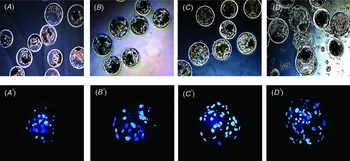
To address the question whether a combination of EGF and GDNF also leads to a beneficial effects on blastocyst quality, the quality of blastocysts cultured in optimal doses of growth factors (i.e. GDNF = 50 ng/ml, EGF 50 ng/ml and EGF = 50 ng/ml + GDNF = 50 ng/ml) was assessed using the following embryo quality criteria: (i) rate of blastocyst hatching; (ii) blastocyst cell number; and (iii) relative expression of six selected gene transcripts by real-time RT-PCR. After 168 h of in vitro culture (IVC), blastocysts cell numbers were determined by Hoechst 33342 staining using a fluorescence microscope as previously described, with few modifications (Yamanaka et al., Reference Yamanaka, Sugimura, Wakai, Kawahara and Sato2009). Briefly, day 7 blastocysts (day 0 = day of insemination) were washed three times in PBS containing 3.7% paraformaldehyde (JT Baker, Denmark) and fixed for 10 min, transferred into DPBS (Sigma-Aldrich, Denmark, cat. no. A7906) containing 10 mg/ml Hoechst 33342 (Sigma B-2261) and incubated in the dark for 5 min. The stained embryos were washed two times in PBS and mounted onto glass slides with fluorescence mounting medium (Dako, Denmark, cat. no. 53023) and covered with a coverslip. The number of nuclei in the resulting blastocysts was finally counted in a fluorescence microscope. Following morphological evaluation, all groups of embryos were processed for RT-PCR. For this purpose, pools of blastocyst (10 blastocysts/tube) were collected into 20 μl of PBS supplemented with 0.1% PVA, snap frozen in liquid nitrogen, and stored at −80°C until analysis.
Supplementation with a combination of epidermal growth factor (EGF) and glial cell line-derived neurotrophic factor (GDNF) during in vitro maturation of cumulus–oocyte cell complexes (COCs) significantly increases hatching, blastocyst rate and blastocyst cell numbers. Representative bright-field images of day 7 porcine blastocysts following in vitro maturation without growth factor (control; A) or with GDNF (B), EGF (C), and a combination of EGF and GDNF (D) supplementation. Porcine blastocyst at day 7 stained with Hoechst 33342 following in vitro maturation without growth factor (control; A′) or with GDNF (B′), EGF (C′), and a combination of EGF and GDNF (D′).

RNA extraction and quantification
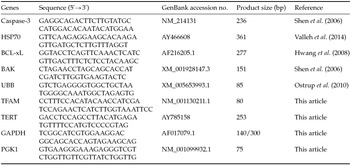
Messenger RNA was isolated from pooled blastocyst using the NucleoSpin® RNA XS Kit (Clontech, Mountain View, CA, USA) according to the manufacturer's instructions. First-strand cDNA synthesis was done using the RevertAid™ First-Strand cDNA Synthesis Kit (Thermo-Scientific) following the manufacturer's protocol. The relative expression of selected genes i.e. BAK, BCL-xL, caspase-3, TERT, TFAM, HSP70 was assessed by real-time PCR performed on a Light Cycler 480 System (Roche Applied Sciences, Indianapolis, IN, USA) using the LightCycler FastStart DNA Master SYBR Green I® kit (Roche Diagnostics). Primer sequences for all target genes except TFAM, TERT, PGK1 and GAPDH were obtained from previously published data in porcine and bovine. TFAM, TERT, PGK1 and GAPDH primers were designed using Premier 6.0 software (Premier Biosoft International, Palo Alto, CA, USA). Moreover, a Basic Local Alignment Search Tool search was conducted to confirm the specificity of the nominated primers (http://www.ncbi.nlm.nih.gov/BLAST).The target and reference primer sequences and their expected product sizes are shown in Table 1. All experiments were replicated three times, and a reaction without template served as negative control. The mRNA expression levels of target genes were normalized to the geomean of three housekeeping genes, glyceraldehyde 3-phosphate dehydrogenase (GAPDH), phosphoglycerate kinase 1 (PGK1) and ubiquitin B (UBB), which were previously identified as optimal reference genes for quantitative PCR studies in porcine preimplantation embryos (Kuijk et al., Reference Kuijk, du Puy, van Tol, Haagsman, Colenbrander and Roelen2007). Relative quantification of gene expression was analyzed based on efficiency-corrected comparative CP method (Pfaffl et al., Reference Pfaffl, Horgan and Dempfle2002), using LightCycler 480 software (release 1.5.0 SP4). To verify qPCR product identity, melting point curves were analyzed following amplification. The PCR product sizes were confirmed by gel electrophoresis on a standard 2% agarose gel stained with ethidium bromide and visualized by exposure to ultraviolet light.
Primer sequences used in real-time PCR of porcine blastocyst

Statistical analysis
The differences in cleavage and blastocyst rates among experimental groups were analysed using analysis of variance (ANOVA) after arcsine transformation to maintain homogeneity of variance. Analysis of differences in embryo cell numbers as well as mRNA expression assayed by qPCR were performed by using ANOVA repeated-measures followed by the Student–Newman–Keuls test, using the JMP Statistical Software Version 7.0 (SAS Institute Inc., Cary, NC, USA). The values are presented as mean ± standard error of the mean (SEM) unless stated otherwise. Each experiment was at least replicated three times. Pearson's pair-wise correlation coefficient was used to determine the degree of correlation between expression patterns of selected genes in resulting blastocyst. A P-value ≤ 0.05 was considered to be statistically significant, unless otherwise stated.
Results
In the current study, we investigated the dose-dependent effects of EGF and GDNF supplementation on oocyte competence using several criteria including, analysis of cleavage pattern, blastocyst rates and quality.
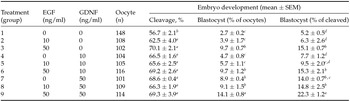
In the first experiment, we found that supplementation of maturation media with EGF and GDNF, both singly and in combination, at concentrations of 50 ng/ml improved cleavage and blastocyst rates as compared with the control group (groups 3, 7 and 9 vs. group 1; P < 0.05) (Table 2). The treatment, numbers of immature oocytes, and cleavage and blastocyst rates are shown in Table 2.
Effect of different doses of EGF and/or GDNF supplementation in serum-free maturation medium on cleavage and blastocyst formation rate*

*Four replicates per treatment.
a , b, c, d Data marked with different superscripts per column are significantly different between treatments (P < 0.05).
EGF, epidermal growth factor; GDNF, glial cell line-derived neurotrophic factor; SEM, standard error of the mean.
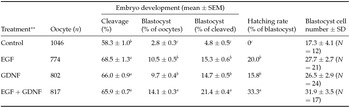
In the second experiment, which is based on the results of the first experiment as well as on previous studies, 3439 matured oocytes from six replicates were in vitro fertilized and cultured to test the effects of the optimal dose of EGF (i.e., 50 ng/ml) and/or GDNF (i.e., 50 ng/ml) on subsequent embryo development and quality. Although, the percentage of cleavage was not significantly different between growth factor-treated groups on day 2, treatments with a combination of growth factors during maturation increased the rates of blastocyst formation, blastocyst hatching as well as the mean of the blastocyst cell numbers compared with controls or either of the EGF or GDNF-treated oocytes alone (Table 3), (P < 0.05).
The effect of in vitro maturation with EGF and/or GDNF on oocyte competency and quality of resulting blastocysts*

* Blastocysts were analyzed on Day 8 post-insemination
**Oocytes were matured in maturation medium without growth factor supplementation as control group or cultured in maturation medium supplemented with optimal dose of EGF (i.e., 50 ng/ml) and/or GDNF (i.e., 50 ng/ml). There were six replicates per treatment.
a , b, c Data marked with different superscripts per column are significantly different between treatments (P < 0.05).
EGF, epidermal growth factor; GDNF, glial cell line-derived neurotrophic factor; SD, standard deviation; SEM, standard error of the mean.
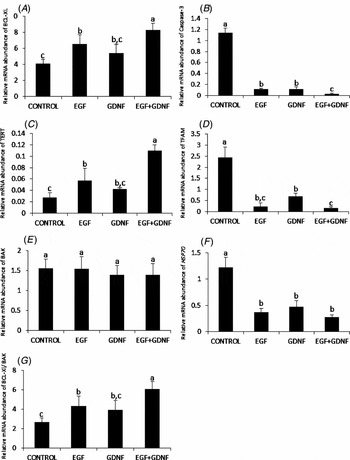
To evaluate whether the effect of GDNF and /or EGF during oocyte maturation affects their subsequent expression levels at the blastocyst stage, messenger RNA levels for TFAM, TERT, caspase-3, BAK and BCL-xL were furthermore determined by RT-qPCR. Transcript levels of BCL-xL and TERT were found to be significantly higher in blastocysts originating from EGF- and GDNF-treated oocytes compared with all of the control and single growth factor treatment groups (P < 0.05; Fig. 2 A, C). In contrast, transcript levels of gene associated with the apoptosis (caspase-3) were significantly lower in blastocysts derived from GDNF- and EGF-treated oocytes compared with all of the controls and those derived from EGF- or GDNF-treated oocytes alone (P < 0.05) (Fig. 2 B). Transcript levels of Mitochondrial Transcription Factor A (TFAM) was also found to be lower in EGF- and GDNF-derived blastocysts than both control and GDNF-derived blastocysts groups (P < 0.05) (Fig. 2 D). There were no significant differences in relative abundance of BAK observed among blastocyst groups (P > 0.05; Fig. 2 E). Expression levels of Hsp70 were found to be higher in blastocysts derived from control groups than in those derived from EGF- and/or GDNF-treated oocytes, although no difference in relative abundance of Hsp-70 transcripts was detected in blastocysts originating from EGF- and/or GDNF-treated oocytes (P < 0.05) (Fig. 2 F). The BCL-xL to BAK ratio, which has been proposed to determine whether a cell undergoes apoptosis, was also found to be significantly higher in blastocysts derived from EGF- and GDNF-treated oocytes compared with all of the control and single growth factor treatment groups; although no differences was observed between blastocysts derived from EGF- or GDNF-treated oocytes (P < 0.05; Fig. 2 G). Furthermore, the correlation analysis results demonstrated that the levels of BCL-xL to BAK ratio transcripts not only positively correlated with the levels of TERT (r = 0.89; P < 0.01) and BCL-xL (r = 0.85; P < 0.01), but also negatively correlated with levels of HSP70 (r = –0.66; P < 0.05), caspase-3 (r = –0.69; P < 0.01) and TFAM expression (r = –0.73; P < 0.01).
Relative abundance of BCL-xL (A), caspase-3 (B), TERT (C), TFAM (D), BAK (E), HSP70 (F) and BCL-xL to BAK ratio (G) mRNA expression in porcine day 7 blastocysts. Values in bars with different letters differ statistically (P < 0.05).

Discussion
Low oocyte developmental competence and poor quality of resulting blastocysts are still unresolved problems related to maturation and insemination of pig oocytes in vitro. However, studies in mammalian species have suggested that growth factors that are produced by the embryo and/or by the reproductive tract may also play a critical role in oocyte developmental competence in vitro (Richter, Reference Richter2008).
In the present study, supplementation of maturation media with GDNF and EGF, especially at a concentration of 50 ng/ml, not only enhanced the cleavage rate but also improved blastocyst rate compared with the control group. These results are in agreement with previous reports in pig, indicating that supplementation of maturation media with GDNF enhances oocyte competence (Linher et al., Reference Linher, Wu and Li2007). Our results are also in line with previously published reports in pig, which have reported stimulating effects of EGF on oocyte competence (Ding & Foxcroft, Reference Ding and Foxcroft1994; Mao et al., Reference Mao, Whitworth, Spate, Walters, Zhao and Prather2012).
Based on our data, we cannot explain the principles of observed synergism between GDNF and EGF on oocyte competency, but it could be attributed to their roles in regulation of different aspects of oocyte maturation. Specifically, GDNF has been shown not only to induce the level of cyclin B1 (CCNB1) protein expression, a proxy for oocyte cytoplasmic maturation (Linher et al., Reference Linher, Wu and Li2007), but also to decrease the meiosis inhibitor WEE1 homolog 2 (WEE1B/WEE2) transcript levels in pig oocytes (Toms et al., Reference Toms, Tsoi, Dobrinsky, Dyck and Li2014). In contrast, the stimulating effects of EGF on oocyte maturation are thought to be mediated through different mechanisms including activation of PI3 kinase and MAPK in cumulus cells (Li et al., Reference Li, Liang, Xiong, Xu, Lin, Hou, Chen, Schatten and Sun2008) as well as increasing the activity of the hexosamine biosynthesis pathway (HBP) rate-limiting enzyme gene in the oocyte (Richani et al., Reference Richani, Sutton-McDowall, Frank, Gilchrist and Thompson2014).
In the present study, there was no difference in cleavage rate between oocytes treated with EGF and/or GDNF. However, the combination of EGF and GDNF caused a significant increase in blastocyst development rate, mean blastocyst cell number and the rate of blastocyst hatchability compared with EGF or GDNF alone. It is becoming clear that coordination of nuclear and cytoplasmic maturation is indispensable not only for oocyte maturation per se, but also for oocyte fertilizability and subsequent embryo development (Eppig, Reference Eppig1996; Demyda & Genero, Reference Demyda and Genero2011). Accordingly, it has been shown that oocytes that are only partially competent to undergo nuclear maturation can undergo fertilization, but are not able to develop further to the blastocyst stage, which is indicative of deficient or defective cytoplasmic maturation (Eppig, Reference Eppig1996). Furthermore, increasing the chances of polyspermic penetration usually results in very early death of the zygote of most taxa, mainly attributed to the poor cytoplasmic maturation of in vitro mature oocytes. Interestingly, similar synergism between these growth factors on the health, development, and differentiation of ovine preantral follicles was also reported by Esmaielzadeh et al. (Reference Esmaielzadeh, Hosseini, Nasiri, Hajian, Chamani, Gourabi, Shahverdi, Vosough and Nasr-Esfahani2013). Furthermore, crosstalk between EGF and GDNF was shown to enhance the survival and proliferation rate of murine retinal progenitor cells (Wang et al., Reference Wang, Yang, Gu and Klassen2010) and mouse spermatogonial stem cells (SSCs) (Kanatsu-Shinohara et al., Reference Kanatsu-Shinohara, Ogonuki, Inoue, Miki, Ogura, Toyokuni and Shinohara2003), respectively.
The exact mechanisms by which EGF and GDNF exert their stimulatory effects on oocyte developmental competence are not yet clear, but both GDNF and EGF have been shown to synergistically stimulate DAZL expression in oocytes derived from antral follicles during IVM, possibly through promotion of Sp1 binding to the DAZL promoter (Liu et al., Reference Liu, Linher and Li2009). DAZL upregulation not only has been shown to play an important role in the translational regulation of key proteins associated with oocyte maturation (Liu et al., Reference Liu, Linher and Li2009), but has also been demonstrated to play a critical role at oocyte-to-zygote transition (Chen et al., Reference Chen, Melton, Suh, Oh, Horner, Xie, Sette, Blelloch and Conti2011). Furthermore, it has previously been shown that human DAZL mRNA expression levels are positively associated with blastocyst quality (Cauffman et al., Reference Cauffman, Van de Velde, Liebaers and Van Steirteghem2005).
In this study, blastocyst gene expression patterns were influenced by the growth factors that were supplemented in the maturation medium. These results are in agreement with animal experiments showing that different components of maturation media could drastically cause persistent alterations of blastocyst gene expression patterns (Boelhauve et al., Reference Boelhauve, Sinowatz, Wolf and Paula-Lopes2005, Warzych et al., Reference Warzych, Wrenzycki, Peippo and Lechniak2007). In the present study, expression levels of Hsp70 were found to be higher in blastocysts derived from control groups than from those derived from EGF- and/or GDNF-treated oocytes, although there was no difference among the three growth factor-treated groups in the level of HSP70 gene transcripts. HSP70 has shown to be expressed at low levels under normal physiological conditions, but its expression increases dramatically in response to cellular stress (Kalmar & Greensmith, Reference Kalmar and Greensmith2009). These results may therefore support previous reports regarding the roles of these growth factors in suppression of cellular stress (Rawson et al., Reference Rawson, Loo, Duimstra, Hedstrom, Schmidt and Barnes1991; Clarkson et al., Reference Clarkson, Zawada and Freed1997; Loo et al., Reference Loo, Bradford, Helmrich and Barnes1998).
One of the major pathways involved in cell programmed death has been shown to be regulated by the Bcl-2 family of proteins that consists of both pro-apoptotic and pro-survival members. The pro-apoptotic BCL2 family member, Bak, has been shown to accelerate the opening of mitochondrial voltage-dependent anion channels, resulting in release of caspase-activating proteins such as cytochrome c and apoptosis-inducing factor (AIF) into the cytosol and initiate apoptosis (Wei et al., Reference Wei, Zong, Cheng, Lindsten, Panoutsakopoulou, Ross, Roth, MacGregor, Thompson and Korsmeyer2001; Green & Kroemer, Reference Green and Kroemer2004). In contrast BCL-xL has been shown to inhibit apoptosis, through either hetero-dimerization with Bak or by inactivating BH3-only proteins (Willis et al., Reference Willis, Chen, Dewson, Wei, Naik, Fletcher, Adams and Huang2005). In the present study, blastocysts derived from in vitro matured oocytes in the presence of both GDNF and EGF expressed higher levels of the anti-apoptotic BCL-xL compared with the other blastocyst groups, whereas expression of the pro-apoptotic gene, Bak, did not show significant differences among blastocyst groups. Moreover, the proportion of BCL-xL and BAK expression was shown to be higher in blastocysts derived from EGF- and GDNF-treated oocytes versus other groups. Similarly; BCL-xL not only was shown to be more abundantly expressed in in vivo compared with in vitro produced embryos (Rho et al., Reference Rho, S, Kim, Son, Cho, Kim, B and Choe2007), but also was shown to be higher in excellent-quality and good-quality blastocysts compared with low-quality ones (Valleh et al., Reference Valleh, Hyttel, Rasmussen and Strøbech2014). Although both BCL-xL and BAK are important in the regulation of apoptosis during early embryonic development of pig (Jeong et al., Reference Jeong, Cui, Kim, Kim, Kim, Chung and Kim2005, Lloyd et al., Reference Lloyd, Romar, Matas, Gutierrez-Adan, Holt and Coy2009) and human embryos (Metcalfe et al., Reference Metcalfe, Hunter, Bloor, Lieberman, Picton, Leese, Kimber and Brison2004), in most cases the ratio of anti-apoptotic BCL-xL to pro-apoptotic BAK within a cell have been shown to govern whether cells live or die (Exley et al., Reference Exley, Tang, McElhinny and Warner1999). The increased ratio of BCL-xL to BAK, suggests that the possible anti-apoptotic mechanisms act through the mitochondrial pathway (Cui & Kim, Reference Cui and Kim2003). This result would also be consistent with the notion that the ratio of BCL-xL to BAK transcript is higher in superior quality embryos (Valleh et al., Reference Valleh, Hyttel, Rasmussen and Strøbech2014).
Although apoptotic signals are vast and vary within different cell types, all apoptotic pathways are believed to converge to the activation of the caspase family of proteases (Exley et al., Reference Exley, Tang, McElhinny and Warner1999). When activated, caspases are able to cleave a wide variety of proteins, including structural components of the cytoskeleton and nucleus, as well as enzymes that regulate cellular functions, such as DNA repair and cell cycle (Thornberry, Reference Thornberry1998; Thornberry & Lazebnik, Reference Thornberry and Lazebnik1998). In our experiments, blastocysts derived from maturation medium supplemented with a combination of EGF and GDNF showed the lowest activity of caspase-3 and were also more likely to undergo hatching. Although caspase-3 has been proposed as a predominant player in the execution of apoptosis, recent studies have provided new evidence that caspase-3 can activate both survival and death-promoting pathways through differential processing of Ras GTPase-activating protein (RasGAP) (Khalil et al., Reference Khalil, Bertrand, Vandenabeele and Widmann2014). It has been suggested that low activation levels of caspase-3 may lead to restricted cleavage of particular substrates, RasGAP, which could promote cell survival. However, higher levels of caspase-3 activation could result in the cleavage of a much wider spectrum of substrates, ultimately leading to the induction of apoptosis (Khalil et al., Reference Khalil, Bertrand, Vandenabeele and Widmann2014). This finding may also support previous reports in the bovine blastocyst, demonstrating that blastocysts with low caspase-3 activity are more likely to undergo hatching than blastocysts with higher caspase-3 activity (Jousan et al., Reference Jousan, de Castro, Brad, Roth and Hansen2008). Importantly, bovine blastocyst survival after transfer was also suggested to be related to caspase activity (Jousan et al., Reference Jousan, de Castro, Brad, Roth and Hansen2008). In addition, the negative correlation between the ratio of BCL-xL/BAK and caspase-3 that was observed in our study may support the notion that caspase activity, at least in part, is regulated by the members of the BCL2 family (Youle & Strasser, Reference Youle and Strasser2008). These results may also be in accordance with a previous report showing that the blastocysts with higher cell numbers, which have better potential to implant and give rise to live offspring, have a lower apoptotic index (Knijn et al., Reference Knijn, Gjorret, Vos, Hendriksen, van der Weijden, Maddox-Hyttel and Dieleman2003).
In this study, the mean of the TERT gene transcript levels was found to be higher in EGF- and GDNF-derived blastocysts than in other groups. The catalytic subunit of telomerase, TERT, has been considered as the rate-limiting determinant of telomerase enzymatic activity (Bodnar et al., Reference Bodnar, Ouellette, Frolkis, Holt, Chiu, Morin, Harley, Shay, Lichtsteiner and Wright1998). Accordingly, ectopic expression of human telomerase reverse transcriptase (hTERT) in bovine embryos was shown to induce telomerase activity and in turn increased telomere length (Iqbal et al., Reference Iqbal, Kues, Baulain, Garrels, Herrmann and Niemann2011, Garrels et al., Reference Garrels, Kues, Herrmann, Holler, Baulain and Niemann2012). Moreover, current evidence indicates that telomerase activity is present from the morula stage and onwards and is associated with an increase in telomere length in blastocysts. More specifically, it has been suggested that telomere length at the morula–blastocyst transition resets to a specific set point (Schaetzlein et al., Reference Schaetzlein, Lucas-Hahn, Lemme, Kues, Dorsch, Manns, Niemann and Rudolph2004). Furthermore, recent studies in human and mice have also shown that telomerase activity and telomere length correlates with the pluripotent status and self-renewal capacities of embryonic stem (ES) cells, respectively (Yang et al., Reference Yang, Przyborski, Cooke, Zhang, Stewart, Anyfantis, Atkinson, Saretzki, Armstrong and Lako2008; Coussens et al., Reference Coussens, Davy, Brown, Foster, Andrews, Nagata and Allsopp2010; Hoffmeyer et al., Reference Hoffmeyer, Raggioli, Rudloff, Anton, Hierholzer, Del Valle, Hein, Vogt and Kemler2012). Positive correlation between blastocyst cell number or BCL-xL transcripts, and TERT transcripts shown in this study may also support previous reports that have demonstrated a role for BCL2 family members in regulation of TERT activity (Park et al., Reference Park, Choi, Cho, Song, Kim, Paik, Kim, Kim and Lee2006) and a role for TERT in regulation of cell proliferation (Yang et al., Reference Yang, Przyborski, Cooke, Zhang, Stewart, Anyfantis, Atkinson, Saretzki, Armstrong and Lako2008).
Another differentially-regulated gene was Mitochondrial Transcription Factor A (TFAM), which was found at lower levels in EGF- and GDNF-derived blastocysts than in both control and GDNF-derived blastocysts groups. TFAM has been shown to play a critical role in the regulation of mitochondrial DNA (mtDNA) replication, transcription, maintenance, packing and eventually repair of mtDNA molecules (Ekstrand et al., Reference Ekstrand, Falkenberg, Rantanen, Park, Gaspari, Hultenby, Rustin, Gustafsson and Larsson2004; Facucho-Oliveira & St John, Reference Facucho-Oliveira and St John2009). Levels of TFAM expression have also been shown to be positively correlated with mtDNA copy number (Ekstrand et al., Reference Ekstrand, Falkenberg, Rantanen, Park, Gaspari, Hultenby, Rustin, Gustafsson and Larsson2004). Accordingly, TFAM knockout mouse embryos have been reported to exhibit severe mtDNA depletion (Larsson et al., Reference Larsson, Wang, Wilhelmsson, Oldfors, Rustin, Lewandoski, Barsh and Clayton1998) together with high levels of apoptosis (Wang et al., Reference Wang, Silva, Gustafsson, Rustin and Larsson2001), suggesting that a dysfunctional mitochondrial respiratory chain can cause apoptosis. Nonetheless, increases in the levels of oxygen consumption and ATP production at the blastocyst stage have been shown to be restricted to the cells differentiating into the trophectoderm lineage. In contrast pluripotent ICM cells are relatively quiescent with persistently low levels of TFAM expression (Facucho-Oliveira & St John, Reference Facucho-Oliveira and St John2009). Remarkably, the combination of GDNF and EGF was shown to be necessary for self-renewal of germ line stem cells (Kanatsu-Shinohara et al., Reference Kanatsu-Shinohara, Lee, Inoue, Ogonuki, Miki, Toyokuni, Ikawa, Nakamura, Ogura and Shinohara2008). Differences in TFAM gene expression detected between blastocyst groups therefore could be a result of the combination effects of these growth factors on embryo epigenetic reprogramming, although this hypothesis was not tested in our study. These findings may also be related to the ‘Quiet Embryo’ hypothesis (Leese, Reference Leese2002) which suggests that metabolically quiet embryos are more viable than their active counterparts.
In conclusion, the results of this study show that supplementation of pig IVM medium with a combination of EGF and GDNF at biologically relevant concentrations enhances oocyte competency and improves blastocyst quality. Moreover, several developmentally important genes are significantly affected by the combined treatment with these growth factors. These findings support the notion that oocyte developmental competence and subsequent embryo quality depends to a great extent on IVM conditions and supplementation of maturation medium with biological doses of these growth factors has distinct effects on blastocyst gene expression and cell numbers.
Acknowledgements
The authors would like to thank Anne Dorte Roed for assistance with in vitro embryo production and Anne Friis for assistance with real-time RT-qPCR experiments.
Declaration of interest
The authors declare that there is no conflict of interest that could be perceived as prejudicing the impartiality of the research reported.
Financial support
This research received no specific grant from any funding agency, commercial or not-for-profit sectors.