Introduction
Patients with schizophrenia are expected to exhibit reduced symptoms after an adequate antipsychotic treatment of 3–6 weeks. However, even during the first episode of psychosis, only 55–60% of patients will show a significant reduction in the severity of psychotic symptoms during the acute phase of the illness (Lieberman et al. Reference Lieberman, Tollefson, Tohen, Green, Gur, Kahn, McEvoy, Perkins, Sharma, Zipursky, Wei and Hamer2003; Crespo-Facorro et al. Reference Crespo-Facorro, Perez-Iglesias, Ramirez-Bonilla, Martinez-Garcia, Llorca and Luis Vazquez-Barquero2006). Current research in antipsychotic treatment response usually focuses on aggregate data that compare entire groups of patients, usually ignoring interindividual heterogeneity in response to treatment. An examination of heterogeneity may have a prognostic and clinical utility, since it may help to identify groups of responders and non-responders, the key periods of response in antipsychotic treatment and differences in the response profile for different antipsychotic treatments (Levine et al. Reference Levine, Rabinowitz, Faries, Lawson and Ascher-Svanum2012). Recent research has challenged the delayed response hypothesis in antipsychotic treatment, showing that a response may occur from the first week of antipsychotic treatment and that early responses predict subsequent responses (Agid et al. Reference Agid, Kapur, Arenovich and Zipursky2003; Leucht et al. Reference Leucht, Busch, Hamann, Kissling and Kane2005). The estimates of rapid response have been observed to range from 1 week (Correll et al. Reference Correll, Malhotra, Kaushik, McMeniman and Kane2003) to 2 months (Emsley et al. Reference Emsley, Rabinowitz and Medori2006), and suggest a great variation in the magnitude and time of response.
Advances in statistical modelling allow examining the existence of different trajectories of symptom severity over time without a priori definitions such as a cut-off in the treatment response (Muthén et al. Reference Muthén, Brown, Masyn, Jo, Khoo, Yang, Wang, Kellam, Carlin and Liao2002; Muthén & Muthén, Reference Muthén and Muthén2007). Accordingly, several studies have focused on the heterogeneity of response to antipsychotics, analysing the pattern of these trajectories over time. Levine & Rabinowitz (Reference Levine and Rabinowitz2010) identified five response trajectories following a latent class analysis approach in a sample of early-onset psychosis patients. They found four parallel trajectories with a modest response and distinguished a trajectory with a dramatic response during the first 4 weeks of treatment. Ensuing studies have replicated these results, with four (Case et al. Reference Case, Stauffer, Ascher-Svanum, Conley, Kapur, Kane, Kollack-Walker, Jacob and Kinon2011; Marques et al. Reference Marques, Arenovich, Agid, Sajeev, Muthéen, Chen, Kinon and Kapur2011) or five (Levine et al. Reference Levine, Rabinowitz, Case and Ascher-Svanum2010; Stauffer et al. Reference Stauffer, Case, Kollack-Walker, Ascher-Svanum, Ball, Kapur and Kinon2011) trajectories as a solution and groups with dramatic, poor or intermediate responses. Levine et al. (Reference Levine, Rabinowitz, Faries, Lawson and Ascher-Svanum2012) reported finding three response trajectories in a post hoc study of the Clinical Antipsychotic Trials of Intervention Effectiveness (CATIE). However, these authors analysed trajectories of treatment response assessed by Positive and Negative Syndrome Scale (PANSS) percentage reduction rather than symptom severity (PANSS scores), which renders a comparison of their results with prior trajectory analyses difficult. Interestingly, only one study focusing on a naturalistic intervention in previously treated patients has reported a similar pattern of five trajectories of response based on total PANSS scores (Schennach et al. Reference Schennach, Meyer, Seemüller, Jäger, Schmauss, Laux, Pfeiffer, Naber, Schmidt, Gaebel, Klosterkötter, Heuser, Maier, Lemke, Rüther, Klingberg, Gastpar, Musil, Möller and Riedel2012). Several predictors have been associated with belonging to particular trajectories including gender, age at illness onset, diagnosis, pre-morbid adjustment, cognitive performance, length of illness, depressive symptoms, social functioning, and early response to treatment, although there are contradictory results. The methodology of trajectory analysis has also been used to identify different courses of schizophrenia in a population using patient cohorts and the number of hospitalized days as a proxy of deterioration course (Levine et al. Reference Levine, Lurie, Kohn and Levav2011).
A number of methodological issues need to be addressed in the research of treatment response trajectories in schizophrenia, since replication and validation of its results may be difficult. More importantly, most studies have focused on trajectories of responses based on the total score of general psychopathological scales, such as the PANSS (Levine & Rabinowitz, Reference Levine and Rabinowitz2010; Levine et al. Reference Levine, Rabinowitz, Case and Ascher-Svanum2010, Reference Levine, Rabinowitz, Faries, Lawson and Ascher-Svanum2012; Case et al. Reference Case, Stauffer, Ascher-Svanum, Conley, Kapur, Kane, Kollack-Walker, Jacob and Kinon2011; Stauffer et al. Reference Stauffer, Case, Kollack-Walker, Ascher-Svanum, Ball, Kapur and Kinon2011) or the Brief Psychiatric Rating Scale (BPRS) (Levine & Leucht, Reference Levine and Leucht2010), but only three research groups have examined trajectories of positive and negative dimensions. Marques et al. (Reference Marques, Arenovich, Agid, Sajeev, Muthéen, Chen, Kinon and Kapur2011) were not able to find an appropriate model for the BPRS negative dimension, whereas Levine & Rabinowitz (Reference Levine and Rabinowitz2010) observed five response trajectories in the total PANSS and its positive and negative subscales but with less improvement in the negative subscale. Case et al. (Reference Case, Stauffer, Ascher-Svanum, Conley, Kapur, Kane, Kollack-Walker, Jacob and Kinon2011) found four trajectories for the PANSS negative subscale that were similar to the trajectories of PANSS total scale, and three trajectories for the PANSS positive subscale that did not include an ‘unsustained response’ trajectory. Discriminating response on the basis of specific symptom dimensions may be a productive research approach to the study of response trajectories, given that there may be different pathological basis (Harvey et al. Reference Harvey, Koren, Reichenberg and Bowie2006) and courses (Levine & Leucht, Reference Levine and Leucht2012) for the positive and negative dimensions that contribute to patients' heterogeneity. Moreover, some patient subsamples have demonstrated high drop-out rates that are associated with different trajectories (Levine & Leucht, Reference Levine and Leucht2010; Levine et al. Reference Levine, Rabinowitz, Faries, Lawson and Ascher-Svanum2012). These drop-out differences may bias the results of studies searching for trajectory predictors and reduce their generalizability. Finally, only a few studies of response trajectories have been performed using first-episode or early-psychosis patients (Levine & Rabinowitz, Reference Levine and Rabinowitz2010, Levine et al. Reference Levine, Rabinowitz, Case and Ascher-Svanum2010). The inclusion of chronic and previously treated patients may increase response heterogeneity and also limit the probability of response. Studies based on representative first-episode samples like the one used in the current study may help to avoid or reduce these biases.
The objectives of the current research were: (1) to identify the number of distinct trajectories that best define antipsychotic response in a representative sample of drug-naive first-episode psychosis patients; (2) to examine whether distinct response trajectory patterns may be identified using different symptom dimensions of schizophrenia; and (3) to search for factors that predict response trajectories. This study is the first to explore the trajectories of the three widely accepted schizophrenia dimensions (positive, negative and disorganized) by using a sophisticated and very comprehensive scale that combines the Scale for the Assessment of Negative Symptoms (SANS; Andreasen, Reference Andreasen1983a ) and the Scale for the Assessment of Positive Symptoms (SAPS; Andreasen, Reference Andreasen1983b ).
Method
Subjects
Detailed descriptions of the sample and primary results on short-term efficacy from this naturalistic randomized clinical trial, which compared effectiveness of treatments with risperidone, olanzapine and haloperidol, have been published elsewhere (Pelayo-Terán et al. Reference Pelayo-Terán, Perez-Iglesias, Ramírez-Bonilla, González-Blanch, Martínez-García, Pardo-García, Rodríguez-Sánchez, Roiz-Santiáñez, Tordesillas-Gutiérrez, Mata, Vázquez-Barquero and Crespo-Facorro2008). Briefly, the patients were recruited from an epidemiological catchment area in northern Spain, where the annual incidence of psychosis has been estimated to be 1.38/10 000 inhabitants. Inclusion criteria were: (1) aged between 15 and 60 years; (2) experiencing a first episode of psychosis; (3) Diagnostic and Statistical Manual of Mental Disorders, fourth edition (DSM-IV) principal diagnosis of schizophrenia, schizophreniform disorder, schizo-affective disorder, brief psychotic disorder or psychosis not otherwise specified; (4) usually living in the catchment area; (5) no prior treatment with antipsychotic medication or, if previously treated, a total lifetime adequate antipsychotic treatment of less than 6 weeks; and (6) having current psychotic symptoms of moderate or greater severity, as assessed by one of the five SAPS items. Patients meeting these criteria and their families provided written informed consent to be included in the study, which conformed to international standards for research ethics and was approved by the local institutional review board.
The diagnoses were confirmed by an expert psychiatrist according to the DSM-IV criteria, using the Structured Clinical Interview for DSM-IV (SCID-I). The diagnosis variable was defined as 1 (schizophrenia) or 0 (other non-affective psychoses).
Both SANS (Andreasen, Reference Andreasen1983a ), SAPS (Andreasen, Reference Andreasen1983b ) and BPRS (Overall & Gorham, Reference Overall and Gorham1962) were used to assess schizophrenia symptom severity. The negative, positive and disorganized dimensions were calculated from the symptom scores provided by these scales, following previous literature (Grube et al. Reference Grube, Bilder and Goldman1998). The positive dimension was calculated as the sum of the global scores of delusions and hallucinations from SAPS (maximum score: 10). The disorganized dimension was calculated as the sum of the global scores of formal thought disorder, and bizarre and inappropriate behaviours from SAPS (maximum score: 15). The negative dimension was calculated as the sum of the global scores of anhedonia/associability, avolition/apathy, affective blunting and alogia in SANS (maximum score: 20). Variables analysed as potential predictive factors were gender, duration of untreated psychosis (DUP), presence or absence of cannabis use (a patient who consumed cannabis at least once per week during the year previous to psychosis onset was considered a cannabis consumer), antipsychotic type, smoking and diagnosis (schizophrenia versus other psychoses). The selection of these variables was based on previous analyses of short- and medium-term responses observed in this trial (Crespo-Facorro et al. Reference Crespo-Facorro, Pelayo-Teran, Perez-Iglesias, Ramirez-Bonilla, Martinez-Garcia, Pardo-Garcia and Vazquez-Barquero2007; Caseiro et al. Reference Caseiro, Perez-Iglesias, Mata, Martinez-Garcia, Pelayo-Teran, Tabares-Seisdedos, Ortiz-Garcia de la Foz, Vazquez-Barquero and Crespo-Facorro2012; Diaz et al. Reference Diaz, Pelayo-Teran, Perez-Iglesias, Mata, Tabares-Seisdedos, Suarez-Pinilla, Vazquez-Barquero and Crespo-Facorro2012). The study included 174 patients. Out of these, a total of 161 provided SAPS-SANS scores at all investigated time points (baseline and at the ends of weeks 1, 2, 3, 4 and 6). Only these 161 patients were used to build a model of trajectories of antipsychotic response.
Statistics
A censored normal model of response trajectories was developed by using the positive dimension of the SAPS-SANS scores (Jones et al. Reference Jones, Nagin and Roeder2001; http://www.andrew.cmu.edu/user/bjones/index.htm). This model allowed identifying the various trajectories of this dimension during the 6-week period. Once these different trajectories were identified, the model allowed estimating the effect of gender, DUP, cannabis use, antipsychotic type, smoking and diagnosis on the probabilities that a patient has the identified trajectories.
The optimal number of group trajectories was identified by using the Bayesian information criterion (Jones et al. Reference Jones, Nagin and Roeder2001). Initially, cubic trajectories were used in all groups. Once the optimal number of groups was identified, non-significant polynomial orders were removed from the model. Then, the effects of gender, DUP, cannabis use, antipsychotic type and diagnosis on the probabilities of belonging to the group trajectories were investigated. A full model was fitted by including all these variables in the model, and then those variables that did not have a significant effect on any of these probabilities were removed from the model. The final model included only those variables that had some significant effects. SAS proc traj was used for computations (Jones et al. Reference Jones, Nagin and Roeder2001). The model uses a generalized logit function to represent the effects of the variables. Thus, the effect (regression coefficient) of a variable on the probability of belonging to a particular trajectory group can be interpreted analogously to the way an effect is interpreted in logistic regression, with the understanding that the particular group is compared with only the reference group.
Analogous models were built for the disorganized and negative dimensions of SAPS-SANS scores. A total of 16 patients who had a disorganized dimension equal to 0 were excluded from the analysis of this dimension for two reasons: (1) the normal model is a continuous model that does not allow a mixture of discrete and continuous distributions; and (2) it makes no sense to investigate the evolution of symptoms when there are no initial symptoms. For similar reasons, 43 subjects who had a negative dimension equal to 0 were excluded from the analysis of this dimension. The censored normal model was also used to identify trajectories of the BPRS total score.
Results
Analysis of trajectories of antipsychotic treatment response: positive dimension
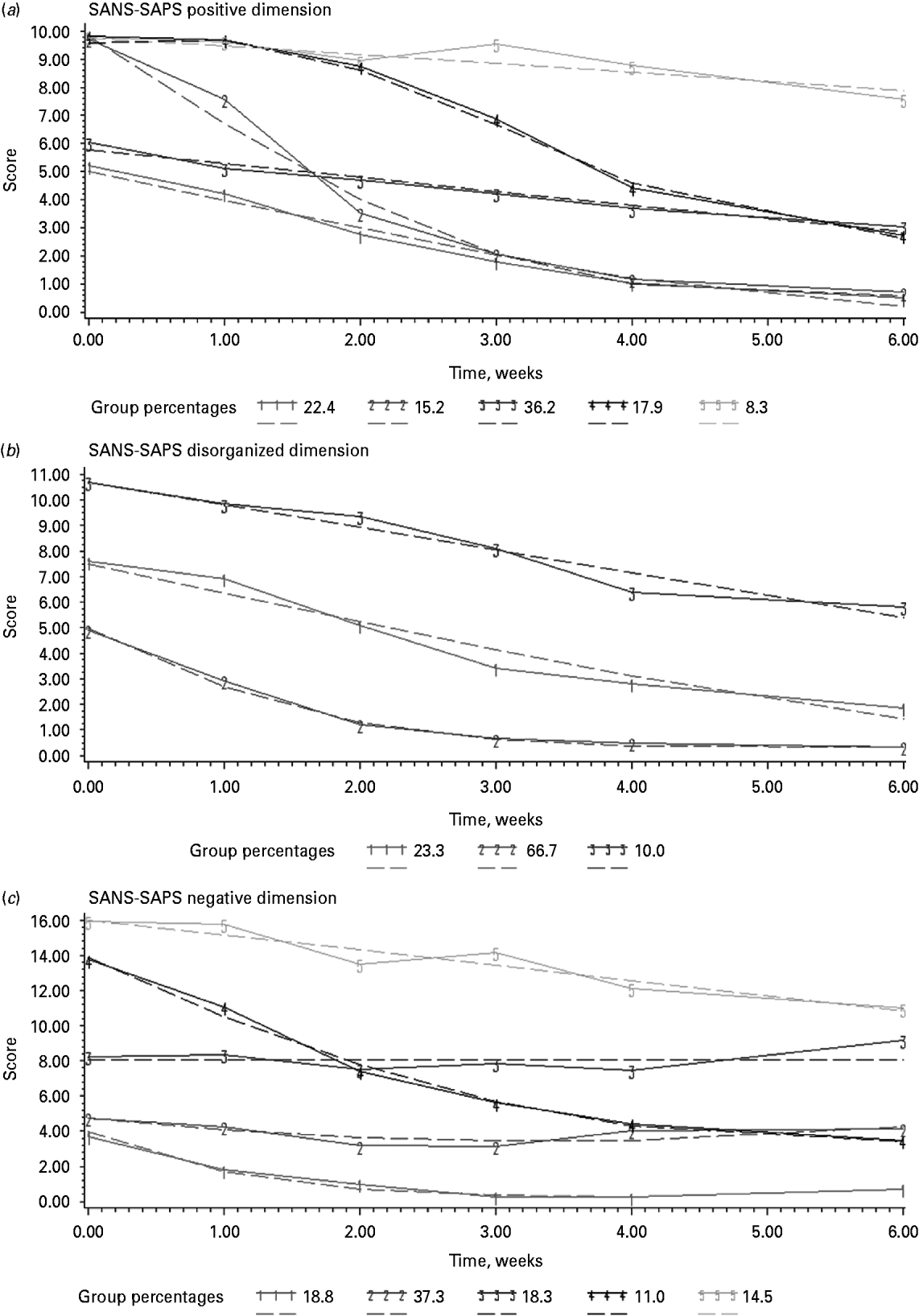
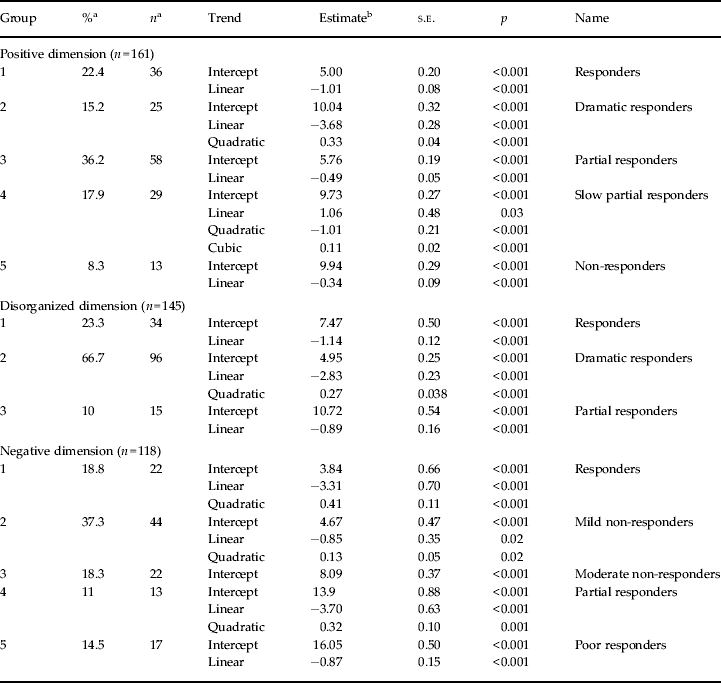
According to the final model, the patients were classified into five types depending on their change in the positive dimension of SAPS-SANS scores over time after antipsychotic treatment (Table 1 and Fig. 1 a). Observe that there is a group of subjects who did not respond or responded very poorly to antipsychotic treatment, according to the positive SAPS-SANS scores (group 5; Fig. 1 a).
Expected (- - -) and observed (––) Scale for the Assessment of Positive Symptoms and Scale for the Assessment of Negative Symptoms (SAPS-SANS) dimension scores versus number of weeks on antipsychotic treatment according to a censored normal model. (a) SAPS-SANS positive dimension: group 1 (responders); group 2 (dramatic responders); group 3 (partial responders); group 4 (slow partial responders); group 5 (non-responders). (b) SAPS-SANS disorganized dimension: group 1 (responders); group 2 (dramatic responders); group 3 (partial responders). (c) SAPS-SANS negative dimension: group 1 (responders); group 2 (mild non-responders); group 3 (moderate non-responders); group 4 (partial responders); group 5 (poor responders).

Identified groups of patients with different 6-week trajectories of response to antipsychotics, according to positive, disorganized and negative dimensions of SAPS-SANS

SAPS-SANS, Scale for the Assessment of Positive Symptoms and Scale for the Assessment of Negative Symptoms; s.e. standard error.
a These columns report the estimated percentage and estimated number (n) of subjects that belong to the group. The number n was inferred from the estimated percentage and N (estimated percentage × N/100).
b For each group of patients, this column shows the coefficients of the polynomial function that describes each dimension of SAPS-SANS scores as a function of time. These functions are plotted in Fig. 1 a–c as dashed lines.
The first group included patients with a mean baseline positive SAPS-SANS score of 5.0, and responded to treatment well, with a mean score close to 0 at the end of the sixth week of treatment (group 1 in Fig. 1 a). We call patients following this trajectory ‘responders’. The second group of patients had a very high mean baseline score, 10.0, but their scores had been dramatically reduced to nearly 0 at the end of the sixth week (group 2); we named patients following this trajectory ‘dramatic responders’. The third group had an initial mean score of 5.8, and a final score of 2.8 (group 3); we called these patients ‘partial responders’. The fourth group of patients had an initially high mean score, 9.7, but their mean score dropped substantially to 2.6 during the first 6 weeks of treatment (group 4). Given that these patients exhibited a high degree of response but the severity of symptoms at the end of the sixth week was similar to that of the partial responders they were called ‘slow partial responders’. The fifth group had the highest positive SAPS-SANS scores and did not appear to respond substantially to antipsychotic treatment during the 6-week follow-up, exhibiting a baseline score of 9.9 and a final score of 7.9 (group 5). Patients on this trajectory were called ‘non-responders’.
Patients in groups with higher label numbers tended to be more difficult to treat or to have a more severe illness than patients in groups with a lower label number. For instance, patients in the non-responders trajectory (group 5) had a very high baseline positive SAPS-SANS score and had a poorer response to antipsychotic treatment than patients in group 3 (partial responders).
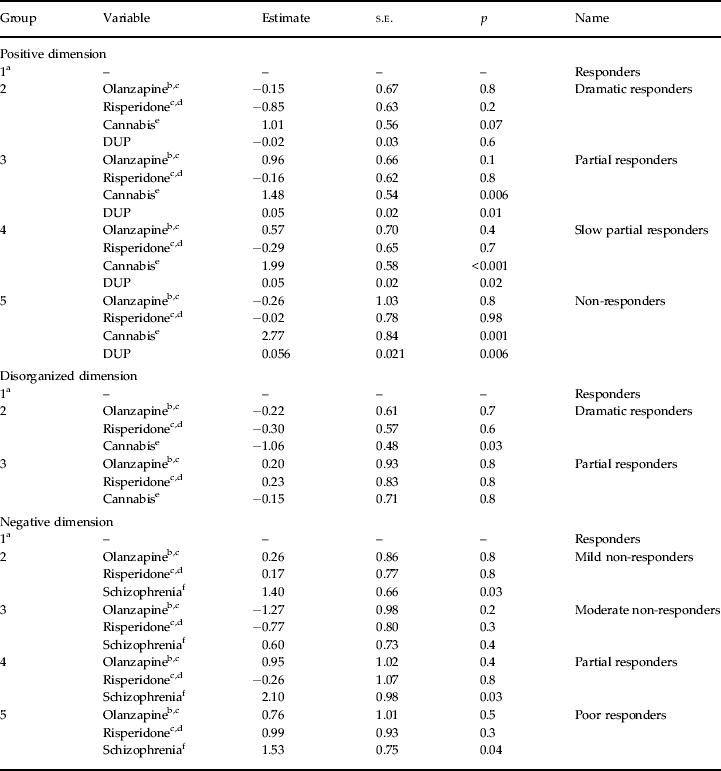
Cannabis use and DUP had significant effects on the probabilities of having particular positive SAPS-SANS response trajectories (Table 2). Antipsychotic type did not have significant effects on the probabilities of belonging to groups 2–5 compared with group 1 (Table 2).
Variables significantly affecting the probabilities that a patient has particular types of response to antipsychotics when the response is measured with SAPS-SANS dimension scores

SAPS-SANS, Scale for the Assessment of Positive Symptoms and Scale for the Assessment of Negative Symptoms; s.e., standard error; DUP, duration of untreated psychosis.
a Group 1 was the reference group.
b The olanzapine variable was defined as 1 if the patient was on olanzapine, 0 otherwise.
c The reference treatment was haloperidol.
d The risperidone variable was defined as 1 if the patient was on risperidone, 0 otherwise.
e The cannabis-use variable was defined as 1 if the patient had smoked cannabis at least once per week during the year previous to psychosis onset, 0 otherwise.
f The schizophrenia variable was defined as 1 if the patient had a diagnosis of schizophrenia, 0 otherwise.
Effect of cannabis use on positive dimension response trajectories
When comparing non-responders with responders, cannabis users had significantly higher odds of being non-responders than non-users (15.9 times higher, p = 0.001, e2.77 = 15.9). When comparing slow partial responders with responders, the odds that a cannabis user was a slow partial responder were significantly higher than the odds for a non-user (7.3 times higher, p < 0.001, e1.99 = 7.32). When comparing partial responders with responders, cannabis users had significantly higher odds of being partial responders than non-users (4.4 times higher, p = 0.006, e1.48 = 4.4; Table 2).
Interestingly, Table 2 shows that there was a gradient in the effect of cannabis use on the severity of (and difficulty in treating) the illness. Parameter estimates show that the effect of cannabis use on the probability of belonging to a particular group increased with illness severity and difficulty in treating the patients in the group (1.01 for group 2 versus group 1, 1.48 for group 3, 1.99 for group 4, and 2.77 for group 5).
Effect of DUP on positive dimension response trajectories
When comparing non-responder patients with responders, higher DUPs were significantly associated with higher odds of being a non-responder (p = 0.006; Table 2). When focusing on these two subpopulations of patients, each additional year of DUP increased significantly the odds of being a non-responder by 5.8% [(e0.056−1) × 100 = 5.8]. Analogous conclusions were obtained when comparing slow partial responders with responders (p = 0.02), and partial responders with responders (p = 0.01).
Gender, smoking and diagnosis did not significantly affect the type of response trajectory after controlling for antipsychotic treatment, cannabis use and DUP, according to the positive dimension of the SAPS-SANS score.
Analysis of trajectories of antipsychotic treatment response: disorganized dimension
A total of three types of trajectories were identified for the disorganized dimension of SAPS-SANS scores. Table 1 and Fig. 1 b show the trajectories and the proportions of patients exhibiting the trajectories. Group 1 in Fig. 1 b included patients with a mean baseline disorganized SAPS-SANS score of 7.5, and responded to treatment well, with a mean score of 0.6 at the end of the sixth week of treatment; we call patients following this trajectory ‘responders’. Group 2 had patients with a mean baseline score of 5.0, and their scores dramatically reduced to nearly 0 at the end of the sixth week; these patients were named ‘dramatic responders’. Group 3 had a high initial mean score of 10.7, and a final score of 5.4 (‘partial responders’). When comparing dramatic responders with responders, cannabis users had significantly lower odds of being dramatic responders than non-users [65.4% lower, p = 0.03, (e−1.06−1) × 100 = −65.4; Table 2]. Antipsychotic treatment, gender, DUP, smoking and diagnosis did not have significant effects on the probabilities of having a particular trajectory after adjusting for cannabis use.
Analysis of trajectories of antipsychotic treatment response: negative dimension
In all, five types of trajectories were identified for the negative dimension of SAPS-SANS score (Table 1 and Fig. 1 c). It can be observed that two trajectories were constant or nearly constant (corresponding to groups 2 and 3). Patients in these two groups were non-responders and could be differentiated regarding the severity of the symptoms exhibited. Group 2 included patients with a mean initial score of 4.7 and a final score of 4.3 in the negative SANS dimension; we called these patients ‘mild non-responders’. Group 3 comprised patients with mean initial and final scores of 8.1, called ‘moderate non-responders’. The other three groups showed some degree of response during the 6-week follow-up. Group 1 included patients with mild symptoms (initial mean score of 3.8) and a reduction to nearly 0 at the end of the follow-up (‘responders’). Group 4 included patients with initially high negative scores (mean, 13.9) and a progressive reduction to a mean score of 3.2 (‘partial responders’). Finally, group 5 included the patients with both the highest negative scores and weakest responses over the investigated period (‘poor responders’). Only diagnosis had significant effects on the probabilities of following particular trajectories of negative symptoms (Table 2). For instance, when comparing poor responders with responders, schizophrenia patients had significantly higher odds of being poor responders than patients without schizophrenia (4.6 times higher, e1.53 = 4.6, p = 0.04). Analogous results were obtained when comparing partial responders with responders (p = 0.03), and mild non-responders with responders (p = 0.03). Interestingly, the probability of belonging to the peculiar group with a constant trajectory (moderate non-responders) was not significantly affected by diagnosis when comparing this group with responders.
Trajectories of BPRS total scores
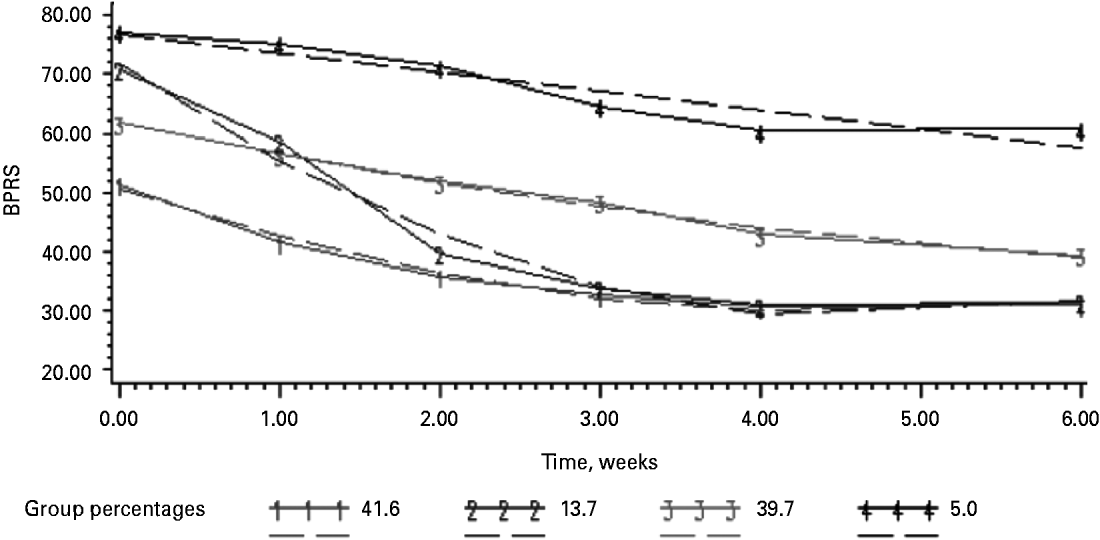
In all, four trajectories for the BPRS total score were found, which were very similar to four of the five trajectories found for the SAPS-SANS positive dimension (Fig. 2). That is, a group analogous to that of the slow partial responders of the SAPS-SANS positive dimension (group 4 in Fig. 1 a) was not observed in the BPRS total score.
Expected (- - -) and observed (—) Brief Psychiatric Rating Scale (BPRS) total scores versus number of weeks on antipsychotic treatment according to a censored normal model. The model shows four types of response trajectories underlying the patient population (total N = 161): group 1 (responders, estimated sample size n = 67); group 2 (dramatic responders, n = 22); group 3 (partial responders, n = 64); group 4 (non-responders, n = 8). For a definition of n, see footnote a of Table 1.

Discussion
Our results show a remarkable interindividual variation in the response to treatment in patients with a first episode of psychosis, which replicates and extends previous research. We found different numbers of trajectories across the three analysed symptomatic dimensions: five trajectories for the positive dimension, three for the disorganized dimension and five for the negative dimension. The dimensions changed differentially over time; their changes had associated predictor factors that are discussed below.
Trajectories of SAPS-SANS positive dimension
Similarly to previous reports that focused on positive symptoms using other scales (Stauffer et al. Reference Stauffer, Case, Kollack-Walker, Ascher-Svanum, Ball, Kapur and Kinon2011; Levine & Leucht, Reference Levine and Leucht2012; Levine et al. Reference Levine, Rabinowitz, Faries, Lawson and Ascher-Svanum2012), we identified five response trajectories. In our study, only 8.3% of the patients were included in a trajectory of non-responders (patients with both a high level of initial psychotic symptoms and a poor level of improvement over the 6-week follow-up). Two groups with marked differences in initial severity (responders and dramatic responders) included patients with a substantial response and the mildest final severity, accounting for 37.6% of the sample. Finally, two more groups (slow partial responders with a high initial severity and partial responders with an intermediate initial severity) showed intermediate responses with mild to moderate severity of positive dimension scores at week 6.
Our results showing five different response trajectories are similar to previous reports describing this same number of trajectories (Stauffer et al. Reference Stauffer, Case, Kollack-Walker, Ascher-Svanum, Ball, Kapur and Kinon2011; Levine & Leucht, Reference Levine and Leucht2012; Levine et al. Reference Levine, Rabinowitz, Faries, Lawson and Ascher-Svanum2012). However, the groups markedly differed in the implications of response course. Previous studies typically found one group of ‘dramatic responders’, characterized by high (Marques et al. Reference Marques, Arenovich, Agid, Sajeev, Muthéen, Chen, Kinon and Kapur2011) or medium (Case et al. Reference Case, Stauffer, Ascher-Svanum, Conley, Kapur, Kane, Kollack-Walker, Jacob and Kinon2011; Levine & Leucht, Reference Levine and Leucht2012; Levine et al. Reference Levine, Rabinowitz, Faries, Lawson and Ascher-Svanum2012) initial symptom severity and a rapid and more complete response over time, accounting for 2.4–22% of the patients. Similarly to our results, the study by Marques et al. (Reference Marques, Arenovich, Agid, Sajeev, Muthéen, Chen, Kinon and Kapur2011), which used the BPRS positive subscale, found two groups of patients who had a rapid and very complete response, and accounted for 32.2% of the sample. Levine & Rabinowitz (Reference Levine and Rabinowitz2010) described a pattern of five trajectories for the PANSS positive subscale, with a group that had a rapid and considerable improvement (17.1% of the patients), and four groups differentiated by the severity of the scores along follow-up. Another study that analysed positive and negative subscales of PANSS found only three different trajectories for the PANSS positive subscale and one of the trajectories was interpreted as a ‘rapid symptom improvement’ (Case et al. Reference Case, Stauffer, Ascher-Svanum, Conley, Kapur, Kane, Kollack-Walker, Jacob and Kinon2011). However, this study used a different statistical methodology.
Differences in conclusions between this and previous studies may also be due to the fact that previous studies used total PANSS or BPRS scores as symptomatology ratings. BPRS and PANSS positive scales included items representing disorganized symptoms, making it difficult to translate results in terms of severity or thresholds and to make comparisons. According to our results, the trajectories of these two dimensions may be quite different and combining symptoms of disorganization with reality distortion may bias the results in trajectory analyses. In contrast with some previous studies, we were not able to find any trajectories that could be identified as ‘unsustained response’ (Case et al. Reference Case, Stauffer, Ascher-Svanum, Conley, Kapur, Kane, Kollack-Walker, Jacob and Kinon2011; Stauffer et al. Reference Stauffer, Case, Kollack-Walker, Ascher-Svanum, Ball, Kapur and Kinon2011) or ‘delayed response’ (Stauffer et al. Reference Stauffer, Case, Kollack-Walker, Ascher-Svanum, Ball, Kapur and Kinon2011). However, the short follow-up of our study may have not allowed identifying these types of trajectory. In this regard, trajectories such as those of partial responders or slow partial responders for positive symptoms could be identified as delayed-response or unsustained-response trajectories in a longer follow-up study. The high response rates in our sample may be due to characteristics of the sample, as first-episode psychosis patients usually have better responses to antipsychotic treatment.
With regard to predictor factors, only longer DUPs and cannabis use were associated with trajectories of worse outcome and we did not find any influence of gender, diagnosis, smoking or antipsychotic class. Our results are not strictly comparable with previous studies of symptom trajectories, as previous research has focused on aggregate data of symptoms instead of symptom dimensions and examined different predictors. However, not having a schizophrenia diagnosis (Levine & Rabinowitz, Reference Levine and Rabinowitz2010), good pre-morbid and cognitive functioning (Levine & Rabinowitz, Reference Levine and Rabinowitz2010; Levine et al. Reference Levine, Rabinowitz, Case and Ascher-Svanum2010) and female gender have been associated with better response trajectories, whereas dropping out of the study has been associated with trajectories of worse response (Levine & Leucht, Reference Levine and Leucht2010; Levine et al. Reference Levine, Rabinowitz, Faries, Lawson and Ascher-Svanum2012). Factors such as age at psychosis onset and initial symptom severity have shown contradictory results in previous studies (Levine & Leucht, Reference Levine and Leucht2010; Levine & Rabinowitz, Reference Levine and Rabinowitz2010; Levine et al. Reference Levine, Rabinowitz, Case and Ascher-Svanum2010; Case et al. Reference Case, Stauffer, Ascher-Svanum, Conley, Kapur, Kane, Kollack-Walker, Jacob and Kinon2011; Stauffer et al. Reference Stauffer, Case, Kollack-Walker, Ascher-Svanum, Ball, Kapur and Kinon2011). Discrepancies in results may also be explained by the use of chronic samples by previous studies. With regard to DUP and cannabis use, only one previous study analysed these factors, but it was unable to find significant associations between these factors and different response trajectories (Levine et al. Reference Levine, Rabinowitz, Case and Ascher-Svanum2010). Our observed association between longer DUPs and worse response trajectories is in agreement with previous research that showed a relationship between longer DUPs and poorer response of positive symptoms (Perkins et al. Reference Perkins, Gu, Boteva and Lieberman2005) and other symptom and outcome dimensions. Similarly, substance-use disorders, particularly cannabis use, have been related to both a poor prognosis in schizophrenia (Kerfoot et al. Reference Kerfoot, Rosenheck, Petrakis, Swartz, Keefe, McEvoy and Stroup2011) and higher rates of psychotic symptoms such as hallucinations and thought disorders (Buhler et al. Reference Buhler, Hambrecht, Loffler, an der Heiden and Hafner2002).
With regard to antipsychotic treatment we were not able to find any differences in the response trajectories of the investigated dimensions across the three investigated antipsychotics (haloperidol, risperidone and olanzapine), but we cannot rule out the possibility that including other antipsychotics may contribute to differences. However, the lack of a differential response is consistent with our previous analysis of effectiveness in our sample, which did not show any differences in the positive or negative symptoms across various antipsychotic treatments, (Crespo-Facorro et al. Reference Crespo-Facorro, Perez-Iglesias, Ramirez-Bonilla, Martinez-Garcia, Llorca and Luis Vazquez-Barquero2006) and with a previous meta-analysis that suggested that the efficacy of atypical antipsychotics is similar to that of haloperidol when controlling for dosage (Geddes et al. Reference Geddes, Freemantle, Harrison and Bebbington2000). Similarly, no differences have been found between the response trajectories of risperidone and amisulpride (Levine & Leucht, Reference Levine and Leucht2010). However, previous studies found that ‘dramatic response’ curves were associated with ziprasidone treatment when compared with quetiapine, risperidone, olanzapine and aripiprazole, whereas aripiprazole was associated with ‘delayed response curves’ (Stauffer et al. Reference Stauffer, Case, Kollack-Walker, Ascher-Svanum, Ball, Kapur and Kinon2011). Additionally, a post hoc study based on CATIE phase 1 showed that patients treated with olanzapine were more likely to belong to the trajectory of responders when compared with patients treated with perphenazine, risperidone, quetiapine and ziprasidone (Levine et al. Reference Levine, Rabinowitz, Faries, Lawson and Ascher-Svanum2012). These results, however, may be mediated, at least in part, by the heterogeneity induced by patients' chronicity, high drop-out rates and follow-up length.
It is remarkable that the results of this study concerning the SAPS-SANS positive dimension are very similar to results obtained by previous studies, despite the fact that a substantially different statistical modelling approach was used. The modelling approach used in our study essentially consists of two steps (Jones et al. Reference Jones, Nagin and Roeder2001). In the first step, the probability distribution of the positive dimension score at the end of a particular week of treatment is assumed to be a mixture of an unknown number of probability distributions. It is also assumed that this unknown number is the same across weeks, and that the means of these distributions are related to the number of weeks under treatment in a way described by a polynomial equation (Table 1). The main goal of the first step is to identify this unknown number, which, in our context, is the number of ‘trajectories’. In the second step, the effect of predictor factors on the ‘risk’ that a particular dimension score comes from a particular probability distribution is modelled in a way analogous to the way a risk is modelled in multinomial logistic regression, assuming that the effect of a particular predictor is the same across weeks. In fact, if only two probability distributions were identified in the first step, the second step essentially fitted the usual logistic regression model that epidemiologists are accustomed to use. A natural consequence of this approach is that odds ratios can be computed and interpreted in the same way as in logistic regression, as we did in the Results section. The overall modelling approach, however, does not require that the ‘risk’ of coming from a particular probability distribution (i.e. the risk that a subject follows a particular trajectory) be computed prior to estimating the effects of the predictors on this risk, because the mixture distribution used in the first step and the multinomial regression model of the second step are mathematically coupled during the estimation of predictor effects.
On the other hand, previous studies have used latent growth curve modelling, which essentially uses covariance structure models that treat the parameters of the equations that describe the trajectories as random variables governed by continuous probability distributions. In contrast, the approach used in our study assumes that these parameters are fixed, non-random quantities and, as described above, assumes a substantially different mathematical structure for the probability of following a particular trajectory and the way predictor variables are related to this probability.
Trajectories of SAPS-SANS disorganized dimension
A total of three trajectories were identified in the response of disorganized dimension, which were almost parallel (Fig. 2). Interestingly, the 66.7% of patients with a dramatic response (group 2) had a moderate initial severity of disorganized symptoms and on average responded rapidly and almost completely, suggesting a better response pattern in disorganized symptoms for these patients. Cannabis use was the only investigated factor that was significantly associated with higher severity and poorer response in disorganized symptoms, in accordance with previous research on substance abuse and schizophrenia (Buhler et al. Reference Buhler, Hambrecht, Loffler, an der Heiden and Hafner2002). To our knowledge this is the first randomized trial that investigated the trajectories of response of disorganized dimension symptoms in schizophrenia, despite the well-established existence of the dimension in schizophrenia along with the negative and positive dimensions (Arndt et al. Reference Arndt, Andreasen, Flaum, Miller and Nopoulos1995). In the studies of Marques et al. (Reference Marques, Arenovich, Agid, Sajeev, Muthéen, Chen, Kinon and Kapur2011), Case et al. (Reference Case, Stauffer, Ascher-Svanum, Conley, Kapur, Kane, Kollack-Walker, Jacob and Kinon2011) and Levine & Rabinowitz (Reference Levine and Rabinowitz2010), in which positive and negative symptoms were analysed independently, disorganized symptoms were combined with reality distortion psychotic symptoms (delusions and hallucinations) by using the positive subscale of BPRS or the PANSS. The aggregation of symptoms that potentially may change differently over time makes it difficult to assess response heterogeneity and may partly explain differences across results from different studies and differences concerning the factors affecting these trajectories.
Trajectories of SAPS-SANS negative dimension
Our study identified five response trajectories for the negative dimension, which exhibited substantially different patterns if compared with the other two symptom dimensions. Mild non-responders and moderate non-responders together accounted for 55.6% of the sample, including patients who exhibited initial mild to medium severity scores but showed minimal variation during the 6-week investigated period, suggesting a persistent severity. The other three groups showed some degree of response. In particular, patients in the responders trajectory had the mildest initial severity and showed the most complete response. Patients in the partial responders trajectory started from a high level of severity, but exhibited a rapid and strong response; however, their response was incomplete at the end of follow-up. Finally, patients in the poor responders trajectory exhibited the highest severity, with a mild response both initially and during follow-up. A recent study (Levine & Leucht, Reference Levine and Leucht2012) found a predominance of early response during the first 2 weeks of treatment compared with the following 4 weeks; however, this study also found a delayed onset response from days 42 to 60, suggesting that a long-term evaluation of negative symptoms is required. This implies that patients of our study other than responders or partial responders may have shown additional changes in their negative symptoms if the follow-up had been extended beyond week 6.
Interestingly, previous studies that tried to identify trajectories of response in negative symptoms were not able to find a model for negative symptoms (Marques et al. Reference Marques, Arenovich, Agid, Sajeev, Muthéen, Chen, Kinon and Kapur2011) or found similar trajectories to those of the total score response (Levine & Rabinowitz, Reference Levine and Rabinowitz2010; Case et al. Reference Case, Stauffer, Ascher-Svanum, Conley, Kapur, Kane, Kollack-Walker, Jacob and Kinon2011). This may be due to the fact that most of the samples were comprised of chronic patients, enrolled at different stages of antipsychotic response. Responses may be influenced by the previous use of antipsychotic medication, increasing the heterogeneity of clinical presentation and response course. Additionally, although the PANSS and BPRS negative subscales measure a similar construct to the SANS negative dimension, their correlation is moderate, which may also explain differences in results (Czobor et al. Reference Czobor, Bitter and Volavka1991; Rabany et al. Reference Rabany, Weiser, Werbeloff and Levkovitz2011).
The only factor associated with some trajectories of negative dimension was diagnosis. Schizophrenia patients had in general higher severity rates and poorer responses in the negative dimension. This result is in agreement with the general notion that negative symptoms are intrinsic to the pathology of schizophrenia and contribute to poor outcome and functioning in schizophrenia. In this respect, previous studies usually reported a higher severity of negative symptoms in patients with schizophrenia compared with other psychoses (Cuesta & Peralta, Reference Cuesta and Peralta1995; Pini et al. Reference Pini, de Queiroz, Dell'Osso, Abelli, Mastrocinque, Saettoni, Catena and Cassano2004; Bobes et al. Reference Bobes, Arango, Garcia-Garcia and Rejas2010). An unexpected negative result is that we did not find an association between DUP and trajectories of the negative dimension.
Trajectories of BPRS total scores
The four trajectories found for the BPRS total scores were very similar to the four trajectories reported by Marques et al. (2010). Analogously to the results in Marques et al. (2010), our patients can be classified into four groups depending on their change in BPRS total scores over time after antipsychotic treatment: responders (group 1 in Fig. 2), dramatic responders (group 2), partial responders (group 3), and non-responders (group 4). In contrast to the results in Marques et al. (2010), a higher percentage of our patients were classified as non-responders and partial responders, and these particular groups of patients exhibited less improvement through follow-up. However, our results may not be strictly comparable with those of Marques et al. (2010), since these authors used the BPRS positive subscale and their sample included chronic patients who may be less responsive to treatment compared with first-episode patients. As previously discussed, differences in the number of trajectories and the degree of response between our study and previous studies may be accounted for at least in part by the inclusion of different symptomatic domains in symptom assessments.
Limitations
The present study has several limitations that should be taken into consideration. First, comparability with previous studies is reduced by the fact that responses were evaluated in different symptom dimensions of the SAPS-SANS scales. Our approach may allow a better understanding of the heterogeneity of response and may represent a much-improved approach compared with previous studies. Second, the follow-up only included short-term responses and response trajectories may be different in the long term. Third, the sample size limits the number of classes identified. Finally, the number of factors analysed was small and did not include some of the factors investigated in previous studies. The sample size, however, limits the number of variables that can be analysed.
Clinical implications
Our results suggest that different patients follow different patterns of response and that the different symptomatic dimensions obey different trajectories over time. In the case of positive symptoms, such as reality distortion, a substantial reduction of symptoms would be expected in a great majority of patients. Even a third of the patients may remit during a short trial of 6 weeks' treatment. However, given that patients start from very different baseline severity scores and that the response change is quite heterogeneous among groups, response rates at the initial 2 weeks of treatment may not be good predictors of the response at later weeks; for instance, responder patients (group 1) could be considered subjects with a low rate of response at week 1 but remitters at week 6. These trajectories may be modulated at least in part by modifiable factors such as cannabis use and longer DUPs and, therefore, our results may have preventive and therapeutic implications in clinical settings. In the disorganized dimension, our results suggest that most patients would be responsive but those subjects with more severe symptoms have a lower probability of achieving a complete response; this severity may also be related to the use of cannabis. With regard to negative symptoms, the heterogeneity of responses seems to be considerably higher and the rate of response appears to be lower in the short term; however, a number of patients still appear to be responsive. Only factors related to the illness seem to be related to the response to antipsychotic treatment when negative symptoms are considered. Given the nature of these symptoms and the mechanisms involved in their modification, a short-term pharmacological treatment may not be sufficient to observe a complete effect on negative symptoms.
Conclusions
The current naturalistic clinical trial investigated a representative sample of patients with a first episode of psychosis, and focused on the analysis of the changes of three symptom dimensions in response to antipsychotic treatment over the course of 6 weeks. Our results illustrate different patterns of short-term changes and trajectories in the psychotic reality distortion, disorganization and negative dimensions. Whereas our results on the trajectories of the positive dimension are comparable with results from previous studies that found a five-trajectory model, the disorganized and particularly the negative dimensions showed marked differences from previous reports, probably caused by differences in study designs and investigated populations. A number of predictor factors affected response heterogeneity: longer DUPs were associated with poorer-outcome trajectories in the positive dimension, cannabis use was related to trajectories of worse outcome in the positive and disorganized dimensions, and negative-dimension trajectories with high overall symptom severity were associated with a diagnosis of schizophrenia.
Acknowledgements
The authors thank: the Psychiatric Research Unit of Cantabria and the Clinical Programme on Early Phases of Psychosis (PAFIP) researchers who helped with data collection and patient care during the study; the study participants and their families for enrolling in this study; and Lorraine Maw, M.A., and Margaret T. Susce, R.N., M.L.T., for editorial assistance.
No pharmaceutical company or commercial organization had any role in the writing of this paper for publication. The original study, including collection, management, analysis and interpretation of the data, was supported by internal funding from the University Hospital Marqués de Valdecilla, IFIMAV, Department of Psychiatry, School of Medicine, University of Cantabria, Santander, Spain; and by general support provided to this department from the Spanish government [CIBERSAM (Centro Investigación Biomédica en Red Salud Mental), Madrid, Spain]. The current analysis and interpretation of the data, and preparation and review of the current manuscript were done without external support.
Declaration of Interest
During the past 3 years, J.M.P.-T. has received support to attend scientific conferences from Bristol-Myers Squibb and Johnson & Johnson and has received honoraria for his participation as a speaker at educational events from Bristol-Myers Squibb and Johnson & Johnson; R.P.-I. has received support to attend scientific conferences from Lilly; R.T.-S. has received grants from or acted as a consultant for AstraZeneca, Janssen, Eli-Lilly, Lundbeck, Novartis, Pfizer, Sanofi-Aventis and Wyeth, which provided money deposited into research accounts of the University of Valencia; J.deL. took part in an National Institutes of Health grant in collaboration with Genomas; B.C.-F. has received unrestricted research funding from AstraZeneca, Pfizer, Bristol-Myers Squibb and Johnson & Johnson, which deposited money into the research accounts of the University of Cantabria, Spain, and has received honoraria for his participation as a speaker at educational events from Pfizer, Bristol-Myers Squibb and Johnson & Johnson, and consultant fees from Pfizer.